Dead of Night (1945)

DEAD OF NIGHT (1945) ****
Back in 2005, I needed three credits to complete a master’s degree in history (lifetime underachievement) and I finished a three-week 120-hour internship that summer at the National Archives in Kansas City, Missouri.

Anyway, they let me loose on their free account on some genealogical site as reward for good behavior and a day-and-a-half later I came back with Sisney family history dating back to 1776.

On February 27, 1776, a few months before the Declaration of Independence, Steven Sisney fought at and was captured and imprisoned during the Battle of Moores Creek Bridge near Wilmington, North Carolina. Sisney was one of about 1600 loyalist-siding Highland Scots who marched from Cross Creek, North Carolina, toward the coast behind British Colonel Donald McLeod. The loyalists lost, the patriots received a morale boost, and North Carolina became the first colony to vote for independence, beating the official declaration by a couple months easy.

Every once in a while, I think about Steven Sisney and his loyalty to the British since I favor the Beatles and the Stones and the Who and the Kinks and Black Sabbath and Led Zeppelin and the Clash and the Sex Pistols and the Buzzcocks and Radiohead and Pink Floyd and Peter Cushing and Christopher Lee and Sherlock Holmes and James Bond and Alec Guinness and Cary Grant and Ben Kingsley and Ian McKellen and Glenda Jackson and Hammer and Hitchcock and Monty Python and Lord of the Rings and Harry Potter and on and so on and on some more again.

If nothing else, the 1945 horror anthology film Dead of Night made me think about Steven Sisney, the epic 1989 David Hackett Fischer history book Albion’s Seed: Four British Folkways in America (never forget the saga of the poor one-eyed servant George Spencer in New Haven, who was hanged for bestiality after a sow birthed a deformed pig with one eye and the two witnesses required for conviction were the deformed piglet and Spencer’s recanted confession), the late Pittsburg State history professor Judith Shaw (1931-2013) who taught many British History courses over the decades, and how much of an impact Dead of Night had on Richard Attenborough’s Magic.

Horror anthologies generally offer a mixed bag of success and failure.

Of course, Ray Davies outlined it in Celluloid Heroes, Success walks hand-in-hand with failure along Hollywood Boulevard. I always think about Twilight Zone: The Movie from 1983 to illustrate the mixed bag qualities of just about every anthology we’ve ever been expected to consume. The segments directed by John Landis and Steven Spielberg suck, the ones from Joe Dante and George Miller are dynamite, and the prologue and epilogue push the overall package into positive review terrain.

In Dead of Night, Alberto Cavalcanti directed Christmas Party and The Ventriloquist’s Dummy, Charles Crichton directed Golfing Story, Robert Hamer directed The Haunted Mirror, and Basil Dearden directed Hearse Driver and Linking Narrative.

It all starts when architect Walter Craig (Mervyn Johns) tells host and potential client Eliot Foley (Roland Culver) and his guests at country estate Pilgrim’s Farm that he’s seen them all in a recurring dream. Craig feels like he’s been at Pilgrim’s Farm before and every guest rings a bell to him despite never having met any of them before. Each person (host and guests alike) rattles off a supernatural tale, inspired by Craig’s revelations. Craig wants to leave because he doesn’t want his dream to come true and the guests do their best to make him stay.

The Haunted Mirror and The Ventriloquist’s Dummy are especially brilliant and Golfing Story reminds one that Ealing Studios later brought us Kind Hearts and Coronets, The Lavender Hill Mob, and The Ladykillers, all of which feature a dark comedy that seems to have started with Hitchcock. Hamer directed Kind Hearts and Coronets and Crichton directed The Lavender Hill Mob (and later on in his career A Fish Called Wanda).

Basil Radford (1897-1952) and Naunton Wayne (1901-70) appear together in Dead of Night, but not as their characters Charters and Caldicott. Charters and Caldicott began in Hitchcock’s 1938 classic The Lady Vanishes and then the acting duo appeared together in a series of films from 1940 through 1949, including three more times playing Charters and Caldicott. They are very funny, both individually and collectively, in Dead of Night. They don’t seem particularly gay in Dead of Night.

During The Haunted Mirror, guest Joan Cortland (Googie Withers) relays to us what happened after she gifted an antique mirror to her future husband Peter (Ralph Michael). Peter sees another room in the mirror’s reflection, does not see Joan in the mirror when she confronts him, and for a spell he sees the room as normal. Joan finds out the history of the mirror and the wealthy man who owned it after she visits the antique shop from which she purchased the mirror. This wealthy man was crippled in a riding accident, then he grew so insanely jealous of his wife that he strangled her and he finally slit his own throat in front of the mirror. When Joan returns home, Peter accuses her of having an affair and then he attempts to strangle her. Joan smashes the mirror in sheer desperation and breaks the spell.

In The Ventriloquist’s Dummy, the absolute most effective segment, resident rational explanation seeker Dr. Van Straaten (Frederick Valk) tells us about the case of ventriloquist Maxwell Frere (Michael Redgrave) and his dummy Hugo Fitch. Maxwell develops a dual personality with Hugo becoming the dominant part. Poor, poor, poor Sylvester Kee (Hartley Power), who happens to catch and be impressed by the act.

In the long run, I was much impressed by Dead of Night and I recommend it to anyone.
Dracula (1931)

DRACULA (1931) ****
I remember being first disappointed by the 1931 Dracula and that disappointment carried over for more than two decades.

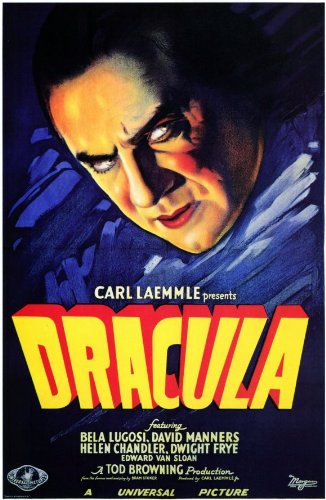
Around the turn of the 21st Century, I bought the 1999 VHS release and that’s what I first watched, the one with Classic Monster Collection across the top and then New Music by Philip Glass and Performed by Kronos Quartet immediately below. Of course, I thought Bela Lugosi as Dracula and Dwight Frye as Renfield were absolutely incredible, David Manners as Jonathan Harker and Edward Van Sloan as Professor Van Helsing and Helen Chandler as Mina Harker less so, and I loved director Tod Browning’s 1932 Freaks at first sight contemporaneous with Dracula. Freaks remains one of my absolute favorite movies, so obviously some movies hit people right from the start and others just simply take more time or sometimes they never make that deep, personal connection others do.

For the longest time, at least a decade if not longer, I thought Dracula was overrated and paled in comparison against Freaks, Frankenstein, The Bride of Frankenstein, and The Wolf Man, all of which I first saw around the same time as Dracula and I loved, absolutely loved, and still do love all of them. At the time, I also loved Abbott and Costello Meet Frankenstein more than Dracula.

It was that darn Philip Glass / Kronos Quartet score that stank up Dracula and I still get a big kick out of the Triumph the Insult Comic Dog couplet, Philip Glass, atonal ass, you’re not immune / Write a song with a fucking tune. I remember my wife complained about Glass’ score for the experimental non-narrative film Koyaanisqatsi and I bristled at his score for Candyman upon revisiting that 1992 film for the first time in several years.

Revisiting the 1931 Dracula in recent years, without the Glass / Kronos score and back closer to how it first appeared in theaters on Feb. 14, 1931, it’s risen in stock from three to three-and-a-half and finally four stars. I cannot deny that it still has a fair share of faults, like those performances I mentioned earlier and the stage-bound production quality since it’s based off the 1924 stage play adapted from Bram Stoker’s 1897 novel, but I’ve grown appreciation for everything that works from the opening scenes in Transylvania to Lugosi (1882-1956) and Frye (1899-1943), who inspired later songs from Bauhaus (Bela Lugosi’s Dead) and Alice Cooper (The Ballad of Dwight Fry).

It also helps one to catch up with the Spanish language Dracula from the same year and the same sets but a different cast, a different language, and a different director. This Spanish version, rediscovered first in 1978 and then later on video in 1992, lasts 30 minutes longer and it’s better in almost every respect than its famous counterpart. Better shot and better looking, vastly superior cleavage and far sexier women (Lupita Tovar over Helen Chandler any day of the millennium), and less wimpy men in the Spanish version, but Lugosi still prevails against Carlos Villarias.

Several lines had already entered the lexicon decades before I first watched Dracula: I never drink … wine. For one who has not lived even a single lifetime, you’re a wise man, Van Helsing. Listen to them. Children of the night. What music they make. Even I am Dracula belongs somewhere in the pantheon near Bond, James Bond. Lugosi’s ability or lack thereof speaking the English language actually benefits the otherworldly nature of his Dracula and I hold his performance in high regard alongside Max Schreck in Nosferatu, Christopher Lee in Dracula, and Gary Oldman in Dracula.

I have a long relationship with vampires.

I remember the 1985 Fright Night being the highlight of a boy slumber party circa 1988 and third or fourth grade.

I must have been 11 or 12 years old and in the fifth or sixth grade when reading the Stoker novel. Right around that point in time, I also read Sir Arthur Conan Doyle’s The Hound of the Baskervilles and Roald Dahl’s Charlie and the Chocolate Factory. I loved all three of them and they each fired up my imagination and creative spirit.

A few years later, I caught up with the Francis Ford Coppola version and talk about a movie that wowed a 14-year-old boy. I remember staying up late and sneaking around (somewhat) to watch this Dracula on my bedroom TV, captivated by all the nudity and sexuality and violence and Winona Ryder and Sadie Frost and it recalled some of what I liked about the novel all while becoming a cinematic extravaganza. I know critics of the 1992 Dracula blasted the film for being all style, no substance and for being overblown, but I think it’s overflowing with creativity and sheer cinematic beauty. I rate it right up there with F.W. Murnau’s Nosferatu as one of the best vampire films ever.

Some things simply transcend Keanu Reeves’ horrible accent and Dracula’s at one point beehive hairdo.

The vampire genre itself transcends such duds as Dracula 2000 and New Moon.

Friday the 13th: The Final Chapter (1984)

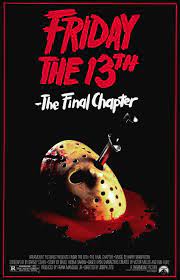
FRIDAY THE 13TH: THE FINAL CHAPTER (1984) ***
Once upon a time, I called Friday the 13th: The Final Chapter the most schizophrenic movie ever made and what I mean by this bit of hyperbole is that The Final Chapter largely alternates being a rather brutal, occasionally mean-spirited horror movie sequel and a jovial teenage sex comedy especially made explicit in casting Lawrence The Last American Virgin Monoson in one of the key supporting roles.

The Final Chapter has some of the best and also some of the worst moments in the entire 12-movie Friday series, easily the best cast and most likable characters from (almost) top to bottom, Tom Savini’s return as makeup artist, Harry Manfredini’s first-rate musical score, Ted White’s brutal conviction selling his kill scenes as Jason Voorhees, and it’s arguably the quintessential Friday the 13th movie.

Let’s hit a couple of the high points first.

The Final Chapter introduces us to Tommy Jarvis (Corey Feldman), a 12-year-old boy with a hyperactive imagination and penchant for monster make-up and masks not unlike Savini; Trish Jarvis (Kimberly Beck), Tommy’s older sister and our Final Girl; Mrs. Jarvis (Joan Freeman), Tommy’s and Trish’s single mother; Gordon the Family Dog, the golden retriever whose fate remains uncertain. Anyway, this family dynamic is something fresh and new for the Friday series.

Crispin Glover, one of the great movie eccentrics, makes his mark on The Final Chapter and his Jimmy becomes one of the most unforgettable horny (dead) teenagers in a series that served them up by the hundreds as fodder for the slaughter. Jimmy and his buddy Ted (Monoson) especially feel like refugees from a teenage sex comedy, like they continued playing their characters from My Tutor (Glover) and The Last American Virgin (Monoson). Jimmy’s dance and exit line in this movie have become the stuff of slasher movie legend.

Feldman and Glover provide us two of the most likable characters in any of the dozen Friday movies, something that’s ironic given the fact The New Beginning (which arrived in theaters around 11 months after The Final Chapter) has almost no likable characters among the largest cast of corpses in series history. Never mind that Tommy did not exactly pan out in The New Beginning and Jason Lives like the endings of The Final Chapter and The New Beginning seemed to promise.

I almost forgot Rob (E. Erich Anderson), the older brother of a character killed by potato sack Jason in Part 2. Rob seeks revenge against Jason and fortunately he meets Trish and Tommy first, though ultimately it does not matter because Rob represents one of the great missed opportunities. Here’s a character who could have served as a basis for an entire movie and The Final Chapter makes him completely underwhelming. His death scene, designed to be poignant, instead becomes laughable (‘He’s killing me. He’s killing me’) and it wishes it could be as enjoyably bad as the bookseller’s death in Dario Argento’s Inferno. You might recall that the creepy old book retailer’s done in by rats and a homicidal Central Park hot dog vendor.

Now, we’ve moved on to the more negative.

Our first two new corpses in The Final Chapter represent one of my least favorite scenarios that’s commonly found in Friday movies. We spend several minutes, it feels even longer, much much much longer, with super horny morgue attendant Axel (Bruce Mahler) and super uninterested Nurse Morgan (Lisa Freeman) before they are massacred by Jason. Maybe it’s only a few minutes, but I never want to watch their scenes ever again to find out. I’ll use their introduction as my cue to go make some scrumptious butter popcorn.

Like the beginning of Part III and the obligatory murder of the lakefront store owners, these are minutes of my life that could have been attended to better things, even during a Friday movie.

The Final Chapter loves breaking glass and characters falling through windows.

The Final Chapter gets straight at the heart of the ambivalent relationship between parent company Paramount Pictures and the Friday movies.

One immediately gets the feeling that Paramount wanted The Final Chapter, you know, to be the end of Jason once and forever because the studio hotshots were ashamed to be associated with such a disreputable and sleazy franchise, but, alas, at the same time, The Final Chapter leaves the door open for more sequels with one of the series’ trademark endings. Paramount walked through that very door — actually, more like sprinted — when The Final Chapter returned a hefty profit.

The Final Chapter finished in the top 25 box office for 1984 and put together a $11.1M opening during the weekend of April 13.

Friday, April 13, 1984. The Challenger returned to Earth from their 11th space shuttle mission. India beat Pakistan by 54 runs to win the first Asia Cricket Cup in Sharjah, United Arab Emirates.

Paramount released A New Beginning on March 22, 1985, and 1983 and 1987 are the only years of the ’80s without a Friday the 13th movie. Do 1983 and 1987 belong to another decade?

I more or less grew up with the Friday movies, so I might be more forgiving of them for all their numerous faults than people who grew up in different times.

Then again, I might not be, because I only consider Jason Lives (the best made and the only entry that deserves a place near second- or third-tier classic horror movies like Frankenstein Meets the Wolf Man), Part III (the most suspenseful and the one where Jason acquires his legendary hockey mask), and The Final Chapter even worth recommending. Most of the rest of them have their isolated moments, all of them are excuses for reels of sex and violence and vulgarity, and the movies definitely created their own distinctive space in the cinematic marketplace.

How did the world end up with 12 Friday the 13th movies and legendary status for both the series overall and serial killer Jason Voorhees specifically, when similar movies like My Bloody Valentine, The Burning, Happy Birthday to Me, and Madman failed to produce one sequel among them. Granted, the original Friday finished 15th in the 1980 American box office sweepstakes and the first three sequels also proved to be solid hits among strong competition, while The Burning grossed $700 thousand, Madman $1.3M, My Bloody Valentine $5.7M, and Happy Birthday to Me $10.6M.

Money obviously talked for Jason.

Frankenstein Meets the Wolf Man (1943)

FRANKENSTEIN MEETS THE WOLF MAN (1943) ***1/2
Frankenstein Meets the Wolf Man starts with an absolute big bang and we have possibly the greatest five minutes in any classic Universal monster movie.

That includes such immortal movies as Frankenstein, The Bride of Frankenstein, Son of Frankenstein, Dracula, The Mummy, The Invisible Man, and The Creature from the Black Lagoon, all stone cold classics essential to every horror movie lover.

The opening gets everything absolutely right: two grave robbers, a cemetery in the middle of the night, Larry The Wolf Man Talbot’s crypt, a full moon, a whole bunch of wolfbane, the revived Wolf Man’s hand, and enough overall spooky atmosphere for approximately 50 scary movie scenes. Yeah, it’s such a phenomenal sequence that director Tom McLoughlin revived it for his opening in Jason Lives, the one film during that long-running series most influenced by classic monster movies.

The rest of Frankenstein Meets the Wolf Man does not quite measure up, especially once Frankenstein’s Monster enters the picture, but it’s still a great deal of fun.

Of course, it doesn’t hurt any that Lon Chaney Jr. (1906-73) returns as Larry Talbot, one of the greatest horror movie characters. Chaney Jr. played Talbot five times from 1941 through 1948 — the original Wolf Man, Frankenstein Meets the Wolf Man, House of Frankenstein, House of Dracula, and Abbott and Costello Meet Frankenstein.

Talbot’s a tortured soul — in fact, mondoshop.com hypes its Wolf Man poster, The most tortured soul in the Universal Monsters universe is unquestionably that suffering bastard Larry Talbot, a.k.a. The Wolf Man — and we feel great empathy for this character because he essentially doesn’t want any damn part of being the Wolf Man. Your own son Bela was a werewolf. He attacked me. He changed me into a werewolf. He’s the one that put this curse on me. You watched over him until he was permitted to die. Well, now I want to die to. Won’t you show me the way?

In that way, he’s different from Dracula, Frankenstein’s Monster, the Mummy, and the Invisible Man. Lon Chaney’s Phantom in the 1925 classic The Phantom of the Opera inspires similar feelings as Talbot and the Wolf Man. To his enduring credit, Boris Karloff (1887-1969) worked some pathos into Frankenstein’s Monster, especially in Frankenstein and The Bride of Frankenstein. Still, Talbot stands apart from most cinematic monsters and maybe it’s because he’s the most explicitly human.

Bela Lugosi (1882-1956) passed on Frankenstein’s Monster in Frankenstein, much to his eternal regret, and so he signed on for the Monster in Frankenstein Meets the Wolf Man after playing Ygor in Son of Frankenstein and The Ghost of Frankenstein. During the latter film, one might remember that Dr. Ludwig Frankenstein accidentally put Ygor’s brain into the Monster’s head — he speaks poetically at one point in the film, I am Ygor. In a series that paid minuscule attention to continuity from one film to the next, the Monster originally spoke and explained his plight in Frankenstein Meets the Wolf Man, but Universal studio heads apparently laughed their heads off at Lugosi’s dialogue and demanded it be excised from the final cut, rendering the monster absolutely ridiculous and his scenes basically a washout. I am not sure why Lugosi’s voice suddenly became laughable. Lugosi’s stunt double stands in for the 61-year-old man in many scenes. Ironically, though, whenever people imitate Frankenstein’s Monster, it’s the Lugosi version from Frankenstein Meets the Wolf Man. (Lugosi played Bela in The Wolf Man and Chaney Jr. was Frankenstein’s Monster in The Ghost of Frankenstein after Karloff bowed out.)

We’re not sure exactly why the Monster’s encased in ice or why there’s a production number that must have moseyed on over from MGM. The second half of Frankenstein Meets the Wolf Man often leaves us feeling awful perplexed.

Frankenstein Meets the Wolf Man finishes strong, thankfully, and we do see our titular monsters slug it out, though it presents an internal struggle because while we’d love more battle royale between the monsters we do love the 90 seconds they give us. This movie paved the highway for King Kong vs. Godzilla and Freddy vs. Jason.

In most every way possible, Frankenstein Meets the Wolf Man proves to be a red hot mess, but a lovable and thoroughly entertaining one nonetheless.

The Texas Chainsaw Massacre 2

THE TEXAS CHAINSAW MASSACRE 2 (1986) ***
I wanted to like The Texas Chainsaw Massacre 2 considerably more than I did, because of the way director Tobe Hooper (1943-2017) and screenwriter Kit Carson (1941-2014) mixed in satire and dark comedy with all the material that seems like a prerequisite for a sequel to only one of the most infamous movies ever made, 1974’s The Texas Chain Saw Massacre.

Unfortunately, though, leading lady Caroline Williams’ harried disc jockey Stretch — yes, even women from Texas have names that play right alongside Slim and Tex — spends a good 75 percent of her screen time screaming. Williams screams more than Fay Wray in The Most Dangerous Game and King Kong and Mystery of the Wax Museum combined, more than Jamie Lee Curtis in Halloween and The Fog and Prom Night and Terror Train and Halloween II combined, and more than all the heroines combined who have faced Jason and Freddy and Michael over the last couple decades. Williams probably wishes they paid her by the scream.

All that infernal screaming begins to bog Massacre 2 down in the middle stretches of a film that both starts and finishes rather strongly.

Massacre 2 also features a Dennis Hopper performance that rates a distant fourth behind River’s Edge, Blue Velvet, and Hoosiers in the unofficial Hopper-portrays-an-epic-burnout-not-totally-unlike-himself (though, to be fair to Hopper, his Blue Velvet character goes beyond, way beyond, the pale of the normal cinematic psychopath) in 1986 competition.

Since Hopper (1936-2010) portrays former Texas Ranger and Sally and Franklin Hardesty-Enright’s uncle Lt. Boude ‘Lefty’ Enright and Cannon Films released Massacre 2, wouldn’t it have been absolutely fantastic if Cannon action hero Chuck Norris played the ranger pursuing vigilante justice against the ripped, twisted, absolutely positively deranged (not to mention cannibalistic) Sawyer family.

Both Chainsaw movies start with narration and an opening crawl.

The original: The film which you are about to see is an account of the tragedy which befell a group of five youths, in particular Sally Hardesty and her invalid brother, Franklin. It is all the more tragic in that they were young. But, had they lived very, very long lives, they could not have expected nor would they have wished to see as much of the mad and macabre as they were to see that day. For them an idyllic summer afternoon drive became a nightmare. The events of that day were to lead to the discovery of one of the most bizarre crimes in the annals of American history, The Texas Chain Saw Massacre.

The sequel: On the afternoon of August 18, 1973, five young people in a Volkswagen van ran out of gas on a farm road in South Texas. Four of them were never seen again. The next morning the one survivor, Sally Hardesty-Enright, was picked up on a roadside, blood-caked and screaming murder. Sally said she had broken out of a window in Hell. The girl babbled a mad tale: a cannibal family in an isolated farmhouse … chainsawed fingers and bones … her brother, her friends hacked up for barbecue … chairs made of human skeletons … Then she sank into catatonia. Texas lawmen mounted a month-long manhunt, but could not locate the macabre farmhouse. They could find no killers and no victims. No facts; no crime. Officially, on the records, The Texas Chainsaw Massacre never happened. But during the last 13 years, over and over again reports of bizarre, grisly chainsaw mass-murders have persisted all across the state of Texas. The Texas Chainsaw Massacre has not stopped. It haunts Texas. It seems to have no end.

Made on an estimated $80-140,000 production budget, the original deserves such descriptive phrases as grainy and gritty. Gory, no. Disturbing, yes definitely, terrifying, for sure, with a more than macabre sense of humor, especially during the best dinner table scene this side of Tod Browning’s Freaks. I about lose it every time the family wants the 124-year-old Grandpa Sawyer to end Sally’s life with one crushing blow of a hammer and this cannibalistic codger just can’t find the strength to do it, ultimately giving Sally the opportunity for escape.

More than a decade later, Hooper wanted Massacre 2 to be a dark comedy, accentuating those elements from the original. Meanwhile, naturally, Cannon desired a finished product more along the lines of The Texas Chainsaw Massacre or at least its shocking reputation.

The finished product plays more like a compromise.

Both films are reflective of the times they were made. The original, released on the first day of October 1974, came out in the midst of Richard Nixon’s resignation speech, the Watergate scandal that brought Nixon down, the final year of the Vietnam War, the Oil Embargo 1973-74, and general discord in the land. The sequel, released on Aug. 22, 1986, gives us cannibals with ‘family values’ a few months before former Hollywood actor turned politician Ronald Reagan’s speech centered around the family unit and giddy excess in every single frame to produce a bigger but not better Texas Chainsaw Massacre.

The original has this insidious way of getting underneath our skin and dominating our thought patterns, and none of the slicker sequels, remakes or imitations even come remotely close to its power to provoke.

NOTE: The parody of The Breakfast Club earns the film’s poster four stars.

Odds and Odds: The Vikings, Dolls, The Monster Squad, Scream Blacula Scream

ODDS AND ODDS: THE VIKINGS, DOLLS, THE MONSTER SQUAD, SCREAM BLACULA SCREAM
Richard Fleischer’s The Vikings calls to mind epic grand adventure pictures Captain Blood, The Adventures of Robin Hood, The Sea Hawk, and The Sea Wolf, not to mention The Seventh Voyage of Sinbad from the same year (1958) and John Boorman’s Excalibur from 1981.

Kirk Douglas’ lust for life recalls Errol Flynn’s in Captain Blood, Robin Hood, and Sea Hawk and Janet Leigh’s incredible beauty compares with Olivia de Havilland’s in Captain Blood and Robin Hood, as well as Helen Mirren’s in Excalibur. Never mind that Leigh and Mirren play characters named Morgana; however, their beauty and first name are where their characters’ similarities begin and end.

In other words, The Vikings belongs to the fine cinematic tradition of swashbucklers, hair-raisers, cliff-hangers, nail-biters, period costume pieces, and historical fiction.

Of course, it doesn’t hurt that it has an uncredited Orson Welles narrate. The Vikings, in Europe of the eighth and ninth century, were dedicated to a pagan god of war, Odin. Trapped by the confines of their barren ice-bound northlands, they exploited their skill as shipbuilders to spread a reign of terror, then unequaled in violence and brutality in all the records of history. Good stuff.

Highlights include Douglas’ Einar and Curtis’ Eric having key body parts removed, the former his eye by a falcon and the latter his hand in a bout of capital punishment. These moments undoubtedly make The Vikings one of the most gruesome films in 1958 this side of the British classic Fiend Without a Face. Oh, that’s a golden oldie.

Naturally, one can’t go too wrong with any picture where Ernest Borgnine plays a character named Ragnar and spouts screenwriter Calder Willingham’s dialogue like a bountiful fountain, for example What man ever had a finer son? Odin could have sired him, but I did … and Look how he glares at me. If he wasn’t fathered by the black ram in the full of the moon my name is not Ragnar.

Back in the day, my friend would call on quotes from Airplane and Austin Powers for our amusement, and it’s a crying shame that we had no idea about The Vikings, because I think lines such as You sound like a moose giving birth to a hedgehog and The sun will cross the sky a thousand times before he dies, and you’ll wish a thousand times that you were dead would have perfectly fit a night of carousing, especially for two byproducts of a school with Vikings for its mascot.

Rating: Four stars.

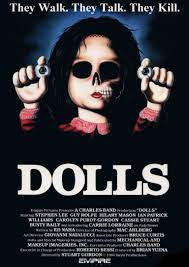
— I finally got around to watching Stuart Gordon’s Dolls for the first time.

Finally, because I love Gordon’s first two features Re-Animator and From Beyond.

I must say that I wasn’t disappointed by Dolls, though it’s a step down from From Beyond and a good two or three from Re-Animator.

Alas, Dolls belongs to a slightly different but no less venerable tradition than Re-Animator and From Beyond, both of which cross mad scientists and low-budget exploitation (nudity, gore, etc.). Think Frankenstein meets Dawn of the Dead.

Dolls, meanwhile, recalls such touchstones as The Old Dark House and The Devil-Doll, not to mention the 1979 Tourist Trap. See if this plot sounds familiar: On a dark and stormy night, six people — a dysfunctional family (husband and father, wife and stepmother, and daughter / stepdaughter) and a young man with two hitchhikers — find the nearest house (The Old Dark House) and they have to fight to make it out of the other end of the motion picture alive because their kindly old hosts are magical toy makers with killer dolls (The Devil-Doll, Tourist Trap).

Like both Re-Animator and From Beyond, Gordon and Dolls screenwriter Ed Naha jump off from their basic old-fashioned plot structure with inspired moments of madness.

Dolls also predates Child’s Play by more than a year and rather than just one killer doll, it has a horde … but Child’s Play, created by Don Mancini, spawned Child’s Play 2, Child’s Play 3, Bride of Chucky, Seed of Chucky, Curse of Chucky, Cult of Chucky, and Child’s Play (2019), plus short films Chucky’s Vacation Slides and Chucky Invades and the TV series Chucky.

So, apparently, not all killer doll films are created equal.

Rating: Three stars.

The Monster Squad starts with an absolute genius idea: Take a group of kids, horror movie fans one and all, and have them do battle against Dracula, Frankenstein’s Monster, Wolf Man, Mummy, and Gill Man.

Yes, what an absolutely positively brilliant idea by screenwriters Shane Black and Fred Dekker, whose names ring a bell loud and clear for genre fans. Others will be familiar with their work regardless whether they know their names or not.

Black made his fame and fortune first for the script of the buddy cop picture Lethal Weapon and some of his other credits include Predator (he plays Hawkins), The Last Boy Scout, and The Long Kiss Goodnight.

Dekker’s other feature directorial credits are the fantastic Night of the Creeps and the not-so-fantastic RoboCop 3.

The Monster Squad gives us both protagonists and monsters that we like, and that goes a long way toward producing a memorable motion picture experience.

The Wolf Man gets his due for a change. The fat kid Horace kicks the Wolf Man in the groin and unleashes the film’s trademark line Wolfman’s got nards! In 2018, Andre Gower, one of the stars of The Monster Squad, directed a documentary named Wolfman’s Got Nards, which looks at the impact one little cult horror film made on fans, cast and crew, and the movie industry.

Anyway, in a movie filled with nifty little moments, I love it when the Wolf Man regenerates after he’s blown up real good.

On the site Drinking Cinema, I found a game for The Monster Squad so drink whenever: 1. Dynamite EXPLODES! 2. A monster dies! 3. You hear a sweet insult. 4. You learn a new monster fact. 5. The cops are having a really hard time figuring out that, um, hello, the perps are various Jack Pierce creations. 6. You see amazing dog acting. 7. You witness a patented Monster Slow-Walk. 8. There’s a monster scare!

I give The Monster Squad a slight deduction for the obligatory music video montage right around the midway point of the picture.

Rating: Three-and-a-half stars.

— Vampirism and voodoo go together rather well and their combination helps Scream Blacula Scream become one of those rare sequels I prefer over the original.

I thought William Marshall’s performance as the title character was the redeeming factor in Blacula and he’s every bit as good in Scream Blacula Scream. Marshall just has a commanding screen presence and he brings both a gravitas to a character and legitimacy to a movie that otherwise might be laughable with the wrong person in the main role. He’s equally effective in every guise of this character — the debonair Mamuwalde who has a definite charm with the ladies befitting an African prince (which he indeed was before the racist Dracula cursed him and imprisoned in a coffin until Blacula awakened in 1972 Los Angeles), the menacing Blacula with his fangs bared, and the more reflective Mamuwalde who hates the dreaded vampire curse.

A highly respectable box office return — not voodoo, no matter what the plot synopsis might read — brought Mamuwalde / Blacula / Marshall back.

In the first movie, Mamuwalde / Blacula comes to believe the lovely Tina’s the reincarnation of his long dead wife Luva. Well, it definitely helps that Vonetta McGee plays both Tina and Luva. By golly, doesn’t this plot thread just get you every single time?

In the sequel, Mamuwalde / Blacula believes in the voodoo powers of Lisa Fortier. She can provide a cure and exorcise the curse once and forever.

Scream Blacula Scream came out two weeks after Coffy and had it been made later in 1973 after Pam Grier busted out as a star playing Coffy, her Lisa Fortier character in Scream Blacula Scream would have undoubtedly been different. Grier plays a more traditional leading lady and screaming and shrinking damsel in distress in Scream Blacula Scream, and she’s definitely no shrinking violet in either Coffy or Foxy Brown. So if Scream Blacula Scream had been produced more in the aftermath of both Coffy and Cleopatra Jones, which came out a month after both Coffy and Scream Blacula Scream, surely American-International — one of the best exploitation film outlets — would have wanted Grier to play one badass mama jama vampire killer rather than her more stereotypical role.

Fair warning: Scream Blacula Scream ends on an extremely jarring note. I remember thinking, in the immortal song title of Peggy Lee, is that all there is? Despite the fact of that ending, you might be surprised to find that I am granting Scream Blacula Scream three-and-a-half stars. Yes, it is just that good.

We Had Ourselves a Real Good Time: Blacula, Dolemite, TNT Jackson, The Devil and Max Devlin

WE HAD OURSELVES A REAL GOOD TIME: BLACULA, DOLEMITE, TNT JACKSON, THE DEVIL AND MAX DEVLIN
Max Schreck, Bela Lugosi, Carlos Villarias, Lon Chaney Jr., John Carradine, Christopher Lee, Klaus Kinski, George Hamilton, Frank Langella, Gary Oldman, and Leslie Nielsen.

That’s a lot of bared fangs, deadly stares, and spectacular deaths over the decades.

Fair warning: Best get outta here with that Tom Cruise, Gerard Butler, Robert Pattinson bull.

Blacula star William Marshall deserves his rightful place among the best screen vampires. For example, he’s definitely better than, oh, let’s say, Carradine, who played Dracula in House of Frankenstein, House of Dracula, and Billy the Kid vs. Dracula and often looked like somebody had squeezed some fresh lemon juice in his eyes. A few months after Marshall debuted as Black Dracula, Lee appeared in his sixth Dracula film — cleverly titled Dracula A.D. 1972 — and Lee’s spiraling lack of enthusiasm for the role that made him famous bites you right smack dab in the neck.

With his booming voice, commanding screen presence, and legitimate acting chops, Marshall (1924-2003) owns Blacula and makes it infinitely better than some cruddy hunk of cinematic junk like Blackenstein. He brings an unexpected dignity to what might otherwise have been a throwaway film.

Rating: Three stars.

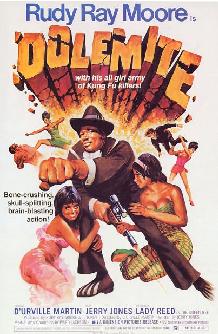
— I enjoyed Dolemite a whole lot more than Disco Godfather, my first Rudy Ray Moore experience, and not only because I’m now calling the former picture Boom Mic Motherfucker.

Disco Godfather lost me by about the millionth or maybe it was by the billionth time Moore (1927-2008) exclaimed Put your weight on it, a slogan that needless to say would not be adopted or adapted by 1980 U.S. Presidential candidates Jimmy Carter, Ronald Reagan, and John B. Anderson. Despite the fact that it tried cultivating a social conscience, Disco Godfather needed some weight put on it, because it was the cinematic equivalent of an anorexic crackhead.

Moore has been called The Godfather of Rap and both Dolemite and the character himself almost instantly serve notice why. Jailbird Dolemite’s first lines are Oh, shit. What the hell does that rat-soup-eatin’ motherfucker want with me? One could play a reasonable drinking game with how many times Dolemite utters motherfucker in the movie, because it’s not every time Cheech & Chong say Man in Up in Smoke (reportedly 285 times) or everybody says Carol Anne in Poltergeist III (121). You won’t get wasted, best shit you ever tasted, from Dolemite. You’ll probably feel pretty good and the alcohol will help laughter.

The plot: Dolemite gets released from prison and fights the criminals and corrupt police officers who sent our favorite cinematic pimp up the river in the first place. Really, though, Dolemite is about the profanity, fight scenes, female (we’ll forget about the male) nudity, and complete utter ridiculousness, all of it done over-the-top. Never mind that it’s a time capsule into Bicentennial-Era America filed right alongside Dog Day Afternoon.

To be honest, though, I was distracted from the plot and everything else by the unpaid co-star Boom Mic Visible, who’s absolutely the funniest motherfucker in Dolemite. According to IMDb, The boom mic is visible in many shots of original Xenon VHS to DVD transfer from the 1980s. The film was originally transferred without the proper ratio ‘gate’ of 1:85.1, revealing more of the top and bottom of the frame than the film makers originally intended. The 2016 Vinegar Syndrome Bluray release was re-transferred from an archive print of the film, at the proper ratio, so the boom mics are hidden in many shots. The Bluray release also includes a ‘boom mic’ version of the new transfer, intentionally revealing the boom mics for comic effect.

Now we know.

The actor John Kerry (not that John Kerry) played Detective Mitchell in Dolemite and it’s a missed opportunity that nobody ever asked 2008 U.S. Presidential Candidate John Kerry about his experiences making Dolemite, what Rudy Ray Moore was really like, etc. That’s a real shame.

Rating: Three stars.

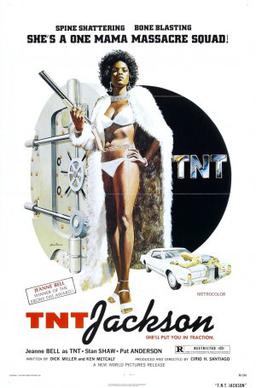
TNT Jackson is definitely not a good movie, but I am still feeling a certain lingering affection for it that other (better) movies wish they could make me feel for them.

What else could be said about some of the worst martial arts sequences ever committed to celluloid, from the very first fists and feet of fury scene all the way to the grand finale. Would you believe punches and kicks that do not connect but still inflict damage? Would you believe the heroine could punch right through the villain? Well, prepare yourself for TNT Jackson.

TNT Jackson falls short of the standard established by similar pictures Coffy and Cleopatra Jones, because, let’s face it, TNT Jackson star Jeannie Bell falls below Pam Grier and Tamara Dobson, respectively. Sure, former playmate and bunny Bell looks absolutely stunning with her great hair, great face, and great body, but she can’t act her way out of a paper bag and we don’t really believe that she could fight her way out of one if she wasn’t the star of the movie. Miss Jackson and her inevitable white chick nemesis (Pat Anderson) wage what’s possibly the worst cat fight ever in the history of the movies. It’s a doozy, and that describes the vast majority of the 72-minute TNT Jackson. Yes, that’s right, 72 minutes, a genuine throwback.

The late, great character actor Dick Miller (1928-2019) earned a screenwriting credit on TNT Jackson, but apparently producer Roger Corman had it rewritten by Ken Metcalfe, who plays the sleazy sub-villain Sid in TNT. Miller does not appear in TNT Jackson.

It’s amazing TNT Jackson romantic lead and main villain Stan Shaw did not get The Sensational, Smooth, Suave, Sophisticated, Stunning Stan Shaw for his screen credit, but maybe just maybe that’s because he overplays his smooth, suave, sophisticated ways so much that we’re tired of his jive real quick. Heck, even Shaw’s afro overplays it throughout TNT Jackson. I’ve not seen this much overacting by hair since, oh, let’s see, Chu Chu and the Philly Flash or maybe I’m mixing up Carol Burnett’s decorative head cover (wait, that’s just part of her costume) with her maracas.

Basically, I can’t hate too much on TNT Jackson like I do Chu Chu (more like Poo Poo and the Poopy Gas), since director Cirio H. Santiago remade TNT a few years later as Firecracker and substituted (white) Jillian Kesner for Bell in the title role. Both movies have similar plot elements, namely infamous topless fights, and Metcalfe in a similar role, but Firecracker does it better.

After watching TNT Jackson, I could not help but gravitate toward AC/DC’s song and the chorus ‘Cause I’m T.N.T., I’m dynamite / T.N.T., and I’ll win the fight / T.N.T., I’m a power load / T.N.T., watch me explode. Bonus points for TNT Jackson, ones that keep it from a two-star rating.

The best version of TNT Jackson is the two-minute promotional trailer put together by Joe Dante and Allan Arkush for New World Pictures circa 1974 or 1975. The voice-over narration takes it to greatness: TNT Jackson, Black Bombshell with a Short Fuse! This Hit Lady’s Charm Will Break Both Your Arms! She’s a One-Mama Massacre Squad! TNT’s Mad and That’s Real Bad! With That Dynamite Bod She’s a Jet Black Hit Squad! A Super Soul Sister and a Bad News Brother Under Cover and Out to Blast a Killer Army That’s Poisoning the People with Deadly China White! You Best Pay the Fine or She’ll Shatter Your Spine! Black Chinatown, Where Flesh is Cheap and Life is Cheaper! TNT Jackson, She’ll Put You in Traction!

Rating: Two-and-a-half stars. Trailer: Four stars.

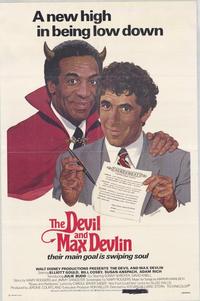
— Before The Devil and Max Devlin, it had no doubt been a long time since Walt Disney Studios depicted Hell in one of their films.

For example, Hell’s Bells from 1929 and Pluto’s Judgement Day from 1935 leap first to mind, two animated shorts that might blow people’s minds who normally associate animation with cute-and-cuddly innocuous fare at this late point in history.

To be fair to the older films, which are both far superior to the main film currently under consideration, feature length The Devil and Max Devlin doesn’t spend a lot of time in Hell.

Well, actually, according to some former President, right, aren’t California and Hell the same?

I wonder, given the subject matter and the presence of Bill Cosby in one of the starring roles, if The Devil and Max Devlin will go or has already gone the way of the controversial, divisive Song of the South — suppressed for seeming eternity by the folks at Disney. I found them both in the dark, dank recesses of the Internet and I hope that I won’t go to jail or Hell for either cultural sin.

Anyway, I like the locations (especially Hell) and I like the high concepts behind The Devil and Max Devlin like a slumlord trying to save his soul by giving the bad guys three unsullied souls and it turned out to be perfect casting to have Cosby in the role of the Devil’s helper, but the movie gets so bogged down in plot details that it evolves into a real slog and we just want more than anything else in the world at the moment for the movie to finally be over. At least, if nothing else, that’s how The Devil and Max Devlin made me feel watching it.

Rating: Two-and-a-half stars.

Rats! Rats! Rats! You’ve Got a Friend in Willard and Ben

RATS! RATS! RATS! YOU’VE GOT A FRIEND IN WILLARD AND BEN
It makes sense that a sequel to the 1971 hit Willard appeared within the next year.

It makes sense that this sequel focused on the rat Ben and would be called Ben, given the previous film’s rather downbeat ending.

It also makes sense that Phil Karlson directed Ben, since Karlson directed such gritty films as Kansas City Confidential, 99 River Street, and The Phenix City Story, all involving characters who might be considered dirty rats.

Karlson never directed any character badder and meaner than Ben, though. Not any of the tough guys played by John Payne, Preston Foster, Neville Brand, Lee Van Cleef, and Jack Elam in Kansas City Confidential. Ben don’t need no stinking mask, for one. Ben also has an infinitely larger gang anyway and they’re real hungry as demonstrated throughout Ben. Nor Tennessee sheriff Buford Pusser from Walking Tall, which Karlson made right after Ben. Joe Don Baker must have come as quite a relief after Ben, who quickly became a has been after his two film roles and multiple songs about him. Ben must have wanted even more dough to return for a third film. That dirty rat!

Ben also won a PATSY Award for his performance in Ben, which undoubtedly contributed to his ego problem.

Anyway, I didn’t much care for Ben, because it quickly established a dread pattern after the obligatory flashback to the events that ended Willard. Here’s that pattern: Rat attack. Cutesy poo musical number. Rat attack. Cutesy poo musical number. Rat attack. Cutesy poo musical number. Rat attack. Cutesy poo musical number. Rat attack. Cutesy poo musical number.

Sounds like a real winner, right? Yeah, if you like a bunch of bad ideas bouncing off each other for 90 minutes.

You can also throw in some police chatter, a journalist character who’s seemingly working on just this one story (though it’s hard to blame him, I mean it’s not everyday that millions of street rats terrorize a city), and a little boy named Danny and his sister (played by Meredith Baxter before her marriage and hyphenated name, before her TV mother fame, before her Lifetime movie career, before her coming out) and his mother who all seem like refugees from a Disney live-action project.

Oh yeah, like Willard before him, the little boy possesses the ability to communicate with rats, especially Ben. Oh yeah, once again, the lonely little boy has a heart condition.

Danny proves responsible for the musical numbers scattered throughout Ben and he even gives Ben a puppet show. Wow, just wow.

A 13-year-old Michael Jackson sings “Ben’s Song” over the end credits and “Ben” competed against songs from The Poseidon Adventure, The Little Ark, The Life and Times of Judge Roy Bean, and The Stepmother for Best Original Song at the 1973 Academy Awards. “Ben” lost to “The Morning After” from The Poseidon Adventure, believe it or not, and having heard both songs, I don’t believe it since “The Morning After” defines godawful. Unfortunately so does most of the movie Ben.

I’ll give Karlson and animal trainer Moe Di Sesso their due for amplifying the rat count to 4,000 for Ben. Eight times the rats as Willard, but that’s the only area in which Ben triumphs over its older brother. Granted, one human year translates to approximately 30 in rat years, so maybe that’s why Ben’s motion picture career stopped after two films in two years.

Rating: One star.

— What else can I say other than I liked Willard and I would not be surprised if I found out that it played as one-half of a double bill with fellow 1971 cult film Harold and Maude.

Both are weird little items with a delightfully morbid sense of humor and I only say delightfully because I like both films, and they have offbeat lead characters who push the patience of every adult.

Bruce Davison stars as Willard Stiles, who must contend with a harridan mother (Elsa Lanchester) and a bully for a boss (Ernest Borgnine). Willard develops a close relationship with Ben and Socrates, who unfortunately for Willard are rats. See, Willard finds out that he can communicate directly with rats and that he enjoys their company more than his fellow human beings, especially his overbearing mother and all her overbearing friends and his asshole boss. His mother wants Willard to get rid of them damn rats and his boss, well, he develops genuine distaste for Rattus norvegicus after Willard’s rats crash his party one night.

Willard also begins a tentative, very tentative relationship with his lovely temporary co-worker Joan (Sondra Locke). In the end, Willard should have pursued Joan more than Socrates and Ben. No doubt that our lad Willard would have lived a whole lot longer.

As interesting as it was to watch Davison and Locke early in their careers and Lanchester (The Bride from The Bride of Frankenstein) late in her career, Borgnine proved to be the key component in the success of Willard. For a picture like Willard to work any whatsoever, we need a character that we love to hate and Borgnine’s Al Martin suitably fills that need. For us to fully anticipate and then relish his inevitable death, Borgnine needed to work us into a frenzy every time he’s onscreen. Borgnine does that and then some, especially when he seizes upon Socrates and kills him with delight. We know then, more than ever before, that Martin will meet a spectacular demise.

Borgnine won the Academy Award for Best Actor in 1956 for his extremely likable performance as the title character in Marty, directed by Delbert Mann. Sixteen years later, in a picture directed by Daniel Mann, Borghine mined the opposite end of the character spectrum for Martin.

For sure, Borghine might be the first, last, and thus far only Academy Award-winning actor to be annihilated by rats.

That alone is worth the price of admission.

Rating: Three stars.

Kingdom of the Spiders (1977)

KINGDOM OF THE SPIDERS (1977) ***
John ‘Bud’ Cardos’ Kingdom of the Spiders proved to be a pleasant surprise.

First, I remembered Cardos directed The Dark, one of the worst movies of 1979.

Second, I remembered the last time I saw Kingdom of the Spiders star William Shatner in a cowboy hat, yes, the absolutely ridiculous The Devil’s Rain, one of the worst movies of 1975.

Third, Kingdom of the Spiders starts out with the country number “Pleasant Verde Valley.”

Finally, Kingdom of the Spiders starts out slow, real slow, tipped off by No. 3.

Kingdom of the Spiders, though, kicks into high gear around the hour mark and it’s a whole lot of fun the final 35-40 minutes once the spiders attack Camp Verde, Arizona, and the tarantulas take complete control of the picture, hence being a pleasant surprise.

Kingdom of the Spiders borrows from such motion picture immortals as The Birds, Jaws, and Night of the Living Dead. That’s all part of the fun, when you enjoy something like Kingdom of the Spiders. Otherwise, it’s one more objection to a failure, like, for example, such bombs from the same era as The Giant Spider Invasion, Food of the Gods, and fellow 1977 release Empire of the Ants.

On the other hand, I have a weakness for Nature Attacks movies. There’s Frogs, starring killer amphibians, birds, insects, and reptiles, plus a crotchety old Ray Milland and a topless Sam Elliott. There’s Night of the Lepus, pairing a mutated killer rabbit infestation with a character actor infestation featuring Janet Leigh, Stuart Whitman, Rory Calhoun, and DeForest Kelley. There’s Squirm, where killer worms and a pair of redheads played by Don Scardino and the perky Patricia Pearcy wreak havoc on Fly Creek, Georgia, after one helluva storm. All of them are good fun and I’ve been known to call Frogs — great fun — better than The Godfather. Ditto for Godzilla vs. The Smog Monster.

Anyway, Kingdom of the Spiders works a thousand times more than The Giant Spider Invasion because it decides on real spiders — many spiders, how many exactly, how about 5,000, I mean that fact alone creates shivers down the spine — rather than a Volkswagen Beetle converted into a silly giant spider invasion. The Giant Spider Invasion doesn’t help itself when Alan Hale’s Sheriff exclaims, “You ever see the movie Jaws? It makes that shark look like a goldfish!” Giant mistake.

Also, the characters in Kingdom of the Spiders are far more likable than the ones in The Giant Spider Invasion. I mean, I eventually forgave Shatner for the cowboy hat — it’s better than the one he wore for The Devil’s Rain — and I even got over the fact that his character’s named “Rack Hansen.”

I remember an elementary school teacher calming the nerves of several pupils who were scared silly by a tarantula. She told us they’re harmless, they’re not poisonous anyway, they just look big and scary and very, very frightening indeed, and Kingdom of the Spiders brought me back 30 years to that moment in time. I’m just thankful our teacher did not show us Kingdom of the Spiders afterwards to counteract her moral lesson on tarantulas.

Venom (1981)

VENOM (1981) ***
I just finished considering Silent Rage, a film that runs Chuck Norris, a Western, Animal House, mad scientists, and a madman killer made indestructible through a cinematic blender.

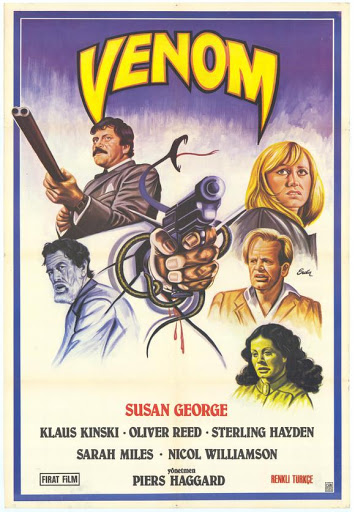
Thus, I feel safe in saying that Silent Rage prepared me for Venom, a British horror film that has a distinguished multinational cast, kidnapping and hostage negotiation, and only the world’s deadliest snake, the dreaded Black mamba from sub-Saharan Africa. The mamba gets a few closeups, more than Norma Desmond in Sunset Boulevard and Daffy Duck in Duck Amuck, and its own POV. Yeah, we’ll call it the Black Mamba Cam.

That distinguished cast includes kidnappers Klaus Kinski and Oliver Reed, Scotland Yard commander and lead negotiator Nicol Williamson, snake expert Sarah Miles, slinky (won’t call her slutty or a snake expert in her own right) nurse Susan George, and lovable crusty old grandfather Sterling Hayden.

Basically, Venom contains three movies within one — the kidnapping inside the house, the hostage negotiation and the behind-the-scenes police maneuvering on the outside, and the deadly snake on the loose. We’ve all seen kidnapping and hostage negotiation plenty before, on TV cop shows and in the movies, but very rarely do the kidnappers have to deal with the world’s deadliest snake. And Lord knows we’ve all seen a bad snake movie or two, like for example the 1972 disaster Stanley, which populated its killer snake scenario with thoroughly unpleasant and despicable characters, a somewhat heavy-handed environmental message, and some of the dopiest music ever heard by man this side of Jonathan Livingston Seagull.

Venom turned out to be a far more enjoyable motion picture experience than Stanley. For example, the scene in Venom where the boy picks up the mamba by mistake and unknowingly transports the world’s deadliest snake from one side of London to another brought to mind the classic sequence in Sabotage that ends in the death of a young boy named Stevie. The inevitable scenes late in the picture when the mamba strikes Reed and Kinski are both well worth their wait, and the mamba’s strike at George about 30 minutes into the picture lets us know that we’re in for a treat when Reed and Kinski do meet their demise.

Later that day, much later in the day to be precise, though, I watched Murders in the Zoo from 1933 and imagine my delightful little surprise when a mamba figured prominently in that older film’s plot. The gruesome hits in Murders in the Zoo just keep on coming down the home stretch, especially when a boa constrictor consumes the dastardly big-game hunter, bastardly zoologist, and insanely jealous husband played by Lionel Atwill.

Venom and Murders in the Zoo both find perfect ways to deal with snakes in the grass.