Jaws (1975)

day 23, jaws

JAWS (1975) Three-and-a-half stars
Steven Spielberg’s JAWS wanted to do for sharks what Alfred Hitchcock’s PSYCHO did for showers 15 years earlier.

Like PSYCHO, JAWS became a game-changing motion picture and it’s been analyzed, overanalyzed, parodied, and satirized, and it spawned many clones and rip-offs with just about every animal turned into a relentless killer.

It’s known as the first summer blockbuster film (released on June 20, 1975), I mean it even says so in the Guinness Book of World Records, “Not only did people queue up around the block to see the movie, it became the first film to earn $100 million at the box office.”

Before 1975, summers were traditionally reserved for dumping insignificant fluff.

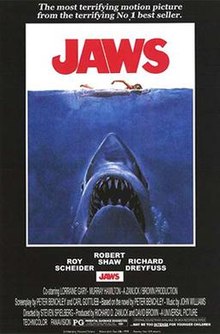
Based on Peter Benchley’s best-selling novel, JAWS tells a pulp story: a great white shark terrorizes Amity Island, a summer resort community, and transplanted city policeman Sheriff Brody (Roy Scheider) wants to close off the beaches but he runs into much resistance from Mayor Larry Vaughn (Murray Hamilton), who of course fears the loss of tourist revenue more than he does a great white shark. Eventually, though, Brody, along with preppy Ichthyologist Matt Hooper (Richard Dreyfuss) and grizzled old man of the sea Quint (Robert Shaw), attempts to hunt down and kill the great white aboard Quint’s ship, the Orca.

The film and the novel are different in several fundamental ways: Hooper and Brody’s wife do not have an affair in the film; Mayor Vaughn’s squeezed by the mafia in the novel and not simply local business interests; newspaper man Harry Meadows plays a bigger role in the novel; Quint’s made a survivor of the World War II USS Indianapolis; Hooper escapes death in the film; Quint dies by drowning in the novel; in the film, Brody kills the shark by shooting a compressed air tank inside the creature’s jaws, of course.

Spielberg said that he rooted for the shark the first time he read Benchley’s novel because he found the human characters unlikeable.

Normally, books are credited for having stronger characterizations than their screen adaptations.

That’s not the case with JAWS.

In fact, none of the subsequent JAWS films could match the characterizations of Brody, Hooper, and Quint and performances by Scheider, Dreyfuss, and Shaw. We have three indelible characters who stay within our hearts and minds just as much as the image of the great white shark.

Scheider and Dreyfuss appeared to have great chemistry together, just like there seemed to be real tension between Dreyfuss and Shaw.

Universal had Scheider bent over a barrel after he dropped out two weeks before filming started on THE DEER HUNTER, due to “creative differences,” and so they forced Scheider into starring in JAWS 2. Scheider’s performance in JAWS 2 suggests a very, very unhappy person and his conflicts with director Jeannot Szwarc must have only contributed to Scheider’s apparent misery.

Dreyfuss passed on JAWS 2 because Spielberg did not direct it; they made CLOSE ENCOUNTERS OF THE THIRD KIND together instead. Of course, there were obvious difficulties in Quint returning for JAWS 2.

JAWS 2 gives us a bunch of teeny boppers and repeats the basic plot of the first movie, JAWS 3-D sinks even more into a morass of mediocrity (how bad must you be to be disowned by the next JAWS film), and JAWS THE REVENGE, well, it gives us the first shark movie designed for geriatric consumption. To be honest, JAWS THE REVENGE defies the suspension of disbelief beyond belief and becomes one of the worst bad movies ever made.

Necessity became the mother of invention for JAWS, because of the numerous technical difficulties with the mechanical shark that became known as Bruce, named after Spielberg’s lawyer, or alternately “the great white turd.” Spielberg wanted to show the shark a lot sooner, but instead the film took on more Val Lewton proportions than the average horror movie. JAWS relies heavily on John Williams’ famous musical score to substitute for the shark.

The JAWS sequels utilized the mechanical shark far more often and much earlier on, honestly to their detriment. Less is more and more is less.

I always love it when horror movies take on more than just being a horror movie. At times, especially when our three protagonists are stuck on that damn boat together, JAWS becomes grand adventure and an unexpected comedy.
Psycho (1960)

day 22, psycho

PSYCHO (1960) Four stars
Oh, to get into any one of the seven DeLorean DMC-12s used in BACK TO THE FUTURE and rev that sonuvabitch up to 88.8 MPH with the date set for June 16, 1960, the release date for Alfred Hitchcock’s PSYCHO.

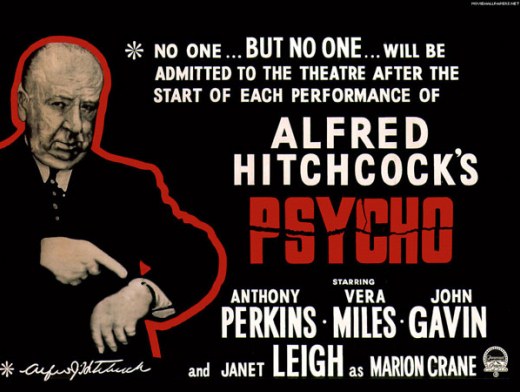
I’d go find the nearest theatre where it’s playing and put down the 69 cents. Of course, I would be sure to arrive early and hang around the lobby if necessary since Hitchcock made sure theaters enforced a strict “no late admission” policy.

Hitchcock even wrote a beautiful note, “Surely you do not have your meat course after your dessert at dinner. You will therefore understand why we are so insistent that you enjoy PSYCHO from start to finish, exactly as we intended that it be served.

“We won’t allow you to cheat yourself. Every theatre manager, everywhere, has been instructed to admit no one after the start of each performance of PSYCHO. We said no one — not even the manager’s brother, the President of the United States or the Queen of England (God bless her).

“To help you cooperate with this extraordinary policy, we are listing the starting times below. Treasure them with your life — or better yet, read them and act accordingly.”

Gotta love that Hitchcock and his ripped, twisted sense of humor.

Anyway, I would go back in time to see PSYCHO just to observe others’ reactions to it, to see their shock, to see their absolute terror at certain moments. They would not have possibly known all the surprises in store for them, while viewers for the last nearly 60 years have not had the benefit of watching PSYCHO with a clean slate. Since its release, PSYCHO has been analyzed, overanalyzed, parodied, satirized, and its famous shower scene long ago replaced the Odessa Steps sequence from BATTLESHIP POTEMKIN (1925) as the most fetishized scene in movie history.

Every time I watch PSYCHO, I am gobsmacked by just how audacious Hitchcock and gang were in making it. Start the movie with a love affair in a seedy hotel? Check. Show the heroine in her bra multiple times? Check. Kill off the heroine played by a big movie star halfway through the film? Check. Start out with the theft of $40,000 and more or less drop it after the death of the heroine? Check.

That’s just the tip of the iceberg.

Of course, none of that might seem the least bit audacious in 2018, but please keep in mind the Motion Picture Production Code dominated Hollywood movies from the early 1930s through 1968. PSYCHO helped chip away at that damn archaic code.

Everybody knows the plot by now. Marion Crane (Janet Leigh) steals $40,000 from her employer’s client and she’s on the lam hoping to get together with her lover Sam (Sam Loomis, played by John Gavin). We hear the voices that are inside her head (her mind and by extension our minds are obsessed with the money) and Hitchcock once again proved he’s the Master of Suspense by making a policeman’s stop and Marion’s drive in the pouring rain as tension-filled as any of the death scenes. With the rain beating down on her poor, weary windshield wipers, a conscience-stricken Marion stops at the famous Bates Motel with its 12 cabins and 12 vacancies.

There we meet proprietor Norman Bates (Anthony Perkins), a fictional character in Robert Bloch’s novel and Hitchcock’s film with roots in the real-life Wisconsin murderer and grave robber Ed Gein (an inspiration for THE TEXAS CHAINSAW MASSACRE’s Leatherface). Gein, for example, loved to make wastebaskets from human skin. Unlike later slasher movie super villains Michael Myers and Jason Voorhees, Norman speaks and he does not wear a mask. This makes Norman Bates far more fascinating than any of the slasher film madmen descended from PSYCHO.

Norman loves taxidermy and he’s got mother issues.

Otherwise, he seems like a good, old-fashioned All-American boy.

Oh, what happens to Marion? Let’s just say that in real life, Leigh stopped taking showers for years, preferring a bath after the fate of her character in PSYCHO.

Sam teams up with Marion’s sister Lila Crane (Vera Miles) and they try and track down Marion. Of course, all roads lead them and poor, poor Detective Arbogast (Martin Balsam) to Bates Motel and Norman Bates and his dear old mother.

In arguably his most audacious move, Hitchcock substituted protagonists from Marion Crane to Norman Bates. Perkins gives one of the great performances, one that will be discussed and cherished for centuries. He walks away with the movie.

The HALLOWEEN sequels continued to add more and more back story to the detriment of Michael Myers. Near the end of PSYCHO, Hitchcock gives us a phony baloney psychiatrist (Simon Oakland) and his phony baloney explanation for Norman Bates, but it’s taken to such an extreme that it plays like a parody. We could have done without this sequence, though, unlike the rest of the movie.

Early on in this review, I shared a note from Hitchcock. Now we go full circle.

A woman complained to Hitchcock that the PSYCHO shower scene had such a deleterious effect on her daughter that the young girl refused to shower.

Hitchcock replied, “Then Madam I suggest you have her dry cleaned.”

The Adventures of Ichabod and Mr. Toad (1949)

DAY 21, THE ADVENTURES OF ICHABOD AND MR. TOAD.jpeg

THE ADVENTURES OF ICHABOD AND MR. TOAD (1949) Three-and-a-half stars

Walt Disney favored package films after the release of BAMBI (1942) and released about one every year to close out the 1940s.

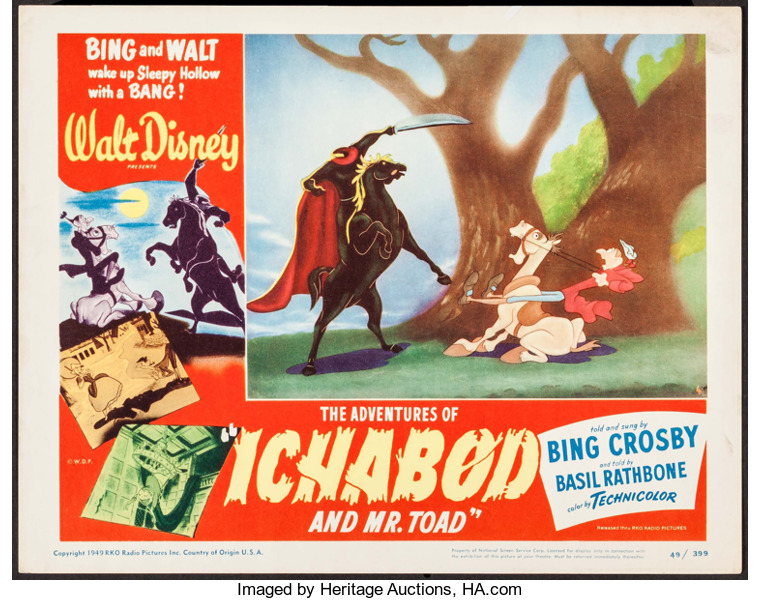
THE ADVENTURES OF ICHABOD AND MR. TOAD runs at 68 minutes, split at just the right length between the opening Mr. Toad segment based on “The Wind in the Willows” by Kenneth Grahame and the closing Ichabod Crane segment based on “The Legend of Sleepy Hollow” by Washington Irving. We have narration duties split between Basil Rathbone (MR. TOAD) and Bing Crosby (ICHABOD), plus Crosby handles voice duties for both Ichabod Crane and Brom Bones and sings a few songs. Crosby sings “The Headless Horseman” tale Brom Bones tells at the campfire that sticks in Ichabod Crane’s imagination on that famous long ride home.

Since we’re on a month of horror movie reviews, I will be focusing on the ICHABOD segment for the purpose of these few hundred words.

I must have first read “The Legend of Sleepy Hollow” in eighth grade and it’s long been one of my favorite stories. It’s compulsively readable (an engrossing yarn as the publicists said in 1820) and I’m looking around for that damn Irving anthology I bought several years ago. It must be hiding, of course, probably somewhere right around that Edgar Allen Poe anthology that could squish a spider the size of a Buick.

Just take a prose sample:

“As Ichabod approached this fearful tree, he began to whistle; he thought his whistle was answered: it was but a blast sweeping sharply through the dry branches,” Irving wrote. “As he approached a little nearer, he thought he saw something white, hanging in the midst of the tree: he paused and ceased whistling; but on looking more narrowly, perceived that it was a place where the tree had been scathed by lightning, and the white wood laid bare. Suddenly he heard a groan—his teeth chattered, and his knees smote against the saddle: it was but the rubbing of one huge bough upon another, as they were swayed about by the breeze. He passed the tree in safety, but new perils lay before him.

“About two hundred yards from the tree, a small brook crossed the road, and ran into a marshy and thickly wooded glen, known by the name of Wiley’s Swamp. On that side of the road where the brook entered the wood, a group of oaks and chestnuts, matted thick with wild grape vines, threw a cavernous gloom over it. To pass this bridge was the severest trial. It was at this identical spot that the unfortunate Andre was captured, and under the covert of those chestnuts and vines were the sturdy yeoman concealed who surprised him. This has ever since been considered a haunted stream, and fearful are the feelings of the schoolboy who has to pass it alone after dark.”

As much as I like the Johnny Depp and Tim Burton SLEEPY HOLLOW (1999), it only appropriates the title and a few character names from Irving’s short story. It’s laughable when you read “Based on ‘The Legend of Sleepy Hollow’ by Washington Irving” in the credits, because Ichabod Crane’s transformed into a horror movie hero who’s rather normal even by Burton and Depp standards and he’s no longer a gold digger like in Irving’s story, where Ichabod schemes after Katrina Van Tassel more for her money than her looks and personality. Ichabod becomes the standard issue lovable movie eccentric and he’s also a constable and not a schoolteacher. Of course, that plays into a murder mystery that manufactures more twists than a year’s worth of production at a pretzel factory.

I have to stifle laughter at this very instant after reading the Wikipedia entry for the 1999 version, which starts “SLEEPY HOLLOW is a 1999 American gothic supernatural horror film directed by Tim Burton. It is a film adaptation loosely based on Washington Irving’s 1820 short story ‘The Legend of Sleepy Hollow.’”

How loosely? Very loosely. Maybe as loosely as the Demi Moore version of SCARLET LETTER.

Burton’s film seems more heavily influenced by Hammer Films (none other than Christopher Lee plays a small role) than the original story, which plays on legends, superstitions, and Ichabod’s overactive imagination for its horrors. SLEEPY HOLLOW makes one feel that it’s merely exploiting the Washington Irving name and literary reputation to give class to what would otherwise be another gory horror movie with a rather convoluted plot.

Take away the slapstick and Crosby’s songs about Ichabod and Katrina, the Walt Disney version sticks closer to the spirit and letter of Washington Irving and the final dozen minutes of ICHABOD AND MR. TOAD are a vivid reminder of Disney films’ ability to scare audiences in classics like SNOW WHITE, PINOCCHIO, and BAMBI.

Ultimately, though, with the Burton film, I accept it for what it is rather than what it is not. Cue to “Seinfeld” and “Not that there’s anything wrong with that.” It does have a lot of virtues and I’ve enjoyed it every time seeing it since that first time in a theater in late 1999. Hey, that reminds me, I need to grab my VHS copy and put the damn thing on.

Cane Toads: An Unnatural History (1988)

day 108, cane toads an unnatural history

CANE TOADS: AN UNNATURAL HISTORY (1988) Four stars
January 14, 2019 will go down in history as one of the great movie-watching days of my life.

Let’s see, I consumed a 1984 kung fu comedy with a little bit of everything including drunken boxing and a monster known as “Banana Monster” or “Watermelon Monster” (TAOISM DRUNKARD, a.k.a. DRUNKEN WU TANG); a 1983 made-for-TV documentary called FROM STAR WARS TO JEDI: THE MAKING OF A SAGA that took a behind-the-scenes look at the making of RETURN OF THE JEDI; a 1987 anime that one headline called “classic demon Anime loaded with succubi, gore and tentacles” (WICKED CITY); a 1985 Japanese comedy mixing a love of movies and a love of food (TAMPOPO); one of the better Godzilla movies (GODZILLA VS. BIOLLANTE); an older Jackie Chan and an older Pierce Brosnan making it work in THE FOREIGNER; a 1988 Krzysztof Kieslowski film called A SHORT FILM ABOUT LOVE that lasts over 80 minutes (guess in the long run 80 minutes constitutes a short time); and I started on Peter Jackson’s debut BAD TASTE before calling it a day.

In between THE FOREIGNER and A SHORT FILM ABOUT LOVE, I watched CANE TOADS: AN UNNATURAL HISTORY, a 47-minute documentary directed by Mark Lewis on a species taking over northern Australia.

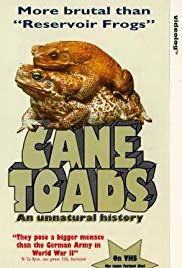
I found a poster for the movie and it hits you with such blurbs as “An Absolute Delight!” (New York Times), “An assault of sex-mad giant toads munching their way across Australia!” (Roger Ebert), and “Riotously funny and hilariously twisted!” (Dallas Times Herald). It has CANE TOADS in huge letters across the top of the spread and a photo of a cane toad who’s as big as the girl who’s holding it.

Yes, it’s one of those “nature run amok” films.

We find out early on that in 1935, the cane toad was introduced to Australia as pest control on a beetle pestering their sugar cane.

Let’s just say that plan backfired, and it backfired miserably.

The toads are back in the headlines in Australia.

“Australian senator says government should pay welfare recipients to kill cane toads” reads one.

Senator Pauline Hanson wrote an open latter to Prime Minister Scott Morrison and she’s a beaut.

“Dear Prime Minister

“As Queensland and neighboring states go through our Summer months, a further explosion of cane toads are hatching, adding to the estimated 200 million already here in Australia.

“Since their misguided introduction to deal with cane beetle in the North Queensland town of Gordonvale in 1935, cane toad numbers have exploded beyond the borders of Queensland and are having enormous effect on native Australian species.

“Unlike native frogs that lay between 1,000 and 2,000 eggs during their breeding cycle, toads will lay between 8,000 and 35,000.

“Their poisonous toxin is deadly to many native species including lizards, quolls, dingoes and crocodiles. Adult cane toads will eat almost anything it can fit in its mouth, including dead animals and pet food scraps. Their appetite and prolific breeding cycle knows no boundaries.”

Parents think teenagers are bad.

Hanson called for swift, bipartisan action.

“I would also encourage you to introduce a 3 month bounty over the Summer months to help reduce the breeding numbers throughout Queensland, New South Wales, the Northern Territory and Western Australia.

“A 10 cent reward for the collection of each cane toad, I believe would encourage most Australians living with the pest to take an active roll (role) in reducing their numbers until a biological measure is developed.”

In the movie, Lewis reportedly wanted to create sympathy for the hated animal.

One resident said, “There are still quite a large number of the toads around, but not as big as they use to be. But I still let the animal and they give me a lot of enjoyment.”

We get a toad’s eye view of the world in a multitude of shots.

Our title creatures participate in a PSYCHO spoof.

They even get songs like “Cane Toad Blues” (Tim Finn) and “Warts ‘N All” (Don Spencer, Allan Caswell).

Around the five- or six-minute mark, Dr. Glen Ingram, then the Senior Curator Amphibia and Birds at Queensland Museum, explains the process of “Amplexus.”

These toads sure do love them a whole lotta “Amplexus.” They are responsible for the phrase “horny toad.”

For example, around 150 were introduced to Oahu in 1932 and in just 17 months, the toads numbered over 100,000.

One article described cane toads as “Fat, toxic and nocturnal.” For some reason, that description called to mind Dean Wormer telling Flounder, “Fat, drunk, and stupid is no way to go through life, son.”

Watching CANE TOADS: AN UNNATURAL HISTORY also brought to mind the 1972 American International exploitation picture FROGS.

One of the legends involving that low-budget picture was that many of the film’s 500 Florida frogs and 100 giant South American toads escaped during production.

Maybe they ran into the cane toads or movie star Ray Milland, who left FROGS three days early because he was such an unhappy camper.

Guess you could say that it’s more a laughing matter for somebody who doesn’t have to deal with cane toads in any way shape or form, because “They pose a bigger menace than the German Army in World War II” (quote from another movie poster).

Cat People (1942)

day 19, cat people

CAT PEOPLE (1942) Four stars
Russian-American producer Val Lewton (1904-51) made his mark on horror movies and cinematic history in general with a series of low-budget thrillers for RKO beginning with CAT PEOPLE and continuing through I WALKED WITH A ZOMBIE, THE LEOPARD MAN, THE SEVENTH VICTIM, THE GHOST SHIP, THE CURSE OF THE CAT PEOPLE, THE BODY SNATCHER, ISLE OF THE DEAD, and BEDLAM.

That’s a fertile period of films (1942 through 1946) that deserves to be mentioned in the same breath as Universal Studios’ horror movies of the 1930s.

Lewton’s influence can be seen on the vast majority of horror movies of the last almost 80 years, unfortunately though in just one way.

Horror movies often rely on jump scares, and “Lewton Bus” is film industry shorthand for a scene that slowly builds tension and then jolts the viewer at the most tense moment with a sudden scare from something that turns out to be completely harmless, like a cat or a dog or that damn stupid friend who loves to play tricks on their friends at the most inopportune times. The audience supposedly “jumps” en masse on cue. This technique gets the name from a scene in CAT PEOPLE, where we think a character will be attacked and killed by a panther and the hissing sounds turn out instead to be an incoming bus pulling up.

Slasher films especially utilize scenes like that, beyond the point of banality after being used in thousands of movies. Occasionally, a film like HALLOWEEN or PHANTASM will succeed using “Lewton Bus” scenes, just to make it clear that I don’t hate jump scares per se, but a stockpile of these scenes in a film often point to lazy filmmakers who just want to generate cheap thrills. Seasoned movie viewers can sniff out a cheap jump scare from a mile away.

Fortunately, Lewton’s productions are far more than jump scares and cheap thrills, right from the start with CAT PEOPLE, directed by Jacques Tourneur.

Necessity becomes the mother of invention, and it’s true for CAT PEOPLE and the other Lewton productions with their low budgets and subsequent high creativity.

The plot centers around Irena (Simone Simon), a fashion designer originally from Serbia, and her romance and marriage with Oliver (Kent Smith). Their marriage remains unconsummated because of Irena’s paralyzing fear that she will turn into a large cat upon consummation. Irene doesn’t even kiss Oliver. Oliver, a most understanding husband all things considered, begins to confide in his assistant at work, Alice (Jane Randolph), and Irena’s anger and jealousy trigger her Serbian curse. Oliver also gets Irena to visit Dr. Louis Judd (Tom Conway) upon Alice’s recommendation; Judd, of course, develops his own designs for Irena.

Unlike the Universal monster movies, CAT PEOPLE does not show the monster and instead relies upon shadows and sound effects. This suggestive approach allows viewers to use our imaginations and we can invent some disturbing scenes on the widescreen of our minds, like what exactly happens to Dr. Judd in his death scene.

“We tossed away the horror formula right from the beginning,” Lewton said in the Los Angeles Times. “No grisly stuff for us. No mask-like faces hardly human, with gnashing teeth and hair standing on end. No creaky physical manifestations. No horror piled on horror.”

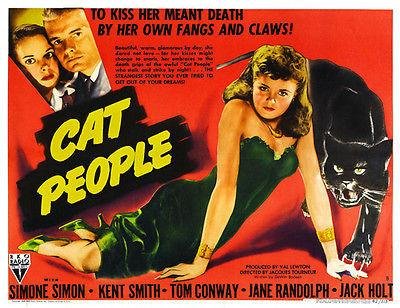
CAT PEOPLE (made for $134,000) became a big hit for the last few days of 1942 and then into 1943 after its 1942 Christmas release date and RKO, of course, sold it through a series of sensationalistic taglines:

“She knew strange, fierce pleasures that no other woman could ever feel!”

“LOVELY WOMAN … GIANT KILLER-CAT … THE SAME “PERSON”! … IT’S SUPER-SENSATIONAL!” (1954 re-release)

“The exciting story of a woman who kills the thing she loves!”

“The strangest story you ever tried to get out of your dreams!”

“A Kiss Could Change Her Into a Monstrous Fang-and-Claw Killer!’

“She Was Marked With The Curse Of Those Who Slink And Court And Kill By Night!”

“To Kiss Her Meant Death By Her Own Fangs and Claws!”

“Kiss me and I’ll claw you to death!”

“The most terrifying menace of them all!”

Oliver, Alice, and Irena return in THE CURSE OF THE CAT PEOPLE (1944), one of the first sequels to throw off a general public (and publicists) expecting more of the same. TCM.com starts its entry, “The RKO publicists must have been using mind-altering drugs when they masterminded the ad campaign behind THE CURSE OF THE CAT PEOPLE (1944), a poetic fantasy about a lonely young girl who invents an imaginary playmate.”

Poetic is one word to describe the Lewton CAT PEOPLE films, and how many horror movies have ever been deserving of that compliment?

The Killing of Satan (1983)

day 106, the killing of satan

THE KILLING OF SATAN (1983) Three stars
Not exactly sure what to make of this 1983 Filipino production named LUMABAN KA, SATANAS or THE KILLING OF SATAN elsewhere in this great big world.

I mean, you can’t go too far wrong with a movie that features the line, “Satan! Where are you? Come out and fight!”

THE KILLING OF SATAN has a preposterous but literal plot (our hero does kill Satan), ridiculous dubbing (mouths are moving without dialogue coming out, I do believe, on multiple occasions), eye-popping special effects, nudity galore (not too much galore, though), and a hero who’s equipped with the powers of a jean jacket, jeans, a rockin’ ‘stache, and Chuck Taylors. Yeah, he’s an ex-con too and you’re right, he sounds like the most believable action hero to ever grace a movie screen.

Not sure how many action heroes graced a jean jacket. I do remember Martin Sheen wore one in BADLANDS, a Levi’s 507XX jacket, but does that count? Oh, I better not forget Chuck Norris and his demolition in denim from INVASION U.S.A.

Jean jackets apparently date back to the late 19th Century.

Levi Strauss designed the first-ever jeans in 1870, designed to be “a durable, breathable utility garment for cowboys, railroad engineers, and miners to wear during the gold rush out West.”

In all my research, I do not see Ramon Revilla, the actor who plays our hero Lando, listed among the great celebrities who rocked jean jackets. I mean, for crying out loud, I think he’s every bit as important as Kanye West, especially after research.

Revilla was around his mid-50s in age when he made THE KILLING OF SATAN. Are you kidding? That makes his feats in THE KILLING OF SATAN even more impressive. You must have God on your side, though, to overcome middle age, a jean jacket, being an ex-con, and that mustache.

Over a lengthy career that started in the 1950s, Revilla has been nominated for five and won two awards from the Filipino Academy of Movie Arts and Sciences (FAMAS), although he was not nominated for THE KILLING OF SATAN.

Revilla won Best Actor for his work in the 1973 film HULIHIN SI TIAGONG AKYAT and won the Presidential Award in 2005. His other nominations include Best Actor for NARDONG PUTIK (1972), SANUGIN ANG SAMAR (1974), and CORDILLERA (1986).

Revilla, now 91 years old, served 12 years (1992-2004) as Senator in the Philippines and he also developed a legendary reputation for being a ladies man, before he ever went near politics.

Did he use killing Satan for his campaign?

Revilla’s son Ramon “Bong” Revilla Jr., who succeeded his old man in politics, took umbrage at Hollywood actor Alec Baldwin for his 2009 “mail-order bride” joke on David Letterman.

“Let him try to come here in the Philippines and he’ll see mayhem,” Revilla said.

“Bong” said this while being an active Filipino senator. Baldwin, of course, later apologized and said he understood why folks like the Senator were so upset.

“Bong” is Revilla’s 60th child of 72 children with 16 different women.

We’ll have more on the rest of THE KILLING OF SATAN in another episode.

The Devil-Doll (1936)

day 18, the devil-doll

THE DEVIL-DOLL (1936) Four stars
Two men escape from Devil’s Island at the beginning of THE DEVIL-DOLL, director Tod Browning’s penultimate theatrical feature.

Paul Lavond (Lionel Barrymore), wrongly convicted and imprisoned for 17 years for looting his own bank and murdering a night watchman, wants nothing more than cold-blooded revenge against his three former business partners who set him up for the fall. They’ve been living high on the hog while he’s been rotting away in prison. That can produce a lot of hatred.

Marcel (Henry B. Walthall, 1878-1936), meanwhile, wants to return to his scientific work. He’s single-minded in purpose, just as Lavond. Marcel, an idealist through and through until his final breath, has developed a way to reduce people to one-sixth their original size and this all ties in with speculation on how mankind will find the necessary resources to feed a growing population. Marcel believes that he’s found the solution for the human race moving forward.

(With the world’s population projected at 10 billion by 2050, there’s articles already written on how we will feed our growing population.)

At the moment of his greatest scientific triumph, the first successful shrunken human, Marcel dies and then Lavond joins Marcel’s widow and assistant Malita (Rafaela Ottiano) in continuing Marcel’s work. Of course, Lavond intends to exploit this scientific breakthrough for his personal revenge with the ultimate goal of clearing his name and Lavond and Malita go to Paris to carry out Lavond’s master plan. Lavond, a wanted man, disguises himself as Madame Mandelip (call her Mrs. Dreadfire) and Lavond/Mandelip and Malita set up a shop selling lifelike dolls.

Lavond can mind control the miniaturized humans (first Marcel and Malita’s slow servant and then one of his former associates Rodan) and they carry out his revenge. Brilliant plan. I mean, what authorities would ever believe that you were attacked by a “devil-doll?” Not only that, but you wouldn’t even know what hit you until it’s too late.

Barrymore (1878-1954) finds the right notes to play the wide range presented to him throughout THE DEVIL-DOLL. On one hand, Barrymore played Mr. Potter in IT’S A WONDERFUL LIFE 10 years after THE DEVIL-DOLL and Mr. Potter earned the No. 6 slot on the American Film Institute’s list of the 50 Greatest Villains. Barrymore uses some of the same notes playing Lavond, although he’s the main protagonist rather than main antagonist. On the other hand, it’s especially sad watching Lavond being unable to reveal himself to his estranged daughter (Maureen O’Sullivan) who’s adamant that she hates him; Lavond mostly contacts his daughter in the Mandelip guise. Mandelip earns a few laughs and like the later performances, for example, by Tony Curtis and Jack Lemmon in SOME LIKE IT HOT and Dustin Hoffman in TOOTSIE, they create legitimate characters that go beyond, way beyond the dudes-in-drag gimmick.

Walthall’s Marcel and Ottiano’s Malita belong alongside many of the great mad scientists throughout cinematic history. Malita is deliriously, delightfully loopy and, of course, relentless in the pursuit of continuing her dead husband’s legacy. Ottiano (1888-1942) became the subject of an article titled “Rafaela Ottiano: The Venetian Who Played the Villainess.” She’s a lot of fun.

Marcel and Malita fit one definition of mad (“carried away by enthusiasm or desire”) while Lavond fits another (“intensely angry or displeased”), and that gives THE DEVIL-DOLL a very interesting dynamic.

Exorcist II: The Heretic (1977)

day 100, exorcist ii the heretic

EXORCIST II: THE HERETIC (1977) Three-and-a-half stars
There’s movies that are hated and then there’s EXORCIST II: THE HERETIC, a movie that received hate on an epic, violent level since it’s considered the worst sequel ever made and one of the worst films ever.

Sequels are often penalized for being too much like the original and then ironically enough, EXORCIST II has been lambasted for being nothing like the original mass phenomenon known as THE EXORCIST.

EXORCIST II director John Boorman admitted to not even liking the original film and his sequel is a direct challenge to the film that came before it.

I just want to know, did Boorman and fellow director William Friedkin ever get into a shouting match that degenerated into fisticuffs?

In a 2017 interview with IndieWire, Friedkin said, “I saw a few minutes of EXORCIST II, but that was only because I was in the Technicolor lab timing a film that I had directed — I forget which one — and one of the color timers at Technicolor said, ‘Hey, we just made a a print of EXORCIST II, would you like to have a look at it?’ I said OK. I went in, and after five minutes, it just blasted me. I couldn’t take it. I thought it was just ridiculous and stupid. But that was only five minutes, so I can’t make an ultimate judgement about it. It just seemed to me to have nothing to do with THE EXORCIST.”

Friedkin was also famously quoted, “And I looked at half an hour of it and I thought it was as bad as seeing a traffic accident in the street. It was horrible. It’s just a stupid mess made by a dumb guy — John Boorman by name, somebody who should be nameless, but in this case should be named. Scurrilous. A horrible picture.”

Boorman articulated on EXORCIST II in a 2005 interview with Film Freak Central, “The film that I made, I saw as a kind of riposte to the ugliness and darkness of THE EXORCIST — I wanted a film about journeys that was positive, about good, essentially. And I think that audiences, in hindsight, were right. I denied them what they wanted and they were pissed off about it — quite rightly, I knew I wasn’t giving them what they wanted and it was a really foolish choice. The film itself, I think, is an interesting one ­— there’s some good work in it — but when they came to me with it I told John Calley, who was running Warners then, that I didn’t want it. ‘Look,’ I said, ‘I have daughters, I don’t want to make a film about torturing a child,’ which is how I saw the original film. But then I read a three-page treatment for a sequel written by a man named William Goodhart and I was really intrigued by it because it was about goodness. I saw it then as a chance to film a riposte to the first picture. But it had one of the most disastrous openings ever — there were riots! And we recut the actual prints in the theatres, about six a day, but it didn’t help of course and I couldn’t bear to talk about it, or look at it, for years.”

Boorman lived out the Jean-Luc Godard quote “In order to criticize a movie, you have to make another movie.”

The critical (and audience) reaction to EXORCIST II seems based on whether or not you liked or hated THE EXORCIST. If you liked it, you hated EXORCIST II; if you hated it, you liked EXORCIST II.

For example, BBC critic Mark Kermode called EXORCIST II the worst film ever made because it trashed the greatest film ever made (THE EXORCIST). Leonard Maltin called it a “preposterous sequel” and Gene Siskel, who rated it no stars, chimed in with “the worst major motion picture I’ve seen in almost eight years on the job.” Siskel ranked THE EXORCIST No. 3 on his Top 10 list for 1973, behind only THE EMIGRANTS / THE NEW LAND and LAST TANGO IN PARIS.

Pauline Kael, a fan of Boorman and a Friedkin detractor, wrote of the original, “The demonic possession of a child, treated with shallow seriousness. The picture is designed to scare people, and it does so by mechanical means: levitations, swivelling heads, vomit being spewed in people’s faces. A viewer can become glumly anesthetized by the brackish color and the senseless ugliness of the conception. Neither the producer-writer, William Peter Blatty, nor the director, William Friedkin, show any feeling for the little girl’s helplessness and suffering, or for her mother’s. It would be sheer insanity to take children.”

Kael on the sequel, “This picture has a visionary crazy grandeur (like that of Fritz Lang’s loony METROPOLIS). Some of its telepathic sequences are golden-toned and lyrical, and the film has a swirling, hallucinogenic, apocalyptic quality; it might have been a horror classic if it had had a simpler, less ritzy script. But, along with flying demons and theology inspired by Teilhard de Chardin, the movie has Richard Burton, with his precise diction, helplessly and inevitably turning his lines into camp, just as the cultivated, stage-trained actors in early-30s horror films did. … But it’s winged camp — a horror fairy tale gone wild, another in the long history of moviemakers’ king-size follies. There’s enough visual magic in it for a dozen good movies; what it lacks is judgment — the first casualty of the moviemaking obsession.”

When I finally caught up with EXORCIST II in the late ’00s, I liked it and liked it enough that it held a spot on my top 10 list for 1977 for a few years. Yeah, I seem to be one of those crazy, wacky people who likes both THE EXORCIST and EXORCIST II. I’ll go ahead and be a heretic, and I’ll step up in defense of THE HERETIC.

— First and foremost, I have never seen a dull or non-visually captivating and compelling John Boorman film. His credits include POINT BLANK, DELIVERANCE, ZARDOZ, EXORCIST II, EXCALIBUR, and THE EMERALD FOREST. As Kael said in her review, EXORCIST II has enough visual magic in it for a dozen good movies. I mostly enjoy EXORCIST II on the level of a first-rate sound and light show. I see the film’s looniness as a virtue, but I can see where that would be a problem with viewers who love the Friedkin picture. Never even on a dare (let alone a review) do I hope to have to explain the plot of EXORCIST II.

— Boorman’s beef with THE EXORCIST centered on its treatment of Regan. Blair earned an Academy Award nomination for Best Supporting Actress for her work in THE EXORCIST, although credit should be given to stunt double Eileen Dietz and actress Mercedes McCambridge, who performed the most controversial scenes (Dietz) and provided the voice of the demon (McCambridge). EXORCIST II gives us a Blair in a transitional period between her child star past and her exploitation film future. She’s absolutely radiant, glowing even in EXORCIST II.

“Finally, one day, the script appears,” Blair said of EXORCIST II. “And I felt like, ‘Wow, this project is amazing, it’s perfect, it’s fabulous.’ They presented a really good next step, for the film, for the project, for Regan. You give me these amazing actors. Richard Burton, for me, that was what got me. To work with Richard Burton, that’s still, to this day, is one of the highlights of my life.”

— Ah yes, Burton (1925-84), an actor reputed to be one of the best actors on his best days and one of the worst actors on his worst days. You can virtually smell the alcohol on Burton during EXORCIST II, so you can guess which end of the Burton performance spectrum covers EXORCIST II. However, I’ll take a Burton train wreck performance over Sir Laurence Olivier’s later “take the money and run” career work in, for example, MARATHON MAN, THE BOYS FROM BRAZIL, and DRACULA, where Olivier (1907-89) stands out for his mannered (tortured) accent.

— I am fascinated by sequels that go in the opposite direction or even comment and criticize the previous entry, like BACK TO THE FUTURE 2 and GREMLINS 2: THE NEW BATCH. They’re far more interesting than sequels that are more or less just inferior copies of the original film, like, for example, JAWS 2 and OMEN II and many, many, many others.

I would even say that EXORCIST II has a more original, more daring vision than THE EXORCIST.

Dr. Jekyll & Mr. Hyde (1931)

day 16, dr. jekyll and mr. hyde

DR. JEKYLL AND MR. HYDE (1931) Four stars
The duality of man.

It was featured in a memorable conversation in FULL METAL JACKET between a colonel and Private Joker:
Colonel: Marine, what is that button on your body armor?
Private Joker: A peace symbol, sir.
Colonel: Where’d you get it?
Private Joker: I don’t remember, sir.
Colonel: What is that you’ve got written on your helmet?
Private Joker: “Born to Kill,” sir.
Colonel: You write “Born to Kill on your helmet and you wear a peace button. What’s that supposed to be, some kind of sick joke?
Private Joker: No, sir.
Colonel: You’d better get your head and your ass wired together, or I will take a giant shit on you.
Private Joker: Yes, sir.
Colonel: Now answer my question or you’ll be standing tall before the man.
Private Joker: I think I was trying to suggest something about the duality of man, sir.
Colonel: The what?
Private Joker: The duality of man. The Jungian thing, sir.

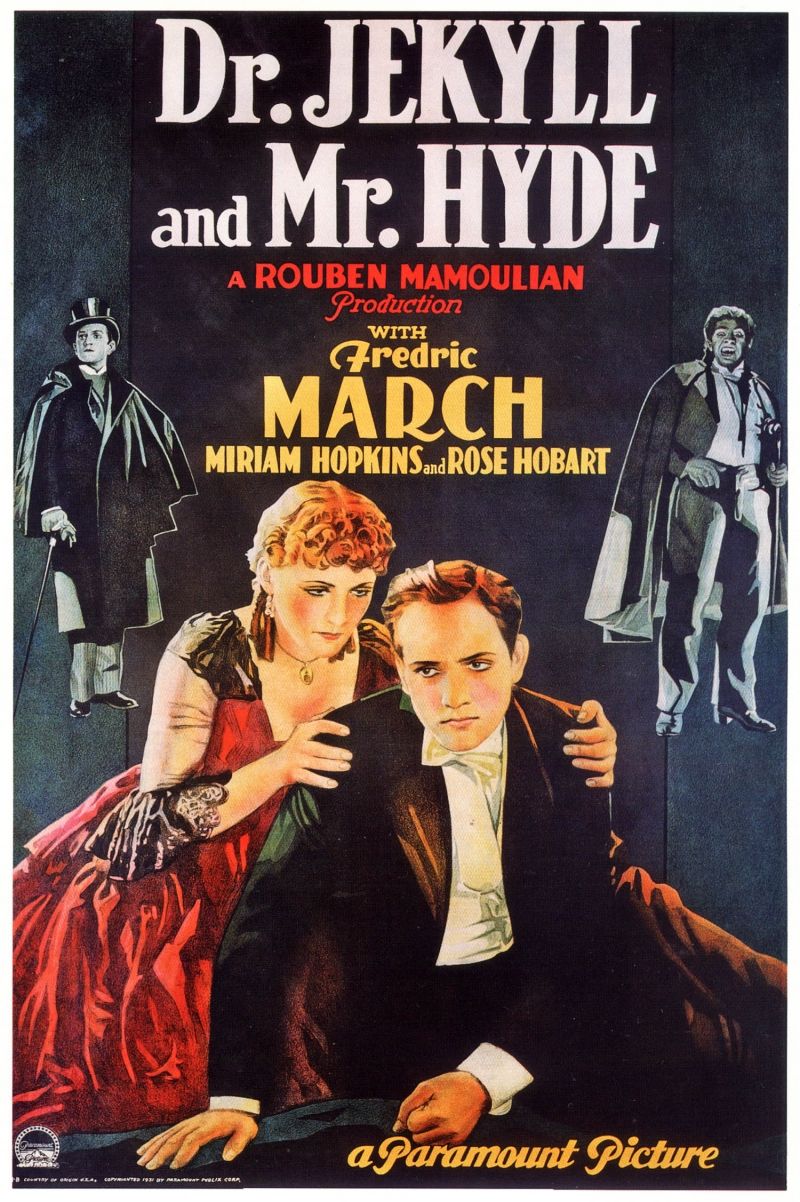
The duality of man is at the heart of DR. JEKYLL AND MR. HYDE in every form, be it Robert Louis Stevenson’s 1886 novella STRANGE CASE OF DR. JEKYLL AND MR HYDE and the 1931 and 1941 film versions with Fredric March and Spencer Tracy, respectively.

Dr. Henry Jekyll (March) believes that every man possesses two inside him (one good and one bad) and he puts this belief to the test with his creation of a formula that separates his good from his bad. He believes that if good and bad are separated, men will become truly liberated. Jekyll’s downfall will be his arrogance and his contempt for both his peers and the bounds for which one should not go.

Jekyll transforms into Mr. Edward Hyde, unleashing his inner demons on the world, especially a down-on-her-luck cabaret singer named Ivy Pearson (Miriam Hopkins). Jekyll saves Miss Pearson one night from a mugging and the very attractive young woman shows her appreciation to Jekyll in ways (bare legs, a kiss) that hasten Jekyll’s transformation into Hyde. It’s that leg that sticks with Jekyll, who’s engaged to be married to the socially respectable Muriel Carew (Rose Hobart) and you can go ahead and read socially respectable as dull. (The movie takes full advantage of coming before the Production Code that would have downplayed the sexual angle.)

Jekyll’s suave and sophisticated, well-respected, and known for both his decency and charitable works, but Hyde’s more a Neanderthal than a 19th Century Man with violent outbursts common and incredible physicality like brute strength and super jumping ability. Hyde is the darker side of Jekyll’s personality that he has repressed for so long, as a man of science turns into a homicidal maniac even without any potion.

Like many scientists in the movies, Jekyll messes around with things no man should and he pays the price dearly. There’s a dialogue scene between Jekyll and his friend Dr. Lanyon that gets to the gist of it:

Lanyon: You’re a rebel, and see what it has done for you. You’re in the power of this monster that you have created.
Jekyll: I’ll never take that drug again!
Lanyon: Yes, but you told me you became that monster tonight not of your own accord. It will happen again.
Jekyll: It never will. I’m sure of it. I’ll conquer it!
Lanyon: Too late. You cannot conquer it. It has conquered you!

March (1897-1975) was one of the best actors of his era on both stage and screen, winning two Academy Awards for Best Actor and two Tony Awards, and he gives two of the greatest performances in any horror film as Jekyll and Hyde, because they both take up residence in our mind.

For his work as Jekyll and Hyde, March tied with Wallace Beery (THE CHAMP) for the Academy Award for Best Actor. Should he not have won outright for playing two roles masterfully?

(Alas, March received one more vote than Beery. Unfortunately, though for March, Academy rules at that point in time considered an one-vote margin to be a tie. Thus, March and Beery tied for the award. This would not be the case any longer under Academy rules.)

DR. JEKYLL AND MR. HYDE, like many horror movies from the 1930s and 1940s, sticks with you long after it’s over and not only for its compelling themes and March’s performances but also for the use of POV shots and lap dissolves, transformation scenes, Hopkins’ performance as Ivy, and its evocation of a Victorian London that made Jekyll say “London is so full of fog, that it has penetrated our minds, set boundaries for our vision.”

Atmospheric has been used to describe the film directed quite masterfully by Rouben Mamoulian only a couple times.

Mamoulian pulls out all the stops in realizing the movie creatively.

Mamoulian on the transformation scene, “I asked, ‘What kind of sound can we put with this? The whole thing is fantastic. You put a realistic sound and it will get you nowhere at all.’ So again, you proceed from imagination and theory and if it makes sense, do it. I said, ‘We’re not going to have a single sound in this transformation that you can hear in life.’ They said, ‘What are you going to use?’ I said, ‘We’ll light the candle and photograph the light, high frequencies, low frequencies, direct from light into sound. Then we’ll hit a gong, cut off the impact, run it backward, things like that.’ So I had this terrific kind of stew, a melange of sounds that do not exist in nature or in life. It was eerie but it lacked a beat, and that’s where I had to introduce rhythm.

“So I said, ‘We need a beat.’ We tried all sorts of drums, but they all sounded like drums. When you run all out of ideas, something always pops into your head. I said, ‘I’ve got it.’ I ran up and down the stairway for two minutes until my heart was really pounding … and said, ‘Record me.’ And that’s the rhythm of the big transformation. So when I say my heart was in JEKYLL AND HYDE, it’s literally true.”

The Old Dark House (1932)

day 15, the old dark house

THE OLD DARK HOUSE (1932) Four stars
Stop me if you think you’ve heard this plot before: On a dark and stormy night, five travelers are caught up in one helluva storm and flooded out roads make it virtually impossible for travel by motorcar. Our travelers seek out overnight shelter from the storm and take refuge at the nearest house.

Next time, of course, our travelers might just take their chances with the rain and the mud rather than people like the ones they find inside that house or, if nothing else, keep walking and eventually find another house with different people inside.

THE OLD DARK HOUSE takes this old-fashioned plot (probably old-fashioned in 1932) and classes it up because of atmosphere, the cast, and the sharp screenplay by J.B. Priestley, Benn Levy, and R.C. Sherriff.

It’s directed by that master of 1930s cinema, James Whale, whose credits include WATERLOO BRIDGE, FRANKENSTEIN, THE INVISIBLE MAN, BRIDE OF FRANKENSTEIN, and THE GREAT GARRICK, some of the best from that era.

Whale’s movies generally have style for miles and miles, and intelligence and wit at their core to go along with their atmosphere.

THE OLD DARK HOUSE is no different, and cinematographer Arthur Edeson and production designer Charles D. Hall do wonders to create a sustained mood for 72 minutes. You’re in the hands of master craftsmen, as well as master performers.
Worlds collide in THE OLD DARK HOUSE.

The Femm house contains dread people who have dread secrets: brother and sister Horace (Ernest Thesiger) and Rebecca (Eva Moore), butler Morgan (Boris Karloff, still not speaking after FRANKENSTEIN), 102-year-old patriarch Sir Roderick Femm (played by a woman named Elspeth Dudgeon when the credits give John Dudgeon), and the pyromaniac named Saul (Brember Willis) who’s kept hidden in a locked room. Horace and Rebecca behave like they’re hiding something (namely their brother Saul) and Morgan, why he’s a mean drunk.

Our travelers are Philip Waverton (Raymond Massey) and his wife Margaret (Gloria Stuart) and Roger Penderel (Melvyn Douglas) and then Sir William Porterhouse (Charles Laughton) and his girlfriend Gladys DuCane (Lilian Bond), who come calling at dinner time.

You can basically guess what happens in THE OLD DARK HOUSE and while that normally sinks lesser pictures, you want the travelers to encounter the dread people and discover the dread secrets inside the Femm house, because you know that you will enjoy watching this plot unfold. We want to see who gets out of there alive in the morning.

There’s really not anything complicated about THE OLD DARK HOUSE, but it’s one of the best examples of the haunted house film, a branch of the horror genre that includes such films as THE SHINING, POLTERGEIST, AMITYVILLE HORROR, and the first two EVIL DEAD movies.

The late film critic Roger Ebert loved to say “It’s not what a movie is about, it’s how it is about it.”

THE OLD DARK HOUSE could be used as one of the exhibits for that argument.