Swamp Thing (1982)

SWAMP THING

SWAMP THING (1982) Three stars
This is the “green” movie I should have watched on St. Patrick’s Day.

Either that or perhaps any of the Incredible Hulk movies or the first SHREK.

Anything, just about anything, would have been preferred over LEPRECHAUN.

SWAMP THING rates as one of those indelible films that leave me with a goofy smile on my face and a warm glow in my heart, probably green colored in this particular case.

It’s been duly noted that filmmaker Wes Craven (1939-2015) earned an undergraduate degree in English and psychology from Wheaton College and a master’s in philosophy and writing from Johns Hopkins. He worked as English teacher before a four-decade film career predominantly associated with exploitation and horror.

Believe it or not, many of his films are informed by his educational, literary background.

Craven’s feature debut THE LAST HOUSE ON THE LEFT (1972) updated Ingmar Bergman’s THE VIRGIN SPRING (1960) for modern times in America; THE VIRGIN SPRING itself told a tale based on a 13th Century Swedish folk ballad incorporating rape, murder, and revenge.

Craven’s third film THE HILLS HAVE EYES (1977) took inspiration from 16th Century Scotland with Sawney Bean and His Cannibal Clan (45 members), responsible for the mass murder and cannibalization of over 1,000 people.

Even Craven’s arguably most famous film, A NIGHTMARE ON ELM STREET (1984), started after Craven read stories in the Los Angeles Times about how Southeast Asian refugees — who fled to the United States after the atrocities in Laos, Cambodia, and Vietnam — began experiencing terrifying nightmares and refused to sleep. Some of these men, ranging from age 19 to 57, even died in their sleep.

Based on a comic book, SWAMP THING, Craven’s fifth feature, was his first attempt to break away from the horror genre that would both be his blessing and his curse.

I suspect that one’s enjoyment of SWAMP THING depends on an individual’s level of sympathy for mad scientists, a megalomaniac and his nasty henchmen, a damsel-in-distress, secret formulas, mutations, comic book action, and Harry (FRIDAY THE 13TH) Manfredini’s relentless music that sounds echoes of his most famous work.

Busty actress Adrienne Barbeau proved to be at the peak of her film career at the time of SWAMP THING — it was the fifth picture in a six-picture run beginning with THE FOG (1980) and continuing with ESCAPE FROM NEW YORK, THE CANNONBALL RUN, THE THING (“Computer Voice”), and SWAMP THING before concluding later in 1982 with CREEPSHOW. She’s at her very best in SWAMP THING, and her very worst in CREEPSHOW.

Barbeau was married to filmmaker John Carpenter from 1979 to 1984, and half of those films listed in the above paragraph came from Carpenter in a flurry of films after HALLOWEEN.

Barbeau’s most famous talents are on display in the “international version” and the original DVD copies in America before viewers complained and had that “smut” recalled. Seriously, who would complain about Barbeau’s boobies, them magnificent mammaries? American DVD and Blu-ray issues since 2005 feature the American theatrical ‘PG’ version, and it would make America great again if we could have the “international version” of SWAMP THING.

Barbeau herself understands what makes SWAMP THING better than one more run-of-the-mill “creature feature.”

“When I read it, I fell in love with the screenplay,” Barbeau said of SWAMP THING. “It was whimsical, and charming, and lovely. I didn’t see it as a horror film. I guess I don’t see it as a horror film to this day, actually. It’s Beauty and the Beast — it’s more of a fantasy or a fairy tale, maybe, in my mind.”

I’ve long had admiration for Boris Karloff as Frankenstein’s Monster and Peter Weller as RoboCop. We can add stunt man and actor Dick Durock (1937-2009) as Swamp Thing to that list.

Like both Karloff and Weller, Durock creates great sympathy for Swamp Thing.

That human element — pieced together with Swamp Thing’s relationship with Alice Cable (Barbeau) — lifts SWAMP THING out of the swamp, if you will.

Just as when the Monster speaks in BRIDE OF FRANKENSTEIN, there’s poignancy when Swamp Thing says a line like “Much beauty in the swamp, if you only look.”

Swamp Thing and Cable have a better relationship than what the Monster and His Bride had in BRIDE OF FRANKENSTEIN. Cable gets far more screen time than the poor Bride, as well.

SWAMP THING has some of the same wit and same spirit as BRIDE OF FRANKENSTEIN.

I always say, “There’s much beauty in B-movies, if you only look.”

Leprechaun (1993)

LEPRECHAUN

LEPRECHAUN (1993) One star
“Just turn off your brain and enjoy the movie.”

Sure everyone’s heard that argument before in their lives when you have the sheer audacity not to enjoy a movie that somebody else holds dear. You think it’s dumb, stupid, idiotic, a waste of precious time, et cetera, and you think, hey, wait, how can you possibly enjoy anything by turning off your brain. I found this priceless bit of information on the Internets, “You may have heard that the brain has a pleasure center that lets us know when something is enjoyable and reinforces the desire for us to perform the same pleasurable action again. This is also called the reward circuit, which includes all kinds of pleasure, from sex to laughter to certain types of drug use.”

This train of thought occurred during LEPRECHAUN, a “brainless” film that left my reward circuit rather unrewarded and so my brain traveled elsewhere. I wanted to enjoy the movie, but it was a 92-minute slog that indulged thoughts like, for example, why did I not just watch the far superior KILLER KLOWNS FROM OUTER SPACE again or, after seeing Mark Holton in the role of Ozzie in LEPRECHAUN, maybe I should have looked up TEEN WOLF instead, films that reward my reward circuit because they’re not dumb, stupid, idiotic, wastes of precious time. (Are you glad that you bought that LEPRECHAUN box set for cheap at Walmart in Grove, Oklahoma, boy genius? How are you going to get through that series, especially since you rarely drink anymore?)

“Leprechaun brainless” entered into Google returned 22,700 results and you guessed it, “Just turn off your brain and enjoy the movie” receives airing in the defense of director Mark Jones’ magnum opus. In fact, the first search result calls LEPRECHAUN “a hilariously bad horror movie” and features the line “It ain’t the greatest, but it’s good for brainless entertainment.”

The Cheat Sheet calls LEPRECHAUN the sixth funniest B-movie of all time — TROLL 2 and TOXIC AVENGER top the list and other gems in the top 25 include No. 8 KILLER KLOWNS, No. 9 PIRANHA, and No. 22 PLAN 9 FROM OUTER SPACE. The Cheat Sheet illustrates the case for LEPRECHAUN with a still from LEPRECHAUN 3 captioned as being from the first LEPRECHAUN.

The only laughs that LEPRECHAUN generated from me are what one might call bad laughs.

What’s a bad laugh?

It’s the experience of the following dialogue exchange, for example, from the Luciano Pavarotti bad laugh masterpiece, YES, GIORGIO (1982).

Giorgio Fini: Pamela, you are a thirsty plant. Fini can water you.

Pamela: I don’t want to be watered on by Fini.

Or the disclaimer at the end of Irvin Allen’s THE SWARM: “The African killer bee portrayed in this film bears absolutely no relationship to the industrious, hardworking American honey bee to which we are indebted for pollinating vital crops that feed our nation.”

Or finding both the killer doll in CHILD’S PLAY and the killer leprechaun in LEPRECHAUN laughable in a bad way.

Did I mention that LEPRECHAUN runs 92 minutes?

Why, oh dear Lord why.

It runs those 92 minutes at a snail’s pace. No, make that at the pace of a three-toed sloth, a mammal that averages a distance of only 0.15 miles per hour.

LEPRECHAUN feels like it moves 15 minutes per hour, so we’ve just seen GONE WITH THE WIND rather than LEPRECHAUN. Ha!

For example, there’s a sequence where the leprechaun kills a police officer that makes five minutes feel like forever.

And that just about describes LEPRECHAUN.

Barring her uncredited role as “Dancer in McDonald’s” in another epic cinematic train wreck known as MAC AND ME (1988), Tory Reding was Jennifer Aniston’s first feature film role. You might have missed her as Ferris Bueller’s sister in 13 episodes of “Ferris Bueller” (TV).

Apparently, Aniston, who’s been in her fair share of bad movies outside her 1999 duo of OFFICE SPACE and THE IRON GIANT (voice work), feels more than a wee bit embarrassed by LEPRECHAUN. I can totally sympathize with her.

LEPRECHAUN is neither good enough nor bad enough to be any good.

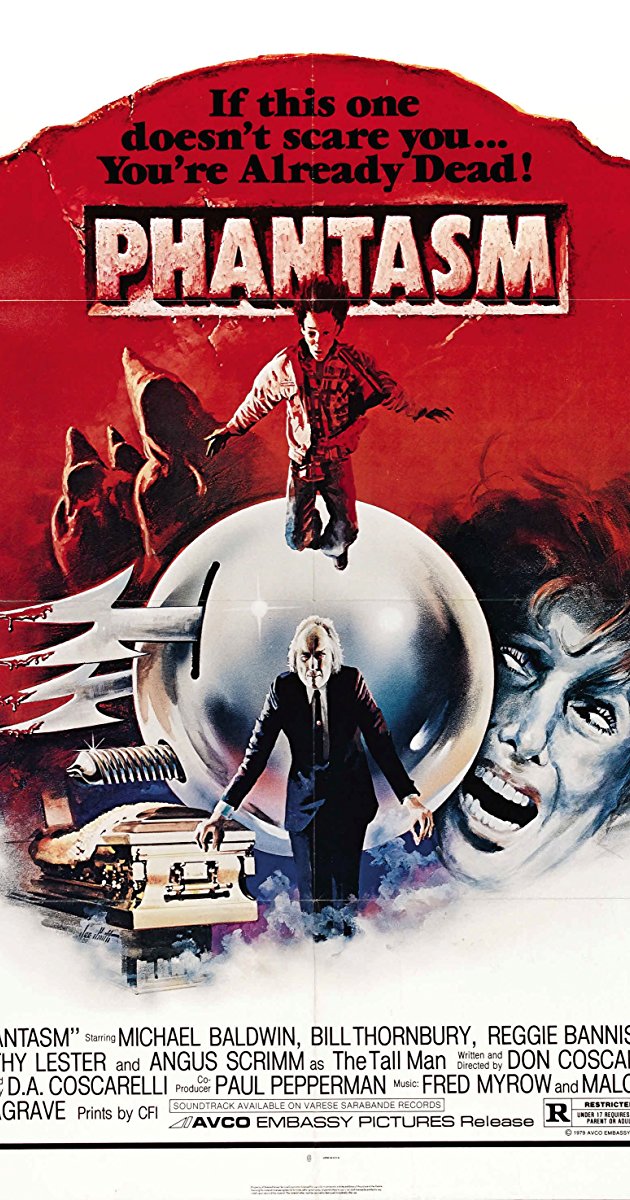
Phantasm (1979)

DAY 27, PHANTASM

PHANTASM (1979) Three-and-a-half stars
Child protagonists have been used to great effect in literature and films.

In the world of film, we’ve had all the Disney films, all the Hayao Miyazaki films, THE WIZARD OF OZ, ALICE IN WONDERLAND, FORBIDDEN GAMES, THE 400 BLOWS, WILLY WONKA AND THE CHOCOLATE FACTORY, THE SPIRIT OF THE BEEHIVE, PAN’S LABYRINTH, and Harry Potter, just to name a few greats.

We can add Don Coscarelli’s low-budget horror film PHANTASM (estimated at $300,000) to that distinguished list and I don’t know if a child protoganist has ever been as resourceful or such a relentless little fighter as the 13-year-old Mike (A. Michael Baldwin).

He’s our entry point into the strange and bizarre world created by Coscarelli, who not only directed but wrote, photographed, and edited this little labor of love.

Mike’s not a passive observer reluctantly drawn into the action, rather his innate curiosity gets the best of him.

Mike fears that his older brother Jody (Bill Thornbury) will leave him at any moment and there’s one rather poignant scene when Mike follows Jody in medium long shot. Mike’s always following Jody and this bothers Jody, who’s considering hitting the road for a while and leaving Mike in the care of their Aunt Belle.

Mike and Jody’s parents died two years before the events in PHANTASM.

Mike and Jody are joined by Reggie (Reggie Bannister), a family friend and an ice cream vendor. Their family and friends seem to be dropping left and right.

They go up against The Tall Man (Angus Schrimm) and I’ll let the “Slender Man Connection Wiki” describe him, “The Tall Man is the primary antagonist of the PHANTASM horror film series and one of the main influences on the Slender Man mythos. Originally a human known as Jebediah Morningside, the Tall Man was a mysterious, malevolent entity disguised as a mortician, who would rob graveyards of their corpses to reanimate them into his vast interdimensional army.”

Both Jody and Reggie are reluctant to believe Michael and his overactive imagination, but boy oh boy are they believers well before the end of PHANTASM.

The Tall Man’s minions include dwarfs who have a nice little back story and he also dispatches flying metallic spheres known as the Sentinel Sphere or the Flying Death Sphere or Brain Suckers. They are one of the most nifty death devices in any horror movie, and every PHANTASM movie includes at least a couple sphere scenes.

The spheres are eight inches tall and 50 pounds, and they fly rapidly through the air relentlessly tracking their potential victims.

Apparently, they contain the shrunken brains of The Tall Man’s victims and The Tall Man controls the spheres with his mind.

The spheres have drills, dual blades, saws, telescopes, explosives, and spikes at their disposal and the golden spheres (that originate from The Tall Man’s body) have tri-blades, lasers, and dual saws. The spheres drain the victims of all their blood.

The spheres do have three weaknesses: extremely cold temperatures, direct hits with a projectile weapon (Jody shotgun blasts one in PHANTASM), and the frequency emitted by a tuning fork. The golden spheres are tougher to kill.

Basically, we have three solid protagonists who take us from the beginning to the end of the picture, one especially malevolent antagonist, and one ripped, twisted instrument of death. What else do we need?

Unfortunately, some viewers have complained about the story.

However, I think the title PHANTASM itself clues the viewer in to the basic nature of the plot. Phantasm means “a figment of the imagination or disordered mind.”

Coscarelli’s imagination created some memorable moments in the history of horror.
For example, Mike’s snooping around one night at The Tall Man’s lair and he survives his first encounter with a sphere, but one of The Tall Man’s henchmen does not.

Then, Mike meets The Tall Man up close and personal for the first time.

The Tall Man chases Mike down the corridors of terror and Mike eventually traps The Tall Man’s hand in a heavy door. This affords Mike the opportunity to cut off The Tall Man’s fingers. The Tall Man emits a ghastly, inhuman sound and yellow blood (embalming fluid) shoots out from the severed fingers on the floor.

Mike takes one of the still-moving fingers and puts the evidence in a box to convince the skeptical thus far Jody.

Jody (Thornbury) plays his reaction to the finger just perfectly, and it’s a great moment of course when the older brother finally believes the younger brother.

As they’re about to take their evidence to the authorities, that yellow finger transforms into a monstrous bug and it attacks the brothers.

I live for moments and scenes like that.

At one point, The Tall Man, in a voiceover, tells Mike, “You play a good game, boy, but the game is finished. Now you die.”

Now, if you’re nice to me and ask me politely, I’ll do my best Tall Man impression and recite that dialogue for you.

My Bloody Valentine (1981)

MY BLOODY VALENTINE

MY BLOODY VALENTINE (1981) Three stars
Several elements lift MY BLOODY VALENTINE — a 1981 Canadian production that became renowned for nine minutes of excised footage so it could receive a “R” from the Motion Picture Association of America — above the average mad slasher film.

1) Valentine Bluffs (“The Little Town with the Big Heart,” elevation 200, population 3735) feels like a real place, definitely more than Springwood, Ohio in A NIGHTMARE ON ELM STREET and any of the locations in the FRIDAY THE 13TH movies.

You can almost feel the characters’ excitement as they plan a Valentine’s Day dance for the first time in two decades, you can almost taste the Moosehead beer, you can almost sense their dread they’re stuck in this small town, and you can almost articulate word-for-word both their frustration and thankfulness for that damn mine where everybody, just about everybody, in town works for all their lives.

MY BLOODY VALENTINE just might be the only horror movie that evokes THE DEER HUNTER, through its mine, its miners, its cars, its bar, its beer drinking, its tough talking, and its romantic triangle.

In an interview with Terror Trap, director George Mihalka touched on the environment in MY BLOODY VALENTINE, at one point mentioning how the film’s screenwriter pictured it as “THE DEER HUNTER of horror films.”

“One of the things that both (screenwriter) John Beaird and I wanted to do was that we wanted to take it out of the suburban bungalow context,” Mihalka said. “We wanted to set this in some place where there is a slight hint of social consciousness. This was really the first film in that era where teenagers are actually talking about the fact that there’s no future left.

“There’s no jobs, there’s no future. Not a lot of hope. It was, in a strange way, the first of a Generation X mentality. I think that’s what may still resonate after all these years.”

Valentine Bluffs rates with Kingston Falls (GREMLINS) at the top of my list for horror towns.

MY BLOODY VALENTINE used Sydney Mines, Nova Scotia, for its location.

Their plants Sydney Steel (DISCO) and the Sydney Mines Steel (SCOTIA) helped produce 50 percent of Canada’s steel during World War I.

MY BLOODY VALENTINE filmed its mine scenes at Princess Colliery Mines, an operation from 1875 to 1975 that produced 30 million tons of coal.

Princess Colliery even had a famous disaster on December 6, 1938.

From the opening paragraph of Canadian Press staff writer Arthur Andrew, “A committee of miners and officials planned today to descend Princess Colliery and trace the death-dealing trail of a runaway ‘man-rake’ that killed 16 men yesterday. Their visit is the first step in an investigation seeking the reason the string of cars broke loose, spreading death and injury. … The evidence they gather, added to the testimony of the more than 200 men who survived the disaster, will be placed before an investigating commissioner. Hon. Michael Dwyer, minister of mines, will attend the probe into the worst accident in the last 21 years of coal mining in Cape Breton.”

2) MY BLOODY VALENTINE mines (pun intended) its holiday for all its worth.

Not only do we have Valentine Bluffs, we have a Valentine’s dance, we have red and white streamers all over the place, its killer has a future writing Hallmark cards … for psychos like this epic “ROSES ARE RED, VIOLETS ARE BLUE, ONE IS DEAD, AND SO ARE YOU!” (the killer underlines you three times for dramatic effect), and it makes brilliant use of a box of chocolates, only rather than candy hearts, well, think we should leave that a surprise for those who have never seen MY BLOODY VALENTINE. I’ve already said too much.

Paramount Pictures released MY BLOODY VALENTINE on February 11, 1981, and its profit proved to be considerably less than what FRIDAY THE 13TH produced for Paramount in 1980.

3) “The Miner” is one of the most iconographic killers, I mean, come on just take a gander at him on Google Images. Hell, better yet, go watch MY BLOODY VALENTINE.

He’s combination miner, Jason Voorhees, and Darth Vader.

4) These characters are years removed from HALLOWEEN, FRIDAY THE 13TH, and A NIGHTMARE ON ELM STREET: They’re adults.

Of course, that fact does not absolve them from doing any of the numbskull things horror movie characters often do at the most inopportune times for numbskull behavior.

5) A 25-year-old John McDermott sang “The Ballad of Harry Warden” over the closing credits and I remember being floored by this song upon first viewing MY BLOODY VALENTINE. I just could not believe it. Wow, it’s just about every bit as great as Bob Dylan’s “Knockin’ On Heaven’s Door” and it’s the closing song for a mad slasher movie.

A sampling of Paul Zaza’s lyrics: “Once upon a time, on a sad Valentine / In a place known as Henniger Mine / A legend began, every woman and man / Would always remember the time / And those who remain were never the same / You could see the fear in their eyes / Once every year, as the 14th draws near / There’s a hush all over the town / For the legend they say, on a Valentine’s Day / Is a curse that’ll live on and on / And no one will know, as the years come and go, of the horror from long time ago.”

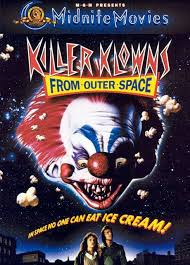
Killer Klowns from Outer Space (1988)

KILLER KLOWNS

KILLER KLOWNS FROM OUTER SPACE (1988) Three-and-a-half stars
Sociologists would undoubtedly have a field day unpacking why KILLER KLOWNS FROM OUTER SPACE retains cult classic status.

We can start at the first two words in the title and focus upon our seemingly eternal fascination with both killers and clowns.

Then, our nostalgia for 1980s kitsch.

I don’t know, that’s not why I dig KILLER KLOWNS FROM OUTER SPACE, because, to begin with, I don’t quite have the same obsession with killers and clowns that most Americans have or I don’t suffer from “coulrophobia,” the irrational fear of clowns.

I know several people who seriously consider 1980s mass entertainments THE GOONIES, DIRTY DANCING, FERRIS BUELLER’S DAY OFF, THE BREAKFAST CLUB, et cetera, not only their favorite movies, but they’ll go on record and proclaim their favorite “the greatest movie ever made.” Talk about a conversational cul-de-sac, it’s happened so many darn times over the years especially during college. I lost track of how many times I stood there in stone face silence (like Buster Keaton) while my brain pondered exactly how many films these other people have seen and why they’re stuck in 1987, for crying out loud.

I did not see KILLER KLOWNS FROM OUTER SPACE until many years later, though I always remembered that glorious title before I put the down payment on the DVD.

I love KILLER KLOWNS FROM OUTER SPACE because it’s a demented cartoon (the best kind of cartoon) that has ingeniousness to spare: “The Big Top” for the Killer Klowns’ spaceship; popcorn ray-guns; cotton candy cocoons that produce a dread end for dead humans; an invisible Clown car; shadow puppetry; killer pies; and the 18-foot tall Killer Klown leader known as “Jojo the Klownzilla,” a man-in-a-suit Godzilla parody or tribute.

KILLER KLOWNS FROM OUTER SPACE will remind some viewers of Steve McQueen’s debut motion picture, THE BLOB (1958).

You know, kids on lovers’ lane see what could be Halley’s Comet … no, hey, wait, that’s what a crusty old farmer named Gene Green (Royal Dano) mistakes “The Big Top” for when he sees the same unidentified flying object streaking across the sky in the opening sequence and boy, oh boy, that’s a dread mistake for Mean Gene and his poor, poor loyal dog Pooh Bear when they go investigate. Ol’ Man Green speaks a few great lines before his inevitable exit, “What in tarnation is going on?”

Straight out of THE BLOB, teenage sweethearts Mike Tobacco (Grant Cramer) and Debbie Stone (Suzanne Snyder) also investigate further and they go to the local authorities with their findings, centered on “The Big Top” and its inner workings. Our two local authorities, of course, are hesitant to believe these wacko teenagers and their whacked out stories of popcorn-shooting guns and cotton candy cocoons.

Damn kids and their elaborate pranks.

We do have a more sympathetic police officer in Dave Hansen (John Allen Nelson) and I seem to remember every other more sympathetic police officer travels by the name “Dave.” You just know you can have total faith in a guy named Dave.

Yes, at least one more sympathetic police officer did have that first name, “Lt. Dave” in THE BLOB, who patiently listened to and believed the cockamamie stories of Steve (McQueen) and Jane (Aneta Corsaut).

Just like THE BLOB, we have one policeman more sympathetic to the kiddos in KILLER KLOWNS FROM OUTER SPACE and then we have Curtis Mooney, who seems like a relative of Dean Vernon Wormer from NATIONAL LAMPOON’S ANIMAL HOUSE.

Of course, there’s a brilliant reason for that, both characters are played by the same actor.

The late John Vernon (1932-2005) has a fabulous start to his IMDb biography: “John Vernon was a prolific stage-trained Canadian character player who made a career out of convincingly playing crafty villains, morally-bankrupt officials and heartless authority figures in American films and television since the 1960s.”

He’s great in KILLER KLOWNS FROM OUTER SPACE, picking up right where he left off in ANIMAL HOUSE.

Maybe Wormer relocated to Crescent Cove and changed his name to Curtis Mooney.

Cramer plays a protagonist named “Mike Tobacco” and it took me a little bit to remember a character from “Charlie and the Chocolate Factory” and WILLY WONKA AND THE CHOCOLATE FACTORY named “Mike Teavee.” Are they distant relatives? While the TV obsessive Mike Teavee brought his obsession to another level in both the book and the 1971 film adaptation, we never see Mike Tobacco smoke tobacco in KILLER KLOWNS FROM OUTER SPACE, although we can be sure that Curtis Mooney believes that Mr. Tobacco’s smoking something stronger than tobacco when he descends upon the police station with that “killer clowns from outer space” story.

The Chiodo Bros. — Stephen, Charles, and Edward — are the auteurs behind KILLER KLOWNS FROM OUTER SPACE, siblings who specialize in clay models, creatures, stop motion, and animatronics. Their credits, in addition to the main film under discussion, include puppets and effects work for CRITTERS, ERNEST SCARED STUPID, and TEAM AMERICA: WORLD POLICE, as well as the Large Marge claymation scene from PEE-WEE’S BIG ADVENTURE.

They deserve a spot alongside such icons as Willis O’Brien and Ray Harryhausen.

On a certain level, KILLER KLOWNS FROM OUTER SPACE deals in a nostalgia for animation, horror, and science fiction entertainments of the past.

The IMDb lists numerous references, but the most important ones seem to be GODZILLA, INVASION OF THE BODY SNATCHERS, FORBIDDEN PLANET, PHANTASM, and ALIEN, as well as THE BLOB, of course, all of which seasoned viewers will be able to notice.

The film’s tagline captures the spirit of the enterprise: “In space, no one can eat ice cream.”

Don’t Torture A Duckling (1972)

DAY 26, DON'T TORTURE A DUCKLING

DON’T TORTURE A DUCKLING (1972) Three-and-a-half stars
The third time proved to be the charm for me and the films of Italian director Lucio Fulci (1927-96), who earned the nicknames “The Godfather of Gore,” “The Spaghetti Splatter King,” and “Horror Maestro.”

About 10 years ago, I watched THE BEYOND and THE HOUSE BY THE CEMETERY (both 1981), two installments of Fulci’s “Gates of Hell” trilogy, and I found them to be two of the most wretched exercises in godawful dubbing, pathetic dialogue and characters and situations recycled from better horror movies (HOUSE BY THE CEMETERY just screams THE SHINING), and laughable gore I have ever seen.

I hated those movies, and I think hate might actually be an understatement. We need a word here that goes beyond hate.

(I have reviews of them buried somewhere.)

Of course, naturally, I came across the DVD of Fulci’s 1972 giallo DON’T TORTURE A DUCKLING in the multimedia collection of the Leonard H. Axe Library on the campus of beautiful Pittsburg State University in lovely Pittsburg, Kansas, U.S.A.

I believe I grabbed KING KONG VS. GODZILLA on VHS and Ingmar Bergman’s PERSONA on DVD in a heartbeat that fateful day in 2009. Another day brought EL NORTE and Akira Kurosawa’s THRONE OF BLOOD.

DON’T TORTURE A DUCKLING presented a conundrum for me, though, right there smack dab in the middle of the Axe.

The Devil on my shoulder (borrowed from ANIMAL HOUSE) fired off a plot summary, “A reporter and a promiscuous young woman try to solve a series of child killings in a remote southern Italian town rife with superstition and a distrust of outsiders.”

Sounds good, I thought, because of the reporter and promiscuous young woman part of his presentation.

Hey, I was in college and had just started my career as hotshit, er, hotshot reporter for the Collegio, the school newspaper.

The Devil jumped out to the early lead, because I never heard anything he said past the point of “A reporter and a promiscuous young woman.”

Not to be outdone, The Angel on my other shoulder (also borrowed from ANIMAL HOUSE) reminded me that I hated THE BEYOND and THE HOUSE BY THE CEMETERY so much.

For his little spiel, The Angel changed his voice into the dub they used for child protagonist Bob in THE HOUSE BY THE CEMETERY. (Just search for “Bob from The House by the Cemetery” on YouTube and there’s a compilation of all his dialogue scenes. Give it a shot and crank that sucker up. You can thank me later. Hopefully, not with a sharp punch or kick to the groin, though. That compilation’s 3 minutes, 23 seconds of pure dubbed torture they should have used at the Guantanamo Bay detention camp.)

I wanted to cover my ears and run right out of the Axe.

With that voice, The Angel sounded more like the Devil.

The Angel, however, did have a point with THE BEYOND and THE HOUSE BY THE CEMETERY. I mean, for crying out loud, life is too short to watch crap like that.

The Devil came back with the fact DON’T TORTURE A DUCKLING includes a fantastic nude scene for the fabulous Barbara Bouchet. (I later discovered The Devil neglected to include the entire story behind this nude scene and that it will likely make you uncomfortable because she’s offering her body to an adolescent boy to initiate him into the world of sex. Damn you, Devil, and your manipulations!)

By the way, The Devil spoke in the voice of Curtis Armstrong’s character from RISKY BUSINESS.

The Devil even gave me the same basic (albeit profane) wisdom Tom Cruise’s Joel received in the movie. The Devil used this wisdom for his final pitch.

“Sometimes you gotta say WHAT THE FUCK, make your move. Brock, every now and then, say WHAT THE FUCK. WHAT THE FUCK brings freedom. Freedom brings opportunity, opportunity makes your future. Grab the movie, check it out, and go watch it.”

Another by the way, isn’t it great that I found a movie like DON’T TORTURE A DUCKLING at the Axe Library?

That’s more irony than “Ironic” by Alanis Morrissette, yeah I really do think.

Personally, I think it’s awesome that I studied hard for long hours at the Axe.

I brought DON’T TORTURE A DUCKLING home, rigged my VCR to my DVD player and broke all forms of international copyright laws, and I still have copies today.

Great success, just like Borat once said.

The Parents Guide for DON’T TORTURE A DUCKLING on IMDb ends on this note of understatement, “A very dark movie.”

Disturbing would also work, but I simply got caught up in the mystery and the themes of Catholic guilt, sexual repression, psychological trauma, and how small towns and communities find scapegoats and carry out their own ripped, twisted vigilante justice. I stayed riveted to the very end and that’s a sign the giallo worked. Fulci had a lot more restraint and tact than he did in THE BEYOND and THE HOUSE BY THE CEMETERY, and that’s the only way to succeed with such lurid subject matter, especially child murders.

Halloween (2018)

day1242challoween2018

HALLOWEEN (2018) Two stars
Our word for today is “retcon” or “retroactive continuity,” which means to “revise (an aspect of a fictional work) retrospectively, typically by introducing a piece of new information that imposes a different interpretation on previously described events.”

This word often gets filed alongside “Soap Opera Rapid Aging Syndrome.”

Anyway, retconning happens frequently not only in soap operas but also manga, serial dramas, movie sequels, cartoons, professional wrestling, video games, and radio series.

Retconning helps explain HALLOWEEN 2018 — the 11th HALLOWEEN movie, the 10th to feature serial slasher Michael Myers, and the third in the series to use that very same title.

HALLOWEEN 2018 pretends the eight other HALLOWEEN movies featuring Michael Myers before it never existed. As tempting as that might sound, though, especially given the appalling quality of several of those movies, HALLOWEEN 2018 complicates that by recycling plot elements from, let’s see here, HALLOWEEN II (1981) and HALLOWEEN 4, for example.

If you recall HALLOWEEN 4: THE RETURN OF MICHAEL MYERS, idiots make the mistake of transferring Michael Myers from one hospital to another. Convenient, yes. Stupid, yes. Guess it never happened, though, and so I guess we should not have recalled it.

At the end of HALLOWEEN II, Michael Myers burns up real good. For that matter, so does Dr. Loomis. Of course, they both return in HALLOWEEN 4, even if the title only made room for one. Yeah, I know, right, never happened, so let’s move past it. We shall overcome.

HALLOWEEN 2018, why it’s the third occasion for bringing back Michael Myers to multiplexes in a year that ends with ‘8,’ a magic number since John Carpenter’s classic original came out in 1978.

We had first HALLOWEEN 4 (1988) and then HALLOWEEN H20: 20 YEARS LATER, Jamie Lee Curtis’ big return highlighted by a final showdown between cinematic siblings. Well, you guessed it, in HALLOWEEN 2018, that never happened, Laurie Strode did not take on an assumed name or become the dean of a private school in Northern California or have a biological son played by Josh Hartnett. No, instead, HALLOWEEN 2018 Laurie’s a lot like what happened to Linda Hamilton’s Sarah Conner in TERMINATOR 2: JUDGMENT DAY.

I strangely remember seeing H20: 20 YEARS LATER in theaters when it came out. Apparently that never happened. That’s it, I want a refund, but wait, how can I get a refund for a movie I never saw? I feel like a relative of George Orwell should be writing this review.

And, yes, Michael’s not Laurie’s brother, since that plot twist and great big revelation late in a movie never happened in the brave new world created by HALLOWEEN 2018.

Of course, you might also remember or at least you think you remember that Michael killed Laurie early on during HALLOWEEN: RESURRECTION (2002). Well, you guessed it, that’s been retconned and never happened, even though investigators can find the infamous scene on YouTube. Might want to delete that evidence.

See, it’s real knee-slapping funny, Laurie (and we in the audience) thought she beheaded Michael in H20: 20 YEARS LATER, but we’re told in RESURRECTION that she killed a paramedic with whom her brother swapped out clothes. Oops, hate when that happens.

H20: 20 YEARS LATER, you see, it’s a retcon itself that pretended only the first two HALLOWEEN movies existed. Well, hell, guess you can just retcon a retcon if you so desire another sequel in a long assembly line of sequels.

Rob Zombie directed two HALLOWEEN movies, titled HALLOWEEN and HALLOWEEN II. Yes, all that never happened, so Zombie’s reboots are retconned.

Man, I am so confused.

In a 1984 interview, Carpenter touched on HALLOWEEN II and HALLOWEEN III. (Has this interview been retconned?)

“There are two sides to when you work in the movie business,” he said. “One is as an artist. You think of yourself as a creative person, and the other side is the business person. I let my producer’s side come out when they offered me the sequels to HALLOWEEN. They offered a nice sum of money. I also had a lot of hope for giving new directors a chance to make films as I had been given a chance with low-budget films. The directors who did 2 and 3 — Rick Rosenthal and Tommy Wallace — what they were given was a budget and in some cases a script. ‘OK, here are the rules of the game, make your movie, nobody’s going to bother you.’ It doesn’t always work.

“I thought HALLOWEEN III was excellent. I really like that film because it’s different. It has a real nice feel to it. I think he’s a talented director (Wallace). On the other hand, I think HALLOWEEN II is an abomination and a horrible movie. I was really disappointed in it. The director (Rosenthal) has gone on and done some other films and I think his career is launched now. But I don’t think he had a feel for the material. I think that’s the problem, he didn’t have a feeling for what was going on.”

Carpenter took on a role as composer, executive producer, and creative consultant for HALLOWEEN 2018.

HALLOWEEN 2018 director David Gordon Green’s career, especially his first two films, suggests that he would not exactly have a feeling for the material. It’s a long way in nearly two decades from a feature debut like GEORGE WASHINGTON to HALLOWEEN 2018, from an independent release made for $42,000 to a major release for $10-15 million.

HALLOWEEN 2018 became a huge hit, especially for a horror movie, so that must already mean a sequel’s in the works. Will they dare call it HALLOWEEN II?

That brings us kicking and screaming back to the HALLOWEEN muddle. Let’s see, HALLOWEEN 2018 pretends none of the other sequels ever happened and that would make it the second HALLOWEEN movie. Not so fast. Where oh where does HALLOWEEN III: SEASON OF THE WITCH fit in, since it ventured away from Michael, Laurie, and Loomis and exists separately other than using HALLOWEEN as part of its title? That would make HALLOWEEN III really HALLOWEEN II and HALLOWEEN 2018 really HALLOWEEN III. I’ve not been this confused since right before I threw away my Rubik’s Cube.

On a basic level, retconning means that one can just do whatever they want. It seems to reflect a fundamental contempt for the audience: We can get away with murder.

That’s basically what they do in HALLOWEEN 2018.

Just remember that you cannot spell retcon or confusion without “con.”

Halloween (1978)

day332challoween

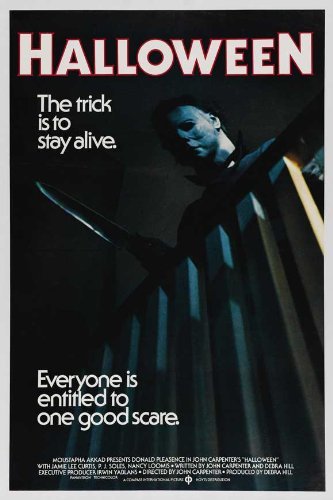
HALLOWEEN (1978) Four stars

There’s one particularly cherished moment from all the years watching HALLOWEEN.

Every time I have showed the film to friends and family, there’s one scene I patiently wait for with devilish anticipation.

I make internal bets with myself that it will work on everybody who’s seeing the movie for the first time, and it will even still work on those return viewers.

It’s a jump scare, one of the best ever filmed.

Every time, I would be taciturn leading up to this scene, not wanting to give a single thing away to my friends and family.

I wanted to see them jump, and I wanted to hear them scream.

It worked every single time.

It’s the scene where Dr. Loomis (Donald Pleasence) and Sheriff Brackett (Charles Cyphers) are discussing matters inside the old Myers house.

I won’t go any further than that.

Like the slasher films that followed, including its own many sequels, HALLOWEEN is a fun one to watch especially with several peers, but for slightly different reasons than the many, many, many followers and imitators.

First and foremost, director John Carpenter (in the words of Alfred Hitchcock) played the audience like a piano in HALLOWEEN. He’s the maestro and we love the music he’s playing, literally. The main theme in HALLOWEEN just stays with the viewer and in fact right now writing this review, I have that song playing over scenes from the first movie playing inside my head. Like other classics PSYCHO and JAWS, the music in HALLOWEEN added immeasurably to the film’s success.

Reportedly, Carpenter composed the theme in one hour, according to an interview he did for Consequence of Sound.

Carpenter discusses the movie and its music at some length on his official site: “HALLOWEEN was written in approximately 10 days by Debra Hill and myself. It was based on an idea by Irwin Yablans about a killer who stalks baby-sitters, tentatively titled ‘The Baby-sitter Murders’ until Yablans suggested that the story could take place on October 31st and HALLOWEEN might not be such a bad title for an exploitation-horror movie.

“I shot HALLOWEEN in the spring of 1978. It was my third feature and my first out-and-out horror film. I had three weeks of pre-production planning, twenty days of principle photography, and then Tommy Lee Wallace spent the rest of the spring and summer cutting the picture, assisted by Charles Bornstein and myself. I screened the final cut minus sound effects and music, for a young executive from 20th Century-Fox (I was interviewing for another possible directing job). She wasn’t scared at all. I then became determined to ‘save it with the music.’

“I had composed and performed the musical scores for my first two features, DARK STAR and ASSAULT ON PRECINCT 13, as well as many student films. I was the fastest and cheapest I could get. My major influences as a composer were Bernard Herrmann and Ennio Morricone (who I had the opportunity to work with on THE THING). Hermann’s ability to create an imposing, powerful score with limited orchestra means, using the basic sound of a particular instrument, high strings or low bass, was impressive. His score for PSYCHO, the film that inspired HALLOWEEN, was primarily all string instruments.

“With Herrmann and Morricone in mind, the scoring for HALLOWEEN began in late June at Sound Arts Studios, then a small brick building in an alley in central Los Angeles. Dan Wyman was my creative consultant. I had worked with him in 1976 on the music for ASSAULT. He programmed the synthesizers, oversaw the recording of my frequently imperfect performances, and often joined me to perform a difficult line or speed-up the seemingly never ending process of overdubbing one instrument at a time. I have to credit Dan as HALLOWEEN’s musical co-producer. His fine taste and musicianship polished up the edges of an already minimalistic, rhythm-inspired score.

“We were working in what I call the ‘double-blind’ mode in 1978, which simply means that the music was composed and performed in the studio, on the spot, without reference or synchronization to the actual picture. recently, my association with Alan Howarth has led me to a synchronized video-tape system, a sort of ‘play it to the TV’ approach. Halloween’s main title theme was the first to go down on tape. The rhythm was inspired by an exercise my father taught me on the bongos in 1961, the beating out of 5-4 time. The themes associated with Laurie (Jamie Lee Curtis) and Dr. Loomis (Donald Pleasence) now seem to be the most Herrmannesque. Finally came the stingers. Emphasizing the visual surprise, they are otherwise known as ‘the cattle prod’: short, percussive sounds placed at opportune moments to startle the audience. I’m now ashamed to admit that I recorded quite so many stingers for this one picture.

“The scoring sessions took two weeks because that’s all the budget would allow. HALLOWEEN was dubbed in late July and I finally saw the picture with an audience in the fall. My plan to ‘save it with the music’ seemed to work. About six months later I ran into the same young executive who had been with 20th Century-Fox (she was now with MGM). Now she too loved the movie and all I had done was add music. But she really was quite justified in her initial reaction.

“There is a point in making a movie when you experience the final result. For me, it’s always when I see an interlock screening of the picture with the music. All of a sudden a new voice is added to the raw, naked-without-effects-or-music footage. The movie takes on it’s final style, and it is on this that the emotional total should be judged. Someone once told me that music, or the lack of it, can make you see better. I believe it.”

HALLOWEEN, unlike its sequels and imitators, works from a minimalist base, with much fewer characters than the run-of-the-mill body count thriller for one prominent example of minimalism. HALLOWEEN gives us time with the characters, especially the three girls Laurie (Curtis), Annie (Nancy Loomis), and Lynda (P.J. Soles) and Dr. Loomis (Pleasence), and this is definitely to the film’s benefit. These characters take on a greater resonance than, for example, the gallery of grotesqueries in FRIDAY THE 13TH: A NEW BEGINNING, who only have a couple minutes of (largely) unpleasant behavior before their gruesome death scenes.

Carpenter and Hill found gold in Curtis: not only the daughter of Janet Leigh (PSYCHO) and Tony Curtis, but a great rooting interest who can be intelligent and resourceful and strong enough that we forgive her for the other moments that are standard in horror films, like (for just one example) her difficulty finding the keys with a madman bearing down on her. She’s pretty, as well, without it being overwhelming.

Annie and especially Lynda are pioneers of the Valley Girl speak, totally, and that might be one of the great sources of annoyance for anybody watching HALLOWEEN. Soles, though, is one of the more likable young actresses from that era, seen to even more effect in ROCK ‘N’ ROLL HIGH SCHOOL and STRIPES.

Likability is a key in the success of both HALLOWEEN and the first NIGHTMARE ON ELM STREET.

Dr. Loomis is the character lacking in any of the FRIDAY THE 13TH movies, for example. He’s just brilliant, brought to the life by the indelible screen presence of the late Pleasence (1919-95). His character commands our attention every time he steps onscreen and definitely every time he delivers that dialogue he keeps that attention, especially about Michael Myers and “pure evil.”

“I met him 15 years ago,” Dr. Loomis said. “I was told there was nothing left: no reason, no conscience, no understanding in even the most rudimentary sense of life or death, of good or evil, right or wrong. I met this … 6-year-old child with this blank, pale, emotionless face, and … the blackest eyes – the Devil’s eyes. I spent eight years trying to reach him, and then another seven trying to keep him locked up, because I realized that what was living behind that boy’s eyes was purely and simply … evil.”

` That’s one of the best monologues in any horror film (or any film period).

Monologues like that can sometimes bring the attached film to a halt, because we don’t want to hear this psychological jive talk recited by some hack actor at just that very moment. Please, shut the fuck up (Donnie).

For example, Simon Oakland’s jive talk late in PSYCHO drags us down a bit.

Honestly, though, I could have listened to Dr. Loomis talk all day.

Pleasence sells this dialogue with the conviction of his craft and I don’t know, I’ve always got the feeling that maybe Dr. Loomis is maybe just maybe a bit mad himself all these years working around Michael Myers.

You see this Dr. Loomis coming, and you just might head to the next city or county or perhaps country, because you know he’s trouble.

In horror films, often times authority figures do not believe the stories of teenage protagonists until it’s too late, but HALLOWEEN applies the slight twist to the formula by having authority figures question the story of another authority figure.

I love the way Carpenter and his team utilize Michael Myers in HALLOWEEN: he’s driving or standing around in the background of many early shots and combined with Dr. Loomis’ dramatic playing up of Myers in dialogue, he takes on mythic proportions. Paraphrasing from Dr. Loomis, this isn’t a man. He’s a shape, and a killing force. But we also get the sense that he’s childlike and in one of the great moments for any screen killer, Myers stands and admires his own craftmanship after one kill.

He’s far more interesting with far less back story, as the sequels beginning with HALLOWEEN II irrefutably proved.

Let’s see here, we have two great protagonists, one great killer (and one great weapon), and great music.

Seems like this is the beginning of a great horror movie.

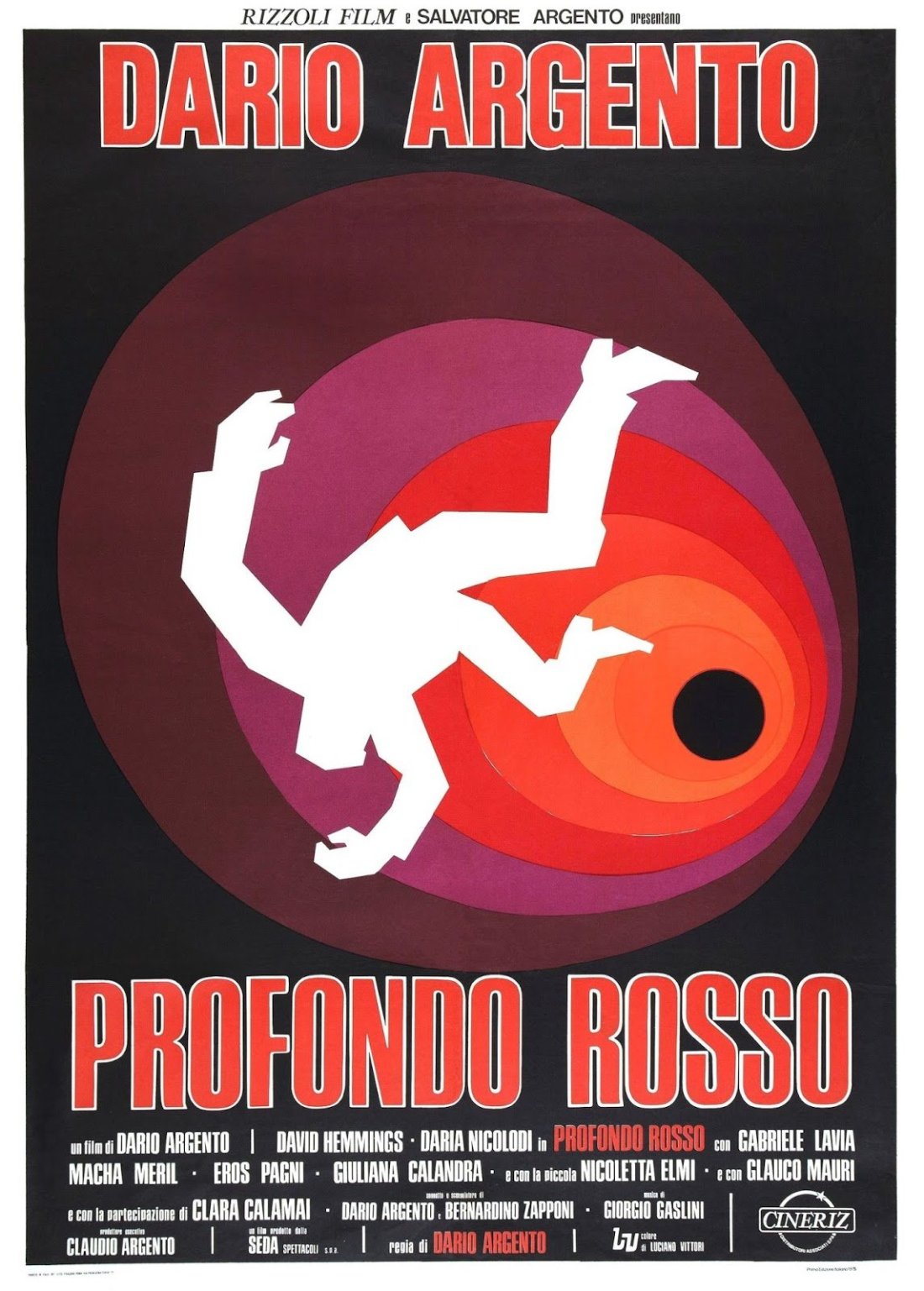
Profondo Rosso (1975)

DAY 25, DEEP RED.jpg

PROFONDO ROSSO (1975) Four stars
Giallo is the Italian word for yellow.

In fiction terms, though, quoting from Wikipedia, giallo means “a 20th century Italian thriller genre of literature and film. Especially outside Italy, giallo refers specifically to a particular Italian thriller-horror genre that has mystery or detective elements and often contains slasher, crime fiction, psychological thriller, psychological horror, exploitation, sexploitation, and, less frequently, supernatural horror elements. In Italy, the term generally denotes thrillers, typically of the crime fiction, mystery, and horror subgenres, regardless of the country of origin.”

An Italian publishing company named Mondadori began releasing crime and mystery novels in 1929 and the series became known as “Il Giallo Mondadori,” distinguished by their heavily yellow front covers. Especially popular were the works of Agatha Christie, Dashiell Hammett, and Raymond Chandler. Mondadori still prints “Il Giallo Mondadori” novels today.

Giallo movies started appearing in the mid-1960s and became a fixture especially in the late 1960s and 1970s through directors like Mario Bava, Dario Argento, and Lucio Fulci, who achieved the greatest international notoriety.

Argento’s PROFONDO ROSSO, also known as DEEP RED or THE HATCHET MURDERS, was the director’s fifth movie and it’s a transitional film, before Argento’s work verged on the fantastical like SUSPIRIA and INFERNO. It and THE BIRD WITH THE CRYSTAL PLUMAGE, his first film, are his best giallos.

Watching PROFONDO ROSSO for the first time, one will be struck by how much you feel like you’ve seen this movie before through later films it influenced such as John Carpenter’s HALLOWEEN and David Cronenberg’s SCANNERS. For example, Goblin’s main theme for PROFONDO ROSSO and Carpenter’s for HALLOWEEN are first cousins. Cronenberg modeled the lead-in to the famous head explosion scene after the early lecture sequence in Argento’s film. Rick Rosenthal’s HALLOWEEN II (produced by Carpenter) featured a death by scalding water scene inspired by Amanda Righetti’s death in PROFONDO ROSSO.

Like the best Argento films, PROFONDO ROSSO sticks with you.

Argento films usually give us a protagonist who’s a writer, a musician, a creative person of some form. In THE BIRD WITH THE CRYSTAL PLUMAGE, it’s American writer Sam Dalmas. In CAT O’NINE TAILS, it’s reporter Carlo Giordani. In FOUR FLIES ON GREY VELVET, it’s rock drummer Roberto Tobias. In PROFONDO ROSSO, it’s pianist Marcus Daly. In SUSPIRIA, it’s American dance student Suzy Bannion. In INFERNO, it’s music student Mark Elliott.

These characters provide us a rooting interest and keep us hanging on through all the convolutions of the plot. They become our surrogate, because they’re normality (just like us) in a mad, mad, mad world. They (and we) are just trying to survive another day. They live out our detective fantasies.

In any mystery, it’s vital that we find that rooting interest.

Argento protagonists normally get in way, way, way over their heads like the ones in Hitchcock films so often do … of course, we see David Hemmings playing Marcus Daly and we cannot help but think of Michelangelo Antonioni’s BLOW-UP, where Hemmings’ very Swinging London photographer believes he may have accidentally photographed a murder in a park. There’s no doubt, though, in PROFONDO ROSSO.

On his way home early in the film, Marcus sees psychic medium Helga Ulmann (Macha Meril) being attacked in her apartment. They live in the same building. He rushes up the stairs and down the hall to her apartment and finds her dead body.

The chief witness becomes the star witness, thanks to female reporter Gianna Brezzi (Daria Nicoladi) and her coverage of the murder, and the reporter and the pianist become partners, both in the romantic and detective sense.

PROFONDO ROSSO is one of those mysteries that rewards our interest to the very end.

Duel (1971)

duel

DUEL (1971) Three-and-a-half stars

24-year-old Steven Spielberg’s first feature film premiered November 13, 1971 on ABC.

Richard Matheson (1926-2013) wrote the script, based on his nightmarish experience on November 22, 1963 (the date of JFK’s assassination). A trucker tailgated Matheson on his return home following a golf match against friend and fellow writer Jerry Sohl. Matheson turned his experience into a short story that originally ran in Playboy.

Spielberg directed on a $450,000 budget and production ran 13 days, three days over schedule, and it played as the “ABC Movie of the Week” lasting 74 minutes. A later theatrical release covered nearly 90 minutes.

Spielberg wanted and got character actor Dennis Weaver (1924-2006). Of course, most of us know the Joplin-born actor for his work on TV series “Gunsmoke” and “McCloud,” but Spielberg admired Weaver for his work in Orson Welles’ TOUCH OF EVIL and in DUEL, Weaver’s character repeats a bit of verbal business from TOUCH OF EVIL. You got another think coming, indeed.

It’s a very basic premise at the center of DUEL: An unnamed truck driver stalks our protagonist David Mann (Weaver), a middle-aged salesman returning home from a business trip.

Mann passes the truck early on and that begins his 90-minute nightmare.

Oh sure, I bet you believe that driver sure as hell gets bent over being passed.

You might even say to yourself that it’s preposterous, but then again, in this day and rage, you might not.

I definitely believe that it’s not and I recall my own bizarre experience from November 2016.

“Driving home from work last night/this morning around 2 a.m., this car began following me from about the Highway 43/96 roundabout. It would creep up, then fall back and never pass despite multiple opportunities. There was no tailgating or attempt to run me off the road. A couple times, I looked back and the car swerved all over the place. At some point, I figured out it was definitely not a cop. That some point had already been reached when I turned on to Highway H toward Jasper, a destination 11 miles from Highway 43. I took a real slow, hesitant turn with a stop at the end and the creeper car behind me matched that slow, hesitant turn with a stop at the end. OK, it’s a creeper. We’re about halfway to Jasper when I turn into a random driveway. I sit in my car for a couple minutes, debating my next move. The car following me backs up a little bit and leaves me room to reverse and turn around. I see that it’s a dude driving the car. He’s alone. I back out, turn around, drive toward him, and engage him in what turned out to be one of the weirdest conversations I’ve ever known. But just like a character said to Inspector Harry Callahan in DIRTY HARRY, ‘I gots to know.’

“Anyway, I now know for sure what it’s like to have a conversation with someone orbiting Planet X. I could only understand bits and pieces of his stammered mutterings, something ‘bout him being from Wichita and then wanting to know if I wanted to make a contribution. No, sorry, I gave at the office.

“The Creepy Crawler: Thought we could talk for 10 minutes.

“Me: No, and we’ve already talked for 5.

“TCC: No, we haven’t.

“Me: It’s late and I just want to get home from working all night.

“(voice tails off quickly)

“TCC: So you don’t want to have a conversation?

“[I drive off into the sunset. No, wait, it’s 2 a.m. There’s no sunset. The sun rises in the opposite direction. Ah, hell, we’re not getting anywhere with this digression into stage direction.]

“Back on the road and that holy quest to make it home safe, I drove about 85 over those crazy little hills of Highway H until I reached Highway 43. No creeper. Very little active human life of any kind. Very few lights. I felt like saying, ‘It’s 30 miles to Arcadia, I’ve got a three-quarters full tank of gas, half a reporter’s notebook, it’s dark out and I am wearing a Star Wars T-shirt.’”

Watching it for the first time in full the other day, DUEL brought on a flashback to that 2016 incident and I certainly felt all the sympathy in the world for the plight of David Mann.

DUEL represented a test run for JAWS, Spielberg’s third feature. Both productions often masterfully exploit our fear of the unknown, but I’ll say that DUEL scares me more than JAWS because I drive a whole helluva lot more than I swim in the ocean.