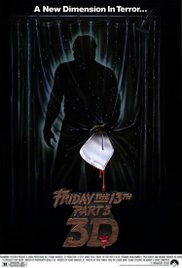
Friday the 13th Part III (1982)

DAY 30, FRIDAY THE 13TH PART III

FRIDAY THE 13TH PART III (1982) Three stars
On their movie review program “Sneak Previews,” Gene Siskel and Roger Ebert hated just about every slasher film (Ebert called them “Dead Teenager” movies) that came down the pike after HALLOWEEN. They lambasted MANIAC, THE BURNING, MADMAN, MY BLOODY VALENTINE, HE KNOWS YOU’RE ALONE, MOTHER’S DAY, and HAPPY BIRTHDAY TO ME (nearly all those picked “Dogs of the Week”), but seemed to save their greatest reserves of spleen for the FRIDAY THE 13TH series. That’s okay, they weren’t alone in condemning the series.

Coming of age in the late-1980s and early-1990s, slasher films played a formative role in my filmgoing experience. One way or another, I caught up with all the Jason, Freddy, Michael Myers, Chucky, et cetera, movies. Why were these films so popular amongst young people? Must have felt that we were rebelling against the decorum set for us young people by our elders. Also sure that we were reveling in the forbidden.

PART III was my very first FRIDAY THE 13TH movie (saw it about 30 years ago) and that must contribute to why it’s among my favorites in the series all these years later.

It’s not a good movie in any traditional way shape or form and it has a lot of the same underlying problems as the other movies in the long-running series, but it’s very entertaining and silly at least until the body count starts piling up. Hey, let’s face it, though, we don’t watch movies like FRIDAY THE 13TH for the same reasons that we watch other movies. We go for the body count, No. 1, then the other exploitation movie elements like gore, nudity, and general vulgarity. The characters are often superficial archetypes, the dialogue is nothing to write home about, and it’s all very predictable. To some degree, we like it that way.

With it being originally filmed in 3-D, that only adds to the silliness of PART III because there must be at least 50 gimmick shots for the sake of the 3-D, including ones where Jason squeezes our male protagonist’s head until his eyeball heads straight for us and Jason’s first kill wearing his iconographic hockey mask. Additionally, we have a disco variation on Harry Manfredini’s score over the gonzo opening credits and some new character archetypes for the slaughter, like a married couple with the male partner suggesting Tommy Chong and a would-be motorcycle gang who gives Jason his first opportunity to kill outside his race.

Just keep in mind the FRIDAY THE 13TH movies have a transcendent appeal; for example, Kim Jong-il (1941-2011) loved him some Jason along with Rambo and Godzilla and rapper Big Daddy Kane used Jason for a rhyme in “Ain’t No Half Steppin.'”

For whatever reason, PART III generates more suspense than any other entry in the series. Steve Miner, assistant director on the first movie, remains the only person to direct more than one installment and that just might be the difference maker. Miner directed PART 2 and PART III.

I mentioned problems and there’s about 10 minutes of my life (multiplied by every time I see this sequence unless I fast-forward) that I will never get back when Jason dispatches Harold and Edna early in the movie, two unfortunate proprietors of a lakefront store. I call this hallmark of the genre “filler killings,” ones that pad running time or serve a body count (PART V fills that bill) and no greater purpose to the movie as a whole. Of course, haters of the genre would say that “filler killings” describe the entire movie.

Also, we have another shock ending that’s only shocking in just how non-shocking it turns out to be. Just about every slasher film in the era had a shock ending. This one almost defies belief.

Larry Zerner, who plays the asshole prankster Shelly, became an entertainment lawyer and Tracie Savage covered the Heidi Fleiss and O.J. Simpson trials as TV reporter, so undoubtedly PART III both served them well in their later careers.

Jason acquires his trademark hockey mask from Shelly. Jason’s played in PART III by British trapeze artist Richard Brooker, who apparently believed that playing a psychopathic killer was his entry way into a successful movie career. “It felt great with the mask on,” Brooker said. “It just felt like I really was Jason because I didn’t have anything to wear before that.”

After his screen debut as Jason, Brooker (1954-2013) appeared in DEATHSTALKER, “Trapper John, M.D.,” and DEEP SEA CONSPIRACY. Brooker later went into TV directing, for example “Bill Nye the Science Guy.” A fan-made documentary FRIDAY THE 13TH: THE MEMORIAM DOCUMENTARY appeared on YouTube in early 2018, which memorialized Brooker by interviews with FRIDAY THE 13TH luminaries and an on-screen dedication to his memory.

Final girl Dana Kimmell appeared in the Chuck Norris action spectacular LONE WOLF McQUADE after FRIDAY THE 13TH PART III. There’s a meme out there, “Chris Higgins survived her encounter with Jason because Chuck Norris wanted Chris Higgins to survive her encounter with Jason.” That’s great and everything, but there’s an alternate ending to PART III where Jason decapitated Chris (Kimmell).

Still, that gets me thinking about what would happen if Chuck Norris met Jason Voorhees in a movie.
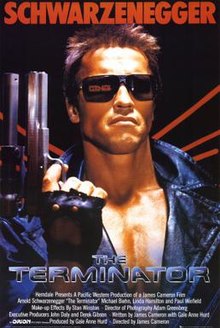
The Terminator (1984)

DAY 29, THE TERMINATOR

THE TERMINATOR (1984) Four stars
James Cameron said that John Carpenter’s HALLOWEEN inspired him to make THE TERMINATOR, and it’s easy to see that with Arnold Schwarzenegger’s T-800 and Michael Myers, both (virtually) unstoppable killing machines.

Apparently, while in Rome around the time of PIRANHA II: THE SPAWNING, Cameron had a dream about a metallic torso equipped with kitchen knives in hand and dragging itself from an explosion, which almost sounds exactly like a scene late in THE TERMINATOR. This dream became the basis for the film.

Then again, late author Harlan Ellison (1934-2018) claimed that Cameron was inspired by Ellison’s 1964 Outer Limits episode “Soldier” (adapted from Ellison’s own short story) where a future soldier goes back in time to save a present-day woman from another future soldier. I believe Ellison (although he liked the movie) used that nasty ‘P’ word, plagiarism. Ellison received a financial settlement from Hemdale and Orion Pictures, and home video releases of THE TERMINATOR subsequently read “The Producers Acknowledge the Works of Harlan Ellison.”

THE TERMINATOR benefits greatly from the casting of the central roles: Schwarzenegger as the literal force of death and destruction, Michael Biehn as the feisty freedom fighter of the future brought back to the present Kyle Reese, and Linda Hamilton as the present-day young woman Sarah Connor who initially can’t quite believe that she’s in the middle of such a ridiculous plot until Reese (and the corpses) convince her. They fit the roles to a T.

Schwarzenegger has largely played heroic characters and in fact, he’s on the good side for the rest of THE TERMINATOR series. Playing the villain, though, he benefits greatly from speaking few lines (keep in mind his first movie, HERCULES IN NEW YORK, dubbed Schwarzenegger); granted, we have less of the great humor that permeates COMMANDO, PREDATOR, and TOTAL RECALL, but it’s still there with Schwarzenegger as villain with his infamous line “I’ll be back,” for example.

That good spirit and joy of performance still comes through for Schwarzenegger in THE TERMINATOR.

Schwarzenegger plays a more interesting variation on Michael Myers and Jason Voorhees, because those roles in theory can be played by anybody. (Please don’t tell that to Ted White or Kane Hodder.)

Reese explains the situation to Sarah Connor, “That Terminator is out there! It can’t be bargained with. It can’t be reasoned with. It doesn’t feel pity, or remorse, or fear. And it absolutely will not stop … ever, until you are dead!”

Schwarzenegger originally read for the Kyle Reese role and Cameron wanted Lance Henriksen to be the Terminator. Wow, Henriksen as the Terminator just boggles the mind, although Cameron used Robert Patrick to great success as T-1000 in TERMINATOR 2: JUDGMENT DAY. Kristianna Loken as T-X in TERMINATOR 3, well, let’s just say epic fail.
Biehn works better in the Reese role because of all the dialogue and in some ways, he’s like Donald Pleasence’s Dr. Sam Loomis in HALLOWEEN. He understands T-800, even though, of course, nobody believes him until it’s too late.

The Dr. Silberman character (Earl Boen) gets one great scene interrogating Reese and then playing the video back for the Paul Winfield and Henriksen police characters. Dr. Silberman just got out of the police station in the nick of time, and he returns for the sequel.

THE TERMINATOR works as horror movie, as science fiction, and as action, in a streamlined combination of some of the best aspects of HALLOWEEN, BLADE RUNNER, and THE ROAD WARRIOR.

On top of all that, we have a great love story and this element gives THE TERMINATOR the slight edge over JUDGMENT DAY.

Just that scene alone when Reese explains why he accepted the assignment to come back through time and save Sarah Connor, mother of a future resistance leader.

“John Connor gave me a picture of you once,” Reese said. “I didn’t know why at the time. It was very old … torn, faded. You were young like you are now. You seemed just a little sad. I used to always wonder what you were thinking at that moment. I memorized every line, every curve. … I came across time for you, Sarah. I love you; I always have.”

When you go see a movie called THE TERMINATOR, bet you weren’t expecting a genuinely touching love story.

It’s the element of the unexpected that makes for the most rewarding experiences, movies or in general.

Suspiria (1977)

DAY 24, SUSPIRIA

SUSPIRIA (1977) Four stars
This is one of those rare films where what would normally be weaknesses actually turn out to be strengths and help the film become a seminal work.

For example, older actors playing high school students (Jessica Harper and Stefania Casini were both in their late 20s) and dubbing only add to the weirdness and disorienting nature of SUSPIRIA, director and writer Dario Argento’s first installment in the “Three Mothers” trilogy.

SUSPIRIA is first and foremost a visceral experience, a treat for the eyes and the ears with first-rate production and sound design. It was one of the last films to use imbition Technicolor (used previously for THE WIZARD OF OZ and GONE WITH THE WIND) and it looks absolutely marvelous with its vivid colors.

You won’t be able to keep your eyes off the screen, even if you want to cover them during some of the more squeamish moments. Just remember the film’s tagline: “The only thing more terrifying than the last 12 minutes of this film are the first 92.”

Italian progressive rock band Goblin, who previously scored Argento’s 1975 classic giallo DEEP RED and later scored TENEBRE (1982), adds tremendously to the disorientating effect; Goblin’s scores for DEEP RED and SUSPIRIA rank with John Carpenter’s main HALLOWEEN theme and Bernard Herrmann’s work for Alfred Hitchcock’s thrillers.

Disorientation is what SUSPIRIA achieves thematically above anything else. We’re never quite sure what’s going to happen next, despite the fact that we think we know what to expect, even in an Argento movie, from all our experience watching scary movies. We know that everything will be heightened in an Argento movie, just like other Italian horror movies by such maestros as Mario Bava and Lucio Fulci.

However, like a lot of those other films, all the elements in SUSPIRIA work together even if logically nothing makes any sense in the moment.

Urban Dictionary lists SUSPIRIA as “One of the greatest movies ever made — Dario Argento’s 1977 horror film, about a young girl at a German dancing academy, who discovers that the faculty are witches, plotting against her life in a series of ritual voodoo killings, involving sacrifices and vestal virgins on a pagan altar. … I first saw SUSPIRIA at the age of 10, and was terrified.”

Guess that’s one way to use “Suspiria” in a sentence.

NOTE: The 2018 remake directed by Luca Guadagnino was released October 26. The movie stars Dakota Johnson and Tilda Swinton, as well as Jessica Harper and Chloe Grace Moretz, and Thom Yorke (Radiohead) provided the soundtrack.

Jaws 2 (1978)

JAWS 2

JAWS 2 (1978) Two stars
When you watch JAWS 2, you just get the feeling that human star Roy Scheider wasn’t a happy camper during the film’s production.

Then you read more about the film and you find out that it’s true.

Scheider had a multi-picture agreement with Universal, makers of the JAWS films, and when he left THE DEER HUNTER, Universal made a deal with Scheider that if he did JAWS 2, it would be counted as the two films remaining on his contract. Fundamental problem: Scheider did not want to appear in JAWS 2.

We can feel Scheider’s resentment on the screen.

Scheider clashed with director Jeannot Szwarc to the point that it produced a physical confrontation between the men. They even carried it over into letters.

Scheider: “Working with Jeannot Szwarc is knowing he will never say he is sorry or ever admitting he overlooked something. Well, enough of that shit for me!”

Szwarc: “Time and pressure are part of my reality and priorities something I must deal with.

“You have been consulted and your suggestions made part of my scenes many times, whenever they did not contradict the overall concept of the picture.

“If you have to be offended, I deplore it, for no offense was meant. At this point in the game, your feelings or my feelings are immaterial and irrelevant, the picture is all that matters.”

When you’re watching JAWS, you don’t get the sense of a troubled production.

We do throughout JAWS 2.

Despite all that behind-the-scenes hullabaloo, also including a change of director and more technical difficulties with that damn mechanical shark, JAWS 2 became a huge financial success as it racked up nearly $78 million at the box office. Why? A hard sell advertising campaign centered around the immortal tagline “Just when you thought it was safe to go back in the water”; “Merchandising, merchandising, where the real money from the movie is made,” in the words of SPACEBALLS; and, let’s face it, at that point in time, folks wanted more of the shark and JAWS 2 delivers “more shark.”

In fact, I give the shark in JAWS 2, oh, let’s see here, three stars, maybe three-and-a-half stars on a charitable day.

The people in JAWS 2, though, sink to one star.

Averaging out both numbers gives JAWS 2 two stars.

Yes, the characters in JAWS 2 (and the following sequels) suck.

The fundamental difference between JAWS and its sequels: JAWS gives audiences three great characters in Chief Brody (Scheider), Matt Hooper (Richard Dreyfuss), and Quint (Robert Shaw). Amity mayor Larry Vaughn (Murray Hamilton), why he’s not too far behind. You care about the characters in JAWS.

Brody and Vaughn return in JAWS 2, but they’re competing against the shark and other less interesting human characters.

Instead of the core of adults in JAWS, we have an endless array of teeny boppers in JAWS 2 who just can’t hold a candle to Hooper and Quint. Dreyfuss did not return for the sequel, as he and JAWS director Steven Spielberg made CLOSE ENCOUNTERS OF THE THIRD KIND. And it’s quite obvious why Quint’s not back for JAWS 2.

All we need to know about the plot of JAWS 2 is that it’s the namesake of “The Jaws 2 Syndrome,” or when a sequel repeats the worst element of the original movie. We all know that Chief Brody will have to take out the shark, but the ringer it runs him through en route does more than try our patience, it’s blowed up real good.

Jaws: The Revenge (1987)

JAWS THE REVENGE

JAWS: THE REVENGE (1987) No stars

Just when you thought it was safe to see a JAWS movie again.

In the JAWS III review, we discussed the Idiot Plot.

That’s when all the characters have to be idiots to propel the plot forward.

Now, with JAWS: THE REVENGE, we have under consideration another idiotic plot.

I mean, if you’ve never seen this one, you better get that suspension of belief ready for the workout of its life.

You will need every single bit of it for a plot where not only does a shark pursue revenge against a single family — them poor Brodys from Amity Island — but this shark follows said familial unit all the way from New England to the ol’ Bahamas after the shark dispatches widow Ellen Brody’s youngest son in the opening sequence.

Maybe it’s another shark who owes the New England shark something fierce and so he carries out the New England shark’s vendetta against one family. The New England shark just dials up the Bahamas shark and gives him the assignment over the phone.

Maybe the New England shark found the Bahamas shark’s number on a bathroom wall in a watering hole, a genuine dive.

Going back a couple paragraphs, yes, it’s true that our New England shark sets a trap for Sean Brody (Mitchell Anderson), who’s a policeman just like dear old Martin Brody. Sean survived a shark in three previous JAWS installments, but not in this one where he’s outsmarted by a (mechanical) shark. This is just plain ridiculous, but it does prepare us for the ridiculousness ahead.

On his JAWS Wiki entry, “Devoured by Vengeance” is listed as Sean’s cause of death.

Oh, by the way, we might as well get this bit of trivia out of the way before we move on to bigger fish, but four different actors play Sean and Michael Brody in the JAWS series.

Jay Mello played Sean in JAWS, followed by Marc Gilpin in JAWS 2, John Putch in JAWS III, and Anderson in THE REVENGE.

The higher-profile character Michael gets higher-profile actors for at least a couple movies in Dennis Quaid in JAWS III and Lance Guest in THE REVENGE. Chris Rebello and Mark Gruner had the honor in JAWS and JAWS 2, respectively.

Just some random thoughts:

— You might wonder how in the world Lorraine Gary could possibly get top billing. She’s terrible in this movie, for crying out loud.

Well, let’s see, she was married at the time to Universal Studios boss Sidney Sheinberg. (Gary, now 81 years old, and Sheinberg were married for more than 62 years, until he passed away March 7, 2019, at the age of 84.)

Gary came out of retirement for THE REVENGE. Her first feature was the first JAWS and her last was THE REVENGE.

Looking at her movie credits, an earlier role describes Gary’s acting in her last feature.

In CAR WASH, Gary played the “Hysterical Lady,” obvious training for THE REVENGE.

Of course, if you’re terrified by sharks like a curse down the generations, one might argue that it’s justification for being hysterical.

Nah, if the Brodys moved to Kansas, for example, their problem would be solved and their life expectancy would probably be elongated by many years.

Instead, they go back in the ocean. Every single time.

— We get a very awkward romance between Ellen and Hoagie, played by Michael Caine, so we have the first shark movie suitable for geriatric consumption.

Filming THE REVENGE caused Caine to miss the 1987 Oscar ceremony,  where he earned Best Supporting Actor for HANNAH AND HER SISTERS.

Caine did give us a great quote about THE REVENGE, “I have never seen it, but by all accounts it is terrible. However, I have seen the house that it built, and it is terrific.”

Hoagie, a charter pilot who carries Michael Brody and his dear friend Jake (Mario Van Peebles) to their shark rendezvous, crash-lands his plane late in the movie in the ocean and he’s submerged. Of course, for a split-second, we think he’s shark chow, especially when our great revenge seeker devours his plane.

Not only does Hoagie survive this close encounter of the shark kind, but when he climbs aboard the ship, he’s completely dry and looks freshly laundered.

Apparently, Caine’s explanation for this epic continuity error was that the filmmakers waited so long for the camera to turn over that Caine’s shirt and pants dried in the sun.

— Honestly, THE REVENGE plays like one continuous error.

I mean, what can you say about a movie where the best thing you can say about it is that the children’s choir gives a good performance. Oh, I forgot to mention, shame on me, THE REVENGE takes place around Christmas. Yeah, sure, it’s the gift that keeps on giving.

Mario Van Peebles chose a laughable accent.

THE REVENGE abuses “It’s Only A Dream” scenes.

Multiple endings exist for this movie, one where Van Peebles survives and the other where his character dies. I’ve seen both, and either way, it doesn’t really matter.

Characters have flashbacks to events where they were not present.

Back to the shark. This one is a doozy, and for even more reasons than what’s already been covered within this space. “Bruce the Shark” roars. Maybe he’s in pain. Maybe he couldn’t believe what he did for the money. Maybe he’s mad that he looks faker than ever before. He even swims backwards, probably in an effort to escape THE REVENGE. Isn’t that how one of the explorers went around the world?

Believe it or not, THE REVENGE finds an even more ridiculous way to kill the shark than the previous entries.

You know what, I do believe that we can believe it with this particular movie.

Jaws III (1983)

JAWS III (1983) One star
In the movies, three is most often not a magic number.

In the movies, three is most often not a magic number.

In the movies, three is most often not a magic number.

Were the second and third entries less interesting than the first?

Of course, they were and that principle applies to sequels like, for example, JAWS III, a long, long way down from the original JAWS directed by Steven Spielberg.

JAWS: THE REVENGE pretended JAWS III — originally titled JAWS 3-D — never happened and that’s something I would like to do with both movies.

Nah, I take it back, because I enjoy both movies for their epic badness. I’ve watched both whenever I’ve had the chance and I hope that I will always be able to marvel once again at their incredible ineptitude.

In the business, they have what’s known as the Idiot Plot or that’s when everything would be figured out much sooner if the characters were not complete idiots.

In JAWS III, it takes our protagonists incredibly long to figure out that our Great White Mother’s inside the park.

I chortle when female protagonist Kathryn Morgan (Bess Armstrong) says the following dialogue, “Overman was killed inside the park. The baby was caught inside the park. Its mother is inside the park.”

This dramatic moment instead plays comedic.

Honestly, though, I live for that moment partially because earlier Morgan explains the bite radius, a plot detail essential to any JAWS film. Right, JAWS: THE REVENGE?

There’s a couple more favorite moments in JAWS III that I will try and get through sooner or later within this review.

Now, however, I’ll go through some of the problems with JAWS III one-by-one. We already hit the Idiot Plot, the film’s biggest problem.

— Weak characters: The original JAWS featured three great characters in Sheriff Brody (Roy Scheider), Hooper (Richard Dreyfuss), and Quint (Robert Shaw). Brody returned in JAWS 2 — Universal had Scheider by the balls and made him do JAWS 2 — and there’s not a single great character in JAWS III or JAWS: THE REVENGE. Not a one.

— Weak shark: In JAWS 2, the shark stood out more than any human character, including Sheriff Brody and Mayor Larry Vaughn. Especially them darn insipid teenagers. Not in JAWS III. The Great White Mother in JAWS III does not approach the ridiculousness of the fourth JAWS entree, but a plot that has a mother shark taking revenge for her son, why that’s just preposterous and plain out-of-character for a shark. I might owe ORCA THE KILLER WHALE (1977) an apology.

— Weak big moment: Let’s briefly set this one up. It’s late in the movie and Morgan and her love interest Mike Brody (Dennis Quaid), park manager Calvin Bouchard (Louis Gossett, Jr.), and two park technicians are inside the control room. Of course, here comes the Great White Mother and it’s obviously going to crash through the glass in full-on 3D glory. Here it comes … here it comes … here it comes … 2D anticlimax! I don’t know what else to say but this scene’s even more laughable than our great-shark-inside-the-park-revelation scene, especially with Morgan and Brody’s priceless slow-motion reactions leading up to the shark’s crash.

— Them damn dolphins: Yes, Cindy and Sandy, who are worse than our teeny boppers from JAWS 2, believe it or not. Granted, to their credit, Cindy and Sandy figure out the plot faster than anybody else in the movie. Cindy and Sandy (a.k.a. “The Shrieking Dolphins”) went up against some tough competition at the 1984 Razzies for Worst New Star — Finola Hughes in STAYING ALIVE, Reb Brown in YOR, THE HUNTER FROM THE FUTURE, Loni Anderson in STROKER ACE, and the grand prize winner Lou Ferrigno in HERCULES.

Okay, okay, that’s enough for now.

I’ll close on what I consider to be the great mystery from JAWS III.

Does anybody out there know what the following dialogue even means: “You tell Shelby Overman for me he can take a flyin’ leap in a rollin’ doughnut on a gravel driveway, you hear?”

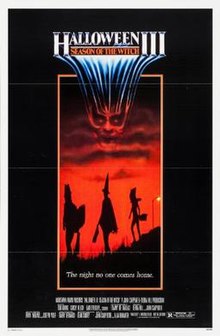
Halloween III: Season of the Witch (1982)

HALLOWEEN III

HALLOWEEN III: SEASON OF THE WITCH (1982) One star

The late critic Roger Ebert (1942-2013) took a lot of heat from readers for his review of HALLOWEEN III, mainly because his review contained glaring factual errors, including the biggie that Michael Myers was in HALLOWEEN III. Even those who agree with his basic finding that HALLOWEEN III sucks wish that Ebert had written a better review.

Recently, a Facebook post on a cult and exploitation film group referenced Ebert’s HALLOWEEN III review from one of his video companion books as just one more reason why the critic sucked. Going back nearly five years ago, the “Halloween III: Season of the Witch Appreciation” group posted his entire review. Would it be too much to say get over it? I mean, I hope Ebert never looked back and moved on past HALLOWEEN III.

Here’s the part, though, referencing Myers: “It begins at the end of HALLOWEEN II, when the monster was burned up in the hospital parking lot, but it’s not still another retread of the invincible monster. In fact, the monster is forgotten, except for a lab technician who spends the whole movie sifting through his ashes.”

Here’s what I find most fascinating: There’s a “Halloween III: Season of the Witch Appreciation” group. Certain fans of the film stick up for it very, very, very intensely and go after those who do not believe in their cult favorite, a phenomenon that also exists with other flicks like, for example, HOWARD THE DUCK. Be careful, very very very careful indeed, when expressing a “negative” opinion these days about somebody’s misunderstood, neglected cult favorite.

As one might gather from the star rating, I think HALLOWEEN III sucks. Yeah, I said it, just like how Rodney Dangerfield said it during CADDYSHACK. (HALLOWEEN III fans believe their movie’s been treated like Dangerfield’s most famous line.)

At just about this moment in time, somebody might be saying that I just don’t understand the conceptual brilliance throughout HALLOWEEN III.

No, believe me, I get HALLOWEEN III, I understand it, hell I even admire it for trying something completely different than being just one more damn assembly line horror movie sequel, I think it fails miserably.

I find HALLOWEEN III to be a drag, a real downer of a movie, redeemed only somewhat by two performances, including one by veteran Irish character actor Dan O’Herlihy as diabolical villain Conal Cochran, the world’s greatest practical joker. Though I enjoyed O’Herlihy more in both THE LAST STARFIGHTER and ROBOCOP, he brings that same ebullient spirit to HALLOWEEN III. He’s just like a James Bond super villain.

Unfortunately, though, I would be hard-pressed to name a main protagonist in any horror movie I like less than Dan Challis in HALLOWEEN III. Maybe somebody from THE AMITYVILLE HORROR series, perhaps. It’s no coincidence that HALLOWEEN III co-writer and director Tommy Lee Wallace also wrote AMITYVILLE II: THE POSSESSION (1982), giving him the distinction of being involved with two of the most unpleasant mainstream horror films I’ve ever seen. Both films come from the Dino DeLaurentiis Corporation. Not sure if there’s an “Amityville II: The Possession Appreciation” group in this great big world.

Challis, getting back on track, he’s played by Tom Atkins. I do like Atkins, especially in the cult favorite NIGHT OF THE CREEPS. He’s traditionally a supporting actor, but I don’t think Atkins proved himself up to the task of being the lead actor. He’s too much of a creep in HALLOWEEN III.

Because of that, HALLOWEEN III features one of the most awkward, most unbelievable, and creepiest love scenes in history between Atkins and Stacey Nelkin.

I do believe Ebert nailed it on Nelkin: “The one saving grace in HALLOWEEN III is Stacey Nelkin, who plays the heroine. She has one of those rich voices that makes you wish she had more to say and in a better role. But watch her, too, in the reaction shots: When she’s not talking, she’s listening. She has a kind of rapt, yet humorous, attention that I thought was really fetching. Too bad she plays her last scene without a head.”

Though enjoying both Nelkin and O’Herlihy (file them under good performances in bad movies), the majority of the movie bludgeons me over the head every few minutes with a gory murder scene involving characters I don’t give a damn about. This is one of those movies where you apply ice to the back of your head after it’s over because it’s been hitting you for 100 minutes.

In a nutshell, we have mostly unpleasant characters in unpleasant situations, topped off by ultra-annoying commercial jingles for Silver Shamrock (I get that it’s the point of these jingles) and plots and scenes recycled wholesale from better movies like INVASION OF THE BODY SNATCHERS (1956 version) and James Bond.

Other than that, how was the play, Mrs. Lincoln?

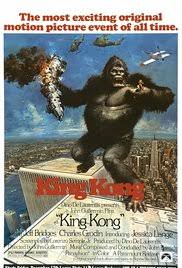
King Kong (1976)

KING KONG 1976

KING KONG (1976) Three-and-a-half stars
Of course this 1976 KING KONG cannot hold a candle to the 1933 version, one of the all-time screen classics.

If and when you and I can get past that fact, admittedly not an easy hurdle, the 1976 version stands out for being a great entertainment.

Jeff Bridges and Jessica Lange are improvements over Bruce Cabot and Fay Wray, respectively, in the male and female leads and Charles Grodin’s not far below what Robert Armstrong did in a similar role.

Of course, you can immediately tell when this movie was made by all the contemporaneous dialogue (especially from Lange) and Grodin plays an executive with Petrox Corporation, a fictional American oil company referencing the “pet rock” phenomenon. This KONG is more bound to 1976 than the original is to 1933.

Beset with production issues of a wide variety, including a complicated legal battle between Paramount, Universal, RKO, and the Cooper estate before filming even started (at one point, both Paramount and Universal had KONG projects lined up), and a first-time leading lady, as well as practical effects that often look more dated than what Willis O’Brien accomplished in 1933, KONG 1976 still works on a basic level.

It is fun.

The stories around the film, though, are more interesting than the finished product and help explain why the hype for the film took on epic proportions before its December 17 premiere.

Italian producer Dino DeLaurentiis (1919-2010) had the Carl Denham quotes in real life: “No one cry when JAWS die,” he said in Time. “But when the monkey die, people gonna cry. Intellectuals gonna love Kong. Even film buffs who love the first Kong gonna love ours.”

Or how about this one about Barbra Streisand told by Roger Ebert: “It’s-a no good, have two monsters in one movie.”

Unfortunately, when Meryl Streep auditioned for the Jessica Lange part, Dino said to his son in Italian that she was “too ugly” for the role; Streep understood Italian and replied in Italian to Dino, “I’m sorry I’m not beautiful enough to be in KING KONG.” We are printing legends, and that only seems appropriate for KING KONG.

Dino talked more smack about JAWS with ORCA THE KILLER WHALE (1977).

Gotta love Dino, whose mouth bit off more than his productions could chew.

Rather than Universal’s competing KONG movie (not released until Peter Jackson’s remake in 2005), the public first received A*P*E, an American / South Korean co-production with its Grade Z special effects, an early appearance for future TV mother Joanna (“Growing Pains”) Kerns, and an infamous shot where the ape uses the middle finger to show his disgust with the helicopters shooting at him.

Either that or he’s just showing his disgust at being trapped in that damn gorilla suit in a shitty movie.

A*P*E would later be topped, in the KING KONG ripoff department, by the Shaw Brothers’ MIGHTY PEKING MAN, the best of the King Kong ripoffs.

There’s also KING KUNG FU from 1976, where a gorilla trained in martial arts wreaks havoc on Wichita, Kansas. Financial constraints forced the makers into not being able to finish their film until 1987.

A*P*E invaded movie screens in October 1976, beating DeLaurentiis’ KONG by a good two months. MIGHTY PEKING MAN came out April 10, 1977, and Quentin Tarantino’s Rolling Thunder Pictures re-released the film on April 23, 1999.

Carlo Rambaldi, Glen Robinson, and Frank Van der Veer won a Special Achievement Award from the Academy of Motion Picture Arts and Sciences for the visual effects in KING KONG, believe it or not.

Legendary make-up artist Rick Baker played Kong, or he’s the man in the ape suit. The original plan had been for KONG ’76 to feature a 40-foot high mechanical ape, but that mechanical monster worked even less than Bruce the Shark in JAWS. JAWS director Steven Spielberg worked around the frequent mechanical failure to make an even better film than if the mechanical shark had been fully operational.

That’s not exactly the case with KONG ’76, partially because musical cues would not be a proper substitute for an ape like John Williams’ musical score proved to be for the shark or even Harry Manfredini’s score for the psycho killer in FRIDAY THE 13TH.

In other words, you have to see the ape.

“KING KONG offered the one chance to do a really perfect gorilla suit,” Baker said. “With the money and the time, it could have been outstanding. Unfortunately, it wasn’t. There were compromises and enforced deadlines.”

Let’s face it, KONG director John Guillermin, he’s no Spielberg.

At the same time, though, I give KONG ’76 and JAWS both three-and-a-half stars. Why?

A) Because life (and my brain) work in mysterious ways.

B) Because star ratings are basically arbitrary.

C) Because both films tap into the same primordial appeal and work as great entertainments for a couple hours each.

Alligator (1980)

ALLIGATOR

ALLIGATOR (1980) Three stars
At the three-quarters mark of the 20th Century, beginning June 20, 1975, the JAWS phenomenon changed the game forever.

Since then, we’ve seen a deluge of killer shark pictures and Nature Attacks flicks, not to mention summer blockbuster after summer blockbuster.

Two of the best films in the JAWS mold are Joe Dante’s PIRANHA (Steven Spielberg himself endorsed PIRANHA) and Lewis Teague’s ALLIGATOR, both written by John Sayles.

Sayles’ surprisingly witty script for ALLIGATOR starts with the urban legend about what happens if you flush a pet alligator down the toilet. Of course, Ramon — our alligator — grows to gigantic proportions by feeing off discarded animal corpses spiked with growth hormones. Awesome sewer chow, no doubt, for a growing boy alligator.

We’ll go through a couple more examples of the film’s wit.

Ramon’s first victim, why he’s named Edward Norton. We all remember Ed Norton from “The Honeymooners” and his occupation. “Ol Ed Norton, reliable ol’ Ed Norton, working 17 years in the sewer. And now everything’s down the drain.” I believe Mr. Norton talked about them damn alligators in the sewer.

Late in the movie, graffiti on the sewer wall states “Harry Lime Lives.” Fans of the late show might remember Harry Lime’s fate in THE THIRD MAN. I wonder if Orson Welles ever caught this cinematic tribute before his 1985 death.

ALLIGATOR has a great cast, very distinguished for a B-movie indeed, and Ramon munches on some big names. This is all part of the fun, watching these actors chew the scenery before they’re chewed up by a giant alligator.

Dean Jagger (1903-91) won an Academy Award for Best Supporting Actor for his performance in TWELVE O’CLOCK HIGH (1949). ALLIGATOR marked Jagger’s last feature film; Jagger died in both his last two features, this one and GAME OF DEATH. What a way to go out!

Jack Carter (1922-2015) plays the weasel mayor who finds his reelection campaign deadly. Carter made his name being a comedian’s comedian, but he’s no laughing matter in ALLIGATOR. The Mayor certainly received no support from Ramon, though.

Sydney Lassick (1922-2003) proved to be one of those memorable character actors. You might remember him best from ONE FLEW OVER THE CUCKOO’S NEST; he played Cheswick, who tells Nurse Ratched, “Rules?! Piss on your fucking rules, Miss Ratched! I want you to know something right here and now, Miss Ratched! I’m no little kid! I ain’t no little kid!” We all can relate.

Henry Silva (who turned 90 in 2018) plays arrogant big game hunter Brock and we all know what happens to arrogant big game hunters in pictures like ALLIGATOR. Silva accumulated 138 acting credits from 1950 through 2001, and he could tell us about Frank Sinatra, Burt Reynolds, Chuck Norris, Steven Seagal, and Forrest Whitaker, not to mention Alfred Hitchcock, John Frankenheimer, and Jim Jarmusch.

Baby face Perry Lang — in his early 20s at the time — made 1941, ALLIGATOR, and THE BIG RED ONE within a year’s period.

Robert Forster and Robin Riker play our main protagonists, he a frazzled police detective with a troubled past and she a perky herpetologist who once was the proud owner of poor Ramon. Forster’s a legitimate good actor and that serves ALLIGATOR well.

Michael V. Gazzo (1923-95), another veteran character actor, plays the crusty but lovable police chief and you might remember Gazzo from THE GODFATHER PART II as Frankie Pentangeli. Gazzo received a nomination for Best Supporting Actor for his work in THE GODFATHER PART II.

I just wish they could have found a role for Keenan Wynn (1916-86), whose characters met their demise in both ORCA THE KILLER WHALE and PIRANHA.

ALLIGATOR proves to be a lot of fun.

Q: The Winged Serpent (1982)

Q

Q: THE WINGED SERPENT (1982) Three-and-a-half stars
I admit loud and proud a weakness for time travel, robots, monsters, and mad scientists.

Maybe weakness is the wrong choice of word. How about predilection?

Q: THE WINGED SERPENT definitely fits the bill for monsters, a grand homage to the great monster movies of the 1950s.

It’s directed, written, and produced by Larry Cohen (1941-2019) and it’s financed by Samuel Z. Arkoff (1918-2001) as the first release from Arkoff International Pictures.

Of course, Arkoff was involved with Q.

Arkoff’s producer credits include THE PHANTOM FROM 10,000 LEAGUES, IT CONQUERED THE WORLD, THE SHE-CREATURE, INVASION OF THE SAUCER MAN, THE AMAZING COLOSSAL MAN, HOW TO MAKE A MONSTER, and REPTILICUS.

Arkoff even provided a great quote in a conversation between the producer and critic Rex Reed (relayed by Roger Ebert).

Reed: “Sam! I just saw THE WINGED SERPENT! What a surprise! All that dreck — and right in the middle of it, a great Method performance by Michael Moriarty!”

Arkoff: “The dreck was my idea.”

That brings us to Michael Moriarty, whose performance elevates Q to another level.

He plays Jimmy Quinn (though he’s not the “Q” of the film’s title), a cheap dime store hood with aspirations of being a jazz pianist.

Quinn’s like Jeffrey Combs’ Herbert West in RE-ANIMATOR and Thomas Wilson’s Biff Tannen (and various historical offshoots) in the BACK TO THE FUTURE series.

In other words, he’s a lovable asshole or we love hating Jimmy Quinn.

Personally, I love what he does after his discovery of the Quetzalcoatl (the real source for the film’s title) responsible for several deaths.

A pair of hoods lean on Quinn after his part in a botched diamond heist and he leads them to the Chrysler Building, nesting ground of the Quetzalcoatl. The hoods don’t know that.

Quinn’s priceless reaction to the fate of the hoods: “Eat ‘em, eat ‘em! Crunch! Crunch!”

Then Quinn comes up with a plan, a ransom deal for New York City authorities: $1 million in cold, hard cash in exchange for divulging the nest location. “All my life I’ve been a nobody and right now I’ve got the chance of being somebody important,” Quinn said.

Seems like Quinn served as New York City’s preparation for the Ghostbusters, especially dealing with one Peter Venkman.

Guess we’ve covered a little bit of the plot.

If you’re not satisfied, though, I found this plot summary on Amazon: “Its name is Quetzalcoatl, a dragon-like Aztec god that is summoned to modern-day Manhattan by a mysterious cult. But just call it Q … because that is all you’ll be able to say before it tears you apart!”

Okay, that’s enough plot.

Moriarty headlines a very capable cast also including David Carradine, Richard Roundtree, and Candy Clark.

Carradine and Roundtree play NYPD detectives, who almost matter-of-factly react to a winged serpent and ritualistic Aztec murder.

Just another day on the beat.

That’s the beauty of a Larry Cohen film.

In the opening paragraph, I mentioned a taste for time travel, robots, monsters, and mad scientists. I should go back and put “stop-motion” in front of monsters, loving everything from Willis O’Brien’s pioneering work in KING KONG (1933) to Ray Harryhausen’s grand finale CLASH OF THE TITANS (1981).

Randall William Cook and David Allen worked on Q, a deliberate throwback to O’Brien and Harryhausen.

Between Moriarty’s performance and a stop-motion winged serpent, as well as Cohen’s work both writing and directing, Q rates as one of the great not-so-guilty pleasures.