SILENT NIGHT, DEADLY NIGHT PART 2 (1987) * One might think that the sequel to one of the most controversial movies ever made would not have to rely upon nearly 40 minutes of flashing back to the original like it was a forgotten movie from long ago.
It’s then quite possible the folks responsible for Silent Night, Deadly Night Part 2 thought they didn’t have much of a movie in the first place and they wanted to see if they could ride in on the coattails of the original controversy.
There’s so much of Silent Night, Deadly Night in Part 2 that we could skip the original and just watch Part 2 instead. In fact, that would be my advice to anybody out there curious about watching a Silent Night, Deadly Night movie for the first time, because it’s better to get two bad movies for the price of one.
Take it from someone who obviously went about it all the wrong way and picked the original movie first. Naughty, very naughty, and I was indeed punished!
I postponed watching Silent Night, Deadly Night Part 2 for so long because I heard it through the grapevine that it flashed back heavily on the original, a movie that I detest like almost no other and rate at zero stars. I consider Silent Night, Deadly Night to be one of the worst movies ever made, let alone one of the worst horror movies. It has a steady succession of scuzzy, sleazy, sordid scenes acted out in the most overacted way imaginable. The actors who play Grandpa, Mother Superior, the toy store owner, in particular, they’re all guilty of crimes against cinema for their overacting. Even the kid mullets are overacting. I did appreciate shots of the mountains in the background, however, and it was interesting to see what toys were on the shelves around 1984. Other than that, though, Silent Night, Deadly Night was one great big lump of coal.
Any movie flashing back so heavily on one of the worst movies ever made would seem to have an uphill struggle. Yes, that’s certainly true for Silent Night, Deadly Night Part 2, because how much I despise the original came back almost instantly.
Part 2 centers around Ricky Caldwell (Eric Freeman), who inherits the mantle of serial killer from his older brother Billy Chapman. Ricky’s responsible for the flashbacks to the first movie, as he tells his life story in a nuthouse to court-appointed therapist Henry Bloom. We flash back on events when Ricky was just a baby and several events where he was not even present, but sure why not and 1987 seems to be the year of the flashback with Part 2 outdoing even Jaws: The Revenge.
Part 2 has developed a cult following over the years, of course, centered around Freeman’s performance as Ricky. Yes, he’s responsible for the meme GARBAGE DAY! At one point, I thought I would give Part 2 two stars just because I was enjoying Freeman’s overacting so much; he’s an overacting force of nature, topping Will Hare as Grandpa, Lilyan Chauvin as Mother Superior, Britt Leach as Mr. Sims and everyone else from the first movie combined. Freeman’s exaggerated line readings and expressive eyebrows start out hysterical before they finally wear out their welcome down the backstretch of a bloodbath.
Elizabeth Kaitan briefly provides a bright and sunny presence as Ricky’s potential romantic interest Jennifer before she becomes cannon fodder.
Subtlety is definitely not the strong point of the first two Silent Night, Deadly Night movies. Take for instance the Mother Superior character in Part 2. We know she’s evil incarnate, right, because we can remember her despicable character from the first movie even without all the flashbacks. Mother Superior had a stroke in the interim and she’s retired and living alone when Billy, er, Ricky catches up with her for one final showdown between more evil and less evil. Naturally, she has a scarred face and lives at an address 666. Ho, ho, ho!
I realize that Part 2 was made in a hurry with a shoestring budget well under $1 million, but nonetheless both Silent Night, Deadly Night and Silent Night, Deadly Night Part 2 are garbage movies.
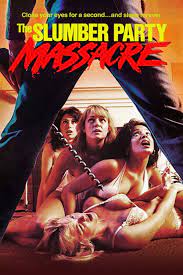
THE SLUMBER PARTY MASSACRE (1982) *** Coming across the beloved cult film that was once not so beloved just might be the biggest hazard of movie spectatorship these days.
You better not ride on the general train of thought from the film’s original release or you just might get bludgeoned in the comments section by devotees of the cinematic item under discussion.
You have no taste! You’re an idiot! You just don’t get it! You’re too stupid to understand the undeniable genius! Blah blah blah!
I am thinking first and foremost about films like Halloween III, Howard the Duck, Sleepaway Camp, and Silent Night, Deadly Night.
Maybe you are reading my confession why I had not watched The Slumber Party Massacre until very recently.
I finally caught up with it on Halloween night 2022, I liked it well enough, and I can definitely understand why it’s held in such high esteem in some quarters though I certainly don’t like it as much as others so enthusiastically do.
The Slumber Party Massacre took a while to get started, packed with so many false alarms and jump scares that I began losing patience early on and it was not until the 45- or 50-minute mark that I became enveloped in suspense. The final 25-30 minutes are especially well-made and filled with plenty of impacting moments, so much so that I almost bumped The Slumber Party Massacre up to three-and-a-half stars even after the mixed reaction to the first two-thirds of the film.
All slasher films, whether it be the good, the bad or the ugly, have their gimmicks, be it their setting or their killer in everything from the favorite weapon of choice down to style.
The Slumber Party Massacre sold a good amount on the fact that it has a female director (Amy Holden Jones) and a feminist screenwriter (Rita Mae Brown), something not common for the horror genre overall and specifically the subgenre of the slasher.
Jones shows definite talent in her directorial debut, and it’s no surprise she later directed Love Letters, Maid to Order, and The Rich Man’s Wife and received screenwriting credits on Love Letters, Maid to Order, Mystic Pizza, Beethoven, Indecent Proposal, The Getaway (1994), and The Relic. She also married acclaimed cinematographer Michael Chapman (Taxi Driver, Raging Bull, The Fugitive) in 1980 and stayed his wife until his death in September 2020.
Brown intended The Slumber Party Massacre to be a satire of the slasher genre, but Jones filmed it as straight horror.
However, satirical traces remain throughout The Slumber Party Massacre.Virtually all the male characters are super horny creeps and more than one female character survives all the murder and mayhem, for example.
Never mind that escaped serial killer Russ Thorn (Michael Villella) walks around in plain sight without a mask from the first scene on. He’s also one of a select few slasher film killers with quotes on the Internet Movie Database. Eat your heart out, Jason and Michael!
Also, never mind Thorn’s weapon of choice that could possibly be some kind of metaphor. Yes, it’s a power drill and I’m not sure of the symbology there! I also don’t believe there’s any greater meaning in the ways he meets his inevitable demise at the end of the movie.
The local radio station announces Thorn’s escape more than once, yet nobody seems to notice let alone care until it’s (almost) too late. I seem to remember one of the characters shutting off her car radio in the middle of one of the announcements.
Nearly all the characters are too preoccupied with their pursuits of pleasure at this very moment in time, just like the characters in any Friday the 13th film, to be concerned about some homicidal maniac on a rampage.
These satirical traces make The Slumber Party Massacre a good deal more interesting than, let’s say, Madman and The Prowler.
It works as both a satire and a straight horror film nearly 15 years before Scream came out.
In fact, not that I want to shout about it or anything, The Slumber Party Massacre works better than Scream.
TAKE A WALK ON THE SPOOKY SIDE: EIGHT GREAT DISNEY ANIMATED SHORTS 1929-49 I know what some of you might be thinking: Why do you have Disney animated shorts under consideration during a horror marathon?
Like The Wizard of Oz, Disney animated films proved to be a perfect introduction to scary movies.
You have the haunted woods in Snow White and the Seven Dwarfs, Chernabog in Fantasia, the donkey boys in Pinocchio, the pink elephants in Dumbo, Bambi’s mother’s death in Bambi, the bear in The Fox and the Hound, the Horned King in The Black Cauldron, and Ratigan (voiced by horror legend Vincent Price) in The Great Mouse Detective, just for starters, all potential source material for the nightmares of children.
Now, I will take a look at eight great Disney animated shorts that were made from between 1929 and 1949.
— The Skeleton Dance (1929; Walt Disney): Why is this short directed by Walt himself and animated by Ub Iwerks, Les Clark, and Wilfred Jackson, with music from Carl W. Stalling and Edvard Grieg, so important?
Music and animation were made at the same time for the first time, rather than having sound added in later, sure, that’s one very important reason, but it’s because the four dancing skeletons make for a great cover photo every October.
Walt Disney Productions made 75 animated musical short films from 1929 to 1939. They were called part of the Silly Symphony series, and the series began with none other than The Skeleton Dance in August 1929 and ended with The Ugly Duckling in April 1939.
Such classics as Iwerks’ Hell’s Bells, Burt Gillett’s Three Little Pigs, Jackson’s The Tortoise and the Hare, and Jackson’s The Old Mill appeared during the decade.
The Skeleton Dance falls under the classification Danse Macabre or dance of death or an artistic genre of allegory of the Late Middle Ages on the universality of death.
For the first couple minutes, we have a series of Gothic images leading us toward skeletons dancing in a cemetery — lightning, large eyes that are revealed to belong to an owl, strong wind, chimes at midnight, bats, a full moon, a howling hound dog, and black cats brawling on top of tombstones until they are scared off by our lead skeleton.
I may have forgotten about the spider, or was that another macabre Disney classic from the year 1929?
Anyway, around 2 minutes, 40 seconds, that’s when the dancing begins, and eat your heart out, Kevin Bacon! These skeletons are footloose and fancy free!
— Hell’s Bells (1929; Ub Iwerks): The fourth entry in the Silly Symphony series takes a dark turn after the October 1929 entry Springtime.
It’s all fun and games and song and dance in this short until one of Satan’s subordinates becomes insubordinate when faced with the prospect of being served to Cerberus, Satan’s three-headed guard dog.
Song and dance set to the theme music from Alfred Hitchcock Presents.
I absolutely love the name of that piece of music, by the way.
Funeral March of a Marionette by Charles Gounod in the 1870s.
Was Hitchcock a Walt Disney fan?
Who Killed Cock Robin appeared in Hitchcock’s Sabotage.
Iwerks beat AC/DC to it by about 51 years.
Hell’s Bells came out on November 21, 1929, while the Hells Bells single was released October 31, 1980.
Somebody on YouTube put the 5:50 Hell’s Bells and the 5:12 Hells Bells together for a perfect marriage of sight and sound.
— The Haunted House (1929; Walt Disney): This one has a plot that will sound awfully darn familiar to fans of the horror, mystery, suspense, and thriller genres.
Good old Mickey Mouse, he’s caught out in this horrible storm that makes the one in The Old Dark House seem like a jolly old time by comparison.
He’s not driving a motor car, though, he’s out walking. What are you doing, Mickey?
Fortunately, no, wait, make that unfortunately for him and fortunately for our high-quality entertainment value, there’s a house nearby that can provide Mickey with shelter from the storm.
Needless to say, we quickly find out why they called this one The Haunted House.
The four dancing skeletons return from The Skeleton Dance and their ability to coordinate a dance number in the midnight hour remained intact only a few months after their legendary motion picture debut.
The Skeleton Dance, Hell’s Bells, and The Haunted House all came out within a few months’ span in 1929, not a coincidence given the dark times faced around the world at that moment in time.
— The Mad Doctor (1933; David Hand): On a dark and stormy night — are there ever any other kind in anything related to horror — the diabolical genius title character takes Pluto away to his mansion for a wacky transplant. Pluto’s head on the body of a chicken, and Mickey Mouse obviously comes to the rescue.
The title character apparently learned from Dr. Jerry Xavier played by Lionel Atwill in the 1932 classic Doctor X or maybe they’re cousins. Maybe it’s the other way around, since the mad doctor in The Mad Doctor goes by Dr. XXX.
Mickey walks his way through Saw 70 years before the start of that infamous series, only in seven minutes rather than 110 and no F-bombs.
Skeletons appear in a Disney short, and that’s almost the guarantee for a classic.
I’ll even forgive The Mad Doctor for including the dreaded ‘It’s only a dream’ ending.
— Pluto’s Judgement Day (1935; David Hand): This one is truly something wild.
The family dog Pepper is absolutely positively terrified by this one.
She won’t even approach the plot summary.
Pluto’s Judgement Day opens with our favorite animated dog in the middle of chasing a kitten through the yard and eventually into Mickey Mouse’s living room.
Pluto becomes a muddy mess, Mickey saves the kitten, and Mickey scolds Pluto, telling him that he’ll pay on Judgment Day.
Pluto falls to sleep in front of the fire, so naturally he dreams that he’s on trial for his life in a Hell presided over by cats. They all have it in for Public Enemy No. 1, all the witnesses are Pluto’s victims, the jury of eight fine cats can balance justice with song and dance, and they give Pluto the chair.
It has a similar ending to The Mad Doctor, the 1933 short directed by David Hand that also featured Mickey and Pluto.
When I hear Pepper dreaming, I wonder if her dreams are anything like Pluto’s Judgement Day.
I sincerely hope not.
— The Old Mill (1937; Wilfred Jackson, Graham Heid): The year 1937 definitely proved to be a landmark year for Walt Disney Studios.
On December 21, 1937, Disney’s first feature-length animated film Snow White and the Seven Dwarfs premiered in Los Angeles.
The Old Mill, a Silly Symphony short, appeared in theaters November 5, 1937, and it’s every bit the landmark in animation as Snow White.
See, The Old Mill introduces the multiplane camera, a technical innovation used on Disney animated films from Snow White to The Little Mermaid.
From the Disney Wiki for a multiplane camera, Various parts of the artwork layers are left transparent, to allow other layers to be seen behind them. The movements are calculated and photographed frame-by-frame, with the result being an illusion of depth by having several layers of artwork moving at different speeds – the further away from the camera, the slower the speed. The multiplane effect is sometimes referred to as a parallax process.
The plot is basic compared to the technical aspects of the short — the animal residents of an old mill do their best to survive a thunderstorm.
I love the scene, just before the storm comes in, when the denizens of a nearby pond — frogs and crickets — have a croaking and chirping duet or duel.
— Lonesome Ghosts (1937; Burt Gillett): Peter Venkman, Ray Stantz, and Egon Spengler owe a debt of gratitude to Mickey Mouse, Donald Duck, and Goofy.
Four of the bored out of their gourd title characters see the ad for the Ajax Ghost Exterminators agency in their local newspaper, so they decide to alleviate their boredom by calling Mickey, Donald, and Goofy and having them come out to investigate their house. Our title characters then get their kicks with pranks and more pranks on Mickey, Donald, and Goofy once they’re inside to investigate. Inconceivable!
Goofy even utters the famous words, I ain’t a-scared of no ghosts.
Goofy also does a mirror routine with one of the ghosts, only he sees the ghost’s reflection in the mirror the entire time.
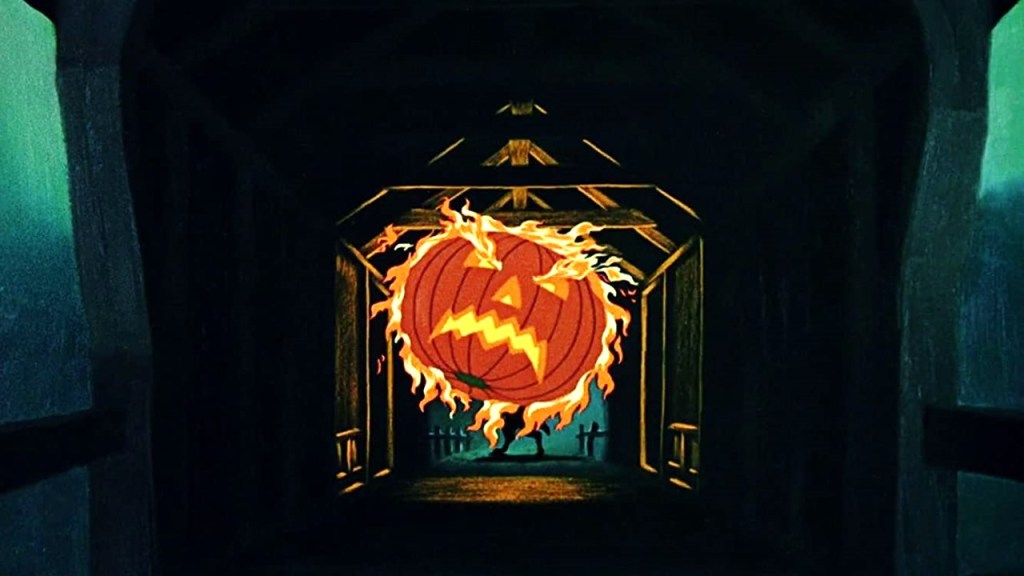
— The Legend of Sleepy Hollow (1949; Clyde Geronimi, Jack Kinney): I already reviewed The Adventures of Ichabod and Mr. Toad that packaged shorts The Wind and the Willows and The Legend of Sleepy Hollow into a 68-minute feature.
I prefer The Legend of Sleepy Hollow alone.
We have an adaptation of Washington Irving’s 1820 The Legend of Sleepy Hollow that’s more faithful than more famous adaptations, like Tim Burton’s 1999 Sleepy Hollow.
We have Ichabod Crane and Brom Bones, as well as a host of other characters, and the legendary Headless Horseman.
Bing Crosby provides the voice for the narrator and the singing voice for Ichabod and Brom Bones.
Crosby and Jud Conlon’s Rhythmaires are great in their performance of The Headless Horseman, which starts Gather ’round and I’ll elucidate / What goes on outside when it gets late / Along about midnight the ghosts and banshees / They get together for their nightly jamboree / There’s things with horns and saucer eyes / Some with fangs about this size / Some are fat and some are thin / And some don’t even wear their skin / I’m telling you, brother, it’s a frightful sight / To see what goes on Halloween night.
Gotta love the chorus: With a hip, hip and a clippity clop / He’s out looking for a top to chop / So don’t stop to figure out a plan / You can’t reason with a headless man.
The final 11 minutes of The Legend of Sleepy Hollow, beginning when Brom starts his Headless Horseman song, rank with the opening in Frankenstein Meets the Wolf Man.
THE UNIVERSAL FRANKENSTEIN MOVIES Of all the horror movie series, there’s not one I like more than Universal Studios’ Frankenstein cycle which started with the immortal 1931 classic Frankenstein and continued through The Bride of Frankenstein, Son of Frankenstein, The Ghost of Frankenstein, Frankenstein Meets the Wolf Man, House of Frankenstein, House of Dracula, and finally concluded with Abbott and Costello Meet Frankenstein in 1948.
Seven of the eight films are stone cold classics and I rate Frankenstein, The Bride of Frankenstein, Son of Frankenstein, and Abbott and Costello Meet Frankenstein at four stars and The Ghost of Frankenstein, Frankenstein Meets the Wolf Man, and House of Frankenstein three-and-a-half, with House of Dracula ranked two-and-a-half and it’s the only one that I would even slightly hesitate to recommend to people.
I watched Frankenstein, The Bride of Frankenstein, and Abbott and Costello Meet Frankenstein around roughly the same time in the late ’90s and early ’00s. I caught up with the others much later on during a marathon of Universal horror films. I liked The Ghost of Frankenstein, Frankenstein Meets the Wolf Man, and House of Frankenstein upon first viewing, as well Abbott and Costello Meet Frankenstein a lot, but they’ve all grown on me to where I bumped up their rating one-half star.
I have a feeling that watching the eight films in close proximity to one another will become a tradition, like it has for who knows how many people over the last 90 years.
Here’s a look at the film series that seemingly started it all in the horror genre.
— Frankenstein (1931; James Whale): The one that started it all, Edward Van Sloan, who plays Dr. Van Helsing in Dracula and Doctor Waldman in Frankenstein, begins the picture, How do you do? Mr. Carl Laemmle feels it would be a little unkind to present this picture without just a word of friendly warning. We’re about to unfold the story of Frankenstein, a man of science who sought to create a man after his own image without reckoning upon God. It is one of the strangest tales ever told. It deals with the two great mysteries of creation: life and death. I think it will thrill you. It may shock you. It might even horrify you. So if any of you feel that you do not care to subject your nerves to such a strain, now is your chance to, uh … well, we’ve warned you!
Colin Clive and Dwight Frye are great in their roles as mad scientist Henry Frankenstein and hunchbacked assistant Fritz, Van Sloan is much better in Frankenstein than in Dracula, and Boris Karloff is not even credited as Karloff yet for playing The Monster. The opening credits have it The Monster — ?
The work done by makeup artist Jack Pierce and set designer Herman Rosse is just as definitive and influential as the characters and performances by Clive, Frye, and Karloff.
We’ve all seen Frankenstein time and time again in the thousands if not hundreds of thousands of films that have been influenced by James Whale’s first horror masterpiece.
— The Bride of Frankenstein (1935; James Whale): One of the greatest horror films and greatest sequels ever made, I rate The Bride of Frankenstein as the best Frankenstein and it’s not even all that close, despite the fact that it shares the same star rating as Frankenstein, Son of Frankenstein, and Abbott and Costello Meet Frankenstein.
The Bride of Frankenstein has a more wicked sense of humor than any of the other films in the series, and that’s including Abbott and Costello Meet Frankenstein, and it’s undeniably the most fun to watch. It’s just as iconic and influential as the original Frankenstein, from the more sympathetic, speaking Monster to the makeup and the sets.
Mad scientists do not come madder than Ernest Thesiger’s Doctor Pretorius, and he’s a devious hoot throughout The Bride of Frankenstein. He’s so mad that he makes Colin Clive’s Doctor Frankenstein seem almost sane. You think I’m mad. Perhaps I am. But listen, Henry Frankenstein. While you were digging in your graves, piecing together dead tissues, I, my dear pupil, went for my material to the source of life. I grew my creatures, like cultures, grew them as nature does, from seed.
I wish they would have done more with the title character, that’s just about my only gripe against The Bride of Frankenstein.
— Son of Frankenstein (1939; Rowland V. Lee): Easily the longest of the series, the third Frankenstein entry benefits tremendously from the presence of four absolute legends of the genre in Lionel Atwill, Boris Karloff, Bela Lugosi, and Basil Rathbone. Atwill and Lugosi are especially fantastic.
I would make the argument that Lugosi never had a better role than Ygor and never gave better performances than he did in Son of Frankenstein and The Ghost of Frankenstein. He’s the driving engine in both films and helps make them so entertaining. They hanged me once Frankenstein. They broke my neck. They said I was dead. Then they cut me down. They threw me in here, long ago. They wouldn’t bury me in holy place like churchyard. Because I stole bodies, eh they said. So, Ygor is dead! So, Dr. Frankenstein. Nobody can mend Ygor’s neck. It’s alright.
Atwill became the most versatile and most important supporting player in the Frankenstein series, playing Inspector Krogh in Son of Frankenstein, Doctor Theodore Bohmer in The Ghost of Frankenstein, the Mayor in Frankenstein Meets the Wolf Man, Inspector Arnz in House of Frankenstein, and Police Inspector Holtz in House of Dracula.
He’s at his best as Inspector Krogh, and this character will ring a bell to Young Frankenstein fans, as will Ygor. Most vivid recollection of my life. I was but a child at the time, about the age of your own son Herr Baron. The Monster had escaped and was … ravaging the countryside, killing, maiming, terrorizing. One night he burst into our house. My father took a gun and fired at him but the savage brute sent him crashing to a corner. Then he grabbed me by the arm!
Karloff gives his final performance as Frankenstein’s Monster and he’s given less to do than Frankenstein and especially The Bride of Frankenstein. He returns to not speaking in Son of Frankenstein after the strides the Monster made in Bride, but Karloff had the innate ability to communicate much without dialogue.
— The Ghost of Frankenstein (1942; Erle C. Kenton): This is the first downturn in quality in the series after the triple triumph of Frankenstein, The Bride of Frankenstein, and Son of Frankenstein, but The Ghost of Frankenstein still proves to be loads of fun with the return of Ygor, the brain transplant and mad scientist plot, and plenty of action during one of the shortest running times in the entire series.
Ygor could take a hanging before Son of Frankenstein and take a shooting in Son and keep on ticking in The Ghost of Frankenstein. He’s still got his one true friend in Ghost, Frankenstein’s Monster, though it’s no longer Boris Karloff but Lon Chaney Jr in his first and only appearance. Chaney became a big horror movie star after The Wolf Man and Universal cast him as Frankenstein’s Monster, Dracula, and Kharis. Not sure how they missed him for The Invisible Man and The Phantom of the Opera.
Anyway, Lugosi dominates The Ghost of Frankenstein, despite the fact that Ygor’s not as menacing as he was in Son of Frankenstein. You cannot take my friend away from me. He’s all that I have. Nothing else. You’re going to make him your friend and I’ll be alone. Ygor plots to have his brain transplanted inside Frankenstein’s Monster, so he can rule the world, and finds a willing conspirator in Atwill’s Doctor Theodore Bohmer. As Doctor Ludwig Frankenstein says, You’re a cunning fellow, Ygor. Do you think I would put your sly and sinister brain into the body of a giant? That would be a monster indeed. You will do as I tell you or I will not be responsible for the consequences.
The Ghost of Frankenstein has one of the better casts in the series with Cedric Hardwicke as Ludwig Frankenstein and The Wolf Man cast members Ralph Bellamy and Evelyn Ankers join Chaney and Lugosi. The original Frankenstein (Colin Clive) makes an archive footage cameo appearance; Clive passed away in 1937 at the age of 37.
— Frankenstein Meets the Wolf Man (1943; Roy William Neill): The fifth installment of the series begins with arguably the best seven minutes of the entire franchise and the film takes a steady dip in quality for the next hour until we get to the last few minutes.
Lawrence Talbot and The Wolf Man make their first appearance in the series, and his tortured soul number makes sweet music especially as played by Chaney Jr. I only want to die. That’s why I’m here. If I ever find peace I’ll find it here. Lugosi plays Frankenstein’s Monster, but one might remember from the end of The Ghost of Frankenstein that our Monster speaks like Ygor because of the brain transplant operation late in the picture. He’s still blind, as well, respecting continuity for a change in any of these sequels, but it’s all rendered moot because Universal muted Lugosi’s speaking voice as the Monster. He’s not the worst Monster, and they all became interchangeable after Karloff left the role anyway.
Before King Kong vs. Godzilla and long before Freddy vs. Jason, there was Frankenstein Meets the Wolf Man.
Isn’t it an interesting coincidence that Frankenstein Meets the Wolf Man came out in 1943, the American version of King Kong vs. Godzilla in 1963, and Freddy vs. Jason in 2003?
— House of Frankenstein (1944; Erle C. Kenton): The sixth installment piles on the monster characters and the acting talent.
Boris Karloff returns to the series for the final time as the mad doctor Gustav Niemann and not Frankenstein’s Monster, Chaney returns as Lawrence Talbot and The Wolf Man, John Carradine and Glenn Strange make their debuts as Dracula and Frankenstein’s Monster, and J. Carrol Naish almost steals the show as the hunchbacked henchman Daniel.
There’s also Lionel Atwill, George Zucco, and Sig Ruman, so there’s no shortage of talent in the cast even in the smallest roles.
Where’s Lugosi? No, seriously, where’s Lugosi?
Carradine and Strange are major downgrades as Dracula and Frankenstein’s Monster, it’s great to have Karloff back in a speaking and a mad doctor role though I’d still prefer him as Frankenstein’s Monster, Chaney plays his tortured soul number again, and Naish joins Dwight Frye and Lugosi in the lexicon of scene-stealing servant characters.
This is as good a place as any to mention Frye, who passed away in 1943 and who appeared in Frankenstein as Fritz, The Bride of Frankenstein as Karl, Son of Frankenstein as a villager, The Ghost of Frankenstein as a village, and Frankenstein Meets the Wolf Man as Rudi, a nice little supporting role for Frye.
House of Frankenstein is a step down from The Ghost of Frankenstein and Frankenstein Meets the Wolf Man and closer to a three-star rating.
— House of Dracula (1945; Erle C. Kenton): This is the only film in the series that I’ve not been able to warm into a positive review after repeat viewings. Apparently, I’ve made three attempts over the last couple years.
Unfortunately, by this point in the series, House of Dracula feels like we’ve been here before … and in better films.
The title, the poster, and the cast of characters echo House of Frankenstein.
The Wolf Man, Dracula, and Frankenstein’s Monster all return and we have a new mad doctor and a new hunchback after Karloff and Naish in House of Frankenstein.
I must state again that I don’t particularly care for Carradine and Strange in the roles of Dracula and Frankenstein’s Monster. They are many grades below Lugosi and Karloff. Especially Carradine, who I unfortunately watched playing Dracula first in Billy the Kid vs. Dracula from 1966. I had no idea back then Carradine had played Dracula before he revisited the role for director William Beaudine in a toothless cross between a western and a horror film. Anyway, Carradine does this thing with his eyes that’s supposed to be hypnotic, but it always comes across like somebody’s just squirted him in the eyes. They wisely gave Strange absolutely little to do in House of Frankenstein, House of Dracula, and Abbott and Costello Meet Frankenstein.
Chaney is still pretty good in House of Dracula, and he’s the main positive reason for the film’s mixed review.
— Abbott and Costello Meet Frankenstein (1948; Charles Barton): The comedic duo of Bud Abbott and Lou Costello and the monsters like Frankenstein’s Monster, Dracula, and The Wolf Man were the main cash cows for Universal throughout the 1940s.
Universal squeezed from the teets for a big hit in Abbott and Costello Meet Frankenstein — we have Bud and Lou as Chick and Wilbur, Lugosi for the second and final time as Dracula, Chaney once more as tortured soul Lawrence Talbot and The Wolf Man, and Strange as Frankenstein’s Monster. The monsters do make for great straight men and Costello’s fright never proved more convincing or delightful or funny than it is throughout Abbott and Costello Meet Frankenstein.
Lenore Aubert and Jane Randolph are both quite fetching as women with ulterior motives for their interest in Wilbur.
I reviewed Abbott and Costello Meet Frankenstein at length earlier in the month, and I stand 100 percent behind that four-star review.
The Universal Frankenstein Movies, Ranked 1. The Bride of Frankenstein (1935) **** 2. Frankenstein (1931) **** 3. Son of Frankenstein (1939) **** 4. Abbott and Costello Meet Frankenstein (1948) **** 5. Frankenstein Meets the Wolf Man (1943) ***1/2 6. The Ghost of Frankenstein (1942) ***1/2 7. House of Frankenstein (1944) ***1/2 8. House of Dracula (1945) **1/2
HALLOWEEN ENDS? SURELY, THEY CAN’T BE SERIOUS! THEY’RE NOT BUT PLEASE DON’T CALL ME SHIRLEY! I have not yet seen Halloween Ends, the latest and 13th overall installment that has now passed Friday the 13th (12) and long passed A Nightmare on Elm Street (9), but I have watched and read a great many reviews of the film.
Based on the early returns, Halloween Ends just might go down in history as the most divisive Halloween film since 1982’s Halloween III: Season of the Witch, you know the one without Michael Myers absolutely hated for many years before it developed a cult following in recent years, like the 1985 tandem A Nightmare on Elm Street 2: Freddy’s Revenge and Friday the 13th: A New Beginning.
Currently, Halloween Ends has a 5 out of 10 score on IMDb, 39 percent on Rotten Tomatoes, and 47 percent on Metacritic.
General audiences seem to hate it even more than critics, interestingly enough for a horror film.
Google returns a 1.9 score for the film, based on 3,266 ratings with the vast majority giving it one.
Probably in the shape of an upraised middle finger.
By comparison, Season of the Witch returns a 3.3 audience rating and both Freddy’s Revenge and A New Beginning score 3.5.
They were hated back in the day, especially Season of the Witch and A New Beginning since they do not feature Michael Myers and Jason Voorhees.
You can bet the initial audience feedback on them would have read or sounded like the furor now over Halloween Ends.
The enraged are treating Halloween Ends like a betrayal of the faith and the spirit of Halloween and Michael Myers.
Seriously, could anything in Halloween Ends possibly be worse than EVIL DIES TONIGHT in Halloween Kills, the White Horse and Michael talking in Rob Zombie’s Halloween II, the white trash back story and mommy issues for Michael in Rob Zombie’s Halloween, Busta Rhymes kicking Michael’s ass in Resurrection, the Dawson’s Creek-meets-Scream flavor of H20, the Thorn cult in The Curse and The Revenge of Michael Myers, no Michael in Season of the Witch, and the revelation that Michael and Laurie are brother and sister in Halloween II?
I don’t like Season of the Witch very much at all, but it’s not because it doesn’t feature Michael Myers.
I like a lot of the ideas behind Season of the Witch, but I feel they are poorly executed.
The majority of Halloween fans seem to want just one more Halloween sequel with a Michael Myers silently stalking and slashing his way through a series of disposable teenagers and disposable adults or corpses-in-waiting for 90-95 minutes.
They could probably take or leave Laurie Strode, but it’s obvious they want more of the same and they don’t want something different when it comes to a Halloween movie.
On the other hand, I wish the Halloween series ended many, many, many years ago, but I don’t think anybody’s foolish enough at this point to believe that it’s the end for Michael Myers or Laurie Strode. The Halloween films have always seemed much smarter than Friday the 13th and even to a lesser degree A Nightmare on Elm Street, because they never featured ends or final or dead in any of their titles until Halloween Ends.
This franchise has returned more times from the dead than any other.
I didn’t want to watch Halloween Ends after Halloween 2018 and especially Halloween Kills where all the gruesome kills in the world cannot make up for some of the worst characters we’ve ever seen in a Halloween movie … even in this series. Evil might (or might not) have died tonight, it might not have since they made another movie, but my desire to watch another new Halloween film seemingly died with Halloween Kills.
I’m just so damn sick and tired of Laurie Strode and Michael Myers, whether or not they’re brother and sister or just two strangers passing in the night and no matter how many times they’ve been retconned, rebooted, and repackaged for maximum consumption.
I love the original from 1978 directed by John Carpenter and starring Donald Pleasence and Jamie Lee Curtis. It remains one of the all-time greats, absolutely essential viewing for the Halloween season.
I liked H20 when I first watched it on the big screen in 1998, but it has not aged well and it has fallen in my estimation, and Halloween II, Halloween 4: The Return of Michael Myers, Halloween 2007, and Halloween 2018 each have their moments, but the rest of the sequels that I have seen are bloody terrible.
I don’t see how Halloween Ends could possibly be any worse a movie than Season of the Witch or Halloween 5 or Halloween 6 or Resurrection.
Maybe one day soon I’ll give it a chance and find out for myself.
ARACNOPHOBIA (1990) ***1/2 Arachnophobia is another one of those movies from the late ’80s or early ’90s that I must have watched a hundred times back when it first played on cable TV.
File it alongside such movies as Back to the Future 2, the first two Bill & Ted movies Excellent Adventure and Bogus Journey, The Great Outdoors, Gremlins 2, Terminator 2, Total Recall, Tremors, and Young Guns. Those are the ones that quickly come to mind.
Recently revisiting Arachnophobia again for the first time in many years, I have to admit that I remembered a good number of the scenes, especially during the second half of the film when the spiders go wild on the fictional small town Canaima, California. I blurted out John Goodman’s line before his exterminator character Delbert McClintock says Rock and roll! I had a lot of fun with it around the age of 13 and I still had a lot of fun with it at 44.
You can have a good old time with Arachnophobia, just like Tremors, because it doesn’t go too far into extreme gross-out territory with the shock moments and death scenes, it has predominantly quirky and likable characters that you can support for the length of a silly, spooky monster movie, it straddles that razor-thin line successfully between comedy and horror, and it enjoys preying upon our fear of the unknown. I don’t have arachnophobia, or an extreme or irrational fear of spiders, but that doesn’t necessarily mean I want a surprise in my size 12 shoe either.
Arachnophobia gives us a lot of familiar character archetypes.
For example, we have the highly educated big city doctor with the loving wife and two small children who relocate to a small town to get away from all the hustle and bustle. They have his new practice, her severance pay, and they also have each other. It goes without saying, of course, that our doctor suffers from arachnophobia.
The crusty old doctor who takes back his retirement after the young doctor and his family already made their move into a new house and who then seemingly opposes the young doctor at every turn during his subsequent effort to set up shop in the small town. He’s also the resident disbeliever when the spiders begin mounting their body count, and the younger doctor wants an outrageous autopsy because he doesn’t believe it was a heart attack.
The local head law enforcement officer who resents somebody like the highly educated big city doctor.
The straight-shooting but friendly old widow who takes an instant shining to the young doctor and who volunteers to be his first patient in a new town.
The football coach and his wholesome All-American family and the funeral home director and his penchant for jokes that never quite land.
Also, the world’s foremost expert on spiders, who Arachnophobia introduces before any of the small-town characters with a prologue set in Venezuela.
See, Dr. James Atherton (Julian Sands) and crew discover a new species of spiders, very large and very deadly, and one of the specimens hitches a ride in the coffin of his first victim Jerry Manley (Mark L. Taylor), a photographer from Canaima, California.
Our lethal spider makes his way out from the coffin and ultimately into the barn of the young doctor named Ross Jennings (Jeff Daniels). He crossbreeds with a local domestic spider that Jennings’ wife saves from their new house and relocates to their barn. The Jennings not only have the barn but also the cellar that’s very convenient for spiders and their nests, and their eventual world domination.
Daniels has been one of the most reliable actors in the movies, and his presence almost guarantees quality. His 88 acting credits include Terms of Endearment, The Purple Rose of Cairo, Something Wild, Gettysburg, Speed, Dumb and Dumber, Pleasantville, The Squid and the Whale, and The Martian. He’s very good as Jennings and this character and performance come across to the audience like Roy Scheider as Martin Brody in Jaws because he’s terrified by spiders just like Brody was not the biggest fan of water. In the end, though, it’s Jennings and Brody who overcome their greatest fears.
Goodman attempts to steal the movie with great moment after great moment. He’s a strong and steady injection of humor especially when the horror kicks into overdrive around the midpoint of the 110-minute film. I wouldn’t be surprised to find out if Goodman’s Delbert McClintock and Michael Gross’ Burt Gummer are related.
I prefer Tremors over Arachnophobia, because Kevin Bacon and Fred Ward are absolutely fantastic and trump any of the characters in Arachnophobia, Finn Carter’s Rhonda LeBeck is not cast aside for large chunks of the movie like Harley Jane Kozak’s Molly Jennings, and I just think it’s a better overall movie.
Both films, though, do a fine cinematic tradition justice.
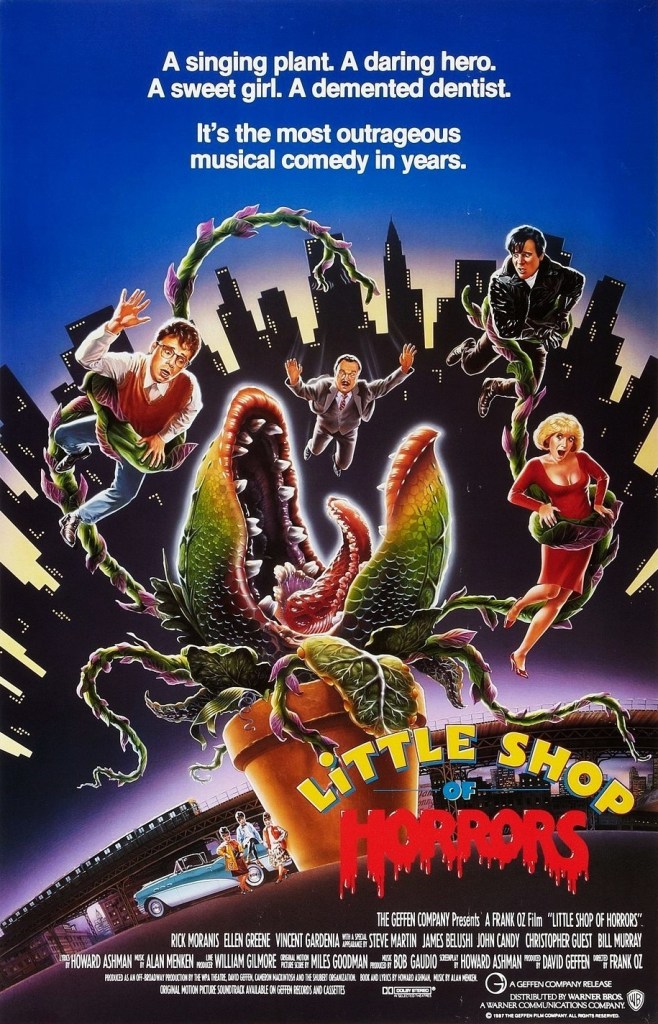
LITTLE SHOP OF HORRORS (1986) **** Little Shop of Horrors, based on the off-Broadway stage musical itself based on the 1960 Roger Corman cult film, is one of those movies that I like a little bit more every time I watch it.
I’ll just come right out and say it early on in this review: I’ll take Little Shop of Horrors over The Rocky Horror Picture Show every day of the week because the performances and characters, the science fiction and horror plot, the script, the direction, the musical production numbers, and the special effects are all far superior. Granted, to be fair, Little Shop of Horrors had more than 25 times the production budget of Rocky Horror.
I watched both films around the same time, in the late ’80s or early ’90s both on late-night local TV Saturday night movie programming. I also remember first coming across Wolfen and The Breakfast Club in this format. Anyway, I’ve always liked Little Shop of Horrors and never particularly cared for Rocky Horror, which I’ve come to like even less with every viewing so it’s Little Shop of Horrors inverted.
Rick Moranis stars as the meek, nerdy florist Seymour Krelborn. He means well but he’s extremely clumsy and pines after his beautiful coworker Audrey (Ellen Greene) who dates the abusive, sadistic, nitrous oxide fiend ’50s style greaser biker dentist Orin Scrivello (Steve Martin). Seymour’s perpetually chewed out by his boss Mr. Mushnik (Vincent Gardenia), the owner of Mushnik’s Flower Shop. Everything changes for Seymour, Audrey, and Mr. Mushnik when Seymour discovers Audrey II (voiced by Levi Stubbs, lead singer of the Four Tops), one mean green mother from outer space with an insatiable appetite and designs on taking over Planet Earth. Feeding Audrey II proves to be a nightmare for Seymour.
Moranis gives his definitive film performance, Greene returns to play Audrey from the stage production, Moranis and Greene make for a great movie couple and they’re very deserving of a happy ending, and Martin and Stubbs are both absolutely incredible in their villainous roles.
In fact, Martin and Stubbs both should have been nominated for Best Supporting Actor, but it’s understandable why they were not in a year with supporting actor winner Michael Caine for Hannah and Her Sisters and nominees Tom Berenger and Willem Dafoe for Platoon, Denholm Elliott for A Room with a View, and Dennis Hopper for Hoosiers.
Comedies, science fiction, and horror films very rarely earn nods from the Academy, a problem for Little Shop of Horrors when it encompasses all three genres.
It also became complicated when considering Stubbs (1936-2008) for a nomination, since he’s the voice of an animatronic puppet with 21 different principal puppeteers including Brian Henson. Stubbs’ authoritative, booming voice benefits the movie infinitely in both the dialogue scenes between Audrey II and poor Seymour and four musical numbers.
Audrey II’s Mean Green Mother from Outer Space, with lyrics by Howard Ashman and music by Alan Menken, received an Academy Award nomination for Best Original Song and lost to Berlin’s Take My Breath Away from Top Gun.
I’ve been known to say to pets both canine and feline Feed me, Seymour.
Crystal (Tichina Arnold), Ronette (Michelle Weeks), and Chiffon (Tisha Campbell), names borrowed from three girl groups contemporaneous with the original Little Shop of Horrors, provide a Greek chorus with sass and style.
Jim Belushi, John Candy, Christopher Guest, and Bill Murray show up in small roles.
Little Shop of Horrors originally retained the ending of the stage musical with Audrey and Seymour killed and giant Audrey II plants on a Godzilla-like rampage, but test audiences positively absolutely hated that Audrey and Seymour were killed and the original 23-minute ending became a rewritten and reshot happy ending that pushed the release date back to December 19, 1986.
I’ve only watched Little Shop of Horrors with the happy ending, and I must say that I’m more than happy with that.
HAPPY BIRTHDAY TO ME (1981) *** Happy Birthday to Me stands out from the early ’80s slasher film craze pack because a) it has superior production values with a name director (J. Lee Thompson, who directed The Guns of Navarone and Cape Fear) and a good cast including an unhappy Glenn Ford, b) it has a longer running time than the average 85- and 90-minute slasher film, and c) it has one of the most bizarre twist endings this side of Sleepaway Camp.
Just like fellow 1981 Canadian slasher My Bloody Valentine, also produced by John Dunning and André Link with distinctive elements for a slasher, Happy Birthday to Me calls to mind a prestigious Academy Award for Best Picture winner, 1980’s Ordinary People. (My Bloody Valentine recalled The Deer Hunter from the coal mine setting and overall working-class milieu, the prodigious beer drinking, and the more adult-like plot and romantic triangle.)
Let’s see, Happy Birthday to Me and Ordinary People both have the same elite upper middle class suburban prep school environment, traumatic events in the past, troubled teenagers, and a therapist who works with our troubled teen protagonist.
Happy Birthday to Me plays more like a glossy, lurid soap opera at times punctuated with some creative, gruesome murder set pieces.
Melissa Sue Anderson makes her motion picture feature debut in Happy Birthday to Me as protagonist Virginia Wainwright. She had nearly a decade of experience on TV by that point, though, most notably as Mary Ingalls / Mary Ingalls Kendall on the hit show Little House on the Prairie. You can bet playing a blind Mary for a number of seasons prepared an 18-year-old Anderson for her flashbacks, brain operation, therapy sessions, memory loss, and traumatic blackouts throughout Happy Birthday to Me.
Slasher films often pursued at least one name actor for their cast: Betsy Palmer (Friday the 13th), Ben Johnson (Terror Train), Leslie Nielsen (Prom Night), Lauren Bacall, James Garner, and Maureen Stapleton (The Fan), and Farley Granger (The Prowler).
Glenn Ford accumulated 110 acting credits from 1937 through 1991, highlighted by Gilda, The Big Heat, Blackboard Jungle, 3:10 to Yuma, Midway, and Superman. Ford (1916-2006) wouldn’t have wanted to be remembered for Happy Birthday to Me and he was reportedly a very unhappy camper making the film, heavily drinking throughout and hitting the assistant director after he called for a lunch break during the middle of one of Ford’s scenes.
He’s not all that big a role in Happy Birthday to Me.
Ginny Wainwright attends the snobby Crawford Academy and she’s a member of the school’s Top 10 clique, only the best and brightest. They are systematically eliminated apparently by Ginny, and we find out that none of the Top Ten attended Ginny’s birthday party four years before the start of the movie. They attended instead another party for a Top 10 member and Ginny and her mother are then involved with an auto accident that kills Ginny’s mother and leaves the surviving Ginny needing her experimental brain tissue restoration.
Ginny was originally planned to be revealed as the killer possessed by the spirit of her dead mother, but the film instead chose a shocking twist ending that remains the main reason why fans of the film remember it so fondly 40 years later.
Thompson (1914-2002) reportedly got so much into the spirit of the enterprise that he was throwing around buckets of blood on set. The final 40 minutes pile up the corpses.
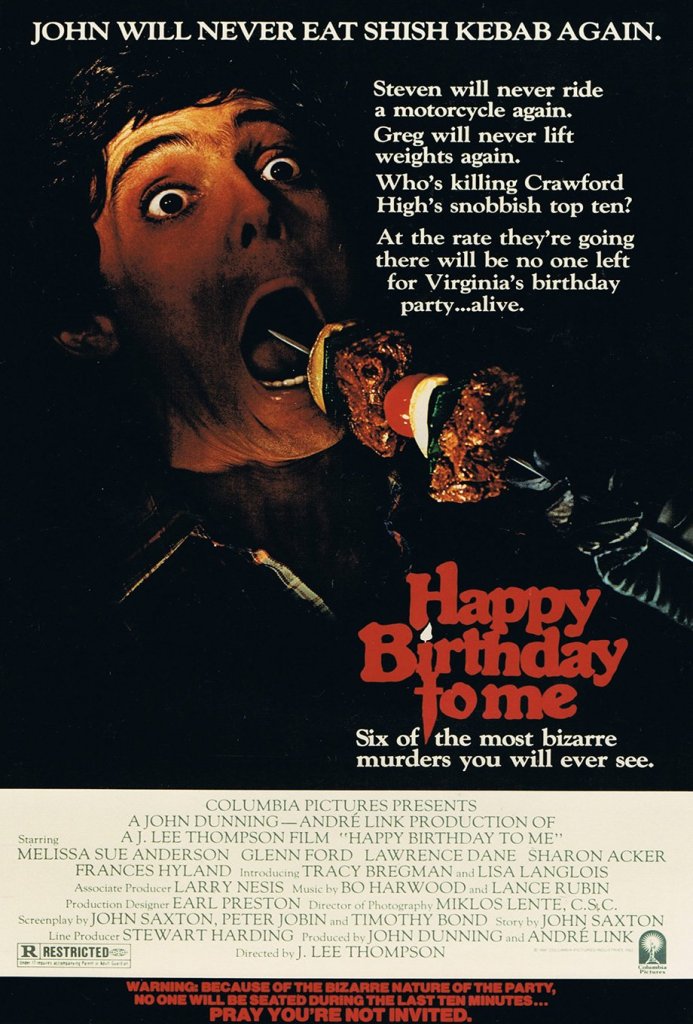
Columbia Pictures went for both the bloody and bizarre in promoting Happy Birthday to Me, a minor hit in the summer of 1981.
The poster has an image of the most famous murder set piece of the movie.
JOHN WILL NEVER EAT SHISH KEBAB AGAIN.
Steven will never ride a motorcycle again.
Greg will never lift weights again.
Who’s killing Crawford High’s snobbish top ten?
At the rate they’re going there will be no one left for Virginia’s birthday party … alive.
Happy Birthday to Me … Six of the most bizarre murders you will ever see.
WARNING: BECAUSE OF THE BIZARRE NATURE OF THE PARTY, NO ONE WILL BE SEATED DURING THE LAST TEN MINUTES … PRAY YOU’RE NOT INVITED.
Factual accuracy is not this poster’s strong suit, since there’s nine deaths in the movie, there’s no John character in the movie, Steven’s the one killed by kebab, and Etienne’s the one done in by a motorcycle.
THE FOG (1980) **1/2 Fog has been a critical element in many horror movies and the 1939 Hound of the Baskervilles, The Wolf Man, Frankenstein Meets the Wolf Man, and The Return of the Vampire immediately leap to mind as films made definitely better from their use of fog effects to create a foreboding atmosphere.
Edgar Allan Poe died at the age of 40 in 1849 but his writing and his influence live on forever. Is all that we see or seem / But a dream within a dream?
Ghost stories around the campfire have been around longer than The Legend of Sleepy Hollow, and I believe that’s how Washington Irving first heard about Ichabod Crane, Brom Bones, and the Headless Horseman.
John Carpenter directed, co-wrote, and scored the original Halloween in 1978, one of the great transcendent low-budget shockers with a boogeyman killer.
Carpenter’s The Fog, his first horror film after Halloween, combines the title character, a Poe quote before the opening credits, a ghost story around the campfire told by distinguished actor John Houseman, and some grisly murder set pieces that far surpass the relatively tame and nearly entirely bloodless Halloween, but I remain steadily down the middle of the road in my reaction to it.
I want to like it a lot more than I do, believe me, and maybe I will get there next time.
I liked it more during the most recent viewing of the film and I definitely understand why it’s developed a cult following and a much better reputation in recent years.
It does create quite the foreboding atmosphere at times, it bears all the trademarks of a Carpenter film with his penchant for great composition both in the sense of framing and the music present throughout, and I do like the story of this small California town celebrating their centenary with a dark secret about the founding discovered, discussed, and confronted during the film as the dead men return 100 years to the day for their revenge.
Still, all the same, it’s underwhelming.
I believe it’s mainly because I don’t particularly connect to any of the characters and thus, I don’t really care about their fates particularly all that much.
I come the closest to connecting with radio station owner and host Stevie (played by Carpenter’s former wife Adrienne Barbeau) and Father Patrick Malone (Hal Holbrook), but they’re not on the same level as Dr. Loomis and Laurie Strode in Halloween, Kurt Russell’s characters in Escape from New York and The Thing, Keith Gordon’s Arnie Cunningham in Christine, Karen Allen’s and Jeff Bridges’ characters in Starman, and Roddy Piper’s George Nada in They Live, some of Carpenter’s best characters and best films.
While it is comforting to see Carpenter regulars like Barbeau, Jamie Lee Curtis, Tom Atkins, Charles Cyphers, Nancy Kyes, and good old ‘Buck’ Flower, they’ll still all be remembered first for other characters in other Carpenter films.
We simply don’t get enough of any of the main characters.
The Fog lacks a certain something, energy perhaps first and foremost, to really take it over the top and into the stratosphere like Halloween.
All that said, The Fog still has some very good even almost great moments.
I especially like the scene when Father Malone reads four entries from his grandfather’s journal and then delivers the best line of the film, The celebration tonight is a travesty. We’re honoring murderers.
Speaking of a travesty, I watched the 2005 remake in a theater and I have to believe that it’s one of the 10 worst movies I’ve ever watched in a multiplex near you.
WHEN A STRANGER CALLS (1979) ** The 1979 psychological horror film When a Stranger Calls has developed a certain reputation in horror movie circles.
Or we should say the first 20 or so minutes of the movie have become legendary.
When a Stranger Calls starts with the babysitter and the man upstairs urban legend, or a teenage girl babysitter keeps receiving phone calls from a stalking stranger who repeatedly asks her to check the children.
The film revisits the babysitter and the man upstairs seven years later for the final 20 or so minutes.
In between, we have many, many, many scenes that left me wondering how exactly I am supposed to be reacting to this bilge. What a waste!
I found When a Stranger Calls predominantly a dull experience, and it kept me thinking about superior and much superior films like Black Christmas, Halloween, and Dog Day Afternoon during even the film’s best moments.
First of all, Carol Kane plays the babysitter and seven years later the married young adult Jill Johnson. When a Stranger Calls tries to make her out to be high school in the first 20 minutes. Of course, that’s a fine showbiz tradition, like the thirtysomething Norma Shearer and fortysomething Leslie Howard playing tempestuous teenage lovers Romeo and Juliet in the 1936 MGM version, but it’s simply not convincing in the slightest bit and jars considerably.
I mean, for crying out loud, Kane received a nomination for Best Actress at the 1976 Academy Awards for her performance in Hester Street. We have the feeling that she shouldn’t be playing meek, timid, and cowering, even if she lost to Louise Fletcher for her performance as Nurse Ratched in One Flew Over the Cuckoo’s Nest.
Black Christmas did this phone caller and psycho killer number and big THE CALLS ARE COMING FROM INSIDE THE HOUSE reveal not only before but also better than When a Stranger Calls. Fred Walton (director and co-writer) and Steve Feke (co-writer) basically remade their 1977 short film The Sitter for the first 20 minutes of When a Stranger Calls, only with a much-larger budget and big-name cast members, and it’s possible they weren’t inspired by Black Christmas.
Seven years after murdering both children Jill was babysitting for Dr. and Mrs Mandrakis, Curt Duncan (Tony Beckley) escapes from the psychiatric facility and Dr. Mendrakis (Carmen Argenziano) hires former police officer and current private detective John Clifford (Charles Durning) to find Duncan. We first see Clifford in an early shock moment.
Are we supposed to feel sympathy for Duncan in the film’s long middle passages?
I only ask because I’m not buying it one bit, especially after Clifford goes into explicit detail about Duncan’s child killings, After the coroner’s investigation the bodies were taken to the mortuary where the undertaker took one look at them and said their bodies couldn’t be reconstructed for the burial without six days of steady work. Then he asked what had been the murder weapon, because looking at the mess in front of him he couldn’t imagine what had been used. The coroner told him there had been no murder weapon. The killer had used only his hands.
Before that monologue, we get to watch two awkward scenes between Duncan and the 54-year-old Colleen Dewhurst’s Tracy. Their first scene together culminates in one of their fellow bar patrons beating Duncan to a pulp. Tracy feels sympathy for Duncan after that.
Clifford’s dogged pursuit and obsession with Duncan calls to mind Dr. Loomis in Halloween and the opening 20 and closing 20 minutes place When a Stranger Calls near both Halloween and Black Christmas.
It’s the roughly 50-55 minutes in between that mostly lose and frustrate me. Imagine Halloween if it ditched Laurie Strode after 20 minutes in only to rejoin her later in the movie and instead, we spent 50 minutes following mostly babysitter killer Michael Myers in mostly awkward and (seemingly) pointless scenes.
That’s right, it would be painful to watch and that describes When a Stranger Calls, an otherwise well-made movie, for most of its duration.







 Attack of the Killer Librarian