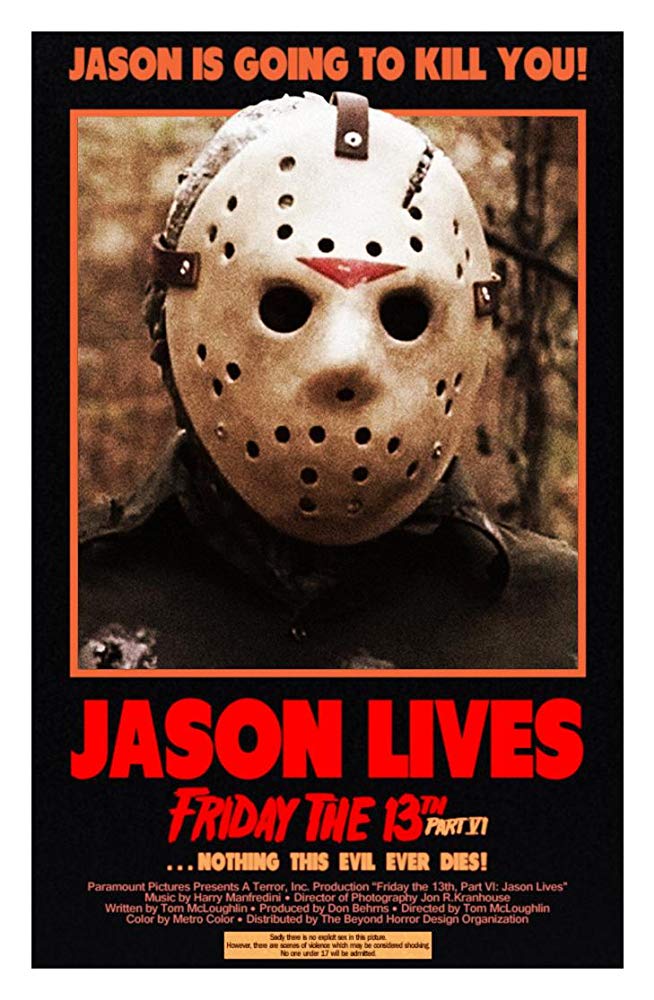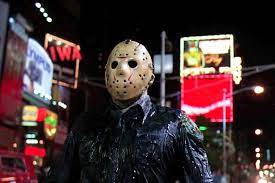
Friday the 13th Part VIII: Jason Takes Manhattan

FRIDAY THE 13TH PART VIII: JASON TAKES MANHATTAN (1989) *
The tragically titled Friday the 13th Part VIII: Jason Takes Manhattan just might be the first movie that I ever considered a bust, a disappointment, and a great big ripoff.

I remember looking forward to Jason Takes Manhattan because I had already seen Part III and Jason Lives on video and liked them a good deal and, let’s face it, I got all hyped up on promotional material that included the trailer and TV spots, the poster and print ads, and Jason Voorhees himself making a guest appearance on The Arsenio Hall Show on Friday, July 28, 1989, the date of the film’s release.

At that very point in time, I thought Jason Takes Manhattan would be the greatest thing ever in the whole wide world.

Boy, would I ever be wrong on that one!

Let’s see here, where to start, other than none of the human characters are exactly likable in the slightest degree, just like most of the later Friday the 13th sequels starting with A New Blood and running through both New Line Cinema films and the 2009 remake.

Uncle Charles, played by veteran character actor Peter Mark Richman (1927-2021), just might possibly be the most reprehensible character in the Friday series. Other worthy contenders right off the old head are Axel from The Final Chapter and Roy Burns from A New Beginning, but there’s so many loathsome characters in the later Friday films.

Jason Takes Manhattan almost feels like an episode of The Love Boat … seriously, the movie spends far more time on a boat than it does Manhattan. It’s unfortunate that Jason Takes Manhattan came out 30 years before Lonely Island’s I’m on a Boat.

Takes Manhattan? Seriously, are you kidding? More like Barely Walks Through Manhattan! It takes more than an hour of the longest entry in the Friday series to even get to Manhattan, and it’s disappointing even after we get there.

Director and screenwriter Rob Hedden possessed a vision to incorporate landmarks like the Statue of Liberty, the Brooklyn Bridge, and Madison Square Garden, naturally, but parent studio Paramount decided to be the Grinch and slash the budget for what turned out to be the final Paramount entry after a series of declining returns starting with A New Beginning and continuing through Jason Lives, A New Blood, and finally Jason Takes Manhattan.

They spent very little time in the actual Manhattan, and of course Vancouver stands in for the Big Apple most of the time.

Guess you could say Jason Takes Manhattan paved the way for Rumble in the Bronx, which makes up for featuring even less of the Bronx than Manhattan’s featured in Jason Takes Manhattan by having some absolutely fantastic Jackie Chan action scenes.

The kill scenes in Jason Takes Manhattan are disappointing, just like about every other single thing during the 100-minute motion picture.

In the film’s most famous scene, Lakeview High School boxing champion Julius Gaw engages our anti-hero Jason Voorhees in a boxing match and punches Jason many, many, many times before Jason knocks Julius’ block off with just a single punch.

I’ve always been underwhelmed by that scene, and I far prefer a similar scene the year before in Killer Klowns from Outer Space.

I don’t even want to think about another one of those patented beyond weird Friday endings that leave viewers dumbfounded and stupefied.

Here instead is a transcript of the Arsenio interview.

A: How are you?

That’s good.

You know what I’ve noticed. I see all your movies, man, and you know what I’ve really noticed. You’re angry.

I don’t mean to laugh. Excuse me, it’s just the way I am, but you’re you’re you’re angry.

What happened, man, where did it all begin?

[Long pause]

You know what I mean? Was it a woman? Did you get cut from the hockey team in high school?

What happened? What’s up?

Let me ask you this.

I saw the new movie, Jason Takes Manhattan.

You killed 16 people … I don’t know why I’m laughing.

You killed 16 people and you were responsible for the death of eight others. Total, that’s less than what you usually kill in a movie.

Are you getting soft? Are you losing a step?

You’re trembling, man.

Oh, you brought a clip.

Would you set it up for us?

Set up the clip, like tell them you know how this fits into the movie and what they’re about to see and all that kind of stuff.

Jason Takes Manhattan, here’s his clip.

[Times Square clip plays.]

Working on the streets of New York, did you get a lot of people come up to you to ask for your autograph and stuff like that?

Ever think about doing a musical?

[Another pause.]

I’m running out of questions, man.

Oh, I know what I wanted to ask you.

You didn’t kill anybody with that big knife you used to kill people with, did you change because you were afraid of being typecast as just being a big knife killer?

So what’s next, man?

Some more of Jason Part Nine, I got some great titles I put together.

Jason and the Three Babies. What do you think of that?

Jason’s Big Top would be funny.

Oh … Jason Rabbit.

That would be great.

Oh … When Jason Met Sally … would that be funny?

You don’t do many comedies, do you?

Um … I’d like to thank you for coming by. It’s a pleasure.

(Jason shakes Arsenio’s hand very, very, very strongly.)

Jason, ladies and gentlemen.

Definitely another case where the promotion is a whole lot better than the picture.
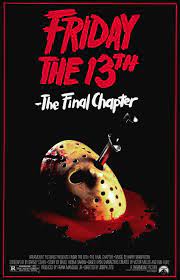
Friday the 13th: The Final Chapter (1984)

FRIDAY THE 13TH: THE FINAL CHAPTER (1984) ***
Once upon a time, I called Friday the 13th: The Final Chapter the most schizophrenic movie ever made and what I mean by this bit of hyperbole is that The Final Chapter largely alternates being a rather brutal, occasionally mean-spirited horror movie sequel and a jovial teenage sex comedy especially made explicit in casting Lawrence The Last American Virgin Monoson in one of the key supporting roles.

The Final Chapter has some of the best and also some of the worst moments in the entire 12-movie Friday series, easily the best cast and most likable characters from (almost) top to bottom, Tom Savini’s return as makeup artist, Harry Manfredini’s first-rate musical score, Ted White’s brutal conviction selling his kill scenes as Jason Voorhees, and it’s arguably the quintessential Friday the 13th movie.

Let’s hit a couple of the high points first.

The Final Chapter introduces us to Tommy Jarvis (Corey Feldman), a 12-year-old boy with a hyperactive imagination and penchant for monster make-up and masks not unlike Savini; Trish Jarvis (Kimberly Beck), Tommy’s older sister and our Final Girl; Mrs. Jarvis (Joan Freeman), Tommy’s and Trish’s single mother; Gordon the Family Dog, the golden retriever whose fate remains uncertain. Anyway, this family dynamic is something fresh and new for the Friday series.

Crispin Glover, one of the great movie eccentrics, makes his mark on The Final Chapter and his Jimmy becomes one of the most unforgettable horny (dead) teenagers in a series that served them up by the hundreds as fodder for the slaughter. Jimmy and his buddy Ted (Monoson) especially feel like refugees from a teenage sex comedy, like they continued playing their characters from My Tutor (Glover) and The Last American Virgin (Monoson). Jimmy’s dance and exit line in this movie have become the stuff of slasher movie legend.

Feldman and Glover provide us two of the most likable characters in any of the dozen Friday movies, something that’s ironic given the fact The New Beginning (which arrived in theaters around 11 months after The Final Chapter) has almost no likable characters among the largest cast of corpses in series history. Never mind that Tommy did not exactly pan out in The New Beginning and Jason Lives like the endings of The Final Chapter and The New Beginning seemed to promise.

I almost forgot Rob (E. Erich Anderson), the older brother of a character killed by potato sack Jason in Part 2. Rob seeks revenge against Jason and fortunately he meets Trish and Tommy first, though ultimately it does not matter because Rob represents one of the great missed opportunities. Here’s a character who could have served as a basis for an entire movie and The Final Chapter makes him completely underwhelming. His death scene, designed to be poignant, instead becomes laughable (‘He’s killing me. He’s killing me’) and it wishes it could be as enjoyably bad as the bookseller’s death in Dario Argento’s Inferno. You might recall that the creepy old book retailer’s done in by rats and a homicidal Central Park hot dog vendor.

Now, we’ve moved on to the more negative.

Our first two new corpses in The Final Chapter represent one of my least favorite scenarios that’s commonly found in Friday movies. We spend several minutes, it feels even longer, much much much longer, with super horny morgue attendant Axel (Bruce Mahler) and super uninterested Nurse Morgan (Lisa Freeman) before they are massacred by Jason. Maybe it’s only a few minutes, but I never want to watch their scenes ever again to find out. I’ll use their introduction as my cue to go make some scrumptious butter popcorn.

Like the beginning of Part III and the obligatory murder of the lakefront store owners, these are minutes of my life that could have been attended to better things, even during a Friday movie.

The Final Chapter loves breaking glass and characters falling through windows.

The Final Chapter gets straight at the heart of the ambivalent relationship between parent company Paramount Pictures and the Friday movies.

One immediately gets the feeling that Paramount wanted The Final Chapter, you know, to be the end of Jason once and forever because the studio hotshots were ashamed to be associated with such a disreputable and sleazy franchise, but, alas, at the same time, The Final Chapter leaves the door open for more sequels with one of the series’ trademark endings. Paramount walked through that very door — actually, more like sprinted — when The Final Chapter returned a hefty profit.

The Final Chapter finished in the top 25 box office for 1984 and put together a $11.1M opening during the weekend of April 13.

Friday, April 13, 1984. The Challenger returned to Earth from their 11th space shuttle mission. India beat Pakistan by 54 runs to win the first Asia Cricket Cup in Sharjah, United Arab Emirates.

Paramount released A New Beginning on March 22, 1985, and 1983 and 1987 are the only years of the ’80s without a Friday the 13th movie. Do 1983 and 1987 belong to another decade?

I more or less grew up with the Friday movies, so I might be more forgiving of them for all their numerous faults than people who grew up in different times.

Then again, I might not be, because I only consider Jason Lives (the best made and the only entry that deserves a place near second- or third-tier classic horror movies like Frankenstein Meets the Wolf Man), Part III (the most suspenseful and the one where Jason acquires his legendary hockey mask), and The Final Chapter even worth recommending. Most of the rest of them have their isolated moments, all of them are excuses for reels of sex and violence and vulgarity, and the movies definitely created their own distinctive space in the cinematic marketplace.

How did the world end up with 12 Friday the 13th movies and legendary status for both the series overall and serial killer Jason Voorhees specifically, when similar movies like My Bloody Valentine, The Burning, Happy Birthday to Me, and Madman failed to produce one sequel among them. Granted, the original Friday finished 15th in the 1980 American box office sweepstakes and the first three sequels also proved to be solid hits among strong competition, while The Burning grossed $700 thousand, Madman $1.3M, My Bloody Valentine $5.7M, and Happy Birthday to Me $10.6M.

Money obviously talked for Jason.

Friday the 13th Part VI: Jason Lives (1986)

JASON LIVES

FRIDAY THE 13TH PART VI: JASON LIVES (1986) Three stars

I find the FRIDAY THE 13TH movies that I like the most are the ones with the best sense of humor.

That’s why I’ll call PART VI: JASON LIVES the best film in the entire series, beating out PART III and THE FINAL CHAPTER. JASON LIVES includes several intentionally funny scenes and that helps its 86 minutes go down smoothly.

Director and writer Tom McLoughlin wanted to satirize a slasher movie all while making one, turn Jason into a supernatural zombie, and not simply churn out a carbon copy of the five previous movies in the series. There are moments intended to recall classic horror movies, like the beginning scene in the cemetery echoes the grave robbers at the beginning of FRANKENSTEIN MEETS THE WOLF MAN. Jason’s revival from the dead courtesy lightning also recalls Frankenstein’s Monster.

“I set up a lot of visual gags,” McLoughlin said in the book “A Strange Idea of Entertainment — Conversations with Tom McLoughlin.” “Like when my wife Nancy is killed by Jason. She tries to bribe him, offering him her wallet to keep him from killing her. She’s got money and a credit card in her wallet, and when Jason kills her in this giant mud puddle, the money sinks and the American Express card floats. I held on that shot for a few extra beats because I knew there would always be some joker in the theater that would yell, ‘Don’t leave home without it!’ And someone always did.”

McLoughlin’s background proved to have a strange influence on Jason Voorhees.

“I was recently interviewed about it, and someone said, ‘Your Jason seemed to be much more communicative,’” McLoughlin said. “I said, ‘That’s because I was dealing with a mime character.’ When he sees the motor home bouncing up and down because a couple are having sex in there, Jason just stands there and stares, with his head tilting back and forth — like a dog trying to figure out what’s going on. It got a big laugh. I wasn’t making fun of Jason … I just figured he would be processing what was going on in that motor home. Whenever I find a way to put my mime training to use in storytelling, I do it.”

Marcel Marceau influenced Jason Voorhees. Makes perfect sense to me.

McLoughlin sang in a rock band before he went to Paris to study mime under Marceau. Back in the States, several years later, McLoughlin had a part as the mutant bear monster in the 1979 horror film PROPHECY directed by John (MANCHURIAN CANDIDATE) Frankenheimer. All these experiences seemingly fed McLoughlin more insight into Jason than any other director.

Alice Cooper provided three songs for JASON LIVES:  “Teenage Frankenstein,” “Hard Rock Summer,” and “He’s Back (The Man Behind the Mask).” Unfortunately, they are not classic Alice Cooper songs, a la the four-album period from “I Love It to Death” through “Billion Dollar Babies” when the band cranked out some of the greatest hard rock ever made, but I still enjoy “He’s Back.” SCREAM later made great use of the Alice classic “School’s Out.”

Speaking of SCREAM, apparently screenwriter Kevin Williamson wanted McLoughlin to direct his hot commodity screenplay, before the project ended up with Wes Craven. Williamson told McLoughlin that JASON LIVES and its humor made a huge impact on Williamson during his youth, so much so that it served as one of the inspirational springboards for SCREAM.

There’s a James Bond gun barrel sequence parody, dialogue that breaks the proverbial fourth wall, a camper reading Jean-Paul Sartre’s existentialist play “No Exit,” a camper praying to God for the first (and only) time in the series, and even Jason surprised at his own astonishing strength. Also, for the first and only time in the series, young campers are in attendance at Camp Forest Green, er, Camp Crystal Lake.

“I’ve seen enough horror movies to know any weirdo wearing a mask is never friendly” and “Some folks sure got a strange idea of entertainment” are lines that display how JASON LIVES influenced SCREAM.

The young children, who Jason does not harm, have their moments, as well, especially when one boy asks his little friend, “So, what were you gonna be when you grew up?”

All these words so far and I have not even mentioned protagonist Tommy Jarvis, who figured in THE FINAL CHAPTER, A NEW BEGINNING, and JASON LIVES. He’s responsible for reviving Jason in the opening sequence and Tommy even makes sure to bring that infamous hockey mask with him. Originally, it had been planned for Tommy to become the antagonist, but it was the extremely negative reaction to A NEW BEGINNING and its non-Jason killer which truly brought Jason back from the dead. Tommy never panned out like he should have and part of the problem is that he’s played by three different actors, Corey Feldman (THE FINAL CHAPTER), John Shepherd (A NEW BEGINNING), and Thom Mathews (JASON LIVES).

Anyway, definitely by this point in the series, Jason became the focus of attention and the antihero extraordinaire of the late ‘80s. Dan Bradley played Jason in the paintball massacre sequence, but former soldier C.J. Graham handled the rest of the duties. He’s a lot more interesting than Tommy Jarvis. That’s why the series moved forward with Jason (Kane Hodder the man behind the mask for four more sequels) and without Tommy Jarvis.

Friday the 13th (1980)

FRIDAY THE 13TH (1980).jpg

FRIDAY THE 13TH (1980) One-and-a-half stars

Of all the horror movies over the decades that have been labelled “classic,” FRIDAY THE 13TH is the one arguably least deserving of that label.

Plain and simple, it’s a bad movie. One-dimensional characters, corny dialogue that even makes references to much much much better movies like CASABLANCA, filler scenes, and perhaps the least convincing mass murderer in screen history are some of its crimes against cinema.

Harry Manfredini’s musical score derived from PSYCHO and JAWS and Tom Savini’s make-up and special effects are both very good, and their work earns the film one half-star each.

I can only see FRIDAY THE 13TH being considered a classic if you count all the sequels and imitations.

My personal favorite FRIDAY THE 13TH movies are PART III, THE FINAL CHAPTER (perhaps the most schizophrenic movie ever made, a cross between leering teenage sex comedy and brutal violence), and JASON LIVES. They succeed more at having a sense of humor and a sense of fun than all the other installments. The rest of the movies all have their isolated moments.

If you have seen the sequels before the original, you might be shocked by the film that started it all. It is very sluggish, at times, and there’s no hockey-masked homicidal maniac in the middle of the mayhem.

Sean Cunningham (director) and Victor Miller (screenwriter) made FRIDAY THE 13TH to cash in on HALLOWEEN, which earned $60-70 million on a $300,000 budget. When there’s an unexpected runaway success like that, naturally the clones and variations start appearing in droves and they did after HALLOWEEN for at least five years.

Cunningham and Miller worked together previously on a family film called MANNY’S ORPHANS, released nearly two months before HALLOWEEN. Cunningham began with adult movies THE ART OF MARRIAGE and TOGETHER, produced Wes Craven’s THE LAST HOUSE ON THE LEFT, and directed a sexploitation comedy named CASE OF THE FULL MOON MURDERS before consecutive family pictures in 1978.

In other words, he saw FRIDAY THE 13TH as the way to make inroads in the brutal movie business. Honestly, who could blame Cunningham, especially as many others had a similar brainstorm.

Cunningham, of course, lacked the finesse and skill of HALLOWEEN director-writer-composer John Carpenter. FRIDAY THE 13TH does benefit, however, from its own low budget production — $550,000 — so it is effective in fits and starts despite itself. It is far more of an exploitation film than HALLOWEEN, and proved nearly as profitable. We saw FRIDAY THE 13TH movies in every year of the 1980s except for 1983 and 1987.

What FRIDAY THE 13TH did was establish a campground setting, add more corpses, er, characters, and amplify the gore, elements that quickly became the norm for an onslaught of “dead teenager” movies. Like virtually every horror movie since CARRIE (1976), it also has one final jump scare. The sequels — namely PART 2, THE FINAL CHAPTER, and THE NEW BEGINNING — upped the nudity and sex quotient. (FRIDAY THE 13TH fans should check out Mario Bava’s BAY OF BLOOD, a 1971 film that undoubtedly influenced the first two FRIDAY THE 13TH installments. If you’ve not seen the Bava film before, you might be surprised. It’s also much better than any of the FRIDAY THE 13TH movies.)

The original FRIDAY THE 13TH exists in that post-HALLOWEEN storytelling mode, where there’s a prologue detailing terrible events that happened in the past and will dovetail with the events of the present. Just about every horror film made after HALLOWEEN includes a bloody, sordid back story.

In FRIDAY THE 13TH, we head back in time to Friday, June 13, 1958, Camp Crystal Lake, when camp counselors Barry and Claudette sneak inside a storage cabin for a little lovin’ and they are murdered. We come to find out that one year before, a 11-year-old boy named Jason Voorhies apparently drowned in Camp Crystal Lake, due to negligent camp counselors.

You could build a nifty little collection of these back story / terrible event in the past scenes.

Let’s see, HALLOWEEN began on Halloween 1963 with 6-year-old Michael Myers killing his older sister Judith.

In PROM NIGHT, it’s 1974 when 11-year-olds Wendy, Jude, Kelly, and Nick cause the accidental death of 10-year old Robin.

In TERROR TRAIN, a sexual initiation prank at a college fraternity’s New Year’s Eve party leads a young man named Kenny to become traumatized and committed to a psychiatric hospital.

In THE BURNING, it’s a fiery prank on a cruel, alcoholic summer camp caretaker named Cropsy that leads to five years in the hospital before his release and revenge.

MY BLOODY VALENTINE waits a bit to spring its 20 years ago flashback story on us.

Anyway, you get the point.

Steve Christy (Peter Brouwer) decides that he will reopen a renovated Camp Crystal Lake. That’s his big mistake, one that results in eight deaths — seven of them Christy and his staff — on Friday, June 13, 1979.

Final Girl Adrienne King does have a great scream and some of the same wholesome All-American appeal as Jamie Lee Curtis. We also find out that she’s very talented at making coffee. Alice Hardy is virtually the only likable character among the lot, although we’re aghast that she ever had a love affair with the creepy Steve Christy. Girl, what were you thinking? There goes the whole idea of the Final Girl being a virgin.

As far as the boys go, Kevin Bacon later became a big star but he’s not around long in FRIDAY THE 13TH. Harry Crosby, son of the legendary actor and singer Bing (1903-77), attended the London Academy of Music and Dramatic Art and earned his MBA from the Fordham Graduate School of Business Administration before becoming a successful investment banker. Anyway, he’s killed in FRIDAY THE 13TH.

That all leads us to Mrs. Pamela Voorhees, played by Betsy Palmer (1926-2015), who we find out committed all the murders in a final act reveal. This middle-aged, albeit crazy, middle-aged lady, who at first seems like a kindly middle-aged lady, created all that mayhem. Early in this review, I called Mrs. Voorhees “perhaps the least convincing mass murderer in screen history” and I stand behind that claim. I just don’t believe that she could have accomplished such murderous feats, especially as she begins her attack on Alice by slapping her silly. Palmer brings on the camp — as in campy — during her screen time.

Film critic Gene Siskel (1946-99) hated FRIDAY THE 13TH so much that he first gave away the movie’s reveal and Palmer’s fate and then he provided the addresses for the chairman of the board of Gulf & Western Industries (who owned Paramount back then) and Palmer. Siskel rated FRIDAY THE 13TH “no stars.”

Palmer herself thought very little initially of the film and took on the assignment so she could buy a Volkswagen Scirocco. She called the script “a piece of shit” and she thought no one would go see FRIDAY THE 13TH.

In her later years, Palmer embraced the film and the role.

Nowadays, the next FRIDAY THE 13TH might be a documentary on the legal copyright battle between Miller and Cunningham.

As of Oct. 19, 2019, 655 folks have signed the change.org petition “Victor Miller & Sean Cunningham, End The Lawsuit and Work Together To Let Jason Live Again.”

The petition reads, “We, the fans of Friday the 13th ask both Victor Miller, Sean Cunningham along with Horror Inc to end the lawsuit and find resolution over the copyright claim by working together.

“Allowing the battle to take place in court helps no one, especially not the fans of the series. Relying on a courts decision will take years with neither side truly profiting within that time frame. Even after the courts decision one side will likely appeal the case and that will lead to even more years of not profiting on the franchise.

“By coming to a mutual agreement you both compromise and get something you want. You find common ground and you can work together to profit both sides. You’d also be supporting the fans that have supported you and the franchise for so many years. We want to continue to watch the franchise grow under your direction. Please support us as we have supported you. Thank you.”

Friday the 13th Part III (1982)

DAY 30, FRIDAY THE 13TH PART III

FRIDAY THE 13TH PART III (1982) Three stars
On their movie review program “Sneak Previews,” Gene Siskel and Roger Ebert hated just about every slasher film (Ebert called them “Dead Teenager” movies) that came down the pike after HALLOWEEN. They lambasted MANIAC, THE BURNING, MADMAN, MY BLOODY VALENTINE, HE KNOWS YOU’RE ALONE, MOTHER’S DAY, and HAPPY BIRTHDAY TO ME (nearly all those picked “Dogs of the Week”), but seemed to save their greatest reserves of spleen for the FRIDAY THE 13TH series. That’s okay, they weren’t alone in condemning the series.

Coming of age in the late-1980s and early-1990s, slasher films played a formative role in my filmgoing experience. One way or another, I caught up with all the Jason, Freddy, Michael Myers, Chucky, et cetera, movies. Why were these films so popular amongst young people? Must have felt that we were rebelling against the decorum set for us young people by our elders. Also sure that we were reveling in the forbidden.

PART III was my very first FRIDAY THE 13TH movie (saw it about 30 years ago) and that must contribute to why it’s among my favorites in the series all these years later.

It’s not a good movie in any traditional way shape or form and it has a lot of the same underlying problems as the other movies in the long-running series, but it’s very entertaining and silly at least until the body count starts piling up. Hey, let’s face it, though, we don’t watch movies like FRIDAY THE 13TH for the same reasons that we watch other movies. We go for the body count, No. 1, then the other exploitation movie elements like gore, nudity, and general vulgarity. The characters are often superficial archetypes, the dialogue is nothing to write home about, and it’s all very predictable. To some degree, we like it that way.

With it being originally filmed in 3-D, that only adds to the silliness of PART III because there must be at least 50 gimmick shots for the sake of the 3-D, including ones where Jason squeezes our male protagonist’s head until his eyeball heads straight for us and Jason’s first kill wearing his iconographic hockey mask. Additionally, we have a disco variation on Harry Manfredini’s score over the gonzo opening credits and some new character archetypes for the slaughter, like a married couple with the male partner suggesting Tommy Chong and a would-be motorcycle gang who gives Jason his first opportunity to kill outside his race.

Just keep in mind the FRIDAY THE 13TH movies have a transcendent appeal; for example, Kim Jong-il (1941-2011) loved him some Jason along with Rambo and Godzilla and rapper Big Daddy Kane used Jason for a rhyme in “Ain’t No Half Steppin.'”

For whatever reason, PART III generates more suspense than any other entry in the series. Steve Miner, assistant director on the first movie, remains the only person to direct more than one installment and that just might be the difference maker. Miner directed PART 2 and PART III.

I mentioned problems and there’s about 10 minutes of my life (multiplied by every time I see this sequence unless I fast-forward) that I will never get back when Jason dispatches Harold and Edna early in the movie, two unfortunate proprietors of a lakefront store. I call this hallmark of the genre “filler killings,” ones that pad running time or serve a body count (PART V fills that bill) and no greater purpose to the movie as a whole. Of course, haters of the genre would say that “filler killings” describe the entire movie.

Also, we have another shock ending that’s only shocking in just how non-shocking it turns out to be. Just about every slasher film in the era had a shock ending. This one almost defies belief.

Larry Zerner, who plays the asshole prankster Shelly, became an entertainment lawyer and Tracie Savage covered the Heidi Fleiss and O.J. Simpson trials as TV reporter, so undoubtedly PART III both served them well in their later careers.

Jason acquires his trademark hockey mask from Shelly. Jason’s played in PART III by British trapeze artist Richard Brooker, who apparently believed that playing a psychopathic killer was his entry way into a successful movie career. “It felt great with the mask on,” Brooker said. “It just felt like I really was Jason because I didn’t have anything to wear before that.”

After his screen debut as Jason, Brooker (1954-2013) appeared in DEATHSTALKER, “Trapper John, M.D.,” and DEEP SEA CONSPIRACY. Brooker later went into TV directing, for example “Bill Nye the Science Guy.” A fan-made documentary FRIDAY THE 13TH: THE MEMORIAM DOCUMENTARY appeared on YouTube in early 2018, which memorialized Brooker by interviews with FRIDAY THE 13TH luminaries and an on-screen dedication to his memory.

Final girl Dana Kimmell appeared in the Chuck Norris action spectacular LONE WOLF McQUADE after FRIDAY THE 13TH PART III. There’s a meme out there, “Chris Higgins survived her encounter with Jason because Chuck Norris wanted Chris Higgins to survive her encounter with Jason.” That’s great and everything, but there’s an alternate ending to PART III where Jason decapitated Chris (Kimmell).

Still, that gets me thinking about what would happen if Chuck Norris met Jason Voorhees in a movie.