The Pride of the Yankees (1942)

THE PRIDE OF THE YANKEES

THE PRIDE OF THE YANKEES (1942) Two stars
A “Yeah right!” movie, why that’s THE PRIDE OF THE YANKEES.

We all know what “Yeah right!” movies are, right, because, yes, they make us say “Yeah right!” It could be any plot element, a plot twist, a casting decision, et cetera.

Watching THE PRIDE OF THE YANKEES again, it left me saying “Yeah right!” more than anything I’ve seen since, oh, perhaps, CRASH (2005).

We’ll start with a defining “Yeah right!” scene.

Of course, I know, THE PRIDE OF THE YANKEES is the cinematic equivalent of those books we read in elementary school about George Washington and Abraham Lincoln. You might remember the larger-than-life stories about George and his cherry tree and Honest Abe wrestling.

THE PRIDE OF THE YANKEES does that with a bat and a glove.

Our Gehrig tall tale starts with a hospital room filled with reporters. Yankee slugger Babe Ruth (Babe Ruth) promises a boy named Billy that he will hit a home run to center field … against St. Louis in the 1926 World Series.

Why, not to be outdone, our hero Lou Gehrig (Gary Cooper) comes over to visit Billy on his own and promises the boy two home runs … in the same game, yes, the same game that Ruth’s supposed to hit a homer. What a lucky boy!

Ruth and Gehrig both get their homers out of the way in the first inning.

Well, Gehrig needs his second homer and it’s not going to be easy.

Sports writers Sam Blake (Walter Brennan) and Hank Hanneman (Dan Duryea) spend the movie bantering back-and-forth with Blake always supporting and Hanneman always doubting Gehrig. Blake and Hanneman bet on whether or not Gehrig will hit a second homer. They keep raising their stakes as the game moves on and Gehrig accumulates strikeouts. I should probably mention that Blake witnessed Gehrig making his promise.

All roads lead us to the ninth inning and why that dirty St. Louis pitcher, he’s gonna intentionally walk Gehrig.

Of course, a promise is a promise, though, and Gehrig finds a way to fulfill it in the absolute most dramatic fashion.

Later in the film, near the end of his life, Gehrig’s visited by an older Billy on Lou Gehrig Day. Billy tells Gehrig that his shining example and two homers that day inspired Billy’s full recovery.

As the reporter said in THE MAN WHO SHOT LIBERTY VALANCE, “When the legend becomes fact, print the legend.”

Opening credits: “This is the story of a hero of the peaceful paths of everyday life.

“It is the story of a gentle young man who, in the full flower of his great fame, was a lesson in simplicity and modesty to the youth of America.

“He faced death with that same valor and fortitude that has been displayed by thousands of young Americans on far-flung fields of battle. He left behind him a memory of courage and devotion that will ever be an inspiration to all men.

“This is the story of Lou Gehrig.”

Signed by famous writer Damon Runyon (1880-1946). Far out.

Yes, THE PRIDE OF THE YANKEES — made shortly after Gehrig’s death in 1941 at the age of 37 — lays it on thick right from the start.

Gehrig remains one of the greatest baseball players — his 2,130 consecutive games played streak stood as record until Cal Ripken, Jr., passed it on Sept. 6, 1995.

Great baseball players do not guarantee great movies — Babe Ruth, for example, received THE BABE RUTH STORY (1948) and THE BABE (1992), both even worse than THE PRIDE OF THE YANKEES.

In a certain mood, THE PRIDE OF THE YANKEES might be a moving experience.

Otherwise, it might be a “Yeah right!” movie for the ages.

Bette Davis: Tougher than Anybody Else

BETTE DAVIS: TOUGHER THAN ANYBODY ELSE
Like most people in my generation, I first encountered Bette Davis (1908-89) through popular music rather than her 123 movie or TV roles from 1931 through 1989.

Oh, let’s see, Davis made a starring performance in Kim Carnes’ “Bette Davis Eyes,” a hit that spent nine weeks at No. 1 on the Billboard Hot 100 and proved to be 1981’s biggest song. You might vividly remember that one and songwriters Donna Weiss and Jackie De Shannon gave their heroine — er, their femme fatale — not only Bette Davis eyes, but also “Harlow gold hair” and “Greta Garbo’s standoff sighs.”

Davis also made the hall of fame in songs by Madonna and the Kinks.

Madonna Ciccone and Step Pettibone (Ciccone-Pettibone has got a better ring to it than Lennon-McCartney or Strummer-Jones) co-wrote “Vogue” and Madonna’s rap (her best) finishes off with “Bette Davis, we love you” after running through Garbo, Monroe, Dietrich, DiMaggio, Brando, James Dean (called Jimmy Dean, not the sausage manufacturer), Kelly, Astaire, Hayworth, Bacall, Hepburn, and Lana Turner.

Like the other two songs that came later in time, Ray Davies’ lyrics on “Celluloid Heroes” mention Garbo and she gets top billing (first mention) before the song moves on to Rudolph Valentino, Bela Lugosi, Davis, George Sanders, Mickey Rooney, and Marilyn Monroe. Davies groups Davis with Valentino and Lugosi, capping off six lines with “But stand close by Bette Davis / Because hers was such a lonely life.” (Davis named her 1962 autobiography “The Lonely Life.”) For the record, Garbo gets six lines, Monroe four, and Valentino, Lugosi, Sanders, and Rooney two each.

— The first Bette Davis movies I saw were ALL ABOUT EVE (1950) and WHAT EVER HAPPENED TO BABY JANE? (1962), both highly enjoyable for different reasons.

Their common ground, though, centers around Davis.

ALL ABOUT EVE, that’s the one featuring her famous line “Fasten your seat belts. It’s going to be a bumpy night.” Margo Channing — a highly-regarded but aging and difficult stage actress — must not have been a great stretch for a Davis in her early 40s.

Other actresses considered for the role were Ingrid Bergman, Marlene Dietrich, Susan Hayward, Gertrude Lawrence, and Barbara Stanwyck. Think we can all agree that Davis was the perfect choice for Margo Channing.

You can almost feel Davis herself speaking through dialogue like “Lloyd, I am not twenty-ish. I am not thirty-ish. Three months ago I was forty years old. Forty. 4-0. That slipped out. I hadn’t quite made up my mind to admit it. Now I suddenly feel as if I’ve taken all my clothes off” and “Bill’s 32. He looks 32. He looked it five years ago. He’ll look it twenty years from now. I hate men.”

BABY JANE capitalized on the real-life feud between Davis and Joan Crawford, where most of the fun comes from speculating how much reality crossed over into their fictional characters.

Just a casual search on the Internet will bring up all sorts of quotes from Davis on Crawford and I might as well as share a few within this space: “You should never say bad things about the dead, you should only say good … Joan Crawford is dead. Good”; “There may be a heaven, but if Joan Crawford is there, I’m not going”; “Why am I so good at playing bitches? I think it’s because I’m not a bitch. Maybe that’s why Miss Crawford always plays ladies”; and “The best time I ever had with Joan Crawford was when I pushed her down the stairs in WHAT EVER HAPPENED TO BABY JANE?”

Davis never had a problem being the villain and that’s one of the things that made her so great. Let’s face it, sometimes we like the villains infinitely more than bland, square heroes.

She played a strong character in almost every single role.

Davis became the first performer to be nominated for 10 Academy Awards, all for Best Actress, and she won statuettes for DANGEROUS (1935) and JEZEBEL (1938), her first two nominations.

— Recently, I caught up with OF HUMAN BONDAGE (1934), FOG OVER FRISCO (1934), and THE PETRIFIED FOREST (1936).

OF HUMAN BONDAGE — her 22nd film — is renowned for being the film that made Davis a star.

Davis’ character Mildred Rogers has been described as “callous,” “manipulative,”  “cold,” “shrewish,” et cetera, and Davis really sinks her teeth into “You cad, you dirty swine! I never cared for you, not once! I was always makin’ a fool of ya! Ya bored me stiff; I hated ya! It made me SICK when I had to let ya kiss me. I only did it because ya begged me, ya hounded me, and drove me crazy! And after ya kissed me, I always used to wipe my mouth! WIPE MY MOUTH!”

That’s her big scene with Leslie Howard’s Philip Carey, an overly sensitive, club-footed man who’s in love with Mildred despite the fact that she treats him like trash.

— FOG OVER FRISCO came out 26 days before OF HUMAN BONDAGE in 1934 and it’s a fast-moving crime melodrama over in 68 minutes. Action-packed and the big chase scene called to mind BULLITT and THE DEAD POOL, believe it or not.

Davis considered this one of her favorite pictures, though her character Arlene Bradford does not make it to the final reel.

Maybe here’s why FOG OVER FRISCO rated among her favorites: Davis received top billing after Warner Bros. boss Jack Warner caught drift of the Bette buzz from rushes of the film and she found out while filming FOG OVER FRISCO that Warner agreed to loan Davis out to RKO to make OF HUMAN BONDAGE.

Davis also said that FOG OVER FRISCO had a good script and that it was superbly directed by William Dieterle over a shoot that lasted around 20 days (Monday, January 22, 1934 through Saturday, February 10, 1934).

Davis plays characters on opposing ends of the social spectrum in FOG OVER FRISCO and OF HUMAN BONDAGE. In both films, though, she has a weak male admirer. She’s the stronger character, as usual.

— A lot of the fascination watching THE PETRIFIED FOREST came from seeing both Davis and Humphrey Bogart in roles early in their career.

Bogart had done 10 feature films before THE PETRIFIED FOREST and he first played the Duke Mantee role in the 1935 Broadway production alongside Leslie Howard. Warner Bros. wanted Edward G. Robinson (LITTLE CAESAR) for the film adaptation, but Howard refused to appear in the film unless Bogart got the chance to revisit Mantee, a character and performance inspired by John Dillinger. The rest was history. (Bogart and Lauren Bacall named their daughter Leslie Howard Bogart, born 1952, in honor of their friend.)

Bogart is just dynamite in THE PETRIFIED FOREST.

Like OF HUMAN BONDAGE, Davis plays a waitress and Howard’s love interest. Unlike that earlier movie, however, her Gabrielle Maple’s almost instantly smitten with Howard’s Alan Squier and their fates are reversed from OF HUMAN BONDAGE.

The New York Times’ review of the film said of her performance in THE PETRIFIED FOREST, “There should be a large measure of praise for Bette Davis, who demonstrates that she does not have to be hysterical to be credited with a grand portrayal.”

Gabrielle’s a very sympathetic character, a dreamer and an aspiring artist.

— Davis once said, “I survived because I was tougher than anybody else.”

ALL ABOUT EVE (1950) Four stars; WHAT EVER HAPPENED TO BABY JANE? (1962) Four stars; OF HUMAN BONDAGE (1934) Three-and-a-half stars; FOG OVER FRISCO (1934) Three-and-a-half stars; THE PETRIFIED FOREST (1936) Three-and-a-half stars

The Manchurian Candidate (1962)

DAY 81, THE MANCHURIAN CANDIDATE

THE MANCHURIAN CANDIDATE (1962) Four stars
John Frankenheimer’s political thriller is one ripped, twisted movie, borrowing famous words from Hunter S. Thompson.

It should make one reconsider both Frank Sinatra and Angela Lansbury, for example.

I did.

Before I first watched THE MANCHURIAN CANDIDATE, I held Sinatra in very little (miniscule) esteem. Maybe it was Phil Hartman’s savage impersonation on “Saturday Night Live.” Maybe it was Sinatra’s appearances on Jerry Lewis’ MDA telethon on Labor Day and when you only have three channels and one of them’s gone all weekend, all booked up, man, we’re talking about Pits City. Maybe it was his crooning that provided the soundtrack for seemingly innocuous yuppie consumption (we all know what seemingly innocuous really means) and little old swooning ladies and every movie that wants to evoke a certain mood just by slapping one of Ol’ Blue Eyes’ standards on every few minutes. Maybe it was the fact that he lived and breathed crusty, old guard establishment, whose reactions to Elvis and the Beatles were not surprising. There was just something about that man that gave me the creeps.

Why, of course, like any child of the 1980s and 1990s, I knew Lansbury from “Murder, She Wrote” and I know I saw her in old Disney entertainments somewhere along the line. I knew that she wasn’t quite this doddering old lady, because, man, if I saw her Jessica Fletcher coming my way, I would have moved to another town or put a down payment on a passport and an one-way plane ticket and move to another country because I know that homicide’s afoot and I want no damn part of it. The homicide rate in Cabot Cove, Maine, must have rivaled Chicago.

So, yeah, in many different ways, THE MANCHURIAN CANDIDATE warped my fragile little mind, including seeing Sinatra as a legitimate dramatic actor and Lansbury as the most wicked mother in screen history. I have no doubt she plays the most wicked mother in screen history, because I don’t want to see anybody else more wicked.

I don’t know if reading or having somebody tell you the plot summary for THE MANCHURIAN CANDIDATE can even adequately convey how messed up the movie’s events are, like this one I just read on the Internets: “Near the end of the Korean War, a platoon of U.S. soldiers is captured by communists and brainwashed. Following the war, the platoon is returned home, and Sergeant Raymond Shaw (Laurence Harvey) is lauded as a hero by the rest of his platoon. However, the platoon commander, Captain Bennett Marco (Sinatra), finds himself plagued by strange nightmares and, together with fellow soldier Allen Melvin (James Edwards), races to uncover a terrible plot.”

Strange nightmares, you can say that again, because they incorporate those Communist brainwashing sessions.

It seems that Shaw’s platoon are surrounded by sweet little old ladies, when in fact they are Chinese and Soviet officials performing their brainwashing routine. Shaw murders two of his men, one by strangulation and one by gunshot through the head. Yet when they come back home, Shaw’s a military hero, just all part of the plan.

These nightmares are very disturbing to watch, of course, and establish the movie’s disorienting tone. We rarely catch a break.

This was one dark movie for 1962 and like DR. STRANGELOVE (1964), it holds up today because of that darkness. In her 1962 review, Pauline Kael said that it may be the most sophisticated political satire ever made in Hollywood. Here we are, decades later, and her statement holds true.

There’s a lot about the plot I don’t want to consider in this space, but there’s still a lot one can discuss considering THE MANCHURIAN CANDIDATE.

For example, it was released October 24, 1962, right in the midst of the Cuban Missile Crisis during which Cold War tensions between the United States and the Soviet Union reached their coldest.

On November 22, 1963, John F. Kennedy was assassinated in Dallas. (THE MANCHURIAN CANDIDATE builds up to an assassination.)

For over two decades, THE MANCHURIAN CANDIDATE became withdrawn from circulation.

Some believe it was because JFK’s assassination had such a toll on Sinatra that he sat on the film.

Apparently, Sinatra had made such a poor deal with United Artists on the film that his attorneys planned for Sinatra to buy the movie’s rights himself and bury his mistake. Sinatra’s plan succeeded in 1972.

Eventually, though, the New York Film Festival organized a 25th anniversary screening of the movie in 1987 and its success led to a theatrical re-release in 1988. Apparently, Sinatra got a better deal this second time. We all got a better deal when THE MANCHURIAN CANDIDATE saw the light of day once again.

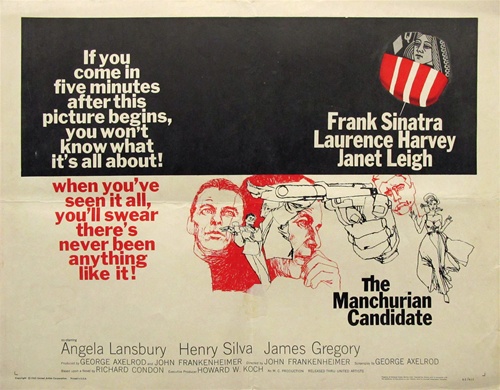
The film’s tagline certainly gets at the truth of the matter: “If you come in five minutes after this picture begins, you won’t know what it’s all about! When you’ve seen it all, you’ll swear there’s never been anything like it!”

Miles Ahead (2016)

MILES AHEAD

MILES AHEAD (2016) Three-and-a-half stars
Jazz trumpeter, composer, and band leader Miles Davis (1926-91) made some of the best albums of all-time: KIND OF BLUE, SKETCHES OF SPAIN, and IN A SILENT WAY among them.

He’s listed for 51 studio albums, 36 live albums, 35 compilation albums, 17 box sets, four soundtrack albums, 57 singles, and three remix albums in a solo career that lasted over 40 years.

MILES AHEAD (also the title of a 1957 album) works as a meditation on Davis’ public image and Samuel L. Jackson’s favorite word.

Actor, director, and writer Don Cheadle, who stars as Davis, has not fashioned a traditional screen biography and I am very thankful for that. I mean, I gave that genre up for good after the double whammy of RAY (2004) and WALK THE LINE (2005) nearly 15 years ago. I don’t think an old-fashioned screen biography could possibly contain Davis, anyway, just like it failed with Johnny Cash; Kris Kristofferson captured Cash better than a two-hour motion picture with these lyrics, “He’s a poet, he’s a picker / He’s a prophet, he’s a pusher / He’s a pilgrim and a preacher, and a problem when he’s stoned / He’s a walkin’ contradiction, partly truth and partly fiction.”

A Rolling Stone article titled “The Two Sides of Miles Davis” begins, “There was never one Miles Davis. Depending on whom you ask, there may have been as many as five. But those would be the jazz fans, those who charted his every artistic move. They’re right. The composer/trumpeter blew through styles with a restless energy unlike any other 20th century musician. But for our purposes, let’s step back from Davis’ stylistic devices and creations and look at the two fundamental Miles Davises: the public and the private.”

The article goes on to discuss Davis’ 1989 autobiography.

It definitely seems that Cheadle and gang read “Miles Davis: An Autobiography,” with detailed notes from Davis’ vocabulary.

Here’s a few samples:

“Anybody can play. The note is only 20 percent. The attitude of the motherfucker who plays it is 80 percent.”

“I remember one time — it might have been a couple times — at the Fillmore East in 1970, I was opening for this sorry-ass cat named Steve Miller. Steve Miller didn’t have his shit going for him, so I’m pissed because I got to open for this non-playing motherfucker just because he had one or two sorry-ass records out. So I would come late and he would have to go on first and then we got there we smoked the motherfucking place, everybody dug it.”

“We were all up in that shit like a muthafucka. It’s cleaner than a broke dick dog.”

“You can tell whether a person plays or not by the way he carries the instrument, whether it means something to him or not. Then the way they talk and act. If they act too hip, you know they can’t play shit.”

Davis would probably tell me to go eat a dead dog’s dick for using the word “jazz” to categorize his music at the start of this review. He rants about that early on during MILES AHEAD.

“I don’t like that word ‘jazz.’ Don’t … don’t call it ‘jazz,’ man. That’s some made-up word. Trying to box somebody in. Don’t call my music ‘jazz.’ It’s social music.”

There’s no effort to soften or sugarcoat or make Davis more palatable for the masses in MILES AHEAD, unlike both RAY and WALK THE LINE.

That’s probably why Cheadle, unlike Jamie Foxx in RAY and Joaquin Phoenix in WALK THE LINE, did not get showered during awards season.

We do hear Davis’ music throughout MILES AHEAD — notably “So What” from KIND OF BLUE, “Solea” from SKETCHES OF SPAIN, “Seven Steps to Heaven” from SEVEN STEPS TO HEAVEN, “Frelon Brun (Brown Hornet)” from FILLES DE KILIMANJARO, and “Black Satin” from ON THE CORNER.

Just incredible music.

You wouldn’t have been able to tell that to Davis. Bless him.

Enjoy this excerpt from Nick Kent’s “Lightening Up with the Prince of Darkness”:

“It’s (music’s) never been better!” Davis said. “Damn right! Are there drawbacks? None whatsoever! Hell, some damn critic’ — the word is spat out — ‘might disagree, but, you see, he don’t know! All this shit about me bein’ better in the old days … music bein’ better. That’s reactionary thinking from motherfuckers who weren’t even there. The old days … shit!”

That’s something that Davis could have easily said during MILES AHEAD.

Cheadle’s film bounces back between Davis’ hiatus period and his relationship and subsequent decade-long marriage (1958-68) with his first wife Frances Taylor (1929-2018).

Several articles have called MILES AHEAD’s factual accuracy into question.

More importantly, though, MILES AHEAD captures the spirit of Miles Davis accurately.