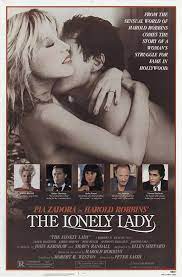
THE LONELY LADY (1983) 1/2* The Lonely Lady is one of the all-time great stinker movies, 91 minutes of unpleasant characters in unsavory relationships with unbelievably bad actors speaking dialogue that should have never been uttered or ever written in the first place.
Like the (believe it or not) even more awful, killer Santa picture Silent Night, Deadly Night, The Lonely Lady potentially takes the heat off viewers by undercutting a procession of controversial scenes with unintentional humor. I could see hooting and howling in derisive laughter at the performances and the dialogue throughout Silent Night, Deadly Night and The Lonely Lady.
I found myself appalled more than anything else throughout The Lonely Lady, so I was basically too appalled to laugh.
The Lonely Lady especially lays it on thick whenever the title character — aspiring young screenwriter Jerilee Randall, played by the immortal Pia Zadora, though she’s never lonely — expresses her outrage at her perpetual exploitation by Hollywood writers, directors, actors, and producers, every one of them sexist pigs who just nonstop use and abuse her.
At the same time, however, the camera lingers on this exploitation from the rape by garden hose early on in the picture to some of the least sexy movie sex ever captured on celluloid.
On top of all that, Zadora’s real-life husband, Israeli multimillionaire industrialist Meshulam Riklis, funded Butterfly and The Lonely Lady with both pictures starring none other than Zadora. Legend has it that Riklis bought a Golden Globe award for his wife and her performance in Butterfly.
Zadora beat out Elizabeth McGovern and Howard E. Rollins Jr. in Ragtime, Kathleen Turner in Body Heat, Rachel Ward in Sharky’s Machine, and Craig Wasson in Four Friends, all five better-received performances in better-received films.
It remains inconceivable that Zadora — who made her motion picture debut in the 1964 cult film Santa Claus Conquers the Martians — won that award on her own merits.
Riklis was more than 30 years older than Zadora, and that’s not any different than the age gap between Jerilee and her much older husband, veteran Hollywood hack screenwriter Walter Thornton (Lloyd Bochner), in The Lonely Lady.
All those factors combine to make Jerilee’s speech at the Academy Awards — highlighted by that risible line I don’t suppose I’m the only one who’s had to fuck her way to the top! — the absolute worst scene in a movie populated by predominantly bad scenes.
Most of them involve Jerilee sleeping her way through some of the ugliest men imaginable.
Let’s take a look at one more scene that epitomizes The Lonely Lady.
Jerilee and Walter argue outside their Beverly Hills home, near the swimming pool seen first in one of the film’s most appalling scenes.
Jerilee: Walter? Walter, come to bed. Walter: Haven’t you had enough wine? Go sleep it off. J: If you’ll come with me. [W turns away.] J: I’m trying to say sorry. W: With a head full of drink! J: We don’t have to make love. W: Thank you. J: We could talk. We need to talk. W: Why didn’t you go off with Dacosta? He would’ve enjoyed it. [W picks up the garden hose that raped J earlier in the film.] W: Or is this more your kick?
That’s even worse than the argument between Kathryn Harrold and Luciano Pavarotti in Yes, Giorgio that culminated in the infamous line I don’t want to be watered on by Fini.
That garden hose, in fact, might have once belonged to Fini.
The Lonely Lady flopped so badly that, thankfully, Hollywood never adapted one of Harold Robbins’ trashy novels again.
THE MAN WHO KNEW TOO MUCH (1956) *** I would have liked to been a fly on the wall (but not Mike Pence’s head) for several conversations throughout motion picture history.
For example, when Chevy Chase was offered Oh Heavenly Dog. We all remember that one, right, where Chase plays a private detective who’s murdered real early in the picture and then, almost just like Warren Beatty in Heaven Can Wait, he’s reincarnated as, wait for it, Benji. We see Benji solve the murder and hear Chase on the soundtrack. Yes, it’s a real movie.
Another example would be how Alfred Hitchcock reacted when he was told his Man Who Knew Too Much star Doris Day would sing Que Sera, Sera (Whatever Will Be, Will Be) not once but twice during the movie — the first time about 12 minutes in and the second with about 12 minutes left.
Isn’t it obvious, though, that Hitchcock wasn’t into Que Sera, Sera, even before Day sings that line about 500 times.
I search it up (as the kids today say) and find this juicy bit of IMDb trivia: Throughout the filming, Doris Day became increasingly concerned that Alfred Hitchcock paid more attention to camera set-ups, lighting, and technical matters than he did to her performance. Convinced that he was displeased with her work, she finally confronted him. His reply was, ‘My dear Miss Day, if you weren’t giving me what I wanted, then I would have to direct you!’
Apparently, Day (1922-2019) herself was initially turned off by the notion of singing what became her signature song, even in death. She thought it was a forgettable children’s song.
I call this 1956 version The Woman Who Sang Too Much.
The Man Who Knew Too Much ’56 (a remake of Hitchcock’s own 1934 film) predominantly works because of the performance of James Stewart and a couple spectacular set pieces.
Despite this being the least of the four features Stewart made with Hitchcock, way behind Vertigo, Rope, and Rear Window (in that order), we follow the events from beginning to end mostly because of the inherent pull of Stewart … and we also know that even during a lesser Hitchcock film, that sly old master, that dirty old dog, would still come up with something to wow us.
Here, it’s the murder of the mysterious Frenchman in Morocco and the attempted assassination of the prime minister at Royal Albert Hall. Personally, I still prefer Jimi Hendrix’s two nights at the Royal Albert in February 1969. Que sera, sera, right?
Bernard Herrmann, the man responsible for the scores to seven Hitchcock films as well as Citizen Kane and Taxi Driver, makes a cameo as the conductor.
Hitchcock apparently made his trademark cameo around 25 minutes in, but I missed it. Que sera, sera, right?
Especially now that I’m blaring Hendrix’s Hear My Train A Comin’.
GRAND HOTEL (1932) *** MGM once boasted More stars than there are in Heaven and as I typed out those words, sounds and images from Grand Hotel played on the motion picture spread inside my head.
Of course, because Grand Hotel put Greta Garbo, John Barrymore, Joan Crawford, Wallace Beery, and Lionel Barrymore — five good old-fashioned movie stars — together. A commercial and critical success, Grand Hotel gave Hollywood a casting model still with us today, as well as the custom that a luxurious setting must host our stars. They even named the movie after this luxurious setting.
Part of the appeal of watching Grand Hotel to this very day — nearly 90 years after the film’s original release, for crying out loud — derives from drawing parallels between the real-life performer and their character, especially true for Garbo, John Barrymore, and Crawford.
Top billed Garbo (1905-90) plays ballerina Grusinskaya, but it’s virtually impossible to not draw the parallels with the actress herself when we hear the famous words, I want to be alone. Or I think Suzette, I’ve never been so tired in all my life. Yes, I listened to the Kinks’ “Celluloid Heroes” so many times before I watched Grand Hotel that the song informed every second of seeing Garbo in arguably her most famous movie role, Don’t step on Greta Garbo as you walk down the Boulevard / She looks so weak and fragile, that’s why she tried to be so hard / But they turned her into a princess / And they sat her on a throne / But she turned her back on stardom / Because she wanted to be alone.
Garbo appeared in eight films after Grand Hotel, her final one being George Cukor’s Two-Faced Woman in 1941. That one came with the slogan Go Gay with Garbo! Her first talking picture, 1930’s Anna Christie, simply hyped Garbo Talks!
John Barrymore (1882-1942) first made his motion picture fame as Dr. Henry Jekyll and Mr. Edward Hyde in the 1920 Dr. Jekyll and Mr. Hyde. Barrymore’s life played out like Jekyll and Hyde, seeing that his matinee idol looks earned him the nickname ‘The Great Profile’ and benefited him in romantic lead parts in Grand Hotel (as the formerly wealthy Baron Felix von Gaigern, who specializes in thievery and gambling with Garbo his potential mark) and Twentieth Century (arguably his best performance as tempestuous temperamental theatrical director Oscar Jaffe) before many years of heavy drinking finally wore him down into a shell of his former self. John Barrymore died 10 years after Grand Hotel premiered, at the age of 60 from pneumonia and cirrhosis of the liver. He’s more famous today for being Drew Barrymore’s grandfather, but his acting talents are well-preserved on celluloid and I’d start (and possibly finish) with Dr. Jekyll and Mr. Hyde, Grand Hotel, and Twentieth Century.
Crawford (1904-77) has remained a divisive figure some 50 years after her final movie — Trog in 1970 — embodied by the essay The Feminine Grotesque: On the Warped Legacy of Joan Crawford by Angelica Jade Bastien that reappeared on RogerEbert.com during Women’s History Month. No lesser authority than Crawford herself described her Grand Hotel character Flaemmchen as “the little whore stenographer,” and the actress’ eternal divisiveness stems in part from her infamous reputation for sleeping her way to the top. Bette Davis said of her arch rival, She slept with every star at MGM. Of both sexes.
Kansas City (Missouri)-born Beery (1885-1949) shared the 1933 Academy Award for Best Actor — with Fredric March from Dr. Jekyll and Mr. Hyde — for his performance as the title character in the feel good heartstring yanker The Champ. The Champ premiered Nov. 21, 1931. Grand Hotel premiered 143 days later and Beery plays a character, General Director Preysing, who proves to be a complete 180 from The Champ. Beery chews through the scenery not only on Grand Hotel but every other movie MGM had in production at that moment in time.
John’s older brother Lionel Barrymore (1878-1954) etched his place in history as the epitome of villain, Mr. Henry F. Potter from It’s a Wonderful Life. So to see him play such a likable character in Grand Hotel might be a great shock for most viewers who are only familiar with Barrymore through It’s a Wonderful Life. He’s definitely a scene stealer in Grand Hotel.
Ironically enough, Lionel Barrymore presented Beery with his Oscar statuette. Barrymore won Best Actor the previous year for his performance in A Free Soul.
I must admit, though, that I prefer International House, taglined in 1933 as ‘The Grand Hotel of Comedy’ and released by Paramount, over Grand Hotel. International House gives us a cast that includes famous gold digger Peggy Hopkins Joyce, W.C. Fields, George Burns and Gracie Allen, Rudy Vallee, and Bela Lugosi, plus Stoopnagle and Budd, Baby Rose Marie, and Cab Calloway. We have Calloway and his band performing “Reefer Man,” Fields smoking opium and driving his American Austin automobile through this grand hotel in Wuhu China, Doctor Burns and Nurse Allen bantering, and plenty more Paramount pre-Code shenanigans stuffed into a 70-minute cinematic confectionery. By comparison, Grand Hotel, lasting more than 110 minutes, seems awful staid and stodgy.
That said, Grand Hotel serves a lasting reminder of how powerful star power used to be.
SIX WEEKS (1982) * My wife awoke in the middle of the night, it took her quite some time falling back asleep, and so naturally she joined me for about the last 30 minutes or so of Six Weeks. She asked me some basic journalistic questions like ‘What’s the little girl dying from?’ ‘I believe it’s leukemia.’ ‘No, it can’t be. It’s got to be something else. I don’t think she’d just suddenly die like that.’
At some point during our discussion, I said that actually this poor little girl has got the dread movie disease where the invariably dead-by-the-end-of-the-movie character becomes ever more beautiful and noble until her big death scene. Yes, the late film critic Roger Ebert named this affliction ‘Ali MacGraw Disease’ after the star of Love Story, the film based on the best-selling novel that one might say started it all way back in 1970.
Movies derived in way or another from Love Story invariably pour it on awful darn thick with the sentiment, until the movie in question becomes a real maudlin exercise. Six Weeks pulls out the stops more than most in this dubious category and that’s why I was utterly amazed that it did not feature a hot-air balloon scene like fellow maudlin tearjerkers Bobby Deerfield, Yes Giorgio, and Just the Way You Are. That’s about the only restraint practiced by Six Weeks.
Casting 101 pairs Dudley Moore (1935-2002) and Mary Tyler Moore (1936-2017), fresh off critical and commercial hot commodities Arthur and Ordinary People, respectively. Yes, wow, how far out, both actors have the same last name and they’re apparently not related. They don’t even have the same national origin. Anyway, like Walter Matthau and Jill Clayburgh in the turkey bomb First Monday in October, Moore and Moore do not share the slightest bit chemistry either, that’s for darn sure. Dudley plays a California politician who’s running for Congress, Mary’s a wealthy cosmetics heiress with the precocious 12-year-old daughter already discussed in the opening paragraph. Dudley’s hopelessly lost in an early scene, very late to a political fundraiser where he’s the featured speaker, and the 12-year-old gives him directions and a whole lot more. She wants Dudley to win his election and Moore² to hook up and become the ultimate happy family for her life’s remaining duration.
Katherine Healy plays the dying little girl and she’s a bit, what’s the word, insufferable. She’s one of those movie children with an unlimited supply of wannabe sharp dialogue and snappy comebacks. She’s dying, remember, and that makes her dialogue even worse and her fantasies ever more powerful. Yes, that’s right, she’s got six weeks left and she’s going to live out as many of her fantasies as possible within the production budget of a 107-minute feel good extravaganza.
Moore² and the little girl hit the bright lights of New York City because what better place to live out fantasies on the big screen and little Niki skates at The Rink at Rockefeller Center, takes on the lead in The Nutcracker, and rounds up Moore² for a smug little cutesy pie wedding ceremony that almost extracted wholesale vomit from the pit of my stomach. Not exactly in that order, though, because the wedding ceremony happens before the grandstanding grand finale ballet number. Niki performed her ballet number on center stage, I looked at my wrist like there’s a watch attached to it and said to my wife, ‘It’s about time for the little girl to die.’ Sure enough, that’s what happened in the very next scene.
I left out the part (until now, anyway) about Dudley’s family, his dutiful wife and teenage son. That’s OK, because they’re not that important and don’t stand in the way of the main body of the plot. Speaking of the plot, Six Weeks pushes and pulls so many emotional levers that it becomes one of the most shameful tearjerkers ever made. They finally resorted to yanking them emotions with pliers. Thankfully, I still resisted and this review signals my protest on aesthetic and emotional grounds.
COUPLE BOMBS FROM ‘81: THE LEGEND OF THE LONE RANGER, FIRST MONDAY IN OCTOBER
THE LEGEND OF THE LONE RANGER fails miserably at capturing any of the magic of the 1978 blockbuster SUPERMAN, its obvious cinematic inspiration.
Not even one speck.
Like SUPERMAN, LONE RANGER gives us a mythic origin story for an old cultural hero and then unfurls a new grand adventure featuring our updated hero and other updated characters. Sounds like a great time at the movies, but where did LONE RANGER go so absolutely incredibly stupendously wrong?
First stumbling block first, we have screen neophyte Klinton Spilsbury, who more or less remains a screen neophyte after LONE RANGER. That’s because Spilsbury botched his opportunity so badly that producers dubbed him with James Keach in post-production. Spilsbury quickly became a punchline upon the release of the film. For example, Gene Siskel remarked in his review that Spilsbury playing the Lone Ranger would make for a fine trivia question in the 1990s. I am straining to remember if Spilsbury appeared in “Trivial Pursuit” or perhaps on “Jeopardy” as the answer to who played the Lone Ranger in THE LEGEND OF THE LONE RANGER. If producers dub in another actor’s voice, how much of a performance did the dubbed out actor really give? Nevertheless, Spilsbury joined the ranks of infinitely superior actor Harvey Keitel, whose trademark Brooklyn accent did not make the final cut of SATURN 3. Sorry, Mr. Keitel.
Spilsbury definitely proved to be no Christopher Reeve, whose performance as both mild-mannered reporter for a great metropolitan newspaper Clark Kent and Kal-El, a.k.a. Superman, a.k.a. The Man of Steel, contributed a great deal to what made SUPERMAN and SUPERMAN II successful super-budget entertainments that connected with a mass audience on a personal level. Reeve said that he found inspiration from Cary Grant’s performance in BRINGING UP BABY and SUPERMAN and SUPERMAN II indeed at times resemble screwball romantic comedies. (Gene Hackman, Ned Beatty, and gang unfortunately suggest the campy villains from the 1960s Batman TV show, almost upsetting that precarious balance ‘tween humor and seriousness. Terence Stamp, Jack O’Halloran, and Sarah Douglas make better villains in SUPERMAN II.)
LONE RANGER lacks a lighter, humorous touch to counterbalance its mythology attempts. It is so somber that it becomes ponderous and then dreary before it finally springs into action, despite the efforts of Merle Haggard in the Waylon Jennings “Dukes of Hazzard” balladeer role. Obituarists skipped this chapter in Haggard’s career out of respect for the man when he died in 2016.
Finally springs into action is an understatement in the case of LONE RANGER.
LONE RANGER takes approximately 70 minutes to get the title character into costume and to play the William Tell Overture on the soundtrack, and we’re talking about a movie clocked at 98 minutes. William A. Fraker (director), Walter Coblenz (producer), Martin Starger (executive producer), and the writing team of Ivan Goff, Ben Roberts, William Roberts, Michael Kane, and Gerald B. Derloshon discovered a new level of stupidity.
Complete epic failure amounts to the only legend created by THE LEGEND OF THE LONE RANGER.
FIRST MONDAY IN OCTOBER also has its roots in old movies, though it may not be as obvious as LONE RANGER.
FIRST MONDAY wanted to be like one of those movies pairing Spencer Tracy and Katharine Hepburn — WOMAN OF THE YEAR, KEEPER OF THE FLAME, WITHOUT LOVE, SEA OF GRASS, STATE OF THE UNION, ADAM’S RIB, PAT AND MIKE, DESK SET, and GUESS WHO’S COMING TO DINNER.
Those movies succeeded in part because of the chemistry between Tracy and Hepburn and our enjoyment from watching them interact.
FIRST MONDAY fails in large part because Walter Matthau and Jill Clayburgh do not spark that Tracy-Hepburn chemistry and they are both miscast in their roles. FIRST MONDAY should be renamed “The Bickersons Go to the Supreme Court.”
Matthau stars as veteran Associate Justice Dan Snow and Clayburgh draws freshly appointed Associate Justice Ruth Loomis. All we need to know about them boils down to cranky old white ultra-liberal male (Snow) and feisty liberated white ultra-conservative female (Loomis) babble and battle but nonetheless develop affection toward each other.
Matthau gives the standard Matthau performance and it simply does not suit his character. Melvyn Douglas and Henry Fonda played this character on stage and they were both much better fits than Matthau.
Clayburgh made her fame as the quintessential liberated woman in AN UNMARRIED WOMAN and so it is jarring to see her play a rigid conservative. Also, she’s too young for her character. Jean Arthur, Jane Alexander (a few years older than Clayburgh), and Eva Marie Saint played the role on stage.
Paramount originally planned to release FIRST MONDAY in early 1982, but after President Ronald Reagan nominated Sandra Day O’Connor to the Supreme Court on July 7, 1981, Paramount rushed FIRST MONDAY forward to release in late August, one month before the Senate confirmed O’Connor’s appointment.
It is possible that FIRST MONDAY benefited commercially from publicity attendant with O’Connor’s historic appointment. FIRST MONDAY earned nearly $13 million in returns. In the long run, though, so what?
Upon first perusal of British director Ronald Neame’s film credits, one sees two disaster films, THE POSEIDON ADVENTURE and METEOR. After watching FIRST MONDAY, I count three disaster films directed by Neame.
I reviewed two bombs from ‘81 because Hollywood still recycles, rehashes, regurgitates, recapitulates, and remakes old movies, old plays, old TV shows relentlessly.
A tale of two movies, both from 1962 and both dealing with racism.
Other than their year of release, some of their subject matter, and their being filmed in black-and-white, the films are worlds apart in virtually every other way, including how they have been received by the establishment and the general public.
Roger Corman directed and co-produced (alongside his younger brother Gene) THE INTRUDER for $80,000 and it was filmed on location for three-and-a-half weeks in Southeast Missouri towns East Prairie, Charleston, and Sikeston. William Shatner stars as race hate inciter and outside agitator Adam Cramer and the young Canadian actor was still years away from becoming a household name for “Star Trek.” THE INTRUDER takes place contemporaneously with the civil rights movement and school integration; Charles Beaumont adapted his screenplay from his own 1959 novel of the same name and he even plays school principal Mr. Paton in the film.
Robert Mulligan directed TO KILL A MOCKINGBIRD behind a $2 million budget and major studio backing with a screenplay by future Pulitzer Prize winner Horton Foote adapted from Harper Lee’s 1960 Pulitzer Prize-winning novel of the same name that had already become an institution even before a prestigious film adaptation. Gregory Peck, nominated for an Academy Award for Best Actor four times before his most famous role (THE KEYS OF THE KINGDOM, THE YEARLING, GENTLEMAN’S AGREEMENT, TWELVE O’CLOCK HIGH), stars as noble lawyer Atticus Finch. TO KILL A MOCKINGBIRD filmed on Hollywood back lots and sets designed to recreate the Monroeville, Alabama of Lee’s Great Depression youth.
THE INTRUDER premiered May 14, 1962 in New York City and it would be reissued as I HATE YOUR GUTS and SHAME. In other words, it flopped and Corman has never quite made another picture like THE INTRUDER again. His later exploitation productions hid and obscured their social commentary behind and beneath protective layers of nudity, sex, and violence.
TO KILL A MOCKINGBIRD debuted Dec. 25, 1962 and just like the Lee source material, it became an almost instantaneous social institution and beloved classic. It received eight Academy Award nominations, including Best Picture, and won three, including Best Actor for Peck. It has been a longtime staple of the American Film Institute: No. 34 on the 1997 “100 Years … 100 Movies” list and No. 25 on the 10th Anniversary list and the AFI voted it the No. 1 courtroom drama and Atticus Finch the No. 1 hero on its list of the 100 greatest heroes and villains.
I watched both films in close proximity of each other (both for the first time) and THE INTRUDER absolutely shames TO KILL A MOCKINGBIRD.
Sorry, folks, Adam Cramer presents a far more interesting character than Atticus Finch and Shatner’s incendiary performance blows away Peck and its relentless note of nobility.
Cramer, a non-Southerner decked in a bright white suit, rides into the fictional small Southern town of Caxton and quickly comes on strong as a gentleman. This clever conman and charlatan then goes to work and preys on the racist, anti-integration sympathies of many of the residents to meet his goal of inciting a race war town-by-town. Cramer’s a master manipulator and rabble-rouser who also sets his sights on a high school girl and a frustrated housewife. His manipulative powers lead to one of the black students, Joey Greene (Charles Barnes), being falsely accused of rape by a white girl. That, of course, ties in with the absolute worst nightmare of a racist, one infinitely worse than integration. In a chilling final scene, the inflamed mob interrogates Mr. Greene about this rape. The mob believes it has become judge, jury, and executioner.
Fact and fiction must have blurred for novice actor Charles Barnes, a 19-year-old young man from Charleston (one of the three towns used in filming) whom Corman instructed to draw from real-life experiences attending an integrated high school in his hometown his senior year. The Pittsburgh Courier ran a story on Barnes in May 1962, headlined “Negro Actor’s Reel Role Too Real for Whites … And He Has to Leave Hometown.”
THE INTRUDER plays real, and that sealed its commercial doom and consignment to the dustbin (at least the margins) of cinematic history.
On the other hand, TO KILL A MOCKINGBIRD plays like a series of pat moral lessons for two hours, interrupted by youthful shenanigans and occasional voice-over narration to put us in a proper nostalgic mood.
Enter “To Kill a Mockingbird moral lessons” into a search engine and it returns 1,340,000 hits.
Is that why so many people love TO KILL A MOCKINGBIRD?
Are fans of the film made to feel virtuous watching it?
Just asking for a friend.
Atticus Finch comes across so darn noble maybe because an older Scout Finch, his daughter, narrates the story.
She begins, “Maycomb was a tired old town, even in 1932 when I first knew it. Somehow, it was hotter then. Men’s stiff collars wilted by nine in the morning; ladies bathed before noon, after their 3 o’clock naps, and by nightfall were like soft teacakes with frosting from sweating and sweet talcum. The day was twenty-four hours long, but it seemed longer. There was no hurry, for there was nowhere to go and nothing to buy … and no money to buy it with. Although Maycomb County had recently been told that it had nothing to fear but fear itself … That summer, I was six years old.”
The narration put me off right from the start and it all translated as “Grandma, tell me about the good ole days.”
Between the narration and the sets and the characters, TO KILL A MOCKINGBIRD feels like experiencing a show called “The South 1932” at Universal Studios Hollywood. LOOK! It’s a one-dimensional racist white trash caricature! LOOK! It’s busybody neighbors! LOOK! It’s a crotchety old bag! LOOK! It’s a sheriff named “Heck Tate”! FEEL GOOD ENTERTAINMENT! I don’t know why I need to pay money to see that when I could experience all that for real somewhere in Small Town U.S.A. Never mind, I’ll pass on both.
TO KILL A MOCKINGBIRD stitches together multiple narrative threads, some more successfully than others.
— Scout (Mary Badham), her older brother Jem (Phillip Alford), and her best friend Dill (John Megna), and their larger-than-life misadventures.
— Scout and Jem and their relationship with Atticus, as well as their black maid Calpurnia (Estelle Evans).
— Atticus defends Tom Robinson (Brock Peters), a black man falsely accused of rape by Mayella Ewell (Collin Wilcox) and her father Robert E. Lee “Bob” Ewell (James Anderson), during a trial when the odds are stacked dramatically against both men. Before the trial, townspeople — including Scout’s school mates — call Atticus a “nigger lover” and some of the most concerned citizens form a lynch mob.
— The children’s obsession with Boo Radley (Robert Duvall).
Badham and Alford both give very good performances and their rapport with each other and Peck forms the strongest part of the movie. Badham’s debut performance received a well-deserved nomination for Academy Award for Best Supporting Actress. I understand why multiple generations of young women have responded so favorably toward TO KILL A MOCKINGBIRD. (Mulligan later directed Reese Witherspoon in a similarly affecting performance in the 1991 film THE MAN IN THE MOON.)
On the race level, though, that’s where TO KILL A MOCKINGBIRD fails and it fails miserably.
The black characters remain predominantly in the background, Tom Robinson dies offscreen, and Bob Ewell belongs to a movie racist tradition called “Ku Klux Klown.”
We also have quite possibly the only mob in history ever talked down by a 6- or 7-year-old girl.
By comparison, in THE INTRUDER, a mob burns a cross in a black neighborhood, blows up the local black church and kills the preacher in the blast, and severely beats up the white character who takes a stand alongside the blacks and encourages them to return to school after the bombing. This conscientious white character gets so beaten that he receives broken ribs and loses one eye.
Nobody lays a hand on Atticus.
Meanwhile, only Peters and Evans received screen credit among the black actors in TO KILL A MOCKINGBIRD.
All the others were not credited.
That includes William “Bill” Walker in the small but pivotal role of Reverend Sykes, who delivers the famous line “Miss Jean Louise? Miss Jean Louise, stand up. Your father’s passin’.” Peck himself said this scene — where all the black people in the balcony stand up for Atticus Finch after he defended Tom Robinson — wrapped up his Academy Award for Best Actor.
To be fair, some of the white actors, including Kim Stanley as the narrator, also were not credited.
By the point late in the movie when Bob Ewell attacks Jem and Scout and Boo Radley comes to their rescue, it was basically too little too late for this viewer. I was just ready for TO KILL A MOCKINGBIRD to be over.
I would not be surprised if writer and director John Huston (1906-87) had the nickname “The Great Adapter.”
Huston directed 37 feature films from 1941 through 1987 and his films adapted from works by Dashiell Hammett, Ellen Glasgow, Robert Carson, B. Traven, Maxwell Anderson, Robert Sylvester, W.R. Burnett, Stephen Crane, C.S. Forester, Pierre LaMure, Claud Cockburn, Herman Melville, Charles Shaw, Romain Gary, Alan LeMay, Philip McDonald, Tennessee Williams, the Book of Genesis, Carson McCullers, Ian Fleming, David Haggart, Hans Koningsberger, Noel Behn, Leonard Gardner, Desmond Bagley, Rudyard Kipling, Flannery O’Conner, Zoltan Fabri, Harold Gray, Malcolm Lowry, Richard Condon, and James Joyce.
Huston co-wrote some of those adaptations, but it was Gardner himself who adapted his own novel, “Fat City,” for the big screen.
In a 2019 interview with the Paris Review, celebrating the 50th anniversary of his novel, Gardner spoke about Huston and the film adaptation.
“Before I started to write it (the screenplay), he invited me to come over to his place in Ireland for a couple of weeks for a discussion about how it was going to go,” Gardner said. “He was a funny guy. He trusted me, I think, because we didn’t talk all day about the script. We talked maybe a half an hour. Then he wanted to paint. He was always painting.
“He’d been an amateur boxer. It was lucky because my objection to boxing movies back then was that they were all the same. It’s a fixed fight and the hero won’t take a dive and maybe they break his hands afterward. I thought there needed to be a boxing film done another way. He was all for it.”
FAT CITY set itself within the city of Stockton, California, population over 100,000 at the time of the making of the film. The scenes are played out in skid row bars, restaurants and living spaces, work on a migrant labor farm, bowling alleys, a boxing gym, and boxing venues in a gritty, street-level fashion. Huston and Gardner definitely created a boxing film that’s done another way.
Stockton, now with a population above 300,000, received a dubious recognition from Forbes Magazine in 2012: “The Most Miserable City in the U.S.”
“I think that this is such a rough place that people who are highly educated use it as a springboard to get jobs in other places, and what it leaves behind is not the cream of the crop. The really smart people don’t want to stay here. They don’t want to be here with the violence and the crime and everything,” said substitute teacher Ronald Schwartz in a story for PBS News Hour.
So things only seemed to get worse in Stockton since 1972.
Creedence Clearwater Revival released the song “Lodi” as the B-side to “Bad Moon Rising,” the lead single from their third album “Green River,” in April 1969. Farrar, Straus & Giroux published “Fat City” in 1969.
Lodi is approximately 15-20 miles north of Stockton.
Creedence songwriter John Fogerty has said that he picked Lodi because it had the coolest-sounding name. The song’s refrain “Oh Lord, stuck in Lodi again” has truly stuck with Lodi for more than 50 years, unfairly or not.
FAT CITY utilizes Kris Kristofferson’s “Help Me Make It Through the Night” and the lyrics and the way Kristofferson sings them suit FAT CITY perfectly. Kristofferson said that he got his inspiration for the song from an interview with Frank Sinatra, who said “Booze, broads, or a bible … whatever helps me make it through the night.”
Any of the characters in FAT CITY could have said that.
We follow two boxers in FAT CITY: 29-year-old Billy Tully (Stacy Keach) and 18-year-old Ernie Munger (Jeff Bridges). Tully meets Ernie in a Stockton gym, sees potential in the young man after they spar, and encourages him to get into the fight game. Tully recommends manager and trainer Ruben (the great character actor Nicholas Colasanto).
Keach and Bridges play off or against each other perfectly. Bridges, in his early 20s and on his fifth feature overall, fits the part of a promising up-and-coming talent like a glove; Bridges had already received an Academy Award nomination for Best Supporting Actor for his performance in THE LAST PICTURE SHOW. Keach’s own struggles to get a part like Billy Tully infuses his characterization of a washed-up boxer clawing and scratching (and drinking) his way through life; for example, Mike Nichols fired Keach from CATCH-22 a week into rehearsals. Keach’s propensity for overacting and Bridges’ for underacting factored in.
“FAT CITY is a good film,” Keach said in Dennis Brown’s “Actors Talk: Profiles and Stories from the Acting Trade,” “but 20 minutes were cut. Twenty minutes longer, FAT CITY is a great film, a classic. Unfortunately, 20 minutes longer made it 20 minutes more depressing.”
A theory: All good films are not depressing and all bad films are.
Boxing takes Ernie away from the pressures of a young wife (Candy Clark) and the start of a nuclear family. Tully, a shell of himself since his wife left him and since his defeat in the ring in Panama City, takes up with Oma (Susan Tyrrell), a character described as a “woozy boozy floozy” in the New York Times. Booze initially lubricates their relationship, of course, but it fizzles out spectacularly down the home stretch.
Tully tells Oma “You can count on me!” so many times that you wonder if he’s attempting to get himself to believe that more than even this woman.
That’s the challenge for readers of Joan Lindsay’s original 1967 novel and viewers of the 1975 Australian film adaptation by screenwriter Cliff Green and director Peter Weir.
Lindsay’s editor Sandra Forbes made the suggestion to remove the final chapter and Lindsay did so before publication. In 1987, three years after Lindsay’s death, “The Secret of Hanging Rock,” the infamous final chapter, Chapter 18, finally appeared.
Weir’s 1998 Director’s Cut trimmed eight minutes from the original film, 115 down to 107 minutes.
In turn of the 20th Century Australia, three Appleyard College school girls and one teacher do not return from their picnic at former volcano Hanging Rock near Mount Macedon in Victoria. The girls’ curiosity about exploring Hanging Rock obviously gets the best of them. One of the girls, Irma, returns every bit as mysteriously as she disappeared one week earlier and she’s no good for answers in the heart of the picture, “I remember — nothing! Nothing! I remember nothing!” Irma’s fellow characters become every bit as frustrated with her as we do in the audience, because all of us (they and we) demand a solution and an explanation. People desperately want rationality in an often irrational world.
School girls Miranda (Anne-Louise Lambert) and Marion (Jane Vallis) and Miss McGraw (Vivean Gray) remain missing, despite the best efforts of both official and unofficial search parties. For example, there’s Michael Fitzhubert (Dominic Guard), a young man who becomes obsessed with finding Miranda.
Seems like virtually everybody’s obsessed with this Miranda, who Mlle. De Poitiers (Helen Morse) describes as a Botticelli angel before her disappearance. The film is very suggestive and hints at terrible, unspeakable events. Imaginations may run wild, as they do within the film.
Miranda provides a line vital to understanding PICNIC AT HANGING ROCK, “What we see and what we seem are but a dream, a dream within a dream,” a quote from Edgar Allan Poe’s 1849 poem “A Dream Within a Dream.” It is quite possible that Poe (1809-49) would have admired PICNIC AT HANGING ROCK.
Take this kiss upon the brow!
And, in parting from you now,
Thus much let me avow —
You are not wrong, who deem
That my days have been a dream;
Yet if Hope has flown away
In a night, or in a day,
In a vision, or in none,
Is it therefore the less gone?
All that we see or seem
Is but a dream within a dream
I stand amid the roar
Of a surf-tormented shore,
And I hold within my hand
Grains of the golden sand —
How few! yet how they creep
Through my fingers to the deep,
While I weep — while I weep!
O God! can I not grasp
Them with a tighter clasp?
O God! can I not save
One from the pitiless wave?
Is all that we see or seem
But a dream within a dream?
Guess we should discuss this Hanging Rock, which becomes a character and even more of an impenetrable mystery in its own right than the central mystery. Australian New Wave films — like PICNIC AT HANGING ROCK — received (and deserved) much praise for their depictions of the natural landscape.
Hanging Rock quickly becomes mythical, powerful, before we even take one look.
Mrs. Appleyard (Rachel Roberts) builds it up within our minds in an early scene, “The rock itself is extremely dangerous. You are therefore forbidden of any tomboy foolishness in the matter of exploration, even on the lowest slopes. I also wish to remind you, the vicinity is renowned for its venomous snakes and poisonous ants of various species. It is, however, a geological marvel.”
Miss McCraw contributes, “The rocks all round — Mount Macedon itself — must be all of 350 million years old. Siliceous lava, forced up from deep down below. Soda trachytes extruded in a highly viscous state, building the steep sided mamelons we see in Hanging Rock. And quite young geologically speaking. Barely a million years.” These dialogue passages remind one of how Dr. Sam Loomis (Donald Pleasence) played up Michael Myers in HALLOWEEN.
The watches of coachman Mr. Hussey (Martin Vaughan) and Miss McGraw both freeze at the stroke of noon. They speculate about the magnetic powers of Hanging Rock.
That’s before the girls decide to go explore Hanging Rock.
PICNIC AT HANGING ROCK derives considerable power from the juxtaposition of the young women and Hanging Rock. Also, Hanging Rock itself cannot be interrogated about what happened on that fateful day or explain how one girl returned. What did Hanging Rock do to and then with these women?
Hanging Rock remains a marvel and tourist hot spot today.
Check out the sales pitch: “Where else in Australia will you find the Black Hole of Calcutta, The Eagle, The Chapel and Lover’s Leap … let the secrets of Hanging Rock unfold before your eyes as you wind your way up to the pinnacle where spectacular views await” and “The unexplained disappearance of a group of schoolgirls at Hanging Rock in 1901 is just one of the legends of this mysterious area, and many visitors say they can feel the spirit of the girls as they climb the Rock. Joan Lindsay’s book and Peter Weir’s film about the ‘Picnic at Hanging Rock’ ensures that the mystery lives on. …”
No evidence has been found to prove the novel and the movie are based on a true story.
PICNIC AT HANGING ROCK sticks with many viewers, just like the surviving characters are haunted.
The technical aspects are first-rate: cinematographer Russell Boyd, editor Max Lemon, art director David Copping, costume designer Judith Dorsman, makeup artist Elizabeth Mitchie and makeup supervisor Jose Luis Perez, composer Bruce Smeaton, and musician Gheorghe Zamfir, in particular.
Zamfir’s pan flute later influenced Ennio Morricone’s work for Sergio Leone’s ONCE UPON A TIME IN AMERICA.
After writing this review, I know that I want to watch PICNIC AT HANGING ROCK again.
I finally watched for the first time PARK ROW, Samuel Fuller’s self-financed labor of love and love letter to newspapers, newspapermen, and the revolutionary concept of a free press.
Of course, Fuller produced his love letter decades before many newspapers became downsized, outsourced, strip-mined, gutted, and homogenized into bland soggy vanilla wafer cookie cutter clone drone carbon copies of all the other papers owned by the same media company. Fewer days printed, earlier and earlier deadlines, fewer pages (less content) because of declining ad revenue and increased printing costs, more delivery issues, and price increases at every level all factor into a worse product, more unhappy customers, and ultimately fewer subscribers, as well as fewer employees, in a vicious cycle. Less (newspaper) for more (money) will not cut it.
That once family-owned small town newspaper … once the beacon, pride and joy, and watchdog of a community (and possibly region) and once housed inside a buzzing building populated by wordsmiths and word slingers, photographers, editors of various persuasions, proof readers and fact checkers, pressmen, inserters, and many others in a diverse work environment … has been reduced over time to a skeleton crew of employees who hear the grief for the sad state of a formerly great paper. They hear the grief because the power players are hundreds if not thousands of miles away. Good luck reaching them.
Not that journalism majors and college paper staff members are forewarned a million times before their graduation about newspapers being a dying industry. It’s not a natural death, though, and it’s both maddening and saddening for the lover of the printed word to see what’s happening to so many papers.
PARK ROW inspired thoughts, reactions, and reflections by the bushel.
People with a vision and the character and personality necessary to carry it out have been replaced by number-crunching, bean-counting, penny-pinching, character- and personality-deficient, machine-like men and women in many decision-making positions in the newspaper industry. Just like protagonist Phineas Mitchell (Gene Evans) says in PARK ROW, “The press is good or evil according to the character of those who direct it.”
Remember that classic line from John Ford’s 1962 western THE MAN WHO SHOT LIBERTY VALANCE? Something like “This is the West, sir. When the legend becomes fact, print the legend.” That’s just what we shall do with PARK ROW, written, directed, produced, and financed by Fuller. That’s right, Fuller himself put up every dollar spent on PARK ROW: $200,000 since the other $1,000 of his life’s savings went toward cigars and vodka.
Fuller (1912-97) became a copy boy at the age of 12 for the New York Evening Journal and a crime reporter for the New York Evening Graphic at 17. He quit his newspaper gig three years later and hitchhiked the U.S.A. with the occasional freelance job. In 1934, Fuller took a temp crime reporter job for the San Francisco Chronicle and then editorial writer for the San Diego Sun. Fuller returned to New York in 1935 and published his first novel, “Burn, Baby, Burn.” Fuller wrote more novels and branched out into screenplays for Hollywood, including one from 1938 with a catchy title, GANGS OF NEW YORK, directed by James Cruze and starring Charles Bickford and Ann Dvorak. Fuller enlisted for the U.S. Army the day after Pearl Harbor and he served in the 26th Regiment, Third Battalion, Company K or the Big Red One for the rest of the war (his experiences inspired his 1980 movie THE BIG RED ONE). Two screenplays were filmed and his mystery novel “The Dark Page” was printed during World War II with Fuller overseas. Back stateside, Fuller directed his first film, I SHOT JESSE JAMES, in 1949 and his 26 films are informed by his background in newspapers and novels.
Fuller’s older brother Ving (1903-65) provided the editorial cartoons for PARK ROW. Ving worked as a newspaper cartoonist, among other gigs including animation and gag writing, and his best known work is the mad scientist comic strip “Doc Syke” from 1944 to 1960.
PARK ROW starts with a scroll through the names of the 1,772 daily newspapers in the United States circa 1952. Bold letters proclaim “ONE OF THEM IS THE PAPER YOU READ.” A few seconds later, “ALL OF THEM ARE THE STARS OF THIS STORY.” About one minute in, “DEDICATED TO AMERICAN JOURNALISM,” with “AMERICAN JOURNALISM” in much bigger letters just like a front page headline for a major news story. That sure as all get-out beats what we see and hear today, you know, all that “evil liberal media” and “fake news” hyperbole. Why, just a couple years ago Walmart sold online, through a third party seller, T-shirts featuring “Rope. Tree. Journalist.” Below that, “Some Assembly Required.” Walmart pulled the shirts after a complaint from the Radio Television Digital News Association.
As of 2016, the number of daily papers in the United States had dropped to 1,286.
After that scroll and a brief Samuel Fuller Productions fanfare, PARK ROW gives us voice-over narration, “This is Johannes Gutenberg, who invented movable type 500 years ago and printed the first Bible. Recognized as the father of modern printing, Gutenberg stands on Park Row, the most famous newspaper street in the world, where giants of journalism mixed blood and ink to make history across the front page of America. Our story takes place in the lusty days of the Golden 80s [1880s] when Park Row was the birth place and graveyard of great headlines, the street of America’s first world famous journalist, a printer’s devil who helped draft the Declaration of Independence and was one of its signers, Benjamin Franklin, patron saint of Park Row … and it is the street of Phineas Mitchell.” I’m already reeled in less than three minutes into the picture.
By the way, newspapers chose their location on Park Row because of the proximity to City Hall and the police department.
PARK ROW belongs right up there with CITIZEN KANE on the list of my favorite newspaper movies. I found myself inspired by Fuller’s depiction of media wars in 1886, of a small rogue newspaper started by an editor (Mitchell) warring against the very newspaper that fired him because he questioned their moral scruples. The Star’s cutthroat heiress publisher Charity Hackett (Mary Welch) does everything in her power to destroy the start-up Globe, a ragtag team put together on the spot in a saloon right after Mitchell’s firing and that succeeds through initiative and ingenuity, of course much to the chagrin of Hackett.
For example, The Globe prints its first edition on butchers’ paper.
Mitchell and Hackett, though, are strongly attracted to each other. The film’s poster shows them kissing with the caption “she had blood in her veins … he had ink … and guts.” Other hype on the poster: “Street of rogues … reporters … and romance!” and “The picture with the page one punch!”
PARK ROW wins for the best use of a Benjamin Franklin statue in a motion picture. Now, maybe, just maybe, I’ll go back and look at “The Autobiography of Benjamin Franklin,” although I prefer “The Autobiography of Malcolm X.” Both are on the nearby shelf.
I have a bias favoring newspapers, because, for one, I learned how to read from one. I love the reaction people have when I tell them I learned to read by the age of 4. Grandpa sat me on his lap and read me the paper. I picked it up from there and have been a passionate newspaper reader ever since.
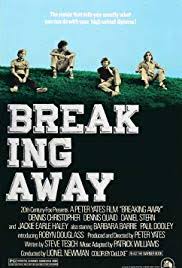
BREAKING AWAY is one of those films that makes me feel incredibly good inside and it belongs on a list with such films as ONE FLEW OVER THE CUCKOO’S NEST, ROCKY, THE BLACK STALLION, CHARIOTS OF FIRE, HOOSIERS, and THE SHAWSHANK REDEMPTION for being uplifting cinematic experiences of the highest order.
It would be enough that BREAKING AWAY ends on a high emotional note, but the film, written by Steve Tesich and directed by Peter Yates, gives us a half-dozen great characters who have left an indelible mark on so many viewers. I’ll discuss these characters far more than I will THE BIG RACE, because they are far more unique and special than a feel good finish that has unfortunately become an industry standard over the decades.
We shall begin with our four main protagonists, Dave (Dennis Christopher), Mike (Dennis Quaid), Cyril (Daniel Stern), and Moocher (Jackie Earle Haley). They are 19 years old and going nowhere fast. They have decided to waste away their lives together and not work or go to college. They are derogatorily known as “cutters” to Indiana University students in Bloomington, since they are the sons of the stone cutters that built the campus. BREAKING AWAY provides us a rare opportunity to hear working class sentiments expressed onscreen. This is also undoubtedly the best movie ever made in Bloomington, Indiana.
All four protagonists, as well as both of Dave’s parents, are developed and sharply delineated. They are as real as the people in our lives.
Dave becomes obsessed with all things Italian, especially cycling and Team Cinzano. Dave takes his obsession so far that the family cat Jake has been renamed Fellini, Dave speaks Italian and plays opera records, he shaves his legs, he wants his parents to have another child because Italians have big families, and he pretends to be an Italian exchange student named Enrico Gimondi to impress a cute coed because he feels that just regular old Dave Stoller won’t cut it with this beauty. Dave drives his parents up a wall, especially his former stone cutter and current used car salesman father; “I want some American food, dammit! I want French fries!” We’ll return to the father soon.
Mike and Cyril both discuss their former athletic careers, Mike football and Cyril basketball.
“You know, I used to think I was a really great quarterback in high school,” Mike said as the contemporary Hoosiers practiced in front of our protagonists at Memorial Stadium. “I still think so too. Can’t even bring myself to light a cigarette, cause I keep thinkin’ I gotta stay in shape. You know what really gets me though? I mean, here I am, I gotta live in this stinkin’ town and I gotta read in the newspapers about some hot shot kid, new star of the college team. Every year it’s gonna be a new one. And every year it’s never gonna be me. I’m just gonna be Mike. Twenty-year-old Mike. Thirty-year-old Mike. Old mean old man Mike.”
Cyril bemoans the fact that his athlete’s foot and jock itch have gone away. “I was sure I was going to get that scholarship. My dad, of course, was sure I wasn’t. When I didn’t, he was real understanding, you know. He loves to do that. He loves to be understanding when I fail.”
Moocher predates Marty McFly, only Moocher hates being called “shorty.” He gives a sound explanation for being short in stature, “It’s my metabolism. I eat three times a day and my metabolism eats five times a day.”
We mentioned Dave’s father earlier and he’s the best character in BREAKING AWAY. Paul Dooley should have won the Academy Award for Best Supporting Actor in 1980, but he was not even nominated for his performance as Dad. Barbara Barrie, who played Mom, did get nominated for Best Supporting Actress.
Please just take an opportunity and think in this moment about how often we see a positive father on film. We’ve seen so many deadbeat dads, absentee fathers, child abusers, goofballs from another planet, etc., that it almost seems like a miracle when we see a more positive portrayal of a movie father. It should not be that way.
Dave exasperates his father in ways that older teenagers and young adults have so often throughout history and then in a way unique to Dave with his Italian obsession. In the long run, though, father loves son and vice versa, most evident in a great scene when father and son take a walk and talk about how they really feel.
“I was proud of my work,” Father tells Son. “And the buildings went up. When they were finished, the damnedest thing happened. It was like the buildings were too good for us. Nobody told us that. It just felt uncomfortable, that’s all.”
After conflict between cutters and campus kids escalates and spills over into a fight in the student union, IU officials determine the cutters are allowed to enter a team in the Little 500 bicycle race. They become “The Cutters.”
IU graduate Tesich based his Academy Award winning screenplay on real people and real events: Dave Stoller takes root from Dave Blase, Tesich’s fraternity brother and Little 500 teammate who put together 139 of the 200 laps (a record) for the winning Phi Kappa Psi team in 1962. Blase also inspired Stoller’s love of everything Italian.
British director Yates (1929-2011) made a large claim of his fame on directing BULLITT, that 1968 Steve McQueen vehicle with the legendary car chase in San Francisco. The bicycle race that ends BREAKING AWAY, it’s every bit as thrilling as the chase in BULLITT. BREAKING AWAY is the better movie.
In closing, I leave BREAKING AWAY a little note.
Adoro BREAKING AWAY ed è una mossa speciale perché solleva gli spiriti e mi fa venire voglia di parlare una lingua straniera con il mio gatto.




 Attack of the Killer Librarian