Beyond and Back (1978)

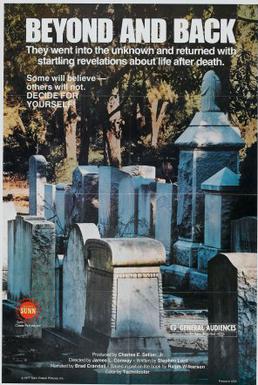
BEYOND AND BACK (1978) No stars

I am here to tell you about life after Beyond and Back.

I cannot believe that I finally watched a film that displaces The Star Wars Holiday Special as my selection for the worst film made in 1978.

Beyond and Back proved to be D.O.A. It showed no vital signs of cinematic life and brought me a micrometre closer to atheism with its faith-based and family-friendly agenda shoved down my throat, 90 minutes of bad actors monotonously gushing over near-death experiences, life after death, psychokinesis, Heaven and Hell, bright light, weighing souls, seeing dead relatives, ad nauseam.

Beyond and Back puts Benjamin Franklin, Elizabeth Barrett Browning, Eddie Rickenbacker, Thomas Edison, Louisa May Alcott, Ernest Hemingway, George S. Patton, and Harry Houdini on an equal plane with Anne Fleck, Dr. Stevens, Byron Temple, and Dr. Paul Kelly, since they’re all just cannon fodder for that agenda told through a pseudo-documentary approach with bad narration and bad reenactment.

Two of the worst films ever made (both from 1978) involve laughable disclaimers:

The African killer bee portrayed in this film bears absolutely no relationship to the industrious, hardworking American honey bee to which we are indebted for pollinating vital crops that feed our nation — The Swarm

The events you have just seen have been taken from actual accounts, but the names of the persons involved have been changed to preserve their anonymity. All such persons have been portrayed by professional actors and actresses — Beyond and Back

Of course, Beyond and Back is the same picture that starts with its narrator telling us, “You are about to see one of the most extraordinary movies of our time, a movie that dares to investigate the possibility of life after death.”

We can thank the folks at Sunn Classic Pictures for such classics, er, drivel as Beyond and Back, namely director, producer, novelist, and Sunn Classics founder Charles E. Sellier. Sellier (1943-2011) evolved from Cajun Catholicism to Mormonism and finally evangelical Christianity, but his product remained in the realm of quick-buck exploitation, whether it was Sunn Classic productions In Search of Noah’s Ark and In Search of Historic Jesus or the controversial killer Santa picture Silent Night, Deadly Night and the teenage comedy Snowballing (both directed by Sellier) or his later productions George W. Bush: Faith in the White House, Breaking the Da Vinci Code, The Search for Heaven, and Apocalypse and the End Times.

For obvious theological reasons and philosophical differences, Beyond and Back passed on many tales and famous last words.

Last words are for fools who haven’t said enough — Karl Marx

I hope the exit is joyful and hope never to return — Frida Kahlo

Dammit, don’t you dare ask God to help me — Joan Crawford

I’m bored with it all — Winston Churchill

I’m going, but I’m going in the name of the Lord — Bessie Smith (I do not recall a single black person in Beyond and Back)

My wallpaper and I are fighting a duel to the death. One or the other of us has to go — Oscar Wilde

Dear World, I am leaving because I am bored. I feel I have lived long enough. I am leaving you with your worries in this sweet cesspool. Good luck — George Sanders (a charming wit to the end)

As we depart this mortal review, I leave this joke: What’s the last thing that goes through a fly’s mind when I kill him? My fist (reporter’s notebook).

Let the Fire Burn (2013)

LET THE FIRE BURN (2013) ****

My wife came home from work as I finished watching LET THE FIRE BURN and she thought I had came down with a cold.

No, as I later explained to her, I broke down in tears by the end of LET THE FIRE BURN, the archive footage only documentary recounting the decade-long conflict between back-to-nature and black liberation group MOVE and Philadelphia police and city officials that culminated in the police siege and aerial bombing of the MOVE house on May 13, 1985. Firefighters were on scene and let the subsequent fire burn for one hour, resulting in 11 deaths (including MOVE leader John Africa and five children), 61 destroyed homes, and more than 250 homeless people.

Only two people from inside 6221 Osage Avenue survived a day that also included water cannons and tear gas and 500 heavily-armed officers firing 10,000 rounds at the burning house. The lone adult survivor, Ramona Africa, was the only person from that day to serve any prison time, seven years for aggravated assault, riot, and conspiracy. No city officials were ever prosecuted for their actions that day, even after the MOVE Commission took aim at Mayor Wilson Goode, Managing Director Leo Brooks, Police Commissioner Gregore Sambor, and Fire Commissioner Wilson Richmond and held each of them responsible for their part in the “reckless,” “unconscionable” bombing. Sambor and Richmond were singled out for their “hasty, reckless, and irresponsible” decision to use fire as a tactical weapon. A grand jury concluded, “We do not exonerate the men responsible for this disaster. Rather than a vindication of those officials, this report should stand as a record of their morally reprehensible behavior.” Both Africa and Ward won civil cases against the city.

I especially lost it late in the film.

Philadelphia officer James Berghaier testifies before the MOVE Commission about how he rescued lone child survivor Birdie Africa, a.k.a. Michael Moses Ward, from a deep pool behind the incinerated MOVE house, braving water and downed power lines to bring the badly burned boy to safety. A title card then informs us that 17-year veteran Berghaier quit the force only months after his testimony due to post traumatic stress disorder … and that he received “nigger lover” harassment for his actions May 13.

Berghaier said in a October 1986 AP story, “I’m constantly reminded of the way that kid looked at me, but it’s not something other people can understand. It’s destroyed me. It never goes away. In order to survive as a policeman, you have to detach yourself from what you have to do, and I’ve never been able to do that.”

Another title card tells us Michael Moses Ward died at the age of 41 in 2012; Ward drowned in a cruise ship hot tub. He reunited with his biological father Andino, learned a lifestyle radically different from his childhood in the communal MOVE house, and eventually became a long-haul truck driver and a part-time barber in his adult years. Ward lost his mother in the fire.

Jason Osder makes an impressive and unorthodox directorial debut by eschewing traditional documentary form — no contemporaneous interviews, no talking heads, no reenactments, only archival footage with an occasional informational title card. LET THE FIRE BURN cuts between MOVE Commission testimony, news reports (mostly from May 13), Ward’s videotaped deposition, and police surveillance footage. It is a tremendous experience.

LET THE FIRE BURN does not let MOVE off the hook. They’re accused of abusing their child members and their black neighbors had an endless array of complaints against them. That’s why city officials worked on evicting them from 6221 Osage and gave their neighbors advance notice of the May 13 raid. MOVE leader John Africa also had the disconcerting habit of calling people — like the police commissioner — “motherfucker” over a loud speaker, something that will not always play well with others. On a surveillance tape played in LET THE FIRE BURN, one police officer can be heard saying that Africa won’t be calling the police commissioner “motherfucker” anymore.

The fact that Goode — the first black mayor in Philadelphia history — was mayor during the bombing and its aftermath makes the events even more complex and interesting. Renowned tough guy and former police commissioner Frank Rizzo (yes, the inspiration for one of the Jerky Boys) was mayor when strife between MOVE and Philadelphia police began and then exploded in 1978 with a confrontation that led to the death of police officer James Ramp and the beating of John Africa (officers can be seen on video beating Africa). Nine MOVE members were charged and convicted for murdering Ramp and received lengthy prison sentences; Delbert Orr Africa became the first member of the Move 9 to be released but he died at the age of 74 only months after his release in early 2020. All three officers were acquitted in the Africa beating; one of them, Terrence Mulvihill, in fact later played a part in the events of May 13.

Goode served as mayor until 1992, after he narrowly won re-election in 1987 against none other than Republican candidate Frank Rizzo; Rizzo lost the Democratic primary to Goode in 1983 and switched parties for the duration of his life. Goode then held a position in the U.S. Department of Education, became a minister and professor at private Christian university Eastern, and he’s currently the CEO of Amachi, a faith-based program geared toward mentoring the children of incarcerated parents. Goode recently called for the city of Philadelphia to issue a formal apology for the events of May 13, 1985.

I am grateful to have encountered this piece of history that’s come up again in recent months, but good luck finding a copy of a full LET THE FIRE BURN to watch online. I wanted to go back for another viewing and pin down some exact quotes, but alas, I could not find the version I just watched a few days before.

Both ignorance of and blatant disregard for the historical record have bothered me for a real long time (latter definitely more than former), and they seem to be practiced more and more from every conceivable angle.

Just a couple months ago, for example, protesters in Madison, Wisconsin, tore down, decapitated, and threw into a lake the statue of Norwegian-American abolitionist, journalist, anti-slavery activist (listed after abolitionist to push the point across more forcefully), politician, and Union soldier Hans Christian Heg, who died at the age of 33 from wounds he received during the Battle of Chickamauga on Sept. 20, 1863. Them protesters probably had absolutely no idea whatsoever this old dead white guy worked hard to and even died in the struggle to end slavery.

Recently, memes have made the rounds that Democrat Senators held the longest filibuster in history, 75 days, attempting to prevent the passage of the 1964 Civil Rights Act. That leaves out the part about the bipartisan effort — yes, both Republicans and Democrats working together, led by Democrats Hubert Humphrey and Mike Mansfield and Republicans Everett Dirksen and Thomas Kuchel — to end the filibuster and pass the bill ending segregation and prohibiting employment discrimination based on race, color, religion, sex, and national origin. Never mind the fact that a Democrat President (John F. Kennedy) proposed the legislation and his successor (Lyndon B. Johnson) signed it into law on July 2, 1964.

The Senate passed it with a vote of 73-27 (46 Democrats, 27 Republicans; 21 Democrats, 6 Republicans). The vast majority of “Nay” votes came from Southern Democrats — both senators from 10 states (Alabama, Arkansas, Florida, Georgia, Louisiana, Mississippi, North Carolina, South Carolina, Tennessee, and Virginia). Texas and West Virginia Democrats Ralph Yarborough and Jennings Randolph both voted for, while Texas Republican John Tower voted against it. West Virginia Democrat Robert Byrd, a nay vote, filibustered for 14 hours, 13 minutes.

In the final House vote, it passed 289-126 (153 Democrats, 136 Republicans; 91 Democrats, 35 Republicans) with a similar vast majority of “Nay” votes from Southern Democrats — including all eight representatives from Alabama, all four from Arkansas, all five from Mississippi, and all five from South Carolina. It is perhaps no coincidence that predominantly reps and senators from the former confederate states voted against every civil rights legislation that came down the pike for a good century.

For some reason, my brain has found these lyrics from Talking Heads’ “Crosseyed and Painless,” “Facts are simple and facts are straight / Facts are lazy and facts are late / Facts all come with points of view / Facts don’t do what I want them to / Facts just twist the truth around / Facts are living turned inside out / Facts are getting the best of them / Facts are nothing on the face of things / Facts don’t stain the furniture / Facts go out and slam the door / Facts are written all over your face / Facts continue to change their shape.” Of course, I’m still waiting. And the world moves on a woman’s hips, it swivels and bops, bounces and hops.

Cobain: Montage of Heck, I Am Chris Farley

COBAIN: MONTAGE OF HECK, I AM CHRIS FARLEY

Like Jimi Hendrix, Janis Joplin, and Jim Morrison before and Tupac and Biggie after him, Kurt Cobain became a cottage industry after his death at the age of 27 in 1994. Nothing floods the market like a dead superstar.

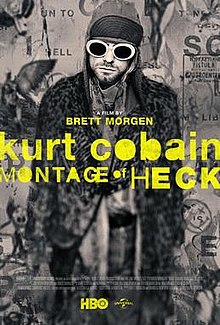
Just on the documentary front alone, we’ve had Nick Bloomfield’s 1998 investigative and speculative KURT & COURTNEY, A.J. Schnack’s 2006 KURT COBAIN: ABOUT A SON built around Cobain interviews for Michael Azerrad’s 1993 book “Come As You Are: The Story of Nirvana,” and then the 2015 double dose of SOAKED IN BLEACH and COBAIN: MONTAGE OF HECK, the former centered around private investigator Tom Grant and his digging into Cobain’s suicide and the latter officially approved by Cobain’s widow Courtney Love and their daughter Frances Bean Cobain. They made a real big deal about MONTAGE OF HECK being the first officially approved Cobain / Nirvana documentary, which automatically raises some red flags.

Throw in Gus Van Sant’s fictionalized LAST DAYS from 2005 and between all those cinematic incarnations and the Greatest Hits package (2002), the Journals (first released 2002), the three CD and one DVD box set (2004), the single-disc “Best of the Box” (2005), and various live albums released after his death beginning with MTV UNPLUGGED IN NEW YORK (Nov. 1, 1994) nearly six months after Cobain’s suicide, as well as all the celebrities from every walk of life fawning over seemingly every little thing Cobain, it’s easy to see why some of us experience Cobain fatigue or even why old fans sour on Cobain and Nirvana and ponder what they ever saw in their former heroes in the first place. Additionally, there are others who will tell you they hated Cobain and Nirvana during their brief heyday and that Cobain’s best move was blowing his brains out (a former co-worker actually said that during one musical discussion). We have more than enough room for each perspective and then some.

Through it all, though, I remain a Nirvana fan, mainly because I do my best to keep the legend at bay and just listen to the music. I turned 13 years old just three days before the release of Nirvana’s second album, NEVERMIND, so I definitely smelled teen spirit. That album, especially its first half, became so ingrained in my life during my teenage years that eventually I rarely ever played it, especially its first half, for quite some time. Only in the last year or so have I listened again to studio “Smells Like Teen Spirit,” “In Bloom,” “Come As You Are,” and “Lithium” on my own accord.

Anyway, that’s a long way of saying I watched MONTAGE OF HECK more than five years after its original release and subsequent hype and backlash. Movies about real people, especially artists, face at least one huge challenge: Do you focus on that person’s darker side or do you focus on the good times or do you try and find a middle ground between dark and light? Matters are compounded when the subject in question committed suicide at the age of 27 and titled songs “I Hate Myself and Want to Die.” Cobain’s often dark sense of humor should never be shortchanged and it’s not during MONTAGE OF HECK. We do see the darker side of Cobain throughout, especially in the second half of MONTAGE OF HECK, but the film also helps recall why Nirvana unexpectedly exploded into the stratosphere in late 1991 and early 1992. That said, I still do not and will probably never understand why Cobain became a generational spokesman, because like others before and after him, he did not want that responsibility and because this whole generational spokesman concept strikes me as being profoundly silly. Always remember, though, “It’s not what your celebrity (corporation) can do for you, it’s what you can do for your celebrity (corporation).”

MONTAGE OF HECK calls to mind Jeff Feuerzeig’s 2005 documentary THE DEVIL AND DANIEL JOHNSTON in a multitude of ways, through their deeply troubled protagonists who have a talent for writing songs, playing music, and drawing, their every moment seemingly captured on camera, and their animated interludes. Cobain himself appeared in THE DEVIL AND DANIEL JOHNSTON, wearing a “Hi, How Are You?” T-shirt alongside Red Hot Chili Peppers bassist and Nirvana trumpeter Flea at the 1992 MTV Music Awards.

MONTAGE OF HECK attempts to avoid the canned talking head format as much as possible — director Brett Morgen said the interviews from Bob Fosse’s Lenny Bruce screen biography LENNY influenced his style for MONTAGE OF HECK.

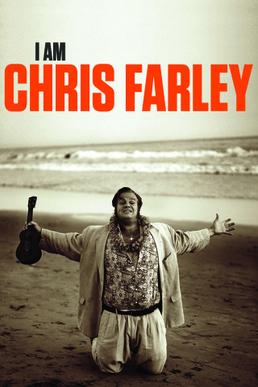
I AM CHRIS FARLEY, meanwhile, reinforces the idea that excess informed Chris Farley’s life and death at the age of 33 from an overdose in December 1997.

Farley enjoyed an excess of friends and loved ones, because fellow celebrities Christina Applegate, Tom Arnold, Dan Aykroyd, Bo Derek, Jon Lovitz, Lorne Michaels, Jay Mohr, Mike Myers, Bob Odenkirk, Bob Saget, Adam Sandler, and David Spade all share their Farley memories and anecdotes, in addition to excess in both overall lifestyle and comedic style.

I quickly realized once again that it was that very excess at the heart of Farley’s lead roles in TOMMY BOY, BLACK SHEEP, BEVERLY HILLS NINJA, and the posthumously released ALMOST HEROES. I watched BLACK SHEEP and BEVERLY HILLS NINJA and passed on the other two, because I thought BLACK SHEEP and BEVERLY HILLS NINJA relentlessly played one note for a good 90 minutes at a time — we shall call this note “Fat Man Takes a Really, Really Big Fall.” Seeing clips in I AM CHRIS FARLEY just brought it all back home again how much I disliked Farley’s films.

Also, during I AM CHRIS FARLEY, Aykroyd compared the comedic duo of Farley and Spade to Aykroyd and Belushi, Abbott and Costello, and Martin and Lewis. Wow. I mean, I did a double take when I first heard it and I just did another now writing it out. Farley and Spade paired for TOMMY BOY and BLACK SHEEP, while Abbott and Costello began working together in radio in 1935 and continued through radio, film, and TV into the mid-50s, highlighted by their legendary “Who’s on First?” routine. Abbott and Costello’s filmography doubled Farley and Spade in 1941 alone. Martin and Lewis made 16 films together — like Abbott and Costello, they worked in three entertainment mediums — from 1949 to 1956. Farley and Spade compared to Aykroyd and Belushi checks out, because of “Saturday Night Live” and two feature films.

On the other hand, I loved almost every Farley clip from “Saturday Night Live,” especially motivational speaker Matt Foley’s debut on May 8, 1993, because I can handle Farley’s excess better at five-minute sketch intervals than feature-length excess. I laughed at the Matt Foley sketch like I remember laughing at it 27 years earlier when it first aired. Spade and Applegate’s reactions and straining to remain in character when Foley unleashes “From what I understand, you’re not using your paper for writing, but for rolling doobies … you’ll be doing a lot of doobie rolling when you’re living in a van down by the river” make this sketch even funnier. Farley’s defining moment and one of the best on SNL.

By the way, you’ll discover the identity of the real-life Matt Foley during I AM CHRIS FARLEY. That’s one of the low-key highlights.

I AM CHRIS FARLEY balances toward light more than dark, but comments like Odenkirk’s “It’s just rare that a person has that much joy and brings that much happiness to everyone around him, but with Chris, there’s a limit to how wonderful it is to me and that limit is when you kill yourself with drugs and alcohol, you know, because that’s where it stops being so fucking magical” certainly get their point across.

Here’s another way to look at Cobain and Farley, “The light that burns twice as bright burns half as long.” In the case of a musician and a comedian who are preserved on record and celluloid, though, we have a chance to step into the light once more any time we so desire our personal favorite Nirvana album or “The Best of Chris Farley.” I believe that’s the best way to remember Cobain and Farley, as well as ourselves in the process.

COBAIN: MONTAGE OF HECK (2015) ****; I AM CHRIS FARLEY (2015) ***1/2

Let’s Dance! Let’s Sing! Let’s Nostalgia!: That’s Entertainment I, II, III

LET’S DANCE! LET’S SING! LET’S NOSTALGIA!: THAT’S ENTERTAINMENT I, II, III

I dutifully watched THAT’S ENTERTAINMENT, the 2-hour, 15-minute compilation of clips from MGM highlighting their hallowed “Golden Age of Musicals.” MGM, founded on April 17, 1924 by Louis B. Mayer and Marcus Loew, commemorated its 50th anniversary and then released THAT’S ENTERTAINMENT two months later commemorating it even more.

I have two immediate spoilsport thoughts, the first which originally occurred to me on June 22, 2004, watching the American Film Institute unveil the super bland “100 Years, 100 Songs.”

THAT’S ENTERTAINMENT brought it all back with a vengeance.

That night in 2004, I said aloud, “Are they going to put every single fucking song ever sung by Judy Garland on the list?” Ditto for Gene Kelly, Barbra Streisand, Julie Andrews, et cetera, who dominated the AFI list with their 20 or 25 songs seeming more like 80 or 100; Kelly and Garland, who passed away in 1969 at the age of 47, dominate THAT’S ENTERTAINMENT.

We get a double dose of heavy duty Judy in THAT’S ENTERTAINMENT, first through her Mickey (Rooney) and Judy “Hey gang, let’s put on a show” Era montage and then a tribute presented by her daughter Liza Minnelli, not long after CABARET. Garland also sings “You Made Me Love You” over a montage of Clark Gable that allows GONE WITH THE WIND (MGM’s most famous production) to be shoehorned into the song-and-dance ballyhoo.

Second spoilsport thought: Aside from THE WIZARD OF OZ and SINGIN’ IN THE RAIN, most of my favorite musicals are not from MGM. For example, Fred Astaire, who’s featured in THAT’S ENTERTAINMENT, did most of his best work at RKO — including TOP HAT and SWING TIME — in the 1930s paired with Ginger Rogers. Never mind alternative musicals like THE 5,000 FINGERS OF DR. T (Columbia and Stanley Kramer Productions) and ONE FROGGY EVENING and WHAT’S OPERA, DOC?, both famous Warner Bros. animated shorts.

What do I like about THAT’S ENTERTAINMENT?

Well, it’s always great seeing the usual suspects from THE WIZARD OF OZ and SINGIN’ IN THE RAIN no matter how many times I have seen them, especially Donald O’Connor’s showstopper “Make ‘Em Laugh.” Clark Gable singing “Puttin’ on the Ritz” from IDIOT’S DELIGHT. Jimmy Stewart’s jab at Robert “He tries his best” Montgomery. The Esther Williams montage. Somebody once said about Williams, “Dry, she ain’t much. Wet, she’s a star.” Madeline Kahn impersonating Marlene Dietrich in BLAZING SADDLES said, “It’s twue, it’s twue.”

We get more or less the same from PART 2, only we get token appearances from MGM employees Groucho Marx, Laurel and Hardy, Buster Keaton, and W.C. Fields and, of course, musical numbers that did not appear in PART I.

It would have been nice to see a musical number from the Marx Brothers or Laurel and Hardy or Fields, despite the fact they all did their best work somewhere else. I mean, would it have killed PART II director Gene Kelly to have aired Groucho’s “Lydia the Tattooed Lady” from AT THE CIRCUS … for example … instead of, I don’t know, one more variation on the song “That’s Entertainment” offered up by contemporaneous Astaire, contemporaneous Kelly together again and for the last time.

After watching PART II, I began hating Arthur Schwartz’s chestnut “That’s Entertainment” unlike ever before, although honestly I hardly ever gave it much thought until it was the (bludgeoning) recurring theme in a darn movie. They must have trotted it out 50 freaking times.

Eventually, to counterbalance the effects of cornball showbiz schmaltz, though, I started humming “That’s Entertainment” from the Jam. Let’s get all misty-eyed nostalgic over a song that starts “A police car and a screaming siren / A pneumatic drill and ripped up concrete / A baby wailing and stray dog howling / The screech of brakes and lamp light blinking.” I particularly love the second verse, “A smash of glass and the rumble of boots / An electric train and a ripped up phone booth / Paint splattered walls and the cry of a tomcat / Lights going out and a kick in the balls.”

I should just stop bitching and moaning and groaning about PART I and PART II of THAT’S ENTERTAINMENT, perhaps because life is short and also perhaps because I realize that I am not the target audience for these nostalgic entertainments. First and foremost, I was born in 1978 and my generation did not grow up on “classic” American musicals. In fact, a lot of us came to hate musicals in our teenage years, especially of the vintage celebrated endlessly by the THAT’S ENTERTAINMENT series. I have come to appreciate some of them corny old classics somewhat more in middle age, but I still prefer musical numbers from Monty Python, Mel Brooks, and “South Park” and I still grumble like nobody’s business at 21st Century schmaltz like FROZEN, MOANA, and THE GREATEST SHOWMAN, entertainment packages that give me fleas. I don’t even have to watch them to get fleas, because it seems like 90 percent of the people around me have memorized every single darn word of every single darn song and they don’t mind singing ‘em every single darn time they feel like singing in their darn glorious off-key melodramatic voice.

Recently, I conducted some independent research by watching MILLION DOLLAR MERMAID (a.k.a. THE ONE PIECE BATHING SUIT in the U.K.) from 1952 and starring Esther Williams, Victor Mature, and Walter Pidgeon. It was directed by Mervyn LeRoy, produced by Arthur Hornblow Jr., and replayed in at least one THAT’S ENTERTAINMENT. I watched it for Williams and the numbers choreographed by the legendary Busby Berkeley (who might be more fondly remembered today for being parodied in early 80s comedies CADDYSHACK and HISTORY OF THE WORLD). I enjoyed it and I realize that I probably would have enjoyed it for the same reasons at a younger age had I given it even half a chance. Now, that’s progress!

MGM returned to the vaults for a third time for THAT’S ENTERTAINMENT! III in 1994, only 18 years after PART II and 20 after the very first greatest hits-golden cinematic oldies compilation.

Anyway, who’d have ever thought that PART III tops both PART I and PART II and does it by including outtakes and unfinished numbers more than greatest hits and golden oldies.

We have Lena Horne’s “Ain’t It the Truth,” a sultry little number cut from CABIN IN THE SKY because a sexy black woman in a bathtub in 1943 would have spurred on a third American Revolution, yes, even in the middle of World War II.

We have two lip-sync takes on “Two-Faced Woman,” presented side-by-side, outtake Cyd Charisse from THE BAND WAGON and black face Joan Crawford from TORCH SONG (both dubbed by India Adams). Crawford’s scene made me think of Pauline Kael’s review of TROG, “Joan Crawford plays Stella Dallas with an ape instead of a baby girl. Some actors will do anything to be in movies: she probably would have played the ape.”

We have another Esther Williams montage and I must say that I am in favor of Esther Williams montages, especially ones that work in Tom and Jerry. Eat your hearts out, Frank and Gene, your movie (ANCHORS AWEIGH) only had Jerry dancing with Gene! In all honesty, the Esther Williams montages in PART I and PART III pushed me to seek out MILLION DOLLAR MERMAID and I have a feeling that I will be consuming Esther, Tom, and Jerry in DANGEROUS WHEN WET soon.

I also prefer PART III because it has much less of the elitist, self-congratulatory, self-important tone that marred the first two installments, as much as I enjoyed seeing all the “old” entertainers that have not been matched (let alone surpassed) since their heyday. PART III hints at the MGM that treated the cast of FREAKS like “freaks” and it at least delves beyond the surface glitz and glamour to the showbiz ugliness beneath.

That’s entertainment.

THAT’S ENTERTAINMENT PART I ***; PART II ***; PART III ****

Ray Harryhausen Special Effects Titan, Corman’s World and That Guy Dick Miller

RAY HARRYHAUSEN SPECIAL EFFECTS TITAN, CORMAN’S WORLD AND THAT GUY DICK MILLER
It’s often been said that Ray Harryhausen’s stop motion animation creatures are the best features of their respective films, everything from “Mighty Joe Young” and “Earth vs. The Flying Saucers” to “Jason and the Argonauts” and “Clash of the Titans.” He became the auteur.

It’s not often that a visual effects artist overshadows both directors and performers, no offense to Nathan R. Juran (“The 7th Voyage of Sinbad”), Don Chaffey (“Jason and the Argonauts”), and the all-star cast in “Clash of the Titans,” Harryhausen’s grand finale.

In fact, in reviewing “Clash of the Titans” a while back, I wrote that it amounts to Harryhausen vs. nominal star Harry Hamlin. Harryhausen wins. Every. Single. Time.

Then again, maybe not. Not when People Magazine featured Hamlin as the “Sexiest Man Alive” in 1987 and it felt like taking a potshot or two at “Clash of the Titans.”

“And there’s always the possibility of doing a remake of ‘Clash of the Titans.’ ‘I brought my toga home,’ says Harry, raising hopes of another glimpse of those knees. He’s kidding, of course. Frivolous flicks are a thing of the past for The Sexiest Man Alive. Besides, says Harry, laughing, ‘I used the toga to wash my car.'”

While pretty boys are a frivolous matter of the past, even in the present, Harryhausen’s creatures will live on forever.

“Special Effects Titan” allows us the opportunity to hear who and what inspired Harryhausen, his thought and work process on his creations, what challenges he faced, and to see the actual models used. Harryhausen (1920-2013) kept the most minute details in his garage.

— Roger Corman, who turned 94 a month to the day before I watched this documentary, has accumulated 415 producer and 56 director credits over a 65-year period. American International and New World produced some of the best exploitation films ever made along with a ton of schlock (some enjoyable, some not so much).

Peter Bogdanovich, Francis Ford Coppola, Monte Hellman, Martin Scorsese, Ron Howard, Jonathan Demme, Jonathan Kaplan, Joe Dante, Allan Arkush, Jack Nicholson, Peter Fonda, and Pam Grier all had their start or their break working for Corman and most of them appear in “Corman’s World: Exploits of a Hollywood Rebel.” Several more big names also appear in “Corman’s World,” but I would like to move on to the next paragraph.

We see Corman working on location as producer on the 2010 TV movie “Dinoshark,” which instantly calls to mind previous Corman productions like “Piranha” and “Humanoids from the Deep.” Near the end of “Corman’s World,” we also see the Hollywood outsider receive an honorary Oscar for “his unparalleled ability to nurture aspiring filmmakers by providing an environment that no film school could match.” It’s only fitting, though, that “Corman’s World” goes out with a set of clips scored by the Ramones’ explosive title song from “Rock ‘N’ Roll High School.” That’s more in the Corman spirit than any award, as Riff Randell blows up Vince Lombardi High School.

“Corman’s World” reminds me that I should watch “The Intruder” (Corman’s most atypical directorial entry, called “one of the most brutal, honest, and unflinching examinations of American racism in cinema history” by Wheeler Winston Dixon in “Senses of Cinema”), thankfully touches on New World’s distribution of films by Bergman, Truffaut, Kurosawa and Herzog, and shows us Jack Nicholson crying over Corman.

Nicholson made his film debut in Corman’s 1958 production “The Cry Baby Killer” and most of his credits before 1969’s smash hit “Easy Rider” are Corman productions, including most famously “The Little Shop of Horrors” and “The Terror.” Corman productions “The Wild Angels” and “The Trip” paved the highway for “Easy Rider.”

Matter of fact, Corman laid a lot of pavement for the road ahead.

— I generally prefer character actors over stars and that group of character actors includes Sydney Greenstreet, Margaret Hamilton, John Cazale, M. Emmet Walsh, Harry Dean Stanton, Brad Dourif, and, of course, perhaps my all-time favorite Dick Miller, who the Academy Awards left out of their “In Memoriam.” Miller died Jan. 30, 2019, at the age of 90.

Miller began his career in Roger Corman productions in the 1950s and he became director Joe Dante’s favorite actor. No matter the size of the role, whether it’s starring like “Bucket of Blood” (the immortal Walter Paisley) or just one scene like “The Terminator” and “Rock ‘N’ Roll High School,” I fondly remember Miller. Sure many of us movie lovers of a certain persuasion do.

— Miller played Murray Futterman in both “Gremlins” films. In “Gremlins,” World War II veteran Futterman keeps going on and on ’bout foreign cars, foreign this, that and everything, and especially “gremlins” before they even attack the fictional upstate New York town of Kingston Falls. Futterman drunkenly rambles, “They put em in cars, they put em in yer TV. They put em in stereos and those little radios you stick in your ears. They even put em in your watches, they have teeny gremlins for our watches!”

— Miller ad-libbed his “They’re ugly. Ugly, ugly people” line about the Ramones in “Rock ‘N’ Roll High School.” Apparently, that’s what he actually thought when he looked at Joey, Johnny, Dee Dee, and Marky.

— Miller originally had aspirations to be a screenwriter and his writing credits are “Four Rode Out,” “Which Way to the Front?,” and the immortal “TNT Jackson.” Miller predominantly stuck to acting, thankfully, with 184 credits listed at IMDb. He played a character named “Walter Paisley” several times. He left behind a tremendous body of work.

RAY HARRYHAUSEN SPECIAL EFFECTS TITAN (2011) Four stars; CORMAN’S WORLD (2011) Four stars; THAT GUY DICK MILLER (2014) Four stars

Electric Boogaloo: The Wild, Untold Story of Cannon Films (2014)

ELECTRIC BOOGALOO, THE WILD UNTOLD STORY OF CANNON FILMS

ELECTRIC BOOGALOO: THE WILD, UNTOLD STORY OF CANNON FILMS (2014) Three-and-a-half stars
There’s bad movies and then there’s movies released by Cannon Films.
Cannon became one of the most productive motion picture studios in the 1980s, known for producing schlock on an epic scale.
You might remember Cannon from their productions SUPERMAN IV: THE QUEST FOR PEACE, THE DELTA FORCE, MASTERS OF THE UNIVERSE, BLOODSPORT, OVER THE TOP, KING SOLOMON’S MINES, THE TEXAS CHAINSAW MASSACRE 2, THE LAST AMERICAN VIRGIN, and, of course, BREAKIN’ 2: ELECTRIC BOOGALOO.
Once upon a time, I believe I wrote that cousins and Cannon heads Menahem Golan (1929-2014) and Yoram Globus were never responsible for a “good” film.
It sure does seem that way at times with their Cannon canon, but I might have been guilty of practicing a little bit of hyperbole. Never. And it’s not like Cannon was never guilty of the same.
I watched many of these films growing up and thus, I watched ELECTRIC BOOGALOO: THE WILD, UNTOLD STORY OF CANNON FILMS with a certain nostalgia.
I’ll take a bad film produced by Cannon over many, many good films. They’re never ever boring, unlike so many prestigious prize winners over the years.
For example, I’ve never considered OVER THE TOP a good movie in any traditional sense, but it’s always been great fun watching this incredible cinematic train wreck that combines “arm wrestling, child custody, and truck driving” into a macho soap opera for the ages. See, your regular bad movie would not take on all three of those subjects and play them full tilt. Child actor David Mendenhall mugs so heavily that I check my wallet every single time I watch OVER THE TOP and his emotional moments with Stallone are so cringe worthy.
Anyhoo, ELECTRIC BOOGALOO is filled with many, many nuggets of juicy information.
— Golan honestly believed that Brooke Shields would win an Academy Award for her performance in SAHARA. Come on, are we talking about the same Brooke Shields, one of the worst actresses ever to disgrace the screen? SAHARA marked the last Cannon picture that MGM distributed; MGM called it “Dry as the Sahara desert … it was awful.” During his review of the 1985 Chevy Chase and Dan Akyroyd comedy SPIES LIKE US, Gene Siskel mentioned that he watched the film while he was on vacation in Hawaii and that Hollywood studios should show him a movie every time he’s on vacation in Hawaii because he’d like anything … then he remembered that a year-and-a-half before, he saw SAHARA in Hawaii and it nuked his see-a-movie-in-Hawaii-and-like-it theory.
Rather than winning an Oscar, Shields instead became the first and so far only actress to win both Worst Actress and Worst Supporting Actor (“Brooke Shields (with a mustache)”) at the 1984 Razzies.
— Cannon wanted “that Stone woman” for their RAIDERS OF THE LOST ARK and ROMANCING THE STONE rip-off KING SOLOMON’S MINES.
Golan meant Kathleen Turner, star of both ROMANCING THE STONE and JEWEL OF THE NILE, but instead “that Stone woman” was interpreted to mean Sharon Stone, who had a limited filmography at that point in her career.
Seemingly everybody hated Stone during the production.
Legend has it that crew members pissed on Stone’s bathtub in her trailer.
Stone said that her contribution to both KING SOLOMON’S MINES and the sequel ALLAN QUATERMAIN AND THE LOST CITY OF GOLD was her bad hairdo running through the jungle. She took work on POLICE ACADEMY 4: CITIZENS ON PATROL next to have some fun after the stress of both King Solomon films and her divorce.
Here I thought it was a chance to work with both Brian Backer and Billie Bird (1908-2002).
— SUPERMAN IV: THE QUEST FOR PEACE is one of the worst super hero movies of all-time and rates with JAWS THE REVENGE as the worst third sequel released in 1987.
This is a film where the IMDb trivia is infinitely more interesting than the final product.
For example, the SUPERMAN IV entry begins promisingly, “Christopher Reeve publicly regretted his involvement in the film. He stated, ‘SUPERMAN IV was a catastrophe from start to finish. That failure was a huge blow to my career.’”
The special effects on the picture are shoddier than probably anything you’ve ever seen, as Cannon slashed the budget by $20 million during the film’s production.
Another juicy bit from the IMDb, “Christopher Reeve’s flying harness was concealed under a larger version of the red shorts he wore for the costume, making his waist look bigger. In previous SUPERMAN movies, the bigger waist was hidden by the cape, quick cuts, or creative camera angles. In this movie, the bigger waist is clearly visible, leading some reviewers to speculate that the thicker waist was Reeve’s actual waistline.”
You could say SUPERMAN IV: THE QUEST FOR PEACE rates a 10 on IMDb, if you add 6.3 points from the trivia section to the 3.7 score the film earned after 39,268 votes.
You could also say that Cannon had no business making pictures like SUPERMAN IV, would-be blockbusters that proved to be dead in the water.
— ELECTRIC BOOGALOO reminds (or informs) one that Cannon took chances on John Cassavetes’ LOVE STREAMS, Andrei Konchalovsky’s RUNAWAY TRAIN, and Jean-Luc Godard’s KING LEAR, for example, respectable films coming from a studio not known for respectability.
— Overall, taking in the wide (and wild) variety of films produced by Cannon, everything from break dancing to ninjas and Michael Dudikoff to Chuck Norris and Bronson to Indiana Jones rip-offs, you might be tempted to conclude — like I do — that yesterday’s bad movies are sometimes better than today’s good movies.
— ELECTRIC BOOGALOO itself surpasses all of the Cannon “classics” in entertainment value.

The Up Series (1964- )

250px-the_up_series_dvd

THE UP SERIES (1964- ) Four stars

In his early 20s, researcher and future director Michael Apted picked 14 7-year-old British boys and girls — Bruce Balden, Jackie Bassett, Symon Basterfield, Andrew Brackfield, John Brisby, Peter Davies, Susan Davis, Charles Furneaux, Nicholas Hitchon, Neil Hughes, Lynn Johnson, Paul Kligerman, Suzanne Lusk, and Tony Walker — from either the upper class or working class to participate in a documentary for Granada Television called “Seven Up!”

That was 1964 and the guiding theory behind the documentary was that each child’s social class determined their future or “Give me a child until he is seven and I will give you the man.”

Beginning in 1971 with 7 PLUS SEVEN, Apted (serving as director) has tracked down the original participants and made another film, every seven years. We catch up with them and their lives. We see and hear them at every seven-year interval. We can expect 63 UP in 2019.

Over the course of time, just one participant willingly dropped out completely, Charles Furneaux, who quit after 21 UP (1977). In an irony, Furneaux became a documentarian himself. Three others have missed a combined six installments.

In May 2013, Lynn Johnson became the first participant to die. A librarian, St. Saviour’s School in London honored Johnson with a refurbished library and the plaque read “St. Saviour’s School Library in honour of Lynn Johnson … who was passionate about reading.” Johnson had been the Chair of Governors at the school for 25 years.

Of course, it’s not been easy for the participants.

Nicholas Hitchon touched on this in a 2012 interview with The Independent.

“It’s always very disturbing,” Hitchon said. “It’s the fact that they don’t show you the way you want to be shown — but that’s not the main thing. They ask you some really disturbing questions. They stick a camera under your nose and ask — ‘Why did you choose your wife?’ — and then it’s shown to gazillions of people. I’ve learnt that the stupider the thing I say, the more likely it is to get in. You’re asked to discuss every intimate part of your life. You feel like you’re just a specimen pinned on the board. It’s totally dehumanising.”

Hitchon said that his relationship has been strained with Apted over the years, especially after his portrayal in 28 UP. By that point in his life, he moved to the United States.

“Anyone who knows me knows that I don’t hang out at malls,” Hitchon said. “But [Apted] took me to one and filmed in front of a lot of girls’ punk clothing and said, ‘Nick came to the US for a salary of £30,000.’ Some people in England changed their mind about me as a result, thinking what a jerk he’s become. That was really upsetting.”

Hitchon has participated in each film, concluding “It’s wonderful that someone had this new idea and I feel very privileged to have been part of it — but it’s come at a big cost.”

Hitchon, the farm kid of the bunch, became a nuclear physicist. “Well, if you’ve seen the film, I was furious because at 7 I was just answering questions. But by the time I was 13, I did not like the way they’d portrayed me. It was clear that they were portraying me as a bumpkin. And, I mean, you know, I was mad.” Hitchon said that before he played a game called ’Not My Job’ for NPR.

School teacher (and later lawyer) Peter Davies dropped out for three installments after remarks he made about the Margaret Thatcher government in 28 UP. We did not see him again until 56 UP (2012).

“I pulled out because of the reaction to my participation in the weeks after 28 UP, particularly from the tabloid press,” Davies said in the Telegraph. “They decided they were going to portray me as the angry young Red in Thatcher’s England. I think I was articulating at the time what a lot of young people of my age were thinking. I was absolutely taken aback, genuinely shocked, at the level of malice and ill will directed toward me. Until you’ve experienced it yourself, you can’t begin to appreciate how it feels.”

Davies returned to the series to promote his band The Good Intentions.

In an academic journal, Apted responded to complaints made about the series.

“The UP films are clearly the one project I’ve done that has stayed around the longest and had the most impact,” Apted wrote. “Yet, it’s also the hardest to define and to nail down. Its power is that it means all things to all people. Everybody who has the patience to watch it finds something in it: a character, an event, a thought, a moment that they can relate to. People project themselves onto it and it becomes very personal to the viewer.”

He’s right.

As I started watching the films (they can be discovered online), I found myself flashing back on my own life at 7, 14, 21, 28, and 35, and made some mental notes on my evolution. I remembered home movies from Christmas 1987 and Thanksgiving 1988, as well as numerous neighborhood basketball games from 1997 through 2000. Always thought it was great to have all that documented.

7 years old (1985): first grader at Arma Elementary School. I can remember every single teacher that I had from K through certainly 8. That year, it was Ms. Golob. For some reason, I recall missing recess due to illness and honing up on all 50 states and their capitals (Montpelier, Vermont, baby!), as well as remembering every United States president in order. Nerd alert!

14 years old (1992): eighth grader at Northeast Junior High. Awkward, very awkward time in my life, as ridiculously big glasses and braces dealt a double whammy of even more awkwardness during a time with raging hormones already taking a toll. Some folks look back on their teenage years as the best years of their lives. To hell with that, for many, many reasons. It took years to work through adolescent awkwardness.

21 years old (1999): final semester at Fort Scott Community College. I remember every time walking up to a bar for a drink and every single damn server not believing that I was 21 years old. In fact, every single time, I heard something like “You look 14 years old.” Damn, baby face! Hell, even several years later, while a substitute teacher at alma mater Fort Scott High, I walked first onto a school bus transporting us to the bowling alley and the bus driver was shocked, absolutely shocked that I was the teacher. She thought I was a student.

28 years old (2006): Eight days after my birthday, I wrecked and rolled over. Bye-bye, Enterprise! That day, I planned on attending a job fair at my alma mater Pittsburg State. About halfway to Pittsburg, I said to hell with all that jazz because at that point in my life, I did not want another damn rejection. After graduating with a master’s degree in 2005, I must have endured a few hundred applications and interviews before returning to college and embarking on my current path.

35 years old (2013): At this point, as sports writer at the Morning Sun, I started working 60-70 hours a week, a rate of work that culminated with a 156-hour time sheet in May 2014. Yeah, that’s right, 76 overtime hours. (That’s a long story. I’d rather talk about something else.) At least, I get to love what I love to do and that’s what keeps me going. Back in sixth grade, I wrote that I wanted to be a sports writer when I grow up. You were right, you crazy bastard.

And now for something completely different: I love, absolutely love it every time characters in the UP films say “row” (rhymes with cow).

Cane Toads: An Unnatural History (1988)

day 108, cane toads an unnatural history

CANE TOADS: AN UNNATURAL HISTORY (1988) Four stars
January 14, 2019 will go down in history as one of the great movie-watching days of my life.

Let’s see, I consumed a 1984 kung fu comedy with a little bit of everything including drunken boxing and a monster known as “Banana Monster” or “Watermelon Monster” (TAOISM DRUNKARD, a.k.a. DRUNKEN WU TANG); a 1983 made-for-TV documentary called FROM STAR WARS TO JEDI: THE MAKING OF A SAGA that took a behind-the-scenes look at the making of RETURN OF THE JEDI; a 1987 anime that one headline called “classic demon Anime loaded with succubi, gore and tentacles” (WICKED CITY); a 1985 Japanese comedy mixing a love of movies and a love of food (TAMPOPO); one of the better Godzilla movies (GODZILLA VS. BIOLLANTE); an older Jackie Chan and an older Pierce Brosnan making it work in THE FOREIGNER; a 1988 Krzysztof Kieslowski film called A SHORT FILM ABOUT LOVE that lasts over 80 minutes (guess in the long run 80 minutes constitutes a short time); and I started on Peter Jackson’s debut BAD TASTE before calling it a day.

In between THE FOREIGNER and A SHORT FILM ABOUT LOVE, I watched CANE TOADS: AN UNNATURAL HISTORY, a 47-minute documentary directed by Mark Lewis on a species taking over northern Australia.

I found a poster for the movie and it hits you with such blurbs as “An Absolute Delight!” (New York Times), “An assault of sex-mad giant toads munching their way across Australia!” (Roger Ebert), and “Riotously funny and hilariously twisted!” (Dallas Times Herald). It has CANE TOADS in huge letters across the top of the spread and a photo of a cane toad who’s as big as the girl who’s holding it.

Yes, it’s one of those “nature run amok” films.

We find out early on that in 1935, the cane toad was introduced to Australia as pest control on a beetle pestering their sugar cane.

Let’s just say that plan backfired, and it backfired miserably.

The toads are back in the headlines in Australia.

“Australian senator says government should pay welfare recipients to kill cane toads” reads one.

Senator Pauline Hanson wrote an open latter to Prime Minister Scott Morrison and she’s a beaut.

“Dear Prime Minister

“As Queensland and neighboring states go through our Summer months, a further explosion of cane toads are hatching, adding to the estimated 200 million already here in Australia.

“Since their misguided introduction to deal with cane beetle in the North Queensland town of Gordonvale in 1935, cane toad numbers have exploded beyond the borders of Queensland and are having enormous effect on native Australian species.

“Unlike native frogs that lay between 1,000 and 2,000 eggs during their breeding cycle, toads will lay between 8,000 and 35,000.

“Their poisonous toxin is deadly to many native species including lizards, quolls, dingoes and crocodiles. Adult cane toads will eat almost anything it can fit in its mouth, including dead animals and pet food scraps. Their appetite and prolific breeding cycle knows no boundaries.”

Parents think teenagers are bad.

Hanson called for swift, bipartisan action.

“I would also encourage you to introduce a 3 month bounty over the Summer months to help reduce the breeding numbers throughout Queensland, New South Wales, the Northern Territory and Western Australia.

“A 10 cent reward for the collection of each cane toad, I believe would encourage most Australians living with the pest to take an active roll (role) in reducing their numbers until a biological measure is developed.”

In the movie, Lewis reportedly wanted to create sympathy for the hated animal.

One resident said, “There are still quite a large number of the toads around, but not as big as they use to be. But I still let the animal and they give me a lot of enjoyment.”

We get a toad’s eye view of the world in a multitude of shots.

Our title creatures participate in a PSYCHO spoof.

They even get songs like “Cane Toad Blues” (Tim Finn) and “Warts ‘N All” (Don Spencer, Allan Caswell).

Around the five- or six-minute mark, Dr. Glen Ingram, then the Senior Curator Amphibia and Birds at Queensland Museum, explains the process of “Amplexus.”

These toads sure do love them a whole lotta “Amplexus.” They are responsible for the phrase “horny toad.”

For example, around 150 were introduced to Oahu in 1932 and in just 17 months, the toads numbered over 100,000.

One article described cane toads as “Fat, toxic and nocturnal.” For some reason, that description called to mind Dean Wormer telling Flounder, “Fat, drunk, and stupid is no way to go through life, son.”

Watching CANE TOADS: AN UNNATURAL HISTORY also brought to mind the 1972 American International exploitation picture FROGS.

One of the legends involving that low-budget picture was that many of the film’s 500 Florida frogs and 100 giant South American toads escaped during production.

Maybe they ran into the cane toads or movie star Ray Milland, who left FROGS three days early because he was such an unhappy camper.

Guess you could say that it’s more a laughing matter for somebody who doesn’t have to deal with cane toads in any way shape or form, because “They pose a bigger menace than the German Army in World War II” (quote from another movie poster).