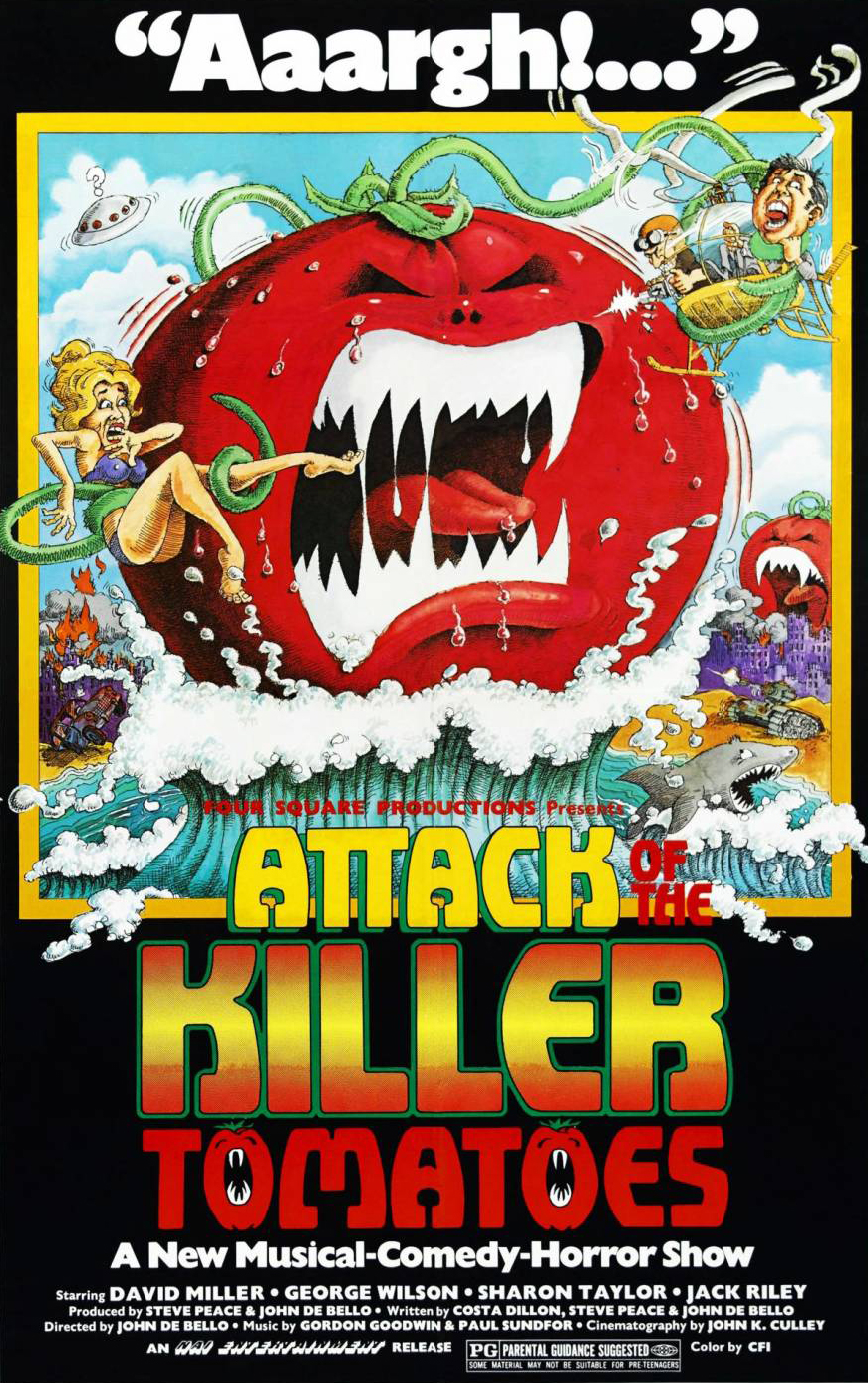
Attack of the Killer Tomatoes (1978)

ATTACK OF THE KILLER TOMATOES

ATTACK OF THE KILLER TOMATOES (1978) Three stars

“In 1963, Alfred Hitchcock made a motion picture entitled THE BIRDS, a film which depicted a savage attack upon human beings by flocks of the winged creatures.

“People laughed.

“In the fall of 1975, 7 million black birds invaded the town of Hopkinsville, Kentucky, resisting the best efforts of mankind to dislodge them.

“No one is laughing now.”

— Introduction to ATTACK OF THE KILLER TOMATOES


Watching ATTACK OF THE KILLER TOMATOES in full for the first time in possibly 30 years, it brought to mind KING KUNG FU.

Both are extremely low-budget labor-of-love parodies and tributes to both older and contemporaneous movies. Both have their dead spots and their high points. Both try many, many, many jokes. Both are filed under cult movies and “so bad they’re good.” Both love their filming locations, Wichita in KING KUNG FU and San Diego in KILLER TOMATOES. Both show people having a darn good time making a silly little movie. Both are so endearingly goofy that I end up forgiving all their various sins and transgressions and enjoying them.

Unlike KING KUNG FU, though, KILLER TOMATOES inspired three sequels — RETURN OF THE KILLER TOMATOES! (1988), KILLER TOMATOES STRIKE BACK! (1990), and KILLER TOMATOES EAT FRANCE! (1991) — plus an animated series and two video games.

Let me highlight what I liked (or loved) about KILLER TOMATOES.

— The songs are great. We have “Theme from Attack of the Killer Tomatoes,” “Puberty Love,” “The Mindmaker Song,” “Tomato Stomp,” and “Love Theme from Attack of the Killer Tomatoes.” I am sure that millions and millions proclaim GREASE the best musical from the film year 1978. No way! I say it’s KILLER TOMATOES all the way. I mean, both the opening and closing musical numbers are fantastic. “Theme” should have been a hit a la “The Blob” by The Five Blobs in 1958. “Love Theme” gives us better opera than YES, GIORGIO, Pavarotti’s feature film debut and farewell. I should have selected it to play at my wedding. “Puberty Love” kills the tomatoes. It’s that bad. Even badder. Just the sheet music for “Puberty Love” alone kills tomatoes smack dead in their tracks. Future Soundgarden and Pearl Jam drummer Matt Cameron sang “Puberty Love” around the tender age of 15. Maybe one day Pearl Jam will cover “Puberty Love.” It couldn’t be any worse than “Last Kiss.” By the way, you can’t throw tomatoes at the performers during “Puberty Love,” because all the tomatoes will be dead.

— KING KUNG FU combined King Kong and kung fu, according to a report from man on the spot Captain Obvious. KILLER TOMATOES affectionately kids monster movies, for example. Notice how the Japanese military always struggles against Godzilla. Well, in KILLER TOMATOES, the American military cannot lick our title characters. Rather, it takes playing a horrible little song named “Puberty Love” throughout San Diego Stadium. Tim Burton must have been taking notes before he made MARS ATTACKS!

— Fans of imported monster movies should have a great time with the character Dr. Nokitofa (credited to Paul Oya). KILLER TOMATOES purposely gave Dr. Nokitofa a bad dub, you know, one of those wildly inappropriate voices that just does not fit the character. I love it and I wish they gave his character more scenes with more lines. I busted a gut at his scene. When Dr. Nokitofa corrects somebody for calling tomatoes “vegetables,” he says “Technically sir, tomatoes are fags” … then his colleague Dr. Morrison says, “He means fruits.” Yes, there’s some bad taste humor in KILLER TOMATOES. Some of it works and some of it does not. Nature of the humor, so they say.

— There’s something absolutely brilliant about a character being chased by a “killer” tomato, relentlessly down the street, up the stairs, and through the hallway.

— I must admit to feeling grateful none of my newspaper bosses ever said that I have a great ass, like the editor (Ron Shapiro) tells Lois Fairchild (Sharon Taylor) in their first scene together.

— With a reporter named Lois, of course that affords KILLER TOMATOES an opportunity to kid SUPERMAN. KILLER TOMATOES came out a good two months before SUPERMAN, one of the most wildly anticipated releases in 1978.

— KILLER TOMATOES kids JAWS much more affectionately and successfully than GIANT SPIDER INVASION, A*P*E, THE HILLS HAVE EYES, and ORCA: THE KILLER WHALE, all of which took pot shots at Steven Spielberg’s game-changing summer blockbuster.

— I cannot have much of any ill will toward a film that works in a cameo for the San Diego Chicken (Ted Giannoulas) and thanks “Every Screwball in San Diego County,” that’s including Mr. Chicken, for the great crowd scene near the end of the picture.

— In conclusion, I thank director and co-writer John DeBello and fellow writers Costa Dillon and J. Stephen Peace (all three each took on even more roles) for their efforts in making a fun little movie.
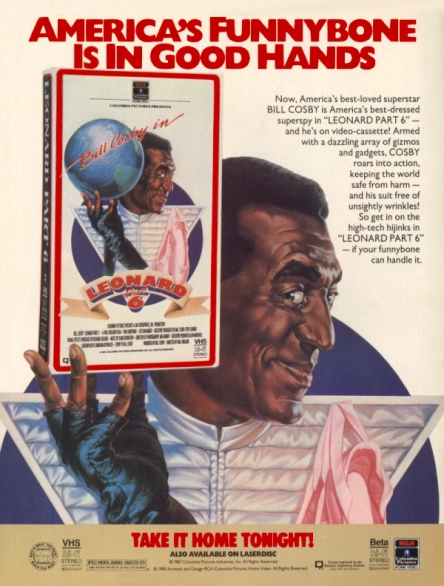
Leonard Part 6 (1987)

LEONARD PART 6

LEONARD PART 6 (1987) No stars

Before all Bill Cosby’s legal troubles, LEONARD PART 6 was merely one of the worst movies ever made.

After more than 60 women accused Cosby of crimes such as sexual assault, rape, drug-facilitated sexual assault, and sexual battery dating back to 1965, we can now safely call LEONARD PART 6 the worst movie ever made.

First and foremost, there’s not a single laugh to be found during the 85 minutes of LEONARD PART 6.

Seriously.

Not one.

Epic fail, especially for a man considered at that point in time by millions of viewers to be one of the funniest people in the world.

At the time of the release of LEONARD PART 6, Cosby was star of the No. 1 show on TV, “The Cosby Show.” “The Cosby Show” spent five consecutive seasons on top of the ratings, from Fall 1985 through Spring 1990. It honestly seemed like Cosby was inescapable during the late ‘80s and early ‘90s, between his TV show and product endorsements. Coca-Cola, Jell-O, home computers, E.F. Hutton, Kodak, you name it.

Speaking of Coca-Cola, the beverage company based in Atlanta, it owned Columbia Pictures at the time of LEONARD PART 6 and there’s an obscene amount of product placement for Coca-Cola and Coke in LEONARD PART 6. Who released LEONARD PART 6? Columbia. In one infamous scene in particular, Cosby holds a bottle in his hand and it says Coca-Cola on one side and Coke on the other. They make sure we see both sides very subtle like.

Jane Fonda and her workout make a cameo and I believe that Cosby’s super spy Leonard Parker even showers in Perrier.

This movie is drenched in product placement, including Cosby himself.

How do I proceed from here with this spoof of secret agent and spy movies?

Guess we should briefly hone in on the joke of the title. Yeah, that’s right, this is the sixth Leonard Parker super spy adventure. Get it? Sure, we all do. I say that we all should consider ourselves blessed in that we did not actually have to see the previous five adventures. I just reviewed JASON LIVES and it does a greater job of spy spoofing (than LEONARD PART 6) with its brief parody of the famous James Bond gun barrel sequence.

Leonard is a retired CIA spy and millionaire restaurant owner. Of course, he’s brought out of retirement to save the world (or at least Northern California, anyway) from Mephistophelian vegetarian Medusa Johnson. Medusa’s played by Gloria Foster (1933-2001), who should be remembered as the Oracle in THE MATRIX and forgotten as Medusa. I believe that she would have wanted it that way.

What happened to the CIA agent to create the need for Leonard Parker’s return? He’s eaten alive by diabolical rainbow trout. Yes, that’s all part of the plan for Medusa and her thugs. She’s enlisted the animal kingdom on her side.

I don’t know if my brain can handle any more thoughts or if my fingers can bang out any more words about LEONARD PART 6, but I must persevere and if just one person out there reading this review decides to never watch LEONARD PART 6, I know that I have done my job and performed humanity a great and honorable service.

Nothing about this stupid film makes any sense.

TROLL 2 did a touch better job with the evil vegetarian plot on a $200,000 budget, whereas LEONARD PART 6 blew $25 million. Now, if somebody could just piece together Darren Ewing’s infamous “Oh my God!” reaction from TROLL 2 with a scene from LEONARD PART 6, that would be utterly fantastic and would make my year.

Why does it say “Ipso Facto” on Leonard’s helmet? Why oh why is there a flying ostrich? Who thought it would be a brilliant idea to have vegetarians killed by raw hamburger meat and glittery hot dogs? Why does Leonard’s wife enjoy pouring food on him? Why? Why? Why?

Cosby himself went on Larry King and denounced LEONARD PART 6 before its release. How often does that happen with any movie? Of course, LEONARD PART 6 is not just any movie, it’s the worst one ever made.

We should be thankful LEONARD PART 7 never happened, although, to be honest, it’s bad enough that Cosby gave us GHOST DAD, perhaps the second worst movie ever made, three years after LEONARD PART 6.

Bela Lugosi Meets a Brooklyn Gorilla (1952)

LUGOSI GORILLA 1953 OWENSBORO

BELA LUGOSI MEETS A BROOKLYN GORILLA (1952) Three stars

They don’t make bad movies like BELA LUGOSI MEETS A BROOKLYN GORILLA any more and that should bring sadness to genuine bad movie connoisseurs everywhere.

It was filmed in six days with a mighty mighty production budget of $12,000. (I have read other reports that have the film down for nine days and $50,000.)

William “One Shot” Beaudine (1892-1970) directed BELA LUGOSI MEETS A BROOKLYN GORILLA and his credits between film and TV amounted to a staggering 372 with his final theatrical features JESSE JAMES MEETS FRANKENSTEIN’S DAUGHTER and BILLY THE KID VS. DRACULA both released in 1966. Beaudine’s directorial career began in 1915, the year of D.W. Griffith’s landmark feature THE BIRTH OF A NATION; in fact, Beaudine assisted Griffith on both THE BIRTH OF A NATION and INTOLERANCE (1916).

Beaudine is not the only legendary Hollywood figure associated with BELA LUGOSI MEETS A BROOKLYN GORILLA.

We have, of course, Mr. Lugosi, no stranger to bad movies, especially in the later stages of his career. He always played a good game, though, and never failed in elevating anything that he was in. One of the all-time greats, Lugosi (1882-1956) even gave great performances in death in both the Kinks’ “Celluloid Heroes” (“Avoid stepping on Bela Lugosi / ‘Cause he’s liable to turn and bite”) and especially Bauhaus’ “Bela Lugosi’s Dead.” MEETS A BROOKLYN GORILLA does not represent peak Lugosi, of course, and it’s not even as good Lugosi as Ed Wood’s GLEN OR GLENDA and BRIDE OF THE MONSTER, but any Lugosi is still good Lugosi.

Martin Landau, who earned an Academy Award for portraying Lugosi in ED WOOD, said that he prepared for his role by watching BELA LUGOSI MEETS A BROOKLYN GORILLA three times (hopefully not in a row). Landau said the film was so bad that it made Ed Wood’s films seem like GONE WITH THE WIND by comparison. Now, there’s a pull quote for the ads: “Makes Ed Wood’s films seem like GONE WITH THE WIND.”

Lugosi made THE GORILLA in 1939 with the Ritz Brothers and Lionel Atwill and THE APE MAN in 1943, a film directed by Beaudine. All three ape films are public domain.

No, please wait, we have not even got to the best part yet. There’s nightclub duo Sammy Petrillo and Duke Mitchell, who play themselves in BELA LUGOSI MEETS A BROOKLYN GORILLA. They are really playing Jerry Lewis and Dean Martin, though, and you might be forgiven for mistaking Petrillo for Lewis and Mitchell for Martin if you missed the opening credits.

I raised my grade by at least one star once I found out that Martin and Lewis considered suing Petrillo and Mitchell for appropriating (misappropriating) their act for BELA LUGOSI MEETS A BROOKLYN GORILLA.

From a 1952 story by the United Press’ Aline Mosby, “The latest ‘Martin and Lewis’ are Duke Mitchell and Sammy Petrillo. They look, talk, laugh, and sing like Dean and Jerry, and they’re in the movies now, too. … Mitchell and Petrillo have the same haircuts, expressions, gestures and even ancestries of Martin, who’s Italian, and Lewis, who is Jewish.”

Mitchell and Petrillo insisted they did not see any resemblance. (Despite the film poster, “They look like Martin & Lewis … You’ll not know the difference … but they are really SAMMY PETRILLO DUKE MITCHELL.”)

After stating that Charlie Chaplin was the only original comic and everybody in show business is a combination of everybody else anyway, Petrillo added, “If it wasn’t for Minosha Skulnic, Harry Ritz and Gene Bayless, Jerry Lewis wouldn’t have an act. And that trick he does with his upper lip he got from Huntz Hall.”

“I’m a combination of Billy Daniels, Billy Eckstine and Sarah Vaughn,” Mitchell said. “Sometimes I get up to sing and I feel like Vaughn Monroe. Nothing’s original in show business. Who do you think Martin is? Crosby. Mel Torme’s like Sinatra, and he did all right.”

Mitchell and Petrillo only made BELA LUGOSI MEETS A BROOKLYN GORILLA and Martin and Lewis split in 1956 after 17 films together beginning with MY FRIEND IRMA (1949).

Mitchell died in 1981, Martin 1995, Petrillo 2009, and Lewis 2017.

BELA LUGOSI MEETS A BROOKLYN GORILLA is one of those movies where you can remember Leonard Maltin’s entire review, let’s see here, “BOMB. One of the all-time greats. Mitchell and Petrillo (the very poor man’s Martin and Lewis) are stranded on a jungle island, where Lugosi is conducting strange experiments. Proceed at your own risk.”

After positive reviews for THE TERROR OF TINY TOWN, KING KUNG FU, THE KILLING OF SATAN, and TROLL 2, I see no problem writing one for BELA LUGOSI MEETS A BROOKLYN GORILLA, although I have mentioned that it’s a bad movie several times. C.M.A., that’s all, folks.

Night School (2018)

NIGHT SCHOOL

NIGHT SCHOOL (2018) One star

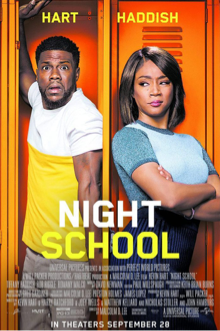
I know that I am probably not the target audience for director Malcolm D. Lee’s comedy starring Kevin Hart, who also served as one of the six writers and producers on NIGHT SCHOOL.

I know that, but I am still hard pressed to come up with a single (even fleeting) moment I laughed at during a movie listed at 111 minutes.

I struggled through NIGHT SCHOOL, but I must report there were those around me who laughed their heads off at regular intervals. They made up the difference for my stone face. (Previously, I had this experience at THE HANGOVER, STEP BROTHERS, and TED, though far more pronounced for those comedies since I watched them in a crowded multiplex.)

Perusing through Hart’s credits, I found one movie over the last 18 years that I watched before experiencing NIGHT SCHOOL, just one movie and not exactly a good one at that, SCARY MOVIE 3. I might have watched SUPERHERO MOVIE, but it’s not exactly coming back to me now with any clarity. I am glad that I have missed just about every one of his movies.

In NIGHT SCHOOL, Hart plays a high school dropout named Teddy who’s forced to attend night school at his alma mater to pursue a GED. It is far more complicated than that, of course, especially since he’s not been honest with his far more successful fiance about a single thing. Yes, he’s a hustler. I know, I know, it’s a shocker.

I especially found any of the restaurant scenes in NIGHT SCHOOL difficult to watch, because they involve a pubic hair custody battle, incessant mugging and melodrama especially by Hart, racism accusations that will remind one of bad scenes from BEVERLY HILLS COP and RUSH HOUR 2 involving Eddie Murphy and Chris Tucker, and I just can’t take that sentence and paragraph any longer though I will be leaving behind crucial plot points.

The classroom scenes are really not any better, since the night school students and authority figures combine to form a modern-day comedic variation on a platoon in a World War II movie. There are would-be identification figures for everybody in NIGHT SCHOOL.

We have the harpy teacher with an inspirational heart of gold (Tiffany Haddish), the high school principal (Taran Killam) whom our protagonist embarrassed back in high school who’s prone to fits of mugging for the camera more pronounced than the rest of the cast, the working class laborer (Rob Riggle) who has literally broken his back and wants to get into management, the harried housewife (Mary Lynn Rajskub) with a great big lummox for a husband, the former waiter (Al Madrigal) who dreams of being like Justin Bieber or Justin Timberlake, the woke conspiracy theorist (Romany Malco), the young woman (Anne Winters) from a wealthy family, and the convict (Fat Joe) beamed into a standard plot through Skype.

Hart, Haddish, and Killam in particular are guilty of overplaying everything, bludgeoning us with every single joke until the film gets all gooey and sentimental in the final reel and takes its plot oh so seriously. This cast acts like each audience member suffers from a learning disability (or hearing loss).

I absolutely hate it when comedies go for cheap gag after cheap gag for most of their running time and then get all serious and borderline preachy at the end, like they want both their NATIONAL LAMPOON’S ANIMAL HOUSE and their ABC Afterschool Special. I wanted to gag when Teddy began his meandering feel good speech at graduation.

Austin Chronicle reviewer Marc Savlov incorporated both the Hindenburg and John Hughes’ THE BREAKFAST CLUB into his opening sentence. That’s good and true, because NIGHT SCHOOL indeed leaves me saying “Oh, the Humanity!”

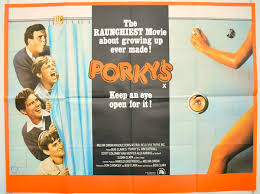
Porky’s (1981)

PORKY'S

PORKY’S (1981) Three stars

“Nobody ever went broke underestimating the intelligence of the American public,” H.L. Mencken famously said.

Mencken said that long before the success of PORKY’S, PORKY’S II: THE NEXT DAY, and PORKY’S REVENGE!, comedies which combined for over $200 million in box office and rental returns. Mencken died in 1956.

PORKY’S earned the vast majority of that $200 million and it came from out of seemingly nowhere to place fifth at the American box office in 1982, behind only breakaway winner E.T., ROCKY III, ON GOLDEN POND, and AN OFFICER AND A GENTLEMAN. PORKY’S sat on top of the American box office from late March through early May and it was dethroned by Arnold Schwarzenegger and CONAN THE BARBARIAN.

Unlike those other films, however, critics absolutely detested PORKY’S and aligned it with FRIDAY THE 13TH and THE CANNONBALL RUN in an unholy trinity of films that would no doubt lead to the downfall of Western Civilization. PORKY’S exhibits more than most how a film can be hated by critics and loved by the masses.

The success of the first PORKY’S spawned a whole slew of teenage sex comedies, often nostalgic and especially set in either the 1950s or 1960s.

I claimed a copy of PORKY’S as one of my first VHS purchases in my late teenage years and it quickly became a favorite movie of my rowdy group of friends. We loved it, as well as NATIONAL LAMPOON’S ANIMAL HOUSE, CADDYSHACK, KINGPIN, and THE BIG LEBOWSKI.

Every time I watch PORKY’S, I find a few big laughs and that’s why I am giving the film a passing grade. As far as the sequels are concerned, they are dreadful and deserve their horrible reputation. I remember seeing all of them in heavily edited form on “USA Up All Night,” before catching up with them all on video or pay TV.

Of course, our seven high school horn balls in PORKY’S are all played by older actors: Dan Monahan turned 26 in 1981, Mark Herrier 27, Wyatt Knight 26, Roger Wilson 25, Cyril O’Reilly 23, Tony Ganios 22, and Scott Colomby 29. That’s not anything new for a Hollywood film. For example, in GREASE, another highly successful nostalgia piece, John Travolta was 23 when he made it and Olivia Newton-John was 28 almost 29, Stockard Channing 33, Jeff Conaway 27, Barry Pearl 27, and Michael Tucci 31 when they were playing high school students.

Speaking of GREASE, one could describe PORKY’S as GREASE with T&A and rednecks instead of PG and greasers and without musical numbers.

PORKY’S includes sex jokes, condom jokes, sex jokes, size jokes, sex jokes, nude jokes, sex jokes, penis jokes, sex jokes, virgin jokes, sex jokes, and fat jokes, especially at the expense of villains Porky (Chuck Mitchell, a 6-foot-3, nearly 400-pound man) and Ms. Beulah Balbricker (Nancy Parsons).

Porky is a real vile piece of work, a saloon and brothel owner who is the most powerful man in his county. Every public official seems to be related to Mr. Wallace, namely his brother Sheriff Wallace (former NFL great Alex Karras). Mitchell wraps his best redneck goon around such dialogue as “I was givin’ the old place an enema and this pile of shit come floatin’ up to the surface” and “Where are these five little virgins who think they reached manhood? You wanna tangle ass with me? Come up here, you sawed-off punk! I’ll educate ya! I’ll wrap this right around your damn neck!” It is to Mitchell’s credit that he creates such a nasty character that we do root for his comeuppance in the final reel.

Balbricker embodies the worst killjoy or she’s basically portrayed as the Carrie Nation of the teenage sex comedy. Less successful, though, much less successful. After all, Carrie Nation (1846-1911) said things like “I felt invincible. My strength was that of a giant. God was certainly standing by me. I smashed five saloons with rocks before I ever took a hatchet” and “I want all hellions to quit puffing that hell fume in God’s clean air.” Balbricker (also called “Ball-breaker” and “King Kong” by other characters) develops an obsession with one character’s penis. Please can we call it a tallywhacker? Penis is so personal. Parsons, like Mitchell, gives a very good performance, one that rates with John Vernon in ANIMAL HOUSE.

Kim Cattrall must have used her work here as Miss Honeywell (“Lassie”) during her audition for “Sex and the City.” It definitely beats MANNEQUIN.

Writer and director Bob Clark (1939-2007) has a very interesting story and filmography, since his credits include the 1974 proto-slasher BLACK CHRISTMAS, the beloved A CHRISTMAS STORY, and the first two PORKY’S films, as well as even more diverse entries like MURDER BY DECREE, TRIBUTE, RHINESTONE, TURK 182!, LOOSE CANNONS, and BABY GENIUSES.

His entry in “Take One’s Essential Guide to Canadian Film” from 2001 : “Clark turned down bids to play pro football to complete a drama major at the University of Miami. With the success of his low-budget horror classic CHILDREN SHOULDN’T PLAY WITH DEAD THINGS, Clark moved to Montreal in 1973 and came to dominate Canadian commercial filmmaking for a decade. He followed CHILDREN with BLACK CHRISTMAS, a box-office hit starring Margot Kidder, and then, from 1978 to 1981, he directed MURDER BY DECREE, TRIBUTE, and PORKY’S – three of the most successful films produced in the tax-shelter era. Sad to say, the sophomoric PORKY’S remains the Canadian box-office champ. Clark returned to the United States in 1984; his career, like his locale, has gone south since.”

I read that Clark gathered the material for PORKY’S over a 15-year period, combining stories from other males of his generation with his own experiences. Every Hollywood studio passed on PORKY’S and it was produced by the Canadian company Astral Bellevue Pathe and Melvin Simon Productions (Mr. Simon, who died in 2009 at the age of 82, developed Mall of America, co-owned the Indiana Pacers along with his brother Herbert, and produced films including PORKY’S, THE STUNT MAN, and ZORRO, THE GAY BLADE), but 20th Century Fox picked up the U.S. distribution and a slick marketing campaign, combined with strong word-of-mouth, produced a monster hit on a $4 million budget.

Clark passionately defended the film amid the constant cries of misogyny and racism.

Those critics are missing that Wendy, played by Kaki Hunter, is often the sunniest presence and that Clark set his film in the Deep South in 1954. One character does overcome his initial anti-Semitism and becomes friends with a Jewish classmate.

THE NEXT DAY seems to address both criticisms, though, with one thoughtful dialogue scene between Wendy and main horn ball Pee-Wee (Monahan) and then adds a fanatical reverend, hypocritical politicians, a Native American, and the Ku Klux Klan to the mix. All the latter material simply does not mesh with the juvenile sex comedy.

Clark did not return to direct REVENGE and director James Komack and screenwriter Ziggy Steinberg wanted the third installment to return to the pure sex farce of the first movie. All the actors simply look too long in the tooth to be partaking in such adolescent shenanigans. I mean, for crying out loud, Colomby was nearly in his mid-30s by the point they made this third PORKY’S film; he graduated from Beverly Hills High School in 1970. Bottom line: I laughed not a single time at PORKY’S REVENGE, maybe once at NEXT DAY.


PORKY’S II: THE NEXT DAY (1983) One star; PORKY’S REVENGE! (1985) No stars

Big (1988)

BIG (1988) Three-and-a-half stars

Twelve-year-old Joshua Baskin (David Moscow) cannot gain admittance on a roller coaster ride because he’s not tall enough, so the embarrassed young man finds a Zoltar Speaks machine and it grants his wish that he were big. Overnight, Joshua Baskin becomes 30 years old and he’s played by Tom Hanks for basically the rest of the movie.

BIG is by far the best of the body switch movies that were all the rave during the Reagan administration. Anybody sentient during that era can surely remember a body switch pic or two. Let’s see, we had OH! HEAVENLY DOG from 1980, whose July 11 release date predates Reagan and which gives us Chevy Chase trapped inside Benji … Chase provides voice-over for Benji in a rather dull murder mystery. Then, there’s LIKE FATHER LIKE SON from 1987 pairing Dudley Moore and Kirk Cameron, who just scream father and son, in one of the worst movies of all-time had it not come out during the same year as such cinematic landmarks as THE GARBAGE PAIL KIDS MOVIE, LEONARD PART 6, JAWS THE REVENGE, MANNEQUIN, and TEEN WOLF TOO. Never mind, it’s still one of the worst movies of all-time.

BIG streamlined and more or less perfected the body switch, because we stick with one character (Joshua Baskin) the whole time and there’s less of a suspension of disbelief required for the movie to work. For example, in LIKE FATHER LIKE SON, we have to picture Dudley Moore inside Kirk Cameron and vice-versa (pun and reference to another body switch movie intended), but it’s almost impossible since their speaking voices remain the same. Movies like LIKE FATHER LIKE SON are why the late Roger Ebert coined the phrase “The Idiot Plot.”

Hanks gives a strong performance, especially in conveying the whole child trapped inside a grown man’s body through body language, facial gestures, boyish enthusiasm, wide-eyed reactions. He works his predicament for laughs, for pathos, for drama, and there’s a compelling sequence during his first “big” day when he’s staying at this seedy New York City hotel and he’s scared by the real world. Hanks broke away from his poor man’s Bill Murray for the first time in his career and established his own niche that would culminate in playing Forrest Gump.

Elizabeth Perkins is just terrific in BIG and I don’t think she’s ever been either better or more beautiful than as Susan. Perkins matches Hanks every step of the way during their complicated romance and please go back and watch her during the farewell scene with Baskin. She kisses him on the forehead and strokes behind his ear, in a tender and more motherly fashion. She makes the scene work, as Hanks reverts back to Moscow as Baskin.

Robert Loggia (1930-2015) and John Heard (1946-2017) were two of the best character actors during their respective careers.

Loggia plays against type here as MacMillan, the owner of a toy company who takes a major liking to the way Baskin looks at toys; phooey to marketing reports, Baskin and MacMillan test toys the old-fashioned way by going straight to the biggest toy store. They pair together for a toy piano duet and create one of the most iconic movie scenes of the late 80s. It’s known quite simply as the “Big Piano Scene.”

There was often an edge to Heard during his performances and he taps into that edge a great deal in BIG. Heard creates a real jerk.

Penny Marshall became a name director after BIG and she and Hanks reunited for A LEAGUE OF THEIR OWN. Anne Spielberg and Gary Ross wrote the script and Barry Sonnenfeld worked as cinematographer; Ross later directed PLEASANTVILLE and Sonnenfeld’s directorial credits include GET SHORTY and MEN IN BLACK.

There seems to be a certain nostalgia for BIG, just like at times it seems like that’s all true for anything (the good and the bad, and the ugly) from the 80s.

How far can that nostalgia go? Well, there’s the Nostalgic Zoltar Speaks machine for sale on the Zoltar site. One machine comes equipped with a $10,500 price tag and that’s not counting any customization like a wireless microphone to talk through Zoltar ($425 without remote control, $520 with), breathing movement for Zoltar ($625), motion activated attract ($75), custom fortune cards, custom audio messages, and traveling case ($1,500 plastic, $650 wood).

If you do buy that Nostalgic Zoltar Speaks machine for a major chunk of change, do you dare make a wish, “I wish I were big.” I say you better for that level of investment.


Good Morning, Vietnam (1987)

GOOD MORNING, VIETNAM.jpg

GOOD MORNING, VIETNAM (1987) Three-and-a-half stars

GOOD MORNING, VIETNAM director Barry Levinson knew that Louis Armstrong’s “What A Wonderful World” came out in 1967 and that his movie was set in 1965, but he overlooked that because Satchmo’s song fit the scene best.

Thus, Levinson created an anachronism or a chronological inconsistency.

Adrian Cronauer (1938-2018), played by Robin Williams (1951-2014) in GOOD MORNING, said that he liked the movie based on his time on Armed Forces Radio in Vietnam well enough, as far as it went, but that it was more about Williams and what suited him than it was about Cronauer and what actually happened. File GOOD MORNING in the “loosely based” category.

Cronauer added that Levinson did not allow Cronauer and Williams to meet each other until after filming completed, because the director did not want Williams impersonating the former disc jockey.

GOOD MORNING is the first Robin Williams movie I ever watched and it’s one of the few I watched again in the immediate aftermath of his 2014 suicide. Just this last time I watched it, though, early in 2020, I paid less attention to Williams and more to a dynamite supporting cast surrounding Williams: Bruno Kirby (1949-2006), J.T. Walsh (1943-98), Noble Willingham (1931-2004), Forest Whitaker, Robert Wuhl, and Richard Edson, as well as the various Vietnamese actors and actresses. I know Williams received most of the acclaim for his performance, a Golden Globe victory and an Academy Award nomination for Best Actor, but it’s the work of that deep supporting cast that makes GOOD MORNING a very good movie rather than merely a good one or at least if nothing else a one-man show.

Kirby plays some of the same notes as he did seven years before in WHERE THE BUFFALO ROAM with Bill Murray’s Hunter S. Thompson his adversary in that earlier film. In GOOD MORNING, Kirby plays Lt. Steven Hauk, who fails to see the humor in Cronauer and who finally bombs on the air when he replaces Cronauer for a brief spell. We patiently wait for that failure to happen, and we are rewarded. We laugh at Hauk’s failure, and the vast disconnect between his ego and his actual ability to make people laugh is the joke.

Walsh put together a decade of memorable supporting performances and he earned that memorability because he plays characters that we love to hate. Quite frankly, he played a dick better than most anybody in show business and thus, it’s no surprise that Walsh plays a character named Sgt. Major Dickerson in GOOD MORNING, because, yes, he’s a major dick. Many of us miss Walsh, a love to hate figure even after his death with both THE NEGOTIATOR and PLEASANTVILLE posthumously released.

Williams and Whitaker especially seem like they have genuine chemistry and their byplay from early in the movie all the way until the end rewards us with both laughter and emotions.

Cronauer teaches English to South Vietnamese students during some of his spare time, initially because he sets his sights on a pretty young woman. Cronauer’s friendship with her brother earns him a flight out of Vietnam, one that’s long overdue given all his trouble from the first time Cronauer shouted “Good morning, Vietnam” on the air.

In short, the soldiers love Cronauer and the brass, especially Dickerson, hate him.

Cronauer plays by his own rules, especially on-air, as he favors that Devil’s music rock and soul over that Easy Listening jive preferred by Hauk and Dickerson. That’s his first sin of many, but it all starts with that playing by one’s own rules.

Probably about half of the movie gives itself over to Williams’ manic free-form ad-libs and Cronauer is one of the few characters played by Williams where his patented comic anarchy fits and does not break away from the fabric of the movie to the point that we forget the character and only see Robin Williams being stand-up comedian Robin Williams. Williams’ anything-for-a-laugh shtick also worked for The Genie in ALADDIN.

In all honesty, I find more humor in Williams’ scenes with the supporting actors, both his fellow military men and his Vietnamese students, than I do his solo flights of fancy on his popular radio show.

GOOD MORNING is not all comedy, though, and it does thankfully give the Vietnamese more of a voice than we normally get in Hollywood films about Vietnam and the war. Cronauer’s friend Tuan (Tung Thanh Tran) expresses it during their confrontation scene late in the movie, “ENEMY? What is enemy? You killing my own people so many miles from your home. We not the enemy! You the enemy! … My mother is dead. And my older brother, who be 29 years old, he dead! Shot by Americans! My neighbor, dead! His wife, dead. WHY? Because we’re not human to them! We’re only Vietnamese.”

The film does lay it on a little too thick with sentimentality and showing that Cronauer’s a good guy at heart performing a noble service for the troops and humanity in general through humor. Critics have accused movie comedians of that weakness for sentimentality ever since the glory days of Charlie Chaplin. Williams definitely fell prey to sentimentality often throughout his career, and it works better in some films than others.

Finally, GOOD MORNING goes on a little too long and it could have been tightened, but I doubt that Levinson and gang wanted to lose any of Williams’ improvisation. Remember that moment in ANIMAL HOUSE when Tim Matheson’s Otter looks at Peter Riegert’s Boon and asks “Germans?” after Bluto says the Germans bombed Pearl Harbor. Boon quite simply and beautifully says, “Forget it, he’s rolling.” Bet that’s what they said every day on the set of GOOD MORNING, VIETNAM about Robin Williams.

Monty Python’s The Meaning of Life (1983)

MONTY PYTHON’S THE MEANING OF LIFE (1983) Three stars

There’s a DVD bundle called “A Little Something to Offend Everybody” and it pairs Mel Brooks’ HISTORY OF THE WORLD PART I and MONTY PYTHON’S THE MEANING OF LIFE.

That’s fitting, because both films definitely fit that bill. For example, both have centerpiece musical numbers that flaunt their potential for controversy: “The Inquisition” in HISTORY OF THE WORLD and “Every Sperm is Sacred” in THE MEANING OF LIFE. Both films go highbrow, middlebrow, lowbrow, below the brow, and even more below the brow. Scatological and sexual jokes abound and Brooks and the Python troupe use just about every trick in the book for their assault on delicate sensibilities and community standards, and they especially indulge their willingness to go over the top in almost every single moment.

It seems like the Monty Python gang (Graham Chapman, John Cleese, Terry Gilliam, Eric Idle, Terry Jones, Michael Palin) made THE MEANING OF LIFE as a reaction to the intense controversy around LIFE OF BRIAN. “If you thought that was bad, well, you ain’t seen nothing yet,” that’s what it seems like they’re saying for all 90 minutes of THE MEANING OF LIFE.

I can hear some of you asking, though, do you get the meaning of life from the movie? Just think about the ridiculousness of that question.

Lady Presenter: Uh, try and be nice to people, avoid eating fat, read a good book every now and then, get some walking in, and try and live together in peace and harmony with people of all creeds and nations. …

The lady presenter (actually Palin in one of his almost 20 roles in the movie) then gets at the crux of the movie as she continues her speech: “And, finally, here are some completely gratuitous pictures of penises to annoy the censors and to hopefully spark some sort of controversy, which, it seems, is the only way, these days, to get the jaded, video-sated public off their fucking arses and back in the sodding cinema. Family entertainment? Bollocks. What they want is filth: people doing things to each other with chainsaws during Tupperware parties, babysitters being stabbed with knitting needles by gay presidential candidates, vigilante groups strangling chickens, armed bands of theatre critics exterminating mutant goats.”

If people truly want “filth,” THE MEANING OF LIFE delivers the goods.

The feature’s second sketch “The Third World” highlights a Catholic working class father (Palin) from Yorkshire, his wife (Jones), and their 63 children. He comes home and informs his family that he’s out of work because the local mill shut down, they are destitute, and that he must sell all 63 children for scientific experiments. He says, “Blame the Catholic Church for not letting me wear one of those little rubber things.”

The father eventually breaks into “Every Sperm is Sacred,” with the memorable chorus “Every sperm is sacred / Every sperm is great / If a sperm is wasted / God gets quite irate.” It turns into a production number straight out of an elaborate musical nominated for a multitude of awards, with even the children getting in on the act before they hit the streets.

The children obviously knew not what they were singing about at the time. Palin felt uncomfortable with one particular line and he originally delivered it “sock” in front of the children before “cock” was later dubbed in.

Beyond “Every Sperm is Sacred,” there’s “Penis Song” (I remember somebody once sang this crowd pleaser at karaoke) and “Christmas in Heaven.”

Quentin Tarantino said the Mr. Creosote sequence makes him nauseous and that says all there needs to be said about the explosive sequence.

I am not or have ever been offended by any of the content in THE MEANING OF LIFE. I think it’s an uneven grab bag of comedy, with hilarious bits, merely funny bits, and other bits where I admire the bits on an intellectual level but I do not laugh. That’s a bit too much of the word bit, but obviously THE MEANING OF LIFE deserves excess verbiage. It’s not as good (funny) as AND NOW FOR SOMETHING COMPLETELY DIFFERENT, THE HOLY GRAIL, and LIFE OF BRIAN.

Before THE MEANING OF LIFE officially starts, we get a bonus 17-minute pirate movie from Gilliam. The elderly British accountants of Crimson Permanent Assurance are fed up with corporate efficiency and they are not gonna take it anymore after the big corporation sacks one of the accountants. Their building turns into a pirate ship with filing cabinets for cannons, ceiling fans for broadswords, and paper spindles for short swords, and they attack The Very Big Corporation of America.

There were several pirate movies during the 1980s and I vote THE CRIMSON PERMANENT ASSURANCE one of the best, right alongside CASTLE IN THE SKY and THE PRINCESS BRIDE.


THE CRIMSON PERMANENT ASSURANCE (1983) Three-and-a-half stars

Bill & Ted’s Bogus Journey (1991)

BILL & TED’S BOGUS JOURNEY (1991) ***1/2

A great supporting character can elevate a movie.

Take, for example, the Grim Reaper from BILL & TED’S BOGUS JOURNEY. I mean, it’s not every day that a supposedly lowbrow comedy puts a novel spin on a character and plot thread from Ingmar Bergman’s THE SEVENTH SEAL.

In that one, you might remember a medieval knight (Max von Sydow) plays a game of chess against a personification of Death (Bengt Ekerot) to prolong his life. The mere image of the knight and Death playing chess by the sea had become one of the most revered in movie history by the time BOGUS JOURNEY director Peter Hewitt, writers Chris Matheson and Ed Solomon, and Grim Reaper player William Sadler, as well as co-stars Keanu Reeves and Alex Winter, got their grubby little mitts on it.

In BOGUS JOURNEY, our two most excellent dudes Bill S. Preston Esquire (Winter) and Ted “Theodore” Logan (Reeves) find themselves in a most hellish predicament. They are killed by evil robot Bill & Teds, called the Evil Robot Usses by our poetic lead characters, and wind up in Hell. What else would happen to a pair of heavy metal fans? Bill & Ted, who quickly discover their album covers lied to them, man, are greeted by Granny Preston, an evil Easter Bunny, Colonel Oats, and eternal boot camp, a plight highlighted by infinity push-ups and verbal abuse, in their own personal Hell. Colonel Oats tells Bill & Ted they are silky boys and silk comes from the butts of Chinese worms.

Back to the Grim Reaper. “How’s it hanging, Death?” asks Ted.

Bill & Ted play The Reaper dude in a series of games, including Battleship, Clue, and Twister, because Death is a sore loser and Bill & Ted must win two out of three or was that three out of five. Nah, believe it’s best five out of seven. The Reaper finally relents, “I will take you back.”

Bill & Ted are the first to ever beat The Reaper, and before that the first to melvin him. “Ted, don’t fear the reaper.” Cue them celestial cowbells.

I love just about everything about the Grim Reaper in BOGUS JOURNEY and he contributes to BOGUS JOURNEY being a step up from EXCELLENT ADVENTURE.

Sadler should have been at least nominated for Best Supporting Actor for his performance here. No, instead, the Academy of Motion Picture Arts and Sciences saw fit to nominate Harvey Keitel and Ben Kingsley from BUGSY, Michael Lerner from BARTON FINK, Tommy Lee Jones from JFK, and winner Jack Palance from CITY SLICKERS. Keitel and Kingsley should have faced off against Sadler in a best-of-seven to see if we could get one less nomination for BUGSY. Colonel Oats would certainly have approved of Palance’s victory with his celebratory one-armed push-ups.

EXCELLENT ADVENTURE takes on time travel, historical figures, and historical fiction. Bill & Ted need to earn an A+ on their final report in history … and the future of the human race hangs in the balance. Literally, because in a mere 700 years in the future, humanity exists in an utopia built around the music of the Wyld Stallions, Bill & Ted’s most excellent rock band.

BOGUS JOURNEY adds depictions of the afterlife, Heaven, and Hell to the mix, and it gives us good and evil robot Bill & Teds in addition to living and dead Bill & Teds. Winter and Reeves compete with Michael J. Fox and Thomas F. Wilson for most permutations in a time travel comedy. Peter Sellers and Tony Randall would have been proud of all of them.

Additionally, the universe’s most brilliant scientific genius uses a single word vocabulary and that’s his name, Station. Station builds the “good robot usses” or “Station’s creations.”

I should not forget Joss Ackland as arch villain Chuck DeNomolos, who programs the evil robots to kill the good Bill & Ted because he hates their ideas and their insipid music. Don’t feel too bad for Chuck, because he gets a shot with Missy. Doesn’t just about everybody?

In the end, though, remember “You might be a king or a street sweeper, but sooner or later you dance with the reaper.”

That and, of course, “Be excellent to each other.”

Kingpin (1996)

KINGPIN (1996) Four stars

Over a period of a couple years in the late 1990s, there were two great bowling comedies released: The Farrelly Brothers’ KINGPIN and the Coen Brothers’ THE BIG LEBOWSKI. Granted, there’s far more to both movies than bowling.

A few of my friends and I watched these movies time and time again. They both played a central role in nearly a decade of regular Friday or Saturday or Sunday night bowling adventures at the Holiday Lanes in Pittsburg, Kansas. Alcohol helped too, although when the bowling alley banned outside cups, college student attendance dramatically took a dip. Eventually, though, our group sucked it up and put the money down on the watered down bowling alley beer.

A couple times during my writing career, I have mentioned KINGPIN. I reviewed ZOMBIELAND for the college newspaper and reunited Woody Harrelson and Bill Murray gave me an opportunity to reference their dueling comb-overs in KINGPIN. I just laughed thinking about it. I named KINGPIN one of my 10 favorite sports movies for The Morning Sun.

Harrelson plays Roy Munson from Ocelot, Iowa, the 1979 Iowa state bowling champion who embarks on a professional bowling career early on during KINGPIN. He’s a promising young bowler, but, unfortunately, he runs afoul veteran bowler Ernie McCracken (Murray), who cons rather than mentors the younger bowler. McCracken hated the fact that Munson beat him in bowling and in a con gone tragically bad, a gang of amateur bowlers take it out on Munson after they find out both he and McCracken are pros. McCracken gets away, of course, and leaves Munson to reap the consequences. Munson loses his right hand in a scene that’s very, very, very rough for a PG-13 comedy. It plays like a scene from a Scorsese gangster pic.

Seventeen years later, Roy Munson’s a real born loser in Scranton, Pennsylvania. Man, talk about down on his luck. He’s got a prosthetic hand and a major drinking problem. He sales bowling supplies, rather unsuccessfully, since nobody wants novelty gags in the men’s room any more. Munson is perpetually behind on his rent and that means his creepy landlady harasses the former pro bowler. They work out a debt solution I do not recommend and work in a Mrs. Robinson parody for tremendous sport Lin Shaye.

Speaking of sports, KINGPIN parodies the genre. Munson takes on a managerial role for Amish bowler Ishmael (Randy Quaid) and they decide to work their way to Reno for a $1 million winner-takes-all tournament to save Ishmael’s farm. Along the way, they gain Claudia (Vanessa Angel) and Roy and Claudia assume the roles with Ishmael that Jack Nicholson and Otis Young did with Quaid in the 1973 film THE LAST DETAIL. Needless to say, Ishmael gets hurt on the eve of the tournament in Reno, Munson makes his bowling comeback, and Munson and McCracken eventually battle for $1 million and comb-over superiority.

I find myself laughing throughout most of KINGPIN. Like the comedies of the Z-A-Z boys and Mel Brooks, or for that matter the Marx Brothers and the Three Stooges, I laugh twice at some of these jokes, a second laugh at the fact that I laughed in the first place. For example, I am laughing right now just thinking about Roger Clemens’ cameo playing a redneck named “Skidmark” and I have already mentioned Harrelson’s and Murray’s comb-overs.

Harrelson, Quaid, and Murray all have no problem looking absolutely ridiculous on screen, something they demonstrate time and time again for nearly two hours in KINGPIN. The Farrelly Brothers and the actors will stoop just that low for a laugh.

Murray has made a parallel career for himself with supporting roles and cameos, ever since CADDYSHACK. He’s done it with TOOTSIE, ED WOOD, SPACE JAM, WILD THINGS, COFFEE AND CIGARETTES, and, of course, KINGPIN, where he appears near the beginning and near the end of the picture. He just about walks away with the movie. Ernie McCracken is a real piece of work, crass, vile, womanizing, on down the line, but he seems to be a beloved figure within the movie. Of course. We love Murray and McCracken, and it’s the way he reads lines like “It’s a small world when you’ve got unbelievable tits, Roy.”

Of course, McCracken’s talking about Claudia, played by the lovely Angel. She is the discovery in KINGPIN, because we have seen Harrelson, Quaid, and Murray be funny before in several movies. At the same time, Angel could be seen on TV during her run on “Weird Science,” playing the character first essayed by Kelly LeBrock. She plays some of the same notes in both roles, with her delightful English accent and her sarcastic wit. It’s a joy watching her sock it to Munson and McCracken. It remains a mystery why Angel has never become a bigger star.

I recently talked about enjoying few comedies as much as NATIONAL LAMPOON’S ANIMAL HOUSE. Well, I just spent over 800 words on one of those few.