Calling All Cars, We Have a 412! Calling All Cars!

CALLING ALL CARS, WE HAVE A 412! CALLING ALL CARS!
I watched Chu Chu and the Philly Flash on March 7 and 18 days later, I can still hear it, that’s for sure, especially co-stars Alan Arkin and Carol Burnett and supporting player Danny Aiello.

Burnett plays Chu Chu, or Emily as only her dearest friends know her, who performs this Carmen Miranda routine out in the streets. Her performance gives one all the maracas needed for at least one year, perhaps even one lifetime. Emily used to be a successful entertainer, before the booze got to her. We all know the story by now.

Arkin, meanwhile, plays the Philly Flash, given that name not because of his ability to shed his raincoat but his former ability turning double plays at second base for the Philadelphia Phillies. Was he named the Philly Flash just because the real-life Phillies won the World Series in 1980? Anyway, just like Emily, booze got to Flash, not Grandmaster Flash (think I’d rather watch The Adventures of Grandmaster Flash on the Wheels of Steel than Chu Chu and the Philly Flash) or Flash Gordon (who just had a movie, a much better one believe it or not, come out in 1980) or The Flash. No, the Philly Flash’s power, like Chu Chu’s, seems to be that he can scream and carry on a whole lot. In fact, that’s about both all they ever do in Chu Chu and the Philly Flash.

Not sure that it even matters or not if Burnett played the Philly Flash and Arkin drew Chu Chu. They could have made him a former professional golfer and her a former burlesque entertainer or something. Yeah, like Bill Murray said in Meatballs, it doesn’t even matter.

Government secrets fall, yes, literally fall into the hands of Philly Flash and Chu Chu. Well, technically, not right into their hands, I mean they did have to walk over and pick up the briefcase. By the way, the briefcase gives the best performance in Chu Chu and the Philly Flash, since even the maracas overact.

Rating: One-half star.

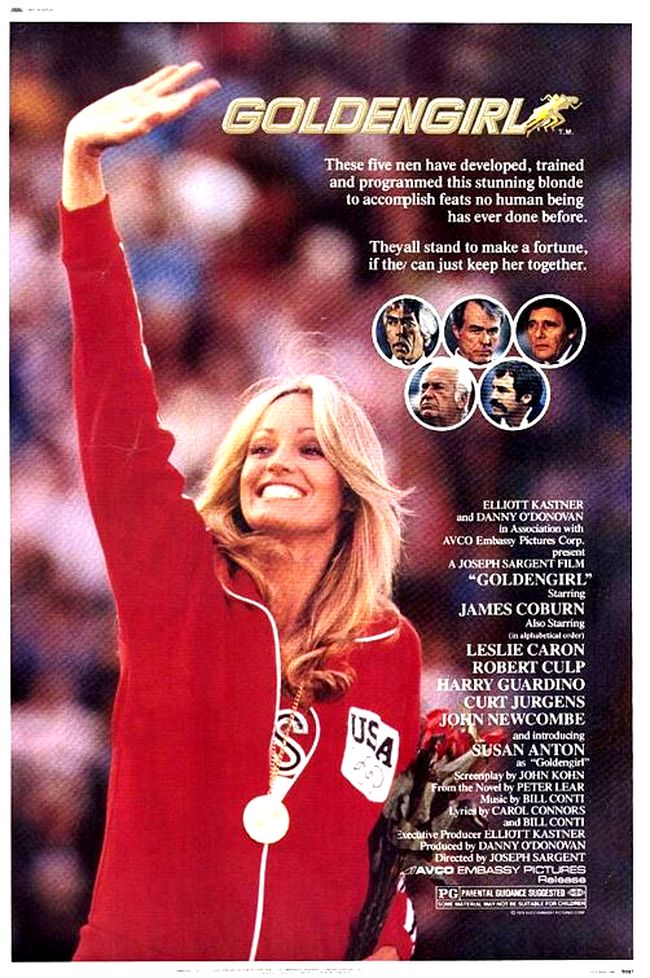
— Earlier in the same day I watched Chu Chu and the Philly Flash, I endured Goldengirl about basically a genetically engineered super female runner and it co-stars James Coburn, Robert Culp, Curt Jurgens, Leslie Caron, Jessica Walter, Michael Lerner, and Harry Guardino.

They’re all fine and dandy, more or less, but it’s star Susan Anton who ruins Goldengirl every single time she expresses any emotion. Guess they can’t genetically engineer the ability to act and the ability to not wreck an entire movie, because Anton can’t act and she absolutely obliterates Goldengirl every single time I wanted to give it another chance.

Give her one thing, though, because just like Donny and Marie Osmond in their motion picture debut and finale Goin’ Coconuts, Anton does have a great set of teeth. Outside her canines, incisors, premolars, and molars, though, Anton sucks in Goldengirl and despite the speeded up and slowed down footage, she’s not the least bit convincing as this incredible champion runner.

Anton and Coburn do have one of the great dialogue exchanges in motion picture history, one that could be played right alongside Fini can water you from Yes, Giorgio. She just set a new Olympic record and doesn’t she even deserve a kiss? Coburn works his way toward her magical lips and Anton moves the goalposts. She insists that he kisses her feet, then laughs maniacally, while Coburn, well, maybe he’s wishing that he could get hit upside the head by his old friend Bruce Lee’s one-hit punch again. Lee died in 1973 and Coburn was one of the pallbearers at Lee’s funeral.

The IMDb trivia entry starts out promisingly for Goldengirl, “Produced and theatrically released in 1979 prior to the 1980 Olympics boycott, this film depicts American athletes competing at the Moscow games. In reality, the boycott meant that the USA did not perform there, making the picture post-release anachronistic and historically inaccurate.”

Blame the boycott on Goldengirl.

Rating: One star.

— I watched Under the Rainbow between opener Goldengirl and closer Chu Chu and the Philly Flash.

That’s right, one of the worst movie-watching nights of a lifetime.

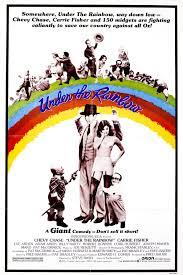
Under the Rainbow, like Goldengirl, has at least a far more interesting plot summary than anything else associated with the finished product.

Okay, to be honest, only the part about the 150 little people descending upon Hollywood for a part in The Wizard of Oz (and a wild and crazy party) sounds interesting, then it gets all mucked up when federal agents, fat cats, and Nazi and Japanese spies enter the picture. Anyway, doesn’t 1938 seem too early for Nazi and Japanese spies? I mean, the Nazis didn’t invade Poland until Sept. 1939 and the United States officially remained neutral until late 1941.

Regardless of social class and nationality and historical accuracy, though, all the characters get run through the cinematic claptrap blender at maximum speed with broad, inane slapstick and would-be wacky hijinks the settings. Despite the maximum speed, Under the Rainbow still feels like it takes forever to be done and over. That’s because it’s all played as loudly as possible, of course, with so much mugging on display that it’s another one of those movies where you feel the back of your head for lumps and bruises and then check for your wallet after watching it.

Chevy Chase and Carrie Fisher are the nominal stars, but they’re lost in the crowd because they play it too cool for school. Meanwhile, Billy Barty acts like he’s in three movies simultaneously and Japanese-American actor Mako settles for only two, and their terminal mugging calls to mind the 1942 propaganda comedy short The Devil with Hitler. The Devil with Hitler is better than Under the Rainbow, and I should just leave it at that statement, though I want to end this review with one last cheap shot at three lousy pictures that I wish I would have left buried inside their time capsules.

Stan Freberg would have charged the casts of Chu Chu and the Philly Flash, Goldengirl, and Under the Rainbow with one heinous crime against humanity: a 412. What’s a 412? Over-acting.

Rating: One star.
Silent Rage (1982)

SILENT RAGE (1982) ***
Michael Miller’s 1982 feature Silent Rage combines several American movie hallmarks into one barely coherent package: Chuck Norris, a small Texas town (never sleepy when Norris plays Sheriff), a madman killer, mad scientists, shots borrowed straight from John Carpenter’s Halloween, two love scenes, Stephen Furst basically playing his character from Animal House again, bar fights, roundhouse kicks, biker gangs, breasts (inc. Norris but not Furst), and a schizophrenic musical score, not in any particular order.

We also have at least five wildly different acting styles for the price of one. We’ve already covered Norris and Furst, then there’s Ron Silver and he’s playing it straight in easily the best dramatic acting that one can find in anything starring Chuck Norris. Silver plays the voice of reason and let’s do the right thing scientist, whereas his colleagues played by Steven Keats and William Finley are variants on Universal horror archetypes updated for a new generation. Keats, of course, wants to push science further than any one ever before even when it’s not prudent and Finley, best known for his roles in Brian De Palma and Tobe Hooper films Phantom of the Paradise and Eaten Alive, occupies the middle ground between Silver and Keats. Brian Libby’s madman killer continues in the proud screen tradition of Frankenstein’s Monster and Michael Myers, especially after our mad scientists flat out turn him posthumously into an indestructible killing machine whose stalking does all the talking. I wanted Dr. Loomis to show up and say THIS ISN’T A MAN. Bummer that it didn’t happen.

Norris battles the mad killer and later the virtually indestructible mad killer in the opening and concluding scenes. Otherwise, he alternates between mentoring and supporting unsure and unsteady rookie cop Furst, rekindling his romance with a former lover played by Toni Kalem, and questioning Silver and Keats. For Norris fans, apparently the scariest parts of Silent Rage involved Kalem’s bare breasts and Norris favoring jazz music because our favorite roundhouse specialist returned to only love scenes between men for the rest of his career, barring his rolling around in the mud with the sultry Barbara Carrera in the 1983 Walker, Texas Ranger precursor Lone Wolf McQuade. I for one like Silent Rage because it’s nice to see more chests on display than just Chuck’s for a change.

Silent Rage unfortunately drags at two main points. The death of Silver’s wife literally feels like it takes forever, like one of the filler killings in a Friday the 13th sequel. Ditto for the bar fight, which are drags both in real life and in the movies. A couple moments in this otherwise humdrum bar fight sequence redeem it, just barely though. If you’ve seen Silent Rage, you know exactly what I mean.

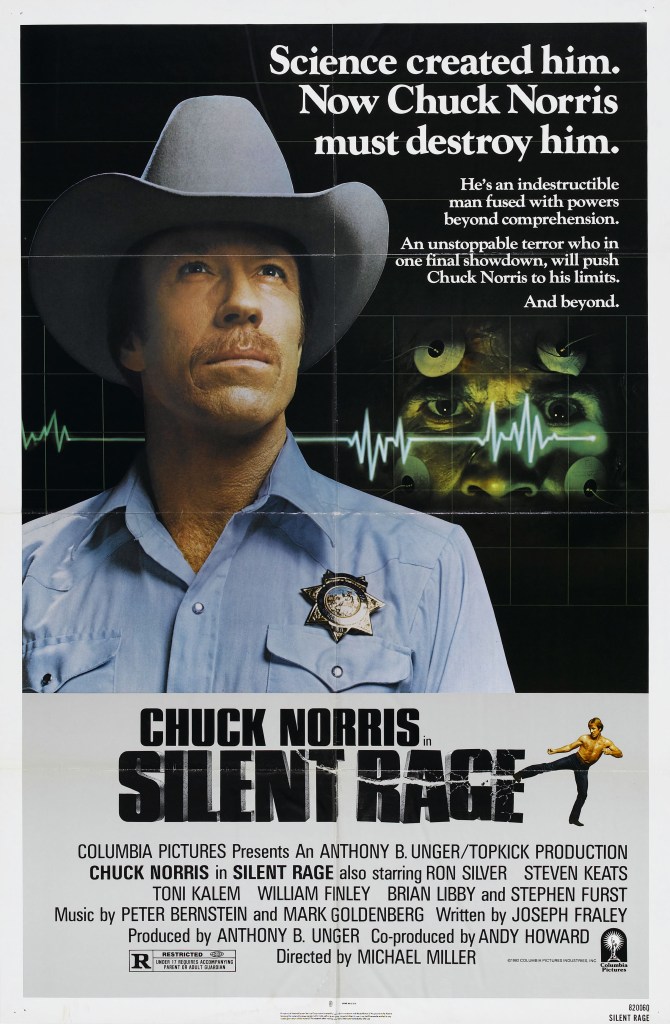
The poster for Silent Rage rates with Breaker! Breaker as the best Norris film poster. There’s really no arguing with a mini-Norris roundhouse cracking the movie’s title and the promotional hype Science created him. Now Chuck Norris must destroy him. He’s an indestructible man fused with powers beyond comprehension. An unstoppable terror who in one final showdown, will push Chuck Norris to his limits. And beyond.

Once upon a review, I believe I wrote that I wanted to see Chuck Norris vs. Jason Voorhees and Silent Rage is the closest that I will ever get to seeing that dream come true.

Bomb, Bomb, Bomb: Partners, Charlie Chan and the Curse of the Dragon Queen, When Time Ran Out

BOMB, BOMB, BOMB: PARTNERS, CHARLIE CHAN AND THE CURSE OF THE DRAGON QUEEN, WHEN TIME RAN OUT

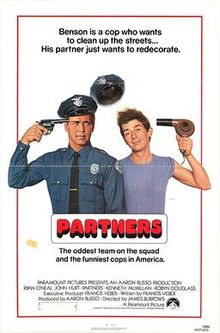
I could only make it through about 30 minutes of Partners and that’s more than enough for at least about 10 lifetimes, I’d say. I gave up on the picture for good around the fourth time star Ryan O’Neal uttered the epithet faggot. Yeah, Partners basically plays Cruising for laughs. Ha-ha, funny … about as funny as punching somebody’s mother in the face.

I consider Partners the absolute worst film from 1982, at least among the 70 or so films that I have seen thus far in my 42 years on this planet. It supplanted Amityville II: The Possession, a lovely little number incorporating blood, vomit, incest, matricide and patricide, fratricide and sororicide, and demonic possession. Never mind Inchon, a $46 million Korean War epic that bombed mightily at the box office with only a $5.2 million return. Never mind Halloween III: Season of the Witch, which features one of the least likable lead characters (Dr. Dan Challis) and lead performances (Tom Atkins) in recent memory. Believe it or not, Partners beats those other films in sheer unpleasantness.

Did longtime TV director James Burrows use Partners for his audition for Will and Grace? I seriously doubt it, because Partners is one of the nastiest pieces of work I have ever seen. Burrows has directed more than 1,000 TV episodes, including 237 Cheers and 75 Taxi and 32 Frasier. Thankfully, Burrows stuck with television after Partners.

Early in the picture, O’Neal asks his boss how he got stuck partnering up (literally) with gay records clerk Kerwin (John Hurt) to infiltrate and investigate a series of murders in the Los Angeles gay community. Anyway, Chief Wilkins (Kenneth McMillan) tells our matinee idol, “Because you’re a good cop, a real good cop. And because of your cute ass.” Maybe that’s how O’Neal himself got the gig. O’Neal certainly dressed up for the part, wearing a ridiculous tank top and then a leather garb in just the portion I watched before saying Roberto Duran on Partners.

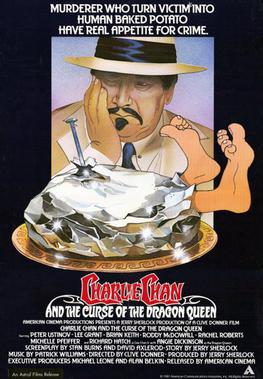
— As I sit here before this keyboard and ponder my next direction, I consider how I endured all 95 minutes or so of Charlie Chan and the Curse of the Dragon Queen, another great big smelly turd from the early ’80s like the ones mentioned about three paragraphs up.

When folks express this incredible nostalgia for the ’80s, undoubtedly it’s not Charlie Chan or Partners or Inchon, for that matter, they’re nostalgic about, because they SUCK in the immortal words of Al from Caddyshack. Then again, if I have learned anything over the years writing about movies or music online, it’s that somewhere in this great big world there’s a cult following Howard the Duck or Halloween III, for example, and they just might flame you for not cherishing their cult object in the same way they do.

Charlie Chan asks us to believe Peter Ustinov (1921-2004), Richard Hatch (1945-2017), and Angie Dickerson as characters of Asian descent. Sure, I believe the Englishman Ustinov as fictional Belgian detective Hercule Poirot (a character he played six times, including features Death on the Nile, Evil Under the Sun, and Appointment with Death) and Roman emperor Nero in Quo Vadis, but I call it more of a stretch to consider him as Chan in 2020, nearly 40 years after the film was made. It’s even worse for both Hatch and Dickerson.

Charlie Chan features plenty of the broadest comedy and frenzied overacting by a rather distinguished cast that also includes Lee Grant, Brian Keith, Roddy McDowall, Rachel Roberts, and Michelle Pfeiffer early in her career. Hatch plays Chan’s fumbling bumbling stumbling grandson Lee Chan Jr. and I’ve watched so many films lately with fumbling stumbling bumbling would-be detectives that I now grumble and rumble when I see them on the screen. I’m thankful my Grandma never behaved like the one played by Grant in Charlie Chan. Keith’s police chief says ‘Goddamn’ about 50 times. McDowall and Roberts play Grant’s domestic helpers, Gillespie and Mrs. Dangers respectively, but they both provide little help to Charlie Chan since they are both in the grand tradition of melodramatic domestic help in the movies; Mrs. Dangers calls to mind Patsy Kelly’s frantic maid in The Gorilla. Pfeiffer could have dialed the perkiness down a notch or few and still have saved enough for the rest of her career. Nearly all of these characters are cringeworthy.

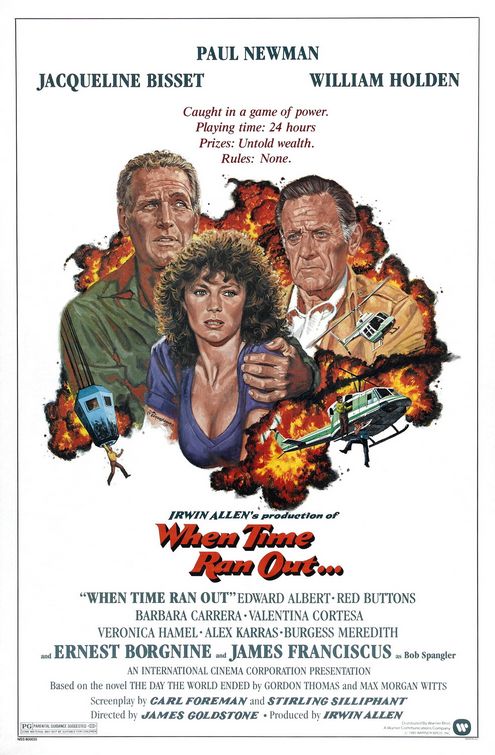
When Time Ran Out came out Mar. 28, 1980 and it eventually fell about $16 million short of making its $20 million production budget back at the American box office.

Later that year, on July 2, Airplane parodied Airport specifically and disaster movies in general, and became one of the biggest hits of the summer and the entire calendar year.

The failure of When Time Ran Out and the success of Airplane signaled the end of the disaster movie, at least in the form that dominated the first half of the seventies with The Poseidon Adventure, Earthquake, and Towering Inferno and then dribbled out pure unadulterated dreck the final half of that decade like The Swarm, Beyond the Poseidon Adventure, and Meteor. Since I mentioned Meteor, I also have to mention Avalanche, which provided disaster footage recycled in Meteor as if being in one disaster of a disaster movie just simply was not enough.

Master of disaster Irwin Allen (1916-91) produced at least half the films mentioned in the paragraph right above this one and he even stepped in the director’s chair for the turkey bombs The Swarm and Beyond the Poseidon Adventure. Allen called on Rollercoaster director James Goldstone for When Time Ran Out, which features the required number of old time movie stars, hot commodities, and fledgling character actors. When Time Ran Out should have been called Take the Money and Run, though Woody Allen and Steve Miller already used it for a comedy (1969) and a hit song (1976).

We have William Holden (1918-81), Paul Newman (1925-2008), Jacqueline Bisset, Ernest Borgnine (1917-2012), James Franciscus (1934-91), Burgess Meredith (1907-97), Red Buttons (1919-2006), Barbara Carrera, Pat Morita (1932-2005), Veronica Hamel, Edward Albert (1951-2006), and Alex Karras (1935-2012), as well as a volcano, a tidal wave, etc.

Seemingly half of the cast takes part in a glorified soap opera before the molten lava really begins to flow and they have to repeat business from Beyond the Poseidon and seemingly every other disaster movie of the era. Here’s that glorified soap opera: Holden proposes to Bisset very early in the movie and she turns him down because she’s in love with Newman, who’s not the marrying kind and anyway he does not seem to much care for Bisset but maybe he’s just masking his true feelings toward her with standard male bluster. Franciscus is married to Hamel but he’s fooling around with half-brother Albert’s significant other Carrera. Just wait, it gets better, Albert does not know that he’s Franciscus’ half-brother … and Holden and Hamel are sleeping together. I think I just about nailed it down and you’re right if you’re thinking all that seems like too much plot for such a dimwitted movie.

You’re also right that I hated these characters and their miserable lives, and rooted for the volcano to wipe them all out.

Especially Franciscus, who takes chronic disbelief in the face of impending disaster to new lows in When Time Ran Out. Unfortunately, an incredibly shoddy special effect leads to an incredibly unsatisfying death for Franciscus’ character. We crave to see him bite the dust or eat molten lava in spectacular fashion, and what we get is just plain laughable.

Of course, just plain laughable describes about 99 percent of When Time Ran Out.

Believe it or not, costume designer Paul Zastupnevich earned an Academy Award nomination for Best Costume Design and went against winner Tess, The Elephant Man, My Brilliant Career, and Somewhere in Time, all of them period films where the look of the film itself becomes another important character.

Yeah, I hope the 1981 Oscar broadcast used a shot of Newman in his utterly ridiculous Urban Cowboy garb.

Zastupnevich received a nomination for the same award two years before for his edgy, state-of-the-art costume work on The Swarm, beekeeper outfits. The Agatha Christie Hercule Poirot period murder mystery Death on the Nile won the prize.

I hate to say it, but time ran out on this review because I don’t want to consider When Time Ran Out any longer than I already have.

Partners No stars; Charlie Chan and the Curse of the Dragon Queen 1/2*; When Time Ran Out *

The Gorilla (1939)

THE GORILLA (1939) *

When you have Bela Lugosi and Lionel Atwill in the cast, make them supporting players, and focus instead on the Ritz Brothers and Patsy Kelly, I call that a major failure.

The Gorilla, distributed by Twentieth Century-Fox and not surprisingly based on a stage play given the film’s limited sets and overall stagy feel, made that very choice. Lugosi earns more laughs than the execrable Ritz Brothers just by playing it straight. Yes, I found Al, Jimmy, and Harry execrable, as they fumbled bumbled and stumbled their way and I conversely grumbled my way through The Gorilla, a horror comedy that fails miserably at both genres. I read the Ritz Brothers walked away from The Gorilla because of the shoddy quality of the script and that’s never a good sign when the stars themselves grumble. They were right, though, because The Gorilla is shoddy, but the Ritz Brothers don’t get let off the hook. Not so fast.

The Ritz Brothers have been called a poor man’s Marx Brothers. No way, they’re not even good enough for that. Granted, to be fair, The Gorilla marked my first exposure to Al, Jimmy, and Harry, so maybe they did their best work elsewhere. Based on The Gorilla, though, I could not differentiate between Al, Jimmy, and Harry, who might as well be any Tom, Dick, and Harry off the street. They blended into one grating personality. I mean, Groucho, Harpo, and Chico created their own distinctive trademark comic personalities and they provided us a wealth of great comic material when they worked at their best (Horse Feathers, Duck Soup).

Laurel and Hardy did this horror comedy number much, much, much better in the 28-minute The Laurel-Hardy Murder Case from 1930. Watching The Gorilla, there’s one recurring gag involving a chair, a desk, a light, and disappearance that specifically makes it clear The Gorilla ripped off The Laurel-Hardy Murder Case, which parodies silent films The Cat and the Canary and The Bat. Paramount released a The Cat and the Canary remake starring Bob Hope and Paulette Goddard on Nov. 10, 1939, only about five-and-a-half months after The Gorilla.

We’ve all seen The Gorilla before, possibly many times before, through other movies, not only the fumbling bumbling stumbling detectives but also the maid who loves to shriek in just about every other scene, the wealthy uncle and the lovely young niece and her male friend and the inheritance plot, the butler who did not do it but who seems to show up at exactly the wrong time so he becomes an obvious suspect for the murders afoot, and both a killer named ‘The Gorilla’ and a real gorilla escaped from the local zoo on the loose and in the same house.

I believe that we talked about Lugosi and his great cinematic love for apes and gorillas back when I reviewed Bela Lugosi Meets a Brooklyn Gorilla. I gave that one three stars, but it actually has almost a full point lower average rating than The Gorilla on Internet Movie Database. Big whoop! I found Jerry Lewis and Dean Martin knockoffs Sammy Petrillo and Duke Mitchell a whole lot more endearing and funny than Al, Jimmy, and Harry Ritz, and Bela Lugosi Meets a Brooklyn Gorilla is not a snooze fest hopelessly dedicated to one set like The Gorilla.

Abbott and Costello Meet the Mummy (1955)

ABBOTT AND COSTELLO MEET THE MUMMY (1955) Two stars
Bud Abbott (1897-1974) and Lou Costello (1906-59) enjoyed a phenomenal run for Universal Studios from 1941’s Buck Privates through 1955’s Abbott and Costello Meet the Mummy.

They made lots of pictures that made lots and lots of money and they met lots and lots of interesting people (and monsters) in their pictures.

Their career meeting people for Universal took off with the 1948 hit Abbott and Costello Meet Frankenstein, a title which sells Larry Talbot / The Wolf Man (Lon Chaney Jr.), Dracula (Bela Lugosi), and even for one gag the Invisible Man (Vincent Price) short. After that, let’s see, Abbott and Costello meet the Killer, Boris Karloff (not the killer), the Invisible Man (not Vincent Price), Captain Kidd, Dr. Jekyll and Mr. Hyde, the Keystone Kops, and the Mummy. We should pause right here and mention Abbott and Costello visited Jack and his beanstalk, Africa, Mexico, and Mars.

I wanted to like Abbott and Costello Meet the Mummy.


I wanted to laugh at Abbott and Costello Meet the Mummy.

I had a mixed reaction instead.

I liked it without laughing at it once.

Since it’s a comedy and I didn’t laugh even once, I guess I don’t really like it.

I call it a forced smile picture more than anything else, where I see the joke, understand the joke, and finally smile with a sense of resignation.

Maybe I have seen too many Abbott and Costello films in close proximity during quarantine, not to mention imitation Abbott and Costello Don Knotts and Tim Conway in The Private Eyes, but I failed to laugh at humor frequently predicated on Costello fumbling bumbling stumbling into or through someone or something, being terrified beyond the capacity for rational thought or a coherent sentence, and then most often failing to make the skeptical Abbott believe him. I swear, Abbott and Costello must play their favorite routine about 100 times during Meet the Mummy.

Abbott and Costello only call each other by name throughout Meet the Mummy. During the final credits, they’re listed playing Pete Patterson and Freddie Franklin, respectively. That’s about the high point of the humor in Meet the Mummy.

Of all the Universal classic monsters, I must admit that I like the Mummy series the least, namely the four pictures Universal rattled off like machine gun fire in the 1940s — The Mummy’s Hand, The Mummy’s Tomb, The Mummy’s Ghost, and The Mummy’s Curse. I like Hand alright, find Tomb elevated by Lon Chaney Jr.’s debut as Kharis, and Ghost and Curse have already blended into monotonous goo in my brain after seeing them back-to-back recently. Don’t even get me started on the Indiana Jones wannabe Brendan Fraser CGI monstrosities and I blissfully missed Tom Cruise’s so-called abomination completely.

Chaney Jr. proved to be the most menacing Mummy on screen, and he’s not in Meet the Mummy. It could be any other guy wrapped in gauze and affecting a lumbering pace. Yeah, it’s a guy named Eddie Parker. Oh, sure, probably a nice guy, but still no Chaney Jr. They call the Mummy ‘Claris’ — not Kharis — anyway in Meet the Mummy.

Meet Frankenstein and Meet the Invisible Man worked because the actors portraying the monsters played it straight rather than knowing they were in a comedy. It’s similar to the acting in Airplane, Top Secret, and The Naked Gun, in that it never received the credit it deserved.

As for Abbott and Costello, there’s always Hold That Ghost, Meet Frankenstein, Meet the Invisible Man, and “Who’s on First.”

The Invisible Woman (1940)

THE INVISIBLE WOMAN (1940) *1/2
Normally, it’s great for a movie to be considered 20 years ahead of its time.

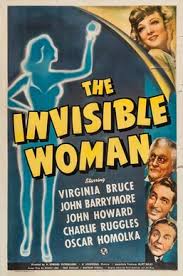
Unfortunately for Universal Studios’ third entry in the Invisible Man series, The Invisible Woman, it’s not so great that it predated the Disney live-action comedies of the ’60s and ’70s, unless you’re into that kind of thing.

One always should account for personal taste in delicate matters like these, so I will note that I prefer both The Invisible Man and The Invisible Man Returns (released earlier in 1940) over The Invisible Woman because they have a darker sense of humor at play than a predominantly lighthearted comedy that revolves heavily around the good old slapstick.

Ah, yes, good old slapstick. That’s where The Invisible Woman paved the way for all them Disney Solid Gold hits of the ’60s and ’70s.

Slapstick, in this case, does not mean the virtuoso physical feats of silent greats Buster Keaton and Harold Lloyd or the brutality of the Three Stooges and Home Alone.

No, rather, it’s mostly supporting characters falling down and fainting and gasping, like, for example, man servant George (played by Charlie Ruggles). Take a drink for every time George falls down or faints or flusters and you’ll be feeling at least a buzz in no time. Depending on the drink, you might miss out on most of The Invisible Woman and I call that a happy ending.

The Invisible Woman throws in comic gangsters, characters that have very rarely worked throughout cinematic history, not then, not before then, not after then, not ever. Given the presence of Shemp Howard in a henchman role, one might be tempted to believe The Incredible Woman would give up on the genial slapstick and really go for the gusto like maybe a Three Stooges short. No, no, no.

I don’t really need to discuss the plot, because it’s one of them movies where the title says it all more or less and we can quickly move on to who plays who, like John Barrymore as nutty Professor Gibbs, Virginia Bruce the spunky title character and John Howard her eventual leading man, Margaret Hamilton and Ruggles the servants, and Oscar Homolka the main heavy. What a waste of a talented cast, though, and undoubtedly one of the worst films made during Universal’s run of horror films.

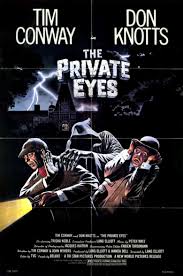
The Private Eyes (1980)

THE PRIVATE EYES (1980) *1/2
Eighty years of nostalgia account for the appeal of the comedy mystery THE PRIVATE EYES.


THE PRIVATE EYES spoofs Sherlock Holmes and Dr. Watson, who first appeared in the 1887 Arthur Conan Doyle novel “A Study in Scarlet” and made a comeback in the ’70s through such films as THE PRIVATE LIFE OF SHERLOCK HOLMES, THE ADVENTURE OF SHERLOCK HOLMES’ SMARTER BROTHER, THE SEVEN-PER-CENT SOLUTION, and MURDER BY DECREE, and it takes on a comedic style made famous by Abbott and Costello in such ’40s films as HOLD THAT GHOST and ABBOTT AND COSTELLO MEET FRANKENSTEIN.

Meanwhile, here we are more than 40 years out from the release of THE PRIVATE EYES, possibly feeling nostalgic for the comedic duo Don Knotts (1924-2006) and Tim Conway (1933-2019), who appeared together in a trifecta of Disney live-action pictures before THE PRIZE FIGHTER and THE PRIVATE EYES, both major successes for Roger Corman’s New World Productions. They last appeared together in a cameo for the bomb turkey CANNONBALL RUN II.

Knotts definitely carries more nostalgic heft than Conway, since I remember him from ‘The Andy Griffith Show,’ ‘Three’s Company,’ PLEASANTVILLE (playing a TV repairman, of course), and even a play in Kansas City when I was in college. Knotts’ Bernard ‘Barney’ Fife worked up my Grandma like no other fictional character and she reveled in his regularly scheduled comeuppance. I fondly remember giving her a hard time about it, saying that Knotts’ Fife made the show and that it went downhill after his departure. Strangely enough, I remember most fondly a TV spot pairing Fife’s antics with Right Said Fred’s ‘I’m Too Sexy.’ Wish that I could find that spot and crack up once again.

So, needless to say, I entered THE PRIVATE EYES with a generosity of good spirit and desire to laugh. I left 90 minutes later defeated by a really, really, really dumb, dumb, dumb mystery comedy and I have no real motivation to seek out the other Knotts and Conway cinematic pairings.

Knotts and Conway portray Inspector Winship and Dr. Tart, two bumbling fumbling stumbling American detectives who have somehow found themselves working for ‘The Yard.’ They bumble fumble stumble from their very first scene together all the way to the end and if you find that bumble fumble stumble worth a funny rumble the first time, you just might find it funny a hundred times. However, I did not find it funny the first or the last time or any darn time in-between.

THE PRIVATE EYES more accurately recalls a Scooby Doo episode. Hey, wouldn’t you know that Knotts appeared in cartoon form in the episodes ‘Guess Who’s Knott Coming to Dinner’ and ‘The Spooky Fog of Juneberry’ and Conway took on the Spirit of Fireball McPhan in ‘The Spirit Spooked Sports Show.’ I vaguely remember watching all three from childhood, but I still have no doubt they are each better than THE PRIVATE EYES.

Ironically, THE PRIVATE EYES has way too much plot for a dumb comedy.

HOLD THAT GHOST works much better than THE PRIVATE EYES because it has flights of fancy that deviate from its mystery plot like Costello’s dance scene with Joan Davis. Since they were all under the imperial offices of Universal Pictures, HOLD THAT GHOST makes room for musical numbers by Ted Lewis and His Orchestra and the Andrews Sisters. THE PRIVATE EYES, meanwhile, offers scenes like a gas station destroyed by Winship and Tart in a way that recalls IT’S A MAD, MAD, MAD, MAD WORLD, a very, very, very, very unfunny comedy. Let’s face it, Hollywood made less dumb comedies in 1941 than both 1963 and 1980.

Knotts and Conway remain likable throughout THE PRIVATE EYES, despite very rarely ever being funny. That said, Australian singer and actress Trisha Noble virtually steals the show out from underneath Knotts and Conway every time she appears as the alluring heiress Phyllis Morley. She’s very, ahem, ‘Oh LàLà,’ like a model for that magazine favored by 1955 Biff Tannen. I can honestly say that she alone boosts the overall rating for THE PRIVATE EYES by at least half a star.

The In-Flight Double Feature: Airplane!, Airplane II: The Sequel

AIRPLANE!, AIRPLANE II: THE SEQUEL

AIRPLANE! contributed to the demise of the dominance of the disaster film just as much as beyond lackluster disaster films AVALANCHE, THE SWARM, WHEN TIME RAN OUT, BEYOND THE POSEIDON ADVENTURE, and AIRPORT ‘77 and THE CONCORDE … AIRPORT ‘79. It was like the decisive blow and disaster movies disappeared for many years.

AIRPLANE satirized disaster films in general and the AIRPORT series in particular. The team of Jim Abrahams, David Zucker, and Jerry Zucker ripped their ridiculous plot straight from the 1957 Paramount Pictures film ZERO HOUR starring an exclamatory title and Dana Andrews, Linda Darnell, Sterling Hayden, and Elroy “Crazy Legs” Hirsch. I watched ZERO HOUR (sans exclamation) after learning of the fact that it directly inspired AIRPLANE, and it’s scary how much AIRPLANE lifted from the earlier film. It is also fitting, because Arthur Hailey co-wrote the screenplay for ZERO HOUR and wrote the 1968 novel AIRPORT that became the beginning of the disaster film craze when AIRPORT hit box office gold upon its March 1970 release.

A decade later, millions were obviously clamoring for a sledgehammer attack on disaster films, because AIRPLANE finished behind only THE EMPIRE STRIKES BACK, 9 TO 5, and STIR CRAZY at the American box office in 1980.

Abrahams, Zucker, and Zucker not only had their way with disaster films, but they ripped to shreds both famous individual scenes (SATURDAY NIGHT FEVER, FROM HERE TO ETERNITY, KNUTE ROCKNE ALL-AMERICAN) and standard narrative devices. They especially had some devious fun with flashbacks and voice-over narration courtesy our rather square, good-looking protagonist with a troubled past (Robert Hays’ Ted Striker a perfect match for Dana Andrews’ Ted Stryker in ZERO HOUR. Andrews’ Stryker also brings to mind his troubled character 11 years earlier in THE BEST YEARS OF OUR LIVES).

In the process of satirizing movie genres, AIRPLANE created its own genre that has endured far longer than disaster films and gave birth to new old movie stars like Leslie Nielsen, Lloyd Bridges, Robert Stack, and Peter Graves, whose ability to play it straight at every moment made at least half the joke work.

(Disaster films have periodically made huge comebacks like when INDEPENDENCE DAY, TWISTER, and ARMAGEDDON became super blockbusters late in the apocalypse-minded 20th Century. Definitely not my favorite trend. For the record, I hate both TWISTER and ARMAGEDDON, and I have never managed to make it through INDEPENDENCE DAY in spite or more precisely because of all the hype and euphoric glee that came with it and still comes with it years later.)

Yes, we have seen virtually every movie genre under the sun parodied, quoted, and (less frequently) satirized. We have lived through all the immediate AIRPLANE imitations, the Z-A-Z Boys’ own movies, and everything from the works of the Wayans Brothers to Jason Friedberg and Aaron Seltzer. At some point, let’s say early in the 21st Century, I dreaded the parody movie even more than its various targets.

Most of these later parodies miss the satirical bent that gave AIRPLANE, TOP SECRET, and THE NAKED GUN, as well as Mel Brooks’ YOUNG FRANKENSTEIN, BLAZING SADDLES, HISTORY OF THE WORLD PART 1, and SPACEBALLS, their special verve. The later parodies seem far more willing to merely quote from a blockbuster movie and to just leave it at that. “You’ve seen it before and now, let’s see it again, only done less effectively.” Honestly, what’s the point and more precisely, what’s so funny about that?

For many years, I passed on AIRPLANE II: THE SEQUEL, especially after learning that Zucker, Abrahams, and Zucker were not involved. The boys apparently sent out a press release before the release of the sequel that stated just that.

The crack research team just unearthed this David Zucker gem from 2015: “Jim just said, ‘If your daughter became a prostitute, would you go and watch her work?’” That’s one way to look at THE SEQUEL, one of the cheaper, less essential AIRPLANE imitations out there. The addition of more stars (Raymond Burr, Chuck Connors, William Shatner) makes it even cheaper.

I laughed a couple and smiled a few times during THE SEQUEL, but mostly I watched this comedy that attempts maybe 500 jokes in an indifferent state. The laughs were front-loaded and I found it challenging to even remember them at the back end of the picture. Have you ever had that feeling, where you’re stuck in the middle of a movie thinking about how much you were enjoying it earlier and now you’re dreading it and the remaining seconds and minutes?

There’s almost nothing worse in the movie world than a comedy that fails, since most human life forms love to laugh, even or especially at the dumbest and corniest jokes. We are prepared to laugh during a comedy. We want to laugh. So, when you find very little or absolutely nothing to laugh at over 84 minutes, all this hostility builds up inside you and you get very upset about how you have wasted 84 minutes of precious time which you could have wasted on something else.

Never mind, I should have passed on THE SEQUEL and just watched AIRPLANE one more time.


AIRPLANE! ***1/2; AIRPLANE II: THE SEQUEL **

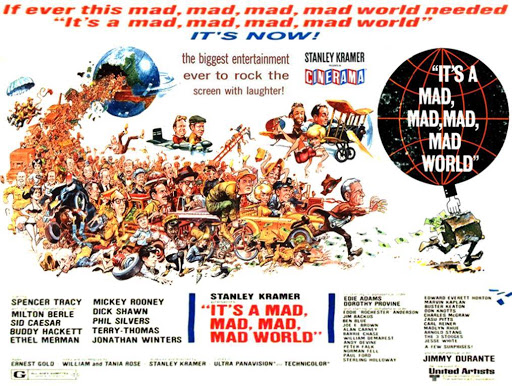
It’s a Mad, Mad, Mad, Mad World (1963)

MAD MAD MAD MAD WORLD

IT’S A MAD, MAD, MAD, MAD WORLD (1963) 1/2*

Let’s start this review with a bold statement and prediction: IT’S A MAD, MAD, MAD, MAD WORLD is the worst comedy I have ever seen and it will remain that way for all my life, even if I would be blessed to reach 100 years old.

Fact: I did not laugh once during the 3-hour, 19-minute duration of IT’S A MAD, MAD, MAD, MAD WORLD.

I consider it a lock on being the worst comedy I will ever see because of that length. Sure, I can go 90 or 95 or even 100 minutes not laughing at some dumb or aggressively stupid comedy, no problem, but 189 minutes proved to be a new personal record for remaining in a state of stone cold silence during a comedy. I only broke that silence to express disbelief with a grunt or a sigh. To be honest these intermittent sighs were deep enough to fill the Grand Canyon.

Yes, I almost forgot LEONARD PART 6 (believe me, how I tried forgetting), which I gave no stars and called “the worst movie ever made.” That’s right, it passes comedy straight into being bad enough to encompass all genres.

Why the half-star for a repetitive, repetitive, repetitive, repetitive comedy? Because I liked looking at the cast members during any fleeting moments when they were quiet. Once they resumed talking, well, shit, IT’S A MAD, MAD, MAD, MAD WORLD turned back into unfunny shit on a stick. Yeah, I felt like IT’S A MAD, MAD, MAD, MAD WORLD beat me over the head with unfunny shit on a stick for roughly a quarter of a quarantine day. I will do my best to utilize past tense during this review because I have no intent to ever watch IT’S A MAD, MAD, MAD, MAD WORLD ever, ever, ever, ever again.

I should rephrase one portion of the paragraph immediately above. Very, very, very, very rarely do any of the characters merely talk during IT’S A MAD, MAD, MAD, MAD WORLD. Just imagine a crowded room populated by people who feel compelled to compete with each other for who can be the loudest (and most obnoxious) person in the world, forget the room. And then being trapped inside that room for over three hours describes this movie in a nutshell. Perhaps it would be too much to add real cars to the room. Nah, instead, we’ll have a movie theater size TV in the room playing a loop of car chases at full volume intensity.

Here’s a main character who speaks in a voice resembling that of a normal person: Emeline-Marcus Finch (Dorothy Provine), whose character seems like the movie loaned her from a library amidst the chaos in this loud, loud, loud, loud movie. They no doubt used the Frances Howard Goldwyn – Hollywood Regional Branch Library, only a three-minute walk from the Walk of Fame.

The film establishes a basic tone early on, when five of the characters stand around and squabble over their potential take of the stolen $350,000 hidden under the ‘Big W’ in the Santa Rosita State Park. Yes, IT’S A MAD, MAD, MAD, MAD WORLD is basically one long argument over money interrupted by chases, overacting, mugging, pitfalls and pratfalls, dancing, overacting, cameo appearances, police chatter, overacting, an intermission, pitfalls and pratfalls, plane crashes, explosions, and (for old times’ sake) overacting.

Just take a look at some of the cast: Spencer Tracy, Milton Berle, Sid Caesar, Buddy Hackett, Ethel Merman, Mickey Rooney, Dick Shawn, Phil Silvers, Terry-Thomas, Jonathan Winters, Jim Backus, William Demarest, Jimmy Durante, Peter Falk, Jack Benny, Joe E. Brown, Norman Fell, Stan Freberg, Leo Gorcey, Edward Everett Horton, Buster Keaton, Don Knotts, Jerry Lewis, ZaSu Pitts, Carl Reiner, Arnold Stang, and the Three Stooges, with more than half of them in minute roles. What a sad, sad, sad, sad waste of talent!

Among the main characters, it’s easy to pick my least favorite: Mrs. Marcus, played by Merman. She’s awful from the start and remains awful for the entire length of the picture. IT’S A MAD, MAD, MAD, MAD WORLD partisans argue that she’s a character that people love to hate. I, however, am not one of those people, because I only hate this character. Thankfully, Merman closed out her career with a hilarious cameo in AIRPLANE!

Gordon Gekko told us “Greed is good” during WALL STREET. Meanwhile, nearly 25 years earlier, IT’S A MAD, MAD, MAD, MAD WORLD told us “Greed is bad, mkay?”

One more zinger before closing time: I laughed more during Stanley Kramer’s INHERIT THE WIND than I did IT’S A MAD, MAD, MAD, MAD WORLD. (If I ever watch Kramer’s JUDGMENT AT NUREMBERG, I’ll be sure to revise this final paragraph and gag.)

It (1927)

IT (1927) ***1/2

“Hey, old timer, have you seen IT?”

“Yeah.”

“I bet, though, knowing you, that you liked the crusty old TV version from, like what, 1890 better than the new one.

[Silence for a couple beats]

“Well, which one did you prefer?”

“Neither.”

“What?”

“That’s right, I prefer the 1927 IT starring legendary ‘It’ girl Clara Bow over any Stephen King adaptations called IT. Boom!”

— Theoretical conversation circa ‘18


That quality possessed by some which draws all others with its magnetic force. With ‘It’ you win all men if you are a woman and all women if you are a man. ‘It’ can be a quality of the mind as well as a physical attraction.

— Definition of ‘It’


Clara Bow obviously had ‘It’ and she displays it throughout IT, the film that officially made her a sensation after it was released on February 19, 1927.

Bow’s 1927 can stand against Babe Ruth’s — .356 average with 158 runs scored, 29 doubles, eight triples, 60 home runs, 165 RBI, 137 walks vs. 89 strikeouts, and 110 victories and a 4-0 World Series sweep against Pittsburgh — and Charles Lindbergh’s, for his legendary nonstop flight from New York City to Paris.

Bow (1905-65) made six films in 1927: IT, CHILDREN OF DIVORCE, ROUGH HOUSE ROSIE, WINGS, HULA, and GET YOUR MAN.

She helped pave the way for every female sex symbol to come. For example, her skirt flew up during IT, a good 28 years before Marilyn Monroe’s most famous movie bit in THE SEVEN YEAR ITCH. WINGS also features a brief — I mean brief — Bow boob flash. Blink and you’ll miss it.

She also inspired a millinery fashion craze, for crying out loud.

From the June 10, 1927 edition of the St. Louis Dispatch — advertising Clara Bow Vacation Hats for $1.25 each — “Smart and clever are these Clara Bow Hats that are fashioned of a good quality felt in twelve attractive modes. In black, white, pink and all the Summer shades — trimmed with applique of felt in contrasting colors as well as soid effects. Are soft and crushable, easily packed in handbag or trunk.” Each hat purchased came with a 8 x 10 photograph of Bow wearing that hat. No additional charge.

In the August 16 edition of the Minneapolis Star Tribune, Clara Bow Hats were being sold for 98 cents and each hat came with a copy of Bow’s signature. Apparently, there were 12 styles and colors of hats.

From the June 19 Nebraska State Journal, “In Gold’s smart millinery collections you’ll find ‘it’ — the cutest cleverest group of Clara Bow hats and every one of ‘em has ‘it.’ These perky little felt novelties are only $1.45 but they look like a million dollars worth of Clara Bow’s vivacity.”

Bow also became tabloid fodder, like this report from the Los Angeles Times during the making of WINGS, “Clara Bow, Paramount star, is becoming destructive. The queen of the flappers wrecked one perfectly good Ford while learning to drive one for certain sequences in “Wings,” the road show which tells the story of the American Ace in France. Miss Bow plays the part of an ambulance driver. “Wings” is being directed by William Wellman, himself a flyer during the war.” The reports and the rumors became wilder.

Bow retired from acting in 1933 to move to a ranch in Nevada, where she focused her energies on being a wife and a mother.

IT provides an early example of a concept film and it uses product placement — plugging Cosmopolitan Magazine and giving source material writer Elinor Glyn a cameo where she expounds on ‘It.’

IT features a plot that’s older than the Hollywood hills: A salesgirl, Betty Lou (Bow), sets her sights on wealthy (and handsome) playboy Cyrus T. Walham (Antonio Moreno), who’s her boss. There’s plot complications left and right — not convolutions, though — like so many romantic comedies but this is a movie that moves easily beyond its plot because of the style of director Clarence Badger, the witty dialogue and inter-titles, and both the incredible style, spunk, and star power of Bow.

“I don’t go to church. Kneeling bags my nylons.” — ACE IN THE HOLE

“Alright, I’ll go manicure my gloves.” — BUGSY MALONE

“She gave me a smile I could feel in my hip pocket.” — FAREWELL, MY LOVELY

Supporting character Monty Montgomery (William Austin) gets one of the all-time great lines, “I feel so low, old chap, that I could get on stilts and walk under a dachshund.” File it alongside the three lines quoted right above.

Monty proved to be a pleasant surprise, a supporting character who at least made me smile from his very first to his very last appearance. Monty creates the film’s biggest laughs and in a different way than Bow, he’s nearly as unforgettable. I would argue his eyes are just as memorable. What could otherwise be melodramatic mugging benefits from the parameters of silent cinema and his reactions — especially his astonished double takes — are worth their weight in comic gold. He’s a genuine hoot. That statement works for IT as a whole. In movie terms, IT definitely has “it.”