Take a Walk on the Spooky Side: Eight Great Disney Animated Shorts 1929-49

TAKE A WALK ON THE SPOOKY SIDE: EIGHT GREAT DISNEY ANIMATED SHORTS 1929-49
I know what some of you might be thinking: Why do you have Disney animated shorts under consideration during a horror marathon?

Like The Wizard of Oz, Disney animated films proved to be a perfect introduction to scary movies.

You have the haunted woods in Snow White and the Seven Dwarfs, Chernabog in Fantasia, the donkey boys in Pinocchio, the pink elephants in Dumbo, Bambi’s mother’s death in Bambi, the bear in The Fox and the Hound, the Horned King in The Black Cauldron, and Ratigan (voiced by horror legend Vincent Price) in The Great Mouse Detective, just for starters, all potential source material for the nightmares of children.

Now, I will take a look at eight great Disney animated shorts that were made from between 1929 and 1949.

The Skeleton Dance (1929; Walt Disney): Why is this short directed by Walt himself and animated by Ub Iwerks, Les Clark, and Wilfred Jackson, with music from Carl W. Stalling and Edvard Grieg, so important?

Music and animation were made at the same time for the first time, rather than having sound added in later, sure, that’s one very important reason, but it’s because the four dancing skeletons make for a great cover photo every October.

Walt Disney Productions made 75 animated musical short films from 1929 to 1939. They were called part of the Silly Symphony series, and the series began with none other than The Skeleton Dance in August 1929 and ended with The Ugly Duckling in April 1939.

Such classics as Iwerks’ Hell’s Bells, Burt Gillett’s Three Little Pigs, Jackson’s The Tortoise and the Hare, and Jackson’s The Old Mill appeared during the decade.

The Skeleton Dance falls under the classification Danse Macabre or dance of death or an artistic genre of allegory of the Late Middle Ages on the universality of death.

For the first couple minutes, we have a series of Gothic images leading us toward skeletons dancing in a cemetery — lightning, large eyes that are revealed to belong to an owl, strong wind, chimes at midnight, bats, a full moon, a howling hound dog, and black cats brawling on top of tombstones until they are scared off by our lead skeleton.

I may have forgotten about the spider, or was that another macabre Disney classic from the year 1929?

Anyway, around 2 minutes, 40 seconds, that’s when the dancing begins, and eat your heart out, Kevin Bacon! These skeletons are footloose and fancy free!

Hell’s Bells (1929; Ub Iwerks): The fourth entry in the Silly Symphony series takes a dark turn after the October 1929 entry Springtime.

It’s all fun and games and song and dance in this short until one of Satan’s subordinates becomes insubordinate when faced with the prospect of being served to Cerberus, Satan’s three-headed guard dog.

Song and dance set to the theme music from Alfred Hitchcock Presents.

I absolutely love the name of that piece of music, by the way.

Funeral March of a Marionette by Charles Gounod in the 1870s.

Was Hitchcock a Walt Disney fan?

Who Killed Cock Robin appeared in Hitchcock’s Sabotage.

Iwerks beat AC/DC to it by about 51 years.

Hell’s Bells came out on November 21, 1929, while the Hells Bells single was released October 31, 1980.

Somebody on YouTube put the 5:50 Hell’s Bells and the 5:12 Hells Bells together for a perfect marriage of sight and sound.

The Haunted House (1929; Walt Disney): This one has a plot that will sound awfully darn familiar to fans of the horror, mystery, suspense, and thriller genres.

Good old Mickey Mouse, he’s caught out in this horrible storm that makes the one in The Old Dark House seem like a jolly old time by comparison.

He’s not driving a motor car, though, he’s out walking. What are you doing, Mickey?

Fortunately, no, wait, make that unfortunately for him and fortunately for our high-quality entertainment value, there’s a house nearby that can provide Mickey with shelter from the storm.

Needless to say, we quickly find out why they called this one The Haunted House.

The four dancing skeletons return from The Skeleton Dance and their ability to coordinate a dance number in the midnight hour remained intact only a few months after their legendary motion picture debut.

The Skeleton Dance, Hell’s Bells, and The Haunted House all came out within a few months’ span in 1929, not a coincidence given the dark times faced around the world at that moment in time.

The Mad Doctor (1933; David Hand): On a dark and stormy night — are there ever any other kind in anything related to horror — the diabolical genius title character takes Pluto away to his mansion for a wacky transplant. Pluto’s head on the body of a chicken, and Mickey Mouse obviously comes to the rescue.

The title character apparently learned from Dr. Jerry Xavier played by Lionel Atwill in the 1932 classic Doctor X or maybe they’re cousins. Maybe it’s the other way around, since the mad doctor in The Mad Doctor goes by Dr. XXX.

Mickey walks his way through Saw 70 years before the start of that infamous series, only in seven minutes rather than 110 and no F-bombs.

Skeletons appear in a Disney short, and that’s almost the guarantee for a classic.

I’ll even forgive The Mad Doctor for including the dreaded ‘It’s only a dream’ ending.

Pluto’s Judgement Day (1935; David Hand): This one is truly something wild.

The family dog Pepper is absolutely positively terrified by this one.

She won’t even approach the plot summary.

Pluto’s Judgement Day opens with our favorite animated dog in the middle of chasing a kitten through the yard and eventually into Mickey Mouse’s living room.

Pluto becomes a muddy mess, Mickey saves the kitten, and Mickey scolds Pluto, telling him that he’ll pay on Judgment Day.

Pluto falls to sleep in front of the fire, so naturally he dreams that he’s on trial for his life in a Hell presided over by cats. They all have it in for Public Enemy No. 1, all the witnesses are Pluto’s victims, the jury of eight fine cats can balance justice with song and dance, and they give Pluto the chair.

It has a similar ending to The Mad Doctor, the 1933 short directed by David Hand that also featured Mickey and Pluto.

When I hear Pepper dreaming, I wonder if her dreams are anything like Pluto’s Judgement Day.

I sincerely hope not.

The Old Mill (1937; Wilfred Jackson, Graham Heid): The year 1937 definitely proved to be a landmark year for Walt Disney Studios.

On December 21, 1937, Disney’s first feature-length animated film Snow White and the Seven Dwarfs premiered in Los Angeles.

The Old Mill, a Silly Symphony short, appeared in theaters November 5, 1937, and it’s every bit the landmark in animation as Snow White.

See, The Old Mill introduces the multiplane camera, a technical innovation used on Disney animated films from Snow White to The Little Mermaid.

From the Disney Wiki for a multiplane camera, Various parts of the artwork layers are left transparent, to allow other layers to be seen behind them. The movements are calculated and photographed frame-by-frame, with the result being an illusion of depth by having several layers of artwork moving at different speeds – the further away from the camera, the slower the speed. The multiplane effect is sometimes referred to as a parallax process.

The plot is basic compared to the technical aspects of the short — the animal residents of an old mill do their best to survive a thunderstorm.

I love the scene, just before the storm comes in, when the denizens of a nearby pond — frogs and crickets — have a croaking and chirping duet or duel.

Lonesome Ghosts (1937; Burt Gillett): Peter Venkman, Ray Stantz, and Egon Spengler owe a debt of gratitude to Mickey Mouse, Donald Duck, and Goofy.

Four of the bored out of their gourd title characters see the ad for the Ajax Ghost Exterminators agency in their local newspaper, so they decide to alleviate their boredom by calling Mickey, Donald, and Goofy and having them come out to investigate their house. Our title characters then get their kicks with pranks and more pranks on Mickey, Donald, and Goofy once they’re inside to investigate. Inconceivable!

Goofy even utters the famous words, I ain’t a-scared of no ghosts.

Goofy also does a mirror routine with one of the ghosts, only he sees the ghost’s reflection in the mirror the entire time.

The Legend of Sleepy Hollow (1949; Clyde Geronimi, Jack Kinney): I already reviewed The Adventures of Ichabod and Mr. Toad that packaged shorts The Wind and the Willows and The Legend of Sleepy Hollow into a 68-minute feature.

I prefer The Legend of Sleepy Hollow alone.

We have an adaptation of Washington Irving’s 1820 The Legend of Sleepy Hollow that’s more faithful than more famous adaptations, like Tim Burton’s 1999 Sleepy Hollow.

We have Ichabod Crane and Brom Bones, as well as a host of other characters, and the legendary Headless Horseman.

Bing Crosby provides the voice for the narrator and the singing voice for Ichabod and Brom Bones.

Crosby and Jud Conlon’s Rhythmaires are great in their performance of The Headless Horseman, which starts Gather ’round and I’ll elucidate / What goes on outside when it gets late / Along about midnight the ghosts and banshees / They get together for their nightly jamboree / There’s things with horns and saucer eyes / Some with fangs about this size / Some are fat and some are thin / And some don’t even wear their skin / I’m telling you, brother, it’s a frightful sight / To see what goes on Halloween night.

Gotta love the chorus: With a hip, hip and a clippity clop / He’s out looking for a top to chop / So don’t stop to figure out a plan / You can’t reason with a headless man.

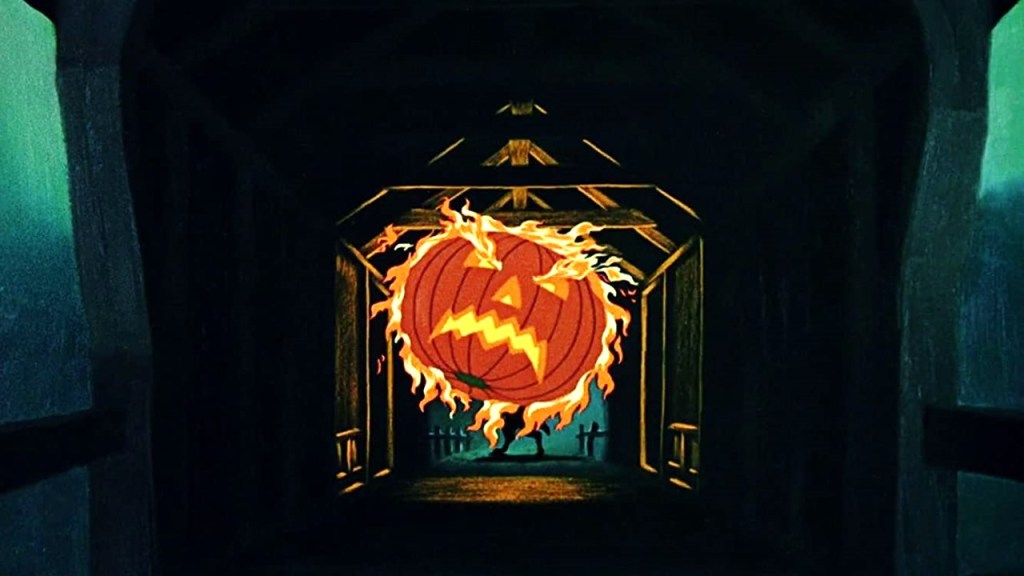
The final 11 minutes of The Legend of Sleepy Hollow, beginning when Brom starts his Headless Horseman song, rank with the opening in Frankenstein Meets the Wolf Man.

Space Jam: A New Legacy (2021)

SPACE JAM: A NEW LEGACY (2021) *
I am not exactly sure why I decided to watch Space Jam: A New Legacy on a Saturday afternoon, following hot on the heels of the Disney live-action films Midnight Madness and Condorman.

I mean, I am not the biggest fan of the original Space Jam from 1996, basically a feature-length advertisement for the greatness of Michael Jordan with Looney Tunes and Bill Murray and Wayne Knight and everybody else guest stars or glorified cameos. Never thought it was all that great even back during the height of the Chicago Bulls — Space Jam came out Nov. 15, 1996, just a few months after the Bulls put together a 72-10 regular season and won an NBA title — and it has aged worse. Of course, it seems to have a major cult following, but then again, so does Howard the Duck.

Also, I have never been much of a LeBron James fan, since his arrival upon the scene in 2002. I’ve never cared for his style of play, his flopping and floundering about like he’s been shot when selling a foul despite the fact that he’s easily the size of an NFL tight end and bigger than most NBA players, his celebratory antics, his aping Michael Jordan from the shoes, money, and the uniform number to the chalk toss and now his very own Space Jam movie, his ring chasing and team hopping, and his outright hijacking of ESPN for the last two decades. He’s arguably been even more omnipresent in our lives than Jordan, one of the most famous people in the world during his glory days in the ’90s, given the social media factor.

For example, I liked and shared one LeBron traveling GIF, and the Facebook algorithms just won’t show me any mercy in the two or three years since. LeBron this, LeBron that, just because I thought it was funny to see LeBron travel across the desert with basketball in hand. Now, I have to see a brilliant quote like this one, I don’t give a fuck what nobody think. I’m him. I get shit for making the right play. Four motherfuckers on me. Motherfucker wide open right here. We are a team and I trust them. Why wouldn’t I have thrown it to them? I don’t care about the results. What?

Anyway.

You guessed it, Space Jam: A New Legacy is a $150 million and 1-hour, 55-minute advertisement for the greatness of LeBron James.

You can even play a drinking game with A New Legacy: Take a swig of the sauce every time you hear King James. It’s a lot safer than drinking every time they say Carol Anne in Poltergeist III or Cheech and Chong utter Hey, man in Up in Smoke.

I found very little to like in A New Legacy. A lot of the movie felt like watching a mash up of the plots from Hook and Space Jam. Also, the Looney Tunes more or less serve LeBron James and his greatness, aside from very fleeting isolated moments that don’t add up to any of the Looney Tunes shorts like Duck Amuck or The Great Piggy Bank Robbery or Porky in Wackyland or You Ought to Be in Pictures or any number of the brilliant shorts of the ’40s and ’50s.

Wile E. Coyote proves though he could be ideal halftime entertainment.

I absolutely hated what they did with all the Warner Brothers intellectual properties: Turn them into fans in The Big Game that closes out the picture. I mean, seriously, do you take King Kong or Pennywise for a basketball fan? I don’t see Pennywise cheering for anything. Come on, man. I didn’t catch Dirty Harry or Rick Deckard or Stanley Kowalski or Jack Torrance or Pazuzu in the crowd, but I sincerely hope that doesn’t mean we’ll see them in Space Jam 3.

I must admit to rooting for the villains, or the goons, during A New Legacy and found the greatest entertainment when they dunked on LeBron real good in the first half.

Of course, I understood the second half would take a dramatic turn and give us a great big happy ending for LeBron and his celluloid family. Wasn’t it cast in stone?

I just hope that LeBron (and his legion of fans) do not try and count his victory in A New Legacy toward his NBA titles.

Charlie Brown, He’s No Clown: Snoopy, Come Home & Race for Your Life, Charlie Brown

CHARLIE BROWN, HE’S NO CLOWN: SNOOPY, COME HOME & RACE FOR YOUR LIFE, CHARLIE BROWN

Charlie Brown and the “Peanuts” gang first appeared as “Li’l Folks” in 1947, debuted as “Peanuts” Oct. 2, 1950, and launched into Sunday papers on Jan. 6, 1952.

Multiple generations came to love Charles M. Schulz’s creation through TV specials, movies, merchandise, and newspapers.

I learned to read at no later than the age of 4 by perusing copies of my grandparents’ Pittsburg Morning Sun and I remember “Peanuts” being at or near the top of the comics page along with “Garfield.” Then, it was (in no particular order) “Blondie,” “Alley Oop,” “Beetle Bailey,” “Doonesbury,” “Family Circus,” and “Calvin and Hobbes.” Sure, I missed a strip or two in this nostalgic reverie.

I later wrote for the Morning Sun (considerably downsized from 2009 through 2014 with sadly more considerable downsizing to come) and I scrapbooked a few strips that particularly tickled my funny bone. You might not believe how much feedback we received about our comics page, but I have found that obituaries, comics, and sports form the backbone of a small town paper. I remember editors grumbling about how readers were still upset years later about what happened with the Sunday comics not being in color and not having their own little section … and I said that I am one of those readers mad about that, as well as the Sun dropping a Monday paper.

Anyway, we have to ask one of the five W’s: What makes “Peanuts” so unique in the first place and even still today?

First and foremost, indelible characters who resonate with readers and viewers. Just as a little exercise, let’s rattle some of them off and I bet that we don’t even need to cheat and consult Google or Wikipedia. Let’s see, we have Schulz’s alter ego Charlie Brown, of course, Linus and his security blanket, Schroeder and his toy piano, Lucy Van Pelt, Peppermint Patty, Marcy, little sister Sally Brown, Snoopy, Woodstock, and Pig-Pen (the Walking Dust Bowl). Over the years, I myself have called a child or two “Pig-Pen.”

Recently, one quarantine afternoon I decided to watch Charlie Brown cinematic adventures SNOOPY, COME HOME (1972) and RACE FOR YOUR LIFE, CHARLIE BROWN (1977) back-to-back.

SNOOPY, COME HOME took me by surprise with its emotional punch and I’d rate it even higher were it not for the presence of so many songs written by Richard M. and Robert B. Sherman that feel like padding to inflate SNOOPY, COME HOME to a running time of 80 minutes.

Snoopy receives a letter from his previous owner Lila, who’s sick in the hospital, and Snoopy and Woodstock set out upon a grand adventure to reach her. Charlie Brown and his friends face the possibility that Snoopy will return to his first owner and that whole plot development provides the emotional sucker punch right to the guts. I’ll admit to getting a little misty-eyed when the gang throws a farewell party for Snoopy.

Meanwhile, throughout his adventure, Snoopy encounters “No Dogs Allowed.” We are talking libraries, beaches, buses, seemingly everywhere our favorite little beagle turns. That’s no way to treat a star the caliber of Snoopy. These people must be somehow unaware of “Peanuts” and they must have never heard the songs “Snoopy vs. The Red Baron,” “The Return of the Red Baron,” and “Snoopy’s Christmas.” What kind of people are these?

After being driven away from the library, Snoopy picks fights against Van Pelt siblings Linus and Lucy, and we are suddenly in Laurel and Hardy territory with big laughs from violent slapstick (though not as violent as say the Three Stooges and still within the ‘G’ rating). Fans have taken Snoopy vs. Lucy and scored MORTAL KOMBAT and ROCKY to it.

Also, during his adventure, Snoopy encounters his worst nightmare, a little girl named Clara who has the unmitigated audacity to call him “Rex.” Snoopy and Woodstock barely make it out alive.

In the end, “No Dogs Allowed” benefits Charlie Brown, Snoopy, etc.

RACE FOR YOUR LIFE, CHARLIE BROWN proved to be a mere meager diversion after SNOOPY, COME HOME.

That’s right, RACE FOR YOUR LIFE is nothing more than a pleasant way to spend 77 minutes with characters that we like.

It does not have the dynamic emotional range of SNOOPY, COME HOME and the river rafting race does not rank with the use of baseball and football in CHARLIE BROWN’S ALL-STARS and numerous gags in strips and TV specials, respectively.

Upon further reflection, the special appeal of the Charlie Brown TV specials and SNOOPY, COME HOME is that adults have the ability to take away more from them than children, without ever feeling that we are being lectured or hearing a sermon. That’s ironic, given the relative absence of adults in “Peanuts.”

SNOOPY, COME HOME ***; RACE FOR YOUR LIFE, CHARLIE BROWN **1/2

Hunger (1974)

HUNGER (1974) Four stars

Over a span of many decades, there have been several great dinner scenes in the movies.

The Wedding Feast in FREAKS, the cannibal family dinner in TEXAS CHAINSAW MASSACRE, and that famous plate throwing in AMERICAN BEAUTY are three that spring quickly to mind.

Oh, of course, there’s Mr. Creosote from MONTY PYTHON’S THE MEANING OF LIFE and Peter Greenaway’s THE COOK, THE THIEF, HIS WIFE & HER LOVER. (Perhaps, on the next episode, I’ll cover great diner scenes in the movies, everything from DINER to SUPERMAN II and SUDDEN IMPACT.)

In that Mr. Creosote spirit, we now turn our attention toward Peter Foldes’ historic computer animated short from 1974. We use historic not because of the appetite of the main character but historic works here because HUNGER broke ground in using computer animation. Please keep in perspective it was some two decades before TOY STORY and it took Foldes and his National Research Council’s Division of Radio and Engineering’s Data Systems Group well over a year to make this nearly 12-minute film.

This is essentially a silent film, with no dialogue, no narration, not even intertitles. Just instrumental music and images.

That makes HUNGER all the more effective as a cautionary tale about greed and gluttony in contemporary society. It does not get preachy because of the lack of words or tiresome because of the length of a short. The animation holds our interest and it also gives Foldes no limits (except for the limits of his own imagination) in showing this greed and gluttony. Images rapidly dissolve and their perpetually changing nature points out some striking differences.

In HUNGER, our main character evolves from a skinny office worker into a monster.

A couple minutes in, our main character grabs a bite from the delicatessen before dinner and then he goes through a pig, two fish, everything else on the menu, and the dinner table itself before he takes home the waitress who served him. He sits back down to eat and repeats his business from the restaurant in the privacy of his own home. He really likes swine and then he starts developing a multitude of mouths on his body, as well as more hands to fill all those hungry mouths. Of course, he grows bigger and bigger and even bigger, until finally he’s mobbed by a hungry horde of emaciated figures.

This short came out roughly a decade before the Ethiopian famine of 1983 through 1985 that claimed 1.2 million lives and brought images of starving children to living rooms around the world. How many of us now adults remember from our childhood when our parents, confronted by a plate with food left uneaten, usually something not favored by a child, scolded us by reminding us there’s starving children in Africa. Since it’s approximately 13,000 km between Kansas and Ethiopia, sadly I did not let this scolding affect me in the slightest and I wasted all that food. I’m still a stubborn, picky eater.

Both the images of starving children and the main character in HUNGER stick with me, though, and I am not alone in that respect.

HUNGER earned a nomination for the 1974 Academy Award for Best Animated Short Film and it competed against THE FAMILY THAT DWELT APART, VOYAGE TO NEXT, WINNIE THE POOH AND TIGGER TOO, and the winner CLOSED MONDAYS (co-directed by Will Vinton). It won a jury prize at Cannes in 1974, the Norman McLaren Award and the Silver Hugo at the 1974 Chicago International Film Festival, and the Best Animation Film at the 1975 British Academy of Film & Television Awards (BAFTA), according to its National Film Board of Canada bio.


FIVE MORE HIGHLY RECOMMENDED ANIMATED SHORT FILMS

  1. A CHRISTMAS CAROL (1971, Richard Williams)
  2. THE DOT AND THE LINE: A ROMANCE IN LOWER MATHEMATICS (1965, Chuck Jones)
  3. THE FLY (1980, Ferenc Rofusz)
  4. THE OLD MILL (1937, Wilfred Jackson)
  5. THUMB SNATCHERS FROM THE MOON COCOON (2012, Bradley Schaffer)

NOTE: All five shorts, as well as HUNGER, can be found through online sources.

Shrek (2001)

SHREK (2001) Four stars

I recently watched SHREK for the who knows how many times and it was every bit as fun as it was the first time all those years ago.

Watching it was just like catching up with an old friend who you have not seen in a long time. Sometimes, that’s a delightful experience as two people do not miss a beat despite the passing of time. Once in a while, it’s just two people in a room who have nothing to say to each other one way or the other. I connected with SHREK all over again.

There’s so many great characters, old friends if you will, in SHREK and I think that, more than anything else, is the secret to its success.

We might as well as start with the title character. The name Shrek itself calls to mind the surname Schreck, the German actor who played Dracula in the F.W. Murnau silent classic NOSFERATU (1922). Schreck means “a feeling of fear or alarm.” Ogre means a man-eating giant in folklore and a cruel or terrifying person in reality. None of those definitions fit the title character in SHREK, who thankfully is more of an ogre with a heart of gold than a man-eating giant. Granted, Shrek would just rather be left alone in his swamp, at least at the beginning of the picture. His privacy’s besieged upon first by a single annoyance and then by a slew of fairy tale characters who have been driven from their kingdom. Eventually, he takes on the assignment of slaying a dragon and rescuing a princess from an outsourcing overlord.

Princess Fiona is not the average princess and, for that matter, Dragon is not the average dragon. Of course, this is not a Disney picture, it’s a DreamWorks extravaganza, and the scene where Fiona unleashes her inner martial artist on Monsieur Robin Hood and his Merry Men proved to be a game changer for animated princesses. I could have lived without the MATRIX reference, since it seemed like every other picture made in the early 2000s referenced THE MATRIX, but it was a pleasant surprise to see her kick ass. She has even more surprises in store, especially for Shrek.

Surprises are SHREK in a nutshell, which puts entertaining and fresh spins and variations on durable storytelling traditions or that’s just another way of saying that SHREK breathed fresh life into fairy tale stories. It will remind viewers of THE PRINCESS BRIDE.

In other words, at times, SHREK absolutely skewers fairy tales. I mean, there’s the delightful scene where antagonist Lord Farquaad tortures the Gingerbread Man for information about the whereabouts of all his fellow fairy tale brothers and sisters. What will it take to make him crack? Lord Farquaad makes a move toward the Gingerbread Man’s gumdrop buttons and that’s going way, way, way too far. That’s a fun scene, and there’s probably about 50 more fun scenes in SHREK.

Children and adults both enjoy SHREK, and that’s because there’s jokes only more experienced viewers will understand. For example, when Shrek observes that Lord Farquaad must be overcompensating for something, we adults know what’s that something. SHREK is a film truly for the entire family, capable of placating the smart ass teenager, the lover of fairy tales and/or musicals, and the grumpy old man to name three demographics.

We have mentioned Lord Farquaad a couple times already in this review, and he makes for a great villain. He’s voiced by John Lithgow, who brings his expertise from live-action villainous roles in BLOW OUT, RAISING CAIN, and CLIFFHANGER. He’s one of those actors who we love to hate. This is also the same Lithgow, by the way, who released “John Lithgow’s Kid-Size Concert” on VHS in 1990, advertised on the box as “Award winning actor JOHN LITHGOW sings and strums his favorite songs for kids.”

If there’s a hero (and a leading lady and a villain), invariably there must be a loyal sidekick for the hero and that’s filled in SHREK by Donkey, voiced by Eddie Murphy. Donkey, of course, exists in sharp contrast to Shrek, meaning that he’s a motormouth who eventually wears down the resistance of the big ogre. Donkey even finds himself a very unlikely love interest.

Until now, I have skipped Mike Myers and Cameron Diaz, who voice Shrek and Princess Fiona. They were not the original choices. Nicolas Cage passed on the title character at one point and Chris Farley recorded nearly all of his lines as Shrek, but Farley died of a drug overdose before he could finish. SHREK paired Farley with Janeane Garofalo as Princess Fiona, but she was fired without an explanation after his death. Shrek and Fiona each received a rewrite and personality changes after the personnel changes to Myers and Diaz, and Myers finally decided upon his trademark Scottish accent for one of his three iconic characters (Wayne and Austin Powers the other two) … hard to imagine Shrek without one at this point. In fact, it’s hard to imagine Myers, Diaz, Murphy, and Lithgow not voicing their respective characters.

SHREK spawned a new wave of computer animated pictures built upon pop-culture references and just being too darn clever for their own darn good, including its own increasingly lackluster sequels (I stopped at SHREK THE TURD, er, SHREK THE THIRD). Apparently, there’s a reboot or sequel named SHREK 5 slated for 2022.

American Pop (1981)

AMERICAN POP

AMERICAN POP (1981) Four stars
From 1972 to 1983, British Mandate of Palestine born and New York City and Washington D.C. raised Ralph Bakshi directed eight animated features: FRITZ THE CAT, HEAVY TRAFFIC, COONSKIN, WIZARDS, THE LORD OF THE RINGS, AMERICAN POP, HEY GOOD LOOKIN’, and FIRE AND ICE.

Bakshi definitely proved to be a game changer: Feature-length animation could be combative, satirical, adult entertainment and more than just good, clean, wholesome family entertainment as in the socially accepted definition for animated films. His films — especially his first three — paved the way for “The Simpsons,” “Beavis & Butt-Head,” “South Park,” “Family Guy,” “Adult Swim,” et cetera.

FRITZ THE CAT, loosely based on Robert Crumb’s comic strip, became a landmark motion picture, the first animated feature to earn the ‘X’ rating in the United States.

HEAVY TRAFFIC, COONSKIN, AMERICAN POP, and HEY GOOD LOOKIN’ are ‘R’ and WIZARDS, THE LORD OF THE RINGS, and FIRE AND ICE are ‘PG,’ although that rating once packed a punch with the first two Indiana Jones, JAWS, POLTERGEIST, GREMLINS, and LONE WOLF McQUADE, arguably the most violent ‘PG’ ever made, being some of the most notorious ‘PG’ entries before ‘PG-13’ debuted in August 1984 with the release of RED DAWN.

I’ve watched seven of the eight Bakshi films listed above, liked nearly all of them, and FRITZ THE CAT, THE LORD OF THE RINGS, and AMERICAN POP have earned a spot on my personal top 10 lists for 1972, 1978, and 1981, respectively.

I just watched AMERICAN POP last night and I was once again impressed by the overall sweep of the enterprise — narratively and musically and, of course, its animation — just like I had been several years back watching it for the first time.

AMERICAN POP tells the story of four generations of Russian Jewish immigrants who all have some involvement with American popular music.

First, we meet Zalmie around the late 19th and early 20th century and follow him for a series of years. Zalmie, who started hanging around burlesque shows at an early age, wants to be a singer, but a wound to his throat during World War I kills his singing career. After the war, back home in New York City, he falls in love and marries a stripper named Bella, and Zalmie transfers his star-making ambition to his wife. She’s killed opening a letter bomb intended for him. See, Zalmie used money from mob boss Nicky Palumbo for his wedding to Bella and eventually, Zalmie testifies against Palumbo on TV, calling the mob boss “a rat.”

Zalmie and Bella have a son named Benny, who becomes a very talented jazz pianist. Benny fights in World War II and in one of the film’s best scenes, he finds an abandoned piano in a bombed-out building that leads to his demise. When we first see Benny in Nazi Germany, he’s playing the harmonica (not exactly his musical forte) and even he quips to two fellow troops who call out his lousy playing, “I know, but it’s hard to fit a piano in a foxhole.” At this abandoned piano, Benny first riffs on “As Time Goes By” (Dooley Wilson’s Sam had to play it — again — in CASABLANCA) and his playing quickly draws the attention of an awakened, armed Nazi soldier who approaches Benny from the rear. Benny changes tune to “Lili Marleen” (Marlene Dietrich made it especially famous) and the appreciative Nazi waits to shoot down Benny until he’s done playing “Lili Marleen.” The Nazi even says thanks in German before firing his shots.

Third generation Tony experiences the Beats and the Hippies as he migrates from East to West and back again — of course, we hear Allen Ginsberg’s “I saw the best minds of my generation destroyed by madness,” one of the best starts to any poem — and he gets poetic himself first over “The Blonde” from Kansas. “Yeah, I’m crazy,” Tony tells her. “I’m crazy in love with your blue eyes … and your corn-sulked hair. Your corn-sulked hair. I’ll never eat corn again without thinkin’ about you. Canned corn, candy corn, popcorn, Crackerjacks! You’re the prize in my box! And my box is this country. It’s all tinfoil on the outside. Corn and sweetness on the inside.”

Tony’s journey leads him next to California and he writes songs for a rock band on the edge of stardom. Tony and female lead singer Frankie Hart — a character archetype obviously inspired by Grace Slick and Janis Joplin — become heroin addicts. With the band set to play after Jimi Hendrix one night in Kansas, two important events happen to Tony: his lover Frankie overdoses backstage and he meets his son Pete, who came from the one night with the corn-sulked hair girl.

Tony moves back to New York City, joined by his son. Both Tony and Pete become drug dealers and Pete begins selling drugs to rock bands. Pete finally seizes the moment and gives the band members an ultimatum: They must listen to Pete’s music before they can have any more cocaine. Pete chooses to play Bob Seger’s “Night Moves” for the band and the management. Next thing we know, before we can get all the way through “Night Moves,” Pete’s on stage with the band playing “Blue Suede Shoes,” “Devil in a Blue Dress,” and “Crazy on You.” Late in the medley, we start to see images from earlier in the movie — Zalmie, Benny, and Tony — with Pete on stage.

Of course, Lynyrd Skynyrd’s “Free Bird” plays over the end credits.

AMERICAN POP guides us through 80 years of popular music — everything from standards to Jimi Hendrix’s “Purple Haze,” Janis Joplin’s “Summertime,” and Lou Reed’s “I’m Waiting for the Man,” in addition to the songs already mentioned. That list barely hints at the music heard throughout AMERICAN POP.

Stylistically, we not only have rotoscoping (a process where live actors are filmed and then animators draw over the live-action footage), but also water colors, computer graphics, live-action shots, and archival footage.

Bakshi swung for the fences making AMERICAN POP — an epic achieved in 96 minutes with any failures consumed by the successful elements.

If you still have, somehow at this point in time after many advances in the field, a belief that animated films occupy a limited range aesthetically, emotionally, and intellectually, then Ralph Bakshi’s AMERICAN POP just might free and expand your mind.

In other words, “Whether you dance to it, drive to it, sing with it or swing to it … if you can crank it up, plug it in, or switch it on … if it assaults your senses, rocks your body, or touches your soul, it’s AMERICAN POP.”

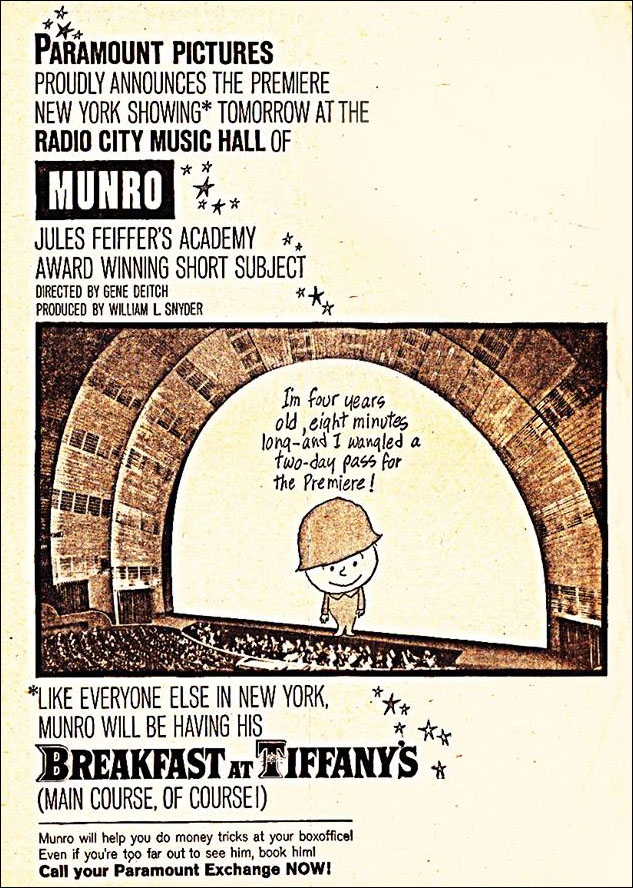
Munro (1960)

day 74, munro

MUNRO (1960) Four stars
I’ll make the review of this 1960 Czechoslovak-American animated short directed by Gene Deitch a short one, I promise.

It centers on a basic premise: The army drafts a 4-year-old boy.

Munro starts out your average little boy and then just a minute into the film, his life changes when he receives something in the mail. He can’t read, so a bigger person reads it to him. Cue that military music.

“At the age of 4, he’d been drafted.”

Then we join Munro for his physical. He’s the runt of the litter, for sure, and he’s the only one not talking about all his physical ailments, like a bad back.

Munro gets classified as “1A” or “eligible for military service.”

Munro goes to war.

It’s a foreign world for the little man with foreign words flying at him. This Sgt. couldn’t speak English very well, according Munro.

“Tenhoot,” “Foorit hoo,” “Hup haw hee haw hip hee haw hip,” et cetera.

Munro becomes a full-blown soldier and he plays all the games that soldiers play, like “Face.” Let’s see, there’s “Ri’,” “Lef’,” “Up,” “Down,” “In,” “Out,” and “Face” variances in “Face.”

Munro eventually becomes very tired.

Why?

“I’m only 4.”

They do not believe him.

Go back out and march in the rain.

They believe Munro’s faking that he’s only 4.

The experts think he’s a malinger.

The Colonel wants to shove him in the stockade.

They still won’t believe that he’s only 4.

Munro decides that he will be the best soldier.

Recruits pass by Munro and they’re told, “See that man, that’s a soldier. That’s what we’re gonna train you to be. We’re gonna separate the men from the boys.”

Munro then begins to cry.

They’re all embarrassed.

The General finally gets to the bottom of it, “You’re nothing but a baby boy.”

Munro signs his release form, and he gets a big parade in his honor with a message from the President himself.

American syndicated cartoonist and author Jules Feiffer, who’s considered the most widely read satirist in the country, wrote MUNRO. Feiffer won a Pulitzer Prize in 1986 and he was inducted into the Comic Book Hall of Fame in 2004. MUNRO won the 1961 Academy Award for Best Animated Short.

Feiffer wrote MUNRO when he was in the U.S. Army from January 1951 to January 1953.

“Every day I was enraged,” Feiffer said in an interview with Bookslut. “Every day I hated it. So much so that when they tried to promote me just as an automatic gesture to getting out, to raise your pay scale so you could get more, I refused to accept the raise in rank from private to PFC.”

Feiffer wrote MUNRO at his desk.

“With the full support of the man who supervised me,” Feiffer said, “who was this lllustrator who had a career that never took off in magazine illustration and this was his way of supporting the family. And his name was Perc Couse, who looked a very daunting, formidable man. He had a deep voice and scary, but he turned out to be a very warm, lovely, generous-hearted fellow who thought I and another G.I. there named Harvey Dinnerstein were much too talented to waste our time on Army stuff. So he let Harvey paint and he let me do my subversive satire. And I’m not sure he understood what I was doing, but after the war (Korea) he certainly did. After we were out, he took great pride, because we remained great friends until his death.”

MUNRO beat out some prestigious films and filmmakers for that Academy Award: Walt Disney Studios’ GOLIATH II, Warner Bros. cartoons HIGH NOTE and MOUSE AND GARDEN (the former directed by Chuck Jones and the latter by Friz Freleng, two of the legendary animators), and A PLACE IN THE SUN (not much info on this one).

George S. Kaufman said the famous words “Satire is what closes on Saturday night” after his play closed in Philadelphia and failed to make it to Broadway.

Though, in the 1960s, we had MUNRO and more prominently Stanley Kubrick’s dark Cold War satire DR. STRANGELOVE OR: HOW I LEARNED TO STOP WORRYING AND LOVE THE BOMB, one that still holds up rather well today.

MUNRO holds up rather well today, as well.

The Star Wars Holiday Special (1978)

day 71, star wars holiday special

THE STAR WARS HOLIDAY SPECIAL (1978) No stars
Movies, oops, TV specials based on movies, like “The Star Wars Holiday Special” are when yours truly wishes that he owned a stunt reviewer or had an evil twin movie reviewer, yes, an evil movie reviewer.

I first watched “The Star Wars Holiday Special” during the same week as LEONARD PART 6 and it’s amazing, it’s stupendous that anything competes with LEONARD PART 6 for sheer gut-wrenching awfulness. Sure enough, I saw two of the most awful pieces of celluloid within a short time of each other. I survived and now I am here to put together my story. Let me just say that you are not a true STAR WARS fan until you see “The Holiday Special,” which I rate at the bottom of the barrel. That’s an insult to the bottom and to the barrel.

Where does this review start? Where does it end? Why didn’t they dub in the laugh track?

First and foremost, please look at the cast for “The Star Wars Holiday Special.”

I seriously doubt kiddos in 1978 wanted codgers like Beatrice (her friends just called her “Bea”) Arthur and Art Carney anywhere near Han Solo, Luke Skywalker, Princess Leia, Chewbacca, and Darth Vader.

One bad idea right after the next flies right past our systems. No, wait, I am practicing the fine art of understatement when I say bad idea.

The first bad idea would be centering the action so to speak on Chewbacca’s family unit. Yeah, I know what you’re thinking. That’s absolutely unbelievable.

Granted, I am somebody who desired Chewbacca being a Hollywood leading man and paired with all them blazing beauty starlets like Kate Hudson, Katherine Heigl, and Jennifer Lopez in all them lovey dovey romances. Sorry, I am behind the times in romantic comedies and their beautiful people.

Anyway, we get Chewbacca’s wife Malla, his son Lumpy, and old man Itchy, who should have been named “Icky.”

Back to the bad ideas.

Malla watches an intergalactic cooking program with a cook based on Julia Child played by Harvey Korman, not Harvey Keitel, in drag.

Diahann Carroll shows up as an intergalactic and holographic sex fantasy of a dirty old wookie and sings a song for all our troubles. She doesn’t solve them, she makes them even worse.

Yes, Bea Arthur owned the intergalactic famous Cantina we saw in STAR WARS and of course, she sings a song.

Dagnammit, everybody, well, almost everybody gets a song.

We see intergalactic famous bounty hunter extraordinaire Boba Fett in cartoon form and we laugh every time he tells our protagonists that he’s a friend of Luke and Han and the droids. Boba Fett sounds like Mr. Rogers. Let’s see, Boba Fett died a crap death in RETURN OF THE JEDI and he made a crap entrance in “The Holiday Special,” but hey, at least, he made for a great action figure.

Jefferson Starship, a holographic facsimile of a rock band in the infant stages of dinosaurism, plays us an old-fashioned love song or perhaps not and they are not yet Starship, who knocked down a city with adult contemporary schlock rock and sang the love theme from MANNEQUIN that stopped Andrew McCarthy’s career.

“The Star Wars Holiday Special … brought to you by the Force or 20th Century Fox.” It premiered November 17, 1978 on CBS to much bewilderment.

George Lucas was not a big fan. Here’s Mr. Lucas from a 2005 interview:

“The special from 1978 really didn’t have much to do with us, you know. I can’t remember what network it was on, but it was a thing that they did. We kind of let them do it. It was done by … I can’t even remember who the group was, but they were variety TV guys. We let them use the characters and stuff and that probably wasn’t the smartest thing to do, but you learn from those experiences.”

If you’re seeking out “The Star Wars Holiday Special,” you will have to do it on YouTube. That’s how I came across my dubbed copy several years back. Folks, a.k.a. preservationists, found their original videotape recordings from November 17, 1978 and made copies, so what you see today started as second- to sixth-generation VHS dubs. Some copies have the original commercials and news breaks.

Apparently, at one point in time, Lucas said that he wished he could take a sledgehammer and smash every single copy of “The Holiday Special” in existence.

Out there in this cold, mean world, you will see “George Lucas Ruined My Childhood,” “Georce Lucas Wrecked My Childhood,” and even “George Lucas Raped My Childhood.”

Would those people look more favorably upon Lucas if he indeed smashed every copy of “The Holiday Special”?

Dammit, George, you’re not smashing mine, though.

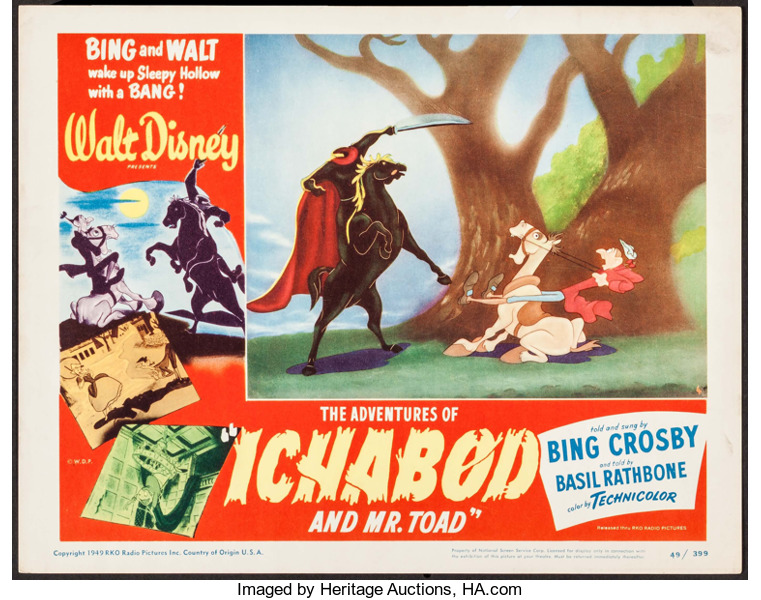
The Adventures of Ichabod and Mr. Toad (1949)

DAY 21, THE ADVENTURES OF ICHABOD AND MR. TOAD.jpeg

THE ADVENTURES OF ICHABOD AND MR. TOAD (1949) Three-and-a-half stars

Walt Disney favored package films after the release of BAMBI (1942) and released about one every year to close out the 1940s.

THE ADVENTURES OF ICHABOD AND MR. TOAD runs at 68 minutes, split at just the right length between the opening Mr. Toad segment based on “The Wind in the Willows” by Kenneth Grahame and the closing Ichabod Crane segment based on “The Legend of Sleepy Hollow” by Washington Irving. We have narration duties split between Basil Rathbone (MR. TOAD) and Bing Crosby (ICHABOD), plus Crosby handles voice duties for both Ichabod Crane and Brom Bones and sings a few songs. Crosby sings “The Headless Horseman” tale Brom Bones tells at the campfire that sticks in Ichabod Crane’s imagination on that famous long ride home.

Since we’re on a month of horror movie reviews, I will be focusing on the ICHABOD segment for the purpose of these few hundred words.

I must have first read “The Legend of Sleepy Hollow” in eighth grade and it’s long been one of my favorite stories. It’s compulsively readable (an engrossing yarn as the publicists said in 1820) and I’m looking around for that damn Irving anthology I bought several years ago. It must be hiding, of course, probably somewhere right around that Edgar Allen Poe anthology that could squish a spider the size of a Buick.

Just take a prose sample:

“As Ichabod approached this fearful tree, he began to whistle; he thought his whistle was answered: it was but a blast sweeping sharply through the dry branches,” Irving wrote. “As he approached a little nearer, he thought he saw something white, hanging in the midst of the tree: he paused and ceased whistling; but on looking more narrowly, perceived that it was a place where the tree had been scathed by lightning, and the white wood laid bare. Suddenly he heard a groan—his teeth chattered, and his knees smote against the saddle: it was but the rubbing of one huge bough upon another, as they were swayed about by the breeze. He passed the tree in safety, but new perils lay before him.

“About two hundred yards from the tree, a small brook crossed the road, and ran into a marshy and thickly wooded glen, known by the name of Wiley’s Swamp. On that side of the road where the brook entered the wood, a group of oaks and chestnuts, matted thick with wild grape vines, threw a cavernous gloom over it. To pass this bridge was the severest trial. It was at this identical spot that the unfortunate Andre was captured, and under the covert of those chestnuts and vines were the sturdy yeoman concealed who surprised him. This has ever since been considered a haunted stream, and fearful are the feelings of the schoolboy who has to pass it alone after dark.”

As much as I like the Johnny Depp and Tim Burton SLEEPY HOLLOW (1999), it only appropriates the title and a few character names from Irving’s short story. It’s laughable when you read “Based on ‘The Legend of Sleepy Hollow’ by Washington Irving” in the credits, because Ichabod Crane’s transformed into a horror movie hero who’s rather normal even by Burton and Depp standards and he’s no longer a gold digger like in Irving’s story, where Ichabod schemes after Katrina Van Tassel more for her money than her looks and personality. Ichabod becomes the standard issue lovable movie eccentric and he’s also a constable and not a schoolteacher. Of course, that plays into a murder mystery that manufactures more twists than a year’s worth of production at a pretzel factory.

I have to stifle laughter at this very instant after reading the Wikipedia entry for the 1999 version, which starts “SLEEPY HOLLOW is a 1999 American gothic supernatural horror film directed by Tim Burton. It is a film adaptation loosely based on Washington Irving’s 1820 short story ‘The Legend of Sleepy Hollow.’”

How loosely? Very loosely. Maybe as loosely as the Demi Moore version of SCARLET LETTER.

Burton’s film seems more heavily influenced by Hammer Films (none other than Christopher Lee plays a small role) than the original story, which plays on legends, superstitions, and Ichabod’s overactive imagination for its horrors. SLEEPY HOLLOW makes one feel that it’s merely exploiting the Washington Irving name and literary reputation to give class to what would otherwise be another gory horror movie with a rather convoluted plot.

Take away the slapstick and Crosby’s songs about Ichabod and Katrina, the Walt Disney version sticks closer to the spirit and letter of Washington Irving and the final dozen minutes of ICHABOD AND MR. TOAD are a vivid reminder of Disney films’ ability to scare audiences in classics like SNOW WHITE, PINOCCHIO, and BAMBI.

Ultimately, though, with the Burton film, I accept it for what it is rather than what it is not. Cue to “Seinfeld” and “Not that there’s anything wrong with that.” It does have a lot of virtues and I’ve enjoyed it every time seeing it since that first time in a theater in late 1999. Hey, that reminds me, I need to grab my VHS copy and put the damn thing on.