The Legend of Drunken Master (2000)

DAY 53, THE LEGEND OF DRUNKEN MASTER

THE LEGEND OF DRUNKEN MASTER (2000) Three-and-a-half stars
Once upon a time, there was a commonly held belief that Jackie Chan and his movies would never succeed in America.

Chan’s first two attempts to capture the American market both failed, 1980’s THE BIG BRAWL (Robert Clouse) and 1985’s THE PROTECTOR (James Glickenhaus).

Clouse (ENTER THE DRAGON, BLACK BELT JONES, GAME OF DEATH) and Glickenhaus (THE EXTERMINATOR, THE SOLDIER, SHAKEDOWN) did not see eye-to-eye with Chan and vice-versa, as Chan felt more confined to the generic American style of movie violence rather than his own more idiosyncratic style during both films. Chan even released his own edit of THE PROTECTOR.

Glickenhaus once said in an interview, “Well, you know that’s still the most successful Jackie Chan movie internationally and always will be because the American audience, the mainstream audience, will never sit still for Jackie’s style of action.”

Wrong, and wrong again.

In 1995, in the third attempt on cornering the American market, New Line Cinema (Freddy Krueger’s studio) finally succeeded with an English dubbed, shortened RUMBLE IN THE BRONX (17 minutes of cuts from the Hong Kong version, two additional scenes filmed for the international market). On a budget of $8.5 million, RUMBLE IN THE BRONX earned $40 million in America, then we saw the deluge of Jackie Chan pictures.

There were SUPER COP, JACKIE CHAN’S FIRST STRIKE, and MR. NICE GUY, for example, leading up to RUSH HOUR in late 1998.

Ah, yes, RUSH HOUR, one of my memorable multiplex experiences because of the way good fortune smiled down on me. Two friends and I went out for pizza and a movie, originally intended to be Adam Sandler’s THE WATERBOY. Already at that point in life, I had tired of Sandler movies after finding so very little of interest or laughter in BILLY MADISON and HAPPY GILMORE; I liked Sandler on “Saturday Night Live,” for what it’s worth. After devouring our large order of cheesesticks, we headed to the Pittsburg Cinema 8 and discovered that THE WATERBOY sold out. Bummer, man, but at least not for me. We discussed it over and finally decided that we take a chance on RUSH HOUR rather than have driven to Pittsburg for virtually nothing.

This was my first exposure to Jackie Chan and I liked it. I liked RUSH HOUR for Chan far more than motormouth Chris Tucker. Of course, it’s a formula picture, “the buddy cop” picture that somehow had survived debacles like A COP AND A HALF (1993), remember that one with Norman D. Golden II and Burt Reynolds. Chan had been successfully integrating comedy and martial arts in his movies for years, and so he was right at home in RUSH HOUR with both elements. Chan and Tucker played well off each other and so naturally, they made two more RUSH HOUR films each less successful than the one before it.

At the turn of the 21st Century, a friend and I watched THE LEGEND OF DRUNKEN MASTER at the Joplin 14.

Around this time, I had discovered the first DRUNKEN MASTER on video and had purchased a couple Chan films on video.

In other words, I became a fan, a big fan.

THE LEGEND OF DRUNKEN MASTER, dubbed into English and re-edited for the American market, is the sequel to the 1978 film that helped make Chan a star. It was originally released in 1994 as DRUNKEN MASTER 2.

I don’t enjoy it nearly as much as the first DRUNKEN MASTER, a film that’s highly reminiscent of both ROCKY and ANIMAL HOUSE, as well as Bruce Lee, but the sequel definitely finishes on an incredibly high note with a rousing fight scene apparently directed by Chan himself.

This fight scene pits Chan against his personal bodyguard Ken Lo, a member of the famous Jackie Chan Stunt Team, the group of martial artists and stuntmen that worked alongside Chan on his movies.

Kinetic would be one word for this fight scene. Epic another. Fiery one more. “Do not try it at home” overkill.

Chan and Lo move so fast and are so fleet of foot and fist that it’s downright amazing, a ballet with kicks and punches.

It’s also funny in the way that Chan and his “drunken boxing” can be.

It makes use of the props that are in the scene’s immediate environment, a Chan trademark that originates from his affinity for silent movie comedians Charlie Chaplin, Buster Keaton, and Harold Lloyd.

Just a couple days ago, we looked at WAY OF THE DRAGON and that featured the epic fight scene between Lee and Chuck Norris. We could pair that scene with Chan and Lo.

After THE BIG BRAWL and before THE PROTECTOR, Chan took supporting roles in two CANNONBALL RUN films directed by Hollywood stuntman turned filmmaker Hal Needham and featuring a cast of thousands headlined by Needham’s friend, Burt Reynolds. Hong Kong production company Golden Harvest produced both CANNONBALL RUN films. The great thing that came from CANNONBALL RUN was that Needham’s tradition of a bloopers reel during the end credits inspired Chan to do the same for his future films. Both CANNONBALL RUN films, thanks to Chan’s popularity, were big in Japan.

Fist of Fury (1972)

day522cfistoffury

FIST OF FURY (1972) Three-and-a-half stars
I started the month with Bruce Lee’s ENTER THE DRAGON and now I review a fifth Bruce Lee action spectacular, FIST OF FURY, originally called THE CHINESE CONNECTION for many, many years after its 1972 release in America.

FIST OF FURY ranks second in the Lee pantheon and for me it’s the most emotionally resonant of his pictures. ENTER THE DRAGON succeeds more as spectacle, a slambang entertainment, than anything else.

I’ve always responded to the story of Lee’s Chan Zhen in FIST OF FURY, a young man who stands against the Japanese antagonists who belittle their Chinese neighbors in Shanghai at every turn and Chan Zhen also seeks justice for those responsible for his master Huo Yuanja’s death. The other Lee films’ stories do not grip me quite like this one.

This was Lee’s second film, coming hot on the heels of THE BIG BOSS. It’s a far more successful film than its precursor, and it does away with any silly notion or pretense of nonviolence, when we all know that it would never last. I don’t think that withholding strategy worked whatsoever in THE BIG BOSS. I mean, come on, we just want to see Lee fight and waiting half the damn film made no damn sense. That would be like a Gene Kelly musical where he did not dance until the final scene.

FIST OF FURY gives us a couple nifty villains, although not quite as nifty as WAY OF THE DRAGON and ENTER THE DRAGON.

Former professional baseball player Riki Hashimoto portrays Suzuki, the master of the Hongkou dojo that presents so many problems for Chan Zhen and Huo Yuanja.

Hashimoto played for the Mainichi Orions (now the Chiba Lotte Marines) in the 1950s before an injury forced his early retirement. Hashimoto turned to acting and he had 25 credits from 1960 to 1985; FIST OF FURY was his third-to-last acting credit. Hashimoto died in 2017 at the age of 83, of lung cancer.

FIST OF FURY introduces a secondary villain, Suzuki’s translator played by Paul Wei. Yes, another movie where a translator’s rendered redundant by the fact all the characters are dubbed into English. Anyway, Wei returned in WAY OF THE DRAGON for a similar role. He’s an oily bastard in both movies, a weasel of the highest order basically. He’s called “Interpreter Wu” in FIST OF FURY and “Ho” in WAY OF THE DRAGON. Wei died in 1989.

So we have a story that grips us, a martial arts dynamo and all-around charismatic movie star in the lead role, and villains that we love to hate.

Sounds like a good movie.

Okay, now back to the titles. Until 2005, FIST OF FURY was mistakenly called THE CHINESE CONNECTION in America. See, they originally meant to title THE BIG BOSS as THE CHINESE CONNECTION and FIST OF FURY as, well, FIST OF FURY. They wanted to exploit William Friedkin’s THE FRENCH CONNECTION, a big critical and commercial success (and the first R-rated movie to win the Academy Award for Best Picture) that featured drug smuggling, just like THE BIG BOSS. For many years, however, we had the wrong titles.

Guess you could say though, in the case of FIST OF FURY, a good action movie under another name is a good action movie all the same.

On the eve of Thanksgiving, I’d like to say thanks for Lee (1940-73) and the work that he left behind. It’s still inspiring after all these years.

NOTE: This review was part of a series of reviews in November 2018.

Bumblebee (2018)

day 123, bumblebee

BUMBLEBEE (2018) Three-and-a-half stars

To be honest, BUMBLEBEE was a pleasant surprise.

Granted, I knew coming in that it received better reviews than each of the five previous live-action TRANSFORMERS movies directed by the beloved Michael Bay. (TEAM AMERICA: WORLD POLICE paid Bay and his general oeuvre tribute with “Pearl Harbor Sucks.”)

In those reviews, I believe BUMBLEBEE was even recommended many times as being a TRANSFORMERS movie for people who did not like the Bay entries. For the record, I liked the first entry from 2007 and they quickly dropped in quality. (REVENGE OF THE FALLEN, though, gave Roger Ebert a zinger first sentence and book title, “A Horrible Experience of Unbearable Length.”)

Anyway, I walked into Flick Theatre in Anderson, popcorn and healthy skepticism in tow.

Leaving the Flick two hours later, I thought, “Hey, that’s the best TRANSFORMERS movie since the animated film released in 1986.”

I’ll go through a short list of reasons why.

— Length: BUMBLEBEE lasts 114 minutes, the shortest running time for TRANSFORMERS since 1986. The animated version ran 90 minutes, a good length. Bay’s five entries lasted 150 minutes, 150 minutes, 157 minutes, 165 minutes, and 149 minutes. Not only were they long but they were long and loud, very very very loud. They’re the kinds of movies heard throughout the multiplex. BUMBLEBEE, directed by Travis Knight, lacks the bloat of the Bay-directed films. By the way, Bay served as producer, just like he did for A QUIET PLACE and the FRIDAY THE 13TH, AMITYVILLE HORROR, and THE TEXAS CHAINSAW MASSACRE remakes.

— Focus: BUMBLEBEE centers on the human characters far more than any previous live-action TRANSFORMERS, especially through female protagonist Charlie (Hailee Steinfeld). She’s a rock solid entry point into this world and she’s the one who finds and befriends Bumblebee in a relationship that echoes E.T. THE EXTRA-TERRESTRIAL and THE IRON GIANT, as well as KING KONG. I never felt that way during the Bay entries. Charlie also reminds one that had this film been made in the 1980s, her character would have been played by Molly Ringwald, maybe Ally Sheedy.

We’re swept up in the emotion of the film, just like E.T., THE IRON GIANT, and KING KONG.

— Humor: Ah, a delicate balance. Do you go too far and become camp like BATMAN & ROBIN or do you lack humor and become a rather grim affair like the Christopher Nolan BATMAN films? I laughed at several points throughout BUMBLEBEE, where I was obviously intended to laugh, like when Charlie and her possible future boyfriend / adoring sidekick Memo have Bumblebee egg and toilet paper the house and car of somebody who’s been cruel and mean to Charlie at every turn … of course, Bumblebee takes it to another level. Or Bumblebee’s priceless reaction to Rick Astley. (Maybe it’s unfortunate that Mojo Nixon’s “Debbie Gibson is Pregnant with My Two-Headed Love Child” did not come out until 1989, given its subject matter, including a Rick Astley insult. Believe Mojo called Astley “a pantywaist.”)

— Soundtrack: Tears for Fears’ “Everybody Wants to Rule the World,” the Simple Minds’ “Don’t You (Forget About Me),” Astley’s “Never Gonna Give You Up,” Steve Winwood’s “Higher Love,” A-Ha’s “Take On Me,” Sam Cooke’s “Unchained Melody,” the Smiths’ “Girlfriend in a Coma,” Sammy Hagar’s “I Can’t Drive 55,” Stan Bush’s “The Touch,” and DJ EZ Rock and Rob Base’s “It Takes Two” are some of the nostalgic buttons pushed by this prequel.

No doubt that a teenage girl in the late 1980s would have favored such songs. Charlie’s a major Smiths fan — I seem to also remember hearing “Bigmouth Strikes Again” — and she wears T-shirts of Elvis Costello, the Damned, and the Rolling Stones, I do believe.

I found a couple anachronisms.

“Never Gonna Give You Up” was released in the UK in July 1987 and later became a hit in America in early 1988.

“It Takes Two” did not appear until August 1988. BUMBLEBEE takes place during 1987.

However, though, I grinned from ear to ear when Bumblebee cued up “The Touch,” a hard rock anthem from the 1986 TRANSFORMERS later covered by Dirk Digger (Mark Wahlberg) during his cocaine would-be rock star phase.

— Little moments like that are scattered throughout BUMBLEBEE.

First-time live-action director Knight is the 45-year-old son of Nike co-founder and Chairman Emeritus Phil Knight. The younger Knight worked in animation (namely stop-motion) before BUMBLEBEE — his works include CORALINE and his directorial debut KUBO AND THE TWO STRINGS (2016) for Laika Entertainment; Travis Knight serves as Laika’s president and CEO (he’s also on Nike’s Board of Directors) and the company employs nearly 400 people in Hillsboro, Oregon.

Will future TRANSFORMERS movies follow the direction taken by Knight and British screenwriter Christina Hodson or go back to the Bay-ten path, if you will?

BUMBLEBEE does not lack action movie spectacle, of course, with shit blowing up real good especially in the opening and closing scenes, but the heart and humor displayed over the balance of the movie takes BUMBLEBEE to a higher level.

Way of the Dragon (1972)

day 51, way of the dragon

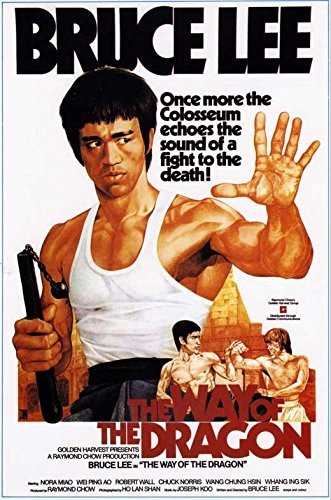
WAY OF THE DRAGON (1972) Three stars
Foreign movies have always faced challenges in America. Always have, most likely always will.

I can remember selecting PAN’S LABYRINTH at the video store and the concerned clerk attempted warning me that it had subtitles.

I was at first amused and then quickly frustrated by this warning, and mumbled back “OK” in a way that communicates far more than just two letters.

Next time I hear something like that, I’ll pipe back, “I can read” and “Well, I hope so, I’m not that fluent in … ”

Some people just have an irrational fear of subtitles, apparently they are the chopsticks of cinema. Come on, suck it up buttercup and don’t be a candy ass, reading won’t kill you.

Another memorable foreign movie experience was CROUCHING TIGER, HIDDEN DRAGON at the Pittsburg 8 Cinema, where two airheads kept snickering throughout the picture and they accounted for more laughter than I heard that year during so-called comedies THE LADIES MAN and NEXT FRIDAY. I laughed most that year at DRACULA 2000, followed by THE SKULLS and ROMEO MUST DIE, although I have been informed that I should not have been laughing.

The challenges faced by foreign movies always come to mind every time I watch Bruce Lee’s WAY OF THE DRAGON, titled RETURN OF THE DRAGON in America because it was released after ENTER OF THE DRAGON. Lee’s movies, by the way, often had title issues.

I always hate it when characters are supposed to be speaking different languages (in WAY OF THE DRAGON, I am betting on Chinese, Italian, and English) and there’s obviously a translator in a scene. Instead, they’re all dubbed awkwardly into English and the translator merely repeats what’s already been said just moments ago. Scenes are (needlessly) rendered redundant.

This situation happened years ago during a version of Jean-Luc Godard’s CONTEMPT that played on Turner Classic Movies, where I was only left with contempt for the English dub. Apparently, only the French received a multilingual (French, English, Italian, and German) release while the American and Italian releases were dubbed entirely into their respective languages. Still a great movie, but the French version would have been superior because I’d rather have multiple languages all subtitled rather than everybody reduced to one dubbed language.

Thankfully, for WAY OF THE DRAGON, it’s a martial arts picture and Bruce Lee’s dynamism cannot be lost in translation.

Howard Hawks once called a good movie “three good scenes and no bad scenes,” and the director of SCARFACE, BRINGING UP BABY, and THE BIG SLEEP would know.

WAY OF THE DRAGON has the three good scenes down pat. Unfortunately, it’s got a few bad scenes, largely because of the dodgy dubbing, but we’ll cover two great scenes in this space.

WAY OF THE DRAGON features arguably the best cinematic display of Lee’s nunchakus, as he takes on a whole gang of buffoonish henchmen.

Lee was introduced to the weapon by Dan Inosanto, who battled against Lee with nunchakus in one of the best scenes in GAME OF DEATH.

Legend has it Lee played ping pong and lit cigarettes with nunchakus. Apparently, the part about ping pong, that’s false. The video was just a promotional spot with digital trickery and a Lee look-alike highlighting the shenanigans, a promo by the way for the Nokia N96 Limited Edition Bruce Lee cell phone that was produced in 2008. Doesn’t sound any more nefarious than any of the other Lee exploitation after his 1973 death.

The crime boss in WAY OF THE DRAGON hires American karate champion Colt and the legendary Chuck Norris makes his motion picture debut.

Lee’s Tang Lung and Colt have one of the great movie fights at the Colosseum and it’s quite possibly the best fight the Colosseum’s seen for at least a few hundred years, a 10-minute spectacle that never gets old to watch.

Indelible images like Norris’ chest hair (enough for a bear skin rug), that damn cute little cat (it gets more close-ups than Norma Desmond and Daffy Duck combined), and Lee’s touching gesture of final respect toward his worthy opponent after an epic battle make it more than just another fight.

Norris makes for a great villain, but it’s unfortunately a vein that he never tapped again, preferring to play square heroes.

Norris fans and fact hunters might deny the existence of WAY OF THE DRAGON. I found some alternative “facts” on the Internets.

Q: Why are there more Chuck Norris Jokes than Bruce Lee?

A: Because Bruce Lee is no joke.

FACT: Monsters look under the bed for Chuck Norris. Chuck Norris checks his closet and looks under the bed in fear of Bruce Lee.

FACT (using John Goodman’s piece-pulling Walter from THE BIG LEBOWSKI in the meme): “Am I the only one around here that thinks Bruce Lee is way more badass than Chuck Norris?”

Q: Want to know Chuck Norris fact?!

A: I (Bruce Lee smiling in the meme) kicked his ass.

Duel (1971)

duel

DUEL (1971) Three-and-a-half stars

24-year-old Steven Spielberg’s first feature film premiered November 13, 1971 on ABC.

Richard Matheson (1926-2013) wrote the script, based on his nightmarish experience on November 22, 1963 (the date of JFK’s assassination). A trucker tailgated Matheson on his return home following a golf match against friend and fellow writer Jerry Sohl. Matheson turned his experience into a short story that originally ran in Playboy.

Spielberg directed on a $450,000 budget and production ran 13 days, three days over schedule, and it played as the “ABC Movie of the Week” lasting 74 minutes. A later theatrical release covered nearly 90 minutes.

Spielberg wanted and got character actor Dennis Weaver (1924-2006). Of course, most of us know the Joplin-born actor for his work on TV series “Gunsmoke” and “McCloud,” but Spielberg admired Weaver for his work in Orson Welles’ TOUCH OF EVIL and in DUEL, Weaver’s character repeats a bit of verbal business from TOUCH OF EVIL. You got another think coming, indeed.

It’s a very basic premise at the center of DUEL: An unnamed truck driver stalks our protagonist David Mann (Weaver), a middle-aged salesman returning home from a business trip.

Mann passes the truck early on and that begins his 90-minute nightmare.

Oh sure, I bet you believe that driver sure as hell gets bent over being passed.

You might even say to yourself that it’s preposterous, but then again, in this day and rage, you might not.

I definitely believe that it’s not and I recall my own bizarre experience from November 2016.

“Driving home from work last night/this morning around 2 a.m., this car began following me from about the Highway 43/96 roundabout. It would creep up, then fall back and never pass despite multiple opportunities. There was no tailgating or attempt to run me off the road. A couple times, I looked back and the car swerved all over the place. At some point, I figured out it was definitely not a cop. That some point had already been reached when I turned on to Highway H toward Jasper, a destination 11 miles from Highway 43. I took a real slow, hesitant turn with a stop at the end and the creeper car behind me matched that slow, hesitant turn with a stop at the end. OK, it’s a creeper. We’re about halfway to Jasper when I turn into a random driveway. I sit in my car for a couple minutes, debating my next move. The car following me backs up a little bit and leaves me room to reverse and turn around. I see that it’s a dude driving the car. He’s alone. I back out, turn around, drive toward him, and engage him in what turned out to be one of the weirdest conversations I’ve ever known. But just like a character said to Inspector Harry Callahan in DIRTY HARRY, ‘I gots to know.’

“Anyway, I now know for sure what it’s like to have a conversation with someone orbiting Planet X. I could only understand bits and pieces of his stammered mutterings, something ‘bout him being from Wichita and then wanting to know if I wanted to make a contribution. No, sorry, I gave at the office.

“The Creepy Crawler: Thought we could talk for 10 minutes.

“Me: No, and we’ve already talked for 5.

“TCC: No, we haven’t.

“Me: It’s late and I just want to get home from working all night.

“(voice tails off quickly)

“TCC: So you don’t want to have a conversation?

“[I drive off into the sunset. No, wait, it’s 2 a.m. There’s no sunset. The sun rises in the opposite direction. Ah, hell, we’re not getting anywhere with this digression into stage direction.]

“Back on the road and that holy quest to make it home safe, I drove about 85 over those crazy little hills of Highway H until I reached Highway 43. No creeper. Very little active human life of any kind. Very few lights. I felt like saying, ‘It’s 30 miles to Arcadia, I’ve got a three-quarters full tank of gas, half a reporter’s notebook, it’s dark out and I am wearing a Star Wars T-shirt.’”

Watching it for the first time in full the other day, DUEL brought on a flashback to that 2016 incident and I certainly felt all the sympathy in the world for the plight of David Mann.

DUEL represented a test run for JAWS, Spielberg’s third feature. Both productions often masterfully exploit our fear of the unknown, but I’ll say that DUEL scares me more than JAWS because I drive a whole helluva lot more than I swim in the ocean.

The Big Boss (1971)

day 50, the big boss

THE BIG BOSS (1971) Two stars
Glad that I didn’t watch THE BIG BOSS (a.k.a. FISTS OF FURY) first among Bruce Lee films; ENTER THE DRAGON, RETURN OF THE DRAGON, and FIST OF FURY (a.k.a. THE CHINESE CONNECTION) each came before and that’s a groovy thing because I could definitely understand what the furor over Lee is about.

First time I watched THE BIG BOSS, I did not know what quite to make of it, other than I didn’t like it very much. I thought, let me get this straight, this is Lee’s first martial arts feature and his character has sworn an oath of nonviolence. Ridiculous. Absolutely ridiculous. I know, I know, they wanted a dramatic build-up to the inevitable moment when that nonviolence goes straight out the damn window and Hell (in the form of Lee) breaks loose. That’s just not how it works, though, for me and I have always found the moments leading up to the later fight scenes a genuine snoozer. Cue to the good parts, please. I’ve watched it several times and I’ve never been able to connect with it like many others have.

Lee’s character taking a pledge to nonviolence, why that’s about the equivalent of strapping a piano on Fred Astaire’s back during one of his musicals or it’s like making a great singer play a mute character for half the movie. This is not quite as frustrating as the script for JAWS 2 that delayed the inevitable for Sheriff Brody to go and kill the damn shark with some truly idiotic plot gyrations … but it’s close, real close. How many characters have to die before it’s set right?

No offense to Lee, but he was no Gandhi or Martin Luther King.

I don’t care what anybody says, but we go to a Lee movie for the fight scenes and there’s just not enough of them in THE BIG BOSS (nearly 120 minutes in length) for it to qualify as one of Lee’s better efforts. It’s a grade above GAME OF DEATH or at least the bastardized posthumous version conjured up by Robert Clouse of what could have been Lee’s masterpiece had the man been able to complete it.

There’s still moments, though, in THE BIG BOSS when you realize what’s so special about Lee. He’s truly one of a kind, even in dreck. This flick made Lee famous throughout Asia, and it became the highest-grossing film of all-time in Hong Kong in 1971, beating out THE SOUND OF MUSIC and TORA! TORA! TORA! That’s all because of Lee, who commands the screen like only a select few have in motion picture history.

Like GAME OF DEATH and its fight scenes late in that movie, viewers have to wade through a lot of crap just to get to the high points; we’re knee deep. There’s a 4-5 minute fight sequence in the ice factory in THE BIG BOSS that gets at the heart of Lee’s appeal, though Lee memorably made his own criticism of his own movies in ENTER THE DRAGON, “Why doesn’t somebody pull out a .45 and, bang, settle it?”

Of course, that would not be within the basic spirit of a martial arts picture. The genre exists as an alternative to the Western and it’s based on a lot of the same themes, such as integrity and honor, as what was once the quintessential American movie genre. Martial artists, though, use their fists and feet rather than guns.

The graphic violence, though, in THE BIG BOSS belongs more to a Spaghetti Western than anything directed by John Ford or Anthony Mann.

THE BIG BOSS is a poorly made exploitation film that features one great aspect (two if you count that poster; all Lee’s films have incredible posters) and reportedly director Lo Wei (1918-96) was more interested in the racetracks than the film. Wei’s known for launching both Lee and Jackie Chan, directing Lee in THE BIG BOSS and FIST OF FURY and Chan in NEW FIST OF FURY. Wei can be seen in FIST OF FURY as the police inspector Lo.

Overlord (1975)

day 73, overlord

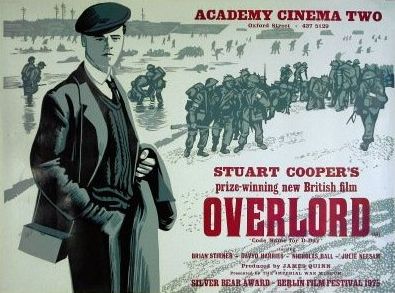
OVERLORD (1975) Four stars
American director Stuart Cooper did something very interesting for his fourth film, 1975’s OVERLORD.

Cooper integrated archival footage of British training missions and the D-Day Invasion (a.k.a. Operation Overlord) into a fictional film about a young man’s journey from call up to the grave. Cooper and his very talented cinematographer John Alcott (he won the Academy Award for Best Cinematography for his work on Stanley Kubrick’s BARRY LYNDON, another 1975 film) did their best to make a consistent look so one could not tell any difference between the archival footage and the fictional story.

The Imperial War Museum granted Cooper access to its vaults and that’s where he found all that historical footage. Cooper had originally planned to make a documentary on the Overlord Embroidery, which commemorates scenes from wartime photos housed by the Imperial War Museum. Sandra Lawrence designed it and the Royal School of Needlework provided the handiwork.

Cooper told The Guardian in 2008, “I spent approximately 3,000 hours in that dark cell between 1971 and 1975, briefly interrupted by a couple of other projects. It was during the archival research that I developed the idea of a dramatised feature film about an English soldier who sees his first action on D-Day, interweaving the archive footage to expand and tell the story. …

“A major concern for my cinematographer, John Alcott, was how to match the texture of the archive footage. In an unprecented move, the museum granted us access to the original nitrate negatives. The quality of the original nitrate negatives was pristine. After Alcott examined them, we decided to film OVERLORD on period lenses. Alcott scoured England and found two sets of 1936 and 1938 German Goetz and Schneider lenses. Alcott then applied a lighting style in keeping with the war photography, seamlessly blending the archive and dramatised story. Seventy percent of the film is live action, which was completed in 10 days of filming.”

OVERLORD, though it won the Silver Bear at the 25th Berlin International Film Festival, seemed to have fallen through the cracks of history for many, many years.

Cooper again in The Guardian, “In spite of OVERLORD’s festival success, it never gained distribution in the U.S., which I suspect hurt its chances of being properly remembered. It may also have been because it was made during the tail end of the Vietnam War, as well as being a black-and-white film with a very British story. The only airing the film received in the U.S. was on Jerry Harvey’s Z Channel in 1982, a forerunner to U.S. cable stations. Twenty-two years later, Xan Cassavetes, John Cassavetes’ daughter, included several clips of OVERLORD in her 2004 documentary, Z CHANNEL: A MAGNIFICENT OBSESSION. As a result, OVERLORD was invited to the Telluride Film Festival, where it was a surprise success. Shortly afterwards, it was belatedly picked up for U.S. distribution.”

Better late than never, for sure.

I found out about the film from Roger Ebert’s 4-star review in 2006.

Ebert first wrote about the film at Telluride in 2004, “The most remarkable discovery at this year’s Telluride is OVERLORD, an elegiac 1975 film that follows the journey of one young British soldier to the beaches of Normandy. … Unlike SAVING PRIVATE RYAN and other dramatizations based on D-Day, OVERLORD is an intimate film, one that focuses closely on Tom Beddoes (Brian Stirner), who enters the British army, goes through basic training and is one of the first ashore on D-Day. Beddoes is not a macho hero but a quiet, nice boy, who worries about his cocker spaniel and takes along ‘David Copperfield’ when he goes off to war.”

Christopher Hudson’s screenplay built scenes based on diaries and letters from real servicemen, again providing something unique from the average war film.

Unique is definitely one word for OVERLORD.

You sometimes feel like you’re watching a real young man’s life, as if Tom Beddoes had been a real person and had been followed around by a documentary film crew who managed to conceal themselves from the real people being filmed.

That’s a different feeling than just about every other fictional war movie.

Of course, OVERLORD includes all the standard issue scenes: Tom’s call up, his basic training, his meeting a young woman whom he falls in love with (she’s called “The Girl” in the credits), his journey overseas, and finally his death on D-Day.

OVERLORD reminds us that clichés have their roots in things commonly happening to people.

Who knows how many Tom Beddoes there have been and will be throughout the pages of history.

I drift back to the following lyrics from the Clash’s “The Call Up,” “There is a rose that I want to live for / Although, God knows, I may not have met her / There is a dance an’ I should be with her / There is a town unlike any other.”

The Big Red One (1980)

day 72, the big red one

THE BIG RED ONE (1980) Four stars
When I think of the dumb things college students love to say, I drift back to the History in Film & Fiction class that I took back in 2005 at Pittsburg State.

Boy oh boy, all those undergrads sure did say the dumbest things. (A graduate student like myself would never.)

Like, for example, after we consumed SAVING PRIVATE RYAN around Veterans’ Day.

Were these normally cynical and reserved undergrads all of a sudden turned into Steven Spielberg’s press agents?

Sounded like it.

I mean, for crying out loud, I don’t remember any of those bastards liking the other films we considered that semester or liking at least enough to break on through that cool, detached undergrad reserve.

Several classmates said “SAVING PRIVATE RYAN is the greatest war movie ever made.” One even said, “It’s the only war movie to ever truly care about its characters.” All said with that gleeful, pretentious undergrad enthusiasm.

The first opinion makes you wonder how many war movies they have seen. Probably not that many, either then or now for that matter. Anyway, just say that it’s your favorite and not make that great leap to being an asshole by saying “the greatest.”

The second one makes you wonder how that undergrad history major knew how Spielberg felt about his characters and how that was somehow purer of heart than all the other makers of countless war movies.

For example, makes you wonder how director William Wyler, a World War II veteran, felt about the three veteran characters returning home in THE BEST YEARS OF OUR LIVES (1946). Man, oh man, betcha he must have disliked them characters and didn’t care a single lick about them and their plight. Sure, sure, sure, Wyler just did it for the money and the heaps of critical praise, unlike Mr. Spielberg.

We needed a Walter Sobchak in our class that day and he could have pretended the undergrads were all named Donny, especially when they were getting just a wee bit too grandiose in their statements.

“SAVING PRIVATE RYAN is the greatest war movie ever made. …”

“Shut the fuck up, Donny.”

“It’s the only war movie to ever truly care about its characters. …”

“Forget it, Donny, you’re out of your element.”

“SAVING PRIVATE RYAN is the greatest war movie ever made. …”

Jeffrey Lebowski speaks up, “Yeah, well, you know, that’s just, like, your opinion, man.”

I am sure that Spielberg would not be guilty of such ridiculous statements as his many unabashed admirers in that Film & Fiction class.

For example, Spielberg and George Lucas grabbed the character name “Short Round” for INDIANA JONES AND THE TEMPLE OF DOOM from director Samuel Fuller’s Korean War film THE STEEL HELMET.

You can be sure Spielberg watched Fuller’s World War II epic THE BIG RED ONE before taking on SAVING PRIVATE RYAN.

Fuller (1912-97) was truly an one-of-a-kind dynamo who lived one helluva life. A screenwriter, a novelist, a reporter, a combat veteran, a World War II survivor, a director, an actor, an inspiration to many. He directed some of the best movies you could ever have the chance to see (I would start with WHITE DOG) and THE BIG RED ONE lives and breathes Fuller.

From his 1980 Cannes Film Festival interview with Roger Ebert, where there’s an audience of a German TV crew and they ask him if THE BIG RED ONE was pro-war or anti-war, Fuller said, “Pro or anti, what the hell difference does it make to the guy who gets his ass shot off? The movie is very simple. It’s a series of combat experiences, and the times of waiting in between. Lee Marvin plays a carpenter of death. The sergeants of this world have been dealing death to young men for 10,000 years. He’s a symbol of all those years and all those sergeants, no matter what their names were or what they called their rank in other languages. That’s why he has no name in the movie.

“The movie deals with death in a way that might be unfamiliar to people who know nothing of war except what they learned in war movies. I believe that fear doesn’t delay death, and so it is fruitless. A guy is hit. So, he’s hit. That’s that. I don’t cry because that guy over there got hit. I cry because I’m gonna get hit next. All that phony heroism is a bunch of baloney when they’re shooting at you. But you have to be honest with a corpse, and that is the emotion that the movie shows rubbing off on four young men.

“I wanted to do the story of a survivor, because all war stories are told by survivors. Pro- or anti-war, that’s immaterial, because in any war picture, you’re going to allegedly feel anti-war because they make a character sympathetic and then the character gets shot, and so you say, ‘How tragic.’ What baloney. Why should I be against war because some kid gets hit while he’s reading a letter from Mom? I don’t think I’ve seen any war movie where you get to know the characters and one of them isn’t killed. It’s a cliche.

“But to the guy who’s killed, try telling him about heroism and courage. Get him to listen after he’s dead. Even World War II, with all its idealism, basically there was a lot of hypocrisy. …”

I could read a Fuller interview all day.

Fuller served in the 1st Infantry Division or “The Big Red One” and he received the Silver Star, Bronze Star, and Purple Heart during his service. THE BIG RED ONE’s based on his experiences with Robert Carradine’s Pvt. Zab as Fuller’s alter ego. Fuller sold a gangster novel that he wrote during his military service and in the movie, just like in real life, he finds out that his novel’s been published when he spots a soldier reading it.

Fuller, in his interview with Ebert, said that Carradine’s character is not nearly as vicious as Fuller was in real life.

Zab’s the narrator in THE BIG RED ONE and I just love his narration, both the words themselves (apparently written by Jim McBride) and Carradine’s delivery.

A couple examples: “The Bangalore Torpedo was 50′ long and packed with 85 pounds of TNT and you assembled it along the way. By hand. I’d love to meet the asshole who invented it.”

Example No. 2: “These Sicilian women cooked us a terrific meal. It’s too bad they were all over 50. We were more horny than we were hungry.”

Those are words you could find yourself saying.

Our four privates are Zab, Griff (Mark Hamill), Vinci (Bobby DiCicco), and Johnson (Kelly Ward), and they all do bang-up jobs. It’s especially nice seeing Hamill in a live-action role outside Luke Skywalker.

In the long run, though, THE BIG RED ONE belongs to Lee Marvin as The Sergeant.

You could just say that Marvin was born to play this role.

He’s one gruff son-of-a-bitch and he’s lovable because of it.

Marvin’s delivery and Fuller’s dialogue are a match made in heaven.

Check out this conversation and try and imagine Marvin saying it as The Sergeant.

Griff: I can’t murder anybody.

The Sergeant: We don’t murder; we kill.

Griff: It’s the same thing.

The Sergeant: The hell it is, Griff. You don’t murder animals; you kill ’em.

THE BIG RED ONE marked Fuller’s return to directing after 11 years, with THE SHARK from 1969 his previous credited film, and it was to be his grand epic.

Fuller originally submitted a 4-hour cut and then a 2-hour cut, and both were rejected, of course, by the studio.

The studio reedited the film and tacked on the narration, but still in any form, THE BIG RED ONE packs a wallop and it’s one of the best war movies out there.

The Foreigner (2017)

the foreigner

THE FOREIGNER (2017) Three stars

There’s a scene in Cameron Crowe’s SAY ANYTHING (1989) when Ione Skye’s Diane accuses John Cusack’s Lloyd of ageism or “prejudice or discrimination on the grounds of a person’s age.”

That was nearly three decades ago and you’d think we’d have progressed beyond all that, given Mike Gundy’s epic “I’m a man! I’m 40!” rant from several years back and the fact that Donald Trump’s over 70 years old, although Trump’s not a good example of aging gracefully.

Perhaps we have progressed generally, but not specifically in the realm of the action movie.

Hell, I don’t know, maybe it’s just me who’s guilty of action movie ageism.

I last liked an Arnold Schwarzenegger action spectacular all the way through, why it’s been since TERMINATOR 2: JUDGMENT DAY and that’s 1991, folks. For what it’s worth, LAST ACTION HERO, TRUE LIES, and ERASER all had their high points but their lows outweighed their highs. BATMAN & ROBIN is just a disaster of epic proportions and COLLATERAL DAMAGE and TERMINATOR 3 are just weak retreads of previous Arnold hits. Arnold’s THE LAST STAND from a few years back did very little for me, though Johnny Knoxville’s presence certainly did not help and especially not when he’s wearing that damn goofy hat.

I’ve had trouble with Sylvester Stallone outside ROCKY and RAMBO movies. It’s been several years since I watched it, but I had great difficulty taking THE EXPENDABLES (2010) seriously or even appreciating it as preposterous action comic strip and now that I’ve admitted that I just might have my “man card” revoked. That’s why my mind was blown when CREED (2015) turned out so damn good. It’s one of the very best ROCKY movies, right behind the original in my estimation. Arnold and Sly teamed up for a prison escape flick named ESCAPE PLAN (2013) and I escaped from watching it with somebody else by taking a nap.

Bruce Willis branched out to PULP FICTION, THE SIXTH SENSE, and UNBREAKABLE, not to mention the absolutely ridiculous COLOR OF NIGHT made the same year (1994) as PULP FICTION. He’s not as pigeonholed to the action genre as Stallone and Schwarzenegger.

Guess this all brings me back around to THE FOREIGNER, starring Jackie Chan and Pierce Brosnan. Honestly, I had no great expectations one way or another coming in and I finished the movie feeling pleasantly surprised.

I’ll be the first to admit that I lost interest in Chan during the more American stage of his career. RUSH HOUR 3 can do that to a person and I skipped THE KARATE KID remake just because it seemed like a lame movie to watch in the 21st century. Over the years, though, I have sought out and watched several Chan spectaculars from earlier in his career, including RUMBLE IN THE BRONX, FIRST STRIKE, SUPERCOP, and THE LEGEND OF DRUNKEN MASTER, that succeeded in making him more of a star in America.

I thought Brosnan made a couple solid James Bond pictures, TOMORROW NEVER DIES and THE WORLD IS NOT ENOUGH, but I honestly believe that he’s become a better actor with age, just like fellow pretty boys Robert Redford and Richard Gere. A couple days after consuming THE FOREIGNER, I saw Brosnan play basically the same “powerful man with dread secrets” role in Roman Polanski’s THE GHOST WRITER (2010). He’s good in this role. Maybe we’ve seen him become like Hal Holbrook or Dabney Coleman, who created archetypes for themselves decades ago.

The plot: Chan plays a London restaurateur (yes, he’s the foreigner or make that “The Foreigner”) whose daughter’s killed by a bomb in an early scene. Of course, it turns out that it’s a terrorist bomb and the terrorists responsible are, of course, the Irish Republican Army. Think it’s been a while since I’ve seen the IRA in the movies. This leads Chan’s protagonist Quan (after he’s been shooed away by the authorities) to the Deputy First Minister of Northern Ireland, Liam Hennessy (Brosnan), who’s a former IRA member. Quan wants Hennessy to give him names and he cannot believe Hennessy knows nothing. Quan seeks revenge.

Basically, we have two movies for the price of one: Quan’s single-minded revenge and Hennessy’s now chaotic life. We go back-and-forth between story lines. Of course, sometimes Quan and Hennessy meet in the middle.

Quan’s a departure for Chan. He’s not high energy like he’s been in everything from DRUNKEN MASTER to RUSH HOUR. There’s no slapstick and no mugging that distinguished Chan from other action movie stars, namely Schwarzenegger and Stallone. With his character in mourning, Chan plays it more melancholy than we likely have ever seen him before. Chan plays him quiet and we see all his pain.

Quan also takes advantage of the fact that all the other characters underestimate him.

We are fascinated by watching for that exact moment when Brosnan’s cool disintegrates in the face of plot developments, all those heavy machinations involving his nephew, his wife, his mistress, and his former IRA associates. Of course, there’s Quan, that fly in the ointment. Granted, this is a fly with special ops training.

Seeing Brosnan in THE FOREIGNER, I flashed back on THE LONG GOOD FRIDAY, where Brosnan played an Irish assassin and one-half of that film’s incredible ending. What ever happened to Harold Shand (played by the late, great Bob Hoskins)?

The Star Wars Holiday Special (1978)

day 71, star wars holiday special

THE STAR WARS HOLIDAY SPECIAL (1978) No stars
Movies, oops, TV specials based on movies, like “The Star Wars Holiday Special” are when yours truly wishes that he owned a stunt reviewer or had an evil twin movie reviewer, yes, an evil movie reviewer.

I first watched “The Star Wars Holiday Special” during the same week as LEONARD PART 6 and it’s amazing, it’s stupendous that anything competes with LEONARD PART 6 for sheer gut-wrenching awfulness. Sure enough, I saw two of the most awful pieces of celluloid within a short time of each other. I survived and now I am here to put together my story. Let me just say that you are not a true STAR WARS fan until you see “The Holiday Special,” which I rate at the bottom of the barrel. That’s an insult to the bottom and to the barrel.

Where does this review start? Where does it end? Why didn’t they dub in the laugh track?

First and foremost, please look at the cast for “The Star Wars Holiday Special.”

I seriously doubt kiddos in 1978 wanted codgers like Beatrice (her friends just called her “Bea”) Arthur and Art Carney anywhere near Han Solo, Luke Skywalker, Princess Leia, Chewbacca, and Darth Vader.

One bad idea right after the next flies right past our systems. No, wait, I am practicing the fine art of understatement when I say bad idea.

The first bad idea would be centering the action so to speak on Chewbacca’s family unit. Yeah, I know what you’re thinking. That’s absolutely unbelievable.

Granted, I am somebody who desired Chewbacca being a Hollywood leading man and paired with all them blazing beauty starlets like Kate Hudson, Katherine Heigl, and Jennifer Lopez in all them lovey dovey romances. Sorry, I am behind the times in romantic comedies and their beautiful people.

Anyway, we get Chewbacca’s wife Malla, his son Lumpy, and old man Itchy, who should have been named “Icky.”

Back to the bad ideas.

Malla watches an intergalactic cooking program with a cook based on Julia Child played by Harvey Korman, not Harvey Keitel, in drag.

Diahann Carroll shows up as an intergalactic and holographic sex fantasy of a dirty old wookie and sings a song for all our troubles. She doesn’t solve them, she makes them even worse.

Yes, Bea Arthur owned the intergalactic famous Cantina we saw in STAR WARS and of course, she sings a song.

Dagnammit, everybody, well, almost everybody gets a song.

We see intergalactic famous bounty hunter extraordinaire Boba Fett in cartoon form and we laugh every time he tells our protagonists that he’s a friend of Luke and Han and the droids. Boba Fett sounds like Mr. Rogers. Let’s see, Boba Fett died a crap death in RETURN OF THE JEDI and he made a crap entrance in “The Holiday Special,” but hey, at least, he made for a great action figure.

Jefferson Starship, a holographic facsimile of a rock band in the infant stages of dinosaurism, plays us an old-fashioned love song or perhaps not and they are not yet Starship, who knocked down a city with adult contemporary schlock rock and sang the love theme from MANNEQUIN that stopped Andrew McCarthy’s career.

“The Star Wars Holiday Special … brought to you by the Force or 20th Century Fox.” It premiered November 17, 1978 on CBS to much bewilderment.

George Lucas was not a big fan. Here’s Mr. Lucas from a 2005 interview:

“The special from 1978 really didn’t have much to do with us, you know. I can’t remember what network it was on, but it was a thing that they did. We kind of let them do it. It was done by … I can’t even remember who the group was, but they were variety TV guys. We let them use the characters and stuff and that probably wasn’t the smartest thing to do, but you learn from those experiences.”

If you’re seeking out “The Star Wars Holiday Special,” you will have to do it on YouTube. That’s how I came across my dubbed copy several years back. Folks, a.k.a. preservationists, found their original videotape recordings from November 17, 1978 and made copies, so what you see today started as second- to sixth-generation VHS dubs. Some copies have the original commercials and news breaks.

Apparently, at one point in time, Lucas said that he wished he could take a sledgehammer and smash every single copy of “The Holiday Special” in existence.

Out there in this cold, mean world, you will see “George Lucas Ruined My Childhood,” “Georce Lucas Wrecked My Childhood,” and even “George Lucas Raped My Childhood.”

Would those people look more favorably upon Lucas if he indeed smashed every copy of “The Holiday Special”?

Dammit, George, you’re not smashing mine, though.