The Predator (2018)

THE PREDATOR

THE PREDATOR (2018) Two stars

One of these days, they’ll get a PREDATOR sequel right and make a film with only Predator characters.

Yeah, that’s right, no human characters.

THE PREDATOR — the fourth or sixth entry (depending on whether or not you want to count two ALIEN VS. PREDATOR movies that combine two 20th Century Fox cash cows) in a series that began only decades ago — gives us a tasty hint of a Predator-only film with a Mega Predator vs. Predator fight scene. It’s the highlight of the film, then it’s back to our more generic human characters.

Seeing that the Walt Disney Company recently acquired 20th Century Fox, we can bet our sweet hard-earned that Disney will be pumping out PREDATOR productions once a year or every two years.

I doubt they’ll get it right.

Anyway, we especially have too many anonymous scientist and military characters in THE PREDATOR, and they’re exhibits for why I stump for the systematic eradication of human characters in PREDATOR movies.

I mean, I get it, they’re around to amplify the body count, but their perfunctory dialogue scenes are dead weight that drag the movie down until the characters are (thankfully) eliminated.

PREDATOR ’87 does not have perfunctory dialogue and dead weight, and it does not drag. It plays like “a lean, mean fighting machine” (in the great words from STRIPES) and it’s a streamlined entertainment that moves faster than this, er, last year’s model (an Elvis Costello reference following STRIPES).

The cast of the original PREDATOR amounted to 16 actors.

By comparison, THE PREDATOR features approximately 50 credited and 20 uncredited performers.

Favorite character: “Sobbing veterinarian.” Second favorite: “Cantina bartender.” Show: “Halloween mom.”

Shane Black co-wrote and directed THE PREDATOR.

You might remember Black, and we definitely remember his movies.

Black’s screenwriting credits: LETHAL WEAPON, LETHAL WEAPON 2, THE LAST BOY SCOUT, LAST ACTION HERO, and THE LONG KISS GOODNIGHT, for which he received a $4 million payday.

You might remember Black from the first PREDATOR.

He played Rick Hawkins, a bespectacled, foul-mouthed mercenary. He’s a foul mouth on an epic scale.

Hawkins tells jokes like “The other day, I was going down on my girlfriend. I said to her, ‘Jeez, you’ve got a big pussy. Jeez, you’ve got a big pussy.’ She said, ‘Why did you say that twice?’ I said, ‘I didn’t.’ See, it was ‘cause of the echo.”

Black did not receive a writing credit on PREDATOR, but we can almost bet that he wrote Hawkins’ dialogue.

Especially since THE PREDATOR features a scene where a soldier with Tourette’s blurts out “Eat your pussy!”

This character, named Baxley and played by Thomas Jane, later spouts more dialogue from the Planet X, “Fuck me in the face with an aardvark.”

At the end of the day, THE PREDATOR is not a bad movie, nor a good one, and I doubt that I’ll be able to remember it for too much longer. I’ll say that I’ve killed two hours of my life in worse fashion many times before and hopefully not as many times after.

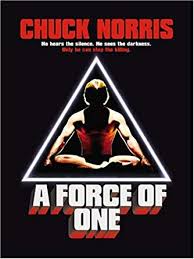
A Force of One (1979)

A FORCE OF ONE

A FORCE OF ONE (1979) Two-and-a-half stars
We should all thank Steve McQueen (1930-80) for the acting career of Chuck Norris, because it was McQueen who encouraged Norris to get into acting.

After all, without Norris’ acting career would there ever have been “Chuck Norris Facts?” Or the lever on “Conan?”

So, thank you, Steve McQueen.

McQueen also had some important advice for Norris after GOOD GUYS WEAR BLACK (1978).

“They said I was the worst thing in 50 years,” Norris said in a 1983 New York Times article. “Well, I wasn’t good, but my feelings were hurt. I said, ‘I’m not trying to be Dustin Hoffman; I just want to project a strong positive hero image on the screen.’ I went to Steve, and he said, ‘In GOOD GUYS, you talk too much. Too much dialogue. Let the character actors lay out the plot. Then, when there’s something important to say, you say it, and people will listen. Anyway, you’ll get better as an actor. You should have seen me in THE BLOB.’”

McQueen seemed to be onto something regarding the quality of Norris movies, because Norris’ best pictures LONE WOLF McQUADE and CODE OF SILENCE both rely on strong casts around Norris: David Carradine, Barbera Carrera, Leon Isaac Kennedy, Robert Beltran, L.Q. Jones, Dana Kimmell, R.G. Armstrong, Sharon Farrell, and William Sanderson (LONE WOLF); Henry Silva, Bert Remsen, Molly Hagan, Dennis Farina, Mike Genovese, and Ralph Foody (CODE OF SILENCE).

A FORCE OF ONE, alas, features a decent supporting cast around Norris — Jennifer O’Neill (she actually receives top billing), Clu Gulager, Ron O’Neal, and Charles Cyphers — and they handle the awfully generic material rather well. We should be grateful for a good supporting cast because. …

I mean, how many times have we seen this plot filmed on TV or even in the movies? We’ve all been here many, many, many times before, sitting through cops, drugs, cop killers, drug lords, et cetera.

Screenwriter Ernest Tidyman’s credits include SHAFT, THE FRENCH CONNECTION, and HIGH PLAINS DRIFTER, heavy duty action credentials.

Tidyman (1928-84), however, was not impressed by A FORCE OF ONE, called it his least successful effort, and said that he only wrote the script to buy his mother a house.

I understand Tidyman’s disappointment with his script.

That said, I enjoyed most of A FORCE OF ONE because it combines a standard issue cops and criminals plot acted out by a good cast with martial arts and a “very subtle” anti-drug message that plays like one of those infamous 1980s TV commercials, only featuring roundhouse kicks.

Wish they would have showed A FORCE OF ONE in D.A.R.E.

Oops, never mind, since all us kiddos are supposed to resist violence.

A FORCE OF ONE loses points and a positive review because of two negative elements.

Dick Halligan’s music hits the viewer like a roundhouse upside the head. I would love to make a joke here referencing either “blood,” “sweat,” or “tears” because Halligan founded the jazz-rock band Blood, Sweat & Tears and played in that group from 1967 through 1972. I just don’t have it today.

All plot roads lead to a final karate showdown between Norris and the main heavy. This is what we wait for all 80 minutes.

Unfortunately, the final karate showdown quickly devolves into slow motion and distorted / echoed vocal effects, plus Halligan’s music returns with a vengeance.

The Manchurian Candidate (1962)

DAY 81, THE MANCHURIAN CANDIDATE

THE MANCHURIAN CANDIDATE (1962) Four stars
John Frankenheimer’s political thriller is one ripped, twisted movie, borrowing famous words from Hunter S. Thompson.

It should make one reconsider both Frank Sinatra and Angela Lansbury, for example.

I did.

Before I first watched THE MANCHURIAN CANDIDATE, I held Sinatra in very little (miniscule) esteem. Maybe it was Phil Hartman’s savage impersonation on “Saturday Night Live.” Maybe it was Sinatra’s appearances on Jerry Lewis’ MDA telethon on Labor Day and when you only have three channels and one of them’s gone all weekend, all booked up, man, we’re talking about Pits City. Maybe it was his crooning that provided the soundtrack for seemingly innocuous yuppie consumption (we all know what seemingly innocuous really means) and little old swooning ladies and every movie that wants to evoke a certain mood just by slapping one of Ol’ Blue Eyes’ standards on every few minutes. Maybe it was the fact that he lived and breathed crusty, old guard establishment, whose reactions to Elvis and the Beatles were not surprising. There was just something about that man that gave me the creeps.

Why, of course, like any child of the 1980s and 1990s, I knew Lansbury from “Murder, She Wrote” and I know I saw her in old Disney entertainments somewhere along the line. I knew that she wasn’t quite this doddering old lady, because, man, if I saw her Jessica Fletcher coming my way, I would have moved to another town or put a down payment on a passport and an one-way plane ticket and move to another country because I know that homicide’s afoot and I want no damn part of it. The homicide rate in Cabot Cove, Maine, must have rivaled Chicago.

So, yeah, in many different ways, THE MANCHURIAN CANDIDATE warped my fragile little mind, including seeing Sinatra as a legitimate dramatic actor and Lansbury as the most wicked mother in screen history. I have no doubt she plays the most wicked mother in screen history, because I don’t want to see anybody else more wicked.

I don’t know if reading or having somebody tell you the plot summary for THE MANCHURIAN CANDIDATE can even adequately convey how messed up the movie’s events are, like this one I just read on the Internets: “Near the end of the Korean War, a platoon of U.S. soldiers is captured by communists and brainwashed. Following the war, the platoon is returned home, and Sergeant Raymond Shaw (Laurence Harvey) is lauded as a hero by the rest of his platoon. However, the platoon commander, Captain Bennett Marco (Sinatra), finds himself plagued by strange nightmares and, together with fellow soldier Allen Melvin (James Edwards), races to uncover a terrible plot.”

Strange nightmares, you can say that again, because they incorporate those Communist brainwashing sessions.

It seems that Shaw’s platoon are surrounded by sweet little old ladies, when in fact they are Chinese and Soviet officials performing their brainwashing routine. Shaw murders two of his men, one by strangulation and one by gunshot through the head. Yet when they come back home, Shaw’s a military hero, just all part of the plan.

These nightmares are very disturbing to watch, of course, and establish the movie’s disorienting tone. We rarely catch a break.

This was one dark movie for 1962 and like DR. STRANGELOVE (1964), it holds up today because of that darkness. In her 1962 review, Pauline Kael said that it may be the most sophisticated political satire ever made in Hollywood. Here we are, decades later, and her statement holds true.

There’s a lot about the plot I don’t want to consider in this space, but there’s still a lot one can discuss considering THE MANCHURIAN CANDIDATE.

For example, it was released October 24, 1962, right in the midst of the Cuban Missile Crisis during which Cold War tensions between the United States and the Soviet Union reached their coldest.

On November 22, 1963, John F. Kennedy was assassinated in Dallas. (THE MANCHURIAN CANDIDATE builds up to an assassination.)

For over two decades, THE MANCHURIAN CANDIDATE became withdrawn from circulation.

Some believe it was because JFK’s assassination had such a toll on Sinatra that he sat on the film.

Apparently, Sinatra had made such a poor deal with United Artists on the film that his attorneys planned for Sinatra to buy the movie’s rights himself and bury his mistake. Sinatra’s plan succeeded in 1972.

Eventually, though, the New York Film Festival organized a 25th anniversary screening of the movie in 1987 and its success led to a theatrical re-release in 1988. Apparently, Sinatra got a better deal this second time. We all got a better deal when THE MANCHURIAN CANDIDATE saw the light of day once again.

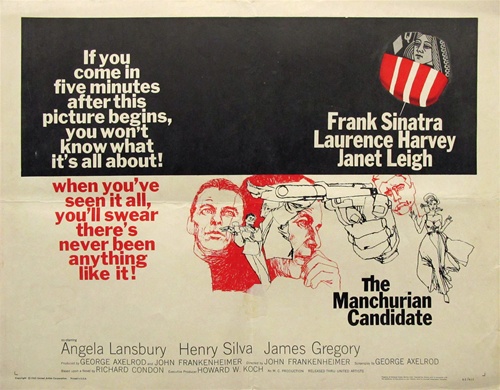
The film’s tagline certainly gets at the truth of the matter: “If you come in five minutes after this picture begins, you won’t know what it’s all about! When you’ve seen it all, you’ll swear there’s never been anything like it!”

The Terminator (1984)

DAY 29, THE TERMINATOR

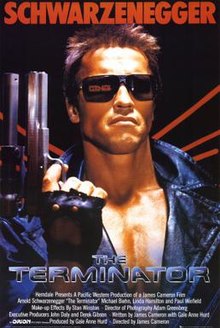
THE TERMINATOR (1984) Four stars
James Cameron said that John Carpenter’s HALLOWEEN inspired him to make THE TERMINATOR, and it’s easy to see that with Arnold Schwarzenegger’s T-800 and Michael Myers, both (virtually) unstoppable killing machines.

Apparently, while in Rome around the time of PIRANHA II: THE SPAWNING, Cameron had a dream about a metallic torso equipped with kitchen knives in hand and dragging itself from an explosion, which almost sounds exactly like a scene late in THE TERMINATOR. This dream became the basis for the film.

Then again, late author Harlan Ellison (1934-2018) claimed that Cameron was inspired by Ellison’s 1964 Outer Limits episode “Soldier” (adapted from Ellison’s own short story) where a future soldier goes back in time to save a present-day woman from another future soldier. I believe Ellison (although he liked the movie) used that nasty ‘P’ word, plagiarism. Ellison received a financial settlement from Hemdale and Orion Pictures, and home video releases of THE TERMINATOR subsequently read “The Producers Acknowledge the Works of Harlan Ellison.”

THE TERMINATOR benefits greatly from the casting of the central roles: Schwarzenegger as the literal force of death and destruction, Michael Biehn as the feisty freedom fighter of the future brought back to the present Kyle Reese, and Linda Hamilton as the present-day young woman Sarah Connor who initially can’t quite believe that she’s in the middle of such a ridiculous plot until Reese (and the corpses) convince her. They fit the roles to a T.

Schwarzenegger has largely played heroic characters and in fact, he’s on the good side for the rest of THE TERMINATOR series. Playing the villain, though, he benefits greatly from speaking few lines (keep in mind his first movie, HERCULES IN NEW YORK, dubbed Schwarzenegger); granted, we have less of the great humor that permeates COMMANDO, PREDATOR, and TOTAL RECALL, but it’s still there with Schwarzenegger as villain with his infamous line “I’ll be back,” for example.

That good spirit and joy of performance still comes through for Schwarzenegger in THE TERMINATOR.

Schwarzenegger plays a more interesting variation on Michael Myers and Jason Voorhees, because those roles in theory can be played by anybody. (Please don’t tell that to Ted White or Kane Hodder.)

Reese explains the situation to Sarah Connor, “That Terminator is out there! It can’t be bargained with. It can’t be reasoned with. It doesn’t feel pity, or remorse, or fear. And it absolutely will not stop … ever, until you are dead!”

Schwarzenegger originally read for the Kyle Reese role and Cameron wanted Lance Henriksen to be the Terminator. Wow, Henriksen as the Terminator just boggles the mind, although Cameron used Robert Patrick to great success as T-1000 in TERMINATOR 2: JUDGMENT DAY. Kristianna Loken as T-X in TERMINATOR 3, well, let’s just say epic fail.
Biehn works better in the Reese role because of all the dialogue and in some ways, he’s like Donald Pleasence’s Dr. Sam Loomis in HALLOWEEN. He understands T-800, even though, of course, nobody believes him until it’s too late.

The Dr. Silberman character (Earl Boen) gets one great scene interrogating Reese and then playing the video back for the Paul Winfield and Henriksen police characters. Dr. Silberman just got out of the police station in the nick of time, and he returns for the sequel.

THE TERMINATOR works as horror movie, as science fiction, and as action, in a streamlined combination of some of the best aspects of HALLOWEEN, BLADE RUNNER, and THE ROAD WARRIOR.

On top of all that, we have a great love story and this element gives THE TERMINATOR the slight edge over JUDGMENT DAY.

Just that scene alone when Reese explains why he accepted the assignment to come back through time and save Sarah Connor, mother of a future resistance leader.

“John Connor gave me a picture of you once,” Reese said. “I didn’t know why at the time. It was very old … torn, faded. You were young like you are now. You seemed just a little sad. I used to always wonder what you were thinking at that moment. I memorized every line, every curve. … I came across time for you, Sarah. I love you; I always have.”

When you go see a movie called THE TERMINATOR, bet you weren’t expecting a genuinely touching love story.

It’s the element of the unexpected that makes for the most rewarding experiences, movies or in general.

King Kong (1976)

KING KONG 1976

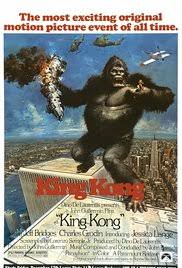
KING KONG (1976) Three-and-a-half stars
Of course this 1976 KING KONG cannot hold a candle to the 1933 version, one of the all-time screen classics.

If and when you and I can get past that fact, admittedly not an easy hurdle, the 1976 version stands out for being a great entertainment.

Jeff Bridges and Jessica Lange are improvements over Bruce Cabot and Fay Wray, respectively, in the male and female leads and Charles Grodin’s not far below what Robert Armstrong did in a similar role.

Of course, you can immediately tell when this movie was made by all the contemporaneous dialogue (especially from Lange) and Grodin plays an executive with Petrox Corporation, a fictional American oil company referencing the “pet rock” phenomenon. This KONG is more bound to 1976 than the original is to 1933.

Beset with production issues of a wide variety, including a complicated legal battle between Paramount, Universal, RKO, and the Cooper estate before filming even started (at one point, both Paramount and Universal had KONG projects lined up), and a first-time leading lady, as well as practical effects that often look more dated than what Willis O’Brien accomplished in 1933, KONG 1976 still works on a basic level.

It is fun.

The stories around the film, though, are more interesting than the finished product and help explain why the hype for the film took on epic proportions before its December 17 premiere.

Italian producer Dino DeLaurentiis (1919-2010) had the Carl Denham quotes in real life: “No one cry when JAWS die,” he said in Time. “But when the monkey die, people gonna cry. Intellectuals gonna love Kong. Even film buffs who love the first Kong gonna love ours.”

Or how about this one about Barbra Streisand told by Roger Ebert: “It’s-a no good, have two monsters in one movie.”

Unfortunately, when Meryl Streep auditioned for the Jessica Lange part, Dino said to his son in Italian that she was “too ugly” for the role; Streep understood Italian and replied in Italian to Dino, “I’m sorry I’m not beautiful enough to be in KING KONG.” We are printing legends, and that only seems appropriate for KING KONG.

Dino talked more smack about JAWS with ORCA THE KILLER WHALE (1977).

Gotta love Dino, whose mouth bit off more than his productions could chew.

Rather than Universal’s competing KONG movie (not released until Peter Jackson’s remake in 2005), the public first received A*P*E, an American / South Korean co-production with its Grade Z special effects, an early appearance for future TV mother Joanna (“Growing Pains”) Kerns, and an infamous shot where the ape uses the middle finger to show his disgust with the helicopters shooting at him.

Either that or he’s just showing his disgust at being trapped in that damn gorilla suit in a shitty movie.

A*P*E would later be topped, in the KING KONG ripoff department, by the Shaw Brothers’ MIGHTY PEKING MAN, the best of the King Kong ripoffs.

There’s also KING KUNG FU from 1976, where a gorilla trained in martial arts wreaks havoc on Wichita, Kansas. Financial constraints forced the makers into not being able to finish their film until 1987.

A*P*E invaded movie screens in October 1976, beating DeLaurentiis’ KONG by a good two months. MIGHTY PEKING MAN came out April 10, 1977, and Quentin Tarantino’s Rolling Thunder Pictures re-released the film on April 23, 1999.

Carlo Rambaldi, Glen Robinson, and Frank Van der Veer won a Special Achievement Award from the Academy of Motion Picture Arts and Sciences for the visual effects in KING KONG, believe it or not.

Legendary make-up artist Rick Baker played Kong, or he’s the man in the ape suit. The original plan had been for KONG ’76 to feature a 40-foot high mechanical ape, but that mechanical monster worked even less than Bruce the Shark in JAWS. JAWS director Steven Spielberg worked around the frequent mechanical failure to make an even better film than if the mechanical shark had been fully operational.

That’s not exactly the case with KONG ’76, partially because musical cues would not be a proper substitute for an ape like John Williams’ musical score proved to be for the shark or even Harry Manfredini’s score for the psycho killer in FRIDAY THE 13TH.

In other words, you have to see the ape.

“KING KONG offered the one chance to do a really perfect gorilla suit,” Baker said. “With the money and the time, it could have been outstanding. Unfortunately, it wasn’t. There were compromises and enforced deadlines.”

Let’s face it, KONG director John Guillermin, he’s no Spielberg.

At the same time, though, I give KONG ’76 and JAWS both three-and-a-half stars. Why?

A) Because life (and my brain) work in mysterious ways.

B) Because star ratings are basically arbitrary.

C) Because both films tap into the same primordial appeal and work as great entertainments for a couple hours each.

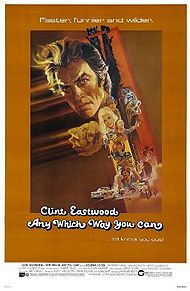
Any Which Way You Can (1980)

ANY WHICH WAY YOU CAN

ANY WHICH WAY YOU CAN (1980) Three stars
If I believed in feeling any guilt whatsoever about feeling pleasure, I might call ANY WHICH WAY YOU CAN a guilty pleasure.

It’s another one of those sublimely ridiculous movie packages that I can’t help but not to like. I mean, it could play on a double bill with ROAD HOUSE.

We all have “guilty pleasures,” and they form one of the most rewarding experiences that we can have at the movies.

If you describe ANY WHICH WAY YOU CAN as a movie with a little bit of everything, that’s still selling it short. I mean, it’s not every day that you have Clint Eastwood in a comedic role, an orangutan named Clyde (played by Buddha and C.J., although there’s no screen credit) who steals every scene that he’s in, a concluding fight scene that can go head-to-head with the later ROCKY sequels and THEY LIVE, a buffoonish motorcycle gang, Ruth Gordon (1896-1985) in what can only be called the “Ruth Gordon” role, and a country song played seemingly every few seconds.

This is the only motion picture that starts with an Eastwood and Ray Charles duet on a little ditty over the opening credits named “Beers for You.”

Personally, I feel the movie could have used more Clyde scenes — more “Right Turn Clyde,” more flipping the bird, more smashing cars, et cetera — and fewer scenes between Eastwood and his real-life partner at the time Sondra Locke. Locke generally became the weak link in Eastwood’s films of the period, and both EVERY WHICH WAY BUT LOOSE and ANY WHICH WAY YOU CAN dramatically prove that as Eastwood demonstrates better chemistry with the orangutan than Locke.

Back to Clyde and Buddha and C.J. Buddha and C.J. assumed the Clyde role for the sequel since Manis — who alone played the role in EVERY WHICH WAY BUT LOOSE — apparently had grown too much between films. Manis returned to his act in Las Vegas.

Reports have it Buddha alone played the role in ANY WHICH WAY YOU CAN and C.J. came on in publicity because Buddha was caught stealing doughnuts on the set near the end of filming and he was brought back to his training facility and beaten for 20 minutes, according to the book “Visions of Caliban: On Chimpanzees and People” by Jane Goodall and Dale Peterson.

Buddha then died soon after of a cerebral hemorrhage.

C.J. went on to star in Bo Derek’s TARZAN THE APE MAN and a NBC sitcom named MR. SMITH.

Executive producer Ed Weinberger said of C.J. in the Washington Post, “It’s a Buddha-like presence. He has wisdom about him. You have to know the animal; I’m in love with him. I’d have him in my house any time.”

MR. SMITH lasted all of 13 episodes from Sept. 22 through Dec. 16 in 1983 and finished a dismal 95th in the Nielsens.

So much for a talking orangutan and who knows if Weinberger had C.J. over at his house after the show flopped big time.

I remember loving ANY WHICH WAY YOU CAN as a young child. It was an affinity for Clyde. He’s what I remembered about the movie for many years before I revisited it decades later.

Not every movie I loved in childhood holds up revisited in adulthood. For example, CANNONBALL RUN, an entertainment I found to be an endurance contest several years back. (For the record, I recently watched SMOKEY AND THE BANDIT, another childhood favorite, again and it held up. I enjoyed Burt Reynolds, Sally Field, Jerry Reed, and Jackie Gleason.)

ANY WHICH WAY YOU CAN is not quite at the same high level as COMMANDO, LONE WOLF McQUADE, and ROAD HOUSE.

That’s because it’s a little flabby with a running time of 1 hour, 56 minutes. Granted, that concluding fight scene between Eastwood and William Smith eats up a good 10 percent of a nearly two-hour experience.

LONE WOLF McQUADE and ROAD HOUSE do have similar run times, but fewer bad scenes than ANY WHICH WAY YOU CAN.

The great director Howard Hawks (1896-1977), born the same year as Ruth Gordon, said that a good movie is “three great scenes and no bad ones.” Not sure that he had movies like ANY WHICH WAY YOU CAN in mind, which does have three great scenes but also some bad ones.

ANY WHICH WAY YOU CAN, though, is one of those sequels better than the original.

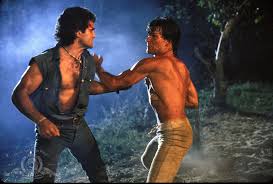
Road House (1989)

ROAD HOUSE

ROAD HOUSE (1989) Three-and-a-half stars
This is the Patrick Swayze (1952-2009) movie that ate all his other movies. More like ripped all the other movies’ throats out. We are talking about ROAD HOUSE, after all.

You can weep to GHOST, you can boogie to DIRTY DANCING, and you can kill Commies to RED DAWN, that’s fine and dandy, whatever floats your boat and tickles your fancy, but ROAD HOUSE is the ultimate Swayze viewing experience, at least for this magnificent bastard.

It is Swayze in Testosterone Hyperdrive, or it should have been titled OVER THE TOP rather than Sylvester Stallone’s epic about child custody, arm wrestling, and truck driving.

“Dalton lives like a loner, fights like a professional. And loves like there’s no tomorrow.”

“The dancing’s over. Now it gets dirty.”

“Dalton’s the best bouncer in the business. His nights are filled with fast action, hot music and beautiful women. It’s a dirty job, but somebody’s got to do it.”

Three taglines for ROAD HOUSE that only hit at the surface of the epic sleaze within the film.

Swayze plays Dalton, who’s not only the world’s greatest bouncer, he’s got a degree in philosophy from NYU. At one point, Dalton shares his general bouncer philosophy to his bouncer troops at the Double Deuce, the world’s roughest bar and the pride of the fictional Jasper, Missouri. (Bet the film’s producers did not know there’s a real Jasper, Missouri.)

“All you have to do is follow three simple rules. 1) Never underestimate your opponent. Expect the unexpected. 2) Take it outside. Never start anything inside the bar unless it’s absolutely necessary. And 3) Be nice.”

I enjoy hearing these rules — every single time — just like in GREMLINS when inventor Rand Peltzer tells his son about his new pet Mogwai, “First of all, keep him out of the light, he hates bright light, especially sunlight, it’ll kill him. Second, don’t give him any water, not even to drink. But the most important rule, the rule you can never forget, no matter how much he cries, no matter how much he begs, never feed him after midnight.”

I enjoy hearing both the rules in GREMLINS and ROAD HOUSE because I know that rules are meant to be broken in the movies. The rules — and a whole lot more, namely bones and plate glass windows — are definitely broken in ROAD HOUSE.

ROAD HOUSE is the most quotable Swayze movie by far.

“Pain don’t hurt.”

“Prepare to die.”

“Nobody ever wins a fight.”

“A polar bear fell on me.”

“You’re too stupid to have a good time.”

“Calling me ‘sir’ is like putting an elevator in an outhouse, it don’t belong.”

“Elvis! Play something with balls!”

“I thought you’d be bigger.”

“I’ll get all the sleep I need when I’m dead.”

“I sure ain’t gonna show you my dick.”

Three lines that you might want to pass on: “I used to fuck guys like you in prison.” “I heard you had balls big enough to come in a dump truck.” “Whaddaya say we get nipple to nipple?”

Sam Elliott strolls into Jasper as Wade Garrett, Dalton’s mentor and friend who rates second best bouncer in the world. Garrett’s salty language would not pass muster with Elliott’s ‘The Stranger’ in THE BIG LEBOWSKI — The Stranger asked The Dude at one point, “Do you have to use so many cuss words?” The Dude replied “What the fuck are you talking about?”

ROAD HOUSE is a Western cast in bar room terms all the way down the line, from the hero to the old mentor to the businessman with an offer for the hero to come in and calm down a rowdy scene to the super villain to the henchmen to the leading lady to the watering hole to a guy named Red. Kelly Lynch plays “Doc,” Dalton’s love interest, and ROAD HOUSE might have showed its only restraint in not choosing “Kitty” for the character’s name. Doc’s real name is the film’s big twist.

Guess we should have expected ROAD HOUSE from a director named Rowdy Herrington.

It was destined to be, especially since Herrington adopted the correct approach: “I saw it as a cartoon,” he said. “Broader than life. Brighter than life.”

Epic bar fights. Live music from a real band. A monster truck. Bouncer philosophy. Boobs. Obligatory Swayze butt shot. All that eminently quotable dialogue, although it would be hard saying any of it if we met arch henchman Jimmy’s fate. By the way, Jimmy’s wardrobe approved by Chuck Norris from INVASION U.S.A. and Ramon Revilla from THE KILLING OF SATAN.

In the film’s bravura climax, we encounter super villain Brad Wesley’s trophy room. True story: Recently visiting the Wonders of Wildlife National Museum in Springfield, Missouri, it called to mind Wesley’s trophy room.

Roger Ebert (1942-2013) found this late scene the key to unlocking the film’s guiding spirit: “His hunting trophies include not only the usual deer and elk and antelopes, but also orangutans, llamas and a matched set of tropical monkeys. This guy went hunting in the zoo.

“We are expected to believe that the sadist financed these hunting expeditions by shaking down the businessmen in a town that, on the visible evidence, contains a bar, a general store, a Ford dealership and two residences. ROAD HOUSE is the kind of movie that leaves reality so far behind that you have to accept it on its own terms.”

That’s right. It’s so ridiculous, so cartoonish, so over-the-top that it becomes highly enjoyable, just like COMMANDO and LONE WOLF McQUADE.

There’s a lot (not a whole lot, though) more that I have to say about ROAD HOUSE, but that can wait for another time down at the Double Deuce.

Don’t worry, it’s cooled down considerably since 1989.

Three favorite character actors in ROAD HOUSE: Sunshine Parker, John Doe (rock musician), and Terry Funk (professional wrestler).

Swamp Thing (1982)

SWAMP THING

SWAMP THING (1982) Three stars
This is the “green” movie I should have watched on St. Patrick’s Day.

Either that or perhaps any of the Incredible Hulk movies or the first SHREK.

Anything, just about anything, would have been preferred over LEPRECHAUN.

SWAMP THING rates as one of those indelible films that leave me with a goofy smile on my face and a warm glow in my heart, probably green colored in this particular case.

It’s been duly noted that filmmaker Wes Craven (1939-2015) earned an undergraduate degree in English and psychology from Wheaton College and a master’s in philosophy and writing from Johns Hopkins. He worked as English teacher before a four-decade film career predominantly associated with exploitation and horror.

Believe it or not, many of his films are informed by his educational, literary background.

Craven’s feature debut THE LAST HOUSE ON THE LEFT (1972) updated Ingmar Bergman’s THE VIRGIN SPRING (1960) for modern times in America; THE VIRGIN SPRING itself told a tale based on a 13th Century Swedish folk ballad incorporating rape, murder, and revenge.

Craven’s third film THE HILLS HAVE EYES (1977) took inspiration from 16th Century Scotland with Sawney Bean and His Cannibal Clan (45 members), responsible for the mass murder and cannibalization of over 1,000 people.

Even Craven’s arguably most famous film, A NIGHTMARE ON ELM STREET (1984), started after Craven read stories in the Los Angeles Times about how Southeast Asian refugees — who fled to the United States after the atrocities in Laos, Cambodia, and Vietnam — began experiencing terrifying nightmares and refused to sleep. Some of these men, ranging from age 19 to 57, even died in their sleep.

Based on a comic book, SWAMP THING, Craven’s fifth feature, was his first attempt to break away from the horror genre that would both be his blessing and his curse.

I suspect that one’s enjoyment of SWAMP THING depends on an individual’s level of sympathy for mad scientists, a megalomaniac and his nasty henchmen, a damsel-in-distress, secret formulas, mutations, comic book action, and Harry (FRIDAY THE 13TH) Manfredini’s relentless music that sounds echoes of his most famous work.

Busty actress Adrienne Barbeau proved to be at the peak of her film career at the time of SWAMP THING — it was the fifth picture in a six-picture run beginning with THE FOG (1980) and continuing with ESCAPE FROM NEW YORK, THE CANNONBALL RUN, THE THING (“Computer Voice”), and SWAMP THING before concluding later in 1982 with CREEPSHOW. She’s at her very best in SWAMP THING, and her very worst in CREEPSHOW.

Barbeau was married to filmmaker John Carpenter from 1979 to 1984, and half of those films listed in the above paragraph came from Carpenter in a flurry of films after HALLOWEEN.

Barbeau’s most famous talents are on display in the “international version” and the original DVD copies in America before viewers complained and had that “smut” recalled. Seriously, who would complain about Barbeau’s boobies, them magnificent mammaries? American DVD and Blu-ray issues since 2005 feature the American theatrical ‘PG’ version, and it would make America great again if we could have the “international version” of SWAMP THING.

Barbeau herself understands what makes SWAMP THING better than one more run-of-the-mill “creature feature.”

“When I read it, I fell in love with the screenplay,” Barbeau said of SWAMP THING. “It was whimsical, and charming, and lovely. I didn’t see it as a horror film. I guess I don’t see it as a horror film to this day, actually. It’s Beauty and the Beast — it’s more of a fantasy or a fairy tale, maybe, in my mind.”

I’ve long had admiration for Boris Karloff as Frankenstein’s Monster and Peter Weller as RoboCop. We can add stunt man and actor Dick Durock (1937-2009) as Swamp Thing to that list.

Like both Karloff and Weller, Durock creates great sympathy for Swamp Thing.

That human element — pieced together with Swamp Thing’s relationship with Alice Cable (Barbeau) — lifts SWAMP THING out of the swamp, if you will.

Just as when the Monster speaks in BRIDE OF FRANKENSTEIN, there’s poignancy when Swamp Thing says a line like “Much beauty in the swamp, if you only look.”

Swamp Thing and Cable have a better relationship than what the Monster and His Bride had in BRIDE OF FRANKENSTEIN. Cable gets far more screen time than the poor Bride, as well.

SWAMP THING has some of the same wit and same spirit as BRIDE OF FRANKENSTEIN.

I always say, “There’s much beauty in B-movies, if you only look.”

They Live (1988)

THEY LIVE

THEY LIVE (1988) Three-and-a-half stars
Back in October 2018, I started writing movie reviews again and sharing them on Facebook so that we could have something else to read other than one more political diatribe or one more unfunny meme taking cheap shots at entire groups of people.

Months later, I will go against the grain and consider THEY LIVE, both an anti-yuppie, anti-Reagan satire and a kick ass 1980s action and science fiction thriller from director John Carpenter.

THEY LIVE came out November 4, 1988 and made $4.8 million during its opening weekend, earning one-third of its box office take.

Four days after THEY LIVE’s opening day, tough-talking and hard-hitting Texan conservative George H.W. Bush crushed soft and elitist Massachusetts liberal Michael Dukakis in the U.S. Presidential Election.

(Though, of course, Bush was born in Massachusetts, attended Yale, and belonged to Skull and Bones, a secret society at Yale, he was not one of the elite to his fervent supporters. Bush’s son, George W. Bush, later riffed on similar associations with Texas and Massachusetts in 2004 against John Kerry. I mean, don’t you know that Massachusetts is the exclusive domain of the most “pussy liberals” and “T is for Tough” just like “T is for Texas.” You can have the utmost faith in a Texan against terrorism.)

Bush could have used THEY LIVE’s most famous one-liner for his campaign slogan, “I have come here to chew bubblegum and kick ass … and I’m all out of bubblegum.”

In the long run, that might have worked out better for Bush — given his popularity after “Operation Nifty Package” and “Operation Desert Storm” — than “Read my lips: no new taxes,” a mantra written by Peggy Noonan for the 1988 Republican National Convention.

Likewise, THEY LIVE would have worked better for Dukakis than a tank, a photo op the Bush campaign used against Dukakis in a memorable 30-second ad with dramatic narration and subtitles, “He opposed new aircraft carriers. He opposed anti-satellite weapons. He opposed four missile systems, including the Pershing Two Missile deployment. Dukakis opposed the Stealth Bomber and a ground emergency warning system against nuclear attack. He even criticized our rescue mission to Grenada and our strike on Libya. And now he wants to be our Commander-in-Chief. America can’t afford that risk.”

“America can’t afford that risk” pops up on a screen mostly filled with the ridiculous image of a smiling Dukakis in that darn tank, topped off by that even more ridiculous name-tagged helmet “Mike Dukakis.” Dukakis looks like an absolute fool, an absolute tool, even worse than “strategic guest star” Eddie Murphy in BEST DEFENSE. Who would vote for this clown?

The Democrats would have been so much cooler if they had been able to latch on to THEY LIVE for the 1988 presidential campaign.

No, as we all know, they failed.

Just imagine an ad with Dukakis sitting at home watching the Republican National Convention and he puts on the THEY LIVE shades, revealing all the Republicans to be aliens. Their real agenda also shows up on screen: CONSUME — OBEY — SUBMIT — WATCH TV — BUY — MARRY REPRODUCE — DO NOT QUESTION AUTHORITY — NO THOUGHT — WORK 8 HOURS. (This would also work against the Democrats.)

I bet nobody can remember any negative campaign ad against Bush in the 1988 Election … but we all remember Willie Horton and “Revolving Door” against Dukakis painting him in broad ideological strokes. Again, leftist = wimp, conservative = tough guy.

It worked and still works.

I mean, where would Donald Trump be without such macho, tough guy associations?

You can just chuck any claims on “family values” and “Moral Majority” right out the window.

“I moved on her, and I failed. I’ll admit it.

“I did try and fuck her. She was married.

“And I moved on her very heavily. In fact, I took her out furniture shopping. She wanted to get some furniture. I said, ‘I’ll show you where they have some nice furniture.’ I took her out furniture — I moved on her like a bitch. But I couldn’t get there. And she was married. Then all of a sudden I see her, she’s now got the big phony tits and everything. She’s totally changed her look. …

“I better use some Tic Tacs just in case I start kissing her. You know I’m automatically attracted to beautiful — I just start kissing them. It’s like a magnet. Just kiss. I don’t even wait. And when you’re a star, they let you do it. You can do anything. Grab ‘em by the pussy. You can do anything.”

Now there’s a campaign slogan for your average Republican or Democrat candidate in an Election coming soon to a screen near you — I CAN DO ANYTHING.

(For the record, I think Trump, Bill Clinton, Hillary Clinton, Spike Lee, Ted Nugent, Rush Limbaugh, and Alec Baldwin are flip sides of the same coin.)

So THEY LIVE mixes liberal and radical ideology with, let’s face it, conservative ass kicking or “Rambo Meets The Sandinistas.”

THEY LIVE’s poster: “You see them on the street. You watch them on TV. You might even vote for one this fall. You think they’re people just like you. You’re wrong. Dead wrong.”

Carpenter, under the name “Frank Armitage,” adapted Ray Nelson’s 1963 short story “Eight O’Clock in the Morning.” Nelson and Philip K. Dick were friends and even co-conspirators on the 1967 alien invasion novel “The Ganymede Takeover.”

On the eve of the 2012 Election, Carpenter talked with “Entertainment Weekly,” “Well, THEY LIVE was a primal scream against Reaganism of the ‘80s. And the ‘80s never went away. They’re still with us. That’s what makes THEY LIVE look so fresh — it’s a document of greed and insanity. It’s about life in the United States then and now. If anything, things have gotten worse.”

In the same interview, Carpenter touched on why aliens should be evil and why professional wrestler — which should be synonymous with “professional actor” — Roddy Piper (1954-2015) landed the gig of the protagonist John Nada.

“First of all, I was a wrestling fan when I was young. Even when I figured out what wrestling was, I was still a fan. To me, Roddy just had a weathered face and looked like he’d been working all his life. He wasn’t a Hollywood star. He had some scars on his face and I thought he would be convincing walking into town with a backpack on his back looking for work. I’d met Roddy at Wrestlemania 3 in Pontiac, Michigan. He was a great heel.”

Piper works his way around one-liners every bit as effectively as both Clint Eastwood and Arnold Schwarzenegger.

Not only the epic “bubblegum,” but also “Either put on these glasses or start eating that trash can,” “It looks like you dipped your face in the cheese dip back in 1957,” “That’s like pouring perfume on a pig,” and “Life’s a bitch, and she’s in heat.”

Piper was one of the all-time great wrestling trash talkers and that served him (and us) well in THEY LIVE.

Keith David plays the character Frank Armitage and we remember David from PLATOON, where he proved a nice counterpoint to Charlie Sheen’s green protagonist, especially in the first part of the film.

For example, in this dialogue, “Shit. You gotta be rich in the first place to think like that. Everybody know the poor are always being fucked over by the rich. Always have, always will.”

Piper and David have one of the memorable fights in THEY LIVE. “South Park” later paid tribute with a Timmy and Jimmy brawl.

Piper and David slug it out for a good six minutes — just because Dada wants Frank to put on the shades and Frank demurs — and in a 2015 article, Vulture starts out, “The fight lasts for six minutes and purportedly serves no purpose; its incomprehensible duration is the joke, and in lieu of a punch line, Carpenter gives us punches.”

Wrong, in that it serves no purpose.

For one, it’s a showcase for the professional wrestler.

Secondly, Piper and David wanted a real brawl, according to info found on IMDb, only faking hits to the face and groin. Apparently, the duo rehearsed their fisticuffs for three weeks. Their final brawl impressed Carpenter so much that he left every single bit of it in the film. The plans had originally been for a 20-second fight.

Finally, viewers have read it as a metaphor for working class people fighting each other rather than fighting their real enemies and that we are wasting our precious time in that fight amongst ourselves.

Six minutes in a movie could symbolize a lifetime in reality.

Victory (1981)

VICTORY

VICTORY (1981) Three stars
It’s hard to believe that any movie directed by the late John Huston (1906-87) and starring Michael Caine and Sylvester Stallone could possibly be a “buried treasure,” but that’s definitely the case for 1981’s VICTORY in North America or ESCAPE TO VICTORY in international markets.

Huston, born in Nevada, Missouri, to actor Walter and sports editor Rhea (who gave up her career after her son was born), debuted with THE MALTESE FALCON in 1941 and his distinguished directorial career included THE TREASURE OF THE SIERRA MADRE, THE ASPHALT JUNGLE, THE RED BADGE OF COURAGE, THE AFRICAN QUEEN, BEAT THE DEVIL, THE MISFITS, FAT CITY, THE MAN WHO WOULD BE KING, WISE BLOOD, ANNIE, UNDER THE VOLCANO, PRIZZI’S HONOR, and his final movie, THE DEAD, in 1987.

Huston directed four more films after VICTORY.

Huston previously directed Caine in THE MAN WHO WOULD BE KING (1975) and Caine’s an actor who has persevered through many a bad movie during his nearly seven-decade career, including such epic disasters as THE SWARM, BEYOND THE POSEIDON ADVENTURE, BLAME IT ON RIO, and JAWS: THE REVENGE. (Caine did not accept his Academy Award for Best Supporting Actor for HANNAH AND HER SISTERS in person because he was making JAWS: THE REVENGE, a role for which he famously stated, “I have never seen it, but by all accounts it is terrible. However, I have seen the house that it built, and it is terrific.” Honestly, Caine gave a better performance in the 1984 Madness song “Michael Caine.”)

Stallone has mostly struggled outside the ROCKY and RAMBO franchises.

If you’ve seen THE GREAT ESCAPE, THE LONGEST YARD, and ROCKY, for example, then you’ve basically seen VICTORY, a movie built along similar lines except for it substitutes fútbol for football (THE LONGEST YARD) and boxing (ROCKY). It leads up to both a big game and the great escape from Nazis in the grand finale, and it features several training sequences as this ragtag group of war prisoners takes on the German national team in a propaganda soccer match.

Although VICTORY is a very predictable movie, it’s a rousing crowd pleaser just like THE GREAT ESCAPE, THE LONGEST YARD, and ROCKY before it.

You do feel good watching it.

Normally, action movies with an international cast (like VICTORY) bite the big one. Not here and it’s not your average international action spectacular cast.

Here, we have soccer players Pele from Brazil, Bobby Moore, Russell Osman, and Mike Summerbee from England, Osvaldo Ardiles from Argentina, Paul Van Himst from Belgium, Kazimierz Deyna from Poland, Co Prins from Holland, John Wark from Scotland, Soren Linsted from  Denmark, Halivar Thoresen from Norway, and Kevin O’Callaghan from Ireland.

That’s just the Allied team.

Caine and Stallone play soccer in the movie, although we can be thankful Caine used a double, professional football player Kevin Beattie. Paul Cooper’s credited for being Stallone’s double, although Stallone insisted on his own work during the big match.

Stallone initially blew off training from England’s World Cup winning goalkeeper Gordon Banks. In a 2015 interview, Pele talked about Stallone and the movie.

“When I got the first script I was a goalkeeper and Stallone was a forward,” Pele said. “I said, ‘Listen, I can’t play as a goalkeeper.’ When we started training for the film, we saw Stallone knew nothing about football. We teased him because he didn’t even know how to kick a ball. Michael Caine was my teacher. He’d call me over and say, ‘Pele, you must be more patient — this is a film, not reality.’ He was fantastic.”

Stallone dislocated a shoulder and broke his ribs a couple times during filming.

Ardiles said of the 47-year-old Caine and his physical and soccer abilities, “Awful, and he couldn’t even run 20 yards.”

Acting wise, though, Caine blows Stallone right off the screen in VICTORY and gets us more from the beginning to the end of the picture than his American counterpart.

Stallone’s not very good in VICTORY.

Apparently, Stallone antagonized cast and crew by eating by himself and flying off to either London or Paris every weekend on his private jet.

Also, Stallone reportedly insisted that he end the film on the note of a game-winning goal. “A game-winning goal from a goalkeeper?” Ridiculous.

That’s why the match ends on a penalty kick where, you guessed it, Stallone makes the save that saves the day.

In “Booked! The Gospel According to our Football Heroes” by John Smith and Dan Treifer, Wark talked about the film with much praise for Caine and the opposite for Stallone.

“Stallone was nowhere near as sociable. He and his entourage, which comprised several minders, were even booked into a different hotel.”

Wark touched on Stallone and a prisoner shower scene in the movie, “We spotted that Stallone preferred to wear a pair of mini briefs and all these years later I still can’t help wondering what ‘Rocky’ wanted to keep hidden from us.”

In the same book, it’s said by Pele that Stallone refused to allow anybody else to sit in his chair on the set and by Ardiles that it took Stallone at least 17 takes before he could make the save on the penalty kick.

You can bet the film’s writers took it all hard.

Yabo Yablonsky, one of two screenwriters and one of three credited for the story, apparently hated the revisions so much that he contemplated taking his own life upon seeing the finished project.

Stallone later made OVER THE TOP, that 1987 epic combining arm wrestling, child custody, and truck driving.

That brings us to a story involving Stallone and professional footballer Beattie.

Beattie told the East Anglian Daily Times in 2008, “We had finished for the day and I was at the bar with Russell Osman and John Wark and we were winding each other up. Somehow we started chatting about arm wrestling and there was a lot of laughing and joking.

“I was just sitting there and Stallone came over and asked if I’d like to give him an arm wrestle. I said, ‘By all means, no problem.’

“He had muscles on his muscles but I don’t remember him being that tall. I just thought I’d give it a go — I’d always been quite strong. Anyway, I ended up beating him and I don’t think he talked to me again for the rest of the film!

“Stallone got a bit of a shock but it’s a good claim to fame. I guess I was naturally strong. I used to carry the bags of coal for my dad and when I was at the gym at Portman Road, I was one of the only ones who could lift all the weights.”

I’d prefer footage of Beattie and Stallone arm wrestling in a bar over all of OVER THE TOP.

That’s because I take my arm wrestling without child custody and truck driving.