Message from Space (1978)

MESSAGE FROM SPACE

MESSAGE FROM SPACE (1978) *

It took two tries to make it all the way through Kinji Fukasaku’s MESSAGE FROM SPACE, one of the first of many STAR WARS rip-offs that only make you appreciate more what George Lucas and gang did in their movies.

How does MESSAGE FROM SPACE rip off STAR WARS? Let us count the ways. A soap, er, space opera, characters named Meia and Hans, a robot, interplanetary strife and destruction, aerial dogfights in space, laser beams, and a musical score by Kenichiro Morioka that should have been enough for grounds for a lawsuit from 20th Century Fox, John Williams, and the London Symphony Orchestra.

I struggled through MESSAGE FROM SPACE and it was a real cinematic endurance contest to get through its 105 minutes. I only made it through about 30 minutes the first try.

At one point in time, I thought about cutting MESSAGE FROM SPACE a little slack for its often lousy special effects, until I read that MESSAGE FROM SPACE cost $5-6 million. Okay, that’s about half of what 20th Century Fox spent on STAR WARS the previous year, but the budget for MESSAGE FROM SPACE apparently established a record (long since broken, of course) for largest budget for a Japanese movie. There went the slack, she be gone.

Vic Morrow (1929-82) sadly found himself at that stage in his career when he appeared in awful movies like HUMANOIDS FROM THE DEEP, GREAT WHITE, and MESSAGE FROM SPACE. Work is work is work, right? In MESSAGE FROM SPACE, Morrow plays a character named General Garuda and receives top billing in the cast above Sonny Chiba. Garuda Indonesia is the airline of Indonesia. Morrow seems to be drinking in every scene and if you had to act with an imitation R2-D2 named Beba, you’d be a full-blown alcoholic too.

This is one of those films not exactly helped out by a bad dubbing job.

I am normally one equipped with more empathy and enthusiasm than the average cinematic pleasure seeker for movies like MESSAGE FROM SPACE. I mean, for crying out loud, I have given four stars to INFRA-MAN, DRUNKEN MASTER, and PLAN 9 FROM OUTER SPACE, three incredibly ridiculous movies that immediately came to mind.

I just found scant pleasure to be experienced from MESSAGE FROM SPACE.

Hard to believe, right, when MESSAGE FROM SPACE features eight Liabe seeds. They resemble walnuts, glowing, magical walnuts that are the unifying plot device; bet Nuts.com would do killer business with a MESSAGE FROM SPACE remake. Rather than The Force, MESSAGE FROM SPACE only manages doze nuts. Bad joke, I know right, but the bad movie made me do it. I promise, I promise, I would never write anything like that otherwise.

A Boy and His Dog (1975)

A BOY AND HIS DOG

A BOY AND HIS DOG (1975) ***

Forgive me for giving away the ending of A BOY AND HIS DOG: The Boy chooses The Dog over The Girl.

Then again, I am not sure I gave away the ending any one bit more than a title like A BOY AND HIS DOG. Yeah, right, it’s not called A BOY AND HIS GIRL.

Character actor L.Q. Jones, a favorite of the director Sam Peckinpah (1925-84), wrote, directed, and produced A BOY AND HIS DOG, adapted from Harlan Ellison’s 1969 short story “A Boy and His Dog.” Just take a look at the film’s poster: “The year is 2024 … a future you’ll probably live to see” and “a boy and his dog: an R rated, rather kinky tale of survival.” That part about A BOY AND HIS DOG being kinky, it’s no lie. Jones, in fact, makes a cameo in the porno movie within the movie.

In post-apocalyptic times, it quickly becomes apparent that a boy and his dog need each other more than ever before.

Especially this boy. He’s named Vic (Don Johnson). He’s 18 years old. He’s obsessed with sex and food, in just that order. Both his parents are gone. He lacks formal education and his ethics and morality are naturally twisted by the world he lives in. He’s a survivor, by any means necessary.

Meanwhile, his telepathic dog named Blood (voiced by Tim McIntire) is one helluva smart and savagely witty canine. He’s better than Benji! Benji, when he was voiced by Chevy Chase in OH! HEAVENLY DOG, never uttered anything like “I hope the next time you play with yourself, you go blind” or “Pull up your pants, Romeo.”

Vic and Blood have worked themselves out a nice little survival pact, at least until the lovely and sassy lass Quilla June Holmes (Susanne Benton). She knows how to appeal to Vic, but good old hound Blood knows a no-count hooch when he sees (and smells) one.

She’s been sent above ground by her powerful father from another world (Jason Robards) to scout talent for a sperm donor to perpetuate the species of underground survivors. Of course, Vic has got the super sperm necessary for the job, a fact Miss Holmes finds out firsthand. She ditches the boy and his dog and returns below ground, proving that Blood definitely sniffed out her wily ways.

Blood advises Vic not to chase the girl and go below ground, but the perpetually horny Vic lets his libido be his guide. Vic asks Blood to wait above ground for his return.

After boy and girl escape the underworld in harrowing fashion, they find Blood and he’s barely alive. That’s when The Boy faces his choice between The Dog and The Girl. Feed her to the dogs, indeed.

A BOY AND HIS DOG makes a strong case that dames are a dime a dozen even in a post-apocalyptic world, but dogs like Blood are truly a rare breed.

The Warriors (1979)

THE WARRIORS

THE WARRIORS (1979) Three-and-a-half stars

David Patrick Kelly belongs in the Actors Who We Love to Hate Hall of Fame, right alongside such performers as Thomas F. Wilson (for his work as 1955 Biff, 1985 Biff, alternate 1985 Biff, 2015 Biff, Griff, and Buford “Mad Dog” Tannen in the BACK TO THE FUTURE trilogy) and Michael Moriarty (Q: THE WINGED SERPENT).

You might remember Kelly from COMMANDO as Sully, the creep who John Matrix promised to kill last because, you know, Matrix liked Sully … well, Matrix lied and Sully took a great fall. Or maybe DREAMSCAPE starring Dennis Quaid and Kate Capshaw, where the name of Kelly’s would-be presidential assassin, Tommy Ray Glatman, suggests Lee Harvey Oswald, John Wilkes Booth, and James Earl Ray.

Kelly made his motion picture debut as Luther in Walter Hill’s 1979 cult classic THE WARRIORS and Kelly plays a great creep right straight out of the box. Hill later cast Kelly as (a different) Luther in 48 HOURS.

Luther assassinates charismatic, visionary street gang leader Cyrus (Roger Hill) in an early scene and the Warriors from Coney Island are framed as the assassins. The police and every street gang in New York City want them Warriors bad, real bad. The Warriors’ long, harrowing journey back home makes up the vast majority of the movie.

Kelly delivers the goods in every scene that he’s in.

Swan (Michael Beck), the leader of the Warriors, and Luther, the leader of the Rogues, are finally face-to-face late in the picture. Thankfully, because everything’s been leading up toward showdown, Swan asks Luther the burning question we’ve been wanting to ask him ourselves, you know, why’d you do it, why’d you waste Cyrus? In an answer that makes THE WILD ONE proud, Luther says, “No reason. I just … like doing things like that!”

Just a few minutes earlier, Kelly begat the world the famous “Warriors, come out to play,” made famous by the way he said it.

Kelly alone earns THE WARRIORS three stars.

THE WARRIORS is a chase movie, predominantly on foot, and a survival of the fittest movie. It’s one of those great entertainments where you can find deeper messages or merely just sit back and enjoy Hill’s ability to stage larger-than-life action scenes, the colorful characters, and the approximately 90-minute tour of large city street gangs.

In addition to our title characters, we have the Turnbull AC’s, the Orphans, the Baseball Furies (they naturally brandish baseball bats and Kiss-like face paint, combining two of Walter Hill’s two loves), the Lizzies, the Punks, the Rogues, the Riffs (Cyrus’ former gang), the Boppers, the Boyle Avenue Runners, the Electric Eliminators, the Gladiators, the Hi-Hats, the Hurricanes, the Jones Street Boys, the Moonrunners, the Panzers, the Saracens, the Satans Mothers, the Savage Huns, the Van Cortland Rangers, and there’s a whole slew of gangs listed in Hill’s original script.

These gangs have a meeting in the Bronx and that’s when Luther kills Cyrus. All hell breaks loose with our title characters, eight gang members, at the center of the mayhem. The Warriors have more than 20 miles to go from the Bronx to their Coney Island home. It takes about 2 hours via mass transit, so THE WARRIORS feels like it plays out in real time.

Another stylistic flourish in a film overflowing with them involves a female DJ (face of Lynne Thigpen, voice of Pat Floyd) who’s the voice of the street gangs. “All right now, for all you boppers out there in the big city, all you street people with an ear for the action, I’ve been asked to relay a request from the Gramercy Riffs. It’s a special for the Warriors, that real live bunch from Coney, and I do mean the Warriors. Here’s a hit with them in mind.” Her apology to the Warriors at the end comes in the form of Joe Walsh’s “In the City.”

Real-life violence, allegedly inspired by seeing THE WARRIORS itself, unfortunately soured the reaction to the film in early 1979. Tony Bill, who produced his own gang film (BOULEVARD NIGHTS) that was protested in early 1979, said in People Magazine, “It makes sense that a movie that basically glorifies violence would attract violence.” Co-screenwriter David Shaber said THE WARRIORS was Sesame Street compared to a Sam Peckinpah movie (like THE WILD BUNCH). Paramount VP Gordon Weaver said of the violence, “[It’s] the sort of thing that happens at rock concerts, high school basketball games and any place where diverse groups meet. It could have happened anywhere.”

Similar controversies unfortunately later swirled around such films as DO THE RIGHT THING, NEW JACK CITY, and BOYZ N THE HOOD.

Grand Theft Auto (1977)

GRAND THEFT AUTO

GRAND THEFT AUTO (1977) Three stars

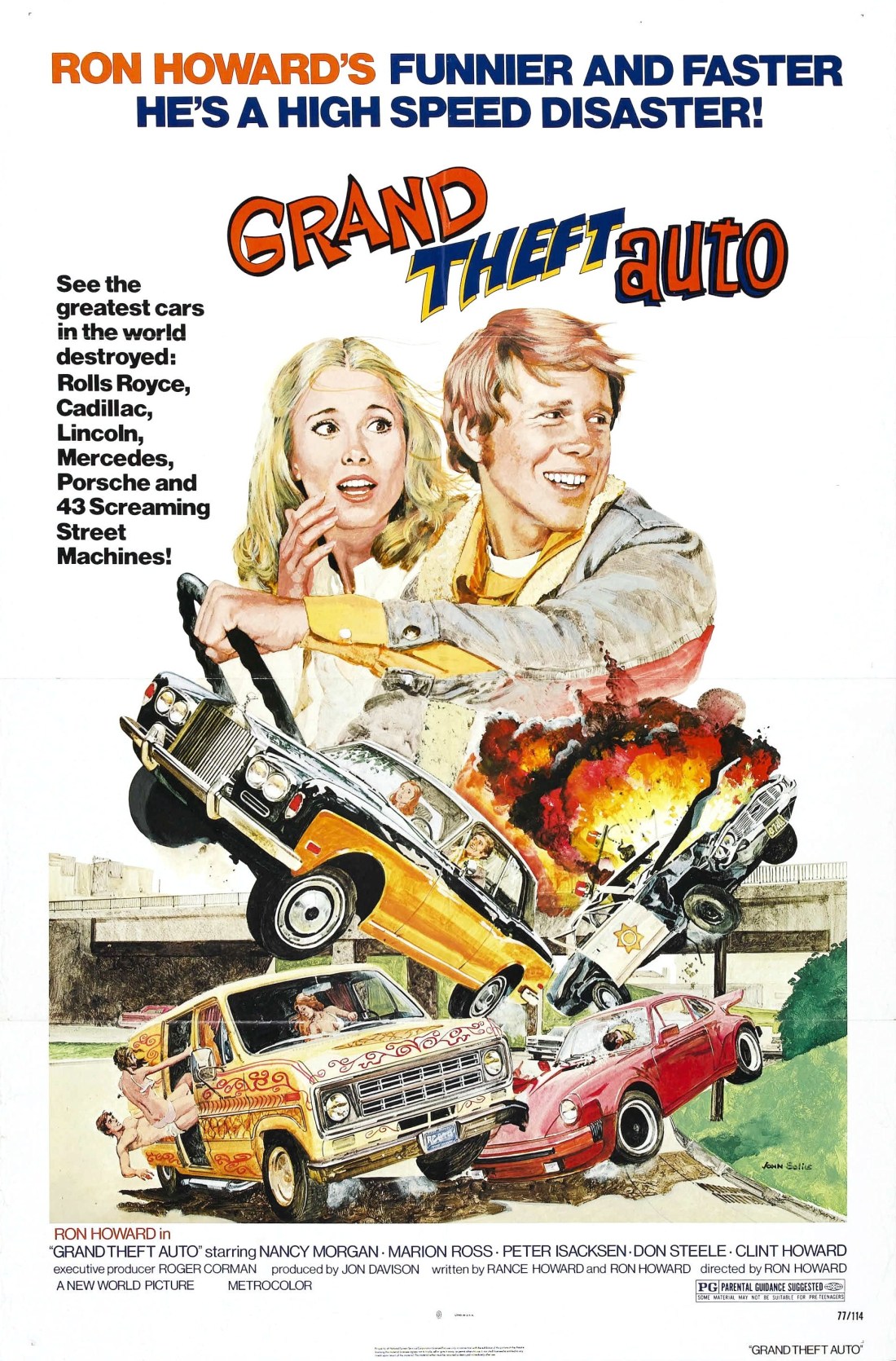
I just love the poster for GRAND THEFT AUTO, Ron Howard’s feature debut as director.

It advertises “See the greatest cars in the world destroyed: Rolls Royce, Cadillac, Lincoln, Mercedes, Porsche and 43 Screaming Street Machines.”

Sounds like my kind of picture.

RON HOWARD’S FUNNIER AND FASTER

HE’S A HIGH SPEED DISASTER!

A drawing of Nancy Morgan aghast and Howard with that All-American smile on his face and his left hand on the steering wheel. Below the young lovebirds are flames and crashes. Sure does resemble a drive-in movie from 1977.

Howard directed, starred in, and co-wrote this picture for New World, produced by Jon Davison and executive produced by Roger Corman. Howard kept some of GRAND THEFT AUTO in the family with father Rance a co-star and co-writer and brother Clint a co-star. It’s no small wonder that Howard earned a reputation for being one of the nicest guys in Hollywood.

Howard did not sell his soul to the Devil to get the picture made. No, instead, he made a deal with Mr. Corman. Howard agreed to star in EAT MY DUST! from 1976 if he could have a crack at directing. The rest is history and Howard’s directorial credits number 32, including Academy Award for Best Picture winner A BEAUTIFUL MIND. His other credits include NIGHT SHIFT, SPLASH, PARENTHOOD, FAR AND AWAY, THE PAPER, APOLLO 13, and FROST/NIXON.

Made for a reported $600,000 on down time for Howard from “Happy Days” (No. 1 show on TV in 1976-77 and No. 2 in 1977-78), GRAND THEFT AUTO tells a simple story.

Paula Powers (Morgan) loves her boyfriend Sam Freeman (Howard) and they want to get married, but her wealthy parents, especially her gubernatorial candidate father, oppose this pairing, taking Mr. Freeman for a gold digger. Paula’s parents want her to marry the wealthy Collins Hedgeworth (Paul Linke), who’s such a blasted tool he spends the movie in his jockey outfit. Paula steals her father’s Rolls Royce and Sam, and they plan to get married in Vegas. There ends up being a $25,000 reward for Paula and then a $25,000 price tag for Collins.

Seemingly all of California (and Nevada) pursues Paula and Sam, as well as Collins.

Collins alone goes through at least three cars in his first few minutes of screen time. What a schmuck! His overprotective mother, played by America’s Sweetheart and Howard’s TV mother Marion Ross, is the one responsible for the reward for Collins and it is one of the undeniable highlights of the movie to hear Marion Ross say “Piss off!” Even a preacher (Hoke Howell) goes after the money. Sleazy DJ Curly Q. Brown (Don Steele) eventually takes to the air in a whirlybird and he tells Mr. Freeman on the air, “Well, if you have it, I’m going to report it. Because every time you turn around and fart, it’s news.” The film especially picks up once Curly Q. Brown starts his play-by-play of the chase across California and Nevada.

The plot also includes a Helicopter vs. Rolls Royce showdown, a bridge blown up real good, and a Demolition Derby. The 1970s were the glory days for the car chase and GRAND THEFT AUTO belongs alongside DUEL, MAD MAX, CONVOY (both movie and song), SMOKEY AND THE BANDIT, THE FRENCH CONNECTION (chase scene), and several other pics.

Do Paula and Sam get married (and live happily ever after)? Well, I would never dream of revealing such an ending, although I told my wife after she asked me if they got married. I will compromise, though, and duly note GRAND THEFT AUTO saves its best demolition for last.

Code of Silence (1985)

CODE OF SILENCE

CODE OF SILENCE (1985) Three-and-a-half stars

CODE OF SILENCE and LONE WOLF McQUADE are the best Chuck Norris movies.

They are the ones for people who otherwise grunt and groan at the possibility of watching a Chuck Norris movie. You know, individuals who go, “Ugh, I don’t like Chuck Norris, his movies are so dumb and stupid. They’re ridiculous and redneck.” Then, there’s other people who only want to watch Norris on “Walker, Texas Ranger” re-runs 24 hours a day 365 days a year because they have little tolerance for movie violence and vulgarity.

Let’s get a few things straight: I don’t especially care for Norris’ ultra-conservative politics (he predicted 1,000 years of darkness if Obama won a second term). I hate those darn infomercials that he did with Christie Brinkley plugging exercise machines. I cannot stand “Walker, Texas Ranger,” except for when clips were used for the “Walker, Texas Ranger Lever” on Conan O’Brien. I hate that he sued “Chuck Norris Facts” author Ian Specter because “Mr. Norris is known as an upright citizen to whom God, country, and values are of paramount importance” and “Mr. Norris also is concerned that the book may conflict with his personal values and thereby tarnish his image and cause him significant personal embarrassment.” I often dislike the use of slow motion in many Norris pictures, like, for example, at the end of A FORCE OF ONE and I cannot decide if that ridiculous echoed voice-over in THE OCTAGON is the worst or the funniest thing I have ever heard. Finding all his voice-overs compiled into a 4-minute, 20-second YouTube video, I vote for the latter. I will one day write a review of THE OCTAGON in the style of that voice-over; I remember Richard Meltzer’s review of the Creedence album PENDULUM with a built-in echo. For whatever reason, Norris’ inner monologues in THE OCTAGON call to mind Ted Striker’s cockpit moment when he hears echo and Manny Mota pinch-hitting for Pedro Borbon. THE OCTAGON voice-over is even funnier than the one in AIRPLANE! I understand that I like watching old Norris movies for their camp and nostalgic value. I’d rather watch one than listen to a Ted Nugent album (or song). I apologize for (possibly) coming on so defensive about Carlos.

In the pantheon of action stars, Norris rates below Clint Eastwood, Steve McQueen, Jackie Chan, Bruce Lee, Arnold Schwarzenegger, and Sylvester Stallone. He’s never made a movie quite at the level of THE GOOD, THE BAD AND THE UGLY, THE GREAT ESCAPE, DRUNKEN MASTER, ENTER THE DRAGON, the first two TERMINATOR movies, and ROCKY. Norris belongs in the second tier of action stars.

Back to CODE OF SILENCE (and LONE WOLF McQUADE).

Both movies have good supporting casts — for example, CODE OF SILENCE surrounds Norris with quality character actors like Henry Silva, Bert Remsen, Dennis Farina (before he became a full-time actor), Ralph Foody, Ron Dean, and Joseph F. Kosala.

Andrew Davis directed CODE OF SILENCE, his first action picture, and his later credits include ABOVE THE LAW, THE PACKAGE, UNDER SIEGE, THE FUGITIVE, CHAIN REACTION, and COLLATERAL DAMAGE. THE FUGITIVE, one of the best films of 1993, was nominated for seven Academy Awards, including Best Picture, and good old grizzled Tommy Lee Jones won an Oscar for Best Supporting Actor. He’s a good director, certainly the best of any Norris movie.

At this point in his career, Norris wanted to distance himself somewhat from his karate and become a more polished, all-purpose action star. If all his subsequent movies were more like CODE OF SILENCE, he would have been onto something, but, alas, Norris returned to third- and fourth-rate product like FIREWALKER and MISSING IN ACTION III before finding his greatest commercial success on TV.

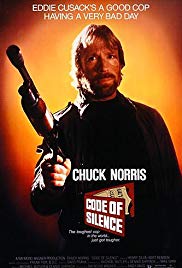
In CODE OF SILENCE, Norris plays Chicago policeman Eddie Cusack, who finds himself in the middle of a gang war all while he’s alienated himself from his fellow officers (barring one, his former partner) for breaking the “code of silence” by standing and testifying lone wolf like against a veteran officer (Foody) accused of killing an unarmed teenager.

Norris enlists Prowler on his side for the final confrontation, Prowler a police robot with a tremendous arsenal that kills bad guys good.

We do see one particularly rare scene in any Norris movie: He gets knocked around real good by a group of thugs. That’s not happened often to Norris since he took on Bruce Lee late in WAY OF THE DRAGON.

Between his work in CODE OF SILENCE, ABOVE THE LAW, and THE FUGITIVE, Davis showed himself to be a master of scenes involving the ‘L,’ Chicago’s elevated train rapid transit system that we have seen on many films and shows. There’s a chase and fight scene on top of the ‘L’ in CODE OF SILENCE that belongs with Norris’ flying kick through a windshield in GOOD GUYS WEAR BLACK and driving his super-charged Dodge Ramcharger out of the grave in LONE WOLF McQUADE as the best Norris moments.

The Delta Force (1986)

THE DELTA FORCE

THE DELTA FORCE (1986) Three stars

Watching THE DELTA FORCE for the first time in 30 years, it surprised me in three ways.

First, it accumulates a running time of 2 hours, 5 minutes.

Second, the heavy action does not kick in until about 1 hour, 15 minutes in.

Third, it’s more thoughtful than expected, given that it is a Golan-Globus production starring Chuck Norris and featuring a cast of many highlighted by hostages Martin Balsam, Joey Bishop, Lainie Kazan, George Kennedy, and Shelley Winters, actors who initially suggest the movie would quickly become AIRPORT ‘86.

About that running time, let’s see here, RAMBO: FIRST BLOOD PART II and COMMANDO, both from 1985, clock in at approximately 96 and 92 minutes, respectively. Then again, Norris’ previous cinematic crusade against terrorism, INVASION U.S.A., lasts 110 minutes.

Once the action does kick in, it kicks in real good in THE DELTA FORCE and it especially delivers the goods with shit blown up real good just like an old school action movie should. Of course, I hope the demolition experts were paid real good.

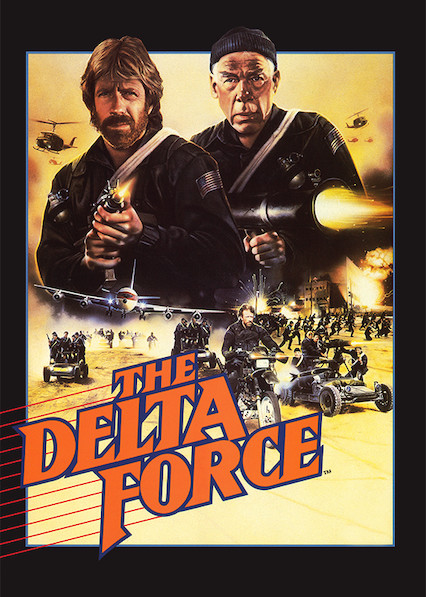
The action truly begins with a chase: Major Scott McCoy (Norris) and his Delta Force colleague are pursued by Lebanese terrorists through Beirut and one terrorist vehicle crashes into a poor defenseless fruit cart and melons fly everywhere. Ah, yes, this is one of the better fruit cart scenes in history because they used both slow motion and big melons. I say the bigger the melons, the better the fruit cart scene.

I have argued the best Chuck Norris movies are the ones with the best supporting casts and THE DELTA FORCE definitely upholds that argument. Other cast members include Robert Forster, Hanna Schygulla (it’s a long way from Rainer Werner Fassbinder melodramas to Chuck Norris action spectaculars), Susan Strasberg, Bo Svenson, and Robert Vaughn. The great Lee Marvin (1924-87) also plays a key role in his final movie performance. Of course, Marvin brings his association with THE DIRTY DOZEN.

This is Norris’ best supporting cast, though I still rate THE DELTA FORCE slightly below LONE WOLF MCQUADE and CODE OF SILENCE overall.

Palestine born Menahem Golan (1929-2014) wrote, produced, and directed the film, which takes an undeniable pro-Israeli, pro-Jewish position. Golan served in the Israeli Air Force as a young man, long before he and his younger cousin and business partner Yoram Globus attempted to conquer the international film market.

Call me a fool and slap me silly, but it seems that Golan paid a lot more attention and dedicated more craft to THE DELTA FORCE than the average run-of-the-mill Cannon production, like, for example, Norris’ other 1986 film, FIREWALKER. Granted, J. Lee Thompson directed that one, but it’s doubtful that Golan would have evinced any passion in a watered down third-rate Indiana Jones retread like he did for THE DELTA FORCE.

THE DELTA FORCE ripped its plot from the real-life hijacking of Trans World Airlines Flight 847 on June 14, 1985. There’s a real-life Delta Force who have engaged in Operation Eagle Claw, Operation Enduring Freedom, the Iraq War, Operation Inherent Resolve, and Operation Kayla Mueller, among many other specialized missions incorporating counter-terrorism, hostage rescue, and direct action.

THE DELTA FORCE began production in July 1985 and filming in September 1985. The shoot lasted until early November. The filming took place in predominantly Israel. THE DELTA FORCE opened February 14, 1986, 245 days after the hijacking.

We have about the same number of passengers and crew members in the movie as in real life, the same number of terrorists behind the hijacking, a purser based on flight service manager Uli Derickson, the singling out of the Jewish passengers and the Navy divers and the eventual murder of one of them, and a similar flight pattern.

In real life, though, diplomats brought about the release of the hostages, not the Delta Force. Of course, that’s not what anybody wants to see in an action movie. I mean, you don’t cast Chuck Norris and Lee Marvin for that.

THE DELTA FORCE can be a wish fulfillment fantasy particularly for those who feel the United States perpetually takes a soft position on international terrorism and that we should go right into the heart of the Middle East and “Kill all the A-rabs” once and forever. Never mind that all our prior and ongoing efforts in the Middle East have seemingly only compounded matters and created more terrorists. One just might be left to conclude the War on Terrorism will never end, just like the War on Drugs.

The Arab characters in THE DELTA FORCE, terrorists one and all, earned their place in Jack G. Shaheen’s book “Reel Bad Arabs: How Hollywood Vilifies a People.” Vincent Canby of the New York Times wrote, “[DELTA FORCE] will be the 1986 film all others will have to beat for sheer, unashamed, hilariously vulgar vaingloriousness.”

Subaru customized a motorcycle just for Norris’ late picture heroics. Gene Siskel wrote in his one-star review for the Chicago Tribune, “The action in Beirut is more appropriate for a bad James Bond film than for a subject that has been all too real lately. Norris gets off shooting rocket launchers from his specially built motorcycle, and we sit there stunned at the movie industry’s ability to make money off of any tragedy.”

Israeli filmmaker Rafi Bukai said that he hated films like THE DELTA FORCE because they do not show Arabs as human beings.

Veteran character actor Robert Forster (1941-2019) plays the main terrorist Abdul Rafai. Forster was born in Rochester, New York, to parents of Italian, English, and Irish descent. His father trained elephants for the Ringling Bros. and Barnum & Bailey Circus. File this casting alongside John Wayne as Genghis Khan in the 1956 THE CONQUEROR. Along this same line, how many ethnicities and nationalities have character actors like Alfred Molina and Armand Assante played over the years?

I give THE DELTA FORCE a positive review because I enjoy it as a big, dumb, and even stupid action movie and it is an effective time capsule piece with Golan-Globus, Cannon Films, Chuck Norris, Lee Marvin, and all those older character actors. Not because it is a sobering, thoughtful, and balanced consideration of Middle East politics and international terrorism. Thankfully, I have read several books just like that on those subjects.

Shaft (1971)

SHAFT

SHAFT (1971) Three-and-a-half stars

A whole new generation of fans discovered Isaac Hayes (1942-2008) through his work for Trey Parker and Matt Stone on “South Park.”

I’m talking about Chef, Hayes’ animated alter ego, his songs like “Chocolate Salty Balls” and “Love Gravy,” his lines “Hello there, children” and “Damn, woman, I just gave you sweet loving five minutes ago” (oh, for just one game of South Park pinball right about now), and his overall cool until everything went all screwy there at the end between Mr. Hayes and the boys.

I went back in time and delved through Hayes’ previous work.

At some point in the late 20th or early 21st century, I watched Gordon Parks’ SHAFT for the first time, roughly the same time as I watched the John Singleton remake, er, sequel starring Samuel Jackson and featuring Christian Bale, Toni Collette, and Jeffrey Wright. It would have been nice if the suburban multiplex paired the ‘71 and ‘00 pictures together, but, no, of course not, and my ears still feel like they’re ringing from the 110-minute action spectacular. Nigel Tufner must have been the projectionist that day, because it was cranked up to 11 x 11.

(For crying out loud, why do we need three movies simply titled SHAFT? This is just as bad as HALLOWEEN.)

I vastly prefer the ‘71 SHAFT over any of the later SHAFT films (I, of course, have not seen the 2019 one) and there’s not one scene in either ‘70s sequel, BIG SCORE and GOES TO AFRICA, or the 2000 sequel or the rest of the first picture itself that even approaches the opening five minutes. Talk about iconic.

It all starts with the multifaceted sounds of the modern day big city rumble, then it moves on to the sights. Burt Lancaster and Telly Savalas in THE SCALPHUNTERS and George Peppard and Dean Martin in ROUGH NIGHT IN JERICHO. Robert Redford, Michael Pollard, and Lauren Hutton in LITTLE FAUSS … never mind, the first 42nd Street showing of HE AND SHE and second big hit THE ANIMAL. There’s more hype, then the first notes of Hayes’ “Theme from Shaft” hit us.

Nearly 45 seconds into the movie, we’re given our introduction to the title character with a close-up of the man coming out from the subway and we’re already interested. He walks across six lanes of traffic and flashes an obscene gesture and shouts “Up yours!” at somebody who had the audacity to honk their horn. We’re interested some more, as we observe what must be just another day in the life of this angry black man.

We see more commercialization and Shaft walks through a crowd of picketers. One sign: “I GOT MY JOB THROUGH THE New York Times.” Another: “WANT YOUR SEX LIFE PUBLISHED?” One more: “I LOST MY JOB THRU Fidelifacts.” Just before making his way through picketers, Shaft flashes his badge at a street peddler, who promptly skedaddles to somewhere else. “Theme from Shaft” has been playing this whole time and picking up momentum as the opening credits scroll and our title character strolls.

It’s been about 150 seconds into the number before Hayes matter-of-factly asks “Who’s the black private dick that’s a sex machine to all the chicks?” Backing vocalists Pat Lewis, Rose Williams, Mitchell Butler, and Telma Hopkins answer “Shaft” and Hayes replies “Damn right.” We are hooked, that’s damn right for sure.

“Theme from Shaft” won the 1972 Academy Award for Best Original Song, and it’s a stone cold classic especially in its single form. We can file the opening scene in SHAFT under “Great Opening Scenes.”

Hayes wrote the lyrics, handled lead vocals, made the arrangements, and played the keyboards. Lester Snell (electric piano), David Becker (viola), Charles Pitts (guitar), Michael Toles (guitar), Marc “Dr. Love” Davis (guitar solo), James Alexander (bass guitar), Richard “Johnny” Davis (trumpet), John Fonville (flute), Gary Jones (congas), and Willie Hall (drums) all played their parts masterfully.

Despite the fact that none of the remaining 90 or so minutes can measure up against the opening five, SHAFT affords one additional pleasures. That should be of little surprise, since this material puts a black spin on James Bond and Mike Hammer.

White author Ernest Tidyman (1928-84) adapted his own 1970 novel for the screen and Tidyman became a household name in Hollywood with SHAFT and THE FRENCH CONNECTION both major hits in 1971. Tidyman won the Academy Award for Best Adapted Screenplay for THE FRENCH CONNECTION, a Best Picture winner.

Tidyman, who FRENCH CONNECTION producer Philip D’Antoni thought would be black, did not like the SHAFT rewrite by John D.F. Black, a writer hired by Parks. Despite his displeasure, Tidyman returned to write the sequel also directed by Parks (1912-2006). The former newspaperman wrote more Shaft novels, “Shaft Among the Jews” (1972), “Shaft’s Big Score” (1972), “Shaft Has a Ball” (1973), “Goodbye, Mr. Shaft” (1973), “Shaft’s Carnival of Killers” (1974), and “The Last Shaft” (1975). Tidyman also wrote HIGH PLAINS DRIFTER and the early Chuck Norris pic A FORCE OF ONE.

Former model turned actor Richard Roundtree makes such a strong impression as Shaft that he’s been called the first black action hero. Not a bad screen debut. Hayes’ opening number greatly assists Roundtree, his character, and us audience members because it paints a portrait of Shaft’s basic personality and makes him a bit larger-than-life. We like this character a great deal already within the film’s first five minutes. We applaud him, especially when he sticks it to the man. Every now and then, all of us wish that we could stick it to the man, just like John Shaft.

King Kung Fu (1976)

KING KUNG FU (1976) Three stars

The Empire State Building, completed just a couple years earlier, played a key role in the 1933 classic KING KONG. At this very moment, we can picture Kong fighting off them darn airplanes from the highest spot in the modern world. Very few endings in movie history can even approach the final minutes in KING KONG. Remains awesome nearly 90 years later.

Meanwhile, our gorilla King Kung Fu takes shapely Pizza Hut waitress Rae Fay to the top of the Holiday Inn Plaza, the tallest building in Wichita at a majestic height of 262 feet, for the grand finale of KING KUNG FU. King Kung Fu battles a stop-motion helicopter piloted by a police captain with a bad John Wayne impersonation. Awesome, in a completely different way.

You win some, you lose some, and often times it seems like Kansas loses on the cultural front, while New York City wins and wins again and again and wins forever more.

Both the Empire State and the Holiday Inn are no longer their cities’ tallest buildings. Heck, the latter is not even the Holiday Inn any more, it’s the 250 Douglas Place Apartments (a.k.a. the Garvey Center). They both are doing quite well for themselves, however, with the Empire State Building in the news in late 2019 for $165 million renovation and being a top tourist destination.

The duo of producer Bob Walterscheid and director Lance D. Hayes started filming KING KUNG FU in 1974 and finished in 1976, but it took another 11 years for Walterscheid to wrangle up the necessary funds to complete the editing on this half-King Kong, half-Kung Fu spoof that has its tongue planted firmly within its cheek. Hell, maybe every cheek in Wichita.

I watched the Korean KING KONG rip-off A*P*E and KING KUNG FU within basically the same 24-hour period.

Objectively, both are “bad” movies, but there’s a world of difference in what both achieve.

A*P*E plays exactly like a cheap, cynical KING KONG rip-off and it’s quite telling that its most famous scene is of the title character flipping the bird.

KING KUNG FU, meanwhile, feels more like a labor of love, an affectionate tribute to King Kong and Kung Fu. Plus, it has this undeniable goofball charm as it tries every lowbrow gag, at least one per minute. Most fail, others succeed, but that’s part and parcel with any sense of humor. I laughed out loud a few times during KING KUNG FU and that’s definitely far more than what I can say for A*P*E.

I laughed at the “Simian Scope” gag at the beginning of KING KUNG FU. This is the first and last movie filmed in “Simian Scope.” We’ve had many variations on CinemaScope over the years: The Shaw Brothers’ “Shaw Scope” being my all-time favorite. Also worth seeking out: The Shaw Brothers released their own take on KING KONG in 1977, MIGHTY PEKING MAN.

I laughed at the John Wayne impersonation, which eradicates the whole “bad” judgment I wrote a few paragraphs back about that impersonation since I believe it was intended to be funny … and … (for a third time) I laughed. We could have used even more scenes with this character played by Tom Leahy, a favorite in the Wichita area for his many years of work in radio and television. Since we have a subordinate officer surnamed Pilgrim, well, you can already guess about half of the dialogue from Mr. Leahy as Captain J.W. Duke. Leahy died in 2010.

The plot: Two would-be reporters Bo (Billy Schwartz) and Herman (Tim McGill) hatch a master plan to free King Kung Fu, a great big gorilla from China whose goodwill tour of the United States stops in Wichita and the Sedgwick County Zoo. Of course, having seen KING KONG, Bo and Herman bait King Kung Fu with Rae Fay (not Fay Wray or Link Wray, for that matter). Sounds like Bo and Herman want to make a movie, one with a happy ending.

Unfortunately, the movie drags just a little bit in the middle section. Plain and simple, it takes way too long for King Kung Fu to be unleashed on Wichita. We get too many scenes with Bo and Herman and their slapstick shenanigans, as the filmmakers seem to have forgotten their own title. Granted, Bo and Herman are likeable oddballs, but they do push endurance levels to breaking point with their schtick in this middle section.

Because we want to see King Kung Fu wreak good-natured havoc on the Old Cowtown Museum, the Joyland Amusement Park (no longer in operation), and Lawrence-Dumont Stadium (demolished for a new facility that will host a new Triple-A franchise named The Wichita Wind Surge, beginning 2020). These scenes are worth their weight in gold.

Never mind Bo’s line, “… Me as the karater and him as the karatee.”

Or the genius in Washington who says, “As you can see, Wichita is located in the center of this great country of ours and it means quite simply we have him surrounded.” That look on his face when he says “It means quite simply we have him surrounded,” I mean, wow, if you watch it now it would be great preparation for the next electoral season.

Guess it should be mentioned King Kung Fu utters dialogue like “I gotta make like a banana and split.” I once told somebody, “Why don’t you make like Michael Jackson and just beat it!”

Believe it or not, KING KUNG FU received a ‘G’ rating. Not many movies are ‘G.’ The Washington Post ran “Rated ‘G’ — For Gone?” in 1992, because a ‘G’ rating became at some point a kiss of death just like X or NC-17 on the other extreme of taste. Disney animated movies survive a ‘G,’ no problem, but little else can break through the stigma associated with ‘G.’

This ‘G’ rating was not a mistake for KING KUNG FU, like, for example, it was for the 1968 Hammer film DRACULA HAS RISEN FROM THE GRAVE. There’s no blood in KING KUNG FU.

You might never look at Wichita quite the same way again after seeing KING KUNG FU.

A*P*E (1976)

A*P*E (1976) One-half star

Finally, now I can mark this one off the bucket list.

I have wanted to watch A*P*E ever since I bought an used copy of John Wilson’s “The Official Razzie Movie Guide” more than 12 years ago. The infamous shot of the man-in-a-suit ape flying the middle finger graces the front cover of the book and of course, I surrendered the hardly-earned on that beautiful book. Wilson wrote of the ape suit, “(It) looks more like your grandmother’s lamb’s wool coat collar than an actual simian.”

On December 2, 2019, a date that will live in Internet infamy, I watched A*P*E and it was even worse than I thought possible, believe it or not. Not sure why it even received a half-star.

This joint South Korean and American production cost an incredible $23,000, including a reported $1,200 for miniatures, and they filmed this 87-minute craptacular in a mere 14 days. Please keep in mind that Robert Rodriguez made EL MARIACHI for $7,000, so I am not knocking A*P*E because of its budget.

It was a quickie exploitation picture designed to cash in on the much hyped KING KONG released in late 1976. A*P*E originally announced itself as THE NEW KING KONG, but RKO filed a $1.5 million suit against Kukje Movies, the Lee Ming Film Co., and Worldwide Entertainment, the producers of A*P*E. They changed the title to APE (we are no longer stylizing a title of a movie with very, very, very little style) and added the tag “Not to be confused with KING KONG.”

APE (a.k.a. “Attacking Primate monstEr”) is so bad that it makes KING KONG ‘76 look much, much, much better.

Let’s start taking down APE flaw by flaw.

Prerequisite screen ingenue Marilyn Baker (Joanna Kerns) and reporter Tom Rose (Rod Arrants) suck face through a lot of APE. I mean, get a room, for crying out loud. When they’re not sucking face, their mouths are utilized for uttering mushy-mouthed dialogue so bad that we prefer them sucking face.

There’s a scene where Miss Baker screams for what feels like an eternity. She probably screams more during this scene than Fay Wray, Jessica Lange, and Naomi Watts did in all their scenes combined in their respective KONG movies.

Between Miss Baker’s screams and two Korean children laughing for another eternity, I was blessed to not have a pencil nearby, because it’s quite possible that I would have grabbed it and jabbed both my eardrums until I could no longer hear.

I love how when they’re evacuating South Korean cities, the voice over the loud speakers speaks English. Guess that’s how imperialism works and this cheap KING KONG rip-off was the cinematic wing.

I shall regroup here and move away from imperialism. They filmed APE in 3-D and even if we did not know that coming in, we could figure it out for ourselves very quickly considering all the objects coming at us, including arrows, boulders, and that infamous middle finger.

The title character not only looks like a shoddy rug, but it is very distracting when he changes in size from scene-to-scene. He’s supposed to be 36 feet tall, but we don’t believe it for a single fleeting second.

In an early scene, the ape kills a shark, just another jab at JAWS. APE joins a club that includes GIANT SPIDER INVASION, THE HILLS HAVE EYES, and ORCA THE KILLER WHALE.

APE arrived in theaters in October ‘76, beating KING KONG by two months. That’s the only thing APE had on KING KONG.

The Cannonball Run (1981)

CANNONBALL RUN

THE CANNONBALL RUN (1981) Two stars

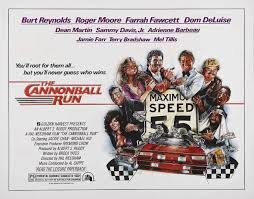
THE CANNONBALL RUN is not a very good movie, but nonetheless it contains a certain undeniable value in the time capsule department.

That’s right, THE CANNONBALL RUN shows us a society that once highly valued Burt Reynolds, James Bond, crude foreign stereotypes, cameos, cleavage, NFL, TV, and stuntman turned director Hal Needham, not in that exact order. THE CANNONBALL RUN finished sixth in the 1981 box office sweepstakes.

However, it came a few years late in the cinematic car chase-and-crash department, not so hot on the wheels of such illustrious precursors as GONE IN 60 SECONDS, DEATH RACE 2000, CANNONBALL,THE GUMBALL RALLY, EAT MY DUST, GRAND THEFT AUTO, and SMOKEY THE BANDIT, by far the best of the six Needham and Reynolds productions that saw the light of multiplex from 1977 through 1984. Never mind John Landis’ THE BLUES BROTHERS, which should have been the final word on car chases and crashes.

Needham (1931-2013) made his directorial debut with SMOKEY AND THE BANDIT and that film contains just about everything you need to know about the director and his films: chases, races, curves, stunts, pile-ups, punch-ups, slapstick, Southern humor, and Reynolds. The great success of SMOKEY AND THE BANDIT, only behind STAR WARS at the box office in 1977, paved the road for the TV show “The Dukes of Hazzard” (1979-85).

On the Needham scale, THE CANNONBALL RUN finds itself halfway between the high point of SMOKEY AND THE BANDIT and the dual low points of STROKER ACE and CANNONBALL RUN II.

SMOKEY AND THE BANDIT had the benefit of the great performance of Jackie Gleason, a performance not matched in any of the other Needham and Reynolds productions, including Gleason again in SMOKEY AND THE BANDIT II. Gleason walked (or drove) away with the first movie.

Reynolds (1936-2018) more or less squandered his career on Needham films.

For example, he chose STROKER ACE over TERMS OF ENDEARMENT. Jack Nicholson won the Best Supporting Actor Oscar for playing former astronaut Garrett Breedlove, the role turned down by Reynolds. The $16.5 million STROKER ACE bombed at the box office as it earned $5 million less than its budget. TERMS OF ENDEARMENT won Best Picture and took in over $100 million, succeeding both commercially and critically.

Reynolds’ career was never quite the same after STROKER ACE.

It would not be until BOOGIE NIGHTS (1997) the name “Burt Reynolds” was spoken with respect again. Reynolds earned a Best Supporting Actor nomination (part of a tally of 12 awards and three more nominations) for his performance as porn director Jack Horner in Paul Thomas Anderson’s sprawling epic. BOOGIE NIGHTS showed us a glimpse of what could have been for Reynolds had the actor not chosen his friend Needham in cynical productions.

They are cynical because they believed that Reynolds’ trademark grin and laugh could get us through a series of tossed off stunts, gags, and in-jokes.

This cynicism hit its absolute worst in CANNONBALL RUN II, which ironically found Reynolds playing alongside TERMS OF ENDEARMENT star Shirley MacLaine.

Frank Sinatra phoned in his cameo appearance and animator-for-hire Ralph Bakshi worked harder on the race than any of the big-name performers.

Roger Ebert called THE CANNONBALL RUN “Hollywood Squares on Wheels.”

“I’ll take James Bond for the block, please.”

“I’ll take Adrienne Barbeau’s cleavage for the win, please.”

When Roger Moore passed on the sequel, they brought in Bond villain Richard Kiel. The 7-foot-2 actor played Jaws in THE SPY WHO LOVED ME and MOONRAKER.

Barbeau and her busty blonde counterpart Tara Buckman were replaced by Catherine Bach and Susan Anton for the sequel.

The best thing to come from the CANNONBALL RUN films was that Jackie Chan borrowed the closing credit gag reel for his productions. Chan showcased not only bloopers and cast members cracking up like the CANNONBALL RUN films, but also stunts like the one in ARMOUR OF GOD that nearly killed him.

“I try to grab every tree,” Chan said in a 2017 interview. “They just keep breaking. Breaking, breaking, breaking, breaking. Then, boom, I just hit on the rock. I get up, I thought, ‘It’s nothing.’ I just feel my back’s hurt. Then I get up, but everybody pushes me down because my whole body was numb. By the time the numb passed, then I feel my air and I see the blood. We go to the hospital … I almost died.”

Even in his worst films, Chan gives it everything he got, certainly more than what the vast majority of the cast members did in CANNONBALL RUN, CANNONBALL RUN II, and SPEED ZONE. Chan’s presence helped CANNONBALL RUN II make a killing in Japan.

All we need to know about the CANNONBALL RUN series is that Jamie Farr’s Sheik Abdul ben Falafel is the only character to appear in all three films.