Silent Rage (1982)

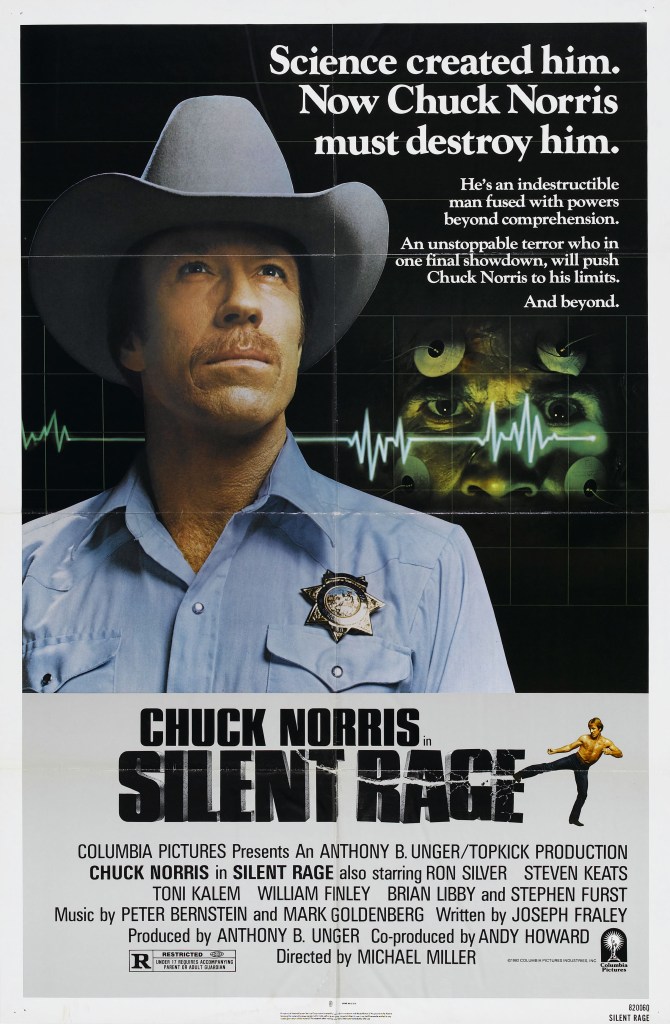
SILENT RAGE (1982) ***
Michael Miller’s 1982 feature Silent Rage combines several American movie hallmarks into one barely coherent package: Chuck Norris, a small Texas town (never sleepy when Norris plays Sheriff), a madman killer, mad scientists, shots borrowed straight from John Carpenter’s Halloween, two love scenes, Stephen Furst basically playing his character from Animal House again, bar fights, roundhouse kicks, biker gangs, breasts (inc. Norris but not Furst), and a schizophrenic musical score, not in any particular order.

We also have at least five wildly different acting styles for the price of one. We’ve already covered Norris and Furst, then there’s Ron Silver and he’s playing it straight in easily the best dramatic acting that one can find in anything starring Chuck Norris. Silver plays the voice of reason and let’s do the right thing scientist, whereas his colleagues played by Steven Keats and William Finley are variants on Universal horror archetypes updated for a new generation. Keats, of course, wants to push science further than any one ever before even when it’s not prudent and Finley, best known for his roles in Brian De Palma and Tobe Hooper films Phantom of the Paradise and Eaten Alive, occupies the middle ground between Silver and Keats. Brian Libby’s madman killer continues in the proud screen tradition of Frankenstein’s Monster and Michael Myers, especially after our mad scientists flat out turn him posthumously into an indestructible killing machine whose stalking does all the talking. I wanted Dr. Loomis to show up and say THIS ISN’T A MAN. Bummer that it didn’t happen.

Norris battles the mad killer and later the virtually indestructible mad killer in the opening and concluding scenes. Otherwise, he alternates between mentoring and supporting unsure and unsteady rookie cop Furst, rekindling his romance with a former lover played by Toni Kalem, and questioning Silver and Keats. For Norris fans, apparently the scariest parts of Silent Rage involved Kalem’s bare breasts and Norris favoring jazz music because our favorite roundhouse specialist returned to only love scenes between men for the rest of his career, barring his rolling around in the mud with the sultry Barbara Carrera in the 1983 Walker, Texas Ranger precursor Lone Wolf McQuade. I for one like Silent Rage because it’s nice to see more chests on display than just Chuck’s for a change.

Silent Rage unfortunately drags at two main points. The death of Silver’s wife literally feels like it takes forever, like one of the filler killings in a Friday the 13th sequel. Ditto for the bar fight, which are drags both in real life and in the movies. A couple moments in this otherwise humdrum bar fight sequence redeem it, just barely though. If you’ve seen Silent Rage, you know exactly what I mean.

The poster for Silent Rage rates with Breaker! Breaker as the best Norris film poster. There’s really no arguing with a mini-Norris roundhouse cracking the movie’s title and the promotional hype Science created him. Now Chuck Norris must destroy him. He’s an indestructible man fused with powers beyond comprehension. An unstoppable terror who in one final showdown, will push Chuck Norris to his limits. And beyond.

Once upon a review, I believe I wrote that I wanted to see Chuck Norris vs. Jason Voorhees and Silent Rage is the closest that I will ever get to seeing that dream come true.

Couple Bombs from ’81: The Legend of the Lone Ranger, First Monday in October

COUPLE BOMBS FROM ‘81: THE LEGEND OF THE LONE RANGER, FIRST MONDAY IN OCTOBER

THE LEGEND OF THE LONE RANGER fails miserably at capturing any of the magic of the 1978 blockbuster SUPERMAN, its obvious cinematic inspiration.

Not even one speck.

Like SUPERMAN, LONE RANGER gives us a mythic origin story for an old cultural hero and then unfurls a new grand adventure featuring our updated hero and other updated characters. Sounds like a great time at the movies, but where did LONE RANGER go so absolutely incredibly stupendously wrong?

First stumbling block first, we have screen neophyte Klinton Spilsbury, who more or less remains a screen neophyte after LONE RANGER. That’s because Spilsbury botched his opportunity so badly that producers dubbed him with James Keach in post-production. Spilsbury quickly became a punchline upon the release of the film. For example, Gene Siskel remarked in his review that Spilsbury playing the Lone Ranger would make for a fine trivia question in the 1990s. I am straining to remember if Spilsbury appeared in “Trivial Pursuit” or perhaps on “Jeopardy” as the answer to who played the Lone Ranger in THE LEGEND OF THE LONE RANGER. If producers dub in another actor’s voice, how much of a performance did the dubbed out actor really give? Nevertheless, Spilsbury joined the ranks of infinitely superior actor Harvey Keitel, whose trademark Brooklyn accent did not make the final cut of SATURN 3. Sorry, Mr. Keitel.

Spilsbury definitely proved to be no Christopher Reeve, whose performance as both mild-mannered reporter for a great metropolitan newspaper Clark Kent and Kal-El, a.k.a. Superman, a.k.a. The Man of Steel, contributed a great deal to what made SUPERMAN and SUPERMAN II successful super-budget entertainments that connected with a mass audience on a personal level. Reeve said that he found inspiration from Cary Grant’s performance in BRINGING UP BABY and SUPERMAN and SUPERMAN II indeed at times resemble screwball romantic comedies. (Gene Hackman, Ned Beatty, and gang unfortunately suggest the campy villains from the 1960s Batman TV show, almost upsetting that precarious balance ‘tween humor and seriousness. Terence Stamp, Jack O’Halloran, and Sarah Douglas make better villains in SUPERMAN II.)

LONE RANGER lacks a lighter, humorous touch to counterbalance its mythology attempts. It is so somber that it becomes ponderous and then dreary before it finally springs into action, despite the efforts of Merle Haggard in the Waylon Jennings “Dukes of Hazzard” balladeer role. Obituarists skipped this chapter in Haggard’s career out of respect for the man when he died in 2016.

Finally springs into action is an understatement in the case of LONE RANGER.

LONE RANGER takes approximately 70 minutes to get the title character into costume and to play the William Tell Overture on the soundtrack, and we’re talking about a movie clocked at 98 minutes. William A. Fraker (director), Walter Coblenz (producer), Martin Starger (executive producer), and the writing team of Ivan Goff, Ben Roberts, William Roberts, Michael Kane, and Gerald B. Derloshon discovered a new level of stupidity.

Complete epic failure amounts to the only legend created by THE LEGEND OF THE LONE RANGER.

FIRST MONDAY IN OCTOBER also has its roots in old movies, though it may not be as obvious as LONE RANGER.

FIRST MONDAY wanted to be like one of those movies pairing Spencer Tracy and Katharine Hepburn — WOMAN OF THE YEAR, KEEPER OF THE FLAME, WITHOUT LOVE, SEA OF GRASS, STATE OF THE UNION, ADAM’S RIB, PAT AND MIKE, DESK SET, and GUESS WHO’S COMING TO DINNER.

Those movies succeeded in part because of the chemistry between Tracy and Hepburn and our enjoyment from watching them interact.

FIRST MONDAY fails in large part because Walter Matthau and Jill Clayburgh do not spark that Tracy-Hepburn chemistry and they are both miscast in their roles. FIRST MONDAY should be renamed “The Bickersons Go to the Supreme Court.”

Matthau stars as veteran Associate Justice Dan Snow and Clayburgh draws freshly appointed Associate Justice Ruth Loomis. All we need to know about them boils down to cranky old white ultra-liberal male (Snow) and feisty liberated white ultra-conservative female (Loomis) babble and battle but nonetheless develop affection toward each other.

Matthau gives the standard Matthau performance and it simply does not suit his character. Melvyn Douglas and Henry Fonda played this character on stage and they were both much better fits than Matthau.

Clayburgh made her fame as the quintessential liberated woman in AN UNMARRIED WOMAN and so it is jarring to see her play a rigid conservative. Also, she’s too young for her character. Jean Arthur, Jane Alexander (a few years older than Clayburgh), and Eva Marie Saint played the role on stage.

Paramount originally planned to release FIRST MONDAY in early 1982, but after President Ronald Reagan nominated Sandra Day O’Connor to the Supreme Court on July 7, 1981, Paramount rushed FIRST MONDAY forward to release in late August, one month before the Senate confirmed O’Connor’s appointment.

It is possible that FIRST MONDAY benefited commercially from publicity attendant with O’Connor’s historic appointment. FIRST MONDAY earned nearly $13 million in returns. In the long run, though, so what?

Upon first perusal of British director Ronald Neame’s film credits, one sees two disaster films, THE POSEIDON ADVENTURE and METEOR. After watching FIRST MONDAY, I count three disaster films directed by Neame.

I reviewed two bombs from ‘81 because Hollywood still recycles, rehashes, regurgitates, recapitulates, and remakes old movies, old plays, old TV shows relentlessly.

Sequels Second to None: The Empire Strikes Back, Indiana Jones and the Temple of Doom

SEQUELS SECOND TO NONE: THE EMPIRE STRIKES BACK, INDIANA JONES AND THE TEMPLE OF DOOM

Having recently watched THE EMPIRE STRIKES BACK and INDIANA JONES AND THE TEMPLE OF DOOM for the first time in a movie theater, I have asked myself one tough question: Why are they my favorite Star Wars and Indiana Jones movies?

THE EMPIRE STRIKES BACK, the second installment in George Lucas’ space opera series eventually taken over by the fine folks at Disney, has the best direction (Irvin Kershner), best writing (courtesy Leigh Brackett and Lawrence Kasdan), best acting, best environs (the icy planet Hoth, the swampy Dagobah, and Cloud City), and the characters display their greatest emotional range and depth. Yoda, Boba Fett, and Lando are iconic additions, especially Yoda. Only the very first STAR WARS (A NEW HOPE) even approaches EMPIRE and please just forget about the prequels (REVENGE OF THE SITH by far the best of them) and the entries post-Disney takeover. It seems like the majority of STAR WARS fans agree.

Meanwhile, I seem to be in the minority who prefer TEMPLE OF DOOM over RAIDERS OF THE LOST ARK. I understand that it’s dark and disgusting, and that Kate Capshaw’s nightclub singer Willie Scott annoys the hell out of you with all that darn histrionic screaming that she does from the first reel to the very last. I grant all those points. Regardless, I prefer TEMPLE OF DOOM because it’s very dark and very disgusting, and yes, I do believe that it is one of the all-time best gross out movies. We’re talking such pleasantries as monkey brains, eels, snakes, bats, bugs, child slavery, heart removal, and bad, bad, bad men eaten by alligators. To be fair and honest, the Shanghai and Indian characters are grotesque caricatures even more disgusting than any of the creature and culinary discomforts, but then again so are the Nazis and Commies in the other Indiana Jones pictures. Understandably, though, India once banned TEMPLE OF DOOM.

TEMPLE OF DOOM does call to mind such classics as BLACK NARCISSUS, GUNGA DIN, THE STEEL HELMET (Short Round borrowed from Samuel Fuller’s 1951 Korean War picture), and THE GENERAL. Scott’s opening production number (Spielberg has long said that he’d love to do a musical and this scene and the jitterbug sequence in 1941 shows that he could make a very good even great one) clues us in on what’s exactly up the sleeves of director Steven Spielberg, screenwriters Willard Huyck and Gloria Katz, story writer Lucas, and gang. What’s that number called? “Anything Goes,” the Cole Porter standard. TEMPLE OF DOOM works because it is oversized and over-the-top like Spielberg’s earlier comedy 1941. Perhaps it is only fitting that Spielberg apparently likes 1941 and TEMPLE OF DOOM the least among his filmography. Does he recoil from their being so politically incorrect?

As far as Willie Scott goes, she epitomizes the sister or girlfriend or wife perpetually grossed out and disgusted by the shenanigans of all the boys surrounding her. I find that element fun. Yes, I do agree that Karen Allen’s Marion Ravenwood is a better match for Indiana Jones and it’s great they brought her character back for KINGDOM OF THE CRYSTAL SKULL. Scott remains more consistent throughout TEMPLE OF DOOM, though, whereas Marion switches between several modes and moods — just one of the boys, spitfire, damsel-in-distress, and wounded woman chief among them. I enjoy both characters, for different reasons. Capshaw’s performance and her character do not mar TEMPLE OF DOOM for me.

It’s been said numerous times before that Lucas endured a divorce around the time of the making of TEMPLE OF DOOM and that seeped into the movie — in the overall tone but specifically the Willie Scott character and the heart removal. Spielberg, two years after his divorce from actress Amy Irving, married Capshaw and they have been together nearly three decades.

It also must be said TEMPLE OF DOOM was my first Indiana Jones movie, because it was the only VHS tape she kept from a mid-1980s Christmas present from her children. Between that and her later acquisition, THE ADVENTURES OF ROBIN HOOD, I must have thrilled on them 100 times. Maybe nostalgia and sentimentality for old movies, even older movies, grand adventure, brassy dames from the Midwest, and politically incorrect characters and gross out gags animates my overall affection for TEMPLE OF DOOM. (I watched RAIDERS OF THE LOST ARK at the drive-in a couple weeks before TEMPLE OF DOOM. I passed on THE LAST CRUSADE for THE EMPIRE STRIKES BACK.)

As I watched THE EMPIRE STRIKES BACK in the Fort Cinema in the town where I attended high school and the first couple years of college, I periodically momentarily flashed back on how I must have first felt watching the movie some more than 35 years ago in the even smaller Southeast Kansas town Arcadia. I felt that way again, despite having seen EMPIRE 30-40-50 times.

Just one nagging thought occasionally spoiled the mood: We were not seeing the original theatrical version of EMPIRE, rather we had one of them dang blasted Special Editions that genius George Lucas masterminded in the mid-’90s for theatrical and home video release circa 1997 where he touched up some of the old school special effects and made some cringe-worthy insertions that will be mocked until the end of time. Lucas has sadly tinkered with A NEW HOPE, EMPIRE, and RETURN OF THE JEDI even more since then, until I think we fans have to ask him, “Why, George, why?” Some outraged STAR WARS fans have gone as far to proclaim “George Lucas Raped My Childhood.” (I do have both VHS and DVD copies of the original theatrical version of EMPIRE.)

Fortunately, I feel that Lucas has mangled EMPIRE considerably less than both A NEW HOPE and RETURN, which alone points to it being the best entry in the entire series. The uncanny valley effect: “An eerie feeling of unfamiliarity people get while observing or interacting with robots that resemble humans almost but not quite perfectly.” I believe we can add the “Star Wars Special Edition” corollary, as well as separate corollaries for both the prequels and the Disney Star Wars, to the uncanny valley effect. George, you should have just kept your ILM CGI magic in the prequels.

As EMPIRE played out more and more and we got deeper into the plot, though, any thoughts about Lucas, Special Edition, cringe-worthy insertions, etc., faded away and I became swept up in the spectacle more than ever before, because it was up there on the big screen for the first time. I felt wonderment and exhilaration, as well as the broader spectrum of emotions that other STAR WARS movies usually do not reach.

THE EMPIRE STRIKES BACK ****; INDIANA JONES AND THE TEMPLE OF DOOM ***1/2

Ninja Rap: Enter the Ninja, Revenge of the Ninja

NINJA RAP: ENTER THE NINJA, REVENGE OF THE NINJA

An instant word search on ninja returns this definition, “A ninja or shinobi was a covert agent or mercenary in feudal Japan. The functions of a ninja included espionage, deception, and surprise attacks. Their covert methods of waging irregular warfare were deemed dishonorable and beneath the honor of the samurai.” Buh.

It goes without saying but we’ll say it anyway that ninja survived a gratuitous Vanilla Ice rap number and mass flatulence, er, mass gas in a kiddie picture.

There’s also “A person who excels in a particular skill or activity. ‘The courses vary — you don’t have to be a computer ninja to apply.’”

I contribute: “An iconic action movie bad ass character archetype epitomized by the legendary ‘Ninja Trilogy’ from Cannon Films, ENTER THE NINJA (1981), REVENGE OF THE NINJA (1983), and NINJA III: THE DOMINATION (1984).”

I’ve already discussed NINJA III at some length — any movie that combines ENTER THE NINJA, THE EXORCIST, and FLASHDANCE must have something brilliant up her sleeve — and only very recently caught up with ENTER THE NINJA and REVENGE OF THE NINJA on the same night.

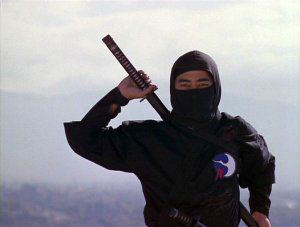
Of course, any definition of “ninja” would be greatly served by a picture of Japanese martial artist Sho Kosugi. In fact, this review would be vastly improved just by the mere insertion of a picture of The Man, The Myth, The Legend. A picture speaks louder than a thousand words … regardless, it’s not like any action movie hero worth their celluloid ever spoke a thousand words.

SHO KOSUGI

I’ve made it through most of the collected film works of Eastwood, Bruce Lee, Jackie Chan, Norris, Stallone, Schwarzenegger, et cetera, and now I am grateful for the opportunity to delve into Kosugi’s filmography. It’s a safe bet that I will eventually seek out PRAY FOR DEATH, DEATHS OF THE NINJA, and RAGE OF HONOR because they’re great titles and have great cover art in addition to starring Mr. Kosugi.

I’ll start with REVENGE OF THE NINJA, the second and best overall installment of the so-called ‘Ninja Trilogy.’ Kosugi takes on a starring role after playing second (or third or fourth) fiddle in ENTER THE NINJA, behind at least Franco Nero, Susan George, and Christopher George. The Kosugi parts are arguably the best parts of ENTER, so REVENGE serves up a full course of Kosugi with hors d’oeuvres, wine (or beer or liquor), and dessert included.

The nominal plot: “After his family is killed in Japan by ninjas, Cho and his son Kane come to America to start a new life. He opens a doll shop but is unwittingly importing heroin in the dolls. When he finds out that his friend has betrayed him, Cho must prepare for the ultimate battle he has ever been involved in.”

The actual plot: ACTION! PLENTY OF ACTION! We’re talking serious hardcore ninja action here. I’m no expert on ninja weaponry, but I do believe that REVENGE (as did ENTER before and THE DOMINATION after it) employs the ninjato, the katana, nunchaku, blowgun, shuriken, crossbow, and many, many more weapons of mass dismemberment. Gore hounds have a lot of howling to do over the ‘Ninja Trilogy.’

REVENGE prevails over ENTER because it spends more time focused on the actual plot than the nominal plot.

We have not only two fierce ninja warriors, Kosugi’s hero Cho Osaki opposed by the dastardly bastard Braden (Arthur Roberts), but we also have two, er, 1 1/2 Kosugis in this picture, since Sho’s real-life son Kane Kosugi plays Cho’s son Kane. We say 1/2 because Kane was around 9 years old when he made his memorable motion picture debut in REVENGE. He’s not one of those insufferable movie brats who mugs so heavily that I check my wallet after their every scene. He’s not David Mendenhall in OVER THE TOP, for example. Yes, he’s basically a miniaturized Sho Kosugi.

Both REVENGE and THE DOMINATION ultimately win over ENTER because they’re more entertaining and off-the-wall in that classic crazy Cannon way.

Nero, of course, makes for an effective action hero in a more traditional sense and I find his filmography very fascinating, from playing the title character in the 1966 Spaghetti Western DJANGO and Lancelot in the lavish 3-hour 1967 American musical CAMELOT (singing voice by Gene Merlino) to roles in Quentin Tarantino’s DJANGO UNCHAINED (naturally) and JOHN WICK: CHAPTER 2. Nero plays a character named “Cole” in ENTER and that has seemed to be one of the more common given names for both action movies and soap operas; Roger Ebert’s Little Movie Glossary includes The Cole Rule: “No movie made since 1977 containing a character with the first name ‘Cole’ has been any good.”

I commented during ENTER that it marked the first time I had seen English actress Susan George (STRAW DOGS) in a movie without her getting naked.

Christopher George almost walks away with the picture as the nefarious businessman Charles Venarius. He’s so bad that he’s good because George savors every single line. It is indelible fun hearing George deliver “This is 20th Century Manila, not feudal Japan.”

Kosugi appeared in all three NINJA films, as three different characters, and ultimately it is his screen presence that makes all three such enjoyable and memorable experiences.

Kill and Kill Again, Firecracker, Circle of Iron

KILL AND KILL AGAIN, FIRECRACKER, CIRCLE OF IRON

In his 1981 TV review of the South African martial arts spectacular KILL AND KILL AGAIN, Roger Ebert predicted action movie stardom for James Ryan and invoked the names Eastwood, Bronson, and Bruce Lee.

Well, in this business and life in general for that matter, you win some, you lose some.

James Ryan, who? Yeah, not exactly a household name.

Describing the plot, I would like to just string together a bunch of random words: martial arts champion for hire undercover government agent top secret rescue mission kidnapped scientist recruit colleagues alternative energy source megalomaniac uniformed cult mind control world domination bar fight mushy romance mushy talk middle-of-nowhere fight storming fortress explosions fisticuffs flips plot revelations not particularly revelatory.

There you go. KILL AND KILL AGAIN, the sequel to KILL OR BE KILLED, in a nutshell.

KILL AND KILL AGAIN works predominantly because it has a good sense of humor and it finds just the right tone to pull off being a successful action comedy.

There’s one especially fun supporting character and supporting performance, the diabolical genius’ assistant and (significant other) Minerva played by Marloe Scott-Wilson. She looks like she drifted over from ROCK ‘N’ ROLL HIGH SCHOOL or THE DECLINE OF WESTERN CIVILIZATION, especially with that ridiculous Day-Glo hairdo. She’s a lot of fun in every scene, especially when she calls residential madman Marduk (Michael Mayer) by these absolutely ridiculous pet names. She comes up with a fresh one every single time. And it rankles Marduk, because good old Minerva says her little terms of endearment right in front of everybody. At one point, Marduk tells her, “I said don’t call me Popsicle.” This running gag even has an explosive payoff in the end.

Guess we should mention that South African beauty queen Anneline Kriel — Miss World 1974 — does her own stunts in the movie. She has to overcome playing a character named “Kandy Kane.” I almost wish they would have named her character “Susan Alexander Kane” or “Emily Kane,” for all us CITIZEN KANE fans in the audience. Now, that would have been an impressive stunt.

Impressive stunts are at the heart of FIRECRACKER, especially during the film’s last 30 minutes.

We’re talking about topless kickboxing and what must surely be one of the weirdest love scenes ever committed to celluloid.

Two sicko creeps pursue our heroine Susanne Carter, played by the luscious Jillian Kesner, and they eventually shed her of her top and bra. She then proceeds to kick their asses viciously. Meanwhile, in the background, we have “Rack Master” boxes. Perfect!

“Rack Master” should have been Carter’s martial arts name and it also should have been a title for FIRECRACKER.

That’s not too much of a stretch, especially since FIRECRACKER traveled as NAKED FIST in Australia.

FIRECRACKER director Cirio H. Santiago plagiarized this topless kickboxing scene from his earlier New World Pictures extravaganza TNT JACKSON.

Now, let us consider that weird love scene. Oh Susanna and her love interest Chuck Donner (Darby Hinton) consummate their relationship, but not before they remove each other’s clothes stitch-by-stitch with a knife. Kinky. Chuck Donner and his incredible mustache, especially his incredible mustache, just scream “Creepy seducer of the ladies who killed Susanna’s sister.” Of course, Susanna does not learn of this fact until after their lovemaking.

Susanna exacts her revenge against Chuck in the ring and we all can be sure that he will never look at another woman ever again.

Kesner passed away in 2007 and she and her late husband Gary Graver (1938-2006) became known for their efforts to preserve the work and legacy of legendary director Orson Welles. I do believe it is time for another reference to CITIZEN KANE.

CIRCLE OF IRON attempts to be something bigger, greater than KILL AND KILL AGAIN and FIRECRACKER. It wants to be a transcendent exploitation film.

We are given the only clue we need as soon as the following title card appears on screen: “Prior to the death of the legendary Bruce Lee he helped to create a movie story that might capture not only the spirit of martial arts but a part of the Zen philosophy he lived by. He was aware that a film with these dynamics would cause controversy, particularly among those unfamiliar with Zen beliefs. But it was this very uniqueness that he believed wound enthrall the moviegoer. Bruce set the story in a land that never was and always is. It is to Bruce Lee that this film is posthumously dedicated.”

I was definitely not enthralled by CIRCLE OF IRON. Not very often.

It certainly did not help that Captain Hairdo, er, Jeff Cooper plays the lead character Cord and this character and performance never quite resonated with me because I kept seeing Roger Daltrey instead and I pretended it was TOMMY.

I kept waiting for Cooper’s cord to break out into song, “Listening to you, I get the music / Gazing at you I get the heat / Following you I climb the mountain / I get excitement at your feet!” and “See me, feel me, touch me, heal me.”

It never happened and I felt extremely disappointed.

David Carradine plays about four roles too many in CIRCLE OF IRON. Okay, I’ll say three roles too many, because we get one of the film’s most entertaining scenes when Carradine assumes the guise of “Monkeyman.” At one point, Carradine’s wig came off and I thought shit like that only happened in SAMURAI COP.

Christopher Lee passed on THE LEGEND OF THE 7 GOLDEN VAMPIRES, a joint venture between Hammer Studios and the Shaw Brothers, because he did not want to play Dracula for the millionth time … but he plays what turns out to be a role that sucks even more in CIRCLE OF IRON, Zoltar, er, Zetan. This is one of those quest movies where you’ll become irritated after hearing a certain name — Zetan, maybe — many, many, many, many, many, many times.

Orson Welles asked me not to reference a certain movie during this review of CIRCLE OF IRON. I must respect his wishes.


KILL AND KILL AGAIN ***; FIRECRACKER ***; CIRCLE OF IRON **

Samurai Cop (1991)

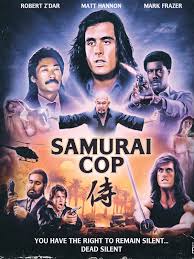
SAMURAI COP

SAMURAI COP (1991) ***

An outtake is defined as “a scene or sequence filmed or recorded for a movie or program but not included in the final version.”

Blown lines and stunts, we all know the routine by now.

Hal Needham and Jackie Chan may have made outtakes for the end credits a cinematic institution, but Iranian “jack of all trades and master of none” Amir Shervan (1929-2006) directed SAMURAI COP, a feature movie solely comprised of outtakes.

Shervan trumped such legendary figures as Dwain Esper, William “One Shot” Beaudine, Bert I. Gordon, Bill Rebane, Ray Dennis Steckler, and even Ed Wood in absolute sheer incompetence.

Like a select few bad movies, SAMURAI COP is so, so, so bad in so, so, so many marvelous ways that it passes all the way through bad into good. It belongs filed next to Efren C. Pinon’s THE KILLING OF SATAN and Claudio Fragasso’s TROLL 2.

— Mathew Karedas, a.k.a. Matt Hannon, stars as Joe Marshall. Most people, though, just call him “Samurai Cop.” Joe must be the least convincing samurai in all history, cinematic and otherwise. For one, Joe’s entire look screams more Fabio and Kato Kaelin than, let’s say, Toshiro Mifune and his most dangerous weapon brandished is that damn speedo he spends what feels like the entire second half of the movie in. Anyway, for somebody allegedly well-versed in the Japanese vernacular, he sure does struggle pronouncing the name “Fujiyama.” When asked by his partner Frank Washington (Mark Frazer) what “katana” means, Joe snaps back “It means Japanese sword.” You don’t say, you don’t say.

— Samurai Cop arguably spends more time being a ladies man than anything else. No, seriously, he beds three, er, two women and he even blatantly talks about the beauty of another woman in the presence of his lover. Smooth, real smooth. Late in the 96-minute spread, he tells his future conquest, “Let’s just say … I can read eyes.” I wish that you couldn’t read dialogue.

Here’s a dialogue exchange from the Planet-X:


Nurse: Do you like what you see?

Joe Marshall: I love what I see.

N: Would you like to touch what you see?

JM: Yes. Yes, I would.

N: Would you like to go out with me?

JM: Uh, yes I would.

N: Would you like to fuck me?

JM: Bingo.

N: Well, then let’s see what you’ve got …

[Nurse investigates Joe’s bulge]

N: Doesn’t interest me. Nothing there.

JM: Nothing there? Just exactly what would interest you, something the size of a jumbo jet?

N: Have you been circumcised?

JM: Yeah, I have, why?

N: Your doctor must have cut a large portion off.

JM: No, uh, he was a, he was a good doctor.

N: Good doctors make mistakes too, that’s why they have insurance.

JM: Hey … don’t worry. I got enough. It’s big.

N: I want bigger.

[Nurse walks away]


I doubt that any screen lothario has ever partaken in dialogue that bad and the sound that we just heard is Rudolph Valentino saying “Thank you” for having made only silent movies.

That dialogue plays like a combination of a porno movie and “Dick and Jane” (most of the rest of the movie belongs to knocking off LETHAL WEAPON) and it belongs alongside the SHARK ATTACK 3: MEGALODON interchange in the anals, er, annals of cinematic history:


Cataline Stone: I’m exhausted.

Ben Carpenter: Yeah, me too. But you know I’m really wired. What do you say … I take you home and eat your pussy.


Boy, that’s just about as great as the whole “Fini can water you” debacle from YES, GIORGIO.

— Lead actor Matt Hannon thought he was done with the picture and got himself a short haircut. Several months later, Shervan looked up Hannon and informed him they were going to reshoot scenes. Unfortunately, Hannon still had short hair. I say unfortunately because Hannon wears one of the least convincing wigs ever made during SAMURAI COP. It does not help that Hannon’s wig flies off during a late fight scene and the actor also displays his obvious displeasure having to wear his wig. Yeah, it’s that bad.

— The chase scenes alternate between moving incredibly slow (nothing like slow-moving cars …) and being artificially sped up (… except for cars that zip along unnaturally). Yes, there are times when the action in SAMURAI COP plays like a silent film projected at the wrong speed.

— Not sure that I want to spend that much more time and space on SAMURAI COP, because I don’t want to risk writing a dissertation. Yes, over 750 words feels like I have been writing on this movie for a long time. However, there’s so many more things wrong but right about SAMURAI COP that we could be here all day, ironic for a movie that lasts a meager 96 minutes. Just imagine SAMURAI COP at GONE WITH THE WIND length.

— In a review long ago, I wrote that the 1979 Chuck Norris action vehicle A FORCE OF ONE combines a standard issue cops and criminals plot acted out by a good cast with martial arts and a “very subtle” anti-drug message that plays like one of those infamous 1980s TV commercials, only featuring roundhouse kicks.

On that note, we can end this review with a public service announcement from SAMURAI COP: “Now I’m telling these son-of-a-bitches that we respect the Japanese of this country, who are honest businessmen. And yeah, this is the land of opportunity for legitimate business, not for death merchants who distribute drugs to our children through schools and on the streets. Now I’m telling these motherfuckers that if they continue killing our children to make their precious millions that they deposit in their secret Swiss bank accounts, counselor, before your lawsuit even gets off the court clerk’s desk, I’ll have their stinking bodies in garbage bags and ship them back to Japan for fertilizer.”

Beautiful, absolutely beautiful, and it makes me want to pop a top on an ice cold one and blast Alice Cooper’s “I Love America.”

It’s a Mad, Mad, Mad, Mad World (1963)

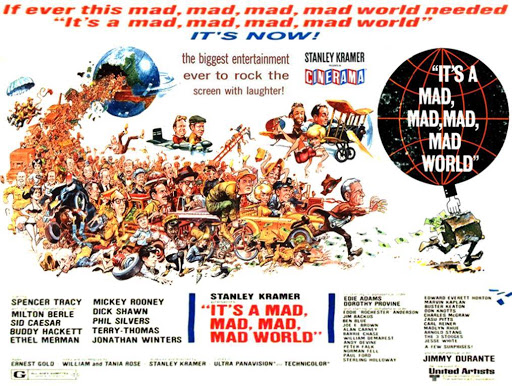
MAD MAD MAD MAD WORLD

IT’S A MAD, MAD, MAD, MAD WORLD (1963) 1/2*

Let’s start this review with a bold statement and prediction: IT’S A MAD, MAD, MAD, MAD WORLD is the worst comedy I have ever seen and it will remain that way for all my life, even if I would be blessed to reach 100 years old.

Fact: I did not laugh once during the 3-hour, 19-minute duration of IT’S A MAD, MAD, MAD, MAD WORLD.

I consider it a lock on being the worst comedy I will ever see because of that length. Sure, I can go 90 or 95 or even 100 minutes not laughing at some dumb or aggressively stupid comedy, no problem, but 189 minutes proved to be a new personal record for remaining in a state of stone cold silence during a comedy. I only broke that silence to express disbelief with a grunt or a sigh. To be honest these intermittent sighs were deep enough to fill the Grand Canyon.

Yes, I almost forgot LEONARD PART 6 (believe me, how I tried forgetting), which I gave no stars and called “the worst movie ever made.” That’s right, it passes comedy straight into being bad enough to encompass all genres.

Why the half-star for a repetitive, repetitive, repetitive, repetitive comedy? Because I liked looking at the cast members during any fleeting moments when they were quiet. Once they resumed talking, well, shit, IT’S A MAD, MAD, MAD, MAD WORLD turned back into unfunny shit on a stick. Yeah, I felt like IT’S A MAD, MAD, MAD, MAD WORLD beat me over the head with unfunny shit on a stick for roughly a quarter of a quarantine day. I will do my best to utilize past tense during this review because I have no intent to ever watch IT’S A MAD, MAD, MAD, MAD WORLD ever, ever, ever, ever again.

I should rephrase one portion of the paragraph immediately above. Very, very, very, very rarely do any of the characters merely talk during IT’S A MAD, MAD, MAD, MAD WORLD. Just imagine a crowded room populated by people who feel compelled to compete with each other for who can be the loudest (and most obnoxious) person in the world, forget the room. And then being trapped inside that room for over three hours describes this movie in a nutshell. Perhaps it would be too much to add real cars to the room. Nah, instead, we’ll have a movie theater size TV in the room playing a loop of car chases at full volume intensity.

Here’s a main character who speaks in a voice resembling that of a normal person: Emeline-Marcus Finch (Dorothy Provine), whose character seems like the movie loaned her from a library amidst the chaos in this loud, loud, loud, loud movie. They no doubt used the Frances Howard Goldwyn – Hollywood Regional Branch Library, only a three-minute walk from the Walk of Fame.

The film establishes a basic tone early on, when five of the characters stand around and squabble over their potential take of the stolen $350,000 hidden under the ‘Big W’ in the Santa Rosita State Park. Yes, IT’S A MAD, MAD, MAD, MAD WORLD is basically one long argument over money interrupted by chases, overacting, mugging, pitfalls and pratfalls, dancing, overacting, cameo appearances, police chatter, overacting, an intermission, pitfalls and pratfalls, plane crashes, explosions, and (for old times’ sake) overacting.

Just take a look at some of the cast: Spencer Tracy, Milton Berle, Sid Caesar, Buddy Hackett, Ethel Merman, Mickey Rooney, Dick Shawn, Phil Silvers, Terry-Thomas, Jonathan Winters, Jim Backus, William Demarest, Jimmy Durante, Peter Falk, Jack Benny, Joe E. Brown, Norman Fell, Stan Freberg, Leo Gorcey, Edward Everett Horton, Buster Keaton, Don Knotts, Jerry Lewis, ZaSu Pitts, Carl Reiner, Arnold Stang, and the Three Stooges, with more than half of them in minute roles. What a sad, sad, sad, sad waste of talent!

Among the main characters, it’s easy to pick my least favorite: Mrs. Marcus, played by Merman. She’s awful from the start and remains awful for the entire length of the picture. IT’S A MAD, MAD, MAD, MAD WORLD partisans argue that she’s a character that people love to hate. I, however, am not one of those people, because I only hate this character. Thankfully, Merman closed out her career with a hilarious cameo in AIRPLANE!

Gordon Gekko told us “Greed is good” during WALL STREET. Meanwhile, nearly 25 years earlier, IT’S A MAD, MAD, MAD, MAD WORLD told us “Greed is bad, mkay?”

One more zinger before closing time: I laughed more during Stanley Kramer’s INHERIT THE WIND than I did IT’S A MAD, MAD, MAD, MAD WORLD. (If I ever watch Kramer’s JUDGMENT AT NUREMBERG, I’ll be sure to revise this final paragraph and gag.)

The Legend of the 7 Golden Vampires (1974)

THE LEGEND OF THE 7 GOLDEN VAMPIRES

THE LEGEND OF THE 7 GOLDEN VAMPIRES (1974) ***

It was really only a matter of time before Hammer, the British masters of the macabre, and the Shaw Brothers, the Hong Kong masters of martial arts, would combine forces and make the world’s first martial arts vampire movie spectacular. An exploitation movie fan’s wet dream come true, in other words.

They created THE LEGEND OF THE 7 GOLDEN VAMPIRES in 1974, not the greatest vampire or martial arts movie ever made, of course, but still an enjoyable romp for those who have a hankering for (in no particular order, except for the last item) vampire hunting, neck biting, blood letting, boiling blood, severed hands, throat slitting, stabbings through the heart, vampires turning to dust, fake bats, fake castles, sword fights, martial arts combat between warriors and vampires & their minions, archery, breasts, romance, and one ridiculous, anticlimactic ending. Three stars, check it out.

Christopher Lee first played Dracula for Hammer in 1958 and he returned for PRINCE OF DARKNESS (1966), DRACULA HAS RISEN FROM THE GRAVE (1968), TASTE THE BLOOD OF DRACULA (1970), SCARS OF DRACULA (1970), DRACULA 1972 (1972), and THE SATANIC RITES OF DRACULA (1973). Lee’s animosity toward the series increased over time and he finally refused to participate in THE LEGEND OF THE 7 GOLDEN VAMPIRES after seven times as the Count. Lee read the script and said “No deal.”

That’s a bummer, especially since John Forbes-Robinson makes for a horrible Dracula. How horrible? They dubbed him with David de Keyser and Dracula only appears in a few minutes at the beginning and end of the picture. In the opening scene, Dracula kills a Chinese monk and takes on his form. (Reportedly, Forbes-Robinson was furious about being dubbed. Hey, it’s not the first time in history. A few years after GOLDEN VAMPIRES, SATURN 3 director Stanley Donen felt dissatisfied with Harvey Keitel’s Brooklyn accent and since Mr. Keitel refused participation in post-production, Donen dubbed over Keitel with a British actor using a Mid-Atlantic accent.)

Granted, we do have Peter Cushing for the fifth time as Professor Van Helsing. Who else would handle the plot exposition through dialogue scenes? How about that plot? Van Helsing, on a lecture stop in China, agrees to help seven siblings (six men, one woman) take back their ancestral mountain village that’s been taken over by seven “golden” vampires (including Dracula trapped in another body) and their living dead minions. Then again, I already described the plot in 44 words in the second paragraph.

THE LEGEND OF THE 7 GOLDEN VAMPIRES can stand with any of the goofiest Shaw Brothers spectaculars and it ranks among the best of the Hammer Dracula films.

The Last Dragon (1985)

THE LAST DRAGON

THE LAST DRAGON (1985) Three stars

Gene Siskel included THE LAST DRAGON among his “Guilty Pleasures” in a 1987 “Siskel & Ebert” show and he gave it one of his funniest reviews, highlighted by “I’m a sucker for glowing fingers. Roger, I see glowing fingers in a movie, I tend to like the movie. … Just one finger (in E.T.), that’s how much I like it. In this one, you get 20. Two men, Roger, 20. Can you imagine the ads? ‘20 times the entertainment value of E.T.’” Siskel gave it three-and-a-half stars in his 1985 print review.

Roger Ebert gave it a mixed negative review and two-and-a-half stars, “THE LAST DRAGON turns into a funny, high-energy combination of karate, romance, rock music and sensational special effects. It’s so entertaining that I could almost recommend it … if it weren’t for an idiotic subplot about a gangster and his girlfriend, a diversion that brings the movie to a dead halt every eight or nine minutes. … They’ve been borrowed from a hundred other movies, they say things that have been said a hundred other times, and they walk around draining the movie of its vitality. They’re tired old cliches getting in the way of the natural energy of Taimak, Vanity and the Shogun character.”

I find myself occupying the middle ground between Siskel and Ebert. They both agreed on the strengths and the weaknesses of THE LAST DRAGON, but Siskel found the strengths to be stronger and Ebert the weaknesses to be weaker. LAST DRAGON co-stars Taimak, Vanity, and Julius J. Carry III are the strengths and Chris Murney as comic gangster Eddie Arkadian and Faith Prince as his aspiring singer girlfriend Angela Viracco are the weaknesses.

Taimak (full name Taimak Guarriello) stars as Leroy Green, who’s inspired by the works of Bruce Lee to such a degree that he’s called “Bruce Leroy.” He’s in pursuit of “The Glow,” referenced memorably by Siskel — see, only a true martial arts master can exhibit “The Glow” over his entire body and that’s Leroy’s No. 1 goal. Scenes like “Don’t think, feel! It’s like a finger pointing away to the moon. Do not concentrate on the finger or you will miss all of the heavenly glory” from ENTER THE DRAGON undoubtedly warmed the heart of Mr. Leroy … and possibly Motown mogul Berry Gordy, whose Motown Productions sponsored THE LAST DRAGON.

He’s opposed by Sho’nuff (Carry III), a.k.a. “The Shogun of Harlem,” who sees Leroy in his way for ultimate martial arts mastery. Sho’nuff interrupts a showing of the sacred text ENTER THE DRAGON in an urban theater and he throws down the gauntlet, “Well well, well. If it ain’t the serious, elusive Leroy Green. I’ve been waiting a long time for this, Leroy. I am sick of hearing these bullshit Superman stories about the — Wassah! — legendary Bruce Leroy catching bullets with his teeth. Catches bullets with his teeth? Nigga please.” Leroy counters with two platitudes that he might have gleaned from the “Kung Fu” TV show, then Sho’nuff throws it down again, “See, now it is mumbo jumbo like that, and skinny little lizards like you thinkin’ they the last dragon that gives kung fu a bad name. Get up, Leroy, I got somethin’ real fo’ yo’ ass in these hands.” Carry III (1952-2008) undoubtedly prepared for his role as Sho’nuff by playing in both DISCO GODFATHER, his debut feature, and THE FISH THAT SAVED PITTSBURGH.

All roads lead to a final showdown between Leroy and Sho’nuff when, sure enough, they both have “The Glow.” Leroy, though, finally exhibits true martial arts mastery.

Bruce Leroy also becomes the protector of television personality Laura Charles (Vanity) against them comic gangsters. She tells Leroy, “I thought that maybe it would be a great idea if I got myself a bodyguard. You know, like someone to guard my body? What girl could do worse than to have her own real life kung fu master?”

THE LAST DRAGON is a lot of fun, especially for viewers who are fans of martial arts spectaculars, particularly Bruce Lee. During the 1985 episode they reviewed THE LAST DRAGON, Siskel and Ebert lamented the lack of quality martial arts entertainment in a special “X-ray segment.” They singled out three “better” martial arts films that predated THE LAST DRAGON: ENTER THE DRAGON, THE OCTAGON starring Chuck Norris, and THE KARATE KID, the surprise blockbuster from 1984. I felt bad for Siskel and Ebert, because it seemed like they missed a great many great martial arts films like DRUNKEN MASTER and THE 36TH CHAMBER OF SHAOLIN, for example, and instead they made several “Dogs of the Week” (their picks for worst movie each episode until September ‘82) from seeing obviously inferior martial arts imports with lousy prints and horrific dubbing. It would be difficult for anybody not to form a negative opinion about martial arts films from seeing only the mass-produced bargain-basement rip-offs that almost immediately came in the wake of Bruce Lee’s death in 1973.

Thankfully, through ventures like the Dragon Dynasty, we can see classics like THE 36TH CHAMBER, KING BOXER (a.k.a. FIVE FINGERS OF DEATH), THE ONE-ARMED SWORDSMAN, FIST OF LEGEND, MAD MONKEY KUNG FU, FIVE DEADLY VENOMS, and EIGHT DIAGRAM POLE FIGHTER in quality prints and not dubbed in dodgy English. Films like these have provided me a ridiculous amount of enjoyment over the years.

The Mighty Peking Man (1977)

THE MIGHTY PEKING MAN

THE MIGHTY PEKING MAN (1977) ***

The Shaw Brothers (Runme 1901-85 and Run Run 1907-2014) have rarely ever let me down and they provided some of the greatest entertainments of all-time, like THE ONE-ARMED SWORDSMAN, FIVE FINGERS OF DEATH, INFRA-MAN, THE 36TH CHAMBER OF SHAOLIN, and CLAN OF THE WHITE LOTUS.

The Shaw Brothers did not (and still do not, in death) cheat us.

For example, in THE MIGHTY PEKING MAN, their 1977 spin on King Kong, Mighty Joe Young, and Tarzan (not to mention Godzilla) that’s not quite peak but still good Shaw Brothers, we don’t have to wait very long whatsoever to see the title character. No, life is short, time is precious, so director Ho Meng-hua gives us our first monster encounter in the first minute of screen time. Okay, to be exact, it’s 1:45 into the movie, but that still beats most every other entry in this distinguished genre.

That establishes a tone for a very generous entertainment package. Find a copy and buy it for somebody, and it’s the gift that keeps on giving.

THE MIGHTY PEKING MAN not only provides a sympathetic monster in the grand tradition, but also (in no particular order) a plucky explorer hero (Danny Lee) who’s been betrayed by his lover with his playboy brother so he’s drowning his sorrows in booze when he’s recruited for a jungle mission, a scantily-clad leading lady (Evelyne Kraft, a regular Swedish Fay Wray) who’s grown up with the animals in the jungle after her parents died in a plane crash (she’s been raised by the Mighty Peking Man, in fact), an earthquake, elephants, tigers and leopards (oh my!), a fight between a leopard and a snake, quicksand, vine swinging, flashbacks to key moments in both the hero’s and the leading lady’s life, callous and shady businessmen, heartless authority figures, mucho destruction of miniatures galore, and a grand finale that boggles the mind even after everything that came before.

My favorite scene, however, begins around the 33-minute mark.

It involves the Semi-Obligatory Lyrical Interlude, a term made famous by the late Roger Ebert. Here’s the definition from Ebert: “Scene in which soft focus and slow motion are used while a would-be hit song is performed on the sound track and the lovers run through a pastoral setting. Common from the mid-1960s to the mid-1970s; replaced in 1980s with the Semi-Obligatory Music Video.”

The Simon and Garfunkel songs in THE GRADUATE epitomize the Semi-OLI.

The one in THE MIGHTY PEKING MAN rates below Louis Armstrong singing “We Have All the Time in the World” over George Lazenby and Diane Rigg in ON HER MAJESTY’S SECRET SERVICE and the foreboding use of Roberta Flack’s “The First Time Ever I Saw Your Face” in Clint Eastwood’s PLAY MISTY FOR ME. Ebert himself said Eastwood filmed the first Semi-OLI that works.

In THE MIGHTY PEKING MAN, our hero and leading lady embrace and lock lips for the first time (watch her eyes after this first kiss) and they unleash the awesomely banal love song “Could It Be I’m in Love, Maybe.”

This is one helluva old-fashioned love song and one helluva Semi-OLI.

I mean, I believe it’s the only Semi-OLI in the history of motion pictures to incorporate a leopard.

Not only that, but the leading lady seems more interested in the leopard than our poor, poor hero. You really sympathize for this guy even more after this scene.

Let’s get back to those lyrics for a second here.

“The love you gave me then showed me a thing or two / I guess I saw it in your eyes / And the look of love upon your face is too hard to disguise / Maybe just a smile will say [cannot make out, even after watching this scene 500 times] / Could it be I’m in love (Maybe? Baby?)” (To hell with it, I already chose “Maybe.” Why does life have to be so difficult?)

“I can’t begin to say what makes me feel like this / I never knew what love could do / But if this is love, it’s here to stay / [Don’t want to make this part out] / So all I have to hear is I’ll give it all to you.”

There’s more lyrics, but we all catch the drift and there’s not any need to drown in banality.

It all totals about 3:30 of pure junk food cinema bliss.

I definitely love it because it’s so utterly ridiculous.

Then again, utterly ridiculous describes THE MIGHTY PEKING MAN.

I should end this review with a consideration of the ending of THE MIGHTY PEKING MAN. Just imagine the ending of KING KONG times 10 times 10.