Prey (2022)

PREY (2022) ***1/2
Even if you do not care for Prey, the latest entry and one of the best entries in the often-lackluster Predator series, you have to admit they cooked up one hell of a great idea for a new Predator movie: Have the action take place in the Northern Great Plains in North America in 1719 with Comanche warriors and French trappers up against the first Predator alien to arrive on Earth.

I’ll come straight to the main point: Prey left me gobsmacked because it far exceeded my feeble expectations for the fifth (or seventh) installment of not exactly my favorite series.

Prey approaches the 1987 original in overall quality, and I never thought I would ever say that because of the track record of the series other than Predator.

There were other significant areas that created trepidation before I sat down and watched Prey on August 15.

I watched The Predator, the previous installment, and wrote a two-star review of it back in 2018 which I closed out with At the end of the day, The Predator is not a bad movie, nor a good one, and I doubt that I’ll be able to remember it for too much longer. I’ll say that I’ve killed two hours of my life in worse fashion many times before and hopefully not as many times after. I was right, because I had to go back and read the review to even remember it.

Prey bypassed theaters and began streaming on Hulu in August 2022.

Prey received several enthusiastic reviews, and I seem to remember one or two or maybe a few voices saying that it’s even better than Predator.

Also, unfortunately I could not avoid garbage discourse like Prey is the most woke blockbuster in Hollywood and woke trash and Prey woke garbage. I don’t know, at this point in time, I bypass any writing or any opinion or any discourse that revolves around calling something and somebody woke. You lost me at woke, a word that has been overused to death in recent times and which I see as intellectual laziness.

A simple Google search returns 5,420,000 results for ‘prey woke.’

Oh, for crying out loud, I liked Prey because it hearkened back to Predator in some ways, staked out plenty territory for itself different than any other Predator film before it, and I don’t think it had one damn thing to do with racial and social justice.

Personally, I would love to see future Predator installments that give us samurai, ninjas, cowboys, bounty hunters, assassins, secret agents, saboteurs, and historic rather than contemporary soldiers.

The Comanche warriors and French trappers were so much more interesting than what passed for characters in The Predator, for example.

Prey worked because it had a strong central premise successfully executed more than not with a main character that we can give a damn about from beginning to end.

Twenty-five-year-old Amber Midthunder is the single best reason to recommend Prey.

I had never seen this actress before or at least I had thought so, but then again, I am not exactly a person who keeps up with the latest, greatest movies and shows.

Looking over her acting credits, Midthunder played Vernon Teller in Hell or High Water, a crime movie from 2016 directed by David Mackenzie and starring Chris Pine, Ben Foster, and Jeff Bridges that I love. I thought about it a little more, and I think I can remember Midthunder from that movie. Hell or High Water could be even more interesting on a revisit, given that I would be specifically looking out for one Midthunder.

Midthunder recently hit a little back at Prey haters.

I think a lot of people thought our movie would be some super woke, F-the-patriarchy kind of a story, and that’s not what it’s about at all. It’s not a girl defying what men say she can and can’t do. It’s literally an individual who feels called to something and the people who know her don’t think that is her calling. That is so much more personal and, I think, as the character, harder to deal with anything.

People don’t know a lot about native history. Period. So they don’t know what kind of warriors we were. There are people who don’t even know that there are different tribes or languages. So already that’s coming from a place of ignorance. Then you look at it and go, ‘Oh no, man. Comanche were really, really great warriors. They were known for being some of the fiercest warriors of all. And they did have female-warrior society, so there were women that fought and hunted. So yeah, I think you look at that and you just [tell yourself], ‘Alright, whatever, people are always going to say stuff.’ I’m proud of what we did.

Midthunder’s Naru works in the fine tradition of an underdog protagonist whose progress makes for compelling, emotionally involving entertainment for 100 minutes.

Right around the same time Prey came out the formal apology from the Academy of Motion Picture Arts and Sciences to Native American activist and actor Sacheen Littlefeather for her mistreatment at the 1973 Academy Awards ceremony became public.

Hello. My name is Sacheen Littlefeather. I’m Apache and I am president of the National Native American Affirmative Image Committee. I’m representing Marlon Brando this evening and he has asked me to tell you in a very long speech, which I cannot share with you presently because of time but I will be glad to share with the press afterwards, that he very regretfully cannot accept this very generous award. And the reasons for this being are the treatment of American Indians today by the film industry and on television in movie reruns, and also with recent happenings at Wounded Knee. I beg at this time that I have not intruded upon this evening and that we will in the future, our hearts and our understandings will meet with love and generosity. Thank you on behalf of Marlon Brando.

Littlefeather passed away Oct. 2, 2022, at the age of 75.

The Wild Geese (1978)

THE WILD GEESE (1978) *
We’ve seen The Wild Geese many times before and we’ve also seen it done a lot better many times before — the rounding up of the mercenary troops for their new mission, the basic training, the jail break, the great escape, the big double cross, the death scenes, etc.

If we pool our collective resources, undoubtedly we could brainstorm 50 or 100 titles easily and recall their overall plots and specific individual developments.

Worse, far worse, infinitely worse even, how do I describe the pace of The Wild Geese?

I thought about saying it moves at a snail’s pace, but then I quickly realized that it more accurately moves like a three-toed sloth dipped in molasses. This is one action movie that does not require slow motion because it’s already slow enough.

In fact, I am hard pressed to come up with an action movie that moves slower than The Wild Geese. I just can’t do it and I don’t want to ever find out if any do exist in this great big universe.

Anyway, we have the first 30 minutes to meet our stars Richard Burton, Richard Harris, and Roger Moore, then around the 45-minute mark it’s basic training and finally around one hour in we get into the main action. I almost said jump, but that’s way too much activity for The Wild Geese. To be fair, The Wild Geese picks up the pace in the last hour to such a degree that only two of the three sloth toes are molasses drenched. Guess what, though, it’s still dull as dishwater.

Yes, indeed, there’s not an exciting moment to be found in The Wild Geese.

Of course, that incredible pace might have something to do with the fact Burton, Harris, and Moore were in their late 40s (Harris) and early 50s (Burton, Moore) when they made The Wild Geese. Harris and especially Burton are not the least bit convincing in their action hero roles. Moore was nearly halfway through his run playing British secret agent James Bond, so he’s more credible than his counterparts and looks much less a fool than either Harris or Burton.

It is ironic that Burton, Harris, and Moore are playing middle-aged mercenaries and the film drops mercenary dialogue routinely during a 135-minute spread, because the three main actors fit the adjective definition of mercenary — primarily concerned with making money at the expense of ethics.

It seems like they paid Burton, Harris, and Moore by the word during The Wild Geese, because they yap and yammer constantly, their barrage of banter only interrupted by the generic requirements of the action movie. Granted, it takes a (long) while before the prerequisite explosions and gunfire.

By my reckoning, a long, long, long, long, long, long while and The Wild Geese lives up only to the geese portion because it is something foul alright. Wild, however, it is most certainly not.

Odds and Odds: The Vikings, Dolls, The Monster Squad, Scream Blacula Scream

ODDS AND ODDS: THE VIKINGS, DOLLS, THE MONSTER SQUAD, SCREAM BLACULA SCREAM
Richard Fleischer’s The Vikings calls to mind epic grand adventure pictures Captain Blood, The Adventures of Robin Hood, The Sea Hawk, and The Sea Wolf, not to mention The Seventh Voyage of Sinbad from the same year (1958) and John Boorman’s Excalibur from 1981.

Kirk Douglas’ lust for life recalls Errol Flynn’s in Captain Blood, Robin Hood, and Sea Hawk and Janet Leigh’s incredible beauty compares with Olivia de Havilland’s in Captain Blood and Robin Hood, as well as Helen Mirren’s in Excalibur. Never mind that Leigh and Mirren play characters named Morgana; however, their beauty and first name are where their characters’ similarities begin and end.

In other words, The Vikings belongs to the fine cinematic tradition of swashbucklers, hair-raisers, cliff-hangers, nail-biters, period costume pieces, and historical fiction.

Of course, it doesn’t hurt that it has an uncredited Orson Welles narrate. The Vikings, in Europe of the eighth and ninth century, were dedicated to a pagan god of war, Odin. Trapped by the confines of their barren ice-bound northlands, they exploited their skill as shipbuilders to spread a reign of terror, then unequaled in violence and brutality in all the records of history. Good stuff.

Highlights include Douglas’ Einar and Curtis’ Eric having key body parts removed, the former his eye by a falcon and the latter his hand in a bout of capital punishment. These moments undoubtedly make The Vikings one of the most gruesome films in 1958 this side of the British classic Fiend Without a Face. Oh, that’s a golden oldie.

Naturally, one can’t go too wrong with any picture where Ernest Borgnine plays a character named Ragnar and spouts screenwriter Calder Willingham’s dialogue like a bountiful fountain, for example What man ever had a finer son? Odin could have sired him, but I did … and Look how he glares at me. If he wasn’t fathered by the black ram in the full of the moon my name is not Ragnar.

Back in the day, my friend would call on quotes from Airplane and Austin Powers for our amusement, and it’s a crying shame that we had no idea about The Vikings, because I think lines such as You sound like a moose giving birth to a hedgehog and The sun will cross the sky a thousand times before he dies, and you’ll wish a thousand times that you were dead would have perfectly fit a night of carousing, especially for two byproducts of a school with Vikings for its mascot.

Rating: Four stars.

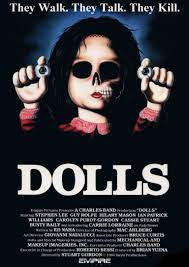
— I finally got around to watching Stuart Gordon’s Dolls for the first time.

Finally, because I love Gordon’s first two features Re-Animator and From Beyond.

I must say that I wasn’t disappointed by Dolls, though it’s a step down from From Beyond and a good two or three from Re-Animator.

Alas, Dolls belongs to a slightly different but no less venerable tradition than Re-Animator and From Beyond, both of which cross mad scientists and low-budget exploitation (nudity, gore, etc.). Think Frankenstein meets Dawn of the Dead.

Dolls, meanwhile, recalls such touchstones as The Old Dark House and The Devil-Doll, not to mention the 1979 Tourist Trap. See if this plot sounds familiar: On a dark and stormy night, six people — a dysfunctional family (husband and father, wife and stepmother, and daughter / stepdaughter) and a young man with two hitchhikers — find the nearest house (The Old Dark House) and they have to fight to make it out of the other end of the motion picture alive because their kindly old hosts are magical toy makers with killer dolls (The Devil-Doll, Tourist Trap).

Like both Re-Animator and From Beyond, Gordon and Dolls screenwriter Ed Naha jump off from their basic old-fashioned plot structure with inspired moments of madness.

Dolls also predates Child’s Play by more than a year and rather than just one killer doll, it has a horde … but Child’s Play, created by Don Mancini, spawned Child’s Play 2, Child’s Play 3, Bride of Chucky, Seed of Chucky, Curse of Chucky, Cult of Chucky, and Child’s Play (2019), plus short films Chucky’s Vacation Slides and Chucky Invades and the TV series Chucky.

So, apparently, not all killer doll films are created equal.

Rating: Three stars.

The Monster Squad starts with an absolute genius idea: Take a group of kids, horror movie fans one and all, and have them do battle against Dracula, Frankenstein’s Monster, Wolf Man, Mummy, and Gill Man.

Yes, what an absolutely positively brilliant idea by screenwriters Shane Black and Fred Dekker, whose names ring a bell loud and clear for genre fans. Others will be familiar with their work regardless whether they know their names or not.

Black made his fame and fortune first for the script of the buddy cop picture Lethal Weapon and some of his other credits include Predator (he plays Hawkins), The Last Boy Scout, and The Long Kiss Goodnight.

Dekker’s other feature directorial credits are the fantastic Night of the Creeps and the not-so-fantastic RoboCop 3.

The Monster Squad gives us both protagonists and monsters that we like, and that goes a long way toward producing a memorable motion picture experience.

The Wolf Man gets his due for a change. The fat kid Horace kicks the Wolf Man in the groin and unleashes the film’s trademark line Wolfman’s got nards! In 2018, Andre Gower, one of the stars of The Monster Squad, directed a documentary named Wolfman’s Got Nards, which looks at the impact one little cult horror film made on fans, cast and crew, and the movie industry.

Anyway, in a movie filled with nifty little moments, I love it when the Wolf Man regenerates after he’s blown up real good.

On the site Drinking Cinema, I found a game for The Monster Squad so drink whenever: 1. Dynamite EXPLODES! 2. A monster dies! 3. You hear a sweet insult. 4. You learn a new monster fact. 5. The cops are having a really hard time figuring out that, um, hello, the perps are various Jack Pierce creations. 6. You see amazing dog acting. 7. You witness a patented Monster Slow-Walk. 8. There’s a monster scare!

I give The Monster Squad a slight deduction for the obligatory music video montage right around the midway point of the picture.

Rating: Three-and-a-half stars.

— Vampirism and voodoo go together rather well and their combination helps Scream Blacula Scream become one of those rare sequels I prefer over the original.

I thought William Marshall’s performance as the title character was the redeeming factor in Blacula and he’s every bit as good in Scream Blacula Scream. Marshall just has a commanding screen presence and he brings both a gravitas to a character and legitimacy to a movie that otherwise might be laughable with the wrong person in the main role. He’s equally effective in every guise of this character — the debonair Mamuwalde who has a definite charm with the ladies befitting an African prince (which he indeed was before the racist Dracula cursed him and imprisoned in a coffin until Blacula awakened in 1972 Los Angeles), the menacing Blacula with his fangs bared, and the more reflective Mamuwalde who hates the dreaded vampire curse.

A highly respectable box office return — not voodoo, no matter what the plot synopsis might read — brought Mamuwalde / Blacula / Marshall back.

In the first movie, Mamuwalde / Blacula comes to believe the lovely Tina’s the reincarnation of his long dead wife Luva. Well, it definitely helps that Vonetta McGee plays both Tina and Luva. By golly, doesn’t this plot thread just get you every single time?

In the sequel, Mamuwalde / Blacula believes in the voodoo powers of Lisa Fortier. She can provide a cure and exorcise the curse once and forever.

Scream Blacula Scream came out two weeks after Coffy and had it been made later in 1973 after Pam Grier busted out as a star playing Coffy, her Lisa Fortier character in Scream Blacula Scream would have undoubtedly been different. Grier plays a more traditional leading lady and screaming and shrinking damsel in distress in Scream Blacula Scream, and she’s definitely no shrinking violet in either Coffy or Foxy Brown. So if Scream Blacula Scream had been produced more in the aftermath of both Coffy and Cleopatra Jones, which came out a month after both Coffy and Scream Blacula Scream, surely American-International — one of the best exploitation film outlets — would have wanted Grier to play one badass mama jama vampire killer rather than her more stereotypical role.

Fair warning: Scream Blacula Scream ends on an extremely jarring note. I remember thinking, in the immortal song title of Peggy Lee, is that all there is? Despite the fact of that ending, you might be surprised to find that I am granting Scream Blacula Scream three-and-a-half stars. Yes, it is just that good.

Invasion U.S.A. (1985)

INVASION U.S.A. (1985) *
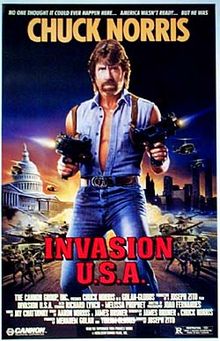
Joseph Zito made a logical progression from directing mad slasher films The Prowler and The Final Chapter (Jason Voorhees’ third screen entry) to Chuck Norris action spectaculars Missing in Action and Invasion U.S.A for the Cannon Films Group, one of the ultimate purveyors of schlock all through the ’80s.

Their schlock includes Ninja III: The Domination and Breakin’ 2: Electric Boogaloo, both from 1984 and directed by Sam Firstenberg.

Anyway, I digress, which is something that I will invariably do whenever discussing Invasion U.S.A. Yes, I admit upfront this review will be filled with digressions.

The plot: Multinationals with guns (sometimes with subtitles, sometimes without) invade the United States, actually Florida but Invasion Florida doesn’t quite ring the same liberty bell, and one-man army Chuck Norris stops them with bloody ballyhoo. Named Matt Hunter in a fit of poetic fancy, perhaps by one of the writers of this garbage, Norris could have killed ’em all with denim.

Basically, Invasion U.S.A is Red Dawn dumbed down even more and it substitutes teeny bopper Commie scum killers Patrick Swayze, Charlie Sheen, C. Thomas Howell, Jennifer Grey, and Lea Thompson for Norris, who laughably tells us that he works alone. No joke, we know this after ’bout 50 Norris films where his character informs us that he kills scumbags all on his lonesome. I mean, wasn’t one of Norris’ better movies even called Lone Wolf McQuade for crying out loud?

The best Norris pictures have strong supporting characters and casts, who make up for the sometimes personality deficient Norris. Alas, Invasion U.S.A gives us one of the worst characters in not only a Norris movie but all movies in general — an apparent photojournalist named McGuire (Melissa Prophet) who probably should have been named Molly Magsnarl instead. She’s not the least bit grateful for Hunter saving her, and I would have let her meet her ultimate demise after the first time she snarls at me Cowboy. She blows out the tires on Invasion U.S.A every time she’s on screen.

Seeing her camera made me laugh, though, because I thought about how it was John Rambo’s assignment to only take photos of the POWs — not to rescue them — in Rambo: First Blood Part 2.

Speaking of First Blood Part 2, released a few months before Invasion U.S.A, it and Arnold Schwarzenegger’s Commando (released just after Invasion U.S.A) both blow away Invasion U.S.A in the great 1985 One-Man Army Movie Sweepstakes.

I also found a worse movie than Star Trek V: The Final Frontier that includes characters singing Row, Row, Row Your Boat.

The Human Tornado (1976)

THE HUMAN TORNADO (1976) **1/2
I have mixed feelings about this sequel to Dolemite
Sometimes it sucks and sometimes it is outta sight
Rudy Ray Moore returns as our title character and he’s fine
He’s truly one of a kind and his bluntness will blow yo’ mind
He’s grown on me since he made a terrible first impression
Both Dolemite and The Human Tornado a better expression
He’s not what earns The Human Tornado a mixed review
I promise that I like Dolemite and Rudy Ray, I really do!
It’s that rat soup eating motherfucker redneck racist sheriff piece of shit
He drags the movie into the mud and his every scene’s just like a cesspit
Character’s named Sheriff Beatty, played by J.D. Baron in his film debut
Somebody should have kung fu kicked him to death, but they never do
His all-out redneck assault often brings The Human Tornado to a halt
Not sure if that’s writer Jerry Jones or director Cliff Roquemore’s fault
Enough about that, how ’bout “Glorya De Lani” as Hurricane Annie
Her glorious breasts distract from Rudy Ray Moore’s big fat fanny
She contributes her fair share to some of the best nudity in screen history
I’d trade her nude for every redneck sheriff scene and it’s sure no mystery
Glorious Gloria Delaney and her breasts returned as Peaches in Penitentiary
What else can be said but yes, God bless the breasts of the Twentieth Century
Dolemite seeks out the sleazy crime boss’ sex pot wife and their sex wrecks the set
Nympho gives Dolemite the info he wants so many times none of us will ever forget
Dolemite takes out anonymous henchmen in a flurry of speeded up kung fu kicks
The Human Tornado truly has everything, a gay blade and a guy with karate sticks
We can’t neglect Ernie Hudson early in his career or Lady Reed and Lord Java in the cast
Funky music, funky hair, miles of nudity, loads of vulgarity, mostly a blast from the past

We Had Ourselves a Real Good Time: Blacula, Dolemite, TNT Jackson, The Devil and Max Devlin

WE HAD OURSELVES A REAL GOOD TIME: BLACULA, DOLEMITE, TNT JACKSON, THE DEVIL AND MAX DEVLIN
Max Schreck, Bela Lugosi, Carlos Villarias, Lon Chaney Jr., John Carradine, Christopher Lee, Klaus Kinski, George Hamilton, Frank Langella, Gary Oldman, and Leslie Nielsen.

That’s a lot of bared fangs, deadly stares, and spectacular deaths over the decades.

Fair warning: Best get outta here with that Tom Cruise, Gerard Butler, Robert Pattinson bull.

Blacula star William Marshall deserves his rightful place among the best screen vampires. For example, he’s definitely better than, oh, let’s say, Carradine, who played Dracula in House of Frankenstein, House of Dracula, and Billy the Kid vs. Dracula and often looked like somebody had squeezed some fresh lemon juice in his eyes. A few months after Marshall debuted as Black Dracula, Lee appeared in his sixth Dracula film — cleverly titled Dracula A.D. 1972 — and Lee’s spiraling lack of enthusiasm for the role that made him famous bites you right smack dab in the neck.

With his booming voice, commanding screen presence, and legitimate acting chops, Marshall (1924-2003) owns Blacula and makes it infinitely better than some cruddy hunk of cinematic junk like Blackenstein. He brings an unexpected dignity to what might otherwise have been a throwaway film.

Rating: Three stars.

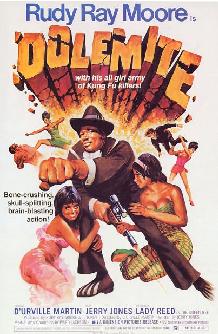
— I enjoyed Dolemite a whole lot more than Disco Godfather, my first Rudy Ray Moore experience, and not only because I’m now calling the former picture Boom Mic Motherfucker.

Disco Godfather lost me by about the millionth or maybe it was by the billionth time Moore (1927-2008) exclaimed Put your weight on it, a slogan that needless to say would not be adopted or adapted by 1980 U.S. Presidential candidates Jimmy Carter, Ronald Reagan, and John B. Anderson. Despite the fact that it tried cultivating a social conscience, Disco Godfather needed some weight put on it, because it was the cinematic equivalent of an anorexic crackhead.

Moore has been called The Godfather of Rap and both Dolemite and the character himself almost instantly serve notice why. Jailbird Dolemite’s first lines are Oh, shit. What the hell does that rat-soup-eatin’ motherfucker want with me? One could play a reasonable drinking game with how many times Dolemite utters motherfucker in the movie, because it’s not every time Cheech & Chong say Man in Up in Smoke (reportedly 285 times) or everybody says Carol Anne in Poltergeist III (121). You won’t get wasted, best shit you ever tasted, from Dolemite. You’ll probably feel pretty good and the alcohol will help laughter.

The plot: Dolemite gets released from prison and fights the criminals and corrupt police officers who sent our favorite cinematic pimp up the river in the first place. Really, though, Dolemite is about the profanity, fight scenes, female (we’ll forget about the male) nudity, and complete utter ridiculousness, all of it done over-the-top. Never mind that it’s a time capsule into Bicentennial-Era America filed right alongside Dog Day Afternoon.

To be honest, though, I was distracted from the plot and everything else by the unpaid co-star Boom Mic Visible, who’s absolutely the funniest motherfucker in Dolemite. According to IMDb, The boom mic is visible in many shots of original Xenon VHS to DVD transfer from the 1980s. The film was originally transferred without the proper ratio ‘gate’ of 1:85.1, revealing more of the top and bottom of the frame than the film makers originally intended. The 2016 Vinegar Syndrome Bluray release was re-transferred from an archive print of the film, at the proper ratio, so the boom mics are hidden in many shots. The Bluray release also includes a ‘boom mic’ version of the new transfer, intentionally revealing the boom mics for comic effect.

Now we know.

The actor John Kerry (not that John Kerry) played Detective Mitchell in Dolemite and it’s a missed opportunity that nobody ever asked 2008 U.S. Presidential Candidate John Kerry about his experiences making Dolemite, what Rudy Ray Moore was really like, etc. That’s a real shame.

Rating: Three stars.

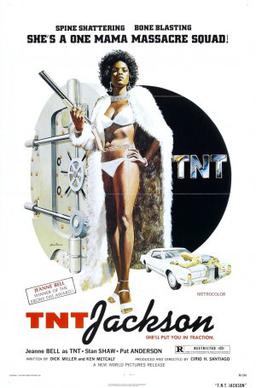
TNT Jackson is definitely not a good movie, but I am still feeling a certain lingering affection for it that other (better) movies wish they could make me feel for them.

What else could be said about some of the worst martial arts sequences ever committed to celluloid, from the very first fists and feet of fury scene all the way to the grand finale. Would you believe punches and kicks that do not connect but still inflict damage? Would you believe the heroine could punch right through the villain? Well, prepare yourself for TNT Jackson.

TNT Jackson falls short of the standard established by similar pictures Coffy and Cleopatra Jones, because, let’s face it, TNT Jackson star Jeannie Bell falls below Pam Grier and Tamara Dobson, respectively. Sure, former playmate and bunny Bell looks absolutely stunning with her great hair, great face, and great body, but she can’t act her way out of a paper bag and we don’t really believe that she could fight her way out of one if she wasn’t the star of the movie. Miss Jackson and her inevitable white chick nemesis (Pat Anderson) wage what’s possibly the worst cat fight ever in the history of the movies. It’s a doozy, and that describes the vast majority of the 72-minute TNT Jackson. Yes, that’s right, 72 minutes, a genuine throwback.

The late, great character actor Dick Miller (1928-2019) earned a screenwriting credit on TNT Jackson, but apparently producer Roger Corman had it rewritten by Ken Metcalfe, who plays the sleazy sub-villain Sid in TNT. Miller does not appear in TNT Jackson.

It’s amazing TNT Jackson romantic lead and main villain Stan Shaw did not get The Sensational, Smooth, Suave, Sophisticated, Stunning Stan Shaw for his screen credit, but maybe just maybe that’s because he overplays his smooth, suave, sophisticated ways so much that we’re tired of his jive real quick. Heck, even Shaw’s afro overplays it throughout TNT Jackson. I’ve not seen this much overacting by hair since, oh, let’s see, Chu Chu and the Philly Flash or maybe I’m mixing up Carol Burnett’s decorative head cover (wait, that’s just part of her costume) with her maracas.

Basically, I can’t hate too much on TNT Jackson like I do Chu Chu (more like Poo Poo and the Poopy Gas), since director Cirio H. Santiago remade TNT a few years later as Firecracker and substituted (white) Jillian Kesner for Bell in the title role. Both movies have similar plot elements, namely infamous topless fights, and Metcalfe in a similar role, but Firecracker does it better.

After watching TNT Jackson, I could not help but gravitate toward AC/DC’s song and the chorus ‘Cause I’m T.N.T., I’m dynamite / T.N.T., and I’ll win the fight / T.N.T., I’m a power load / T.N.T., watch me explode. Bonus points for TNT Jackson, ones that keep it from a two-star rating.

The best version of TNT Jackson is the two-minute promotional trailer put together by Joe Dante and Allan Arkush for New World Pictures circa 1974 or 1975. The voice-over narration takes it to greatness: TNT Jackson, Black Bombshell with a Short Fuse! This Hit Lady’s Charm Will Break Both Your Arms! She’s a One-Mama Massacre Squad! TNT’s Mad and That’s Real Bad! With That Dynamite Bod She’s a Jet Black Hit Squad! A Super Soul Sister and a Bad News Brother Under Cover and Out to Blast a Killer Army That’s Poisoning the People with Deadly China White! You Best Pay the Fine or She’ll Shatter Your Spine! Black Chinatown, Where Flesh is Cheap and Life is Cheaper! TNT Jackson, She’ll Put You in Traction!

Rating: Two-and-a-half stars. Trailer: Four stars.

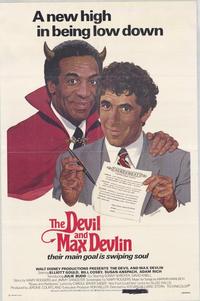
— Before The Devil and Max Devlin, it had no doubt been a long time since Walt Disney Studios depicted Hell in one of their films.

For example, Hell’s Bells from 1929 and Pluto’s Judgement Day from 1935 leap first to mind, two animated shorts that might blow people’s minds who normally associate animation with cute-and-cuddly innocuous fare at this late point in history.

To be fair to the older films, which are both far superior to the main film currently under consideration, feature length The Devil and Max Devlin doesn’t spend a lot of time in Hell.

Well, actually, according to some former President, right, aren’t California and Hell the same?

I wonder, given the subject matter and the presence of Bill Cosby in one of the starring roles, if The Devil and Max Devlin will go or has already gone the way of the controversial, divisive Song of the South — suppressed for seeming eternity by the folks at Disney. I found them both in the dark, dank recesses of the Internet and I hope that I won’t go to jail or Hell for either cultural sin.

Anyway, I like the locations (especially Hell) and I like the high concepts behind The Devil and Max Devlin like a slumlord trying to save his soul by giving the bad guys three unsullied souls and it turned out to be perfect casting to have Cosby in the role of the Devil’s helper, but the movie gets so bogged down in plot details that it evolves into a real slog and we just want more than anything else in the world at the moment for the movie to finally be over. At least, if nothing else, that’s how The Devil and Max Devlin made me feel watching it.

Rating: Two-and-a-half stars.

Godzilla vs. Kong (2021)

GODZILLA VS. KONG (2021) ****
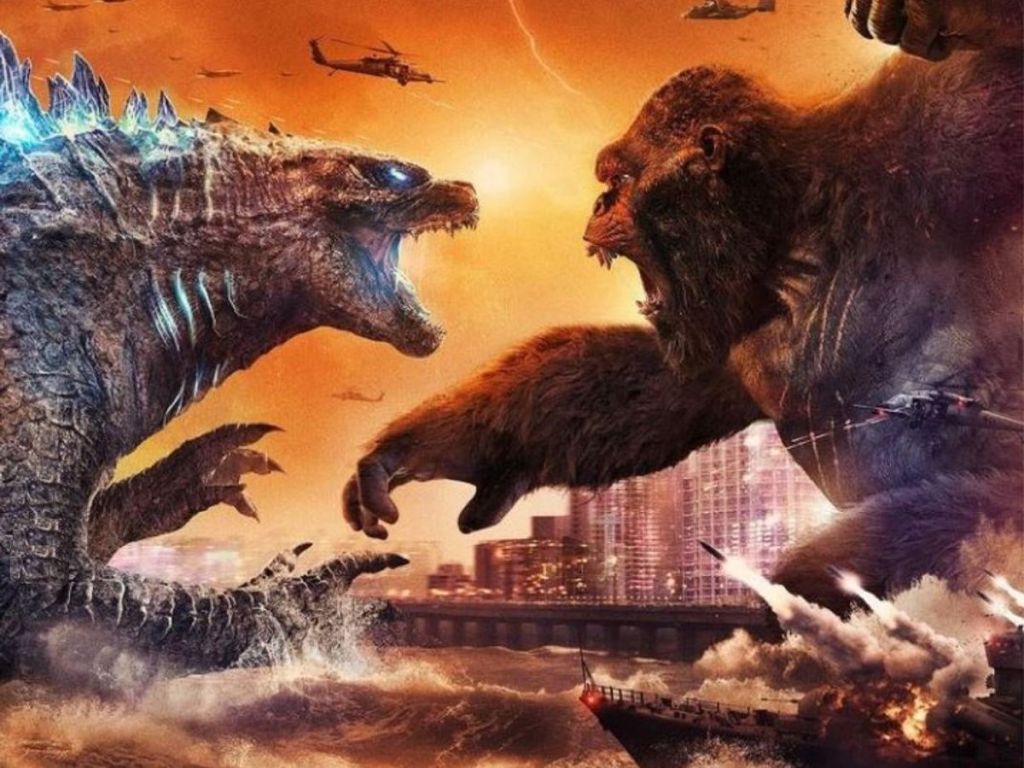
Adam Wingard’s Godzilla vs. Kong got it (mostly) right, especially compared with its immediate predecessor Godzilla: King of the Monsters, and that’s because the film wisely spends more time with protagonist Kong and antagonist Godzilla than its banal human characters and their petty dramas and squabbles and simply functional dialogue.

Also, unlike both Godzilla 2014 and King of the Monsters, we get monster fights shot in broad daylight or neon light. All the monsters and their incredible mayhem are clearly visible, and it makes a huge difference from the disappointing King of the Monsters. Thus, it seems that Wingard and Warner Brothers must have caught wind of the complaints about King of the Monsters, that we didn’t see Godzilla and King Ghidorah and Mothra enough and instead we had to squirm our way through too many family drama scenes involving father Kyle Chandler, mother Vera Farmiga, and daughter Millie Bobby Brown just to get to the monsters. Chandler and Brown return for Godzilla vs. Kong, Farmiga does not for an obvious reason from the end of King of the Monsters, and they’re sidelined for Godzilla and Kong, the nominal stars of the movie, just like they should. We have plenty of new human characters in Godzilla vs. Kong, as well, and they’re not all that important, not as important as Mechagodzilla anyway. Monsters rule Godzilla vs. Kong.

In other words, Godzilla vs. Kong gave me a damn good time at the movies.

I’ve read and heard complaints that Godzilla vs. Kong features too many ridiculous and just plain inexplicable plot elements and developments. What? No way! That’s what I wanted more from Godzilla ’14 and King of the Monsters, to just be silly and ridiculous occasionally and display a lighter touch, esp. King of the Monsters.

The best Godzilla movies work for different reasons: The original 1954 classic has a darker, somber tone unlike any other Godzilla and introduces one of the great movie monsters; Godzilla vs. Hedorah (1971) and Godzilla vs. King Ghidorah (1991) are off-the-wall and so far off-the-wall they could be in another house; Godzilla ’14 gave us a serious Godzilla movie with legitimate actors and it took many of us by surprise, especially with memories of the previous American Godzilla picture.

I’ve watched most all of the 36 Godzilla films — 32 from Japan’s Toho Studios, four from America — and I currently recommend 28 of them, except for Godzilla vs. Gigan (a close miss), All Monsters Attack and Son of Godzilla, and the 1998 Godzilla, the absolute bottom-of-the-barrel cinematic dregs from Roland Emmerich and Dean Devlin that should have been fed to the Smog Monster.

We’ve had many fewer Kong movies over the years, but I’ve loved most of them. The 1933 original remains one of my touchstone movie experiences and it’s something that I am compelled to put on every once in a while just to be dazzled and amazed all over again. I’ll enthusiastically or vehemently defend the 1976 and 2005 remakes, the 1933 sequel could have been so much greater had it not been rushed into release during the same calendar year as the original film, I’ve not seen King Kong Lives from 1986, and I enjoyed Kong: Skull Island more than King of the Monsters, though go figure I gave them both the same three-star rating. Okay, okay, Skull Island edges closer to three-and-a-half and King of the Monsters two-and-a-half, but who needs all that nuance. Apparently, there’s 12 films overall in the King Kong franchise, including the Toho productions King Kong vs. Godzilla and King Kong Escapes. I love King Kong Escapes for most of the reasons I love Godzilla vs. Hedorah and Godzilla vs. King Ghidorah, and they’re all gloriously ridiculous and preposterous. Quite frankly, I wouldn’t have it any other way.

What better space than here and better time than now to put in a word for Marv Newland’s 1969 classic animated short Bambi Meets Godzilla and King Kong knockoff films King Kung Fu and the Shaw Brothers’ The Mighty Peking Man, the former the only monster movie filmed in Wichita, Kansas, and the latter comes to us from dudes known for The One-Armed Swordsman and Five Fingers of Death though they also brought us The Super Inframan and Hammer co-production The Legend of the 7 Golden Vampires. We’re still giving the middle finger to A*P*E and I would be remiss to not mention The Most Dangerous Game from 1932 that was filmed on some of the same sets as King Kong and includes King Kong stars Fay Wray and Robert Armstrong in a dangerous adventure saga on an island and Mighty Joe Young from 1949 with the same creative team as King Kong — Merian C. Cooper and Ernest B. Schoedsack — as well as Armstrong, splendid work from The Lost World and King Kong special effects pioneer Willis O’Brien (assisted by Ray Harryhausen), and a surprisingly touching and involving friendship at the heart of the picture.

The original King Kong vs. Godzilla needed upgraded because, let’s face it, its success or failure hinges on whether or not viewers embrace or reject the cheesy special effects, the preposterous plot, the horrific dubbing (at least in the American version). On first viewing, I rejected King Kong vs. Godzilla yet I’ve warmed to it just a little bit more every time on subsequent viewings. I watched it as the start of a mini-marathon the night before seeing Godzilla vs. Kong in theaters and it remained good, solid fun. Still, though, it’s not some masterpiece that should never be remade and remodeled, like, for example, Psycho (oops, Gus Van Sant didn’t get that memo) and 2001.

I appreciate the nods that Godzilla vs. Kong makes to King Kong vs. Godzilla and King Kong Escapes (I hope a future installment makes room for Mechani-Kong), as well as other elements seen before during Pacific Rim and Tron. Guess what? I have enjoyed Pacific Rim and Tron, films which their critics have dismissed for being cheesy, as well and Godzilla vs. Kong joins their ranks.

— BONUS: I read three reviews of Godzilla vs. Kong before seeing the movie. Two of them reminded me that Emmerich and Devlin inserted characters based on Roger Ebert and Gene Siskel in their Godzilla, but they didn’t have the guts or the nuts to have Mayor Ebert and Gene stomped out by their bad CGI monster.

You don’t even have to read the full review by Armond White to feel like saying Lighten up, Francis. On Apr. 2, White proclaimed Godzilla vs. Kong to be the Shiny Dud of the Week, because it (in White’s words) cheapens the moviegoing habit thru mindless spectacle and shameless formula. Several hours later, White shared his review again and hyped it, If you have a mind, Godzilla vs. Kong is not the movie for you. Ah, it’s mindless entertainment, I see, but, hey wait, my prefrontal and limbic regions of the neocortex, particularly the orbitofrontal region of the prefrontal cortex, anterior cingulate cortex, and the insular cortex, especially object to White’s review.

Web-based film critic James Berardinelli finished his review, I wonder how my eight-year-old self would have reacted to Godzilla vs. Kong. There was a time when I gobbled up anything with monsters, irrespective of the quality of special effects. I didn’t care about the level of destruction and took it as a necessity that the movie would sometimes become bogged down by focusing on underdeveloped humans and their silly concerns. I suspect I might have loved this film in all its overproduced glory. But what works for an eight-year-old doesn’t always work for someone who has evolved to expect more.

Personally, the 42-year-old me is ecstatic the 38-year-old director Wingard and the screenwriting team of 41-year-old Eric Pearson and presumably-40ish-year-old Max Borenstein decided to focus more on Kong and Godzilla and less on inane humans. They could have gone even further. I’d love a Jurassic Park movie, for example, to feature only dinosaurs and prehistoric life — no banal or venal human beings to muddle and bungle it all up — and this ideal dinosaur movie would be made in the style of Luis Bunuel’s The Phantom of Liberty and Richard Linklater’s Slacker.

I find myself closer to Matt Zoller Seitz’s rave on RogerEbert.com, which had me at Godzilla vs. Kong is a crowd-pleasing, smash-’em-up monster flick and a straight-up action picture par excellence. It is a fairy tale and a science-fiction exploration film, a Western, a pro wrestling extravaganza, a conspiracy thriller, a Frankenstein movie, a heartwarming drama about animals and their human pals, and, in spots, a voluptuously wacky spectacle that plays as if the creation sequence in The Tree of Life had been subcontracted to the makers of Yellow Submarine.

Yeah, Godzilla vs. Kong got it about 90 percent right.

Robin and Marian (1976)

ROBIN AND MARIAN (1976) ****
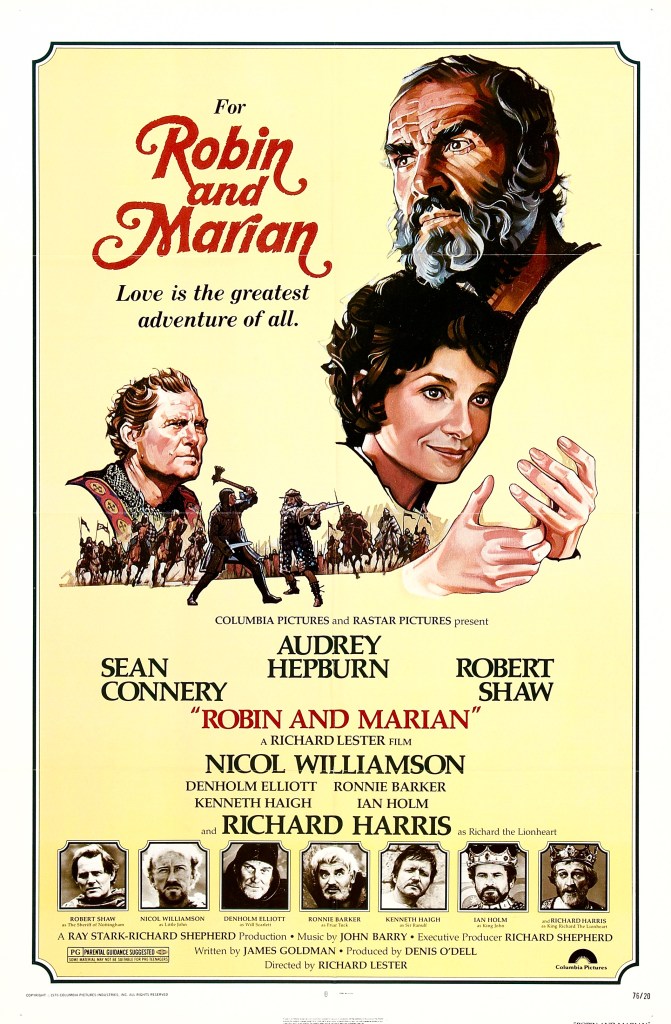
Richard Lester’s Robin and Marian definitely made a strong first impression.

I placed it on my top 10 films list for 1976, based on just viewing it a single time on cable TV many years ago.

Granted, Robin and Marian crossed my mind several times in recent months, especially after Robin and Marian star Sean Connery died last Halloween and then after I watched both the Disney (1973’s Robin Hood) and the Mel Brooks (1993’s Robin Hood: Men in Tights) takes on the legendary old warhorse. Disney and Brooks both left me feeling often unimpressed and ultimately supremely disappointed, for very different reasons, and I started thinking instead about superior Robin Hood films The Adventures of Robin Hood and Robin and Marian, both of which I first encountered during childhood or teenage years.

The Adventures of Robin Hood remains my favorite take on Robin Hood and I’ve watched it numerous times over the years. Of course, it helped that The Adventures of Robin Hood ranked among the select few titles Grandma Sisney had on VHS and I played it — along with Indiana Jones and the Temple of Doom and Fun in Acapulco — so many times before Grandma took over her TV for a day of game shows and soap operas. There’s always been something so indelible about Errol Flynn’s Robin Hood that I judge all others portraying Robin Hood against Flynn’s standard, Claude Rains and Basil Rathbone make incredibly satisfying villains, and Olivia de Havilland’s Maid Marian simply radiates a MOST BEAUTIFUL WOMAN IN THE WORLD AT THIS VERY MOMENT glow. Plus, it’s hard to forget the colors (and costumes) that argue for three-strip Technicolor superiority.

Robin and Marian left a mark for similar reasons — Connery and Audrey Hepburn both carry some of the same appeal as Flynn and de Havilland do in their iconic roles. Flynn was just a month shy of 29 years old when The Adventures of Robin Hood first came out in May 1938 and similarly, De Havilland was two months shy of a mere 22. However, Connery and Hepburn play older Robin Hood and older Maid Marian — please consider both Connery and Hepburn were in their mid-40s during Robin and Marian and each had a solid 15-20 years of stardom behind them. Connery and Flynn both have an undeniable robust humor and physicality (both men seemed tailor-made for James Bond, for example) and Hepburn could make claims on de Havilland’s radiant MBWITW glow several times during her career, from Roman Holiday and My Fair Lady to Robin and Marian.

Anyway, I finally watched Robin and Marian for a second time and it holds up as a great movie, right behind only The Adventures of Robin Hood in the Robin Hood cinematic pantheon.

Because of centering around middle age characters, Robin and Marian plays different notes and takes on a greater emotional range than any other Robin Hood film I have ever seen.

It’s definitely not the lusty adventure like The Adventures of Robin Hood. Sure, Robin and Marian has sword fights and scenic vistas and soaring music and horses and romantic clinches and every prerequisite of the genre, as well as King John, King Richard the Lionhearted, the Sheriff of Nottingham, Little John, Friar Tuck, Will Scarlett, and Sherwood Forest, but they’re all — both people and places, and every plot event — suffused with melancholy.

To be fair, though, Lester and Connery inject enough good humor and spirit into Robin and Marian to help it avoid being a more downbeat experience like the 1991 Robin Hood starring Kevin Costner. And the scenes between Connery and Hepburn are simply flat-out appealing, rooted in seeing two of the most attractive, most ebullient performers to ever grace the screen share time with each other (and us audience members).

It should also be mentioned that supporting players Nicol Williamson, Richard Harris, Denholm Elliott, and Ian Holm contribute to an absolute dynamite cast.

Didn’t we always ponder how it all turned out for Robin Hood, Maid Marian, the Sheriff, Little John, Friar Tuck, and Will Scarlett?

Lester’s film, with a screenplay written by James Goldman (writer of the play, film adaptation, and TV movie version of The Lion in Winter), answers those very questions, but do we viewers feel comfortable with the answers? Are we prepared to see Maid Marian as a nun because Robin Hood, off on his damn crusades and holy wars with Richard and Little John, didn’t write her for the last 20 years? We also found out that she attempted suicide. He’s back, though, and it’s obvious that Robin Hood and Maid Marian are destined to be together. They might initially hate it and initially fight it, she invariably more than he, but they are pulled together rather than apart.

All roads lead toward a final showdown between Robin Hood and the Sheriff (Robert Shaw). They fight like two worn-out, downtrodden men with many, many battles behind them and none ahead of them, who have resigned themselves to their final destiny. They fight because it’s their duty, or their almost perverse obligation to each other as hero and villain. They really don’t want to be fighting each other at this precise historical moment, it feels like, BUT THEY MUST FIGHT TO THE DEATH. There’s none of the joy in this fight that can be found in great film sword fights like the one, for example, between Robin Hood (Flynn) and the Sheriff (Rathbone) in The Adventures of Robin Hood. This final showdown, just like Robin and Marian overall, gives us something that’s different from any other purely adventure movie. All the main players have lived through considerable pain, considerable disappointment, and the film serves a reminder (from early on and throughout) there’s flesh-and-blood and real-life experience behind every legend, every song, every ode, every hymn, every myth.

Maid Marian gives Robin Hood (and us) some final words, “I love you. More than all you know. I love you more than children. More than fields I’ve planted with my hands. I love you more than morning prayers or peace or food to eat. I love you more than sunlight, more than flesh or joy or one more day. I love you more than God.”

Forced Vengeance (1982)

FORCED VENGEANCE (1982) **1/2
Slow motion’s absolutely vital to understanding the cinematic and TV work of the one and only Carlos Ray Norris.

Slow motion’s everywhere, in action movies, sporting events, movie musicals, etc. To the point that we don’t even realize how everywhere it’s become.

Over the decades, for example, slow motion became a customary tool in violent scenes, from Arthur Penn’s Bonnie and Clyde and Sam Peckinpah’s The Wild Bunch to The Matrix and beyond. Sometimes, I think Gee whiz, that’s awesome and very artfully done, but mostly I just think That’s super lame. I take off points for the obligatory and cheap use of slow motion.

Let’s see, off the top of my head, I deducted from The Lion King and Teen Wolf and Young Guns for their abuse of slow motion late in their motion picture spreads, while Kickboxer 2 flogs viewers with slow motion until it’s like receiving a slow motion roundhouse upside the head. For crying out loud, though, it’s slow motion, super slow even, and that gives us a greater chance to duck out of the way and to see all the cheap audience manipulation at play. I mean, I ducked the Kickboxer 2 roundhouse and found the Siskel & Ebert review playing alongside the movie inside my head esp. Ebert imitating the sounds of slow motion. It was more entertaining that way.

That brings us full roundhouse back to Norris, one of the foremost slow motion abusers.

A former co-worker said that his ears were ringing for a long time after he watched the Who play one of the Day on the Green concerts at Oakland-Alameda County Coliseum. He talked about being whacked upside the head by their incredible Wall of Noise. I soaked up this conversation.

“In 1976, the Who entered the Guinness Book of World Records for performing the loudest concert in history at the time during their concert at England’s Charlton Athletic Grounds with 76,000 watts at 120 decibels. This record would stand for nearly a decade.”

You can bet they used the Rock-o-meter from Rock ‘N’ Roll High School.

Anyway, now I will make the case for something that’s louder than any rock concert or sporting event, any plane taking flight, any hyena’s laugh, and any howler monkey.

For a couple months, I visited my Grandma for her bingo dominance Tuesday and Thursday. After the bingo hour, we’d return to her room and she’d turn her TV back on. Naturally, it would be Walker, Texas Ranger on Hallmark. Of course. At 3 every day, every single TV in the nursing home would simultaneously be turned on full volume and tuned in to Walker, Texas Ranger. That’d be probably close to 100 TVs. Yeah, we’ll go with 100 for the sake of hyperbole.

I’ve never in my life heard anything louder than 100 full blast TVs simultaneously reverberating Walker slow motion roundhouse kicks.

Guinness, book it.

I deducted a half-star from Forced Vengeance because it broke through my pain threshold for slow motion consumption early on during the final act leading toward a grand finale.

You have been forewarned.

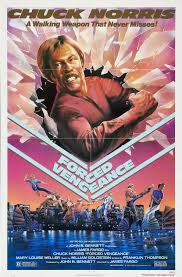
Once again, though, a poster for a Norris spectacular earns four stars.

An Eye for an Eye (1981)

AN EYE FOR AN EYE (1981) ***
An Eye for an Eye is one of the better Chuck Norris movies and that’s because it fits the bill for what helps define a better Chuck Norris movie — the quality of the supporting cast, something it has in common with Lone Wolf McQuade, Code of Silence, The Delta Force, and Silent Rage.

Let’s see, we have Christopher Lee, Richard Roundtree, Matt Clark, Mako, Maggie Cooper, Rosalind Chao, Professor Toru Tanaka, Stuart Pankin, Terry Kiser and Mel Novak, and they’re basically all good in their standard hero and villain roles.

Lee (1922-2015) enjoyed a truly marvelous career that intersected with Sherlock Holmes, Dracula, James Bond, Star Wars, Ichabod Crane, Kharis, Victor Frankenstein, Gandalf, and Hercules. Never mind acting alongside Slim Pickens and Toshiro Mifune in Steven Spielberg’s 1941. Often playing the villain, Lee had the ability to maximize his minimal screen time and An Eye for an Eye benefits from his presence.

Roundtree made his fame as the title character in Shaft and sequels Shaft’s Big Score and Shaft in Africa, and so I must admit to being somewhat amused that he’s played a cop so often throughout his career. It was both amusing and frustrating to watch his police superior character bust Norris’ chops. I told my wife during An Eye for an Eye, ‘At least he’s not killed by a winged serpent in this movie.’

Cooper plays Norris’ obligatory romantic interest and she gets a rare female nude scene in a Norris movie. Writing on Silent Rage, I noted that it was refreshing to see somebody’s chest other than Norris and I second that emotion after An Eye for an Eye.

Tanaka’s dossier begins, ‘Was an American professional wrestler, professional boxer, college football player, soldier, actor, and martial artist.’ What did the Professor earn his degree in? Judging by An Eye for an Eye and the vast majority of his filmography and his professions, it’s safe to say Tanaka earned a doctorate in pain. Like others in the An Eye for an Eye cast, he’s good at maximizing minimal screen time and in his case, minimal dialogue. Norris vs. Tanaka proved to be one of the film’s greatest highlights.

Before she went to sleep, I told my wife that Norris’ partner will be dead very shortly and it did not help the character’s survival odds being played by Terry Kiser, an actor best known for playing a corpse. Bernie from Weekend at Bernie’s and Weekend at Bernie’s II ring any bells? Yeah, I still argue that dead Bernie still shows more life than nominal leads Andrew McCarthy and Jonathan Silverman. For a man later hacked and whacked by Jason Voorhees, Kiser’s character died spectacularly in An Eye for an Eye — shot in the chest, crushed between not one but two cars, and caught on fire. His death haunts Norris’ Sean Kane during two flashback scenes.

An Eye for an Eye director Steve Carver died in January 2021 of complications from COVID-19 and he was 75. Carver also directed arguably Norris’ best picture, Lone Wolf McQuade, and the infamous 1974 Roger Corman / New World Productions films The Arena and Big Bad Mama. No doubt that Pam Grier and Angie Dickinson, as well as William Shatner, prepared Carver for Chuck Norris.