
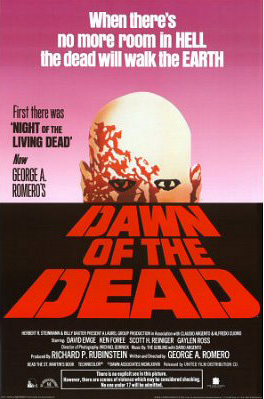
Dawn of the Dead (1978)

DAY 10, DAWN OF THE DEAD

DAWN OF THE DEAD (1978): Four stars
In a 2014 NPR interview, the late director George Romero (1940-2017) answered the question about how zombies were a vessel for commentary.

“I’ve sort of been able to bring them out of the closet whenever I need them,” he said. “They are multi-purpose, you can’t really get angry at them, they have no hidden agenda, they are what they are. I sympathize with them. My stories have always been more about the humans and the mistakes that they’ve made and the zombies are just sort of out there. … They’re the disaster that everyone is facing, but my stories are more about the humans.”

None of Romero’s zombie movies have been more about the humans than DAWN OF THE DEAD.

It gives us four characters that we grow to care about, Stephen (David Emge) and his girlfriend Francine (Gaylen Ross) and Peter (Ken Foree) and Roger (Scott H. Reiniger). Stephen’s a traffic reporter (light on traffic, heavy on zombies in this flick) and our four protagonists load up into his traffic helicopter and eventually take refuge and lock themselves within a secluded shopping mall (Monroeville Mall located in Monroeville, Pennsylvania, east of Pittsburgh). They kill all the zombies inside and literally clean up, with an endless array of consumer goods at their disposal. They’re like four big kids in a candy store. They become complacent fat cats in a sense, fattened up by self-indulgence, until a motorcycle gang descends upon the mall and these rough biker dudes have the unmitigated gall to go for the kingdom. Of course, our two remaining male protagonists take on the motorcycle gang to the bloody end.

These characters are much better than what Romero and fellow script writer John Russo gave us in the 1968 classic NIGHT OF THE LIVING DEAD.

First and foremost, Francine seems at one crucial point early on like she might be headed for the Judith O’Dea Barbra character in the first movie, a real drag of a helpless female who’s either in panic mode or a catatonic state throughout. Granted, Francine gave us other early signs that she would break the helpless female mode. Sure enough, Francine does break that stereotype and DAWN OF THE DEAD is all the better for it.

Not counting Russell Streiner’s indelible Johnny, who’s only in the movie for a few minutes, Duane Jones’ Ben was the best character in NIGHT OF THE LIVING DEAD. Likewise, Foree gives us another strong black male protagonist and Peter’s the best character here. In fact, Peter’s even stronger than Ben. He’s a Superfly T.N.T. bad ass mofo zombie killin’ action hero, he says all the great lines including “When there’s no more room in Hell, the dead will walk the Earth,” and he’s also far more upbeat than Ben. We end the flick happy little consumers when Peter decides that he will continue to fight rather than pull his trigger and end it all. Two downbeat endings in a row would have been truly horrible.

Romero told Rolling Stone in 1978, “Monsters do exist: in us, and among us.”

Through Stephen, Francine, Peter, and Roger, I think we can see the monster that’s inside us, especially after they become fat cats inside the mall. It’s because these characters all develop within our hearts and minds until they’re not just standard issue, interchangeable horror movie victims like characters in lesser movies. We understand them when they indulge themselves at the mall; they’re living out many people’s consumerist fantasies. We truly feel it when zombies happen to them. We’re there with them every step of the way during their incredible journey.

Not only are the human characters an improvement from Romero’s first zombie try, but the zombies truly come alive in DAWN OF THE DEAD.

At times, they are sinister and relentlessly terrifying. Other times, they are sad or they are funny at other junctures. Romero uses them like characters from different silent movie genres, for slapstick, for sentiment, and to scare us, and they also remind us of the Monster in BRIDE OF FRANKENSTEIN. The director said that he sympathized with his zombies and that’s apparent throughout DAWN OF THE DEAD. Like the four main protagonists, the main antagonists are not standard issue, interchangeable zombies. Anyway, they still just want to go shopping too, just like us.

Now, let’s talk about the gore.

Like the later EVIL DEAD movies and RE-ANIMATOR, the gore in DAWN OF THE DEAD passes through queasy to surreal and quite enjoyable.

On the other hand, in April 1979, former New York Times film critic Janet Maslin walked away from DAWN OF THE DEAD. Here’s the opening paragraph of her review:

“Some people hate musicals, and some dislike westerns, and I have a pet peeve about flesh-eating zombies who never stop snacking. Accordingly, I was able to sit through only the first 15 minutes of ‘Dawn of the Dead,’ George Romero’s follow-up to ‘Night of the Living Dead,’ which Mr. Romero directed in black and white in 1968. Since then, he has discovered color. Perhaps horror-movie buffs will consider this an improvement.”

No, I don’t view the color in DAWN OF THE DEAD an improvement over the B & W in NIGHT OF THE LIVING DEAD, but I do believe the 1978 movie improves on the earlier film in just about every single possible way. Better human characters and better zombies (who are still not all that different from us, despite their preference in food and their makeovers) especially make this a rare sequel that outdoes the original. Not to mention Romero’s biting satire on consumerism.

I mentioned DAWN OF THE DEAD in the review of THE FLY and it’s a fitting way to end this review.

“For example, George Romero’s DAWN OF THE DEAD (1978), a horror movie or a zombie picture that also passes through action and adventure, black comedy, silent and slapstick comedy, drama, gore galore, cinematic and social satire, surrealism, survivalism, and melodrama in addition to being great at the basic level of being a horror movie. All those extra traits put DAWN OF THE DEAD in the upper echelon.”

Night of the Living Dead (1968)

DAY 9, NIGHT OF THE LIVING DEAD

NIGHT OF THE LIVING DEAD (1968) Four stars
The other day on Facebook, I thought I saw a fan ask others not to bring politics into their appreciation of a classic on the NIGHT OF THE LIVING DEAD page.

Are you kidding?

As many fans would be quick to point out, George Romero’s films often have political themes and some of us fools love them even more for it.

I once wrote a review of the 2010 remake of Romero’s THE CRAZIES and lamented the fact the remake traded Romero’s sharp-edged content in for cheap trick, conventional jump scares.

That review included a mention of the scene in Romero’s original where a priest (infected by the virus) self-immolates because of soldiers rousing his flock, a harrowing moment that calls to mind Norman Morrison, the 31-year-old Baltimore Quaker pacifist who carried self-immolation out below Secretary of Defense Robert McNamara’s Pentagon office to protest American involvement in the Vietnam War, and the Buddhist monk Thich Quang Duc at a busy Saigon intersection to protest the corrupt South Vietnamese government’s persecution of Buddhist monks.

THE CRAZIES remake did not include such a scene, and that epitomized its lack of balls. (By the way, the references to the priest’s self-immolation in the movie, Morrison, and the Buddhist monk were all excised from the review that printed in the college paper, most likely for space considerations.)

Just thought it was strange that a Romero fan bitched about political conversation, because politics are part and parcel of each and every DEAD movie.

For example, it’s hard not to consider NIGHT OF THE LIVING DEAD in the broader context of 1968 (or any year) America.

The radio and TV news reports about flesh-eating ghouls in NIGHT OF THE LIVING DEAD would have been natural alongside such watershed events as the Tet Offensive, the My Lai Massacre, Lyndon B. Johnson’s announcement that he will not seek or accept presidential renomination, the assassinations of Martin Luther King and Robert Kennedy, and the riots riots riots all through a turbulent 1968.

(NIGHT OF THE LIVING DEAD was filmed in 1967 and officially released on October 1, 1968.)

When the black protagonist Ben (Duane Jones) gets mistaken for a ghoul, shot in the head and killed by a member of a white mob looking for ghouls, and thrown in a burn pile with the other ghouls at the end of the movie, of course viewers can draw parallels with MLK, Emmett Till, and numerous other horrifying incidents over the years. Or you can just take the scene at face value. Any way you read it, it’s a shocker of an ending.

Casting Jones as Ben changed the dynamic of the movie. Originally, this character was scripted as a white man (according to a 2010 article by Joe Kane that appeared in “The Wrap”), a resourceful but rough and crude-talking trucker. Jones brought a strong presence, an obvious intelligence, and an unmistakable rage to the part that would have been lacking with the original casting plan. The interactions between Ben and Harry Cooper (Karl Hardman) take on another dimension with the racial tension palpable between both men.

I’ll just go ahead and say it: NIGHT OF THE LIVING DEAD would have been a lesser movie without a black male in the lead.

At one point, again from the Kane article, the filmmakers thought about changing the ending to allow Ben to survive. Jones was not having any. “I convinced George that the black community would rather see me dead than saved, after all that had gone on, in a corny and symbolically confusing way,” he said. “The heroes never die in American movies. The jolt of that and the double jolt of the hero figure being black seemed like a double-barreled whammy.”

There’s a multitude of whammies in NIGHT OF THE LIVING DEAD.

Consider the plight of Mr. Cooper, his wife Helen (Marilyn Eastman), and their 11-year-old daughter Karen (Kyra Schon), who’s seriously ill after being bitten by one of the ghouls. Karen’s in the cellar for the duration of the movie.

Mr. and Mrs. Cooper, why you can just tell they do not get along very well. Understatement of the year. Nearly every word they say to each other, especially from her to him, carries an undercurrent of hostility. We feel there’s no love between the two.

Eventually, Karen dies and becomes one of the flesh-eating ghouls. She first eats her father and then bludgeons her mother with a trowel. The latter sequence calls to mind Detective Arbogast’s encounter with Mother in PSYCHO (1960).

You probably have noticed this sentence is the first mention of Barbra (Judith O’Dea), another main protagonist. She’s definitely the weak link in the movie, the epitome of the helpless female who spends nearly all her screen time in either panic mode or in a catatonic state. She’s not much of a help to anybody, and we delight in her fate near the end of the movie. (In the 1990 remake, Barbra’s more along the lines of Ellen Ripley in the ALIEN movies.)

Russell Streiner, one of the producers of the movie along with Hardman, plays Johnny and he’s absolutely fantastic during his screentime (just a few minutes) in the classic opening cemetery scene. He complains about virtually everything, he gives his uptight sister Barbra a hard time, and he delivers one of the great lines in horror movie history doing the latter, “They’re coming to get you, Barbra.”

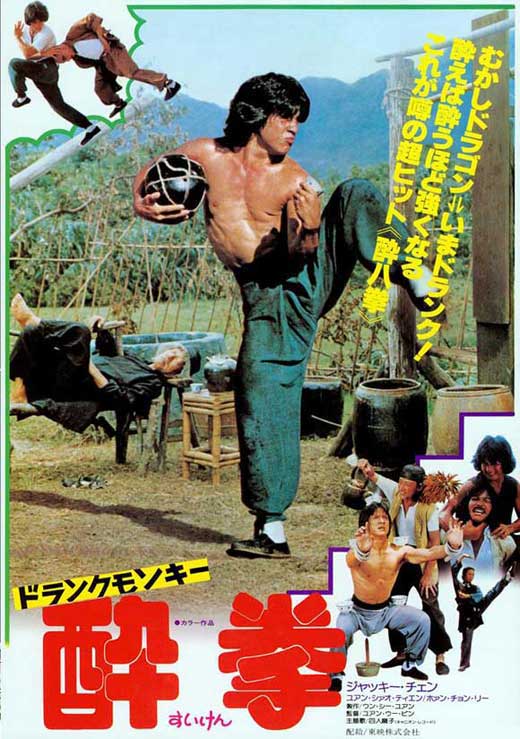
Drunken Master (1978)

DAY 35, DRUNKEN MASTER

DRUNKEN MASTER (1978) Four stars
There’s at least one more DRUNKEN MASTER fan out there in this great big world: 11-year-old Isaac Gonzalez from Carthage, Missouri.

Looking for a movie to watch one night, bored out of his skull after being grounded from his PlayStation 4 and his tablet, Mr. Gonzalez started thumbing around through hundreds of “old” and “older” movies, finally discovering a run of martial arts films, namely Jackie Chan films.

A wise old man finally asked Mr. Gonzalez, “Don’t you like THE KARATE KID?”

Mr. Gonzalez said, “Yeah.”

The wise old man then declared, “Well, I’ve got a movie that’s much better than THE KARATE KID. It’s awesome.”

Mr. Gonzalez said, “OK, put it on.”

Mr. Gonzalez, after subtitles were retired and the English dub reinstated early on, sat back and watched DRUNKEN MASTER in an apparent state of joy.

He laughed at the slapstick comedy, the vulgar humor, the silly banter, and the drunken boxing shenanigans. After all, doesn’t the Three Stooges’ humor transcend?

He enjoyed all the fight scenes and the great wide world variety of fighters thrown at Chan’s Wong Fei-hung.

The wise old man, after the 110 minutes were over and right before the 11-year-old boy had to go to bed on a school night, asked Mr. Gonzalez how the movie was and he said, “You were right, it’s better than THE KARATE KID. It’s awesome.”

Watching the film again with Mr. Gonzalez, paying attention to his reaction to it as well as my own, I was reminded that DRUNKEN MASTER rates as one of the most entertaining movies ever made.

It’s a blast.

This was still relatively early in Chan’s long career and two films released in 1978 helped make Chan a star, at least in Hong Kong, SNAKE IN THE EAGLE’S SHADOW and DRUNKEN MASTER. Both films have the same director and the same three actors in hero and villain roles.

I prefer DRUNKEN MASTER because, let’s see, it’s ROCKY meets ANIMAL HOUSE meets Bruce Lee.

It’s sublime ridiculousness.

Just imagine if Rocky Balboa drank alcohol before he came out against Apollo Creed and if Rocky’s trainer Mickey threw him a bottle in the middle of the fight and Rocky downed every single drop of it before knocking out Apollo.

Or if Bluto Blutarsky threw down and kicked the holy living hell out of Marmalard and Neidermeyer in a karate fight rather than start a food fight or throw a toga party. (Not that ANIMAL HOUSE had any influence on DRUNKEN MASTER. Both were released in 1978: ANIMAL HOUSE on July 28 in the United States and DRUNKEN MASTER on October 5 in Hong Kong. However, I would pair them in a double feature or perhaps group them with ROCKY for a triple feature.)

Lee tried some relatively bawdy humor early on during THE WAY OF THE DRAGON, but alas, that style worked better for Chan.

Just as it worked better for Chan developing his own brand of martial arts theater and not becoming “the next Bruce Lee.” Not possible, anyway.

DRUNKEN MASTER mixes raunch, slapstick, and (of course) great fight scenes in a way that I had never seen before.

It must have been almost 20 years ago when I first saw it; I rented a dubbed copy on VHS and was blown away.

Like I said not that long ago (certainly not been 20 years), I had never seen anything like DRUNKEN MASTER before and it especially enthralled me with its bountiful supply of colorful fighters with distinct fighting styles. Seems like there’s a great fight scene every few minutes, and they just keep getting better every single fight.

Yes, virtually every single character in this action spectacular can fight and these characters each get their moment in the sun over 110 minutes.

It also has a fantastic “Eight Drunken Gods” training montage.

Speaking of training, before we leave one should mention THE KARATE KID (1984) features a watered-down, more feel-good version of the mentor by comparison with the one in DRUNKEN MASTER. Beggar So (Yuen Siu-Tien) can be cruel and sadistic, at times, but he and Chan’s Wong Fei-Hung do form enough of a bond that helps carry us through.
Ironic that Chan played the mentor role in THE KARATE KID remake (2010).

With DRUNKEN MASTER, Chan started to find his niche as one of the most enduring of action movie stars.

He’s so damn likable partly because he gives you value for money. You know you’re likely to get your money’s worth when you put it down on Chan, through action or humor or both and you know that it’s Chan performing all those stunts himself. That man certainly risked life and limb to entertain us.

Chan also brought his influences from silent movie comedians like Buster Keaton, Charlie Chaplin, and Harold Lloyd, unique sources for inspiration. Chan even replicated a pair of the most famous stunts from Keaton and Lloyd, respectively.

Having a small role in CANNONBALL RUN, Chan was influenced by that Burt Reynolds-starring, Hal Needham-directed, cast-of-thousands car race comedy to feature a gag reel in his own movies, but rather than blown lines, Chan’s end credits often highlight stunts gone awry.

Chan belongs in the upper echelon of action stars, alongside such luminaries as Clint Eastwood, Arnold Schwarzenegger, Bruce Lee, Paul Newman, and Sylvester Stallone, who at their very best deliver the goods at a high level.

Enter the Dragon (1973)

DAY 34, ENTER THE DRAGON

ENTER THE DRAGON (1973) Four stars
There’s a line in BLADE RUNNER that makes me think about Bruce Lee (1940-73), “The light that burns twice as bright burns half as long, and you have burned so very very brightly.”

Lee made his screen debut as an infant in GOLDEN GATE GIRL, a.k.a. TEARS IN SAN FRANCISCO.

He appeared in several films throughout the ’50s and ’60s, and played the role of Kato on “The Green Hornet” during that show’s 1966-67 run.

Lee made his legend, though, on five martial arts films that were filmed over a period of two years in the early ’70s, where his light burned twice as bright half as long: THE BIG BOSS, FIST OF FURY, THE WAY OF THE DRAGON, ENTER THE DRAGON, and THE GAME OF DEATH (a new, different plot filmed after his death around Lee’s completed fight scenes; Lee postponed finishing THE GAME OF DEATH to make ETD).

ENTER THE DRAGON was the groundbreaker, known as the first martial arts film produced by a major American studio and for a whopping $850,000. The film made $21,483,063 in North America and coupled with the success of the English dub of FIVE FINGERS OF DEATH earlier in 1973, martial arts exploded. (Lee’s earlier films FIST OF FURY and THE WAY OF THE DRAGON fared much better financially in Hong Kong.)

Unfortunately, Lee died of a cerebral edema on July 20, 1973, just six days before ENTER THE DRAGON premiered in Hong Kong. One month later, it premiered in the United States at Grauman’s Chinese Theatre on the Hollywood Walk of Fame.

It’s been said that Lee was very nervous before making ENTER THE DRAGON. Lee’s wife, Linda Lee Cadwell, countered that in the Q&A session for the film’s 40th anniversary Blu-ray.

“I think it’s been portrayed that (Bruce) was very nervous before filming began,” she said. “I think it’s been misrepresented to the point that some people say he was having a nervous breakdown he was so paralyzed by fear. That is false. He was a professional actor. He’d been acting his whole life. And he was a professional martial artist as well. So he had no butterflies about that kind of thing. But what he wanted was to make this film very special. And he had ideas he would like to see added to the script. He was very adamant about it.

“He really put a lot of work into studying how to improve this film. To make it the best product that it could be because this was an important film for Bruce. It was going to be his first introduction to the American market. There was some reticence on the side of the people making the film. They wanted Bruce to get on the set and get going but he didn’t want to show up and get going on the film until the things he wanted — namely all the philosophy ­— in the film were done.”

ENTER THE DRAGON has been described as James Bond meets Fu Manchu, a fact some reviewers have lamented.

For example this one from Time Out, “A sorry mixture of James Bond and Fu Manchu, it tacks together the exploits of a multi-national crew of martial artists converging on Hong Kong for a tournament, infiltrated by Lee — fresh from his Shaolin temple — on an assignment to bust an opium racket. Worth seeing for Lee, but still unforgivably wasteful of his talents.”

Paul Bramhall wrote “Enter the Dragon: The Most Overrated Kung Fu Movie Ever?” in July 2018 and here’s his take on the Bond element: “The influence of Bond drifts in and out of ENTER THE DRAGON like spliced footage in a Godfrey Ho movie, making it come across as shoehorned in rather than a natural part of the narrative. … Released the same year as Roger Moore’s debut as Ian Fleming’s most famous creation, the secret agent styled shenanigans on display in ENTER THE DRAGON were dated even before it hit cinema screens. Casting Geoffrey Weeks a poor man’s M, and a head scratching plot of a rogue Shaolin student using a martial arts tournament as a front to his opium smuggling operation, (director) Robert Clouse and co. should have taken a page out of the ‘less is more’ manual of filmmaking.”

Nigel Tufnel had the answer for all that, “That’s just nitpicking, isn’t it?”

ENTER THE DRAGON downplays the sex angle, the double entendres, and the gadgets, and this low-budget “Bond movie” can stand head-to-head with any of the best Bond films like FROM RUSSIA WHITH LOVE, GOLDFINGER, ON HER MAJESTY’S SECRET SERVICE, and SKYFALL, for example.

Like how those early Bond films gather a lot of their appeal from the star power of Sean Connery, ENTER THE DRAGON draws heavily on Lee.

He’s a movie star, yes, tried and true with charisma and electricity that can transcend a low budget, a dodgy or dopey plot, awkward and awful voice dubbing, and other production lapses.

Lee ranks with Humphrey Bogart, Marilyn Monroe, James Dean, et cetera, all the great stars of the screen.

Not only that, watching Lee in action is like watching great athletes Barry Sanders, Jerry Rice, Michael Jordan, and Mike Tyson, for example.

You know you’re watching the very best, a grand master at his or her craft and somebody in the greatest physical (and mental) shape.

George C. Scott said that he looked for a “joy of performing” quality in judging actors, that the great ones separated themselves from the good with their joy. Scott named James Cagney.

You can say all these actors and athletes named in the last few paragraphs all have this “joy of performing.”

Lee definitely had that joy, and it’s apparent throughout even his worst movies.

Unlike the other Lee martial arts movies released in America, though, we hear Lee’s actual speaking voice in ENTER THE DRAGON.

He’s very, very quotable and my friends and I loved to do our best Lee impression with lines such as “Don’t think. FEEEEEEEEL! It’s like a finger pointing away to the moon. Do not concentrate on the finger or you miss all of the heavenly glory,” “You can call it the art of fighting without fighting,” and “Why doesn’t somebody pull out a .45 and, bang, settle it?”

In addition to Lee at the center, we have John Saxon and Jim Kelly as Roper and Williams, respectively, who also end up on Han’s Island (not to be confused with the small, uninhabited island that Canada and Denmark are in dispute over) because they were designed to give the film a wider appeal to maximize profits. Unlike Lee, who transcends fads and fashions, Saxon and Kelly and their characters are a bit more prisoner of the times. Fortunately, the two Americans both have enough personality and martial arts skill to justify their presences, and they’re fun.

Then we have the arch villain Han, just like a Bond picture, but please try and picture Gert Frobe or Telly Savalas do martial arts battle with Lee and the other protagonists and their fists and feet of fury.

Shin Kein (his speaking voice dubbed by Keye Luke, since he did not speak English) received acting credits in 272 films from 1940-95 and he’s most identified with Han. Like the best of the Bond films, Han contributes to the success of ENTER THE DRAGON with his villainy, a great foil to the good guys.

I love this blurb from his profile on the Villains Wiki, “Han is a heroin drug lord who runs his heroin cooking business from a secluded island. He also lost a hand, though how he lost it is never explained. He keeps the bones of the severed hand on display in a museum of torture and weapons. In place of the missing hand he has a variety of weapon hands to use like a iron hand, claw hand and a bladed hand. He is also an expert in martial arts.”

ENTER THE DRAGON ends in slambang fashion with the final fight between Lee and Han — a scene that could be played right alongside THE LADY FROM SHANGHAI and DUCK SOUP, three of the best usages of mirrors in motion picture history.

I would love to have seen ENTER THE DRAGON at its American premiere, just for the response to Lee alone.

NOTE: Raymond Chow, the producer behind Lee and Jackie Chan, died Friday, November 2, 2018 at the age of 91.

The Fly (1986)

DAY 5, THE FLY

THE FLY (1986) Four stars
I absolutely love it when a horror movie takes on more than just merely being a horror movie. These movies rank among the most pleasurable viewing experiences.

For example, George Romero’s DAWN OF THE DEAD (1978), a horror movie or a zombie picture that also passes through action and adventure, black comedy, silent and slapstick comedy, drama, gore galore, cinematic and social satire, surrealism, survivalism, and melodrama in addition to being great at the basic level of being a horror movie. All those extra traits put DAWN OF THE DEAD in the upper echelon.

Another example is David Cronenberg’s THE FLY (1986). It works on the most basic horror movie level but reaches greatness because it’s also a few other things it didn’t have to be. It grosses us out at times (rather, make that many times) but it also zaps us straight in the heart with its central storyline.

We’ve seen lots and lots of scientists over the years in loads and loads of pictures, but Jeff Goldblum’s Seth Brundle is one of those that sticks with you and stays in your mind. He’s not Colin Clive’s Dr. Frankenstein and he’s not Jeffrey Combs’ Herbert West, two other great cinematic scientists who embody more of the mad scientist archetype than Brundle. Brundle is more of the lovable eccentric that puts you in mind of what Albert Einstein must have been like in real life. We come to know this cinematic scientist more than just about any that spring to mind.

Brundle invents a teleportation device and he’s inspired to teleport himself one night after having successfully tried everything from Geena Davis’ stocking to a baboon. Of course, unbeknowst to him, a darn pesky housefly joins Brundle in the pod and throws a monkey wrench variable into this grand scientific experiment. Over the rest of the movie, Brundle transforms into Brundlefly.

Some viewers took what happened to Brundle as a metaphor for AIDS, but director Cronenberg said that his original intent was for an analogy for disease itself, terminal conditions such as cancer, and aging. This is one of the main sources for the emotional heft of THE FLY, because most of us grow old and die from a disease. Most of us are afraid, very afraid, indeed, it seems, and THE FLY plays on our fears.

On top of that, there’s a great tragic love story between Goldblum’s Brundle and Davis’ Veronica Quaife.

I highly doubt anybody expected such a moving love story coming in, especially considering Cronenberg’s previous films like SCANNERS and VIDEODROME.

And, let’s face a fact: Horror movies have not always been a great source for love stories.

Chris Walas deserved his Academy Award for Best Special Effects Make-up, but it’s the pleasant surprise love story and Brundle himself that elevate THE FLY.

Goldblum and Davis were a real-life couple, boyfriend and girlfriend during the making of THE FLY, and they were married from 1987 to 1990. They met during TRANSYLVANIA 6-5000 and later made a third movie together, EARTH GIRLS ARE EASY. For both actors, THE FLY would be their break into the mainstream and honestly, neither performer has ever done anything better.

Goldblum would play variations on scientists in seemingly every appearance for the next 30 years, in everything from JURASSIC PARK and INDEPENDENCE DAY to POWDER and THE LIFE AQUATIC WITH STEVE ZISSOU. It’s a role that fits him well and we can say that it’s become the Jeff Goldblum role just as we can say that Dabney Coleman (think NINE TO FIVE) and Hal Holbrook (think ALL THE PRESIDENT’S MEN) have come to develop their own respective roles.

Davis moved on to director Renny Harlin in both her personal and professional life, and her career never quite recovered after such flops as SPEECHLESS, CUTTHROAT ISLAND, and THE LONG KISS GOODNIGHT, the latter pair directed by Harlin. Davis’ career took off for a few years after THE FLY with hits like BEETLEJUICE, THELMA & LOUISE, and A LEAGUE OF THEIR OWN and an Academy Award for Best Supporting Actress for THE ACCIDENTAL TOURIST.

This is the rare remake that has obscured the original, which was made in 1958, directed by Kurt Neumann, and starred Vincent Price.

Goldblum wrote Price a letter telling one of the great hams in history, “I hope you like it as much as I liked yours.” Price, touched by the letter, went to see the remake and unfortunately, he did not quite return Goldblum’s affection for the original and called the remake “wonderful right up to a certain point … it went a little too far.”

In addition to both FLY movies, there’s been a lot of great fly moments throughout history, both screen and sound.

I’ll briefly guide you through three of them.

Norman Bates (Anthony Perkins), his stare, his voiceover, and a fly in the final moments of PSYCHO (1960): “They’re probably watching me. Well, let them. Let them see what kind of a person I am. I’m not even going to swat that fly. I hope they are watching. They’ll see. They’ll see and they’ll know, and they’ll say, ‘Why she wouldn’t even harm a fly.'”

Hungarian animator Ferenc Rofusz’s THE FLY (1980) won the 1981 Academy Award for Best Animated Short and it follows a fly on its journey from the woods to a house and finally on death’s end of a fly swatter. Oh, sorry, did I spoil that for you or the fly? Since it’s only three minutes long, this animated short might be a replacement if you have no desire to sit through 96 minutes of THE FLY (1986). In fact, you can watch the animated one 32 times in a row to substitute for the experience of the live-action flick.

English rock band Wire released the song “I Am the Fly” on its 1978 album CHAIRS MISSING and it features the great lines “I am the fly in the ointment / I can spread more disease than the fleas which nibble away at your window display / Yes, I am the fly in the ointment / I shake you down to say please as you accept the next dose of disease.”

Matinee (1993)

DAY 3, MATINEE

MATINEE (1993) Four stars
I still cannot believe, Mr. Sisney, that it took you until 2018 to finally see MATINEE. Better late than never, though.

I know, right, especially since Joe Dante’s one of my favorite directors and I cannot think of a single time when he’s let me down.

Just rattle off the titles to prove the case that Dante’s an American cinematic treasure of the highest degree.

We have PIRANHA (1978), THE HOWLING, GREMLINS, INNERSPACE, THE ‘BURBS, GREMLINS 2: THE NEW BATCH, SMALL SOLDIERS, and LOONEY TUNES: BACK IN ACTION.

Please don’t forget “It’s A Good Life,” his segment from the highly uneven TWILIGHT ZONE: THE MOVIE or that Dante was pursued to direct a third JAWS film planned as a horror spoof titled JAWS 3, PEOPLE 0.

Oh, if only that would have been made rather than what turned out to be JAWS 3.

Or just imagine Dante’s remake of Dario Argento’s INFERNO.

Yeah, you’re right, Dante’s INFERNO just rolls straight off the tongue.

Oh, Dante also directed an early dance sequence in ROCK ‘N’ ROLL HIGH SCHOOL, the one when Mary Woronov’s fascist Principal Togar meets P.J. Soles’ Riff Randell for the first time, I do believe. Apparently Dante helped out fellow director Allan Arkush when the latter suffered from exhaustion.

I generally prefer Dante over both Steven Spielberg and Robert Zemeckis, who often strayed too far over into strained seriousness for their (and our) own good.

Few directors have been as explicit as Dante about being an unabashed film buff with a steady stream of references and that’s just one of the many joys found within his films. Granted, you don’t have to be a film buff to enjoy a Dante movie, but the pleasures can be limitless if you are one.

MATINEE expresses that more than any other Dante film.

It gives us an independent film producer named Lawrence Woolsey (John Goodman), visiting Key West, Florida, to promote his latest greatest monster movie named MANT!, a half-man, half-ant epic in “Atomo-Vision and Rumble-Rama!”

It also gives us Gene Loomis, our resident teenage film buff who knows just about everything there is to know about the movies. You can just bet your bottom dollar that Dante was like that growing up.

Woolsey’s latest masterwork comes in the middle of the Cuban Missile Crisis and why, of course, you can’t have a frivolous entertainment like “Mant!” in the middle of the Cold War, the Red Scare, and, of course, nothing less than the End of the World.

That’s why you have concerned citizens (a.k.a. busybodies, killjoys, spoilsports) like the members of Citizens for Decent Entertainment milling around. Of course, there’s more to it than meets the eye.

Woolsey initially calls to mind Alfred Hitchcock, but there’s also William Castle (inspiration for Woolsey), Samuel Z. Arkoff, Roger Corman, and other figures of a bygone era evoked throughout MATINEE.

Castle perpetuated enough gags for a lifetime and he filmed HOUSE ON HAUNTED HILL in “Emergo,” THE TINGLER in “Percepto,” and 13 GHOSTS in “Illusion-O.”

Film director John Waters touched on Castle, the director who made Waters want to make films (yes, blame it on Castle, lol): “William Castle simply went nuts. He came up with ‘Coward’s Corner,’ a yellow cardboard booth, manned by a bewildered theater employee in the lobby. When the Fright Break was announced, and you found that you couldn’t take it anymore, you had to leave your seat and, in front of the entire audience, follow yellow footsteps up the aisle, bathed in a yellow light. Before you reached Coward’s Corner, you crossed yellow lines with the stenciled message: ‘Cowards Keep Walking.’ You passed a nurse (in a yellow uniform?…I wonder), who would offer a blood-pressure test. All the while a recording was blaring, ‘Watch the chicken! Watch him shiver in Coward’s Corner!’ As the audience howled, you had to go through one final indignity – at Coward’s Corner you were forced to sign a yellow card stating, ‘I am a bona fide coward.'”

Meanwhile, Arkoff, through American International Pictures, produced everything from the Beach Party movies to biker films to Pam Grier to Ralph Bakshi to C.H.O.M.P.S. Arkoff created his own formula, The Arkoff Formula: Action, Revolution, Killing, Oratory, Fantasy, Fornication.

Corman, through both AIP and New World Pictures, directed or produced such notables as ATTACK OF THE CRAB MONSTERS, A BUCKET OF BLOOD, THE WASP WOMAN, THE LITTLE SHOP OF HORRORS, TARGETS, DEATH RACE 2000, GRAND THEFT AUTO, PIRANHA, and ROCK ‘N’ ROLL HIGH SCHOOL. Martin Scorsese, Peter Bogdanovich, Jack Nicholson, Ron Howard, Sylvester Stallone, James Cameron and, of course, Dante are just a few of the famous names who got their start or big break working for Corman behind or in front of the camera.

You might say that they don’t make ’em like they used to, back in the glory days of Castle, Arkoff, Corman, et cetera.

That’s not true and Dante’s films are exhibits for good “B” movies still being made.

Dante cast regulars Robert Picardo, Kevin McCarthy, Belinda Balaski, and, of course, “that guy” Dick Miller are in MATINEE. Miller has appeared in every one of Dante’s films, and he’s one of the main links with the cinematic past and present. I’m always glad to see Miller.

Both the main story of MATINEE and the film-within-the-film work, and I’ve largely touched on just the film buff aspect of the production.

Bottom line: MATINEE gets straight to the heart of why we love movies both good and bad. Just look at that beautiful advertising poster.