The Devil-Doll (1936)

day 18, the devil-doll

THE DEVIL-DOLL (1936) Four stars
Two men escape from Devil’s Island at the beginning of THE DEVIL-DOLL, director Tod Browning’s penultimate theatrical feature.

Paul Lavond (Lionel Barrymore), wrongly convicted and imprisoned for 17 years for looting his own bank and murdering a night watchman, wants nothing more than cold-blooded revenge against his three former business partners who set him up for the fall. They’ve been living high on the hog while he’s been rotting away in prison. That can produce a lot of hatred.

Marcel (Henry B. Walthall, 1878-1936), meanwhile, wants to return to his scientific work. He’s single-minded in purpose, just as Lavond. Marcel, an idealist through and through until his final breath, has developed a way to reduce people to one-sixth their original size and this all ties in with speculation on how mankind will find the necessary resources to feed a growing population. Marcel believes that he’s found the solution for the human race moving forward.

(With the world’s population projected at 10 billion by 2050, there’s articles already written on how we will feed our growing population.)

At the moment of his greatest scientific triumph, the first successful shrunken human, Marcel dies and then Lavond joins Marcel’s widow and assistant Malita (Rafaela Ottiano) in continuing Marcel’s work. Of course, Lavond intends to exploit this scientific breakthrough for his personal revenge with the ultimate goal of clearing his name and Lavond and Malita go to Paris to carry out Lavond’s master plan. Lavond, a wanted man, disguises himself as Madame Mandelip (call her Mrs. Dreadfire) and Lavond/Mandelip and Malita set up a shop selling lifelike dolls.

Lavond can mind control the miniaturized humans (first Marcel and Malita’s slow servant and then one of his former associates Rodan) and they carry out his revenge. Brilliant plan. I mean, what authorities would ever believe that you were attacked by a “devil-doll?” Not only that, but you wouldn’t even know what hit you until it’s too late.

Barrymore (1878-1954) finds the right notes to play the wide range presented to him throughout THE DEVIL-DOLL. On one hand, Barrymore played Mr. Potter in IT’S A WONDERFUL LIFE 10 years after THE DEVIL-DOLL and Mr. Potter earned the No. 6 slot on the American Film Institute’s list of the 50 Greatest Villains. Barrymore uses some of the same notes playing Lavond, although he’s the main protagonist rather than main antagonist. On the other hand, it’s especially sad watching Lavond being unable to reveal himself to his estranged daughter (Maureen O’Sullivan) who’s adamant that she hates him; Lavond mostly contacts his daughter in the Mandelip guise. Mandelip earns a few laughs and like the later performances, for example, by Tony Curtis and Jack Lemmon in SOME LIKE IT HOT and Dustin Hoffman in TOOTSIE, they create legitimate characters that go beyond, way beyond the dudes-in-drag gimmick.

Walthall’s Marcel and Ottiano’s Malita belong alongside many of the great mad scientists throughout cinematic history. Malita is deliriously, delightfully loopy and, of course, relentless in the pursuit of continuing her dead husband’s legacy. Ottiano (1888-1942) became the subject of an article titled “Rafaela Ottiano: The Venetian Who Played the Villainess.” She’s a lot of fun.

Marcel and Malita fit one definition of mad (“carried away by enthusiasm or desire”) while Lavond fits another (“intensely angry or displeased”), and that gives THE DEVIL-DOLL a very interesting dynamic.

Dr. Jekyll & Mr. Hyde (1931)

day 16, dr. jekyll and mr. hyde

DR. JEKYLL AND MR. HYDE (1931) Four stars
The duality of man.

It was featured in a memorable conversation in FULL METAL JACKET between a colonel and Private Joker:
Colonel: Marine, what is that button on your body armor?
Private Joker: A peace symbol, sir.
Colonel: Where’d you get it?
Private Joker: I don’t remember, sir.
Colonel: What is that you’ve got written on your helmet?
Private Joker: “Born to Kill,” sir.
Colonel: You write “Born to Kill on your helmet and you wear a peace button. What’s that supposed to be, some kind of sick joke?
Private Joker: No, sir.
Colonel: You’d better get your head and your ass wired together, or I will take a giant shit on you.
Private Joker: Yes, sir.
Colonel: Now answer my question or you’ll be standing tall before the man.
Private Joker: I think I was trying to suggest something about the duality of man, sir.
Colonel: The what?
Private Joker: The duality of man. The Jungian thing, sir.

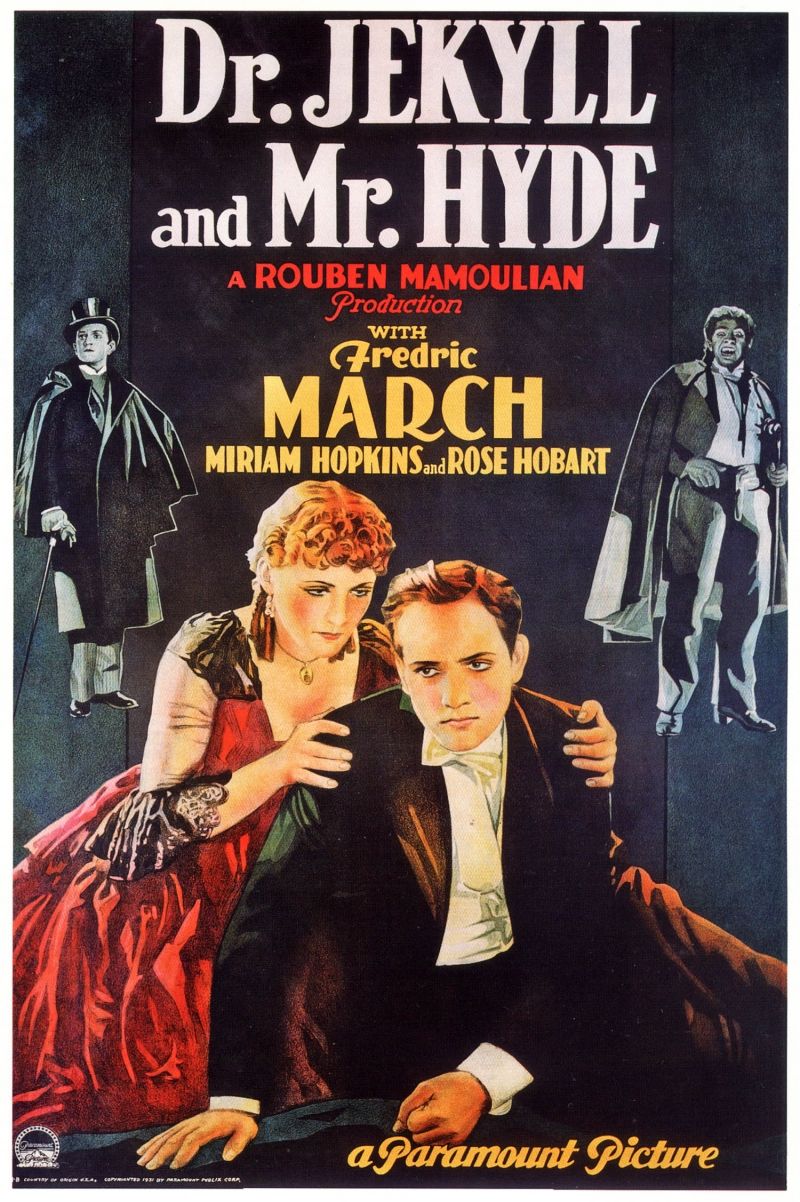
The duality of man is at the heart of DR. JEKYLL AND MR. HYDE in every form, be it Robert Louis Stevenson’s 1886 novella STRANGE CASE OF DR. JEKYLL AND MR HYDE and the 1931 and 1941 film versions with Fredric March and Spencer Tracy, respectively.

Dr. Henry Jekyll (March) believes that every man possesses two inside him (one good and one bad) and he puts this belief to the test with his creation of a formula that separates his good from his bad. He believes that if good and bad are separated, men will become truly liberated. Jekyll’s downfall will be his arrogance and his contempt for both his peers and the bounds for which one should not go.

Jekyll transforms into Mr. Edward Hyde, unleashing his inner demons on the world, especially a down-on-her-luck cabaret singer named Ivy Pearson (Miriam Hopkins). Jekyll saves Miss Pearson one night from a mugging and the very attractive young woman shows her appreciation to Jekyll in ways (bare legs, a kiss) that hasten Jekyll’s transformation into Hyde. It’s that leg that sticks with Jekyll, who’s engaged to be married to the socially respectable Muriel Carew (Rose Hobart) and you can go ahead and read socially respectable as dull. (The movie takes full advantage of coming before the Production Code that would have downplayed the sexual angle.)

Jekyll’s suave and sophisticated, well-respected, and known for both his decency and charitable works, but Hyde’s more a Neanderthal than a 19th Century Man with violent outbursts common and incredible physicality like brute strength and super jumping ability. Hyde is the darker side of Jekyll’s personality that he has repressed for so long, as a man of science turns into a homicidal maniac even without any potion.

Like many scientists in the movies, Jekyll messes around with things no man should and he pays the price dearly. There’s a dialogue scene between Jekyll and his friend Dr. Lanyon that gets to the gist of it:

Lanyon: You’re a rebel, and see what it has done for you. You’re in the power of this monster that you have created.
Jekyll: I’ll never take that drug again!
Lanyon: Yes, but you told me you became that monster tonight not of your own accord. It will happen again.
Jekyll: It never will. I’m sure of it. I’ll conquer it!
Lanyon: Too late. You cannot conquer it. It has conquered you!

March (1897-1975) was one of the best actors of his era on both stage and screen, winning two Academy Awards for Best Actor and two Tony Awards, and he gives two of the greatest performances in any horror film as Jekyll and Hyde, because they both take up residence in our mind.

For his work as Jekyll and Hyde, March tied with Wallace Beery (THE CHAMP) for the Academy Award for Best Actor. Should he not have won outright for playing two roles masterfully?

(Alas, March received one more vote than Beery. Unfortunately, though for March, Academy rules at that point in time considered an one-vote margin to be a tie. Thus, March and Beery tied for the award. This would not be the case any longer under Academy rules.)

DR. JEKYLL AND MR. HYDE, like many horror movies from the 1930s and 1940s, sticks with you long after it’s over and not only for its compelling themes and March’s performances but also for the use of POV shots and lap dissolves, transformation scenes, Hopkins’ performance as Ivy, and its evocation of a Victorian London that made Jekyll say “London is so full of fog, that it has penetrated our minds, set boundaries for our vision.”

Atmospheric has been used to describe the film directed quite masterfully by Rouben Mamoulian only a couple times.

Mamoulian pulls out all the stops in realizing the movie creatively.

Mamoulian on the transformation scene, “I asked, ‘What kind of sound can we put with this? The whole thing is fantastic. You put a realistic sound and it will get you nowhere at all.’ So again, you proceed from imagination and theory and if it makes sense, do it. I said, ‘We’re not going to have a single sound in this transformation that you can hear in life.’ They said, ‘What are you going to use?’ I said, ‘We’ll light the candle and photograph the light, high frequencies, low frequencies, direct from light into sound. Then we’ll hit a gong, cut off the impact, run it backward, things like that.’ So I had this terrific kind of stew, a melange of sounds that do not exist in nature or in life. It was eerie but it lacked a beat, and that’s where I had to introduce rhythm.

“So I said, ‘We need a beat.’ We tried all sorts of drums, but they all sounded like drums. When you run all out of ideas, something always pops into your head. I said, ‘I’ve got it.’ I ran up and down the stairway for two minutes until my heart was really pounding … and said, ‘Record me.’ And that’s the rhythm of the big transformation. So when I say my heart was in JEKYLL AND HYDE, it’s literally true.”

Full Metal Jacket (1987)

day 65, full metal jacket

FULL METAL JACKET (1987) Four stars
I’m a firm believer in the “Full Metal Jacket Fallacy.”

Why, that’s when fools argue the first half of Stanley Kubrick’s FULL METAL JACKET is just brilliant and the second half flat-out sucks donkey testicles.

I’ve heard that argument many, many times in high school, college, and probably will continue to hear it for all my living days. You’re all wrong and I have no problem saying that.

Yes, I would agree the first half’s superior to the second, especially thanks to the powerhouse performances by R. Lee Ermey (1944-2018) and Vincent D’Onofrio, but the second half does not suck.

Granted, I do believe Kubrick’s Vietnam begins with our main protagonist Private Joker (Matthew Modine) and his sidekick Rafterman (Kevyn Major Howard) picking up a Da Nang hooker. In dialogue sampled by infamous rap group 2 Live Crew, she says, “Me so HORNY. Me love you long time.” Anyway, she goes on to guarantee “Me sucky-sucky. Me love you too much” and later on, we hear “Sucky! Sucky! Five dolla!,” rather infamous words. She’s relentless, I’ll give her that.

So, yeah, I can see why people think FULL METAL JACKET sucks during its second half, since hearing “suck” so many times conditioned them into believing the Vietnam portion sucked. I get it now, after many years of being mystified.

FULL METAL JACKET, as many already know, made several great contributions to the English language and it furthered cursing more than just about any other film in cinematic history. Ermey, in particular, used profanity like other artists use clay.

For example, I learned such timid little phrases as “I didn’t know they stacked shit that high,” “Only steers and queers come from Texas” (an Oklahoma variation on this line used in AN OFFICER AND A GENTLEMAN), and “I bet you’re the kind of guy that would fuck a person in the ass and not even have the goddamn common courtesy to give him a reach-around.”

Not that I ever use such phrases, I promise.

That’s good, since I first watched FULL METAL JACKET around the age of 10 on home video. Right around that same moment in time, I first watched films like COMMANDO, THE TERMINATOR, PREDATOR, PLATOON, and STAND BY ME, all films that definitely had an impact on me, though I found their vulgarity funny at the time in a different way than years later. I did not know what most of the words meant upon first viewing, but found them funny in just how they sounded and how they were delivered. I picked up the meanings in later viewings, and I still find them all funny.

STAND BY ME, as well as THE BAD NEWS BEARS, especially proved revelatory, in that kids from different eras cussed.

I mean, STAND BY ME gave us the line “A pile of shit has a thousand eyes” and Tanner Boyle in THE BAD NEWS BEARS, why he’s one of the greatest foul-mouthed hooligans in history.

Ermey and D’Onofrio give two brilliant performances, but since they’re in a film directed by Kubrick (1927-99), they were not nominated for the Academy Awards.

That’s because Kubrick’s often considered the real star in his movies and he’s one of the greatest directors ever whose credits include THE KILLING (watch this one followed by RESERVOIR DOGS), PATHS OF GLORY, SPARTACUS, DR. STRANGELOVE, 2001, A CLOCKWORK ORANGE, BARRY LYNDON, THE SHINING, and EYES WIDE SHUT.

Kubrick made 13 feature films during his career from 1953 through 1999. He was a photographer for Look magazine in the late 1940s and early 1950s, and that background informs all his films. They all have indelible scenes.

Kubrick’s films grow better over time and they’re generally perceived more favorably after cold or hostile receptions during their first theatrical release. They have a timeless quality about them.

How often were the actors’ performances saluted by the industry?

Seemingly not very often.

Peter Ustinov won the 1961 Academy Award for Best Supporting Actor for SPARTACUS, probably the project least satisfactory personally to Kubrick.

Sue Lyon won the Golden Globe for Most Promising Newcomer for her work in LOLITA and James Mason, Shelley Winters, and James Mason were nominated along with Lyon.

Peter Sellers received a 1965 Academy Award Best Actor nomination for DR. STRANGELOVE. Sellers played three roles … and he lost the award to Rex Harrison, Professor Henry Higgins in MY FAIR LADY. (Lee Marvin won the next year for two roles in CAT BALLOU, so it must have been easier to win for two roles rather than three.)

All of the awards and nominations for 2001 were either technical (visual effects, cinematography, production design) or for Kubrick and writer Arthur C. Clarke, though Douglas Rain, as the voice of HAL 9000, gives one of the best performances in any film. How would you like to have been beaten out by a sentient computer? No, instead, the 1969 Academy Award nominees for Best Actor were Cliff Robertson in CHARLY, Alan Arkin in THE HEART IS A LONELY HUNTER, Alan Bates in THE FIXER, Ron Moody in OLIVER!, and Peter O’Toole in THE LION IN WINTER … with the prize to Robertson. Who remembers their performances? Honestly … we all remember HAL 9000, “Look Dave, I can see you’re really upset about this. I honestly think you ought to sit down calmly, take a stress pill, and think things over.”

Nearly all the kudos for A CLOCKWORK ORANGE were technical or for the director, like before, but Malcolm McDowell earned a Golden Globe nomination for his performance as larger-than-life Alex DeLarge.

BARRY LYNDON won 1976 Academy Awards for best production design, best costume design, best cinematography, and best original score.

Jack Nicholson won Academy Awards for Best Actor in 1976 (ONE FLEW OVER THE CUCKOO’S NEST) and 1998 (AS GOOD AS IT GETS) and for Best Supporting Actor in 1984 (TERMS OF ENDEARMENT), but he got no love for THE SHINING though his flamboyant performances before and after Kubrick received nominations. I mean, for example, is Nicholson’s performance in THE SHINING all that different from his one in ONE FLEW OVER THE CUCKOO’S NEST?

EYES WIDE SHUT received no Academy Award nominations, just like THE SHINING before it, although Tom Cruise and Nicole Kidman do some of their best work.

Back to FULL METAL JACKET.

Kubrick, Michael Herr, and Gustav Hasford received the film’s lone Academy Award nomination for Best Adapted Screenplay, while both Ermey and D’Onofrio were both separately nominated for Best Supporting Actor, Ermey by the Golden Globes and D’Onofrio by the Boston Society of Film Critics.

I doubt there were better performances from any films released in 1987.

Erney and D’Onofrio bring their characters Gunnery Sergeant Hartman and Private Leonard “Gomer Pyle” Lawrence to such life that they stay with us for the rest of the movie after their unfortunate, tragic demise at the end of the Parris Island sequence. Their characters stay with us forever, in fact, and I venture to say that’s a definition of a great performance.

If somebody mentions Gomer Pyle, for example, I think first of FULL METAL JACKET and not Jim Nabors of “The Andy Griffith Show” and “Gomer Pyle, U.S.M.C.” Please consider that, for a second.

D’Onofrio gained 70 pounds for the role of the overweight Gomer Pyle, who finds that he’s only got one true skill in basic training. Those 70 pounds surpassed what Robert DeNiro did for RAGING BULL, and that performance earned an Academy Award.

Ermey served as a U.S. Marine drill instructor during the Vietnam War and this real experience informed his performance as Hartman.

Kubrick allowed Ermey to ad lib his dialogue, something that does not jibe with Kubrick’s reputed uncompromising perfectionism. In fact, Google “Kubrick perfectionist” and see results like a Telegraph article titled “The relentless, ridiculous perfectionism of Stanley Kubrick.”

I don’t know, Kubrick earned his reputation for relentless perfectionism, of course, but what about Sellers in DR. STRANGELOVE or, for that matter, George C. Scott’s War Room stumble in that same film? Or McDowell’s “Singin’ in the Rain” number in A CLOCKWORK ORANGE? Or Nicholson’s “Here’s Johnny” in THE SHINING? Ad libs, ad libs, ad libs.

Kubrick and his films are complex, contradictory, and controversial, and that’s part of why they stand the test of time.

The 36th Chamber of Shaolin (1978)

day 38, the 36th chamber of shaolin

THE 36TH CHAMBER OF SHAOLIN (1978) Four stars
Wu Tang Clan founder RZA said that he’s probably watched THE 36TH CHAMBER OF SHAOLIN more than 300 times, beginning with a dub on TV (called THE MASTER KILLER) and then continuing through many, many viewings in seedy urban theaters.

RZA has shown the movie the same devotion that its central character Liu Yude / Monk San Te (Gordon Liu) shows in THE 36TH CHAMBER OF SHAOLIN.

THE 36TH CHAMBER OF SHAOLIN truly takes off into the stratosphere of the highest level of martial arts entertainment when our protagonist arrives at the Shoalin Temple around the 31st minute.

Training sequences have long been a staple of action movies, in everything from THE DIRTY DOZEN and FULL METAL JACKET to ROCKY, DRUNKEN MASTER, and THE KARATE KID, just a few prominent examples.

However, I’ve never seen anything quite like the training sequences in THE 36TH CHAMBER. They’re on another level, taken far more seriously than usual.

Training sequences in a lot of movies seem to end up being consolidated into a couple montages and topped off with an uplifting song along the lines of Bill Conti’s “Gonna Fly Now” (ROCKY). We’ve seen it time and time again, a standard of the action movie relentlessly satirized in TEAM AMERICA: WORLD POLICE.

THE 36TH CHAMBER gives us a good 45 minutes of training, helped out by the fact there’s 35 chambers in the Shaolin Temple. San Te advances more rapidly than any student ever before, six years that, through the magic of movies, goes by quickly. I could have gone for the entire movie being nothing but training sequences, though.

It all leaves you with an unbelievably giddy feeling as he cracks every level, bests every challenge. The challenges are not merely physical, and there’s a rigorous attention to detail rare for any genre.

San Te wants to create a 36th chamber to teach the common man the basics of Kung Fu. He’s rebuffed and sent back out into the larger world.

San Te sought sanctuary at the temple because, as a young student named Liu Yude, he took part in an uprising against the Manchu government.

Now, back in the world, equipped with his three section staff invention, San Te’s ready for combat against those heartless Manchu oppressors.

After vanquishing his foes, San Te eventually returns to the temple and establishes that 36th chamber.

Of course, he becomes a folk legend.

Beyond the usual suspects Bruce Lee and Jackie Chan, Gordon Liu is one of my absolute favorite martial arts stars. In addition to THE 36TH CHAMBER, notable titles in his filmography include CLAN OF THE WHITE LOTUS, RETURN TO THE 36TH CHAMBER, and EIGHT DIAGRAM POLE FIGHTER.

Western audiences likely know Liu best from his role in Quentin Tarantino’s KILL BILL movies, where he played Johnny Mo and Pai Mei in the two parts, respectively. Pai Mei in EXECUTIONERS FROM SHAOLIN and Priest White Lotus in CLAN OF THE WHITE LOTUS, both villains, inspired Tarantino’s Pai Mei.

(Please watch CLAN OF THE WHITE LOTUS if you want another screw loose entertainment. Liu defeats Priest White Lotus in one memorable final fight that incorporates the fine art of needlepoint.)

Liu had the necessary movie star charisma and joy of performing to carry viewers from one end of the picture to the next or stay interested through 35 chambers, to be more precise. Riveting is the word for it.

Liu’s at his best in THE 36TH CHAMBER and the movie does not waste any time in showcasing him, with an opening credits sequence that previews the final hour of the film when it kicks into a high level.

Lo Lieh played the villain General Tien Ta in THE 36TH CHAMBER and he also played both Pai Mei and Priest White Lotus. He played the heavy in a lot of Shaw Brothers films, but one should remember that he played the protagonist in FIVE FINGERS OF DEATH, a film (along with ENTER THE DRAGON) that broke martial arts films in the Western world. Lieh also directed himself as Priest White Lotus.

This is not his best villain, but that’s alright because the training sequences and Liu’s starmaking performance alone make THE 36TH CHAMBER one for the ages.

We know what RZA has to say on that.

“Me and Dirty (Ol’ Dirty Bastard) were probably the most fanatical about it,” RZA said in Rolling Stone. “36TH CHAMBER to me has had a strong spiritual connection that set me and Dirty on the path.

“It’s one film I’ve never gotten sick of. I’ve probably seen this movie more than any other, especially now that it’s something I perform with, but I don’t get tired of it. More than anything, I love watching people discover it. When I was in California doing it at the Egyptian Theater, that was the first time my son, 10 years old, watched the movie. And he loved it. Turning somebody onto a film that’s so dear to you is, to me, for me, the coolest thing.”

RZA provided a live score to THE 36TH CHAMBER at various Alamo Drafthouse Cinema screenings.

The Old Dark House (1932)

day 15, the old dark house

THE OLD DARK HOUSE (1932) Four stars
Stop me if you think you’ve heard this plot before: On a dark and stormy night, five travelers are caught up in one helluva storm and flooded out roads make it virtually impossible for travel by motorcar. Our travelers seek out overnight shelter from the storm and take refuge at the nearest house.

Next time, of course, our travelers might just take their chances with the rain and the mud rather than people like the ones they find inside that house or, if nothing else, keep walking and eventually find another house with different people inside.

THE OLD DARK HOUSE takes this old-fashioned plot (probably old-fashioned in 1932) and classes it up because of atmosphere, the cast, and the sharp screenplay by J.B. Priestley, Benn Levy, and R.C. Sherriff.

It’s directed by that master of 1930s cinema, James Whale, whose credits include WATERLOO BRIDGE, FRANKENSTEIN, THE INVISIBLE MAN, BRIDE OF FRANKENSTEIN, and THE GREAT GARRICK, some of the best from that era.

Whale’s movies generally have style for miles and miles, and intelligence and wit at their core to go along with their atmosphere.

THE OLD DARK HOUSE is no different, and cinematographer Arthur Edeson and production designer Charles D. Hall do wonders to create a sustained mood for 72 minutes. You’re in the hands of master craftsmen, as well as master performers.
Worlds collide in THE OLD DARK HOUSE.

The Femm house contains dread people who have dread secrets: brother and sister Horace (Ernest Thesiger) and Rebecca (Eva Moore), butler Morgan (Boris Karloff, still not speaking after FRANKENSTEIN), 102-year-old patriarch Sir Roderick Femm (played by a woman named Elspeth Dudgeon when the credits give John Dudgeon), and the pyromaniac named Saul (Brember Willis) who’s kept hidden in a locked room. Horace and Rebecca behave like they’re hiding something (namely their brother Saul) and Morgan, why he’s a mean drunk.

Our travelers are Philip Waverton (Raymond Massey) and his wife Margaret (Gloria Stuart) and Roger Penderel (Melvyn Douglas) and then Sir William Porterhouse (Charles Laughton) and his girlfriend Gladys DuCane (Lilian Bond), who come calling at dinner time.

You can basically guess what happens in THE OLD DARK HOUSE and while that normally sinks lesser pictures, you want the travelers to encounter the dread people and discover the dread secrets inside the Femm house, because you know that you will enjoy watching this plot unfold. We want to see who gets out of there alive in the morning.

There’s really not anything complicated about THE OLD DARK HOUSE, but it’s one of the best examples of the haunted house film, a branch of the horror genre that includes such films as THE SHINING, POLTERGEIST, AMITYVILLE HORROR, and the first two EVIL DEAD movies.

The late film critic Roger Ebert loved to say “It’s not what a movie is about, it’s how it is about it.”

THE OLD DARK HOUSE could be used as one of the exhibits for that argument.

All Quiet on the Western Front (1930)

day 64, all quiet on the western front

ALL QUIET ON THE WESTERN FRONT (1930) Four stars
Working on a master’s degree in history (world history emphasis), the last three credit hours I needed were from an internship.

In the summer of 2005, I worked a three-week, 120-hour internship at the National Archives (no, I did not see Benjamin Gates or Nicolas Cage playing another character, for that matter) on Bannister Road, Kansas City. I worked a week on a file project, utilized a spatula to remove “sensitive” staples from at least 100-year-old Fort Leavenworth prisoner files (another week), spent a day looking up family history, and visited what became the National WWI Museum and Memorial. In the past, before September 11, 2001, of course, interns were allowed to keep both their federal employee badges (needed to enter the facility) and their spatula. I settled for a picture of the badge.

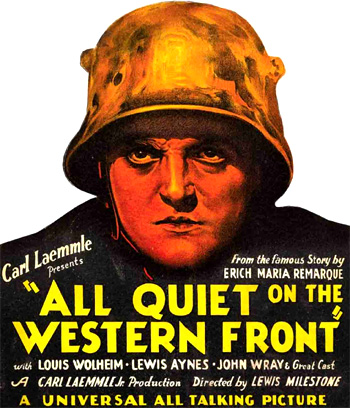
At that point in time in the WWI museum, they only had the gift shop completed and open to the public, so I bought a Buffalo Soldier T-shirt (absolutely loved that design) and German author Erich Maria Remarque’s remarkable book “All Quiet on the Western Front,” a book originally released in 1929 and made into an Academy Award for Best Picture winner in 1930.

I wanted to go back to the Archives as full-time employee, but alas, it did not come to be after multiple tries. Finally, in 2008, after three years of frustration and substitute teaching (just another phrase that means “frustration”), I returned to Pittsburg State and embarked on a new path that led to where I am today.

(Of course, when I did the internship, I enjoyed telling people, “I work for the government. … I could tell you, but I’d have to kill you.”)

I watched the movie before I read the book and both are essentials. However, I’ll just focus on the movie (directed by Lewis Milestone) within this space.

We follow a group of German young men, predominantly Paul Baumer (Lew Ayres), from when they’re idealistic prep school students who are inspired to enlist by their jingoistic teacher to their inevitable disillusionment after being hit straight in the face with the brutal realities of World War I. Death, mutilation, rations, starvation, trench warfare, on down the line, and finally Paul asks the fundamental questions of life and death and what exactly is he fighting for.

When he returns to his old classroom where his former teacher still gives the students the same old propagandistic spiel as before, Paul confronts him and the students, “We used to think you knew. The first bombardment taught us better. It’s dirty and painful to die for your country. When it comes to dying for your country, it’s better not to die at all! There are millions out there dying for their countries, and what good is it?”

The students yell and scream COWARD at Paul.

Of course, one would be easily tempted to say that it’s much easier telling an anti-war story from a German perspective, since war is more Hell for the “losing” side. Notice the difference in World War II movies from Germany and Japan versus movies from Great Britain and the United States, for example.

Francois Truffaut (1932-84), first a film critic and then a director himself whose credits include THE 400 BLOWS, JULES AND JIM, and THE WILD CHILD, reportedly told Gene Siskel in a 1973 interview, “I find that violence is very ambiguous in movies. For example, some films claim to be anti-war, but I don’t think I’ve really seen an anti-war film. Every film about war ends up being pro-war.”

Anyway, Truffaut became famous for saying “There’s no such thing as an anti-war film”; for example Roger Ebert used it when reviewing PLATOON. The actual original Truffaut anti-war film quote seems to be quite elusive.

The thinking behind the quote (whether Truffaut said it or not) is that movies glorify whatever behaviors are being shown or war movies make war seem attractive, glamorous, et cetera, basically cinematic propaganda that’s an upgrade on what Paul’s school teacher tells generations of young men in the classroom.

On that train of thought, it makes ALL QUIET ON THE WESTERN FRONT pro-war rather than anti-war, despite any noble intentions and whatever dialogue comes out of the characters’ mouths.

However, ALL QUIET ON THE WESTERN FRONT definitely had an impact on Lew Ayres, the 22-year-old actor who played Paul.

Ayres became a conscientious objector during World War II, basing it on his pacifism. Ayres said, “To me, war was the greatest sin. I couldn’t bring myself to kill other men,” and he told the draft board in Beverly Hills, “Don’t think I am trying to save my neck. I would like to be of service to my country in a constructive way and not a destructive way.”

Since Ayres did not belong to any organized religion and did not have any formal religious training, he faced long odds in being classified a CO. The draft board deliberated on Ayres’ case for months and they mistakenly classified him IV-E, meaning that he objected to all military service. Ayres preferred to be I-A-O, meaning that he could have noncombatant military service like the medical corps he most desired. The draft board assigned the IV-E Ayres to a labor camp in Wyeth, Oregon.

The public, especially the Hollywood community, hit Ayres with a major wave of backlash. Of course, this was early 1942, months after Pearl Harbor and months after the United States surrendered neutrality and joined World War II against the Axis powers (basically Germany, Italy, and Japan). It looked extremely bad for a Hollywood actor to be a conscientious objector.

A soldier, though, wrote a letter of support to Time, “Lew Ayres, instead of being detrimental to our public good, is indicative of what the American people wrote into their Bill of Rights and what we fight our wars about, the right to freedom in a democracy.”

Over a month later, the draft board reclassified Ayres I-A-O.

Ayres received the assignment to the medical corps that he desired. He served 3 1/2 years in the medical corps and earned three battle stars.

In a story called “The ‘Good’ Conscientious Objector Lew Ayres,” writer Joseph Connor quoted Ayres on his experiences, “I had imagined that war was a horrible thing. But it actually surpassed anything I’d dreamed of. It’s bad enough in the field, where soldiers expect cruelty and death; but in cities, among helpless civilians, the picture is far worse.”

Ayres said that he found it the most difficult to attend to children with bullet holes in them.

Bride of Frankenstein (1935)

day 14, bride of frankenstein

BRIDE OF FRANKENSTEIN (1935) Four stars
Boris Karloff movies could fill an entire year of daily movie reviews.

Karloff (1887-1969) undoubtedly is one of the most prolific actors who ever lived, working steadily from 1918 through 1968.

Karloff established an incredible work pace, especially in the 1930s.

Take, for example, the years 1931 and 1932 alone when Karloff appeared in 24 films, including such classics as FRANKENSTEIN, SCARFACE, THE OLD DARK HOUSE, THE MASK OF FU MANCHU, and THE MUMMY.

He was billed only as “Karloff” in several pictures after FRANKENSTEIN (1931) made him a phenomenon.

For example, a producer’s note before the start of THE OLD DARK HOUSE: “Karloff, the mad butler in this production, is the same Karloff who created the part of the mechanical monster in ‘Frankenstein.’ We explain this to settle all disputes in advance, even though such disputes are a tribute to his great versatility.”

Every time I watch both FRANKENSTEIN and BRIDE OF FRANKENSTEIN (1935), I am just amazed once again by what Karloff was able to do with The Monster.

He’s absolutely phenomenal.

It took make-up artist Jack Pierce four hours every day to make Karloff into Frankenstein’s Monster, with a concoction of cotton, collodion, gum, and green greasepaint. Pierce and Karloff worked together on a multitude of films during the Golden Age of Horror (1930s and 1940s).

The IMDb identified eight Karloff trademarks and I especially like the eighth one: “Making audiences feel sorry for his evil characters by displaying extreme frailty and vulnerability, even when the material didn’t call for this.”

We feel a multitude of things for the Frankenstein Monster, and that’s at the center of the character’s greatness.

We especially feel for The Monster during BRIDE OF FRANKENSTEIN, a rare sequel that builds upon and honestly betters the previous film.

Karloff did not want The Monster to speak, feeling that it would eventually destroy the character. He looks a little differently here than in the first film, because in order to speak more clearly Karloff did not remove the dental plate in his face like he did in the first film. His cheeks appear less hollow as a result.

While giving The Monster the ability to speak could have miserably backfired, it works (like just about everything else) in BRIDE OF FRANKENSTEIN.

The Monster is a quick learner and the writers give him some great lines.

“I love dead … hate living” and “Alone: bad. Friend: good!” might not seem like much on the page, but the way Karloff handles them, they affect viewers on a deep emotional level.

There’s much poignancy to be found in the plight of The Monster.

He’s more like an innocent child than pure evil in both FRANKENSTEIN and BRIDE OF FRANKENSTEIN.

He can’t help what God or Dr. Henry (Victor in the novel) Frankenstein in this case made him.

Like Karloff, Colin Clive returns for the sequel as Dr. Frankenstein and he’s reluctant to the extreme (after the events of the first movie) to participate in Dr. Pretorius’ scheme to make The Monster a bride. Finally, he does though, of course, and it’s back to the laboratory; production designer Charles D. Hall’s lab sets in the first two FRANKENSTEIN films have been endlessly influential.

Clive and Dwight Frye (killed as two different characters in FRANKENSTEIN and BRIDE OF FRANKENSTEIN) are two of the great scenery chewers of all-time, but this is largely Karloff’s and Ernest Thesiger’s show.

Thesiger plays Dr. Pretorius, Dr. Frankenstein’s former teacher and, of course, a rebellious mad scientist. He’s as explicitly homosexual as one could present in a 1935 film and, according to the book “The Monster Show: A Cultural History of Horror” by David J. Skal, openly gay director James Whale told Thesinger to play Dr. Pretorius as an “over-the-top caricature of a bitchy and aging homosexual.”

Frankenstein and Pretorius rank among the best screen mad scientists.

BRIDE OF FRANKENSTEIN can be enjoyed at face value or can be seen as a daring gay parable that sneaked just enough content past the censors.

In the 1997 Gary Morris article “Sexual Subversion: The Bride of Frankenstein” printed in the Bright Lights Film Journal, the author postulates that the movie “assaults the notion of the sanctity of standard sex roles and ‘family values.'” Whale thus made the only sequel that interested him.

“THE BRIDE can be read from a modern perspective as a homosexual joke on the heterosexual communities Whale — a gay man — served and benefited from: his ‘masters’ at Universal and the mass audience to whom he could present unconventional images and ideas and see them unknowingly endorsed and approved in the most direct way possible: from the moviegoer’s pocketbook,” Morris wrote.

Under this theory, Whale’s attacks on hetero institutions can be seen most vividly when The Bride (Elsa Lanchester) rejects The Monster near the end, including a famous hiss that speaks louder than a thousand words. (Reportedly, Lanchester based her spitting and hissing on the swans in Regent’s Park, London.)

Not everything passed the censors enforcing the Motion Picture Production Code: Any references to the sexual arrangements of Mary Shelley (Lanchester in her first of two roles), Percy Bysshe Shelley, and Lord Byron (especially this line of dialogue: “We are all three infidels, scoffers at all marriage ties, believing only in living freely and full”) and “too revealing” shots of Lanchester’s cleavage were cut.

It’s still amazing what Whale put into the film.

Others have dismissed the gay parable angle in BRIDE OF FRANKENSTEIN.

That’s fine because any way you read it, though, BRIDE OF FRANKENSTEIN is a classic.

Infra-Man (1975)

day 36, infra-man

INFRA-MAN (1975) Four stars
I just looked at DRUNKEN MASTER, one of the most entertaining movies ever made, and here we are back with INFRA-MAN, another one.

Roger Ebert wrote an enthusiastic review in March 1976: “And so we’re off and running, in the best movie of its kind since INVASION OF THE BEE GIRLS. I’m a pushover for monster movies anyway, but INFRA-MAN has it all: Horrendous octopus men, a gigantic beetle man with three eyes who sprays his victims with sticky cocoons, savage robots with coiled spring necks that can extend ten feet, a venomous little critter that looks like a hairy mutant footstool, elaborately staged karate fights, underground throne rooms, damsels in distress, exploding volcanoes, and a whip-cracking villainess named Princess Dragon Mom.”

Believe it or not, Ebert originally gave INFRA-MAN only two-and-a-half stars and later changed his star rating to three after the re-release of MIGHTY PEKING MAN, another incredibly goofy movie by the same studio.

However, obviously, I don’t think Ebert went far enough, because INFRA-MAN should be four stars.

I just called DRUNKEN MASTER “sublime ridiculousness.”

That’s an understatement for INFRA-MAN.

No, seriously.

Not just because I’ve seen the movie in a print with a Mandarin soundtrack and Spanish subtitles.

It really is the most ridiculous movie I have seen, especially in the English dub.

This Shaw Brothers production combines super heroes, Kung Fu, and science fiction into one explosive 90-minute entertainment package influenced by the Japanese TV shows ULTRAMAN and KAMEN RIDER that were popular in Hong Kong.

It’s not only explosive because shit blows up real good throughout INFRA-MAN.

Seriously, there might be a land speed record for explosions in the movie.

Everything blows up.

Not convinced yet?

The short plot summary from IMDb: “Princess Dragon Mom and her mutant army have arisen, and only Infra-Man can stop them!”

A longer plot summary: “The ten million year-old Princess Dragon Mom (Terry Liu) attempts to conquer the Earth with her legion of mutant monsters. In response, Professor Chang (Wang Hsieh) creates Infra-Man, turning a young volunteer into a bionic superhero to save the world. However, the Princess kidnaps Chang’s daughter. Can Infra-Man save her and the planet before it’s too late?” (IMDb)

Princess Dragon Mom is one of the great villains of all-time, definitely ahead of her time in having cones on her breasts well before Madonna.

Not only that, which is no small feat, but when Infra-Man tries decapitating her when she’s in her dragon form with his energy blades, Princess Dragon Mom regenerates a new head. Every single time, and I mean every single time. Finally, he must use his solar beam to destroy her forever.

Princess Dragon Mom leads one of the more interesting groups of villains. Her minions include Witch-Eye, second-in-command who shoots great beams from eyes on her palms, and Skeleton Ghosts, who have explosive metal spears and wear black and white suits with a lovely skeleton decor that really holds it all together. Princess Dragon Mom’s villainous crew includes several monsters: Fire Dragon, Spider Monster (or the Will Not Stop Growling Spider Monster), Plant Monster, Mutant Drill, Long-Haired Monster, and Iron Armor Monster Brothers. How would you like to have portrayed any one of these minions or monsters?

Where does a performer go after playing Princess Dragon Mom? Did she get to keep any of the costume?

Terry Liu has some interesting titles among her 50 credits from 1973 to 2016, including THE BAMBOO HOUSE OF DOLLS, THAT’S ADULTERY (PART 1), SPIRIT OF THE RAPED, EROTIC NIGHTS, THE OILY MANIAC, and DEADLY HANDS OF KUNG FU.

She’ll always have a soft spot in my heart for her Princess Dragon Mom.

The rest of the world could call her Demon Princess Elzebub, but Princess Dragon Mom will more than suffice for me.

I’ll have more on the Shaw Brothers later.

Freaks (1932)

day 13, freaks

FREAKS (1932) Four stars
Tod Browning’s 1932 one-of-a-kind masterpiece had incredible difficulty passing muster with the British Board of Film Classification, failing twice before the third time’s a charm in 1963 when it was slapped with an X rating and the caveat “People should be warned of the nature of the film so that those to whom such sights are displeasing will not see it.”

That’s amazing, since 30 minutes of even more shocking content were excised after a disastrous test screening in January 1932. Apparently, one woman threatened suing MGM for giving her a miscarriage. Removed scenes and sequences possibly lost forever include a longer attack on female villain Cleopatra, her conspirator Hercules being castrated, several comedy sequences, and the original epilogue (replaced by a more traditional happy ending). When the film debuted February 20, 1932, it was 64 minutes in length and that’s what we have always seen.

It’s also amazing, of course, the film was even made in the first place, but MGM desperately wanted a piece of the horror market. Keep in mind that 1932 was a glorious year for horror: THE OLD DARK HOUSE, THE MUMMY, WHITE ZOMBIE, ISLAND OF LOST SOULS, VAMPYR, MURDERS IN THE RUE MORGUE, THE MASK OF FU MANCHU, and THE MOST DANGEROUS GAME.

Browning had the opportunity to direct anything he wanted after the Universal Studios hit DRACULA (1931) and his career would never be the same after FREAKS. Browning did not direct again until 1935’s MARK OF THE VAMPIRE.

What made the film so damn shocking? Perhaps it’s because the so-called straight characters are the freaks and the so-called freaks are everyday people just like you and I. Of course, there would be many people made to feel uncomfortable with the freaks’ matter-of-fact treatment.

Speaking of folks made uncomfortable, there’s always the account of MGM Studios’ reaction to the FREAKS cast from an article called “The Making of Freaks” (originally 1973 by Mark Frank).

“By late October 1931, carloads of freaks were beginning to arrive at M-G-M studio, much to the consternation of the personnel there, most of whom did not expect such a materialization of ‘talent.’ While the newcomers were getting acquainted with their new surroundings, popping in and out of alleyways, the weak-hearted secretaries went scurrying about in the opposite direction. During those first days of the freaks’ immigration, opposition to the production grew to alarming proportions. Louis B. Mayer, executive president, who had somehow allowed this enterprise to slip through his fingers, was now furiously against allowing the project to continue. Many of his executives, spurred on by producer Harry Rapf, were trying to organize a petition calling on (Irving) Thalberg to halt the ugly venture. Their argument concerned the Metro commissary, where they believed it would become unbearable to dine with Prince Randian or Zip the Pin-Head.

“Thalberg, having complete faith in his strange little undertaking, stood fast against the barrage of criticism, and continued his ardent support for the film. Within a few days, word came from the higher-ups that the freaks, with the exceptions of Harry and Daisy Earles and the Hilton Twins, were banned from the commissary. In order to accommodate them a private room, especially fitted for them to dine in, was constructed just off the set. Metro also had the cast quartered in a hotel in Culver City, where they were shipped every night as soon as work was over.”

Just another case of life imitating art or art imitating life, since one of the centerpiece scenes in FREAKS involves a wedding feast for “straight” Cleopatra (Olga Baclanova) and “freak” Hans (Harry Earles). Cleopatra and her real lover Hercules have conspired to kill Hans for his fortune, slipping poison into his wine. Straights are the real freaks, indeed. Hans’ sideshow friends have joined him for this special occasion and they decide they will accept Cleopatra as one of them. They pass “a loving cup” around the table and begin chanting “We accept her, one of us. We accept her, one of us. Gooble-gobble, gooble-gobble” (later inspiration for the chant in the Ramones’ “Pinhead”). Cleopatra is so disgusted by this development that, with the loving cup finally in hand, she goes on a rant, “You dirty, slimy freaks! Freaks, freaks, freaks! You fools! Make me one of you, will you?,” and she tosses the wine literally back in their faces.

FREAKS leaves an indelible mark on viewers and that’s mainly because of its unforgettable characters. That’s definitely why it’s one of my very favorite films and has been since I first watched it on video nearly 20 years ago.

Here’s a few briefs on some of these incredible characters:

• English born conjoined twins Daisy and Violet Hilton (1908-69) play basically themselves in FREAKS. They were born joined at their hips and buttocks and they shared blood circulation but no major organs. Their showbiz career began early, touring Britain at age 3, and they were exploited by their various managers throughout their careers; they formed their own jazz band and had been a hit on the vaudeville circuit. Their great moment in FREAKS involved one twin kissing her lover passionately while the other just stood there vicariously pleasured. The Hilton Sisters (better than Paris and Nicky) ended up working at a grocery store in Charlotte, North Carolina, and they were found dead at their home after neither reported for work on January 4, 1969.

• Johnny Eck (1911-91) was born Johnny Eckhardt in Baltimore, Maryland, 20 minutes after a twin brother. Johnny was born with no lower half, while his twin brother Robert was born a normal and healthy child. Eck not only appeared in sideshows and films, but he found time to be (most notably) an artist, a musician, and a photographer. Eck, hyped as “The Most Remarkable Man Alive,” performed for the Ripley’s Believe It or Not Odditorium at the 1933 World’s Fair in Chicago, to help support his family during the Great Depression. Eck and Browning became close friends.

• Prince Randian (1871-1934) plays “The Living Torso” in FREAKS and he gets another one of the great moments when he lights up a cigarette. This longtime carnival and circus performer earned names like “The Snake Man,” “The Human Torso,” and “The Human Caterpillar.” He fathered four children (three daughters and one son) with his wife, known as Princess Sarah.

• Real-life siblings Harry (1902-85) and Daisy Earles (1907-80) play Hans and Frieda, who are engaged before Cleopatra steals away Hans. Harry and Daisy were part of four siblings, along with Gracie and Tiny, known and billed as either The Doll Family or The Earles Family. They were all featured in the Ringling Brothers and Barnum and Bailey Circus for decades. Harry appeared in films THE UNHOLY THREE (both the 1925 silent and the 1930 sound remake, the first directed by Browning and both featuring Lon Chaney) and THE WIZARD OF OZ (where he’s a member of the Lollipop Guild). Daisy made her final screen appearance with a small part in Cecil B. DeMille’s THE GREATEST SHOW ON EARTH.

• Then there’s the iconographic Schlitzie (1901-71), a microcephalic who inspired Bill Griffith’s “Zippy the Pinhead” comic and the Ramones’ “Pinhead” (inspired by the film in general but especially Schlitzie and the wedding feast). Microcephalics were normally promoted as “pinheads” or “missing links.” From “The Making of Freaks”: “One of those selected (to be in FREAKS) was Schlitzie, the Pin-Head, who was a most unusual character. In a conquest of personality, it was claimed that she was a woman, since she dressed like one, but it was also rumored that she was a man. Furthermore, it was said that Schlitzie was neither one nor the other. This conflict of identity did not seem to affect her zeal to work in pictures, especially FREAKS, for on any day that she was not scheduled for filming she would make such a fuss at the hotel that they would have to bring her over to the set and let her sit there. She could very well afford this sort of behavior because, being very well managed, she had amassed a sizeable wealth in diamond rings and apartment houses.” Billed as female, Schlitzie was in fact male.

Day of the Dead (1985)

DAY 12, DAY OF THE DEAD

DAY OF THE DEAD (1985) Four stars
DAWN OF THE DEAD (1978) showed more hope for humanity than NIGHT OF THE LIVING DEAD (1968).

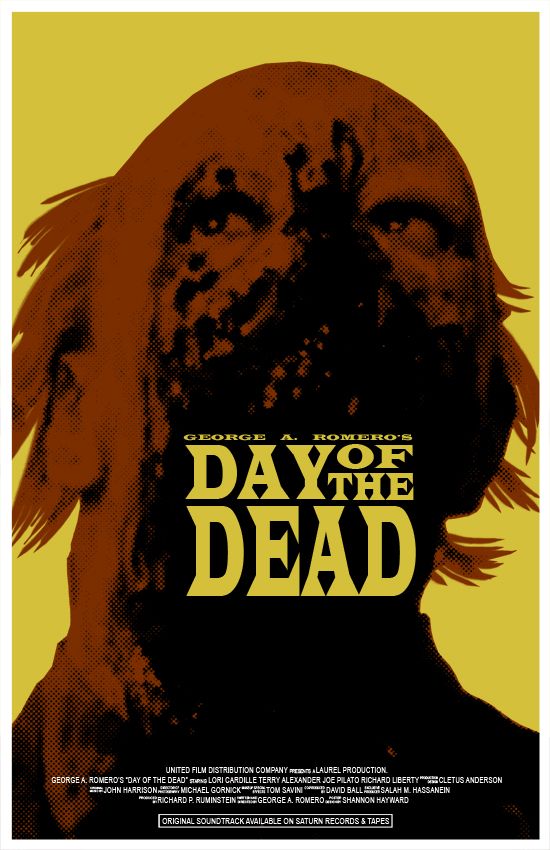
DAY OF THE DEAD (1985), the third entry in George Romero’s zombie series, heads in the opposite direction and it’s the bleakest installment of the entire run of films (six in total) as we see only just a sliver of hope for the human race. Honestly, we see more potential in the evolution of zombies throughout DAY OF THE DEAD than we do in mankind. Fans were blindsided after the more humorous DAWN OF THE DEAD.

The human characters in DAY OF THE DEAD mostly scream and shout at each other, they don’t listen to one another, and they’re just plain nasty and mean on a regular basis. You would think in a zombie apocalypse that they could put aside their differences and unite and fight toward a common goal, their survival. You would think they could get past their petty differences, their hostility for others who don’t fit their preconceived notions, their political and religious beliefs and prejudices, et cetera, but they are only human after all.

The action centers on an underground bunker where scientists are working on a solution to the zombie pandemic, while being protected from the hordes of zombies (who outnumber humans by 400,000 to 1) above by soldiers. Keep in mind that zombies, of course, are the test subjects and the soldiers are responsible for procuring more specimens. Whatever natural tensions exist between scientists and military professionals are only exacerbated by dwindling supplies, communication breakdowns, and not enough results from the scientists in the eyes of the soldiers.

Of course, we like some characters more than others and it’s quite obvious from the getgo that we are to be more sympathetic toward female scientist Dr. Sarah Bowman (Lori Cardille), black helicopter pilot John (Terry Alexander), and booze hound radio operator McDermott (Jarlath Conroy) than screw loose martinet Captain Henry Rhodes (Joseph Pilato) and mad scientist Dr. Matthew “Frankenstein” Logan (Richard Liberty).

That Romero always loved to mess with audience expectations.

Bowman’s an even stronger female character than Francine Parker in DAWN OF THE DEAD and it’s a joy watching her go toe-to-toe with Captain Rhodes and the boys.

Pilato makes for a great human antagonist and his demise provides us one of the great death scenes in any zombie movie.

Roger Ebert criticized the actors in DAY OF THE DEAD for overacting. Yes, these performances fit the definition of overacting with their exaggerated manner, but this overacting is for a very good reason. It demonstrates how much the human characters have lost the plot and degenerated into worse monsters than the zombies.

That’s apparent throughout by not only the behavior of the human characters but the behavior of the domesticated zombie Bub (Richard Sherman). Bub learns more than any of the characters in DAY OF THE DEAD and that’s a painful lesson for humanity.

DAY OF THE DEAD works today even more than when it was originally released on July 3, 1985.

Just go online and look at the comments section on especially a political story. Bask in relentless name-calling, abusive language, and hostility that only continue to get worse over time. You will probably come across words like “snowflake” and “libtard” (both especially popular since the 2016 Election) and other phrases from the main two sides of the political divide that show our increasing inability to have civil discussions about politics and religion. It should be alright to agree to disagree.

Reading an Oxford Dictionaries article from 2014 on the most common American political insults, it started with a quote from a Pew Research Center report conclusion, “Republicans and Democrats are more divided along ideological lines—and partisan antipathy is deeper and more extensive—than at any point in the last two decades.”

The article continued, “The lack of civility in our political discourse shines through in the frequency of taunts suggesting stupidity and irrationality. Such terms were brandished on both sides, but liberals were more likely to be called morons, fools, and loons, whereas conservatives were most often derided as nutjobs, nuts, and lunatics. Idiot was a favorite on both sides of the aisle.

“The type of adjective favored in insulting phrases varied by partisan affiliation as well. People insulting conservatives favored the adjective right-wing, which was more than twice as common as Republican and nearly four times more common than conservative. In contrast, the dominant adjective in negative epiphets for liberals was—liberal. Liberal was used more than four times as often as left-wing, and Democrat and Democratic accounted for only a fraction of the insults for liberals, with the former used twice as often as the latter.”

It concluded, “But there may be a ray of hope: partisans on both sides of the aisle accuse each other of being racists and bigots, demonstrating a consensus that intolerance and discrimination are universally reprehensible. And while there may not be much common ground between Democrats and Republicans, at least we can all agree on calling each other ‘idiots.'”

During a summer vacation in 2013, several months after the presidential election, a downtown Omaha, Nebraska artist displayed two posters combining both major parties’ candidates with silent movie classics, creating “Obamaratu” and “Mittropolis.” Of course, I bought both posters, because I love both NOSFERATU and METROPOLIS and I hated the 2012 Election. And the 2016 Election was amazingly even worse, a nonstop spitting contest between two jerks that brought thought and discourse to a new low. We’re being taken on a toboggan slide down the slopes of stupidity.

Every time I watch DAY OF THE DEAD, the shouting matches painfully recall so much of what life in 21st Century America has become. Increasingly strident, unpleasant, hateful negativity that’s become far less escapable with the social media boom providing us more convenient and diverse ways to hate. It’s so easy to be an asshole with the safe distance that social media entails. There’s very likely to be absolutely no repercussions for running one’s mouth online, especially when there’s an opportunity to hide behind the cloak of anonymity. Now, if we can develop the means to reach through our side of the screen and punch or kick the other person, we might actually get somewhere on the civility front. It would take just one legitimate punch in the mouth or kick in the crotch to curtail the snarkiness, and that goes for each party.

Being a sports writer by trade, I’ve found it bitterly ironic that over the nearly eight years in the sports writing business politics have become more “sports” than sports. Winning or losing and nothing else in between with much bellyaching, boohooing and bragging depending on which side of the outcome you’re on and increasingly partisan with passionate fans who can be fired up apparently so easily at rallies with platitudes and slogans mostly based on hating the other team. GO! FIGHT! HATE! TEAM!

Unfortunately, though, unlike sports, American politics gives us two basic teams, Democrats and Republicans. Why only two sides of the same coin? Should we not have far more diversity in thought or, if nothing else, evils? Pretend for a moment if the only NFL teams were the New England Patriots and the Dallas Cowboys or the only MLB teams were the New York Yankees and the Boston Red Sox.

One of my favorite concepts in George Orwell’s 1984 is the Two Minutes Hate. Absolutely brilliant. Every day in Oceania, Party members must watch a film depicting the Party’s enemies (namely the traitor Goldstein) and express nothing but their hatred for two minutes. It’s also a memorable scene in Michael Radford’s film adaptation.

In our rather informal way, how many minutes of hate do some of us get in? Bet we don’t limit it to two minutes every day. I’ll be honest, I am guilty of it too, I react violently to certain stimuli like a true automaton. There seems to be only two ways to react to Donald Trump, Hillary Clinton, Barack Obama, Kanye West, Colin Kaepernick, and LeBron James, using the most prominent examples.

“The horrible thing about the Two Minutes Hate was not that one was obliged to act a part, but that it was impossible to avoid joining in,” Orwell wrote. “Within thirty seconds any pretense was absolutely unnecessary. A hideous ecstasy of fear and vindictiveness, a desire to kill, to torture, to smash faces in with a sledge hammer, seemed to flow through the whole group of people like an electric current, turning one even against one’s will into a grimacing, screaming lunatic. And yet the rage that one felt was an abstract, undirected emotion which could be switched from one subject to another like the flame of a blowlamp.”

I generally avoid making explicitly political posts on Facebook, mainly because I do not want to contribute any more to the quagmire. This especially holds true after every mass shooting or the latest national anthem controversy, for example. Sure, I have my own beliefs and my own opinions, but a few years back I learned not to blurt them out because it doesn’t do any damn bit of good beyond possibly making me feel good.

Now we can generate memes that encapsulate our beliefs, our prejudices, and our thoughts in a most catchy (and generally rude) fashion, of course packaged together by somebody else. Orwell was clearly ahead of his time and one of the true meme pioneers before anybody even knew what the hell memes were. You might remember his greatest hits “Big Brother is Watching You” and “War is Peace / Freedom is Slavery / Ignorance is Strength.” Package them together with great images normally painting the target in a most unsavory light and why the Internet Wars are won.

Sometimes I’ll laugh at memes, sometimes I’ll look at them rather unamused, and sometimes I lose a smidgen of faith in intelligent thought, one bad meme at a time.

That said, I haven’t blocked or unfriended anybody on Facebook just because their political or religious beliefs are different than mine.