Patton (1970)

DAY 79, PATTON

PATTON (1970) Four stars
That darn cat Patton has been wanting me to get around to writing this review all month.

He’s especially been frustrated with his humanoid friend the last couple days. “Will you stop writing about sports long enough to sit down and write on PATTON? Will you do it for me?” He’s been asking such tough questions the last couple days.

I told him, “I worked a 13-hour day Saturday and wrote up over 4,200 words for Tuesday’s paper. I covered a few games in person and I’m dog tired. Then, I stayed up all night Sunday formatting everything into the system and posting it online.”

Patton the Cat did not want to hear such excuses. He said, “Don’t be a candy ass, suck it up Buttercup, and write me a few hundred words on PATTON. It’s where I got my name, you know, of course.” He knows how to bust a fellow’s balls, that’s for sure, that darn cat.

Just in a dirty look, one which he normally directs at the dog.

Alright, I’ll get you that darn review. Sure thing, boss, and I’ll give it everything I got just for you because I know you’ll come over and check out Facebook.

Fortunately, I’ve watched PATTON quite a few times over the years. Many years ago, I would slide the VHS into the player and just sit back and relax for nearly 3 hours. I did that on a regular basis. Sometimes, I would fall to sleep and take a little nap.

On a certain level, I’m a sucker for epics like BRIDGE ON THE RIVER KWAI, LAWRENCE OF ARABIA, THE TEN COMMANDMENTS, and even ones of more recent vintage like THE PATRIOT and THE LORD OF THE RINGS trilogy, for example. There’s just something innately appealing about the form itself. Like a baseball game, you can just lose yourself inside an epic for three hours at a time.

PATTON wisely starts out with a speech based on George S. Patton’s rabble-rouser to the Third Army. Of course, we see an abbreviated and less profane version, but it’s an effective curtain raiser that gets at the heart of the character and how we find this contradictory, larger-than-life character so fascinating despite any objections we might have to this man of war.

“Now, I want you to remember that no bastard ever won a war by dying for his country. He won it by making the other poor dumb bastard die for his country.

“Men, all this stuff you’ve heard about America not wanting to fight, wanting to stay out of the war, is a lot of horse dung. Americans, traditionally, love to fight. All real Americans love the sting of battle.

“When you were kids, you all admired the champion marble shooter, the fastest runner, the big league ball players, the toughest boxers. Americans love a winner and will not tolerate a loser. Americans play to win all the time. Now, I wouldn’t give a hoot in hell for a man who lost and laughed. That’s why Americans have never lost and will never lose a war. Because the very thought of losing is hateful to Americans.

“Now, an army is a team. It lives, eats, sleeps, fights as a team. This individuality stuff is a bunch of crap. The bilious bastards who wrote that stuff about individuality for the Saturday Evening Post don’t know anything more about real battle than they do about fornicating.

“Now, we have the finest food and equipment, the best spirit, and the best men in the world. You know, by God, I actually pity those poor bastards we’re going up against. By God, I do. We’re not just going to shoot the bastards. We’re going to cut out their living guts and use them to grease the treads of our tanks. We’re going to murder those lousy Hun bastards by the bushel.

“Now, some of you boys, I know, are wondering whether or not you’ll chicken-out under fire. Don’t worry about it. I can assure you that you will all do your duty. The Nazis are the enemy. Wade into them. Spill their blood. Shoot them in the belly. When you put your hand into a bunch of goo that a moment before was your best friend’s face, you’ll know what to do.

“Now there’s another thing I want you to remember. I don’t want to get any messages saying that we are holding our position. We’re not holding anything. Let the Hun do that. We are advancing constantly and we’re not interested in holding onto anything — except the enemy. We’re going to hold onto him by the nose, and we’re gonna kick him in the ass. We’re gonna kick the hell out of him all the time, and we’re gonna go through him like crap through a goose!

“Now, there’s one thing that you men will be able to say when you get back home, and you may thank God for it. Thirty years from now when you’re sitting around your fireside with your grandson on your knee, and he asks you, “What did you do in the great World War II?” — you won’t have to say, “Well, I shoveled shit in Louisiana.”

“Alright now you sons-of-bitches, you know how I feel. Oh, I will be proud to lead you wonderful guys into battle anytime, anywhere. That’s all.”

That speech definitely sets the mood for the rest of the picture, and George C. Scott commands the screen.

Francis Ford Coppola and Edmund H. North’s screenplay effectively plays both sides of the street and director Franklin J. Schaffner (PLANET OF THE APES) helmed a film that can appeal to both hawks and doves, a divide that was especially sharp in 1970 America.

(Or you can simultaneously or alternately be attracted to and repulsed by Patton and PATTON.)

Historical movies undoubtedly say more about the era when they are made, rather than whatever era in time they are depicting.

For example, three events from a turbulent April-May 1970 are tied together.

PATTON premiered on April 2.

Richard Nixon announced the invasion of Cambodia on national TV on April 30.

The Kent State shootings happened on May 4 after four days of protest by college students against invading Cambodia.

PATTON was Nixon’s favorite movie.

Philip D. Beidler wrote “Just Like in the Movies: Richard Nixon and Patton,” which appeared in “The Georgia Review” in the fall of 1995.

Beidler’s opening paragraph: “I began this examination of the strange and often dreadful reciprocity between American life and American entertainment—a commemorative essay, one might call it, in several meanings of that term—by adducing two parallel narratives, both essentially factual and both spanning roughly the same period twenty-five years ago. Each began in early April 1970 and ended slightly more than a month later, after the US Army invasion of Cambodia and the killing of four students by Ohio National Guardsmen at Kent State University. The first involves a US president and his obsession with a war movie. The second involves a US Army lieutenant and his experiences in a war being conducted at that time by that president. The president was Richard Nixon. The war movie was PATTON. The army lieutenant was me. The war, of course, was Vietnam.”

I am unable to read past the first page of Biedler’s essay because I do not have a JSTOR account.

Nixon, of course, instantly identified with PATTON and Patton, because I am sure Nixon was aware that he’s one of those people who many folks loved to hate, just like Patton. We have little doubt that PATTON inspired Nixon to get on with Cambodia.

Nixon’s official response to Kent State: “We think we’ve done a rather good job here in Washington in that respect. As you know, we handled the two demonstrations, Oct. 15 and Nov. 15 of last year, without any significant casualties. That took a lot of doing, because there were some rough people who were involved. A few were rough. Most of them were very peaceful.

“I would hope that the experience that we have had in that respect could be shared by the National Guards, which of course are not under Federal control but under state control. … I do know that when you have a situation with a crowd throwing rocks and the National Guard is called in, that there is always a chance that it will escalate into the kind of tragedy that happened at Kent State. … I saw the pictures of those four youngsters in the Evening Star the day after that tragedy. I vowed then that we were going to find methods that would be more effective to deal with these problems of violence, methods that would deal with those who would use force and violence and endanger others, but at the same time would not take the lives of innocent people.”

Kent State inspired Neil Young to write “Ohio” and it was released in June 1970, “Tin soldiers and Nixon coming / We’re finally on our own / This summer I hear the drumming / Four dead in Ohio” and “Gotta get down to it / Soldiers are cutting us down / Should have been done long ago / What if you knew her / And found her dead on the ground / How can you run when you know?”

Young on the song in the liner notes to 1977’s DECADE, “It’s still hard to believe I had to write this song. It’s ironic that I capitalized on the death of these American students. Probably the biggest lesson ever learned at an American place of learning. My best CSNY cut. Recorded totally live in Los Angeles. David Crosby cried after this take.”

And the sad saga pushed Jerry Casale, then a Kent State student, into forming Devo and using “De-evolution” (a.k.a. backward human evolution) as the conceptual framework of the band. Jeffrey Miller and Allison Krause, two of the four killed on May 4, were Casale’s friends.

“Until then I was a hippie,” Casale said in a 2005 interview. “I thought that the world is essentially good. If people were evil, there was justice … and that the law mattered. All of those silly naïve things. I saw the depths of the horrors and lies and the evil. The paper that evening, the Akron Beacon Journal, said that students were running around armed and that officers had been hurt. So deputy sheriffs went out and deputized citizens. They drove around with shotguns and there was martial law for 10 days. 7 p.m. curfew. It was open season on the students. We lived in fear. Helicopters surrounding the city with hourly rotating runs out to the West Side and back downtown. All first amendment rights are suspended at the instant the governor gives the order. All of the class-action suits by the parents of the slain students were all dismissed out of court, because once the governor announced martial law, they had no right to assemble.”
Halloween (1978)

day332challoween

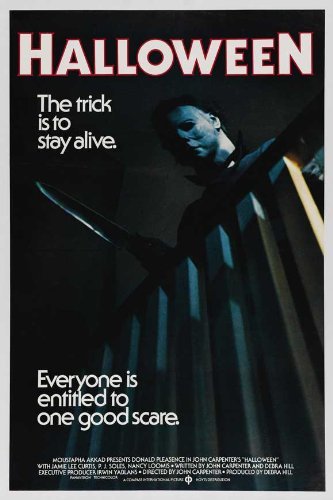
HALLOWEEN (1978) Four stars

There’s one particularly cherished moment from all the years watching HALLOWEEN.

Every time I have showed the film to friends and family, there’s one scene I patiently wait for with devilish anticipation.

I make internal bets with myself that it will work on everybody who’s seeing the movie for the first time, and it will even still work on those return viewers.

It’s a jump scare, one of the best ever filmed.

Every time, I would be taciturn leading up to this scene, not wanting to give a single thing away to my friends and family.

I wanted to see them jump, and I wanted to hear them scream.

It worked every single time.

It’s the scene where Dr. Loomis (Donald Pleasence) and Sheriff Brackett (Charles Cyphers) are discussing matters inside the old Myers house.

I won’t go any further than that.

Like the slasher films that followed, including its own many sequels, HALLOWEEN is a fun one to watch especially with several peers, but for slightly different reasons than the many, many, many followers and imitators.

First and foremost, director John Carpenter (in the words of Alfred Hitchcock) played the audience like a piano in HALLOWEEN. He’s the maestro and we love the music he’s playing, literally. The main theme in HALLOWEEN just stays with the viewer and in fact right now writing this review, I have that song playing over scenes from the first movie playing inside my head. Like other classics PSYCHO and JAWS, the music in HALLOWEEN added immeasurably to the film’s success.

Reportedly, Carpenter composed the theme in one hour, according to an interview he did for Consequence of Sound.

Carpenter discusses the movie and its music at some length on his official site: “HALLOWEEN was written in approximately 10 days by Debra Hill and myself. It was based on an idea by Irwin Yablans about a killer who stalks baby-sitters, tentatively titled ‘The Baby-sitter Murders’ until Yablans suggested that the story could take place on October 31st and HALLOWEEN might not be such a bad title for an exploitation-horror movie.

“I shot HALLOWEEN in the spring of 1978. It was my third feature and my first out-and-out horror film. I had three weeks of pre-production planning, twenty days of principle photography, and then Tommy Lee Wallace spent the rest of the spring and summer cutting the picture, assisted by Charles Bornstein and myself. I screened the final cut minus sound effects and music, for a young executive from 20th Century-Fox (I was interviewing for another possible directing job). She wasn’t scared at all. I then became determined to ‘save it with the music.’

“I had composed and performed the musical scores for my first two features, DARK STAR and ASSAULT ON PRECINCT 13, as well as many student films. I was the fastest and cheapest I could get. My major influences as a composer were Bernard Herrmann and Ennio Morricone (who I had the opportunity to work with on THE THING). Hermann’s ability to create an imposing, powerful score with limited orchestra means, using the basic sound of a particular instrument, high strings or low bass, was impressive. His score for PSYCHO, the film that inspired HALLOWEEN, was primarily all string instruments.

“With Herrmann and Morricone in mind, the scoring for HALLOWEEN began in late June at Sound Arts Studios, then a small brick building in an alley in central Los Angeles. Dan Wyman was my creative consultant. I had worked with him in 1976 on the music for ASSAULT. He programmed the synthesizers, oversaw the recording of my frequently imperfect performances, and often joined me to perform a difficult line or speed-up the seemingly never ending process of overdubbing one instrument at a time. I have to credit Dan as HALLOWEEN’s musical co-producer. His fine taste and musicianship polished up the edges of an already minimalistic, rhythm-inspired score.

“We were working in what I call the ‘double-blind’ mode in 1978, which simply means that the music was composed and performed in the studio, on the spot, without reference or synchronization to the actual picture. recently, my association with Alan Howarth has led me to a synchronized video-tape system, a sort of ‘play it to the TV’ approach. Halloween’s main title theme was the first to go down on tape. The rhythm was inspired by an exercise my father taught me on the bongos in 1961, the beating out of 5-4 time. The themes associated with Laurie (Jamie Lee Curtis) and Dr. Loomis (Donald Pleasence) now seem to be the most Herrmannesque. Finally came the stingers. Emphasizing the visual surprise, they are otherwise known as ‘the cattle prod’: short, percussive sounds placed at opportune moments to startle the audience. I’m now ashamed to admit that I recorded quite so many stingers for this one picture.

“The scoring sessions took two weeks because that’s all the budget would allow. HALLOWEEN was dubbed in late July and I finally saw the picture with an audience in the fall. My plan to ‘save it with the music’ seemed to work. About six months later I ran into the same young executive who had been with 20th Century-Fox (she was now with MGM). Now she too loved the movie and all I had done was add music. But she really was quite justified in her initial reaction.

“There is a point in making a movie when you experience the final result. For me, it’s always when I see an interlock screening of the picture with the music. All of a sudden a new voice is added to the raw, naked-without-effects-or-music footage. The movie takes on it’s final style, and it is on this that the emotional total should be judged. Someone once told me that music, or the lack of it, can make you see better. I believe it.”

HALLOWEEN, unlike its sequels and imitators, works from a minimalist base, with much fewer characters than the run-of-the-mill body count thriller for one prominent example of minimalism. HALLOWEEN gives us time with the characters, especially the three girls Laurie (Curtis), Annie (Nancy Loomis), and Lynda (P.J. Soles) and Dr. Loomis (Pleasence), and this is definitely to the film’s benefit. These characters take on a greater resonance than, for example, the gallery of grotesqueries in FRIDAY THE 13TH: A NEW BEGINNING, who only have a couple minutes of (largely) unpleasant behavior before their gruesome death scenes.

Carpenter and Hill found gold in Curtis: not only the daughter of Janet Leigh (PSYCHO) and Tony Curtis, but a great rooting interest who can be intelligent and resourceful and strong enough that we forgive her for the other moments that are standard in horror films, like (for just one example) her difficulty finding the keys with a madman bearing down on her. She’s pretty, as well, without it being overwhelming.

Annie and especially Lynda are pioneers of the Valley Girl speak, totally, and that might be one of the great sources of annoyance for anybody watching HALLOWEEN. Soles, though, is one of the more likable young actresses from that era, seen to even more effect in ROCK ‘N’ ROLL HIGH SCHOOL and STRIPES.

Likability is a key in the success of both HALLOWEEN and the first NIGHTMARE ON ELM STREET.

Dr. Loomis is the character lacking in any of the FRIDAY THE 13TH movies, for example. He’s just brilliant, brought to the life by the indelible screen presence of the late Pleasence (1919-95). His character commands our attention every time he steps onscreen and definitely every time he delivers that dialogue he keeps that attention, especially about Michael Myers and “pure evil.”

“I met him 15 years ago,” Dr. Loomis said. “I was told there was nothing left: no reason, no conscience, no understanding in even the most rudimentary sense of life or death, of good or evil, right or wrong. I met this … 6-year-old child with this blank, pale, emotionless face, and … the blackest eyes – the Devil’s eyes. I spent eight years trying to reach him, and then another seven trying to keep him locked up, because I realized that what was living behind that boy’s eyes was purely and simply … evil.”

` That’s one of the best monologues in any horror film (or any film period).

Monologues like that can sometimes bring the attached film to a halt, because we don’t want to hear this psychological jive talk recited by some hack actor at just that very moment. Please, shut the fuck up (Donnie).

For example, Simon Oakland’s jive talk late in PSYCHO drags us down a bit.

Honestly, though, I could have listened to Dr. Loomis talk all day.

Pleasence sells this dialogue with the conviction of his craft and I don’t know, I’ve always got the feeling that maybe Dr. Loomis is maybe just maybe a bit mad himself all these years working around Michael Myers.

You see this Dr. Loomis coming, and you just might head to the next city or county or perhaps country, because you know he’s trouble.

In horror films, often times authority figures do not believe the stories of teenage protagonists until it’s too late, but HALLOWEEN applies the slight twist to the formula by having authority figures question the story of another authority figure.

I love the way Carpenter and his team utilize Michael Myers in HALLOWEEN: he’s driving or standing around in the background of many early shots and combined with Dr. Loomis’ dramatic playing up of Myers in dialogue, he takes on mythic proportions. Paraphrasing from Dr. Loomis, this isn’t a man. He’s a shape, and a killing force. But we also get the sense that he’s childlike and in one of the great moments for any screen killer, Myers stands and admires his own craftmanship after one kill.

He’s far more interesting with far less back story, as the sequels beginning with HALLOWEEN II irrefutably proved.

Let’s see here, we have two great protagonists, one great killer (and one great weapon), and great music.

Seems like this is the beginning of a great horror movie.

Dr. Strangelove (1964)

day752cdr.strangelove

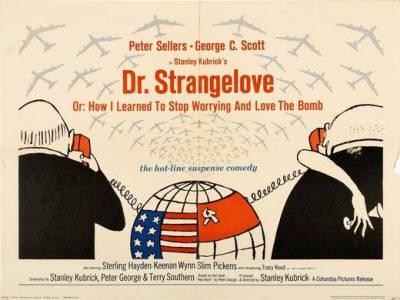
DR. STRANGELOVE (1964) Four stars
Stanley Kubrick’s DR. STRANGELOVE (abbreviated title) OR: HOW I LEARNED TO STOP WORRYING AND LOVE THE BOMB (long title) contains one of my favorite lines of dialogue in any movie.

President Merkin Muffley, played by Peter Sellers in one of his three roles in the movie, tells the Americans and Commies both, “Gentlemen, you can’t fight in here! This is the War Room!”

I don’t give a damn that it placed No. 64 on the American Film Institute’s 100 Years … 100 Movie Quotes list.

Oh, sorry, “Frankly, my dear, I don’t give a damn” from GONE WITH THE WIND came in at No. 1, followed by quotes from Marlon Brando characters in THE GODFATHER and ON THE WATERFRONT that bums just can’t refuse.

Kansans will be sure thrilled that “Toto, I’ve a feeling we’re not in Kansas anymore” came in at No. 4.

CASABLANCA led that list with six quotes and freaking JERRY MAGUIRE picked up two. Are you kidding?

Anyhoo, DR. STRANGELOVE certainly lives up to such a title: It’s a strange movie about strange people doing and saying the strangest things.

I’ve heard it described as a movie about what could happen if the wrong person pushed the wrong button.

That wrong person would be General Jack D. Ripper (Sterling Hayden), who believes them damn commies have conspired to pollute our “precious bodily fluids.” To say that it’s an obsession for Gen. Ripper would be one of the great understatements.

Gen. Ripper orders a first strike nuclear attack on the Soviet Union.

Then we get a mad gallery of characters that are just slightly less mad than Ripper: Muffley, Group Captain Lionel Mandrake, and Dr. Strangelove played by Sellers; General Buck Turgidson by George C. Scott; Colonel Bat Guano by Keenan Wynn; and Major T.J. “King” Kong by Slim Pickens, for example. Muffley and Turgidson are predominantly inside the War Room, one of the great movie sets.

Sellers originally had been slated to play four roles, including Kong, but it went down to three after he hurt his ankle.

Sellers predominantly improvised most of his dialogue and his ad-libs were retroscripted into the screenplay.

Sellers modeled Muffley after 1952 and 1956 U.S. Presidential candidate Adlai Stevenson and former Nazi scientist Dr. Strangelove after Wernher von Braun. Strangelove’s very reminiscent stylistically of mad scientist Rotwang from Fritz Lang’s METROPOLIS.

Strangelove comes aboard late in the movie as humanity faces nuclear destruction.

Scott, who later won an Oscar for Gen. Patton in the Best Picture-winning PATTON, played Gen. Turgidson a lot differently than he intended and he was apparently tricked by Kubrick into acting ridiculously like in the final film. Scott never worked with Kubrick again. Kubrick and Scott played each other at chess and Kubrick got the edge on Scott, a skilled player, often.

John Wayne and Dan Blocker, of course, turned down Kong because, you know, DR. STRANGELOVE was just way too darn pinko for their persuasions.

The role ended up in the hands of the one-and-only Pickens, whom the makers of DR. STRANGELOVE did not understand was a genuine cowboy.

They did not tell Pickens that it was a black comedy and he played it straight, gloriously straight.

He gets one of the great exit scenes in film history.

There’s a whole lot about DR. STRANGELOVE that I don’t want to talk about in this space, especially for those who have not yet seen the movie.

I believe, however, that you will find it to be one of the great movie experiences.

It’s definitely the satire the Cold War deserved.

It’s an incredibly smart and sneaky movie, truly ahead of its time.

For example, a Cornell University professor Legrace G. Benson wrote Kubrick a fan letter and the professor interpreted DR. STRANGELOVE as being very sexually-layered. (Not sure how people could miss it.)

Kubrick wrote Benson back, “Seriously, you are the first one who seems to have noticed the sexual framework from intromission (the planes going in) to the last spasm (Kong’s ride down and detonation at target).”

And, for sure, after DR. STRANGELOVE you will never hear “We’ll Meet Again” the same way again.

Munro (1960)

day 74, munro

MUNRO (1960) Four stars
I’ll make the review of this 1960 Czechoslovak-American animated short directed by Gene Deitch a short one, I promise.

It centers on a basic premise: The army drafts a 4-year-old boy.

Munro starts out your average little boy and then just a minute into the film, his life changes when he receives something in the mail. He can’t read, so a bigger person reads it to him. Cue that military music.

“At the age of 4, he’d been drafted.”

Then we join Munro for his physical. He’s the runt of the litter, for sure, and he’s the only one not talking about all his physical ailments, like a bad back.

Munro gets classified as “1A” or “eligible for military service.”

Munro goes to war.

It’s a foreign world for the little man with foreign words flying at him. This Sgt. couldn’t speak English very well, according Munro.

“Tenhoot,” “Foorit hoo,” “Hup haw hee haw hip hee haw hip,” et cetera.

Munro becomes a full-blown soldier and he plays all the games that soldiers play, like “Face.” Let’s see, there’s “Ri’,” “Lef’,” “Up,” “Down,” “In,” “Out,” and “Face” variances in “Face.”

Munro eventually becomes very tired.

Why?

“I’m only 4.”

They do not believe him.

Go back out and march in the rain.

They believe Munro’s faking that he’s only 4.

The experts think he’s a malinger.

The Colonel wants to shove him in the stockade.

They still won’t believe that he’s only 4.

Munro decides that he will be the best soldier.

Recruits pass by Munro and they’re told, “See that man, that’s a soldier. That’s what we’re gonna train you to be. We’re gonna separate the men from the boys.”

Munro then begins to cry.

They’re all embarrassed.

The General finally gets to the bottom of it, “You’re nothing but a baby boy.”

Munro signs his release form, and he gets a big parade in his honor with a message from the President himself.

American syndicated cartoonist and author Jules Feiffer, who’s considered the most widely read satirist in the country, wrote MUNRO. Feiffer won a Pulitzer Prize in 1986 and he was inducted into the Comic Book Hall of Fame in 2004. MUNRO won the 1961 Academy Award for Best Animated Short.

Feiffer wrote MUNRO when he was in the U.S. Army from January 1951 to January 1953.

“Every day I was enraged,” Feiffer said in an interview with Bookslut. “Every day I hated it. So much so that when they tried to promote me just as an automatic gesture to getting out, to raise your pay scale so you could get more, I refused to accept the raise in rank from private to PFC.”

Feiffer wrote MUNRO at his desk.

“With the full support of the man who supervised me,” Feiffer said, “who was this lllustrator who had a career that never took off in magazine illustration and this was his way of supporting the family. And his name was Perc Couse, who looked a very daunting, formidable man. He had a deep voice and scary, but he turned out to be a very warm, lovely, generous-hearted fellow who thought I and another G.I. there named Harvey Dinnerstein were much too talented to waste our time on Army stuff. So he let Harvey paint and he let me do my subversive satire. And I’m not sure he understood what I was doing, but after the war (Korea) he certainly did. After we were out, he took great pride, because we remained great friends until his death.”

MUNRO beat out some prestigious films and filmmakers for that Academy Award: Walt Disney Studios’ GOLIATH II, Warner Bros. cartoons HIGH NOTE and MOUSE AND GARDEN (the former directed by Chuck Jones and the latter by Friz Freleng, two of the legendary animators), and A PLACE IN THE SUN (not much info on this one).

George S. Kaufman said the famous words “Satire is what closes on Saturday night” after his play closed in Philadelphia and failed to make it to Broadway.

Though, in the 1960s, we had MUNRO and more prominently Stanley Kubrick’s dark Cold War satire DR. STRANGELOVE OR: HOW I LEARNED TO STOP WORRYING AND LOVE THE BOMB, one that still holds up rather well today.

MUNRO holds up rather well today, as well.

Profondo Rosso (1975)

DAY 25, DEEP RED.jpg

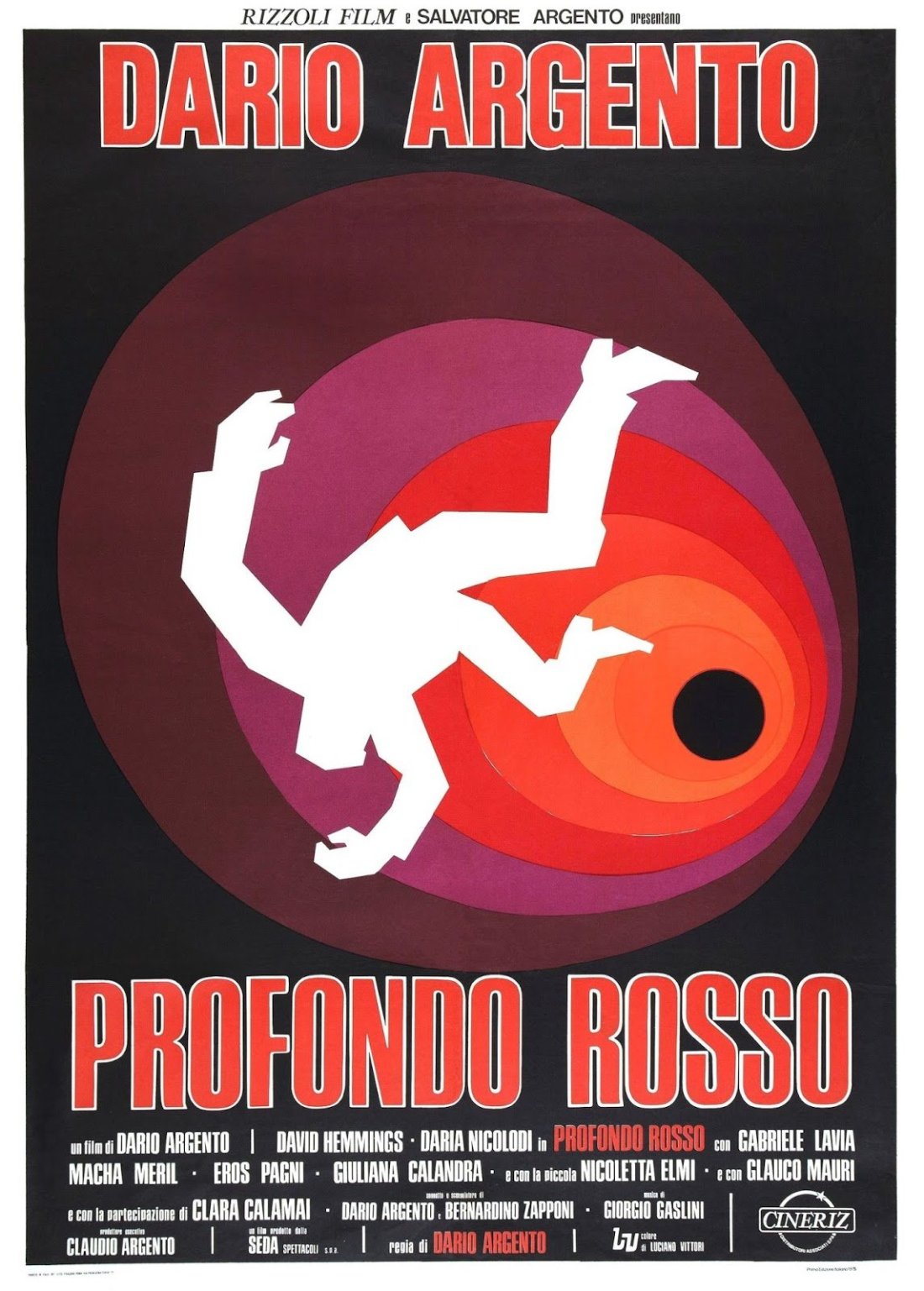
PROFONDO ROSSO (1975) Four stars
Giallo is the Italian word for yellow.

In fiction terms, though, quoting from Wikipedia, giallo means “a 20th century Italian thriller genre of literature and film. Especially outside Italy, giallo refers specifically to a particular Italian thriller-horror genre that has mystery or detective elements and often contains slasher, crime fiction, psychological thriller, psychological horror, exploitation, sexploitation, and, less frequently, supernatural horror elements. In Italy, the term generally denotes thrillers, typically of the crime fiction, mystery, and horror subgenres, regardless of the country of origin.”

An Italian publishing company named Mondadori began releasing crime and mystery novels in 1929 and the series became known as “Il Giallo Mondadori,” distinguished by their heavily yellow front covers. Especially popular were the works of Agatha Christie, Dashiell Hammett, and Raymond Chandler. Mondadori still prints “Il Giallo Mondadori” novels today.

Giallo movies started appearing in the mid-1960s and became a fixture especially in the late 1960s and 1970s through directors like Mario Bava, Dario Argento, and Lucio Fulci, who achieved the greatest international notoriety.

Argento’s PROFONDO ROSSO, also known as DEEP RED or THE HATCHET MURDERS, was the director’s fifth movie and it’s a transitional film, before Argento’s work verged on the fantastical like SUSPIRIA and INFERNO. It and THE BIRD WITH THE CRYSTAL PLUMAGE, his first film, are his best giallos.

Watching PROFONDO ROSSO for the first time, one will be struck by how much you feel like you’ve seen this movie before through later films it influenced such as John Carpenter’s HALLOWEEN and David Cronenberg’s SCANNERS. For example, Goblin’s main theme for PROFONDO ROSSO and Carpenter’s for HALLOWEEN are first cousins. Cronenberg modeled the lead-in to the famous head explosion scene after the early lecture sequence in Argento’s film. Rick Rosenthal’s HALLOWEEN II (produced by Carpenter) featured a death by scalding water scene inspired by Amanda Righetti’s death in PROFONDO ROSSO.

Like the best Argento films, PROFONDO ROSSO sticks with you.

Argento films usually give us a protagonist who’s a writer, a musician, a creative person of some form. In THE BIRD WITH THE CRYSTAL PLUMAGE, it’s American writer Sam Dalmas. In CAT O’NINE TAILS, it’s reporter Carlo Giordani. In FOUR FLIES ON GREY VELVET, it’s rock drummer Roberto Tobias. In PROFONDO ROSSO, it’s pianist Marcus Daly. In SUSPIRIA, it’s American dance student Suzy Bannion. In INFERNO, it’s music student Mark Elliott.

These characters provide us a rooting interest and keep us hanging on through all the convolutions of the plot. They become our surrogate, because they’re normality (just like us) in a mad, mad, mad world. They (and we) are just trying to survive another day. They live out our detective fantasies.

In any mystery, it’s vital that we find that rooting interest.

Argento protagonists normally get in way, way, way over their heads like the ones in Hitchcock films so often do … of course, we see David Hemmings playing Marcus Daly and we cannot help but think of Michelangelo Antonioni’s BLOW-UP, where Hemmings’ very Swinging London photographer believes he may have accidentally photographed a murder in a park. There’s no doubt, though, in PROFONDO ROSSO.

On his way home early in the film, Marcus sees psychic medium Helga Ulmann (Macha Meril) being attacked in her apartment. They live in the same building. He rushes up the stairs and down the hall to her apartment and finds her dead body.

The chief witness becomes the star witness, thanks to female reporter Gianna Brezzi (Daria Nicoladi) and her coverage of the murder, and the reporter and the pianist become partners, both in the romantic and detective sense.

PROFONDO ROSSO is one of those mysteries that rewards our interest to the very end.

Overlord (1975)

day 73, overlord

OVERLORD (1975) Four stars
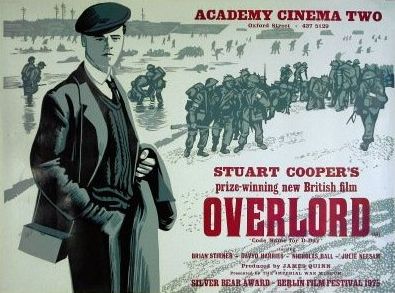
American director Stuart Cooper did something very interesting for his fourth film, 1975’s OVERLORD.

Cooper integrated archival footage of British training missions and the D-Day Invasion (a.k.a. Operation Overlord) into a fictional film about a young man’s journey from call up to the grave. Cooper and his very talented cinematographer John Alcott (he won the Academy Award for Best Cinematography for his work on Stanley Kubrick’s BARRY LYNDON, another 1975 film) did their best to make a consistent look so one could not tell any difference between the archival footage and the fictional story.

The Imperial War Museum granted Cooper access to its vaults and that’s where he found all that historical footage. Cooper had originally planned to make a documentary on the Overlord Embroidery, which commemorates scenes from wartime photos housed by the Imperial War Museum. Sandra Lawrence designed it and the Royal School of Needlework provided the handiwork.

Cooper told The Guardian in 2008, “I spent approximately 3,000 hours in that dark cell between 1971 and 1975, briefly interrupted by a couple of other projects. It was during the archival research that I developed the idea of a dramatised feature film about an English soldier who sees his first action on D-Day, interweaving the archive footage to expand and tell the story. …

“A major concern for my cinematographer, John Alcott, was how to match the texture of the archive footage. In an unprecented move, the museum granted us access to the original nitrate negatives. The quality of the original nitrate negatives was pristine. After Alcott examined them, we decided to film OVERLORD on period lenses. Alcott scoured England and found two sets of 1936 and 1938 German Goetz and Schneider lenses. Alcott then applied a lighting style in keeping with the war photography, seamlessly blending the archive and dramatised story. Seventy percent of the film is live action, which was completed in 10 days of filming.”

OVERLORD, though it won the Silver Bear at the 25th Berlin International Film Festival, seemed to have fallen through the cracks of history for many, many years.

Cooper again in The Guardian, “In spite of OVERLORD’s festival success, it never gained distribution in the U.S., which I suspect hurt its chances of being properly remembered. It may also have been because it was made during the tail end of the Vietnam War, as well as being a black-and-white film with a very British story. The only airing the film received in the U.S. was on Jerry Harvey’s Z Channel in 1982, a forerunner to U.S. cable stations. Twenty-two years later, Xan Cassavetes, John Cassavetes’ daughter, included several clips of OVERLORD in her 2004 documentary, Z CHANNEL: A MAGNIFICENT OBSESSION. As a result, OVERLORD was invited to the Telluride Film Festival, where it was a surprise success. Shortly afterwards, it was belatedly picked up for U.S. distribution.”

Better late than never, for sure.

I found out about the film from Roger Ebert’s 4-star review in 2006.

Ebert first wrote about the film at Telluride in 2004, “The most remarkable discovery at this year’s Telluride is OVERLORD, an elegiac 1975 film that follows the journey of one young British soldier to the beaches of Normandy. … Unlike SAVING PRIVATE RYAN and other dramatizations based on D-Day, OVERLORD is an intimate film, one that focuses closely on Tom Beddoes (Brian Stirner), who enters the British army, goes through basic training and is one of the first ashore on D-Day. Beddoes is not a macho hero but a quiet, nice boy, who worries about his cocker spaniel and takes along ‘David Copperfield’ when he goes off to war.”

Christopher Hudson’s screenplay built scenes based on diaries and letters from real servicemen, again providing something unique from the average war film.

Unique is definitely one word for OVERLORD.

You sometimes feel like you’re watching a real young man’s life, as if Tom Beddoes had been a real person and had been followed around by a documentary film crew who managed to conceal themselves from the real people being filmed.

That’s a different feeling than just about every other fictional war movie.

Of course, OVERLORD includes all the standard issue scenes: Tom’s call up, his basic training, his meeting a young woman whom he falls in love with (she’s called “The Girl” in the credits), his journey overseas, and finally his death on D-Day.

OVERLORD reminds us that clichés have their roots in things commonly happening to people.

Who knows how many Tom Beddoes there have been and will be throughout the pages of history.

I drift back to the following lyrics from the Clash’s “The Call Up,” “There is a rose that I want to live for / Although, God knows, I may not have met her / There is a dance an’ I should be with her / There is a town unlike any other.”

The Up Series (1964- )

250px-the_up_series_dvd

THE UP SERIES (1964- ) Four stars

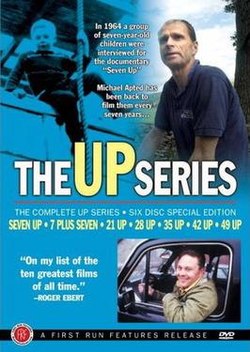
In his early 20s, researcher and future director Michael Apted picked 14 7-year-old British boys and girls — Bruce Balden, Jackie Bassett, Symon Basterfield, Andrew Brackfield, John Brisby, Peter Davies, Susan Davis, Charles Furneaux, Nicholas Hitchon, Neil Hughes, Lynn Johnson, Paul Kligerman, Suzanne Lusk, and Tony Walker — from either the upper class or working class to participate in a documentary for Granada Television called “Seven Up!”

That was 1964 and the guiding theory behind the documentary was that each child’s social class determined their future or “Give me a child until he is seven and I will give you the man.”

Beginning in 1971 with 7 PLUS SEVEN, Apted (serving as director) has tracked down the original participants and made another film, every seven years. We catch up with them and their lives. We see and hear them at every seven-year interval. We can expect 63 UP in 2019.

Over the course of time, just one participant willingly dropped out completely, Charles Furneaux, who quit after 21 UP (1977). In an irony, Furneaux became a documentarian himself. Three others have missed a combined six installments.

In May 2013, Lynn Johnson became the first participant to die. A librarian, St. Saviour’s School in London honored Johnson with a refurbished library and the plaque read “St. Saviour’s School Library in honour of Lynn Johnson … who was passionate about reading.” Johnson had been the Chair of Governors at the school for 25 years.

Of course, it’s not been easy for the participants.

Nicholas Hitchon touched on this in a 2012 interview with The Independent.

“It’s always very disturbing,” Hitchon said. “It’s the fact that they don’t show you the way you want to be shown — but that’s not the main thing. They ask you some really disturbing questions. They stick a camera under your nose and ask — ‘Why did you choose your wife?’ — and then it’s shown to gazillions of people. I’ve learnt that the stupider the thing I say, the more likely it is to get in. You’re asked to discuss every intimate part of your life. You feel like you’re just a specimen pinned on the board. It’s totally dehumanising.”

Hitchon said that his relationship has been strained with Apted over the years, especially after his portrayal in 28 UP. By that point in his life, he moved to the United States.

“Anyone who knows me knows that I don’t hang out at malls,” Hitchon said. “But [Apted] took me to one and filmed in front of a lot of girls’ punk clothing and said, ‘Nick came to the US for a salary of £30,000.’ Some people in England changed their mind about me as a result, thinking what a jerk he’s become. That was really upsetting.”

Hitchon has participated in each film, concluding “It’s wonderful that someone had this new idea and I feel very privileged to have been part of it — but it’s come at a big cost.”

Hitchon, the farm kid of the bunch, became a nuclear physicist. “Well, if you’ve seen the film, I was furious because at 7 I was just answering questions. But by the time I was 13, I did not like the way they’d portrayed me. It was clear that they were portraying me as a bumpkin. And, I mean, you know, I was mad.” Hitchon said that before he played a game called ’Not My Job’ for NPR.

School teacher (and later lawyer) Peter Davies dropped out for three installments after remarks he made about the Margaret Thatcher government in 28 UP. We did not see him again until 56 UP (2012).

“I pulled out because of the reaction to my participation in the weeks after 28 UP, particularly from the tabloid press,” Davies said in the Telegraph. “They decided they were going to portray me as the angry young Red in Thatcher’s England. I think I was articulating at the time what a lot of young people of my age were thinking. I was absolutely taken aback, genuinely shocked, at the level of malice and ill will directed toward me. Until you’ve experienced it yourself, you can’t begin to appreciate how it feels.”

Davies returned to the series to promote his band The Good Intentions.

In an academic journal, Apted responded to complaints made about the series.

“The UP films are clearly the one project I’ve done that has stayed around the longest and had the most impact,” Apted wrote. “Yet, it’s also the hardest to define and to nail down. Its power is that it means all things to all people. Everybody who has the patience to watch it finds something in it: a character, an event, a thought, a moment that they can relate to. People project themselves onto it and it becomes very personal to the viewer.”

He’s right.

As I started watching the films (they can be discovered online), I found myself flashing back on my own life at 7, 14, 21, 28, and 35, and made some mental notes on my evolution. I remembered home movies from Christmas 1987 and Thanksgiving 1988, as well as numerous neighborhood basketball games from 1997 through 2000. Always thought it was great to have all that documented.

7 years old (1985): first grader at Arma Elementary School. I can remember every single teacher that I had from K through certainly 8. That year, it was Ms. Golob. For some reason, I recall missing recess due to illness and honing up on all 50 states and their capitals (Montpelier, Vermont, baby!), as well as remembering every United States president in order. Nerd alert!

14 years old (1992): eighth grader at Northeast Junior High. Awkward, very awkward time in my life, as ridiculously big glasses and braces dealt a double whammy of even more awkwardness during a time with raging hormones already taking a toll. Some folks look back on their teenage years as the best years of their lives. To hell with that, for many, many reasons. It took years to work through adolescent awkwardness.

21 years old (1999): final semester at Fort Scott Community College. I remember every time walking up to a bar for a drink and every single damn server not believing that I was 21 years old. In fact, every single time, I heard something like “You look 14 years old.” Damn, baby face! Hell, even several years later, while a substitute teacher at alma mater Fort Scott High, I walked first onto a school bus transporting us to the bowling alley and the bus driver was shocked, absolutely shocked that I was the teacher. She thought I was a student.

28 years old (2006): Eight days after my birthday, I wrecked and rolled over. Bye-bye, Enterprise! That day, I planned on attending a job fair at my alma mater Pittsburg State. About halfway to Pittsburg, I said to hell with all that jazz because at that point in my life, I did not want another damn rejection. After graduating with a master’s degree in 2005, I must have endured a few hundred applications and interviews before returning to college and embarking on my current path.

35 years old (2013): At this point, as sports writer at the Morning Sun, I started working 60-70 hours a week, a rate of work that culminated with a 156-hour time sheet in May 2014. Yeah, that’s right, 76 overtime hours. (That’s a long story. I’d rather talk about something else.) At least, I get to love what I love to do and that’s what keeps me going. Back in sixth grade, I wrote that I wanted to be a sports writer when I grow up. You were right, you crazy bastard.

And now for something completely different: I love, absolutely love it every time characters in the UP films say “row” (rhymes with cow).

The Big Red One (1980)

day 72, the big red one

THE BIG RED ONE (1980) Four stars
When I think of the dumb things college students love to say, I drift back to the History in Film & Fiction class that I took back in 2005 at Pittsburg State.

Boy oh boy, all those undergrads sure did say the dumbest things. (A graduate student like myself would never.)

Like, for example, after we consumed SAVING PRIVATE RYAN around Veterans’ Day.

Were these normally cynical and reserved undergrads all of a sudden turned into Steven Spielberg’s press agents?

Sounded like it.

I mean, for crying out loud, I don’t remember any of those bastards liking the other films we considered that semester or liking at least enough to break on through that cool, detached undergrad reserve.

Several classmates said “SAVING PRIVATE RYAN is the greatest war movie ever made.” One even said, “It’s the only war movie to ever truly care about its characters.” All said with that gleeful, pretentious undergrad enthusiasm.

The first opinion makes you wonder how many war movies they have seen. Probably not that many, either then or now for that matter. Anyway, just say that it’s your favorite and not make that great leap to being an asshole by saying “the greatest.”

The second one makes you wonder how that undergrad history major knew how Spielberg felt about his characters and how that was somehow purer of heart than all the other makers of countless war movies.

For example, makes you wonder how director William Wyler, a World War II veteran, felt about the three veteran characters returning home in THE BEST YEARS OF OUR LIVES (1946). Man, oh man, betcha he must have disliked them characters and didn’t care a single lick about them and their plight. Sure, sure, sure, Wyler just did it for the money and the heaps of critical praise, unlike Mr. Spielberg.

We needed a Walter Sobchak in our class that day and he could have pretended the undergrads were all named Donny, especially when they were getting just a wee bit too grandiose in their statements.

“SAVING PRIVATE RYAN is the greatest war movie ever made. …”

“Shut the fuck up, Donny.”

“It’s the only war movie to ever truly care about its characters. …”

“Forget it, Donny, you’re out of your element.”

“SAVING PRIVATE RYAN is the greatest war movie ever made. …”

Jeffrey Lebowski speaks up, “Yeah, well, you know, that’s just, like, your opinion, man.”

I am sure that Spielberg would not be guilty of such ridiculous statements as his many unabashed admirers in that Film & Fiction class.

For example, Spielberg and George Lucas grabbed the character name “Short Round” for INDIANA JONES AND THE TEMPLE OF DOOM from director Samuel Fuller’s Korean War film THE STEEL HELMET.

You can be sure Spielberg watched Fuller’s World War II epic THE BIG RED ONE before taking on SAVING PRIVATE RYAN.

Fuller (1912-97) was truly an one-of-a-kind dynamo who lived one helluva life. A screenwriter, a novelist, a reporter, a combat veteran, a World War II survivor, a director, an actor, an inspiration to many. He directed some of the best movies you could ever have the chance to see (I would start with WHITE DOG) and THE BIG RED ONE lives and breathes Fuller.

From his 1980 Cannes Film Festival interview with Roger Ebert, where there’s an audience of a German TV crew and they ask him if THE BIG RED ONE was pro-war or anti-war, Fuller said, “Pro or anti, what the hell difference does it make to the guy who gets his ass shot off? The movie is very simple. It’s a series of combat experiences, and the times of waiting in between. Lee Marvin plays a carpenter of death. The sergeants of this world have been dealing death to young men for 10,000 years. He’s a symbol of all those years and all those sergeants, no matter what their names were or what they called their rank in other languages. That’s why he has no name in the movie.

“The movie deals with death in a way that might be unfamiliar to people who know nothing of war except what they learned in war movies. I believe that fear doesn’t delay death, and so it is fruitless. A guy is hit. So, he’s hit. That’s that. I don’t cry because that guy over there got hit. I cry because I’m gonna get hit next. All that phony heroism is a bunch of baloney when they’re shooting at you. But you have to be honest with a corpse, and that is the emotion that the movie shows rubbing off on four young men.

“I wanted to do the story of a survivor, because all war stories are told by survivors. Pro- or anti-war, that’s immaterial, because in any war picture, you’re going to allegedly feel anti-war because they make a character sympathetic and then the character gets shot, and so you say, ‘How tragic.’ What baloney. Why should I be against war because some kid gets hit while he’s reading a letter from Mom? I don’t think I’ve seen any war movie where you get to know the characters and one of them isn’t killed. It’s a cliche.

“But to the guy who’s killed, try telling him about heroism and courage. Get him to listen after he’s dead. Even World War II, with all its idealism, basically there was a lot of hypocrisy. …”

I could read a Fuller interview all day.

Fuller served in the 1st Infantry Division or “The Big Red One” and he received the Silver Star, Bronze Star, and Purple Heart during his service. THE BIG RED ONE’s based on his experiences with Robert Carradine’s Pvt. Zab as Fuller’s alter ego. Fuller sold a gangster novel that he wrote during his military service and in the movie, just like in real life, he finds out that his novel’s been published when he spots a soldier reading it.

Fuller, in his interview with Ebert, said that Carradine’s character is not nearly as vicious as Fuller was in real life.

Zab’s the narrator in THE BIG RED ONE and I just love his narration, both the words themselves (apparently written by Jim McBride) and Carradine’s delivery.

A couple examples: “The Bangalore Torpedo was 50′ long and packed with 85 pounds of TNT and you assembled it along the way. By hand. I’d love to meet the asshole who invented it.”

Example No. 2: “These Sicilian women cooked us a terrific meal. It’s too bad they were all over 50. We were more horny than we were hungry.”

Those are words you could find yourself saying.

Our four privates are Zab, Griff (Mark Hamill), Vinci (Bobby DiCicco), and Johnson (Kelly Ward), and they all do bang-up jobs. It’s especially nice seeing Hamill in a live-action role outside Luke Skywalker.

In the long run, though, THE BIG RED ONE belongs to Lee Marvin as The Sergeant.

You could just say that Marvin was born to play this role.

He’s one gruff son-of-a-bitch and he’s lovable because of it.

Marvin’s delivery and Fuller’s dialogue are a match made in heaven.

Check out this conversation and try and imagine Marvin saying it as The Sergeant.

Griff: I can’t murder anybody.

The Sergeant: We don’t murder; we kill.

Griff: It’s the same thing.

The Sergeant: The hell it is, Griff. You don’t murder animals; you kill ’em.

THE BIG RED ONE marked Fuller’s return to directing after 11 years, with THE SHARK from 1969 his previous credited film, and it was to be his grand epic.

Fuller originally submitted a 4-hour cut and then a 2-hour cut, and both were rejected, of course, by the studio.

The studio reedited the film and tacked on the narration, but still in any form, THE BIG RED ONE packs a wallop and it’s one of the best war movies out there.

Psycho (1960)

day 22, psycho

PSYCHO (1960) Four stars
Oh, to get into any one of the seven DeLorean DMC-12s used in BACK TO THE FUTURE and rev that sonuvabitch up to 88.8 MPH with the date set for June 16, 1960, the release date for Alfred Hitchcock’s PSYCHO.

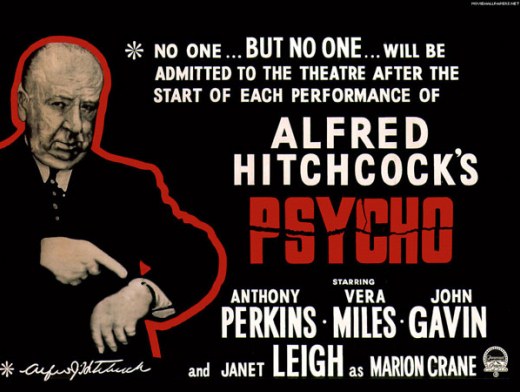
I’d go find the nearest theatre where it’s playing and put down the 69 cents. Of course, I would be sure to arrive early and hang around the lobby if necessary since Hitchcock made sure theaters enforced a strict “no late admission” policy.

Hitchcock even wrote a beautiful note, “Surely you do not have your meat course after your dessert at dinner. You will therefore understand why we are so insistent that you enjoy PSYCHO from start to finish, exactly as we intended that it be served.

“We won’t allow you to cheat yourself. Every theatre manager, everywhere, has been instructed to admit no one after the start of each performance of PSYCHO. We said no one — not even the manager’s brother, the President of the United States or the Queen of England (God bless her).

“To help you cooperate with this extraordinary policy, we are listing the starting times below. Treasure them with your life — or better yet, read them and act accordingly.”

Gotta love that Hitchcock and his ripped, twisted sense of humor.

Anyway, I would go back in time to see PSYCHO just to observe others’ reactions to it, to see their shock, to see their absolute terror at certain moments. They would not have possibly known all the surprises in store for them, while viewers for the last nearly 60 years have not had the benefit of watching PSYCHO with a clean slate. Since its release, PSYCHO has been analyzed, overanalyzed, parodied, satirized, and its famous shower scene long ago replaced the Odessa Steps sequence from BATTLESHIP POTEMKIN (1925) as the most fetishized scene in movie history.

Every time I watch PSYCHO, I am gobsmacked by just how audacious Hitchcock and gang were in making it. Start the movie with a love affair in a seedy hotel? Check. Show the heroine in her bra multiple times? Check. Kill off the heroine played by a big movie star halfway through the film? Check. Start out with the theft of $40,000 and more or less drop it after the death of the heroine? Check.

That’s just the tip of the iceberg.

Of course, none of that might seem the least bit audacious in 2018, but please keep in mind the Motion Picture Production Code dominated Hollywood movies from the early 1930s through 1968. PSYCHO helped chip away at that damn archaic code.

Everybody knows the plot by now. Marion Crane (Janet Leigh) steals $40,000 from her employer’s client and she’s on the lam hoping to get together with her lover Sam (Sam Loomis, played by John Gavin). We hear the voices that are inside her head (her mind and by extension our minds are obsessed with the money) and Hitchcock once again proved he’s the Master of Suspense by making a policeman’s stop and Marion’s drive in the pouring rain as tension-filled as any of the death scenes. With the rain beating down on her poor, weary windshield wipers, a conscience-stricken Marion stops at the famous Bates Motel with its 12 cabins and 12 vacancies.

There we meet proprietor Norman Bates (Anthony Perkins), a fictional character in Robert Bloch’s novel and Hitchcock’s film with roots in the real-life Wisconsin murderer and grave robber Ed Gein (an inspiration for THE TEXAS CHAINSAW MASSACRE’s Leatherface). Gein, for example, loved to make wastebaskets from human skin. Unlike later slasher movie super villains Michael Myers and Jason Voorhees, Norman speaks and he does not wear a mask. This makes Norman Bates far more fascinating than any of the slasher film madmen descended from PSYCHO.

Norman loves taxidermy and he’s got mother issues.

Otherwise, he seems like a good, old-fashioned All-American boy.

Oh, what happens to Marion? Let’s just say that in real life, Leigh stopped taking showers for years, preferring a bath after the fate of her character in PSYCHO.

Sam teams up with Marion’s sister Lila Crane (Vera Miles) and they try and track down Marion. Of course, all roads lead them and poor, poor Detective Arbogast (Martin Balsam) to Bates Motel and Norman Bates and his dear old mother.

In arguably his most audacious move, Hitchcock substituted protagonists from Marion Crane to Norman Bates. Perkins gives one of the great performances, one that will be discussed and cherished for centuries. He walks away with the movie.

The HALLOWEEN sequels continued to add more and more back story to the detriment of Michael Myers. Near the end of PSYCHO, Hitchcock gives us a phony baloney psychiatrist (Simon Oakland) and his phony baloney explanation for Norman Bates, but it’s taken to such an extreme that it plays like a parody. We could have done without this sequence, though, unlike the rest of the movie.

Early on in this review, I shared a note from Hitchcock. Now we go full circle.

A woman complained to Hitchcock that the PSYCHO shower scene had such a deleterious effect on her daughter that the young girl refused to shower.

Hitchcock replied, “Then Madam I suggest you have her dry cleaned.”

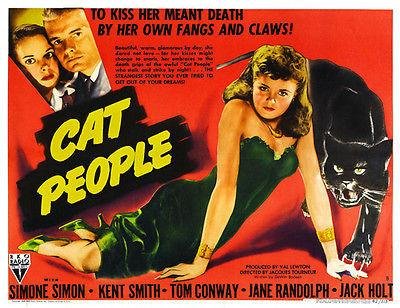
Cat People (1942)

day 19, cat people

CAT PEOPLE (1942) Four stars
Russian-American producer Val Lewton (1904-51) made his mark on horror movies and cinematic history in general with a series of low-budget thrillers for RKO beginning with CAT PEOPLE and continuing through I WALKED WITH A ZOMBIE, THE LEOPARD MAN, THE SEVENTH VICTIM, THE GHOST SHIP, THE CURSE OF THE CAT PEOPLE, THE BODY SNATCHER, ISLE OF THE DEAD, and BEDLAM.

That’s a fertile period of films (1942 through 1946) that deserves to be mentioned in the same breath as Universal Studios’ horror movies of the 1930s.

Lewton’s influence can be seen on the vast majority of horror movies of the last almost 80 years, unfortunately though in just one way.

Horror movies often rely on jump scares, and “Lewton Bus” is film industry shorthand for a scene that slowly builds tension and then jolts the viewer at the most tense moment with a sudden scare from something that turns out to be completely harmless, like a cat or a dog or that damn stupid friend who loves to play tricks on their friends at the most inopportune times. The audience supposedly “jumps” en masse on cue. This technique gets the name from a scene in CAT PEOPLE, where we think a character will be attacked and killed by a panther and the hissing sounds turn out instead to be an incoming bus pulling up.

Slasher films especially utilize scenes like that, beyond the point of banality after being used in thousands of movies. Occasionally, a film like HALLOWEEN or PHANTASM will succeed using “Lewton Bus” scenes, just to make it clear that I don’t hate jump scares per se, but a stockpile of these scenes in a film often point to lazy filmmakers who just want to generate cheap thrills. Seasoned movie viewers can sniff out a cheap jump scare from a mile away.

Fortunately, Lewton’s productions are far more than jump scares and cheap thrills, right from the start with CAT PEOPLE, directed by Jacques Tourneur.

Necessity becomes the mother of invention, and it’s true for CAT PEOPLE and the other Lewton productions with their low budgets and subsequent high creativity.

The plot centers around Irena (Simone Simon), a fashion designer originally from Serbia, and her romance and marriage with Oliver (Kent Smith). Their marriage remains unconsummated because of Irena’s paralyzing fear that she will turn into a large cat upon consummation. Irene doesn’t even kiss Oliver. Oliver, a most understanding husband all things considered, begins to confide in his assistant at work, Alice (Jane Randolph), and Irena’s anger and jealousy trigger her Serbian curse. Oliver also gets Irena to visit Dr. Louis Judd (Tom Conway) upon Alice’s recommendation; Judd, of course, develops his own designs for Irena.

Unlike the Universal monster movies, CAT PEOPLE does not show the monster and instead relies upon shadows and sound effects. This suggestive approach allows viewers to use our imaginations and we can invent some disturbing scenes on the widescreen of our minds, like what exactly happens to Dr. Judd in his death scene.

“We tossed away the horror formula right from the beginning,” Lewton said in the Los Angeles Times. “No grisly stuff for us. No mask-like faces hardly human, with gnashing teeth and hair standing on end. No creaky physical manifestations. No horror piled on horror.”

CAT PEOPLE (made for $134,000) became a big hit for the last few days of 1942 and then into 1943 after its 1942 Christmas release date and RKO, of course, sold it through a series of sensationalistic taglines:

“She knew strange, fierce pleasures that no other woman could ever feel!”

“LOVELY WOMAN … GIANT KILLER-CAT … THE SAME “PERSON”! … IT’S SUPER-SENSATIONAL!” (1954 re-release)

“The exciting story of a woman who kills the thing she loves!”

“The strangest story you ever tried to get out of your dreams!”

“A Kiss Could Change Her Into a Monstrous Fang-and-Claw Killer!’

“She Was Marked With The Curse Of Those Who Slink And Court And Kill By Night!”

“To Kiss Her Meant Death By Her Own Fangs and Claws!”

“Kiss me and I’ll claw you to death!”

“The most terrifying menace of them all!”

Oliver, Alice, and Irena return in THE CURSE OF THE CAT PEOPLE (1944), one of the first sequels to throw off a general public (and publicists) expecting more of the same. TCM.com starts its entry, “The RKO publicists must have been using mind-altering drugs when they masterminded the ad campaign behind THE CURSE OF THE CAT PEOPLE (1944), a poetic fantasy about a lonely young girl who invents an imaginary playmate.”

Poetic is one word to describe the Lewton CAT PEOPLE films, and how many horror movies have ever been deserving of that compliment?