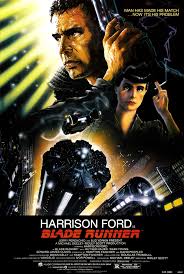
Blade Runner (1982)

BLADE RUNNER

BLADE RUNNER (1982) Four stars

Rutger Hauer’s death at the age of 75 brought me back a day later to BLADE RUNNER, one of the key movies in understanding the cinema of the last four decades.

It seems ironic that Hauer died in 2019, the same year as his character in BLADE RUNNER.

I can’t believe I’ve never written in detail about BLADE RUNNER, which has long been my No. 5 favorite movie of all-time behind CITY LIGHTS, DUCK SOUP, FREAKS, and TAXI DRIVER. Well, now is just as good a time as any to change that.

Watching the theatrical version from 1982, seeing BLADE RUNNER in any cut for what must have been the 100th time, faces especially stood out.

Title character Rick Deckard (Harrison Ford) as he takes in the death of main replicant Roy Batty (Hauer). We can read many different thoughts going through Deckard’s mind. The theatrical cut articulates it through Decker’s voice-over narration. I’ll get back to the narration later.

Batty throughout, from his entrance to his exit. Hauer’s so damn good that he almost steals the movie from both Ford and the incredible production design.

Batty’s punk pleasure model replicant lover Pris (Daryl Hannah) when she ambushes and assaults Deckard late in the picture.

J.F. Sebastian (William Sanderson) as he bears unfortunate witness to Batty settling his account with his creator Tyrell (Joe Turkel, best known as Lloyd from THE SHINING).

Leon Kowalski (Brion James) as he’s shot dead by replicant and Deckard romantic interest Rachel (Sean Young), just when it seemed Kowalski had Deckard near his demise.

Capt. Harry Bryant (M. Emmet Walsh) and his oily charm, and the enigma of Gaff (Edward James Olmos).

I’ve never exactly understood the criticism leveled at BLADE RUNNER that it’s great to look at but difficult to care about any of the characters.

I wonder if those critics saw the same movie.

I’ve always been moved by the plight of the replicants, the bio-engineered people who are “more human than human.”

The Nexus-6 model of replicants — represented by Batty, Pris, Leon, and Zhora (Joanna Cassidy) — look exactly like your average adult human being, but they have superior strength, speed, agility, resilience, and intelligence, especially combat model Batty. For the protection of the human race, replicants have a four-year life span and were given false memories.

Imagine finding out your childhood never happened.

The cold, hard facts of life.

Indeed.

The replicants bring a wide range of responses.

They’re slave labor off Earth … and illegal on Earth. “Quite an experience to live in fear, isn’t it? That’s what it is to be a slave.”

They’re at least complex villains, if they’re even the “bad guys.” We can make a strong case for Tyrell being more of a villain.

Then, we have the ambiguous title character who’ll probably always inspire debate: Is or isn’t Deckard a replicant? Ford argues human, director Ridley Scott replicant, but it’s been left for each viewer to determine.

Deckard plays like the detective hero lifted straight from THE BIG SLEEP or CHINATOWN and that comes across even more in the theatrical version with Ford’s gruff narration explicitly putting over Deckard’s world-weary cynicism.

Deckard gets no pleasure from his job “retiring” replicants. And the narration makes Deckard sound like he’s just woke up from a long hangover. (Ford’s hatred of the narration could not be more obvious.)

Later releases excised the voice-over narration, a device the executives wanted to make the film seem less confusing.

I watched the 1992 Director’s Cut first and so it took some adjustment to the narration. I find it works, except for one scene very late in the film where it’s sheer overkill. I mean, try it out:

“I don’t know why he saved my life. Maybe in those last moments he loved life more than he ever had before. Not just his life — anybody’s life; my life. All he’d wanted were the same answers the rest of us want. Where did I come from? Where am I going? How long have I got? All I could do was sit there and watch him die.” Do we need that? No.

That brings us to Batty’s final speech, “I’ve seen things you people wouldn’t believe. Attack ships on fire off the shoulder of Orion. I watched C-beams glitter in the dark near the Tannhauser gate. All those moments will be lost in time … like tears in rain … Time to die.”

In a sports column way back in 2012, I called Batty’s final speech my favorite movie dialogue.

In office conversation about this column, the late, great Morning Sun writer Nikki Patrick said that Hauer improvised Batty’s speech.

That made the speech even greater and Nikki even cooler.

The Marx Brothers & The Three Stooges

THE MARX BROTHERS & THE THREE STOOGES

Before Elvis and Chuck Berry, the Beatles and the Stones, Zeppelin and the Who, the Clash and the Sex Pistols, Nirvana and Pearl Jam, Woody Allen and Mel Brooks, Richard Pryor and George Carlin, Monty Python and Benny Hill, David Letterman and Jay Leno, and Jay and Conan, there was Buster Keaton and Charlie Chaplin, yes, but also the Marx Brothers and the Three Stooges.

There seems to be a notion that you can’t like both the Marx Brothers and the Three Stooges, and that you have to choose one over the other and the twain shall never meet.

I call bullshit on that notion.

There’s room for both in this mad, mad, mad, mad world.

However, I will admit upfront a preference for the Marx Brothers.

Granted, at the age of 8 through 10 or 11, I absolutely loved the Three Stooges and I learned only of the Marx Brothers from a scene in GOOD MORNING, VIETNAM. For a period of time on the school bus, my two cousins and I pretended that we were the Three Stooges and I played the Moe role. For many years after that obsessive period, though, I barely paid the Three Stooges a bit of attention. I don’t know, like fart jokes, they just seemed precisely like something that you instinctively move beyond as you get older and mature. I’ve revisited the Three Stooges’ work recently, though, and I’ve found enjoyment in them once again.

During college, I discovered the Marx Brothers and DUCK SOUP (1933) became one of my favorite all-time movies and Groucho Marx’s Rufus T. Firefly one of my favorite all-time characters. The Marx Brothers influenced my sense of humor tremendously, Groucho especially, and I don’t know how many co-workers or women I flirted with ever picked up any of the distinctive Marxist vibes.

I once argued with a college professor that DUCK SOUP retained value in the 21st Century because there’s still pompous jerks around who need to be deflated, not that I would have ever thought of naming that particular college professor as one.

In the end, I’ll choose Marxist anarchy over Stoogian anarchy because I prefer absurdist verbal wit over slapstick brutality.

The Marx Brothers paved the road for Mel Brooks, Woody Allen, Monty Python, Rodney Dangerfield, Bill Murray, Dan Aykroyd, Peter Sellers, Carl Reiner, Robin Williams, AIRPLANE!, Borat, Bugs Bunny, and “South Park.” Their influence extended to music — you cannot tell me their satirical and sartorial choices in military dress at the end of DUCK SOUP did not have an impact on the “Combat Rock” era Clash, Queen named two of their albums after Marx Brothers spectaculars (A NIGHT AT THE OPERA, A DAY AT THE RACES), and Alice Cooper and Groucho reportedly became good friends late in Groucho’s life. Groucho died in 1977, a year that also included the deaths of Elvis Presley and Charlie Chaplin (Elvis and Groucho separated by a mere three days in August 1977). The Ramones also had that great song “I’m Against It” on 1978’s ROAD TO RUIN, itself a reference to Hope and Crosby.

The Three Stooges influenced Sam Raimi, John Hughes, John Landis, John Belushi, John Candy, Chris Farley, the Farrelly Brothers, Mel Gibson, SMOKEY AND THE BANDIT, and wherever violent slapstick can be found in animation or live-action.

Now, I present 10 Marx Brothers and Three Stooges classics, five from each comedic team.

It should be duly noted the Marx Brothers starred in feature-length pictures (13 from 1929 to 1949) and the Three Stooges produced shorts (190 from 1934-1959).

HORSE FEATHERS (1932) — You don’t have to attend college for 10 years to appreciate HORSE FEATHERS. Oh, it definitely helps, don’t get me wrong. I must say I adopted Groucho’s opening song “I’m Against It” as my credo during college (I didn’t give a hoot that I had no son during the song adoption process): “I don’t know what they have to say / It makes no difference anyway / Whatever it is, I’m against it / No matter what it is or who commenced it / I’m against it / Your proposition may be good / But let’s have one thing understood: Whatever it is, I’m against it / And even when you’ve changed it or condensed it / I’m against it / I’m opposed to it / On general principles, I’m opposed to it … For months before my son was born / I used to yell from night till morn / ‘Whatever it is, I’m against it’ / And I’ve been yelling since I first commenced it / I’m against it.” I just now realized that “I’m Against It” as credo may have been responsible for 10 years of college. I met a lot of Connie Baileys during college, and they for sure were not “college widows,” but, yeah, everyone still says ‘I love you.’

DUCK SOUP (1933) — I don’t know how many damn times I’ve laughed myself silly at this damn movie. I just love how Groucho comes out firing innuendos and witticisms from the get-go and I’ve used several of them in real life like “I could dance with you till the cows come home. On second thought, I’d rather dance with the cows till you came home” and “[Fill in the blank] here may talk like an idiot and look like an idiot. But don’t let that fool you. He really is an idiot.” I must say that I always wanted to conduct official business at staff meetings just like Groucho’s Rufus T. Firefly does in the darkest chamber of Freedonia, especially the business about new and old business and the workers demanding shorter hours. DUCK SOUP upset Benito Mussolini and flopped at the box office, precipitating the brothers’ move from Paramount to MGM and the loss of one brother (Zeppo) from their movies. That’s what you get for truly being ahead of your time. DUCK SOUP is all killer, no filler Marx Brothers madness, and earns the highest (second highest) recommendation.

PUNCH DRUNKS (1934) — Moe Howard, Larry Fine, and Curly Howard starred together in 97 short films from 1934 to 1947, and there were many, many more featuring different Stooge permutations for Columbia Pictures. In their second production, Moe’s a struggling boxing manager, Curly’s a shy waiter, and Larry’s a fiddler. Curly turns into the world’s greatest heavyweight boxer, though, under the influence of the tune “Pop Goes the Weasel.” Rosin up that bow, Larry, and say ‘Bye, Curly, hello, K.O. Stradivarius.’ We can understand the effects of “Pop Goes the Weasel” in 1934 through later songs. In the late-1960s, for example, it’d have been the MC5’s “Kick Out the Jams.” In the early 1980s, Motorhead’s “Ace of Spades” or AC-DC’s “Hells Bells.” In the early 2000s, Drowning Pool’s “Bodies” would’ve perfectly suited a PUNCH DRUNKS remake. Personally, over the years, I’ve found much therapeutic value in such lovely, lilting songs as the Stooges’ “Search and Destroy,” the Clash’s “Cheat,” and the Misfits’ “Where Eagles Dare.”

MEN IN BLACK (1934) — Before Tommy Lee Jones and Will Smith, there was Doctor Howard, Doctor Fine, and Doctor Howard hot off the heels of PUNCH DRUNKS in this hospital spectacular that puts “Laughter is the Best Medicine” to the ultimate test. I know it was during the Great Depression, but one should consider how much dire straits a hospital must have been in to call on Doctor Howard, Doctor Fine, and Doctor Howard. MEN IN BLACK spoofs on the Clark Gable and Myrna Loy film MEN IN WHITE, which earned the distinction of being one of the first films condemned by the Legion of Decency. MEN IN BLACK competed against winner LA CUCARACHA and WHAT, NO MEN! for Best Short Subject – Comedy at the Academy Awards, the Three Stooges’ lone nomination in this category. The Three Stooges worked the broken glass running gag better than BETTER OFF DEAD (1985).

HOI POLLOI (1935) — Greek rooted phrase “Hoi polloi” means the masses or the common people, and elitist snobs use it derisively for people they believe are beneath them. Some pompous fools might even say the Three Stooges are “hoi polloi” or lowest common denominator entertainment. You might remember the good old “Nature vs. Nurture” discussion from school or at least TRADING PLACES when Ralph Bellamy and Don Ameche placed their bets on Dan Aykroyd and Eddie Murphy. Nature argues that genes and hereditary factors determine human behavior, whereas nurture centers around childhood experiences and how individuals are raised. Many great minds — from John Locke to Steven Pinker — have entered the dialectical fray in the last say 400 years, but the work of Doctor Howard, Doctor Fine, and Doctor Howard should not be neglected in the halls of history. HOI POLLOI is their 18-minute dissertation, replete with those patented Three Stooges slaps, eye pokes, head conks, and nose honks. Believe that’s even the name of a 1-minute, 42-second YouTube clip. There’s also some real good dancing in HOI POLLOI, and it left me with the urge to listen to Pulp’s or William Shatner’s “Common People.”

NIGHT AT THE OPERA, A (1935) — MGM producer Irving Thalberg (1899-1936) made sure the Marx Brothers were more “commercial” and “normal” after their five anarchic pictures at Paramount — especially DUCK SOUP — failed. A NIGHT AT THE OPERA, their MGM debut, gives us less Groucho, Chico, and Harpo and more standard romantic leads Allan Jones (not an improvement from Zeppo, who was a perfect parody of this kind of leading man) and Kitty Carlisle. We don’t want this romantic carp, er, crap, er, carp anywhere near our Marx Brothers madcap antics and wasn’t this a betrayal for our boys? For crying out loud, at the end of DUCK SOUP, all four Marx Brothers pelt Margaret Dumont with fruit when she begins singing a sweet victory song. One picture two years later, our boys embraced opera and let Jones and Carlisle sing their songs. What a letdown! Come on, man, I wish our heroes used fruit on Jones and Carlisle. I wish Zeppo stayed in their act. That said, Groucho, Chico, and Harpo still perform some of their best gags in A NIGHT AT THE OPERA and that’s a must to get somebody who hates opera through 96 minutes of a plot centered around opera.

DAY AT THE RACES, A (1937) — Despite not being the biggest fan of phones in real life, I’ve long been a fan of great telephone scenes in the movies, everything from Ray Milland’s final scene in FROGS (referencing DIAL M FOR MURDER, no doubt) and DR. STRANGELOVE to ONCE UPON A TIME IN AMERICA and IT’S A WONDERFUL LIFE. Groucho’s Dr. Hackenbush gives us a beautiful prank stall call scene and the boys get to ruffle the stuffed shirts of both Leonard Ceeley and Sig Ruman in A DAY AT THE RACES. I’ve always found it easier to get through A DAY AT THE RACES than A NIGHT AT THE OPERA, surely because it’s not opera. Yes, because it’s not opera and I’ll stop calling you Shirley. Allan Jones still needs a pie in the face whenever he opens that pretty boy mouth to sing, but Maureen O’Sullivan — TARZAN movies — proves to be a major upgrade from Kitty Carlisle and this is the MGM picture that most captures the spirit of the Marx Brothers at Paramount.

YOU NAZTY SPY! (1940) — A pioneer in mocking Hitler, well before THE DEVIL WITH HITLER and DER FUEHRER’S FACE and even before Charlie Chaplin’s THE GREAT DICTATOR. YOU NAZTY SPY premiered January 19, 1940, beating Chaplin’s first full-fledged talking picture by 286 days. Moe plays dictator Moe Heilstone, Larry’s propaganda minister Larry Pebble, and Curly’s field marshal Curly Gallstone. At least nobody’s “kidney stone.” After some evil shenanigans by evil cabinet ministers, Moe, Larry, and Curly take over Moronica and prove that old Rufus T. Firefly line true from the start of DUCK SOUP, “If you think this country’s bad off now / Just wait ‘till I get through with it.” The sung laws of Firefly’s administration included the line “Pop goes the weasel,” ironically the ditty featured in PUNCH DRUNKS. Yes, both YOU NAZTY SPY and its follow-up I’LL NEVER HEIL AGAIN could play right alongside DUCK SOUP … in fact, all three could join THE GREAT DICTATOR, TO BE OR NOT TO BE, THE DEVIL WITH HITLER, DER FUEHRER’S FACE, STALAG 17, and THE PRODUCERS in a marathon friendly to fascist dictators. Reportedly, YOU NAZTY SPY was both Moe’s and Larry’s favorite Three Stooges short.

I’LL NEVER HEIL AGAIN (1941) — Moe Heilstone (dictator), Larry Pebble (propaganda minister), and Curly Gallstone (field marshal) return again for this sequel released July 4, 1941, months before the United States’ official entry into World War II. The boys are paired again with director Jules White and screenwriters Clyde Bruckman and Felix Adler, despite the fact their characters were fed to the lions or something disturbing like that in YOU NAZTY SPY. One must wonder if Adolf Hitler and Joseph Goebbels ever came across YOU NAZTY SPY and I’LL NEVER HEIL AGAIN and how exactly they reacted. There’s much debate on whether or not Hitler saw THE GREAT DICTATOR. Chaplin himself wanted to know what Hitler thought of it. There were reports that Moe Howard rushed from the production to his daughter’s birthday party while still being dressed in full-on Hitler. Bet the switchboards in Hollywood went crazy on that one. It predated the mass hysteria in PLAN 9 FROM OUTER SPACE.

NIGHT IN CASABLANCA, A (1946) — German emigre Sig Ruman enjoyed a distinguished career in the films of the Marx Brothers, Ernst Lubitsch, and Billy Wilder and when you Google Sig Ruman you’ll encounter “Sig Ruman Marx Brothers” as keyword very quickly. He appeared in A NIGHT AT THE OPERA, A DAY AT THE RACES, and A NIGHT IN CASABLANCA, finding work in the most temporal Marx Brothers films. He’s like a windup machine that specializes in anger … and the Marx Brothers masterfully wind up that machine. Ruman’s incredible at both the double take and the overreaction. Watching A NIGHT IN CASABLANCA for the first time in several years, Ruman came to mind because he’s so great as the comic villain. Both the Marx Brothers and the Three Stooges needed comic villains, because sure they aggravate virtually everybody in their films but it’s more fun when it’s a comic villain who’s beyond exasperated.

The Marx Brothers: HORSE FEATHERS (1932) Four stars; DUCK SOUP (1933) Four stars; NIGHT AT THE OPERA, A (1935) Three-and-a-half stars; DAY AT THE RACES, A (1937) Four stars; NIGHT IN CASABLANCA, A (1946) Three-and-a-half stars

The Three Stooges: PUNCH DRUNKS (1934) Three-and-a-half stars; MEN IN BLACK (1934) Three-and-a-half stars; HOI POLLOI (1935) Three-and-a-half stars; YOU NAZTY SPY (1940) Four stars; I’LL NEVER HEIL AGAIN (1941) Four stars

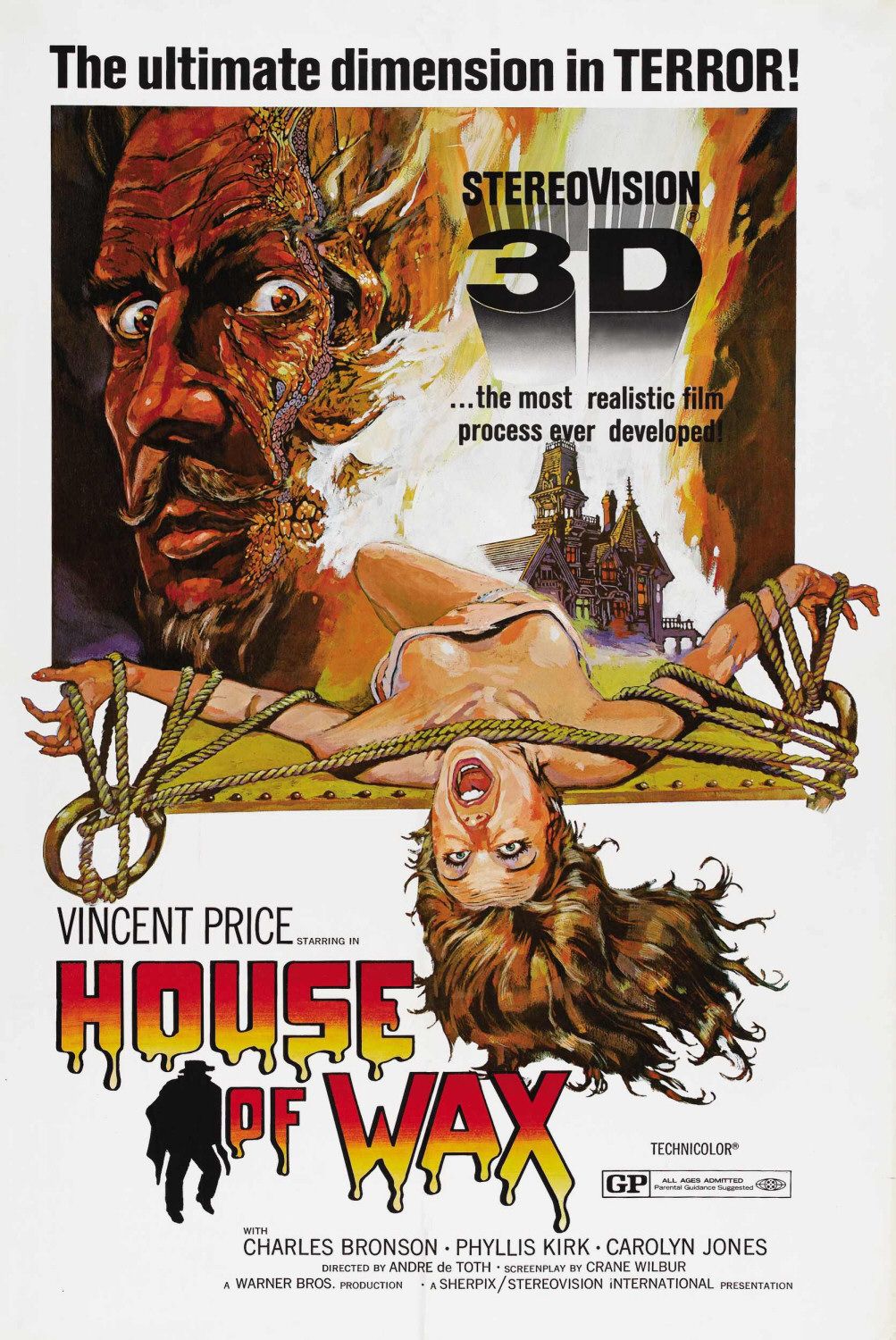
House of Wax (1953)

HOUSE OF WAX

HOUSE OF WAX (1953) Four stars
I’m a big fan of the late, great St. Louis born Vincent Price (1911-93).
 
Like most people from my generation, I first discovered Price through his voice work on Michael Jackson’s mega-hit “Thriller.”
 
Over time, of course, I began to encounter more and more of his work and I became more and more of a fan.
 
A couple of my favorites include his narration on Alice Cooper’s “Black Widow” from the 1975 Cooper album “Welcome to My Nightmare” (AC’s first solo LP) and THEATER OF BLOOD (1973).
 
“Black Widow” foreshadowed Price’s work on “Thriller.”
 
THEATER OF BLOOD lets Price sink his teeth into a juicy role and plot scenario — an irate Shakespearean actor who takes ultimate revenge on all his critics. It’s a lot of fun.
 
Several movies have taken cheap shots at critics over the years — for example, GODZILLA ’98 gave us the buffoonish Mayor Ebert and his aide Gene and LADY IN THE WATER (2006) knocked off that pretentious killjoy Harry Farber, a no-count film and book critic — but THEATER OF BLOOD gets it just right, unlike both GODZILLA and LADY IN THE WATER.
 
In the case of GODZILLA, Roland Emmerich and Dean Devlin didn’t even have the guts to have their Godzilla devour their Siskel & Ebert parodies. Chicken shits. I mean, were they holding out hope their film might still get a positive review? You know it’s bad when M. Night had more balls than you.
 
Anyway, in the spirit of a Camper Van Beethoven song, I have to ask ‘Where the hell am I?’
 
Oh yeah, Vincent Price and his incredibly entertaining HOUSE OF WAX, a remake of the 1933 horror film MYSTERY OF THE WAX MUSEUM.
 
By the way, Warner Bros. packaged together the 1933 with the 1953 film on a DVD and it’s not every day that you get two good movies for the price of one.
 
Now, I can add HOUSE OF WAX to the Price favorites list.
 
Price stars as Prof. Henry Jarrod, who’s absolutely committed to his wax museum. They’re not just wax figures to him. After all, they are extremely lifelike — a fine art — and he sums up the essence of his art with this dialogue, “Once in his lifetime, every artist feels the hand of God, and creates something that comes alive.”
 
Jarrod especially loves his Marie Antoinette, “Everything I ever loved has been taken away from me, but not you, my Marie Antoinette, for I will give you eternal life.” (Just pretend using Price’s voice while reading the dialogue.)
 
Jarrod thinks first and foremost in artistic terms, whereas his business partner Matthew Burke (Roy Roberts) hatches a devious scheme. If they set the wax museum ablaze, they can collect the $25,000 insurance policy and split it straight down the middle. Jarrod cannot believe his ears, for he loves his wax museum and his creations too much to see them destroyed for money.
 
Burke and Jarrod fight it out, with Burke ultimately winning the upper hand and burning down the wax museum with Jarrod inside. Burke believes Jarrod died … of course, Jarrod survives, enacts his revenge, and starts his wax museum all over bigger and better.
 
File the wax figures burning under “Great Movie Scenes.”
 
In early September 1988, a fire claimed the lives of 300 wax figures from the Southwestern Historical Wax Museum in Grand Prairie, Texas.
 
Lost were figures of Elvis, JFK, Robert Redford, and Paul Newman.
 
“One of the things that has made this fire so difficult to fight was the fact these figures are just like a candle,” Lt. Doug Conner said. “They generate tremendous heat. It appears it’s totally destroyed.”
 
The burning down of the wax museum certainly proves to be a great opener for HOUSE OF WAX.
 
HOUSE OF WAX came in the wake of the first 3-D feature, BWANA DEVIL (1952), and it gives us one of the best 3-D scenes I have ever seen. This scene comes right after intermission.
 
We have a barker for Jarrod’s new wax museum known as the House of Wax. We all know barkers, right, are people who “attempt to attract patrons to entertainment events, such as a circus or fair, by exhorting passing members of the public, announcing attractions of show, and emphasizing variety, novelty, beauty, or some other enticing feature of the show.”
 
Our barker seems to be an elite paddle ball player and he breaks the fourth wall, as he directly addresses the audience and hits the paddle ball toward us.
 
“Well, there’s someone with a bag of popcorn. Close your mouth, it’s the bag I’m aiming at, not your tonsils.”
 
This is better than anything in JAWS or AMITYVILLE 3-D.
 
There’s more choice moments in HOUSE OF WAX, and it’s essential viewing for Price fans.
 
Five must-see Vincent Price films:
— HOUSE OF WAX (1953)
— THE FLY (1958)
— HOUSE ON HAUNTED HILL (1959)
— THEATER OF BLOOD (1973)
— VINCENT (1982)

Back to the Future Trilogy (1985-90)


BACK TO THE FUTURE TRILOGY (1985-1990)
The BACK TO THE FUTURE trilogy stands up better now than when the films were originally released.

That’s partly because we’ve not seen any more sequels or remakes, retcons, reboots, and ripoffs.

The three films have been allowed to stand on their own.

They stand up tall and straight.

Once upon a time, I wrote that DAWN OF THE DEAD, THE TERMINATOR, and THE FLY are great films because they not only succeed at giving audiences satisfaction on genre terms but they also work on additional levels. For example, the satire that equates mall shoppers with zombies (DAWN OF THE DEAD), the romance between Kyle Reese and Sarah Connor (THE TERMINATOR), and the romance between Seth Brundle and Veronica (THE FLY). All three films have a lot going on for and in them.

The same greatness principle holds true for all three BACK TO THE FUTURE films: They’re all successful comedies that work on a deeper level, mostly thanks to time travel.

Speaking of time travel, I’m definitely a fan because I love THE TERMINATOR, TIME AFTER TIME, X-MEN: DAYS OF FUTURE PAST, and MEN IN BLACK 3 and enjoy BILL & TED’S EXCELLENT ADVENTURE, STAR TREK IV: THE VOYAGE HOME, and FREQUENCY, for example.

The BACK TO THE FUTURE films — especially PART II — play around with the paradoxes of time travel, both for comedic and dramatic effect. It allows certain actors to play multiple roles in different times — 1885, 1955, 1985, alternate 1985, and 2015.

BACK TO THE FUTURE starts with the inspiration of containing a time machine in a DeLorean and the movie revs up when that baby moves 88 mph because, as Christopher Lloyd’s Dr. Emmett “Doc” Brown says, “If my calculations are correct, when this baby hits 88 miles per hour, you’re gonna see some serious shit.”

We do.

Anyway, our teenage protagonist Marty McFly (played by a 23-year-old Michael J. Fox), he’s bummed out by his parents George (Crispin Glover) and Lorraine (Lea Thompson), a hopeless nerd picked on by eternal bully Biff Tannen (Thomas F. Wilson) for one parent and a drunk for the other.

Sitting at the dinner table with his family, Marty’s not too interested in how his parents met: Lorraine’s father hit George with his car and Lorraine nursed George back to health. Lorraine experienced a real Florence Nightingale effect.

However, no kid’s ever all that interested in how their parents met. Especially parents like George and Lorraine.

The DeLorean hits 88 mph and Marty ends up back in 1955 — Nov. 5, 1955, stuck there, without any plutonium to return.

BACK TO THE FUTURE then becomes an even greater movie when it takes on the premise of a teenager meeting their parents when they’re teenagers. Marty’s a lot more interested in how his parents met, that’s for sure.

Not long after their first meeting in 1955, Marty saves George from being hit by that fateful car. Marty’s knocked unconscious instead and Nurse Lorraine grows “amorously infatuated” (Doc’s words) with her future son rather than her future husband. She’s in hot pursuit, and we remember her 1985 self warning her teenaged son about girls that chase after boys.

Just be glad that Marty finds a younger Doc to sort it all out and get him “back to the future.”

We especially need Doc around for PART II to explain the movie’s convoluted plot.

PART II gives us a version of 2015 highlighted by technological advancements. It was great fun watching the 2015 scenes in 1989 based on future speculation and it’s still great fun watching them 30 years later as we reflect what they got right and what they got wrong. The Royals, not the Cubs though, won the World Series and Universal mercifully stopped at four JAWS films.

(The Cubs ended the longest world championship drought in North American professional sports history — only 108 years — by winning the 2016 World Series.)

Futurepedia even provided a list of the new technology: Air traffic control; auto-adjusting and auto-drying jacket; automatic dog walker; automated Texaco service station; barcode license plate; binocular card; bionic implants; Compu-Fax; Compu-Serve; computerized breastplate; cosmetic factory; data-court; dehydrated pizza; dust-repellent paper; flying circuits; fruit dispenser; hands free video games; holobillboard; holofilms a la JAWS 19; hoverboards; hovercam; hover conversion; hydrator; Identa-pad; Internet; Kirk Gibson Jr. Slugger 2000 adjustable bat; Litter Bugs; Master-cook; Mr. Fusion; multi-channel video screen; neon curbing; Ortho-lev; Pac Fax; portable thumb unit; power-lacing shoes; rejuvenation clinic; scene screen; skyway; slam ball; sleeping device; soda bottles with built-in straws; flying cars; tablet computer; thumb pad; tranquilization; transponder; U.S. Weather Service; video glasses and video telephone glasses; video simulacrum; video telephone.

PART II ends up back in Nov. 12, 1955 (Marty’s final day in 1955 in BACK TO THE FUTURE), so we have two Martys and two Docs running breathlessly around Hill Valley.

Given all the plot convolutions and time permutations in PART II, it’s fitting that the 1955 Doc faints during a scene late in the movie.

Lightning strikes the DeLorean and sends Doc back to 1885 near the end of PART II … and Marty tracks him down in PART III.

We get a Western comedy in a year that included Best Picture winner DANCES WITH WOLVES and QUIGLEY DOWN UNDER.

PART III finds employment for veteran character actors Pat Buttram (1915-94), Harry Carey Jr. (1921-2012), and Dub Taylor (1907-94) in the 1885 scenes. It’s nice to see and hear them codgers.

Their presence lets us know that PART III is a different kind of Western than DANCES WITH WOLVES and QUIGLEY DOWN UNDER, more like a TV Western.

Marty takes Clint Eastwood for his 1885 name.

PART III casts Mary Steenburgen as Doc’s love interest and we remember Steenburgen as H.G. Wells’ love interest in TIME AFTER TIME (1979). Wells wrote “The Time Machine.” In TIME AFTER TIME, Jack the Ripper uses Wells’ time machine to travel to modern day San Francisco and Wells follows and pursues Jack the Ripper. During his pursuit, Wells meets bank clerk Amy (Steenburgen) and falls in love with her. (In real life, McDowell and Steenburgen became married in 1980, separated in 1989, and divorced in 1990. They met and began dating making TIME AFTER TIME.)

The BACK TO THE FUTURE trilogy ends on a satisfying note.

More notes on BACK TO THE FUTURE:

— Michael J. Fox is one of the most likable actors of all-time. He was the first choice for Marty, but “Family Ties” producer Gary David Goldberg refused to allow Fox away from that show to make a movie. That’s why BACK TO THE FUTURE originally cast Eric Stoltz as Marty. Stoltz worked a few weeks on the film before director Robert Zemeckis and screenwriter Bob Gale realized there’s something wrong with Stoltz as Marty: He’s not the Marty they wanted. Stoltz lacked screwball energy and he played scenes more dramatically. They let Stoltz go and recast with Fox, who became free to make the movie. Fox did not have to reach very far to portray Marty, “All I did in high school was skateboard, chase girls, and play in bands. I even dreamed of becoming a rock star.”

For two months, Fox worked on “Family Ties” during the day and BACK TO THE FUTURE at night, giving him at most a few hours of sleep each day.

Re-shooting added $3 million to the film’s budget, a number more than made up for by grosses for all three films that have amassed nearly $1 billion in returns.

— Christopher Lloyd’s boundless madcap energy earns Doc a place in the annals of great mad scientists and nutty professors. He becomes more than that, though, over the course of three movies. We love Doc, perhaps more than any other character in the series.

— Thomas F. Wilson makes any variation on the bully, whether it’s Buford “Mad Dog,” Biff, or Griff Tannen and whether it’s 1885, 1955, 1985, alternate 1985, or 2015, a lovable asshole. We love to hate “Mad Dog,” Biff, and Griff, especially Biff. We love every time Biff screws up a phrase like “Make like a tree … and get out of here.” We love every time he’s doused in manure. We love every time he’s burned and showed up by our protagonists. How do you feel after learning Donald Trump inspired the Biff character?

— Crispin Glover proved to be the next evolution in screen nerd, taking off from Eddie Deezen and REVENGE OF THE NERDS. Glover stepped in that direction in FRIDAY THE 13TH: THE FINAL CHAPTER, but he gets a fuller character in BACK TO THE FUTURE.

— Lea Thompson is quite fetching in the 1955 scenes and her character unknowingly lusting after her future son fits into a career where she was attacked by The Great White Mother in JAWS 3-D, yelled at and embarrassed by her sexually frustrated and football obsessed boyfriend in ALL THE RIGHT MOVES, involved with a married police officer who should have arrested himself for his own sex crimes in THE WILD LIFE, and kissed by an animatronic duck in HOWARD THE DUCK. John Hughes at least gave her the name Amanda Jones in SOME KIND OF WONDERFUL, from the Rolling Stones song “Miss Amanda Jones.” What a career.

— Huey Lewis and the News’ “Power of Love” achieves being their only song that does not inspire my thoughts of giving the nearest person a pencil and having them stab my eardrums. For example, it seemed that for the longest time at the Pittsburg Subway I’d hear their hit song “The Heart of Rock & Roll.” Every damn single time. I survived by wisecracking, “If Huey Lewis is the heart of rock ’n’ roll, then rock ’n’ roll needs a defibrillator.” I suppose I think more positively of “Power of Love” from being in BACK TO THE FUTURE.

— Zemeckis produced some of the best mass entertainments for nearly a decade-and-a-half, everything from 1941 (directed by Steven Spielberg) and USED CARS to BACK TO THE FUTURE and WHO FRAMED ROGER RABBIT.

I just hope that Hollywood leaves those films alone and does not burden us with remakes, retcons, reboots, or any other ripoff.

Is that too much to ask?

BACK TO THE FUTURE (1985) Four stars; BACK TO THE FUTURE PART II (1989) Three-and-a-half stars; BACK TO THE FUTURE PART III (1990) Four stars

Bette Davis: Tougher than Anybody Else

BETTE DAVIS: TOUGHER THAN ANYBODY ELSE
Like most people in my generation, I first encountered Bette Davis (1908-89) through popular music rather than her 123 movie or TV roles from 1931 through 1989.

Oh, let’s see, Davis made a starring performance in Kim Carnes’ “Bette Davis Eyes,” a hit that spent nine weeks at No. 1 on the Billboard Hot 100 and proved to be 1981’s biggest song. You might vividly remember that one and songwriters Donna Weiss and Jackie De Shannon gave their heroine — er, their femme fatale — not only Bette Davis eyes, but also “Harlow gold hair” and “Greta Garbo’s standoff sighs.”

Davis also made the hall of fame in songs by Madonna and the Kinks.

Madonna Ciccone and Step Pettibone (Ciccone-Pettibone has got a better ring to it than Lennon-McCartney or Strummer-Jones) co-wrote “Vogue” and Madonna’s rap (her best) finishes off with “Bette Davis, we love you” after running through Garbo, Monroe, Dietrich, DiMaggio, Brando, James Dean (called Jimmy Dean, not the sausage manufacturer), Kelly, Astaire, Hayworth, Bacall, Hepburn, and Lana Turner.

Like the other two songs that came later in time, Ray Davies’ lyrics on “Celluloid Heroes” mention Garbo and she gets top billing (first mention) before the song moves on to Rudolph Valentino, Bela Lugosi, Davis, George Sanders, Mickey Rooney, and Marilyn Monroe. Davies groups Davis with Valentino and Lugosi, capping off six lines with “But stand close by Bette Davis / Because hers was such a lonely life.” (Davis named her 1962 autobiography “The Lonely Life.”) For the record, Garbo gets six lines, Monroe four, and Valentino, Lugosi, Sanders, and Rooney two each.

— The first Bette Davis movies I saw were ALL ABOUT EVE (1950) and WHAT EVER HAPPENED TO BABY JANE? (1962), both highly enjoyable for different reasons.

Their common ground, though, centers around Davis.

ALL ABOUT EVE, that’s the one featuring her famous line “Fasten your seat belts. It’s going to be a bumpy night.” Margo Channing — a highly-regarded but aging and difficult stage actress — must not have been a great stretch for a Davis in her early 40s.

Other actresses considered for the role were Ingrid Bergman, Marlene Dietrich, Susan Hayward, Gertrude Lawrence, and Barbara Stanwyck. Think we can all agree that Davis was the perfect choice for Margo Channing.

You can almost feel Davis herself speaking through dialogue like “Lloyd, I am not twenty-ish. I am not thirty-ish. Three months ago I was forty years old. Forty. 4-0. That slipped out. I hadn’t quite made up my mind to admit it. Now I suddenly feel as if I’ve taken all my clothes off” and “Bill’s 32. He looks 32. He looked it five years ago. He’ll look it twenty years from now. I hate men.”

BABY JANE capitalized on the real-life feud between Davis and Joan Crawford, where most of the fun comes from speculating how much reality crossed over into their fictional characters.

Just a casual search on the Internet will bring up all sorts of quotes from Davis on Crawford and I might as well as share a few within this space: “You should never say bad things about the dead, you should only say good … Joan Crawford is dead. Good”; “There may be a heaven, but if Joan Crawford is there, I’m not going”; “Why am I so good at playing bitches? I think it’s because I’m not a bitch. Maybe that’s why Miss Crawford always plays ladies”; and “The best time I ever had with Joan Crawford was when I pushed her down the stairs in WHAT EVER HAPPENED TO BABY JANE?”

Davis never had a problem being the villain and that’s one of the things that made her so great. Let’s face it, sometimes we like the villains infinitely more than bland, square heroes.

She played a strong character in almost every single role.

Davis became the first performer to be nominated for 10 Academy Awards, all for Best Actress, and she won statuettes for DANGEROUS (1935) and JEZEBEL (1938), her first two nominations.

— Recently, I caught up with OF HUMAN BONDAGE (1934), FOG OVER FRISCO (1934), and THE PETRIFIED FOREST (1936).

OF HUMAN BONDAGE — her 22nd film — is renowned for being the film that made Davis a star.

Davis’ character Mildred Rogers has been described as “callous,” “manipulative,”  “cold,” “shrewish,” et cetera, and Davis really sinks her teeth into “You cad, you dirty swine! I never cared for you, not once! I was always makin’ a fool of ya! Ya bored me stiff; I hated ya! It made me SICK when I had to let ya kiss me. I only did it because ya begged me, ya hounded me, and drove me crazy! And after ya kissed me, I always used to wipe my mouth! WIPE MY MOUTH!”

That’s her big scene with Leslie Howard’s Philip Carey, an overly sensitive, club-footed man who’s in love with Mildred despite the fact that she treats him like trash.

— FOG OVER FRISCO came out 26 days before OF HUMAN BONDAGE in 1934 and it’s a fast-moving crime melodrama over in 68 minutes. Action-packed and the big chase scene called to mind BULLITT and THE DEAD POOL, believe it or not.

Davis considered this one of her favorite pictures, though her character Arlene Bradford does not make it to the final reel.

Maybe here’s why FOG OVER FRISCO rated among her favorites: Davis received top billing after Warner Bros. boss Jack Warner caught drift of the Bette buzz from rushes of the film and she found out while filming FOG OVER FRISCO that Warner agreed to loan Davis out to RKO to make OF HUMAN BONDAGE.

Davis also said that FOG OVER FRISCO had a good script and that it was superbly directed by William Dieterle over a shoot that lasted around 20 days (Monday, January 22, 1934 through Saturday, February 10, 1934).

Davis plays characters on opposing ends of the social spectrum in FOG OVER FRISCO and OF HUMAN BONDAGE. In both films, though, she has a weak male admirer. She’s the stronger character, as usual.

— A lot of the fascination watching THE PETRIFIED FOREST came from seeing both Davis and Humphrey Bogart in roles early in their career.

Bogart had done 10 feature films before THE PETRIFIED FOREST and he first played the Duke Mantee role in the 1935 Broadway production alongside Leslie Howard. Warner Bros. wanted Edward G. Robinson (LITTLE CAESAR) for the film adaptation, but Howard refused to appear in the film unless Bogart got the chance to revisit Mantee, a character and performance inspired by John Dillinger. The rest was history. (Bogart and Lauren Bacall named their daughter Leslie Howard Bogart, born 1952, in honor of their friend.)

Bogart is just dynamite in THE PETRIFIED FOREST.

Like OF HUMAN BONDAGE, Davis plays a waitress and Howard’s love interest. Unlike that earlier movie, however, her Gabrielle Maple’s almost instantly smitten with Howard’s Alan Squier and their fates are reversed from OF HUMAN BONDAGE.

The New York Times’ review of the film said of her performance in THE PETRIFIED FOREST, “There should be a large measure of praise for Bette Davis, who demonstrates that she does not have to be hysterical to be credited with a grand portrayal.”

Gabrielle’s a very sympathetic character, a dreamer and an aspiring artist.

— Davis once said, “I survived because I was tougher than anybody else.”

ALL ABOUT EVE (1950) Four stars; WHAT EVER HAPPENED TO BABY JANE? (1962) Four stars; OF HUMAN BONDAGE (1934) Three-and-a-half stars; FOG OVER FRISCO (1934) Three-and-a-half stars; THE PETRIFIED FOREST (1936) Three-and-a-half stars

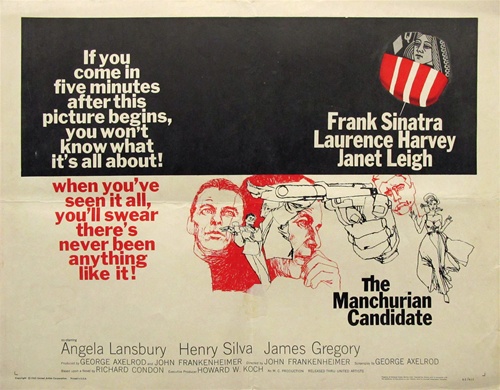
The Manchurian Candidate (1962)

DAY 81, THE MANCHURIAN CANDIDATE

THE MANCHURIAN CANDIDATE (1962) Four stars
John Frankenheimer’s political thriller is one ripped, twisted movie, borrowing famous words from Hunter S. Thompson.

It should make one reconsider both Frank Sinatra and Angela Lansbury, for example.

I did.

Before I first watched THE MANCHURIAN CANDIDATE, I held Sinatra in very little (miniscule) esteem. Maybe it was Phil Hartman’s savage impersonation on “Saturday Night Live.” Maybe it was Sinatra’s appearances on Jerry Lewis’ MDA telethon on Labor Day and when you only have three channels and one of them’s gone all weekend, all booked up, man, we’re talking about Pits City. Maybe it was his crooning that provided the soundtrack for seemingly innocuous yuppie consumption (we all know what seemingly innocuous really means) and little old swooning ladies and every movie that wants to evoke a certain mood just by slapping one of Ol’ Blue Eyes’ standards on every few minutes. Maybe it was the fact that he lived and breathed crusty, old guard establishment, whose reactions to Elvis and the Beatles were not surprising. There was just something about that man that gave me the creeps.

Why, of course, like any child of the 1980s and 1990s, I knew Lansbury from “Murder, She Wrote” and I know I saw her in old Disney entertainments somewhere along the line. I knew that she wasn’t quite this doddering old lady, because, man, if I saw her Jessica Fletcher coming my way, I would have moved to another town or put a down payment on a passport and an one-way plane ticket and move to another country because I know that homicide’s afoot and I want no damn part of it. The homicide rate in Cabot Cove, Maine, must have rivaled Chicago.

So, yeah, in many different ways, THE MANCHURIAN CANDIDATE warped my fragile little mind, including seeing Sinatra as a legitimate dramatic actor and Lansbury as the most wicked mother in screen history. I have no doubt she plays the most wicked mother in screen history, because I don’t want to see anybody else more wicked.

I don’t know if reading or having somebody tell you the plot summary for THE MANCHURIAN CANDIDATE can even adequately convey how messed up the movie’s events are, like this one I just read on the Internets: “Near the end of the Korean War, a platoon of U.S. soldiers is captured by communists and brainwashed. Following the war, the platoon is returned home, and Sergeant Raymond Shaw (Laurence Harvey) is lauded as a hero by the rest of his platoon. However, the platoon commander, Captain Bennett Marco (Sinatra), finds himself plagued by strange nightmares and, together with fellow soldier Allen Melvin (James Edwards), races to uncover a terrible plot.”

Strange nightmares, you can say that again, because they incorporate those Communist brainwashing sessions.

It seems that Shaw’s platoon are surrounded by sweet little old ladies, when in fact they are Chinese and Soviet officials performing their brainwashing routine. Shaw murders two of his men, one by strangulation and one by gunshot through the head. Yet when they come back home, Shaw’s a military hero, just all part of the plan.

These nightmares are very disturbing to watch, of course, and establish the movie’s disorienting tone. We rarely catch a break.

This was one dark movie for 1962 and like DR. STRANGELOVE (1964), it holds up today because of that darkness. In her 1962 review, Pauline Kael said that it may be the most sophisticated political satire ever made in Hollywood. Here we are, decades later, and her statement holds true.

There’s a lot about the plot I don’t want to consider in this space, but there’s still a lot one can discuss considering THE MANCHURIAN CANDIDATE.

For example, it was released October 24, 1962, right in the midst of the Cuban Missile Crisis during which Cold War tensions between the United States and the Soviet Union reached their coldest.

On November 22, 1963, John F. Kennedy was assassinated in Dallas. (THE MANCHURIAN CANDIDATE builds up to an assassination.)

For over two decades, THE MANCHURIAN CANDIDATE became withdrawn from circulation.

Some believe it was because JFK’s assassination had such a toll on Sinatra that he sat on the film.

Apparently, Sinatra had made such a poor deal with United Artists on the film that his attorneys planned for Sinatra to buy the movie’s rights himself and bury his mistake. Sinatra’s plan succeeded in 1972.

Eventually, though, the New York Film Festival organized a 25th anniversary screening of the movie in 1987 and its success led to a theatrical re-release in 1988. Apparently, Sinatra got a better deal this second time. We all got a better deal when THE MANCHURIAN CANDIDATE saw the light of day once again.

The film’s tagline certainly gets at the truth of the matter: “If you come in five minutes after this picture begins, you won’t know what it’s all about! When you’ve seen it all, you’ll swear there’s never been anything like it!”

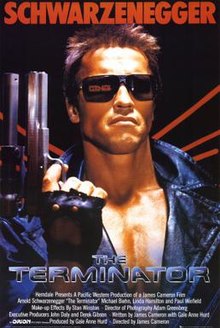
The Terminator (1984)

DAY 29, THE TERMINATOR

THE TERMINATOR (1984) Four stars
James Cameron said that John Carpenter’s HALLOWEEN inspired him to make THE TERMINATOR, and it’s easy to see that with Arnold Schwarzenegger’s T-800 and Michael Myers, both (virtually) unstoppable killing machines.

Apparently, while in Rome around the time of PIRANHA II: THE SPAWNING, Cameron had a dream about a metallic torso equipped with kitchen knives in hand and dragging itself from an explosion, which almost sounds exactly like a scene late in THE TERMINATOR. This dream became the basis for the film.

Then again, late author Harlan Ellison (1934-2018) claimed that Cameron was inspired by Ellison’s 1964 Outer Limits episode “Soldier” (adapted from Ellison’s own short story) where a future soldier goes back in time to save a present-day woman from another future soldier. I believe Ellison (although he liked the movie) used that nasty ‘P’ word, plagiarism. Ellison received a financial settlement from Hemdale and Orion Pictures, and home video releases of THE TERMINATOR subsequently read “The Producers Acknowledge the Works of Harlan Ellison.”

THE TERMINATOR benefits greatly from the casting of the central roles: Schwarzenegger as the literal force of death and destruction, Michael Biehn as the feisty freedom fighter of the future brought back to the present Kyle Reese, and Linda Hamilton as the present-day young woman Sarah Connor who initially can’t quite believe that she’s in the middle of such a ridiculous plot until Reese (and the corpses) convince her. They fit the roles to a T.

Schwarzenegger has largely played heroic characters and in fact, he’s on the good side for the rest of THE TERMINATOR series. Playing the villain, though, he benefits greatly from speaking few lines (keep in mind his first movie, HERCULES IN NEW YORK, dubbed Schwarzenegger); granted, we have less of the great humor that permeates COMMANDO, PREDATOR, and TOTAL RECALL, but it’s still there with Schwarzenegger as villain with his infamous line “I’ll be back,” for example.

That good spirit and joy of performance still comes through for Schwarzenegger in THE TERMINATOR.

Schwarzenegger plays a more interesting variation on Michael Myers and Jason Voorhees, because those roles in theory can be played by anybody. (Please don’t tell that to Ted White or Kane Hodder.)

Reese explains the situation to Sarah Connor, “That Terminator is out there! It can’t be bargained with. It can’t be reasoned with. It doesn’t feel pity, or remorse, or fear. And it absolutely will not stop … ever, until you are dead!”

Schwarzenegger originally read for the Kyle Reese role and Cameron wanted Lance Henriksen to be the Terminator. Wow, Henriksen as the Terminator just boggles the mind, although Cameron used Robert Patrick to great success as T-1000 in TERMINATOR 2: JUDGMENT DAY. Kristianna Loken as T-X in TERMINATOR 3, well, let’s just say epic fail.
Biehn works better in the Reese role because of all the dialogue and in some ways, he’s like Donald Pleasence’s Dr. Sam Loomis in HALLOWEEN. He understands T-800, even though, of course, nobody believes him until it’s too late.

The Dr. Silberman character (Earl Boen) gets one great scene interrogating Reese and then playing the video back for the Paul Winfield and Henriksen police characters. Dr. Silberman just got out of the police station in the nick of time, and he returns for the sequel.

THE TERMINATOR works as horror movie, as science fiction, and as action, in a streamlined combination of some of the best aspects of HALLOWEEN, BLADE RUNNER, and THE ROAD WARRIOR.

On top of all that, we have a great love story and this element gives THE TERMINATOR the slight edge over JUDGMENT DAY.

Just that scene alone when Reese explains why he accepted the assignment to come back through time and save Sarah Connor, mother of a future resistance leader.

“John Connor gave me a picture of you once,” Reese said. “I didn’t know why at the time. It was very old … torn, faded. You were young like you are now. You seemed just a little sad. I used to always wonder what you were thinking at that moment. I memorized every line, every curve. … I came across time for you, Sarah. I love you; I always have.”

When you go see a movie called THE TERMINATOR, bet you weren’t expecting a genuinely touching love story.

It’s the element of the unexpected that makes for the most rewarding experiences, movies or in general.

Suspiria (1977)

DAY 24, SUSPIRIA

SUSPIRIA (1977) Four stars
This is one of those rare films where what would normally be weaknesses actually turn out to be strengths and help the film become a seminal work.

For example, older actors playing high school students (Jessica Harper and Stefania Casini were both in their late 20s) and dubbing only add to the weirdness and disorienting nature of SUSPIRIA, director and writer Dario Argento’s first installment in the “Three Mothers” trilogy.

SUSPIRIA is first and foremost a visceral experience, a treat for the eyes and the ears with first-rate production and sound design. It was one of the last films to use imbition Technicolor (used previously for THE WIZARD OF OZ and GONE WITH THE WIND) and it looks absolutely marvelous with its vivid colors.

You won’t be able to keep your eyes off the screen, even if you want to cover them during some of the more squeamish moments. Just remember the film’s tagline: “The only thing more terrifying than the last 12 minutes of this film are the first 92.”

Italian progressive rock band Goblin, who previously scored Argento’s 1975 classic giallo DEEP RED and later scored TENEBRE (1982), adds tremendously to the disorientating effect; Goblin’s scores for DEEP RED and SUSPIRIA rank with John Carpenter’s main HALLOWEEN theme and Bernard Herrmann’s work for Alfred Hitchcock’s thrillers.

Disorientation is what SUSPIRIA achieves thematically above anything else. We’re never quite sure what’s going to happen next, despite the fact that we think we know what to expect, even in an Argento movie, from all our experience watching scary movies. We know that everything will be heightened in an Argento movie, just like other Italian horror movies by such maestros as Mario Bava and Lucio Fulci.

However, like a lot of those other films, all the elements in SUSPIRIA work together even if logically nothing makes any sense in the moment.

Urban Dictionary lists SUSPIRIA as “One of the greatest movies ever made — Dario Argento’s 1977 horror film, about a young girl at a German dancing academy, who discovers that the faculty are witches, plotting against her life in a series of ritual voodoo killings, involving sacrifices and vestal virgins on a pagan altar. … I first saw SUSPIRIA at the age of 10, and was terrified.”

Guess that’s one way to use “Suspiria” in a sentence.

NOTE: The 2018 remake directed by Luca Guadagnino was released October 26. The movie stars Dakota Johnson and Tilda Swinton, as well as Jessica Harper and Chloe Grace Moretz, and Thom Yorke (Radiohead) provided the soundtrack.

American Pop (1981)

AMERICAN POP

AMERICAN POP (1981) Four stars
From 1972 to 1983, British Mandate of Palestine born and New York City and Washington D.C. raised Ralph Bakshi directed eight animated features: FRITZ THE CAT, HEAVY TRAFFIC, COONSKIN, WIZARDS, THE LORD OF THE RINGS, AMERICAN POP, HEY GOOD LOOKIN’, and FIRE AND ICE.

Bakshi definitely proved to be a game changer: Feature-length animation could be combative, satirical, adult entertainment and more than just good, clean, wholesome family entertainment as in the socially accepted definition for animated films. His films — especially his first three — paved the way for “The Simpsons,” “Beavis & Butt-Head,” “South Park,” “Family Guy,” “Adult Swim,” et cetera.

FRITZ THE CAT, loosely based on Robert Crumb’s comic strip, became a landmark motion picture, the first animated feature to earn the ‘X’ rating in the United States.

HEAVY TRAFFIC, COONSKIN, AMERICAN POP, and HEY GOOD LOOKIN’ are ‘R’ and WIZARDS, THE LORD OF THE RINGS, and FIRE AND ICE are ‘PG,’ although that rating once packed a punch with the first two Indiana Jones, JAWS, POLTERGEIST, GREMLINS, and LONE WOLF McQUADE, arguably the most violent ‘PG’ ever made, being some of the most notorious ‘PG’ entries before ‘PG-13’ debuted in August 1984 with the release of RED DAWN.

I’ve watched seven of the eight Bakshi films listed above, liked nearly all of them, and FRITZ THE CAT, THE LORD OF THE RINGS, and AMERICAN POP have earned a spot on my personal top 10 lists for 1972, 1978, and 1981, respectively.

I just watched AMERICAN POP last night and I was once again impressed by the overall sweep of the enterprise — narratively and musically and, of course, its animation — just like I had been several years back watching it for the first time.

AMERICAN POP tells the story of four generations of Russian Jewish immigrants who all have some involvement with American popular music.

First, we meet Zalmie around the late 19th and early 20th century and follow him for a series of years. Zalmie, who started hanging around burlesque shows at an early age, wants to be a singer, but a wound to his throat during World War I kills his singing career. After the war, back home in New York City, he falls in love and marries a stripper named Bella, and Zalmie transfers his star-making ambition to his wife. She’s killed opening a letter bomb intended for him. See, Zalmie used money from mob boss Nicky Palumbo for his wedding to Bella and eventually, Zalmie testifies against Palumbo on TV, calling the mob boss “a rat.”

Zalmie and Bella have a son named Benny, who becomes a very talented jazz pianist. Benny fights in World War II and in one of the film’s best scenes, he finds an abandoned piano in a bombed-out building that leads to his demise. When we first see Benny in Nazi Germany, he’s playing the harmonica (not exactly his musical forte) and even he quips to two fellow troops who call out his lousy playing, “I know, but it’s hard to fit a piano in a foxhole.” At this abandoned piano, Benny first riffs on “As Time Goes By” (Dooley Wilson’s Sam had to play it — again — in CASABLANCA) and his playing quickly draws the attention of an awakened, armed Nazi soldier who approaches Benny from the rear. Benny changes tune to “Lili Marleen” (Marlene Dietrich made it especially famous) and the appreciative Nazi waits to shoot down Benny until he’s done playing “Lili Marleen.” The Nazi even says thanks in German before firing his shots.

Third generation Tony experiences the Beats and the Hippies as he migrates from East to West and back again — of course, we hear Allen Ginsberg’s “I saw the best minds of my generation destroyed by madness,” one of the best starts to any poem — and he gets poetic himself first over “The Blonde” from Kansas. “Yeah, I’m crazy,” Tony tells her. “I’m crazy in love with your blue eyes … and your corn-sulked hair. Your corn-sulked hair. I’ll never eat corn again without thinkin’ about you. Canned corn, candy corn, popcorn, Crackerjacks! You’re the prize in my box! And my box is this country. It’s all tinfoil on the outside. Corn and sweetness on the inside.”

Tony’s journey leads him next to California and he writes songs for a rock band on the edge of stardom. Tony and female lead singer Frankie Hart — a character archetype obviously inspired by Grace Slick and Janis Joplin — become heroin addicts. With the band set to play after Jimi Hendrix one night in Kansas, two important events happen to Tony: his lover Frankie overdoses backstage and he meets his son Pete, who came from the one night with the corn-sulked hair girl.

Tony moves back to New York City, joined by his son. Both Tony and Pete become drug dealers and Pete begins selling drugs to rock bands. Pete finally seizes the moment and gives the band members an ultimatum: They must listen to Pete’s music before they can have any more cocaine. Pete chooses to play Bob Seger’s “Night Moves” for the band and the management. Next thing we know, before we can get all the way through “Night Moves,” Pete’s on stage with the band playing “Blue Suede Shoes,” “Devil in a Blue Dress,” and “Crazy on You.” Late in the medley, we start to see images from earlier in the movie — Zalmie, Benny, and Tony — with Pete on stage.

Of course, Lynyrd Skynyrd’s “Free Bird” plays over the end credits.

AMERICAN POP guides us through 80 years of popular music — everything from standards to Jimi Hendrix’s “Purple Haze,” Janis Joplin’s “Summertime,” and Lou Reed’s “I’m Waiting for the Man,” in addition to the songs already mentioned. That list barely hints at the music heard throughout AMERICAN POP.

Stylistically, we not only have rotoscoping (a process where live actors are filmed and then animators draw over the live-action footage), but also water colors, computer graphics, live-action shots, and archival footage.

Bakshi swung for the fences making AMERICAN POP — an epic achieved in 96 minutes with any failures consumed by the successful elements.

If you still have, somehow at this point in time after many advances in the field, a belief that animated films occupy a limited range aesthetically, emotionally, and intellectually, then Ralph Bakshi’s AMERICAN POP just might free and expand your mind.

In other words, “Whether you dance to it, drive to it, sing with it or swing to it … if you can crank it up, plug it in, or switch it on … if it assaults your senses, rocks your body, or touches your soul, it’s AMERICAN POP.”

The Big Lebowski (1998)

THE BIG LEBOWSKI

THE BIG LEBOWSKI (1998) Four stars
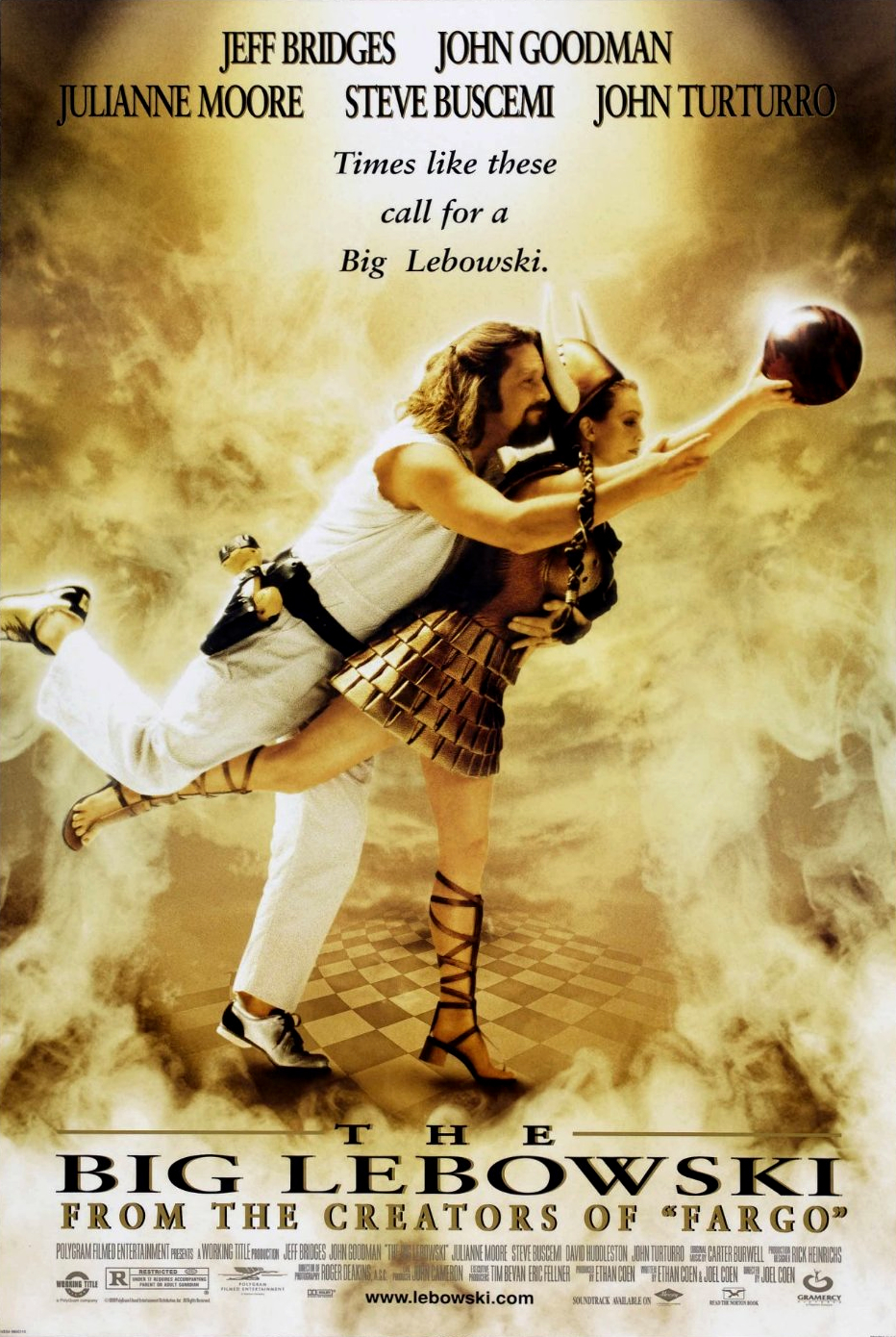
The Coen Brothers’ THE BIG LEBOWSKI starts with a brilliant idea: Why not take a blissed out former 1960s radical who loves his White Russians and his bowling with his two best mates and place him right smack dab in the heart of a labyrinthine plot straight from THE BIG SLEEP.

You might remember Howard Hawks’ 1946 classic, starring Humphrey Bogart and Lauren Bacall. That’s the one where writer Raymond Chandler famously said of the identity of the murderer of the Sternwoods’ chauffeur, “I don’t know.” Apparently, neither did Hawks or any of the various writers — William Faulkner, Leigh Brackett, Jules Furthman, and Phiip Epstein — involved with the screen adaptation of Chandler’s 1939 novel.

How does Jeffrey “The Dude” Lebowski react to such a convoluted plot?

I believe he explains it as such, “This is a very complicated case. You know, a lotta ins, lotta outs, lotta what-have-you’s. And, uh, lotta strands to keep in my head, man. Lotta strands in old Duder’s head. Luckily I’m adhering to a pretty strict, uh, drug regimen to keep my mind, you know, limber.”

Main characters “The Dude” and Walter Sobchack are known to be inspired by a couple Hollywood eccentrics: Jeff Dowd and John Milius.

Dowd was a member of the Seattle Liberation Front, a radical anti-Vietnam War protest group that became known as the Seattle Seven. Lebowski mentions this fact in THE BIG LEBOWSKI.

Dowd then became a producer’s representative, a consulting producer, creative consultant, post-production consultant, producer, and executive producer. Those are some of his credits.

Ethan and Joel Coen first met Dowd around the time of their feature debut BLOOD SIMPLE.

I remember coming across him in the writings of Roger Ebert, for example a story from the 1999 Toronto Film Festival called “Dude Keeps Building a Rep.”

It starts out with Dowd telling Ebert that he’s got to see a movie called GOAT ON FIRE & SMILING FISH. Ebert’s in the press office at the Toronto Film Festival, only out of his hotel room four minutes before Dowd could find the critic. Dowd hands Ebert two Xeroxed sheets stapled together promoting GOAT ON FIRE & SMILING FISH.

Ebert wrote, “The Dude’s name is Jeff Dowd. He is tall and large and has a lot of unruly curly hair and a big mustache. If you saw the Coen Brothers movie THE BIG LEBOWSKI, Jeff Bridges was playing a character based on him, although the Dude is a great deal more abstentious than the Bridges character. If he were not, the movie would have been called THE LATE LEBOWSKI. The Coens and Dowd go back a long way, to 1984, when he was telling me, ‘You gotta see this one. It’s called BLOOD SIMPLE. These are the Coen Brothers.’”

Dowd “repped” THE BLACK STALLION, CHARIOTS OF FIRE, HOOSIERS, THE STUNT MAN, and THE BLAIR WITCH PROJECT, just like he did GOAT ON FIRE & SMILING FISH.

Dowd to Ebert, “Just so people see them. I’d walk up and down the lines for hit movies, handing out brochures for what we were showing. The way I figure it is, who goes to movies? People who go to movies, that’s who. They may or may not read Premiere magazine. They may or may not watch TV. But they go to movies. So if Warner Bros. spends $40 million to promote a movie and they’re standing in line to see it, why not tell them about my movie?

“A lot of the movies, they’re not what they seem to be. You take THE BLACK STALLION. The studio said it would never appeal to children because the first 18 minutes were without dialogue. I hold a test screening. A little girl, 5 years old, is in front of me. She tells her mommy she has to pee. She gets up and stands on the aisle, still watching the screen, and she stands there for the next 10 minutes. Her knees are knocking together, she has to pee so bad, but she can’t stop watching. The whole history of THE BLACK STALLION was changed, right then and there.”

The St. Louis-born Milius’ writing credits include JEREMIAH JOHNSON, MAGNUM FORCE, APOCALYPSE NOW, 1941, and CLEAR AND PRESENT DANGER. He both wrote and directed THE WIND AND THE LION, BIG WEDNESDAY, CONAN THE BARBARIAN, and RED DAWN. He’s not directed anything since 1997.

Milius says that Hollywood blacklisted him for his conservative beliefs.

He’s the disreputable one of the Film Brat Generation, whose friends and colleagues include Steven Spielberg, George Lucas, Francis Ford Coppola, and Brian DePalma.

A 2017 Indie Film Hustle story comes with the tagline “John Milius: The Craziest Director in Hollywood?”

“He’s a really funny guy, a really good storyteller,” Ethan Coen said of Milius in a book on THE BIG LEBOWSKI. “He was never actually in the military, although he wears a lot of military paraphernalia. He’s a gun enthusiast and survivalist type. Whenever we saw him, he’d invite us out to his house to look at his guns — although we never took him up on it.”

You can hear Milius’ storytelling abilities on commentaries for APOCALYPSE NOW, 1941, and CONAN THE BARBARIAN, for example.

Milius contributed Robert Shaw’s famous U.S.S. Indianapolis speech in JAWS (uncredited), some of Dirty Harry’s best lines, and all that stuff about surfing in APOCALYPSE NOW.

It helps that John Goodman, like Milius, is a native of the St. Louis area.

Bridges and Goodman have been two of the best actors working in the movies.

They’re probably as close to a guarantee of quality as anybody you can name.

“The Dude” and Walter are likely the characters they will be most associated with all their lives.

There’s lots of inspired madness throughout THE BIG LEBOWSKI.

Like the trippy production number called “Gutterballs,” combining bowling and Busby Berkeley, all scored by Kenny Rogers and the New Edition’s “Just Dropped In (To See What Condition My Condition Was In),” Rogers’ first Top 10 hit.

Like the German nihilists who have a band and album that are parodies of / homages to Kraftwerk, with the band name Autobahn and the album cover that’s similar to THE MAN-MACHINE.

Like utilizing gems like Bob Dylan’s “The Man in Me” and Captain Beefheart’s “Her Eyes Are A Blue Million Miles.”

Like Mr. Lebowski’s rant about the Eagles. Reportedly, Allen Klein (1931-2009) wanted $150,000 for usage of the Rolling Stones’ “Dead Flowers,” but he waived that licensing fee because he so loved the scene where “The Dude” hates on the Eagles. You’re not the only one, Mr. Klein.

THE BIG LEBOWSKI joins TWILIGHT ZONE: THE MOVIE and AN AMERICAN WEREWOLF IN LONDON for some of the best utilization of Creedence Clearwater Revival in a moving picture.

Coupled with BOOGIE NIGHTS (1997), THE BIG LEBOWSKI helped start my love affair with Julianne Moore, which continued over many, many years in everything from THE END OF THE AFFAIR to CHLOE.

Character actors Steve Buscemi, John Turturro, Ben Gazzara, David Huddleston, and Philip Seymour Hoffman all lend their abilities to the menagerie.

Never mind Sam Elliott’s voiceover narration.

I vividly remember coming across THE BIG LEBOWSKI when it came on Showtime in the late 1990s. I played the VHS dub I had for several friends and it became one of our favorite movies.

I’ve seen it many, many, many times over the years. It’s my favorite Coen Brothers movie, certainly far ahead of the overrated FARGO and NO COUNTRY FOR OLD MEN.

An old friend would seemingly only want to play THE BIG LEBOWSKI, FEAR AND LOATHING IN LAS VEGAS, and THE CROW, although he would also play the hell out of CITY LIGHTS, BLADE RUNNER, and SOME LIKE IT HOT as well, for that matter.

It’s been a while since I’ve watched it and I just might have to change that very, very soon.