The Wizard of Oz (1939)

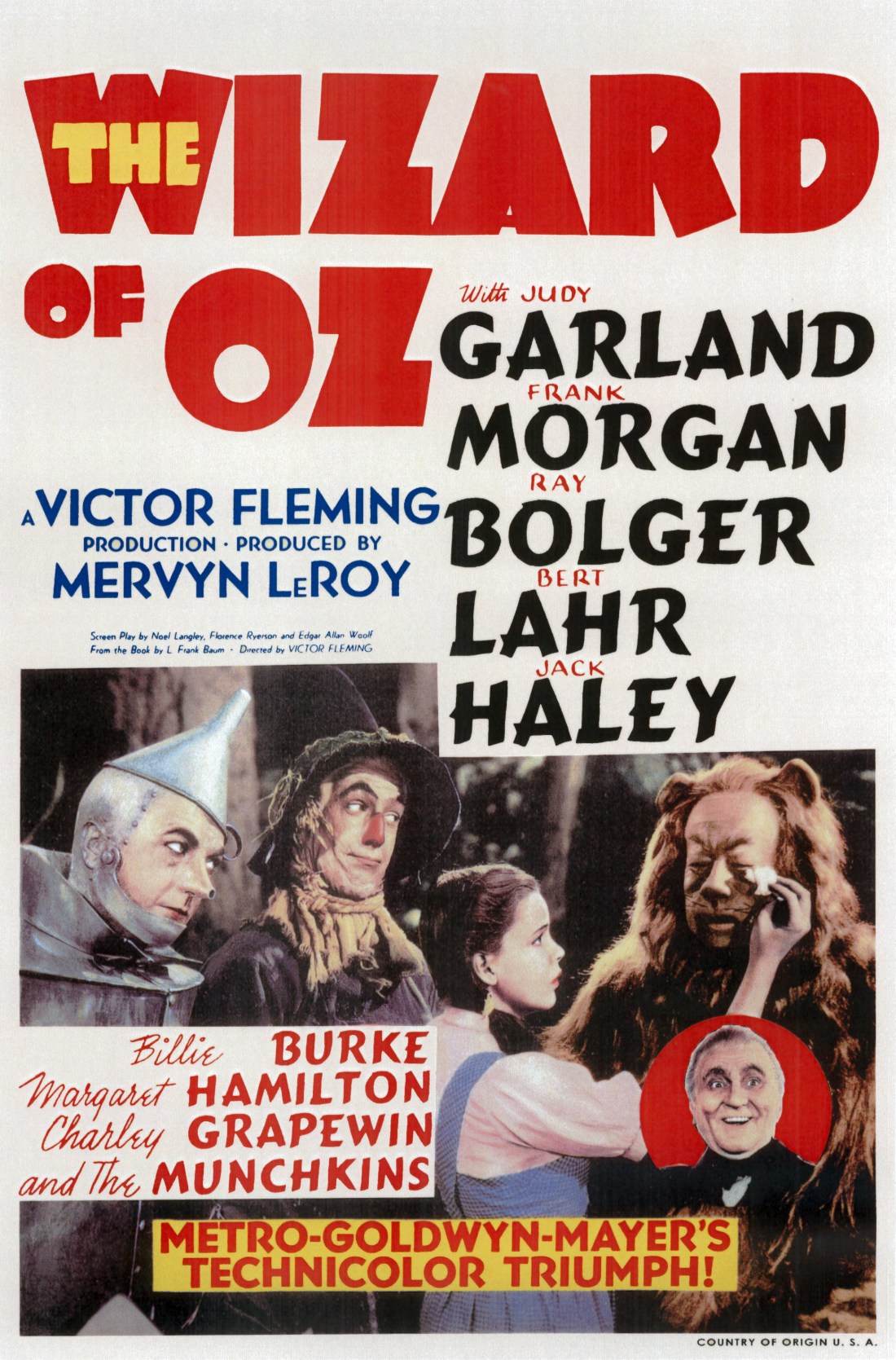
THE WIZARD OF OZ

THE WIZARD OF OZ (1939) Four stars

I watched THE WIZARD OF OZ for the first time since my Grandma died and the experience naturally brought on a lot of precious memories.

After all, I watched THE WIZARD OF OZ for the first (and second and third …) time at my Grandma’s house. She loved the movie and every now and then, she also talked about how many times she went to the movies to watch GONE WITH THE WIND. It was several, and I can remember hearing the delight in her voice just talking about it. She turned 10 years old in 1939, one of Hollywood’s hallowed years with MGM productions THE WIZARD OF OZ and GONE WITH THE WIND headlining. GONE WITH THE WIND was the TITANIC of its day, but a 4-hour historical soap opera did not enter my priority list until college. I watched THE WIZARD OF OZ a good dozen times before I got through GONE WITH THE WIND even once.

It was the CBS broadcast of THE WIZARD OF OZ that we watched together and the first time I can remember it I must have been 8 years old. Like IT’S A WONDERFUL LIFE, THE WIZARD OF OZ became an annual TV event for generations of Americans. I first watched IT’S A WONDERFUL LIFE at my Grandma’s house and it assumed the position of a holiday tradition for many years. I want to say that IT’S A WONDERFUL LIFE played on the local NBC affiliate.

Seeing THE WIZARD OF OZ for the 20th or 30th or 40th or 50th time (I lost track) in my life before this review, I found myself singing the songs, yes, every single line of every single darn song, but the most pleasure I experienced came from imitating the Wicked Witch of the West (Margaret Hamilton). I mean, I doubt that anybody who’s ever watched THE WIZARD OF OZ can resist imitating her voice on the all-time classic line “I’ll get you, my little pretty, and your little dog, too.” Hamilton virtually steals the movie and she’s so much more fun than that darn Glinda the Good Witch (Billie Burke), whose goodness decreases over time.

The Wicked Witch finished in fourth place on the American Film Institute’s top 50 villains list (2003), behind Hannibal Lecter, Norman Bates, and Darth Vader and ahead of Nurse Ratched, Mr. Potter, Alex Forrest, Phyllis Dietrichson, Regan MacNeil (when possessed), and the Evil Queen in the top 10.

Ironically enough, Hamilton served as a school teacher before her acting career. She became known for terrifying children … but she retained a lifelong commitment to education.

I wish I could have met Hamilton (1902-85).

“Almost always they want me to laugh like the Witch,” she said. “And sometimes when I go to schools, if we’re in an auditorium, I’ll do it. And there’s always a funny reaction, like they wish they hadn’t asked. They’re scared. They’re really scared for a second. Even adolescents. I guess for a minute they get the feeling they got when they watched the picture. They like to hear it but they don’t like to hear it. And then they go, ‘Oh…’ The picture made a terrible impression of some kind on them, sometimes a ghastly impression, but most of them got over it, I guess. … Because when I talk like the Witch and when I laugh, there is a hesitation, and then they clap. They’re clapping at hearing the sound again.”

THE WIZARD OF OZ served as many people’s introduction to scary movies. (Throw in classic Disney films SNOW WHITE and PINOCCHIO, as well, both of which I remember first watching during roughly the same period as when I first watched THE WIZARD OF OZ.)

Not only the Wicked Witch, but also somebody wanting to take your pet away, running away from home, a tornado, them flying monkeys, et cetera, they’re all terrifying, especially to a small child watching it for the first time. (Please consider the film left out the most gruesome details from the L. Frank Baum source material.)

THE WIZARD OF OZ shows us how much fun it can be to be scared.

That’s just one way the film reaches us.

Hamilton herself talked about its seemingly everlasting appeal.

“THE WIZARD OF OZ keeps coming back every year,” she said, “because it’s such a beautiful film. I don’t think any of us knew how lovely it was at first. But, after a while, we all began to feel it coming together and knew we had something. I can watch it again and again and remember wonderful Judy, Bert, Ray, Jack, Billie, Frank and how wonderful they all were. The scene that always gets to me, though, and I think it’s one of the most appealing scenes I’ve ever seen, is the one where the Wizard gives the gifts to them at the end. Frank (Morgan) was just like that as a person. And every time I see him do it, the tears come to my eyes. I listen to the words. I think of Frank, and I know how much he meant what he said, and how much the words themselves mean.”

I devoted much space to Hamilton and the Wicked Witch, but there are at least six more beloved characters and performers: Dorothy Gale (Judy Garland, 1922-69), the Scarecrow (Ray Bolger, 1904-87), the Tin Man (Jack Haley, 1898-1979), the Cowardly Lion (Bert Lahr, 1895-1967), Toto (Terry, 1933-45), and the Wizard (Frank Morgan, 1890-1949). They go a long way toward making THE WIZARD OF OZ a classic that will persevere down the ages.

On this latest go-around, I again noticed how much of an influence WIZARD OF OZ had on George Lucas when he made STAR WARS.

THE WIZARD OF OZ grabs us early on, precisely at the moment when Garland begins singing “Over the Rainbow,” and it just builds and builds for the next 90-odd minutes.

Eighty years after it premiered (Aug. 25, 1939), I now have one more reason to watch it moving forward. Grandma, it felt like you were right there with me.

House (1977)

HOUSE

HOUSE (1977) Four stars

The year 1977 produced four of the definitive WTF movies in the history of cinema: ERASERHEAD, SUSPIRIA, EXORCIST II, and HOUSE, an item from the Japanese studio (Toho) responsible for Akira Kurosawa, Godzilla, Mothra, Rodan, and the H-Man.

Toho really outdid itself with HOUSE, which even surpasses GODZILLA VS. THE SMOG MONSTER in nonstop funky weirdness. Janus Films describes HOUSE as an episode of “Scooby Doo” directed by Dario Argento.

Bottom line: HOUSE just might be even weirder than ERASERHEAD, more colorful than SUSPIRIA, and more whacked out bat shit crazy than EXORCIST II. You have been warned.

First-time director Nobuhiko Obayashi pulls out all the stops in realizing a rather simple tale on the surface: teenage girl Gorgeous (Kimiko Ikegami) and her six friends Prof (Ai Matsubara), Melody (Eriko Tanaka), Mac (Mieko Sato), Kung Fu (Miki Jinbo), Sweet (Masayo Miyako), and Fantasy (Kumiko Oba) pay Gorgeous’ aunt (Yoko Minamida) in the country a visit. It just so happens that the aunt died in this house many years ago waiting on her fiancee to return from World War II and her spirit remains and feasts on unmarried girls. This is a haunted house movie where the house is hungry, very hungry indeed.

Obayashi’s at-the-time pre-teen daughter Chigumi Obayashi contributed ideas to her father. She came up with several childhood fears, her father relayed the fears to screenwriter Chiho Katsura, and they incorporated her ideas into the finished product. You’ll be able to recognize her contributions almost instantly and they contribute to the uniqueness.

Just as a fun exercise, I looked up the plot keywords for HOUSE on IMDb: “refrigerator,” “banana,” “watermelon,” “bloody spray,” “dismemberment,” “decapitation,” “full frontal nudity,” and “severed head” are some of the more interesting 75 keywords and they only scratch at the surface of the overall bizarre nature of the entire enterprise.

More than 30 years after its original release, HOUSE seemingly came from out of nowhere to develop a cult following in the United States, playing first as a midnight movie in Nashville and then at a film festival in Austin in 2009 before heading to DVD.

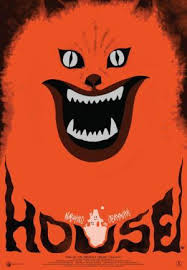
I first encountered HOUSE through its cover image for the Criterion Collection release on October 26, 2010. Maybe you remember seeing that artwork, as well. Nashville graphic designer and Ben Folds drummer Sam Smith came up with the distinctive image: “I used the first idea that came to me after watching a screener of the film — Blanche the cat’s psycho-screaming mug — and adapted it to stand alone as a symbol of the uncanny and over-the-top assault that our midnight-movie audience was in for,” Smith said. The poster first appeared for the film at the Belcourt Theatre in Smith’s hometown.

Then, I read the reviews for HOUSE and they’re nearly as over-the-top as the film itself.

Online reviewer Dennis Schwartz wrapped up his mixed review, “The director uses freeze-frames, jump-cuts, video effects to change dimensions, spiral effects, color tints, and assorted other techie tricks to play the scary pic card more for laughs than to be gruesome. It’s an experimental visual pic that becomes overwhelmed with low-brow slapstick comedy, a ridiculous killer house and garish visuals. But it’s a one-of-a-kind film that has its admirers, who just can’t resist such weird childish nonsense.”

Michael Atkinson opined in the Village Voice, “But though it plays like a retarded hybrid of ROCKY HORROR and WHISPERING CORRIDORS, it is, moment to moment, its own kind of movie hijinks. It even won a directorial-debut critics’ prize back in the day. Gigglers and cultists, pony up.”

I watched James Rolfe’s review for Monster Madness X from 2016. Rolfe started his review with a pause and a WOW! Of course, Rolfe picked HOUSE for one of the “WTF Wednesday” reviews.

I finally caught up with HOUSE in late summer 2019 and it lived up to expectations. It calls to mind a few pictures: EVIL DEAD II, THE SPIRIT OF THE BEEHIVE, THE 5,000 FINGERS OF DR. T, DAISIES, SUSPIRIA, and MY NEIGHBOR TOTORO. Like those films, though, HOUSE ultimately stands alone as an unique work because it creates its own world. I find that I respond more forcefully to fictional works that do that, rather than just rehash more of the same old already damaged goods. I want to be challenged, inspired, etc. I’ve never seen a haunted house movie quite like HOUSE.

HOUSE haunts one’s thoughts and gains in strength upon deeper reflection. At this moment of typing, I am thinking about Gorgeous’ aunt and how much time she spent waiting alone in that house for the love of her life to return from World War II. He never did, and they both died, she in that darn house and she’s cursed to haunt it for eternity because of her bitterness about the war. Then, I start thinking about the sheer enormity of the loss endured by the human race from Sept. 1, 1939 through Sept. 2, 1945: An estimated 70-85 million people died or three percent of the world’s population in 1940; 50-55 million civilians and 21-25 million soldiers no longer lived on this planet from a variety of causes, death on a mass scale that doubled World War I; the atomic bomb and the Holocaust two of humanity’s depressing advancements in death.

Obayashi was born in Hiroshima in 1938 and he lost all his childhood friends when the United States dropped an atomic bomb on Hiroshima on Aug. 6, 1945. Hiroshima and Nagasaki, as well as post-WWII nuclear testing, inform many Japanese films of the last almost 75 years.

The Blair Witch Project (1999)


THE BLAIR WITCH PROJECT (1999) Four stars

I occasionally find myself looking back fondly on all the multiplex experiences I had during 1999 and 2000.

Please bear with me as I rattle off the titles: THE PHANTOM MENACE, SOUTH PARK BLU, SLEEPY HOLLOW, AMERICAN BEAUTY, GLADIATOR, THE PATRIOT, THE LEGEND OF DRUNKEN MASTER, and CROUCHING TIGER, HIDDEN DRAGON. Just for variety and to balance the bad with the good, there was also DRACULA 2000, THE LADIES MAN, ROMEO MUST DIE, and THE SKULLS. There’s even one more.

I shall never forget when I watched THE BLAIR WITCH PROJECT on the first night it played at the Pittsburg 8.

This was a major event for my generation (let’s say those of us born from 1965 through 1981), because the BLAIR WITCH hype was inescapable that summer and fall in 1999 and the seemingly inevitable backlash proved even stronger and more lasting. For at least a couple years, you just had to watch THE BLAIR WITCH PROJECT and form your own strong opinion. You either loved or hated THE BLAIR WITCH PROJECT with no middle ground whatsoever and everybody felt like expressing their opinion about it, something that cannot be said for the average movie. Nowadays, though, how many people give this 20-year-old movie the time of day.

Anyway, I myself walked into the late show that night stoked, not only because of the insane buzz around the film but also because of the four-star review written by Roger Ebert that I read when the film opened July 16. “At a time when digital techniques can show us almost anything, THE BLAIR WITCH PROJECT is a reminder that what really scares us is the stuff we can’t see. The noise in the dark is almost always scarier than what makes the noise in the dark. Any kid can tell you that. Not that he believes it at the time” finishes off Ebert’s review. BLAIR WITCH later rounded out Ebert’s list of the 10 most influential films of the 20th Century.

Of course, leading up to whenever we first watched it, we heard all the noise about THE BLAIR WITCH PROJECT being the “scariest movie ever made.” How many times have we heard that about the latest horror movie and then found it out to be a lie, a hype, a con?

Sitting down in the Pittsburg 8 that night, though, we knew that we were in for a treat, a transcendent experience. THE BLAIR WITCH PROJECT, whether you love it or hate it, delivered.

I have never seen a movie in a theater setting before or after create such an intense reaction. As the end credits rolled, members of the packed house cheered and booed. I remember more people cheering, but the boos were both louder and longer. Debates broke out across the theater as we slowly exited. I loved the film and defended it in the midst of some intense hostility from individuals who felt they had been cheated. They expected something different than what they got from THE BLAIR WITCH PROJECT. And hated main protagonist Heather Donahue and found her incredibly annoying. And hated hated hated that darn ending. I started thinking even more positively about the film after each hate-filled editorial I heard.

A strange thing happened in the first couple years after THE BLAIR WITCH PROJECT: I encountered several people who enjoyed the sequel BOOK OF SHADOWS more than the original. It was here that I developed a little theory: People who hated THE BLAIR WITCH PROJECT but liked or even loved BOOK OF SHADOWS wanted a more traditional horror movie or at least one more beholden to the conventions of the late 20th Century horror movie. Meanwhile, people who loved THE BLAIR WITCH PROJECT loved it partly because it broke away from the conventions of contemporary horror movies. It was not SCREAM, not I KNOW WHAT YOU DID LAST SUMMER, not URBAN LEGENDS, et cetera, populated by late 20th Century pretty boy or hip actors and lovely actresses with that nudge-nudge wink-wink we’re so contemporary and hip tone. I know I dig BLAIR WITCH mostly because it is different from the horror movies of its time and belongs to another tradition. At the time, most of us had probably never seen a found footage movie before, although everybody who believed the whole “true story” bit should have known better. I mean, come on, after THE TEXAS CHAINSAW MASSACRE and FARGO, you fell for that jive?

THE BLAIR WITCH PROJECT set itself up perfectly for a backlash of epic proportions. We already mentioned anything touted as “the scariest movie ever made” will create large numbers of viewers laughing and scoffing at such a ridiculous claim. The film made nearly $250 million on a $60,000 budget … with the help of a groundbreaking marketing plan that ultimately backfired, at least in terms of perception of the film itself.

Here’s the third paragraph of a story by MWP Digital Media, “So perhaps you’d be surprised to learn the most successful viral marketing campaign of all time took place before social media existed. Even before mainstream use of the Internet. The most successful viral marketing campaign of all time centred on a small, low-budget indie flick in 1999 called THE BLAIR WITCH PROJECT.” Just thinking about it even now, yeah, it’s crazy to conceive of a frenzied audience in small college town Pittsburg, Kansas, for a low-budget horror movie with no-name performers.

The filmmakers decided to use a website to promote their little movie, not just any website though since this one creates an entire world treating THE BLAIR WITCH PROJECT like it really happened rather than it being a fictional work. More than 20 years later, we can still check out blairwitch.com/project. We’re greeted with a familiar title card upon visiting the site, “In October of 1994, three student filmmakers disappeared in the woods near Burkittsville, Maryland while shooting a documentary. A year later their footage was found.”

There’s “Mythology,” a timeline of major events in the history of the Blair Witch: February 1785, November 1786, November 1809, 182, August 1825, March 1886, November 1940-May 1941, and several dates from October 1994-October 1997. The front page of “Mythology” ends on this note, “The found footage of their children’s last days is turned over to the families of Heather Donahue, Joshua Leonard, and Michael Williams. Angie Donahue contracts Haxan Films to examine the footage and piece together the events of October 20-28, 1994.”

We can see a picture of “Montgomery College film students Michael Williams, Joshua Leonard, and Heather Donahue less than a week before their disappearance” and several stills from their documentary.

The “Aftermath” section includes evidence, search, interviews, and news. Evidence includes crime scene photos from the Frederick County Sheriff’s Office and anthropology professor David Mercer describing how there is no scientific explanation for a certain event. Search provides a MISSING poster for Donahue, Leonard, and Williams with their photos, measurements, and features; “Last seen camping in the Black Hills Forrest area, near Burkittsville.” If you look closely, you can see the famous 555 extension listed for the Frederick County Sheriff’s Office. Interviews are clips featuring such figures as Sheriff Ron Cravens and search party members. News offers clips from coverage by Channel 11 and Channel 6.

“The Legacy” takes in discovered footage, audio, and Heather’s journal, which was found buried beneath a 100-year-old cabin in the woods. Her journal amounted to 37 pages; from Page 21, “It is freezing and we are still out here. We’re completely fucking lost now, we’ve decided basically to just keep heading south, but it doesn’t seem to be getting us anywhere fast and weird shit keeps happening which is, to be totally honest, sitting here with gloves and sweaters in a cold tent in the middle of nowhere and the guys asleep – beginning to scare me. I’m hungry. I’m cold. I want to see what we shot. We didn’t light a campfire tonight because we wanted to lay low. Not that there’s anything left to cook on it anyway. I feel like we are bound to cross a road of something soon, it’s not like Maryland has wilds that go on forever or some shit. We have got to get out of here. As much as I would like…”

Personally, I appreciate that THE BLAIR WITCH PROJECT deals in myths and legends and makes a valiant effort to create its own timeless story. It belongs most to a tradition of American storytelling that started with Washington Irving (1783-1859), namely his 1820 work “The Legend of Sleepy Hollow.” This tradition also involves more local stories, like, for example, haunted McCray Hall at Pittsburg State; “Sightings of a lady in a black dress. The Pipe organ is heard playing at night. Sudden temperature variations. Strange movements from corners of eyes” highlights the listing on “Dark Kansas.” BLAIR WITCH remembers the power of imagination.

Daniel Myrick and Eduardo Sanchez, BLAIR WITCH directors, talked about the genesis for their movie in Little White Lies, “We came up with the basic premise for what eventually became THE BLAIR WITCH PROJECT back in the early ‘90s. We were studying at the University of Central Florida at the time, and like most college students we didn’t have any money. … One day we got to talking about this show called “In Search of…,” which Leonard Nimoy hosted in the ‘70s. We started thinking about all these pseudo-documentaries like THE LEGEND OF BOGGY CREEK, IN SEARCH OF NOAH’S ARK, CHARIOTS OF THE GODS, exploratory, investigative films linked to paranormal encounters, and how they really freaked us out as kids. So we rented a bunch of those movies and we were surprised how much they still freaked us out. …

“We shot [BLAIR WITCH] in two sections: Phase One, which is everything in the woods, and then Phase Two, which ended up being used for the “Curse of the Blair Witch” TV documentary. The Phase One stuff was shot over about eight pretty intensive days. It was a continuous shoot, where the actors were the cameramen and all the dialogue was improvised.”

Lead performer Donahue took a great deal of the backlash against BLAIR WITCH, as she was the most publicly visible; she won Worst Actress from the Golden Raspberry Awards, for example, beating out Melanie Griffith in CRAZY IN ALABAMA, Milla Jovovich in THE MESSENGER: THE STORY OF JOAN OF ARC, Sharon Stone in GLORIA, and Catherine Zeta-Jones in ENTRAPMENT and THE HAUNTING. Her acting career persisted until 2008, for example she appeared in the billion times worse than BLAIR WITCH romantic comedy BOYS AND GIRLS, and she left the profession to grow medical marijuana. She then became an author and delivered the 2012 memoir “Growgirl: How My Life After the Blair Witch Project Went to Pot.”

Two movies from 1999 became parodied to what seemed like no end at the time, THE MATRIX and BLAIR WITCH. This endless parodying did not help either film. I especially got beyond exasperated at MATRIX parodies. Anybody who lived during that era knows which two scenes that we’re talking about without even mentioning them. Just say THE MATRIX and BLAIR WITCH, and we can bet they’re the first scenes that come to mind.

Myrick and Sanchez filmed apology scenes for both Donahue and Williams, and decided upon Donahue for the finished product because she had the most reason to apologize. Reactions to her apology are the most extreme in a film that creates extreme reactions. Ebert said that it reminded him of explorer Robert Scott’s notebook entries as he froze to death in the Terra Nova expedition (1910-13). Others have laughed at it like it was the funniest thing they have ever seen.

Leonard and Williams have both maintained acting careers, Leonard being far more busy. BLAIR WITCH marked the feature debuts for Donahue, Leonard, and Williams and I like them all because they have an everyman appeal not typically found in horror movies of the late 90s and early 00s.

The promotion for BLAIR WITCH proved so effective that Donahue’s mother even received sympathy cards from people who believed that her daughter was either dead or missing. Sanchez’s experience in web design proved to be a godsend. It was probably just some elective that he barely thought about at the time he took it.

Frenzy (1972)

FRENZY

FRENZY (1972) Four stars
Legendary director Alfred Hitchcock (1899-1980) used the theme of the falsely accused several times: THE LODGER (1929), MURDER! (1930), THE 39 STEPS (1935), YOUNG AND INNOCENT (1937), THE TROUBLE WITH HARRY (1955), THE WRONG MAN (1956), NORTH BY NORTHWEST (1959), and, for the last time, FRENZY.

FRENZY, Hitchcock’s penultimate film in a 53-film career that lasted from silent through sound, found Hitchcock returning to not only one of his favorite themes but also to his native land of England for the third and final time since his exodus to Hollywood that began in 1940 with REBECCA, Hitchcock’s only Academy Award for Best Picture winner.

I have not seen every one of Hitchcock’s falsely accused movies (MURDER! and THE TROUBLE WITH HARRY have eluded me thus far in life), but I believe it is safe to say that Richard Ian “Dick” Blaney (Jon Finch) in FRENZY presents us with the Hitchcock falsely accused protagonist with the greatest odds against him in proving his innocence during the movie. Blaney’s not an inherently likeable character, he’s not played by a big charismatic movie star like Henry Fonda or Cary Grant, so it does take some time for this Blaney to grow on us. We have all had stretches in our lives where we’ve been down on our luck and it seems everything’s against us. Blaney has it even worse.

We viewers know Blaney’s not the killer. That’s because we are shown the true identity of “The Necktie Killer,” a serial killer and rapist terrorizing London town, early on in the picture, Blaney’s friend Bob (Barry Foster). Blaney definitely seems like the most obvious suspect as the circumstantial evidence piles up against him, with a little help from his old friend Bob. We root for Blaney to prove his innocence and for Bob to be caught because this “Necktie Killer” is one of the nastiest pieces of work that we have ever seen on a movie screen.

FRENZY takes it down to the very end of the movie before playing its final hand. The film is a reminder why Hitchcock is still called “The Master of Suspense” decades after his death.

Where did the themes of the falsely accused and fear of the police come from in Hitchcock? A childhood experience, of course.

One day, Hitchcock’s father decided upon an unique punishment for the troublesome young lad. You can just imagine how much of a devious little brat Hitchcock was as a child.

“I must have been about 4 or 5 years old,” Hitchcock told Francois Truffaut in 1966. “My father sent me to the police station with a note. The chief of police read it and locked me in a cell for five or 10 minutes, saying, ‘This is what we do to naughty boys.’”

Truffaut followed up with the question why did Hitchcock’s father punish him.

“I haven’t the faintest idea,” Hitchcock said. “As a matter of fact, my father used to call me his ‘little lamb without a spot.’ I truly cannot imagine what it was I did.”

Hitchcock was in his early 70s when he made FRENZY, and it’s not a work that one would necessarily associate with an older man. It pulsates with a certain anger, especially through the down-on-his-luck protagonist, and that’s a state associated with younger men.

There’s a rape and murder sequence in FRENZY that’s even more unsettling than anything in PSYCHO, since it goes on far longer than any of the murders in PSYCHO.

Anthony Shaffer’s screenplay also expresses a tremendously morbid sense of humor that befits Hitchcock. For example, a doctor in a pub says, “We haven’t had a good juicy series of sex murders since Christie. And they’re so good for the tourist trade. Foreigners somehow expect the squares of London to be fog-wreathed, full of hansom cabs and *littered* with ripped whores, don’t you think?”

In the midst of all this murder and mayhem, we get an unique relationship between Chief Inspector Tim Oxford (Alec McCowan) and his wife (Vivien Merchant) that’s both funny and touching. Mrs. Oxford serves her husband a variety of culinary delights and then dishes up her own take on the case of “The Necktie Killer” and these Blaney and Bob characters.

FRENZY is a powerful work by a grand master, one of many great films by Hitchcock.

Young Frankenstein (1974)

YOUNG FRANKENSTEIN

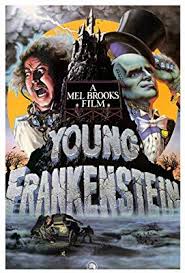
YOUNG FRANKENSTEIN (1974) Four stars

Over a 20-year period from the late ‘60s to the late ’80s, Mel Brooks directed a series of inspired comedies: THE PRODUCERS, THE TWELVE CHAIRS, BLAZING SADDLES, YOUNG FRANKENSTEIN, SILENT MOVIE, HIGH ANXIETY, HISTORY OF THE WORLD PART I, and SPACEBALLS.

I’ll choose YOUNG FRANKENSTEIN as his best (i.e. my favorite) work.

It’s not his funniest work, per se, but you could put it on a DVD following FRANKENSTEIN, BRIDE OF FRANKENSTEIN, SON OF FRANKENSTEIN, and THE GHOST OF FRANKENSTEIN and it would be perfect. In fact, YOUNG FRANKENSTEIN nearly gives you the feeling that it’s a lost classic from Universal Studios during their reign of terror.

Brooks and co-writer and star Gene Wilder obviously loved Universal classics like FRANKENSTEIN. Brooks’ last feature film, DRACULA: DEAD AND LOVING IT, came in 1995, so Brooks took on Universal’s two most legendary monsters.

We can be sure the big boys at 20th Century Fox did not want YOUNG FRANKENSTEIN made in black & white. Some folks are guaranteed to say, “Black & white will never work again,” but what about every time it has worked over the years.

Wilder and Brooks based their characters on Mary Wollstonecraft Shelley’s original classic novel. They might as well have credited the screenwriters for the old Universal FRANKENSTEIN pictures.

All the technical people deserve their fair share of the credit for YOUNG FRANKENSTEIN: John Morris’ musical score, Gerald Hirschfeld’s cinematography, John C. Howard’s editing, Dale Hennesy’s production design, Robert De Vestel’s set decoration, Dorothy Jeakins’ costume design, and Edwin Butterworth’s, Mary Keats’, and William Tuttle’s work in the makeup department.

YOUNG FRANKENSTEIN benefits from using some of the same sets the original FRANKENSTEIN used.

Beyond the overall look and style of the picture, though, both the performances and the jokes are their usual grab bag that’s found in a Mel Brooks film.

Wilder’s obits called him “A Master of Hysteria” and he gave some of his defining performances in Mel Brooks comedies, namely THE PRODUCERS, BLAZING SADDLES, and YOUNG FRANKENSTEIN. There’s even the legendary “I’m hysterical and I’m wet” scene in THE PRODUCERS. Honestly, though, I prefer Wilder when he’s more calmer, more restrained and that patented hysteria did not work as well in his later pictures.

Wilder’s hysteria fits Dr. Frederick Frankenstein, the grandson of Victor Frankenstein, because British actor Colin Clive (1900-37) specialized in a bit of hysteria in FRANKENSTEIN and BRIDE OF FRANKENSTEIN.

Brooks himself does not appear as a main character in YOUNG FRANKENSTEIN, which differentiates it from later Brooks productions like SILENT MOVIE, HIGH ANXIETY, and HISTORY OF THE WORLD PART I.

Marty Feldman (1934-82) was perfect for the role of Igor (pronounced “EYE-gore”), Frankenstein’s hunchback compadre. Madeline Kahn (1942-99), Cloris Leachman, and Teri Garr insure that it’s not all about the boys — Kahn eventually makes a perfect bride for The Monster after being engaged to Frankenstein, Leachman plays a character and a name (Frau Blucher) loved by horses, and Garr’s cleavage deserves its own screen credit. Kenneth Mars’ police inspector Hans Wilhelm Friedrich Kemp calls to mind Dr. Strangelove in addition to his FRANKENSTEIN precursors. Gene Hackman makes a cameo as the blind hermit who befriends The Monster.

That brings us to The Monster, played by the great character actor Peter Boyle (1935-2006). I’ll make a case for Boyle being the second best actor to play The Monster, behind only the immortal Boris Karloff (1887-1969) who initiated the role. Boyle definitely gives a better performance than his TAXI DRIVER co-star Robert DeNiro did as “The Creation” in Kenneth Branagh’s MARY SHELLEY’S FRANKENSTEIN (1994). Of course, Boyle is the only Monster required to perform a soft-shoe number and he enjoys a domestic life.

Brooks practiced “saturation comedy,” a style where the jokes fly past fast and furious. It’s been said to not worry if you missed one joke because another one will be coming any moment. Brooks’ comedies are not quite as saturated as the works of the Zucker Brothers and Jim Abrahams during AIRPLANE!, TOP SECRET!, and THE NAKED GUN, which have jokes in virtually every inch of the frame. Saturation comedies are special because they believe in the intelligence of the audience, that we’re smart enough to get the jokes.

I’ll say that my favorite moment in YOUNG FRANKENSTEIN involves a revolving bookcase.

Re-Animator (1985)

RE-ANIMATOR

RE-ANIMATOR (1985) Four stars

Watching director Stuart Gordon’s feature debut for the first time in a theater and the first time in a couple years, I became impressed all over again by a horror movie that’s so gory and gross that it crosses over from gory and gross into surreal and comical.

DAWN OF THE DEAD (1978) and EVIL DEAD II (1987) are two more examples.

I also became impressed once again by the performances of Jeffrey Combs as Herbert West and the late David Gale as Dr. Carl Hill. Their work helps elevate RE-ANIMATOR.

I absolutely love Combs’ performance in RE-ANIMATOR. West’s a mad scientist pushed to the absolute limit of madness, but he’s not the least bit campy. He’s intense and 1,000 percent committed to his life’s work. West never waivers from this intensity, not even in the face of death or being kicked out of medical school. Mr. West has developed a reagent that can re-animate dead bodies, and his experiments graduate from a house cat to humans. West will see it through.

The poster’s tagline: “Herbert West has a good head on his shoulders … and another one on his desk.”

That another one belongs to Dr. Hill, whose ego and libido are epic and legendary.

Gale (1936-91) plays Dr. Hill in sleaze mode. This is a character that you absolutely love to hate. You want to see him bashed over the head with that shovel, but you also enjoy when his disembodied head takes command over the rest of his body and then takes control of the situation against West and his reluctant partner Dan Cain (Bruce Abbott). West hates Dr. Hill from the get-go and it’s fun to watch their mutual hatred for each other develop over RE-ANIMATOR.

Dr. Hill lusts after both Cain’s fiancee Megan (Barbara Crampton) and West’s reagent, and his intense lusting only makes this character even more hatable.

Crampton plays a tougher role than any of the boys: She gasps and screams a lot, understandably so, and she’s naked a couple times, including for one of the most interesting sex scenes around since it alternates between disturbing and comical. Let’s just say the disembodied head of Dr. Hill attempts to carry out his depraved sexual fantasies.

RE-ANIMATOR follows Mr. West and Dr. Hill into some ripped, twisted territory, but it’s also delightfully funny.

In a review of AN AMERICAN WEREWOLF IN LONDON, I rattled off a bunch of titles from the 80s that effectively balanced horror and comedy: EVIL DEAD II, FRIGHT NIGHT, GREMLINS, GHOSTBUSTERS, KILLER KLOWNS FROM OUTER SPACE, and, yes, of course, RE-ANIMATOR.

Those films carry on the proud tradition of the great 1930s horror films that successfully integrated comedy into horror, without one sacrificing the other. You can laugh one moment and be frightened the next, or delighted that next moment, all legitimate reactions.

Guess it’s the highest praise for RE-ANIMATOR when you say that it could have been directed by James Whale (1889-1957), who brought us FRANKENSTEIN, THE OLD DARK HOUSE, THE INVISIBLE MAN, and BRIDE OF FRANKENSTEIN.

The Blob (1958)

THE BLOB 2

THE BLOB (1958) Four stars

Watching the original BLOB just the other day, once again it hit me how much THE BLOB seems to be influenced by the 1955 classic REBEL WITHOUT A CAUSE.

THE BLOB leads Steven McQueen and Aneta Corseaut respectively call to mind James Dean and Natalie Wood (McQueen even a few years older than Dean playing a high schooler), there’s a more friendly policeman in both films (Ray in REBEL WITHOUT A CAUSE, Dave in THE BLOB), and they both are iconographic time capsule films that appeal to all generations.

Plain and simple, THE BLOB is a goofy, ridiculously fun time at the movies.

It sets the tone with that glorious theme song over the opening credits — “Theme from the Blob” by the Five Blobs and it’s a real catchy little ditty written by Burt Bacharach and Mack David. It sure beats “Raindrops Keep Falling on My Head.”

“Beware of the Blob, it creeps

And leaps and glides and slides

Across the floor

Right through the door

And all around the wall

A splotch, a blotch

Be careful of the Blob.”

What’s the Blob? A modified weather balloon in early shots and colored silicone gel in later shots. From outer space.

It’s also been compared to cherry Jell-O.

THE BLOB was inspired by a real event that happened in  1950 Philadelphia. The Philadelphia Inquirer headline on Sept. 27, 1950: FLYING ‘SAUCER’ JUST DISSOLVES. Joe Keenan and John Collins, a pair of veteran police officers who probably both thought they had seen just about everything before the night in question, spotted a mysterious object falling from the sky, of course, just like in THE BLOB and KILLER KLOWNS FROM OUTER SPACE, for that matter. They pursued this mysterious object and eventually encountered a large mass which they described as “purple jelly.” Collins decided that he would reach out and touch the mysterious object … by that point, backup (two more officers) had arrived, so four policemen were taking on the case. Collins had much better luck than the old man at the beginning of both ’58 BLOB and ’88 BLOB. He survived. Within 30 minutes of the first sighting, this blob-like object disappeared. The police told their story to the local media the next day, and the rest is history.

Made for $240,000 (though numbers vary, as low as $110,000 has been reported), THE BLOB predates later George Romero horror films made in Pennsylvania.

THE BLOB filmed at Valley Forge Studios — destroyed by a fire in 1962 — and the towns of Phoenixville, Downingtown, Chester Springs, and Royersford. These locations give THE BLOB an unique flavor and I do enjoy how eventually young and old alike work together to defeat the monster.

Phoenixville (2018 estimated pop.: 16,957) features the historic Colonial Theatre, one of the town’s claims to fame. Since 2000, Phoenixville and the Colonial commemorate THE BLOB with the annual “Blobfest.” The 21st edition will be held July 10-12, 2020. Every year, of course, they reenact the famous run out from the Colonial when the title character attacks. In addition to THE BLOB, FORBIDDEN PLANET and TEENAGERS FROM OUTER SPACE will be featured in 2020.

(BTW, Phoenixville ranks in the top 10 in the U.S. in breweries per capita. Let’s see, there’s Root Down, Crowded Castle, Stable 12, Rebel Hill, Rec Room, Iron Hill, Sly Fox, Baba’s Brew, A Culture Factory, Stickman Brews, Tuned Up, Steel City, et cetera, on the map.)

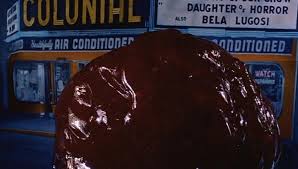
It just doesn’t get much better than when the title character attacks The Colonial during DAUGHTER OF HORROR, a real movie that’s the altered version of the 1955 movie DEMENTIA. The Kino Video DVD cover highlights three great reviews for DEMENTIA. Variety: “May be the strangest film ever offered for theatrical release.” Preston Sturges: “A work of art. It stirred my blood and purged my libido.” New York Censor Board: “Overflows with horror, hopelessness, sadism, violent acts of terror and outbursts of panic.”

Anyway, the Blob hates the cold. In that case, though, the Colonial must not have been too “Healthfully Air Conditioned,” because the Blob seems to thrive as it engorges the poor projectionist and heads into the auditorium.

Sometimes, during a bad bad bad movie at the multiplex, I’ve wanted the Blob to strike our screen and send us running.

Plan 9 from Outer Space (1959)


PLAN 9 FROM OUTER SPACE (1959) Four stars
Discourse around Ed Wood’s 1959 feature gives us two options: it’s either the worst movie ever made or it’s so bad that it’s actually good.

Having recently watched PLAN 9 twice, once near the 60th anniversary of the film’s initial release on July 22, I find that I disagree with both options, especially the first one.

It’s a great movie, because I traditionally equate personal enjoyment with greatness and I enjoy the living dead out of PLAN 9.

Wood’s films have been called “accidental avant-garde” or Wood didn’t know what he was doing and this sheer ineptitude created something arguably more bizarre. Wood’s films, like Ray Dennis Steckler’s THE INCREDIBLY STRANGE CREATURES WHO STOPPED LIVING AND BECAME MIXED-UP ZOMBIES and RAT PFINK A BOO BOO, exist in their own realm despite taking on many genres.

For example, in PLAN 9, we have horror, science fiction, action, adventure, and drama.

Sure, that seems like nothing special because a lot of movies yesterday and today and tomorrow mix and match genres, but just wait until you see PLAN 9.

What other movie would begin with a spiel from a psychic named “The Amazing Criswell” (1907-82) who became infamous for making “wildly inaccurate predictions.” (Aside from another Ed Wood film, of course.)

Criswell sets the tone for the rest of the movie right from the very start, “Greetings, my friend. We are all interested in the future, for that is where you and I are going to spend the rest of our lives. And remember my friend, future events such as these will affect you in the future. … My friend, can your heart stand the shocking facts about grave robbers from outer space?”

Wood had originally planned for GRAVE ROBBERS FROM OUTER SPACE to be his title, but financier J. Edward Reynolds, a devout Southern Baptist, found GRAVE ROBBERS offensive and Wood changed it to the title we all know and love. Wood and several cast members were even baptized at Reynolds’ church.

Taking into consideration the fascinating nature of the cast and Wood himself, you understand why Tim Burton’s fantastic ED WOOD focused so much time on PLAN 9.

— Criswell, given name Jeron Criswell King, became a fringe celebrity in Hollywood and he cut an entertaining figure at parties with his predictions. Criswell appeared on late night TV (he predicted 1966 on Johnny Carson), published his predictions in both magazines and newspapers, and wrote three books — “From Now to the Year 2000,” “Your Next Ten Years,” and “Forbidden Predictions” — and made a record titled “The Legendary Criswell Predicts Your Incredible Future” (which can be found online). Criswell’s friend and fellow PLAN 9 cast member Paul Marco released Criswell’s song “Someone Walked Over My Grave” after Criswell’s 1982 death, apparently because Criswell wanted it released that way.

— Finnish-American actress Maila Nurmi (1922-2008) became better known as “Vampira,” who hosted horror movies on her own series, “The Vampira Show,” from 1954-55 on KABC-TV in Los Angeles. Vampira is a combination of Morticia Addams, the Dragon Lady from “Terry and the Pirates,” and the evil queen from “Snow White.” Vampira sued horror movie host Elvira for $10 million for “infringing upon her trademark, public reputation and ability to market her lucrative character.” “The character was ripped off,” Vampira’s attorney Jan Goodman said. “Hopefully, my client will be fairly compensated and Cassandra Peterson will continue with her character and share the proceeds with my client.” The court ruled in favor of Elvira, “‘Likeness’ means actual representation of another person’s appearance, and not simply close resemblance.” Vampira played a silent role in PLAN 9 reportedly because she wanted absolutely nothing to do with the dialogue written by Wood.

— Hollywood legend Bela Lugosi (1882-1956) found his roles diminished greatly because his dependence on morphine and methadone for his sciatic neuritis became known by Hollywood producers. Lugosi and Wood struck up a friendship, and Wood cast Lugosi in GLEN OR GLENDA? and BRIDE OF THE MONSTER. Wood filmed Lugosi picking a flower in front of Tor Johnson’s home, which became Lugosi’s final work on film because the great actor died five months before production on PLAN 9 began. Lugosi’s absence obviously left a major hole in PLAN 9 and chiropractor Tom Mason stepped in for Lugosi in a way that predates the Bruce Lee subterfuge in GAME OF DEATH. It’s just as effective as GAME OF DEATH, as well, to get that out of the way. Mason stalks through his every scene in PLAN 9 with a cape over his face, a classic Lugosi gesture borrowed from his final performance as Dracula in ABBOTT AND COSTELLO MEET FRANKENSTEIN (1948). Legend has it that Lugosi was even buried in his cape.

— Swedish professional wrestler Tor Johnson (1902-71) appeared in 31 movie roles over nearly 30 years, mostly as a weightlifter or a strongman. Wood let the hulking Johnson speak in PLAN 9 and you will quickly realize why Johnson’s other roles were non-speaking. In fact, you might wish that he was mute like both Lugosi and Vampira in PLAN 9, but I find his dialogue as Inspector Daniel Clay strangely endearing, just like the movie itself, especially his line “I’m a big boy now, Johnny.” Johnson scared Groucho Marx on “You Bet Your Life” in 1954, where he weighed 387 pounds “soaking wet.” Groucho said, “With those measurements, you oughta be twice as attractive as Jayne Mansfield.” Johnson — played by fellow former professional wrestler George “The Animal” Steele in ED WOOD — also became a Halloween mask.

— Character actor Duke Moore (1913-76) had the distinction of his entire character actor career being spent in Ed Wood productions: CROSSROADS OF LAREDO, FINAL CURTAIN, NIGHT OF THE GHOULS, PLAN 9, THE SINISTER URGE, and TAKE IT OUT IN TRADE. In PLAN 9, he plays Lt. Harper, who’s not a very responsible gun owner. Lt. Harper touches his gun underneath his hat, holds it on top of his trench coat, and even points it at himself several times. According to Internet Movie Database trivia, Moore pointed the gun at himself deliberately to see if Wood would notice. Of course, Wood did not.

— Speaking of character actors, Lyle Talbot (1902-96) appeared in more than 150 films over a 56-year career. Talbot’s daughter Margaret wrote a book on her father called “The Entertainer: Movies, Magic and My Father’s 20th Century,” as Lyle worked in a carnival, as a hypnotist’s assistant, in theater, in the movies, and on TV. Lyle played Joe Randolph in 71 episodes of “The Adventures of Ozzie and Harriet” from 1956 to 1966. Lyle’s son, Stephen, played Gilbert on “Leave It to Beaver” (1957-63) and later became a journalist and documentarian. You will notice Lyle Talbot real quick in PLAN 9 because of the level of his performance.

— Dudley Manlove (1914-96, not Manlike, please, Auto Correct) has a voice that will make you think he’d be great in radio. Sure enough, looking up Manlove today, I discover that he worked on radio stations in Oakland and San Francisco. Manlove plays Commander Eros in PLAN 9.

— Independently wealthy, openly gay, and sex change seeking theatrical actor John “Bunny” Breckinridge (1903-96) made his only film appearance as “The Ruler” in PLAN 9.

Breckinridge’s obituary, “John ‘Bunny’ Breckinridge, an eccentric and troubled San Francisco millionaire who entertained grandly, served time in jail for vagrancy and was sued by his mother for lack of support, died Tuesday, November 5th, 1996 of heart failure in a Monterey nursing home. …

“Mr. Breckinridge, the great grandson of U.S. Vice President John Breckinridge and of Wells Fargo Bank founder Lloyd Tevis, was born in Paris. He spent time at Eton College and Oxford University in England and at the Atascadero State Hospital for the criminally insane.

“He was known for his flamboyant lifestyle, outrageous comments and penchant for perfume and costume jewelry. He performed in Shakespearean plays in England before coming to San Francisco in the late 1920s.

“He married the daughter of a French countess in 1927. The couple was divorced in 1929.

“‘I was a little bit wild when I was young, darling, but I lived my life grandly,’ he said.”

Bill Murray played Breckinridge in ED WOOD, so they’ve both got that going for them.

— Fumbling, bumbling, stumbling cop Kelton, played by Paul Marco (1927-2006), appeared in three Ed Wood productions and they form the “Kelton Trilogy” — BRIDE OF THE MONSTER, PLAN 9 FROM OUTER SPACE, and NIGHT OF THE GHOULS. Marco introduced Breckinridge to Wood, as the circle of friends around Wood expanded into his movies.

— Gregory Walcott (1928-2015) long regretted that he ever had anything to do with PLAN 9 FROM OUTER SPACE. From a 2000 Los Angeles Times article, “Drawbacks like this [Lugosi being dead] didn’t faze Ed Wood. He used a home movie of Lugosi and an impersonator. He used non-union crews and borrowed equipment. Walcott agreed as a favor, not even telling his agent, but regretted it instantly and for years thereafter. Virtually every reference guide labels PLAN 9 FROM OUTER SPACE the worst movie ever made.”

By the time (2000) that his old hometown of Wilson, North Carolina held a two-day Gregory Walcott Film Festival, Walcott (given name Bernard Mattox) had made peace with both Wood and PLAN 9.

“I didn’t want to be remembered for that,” Walcott said in the Times. “But it’s better to be remembered for something than for nothing, don’t you think?

“So I guess I owe Ed Wood an apology after all these years. Thanks, Ed.”

— Conrad Brooks (1931-2017), along with Walcott and Marco, appeared in Tim Burton’s ED WOOD and then, in his 80s, appeared in the 2015 PLAN 9 FROM OUTER SPACE remake directed by John Johnson and featuring such notables as Brian Krause, Camille Keaton, Mr. Lobo, and James “Angry Video Game Nerd” Rolfe.

Brooks, who played Patrolman Jamie in PLAN 9, was the last of the surviving Ed Wood actors.

— Wood (1924-78) unfortunately did not live to see the cult following that built up around PLAN 9 since 1980 when authors Harry and Michael Medved named it the “worst film ever made” in their book “The Golden Turkey Awards.” That pronouncement got the ball rolling.

Tim Burton’s rather feel good film only reinvigorated interest in both Wood and his filmography. ED WOOD treats PLAN 9 like a sacred text and jumps off the life story and filmography at that point. Wood’s later career included erotica, pornography, and even sexual education movies; Wood also wrote many pulp crime, horror, and sex novels.

ED WOOD (which undoubtedly cost more than all of the real Ed Wood’s films combined) also skips Wood’s alcoholism, but, hey, at least it does not skimp on his love of angora. (It’s also the most affectionate tribute from one director to another that I have ever seen, the film’s biggest strength.)

There’s even a Church of Ed Wood and if you go to www.edwood.org, you will have to click OK to “www.edwood.org says To answer your first question — yes, we’re serious!

“Woodism is a pop-culture-based religion created in 1996 by Reverend Steve Galindo. We follow the late cult director Edward D. Wood Jr., and we look to him as a savior. We at The Church of Ed Wood use Ed and his films to inject spirituality into those who get little fulfillment from more mainstream religions like Christianity. By looking at his films and his life, we learn to lead happy, positive lives. We strive for acceptance of others and of the self.”

I first encountered BRIDE OF THE MONSTER and PLAN 9 FROM OUTER SPACE around 12 years ago when Rob Zombie hosted “TCM Underground” on Turner Classic Movies, a show that I definitely miss since not having cable TV after the 2012 Election. I taped both movies, as well as Zombie’s bookend intros and outros for both, and that’s how I watched PLAN 9 twice recently.

I don’t write over 2,000 words on just any movie, so that only shows how much I love PLAN 9 FROM OUTER SPACE.

I love all the errors (boom mics visible, night-and-day day-and-night shifts during scenes), the cheesy special effects (love them flying saucers), the incongruous stock footage, the cast of goofball characters, the loopy dialogue, and, of course, Criswell’s narration.

BRIDE OF THE MONSTER (1955) Three stars; ED WOOD (1994) Four stars; PLAN 9 FROM OUTER SPACE (1959) Four stars

The Bad News Bears (1976)

THE BAD NEWS BEARS

THE BAD NEWS BEARS (1976) Four stars

I can hear somebody out there shout that THE BAD NEWS BEARS is not an underrated movie.

Sure, it’s not an underrated comedy or an underrated baseball movie, but I believe THE BAD NEWS BEARS is underrated as a serious consideration of competition and the effects of winning both individually and collectively on a team. Perhaps it’s because of director Michael Ritchie (1938-2001), whose other credits include THE CANDIDATE, SMILE, DOWNHILL RACER, and both FLETCH movies, that we get a sports comedy that goes a little deeper.

It’s that additional level that makes THE BAD NEWS BEARS my favorite baseball movie.

The Bears are, of course, the worst team in a prestigious California Little League. They’re a motley crew of misfits or as their firebrand shortstop Tanner Boyle (Chris Barnes) puts it in his inimitable way, “All we got on this team are a buncha Jews, spics, niggers, pansies, and a booger-eatin’ moron.”

Of course, they’re not wanted in this elite league — in fact, city councilman and attorney Bob Whitewood (Ben Piazza) sued and won a lawsuit against that prestigious Little League to allow the least skilled athletes (including his son Toby) to play in the first place. The Bears are made up of those bottom-of-the-barrel players.

Whitewood hires Morris Buttermaker (Walter Matthau), a former Minor League pitcher who turned to a life of beer and cleaning swimming pools … but mostly beer. Whitewood pays Buttermaker under the table to coach the Bears.

Buttermaker and the Bears are opposed by Coach Roy Turner (Vic Morrow) and the Yankees, namely Coach Turner’s son and star pitcher Joey Turner (Brandon Cruz, later a punk rock singer), at every turn. The Yankees are a juggernaut, of course, and the assholes and the bullies.

Along the way the Bears pick up two critical acquisitions: 11-year-old tomboy pitcher Amanda Whurlizer (Tatum O’Neal) and local hoodlum Kelly Leak (Jackie Earle Haley), who joins the Bears to get back at Coach Turner and to pursue his crush on Amanda.

The Bears start winning and they make it to the championship game against the hated Yankees.

Please keep in mind THE BAD NEWS BEARS does not end like so many sports movies with the underdog winning the Big Game. It’s funny that both THE BAD NEWS BEARS and ROCKY end differently than all the movies they influenced.

It’s more important that Buttermaker and the Bears finally see the effects winning had on them and how they started becoming more and more like them damn Yankees.

By the final scene, when the Yankees sing an obligatory and condescending cheer for the Bears, they’ve already had it and Tanner speaks for the entire Bears team when he tells the Yankees, “You can take your apology and your trophy and shove ‘em straight up your ass!”

Honestly, that’s a more satisfying finish than a win in the big game.

THE BAD NEWS BEARS IN BREAKING TRAINING and THE BAD NEWS BEARS GO TO JAPAN followed in successive years for three movies in three years and both sequels are lesser movies, especially the latter as the Bears resembled a high school baseball team. Kelly Leak, in fact, looks ready to join the cast of BREAKING AWAY. Yeah, GO TO JAPAN should be titled LONG IN THE TOOTH.

Matthau is perfect for the role of Buttermaker and the sequels miss him dearly, as William Devane (BREAKING TRAINING) and Tony Curtis (GO TO JAPAN) lack both the comedic and dramatic touches of Matthau. They’re just not as good as Matthau, who takes on a wide range in THE BAD NEWS BEARS. Matthau (1920-2000) handles the scenes where Buttermaker’s drunk, the quiet moments with Amanda, the screaming matches against Turner, and the shift in his personality after the Bears start winning. Matthau gives a great performance. He’s one of those actors that we’ll follow all the way through a turn toward asshole. Buttermaker takes a major asshole turn.

For example, Buttermaker pitches Amanda into early retirement, instructs Kelly Leak to go chase down and catch every fly ball even the ones hit to the other fielders, and commands godawful hitter Rudi Stein (David Pollock) to purposely get hit by pitches to give the Bears a runner on base.

The younger actors do not wear out their welcome and they’re not too damn cute for their (and our) own good. Yes, thankfully, it’s not one of those movies where the younger actors mug so heavily that I have to check my back pocket for my wallet.

There are many big laughs and moments of truth in THE BAD NEWS BEARS and the film deftly maneuvers between farce and slapstick, satire, sentiment, and drama.

Mad Max (1979)

MAD MAX

MAD MAX (1979) Four stars
12 weeks. $350,000. Guerrilla style filmmaking in and around Melbourne, Australia. A first-time feature film director and a largely unknown cast. A legitimate motorcycle gang. A refurbished 35mm camera somehow left behind from Sam Peckinpah’s THE GETAWAY.

You just read a success story.

Part of the Australian New Wave that invaded American theaters in the late 1970s and early 1980s, George Miller’s MAD MAX plays like a ripped, twisted cross between an American Western like HIGH NOON, Sergio Leone Westerns, Jack Kerouac’s “On the Road” and Hunter S. Thompson’s “Hell’s Angels,” American International biker pics, dystopian science fiction, horror films, good old-fashioned hyperkinetic action, and ultra-violent vigilante justice like DEATH WISH and TAXI DRIVER.

When good old American International Pictures released MAD MAX in America in 1980, they played up the film’s action content in promotion since lead actor Mel Gibson was not yet the international star that he would soon become and they Americanized the language with a new dub replacing the original Australian dialogue. (I own both versions, and I prefer the original Australian dub.)

After the prerequisite title card (Miller said the film’s low budget created the need for a post apocalyptic world), MAD MAX wisely jumps straight into the action with a fantastic, slam-bang chase scene that lasts 10 minutes. I rate this chase among the very best during an era that included many great chase scenes, like BULLITT and THE FRENCH CONNECTION.

In those chases, you feel like anything could happen at any given time. They look real. They feel real. Real cars, real danger.

Understatement: MAD MAX starts on a high note.

The setup for the chase: A ripped, twisted individual named “The Nightrider” kills a Main Force Patrol rookie officer and takes off in the officer’s Pursuit Special. MFP officers are in hot pursuit and the Nightrider eludes them until he meets his match in Max Rockatansky (Gibson).

Vincent Gil plays the Nightrider and his brief appearance proves to be absolutely essential in establishing the entire MAD MAX series.

He’s crazy, yeah, crazier than a shit house rat. I believe one of the officers calls him a terminal psychotic. He’s got verbal style, though, and this is one of the elements that defines MAD MAX, although words became fewer over time.

Max asks his best friend Goose (Steve Bisley) “Much damage?” over the radio and the Nightrider gives one of the great responses, helped out by a quote from Australian hard rock band AC/DC: “You should see the damage, bronze. Huh? Metal damage, brain damage. Heheheh. Are you listening, bronze? I am the Nightrider. I’m a fuel injected suicide machine. I am a rocker, I am a roller, I am a out-of-controller! I’m the Nightrider, baby!”

It’s an indelible sight as the Nightrider turns from brashness to sheer terror in his final moments.

The Nightrider’s motorcycle gang brethren, namely the Toecutter (Hugh Keays-Byrne), Bubba Zanetti (Geoff Parry), and Johnny the Boy (Tim Burns), pursue their revenge and enact their reign of terror on the Australian countryside.

Max loses his faith in justice, his best friend, and his family, his wife Jessie (Joanne Samuel) and his infant son.

At one point, Max tells his boss, “Any longer out on that road and I’m one of them, you know? A terminal crazy … only I got a bronze badge to say I’m one of the good guys.”

Max goes AWOL from the MFP, steals their Pursuit Special, and he stalks and kills the Toecutter, Bubba Zanetti, and finally Johnny the Boy.

Max drives off into the wasteland, a shell of his former self. We’re unsure of the future of this man.

I favor MAD MAX over both THE ROAD WARRIOR and MAD MAX: FURY ROAD because of a greater emotional investment. It shows us everything Max lost, and it’s less spectacle than the later films, obviously due to the difference in budget constraints. (FURY ROAD, for example, cost a cool $150 million. That’s 428.571428571 times the budget of the original.)

Miller, whose credits include BABE: PIG IN THE CITY and THE WITCHES OF EASTWICK in addition to the Mad Max films, is a former medical doctor and that profession informs MAD MAX.

Miller worked as an emergency room doctor to earn funds to make MAD MAX.

The surname “Rockatansky” derives from 19th century Bohemian pathologist Carl von Rokitansky, who originated a procedure that became the most common method for the removal of internal organs during an autopsy.

Miller’s experiences in the emergency room with motorcycle and automobile accidents are played out in MAD MAX.

Five great Australian New Wave films:
— PICNIC AT HANGING ROCK (1975)
— THE LAST WAVE (1977)
— THE CHANT OF JIMMIE BLACKSMITH (1978)
— MAD MAX (1979)
— BREAKER MORANT (1980)