Godzilla vs. Kong (2021)

GODZILLA VS. KONG (2021) ****
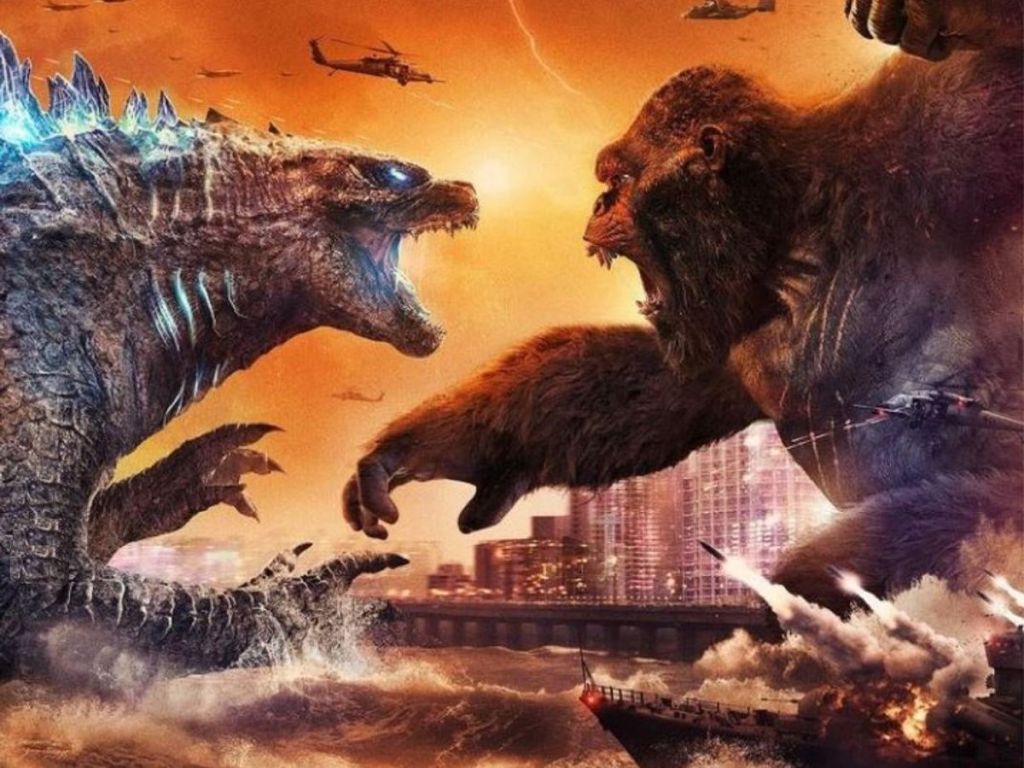
Adam Wingard’s Godzilla vs. Kong got it (mostly) right, especially compared with its immediate predecessor Godzilla: King of the Monsters, and that’s because the film wisely spends more time with protagonist Kong and antagonist Godzilla than its banal human characters and their petty dramas and squabbles and simply functional dialogue.

Also, unlike both Godzilla 2014 and King of the Monsters, we get monster fights shot in broad daylight or neon light. All the monsters and their incredible mayhem are clearly visible, and it makes a huge difference from the disappointing King of the Monsters. Thus, it seems that Wingard and Warner Brothers must have caught wind of the complaints about King of the Monsters, that we didn’t see Godzilla and King Ghidorah and Mothra enough and instead we had to squirm our way through too many family drama scenes involving father Kyle Chandler, mother Vera Farmiga, and daughter Millie Bobby Brown just to get to the monsters. Chandler and Brown return for Godzilla vs. Kong, Farmiga does not for an obvious reason from the end of King of the Monsters, and they’re sidelined for Godzilla and Kong, the nominal stars of the movie, just like they should. We have plenty of new human characters in Godzilla vs. Kong, as well, and they’re not all that important, not as important as Mechagodzilla anyway. Monsters rule Godzilla vs. Kong.

In other words, Godzilla vs. Kong gave me a damn good time at the movies.

I’ve read and heard complaints that Godzilla vs. Kong features too many ridiculous and just plain inexplicable plot elements and developments. What? No way! That’s what I wanted more from Godzilla ’14 and King of the Monsters, to just be silly and ridiculous occasionally and display a lighter touch, esp. King of the Monsters.

The best Godzilla movies work for different reasons: The original 1954 classic has a darker, somber tone unlike any other Godzilla and introduces one of the great movie monsters; Godzilla vs. Hedorah (1971) and Godzilla vs. King Ghidorah (1991) are off-the-wall and so far off-the-wall they could be in another house; Godzilla ’14 gave us a serious Godzilla movie with legitimate actors and it took many of us by surprise, especially with memories of the previous American Godzilla picture.

I’ve watched most all of the 36 Godzilla films — 32 from Japan’s Toho Studios, four from America — and I currently recommend 28 of them, except for Godzilla vs. Gigan (a close miss), All Monsters Attack and Son of Godzilla, and the 1998 Godzilla, the absolute bottom-of-the-barrel cinematic dregs from Roland Emmerich and Dean Devlin that should have been fed to the Smog Monster.

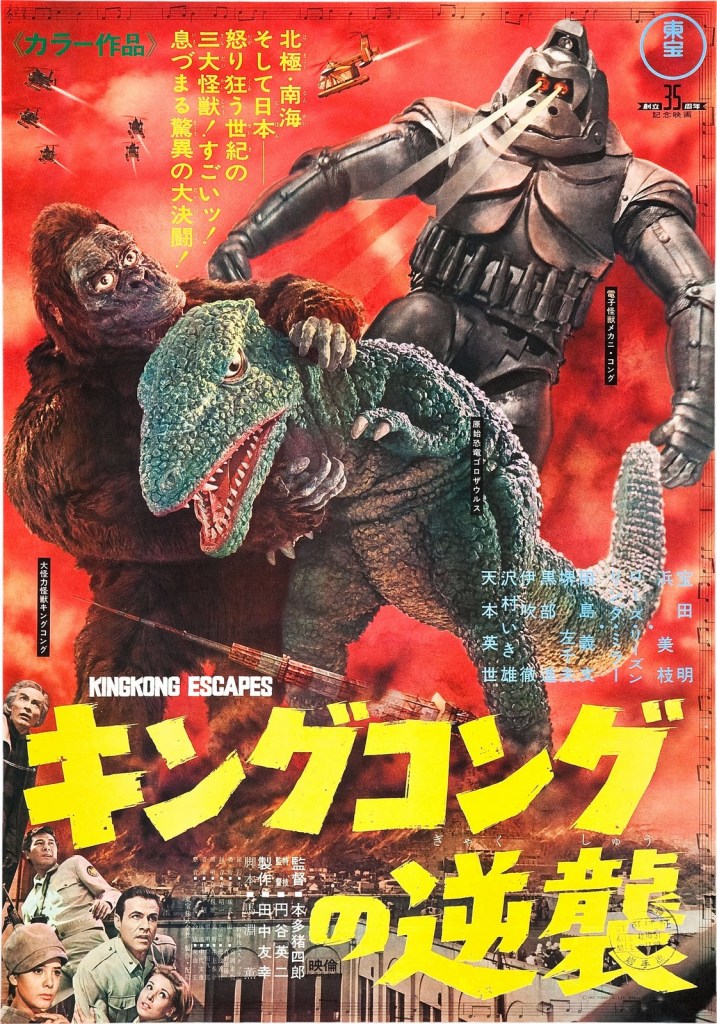
We’ve had many fewer Kong movies over the years, but I’ve loved most of them. The 1933 original remains one of my touchstone movie experiences and it’s something that I am compelled to put on every once in a while just to be dazzled and amazed all over again. I’ll enthusiastically or vehemently defend the 1976 and 2005 remakes, the 1933 sequel could have been so much greater had it not been rushed into release during the same calendar year as the original film, I’ve not seen King Kong Lives from 1986, and I enjoyed Kong: Skull Island more than King of the Monsters, though go figure I gave them both the same three-star rating. Okay, okay, Skull Island edges closer to three-and-a-half and King of the Monsters two-and-a-half, but who needs all that nuance. Apparently, there’s 12 films overall in the King Kong franchise, including the Toho productions King Kong vs. Godzilla and King Kong Escapes. I love King Kong Escapes for most of the reasons I love Godzilla vs. Hedorah and Godzilla vs. King Ghidorah, and they’re all gloriously ridiculous and preposterous. Quite frankly, I wouldn’t have it any other way.

What better space than here and better time than now to put in a word for Marv Newland’s 1969 classic animated short Bambi Meets Godzilla and King Kong knockoff films King Kung Fu and the Shaw Brothers’ The Mighty Peking Man, the former the only monster movie filmed in Wichita, Kansas, and the latter comes to us from dudes known for The One-Armed Swordsman and Five Fingers of Death though they also brought us The Super Inframan and Hammer co-production The Legend of the 7 Golden Vampires. We’re still giving the middle finger to A*P*E and I would be remiss to not mention The Most Dangerous Game from 1932 that was filmed on some of the same sets as King Kong and includes King Kong stars Fay Wray and Robert Armstrong in a dangerous adventure saga on an island and Mighty Joe Young from 1949 with the same creative team as King Kong — Merian C. Cooper and Ernest B. Schoedsack — as well as Armstrong, splendid work from The Lost World and King Kong special effects pioneer Willis O’Brien (assisted by Ray Harryhausen), and a surprisingly touching and involving friendship at the heart of the picture.

The original King Kong vs. Godzilla needed upgraded because, let’s face it, its success or failure hinges on whether or not viewers embrace or reject the cheesy special effects, the preposterous plot, the horrific dubbing (at least in the American version). On first viewing, I rejected King Kong vs. Godzilla yet I’ve warmed to it just a little bit more every time on subsequent viewings. I watched it as the start of a mini-marathon the night before seeing Godzilla vs. Kong in theaters and it remained good, solid fun. Still, though, it’s not some masterpiece that should never be remade and remodeled, like, for example, Psycho (oops, Gus Van Sant didn’t get that memo) and 2001.

I appreciate the nods that Godzilla vs. Kong makes to King Kong vs. Godzilla and King Kong Escapes (I hope a future installment makes room for Mechani-Kong), as well as other elements seen before during Pacific Rim and Tron. Guess what? I have enjoyed Pacific Rim and Tron, films which their critics have dismissed for being cheesy, as well and Godzilla vs. Kong joins their ranks.

— BONUS: I read three reviews of Godzilla vs. Kong before seeing the movie. Two of them reminded me that Emmerich and Devlin inserted characters based on Roger Ebert and Gene Siskel in their Godzilla, but they didn’t have the guts or the nuts to have Mayor Ebert and Gene stomped out by their bad CGI monster.

You don’t even have to read the full review by Armond White to feel like saying Lighten up, Francis. On Apr. 2, White proclaimed Godzilla vs. Kong to be the Shiny Dud of the Week, because it (in White’s words) cheapens the moviegoing habit thru mindless spectacle and shameless formula. Several hours later, White shared his review again and hyped it, If you have a mind, Godzilla vs. Kong is not the movie for you. Ah, it’s mindless entertainment, I see, but, hey wait, my prefrontal and limbic regions of the neocortex, particularly the orbitofrontal region of the prefrontal cortex, anterior cingulate cortex, and the insular cortex, especially object to White’s review.

Web-based film critic James Berardinelli finished his review, I wonder how my eight-year-old self would have reacted to Godzilla vs. Kong. There was a time when I gobbled up anything with monsters, irrespective of the quality of special effects. I didn’t care about the level of destruction and took it as a necessity that the movie would sometimes become bogged down by focusing on underdeveloped humans and their silly concerns. I suspect I might have loved this film in all its overproduced glory. But what works for an eight-year-old doesn’t always work for someone who has evolved to expect more.

Personally, the 42-year-old me is ecstatic the 38-year-old director Wingard and the screenwriting team of 41-year-old Eric Pearson and presumably-40ish-year-old Max Borenstein decided to focus more on Kong and Godzilla and less on inane humans. They could have gone even further. I’d love a Jurassic Park movie, for example, to feature only dinosaurs and prehistoric life — no banal or venal human beings to muddle and bungle it all up — and this ideal dinosaur movie would be made in the style of Luis Bunuel’s The Phantom of Liberty and Richard Linklater’s Slacker.

I find myself closer to Matt Zoller Seitz’s rave on RogerEbert.com, which had me at Godzilla vs. Kong is a crowd-pleasing, smash-’em-up monster flick and a straight-up action picture par excellence. It is a fairy tale and a science-fiction exploration film, a Western, a pro wrestling extravaganza, a conspiracy thriller, a Frankenstein movie, a heartwarming drama about animals and their human pals, and, in spots, a voluptuously wacky spectacle that plays as if the creation sequence in The Tree of Life had been subcontracted to the makers of Yellow Submarine.

Yeah, Godzilla vs. Kong got it about 90 percent right.
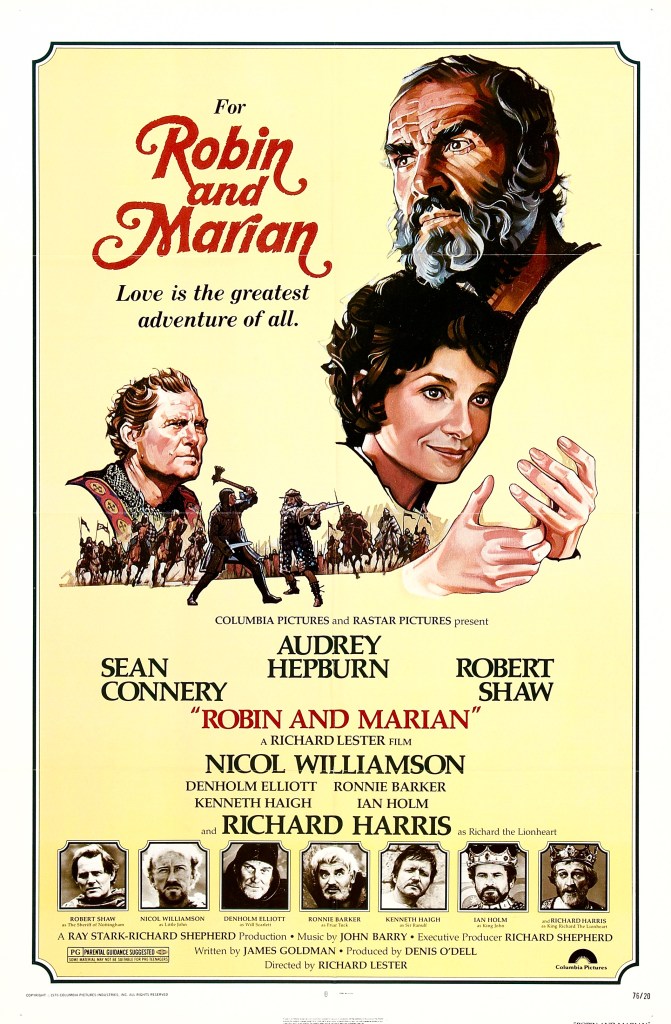
Robin and Marian (1976)

ROBIN AND MARIAN (1976) ****
Richard Lester’s Robin and Marian definitely made a strong first impression.

I placed it on my top 10 films list for 1976, based on just viewing it a single time on cable TV many years ago.

Granted, Robin and Marian crossed my mind several times in recent months, especially after Robin and Marian star Sean Connery died last Halloween and then after I watched both the Disney (1973’s Robin Hood) and the Mel Brooks (1993’s Robin Hood: Men in Tights) takes on the legendary old warhorse. Disney and Brooks both left me feeling often unimpressed and ultimately supremely disappointed, for very different reasons, and I started thinking instead about superior Robin Hood films The Adventures of Robin Hood and Robin and Marian, both of which I first encountered during childhood or teenage years.

The Adventures of Robin Hood remains my favorite take on Robin Hood and I’ve watched it numerous times over the years. Of course, it helped that The Adventures of Robin Hood ranked among the select few titles Grandma Sisney had on VHS and I played it — along with Indiana Jones and the Temple of Doom and Fun in Acapulco — so many times before Grandma took over her TV for a day of game shows and soap operas. There’s always been something so indelible about Errol Flynn’s Robin Hood that I judge all others portraying Robin Hood against Flynn’s standard, Claude Rains and Basil Rathbone make incredibly satisfying villains, and Olivia de Havilland’s Maid Marian simply radiates a MOST BEAUTIFUL WOMAN IN THE WORLD AT THIS VERY MOMENT glow. Plus, it’s hard to forget the colors (and costumes) that argue for three-strip Technicolor superiority.

Robin and Marian left a mark for similar reasons — Connery and Audrey Hepburn both carry some of the same appeal as Flynn and de Havilland do in their iconic roles. Flynn was just a month shy of 29 years old when The Adventures of Robin Hood first came out in May 1938 and similarly, De Havilland was two months shy of a mere 22. However, Connery and Hepburn play older Robin Hood and older Maid Marian — please consider both Connery and Hepburn were in their mid-40s during Robin and Marian and each had a solid 15-20 years of stardom behind them. Connery and Flynn both have an undeniable robust humor and physicality (both men seemed tailor-made for James Bond, for example) and Hepburn could make claims on de Havilland’s radiant MBWITW glow several times during her career, from Roman Holiday and My Fair Lady to Robin and Marian.

Anyway, I finally watched Robin and Marian for a second time and it holds up as a great movie, right behind only The Adventures of Robin Hood in the Robin Hood cinematic pantheon.

Because of centering around middle age characters, Robin and Marian plays different notes and takes on a greater emotional range than any other Robin Hood film I have ever seen.

It’s definitely not the lusty adventure like The Adventures of Robin Hood. Sure, Robin and Marian has sword fights and scenic vistas and soaring music and horses and romantic clinches and every prerequisite of the genre, as well as King John, King Richard the Lionhearted, the Sheriff of Nottingham, Little John, Friar Tuck, Will Scarlett, and Sherwood Forest, but they’re all — both people and places, and every plot event — suffused with melancholy.

To be fair, though, Lester and Connery inject enough good humor and spirit into Robin and Marian to help it avoid being a more downbeat experience like the 1991 Robin Hood starring Kevin Costner. And the scenes between Connery and Hepburn are simply flat-out appealing, rooted in seeing two of the most attractive, most ebullient performers to ever grace the screen share time with each other (and us audience members).

It should also be mentioned that supporting players Nicol Williamson, Richard Harris, Denholm Elliott, and Ian Holm contribute to an absolute dynamite cast.

Didn’t we always ponder how it all turned out for Robin Hood, Maid Marian, the Sheriff, Little John, Friar Tuck, and Will Scarlett?

Lester’s film, with a screenplay written by James Goldman (writer of the play, film adaptation, and TV movie version of The Lion in Winter), answers those very questions, but do we viewers feel comfortable with the answers? Are we prepared to see Maid Marian as a nun because Robin Hood, off on his damn crusades and holy wars with Richard and Little John, didn’t write her for the last 20 years? We also found out that she attempted suicide. He’s back, though, and it’s obvious that Robin Hood and Maid Marian are destined to be together. They might initially hate it and initially fight it, she invariably more than he, but they are pulled together rather than apart.

All roads lead toward a final showdown between Robin Hood and the Sheriff (Robert Shaw). They fight like two worn-out, downtrodden men with many, many battles behind them and none ahead of them, who have resigned themselves to their final destiny. They fight because it’s their duty, or their almost perverse obligation to each other as hero and villain. They really don’t want to be fighting each other at this precise historical moment, it feels like, BUT THEY MUST FIGHT TO THE DEATH. There’s none of the joy in this fight that can be found in great film sword fights like the one, for example, between Robin Hood (Flynn) and the Sheriff (Rathbone) in The Adventures of Robin Hood. This final showdown, just like Robin and Marian overall, gives us something that’s different from any other purely adventure movie. All the main players have lived through considerable pain, considerable disappointment, and the film serves a reminder (from early on and throughout) there’s flesh-and-blood and real-life experience behind every legend, every song, every ode, every hymn, every myth.

Maid Marian gives Robin Hood (and us) some final words, “I love you. More than all you know. I love you more than children. More than fields I’ve planted with my hands. I love you more than morning prayers or peace or food to eat. I love you more than sunlight, more than flesh or joy or one more day. I love you more than God.”

King Kong Escapes (1967)

KING KONG ESCAPES (1967) ****
I must be a sucker for movies like King Kong Escapes, but I just can’t help myself when it features so many awesome characters, plot details, and scenes.

Of course, we have the title character who’s obviously back from King Kong vs. Godzilla, one of Japan’s biggest Solid Gold hits of the early ’60s.

King Kong Escapes, a Toho Studios and Rankin/Bass Productions co-production, topped King Kong vs. Godzilla for me and I’d like to share how it did just that.

Not only do we have the iconic man-in-a-suit Kong, rather than the Willis O’Brien stop motion Kong from the immortal King Kong, the one that started it all, but we have Mechani-Kong, a giant robot double of Kong that first appeared in the 1966 animated TV series The King Kong Show (hence the Rankin/Bass involvement) and returned for live-action duty in King Kong Escapes.

King Kong Escapes also gives us Gorosaurus and a giant sea serpent, and Kong battles them near their home Mondo Island. See, Kong’s become obviously smitten with the lovely nurse Susan Watson (Linda Miller) and he’ll take on any beast to protect her. She holds sway on the big lug, and that naturally puts her life in danger from the bad guys. Kong saves her several times over the course of a 100-minute spectacular. All in a day’s work.

I believe it’s the human villains who put King Kong Escapes over into greatness for me — the evil mad scientist Dr. Who (not that Doctor Who) and the shady representative of an unknown Asian nation, Madame Piranha. She’s also called Madame X, but I’m sticking with Madame Piranha because I like that name better and she’s played by the pretty Mie Hama. 1967 proved to be a vintage year for Hama, who turned 24 that year and played Kissy Suzuki in the fifth James Bond film, You Only Live Twice. I believe Madame Piranha wins over Kissy Suzuki and ditto for their respective films. Madame Piranha, in fact, belongs right up there with Pussy Galore and Princess Dragon Mom.

Anyway, back to Dr. Who, played by the veteran character actor Hideyo Amamoto (1926-2003). He’s a cross between, I don’t know, Dracula (it’s the cape) and a Bond megalomaniac. He’s one of those characters that we absolutely love to hate and we savor his inevitable demise late in the picture. He’s so vain, so darn smart, so reckless, so persistent, so evil. Dr. Who created Mechani-Kong and when it fails him about 30 minutes into King Kong Escapes, Dr. Who captures first Kong and then Susan Watson, Commander Carl Nelson (Rhodes Reason), and Lt. Commander Jiro Nomura (Akira Takarada), Watson’s human interest. Needless to say, Kong and Mechani-Kong and Watson and gang escape from Dr. Who and his henchmen, which leads us to a battle royale atop Tokyo Tower.

I admit upfront that King Kong Escapes is silly, preposterous, and outright bloody ridiculous, in everything from its plot to its English dubbing, but it came as such a rejuvenation to my spirit after I watched The Gorilla, The Screaming Skull, The Robot vs. The Aztec Mummy, and The Curse of the Aztec Mummy earlier that same day, four exploitation films that if added together still did not provide as much entertainment value as King Kong Escapes.

The Stepfather (1987)

THE STEPFATHER (1987) ****

Every now and then, a horror film will feature a performance that earns widespread critical acclaim and official recognition typically not bestowed on actors or actresses within horror films.
For example, we’ve had Fredric March in Dr. Jekyll and Mr. Hyde, Anthony Perkins in Psycho, Sissy Spacek in Carrie, Anthony Hopkins in Magic, and Jeff Goldblum in The Fly. We should include The Stepfather star Terry O’Quinn with those distinguished performances. He’s so magnificently malevolent that he elevates The Stepfather a notch or two above the average horror thriller and makes it a transcendent exploitation film.

O’Quinn is one of those veteran character actor types who creates the stereotypical reaction, “Hey, I know that guy! He looks so familiar and he was in. …” But most people can’t quite name him! That joke told about John Malkovich in Being John Malkovich applies even more to O’Quinn. Let’s see, aside from a pair of Stepfather movies, O’Quinn appeared in Young Guns, The Rocketeer, and Tombstone, as well as numerous TV shows and movies.

O’Quinn plays a real piece of work in The Stepfather and the movie begins with him assuming his next guise Jerry Blake, after he murdered his family. We see the bloody aftermath, so there’s no doubt about the identity of the killer and we’re left waiting for the moment Blake again explodes into violence. We’re also waiting for when his new family discovers his old identity and his bloody murders, all roads leading to a final showdown that seems obligatory for any thriller since Halloween. That macabre interest level starts with the standard One Year Later title card.

O’Quinn effectively shows that he wants to be a straight, clean-cut, self-effacing man with the All-American nuclear family traditionally identified with Father Knows Best, Leave It to Beaver, and The Adventures of Ozzie and Harriet, also familiar through many, many other sitcoms. At the same time, we know that it’s 99.9 percent likely he’ll gradually snap, crack, and pop when familial disappointment hits dear old Dad again, so a lot of the fun involves Blake’s tension between establishing or slaughtering his new family.

Jill Schoelen’s spitfire teenage stepdaughter Stephanie naturally sees right through Jerry Blake and her character earns our sympathy and empathy almost immediately after we learn her biological father died only a year before this Blake fellow entered the picture and romanced her mother. Of course, nobody quite believes Stephanie, who gets expelled from school for her latest punch out, when she expresses that something’s not quite right about her stepfather. Schoelen plays a 16-year-old girl, so it’s a little creepy when director Joseph Ruben and screenwriter Donald E. Westlake give her a nude scene late in the picture; granted, Schoelen carried on the grand old movie tradition of a teenager portrayed by somebody at least several years older.

Shelley Hack complements O’Quinn and Schoelen and completes the trio of solid performances, in the role of the new Mrs. Blake. She plays a tricky role, perhaps just as tricky as the title role, because her discovery of the truth must be timed absolutely perfect. Otherwise, we see that she’s a dolt and feel she deserves her fate. The Stepfather times it just perfect, and it gets so many things right that we bask in the presence of a superior horror film.

Orgy of the Dead (1965)

ORGY OF THE DEAD (1965) ****
Officially, Stephen C. Apostolof (1928-2005) is the director of Orgy of the Dead, but it bears so many of the trademarks of its screenwriter, Edward D. Wood Jr., that it could play as the back end of a doubleheader with the immortal Plan 9 from Outer Space directed by Wood.

Loopy dialogue? Check. How about “Torture, torture! It pleasures me!” “A pussycat is born to be whipped.” “If I am not pleased with tonight’s entertainment, I shall banish their souls to everlasting damnation!” “Q: Is it some kind of college initiation? A: It’s an initiation alright, but not to any college as you or I know it!”

Criswell as narrator? Check. On top of being the narrator, Criswell stars as The Emperor, giving him more screen time than Plan 9 and he’s the source of most of the quotes in the above paragraph. Yeah, anyway, here’s the epic narration to open the film in true Wood (and Criswell) style, “I am Criswell. For years, I have told the almost unbelievable, related the unreal, and showed it to be more than a fact. Now I tell a tale of the threshold people, so astounding that some of you may faint. This is a story of those in the twilight time. Once human, now monsters, in a void between the living and the dead. Monsters to be pitied, monsters to be despised. A night with the ghouls, the ghouls reborn from the innermost depths of the world.”

Questionable acting? Check. Continuity errors galore? Check. Shoddy visual effects stemming from a micro budget? Check.

Unlike Plan 9 though, Orgy of the Dead features about one dozen bizarre topless dance sequences and that ultimately gives it the edge over Plan 9.

I love a film where the nominal protagonists have the only proper names. Of course, one of them answers to Bob and he’s a writer looking for inspiration. Boy, does he ever find it. Otherwise, in addition to The Emperor, we have The Black Ghoul and the bevy of dancers, Hawaiian Dance, Skeleton Dance, Indian Dance, Slave Dance, Street Walker Dance, Cat Dance, Fluff Dance, Mexican Dance, and Zombie Dance (great Cramps song). That’s all the plot synopsis necessary.

Orgy of the Dead, though, also leaves plenty enough room for poorly costumed Mummy and Wolfman as imperial henchmen. Pat Barrington essays a double role as Bob’s lady friend Shirley and the Gold Girl. The Gold Girl calls to mind Shirley Eaton’s infamous golden paint demise in the 1964 Bond film Goldfinger. At first, I thought they were saving the good girl’s nudity for last, like the bodaciously buxom good girl Debra Blee in the 1982 sex comedy The Beach Girls, but that’s not true in Orgy of the Dead since Barrington also played the Gold Girl.

Even the taglines for Orgy of the Dead (Titty Dance of the Dead describes the film more accurately) are incredible, especially “Are you heterosexual?” and “In Gorgeous ASTRAVISION and Shocking SEXICOLOR!” Shocking sexy color, indeed.

Let the Fire Burn (2013)

LET THE FIRE BURN (2013) ****

My wife came home from work as I finished watching LET THE FIRE BURN and she thought I had came down with a cold.

No, as I later explained to her, I broke down in tears by the end of LET THE FIRE BURN, the archive footage only documentary recounting the decade-long conflict between back-to-nature and black liberation group MOVE and Philadelphia police and city officials that culminated in the police siege and aerial bombing of the MOVE house on May 13, 1985. Firefighters were on scene and let the subsequent fire burn for one hour, resulting in 11 deaths (including MOVE leader John Africa and five children), 61 destroyed homes, and more than 250 homeless people.

Only two people from inside 6221 Osage Avenue survived a day that also included water cannons and tear gas and 500 heavily-armed officers firing 10,000 rounds at the burning house. The lone adult survivor, Ramona Africa, was the only person from that day to serve any prison time, seven years for aggravated assault, riot, and conspiracy. No city officials were ever prosecuted for their actions that day, even after the MOVE Commission took aim at Mayor Wilson Goode, Managing Director Leo Brooks, Police Commissioner Gregore Sambor, and Fire Commissioner Wilson Richmond and held each of them responsible for their part in the “reckless,” “unconscionable” bombing. Sambor and Richmond were singled out for their “hasty, reckless, and irresponsible” decision to use fire as a tactical weapon. A grand jury concluded, “We do not exonerate the men responsible for this disaster. Rather than a vindication of those officials, this report should stand as a record of their morally reprehensible behavior.” Both Africa and Ward won civil cases against the city.

I especially lost it late in the film.

Philadelphia officer James Berghaier testifies before the MOVE Commission about how he rescued lone child survivor Birdie Africa, a.k.a. Michael Moses Ward, from a deep pool behind the incinerated MOVE house, braving water and downed power lines to bring the badly burned boy to safety. A title card then informs us that 17-year veteran Berghaier quit the force only months after his testimony due to post traumatic stress disorder … and that he received “nigger lover” harassment for his actions May 13.

Berghaier said in a October 1986 AP story, “I’m constantly reminded of the way that kid looked at me, but it’s not something other people can understand. It’s destroyed me. It never goes away. In order to survive as a policeman, you have to detach yourself from what you have to do, and I’ve never been able to do that.”

Another title card tells us Michael Moses Ward died at the age of 41 in 2012; Ward drowned in a cruise ship hot tub. He reunited with his biological father Andino, learned a lifestyle radically different from his childhood in the communal MOVE house, and eventually became a long-haul truck driver and a part-time barber in his adult years. Ward lost his mother in the fire.

Jason Osder makes an impressive and unorthodox directorial debut by eschewing traditional documentary form — no contemporaneous interviews, no talking heads, no reenactments, only archival footage with an occasional informational title card. LET THE FIRE BURN cuts between MOVE Commission testimony, news reports (mostly from May 13), Ward’s videotaped deposition, and police surveillance footage. It is a tremendous experience.

LET THE FIRE BURN does not let MOVE off the hook. They’re accused of abusing their child members and their black neighbors had an endless array of complaints against them. That’s why city officials worked on evicting them from 6221 Osage and gave their neighbors advance notice of the May 13 raid. MOVE leader John Africa also had the disconcerting habit of calling people — like the police commissioner — “motherfucker” over a loud speaker, something that will not always play well with others. On a surveillance tape played in LET THE FIRE BURN, one police officer can be heard saying that Africa won’t be calling the police commissioner “motherfucker” anymore.

The fact that Goode — the first black mayor in Philadelphia history — was mayor during the bombing and its aftermath makes the events even more complex and interesting. Renowned tough guy and former police commissioner Frank Rizzo (yes, the inspiration for one of the Jerky Boys) was mayor when strife between MOVE and Philadelphia police began and then exploded in 1978 with a confrontation that led to the death of police officer James Ramp and the beating of John Africa (officers can be seen on video beating Africa). Nine MOVE members were charged and convicted for murdering Ramp and received lengthy prison sentences; Delbert Orr Africa became the first member of the Move 9 to be released but he died at the age of 74 only months after his release in early 2020. All three officers were acquitted in the Africa beating; one of them, Terrence Mulvihill, in fact later played a part in the events of May 13.

Goode served as mayor until 1992, after he narrowly won re-election in 1987 against none other than Republican candidate Frank Rizzo; Rizzo lost the Democratic primary to Goode in 1983 and switched parties for the duration of his life. Goode then held a position in the U.S. Department of Education, became a minister and professor at private Christian university Eastern, and he’s currently the CEO of Amachi, a faith-based program geared toward mentoring the children of incarcerated parents. Goode recently called for the city of Philadelphia to issue a formal apology for the events of May 13, 1985.

I am grateful to have encountered this piece of history that’s come up again in recent months, but good luck finding a copy of a full LET THE FIRE BURN to watch online. I wanted to go back for another viewing and pin down some exact quotes, but alas, I could not find the version I just watched a few days before.

Both ignorance of and blatant disregard for the historical record have bothered me for a real long time (latter definitely more than former), and they seem to be practiced more and more from every conceivable angle.

Just a couple months ago, for example, protesters in Madison, Wisconsin, tore down, decapitated, and threw into a lake the statue of Norwegian-American abolitionist, journalist, anti-slavery activist (listed after abolitionist to push the point across more forcefully), politician, and Union soldier Hans Christian Heg, who died at the age of 33 from wounds he received during the Battle of Chickamauga on Sept. 20, 1863. Them protesters probably had absolutely no idea whatsoever this old dead white guy worked hard to and even died in the struggle to end slavery.

Recently, memes have made the rounds that Democrat Senators held the longest filibuster in history, 75 days, attempting to prevent the passage of the 1964 Civil Rights Act. That leaves out the part about the bipartisan effort — yes, both Republicans and Democrats working together, led by Democrats Hubert Humphrey and Mike Mansfield and Republicans Everett Dirksen and Thomas Kuchel — to end the filibuster and pass the bill ending segregation and prohibiting employment discrimination based on race, color, religion, sex, and national origin. Never mind the fact that a Democrat President (John F. Kennedy) proposed the legislation and his successor (Lyndon B. Johnson) signed it into law on July 2, 1964.

The Senate passed it with a vote of 73-27 (46 Democrats, 27 Republicans; 21 Democrats, 6 Republicans). The vast majority of “Nay” votes came from Southern Democrats — both senators from 10 states (Alabama, Arkansas, Florida, Georgia, Louisiana, Mississippi, North Carolina, South Carolina, Tennessee, and Virginia). Texas and West Virginia Democrats Ralph Yarborough and Jennings Randolph both voted for, while Texas Republican John Tower voted against it. West Virginia Democrat Robert Byrd, a nay vote, filibustered for 14 hours, 13 minutes.

In the final House vote, it passed 289-126 (153 Democrats, 136 Republicans; 91 Democrats, 35 Republicans) with a similar vast majority of “Nay” votes from Southern Democrats — including all eight representatives from Alabama, all four from Arkansas, all five from Mississippi, and all five from South Carolina. It is perhaps no coincidence that predominantly reps and senators from the former confederate states voted against every civil rights legislation that came down the pike for a good century.

For some reason, my brain has found these lyrics from Talking Heads’ “Crosseyed and Painless,” “Facts are simple and facts are straight / Facts are lazy and facts are late / Facts all come with points of view / Facts don’t do what I want them to / Facts just twist the truth around / Facts are living turned inside out / Facts are getting the best of them / Facts are nothing on the face of things / Facts don’t stain the furniture / Facts go out and slam the door / Facts are written all over your face / Facts continue to change their shape.” Of course, I’m still waiting. And the world moves on a woman’s hips, it swivels and bops, bounces and hops.

Cobain: Montage of Heck, I Am Chris Farley

COBAIN: MONTAGE OF HECK, I AM CHRIS FARLEY

Like Jimi Hendrix, Janis Joplin, and Jim Morrison before and Tupac and Biggie after him, Kurt Cobain became a cottage industry after his death at the age of 27 in 1994. Nothing floods the market like a dead superstar.

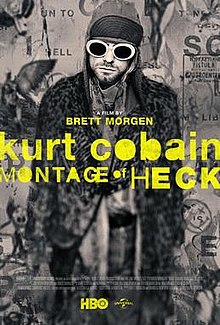
Just on the documentary front alone, we’ve had Nick Bloomfield’s 1998 investigative and speculative KURT & COURTNEY, A.J. Schnack’s 2006 KURT COBAIN: ABOUT A SON built around Cobain interviews for Michael Azerrad’s 1993 book “Come As You Are: The Story of Nirvana,” and then the 2015 double dose of SOAKED IN BLEACH and COBAIN: MONTAGE OF HECK, the former centered around private investigator Tom Grant and his digging into Cobain’s suicide and the latter officially approved by Cobain’s widow Courtney Love and their daughter Frances Bean Cobain. They made a real big deal about MONTAGE OF HECK being the first officially approved Cobain / Nirvana documentary, which automatically raises some red flags.

Throw in Gus Van Sant’s fictionalized LAST DAYS from 2005 and between all those cinematic incarnations and the Greatest Hits package (2002), the Journals (first released 2002), the three CD and one DVD box set (2004), the single-disc “Best of the Box” (2005), and various live albums released after his death beginning with MTV UNPLUGGED IN NEW YORK (Nov. 1, 1994) nearly six months after Cobain’s suicide, as well as all the celebrities from every walk of life fawning over seemingly every little thing Cobain, it’s easy to see why some of us experience Cobain fatigue or even why old fans sour on Cobain and Nirvana and ponder what they ever saw in their former heroes in the first place. Additionally, there are others who will tell you they hated Cobain and Nirvana during their brief heyday and that Cobain’s best move was blowing his brains out (a former co-worker actually said that during one musical discussion). We have more than enough room for each perspective and then some.

Through it all, though, I remain a Nirvana fan, mainly because I do my best to keep the legend at bay and just listen to the music. I turned 13 years old just three days before the release of Nirvana’s second album, NEVERMIND, so I definitely smelled teen spirit. That album, especially its first half, became so ingrained in my life during my teenage years that eventually I rarely ever played it, especially its first half, for quite some time. Only in the last year or so have I listened again to studio “Smells Like Teen Spirit,” “In Bloom,” “Come As You Are,” and “Lithium” on my own accord.

Anyway, that’s a long way of saying I watched MONTAGE OF HECK more than five years after its original release and subsequent hype and backlash. Movies about real people, especially artists, face at least one huge challenge: Do you focus on that person’s darker side or do you focus on the good times or do you try and find a middle ground between dark and light? Matters are compounded when the subject in question committed suicide at the age of 27 and titled songs “I Hate Myself and Want to Die.” Cobain’s often dark sense of humor should never be shortchanged and it’s not during MONTAGE OF HECK. We do see the darker side of Cobain throughout, especially in the second half of MONTAGE OF HECK, but the film also helps recall why Nirvana unexpectedly exploded into the stratosphere in late 1991 and early 1992. That said, I still do not and will probably never understand why Cobain became a generational spokesman, because like others before and after him, he did not want that responsibility and because this whole generational spokesman concept strikes me as being profoundly silly. Always remember, though, “It’s not what your celebrity (corporation) can do for you, it’s what you can do for your celebrity (corporation).”

MONTAGE OF HECK calls to mind Jeff Feuerzeig’s 2005 documentary THE DEVIL AND DANIEL JOHNSTON in a multitude of ways, through their deeply troubled protagonists who have a talent for writing songs, playing music, and drawing, their every moment seemingly captured on camera, and their animated interludes. Cobain himself appeared in THE DEVIL AND DANIEL JOHNSTON, wearing a “Hi, How Are You?” T-shirt alongside Red Hot Chili Peppers bassist and Nirvana trumpeter Flea at the 1992 MTV Music Awards.

MONTAGE OF HECK attempts to avoid the canned talking head format as much as possible — director Brett Morgen said the interviews from Bob Fosse’s Lenny Bruce screen biography LENNY influenced his style for MONTAGE OF HECK.

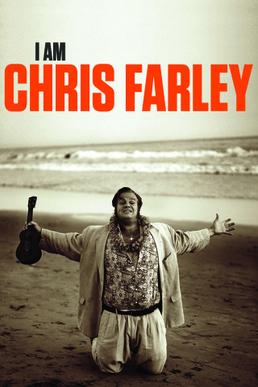
I AM CHRIS FARLEY, meanwhile, reinforces the idea that excess informed Chris Farley’s life and death at the age of 33 from an overdose in December 1997.

Farley enjoyed an excess of friends and loved ones, because fellow celebrities Christina Applegate, Tom Arnold, Dan Aykroyd, Bo Derek, Jon Lovitz, Lorne Michaels, Jay Mohr, Mike Myers, Bob Odenkirk, Bob Saget, Adam Sandler, and David Spade all share their Farley memories and anecdotes, in addition to excess in both overall lifestyle and comedic style.

I quickly realized once again that it was that very excess at the heart of Farley’s lead roles in TOMMY BOY, BLACK SHEEP, BEVERLY HILLS NINJA, and the posthumously released ALMOST HEROES. I watched BLACK SHEEP and BEVERLY HILLS NINJA and passed on the other two, because I thought BLACK SHEEP and BEVERLY HILLS NINJA relentlessly played one note for a good 90 minutes at a time — we shall call this note “Fat Man Takes a Really, Really Big Fall.” Seeing clips in I AM CHRIS FARLEY just brought it all back home again how much I disliked Farley’s films.

Also, during I AM CHRIS FARLEY, Aykroyd compared the comedic duo of Farley and Spade to Aykroyd and Belushi, Abbott and Costello, and Martin and Lewis. Wow. I mean, I did a double take when I first heard it and I just did another now writing it out. Farley and Spade paired for TOMMY BOY and BLACK SHEEP, while Abbott and Costello began working together in radio in 1935 and continued through radio, film, and TV into the mid-50s, highlighted by their legendary “Who’s on First?” routine. Abbott and Costello’s filmography doubled Farley and Spade in 1941 alone. Martin and Lewis made 16 films together — like Abbott and Costello, they worked in three entertainment mediums — from 1949 to 1956. Farley and Spade compared to Aykroyd and Belushi checks out, because of “Saturday Night Live” and two feature films.

On the other hand, I loved almost every Farley clip from “Saturday Night Live,” especially motivational speaker Matt Foley’s debut on May 8, 1993, because I can handle Farley’s excess better at five-minute sketch intervals than feature-length excess. I laughed at the Matt Foley sketch like I remember laughing at it 27 years earlier when it first aired. Spade and Applegate’s reactions and straining to remain in character when Foley unleashes “From what I understand, you’re not using your paper for writing, but for rolling doobies … you’ll be doing a lot of doobie rolling when you’re living in a van down by the river” make this sketch even funnier. Farley’s defining moment and one of the best on SNL.

By the way, you’ll discover the identity of the real-life Matt Foley during I AM CHRIS FARLEY. That’s one of the low-key highlights.

I AM CHRIS FARLEY balances toward light more than dark, but comments like Odenkirk’s “It’s just rare that a person has that much joy and brings that much happiness to everyone around him, but with Chris, there’s a limit to how wonderful it is to me and that limit is when you kill yourself with drugs and alcohol, you know, because that’s where it stops being so fucking magical” certainly get their point across.

Here’s another way to look at Cobain and Farley, “The light that burns twice as bright burns half as long.” In the case of a musician and a comedian who are preserved on record and celluloid, though, we have a chance to step into the light once more any time we so desire our personal favorite Nirvana album or “The Best of Chris Farley.” I believe that’s the best way to remember Cobain and Farley, as well as ourselves in the process.

COBAIN: MONTAGE OF HECK (2015) ****; I AM CHRIS FARLEY (2015) ***1/2

Let’s Dance! Let’s Sing! Let’s Nostalgia!: That’s Entertainment I, II, III

LET’S DANCE! LET’S SING! LET’S NOSTALGIA!: THAT’S ENTERTAINMENT I, II, III

I dutifully watched THAT’S ENTERTAINMENT, the 2-hour, 15-minute compilation of clips from MGM highlighting their hallowed “Golden Age of Musicals.” MGM, founded on April 17, 1924 by Louis B. Mayer and Marcus Loew, commemorated its 50th anniversary and then released THAT’S ENTERTAINMENT two months later commemorating it even more.

I have two immediate spoilsport thoughts, the first which originally occurred to me on June 22, 2004, watching the American Film Institute unveil the super bland “100 Years, 100 Songs.”

THAT’S ENTERTAINMENT brought it all back with a vengeance.

That night in 2004, I said aloud, “Are they going to put every single fucking song ever sung by Judy Garland on the list?” Ditto for Gene Kelly, Barbra Streisand, Julie Andrews, et cetera, who dominated the AFI list with their 20 or 25 songs seeming more like 80 or 100; Kelly and Garland, who passed away in 1969 at the age of 47, dominate THAT’S ENTERTAINMENT.

We get a double dose of heavy duty Judy in THAT’S ENTERTAINMENT, first through her Mickey (Rooney) and Judy “Hey gang, let’s put on a show” Era montage and then a tribute presented by her daughter Liza Minnelli, not long after CABARET. Garland also sings “You Made Me Love You” over a montage of Clark Gable that allows GONE WITH THE WIND (MGM’s most famous production) to be shoehorned into the song-and-dance ballyhoo.

Second spoilsport thought: Aside from THE WIZARD OF OZ and SINGIN’ IN THE RAIN, most of my favorite musicals are not from MGM. For example, Fred Astaire, who’s featured in THAT’S ENTERTAINMENT, did most of his best work at RKO — including TOP HAT and SWING TIME — in the 1930s paired with Ginger Rogers. Never mind alternative musicals like THE 5,000 FINGERS OF DR. T (Columbia and Stanley Kramer Productions) and ONE FROGGY EVENING and WHAT’S OPERA, DOC?, both famous Warner Bros. animated shorts.

What do I like about THAT’S ENTERTAINMENT?

Well, it’s always great seeing the usual suspects from THE WIZARD OF OZ and SINGIN’ IN THE RAIN no matter how many times I have seen them, especially Donald O’Connor’s showstopper “Make ‘Em Laugh.” Clark Gable singing “Puttin’ on the Ritz” from IDIOT’S DELIGHT. Jimmy Stewart’s jab at Robert “He tries his best” Montgomery. The Esther Williams montage. Somebody once said about Williams, “Dry, she ain’t much. Wet, she’s a star.” Madeline Kahn impersonating Marlene Dietrich in BLAZING SADDLES said, “It’s twue, it’s twue.”

We get more or less the same from PART 2, only we get token appearances from MGM employees Groucho Marx, Laurel and Hardy, Buster Keaton, and W.C. Fields and, of course, musical numbers that did not appear in PART I.

It would have been nice to see a musical number from the Marx Brothers or Laurel and Hardy or Fields, despite the fact they all did their best work somewhere else. I mean, would it have killed PART II director Gene Kelly to have aired Groucho’s “Lydia the Tattooed Lady” from AT THE CIRCUS … for example … instead of, I don’t know, one more variation on the song “That’s Entertainment” offered up by contemporaneous Astaire, contemporaneous Kelly together again and for the last time.

After watching PART II, I began hating Arthur Schwartz’s chestnut “That’s Entertainment” unlike ever before, although honestly I hardly ever gave it much thought until it was the (bludgeoning) recurring theme in a darn movie. They must have trotted it out 50 freaking times.

Eventually, to counterbalance the effects of cornball showbiz schmaltz, though, I started humming “That’s Entertainment” from the Jam. Let’s get all misty-eyed nostalgic over a song that starts “A police car and a screaming siren / A pneumatic drill and ripped up concrete / A baby wailing and stray dog howling / The screech of brakes and lamp light blinking.” I particularly love the second verse, “A smash of glass and the rumble of boots / An electric train and a ripped up phone booth / Paint splattered walls and the cry of a tomcat / Lights going out and a kick in the balls.”

I should just stop bitching and moaning and groaning about PART I and PART II of THAT’S ENTERTAINMENT, perhaps because life is short and also perhaps because I realize that I am not the target audience for these nostalgic entertainments. First and foremost, I was born in 1978 and my generation did not grow up on “classic” American musicals. In fact, a lot of us came to hate musicals in our teenage years, especially of the vintage celebrated endlessly by the THAT’S ENTERTAINMENT series. I have come to appreciate some of them corny old classics somewhat more in middle age, but I still prefer musical numbers from Monty Python, Mel Brooks, and “South Park” and I still grumble like nobody’s business at 21st Century schmaltz like FROZEN, MOANA, and THE GREATEST SHOWMAN, entertainment packages that give me fleas. I don’t even have to watch them to get fleas, because it seems like 90 percent of the people around me have memorized every single darn word of every single darn song and they don’t mind singing ‘em every single darn time they feel like singing in their darn glorious off-key melodramatic voice.

Recently, I conducted some independent research by watching MILLION DOLLAR MERMAID (a.k.a. THE ONE PIECE BATHING SUIT in the U.K.) from 1952 and starring Esther Williams, Victor Mature, and Walter Pidgeon. It was directed by Mervyn LeRoy, produced by Arthur Hornblow Jr., and replayed in at least one THAT’S ENTERTAINMENT. I watched it for Williams and the numbers choreographed by the legendary Busby Berkeley (who might be more fondly remembered today for being parodied in early 80s comedies CADDYSHACK and HISTORY OF THE WORLD). I enjoyed it and I realize that I probably would have enjoyed it for the same reasons at a younger age had I given it even half a chance. Now, that’s progress!

MGM returned to the vaults for a third time for THAT’S ENTERTAINMENT! III in 1994, only 18 years after PART II and 20 after the very first greatest hits-golden cinematic oldies compilation.

Anyway, who’d have ever thought that PART III tops both PART I and PART II and does it by including outtakes and unfinished numbers more than greatest hits and golden oldies.

We have Lena Horne’s “Ain’t It the Truth,” a sultry little number cut from CABIN IN THE SKY because a sexy black woman in a bathtub in 1943 would have spurred on a third American Revolution, yes, even in the middle of World War II.

We have two lip-sync takes on “Two-Faced Woman,” presented side-by-side, outtake Cyd Charisse from THE BAND WAGON and black face Joan Crawford from TORCH SONG (both dubbed by India Adams). Crawford’s scene made me think of Pauline Kael’s review of TROG, “Joan Crawford plays Stella Dallas with an ape instead of a baby girl. Some actors will do anything to be in movies: she probably would have played the ape.”

We have another Esther Williams montage and I must say that I am in favor of Esther Williams montages, especially ones that work in Tom and Jerry. Eat your hearts out, Frank and Gene, your movie (ANCHORS AWEIGH) only had Jerry dancing with Gene! In all honesty, the Esther Williams montages in PART I and PART III pushed me to seek out MILLION DOLLAR MERMAID and I have a feeling that I will be consuming Esther, Tom, and Jerry in DANGEROUS WHEN WET soon.

I also prefer PART III because it has much less of the elitist, self-congratulatory, self-important tone that marred the first two installments, as much as I enjoyed seeing all the “old” entertainers that have not been matched (let alone surpassed) since their heyday. PART III hints at the MGM that treated the cast of FREAKS like “freaks” and it at least delves beyond the surface glitz and glamour to the showbiz ugliness beneath.

That’s entertainment.

THAT’S ENTERTAINMENT PART I ***; PART II ***; PART III ****

Sequels Second to None: The Empire Strikes Back, Indiana Jones and the Temple of Doom

SEQUELS SECOND TO NONE: THE EMPIRE STRIKES BACK, INDIANA JONES AND THE TEMPLE OF DOOM

Having recently watched THE EMPIRE STRIKES BACK and INDIANA JONES AND THE TEMPLE OF DOOM for the first time in a movie theater, I have asked myself one tough question: Why are they my favorite Star Wars and Indiana Jones movies?

THE EMPIRE STRIKES BACK, the second installment in George Lucas’ space opera series eventually taken over by the fine folks at Disney, has the best direction (Irvin Kershner), best writing (courtesy Leigh Brackett and Lawrence Kasdan), best acting, best environs (the icy planet Hoth, the swampy Dagobah, and Cloud City), and the characters display their greatest emotional range and depth. Yoda, Boba Fett, and Lando are iconic additions, especially Yoda. Only the very first STAR WARS (A NEW HOPE) even approaches EMPIRE and please just forget about the prequels (REVENGE OF THE SITH by far the best of them) and the entries post-Disney takeover. It seems like the majority of STAR WARS fans agree.

Meanwhile, I seem to be in the minority who prefer TEMPLE OF DOOM over RAIDERS OF THE LOST ARK. I understand that it’s dark and disgusting, and that Kate Capshaw’s nightclub singer Willie Scott annoys the hell out of you with all that darn histrionic screaming that she does from the first reel to the very last. I grant all those points. Regardless, I prefer TEMPLE OF DOOM because it’s very dark and very disgusting, and yes, I do believe that it is one of the all-time best gross out movies. We’re talking such pleasantries as monkey brains, eels, snakes, bats, bugs, child slavery, heart removal, and bad, bad, bad men eaten by alligators. To be fair and honest, the Shanghai and Indian characters are grotesque caricatures even more disgusting than any of the creature and culinary discomforts, but then again so are the Nazis and Commies in the other Indiana Jones pictures. Understandably, though, India once banned TEMPLE OF DOOM.

TEMPLE OF DOOM does call to mind such classics as BLACK NARCISSUS, GUNGA DIN, THE STEEL HELMET (Short Round borrowed from Samuel Fuller’s 1951 Korean War picture), and THE GENERAL. Scott’s opening production number (Spielberg has long said that he’d love to do a musical and this scene and the jitterbug sequence in 1941 shows that he could make a very good even great one) clues us in on what’s exactly up the sleeves of director Steven Spielberg, screenwriters Willard Huyck and Gloria Katz, story writer Lucas, and gang. What’s that number called? “Anything Goes,” the Cole Porter standard. TEMPLE OF DOOM works because it is oversized and over-the-top like Spielberg’s earlier comedy 1941. Perhaps it is only fitting that Spielberg apparently likes 1941 and TEMPLE OF DOOM the least among his filmography. Does he recoil from their being so politically incorrect?

As far as Willie Scott goes, she epitomizes the sister or girlfriend or wife perpetually grossed out and disgusted by the shenanigans of all the boys surrounding her. I find that element fun. Yes, I do agree that Karen Allen’s Marion Ravenwood is a better match for Indiana Jones and it’s great they brought her character back for KINGDOM OF THE CRYSTAL SKULL. Scott remains more consistent throughout TEMPLE OF DOOM, though, whereas Marion switches between several modes and moods — just one of the boys, spitfire, damsel-in-distress, and wounded woman chief among them. I enjoy both characters, for different reasons. Capshaw’s performance and her character do not mar TEMPLE OF DOOM for me.

It’s been said numerous times before that Lucas endured a divorce around the time of the making of TEMPLE OF DOOM and that seeped into the movie — in the overall tone but specifically the Willie Scott character and the heart removal. Spielberg, two years after his divorce from actress Amy Irving, married Capshaw and they have been together nearly three decades.

It also must be said TEMPLE OF DOOM was my first Indiana Jones movie, because it was the only VHS tape she kept from a mid-1980s Christmas present from her children. Between that and her later acquisition, THE ADVENTURES OF ROBIN HOOD, I must have thrilled on them 100 times. Maybe nostalgia and sentimentality for old movies, even older movies, grand adventure, brassy dames from the Midwest, and politically incorrect characters and gross out gags animates my overall affection for TEMPLE OF DOOM. (I watched RAIDERS OF THE LOST ARK at the drive-in a couple weeks before TEMPLE OF DOOM. I passed on THE LAST CRUSADE for THE EMPIRE STRIKES BACK.)

As I watched THE EMPIRE STRIKES BACK in the Fort Cinema in the town where I attended high school and the first couple years of college, I periodically momentarily flashed back on how I must have first felt watching the movie some more than 35 years ago in the even smaller Southeast Kansas town Arcadia. I felt that way again, despite having seen EMPIRE 30-40-50 times.

Just one nagging thought occasionally spoiled the mood: We were not seeing the original theatrical version of EMPIRE, rather we had one of them dang blasted Special Editions that genius George Lucas masterminded in the mid-’90s for theatrical and home video release circa 1997 where he touched up some of the old school special effects and made some cringe-worthy insertions that will be mocked until the end of time. Lucas has sadly tinkered with A NEW HOPE, EMPIRE, and RETURN OF THE JEDI even more since then, until I think we fans have to ask him, “Why, George, why?” Some outraged STAR WARS fans have gone as far to proclaim “George Lucas Raped My Childhood.” (I do have both VHS and DVD copies of the original theatrical version of EMPIRE.)

Fortunately, I feel that Lucas has mangled EMPIRE considerably less than both A NEW HOPE and RETURN, which alone points to it being the best entry in the entire series. The uncanny valley effect: “An eerie feeling of unfamiliarity people get while observing or interacting with robots that resemble humans almost but not quite perfectly.” I believe we can add the “Star Wars Special Edition” corollary, as well as separate corollaries for both the prequels and the Disney Star Wars, to the uncanny valley effect. George, you should have just kept your ILM CGI magic in the prequels.

As EMPIRE played out more and more and we got deeper into the plot, though, any thoughts about Lucas, Special Edition, cringe-worthy insertions, etc., faded away and I became swept up in the spectacle more than ever before, because it was up there on the big screen for the first time. I felt wonderment and exhilaration, as well as the broader spectrum of emotions that other STAR WARS movies usually do not reach.

THE EMPIRE STRIKES BACK ****; INDIANA JONES AND THE TEMPLE OF DOOM ***1/2

X: The Man with the X-Ray Eyes (1963)

X: THE MAN WITH THE X-RAY EYES (1963) ****

I had wondered long and hard for many years where Al Jourgensen found a certain sample for a cover version of Black Sabbath’s “Supernaut” that appeared on the Ministry greatest hits compilation “Greatest Fits.”

This incredible sample about halfway through “Supernaut” goes something like, “I’ve come to tell you what I see. There are great darknesses. Farther than time itself. And beyond the darkness … a light that glows, changes … and in the center of the universe, the eye … the eye … the eye … the eye … the eye.”

There I was minding my own fucking business on a hot Saturday night in early June 2020, watching the thrilling conclusion of a pretty damn good little science fiction horror movie called X: THE MAN WITH THE X-RAY EYES, directed by Roger Corman and starring the reliably good Ray Milland. Then, hot dog, what do I hear but “I’ve come to tell you what I see. There are great darknesses. Farther than time itself. And beyond the darkness … a light that glows, changes … and in the center of the universe, the eye that sees us all.” I said to myself, “You magnificent bastard! That’s that sample from ‘Supernaut!’”

Before that discovery, I already thought X was one groovy movie. After that discovery, though, I am convinced it’s a great movie.

I must admit upfront to having a bias in favor of Ray Milland (as well as Roger Corman, for that matter). Milland (1907-86) has never let me down so far and that includes his Academy Award-winning performance as a struggling alcoholic writer in Billy Wilder’s THE LONG WEEKEND, his battle of minds with John Williams’ Chief Inspector Hubbard in DIAL M FOR MURDER, his ultimate cantankerous old coot Jason Crockett in FROGS, his ultimate hateful old bigot Maxwell Kirshner in THE THING WITH TWO HEADS, and his better-than-average Disney live-action villain Aristotle Bolt in the better-than-average Disney live-action film ESCAPE TO WITCH MOUNTAIN. To be honest, I enjoy FROGS every bit as much as DIAL M FOR MURDER and Milland proves responsible for much of the enjoyment of both films.

He’s very good in X as Dr. James Xavier, whose name immediately puts the X-Man character Charles Xavier to mind. Are they related?

In X, Xavier develops special eye drops that give himself X-ray vision and with this great power comes terrible repercussions, of course. Xavier just cannot stop himself from pushing the limits farther and farther. He must see what no man has ever seen before. His friend and colleague Dr. Brant (Harold J. Stone) tries stopping Xavier and Xavier accidentally kills Brant. Xavier goes on the run, first to a carnival, then to a Las Vegas casino, and finally to a religious tent revival that leads to one helluva conclusion.

One of the great scenes begins when Xavier’s lovely colleague Dr. Diane Fairfax (Diana Van der Vlis) takes the X-Man to a groovy little party where everybody just loves to do the Twist. Xavier’s X-ray vision kicks in at some point and we ponder what this scene would have been like had the movie came out in 1969. Even greater.

Before closing soon, I should mention Don Rickles’ strong performance and Dick Miller’s enjoyable one as carny heckler.

X: THE MAN WITH THE X-RAY EYES should be a treat for Corman, Milland, science fiction, horror, American International, sample, Black Sabbath, Ministry, Rickles, and/or Miller connoisseurs. Speaking only from personal experience, it was for me.