King Kong Escapes (1967)

KING KONG ESCAPES (1967) ****
I must be a sucker for movies like King Kong Escapes, but I just can’t help myself when it features so many awesome characters, plot details, and scenes.

Of course, we have the title character who’s obviously back from King Kong vs. Godzilla, one of Japan’s biggest Solid Gold hits of the early ’60s.

King Kong Escapes, a Toho Studios and Rankin/Bass Productions co-production, topped King Kong vs. Godzilla for me and I’d like to share how it did just that.

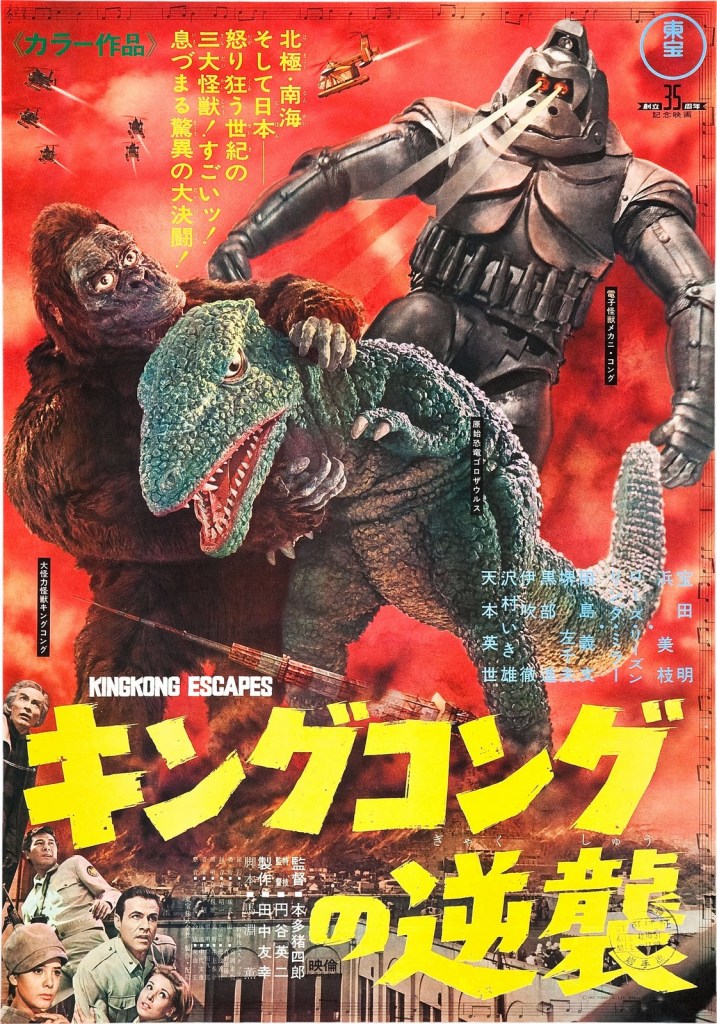
Not only do we have the iconic man-in-a-suit Kong, rather than the Willis O’Brien stop motion Kong from the immortal King Kong, the one that started it all, but we have Mechani-Kong, a giant robot double of Kong that first appeared in the 1966 animated TV series The King Kong Show (hence the Rankin/Bass involvement) and returned for live-action duty in King Kong Escapes.

King Kong Escapes also gives us Gorosaurus and a giant sea serpent, and Kong battles them near their home Mondo Island. See, Kong’s become obviously smitten with the lovely nurse Susan Watson (Linda Miller) and he’ll take on any beast to protect her. She holds sway on the big lug, and that naturally puts her life in danger from the bad guys. Kong saves her several times over the course of a 100-minute spectacular. All in a day’s work.

I believe it’s the human villains who put King Kong Escapes over into greatness for me — the evil mad scientist Dr. Who (not that Doctor Who) and the shady representative of an unknown Asian nation, Madame Piranha. She’s also called Madame X, but I’m sticking with Madame Piranha because I like that name better and she’s played by the pretty Mie Hama. 1967 proved to be a vintage year for Hama, who turned 24 that year and played Kissy Suzuki in the fifth James Bond film, You Only Live Twice. I believe Madame Piranha wins over Kissy Suzuki and ditto for their respective films. Madame Piranha, in fact, belongs right up there with Pussy Galore and Princess Dragon Mom.

Anyway, back to Dr. Who, played by the veteran character actor Hideyo Amamoto (1926-2003). He’s a cross between, I don’t know, Dracula (it’s the cape) and a Bond megalomaniac. He’s one of those characters that we absolutely love to hate and we savor his inevitable demise late in the picture. He’s so vain, so darn smart, so reckless, so persistent, so evil. Dr. Who created Mechani-Kong and when it fails him about 30 minutes into King Kong Escapes, Dr. Who captures first Kong and then Susan Watson, Commander Carl Nelson (Rhodes Reason), and Lt. Commander Jiro Nomura (Akira Takarada), Watson’s human interest. Needless to say, Kong and Mechani-Kong and Watson and gang escape from Dr. Who and his henchmen, which leads us to a battle royale atop Tokyo Tower.

I admit upfront that King Kong Escapes is silly, preposterous, and outright bloody ridiculous, in everything from its plot to its English dubbing, but it came as such a rejuvenation to my spirit after I watched The Gorilla, The Screaming Skull, The Robot vs. The Aztec Mummy, and The Curse of the Aztec Mummy earlier that same day, four exploitation films that if added together still did not provide as much entertainment value as King Kong Escapes.

The Gorilla (1939)

THE GORILLA (1939) *

When you have Bela Lugosi and Lionel Atwill in the cast, make them supporting players, and focus instead on the Ritz Brothers and Patsy Kelly, I call that a major failure.

The Gorilla, distributed by Twentieth Century-Fox and not surprisingly based on a stage play given the film’s limited sets and overall stagy feel, made that very choice. Lugosi earns more laughs than the execrable Ritz Brothers just by playing it straight. Yes, I found Al, Jimmy, and Harry execrable, as they fumbled bumbled and stumbled their way and I conversely grumbled my way through The Gorilla, a horror comedy that fails miserably at both genres. I read the Ritz Brothers walked away from The Gorilla because of the shoddy quality of the script and that’s never a good sign when the stars themselves grumble. They were right, though, because The Gorilla is shoddy, but the Ritz Brothers don’t get let off the hook. Not so fast.

The Ritz Brothers have been called a poor man’s Marx Brothers. No way, they’re not even good enough for that. Granted, to be fair, The Gorilla marked my first exposure to Al, Jimmy, and Harry, so maybe they did their best work elsewhere. Based on The Gorilla, though, I could not differentiate between Al, Jimmy, and Harry, who might as well be any Tom, Dick, and Harry off the street. They blended into one grating personality. I mean, Groucho, Harpo, and Chico created their own distinctive trademark comic personalities and they provided us a wealth of great comic material when they worked at their best (Horse Feathers, Duck Soup).

Laurel and Hardy did this horror comedy number much, much, much better in the 28-minute The Laurel-Hardy Murder Case from 1930. Watching The Gorilla, there’s one recurring gag involving a chair, a desk, a light, and disappearance that specifically makes it clear The Gorilla ripped off The Laurel-Hardy Murder Case, which parodies silent films The Cat and the Canary and The Bat. Paramount released a The Cat and the Canary remake starring Bob Hope and Paulette Goddard on Nov. 10, 1939, only about five-and-a-half months after The Gorilla.

We’ve all seen The Gorilla before, possibly many times before, through other movies, not only the fumbling bumbling stumbling detectives but also the maid who loves to shriek in just about every other scene, the wealthy uncle and the lovely young niece and her male friend and the inheritance plot, the butler who did not do it but who seems to show up at exactly the wrong time so he becomes an obvious suspect for the murders afoot, and both a killer named ‘The Gorilla’ and a real gorilla escaped from the local zoo on the loose and in the same house.

I believe that we talked about Lugosi and his great cinematic love for apes and gorillas back when I reviewed Bela Lugosi Meets a Brooklyn Gorilla. I gave that one three stars, but it actually has almost a full point lower average rating than The Gorilla on Internet Movie Database. Big whoop! I found Jerry Lewis and Dean Martin knockoffs Sammy Petrillo and Duke Mitchell a whole lot more endearing and funny than Al, Jimmy, and Harry Ritz, and Bela Lugosi Meets a Brooklyn Gorilla is not a snooze fest hopelessly dedicated to one set like The Gorilla.

She-Wolf of London (1946)

SHE-WOLF OF LONDON (1946) *
I have an alternate title for the 1946 Universal Studios anti-horror classic She-Wolf of London: She-Wolf of Tedium.

Since there’s no actual she-wolf, our new alternate title downsizes to Tedium.

Over a 31-year period, Universal made 31 films that are grouped together as the Classic Monsters series, featuring Dracula, Frankenstein’s Monster, the Wolf Man, the Invisible Man, the Phantom, the Mummy, and/or the Werewolf of London, not to mention Abbott and Costello.

She-Wolf of London falls outside the Classic Monsters jurisdiction and it’s worse than any of them. Yes, it’s even worse than The Invisible Woman, the nadir of the Classic Monsters series.

Since I watched The Wolf Man and Werewolf of London, I expected a she-wolf in London, transformation scenes, and scenes of mayhem.

No, director Jean Yarbrough (The Devil Bat), screenwriter George Bricker, and producer Ben Pivar give us a standard issue murder mystery.

June Lockhart, then a 21-year-old ingenue years before her mother roles on Lassie and Lost in Space, stars as poor, poor Phyllis Allenby, whose deep, deep belief in the so-called ‘Curse of the Allenbys’ leads her to believe that she’s the werewolf responsible for all the deaths in the local park. Good old Aunt Martha (Sara Haden), that good old Aunt Martha, anyway, she owns dogs that bark all night and they take a real shining to poor, poor Phyllis. Between all the murders that point toward her and dogs barking and curse talk, Phyllis gets worse over the course of She-Wolf of London. That’s all part of Aunt Martha’s master plan, since she wants to drive Phyllis insane and inside an asylum so Aunt Martha and her daughter remain living inside the mansion rather than Phyllis and her doting barrister, boyfriend, and potential husband Barry Lanfield (Don Porter). Barry sees through it all, believes in Phyllis, and it’s all so touching when he proves her innocence. Instead, Aunt Martha becomes one of those less than convincing movie murderers, you know, in a revelation that renders the rest of the movie, what’s the word, ridiculous … and not the good ridiculous either.

Yeah, that’s a whole lot of plot synopsis and She-Wolf of London surrenders itself to many exposition scenes during a 61-minute motion picture spread. All that exposition becomes the source of all that pesky tedium, which is not exactly what I was expecting from a movie titled (incorrectly) She-Wolf of London. There I go again, my own worst enemy.

The Creature Walks Among Us (1956)

THE CREATURE WALKS AMONG US (1956) **1/2
I should have already learned my lesson.

I bitch about the yucky suck face between scientists John Agar and the lovely Lori Nelson through most of the second half of Revenge of the Creature, so it only serves me right that I got immediately served with the miserably married couple played by Jeff Morrow and Leigh Snowden in The Creature Walks Among Us, the third and final entry in the Creature series released by Universal Studios. Morrow and Snowden are truly a downer and their scenes drag The Creature Walks Among Us down a notch or two from being a perfectly enjoyable creature feature.

All three Creature features benefit heavily from their underwater photography and Walks Among Us works best when the action takes place underwater. Above water, especially when Morrow and Snowden provide us another unpleasant scene together, it’s not so hot. Watching Revenge and Walks Among Us in close proximity, it’s obvious just how much influence these earlier films had upon the later Jaws series also produced by Universal. Jaws 3 borrowed major plot developments from Revenge, for crying out loud.

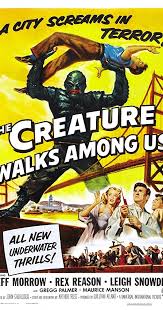
In a fundamental way, though, Walks Among Us cheats us. It doesn’t really live up to any part of that title until the very end of the picture, when the title character escapes from captivity. I certainly don’t remember a city screaming in terror and the poster incorporates the Golden Gate Bridge into its promotional campaign. Good job, marketing department. Sure, we see the Golden Gate, kinda sorta obligatory for any film shot for any length in San Francisco, but I don’t recall any character being held up above the Golden Gate by our title character, sure to be thrown to his death. Now, that would be an impressive scene.

I feel like I must make amends in this review for cheating Ricou Browning (born 1930) in the Revenge review. He’s the man in the creature suit in the underwater scenes. In Walks Among Us, Don Megowan plays the Gill Man on land. In Revenge, it was Tom Hennesy. In Creature, it was Ben Chapman. I believe it’s a testament to the quality of Browning’s work in the underwater scenes that he filled the creature suit in all three movies.

Strangely enough, I felt a certain sadness during Walks Among Us, alternating with a sense of overall wonderment toward the Universal Classic Monsters series. Walks Among Us ended a stretch where I watched 16 classic horror films, from 1935’s Werewolf of London to 1956’s The Creature Walks Among Us, for the first time, having already watched Universal’s true classics like The Bride of Frankenstein and The Wolf Man several times before. Because I even sometimes enjoy watching a bad movie, like The Invisible Woman, this stretch greatly satisfied both the historian and the horror movie fan living inside me.

Top 12 Universal Classic Monster Movies
1. The Bride of Frankenstein (1935)
2. Frankenstein (1931)
3. The Wolf Man (1941)
4. Son of Frankenstein (1939)
5. Creature from the Black Lagoon (1954)
6. The Invisible Man (1933)
7. The Phantom of the Opera (1925)
8. The Mummy (1932)
9. Dracula’s Daughter (1936)
10. Dracula (Spanish version) (1931)
11. Dracula (English version) (1931)
12. Abbott and Costello Meet Frankenstein (1948)

Abbott and Costello Meet the Mummy (1955)

ABBOTT AND COSTELLO MEET THE MUMMY (1955) Two stars
Bud Abbott (1897-1974) and Lou Costello (1906-59) enjoyed a phenomenal run for Universal Studios from 1941’s Buck Privates through 1955’s Abbott and Costello Meet the Mummy.

They made lots of pictures that made lots and lots of money and they met lots and lots of interesting people (and monsters) in their pictures.

Their career meeting people for Universal took off with the 1948 hit Abbott and Costello Meet Frankenstein, a title which sells Larry Talbot / The Wolf Man (Lon Chaney Jr.), Dracula (Bela Lugosi), and even for one gag the Invisible Man (Vincent Price) short. After that, let’s see, Abbott and Costello meet the Killer, Boris Karloff (not the killer), the Invisible Man (not Vincent Price), Captain Kidd, Dr. Jekyll and Mr. Hyde, the Keystone Kops, and the Mummy. We should pause right here and mention Abbott and Costello visited Jack and his beanstalk, Africa, Mexico, and Mars.

I wanted to like Abbott and Costello Meet the Mummy.


I wanted to laugh at Abbott and Costello Meet the Mummy.

I had a mixed reaction instead.

I liked it without laughing at it once.

Since it’s a comedy and I didn’t laugh even once, I guess I don’t really like it.

I call it a forced smile picture more than anything else, where I see the joke, understand the joke, and finally smile with a sense of resignation.

Maybe I have seen too many Abbott and Costello films in close proximity during quarantine, not to mention imitation Abbott and Costello Don Knotts and Tim Conway in The Private Eyes, but I failed to laugh at humor frequently predicated on Costello fumbling bumbling stumbling into or through someone or something, being terrified beyond the capacity for rational thought or a coherent sentence, and then most often failing to make the skeptical Abbott believe him. I swear, Abbott and Costello must play their favorite routine about 100 times during Meet the Mummy.

Abbott and Costello only call each other by name throughout Meet the Mummy. During the final credits, they’re listed playing Pete Patterson and Freddie Franklin, respectively. That’s about the high point of the humor in Meet the Mummy.

Of all the Universal classic monsters, I must admit that I like the Mummy series the least, namely the four pictures Universal rattled off like machine gun fire in the 1940s — The Mummy’s Hand, The Mummy’s Tomb, The Mummy’s Ghost, and The Mummy’s Curse. I like Hand alright, find Tomb elevated by Lon Chaney Jr.’s debut as Kharis, and Ghost and Curse have already blended into monotonous goo in my brain after seeing them back-to-back recently. Don’t even get me started on the Indiana Jones wannabe Brendan Fraser CGI monstrosities and I blissfully missed Tom Cruise’s so-called abomination completely.

Chaney Jr. proved to be the most menacing Mummy on screen, and he’s not in Meet the Mummy. It could be any other guy wrapped in gauze and affecting a lumbering pace. Yeah, it’s a guy named Eddie Parker. Oh, sure, probably a nice guy, but still no Chaney Jr. They call the Mummy ‘Claris’ — not Kharis — anyway in Meet the Mummy.

Meet Frankenstein and Meet the Invisible Man worked because the actors portraying the monsters played it straight rather than knowing they were in a comedy. It’s similar to the acting in Airplane, Top Secret, and The Naked Gun, in that it never received the credit it deserved.

As for Abbott and Costello, there’s always Hold That Ghost, Meet Frankenstein, Meet the Invisible Man, and “Who’s on First.”

Revenge of the Creature (1955)

REVENGE OF THE CREATURE (1955) **1/2
Once upon a time, Universal Studios took more time between sequels: The Bride of Frankenstein four years after Frankenstein, Dracula’s Daughter five after Dracula, The Invisible Man Returns seven after The Invisible Man, and The Mummy’s Hand eight after The Mummy.

Universal threw all that right out the window during the 1940s and churned out four Mummy, three Invisible Man, four Frankenstein, two Dracula, and five Wolf Man pictures, although the studio mashed just about every monster it had for bashes like House of Frankenstein, House of Dracula, and Abbott and Costello Meet Frankenstein so my numbers might be a slight bit inaccurate.

Creature from the Black Lagoon premiered Feb. 12, 1954, and it became a box office success. Of course, that meant two sequels, Revenge of the Creature in 1955 and The Creature Walks Among Us in 1956, and the latter sequel closed out a 31-film run of horror movies for Universal that began with 1925’s The Phantom of the Opera and continued through Dracula, Frankenstein’s Monster, The Mummy, The Invisible Man, and The Wolf Man.

Revenge of the Creature will seem awful familiar to first time viewers, and not only because it’s a sequel to a legendary horror film. No, when I watched it for the first time, I thought about how much fellow Universal production Jaws 3 (1983) ripped off from Revenge. Both movies were made in 3-D and the later sequel borrowed and updated several plot elements from the earlier one, mainly a monster on the loose in an amusement park.

Revenge proves to be far more enjoyable and memorable than Jaws 3.

Clint Eastwood’s motion picture career had to start somewhere, and that somewhere happens to be Revenge. His one scene occurs somewhere about 10 minutes in. He plays college lab assistant Jennings, intended comic relief. Back to the Future Part III (another Universal sequel) worked in a nod to both Revenge and Tarantula, Eastwood’s second appearance in an Universal creature feature / monster movie from 1955 directed by Jack Arnold. Eastwood plays the jet squadron leader in Tarantula, and Mr. Eastwood helps blow up the title character real good in a preview of his future action hero glory. I recommend Tarantula over Revenge of the Creature, but they do make a suitable double feature, sharing not only Arnold (and Eastwood) but producer William Alland, actors John Agar and Nestor Paiva, and Henry Mancini stock music.

At this point, I should mention that protagonists Professor Clete Ferguson (Agar) and Helen Dobson (Lori Nelson) spend most of the second half of Revenge locked in suck face embrace. Holy cow, why didn’t they just get a room … or a romantic comedy or something. I have not seen two love birds like Clete and Helen since Rod Arrants’ Tom Rose and Joanna Kerns’ Marilyn Baker in the 1976 anti-classic Ape. In all honesty, I wanted The Gill Man to come in and break up Clete and Helen sooner rather than later … and it just doesn’t happen soon enough.

I certainly don’t believe that Agar and Nelson are improvements from previous leads Richard Carlson and Julie Adams, and I don’t recall Creature bludgeoning us over the head with their romance. Revenge shows that our horny Gill Man does not discriminate in the hair color of leading ladies, loving and lusting after both brunette (Adams) and blonde (Nelson). How progressive! Nelson naturally spends a lot of her screen time scantily clad, in swimsuit and even her lingerie in one scene much to the delight of the Gill Man and likely millions of teenage boys of all ages in 1955. Here we are 65 years later and I’m not complaining, just merely stating actual factual information.

Yeah, anyway, Revenge takes its sweet time in getting to the good parts again once it gets the Gill Man into captivity and for that very reason, it ranks below not only Creature from the Black Lagoon and Tarantula but also The Incredible Shrinking Man, the 1957 science fiction classic from Universal directed by Arnold.

Revenge possesses some of the same virtues as Creature, especially sensational underwater photography, and it’s nice they at least brought Nestor Paiva’s enjoyable Lucas character back for the sequel without killing him off in his early appearance. I am looking forward to watching The Creature Walks Among Us and finishing the Universal Classic Monsters series.

Werewolf of London (1935)

WEREWOLF OF LONDON (1935) ***
Werewolf of London — Hollywood’s first werewolf picture — must be one of the most overlooked horror films in the history of overlooked horror films, for obvious reasons.

During the 1930s, Universal Studios released Werewolf of London among the following group of horror films: Dracula, Dracula (Spanish version), Frankenstein, The Mummy, The Invisible Man, The Bride of Frankenstein, Dracula’s Daughter, and Son of Frankenstein, over half of them landmark productions that spawned multiple imitations and sequels. Werewolf of London came out nearly a month after The Bride of Frankenstein in the spring of 1935 and The Bride of Frankenstein became a big hit and developed a reputation for being a sequel that arguably betters the original.

Late in 1941, Universal’s second werewolf film appeared, The Wolf Man, and it quickly became the quintessential werewolf film, leaving Werewolf of London behind in the dustbins of cinematic history. Lon Chaney Jr. joined his late father Lon Chaney (Phantom of the Opera), Boris Karloff (Frankenstein), and Bela Lugosi (Dracula) in becoming a horror movie icon just from a single performance. Chaney Jr. revisited Larry Talbot / The Wolf Man in Frankenstein Meets the Wolf Man, The House of Frankenstein, House of Dracula, and Abbott and Costello Meets Frankenstein, and he displayed his versatility by portraying Dracula, Frankenstein’s Monster, and the Mummy.

In addition to Chaney Jr., The Wolf Man cast includes Claude Rains and Ralph Bellamy and many horror films love it for its mood and first-rate atmosphere.

By contrast, Werewolf of London stars veteran character actor Henry Hull and that’s unfortunately not a name that rolls off the tongue like, say, Lon Chaney Jr. Warren Zevon name checked both Chaneys in “Werewolves of London” — Well, I saw Lon Chaney walking with the Queen / Doing the Werewolves of London / I saw Lon Chaney Jr. walking with the Queen / Doing the Werewolves of London / I saw a werewolf drinking a piña colada at Trader Vic’s / And his hair was perfect — but, alas, no direct mention of Hull.

Werewolf of London definitely holds its most value as curiosity (and conversational) piece and not only for its place as the most overlooked film within the Universal canon and for its overall historical standing. After all, when’s the last time any protagonist in a film counted botany for their career or a horror film started with a prologue in Tibet. It also holds considerable fascination comparing and contrasting Jack Pierce’s makeup work between Werewolf of London and The Wolf Man, as well as how this earlier film handled the essential transformation scenes. The werewolf seems to have inspired Eddie Munster, so Werewolf of London does have that going for it.

Phantom of the Opera (1943)

PHANTOM OF THE OPERA (1943) **
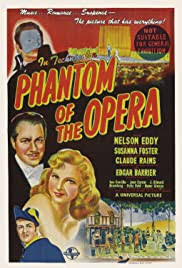
I put off watching a sound version of Phantom of the Opera for the longest time and the 1943 Phantom of the Opera only confirmed that suspicion and doubt.

Claude Rains did not even remotely approach what Lon Chaney accomplished in the 1925 silent version and I have to face the fact that I am definitely not the world’s biggest opera fan.

Yes, I do realize that I made it through A Night at the Opera and Opera with relative ease, but predominantly because I am big fans of both the Marx Brothers and Dario Argento, not opera.

Allan Jones’ production numbers in both A Night at the Opera and A Day at the Races, as well as James Whale’s Show Boat, are why they invented the fast-forward and skip buttons. The Marx Brothers’ numbers are infinitely better on the ears.

As for Argento, he goes so far over the top (especially in the murder sequences) that I find his operatic excess in Opera enjoyable.

Universal Studios invested $1.75 million on Phantom of the Opera (both Phantom and fellow 1943 release Frankenstein Meets the Wolf Man received much larger production budgets than previous Universal releases, like, for example, the $180,000 Wolf Man from 1941) and the film accomplished something unique for an Universal horror film — win an Academy Award, for Best Art Direction and Best Cinematography, and it was nominated in two more categories.

Phantom of the Opera, the first adaptation of the 1910 Gaston Leroux novel filmed in Technicolor, became a hit, especially in France.

Sorry to say, though, it’s not deserving of classic status.

Universal released 25 horror films from 1931’s Dracula through 1948’s Abbott and Costello Meet Frankenstein that are grouped together in the Classic Monsters series and I rank Phantom of the Opera only ahead of The Mummy’s Ghost, The Mummy’s Curse, and The Invisible Woman.

Lon Chaney Jr. (1906-73) felt slighted Universal did not consider him for his father’s most legendary role. Granted, he was an incredibly busy actor. Chaney Jr. had starring roles in the three films immediately surrounding Phantom of the Opera in 1942 and 1943 — his first time playing Kharis in The Mummy’s Hand, his second time as Larry Talbot / The Wolf Man in Frankenstein Meets the Wolf Man, and his first and only time as Dracula in Son of Dracula. Chaney Jr. previously took on Frankenstein’s Monster in The Ghost of Frankenstein (1942) and he proved himself Universal’s most versatile monster thespian, only missing the Invisible Man and the Phantom from his credits.

Chaney Jr. especially worked as Larry Talbot / The Wolf Man, and I am imagining what he could have done in Phantom of the Opera.

Rains killed it as Dr. Jack Griffin in the 1933 James Whale classic The Invisible Man. In Phantom of the Opera, not so much, because he’s just not scary, even without his ridiculous mask when his mutilated face is revealed in the laughable grand finale. He’s not the film’s main problem, though, believe it or not.

I mean, Rains plays the freaking title character in Phantom of the Opera and he’s third-billed, for crying out loud, behind our singing leads Nelson Eddy and Susanna Foster. This never happened to Lon Chaney, who’s billed above both Mary Philbin and Norman Kerry. Rains’ Phantom becomes less of a factor and that just about sums up the failure of this particular Phantom of the Opera — too heavy on the opera and too light on the phantom.

Dr. Jekyll and Mr. Hyde (1941)

DR. JEKYLL AND MR. HYDE (1941) **
Casting the wrong actor can be fatal to any motion picture.

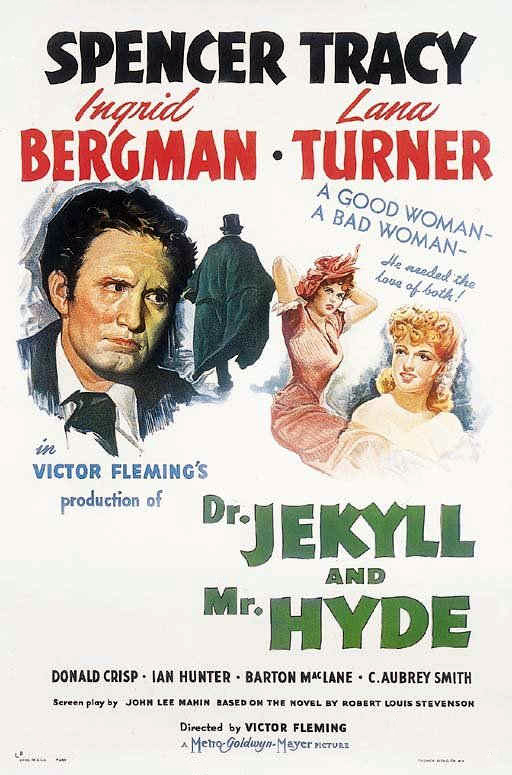
Take for instance the 1941 horror film Dr. Jekyll and Mr. Hyde directed by Victor Fleming (credited director for Gone with the Wind and The Wizard of Oz) and starring Spencer Tracy, Ingrid Bergman, and Lana Turner, who are wrong for three of the four main roles.

Tracy (1900-67) could play the idealistic Dr. Jekyll in his sleep, but he’s simply not believable as the malevolent Mr. Hyde and that’s a major strike against the film because the duality of man theme flies right out the window without a convincing Mr. Hyde.

Bergman (1915-82) sought out the bad girl role Ivy Pearson and she’s plainly just wrong for a lower class trollop and saloon girl, even before Casablanca, Gaslight, and The Bells of St. Mary’s placed Bergman in the popular imagination as the ideal woman. Ironically, Bergman and Tracy dated during Dr. Jekyll and Mr. Hyde and director Fleming reportedly fell in love with her. Her image as the ideal woman cracked and her career in America ended for the better part of a decade circa 1949 after her affair with married Italian director Roberto Rossellini dominated headlines.

Turner (1921-95) plays against type as the good girl Beatrix Emery and she becomes such a nonentity during Dr. Jekyll and Mr. Hyde that we forget she’s even in the picture. Turner later made her enduring fame playing a femme fatale, a la The Postman Always Rings Twice.

Throughout cinematic history, more than 120 adaptations of Robert Louis Stevenson’s 1886 novella Strange Case of Dr. Jekyll and Mr. Hyde exist, with seemingly a major one every decade.

I vote for the superiority of the 1931 version produced by Paramount, directed by Rouben Mamoulian, and starring Fredric March and Miriam Hopkins. It blows the MGM version made 10 years later right straight out of the water and it’s not even close. Ditto for March and Hopkins, as well as Mamoulian, in comparison against Tracy, Bergman, and Fleming.

The 1931 Dr. Jekyll and Mr. Hyde benefited from being made before the Production Code that came into play around 1934 and being made at Paramount rather than MGM.

Hopkins’ Ivy showing March’s Jekyll her leg still stands up as one of the great erotic moments. March never fails to convince us as both Dr. Jekyll and Mr. Hyde, and he deserved to win the Academy Award for Best Actor for his performance. Mamoulian’s creativity shines throughout.

In the early ’30s, Paramount released such films as Morocco, Unfaithful, Dishonored, Tarnished Lady, Tabu, Million Dollar Legs, Horse Feathers, Island of Lost Souls, She Done Him Wrong, Murders in the Zoo, I’m No Angel, Duck Soup, and Design for Living. Paramount also distributed Fritz Lang’s 1931 all-time classic M in March 1933.

By comparison with the wild-and-crazy Paramount, where the Marx Brothers and Mae West once held court, MGM seemed awful stodgy and strange films like Tod Browning’s Freaks, Mark of the Vampire, and The Devil-Doll feel like aberrations on the studio’s permanent record. The folks around MGM reportedly treated Freaks cast members like, well, freaks.

So, in essence, if you have a chance and you’ve not seen it before, please go find the 1931 Dr. Jekyll and Mr. Hyde and watch it as soon as possible.

The Invisible Man (2020)

THE INVISIBLE MAN (2020) *
I should have called the cops on The Invisible Man.

The latest remake of an old Universal Studios warhorse, The Invisible Man gives viewers two hours of domestic violence. That makes it a relentlessly unpleasant and positively joyless viewing experience, and definitely not what I expected from an Invisible Man movie. Obviously, it’s my problem that I entered The Invisible Man expecting a grand old entertainment and received something else that produced the barest minimum of entertainment value.

I know, I know, shame on me.

Recently, I watched The Invisible Woman, Invisible Agent, and The Invisible Man’s Revenge to complete the series of six Invisible Man pictures that began in 1933 with James Whale’s classic and ended in 1951 with Abbott and Costello Meet The Invisible Man. I give five of the six films positive reviews and they’re all entertaining in their own ways — yes, even The Invisible Woman has its moments, few and far between but nonetheless they’re visible.

Invisible Agent wisely took the series in a new direction — a different one from the wrong hard left turn made by The Invisible Woman — incorporating Nazis, Nazi spies, spying against Nazis, and Peter Lorre into the formula. It’s hard not to watch Invisible Agent and think Steven Spielberg loved the movie growing up and it later informed Raiders of the Lost Ark, especially Ronald Lacey’s Peter Lorre-like character.

The Invisible Man’s Revenge returns to the roots of the series and the title describes the plot.

Here’s the length of the first six Invisible Man pictures: 71 minutes, 81, 72, 81, 78, and 82, all well below the 124 minutes offered by the 2020 version.

However, the new Invisible Man contributes maybe five minutes of entertainment value and it’s one of those films I liked less and less as it traveled down a long and predictable road. The earlier Invisible Man films move along briskly, while this marvel of modern technology belabors everything to such a degree that a three-toed sloth dipped in molasses moves faster.

Aside from the invisibility hook and the Griffin surname for the title character and his slimy brother, the new Invisible Man has a lot more in common with the 1991 Julia Roberts battered woman hit Sleeping with the Enemy. By calling it The Invisible Man brand name, though, expectations are high for entertainment, but that’s not what it offers in the slightest so it set itself up for its own failure.

I generally distrust remakes, reboots, sequels, etc., and I am sure that many of us do in varying degrees. I love it when viewers of all demographics bitch and complain about old movies, how they’re crusty and slow-moving and not in color, but they’re plundered from on a regular basis most often with inferior storytelling craft by the new guard.

The Invisible Man director and writer Leigh Whannell previously brought us the first three Saw movies, and so the fact that his Invisible Man wallows in and lingers over domestic violence should be of little or no surprise. Whannell wrote the story or screenplay or both for all three, and starred as Adam Faulkner-Stanheight in Saw. I managed to mostly avoid the once seemingly interminable Saw series, catching only one of the seven films churned out by the foremost torture porn assembly line in seven years. For some unknown reason even to me, I watched Saw IV and hated just about every single millisecond of it. All these years later, I only remember thinking they should have called it Fuck with an exclamation point because that’s about the only dialogue used with any regularity.

Never fear, fans of Whannell and rehashes and Whannell rehashes, because Wolfman and Escape from New York are in pre-production.

Fuck!