King Kung Fu (1976)

KING KUNG FU (1976) Three stars

The Empire State Building, completed just a couple years earlier, played a key role in the 1933 classic KING KONG. At this very moment, we can picture Kong fighting off them darn airplanes from the highest spot in the modern world. Very few endings in movie history can even approach the final minutes in KING KONG. Remains awesome nearly 90 years later.

Meanwhile, our gorilla King Kung Fu takes shapely Pizza Hut waitress Rae Fay to the top of the Holiday Inn Plaza, the tallest building in Wichita at a majestic height of 262 feet, for the grand finale of KING KUNG FU. King Kung Fu battles a stop-motion helicopter piloted by a police captain with a bad John Wayne impersonation. Awesome, in a completely different way.

You win some, you lose some, and often times it seems like Kansas loses on the cultural front, while New York City wins and wins again and again and wins forever more.

Both the Empire State and the Holiday Inn are no longer their cities’ tallest buildings. Heck, the latter is not even the Holiday Inn any more, it’s the 250 Douglas Place Apartments (a.k.a. the Garvey Center). They both are doing quite well for themselves, however, with the Empire State Building in the news in late 2019 for $165 million renovation and being a top tourist destination.

The duo of producer Bob Walterscheid and director Lance D. Hayes started filming KING KUNG FU in 1974 and finished in 1976, but it took another 11 years for Walterscheid to wrangle up the necessary funds to complete the editing on this half-King Kong, half-Kung Fu spoof that has its tongue planted firmly within its cheek. Hell, maybe every cheek in Wichita.

I watched the Korean KING KONG rip-off A*P*E and KING KUNG FU within basically the same 24-hour period.

Objectively, both are “bad” movies, but there’s a world of difference in what both achieve.

A*P*E plays exactly like a cheap, cynical KING KONG rip-off and it’s quite telling that its most famous scene is of the title character flipping the bird.

KING KUNG FU, meanwhile, feels more like a labor of love, an affectionate tribute to King Kong and Kung Fu. Plus, it has this undeniable goofball charm as it tries every lowbrow gag, at least one per minute. Most fail, others succeed, but that’s part and parcel with any sense of humor. I laughed out loud a few times during KING KUNG FU and that’s definitely far more than what I can say for A*P*E.

I laughed at the “Simian Scope” gag at the beginning of KING KUNG FU. This is the first and last movie filmed in “Simian Scope.” We’ve had many variations on CinemaScope over the years: The Shaw Brothers’ “Shaw Scope” being my all-time favorite. Also worth seeking out: The Shaw Brothers released their own take on KING KONG in 1977, MIGHTY PEKING MAN.

I laughed at the John Wayne impersonation, which eradicates the whole “bad” judgment I wrote a few paragraphs back about that impersonation since I believe it was intended to be funny … and … (for a third time) I laughed. We could have used even more scenes with this character played by Tom Leahy, a favorite in the Wichita area for his many years of work in radio and television. Since we have a subordinate officer surnamed Pilgrim, well, you can already guess about half of the dialogue from Mr. Leahy as Captain J.W. Duke. Leahy died in 2010.

The plot: Two would-be reporters Bo (Billy Schwartz) and Herman (Tim McGill) hatch a master plan to free King Kung Fu, a great big gorilla from China whose goodwill tour of the United States stops in Wichita and the Sedgwick County Zoo. Of course, having seen KING KONG, Bo and Herman bait King Kung Fu with Rae Fay (not Fay Wray or Link Wray, for that matter). Sounds like Bo and Herman want to make a movie, one with a happy ending.

Unfortunately, the movie drags just a little bit in the middle section. Plain and simple, it takes way too long for King Kung Fu to be unleashed on Wichita. We get too many scenes with Bo and Herman and their slapstick shenanigans, as the filmmakers seem to have forgotten their own title. Granted, Bo and Herman are likeable oddballs, but they do push endurance levels to breaking point with their schtick in this middle section.

Because we want to see King Kung Fu wreak good-natured havoc on the Old Cowtown Museum, the Joyland Amusement Park (no longer in operation), and Lawrence-Dumont Stadium (demolished for a new facility that will host a new Triple-A franchise named The Wichita Wind Surge, beginning 2020). These scenes are worth their weight in gold.

Never mind Bo’s line, “… Me as the karater and him as the karatee.”

Or the genius in Washington who says, “As you can see, Wichita is located in the center of this great country of ours and it means quite simply we have him surrounded.” That look on his face when he says “It means quite simply we have him surrounded,” I mean, wow, if you watch it now it would be great preparation for the next electoral season.

Guess it should be mentioned King Kung Fu utters dialogue like “I gotta make like a banana and split.” I once told somebody, “Why don’t you make like Michael Jackson and just beat it!”

Believe it or not, KING KUNG FU received a ‘G’ rating. Not many movies are ‘G.’ The Washington Post ran “Rated ‘G’ — For Gone?” in 1992, because a ‘G’ rating became at some point a kiss of death just like X or NC-17 on the other extreme of taste. Disney animated movies survive a ‘G,’ no problem, but little else can break through the stigma associated with ‘G.’

This ‘G’ rating was not a mistake for KING KUNG FU, like, for example, it was for the 1968 Hammer film DRACULA HAS RISEN FROM THE GRAVE. There’s no blood in KING KUNG FU.

You might never look at Wichita quite the same way again after seeing KING KUNG FU.

Conan the Barbarian (1982)

CONAN THE BARBARIAN

CONAN THE BARBARIAN (1982) Three stars

For the longest time, at least since Al Gore invented the Internets, I have thought the ultimate version of CONAN THE BARBARIAN is the 3-minute, 52-second version on YouTube that scores select scenes from the movie with Iron Maiden’s “Run to the Hills.”

As I watched CONAN THE BARBARIAN again, I kept hoping that Basil Poledouris’ score would be replaced by Bruce Dickinson’s wail and the soaring guitars of Dave Murray and Adrian Smith. Alas, it was not to be.

Lyrically, though, it’s not a perfect fit, since Conan seeks revenge against Thulsa Doom, who’s played by none other than James Earl Jones.

Iron Maiden released “Run to the Hills” on February 12, 1982 and THE NUMBER OF THE BEAST album on March 22.

CONAN THE BARBARIAN came out on May 14, 1982.

Both works proved to be controversial.

Critics thought CONAN THE BARBARIAN was either too violent or that it fell too short of the violence in the source material. That was the biggest controversy for John Milius’ film.

Of course, with an album title like THE NUMBER OF THE BEAST, Iron Maiden were called Satanists and boycotts, record burning, and demonstrations were organized by religious groups in the United States. Just picture old women smashing hundreds of copies of THE NUMBER OF THE BEAST to bits with their hammers.

“The Number of the Beast,” though, is not 867-5309.

Sword and sorcery films were big in the 1980s, a fantasy sub-genre defined as “sword-wielding heroes engaged in exciting and violent adventures. An element of romance is often present, as is an element of magic and the supernatural.”

CONAN THE BARBARIAN inspired a steady stream of imitations and knockoffs, like the DEATHSTALKER series: A big man with a big sword, busty women, and plenty of sex, violence, and head-splitting gore. Not that there’s anything wrong with that.

I had forgotten (shame on me) the amount of nudity during the first hour of CONAN and here I thought that I never forget a nude scene. (For what it’s worth, I remembered Sandahl Bergman’s shining moments in CONAN.)

Then, down the home stretch, CONAN turns up the violence to an operatic level. There’s also an orgy late in the picture.

Arnold Schwarzenegger was born to play Conan and he played him twice, less effectively though a second time. Arnold also played supporting role Lord Kalidor in RED SONJA, so three of his four films made for sultan of schlock producer Dino DeLaurentiis were sword and sorcery. Ed Pressman and fellow producer Edward Summer had considered Charles Bronson, Sylvester Stallone, and William Smith for the Conan role, but they found Arnold to be the embodiment of Conan the Barbarian after they watched a rough cut of PUMPING IRON. The success of both CONAN and THE TERMINATOR made Arnold a star.

Before CONAN, Arnold found mixed success in the motion picture business. In his 1969 debut HERCULES IN NEW YORK, Arnold’s thick Austrian accent required a dub job and the film credits him as “Arnold Strong ‘Mr. Universe’” partly to play against the name of co-star Arnold Stang. If you watch HERCULES IN NEW YORK, you will be amazed that Arnold ever had a motion picture career. I’ve seen it several times and it gets me every single time.

Other than PUMPING IRON, Arnold’s best early career role is Joe Santo in STAY HUNGRY, where he played alongside Jeff Bridges and Sally Field in a supporting role. This is a role that stands alone in a Schwarzenegger filmography populated with action and comedy.

CONAN started Arnold’s decade long run of solid action movies. Why did this seemingly muscle-bound guy with a ridiculous accent become at one point the biggest movie star in the world? Siskel & Ebert pondered that very question in an entire show dedicated to Arnold called “Arnold Schwarzenegger: The Unlikeliest Star.”

A joy of performance is the one element that Arnold exudes in all his best films and it’s what separates him from his competition.

Arnold meets his match in Broadway dancer Sandahl Bergman and when she and Arnold pair up, CONAN truly kicks into gear. The 6-foot tall Bergman (this Shawnee Mission East High graduate liked to say that she’s 5-12 rather than 6-0 because no girl should have to be 6-0) possesses an impressive physicality that’s not dwarfed by Arnold or any of her male co-stars and she exudes the same joy of performance as Arnold.

There’s certainly not been another woman, not Grace Jones in CONAN THE DESTROYER or Brigitte Nielsen in RED SONJA, paired more effectively on screen with Arnold than Bergman.

James Earl Jones became a popular villain after STAR WARS came out in 1977; Jones lent his voice to Darth Vader because director George Lucas did not want David Prowse’s English accent for Vader. Never mind Jones’ role as the older Kokumo in EXORCIST II: THE HERETIC, which was released not long after STAR WARS during the summer of ‘77. Just imagine the collection Jones possibly built from his villainous roles in the STAR WARS films, THE HERETIC, and CONAN. Not only Darth Vader’s helmet, but also his locust costume from THE HERETIC and possibly the snake from CONAN after his transformation. Later in the 1980s, Jones began playing kindly older men and that’s where he’s been ever since.

In addition to Jones, Max von Sydow (most famous for his work with Ingmar Bergman and THE EXORCIST) and Mako (Academy Award nomination for Best Supporting Actor for THE SAND PEBBLES) also lend their gravitas to the proceedings.

When he was the Governor of California, did Arnold read the following dialogue, “To crush your enemies, to see them driven before you, and to hear the lamentations of their women,” or say the following prayer, “Crom, I have never prayed to you before. I have no tongue for it. No one, not even you, will remember if we were good men or bad. Why we fought, or why we died. All that matters is that two stood against many. That’s what’s important! Valor pleases you, Crom … so grant me one request. Grant me revenge! And if you do not listen, then to HELL with you!”

Let’s hope there’s a soundboard with Arnold’s CONAN dialogue out there somewhere. This would restore a smidgen of my faith in humanity.

King Kong vs. Godzilla (1963)

KING KONG VS. GODZILLA

KING KONG VS. GODZILLA (1963) Three stars

The Japanese champion Godzilla had last appeared in GODZILLA RAIDS AGAIN in 1955 or in the American version GIGANTIS, THE FIRE MONSTER in 1959.

The American champion King Kong (guess we claim the big lug, though we kidnapped him from Skull Island and brought him to the Big Apple) had last appeared in SON OF KONG in 1933. Yes, they rushed out a sequel nine months after the seminal KING KONG.

With a title like KING KONG VS. GODZILLA, maybe we can take a guess at the content of the third GODZILLA and third KING KONG film. Three is the magic number, right? At least it was in Japan, where its success at the box office inspired Toho to continue the Godzilla series.

Both monsters appear in color for the first time.

Like a lot of Jackie Chan films, the Godzilla films appeared in radically different forms when they invaded America after their original release.

It started with the very first GODZILLA in 1954, released two years later in America as GODZILLA, KING OF THE MONSTERS. This new version excised 16 minutes of footage from the original, mainly the political, social, and anti-nuclear themes so vital to the Japanese version. Remember that GODZILLA came out less than a decade after Hiroshima and Nagasaki. The American producers sponsored new footage and inserted American journalist Steve Martin (Raymond Burr), used mostly in flashbacks and voice-over narration. Japanese-American actors and look-alikes had to be used to attempt to make it seem like Martin had been in the original film. Martin speaks into a tape recorder, “George, here in Tokyo, time has been turned back two million years. This is my report as it happens. The prehistoric monster the Japanese call ‘Godzilla’ has just walked out of Tokyo Bay. He’s as tall as a 30-story building.”

In America, KING KONG VS. GODZILLA follows that KING OF THE MONSTERS format, as we get a series of talking head scenes before we finally get down to the heavy-duty monster battle royal in the let’s say last half. Several years ago, I wrote a negative review of KING KONG VS. GODZILLA because I wanted to yell at United Nations reporter Eric Carter to shut his big fat trap and just let the title characters fight. On the latest watch or two, after purchasing a VHS copy (GoodTimes big box, no less, with a blurb from Leonard Maltin, “Above average special effects”) recently, I enjoyed the film a lot more than I had before.

Now, I think of the Eric Carter and the blah, blah, blah gang as the wrestling commentators on a big pay-per-view hyping up Hulk Hogan vs. Andre the Giant, for example. King Kong vs. Godzilla and Hulk Hogan vs. Andre the Giant have equal stature in my estimation.

I just love monsters fighting and the Godzilla films delivered that for nearly a 15-year period beginning with KING KONG VS. GODZILLA and continuing through Ghidorah, Mothra, Rodan, Ebirah, the Smog Monster, Gigan, Megalon, and Mechagodzilla. Technically, it started with GODZILLA RAIDS AGAIN when Godzilla fought Anguirus … or when Kong battled a T-Rex in the original KONG.

What was the genesis of KING KONG VS. GODZILLA?

Stop motion animator pioneer Willis O’Brien (1886-1962), who did the work for both KONG films, created a story outline where Kong battled Frankenstein’s Monster. O’Brien gave the outline to producer John Beck to develop a project, but Beck took the project instead to Toho behind O’Brien’s back. The rest is history, including Frankenstein’s Monster.

Some of us are probably thinking right about now that it does not seem like a fair fight between Kong and Godzilla. Over the years, Godzilla’s size has varied greatly from 164 feet tall in 1954 to 492 feet tall 60 years later. Kong, meanwhile, stands at 24 feet at his highest height in 1933. KING KONG VS. GODZILLA makes Kong 147 feet tall.

Machine gun fire topples Kong from the Empire State Building, while Godzilla seems virtually indestructible despite the best efforts of the military. Well, let’s just say that lightning gives Kong incredible powers; later in the Godzilla series, lightning would have the same effect on Godzilla. Maybe one day we’ll have a film combining Frankenstein’s Monster, Godzilla, King Kong, and Jason Voorhees, and we’ll call it LIGHTNING STRIKES.

A legend grew up around KING KONG VS. GODZILLA that Kong won in the American version and Godzilla won in the Japanese version. That’s not true. I mean, for crying out loud, Kong gets top billing in the title.

Foul Play (1978)

FOUL PLAY

FOUL PLAY (1978) Three stars

Universal Studios demanded that Chevy Chase, the first breakout star from “Saturday Night Live,” be cast in NATIONAL LAMPOON’S ANIMAL HOUSE. However, in a lunch between ANIMAL HOUSE director John Landis, producers Matty Simmons and Ivan Reitman, and Chase, Landis played a Jedi mind trick on Chase, telling him that ANIMAL HOUSE would be an ensemble piece whereas FOUL PLAY would let Chase be a star. Chase stayed with FOUL PLAY and ANIMAL HOUSE cast Tim Matheson in the Otter role.

FOUL PLAY debuted July 14, 1978, and ANIMAL HOUSE came out two weeks later.

ANIMAL HOUSE made $141.6 million on a $3 million budget and changed the face of comedy forever. Yes, every year we get at least one comedy that would not have been possible without the example set by ANIMAL HOUSE. Meanwhile, FOUL PLAY generated $45 million and has been consigned to the margins of history.

It’s certainly not a bad movie by any stretch of the imagination, but it does pale in comparison when stacked up against ANIMAL HOUSE. Granted, FOUL PLAY chased different goals than the undeniably anarchic, anti-establishment ANIMAL HOUSE.

FOUL PLAY is the byproduct of writer and director Colin Higgins (1941-88). He’s one of those cases where you just might not know the name but you definitely know his movies. He made his name in Hollywood by penning the screenplay for the legendary cult favorite HAROLD AND MAUDE (1971). Five years later, he wrote the screenplay to SILVER STREAK, a comedic thriller hit pairing Gene Wilder and Richard Pryor. Higgins made his directorial debut with FOUL PLAY and would end with three directorial credits, 9 TO 5 and THE BEST LITTLE WHOREHOUSE IN TEXAS his second and third efforts. Additionally, Higgins wrote the screenplay for all three comedies he directed. All five comedies enjoyed some level of success.

Nominally Chase and Goldie Hawn are the stars of FOUL PLAY, but the writing and directing style of Higgins should not go unappreciated.

Both SILVER STREAK and FOUL PLAY stand out from HAROLD AND MAUDE, 9 TO 5, and THE BEST LITTLE WHOREHOUSE, in the fact they are heavily influenced by Alfred Hitchcock. SILVER STREAK screams Hitchcock’s 1938 thriller THE LADY VANISHES and FOUL PLAY references THE 39 STEPS, SABOTEUR, NORTH BY NORTHWEST, THE MAN WHO KNEW TOO MUCH, NOTORIOUS, VERTIGO, and PSYCHO. Fans of the Master of Suspense will also be delighted by Higgins’ inclusion of what the maestro called “The MacGuffin,” which is a roll of film hidden in a pack of cigarettes in FOUL PLAY.

I know that Hitchcock himself loved Mel Brooks’ HIGH ANXIETY, a 1977 affectionate spoof of suspense films mostly focused on Hitchcock’s SPELLBOUND, VERTIGO, PSYCHO, and THE BIRDS, so it is quite possible that he enjoyed FOUL PLAY.

In FOUL PLAY, librarian Gloria Mundy (Hawn) finds herself in the midst of a bizarre plot that ultimately involves an assassination attempt on the pope. We have a dwarf, an albino, a wild and crazy guy who attempts to seduce Miss Mundy, a karate fight between two highly unlikely combatants, an endless chase scene, and a pair of Japanese tourists who are big fans of Kojak and bang, bang! This is a pleasantly silly concoction and Hawn takes us through what turns out to be an overlong motion picture at 115 minutes. Or maybe it just felt that way every single damn time I heard the song “Ready to Take a Chance Again,” which predated the similar use of the song “That’s What Friends Are For” a few years later in NIGHT SHIFT. In both cases, I was ready to hear another song again instantly.

What about Chase? He’s part of an ensemble and he almost gets lost in the shuffle at times in his first movie leading role, but this is one of his better performances and his best films. Chase plays a capable leading man paired with Hawn.

Dudley Moore (1935-2002) basically steals every scene that he’s in and his work here led to his being cast in Blake Edwards’ 10, Burgess Meredith (1907-97) made four movies in 1978 and this is the one where his character knows martial arts, and Rachel Roberts’ last screen credit before FOUL PLAY was the eccentric Australian thriller PICNIC AT HANGING ROCK. Moore and Brian Dennehy, Chase’s partner, appeared together in 10.

FOUL PLAY is a minor film with minor charms, but sometimes that’s more than enough or just enough to hit the spot.

The Last House on the Left (1972)

LAST HOUSE ON THE LEFT

THE LAST HOUSE ON THE LEFT (1972) Three stars
Former academic Wes Craven (1939-2015), who also did some work on pornographic films under different aliases, made a big bang with his feature debut THE LAST HOUSE ON THE LEFT, one of the great shockers of the seventies.

It’s an exploitative American modern take on Ingmar Bergman’s THE VIRGIN SPRING (1960), a film itself based on a 13th Century Swedish folk ballad. THE VIRGIN SPRING won the Academy Award for Best Foreign Language Film at the 1961 Academy Awards.

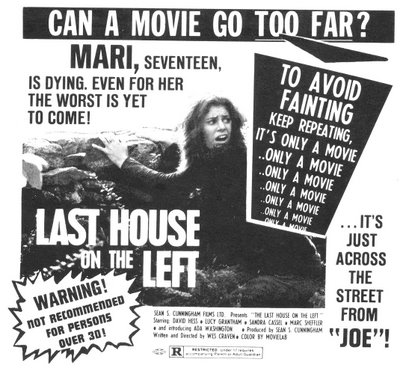
The film’s classic tagline, “To avoid fainting, keep repeating: It’s only a movie, only a movie, only a movie. …” Viewers had a variety of extreme reactions, of course which only helped to hype the film en route to $3.1 million in returns on a $87,000 budget.

Theaters and drive-ins showed LAST HOUSE in many different prints, because individual machinists took it upon themselves to make their own cuts. Normally, the most shocking bits would end up missing. Good luck finding an uncut version of the film.

It received some of the nastiest reviews imaginable, which made seeing the film again seem like more of an event, a happening. Writing for the New York Times, Howard Thompson said, “When I walked out, after 50 minutes (with 35 to go), one girl had just been dismembered with a machete. They had started in on the other with a slow switch blade. The party who wrote this sickening tripe and also directed the inept actors is Wes Craven. It’s at the Penthouse Theater, for anyone interested in paying to see repulsive people and human agony.” Roger Ebert wrote just about the only positive review at the time of the film.

I first watched it about 10 years back and I thought it was a powerful work. I wrote a very positive review somewhere and I gave it three-and-a-half stars. I found it less powerful after subsequent viewings.

Craven and crew made some appalling choices that create a split personality movie.

Watching LAST HOUSE for the first time, you might notice the buffoonish antics of the Sheriff (Marshall Anker) and the Deputy (Martin Kove). Their comedic relief never works and in fact they play like failed slapstick comedy dropped in from another movie. I noticed this element upon first viewing and it was the reason I graded THE LAST HOUSE ON THE LEFT three-and-a-half rather than four stars.

PSYCHO. Herrmann. SUSPIRIA. Goblin. HALLOWEEN. Carpenter.

Well, you’ll never find THE LAST HOUSE ON THE LEFT soundtrack filed alongside those indelible horror movie scores and their composers. That’s why I started a new paragraph.

David Hess, who plays the main villain Krug, wrote and performed four songs for the movie: “The Road Leads to Nowhere” (the best song of the bunch), “Wait for the Rain,” “Sadie and Krug (Baddies’ Theme),” and “Now You’re All Alone.”

Upon more viewings, this music stuck out like a sore thumb, one that poked me right straight in the eye. I’m not sure why I overlooked the music the first time around.

Krug the character, played by Hess the actor, would have killed Hess the singer and songwriter, just slit his throat for singing one of those ridiculous songs. Believe it or not, Hess wrote “Speedy Gonzales,” which became a big hit for Pat Boone in the year 1962.

I still deduct one-half star from LAST HOUSE for the rumbling bumbling stumbling cops and a good quarter star for them Hess songs.

Hess (1936-2011) is so good as the bad guy in LAST HOUSE that we can understand precisely why he became typecast as villain. He played one of the henchmen in Craven’s SWAMP THING.

Sandra Peabody and Lucy Grantham play Mari and Phyllis, who are kidnapped, tortured, raped, and murdered by Krug and company. They have the most difficult roles.

Filming LAST HOUSE proved to be a horrifying ordeal for Peabody, especially since Hess believed in method acting and even threatened assaulting her for real during a rape scene. Peabody dropped out from acting in 1974, after being cast in movies like VOICES OF DESIRE and MASSAGE PARLOR MURDERS! She went into screenwriting, producing children-orientated entertainment, and being an acting coach.

Fred Lincoln (1936-2013) played Weasel, one of Krug’s nasty associates, and LAST HOUSE marked Lincoln’s only non-pornographic role. Lincoln directed more than 300 films; the Internet Movie Database lists 340 directorial credits for the New York native.

Jeramie Rain, who played the vicious Sadie, was married to Richard Dreyfuss from 1983 to 1995 and their union produced three children. She once hitched a ride with real-life serial killers Charles Manson and Tex Watson. That’s fitting because LAST HOUSE seems to have been heavily influenced by the Manson Family and their murders.

Richard Towers and Eleanor Shaw, under different names, play Mari’s parents Dr. John and Estelle Collingwood, highly respectable upper middle class folk. Krug and his gang disguise themselves as traveling salesmen and they call upon the Collingwoods. Both parties eventually discover the others’ identities: The Collingwoods find out their guests killed their daughter and Krug and company discover that Dr. John and Estelle are Mari’s parents.

Dr. John and Estelle devise some elaborate booby traps and Craven displays his fondness for booby traps for the first time. Booby traps also played a role in both THE HILLS HAVE EYES and A NIGHTMARE ON ELM STREET. I believe that Craven should have directed at least the first HOME ALONE, given his predilection for booby traps.

This juxtaposition of seeing a socially respectable upper middle class couple getting down-and-dirty to exact revenge has been one of the most fascinating elements at work in LAST HOUSE. You just might find yourself asking, “What would I do if I found myself in a similar situation?”

Though it’s not a classic on the same level as both NIGHT OF THE LIVING DEAD and THE TEXAS CHAINSAW MASSACRE, LAST HOUSE is essential viewing for horror fans.

Teen Wolf (1985)

TEEN WOLF

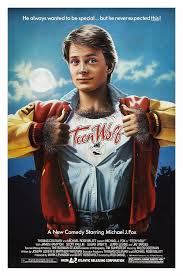
TEEN WOLF (1985) Three stars

During the review of SILVER BULLET, TEEN WOLF came to mind and then I looked up a rather negative review I wrote 10 years ago.

A decade later, I recommend TEEN WOLF for the very things I once mocked. Here’s the original two-star review (with only small edits):

“TEEN WOLF almost succeeds in spite of itself and I do mean in spite of itself.

“The film stockpiles a nuclear arsenal of cliches. Next time I see Kim Jong-Il I will ask him what he thinks of the film, in between our usual rap session ‘bout FRIDAY THE 13TH films. Let’s see, I’ll have to make a list otherwise my brain will explode and that cannot happen before Finals Week, let alone Dead Week.

“I’ll briefly mention 1) the Nebraska small town setting; 2) the loving, single widower and his teenage son protagonist on their own; 3) the teenage son protagonist feels he’s doomed to an eternity of being “average” until he finds out that he can be a teenage werewolf just like Michael Landon and the Cramps song before him; 4) the protagonist’s hipster and profiteer best friend; 5) the “fat guy” fifth wheel nicknamed, oh you’ll love this one, “Chubby”; 6) The Blonde = Bad Girl and The Brunette = Good Girl formula; 7)the protagonist lusts after the Blonde, actually succeeds in sleeping with the Blonde as the Wolf, and ends up realizing his undying love for the Brunette in the final act though she prefers “average” Scott Howard over the Wolf; 8) the Blonde’s Evil Overlord of Brooding Hot Shot boyfriend and the protagonist’s eternal foil; 9) the Evil Principal; 10) the wise guy head basketball coach who spits out incantations of advice rejected by Fortune 500 fortune cookie companies; 11) the scene where the protagonist faces down a wily old liquor store veteran who’s heard every scam ever to purchase some alcoholic contraband for a monster party; 12) The Monster Party; 13) The Big High School Dance; and I believe I’m done after this one, 14) The Big Game. Sorry, I apologize in advance for missing a few there.

“Once we grant the film’s central premise, that werewolf genes run down a family’s genetic line, which sounds too much like TWILIGHT for its own good before Taylor Lautner was even born, what’s wrong with a few generic movie standards? Nothing, absolutely nothing, except for when taken in tandem our friendly standards make for a generic motion picture spread. TEEN WOLF almost set the cliche land speed record.

“Michael J. Fox makes for a likable, charismatic protagonist and his energetic movie star performance lets us live through standard, predictable material. He enlists us on his side, whether he’s average small town boy lined up to inherit his father’s small town hardware store, Scott Howard, or his alter ego, ultra-cool and ultra-hip and dazzling slam dunker “The Wolf.” Fox essentially plays the Lon Chaney existential dread film werewolf crossed with John Travolta in SATURDAY NIGHT FEVER (at least for the big dance sequence and the big preparation for the dance sequence) and Julius Erving, as well as having issues with anger management and teenage angst.

“Do teen wolves get pimples? TEEN WOLF fails to address several burning questions. Especially not a PG-rated TEEN WOLF. Fox plays these scenes ‘bout as good as any actor possibly can and we stomach him through every predictable change like, for example, how Scott Howard transforms himself into above average when he’s the Wolf: He can dance, he can act, he can surf on slow-moving customized Wolf vans, and he can play mean basketball. Scott Howard eventually turns his back on ‘Wolf Mania’ and decides to be himself for The Big Game.

“James Hampton must have enjoyed playing a humble, sagely teenage protagonist’s old man in TEEN WOLF, considering his past as evil public relations man in THE CHINA SYNDROME and his future as evil federal regulatory agency man in PUMP UP THE VOLUME. Susan Ursitti breathes some fire into her standard issue role as the Brunette / Good Girl and this is both good and bad, good because it makes our lives relatively less boring and bad ‘cause we get even more frustrated by the wait for the inevitable dramatic (overdue) realization made by the protagonist that she’s meant for him, forever. The Bad Girl and her maligned Evil Overlord of Brooding Hot Shit boyfriend are the only characters who fail to entertain us, interest us, et cetera. They’re not very good performers and it’s painful waiting for their inevitable downfalls.

“Surely Teen Wolf’s impressive slam dunk artistry did not inspire Spud Webb, the 5’7” Atlanta Hawks point guard who prevailed in the NBA Slam Dunk Contest at the 1986 NBA All-Star Weekend in Dallas, besting his own Atlanta Hawks teammate, Dominique Wilkins. Michael J. Fox, why he’s short and he’s Canadian, two proverbial strikes against him, so naturally it takes a stunt double werewolf for him to slam dunk. I would have thought a werewolf’s claws would have made playing basketball like a proverbial artiste virtually impossible. Anything goes, in the movies.

“Hey wait, lovely lads and lovely ladies, I recollect another standard trotted out by TEEN WOLF. The montage. The “Winning Streak” Montage. The Car Surfing Montage. The Big High School Dance Montage. The Big Game Montage. Hyperkinetic action scored by a hyperkinetic rock song. For the big dance montage, we get a bad theme song namedropping “The Big Bad Wolf.” It’s an unwritten rule that any 1980s movie referencing itself in song, like PROM NIGHT and BETTER OFF DEAD, will turn out crap. When in doubt, filmmakers, yes, bring on a montage of hyperkinetic action (basketball, dancing, violence) scored by hyperkinetic rock music. TEEN WOLF competes with THE HEAVENLY KID and OVER THE TOP for montage land speed record. I bet the composers do not put TEEN WOLF down on their permanent record.

“Oh, now I remember a couple more standard tricks exploited by TEEN WOLF. Slow motion. BONNIE AND CLYDE and THE WILD BUNCH used slow motion to brilliant effect, as did early Bruce Lee karate films, but lesser films like BLACK BELT JONES made slow motion passé, not to mention its overuse on sports television. Want to see Teen Wolf slam dunk for what feels like the hundredth billionth time? Watch TEEN WOLF! Want to see “average” Scott Howard’s lay-up that barely makes it around the cup and in? Watch TEEN WOLF!

“Now, here we have a standard within a standard: late in the game, Scott Howard gets clotheslined on a final shot layup attempt by his eternal foil (at least for 90 minutes eternity) and his team, the Beavers, are down by one point and two made free throws will naturally win The Big Game for the Beavers.

“Howard steps to the free throw line … his eternal foil stares him down … he makes the first one, smoothly … the second free throw … it’s released … it’s looking good … it’s SLOW MOTION … slower and slower … oh no! … it hits the back of the rim … slower and slower and even slower motion … it touches almost every corner of the rim … and it finally rolls in … reaction shots galore … NO MORE SLOW MOTION … and the crowd storms the court in celebration of either the end of the Big Game, the end of the movie, the end of shooting the movie, or all three simultaneously. I’ll bet on all three ‘cause I know they were solid pros.

“Rod Daniel, oh what a director, this here Rod Daniel. TEEN WOLF perhaps represents the peak of Rod Daniel’s cinematic directorial career, TEEN WOLF up against the Dudley Moore-Kirk Cameron body switch masterpiece of dreck cinema LIKE FATHER LIKE SON and the BEETHOVEN sequel. I favor a slam-dunking, breakdancing Teen Wolf over a born again Kirk Cameron (Jesus couldn’t save Kirk Cameron’s acting) and Charles Grodin overshadowed by a dog. At least, Daniel had the decency not to direct TEEN WOLF TOO. On this or any other job, you win some, you lose some.”

Not sure what came over me when I wrote that review 10 years ago, especially since I have enjoyed TEEN WOLF many times over the years. A lot of the success of TEEN WOLF has to do with Michael J. Fox at the center. After all, with Jason Bateman in the title role instead, TEEN WOLF TOO proved to be a disaster, although that’s partly because TEEN WOLF did not require a sequel.

An American Werewolf in London (1981)

AN AMERICAN WEREWOLF IN LONDON

AN AMERICAN WEREWOLF IN LONDON (1981) Three stars

The 1980s were a golden age for comedy horror: GREMLINS, GHOSTBUSTERS, RE-ANIMATOR, EVIL DEAD II, FRIGHT NIGHT, LITTLE SHOP OF HORRORS, and KILLER KLOWNS FROM OUTER SPACE.

I’d put AN AMERICAN WEREWOLF IN LONDON among the second tier of 1980s comedy horror films, below every film listed in the opening paragraph. Do not fear, though, because it’s still a good movie.

AMERICAN WEREWOLF specializes in dark comedy, very very very dark, even beyond morbid especially when a dead Jack Goodman (Griffin Dunne) haunts best friend David Kessler (David Naughton) as Mr. Kessler becomes the title character. Jack tells David that he must kill himself before he kills others and that he’s under the werewolf’s curse. Jack still has that same way with words he had when he was alive; that’s why David tells Jack, “I will not be threatened by a walking meatloaf.” Poor, poor Jack.

Of course, all this started when David and Jack, two American college students on a walking tour, stop at the Slaughtered Lamb. We’ve all heard of the Wrong Gas Station, a hallmark of many horror movies, but the Slaughtered Lamb represents the Wrong Drinking Establishment. You have to be real thirsty or hungry or both to stop at the Slaughtered Lamb. The regulars don’t exactly warm to no bratty Americans in the first place, but the irrepressible Jack sticks his foot in his mouth big time when he blurts out about a pentagram. The conspiratorial patrons give Jack and David the boot, although Jack and David are told very specifically to stay on the road and not to go into the moors. I believe that I last saw that setting in the 1939 Basil Rathbone Sherlock Holmes movie HOUND OF THE BASKERVILLES. I love the moors in the movies.

Of course, we all know that David and Jack don’t stick to the road and go exactly where they’re not supposed to go.

1981 featured three good wolf movies: THE HOWLING premiered March 13, WOLFEN July 24, and AMERICAN WEREWOLF August 21. For the record, I prefer both WOLFEN and THE HOWLING over AMERICAN WEREWOLF, and that’s an indication just how great of a year it was for movies about wolves. All three have their own distinct qualities, though both Joe Dante’s THE HOWLING and John Landis’ AMERICAN WEREWOLF pursue laughter far more than Michael Wadleigh’s WOLFEN.

All three stand out for their special effects: Rob Bottin and Rick Baker, who previously worked together on Dante’s PIRANHA, battled for werewolf transformation superiority and Baker’s makeup work on AMERICAN WEREWOLF earned him the first Academy Award for Best Makeup, as he beat out Stan Winston on the comedic craptacular HEARTBEEPS. The overshadowed WOLFEN did some innovative things with sound and image to depict the world of the wolf.

At this point in Landis’ career, the controversial director was on a major roll with a three-picture run of NATIONAL LAMPOON’S ANIMAL HOUSE, THE BLUES BROTHERS, and AMERICAN WEREWOLF. This was before TWILIGHT ZONE: THE MOVIE, when actor Vic Morrow and child actors Myca Dinh Le and Renee Shin-Yi Chen were killed in a helicopter accident during filming in July 1982.

The National Transportation Safety Board reported a couple years later: “The probable cause of the accident was the detonation of debris-laden high temperature special effects explosions too near a low-flying helicopter leading to foreign object damage to one rotor blade and delamination due to heat to the other rotor blade, the separation of the helicopter’s tail rotor assembly, and the uncontrolled descent of the helicopter. The proximity of the helicopter to the special effects explosions was due to the failure to establish direct communications and coordination between the pilot, who was in command of the helicopter operation, and the film director, who was in charge of the filming operation.”

(If you want to watch something fucked up, you can find “Vic Morrow’s Death Video” on YouTube. The rotor blades decapitated Morrow and Le and the right landing skid crushed Chen to death. All three died instantaneously. For this reason and the fact that it’s not very good, I cannot watch Landis’ installment in TWILIGHT ZONE: THE MOVIE and skip ahead on the DVD to the Joe Dante and George Miller portions of the program.)

Despite being acquitted of involuntary manslaughter after a nine-month jury trial over 1986 and 1987, Landis’ reputation rightfully took a major hit … and every single thing you can find about the incident makes Landis seem like the ultimate asshole director, worse than Hitchcock, worse than Kubrick, worse than Lang, worse than Preminger, worse than Woody Allen, worse than any other director in relentless pursuit of perfection. Landis broke California child labor laws by hiring both child actors without their required permits, in addition to his reckless behavior filming the nighttime helicopter sequence. None of this should have ever happened and Landis served not a single second of time for his crimes.

TRADING PLACES and COMING TO AMERICA both were hits directed by Landis. He also directed the nearly 14-minute music video for Michael Jackson’s “Thriller,” a job Landis earned after Jackson saw AMERICAN WEREWOLF. It is widely considered the greatest musical video of all-time.

Back to AMERICAN WEREWOLF.

AMERICAN WEREWOLF represents a throwback to the horror movies of the 1930s, especially the ones from Universal, updated with gore, nudity, and profanity of a modern era.

Like several other films from the 1980s, it deftly balances laughs and scares just right so often.

AMERICAN WEREWOLF, though, falls shy of greatness: There’s a lot to love, especially in the first 30 minutes, but I’ve never loved its ending (full half-point deduction alone for this deficiency) and I just cannot believe the savvy Landis did not choose Warren Zevon’s “Werewolves of London” — Lon Chaney Sr. and Jr. references on top lyrics “You hear him howling around your kitchen door / You better not let him in / Little old lady got mutilated late last night / Werewolves of London again” and “He’s the hairy-handed gent who ran amuck in Kent / Lately he’s been overheard in Mayfair / You better stay away from him / He’ll rip your lungs out, Jim / I’d like to meet his tailor.” In other words, Zevon’s dark sense of humor would have fit AMERICAN WEREWOLF, just like a wolf suit.

No matter how many times I’ve heard CCR’s “Bad Moon Rising” and Van Morrison’s “Moondance,” they still thrill and AMERICAN WEREWOLF uses them perfectly, especially pairing Morrison’s lyrics “Well, I want to make love to you tonight / I can’t wait ’til the morning has come / And I know now the time is just right / And straight into my arms you will run / And when you come my heart will be waiting / To make sure that you’re never alone / et cetera” with the escalation in David’s relationship with friendly nurse Alex (the alluring Jenny Agutter).

I’ll end this review with a warning to stick to the original and please do not watch AN AMERICAN WEREWOLF IN PARIS.

Tourist Trap (1979)

TOURIST TRAP


TOURIST TRAP (1979) Three stars

TOURIST TRAP belongs to a rather fine and distinguished horror movie tradition I’ll call “American Gothic” (forget the famous 1930 painting by Grant Wood).

Other films that fit the bill are several Universal productions, Val Lewton productions beginning with CAT PEOPLE, HOUSE OF WAX, PSYCHO, NIGHT OF THE LIVING DEAD, THE LAST HOUSE ON THE LEFT, TEXAS CHAINSAW MASSACRE, EATEN ALIVE, THE HILLS HAVE EYES, and FUNHOUSE. As you can see, directors Wes Craven (1939-2015) and Tobe Hooper (1943-2017) both liked this mode.

“American Gothic” horror films are heavy on atmosphere, whether they’re filmed in black & white or color. They often delight in exposing the darker underbelly of American society after such happenings as the closing of the local slaughterhouse or the roadside wax museum that once existed on the right side of the road before it was bypassed. They sometimes take on the disintegration of the family unit or any number of issues plaguing our society. “American Gothic” films are rich in metaphorical readings.

Since it belongs to such a fine tradition, you’ll be able to recognize TOURIST TRAP right off the bat and see that it’s a dab of HOUSE OF WAX layered on top THE HILLS HAVE EYES or any of the seemingly hundreds of horror movie plots that begin with car trouble and the wrong gas station and end after several deaths.

Later on, you’ll note that it’s also a pinch of PSYCHO and a dash of TEXAS CHAINSAW MASSACRE — Chuck Connors plays wax museum proprietor Mr. Slausen in the grand old Anthony Perkins as Norman Bates style (a hallmark “American Gothic” element)  and production designer Robert Burns worked on both TEXAS CHAINSAW and THE HILLS HAVE EYES.

Just like the Bates Motel had seen better days before PSYCHO, so had Mr. Slausen’s “Slausen’s Lost Oasis.” Nowadays, Mr. Slausen’s wax museum would have been profiled by Roadside America, the guide to “uniquely odd tourist attractions,” and it could have survived and even thrived off this exposure.

If you find wax figures, mannequins, human replicas, et cetera, repellent or they weird you the fuck out, then you will enjoy TOURIST TRAP.

I especially recommend seeing the film before stopping in at Jesse James Wax Museum right off the highway in Stanton, Missouri.

It’s your patriotic duty.

TOURIST TRAP creates a creepy, claustrophobic atmosphere transcendent of the standard issue plot.

From the brilliant opening scene all the way to the bitter end about 90 minutes later, there’s somebody eyeball stalking the protagonists in every scene in TOURIST TRAP.

That somebody’s usually a wax figure, mannequin, human replica, etc., and that’s just creepy, for lack of a better word.

For many years, TOURIST TRAP itself met the fate of “Slausen’s Lost Oasis,” seemingly forgotten and consigned to being a relic of a bygone era of horror movies. Never mind Stephen King’s recommendation in his 1981 book “Danse Macabre.”

The film has made a comeback in recent years.

Cinemassacre’s “Monster Madness” featured TOURIST TRAP in 2014.

In July 2018, Joe Bob Briggs opened “The Last Drive-In with Joe Bob Briggs” by showcasing TOURIST TRAP.

It just goes to show you that nobody can ever keep an “American Gothic” horror film down for too long.

Squirm (1976)

SQUIRM

SQUIRM (1976) Three stars

You either have a predisposition for liking a silly creature feature like SQUIRM or you don’t.

I thankfully do.

Just a couple quick statements.

1) That’s a lovely title.

2) It’s produced by American International Pictures (1954-80), one of the best production outfits in the motion picture business.

3) I’d rate SQUIRM the second-best killer worm picture right after TREMORS.

Granted, I’m not exactly sure how many killer worm movies there are in existence.

SQUIRM, written and directed by Jeff Lieberman, reminds yours truly of the 1972 classic from American International, FROGS.

American International promoted FROGS with the immortal tagline “Today the pond, tomorrow the world.”

Meanwhile, SQUIRM received, “This was the night of the crawling terror!” Crawling terror in all caps! Like CRAWLING TERROR!

The opening title card informs us that SQUIRM is “based on a true story.” Are you gonna fall for that one?

Intense storms hit Fly Creek, Georgia and electricity from downed power lines + wet soil creates mad worms … and they develop an insatiable taste for human flesh. Of course, they do … or we’d not have much of a movie, at least not much of a one worthy of the title SQUIRM.

We have two gingers for our protagonists: Mick (Don Scardino), a no-count city slicker who seems to get on just about everybody’s bad side, especially good ol’ boy Sheriff Jim Reston (Peter MacLean) and creepy romantic rival Roger Grimes (R.A. Dow), and Mick’s romantic interest Geri (Patricia Pearcy).

Right off the top of the old noggin, I cannot think of another film headlined by a pair of redheads.

Mick starts off on the wrong foot real quick when he orders an egg cream. An egg cream in Fly Creek, Georgia? Only a city slicker would make such an order.

What’s an egg cream? Milk, carbonated water, and flavored syrup, apparently, and it does not contain eggs or cream. New Yorkers loved them some egg cream. Why do them old Pace Picante commercials leap to mind?

Mick encounters a worm in his egg cream and freaks out. Boy, oh boy, he’s not making friends very fast around here.

It all sort of reminds you of Dustin Hoffman’s work alienating the natives in Sam Peckinpah’s STRAW DOGS.

Many years ago, I brought in a DVD haul that included AFTER HOURS, ERASERHEAD, and FROGS.

Just from that day alone, I could have started the “So You’re Think You’re Having a Bad Day” Film Festival.

SQUIRM could make the cut, just based on what happens to Roger alone.

Shakespeare, “A coward dies a thousand times before his death, but the valiant taste of death but once. It seems to me most strange that men should fear, seeing that death, a necessary end, will come when it come.”

Roger “dies” a thousand times in SQUIRM. At least it seems that way. You can’t keep a good creep down.

He’s the SQUIRM character remembered most.

I read an interview with Lieberman where he recounted how most of the inner-city audience in a 900-seat theater rooted for Roger and wanted both redheads to die either by Roger or the worms.

SQUIRM amounts to a whole lot of fun, but take my word with a grain of salt especially since I have a predisposition to like this kind of movie.

squirm /skwərm/: wriggle or twist the body from side to side, especially as a result of nervousness or discomfort. Synonyms: wriggle, wiggle, writhe, twist, slide, slither, turn, shift, fidget, jiggle, twitch, thresh, flounder, flail, agonize.

“SQUIRM made late Atlanta Braves broadcaster Skip Caray squirm.”

Friday the 13th Part III (1982)

DAY 30, FRIDAY THE 13TH PART III

FRIDAY THE 13TH PART III (1982) Three stars
On their movie review program “Sneak Previews,” Gene Siskel and Roger Ebert hated just about every slasher film (Ebert called them “Dead Teenager” movies) that came down the pike after HALLOWEEN. They lambasted MANIAC, THE BURNING, MADMAN, MY BLOODY VALENTINE, HE KNOWS YOU’RE ALONE, MOTHER’S DAY, and HAPPY BIRTHDAY TO ME (nearly all those picked “Dogs of the Week”), but seemed to save their greatest reserves of spleen for the FRIDAY THE 13TH series. That’s okay, they weren’t alone in condemning the series.

Coming of age in the late-1980s and early-1990s, slasher films played a formative role in my filmgoing experience. One way or another, I caught up with all the Jason, Freddy, Michael Myers, Chucky, et cetera, movies. Why were these films so popular amongst young people? Must have felt that we were rebelling against the decorum set for us young people by our elders. Also sure that we were reveling in the forbidden.

PART III was my very first FRIDAY THE 13TH movie (saw it about 30 years ago) and that must contribute to why it’s among my favorites in the series all these years later.

It’s not a good movie in any traditional way shape or form and it has a lot of the same underlying problems as the other movies in the long-running series, but it’s very entertaining and silly at least until the body count starts piling up. Hey, let’s face it, though, we don’t watch movies like FRIDAY THE 13TH for the same reasons that we watch other movies. We go for the body count, No. 1, then the other exploitation movie elements like gore, nudity, and general vulgarity. The characters are often superficial archetypes, the dialogue is nothing to write home about, and it’s all very predictable. To some degree, we like it that way.

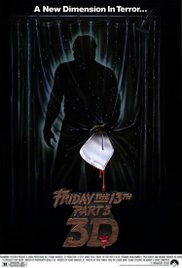
With it being originally filmed in 3-D, that only adds to the silliness of PART III because there must be at least 50 gimmick shots for the sake of the 3-D, including ones where Jason squeezes our male protagonist’s head until his eyeball heads straight for us and Jason’s first kill wearing his iconographic hockey mask. Additionally, we have a disco variation on Harry Manfredini’s score over the gonzo opening credits and some new character archetypes for the slaughter, like a married couple with the male partner suggesting Tommy Chong and a would-be motorcycle gang who gives Jason his first opportunity to kill outside his race.

Just keep in mind the FRIDAY THE 13TH movies have a transcendent appeal; for example, Kim Jong-il (1941-2011) loved him some Jason along with Rambo and Godzilla and rapper Big Daddy Kane used Jason for a rhyme in “Ain’t No Half Steppin.'”

For whatever reason, PART III generates more suspense than any other entry in the series. Steve Miner, assistant director on the first movie, remains the only person to direct more than one installment and that just might be the difference maker. Miner directed PART 2 and PART III.

I mentioned problems and there’s about 10 minutes of my life (multiplied by every time I see this sequence unless I fast-forward) that I will never get back when Jason dispatches Harold and Edna early in the movie, two unfortunate proprietors of a lakefront store. I call this hallmark of the genre “filler killings,” ones that pad running time or serve a body count (PART V fills that bill) and no greater purpose to the movie as a whole. Of course, haters of the genre would say that “filler killings” describe the entire movie.

Also, we have another shock ending that’s only shocking in just how non-shocking it turns out to be. Just about every slasher film in the era had a shock ending. This one almost defies belief.

Larry Zerner, who plays the asshole prankster Shelly, became an entertainment lawyer and Tracie Savage covered the Heidi Fleiss and O.J. Simpson trials as TV reporter, so undoubtedly PART III both served them well in their later careers.

Jason acquires his trademark hockey mask from Shelly. Jason’s played in PART III by British trapeze artist Richard Brooker, who apparently believed that playing a psychopathic killer was his entry way into a successful movie career. “It felt great with the mask on,” Brooker said. “It just felt like I really was Jason because I didn’t have anything to wear before that.”

After his screen debut as Jason, Brooker (1954-2013) appeared in DEATHSTALKER, “Trapper John, M.D.,” and DEEP SEA CONSPIRACY. Brooker later went into TV directing, for example “Bill Nye the Science Guy.” A fan-made documentary FRIDAY THE 13TH: THE MEMORIAM DOCUMENTARY appeared on YouTube in early 2018, which memorialized Brooker by interviews with FRIDAY THE 13TH luminaries and an on-screen dedication to his memory.

Final girl Dana Kimmell appeared in the Chuck Norris action spectacular LONE WOLF McQUADE after FRIDAY THE 13TH PART III. There’s a meme out there, “Chris Higgins survived her encounter with Jason because Chuck Norris wanted Chris Higgins to survive her encounter with Jason.” That’s great and everything, but there’s an alternate ending to PART III where Jason decapitated Chris (Kimmell).

Still, that gets me thinking about what would happen if Chuck Norris met Jason Voorhees in a movie.