Rats! Rats! Rats! You’ve Got a Friend in Willard and Ben

RATS! RATS! RATS! YOU’VE GOT A FRIEND IN WILLARD AND BEN
It makes sense that a sequel to the 1971 hit Willard appeared within the next year.

It makes sense that this sequel focused on the rat Ben and would be called Ben, given the previous film’s rather downbeat ending.

It also makes sense that Phil Karlson directed Ben, since Karlson directed such gritty films as Kansas City Confidential, 99 River Street, and The Phenix City Story, all involving characters who might be considered dirty rats.

Karlson never directed any character badder and meaner than Ben, though. Not any of the tough guys played by John Payne, Preston Foster, Neville Brand, Lee Van Cleef, and Jack Elam in Kansas City Confidential. Ben don’t need no stinking mask, for one. Ben also has an infinitely larger gang anyway and they’re real hungry as demonstrated throughout Ben. Nor Tennessee sheriff Buford Pusser from Walking Tall, which Karlson made right after Ben. Joe Don Baker must have come as quite a relief after Ben, who quickly became a has been after his two film roles and multiple songs about him. Ben must have wanted even more dough to return for a third film. That dirty rat!

Ben also won a PATSY Award for his performance in Ben, which undoubtedly contributed to his ego problem.

Anyway, I didn’t much care for Ben, because it quickly established a dread pattern after the obligatory flashback to the events that ended Willard. Here’s that pattern: Rat attack. Cutesy poo musical number. Rat attack. Cutesy poo musical number. Rat attack. Cutesy poo musical number. Rat attack. Cutesy poo musical number. Rat attack. Cutesy poo musical number.

Sounds like a real winner, right? Yeah, if you like a bunch of bad ideas bouncing off each other for 90 minutes.

You can also throw in some police chatter, a journalist character who’s seemingly working on just this one story (though it’s hard to blame him, I mean it’s not everyday that millions of street rats terrorize a city), and a little boy named Danny and his sister (played by Meredith Baxter before her marriage and hyphenated name, before her TV mother fame, before her Lifetime movie career, before her coming out) and his mother who all seem like refugees from a Disney live-action project.

Oh yeah, like Willard before him, the little boy possesses the ability to communicate with rats, especially Ben. Oh yeah, once again, the lonely little boy has a heart condition.

Danny proves responsible for the musical numbers scattered throughout Ben and he even gives Ben a puppet show. Wow, just wow.

A 13-year-old Michael Jackson sings “Ben’s Song” over the end credits and “Ben” competed against songs from The Poseidon Adventure, The Little Ark, The Life and Times of Judge Roy Bean, and The Stepmother for Best Original Song at the 1973 Academy Awards. “Ben” lost to “The Morning After” from The Poseidon Adventure, believe it or not, and having heard both songs, I don’t believe it since “The Morning After” defines godawful. Unfortunately so does most of the movie Ben.

I’ll give Karlson and animal trainer Moe Di Sesso their due for amplifying the rat count to 4,000 for Ben. Eight times the rats as Willard, but that’s the only area in which Ben triumphs over its older brother. Granted, one human year translates to approximately 30 in rat years, so maybe that’s why Ben’s motion picture career stopped after two films in two years.

Rating: One star.

— What else can I say other than I liked Willard and I would not be surprised if I found out that it played as one-half of a double bill with fellow 1971 cult film Harold and Maude.

Both are weird little items with a delightfully morbid sense of humor and I only say delightfully because I like both films, and they have offbeat lead characters who push the patience of every adult.

Bruce Davison stars as Willard Stiles, who must contend with a harridan mother (Elsa Lanchester) and a bully for a boss (Ernest Borgnine). Willard develops a close relationship with Ben and Socrates, who unfortunately for Willard are rats. See, Willard finds out that he can communicate directly with rats and that he enjoys their company more than his fellow human beings, especially his overbearing mother and all her overbearing friends and his asshole boss. His mother wants Willard to get rid of them damn rats and his boss, well, he develops genuine distaste for Rattus norvegicus after Willard’s rats crash his party one night.

Willard also begins a tentative, very tentative relationship with his lovely temporary co-worker Joan (Sondra Locke). In the end, Willard should have pursued Joan more than Socrates and Ben. No doubt that our lad Willard would have lived a whole lot longer.

As interesting as it was to watch Davison and Locke early in their careers and Lanchester (The Bride from The Bride of Frankenstein) late in her career, Borgnine proved to be the key component in the success of Willard. For a picture like Willard to work any whatsoever, we need a character that we love to hate and Borgnine’s Al Martin suitably fills that need. For us to fully anticipate and then relish his inevitable death, Borgnine needed to work us into a frenzy every time he’s onscreen. Borgnine does that and then some, especially when he seizes upon Socrates and kills him with delight. We know then, more than ever before, that Martin will meet a spectacular demise.

Borgnine won the Academy Award for Best Actor in 1956 for his extremely likable performance as the title character in Marty, directed by Delbert Mann. Sixteen years later, in a picture directed by Daniel Mann, Borghine mined the opposite end of the character spectrum for Martin.

For sure, Borghine might be the first, last, and thus far only Academy Award-winning actor to be annihilated by rats.

That alone is worth the price of admission.

Rating: Three stars.

Kingdom of the Spiders (1977)

KINGDOM OF THE SPIDERS (1977) ***
John ‘Bud’ Cardos’ Kingdom of the Spiders proved to be a pleasant surprise.

First, I remembered Cardos directed The Dark, one of the worst movies of 1979.

Second, I remembered the last time I saw Kingdom of the Spiders star William Shatner in a cowboy hat, yes, the absolutely ridiculous The Devil’s Rain, one of the worst movies of 1975.

Third, Kingdom of the Spiders starts out with the country number “Pleasant Verde Valley.”

Finally, Kingdom of the Spiders starts out slow, real slow, tipped off by No. 3.

Kingdom of the Spiders, though, kicks into high gear around the hour mark and it’s a whole lot of fun the final 35-40 minutes once the spiders attack Camp Verde, Arizona, and the tarantulas take complete control of the picture, hence being a pleasant surprise.

Kingdom of the Spiders borrows from such motion picture immortals as The Birds, Jaws, and Night of the Living Dead. That’s all part of the fun, when you enjoy something like Kingdom of the Spiders. Otherwise, it’s one more objection to a failure, like, for example, such bombs from the same era as The Giant Spider Invasion, Food of the Gods, and fellow 1977 release Empire of the Ants.

On the other hand, I have a weakness for Nature Attacks movies. There’s Frogs, starring killer amphibians, birds, insects, and reptiles, plus a crotchety old Ray Milland and a topless Sam Elliott. There’s Night of the Lepus, pairing a mutated killer rabbit infestation with a character actor infestation featuring Janet Leigh, Stuart Whitman, Rory Calhoun, and DeForest Kelley. There’s Squirm, where killer worms and a pair of redheads played by Don Scardino and the perky Patricia Pearcy wreak havoc on Fly Creek, Georgia, after one helluva storm. All of them are good fun and I’ve been known to call Frogs — great fun — better than The Godfather. Ditto for Godzilla vs. The Smog Monster.

Anyway, Kingdom of the Spiders works a thousand times more than The Giant Spider Invasion because it decides on real spiders — many spiders, how many exactly, how about 5,000, I mean that fact alone creates shivers down the spine — rather than a Volkswagen Beetle converted into a silly giant spider invasion. The Giant Spider Invasion doesn’t help itself when Alan Hale’s Sheriff exclaims, “You ever see the movie Jaws? It makes that shark look like a goldfish!” Giant mistake.

Also, the characters in Kingdom of the Spiders are far more likable than the ones in The Giant Spider Invasion. I mean, I eventually forgave Shatner for the cowboy hat — it’s better than the one he wore for The Devil’s Rain — and I even got over the fact that his character’s named “Rack Hansen.”

I remember an elementary school teacher calming the nerves of several pupils who were scared silly by a tarantula. She told us they’re harmless, they’re not poisonous anyway, they just look big and scary and very, very frightening indeed, and Kingdom of the Spiders brought me back 30 years to that moment in time. I’m just thankful our teacher did not show us Kingdom of the Spiders afterwards to counteract her moral lesson on tarantulas.

An Eye for an Eye (1981)

AN EYE FOR AN EYE (1981) ***
An Eye for an Eye is one of the better Chuck Norris movies and that’s because it fits the bill for what helps define a better Chuck Norris movie — the quality of the supporting cast, something it has in common with Lone Wolf McQuade, Code of Silence, The Delta Force, and Silent Rage.

Let’s see, we have Christopher Lee, Richard Roundtree, Matt Clark, Mako, Maggie Cooper, Rosalind Chao, Professor Toru Tanaka, Stuart Pankin, Terry Kiser and Mel Novak, and they’re basically all good in their standard hero and villain roles.

Lee (1922-2015) enjoyed a truly marvelous career that intersected with Sherlock Holmes, Dracula, James Bond, Star Wars, Ichabod Crane, Kharis, Victor Frankenstein, Gandalf, and Hercules. Never mind acting alongside Slim Pickens and Toshiro Mifune in Steven Spielberg’s 1941. Often playing the villain, Lee had the ability to maximize his minimal screen time and An Eye for an Eye benefits from his presence.

Roundtree made his fame as the title character in Shaft and sequels Shaft’s Big Score and Shaft in Africa, and so I must admit to being somewhat amused that he’s played a cop so often throughout his career. It was both amusing and frustrating to watch his police superior character bust Norris’ chops. I told my wife during An Eye for an Eye, ‘At least he’s not killed by a winged serpent in this movie.’

Cooper plays Norris’ obligatory romantic interest and she gets a rare female nude scene in a Norris movie. Writing on Silent Rage, I noted that it was refreshing to see somebody’s chest other than Norris and I second that emotion after An Eye for an Eye.

Tanaka’s dossier begins, ‘Was an American professional wrestler, professional boxer, college football player, soldier, actor, and martial artist.’ What did the Professor earn his degree in? Judging by An Eye for an Eye and the vast majority of his filmography and his professions, it’s safe to say Tanaka earned a doctorate in pain. Like others in the An Eye for an Eye cast, he’s good at maximizing minimal screen time and in his case, minimal dialogue. Norris vs. Tanaka proved to be one of the film’s greatest highlights.

Before she went to sleep, I told my wife that Norris’ partner will be dead very shortly and it did not help the character’s survival odds being played by Terry Kiser, an actor best known for playing a corpse. Bernie from Weekend at Bernie’s and Weekend at Bernie’s II ring any bells? Yeah, I still argue that dead Bernie still shows more life than nominal leads Andrew McCarthy and Jonathan Silverman. For a man later hacked and whacked by Jason Voorhees, Kiser’s character died spectacularly in An Eye for an Eye — shot in the chest, crushed between not one but two cars, and caught on fire. His death haunts Norris’ Sean Kane during two flashback scenes.

An Eye for an Eye director Steve Carver died in January 2021 of complications from COVID-19 and he was 75. Carver also directed arguably Norris’ best picture, Lone Wolf McQuade, and the infamous 1974 Roger Corman / New World Productions films The Arena and Big Bad Mama. No doubt that Pam Grier and Angie Dickinson, as well as William Shatner, prepared Carver for Chuck Norris.

Venom (1981)

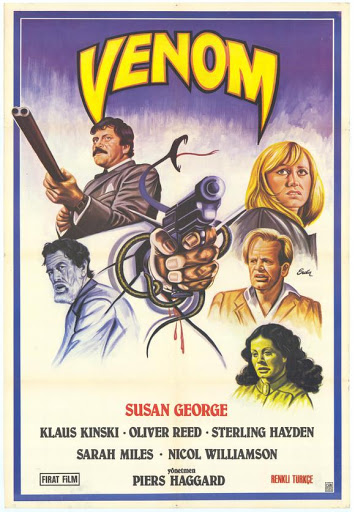
VENOM (1981) ***
I just finished considering Silent Rage, a film that runs Chuck Norris, a Western, Animal House, mad scientists, and a madman killer made indestructible through a cinematic blender.

Thus, I feel safe in saying that Silent Rage prepared me for Venom, a British horror film that has a distinguished multinational cast, kidnapping and hostage negotiation, and only the world’s deadliest snake, the dreaded Black mamba from sub-Saharan Africa. The mamba gets a few closeups, more than Norma Desmond in Sunset Boulevard and Daffy Duck in Duck Amuck, and its own POV. Yeah, we’ll call it the Black Mamba Cam.

That distinguished cast includes kidnappers Klaus Kinski and Oliver Reed, Scotland Yard commander and lead negotiator Nicol Williamson, snake expert Sarah Miles, slinky (won’t call her slutty or a snake expert in her own right) nurse Susan George, and lovable crusty old grandfather Sterling Hayden.

Basically, Venom contains three movies within one — the kidnapping inside the house, the hostage negotiation and the behind-the-scenes police maneuvering on the outside, and the deadly snake on the loose. We’ve all seen kidnapping and hostage negotiation plenty before, on TV cop shows and in the movies, but very rarely do the kidnappers have to deal with the world’s deadliest snake. And Lord knows we’ve all seen a bad snake movie or two, like for example the 1972 disaster Stanley, which populated its killer snake scenario with thoroughly unpleasant and despicable characters, a somewhat heavy-handed environmental message, and some of the dopiest music ever heard by man this side of Jonathan Livingston Seagull.

Venom turned out to be a far more enjoyable motion picture experience than Stanley. For example, the scene in Venom where the boy picks up the mamba by mistake and unknowingly transports the world’s deadliest snake from one side of London to another brought to mind the classic sequence in Sabotage that ends in the death of a young boy named Stevie. The inevitable scenes late in the picture when the mamba strikes Reed and Kinski are both well worth their wait, and the mamba’s strike at George about 30 minutes into the picture lets us know that we’re in for a treat when Reed and Kinski do meet their demise.

Later that day, much later in the day to be precise, though, I watched Murders in the Zoo from 1933 and imagine my delightful little surprise when a mamba figured prominently in that older film’s plot. The gruesome hits in Murders in the Zoo just keep on coming down the home stretch, especially when a boa constrictor consumes the dastardly big-game hunter, bastardly zoologist, and insanely jealous husband played by Lionel Atwill.

Venom and Murders in the Zoo both find perfect ways to deal with snakes in the grass.

Silent Rage (1982)

SILENT RAGE (1982) ***
Michael Miller’s 1982 feature Silent Rage combines several American movie hallmarks into one barely coherent package: Chuck Norris, a small Texas town (never sleepy when Norris plays Sheriff), a madman killer, mad scientists, shots borrowed straight from John Carpenter’s Halloween, two love scenes, Stephen Furst basically playing his character from Animal House again, bar fights, roundhouse kicks, biker gangs, breasts (inc. Norris but not Furst), and a schizophrenic musical score, not in any particular order.

We also have at least five wildly different acting styles for the price of one. We’ve already covered Norris and Furst, then there’s Ron Silver and he’s playing it straight in easily the best dramatic acting that one can find in anything starring Chuck Norris. Silver plays the voice of reason and let’s do the right thing scientist, whereas his colleagues played by Steven Keats and William Finley are variants on Universal horror archetypes updated for a new generation. Keats, of course, wants to push science further than any one ever before even when it’s not prudent and Finley, best known for his roles in Brian De Palma and Tobe Hooper films Phantom of the Paradise and Eaten Alive, occupies the middle ground between Silver and Keats. Brian Libby’s madman killer continues in the proud screen tradition of Frankenstein’s Monster and Michael Myers, especially after our mad scientists flat out turn him posthumously into an indestructible killing machine whose stalking does all the talking. I wanted Dr. Loomis to show up and say THIS ISN’T A MAN. Bummer that it didn’t happen.

Norris battles the mad killer and later the virtually indestructible mad killer in the opening and concluding scenes. Otherwise, he alternates between mentoring and supporting unsure and unsteady rookie cop Furst, rekindling his romance with a former lover played by Toni Kalem, and questioning Silver and Keats. For Norris fans, apparently the scariest parts of Silent Rage involved Kalem’s bare breasts and Norris favoring jazz music because our favorite roundhouse specialist returned to only love scenes between men for the rest of his career, barring his rolling around in the mud with the sultry Barbara Carrera in the 1983 Walker, Texas Ranger precursor Lone Wolf McQuade. I for one like Silent Rage because it’s nice to see more chests on display than just Chuck’s for a change.

Silent Rage unfortunately drags at two main points. The death of Silver’s wife literally feels like it takes forever, like one of the filler killings in a Friday the 13th sequel. Ditto for the bar fight, which are drags both in real life and in the movies. A couple moments in this otherwise humdrum bar fight sequence redeem it, just barely though. If you’ve seen Silent Rage, you know exactly what I mean.

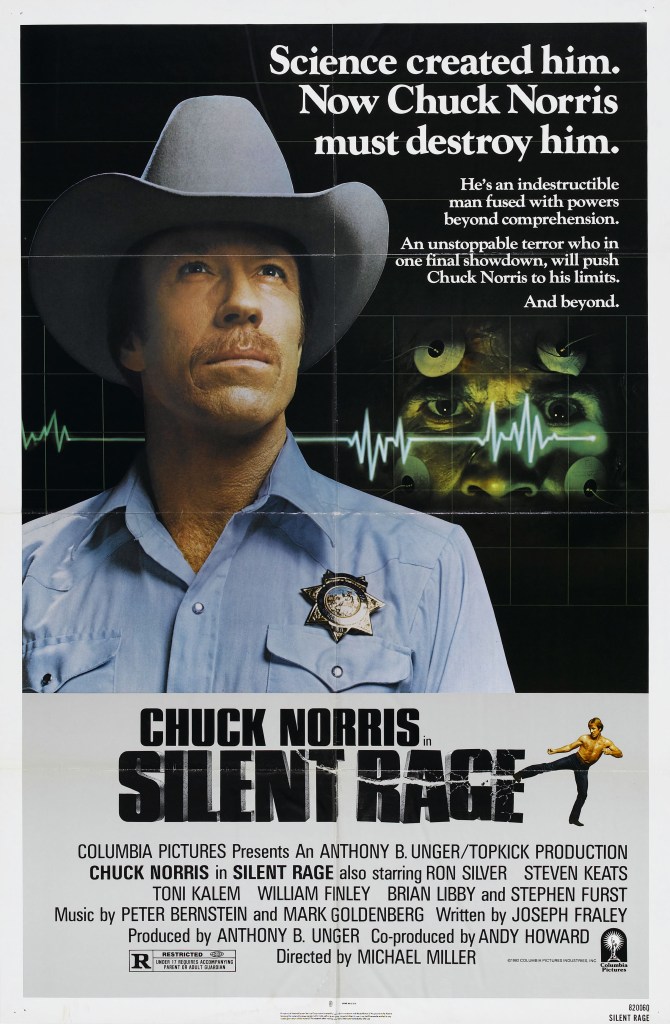
The poster for Silent Rage rates with Breaker! Breaker as the best Norris film poster. There’s really no arguing with a mini-Norris roundhouse cracking the movie’s title and the promotional hype Science created him. Now Chuck Norris must destroy him. He’s an indestructible man fused with powers beyond comprehension. An unstoppable terror who in one final showdown, will push Chuck Norris to his limits. And beyond.

Once upon a review, I believe I wrote that I wanted to see Chuck Norris vs. Jason Voorhees and Silent Rage is the closest that I will ever get to seeing that dream come true.

Werewolf of London (1935)

WEREWOLF OF LONDON (1935) ***
Werewolf of London — Hollywood’s first werewolf picture — must be one of the most overlooked horror films in the history of overlooked horror films, for obvious reasons.

During the 1930s, Universal Studios released Werewolf of London among the following group of horror films: Dracula, Dracula (Spanish version), Frankenstein, The Mummy, The Invisible Man, The Bride of Frankenstein, Dracula’s Daughter, and Son of Frankenstein, over half of them landmark productions that spawned multiple imitations and sequels. Werewolf of London came out nearly a month after The Bride of Frankenstein in the spring of 1935 and The Bride of Frankenstein became a big hit and developed a reputation for being a sequel that arguably betters the original.

Late in 1941, Universal’s second werewolf film appeared, The Wolf Man, and it quickly became the quintessential werewolf film, leaving Werewolf of London behind in the dustbins of cinematic history. Lon Chaney Jr. joined his late father Lon Chaney (Phantom of the Opera), Boris Karloff (Frankenstein), and Bela Lugosi (Dracula) in becoming a horror movie icon just from a single performance. Chaney Jr. revisited Larry Talbot / The Wolf Man in Frankenstein Meets the Wolf Man, The House of Frankenstein, House of Dracula, and Abbott and Costello Meets Frankenstein, and he displayed his versatility by portraying Dracula, Frankenstein’s Monster, and the Mummy.

In addition to Chaney Jr., The Wolf Man cast includes Claude Rains and Ralph Bellamy and many horror films love it for its mood and first-rate atmosphere.

By contrast, Werewolf of London stars veteran character actor Henry Hull and that’s unfortunately not a name that rolls off the tongue like, say, Lon Chaney Jr. Warren Zevon name checked both Chaneys in “Werewolves of London” — Well, I saw Lon Chaney walking with the Queen / Doing the Werewolves of London / I saw Lon Chaney Jr. walking with the Queen / Doing the Werewolves of London / I saw a werewolf drinking a piña colada at Trader Vic’s / And his hair was perfect — but, alas, no direct mention of Hull.

Werewolf of London definitely holds its most value as curiosity (and conversational) piece and not only for its place as the most overlooked film within the Universal canon and for its overall historical standing. After all, when’s the last time any protagonist in a film counted botany for their career or a horror film started with a prologue in Tibet. It also holds considerable fascination comparing and contrasting Jack Pierce’s makeup work between Werewolf of London and The Wolf Man, as well as how this earlier film handled the essential transformation scenes. The werewolf seems to have inspired Eddie Munster, so Werewolf of London does have that going for it.

Godzilla: King of the Monsters (2019)


GODZILLA: KING OF THE MONSTERS (2019) ***
The latest Godzilla: King of the Monsters inspires mixed feelings.

On the one hand, Warner Bros. pumped an estimated $170-200 million into King of the Monsters (likely more spent on this one Godzilla picture than all the Toho Studios productions combined) and cast a diverse, multinational group of actors and actresses, Kyle Chandler, Vera Farmiga, Millie Bobby Brown, Bradley Whitford, Sally Hawkins, Charles Dance, Thomas Middleditch, Aisha Hinds, O’Shea Jackson Jr., David Straithaim, Ken Watanabe, and Zhang Ziyi. Perhaps, most importantly for them, they are not dubbed, badly dubbed.

On the other, King of the Monsters spends way too much time in banter and disputes between scientists, military men, etc., and it’s still cliché dialogue no matter what if read by an Oscar winner or not. When the monsters Godzilla, King Ghidorah, Mothra, and Rodan do fight, it’s somehow not enough and I wanted King of the Monsters to give us a good old Royal Monster Mash Rumble right out in the middle of the streets in broad daylight, for crying out loud. Watching King of the Monsters for a second time, I felt tempted to begin chanting “No rain! No rain! No rain!” but I doubted there were any Woodstock or Live Rust fans aside from me in the house, so I restrained myself and thought better to save it for this review.

Honestly, I definitely miss all the bizarre little touches Toho sprinkled throughout their Godzilla films, especially the 1954-75 Showa Era. For example, it took a little time to wrap my warped little mind around seeing Mothra without her representatives from Infant Island, two tiny twin fairies who speak for and accompany Mothra and sing “Mothra’s Song,” “Mothra oh Mothra / If we were to call for help / Over time, over sea, like a wave / You’d come / Like a guardian angel / Mothra oh Mothra.” To be fair, King of the Monsters references the twins through twin scientist characters Ilene and Ling Chen (played by Ziyi) and we do get an instrumental version of “Mothra’s Song” late in the picture.

King of the Monsters could have used a lighter touch.

I liked the first Warner Bros. Godzilla more than King of the Monsters and I have no doubt Godzilla 2014 benefited more from the novelty of being a serious Godzilla film, which took so many of us by surprise because that’s not what we expected from an American Godzilla film after the disastrous 1998 production brought to us kind folks by TriStar Pictures and the creative partnership — writer and director Roland Emmerich and writer and producer Dean Devlin — who previously dumped Stargate and Independence Day on humanity.

Regardless, I am looking forward to Godzilla vs. Kong whenever that moment will come.

The Vampire Bat (1933)

THE VAMPIRE BAT (1933) ***
The Vampire Bat would otherwise be a forgotten horror entry were it not for the presence of four members of the Horror Movie Hall of Fame, three of them surefire first ballot inductees.

Fay Wray (1907-2004) earned her claim to be the First Lady of Horror and the first scream queen through her work alone in the 1933 classic King Kong. Ann Darrow gave Wray instantaneous immortality, but she also starred in Doctor X, The Most Dangerous Game, The Vampire Bat, and Mystery of the Wax Museum in a year period leading up to King Kong. She was no one-hit wonder.

Lionel Atwill (1885-1946) appeared in a variety of horror movie roles over a 15-year period, in such entries as Doctor X, The Vampire Bat, Mystery of the Wax Museum, Mark of the Vampire, Son of Frankenstein, The Ghost of Frankenstein, Frankenstein Meets the Wolf Man, House of Frankenstein, and House of Dracula. He generally played a mad doctor or an authority figure, be it Inspector Krogh (Son of Frankenstein) or the Mayor (Frankenstein Meets the Wolf Man). Atwill essayed an inspector in several Universal horror flicks.

Salina, Kansas born Dwight Frye (1899-1943) received a tribute nearly 30 years after his death when Alice Cooper released “Ballad of Dwight Fry” on the 1971 album Love It to Death, one of those classic Cooper morbid ballads / epics. Babe Ruth once said that he was paid more than Herbert Hoover because he had a better year than the President and Frye should have been able to say the same in 1931, between his roles in Dracula and Frankenstein, but it’s doubtful Universal paid a supporting actor in any movie more than the greatest home run hitter. Renfield’s presence certainly would have made the Kamala Harris-Mike Pence vice-presidential debate more interesting.

Melvyn Douglas (1901-81) enjoyed a 50-year acting career and he won Academy Awards for his supporting performances in Hud and Being There, but he earned his spot in the hallowed halls of horror history by appearing in the 1932 classic The Old Dark House.

In other words, Wray, Atwill, Frye, and Douglas elevate The Vampire Bat.

Comin’ at Ya! (1981)

COMIN’ AT YA! (1981) ***
Certain movie titles just don’t lie about their contents and intents.

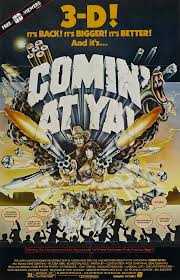
For example, Comin’ at Ya (Bye-bye, exclamation point! You only get one, baby), because it keeps every object and every Spaghetti Western hallmark coming straight at us for 90 minutes. We get the objects because Comin’ at Ya inaugurated the resurgence of 3-D movies, a wave of exploitation that included such followers as Spacehunter: Adventures in the Forbidden Zone and The Man Who Wasn’t There, not to mention Friday the 13th Part III, Jaws 3-D, and Amityville 3-D.

I’ll try and not spoil all the fun by revealing every object thrown at the screen, but I will say that Comin’ at Ya absolutely loves arrows and works in a yo-yo showcase. Trust me on this one, you’ll go bats during Comin’ at Ya.

American actor, writer, producer, and director Tony Anthony, not the British Christian evangelist or the retired professional wrestler better known by his professional name Dirty White Boy, made a living in recycled Spaghetti Westerns like A Stranger in Town, The Stranger Returns, The Silent Stranger, Blindman, and Get Mean before writing the original story and starring in Comin’ at Ya. He certainly knows his way around a cowboy hat and a horse.

Veteran movie viewers will recognize just about every Spaghetti Western standard trotted out by Comin’ at Ya, especially its revenge revenge revenge plot, landscapes derived from Leone, music derived from Morricone, and mannerisms derived from Eastwood. Comin’ at Ya director Ferdinando Baldi and his writing team of Wolfe Lowenthal, Lloyd Battista, Gene Quintano, Anthony, Esteban Cuenca, and Ramon Plana also use clichés older than cinema or even dirt itself, like a dying old man who musters just enough life to give our hero critical informational bits and then dies from his wounds after muttering his remaining life, er, his final word. How many times have we seen that one? No, please, don’t tell me, it’s a rhetorical question.

It’s about time I get around to mentioning Comin’ at Ya shells out big doses of bad dubbing.

Between all the 3-D and Spaghetti Western brandishing and bludgeoning, mostly badly dubbed, one might think that’s more than enough to recommend a single movie. That’s wrong, though, because Comin’ at Ya features one of the most beautiful women in the world, Spanish actress and singer Victoria Abril, early in her career. Abril later starred in four Pedro Almodovar films and played the bisexual housewife in the acclaimed French sex farce French Twist.

I recommend Comin’ at Ya for any true connoisseur of clunky cinematic junk.

Bill & Ted Face the Music (2020)

BILL & TED FACE THE MUSIC (2020) ***

What the world needs more than ever before is Bill S. Preston Esquire and Ted “Theodore” Logan, characters played respectively by Alex Winter and Keanu Reeves who live by the credo “Be excellent to each other.”

Yes, we could all use a little more being excellent to each other right about now.

They are back in BILL & TED FACE THE MUSIC, the third entry in a series that began way before Cardi B. (born 1992) and Megan Thee Stallion (born 1995), the Internet boom, widespread cell phones, and COVID … and if a time traveler from 2020 told you in 1989 or 1991 that one day Donald Trump would be your President you’d react about just like 1955 Emmett “Doc” Brown did when Marty McFly told him Ronald Reagan was President in 1985.

I know what some of you might be thinking: Why does the world need another dumb comedy starring two dim-witted characters who have not been seen on a movie screen for 29 years … more than Christopher Nolan’s TENET, the film already considered 2020’s most anticipated theatrical release during a time of much uncertainty for the future of movie theaters and movies in general.

For one, I have never believed the Bill & Ted characters to be dumb and their movies are definitely not dumb. Those who believe that Bill & Ted (and their movies) are dumb are perhaps easily distracted by a vernacular featuring such words as “dude,” “bogus,” “non-heinous,” and “excellent” or their frequent air guitar pyrotechnics.

Also, Bill & Ted were flunking history in EXCELLENT ADVENTURE and surely that did not help their cause, but so what, I mean I wish I had a dollar for every time somebody told me “History’s boring, man, but I do love watching me some History Channel.” I’d have amassed a small fortune.

Bill & Ted, first and foremost, are positive and upbeat without being a preachy drag or becoming simps, and that’s a tricky feat to pull off. They are two of the most likeable characters in film history, a fact made apparent once again by their return in FACE THE MUSIC.

Secondly, I have enjoyed the first two Bill & Ted movies more than I have anything by Christopher Nolan. That’s not saying EXCELLENT ADVENTURE and BOGUS JOURNEY are better than INTERSTELLAR and DUNKIRK, for example, or MEMENTO and THE DARK KNIGHT, for that matter. It’s not much of an understatement, though, when I state I must have watched EXCELLENT ADVENTURE and BOGUS JOURNEY 100 times when they played on cable TV in the early ’90s.

FACE THE MUSIC won me over almost right from the start, when wedding singers Bill & Ted (no longer rock stars) introduce their latest epic “That Which Binds Us Through Time: The Chemical, Physical and Biological Nature of Love; an Exploration of The Meaning of Meaning, Part 1.” Rick Wakeman, eat your heart out!

Just before that number, though, FACE THE MUSIC revisits a running joke from their prior movies. Missy, who’s three years older than Bill & Ted, married Bill’s dad in EXCELLENT ADVENTURE, Ted’s dad in BOGUS JOURNEY (Bill’s dad took it really hard), and now Ted’s younger brother Deacon in FACE THE MUSIC. Just think Bill & Ted each asked her to the prom when they were freshmen and she was a senior. When it is suggested that Ted’s father is now his own son, I sensed a disturbance in the force in my wife seated to my immediate right. I looked over at her and she was in deep thought. I laughed to myself.

FACE THE MUSIC introduces several new characters and they’re mostly winners.

Let’s see, we have Theodora “Thea” Preston (Samara Weaving) and Wilhelmina “Billie” Logan (Brigette Lundy-Paine), Bill & Ted’s daughters. They are music lovers and they share a chemistry and bond just like their fathers. They are every bit as endearing as Bill & Ted.

There’s a scene-stealing robot (Anthony Carrigan) from hundreds of years in the future who’s sent to kill Bill & Ted. We eventually learn his full name.

We also have Jimi Hendrix (DazMann Still), Louis Armstrong (Jeremiah Craft), Wolfgang Amadeus Mozart (Daniel Dorr), and legendary founder of music Ling Lun (Sharon Gee) given a gender switch. Possessing two college degrees in history, I have always loved the Bill & Ted movies for their astonishing historical accuracy.

FACE THE MUSIC incorporates basic plot elements from both EXCELLENT ADVENTURE and BOGUS JOURNEY. Facing a major deadline crunch to finally write the song to save the world, Bill & Ted are back in their H.G. Wells phone booth to visit their future selves and steal the song from themselves. Can they do that? I mean, it’s not really stealing if you “steal” from yourself, right? I laughed at this plot development, because I thought about how John Fogerty got sued by his former record company for ripping himself off.

Bill & Ted visit at least four different future self permutations, highlighted by a tender scene in 2067 with a geriatric Bill & a geriatric Ted. Just like BACK TO THE FUTURE PART 2 and EXCELLENT ADVENTURE, FACE THE MUSIC flat out embraces the silliness of time-travel. Unlike the BACK TO THE FUTURE series, the Bill & Ted movies do not concern themselves with paradoxes or plot loopholes, for that matter. They (and we) are having too much fun.

Thea & Billie take on a similar role as their fathers in EXCELLENT ADVENTURE, as they travel through time to recruit the all-time ultimate band to play their fathers’ song.

Like BOGUS JOURNEY, we descend into Hell, because Bill & Ted need to get their daughters, Ted’s dad, and Hendrix, Armstrong, et cetera, as well as killer bass player Grim Reaper (William Sadler), to round out the band. Nearly 30 years later, this character and the way Sadler plays him remain a hoot. I only wish they would have got to him a little sooner, despite the fact FACE THE MUSIC plugs the killer robot into the role served by the Reaper in BOGUS JOURNEY.

There are numerous other faults in FACE THE MUSIC (including Reeves’ sometimes obvious discomfort playing Ted), but, in the end, they’re smoothed over by the genial spirit of the enterprise. BOGUS JOURNEY remains the best entry in the series, because of its darker sense of humor and inspired production design in places like Heaven and Hell … and it features limited time-travel.

Chris Matheson and Ed Solomon wrote all three Bill & Ted movies and they originated the characters in a Hollywood improv shop in 1983. Matheson (son of the science fiction writer Richard Matheson) and Solomon make “stupid” cameos in each film, waiters in EXCELLENT ADVENTURE, seance members in BOGUS JOURNEY, and demons in FACE THE MUSIC. Matheson and Solomon, Winter and Reeves, and Sadler and Hal Landon Jr. (Ted’s perpetually disapproving father) help FACE THE MUSIC become more a labor-of-love than cynical cash grab.

I left FACE THE MUSIC with a goofy smile on my face and a burning desire to get in the car and blare some music. I rocked out to a playlist that started with Pink Floyd’s “Pigs (Three Different Ones),” Neil Young’s “Like a Hurricane,” and AC/DC’s “Let There Be Rock.” Yes, what a wonderful world!