They Live (1988)

THEY LIVE

THEY LIVE (1988) Three-and-a-half stars
Back in October 2018, I started writing movie reviews again and sharing them on Facebook so that we could have something else to read other than one more political diatribe or one more unfunny meme taking cheap shots at entire groups of people.

Months later, I will go against the grain and consider THEY LIVE, both an anti-yuppie, anti-Reagan satire and a kick ass 1980s action and science fiction thriller from director John Carpenter.

THEY LIVE came out November 4, 1988 and made $4.8 million during its opening weekend, earning one-third of its box office take.

Four days after THEY LIVE’s opening day, tough-talking and hard-hitting Texan conservative George H.W. Bush crushed soft and elitist Massachusetts liberal Michael Dukakis in the U.S. Presidential Election.

(Though, of course, Bush was born in Massachusetts, attended Yale, and belonged to Skull and Bones, a secret society at Yale, he was not one of the elite to his fervent supporters. Bush’s son, George W. Bush, later riffed on similar associations with Texas and Massachusetts in 2004 against John Kerry. I mean, don’t you know that Massachusetts is the exclusive domain of the most “pussy liberals” and “T is for Tough” just like “T is for Texas.” You can have the utmost faith in a Texan against terrorism.)

Bush could have used THEY LIVE’s most famous one-liner for his campaign slogan, “I have come here to chew bubblegum and kick ass … and I’m all out of bubblegum.”

In the long run, that might have worked out better for Bush — given his popularity after “Operation Nifty Package” and “Operation Desert Storm” — than “Read my lips: no new taxes,” a mantra written by Peggy Noonan for the 1988 Republican National Convention.

Likewise, THEY LIVE would have worked better for Dukakis than a tank, a photo op the Bush campaign used against Dukakis in a memorable 30-second ad with dramatic narration and subtitles, “He opposed new aircraft carriers. He opposed anti-satellite weapons. He opposed four missile systems, including the Pershing Two Missile deployment. Dukakis opposed the Stealth Bomber and a ground emergency warning system against nuclear attack. He even criticized our rescue mission to Grenada and our strike on Libya. And now he wants to be our Commander-in-Chief. America can’t afford that risk.”

“America can’t afford that risk” pops up on a screen mostly filled with the ridiculous image of a smiling Dukakis in that darn tank, topped off by that even more ridiculous name-tagged helmet “Mike Dukakis.” Dukakis looks like an absolute fool, an absolute tool, even worse than “strategic guest star” Eddie Murphy in BEST DEFENSE. Who would vote for this clown?

The Democrats would have been so much cooler if they had been able to latch on to THEY LIVE for the 1988 presidential campaign.

No, as we all know, they failed.

Just imagine an ad with Dukakis sitting at home watching the Republican National Convention and he puts on the THEY LIVE shades, revealing all the Republicans to be aliens. Their real agenda also shows up on screen: CONSUME — OBEY — SUBMIT — WATCH TV — BUY — MARRY REPRODUCE — DO NOT QUESTION AUTHORITY — NO THOUGHT — WORK 8 HOURS. (This would also work against the Democrats.)

I bet nobody can remember any negative campaign ad against Bush in the 1988 Election … but we all remember Willie Horton and “Revolving Door” against Dukakis painting him in broad ideological strokes. Again, leftist = wimp, conservative = tough guy.

It worked and still works.

I mean, where would Donald Trump be without such macho, tough guy associations?

You can just chuck any claims on “family values” and “Moral Majority” right out the window.

“I moved on her, and I failed. I’ll admit it.

“I did try and fuck her. She was married.

“And I moved on her very heavily. In fact, I took her out furniture shopping. She wanted to get some furniture. I said, ‘I’ll show you where they have some nice furniture.’ I took her out furniture — I moved on her like a bitch. But I couldn’t get there. And she was married. Then all of a sudden I see her, she’s now got the big phony tits and everything. She’s totally changed her look. …

“I better use some Tic Tacs just in case I start kissing her. You know I’m automatically attracted to beautiful — I just start kissing them. It’s like a magnet. Just kiss. I don’t even wait. And when you’re a star, they let you do it. You can do anything. Grab ‘em by the pussy. You can do anything.”

Now there’s a campaign slogan for your average Republican or Democrat candidate in an Election coming soon to a screen near you — I CAN DO ANYTHING.

(For the record, I think Trump, Bill Clinton, Hillary Clinton, Spike Lee, Ted Nugent, Rush Limbaugh, and Alec Baldwin are flip sides of the same coin.)

So THEY LIVE mixes liberal and radical ideology with, let’s face it, conservative ass kicking or “Rambo Meets The Sandinistas.”

THEY LIVE’s poster: “You see them on the street. You watch them on TV. You might even vote for one this fall. You think they’re people just like you. You’re wrong. Dead wrong.”

Carpenter, under the name “Frank Armitage,” adapted Ray Nelson’s 1963 short story “Eight O’Clock in the Morning.” Nelson and Philip K. Dick were friends and even co-conspirators on the 1967 alien invasion novel “The Ganymede Takeover.”

On the eve of the 2012 Election, Carpenter talked with “Entertainment Weekly,” “Well, THEY LIVE was a primal scream against Reaganism of the ‘80s. And the ‘80s never went away. They’re still with us. That’s what makes THEY LIVE look so fresh — it’s a document of greed and insanity. It’s about life in the United States then and now. If anything, things have gotten worse.”

In the same interview, Carpenter touched on why aliens should be evil and why professional wrestler — which should be synonymous with “professional actor” — Roddy Piper (1954-2015) landed the gig of the protagonist John Nada.

“First of all, I was a wrestling fan when I was young. Even when I figured out what wrestling was, I was still a fan. To me, Roddy just had a weathered face and looked like he’d been working all his life. He wasn’t a Hollywood star. He had some scars on his face and I thought he would be convincing walking into town with a backpack on his back looking for work. I’d met Roddy at Wrestlemania 3 in Pontiac, Michigan. He was a great heel.”

Piper works his way around one-liners every bit as effectively as both Clint Eastwood and Arnold Schwarzenegger.

Not only the epic “bubblegum,” but also “Either put on these glasses or start eating that trash can,” “It looks like you dipped your face in the cheese dip back in 1957,” “That’s like pouring perfume on a pig,” and “Life’s a bitch, and she’s in heat.”

Piper was one of the all-time great wrestling trash talkers and that served him (and us) well in THEY LIVE.

Keith David plays the character Frank Armitage and we remember David from PLATOON, where he proved a nice counterpoint to Charlie Sheen’s green protagonist, especially in the first part of the film.

For example, in this dialogue, “Shit. You gotta be rich in the first place to think like that. Everybody know the poor are always being fucked over by the rich. Always have, always will.”

Piper and David have one of the memorable fights in THEY LIVE. “South Park” later paid tribute with a Timmy and Jimmy brawl.

Piper and David slug it out for a good six minutes — just because Dada wants Frank to put on the shades and Frank demurs — and in a 2015 article, Vulture starts out, “The fight lasts for six minutes and purportedly serves no purpose; its incomprehensible duration is the joke, and in lieu of a punch line, Carpenter gives us punches.”

Wrong, in that it serves no purpose.

For one, it’s a showcase for the professional wrestler.

Secondly, Piper and David wanted a real brawl, according to info found on IMDb, only faking hits to the face and groin. Apparently, the duo rehearsed their fisticuffs for three weeks. Their final brawl impressed Carpenter so much that he left every single bit of it in the film. The plans had originally been for a 20-second fight.

Finally, viewers have read it as a metaphor for working class people fighting each other rather than fighting their real enemies and that we are wasting our precious time in that fight amongst ourselves.

Six minutes in a movie could symbolize a lifetime in reality.
Killer Klowns from Outer Space (1988)

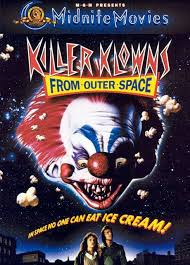
KILLER KLOWNS

KILLER KLOWNS FROM OUTER SPACE (1988) Three-and-a-half stars
Sociologists would undoubtedly have a field day unpacking why KILLER KLOWNS FROM OUTER SPACE retains cult classic status.

We can start at the first two words in the title and focus upon our seemingly eternal fascination with both killers and clowns.

Then, our nostalgia for 1980s kitsch.

I don’t know, that’s not why I dig KILLER KLOWNS FROM OUTER SPACE, because, to begin with, I don’t quite have the same obsession with killers and clowns that most Americans have or I don’t suffer from “coulrophobia,” the irrational fear of clowns.

I know several people who seriously consider 1980s mass entertainments THE GOONIES, DIRTY DANCING, FERRIS BUELLER’S DAY OFF, THE BREAKFAST CLUB, et cetera, not only their favorite movies, but they’ll go on record and proclaim their favorite “the greatest movie ever made.” Talk about a conversational cul-de-sac, it’s happened so many darn times over the years especially during college. I lost track of how many times I stood there in stone face silence (like Buster Keaton) while my brain pondered exactly how many films these other people have seen and why they’re stuck in 1987, for crying out loud.

I did not see KILLER KLOWNS FROM OUTER SPACE until many years later, though I always remembered that glorious title before I put the down payment on the DVD.

I love KILLER KLOWNS FROM OUTER SPACE because it’s a demented cartoon (the best kind of cartoon) that has ingeniousness to spare: “The Big Top” for the Killer Klowns’ spaceship; popcorn ray-guns; cotton candy cocoons that produce a dread end for dead humans; an invisible Clown car; shadow puppetry; killer pies; and the 18-foot tall Killer Klown leader known as “Jojo the Klownzilla,” a man-in-a-suit Godzilla parody or tribute.

KILLER KLOWNS FROM OUTER SPACE will remind some viewers of Steve McQueen’s debut motion picture, THE BLOB (1958).

You know, kids on lovers’ lane see what could be Halley’s Comet … no, hey, wait, that’s what a crusty old farmer named Gene Green (Royal Dano) mistakes “The Big Top” for when he sees the same unidentified flying object streaking across the sky in the opening sequence and boy, oh boy, that’s a dread mistake for Mean Gene and his poor, poor loyal dog Pooh Bear when they go investigate. Ol’ Man Green speaks a few great lines before his inevitable exit, “What in tarnation is going on?”

Straight out of THE BLOB, teenage sweethearts Mike Tobacco (Grant Cramer) and Debbie Stone (Suzanne Snyder) also investigate further and they go to the local authorities with their findings, centered on “The Big Top” and its inner workings. Our two local authorities, of course, are hesitant to believe these wacko teenagers and their whacked out stories of popcorn-shooting guns and cotton candy cocoons.

Damn kids and their elaborate pranks.

We do have a more sympathetic police officer in Dave Hansen (John Allen Nelson) and I seem to remember every other more sympathetic police officer travels by the name “Dave.” You just know you can have total faith in a guy named Dave.

Yes, at least one more sympathetic police officer did have that first name, “Lt. Dave” in THE BLOB, who patiently listened to and believed the cockamamie stories of Steve (McQueen) and Jane (Aneta Corsaut).

Just like THE BLOB, we have one policeman more sympathetic to the kiddos in KILLER KLOWNS FROM OUTER SPACE and then we have Curtis Mooney, who seems like a relative of Dean Vernon Wormer from NATIONAL LAMPOON’S ANIMAL HOUSE.

Of course, there’s a brilliant reason for that, both characters are played by the same actor.

The late John Vernon (1932-2005) has a fabulous start to his IMDb biography: “John Vernon was a prolific stage-trained Canadian character player who made a career out of convincingly playing crafty villains, morally-bankrupt officials and heartless authority figures in American films and television since the 1960s.”

He’s great in KILLER KLOWNS FROM OUTER SPACE, picking up right where he left off in ANIMAL HOUSE.

Maybe Wormer relocated to Crescent Cove and changed his name to Curtis Mooney.

Cramer plays a protagonist named “Mike Tobacco” and it took me a little bit to remember a character from “Charlie and the Chocolate Factory” and WILLY WONKA AND THE CHOCOLATE FACTORY named “Mike Teavee.” Are they distant relatives? While the TV obsessive Mike Teavee brought his obsession to another level in both the book and the 1971 film adaptation, we never see Mike Tobacco smoke tobacco in KILLER KLOWNS FROM OUTER SPACE, although we can be sure that Curtis Mooney believes that Mr. Tobacco’s smoking something stronger than tobacco when he descends upon the police station with that “killer clowns from outer space” story.

The Chiodo Bros. — Stephen, Charles, and Edward — are the auteurs behind KILLER KLOWNS FROM OUTER SPACE, siblings who specialize in clay models, creatures, stop motion, and animatronics. Their credits, in addition to the main film under discussion, include puppets and effects work for CRITTERS, ERNEST SCARED STUPID, and TEAM AMERICA: WORLD POLICE, as well as the Large Marge claymation scene from PEE-WEE’S BIG ADVENTURE.

They deserve a spot alongside such icons as Willis O’Brien and Ray Harryhausen.

On a certain level, KILLER KLOWNS FROM OUTER SPACE deals in a nostalgia for animation, horror, and science fiction entertainments of the past.

The IMDb lists numerous references, but the most important ones seem to be GODZILLA, INVASION OF THE BODY SNATCHERS, FORBIDDEN PLANET, PHANTASM, and ALIEN, as well as THE BLOB, of course, all of which seasoned viewers will be able to notice.

The film’s tagline captures the spirit of the enterprise: “In space, no one can eat ice cream.”

The Legend of Drunken Master (2000)

DAY 53, THE LEGEND OF DRUNKEN MASTER

THE LEGEND OF DRUNKEN MASTER (2000) Three-and-a-half stars
Once upon a time, there was a commonly held belief that Jackie Chan and his movies would never succeed in America.

Chan’s first two attempts to capture the American market both failed, 1980’s THE BIG BRAWL (Robert Clouse) and 1985’s THE PROTECTOR (James Glickenhaus).

Clouse (ENTER THE DRAGON, BLACK BELT JONES, GAME OF DEATH) and Glickenhaus (THE EXTERMINATOR, THE SOLDIER, SHAKEDOWN) did not see eye-to-eye with Chan and vice-versa, as Chan felt more confined to the generic American style of movie violence rather than his own more idiosyncratic style during both films. Chan even released his own edit of THE PROTECTOR.

Glickenhaus once said in an interview, “Well, you know that’s still the most successful Jackie Chan movie internationally and always will be because the American audience, the mainstream audience, will never sit still for Jackie’s style of action.”

Wrong, and wrong again.

In 1995, in the third attempt on cornering the American market, New Line Cinema (Freddy Krueger’s studio) finally succeeded with an English dubbed, shortened RUMBLE IN THE BRONX (17 minutes of cuts from the Hong Kong version, two additional scenes filmed for the international market). On a budget of $8.5 million, RUMBLE IN THE BRONX earned $40 million in America, then we saw the deluge of Jackie Chan pictures.

There were SUPER COP, JACKIE CHAN’S FIRST STRIKE, and MR. NICE GUY, for example, leading up to RUSH HOUR in late 1998.

Ah, yes, RUSH HOUR, one of my memorable multiplex experiences because of the way good fortune smiled down on me. Two friends and I went out for pizza and a movie, originally intended to be Adam Sandler’s THE WATERBOY. Already at that point in life, I had tired of Sandler movies after finding so very little of interest or laughter in BILLY MADISON and HAPPY GILMORE; I liked Sandler on “Saturday Night Live,” for what it’s worth. After devouring our large order of cheesesticks, we headed to the Pittsburg Cinema 8 and discovered that THE WATERBOY sold out. Bummer, man, but at least not for me. We discussed it over and finally decided that we take a chance on RUSH HOUR rather than have driven to Pittsburg for virtually nothing.

This was my first exposure to Jackie Chan and I liked it. I liked RUSH HOUR for Chan far more than motormouth Chris Tucker. Of course, it’s a formula picture, “the buddy cop” picture that somehow had survived debacles like A COP AND A HALF (1993), remember that one with Norman D. Golden II and Burt Reynolds. Chan had been successfully integrating comedy and martial arts in his movies for years, and so he was right at home in RUSH HOUR with both elements. Chan and Tucker played well off each other and so naturally, they made two more RUSH HOUR films each less successful than the one before it.

At the turn of the 21st Century, a friend and I watched THE LEGEND OF DRUNKEN MASTER at the Joplin 14.

Around this time, I had discovered the first DRUNKEN MASTER on video and had purchased a couple Chan films on video.

In other words, I became a fan, a big fan.

THE LEGEND OF DRUNKEN MASTER, dubbed into English and re-edited for the American market, is the sequel to the 1978 film that helped make Chan a star. It was originally released in 1994 as DRUNKEN MASTER 2.

I don’t enjoy it nearly as much as the first DRUNKEN MASTER, a film that’s highly reminiscent of both ROCKY and ANIMAL HOUSE, as well as Bruce Lee, but the sequel definitely finishes on an incredibly high note with a rousing fight scene apparently directed by Chan himself.

This fight scene pits Chan against his personal bodyguard Ken Lo, a member of the famous Jackie Chan Stunt Team, the group of martial artists and stuntmen that worked alongside Chan on his movies.

Kinetic would be one word for this fight scene. Epic another. Fiery one more. “Do not try it at home” overkill.

Chan and Lo move so fast and are so fleet of foot and fist that it’s downright amazing, a ballet with kicks and punches.

It’s also funny in the way that Chan and his “drunken boxing” can be.

It makes use of the props that are in the scene’s immediate environment, a Chan trademark that originates from his affinity for silent movie comedians Charlie Chaplin, Buster Keaton, and Harold Lloyd.

Just a couple days ago, we looked at WAY OF THE DRAGON and that featured the epic fight scene between Lee and Chuck Norris. We could pair that scene with Chan and Lo.

After THE BIG BRAWL and before THE PROTECTOR, Chan took supporting roles in two CANNONBALL RUN films directed by Hollywood stuntman turned filmmaker Hal Needham and featuring a cast of thousands headlined by Needham’s friend, Burt Reynolds. Hong Kong production company Golden Harvest produced both CANNONBALL RUN films. The great thing that came from CANNONBALL RUN was that Needham’s tradition of a bloopers reel during the end credits inspired Chan to do the same for his future films. Both CANNONBALL RUN films, thanks to Chan’s popularity, were big in Japan.

Don’t Torture A Duckling (1972)

DAY 26, DON'T TORTURE A DUCKLING

DON’T TORTURE A DUCKLING (1972) Three-and-a-half stars
The third time proved to be the charm for me and the films of Italian director Lucio Fulci (1927-96), who earned the nicknames “The Godfather of Gore,” “The Spaghetti Splatter King,” and “Horror Maestro.”

About 10 years ago, I watched THE BEYOND and THE HOUSE BY THE CEMETERY (both 1981), two installments of Fulci’s “Gates of Hell” trilogy, and I found them to be two of the most wretched exercises in godawful dubbing, pathetic dialogue and characters and situations recycled from better horror movies (HOUSE BY THE CEMETERY just screams THE SHINING), and laughable gore I have ever seen.

I hated those movies, and I think hate might actually be an understatement. We need a word here that goes beyond hate.

(I have reviews of them buried somewhere.)

Of course, naturally, I came across the DVD of Fulci’s 1972 giallo DON’T TORTURE A DUCKLING in the multimedia collection of the Leonard H. Axe Library on the campus of beautiful Pittsburg State University in lovely Pittsburg, Kansas, U.S.A.

I believe I grabbed KING KONG VS. GODZILLA on VHS and Ingmar Bergman’s PERSONA on DVD in a heartbeat that fateful day in 2009. Another day brought EL NORTE and Akira Kurosawa’s THRONE OF BLOOD.

DON’T TORTURE A DUCKLING presented a conundrum for me, though, right there smack dab in the middle of the Axe.

The Devil on my shoulder (borrowed from ANIMAL HOUSE) fired off a plot summary, “A reporter and a promiscuous young woman try to solve a series of child killings in a remote southern Italian town rife with superstition and a distrust of outsiders.”

Sounds good, I thought, because of the reporter and promiscuous young woman part of his presentation.

Hey, I was in college and had just started my career as hotshit, er, hotshot reporter for the Collegio, the school newspaper.

The Devil jumped out to the early lead, because I never heard anything he said past the point of “A reporter and a promiscuous young woman.”

Not to be outdone, The Angel on my other shoulder (also borrowed from ANIMAL HOUSE) reminded me that I hated THE BEYOND and THE HOUSE BY THE CEMETERY so much.

For his little spiel, The Angel changed his voice into the dub they used for child protagonist Bob in THE HOUSE BY THE CEMETERY. (Just search for “Bob from The House by the Cemetery” on YouTube and there’s a compilation of all his dialogue scenes. Give it a shot and crank that sucker up. You can thank me later. Hopefully, not with a sharp punch or kick to the groin, though. That compilation’s 3 minutes, 23 seconds of pure dubbed torture they should have used at the Guantanamo Bay detention camp.)

I wanted to cover my ears and run right out of the Axe.

With that voice, The Angel sounded more like the Devil.

The Angel, however, did have a point with THE BEYOND and THE HOUSE BY THE CEMETERY. I mean, for crying out loud, life is too short to watch crap like that.

The Devil came back with the fact DON’T TORTURE A DUCKLING includes a fantastic nude scene for the fabulous Barbara Bouchet. (I later discovered The Devil neglected to include the entire story behind this nude scene and that it will likely make you uncomfortable because she’s offering her body to an adolescent boy to initiate him into the world of sex. Damn you, Devil, and your manipulations!)

By the way, The Devil spoke in the voice of Curtis Armstrong’s character from RISKY BUSINESS.

The Devil even gave me the same basic (albeit profane) wisdom Tom Cruise’s Joel received in the movie. The Devil used this wisdom for his final pitch.

“Sometimes you gotta say WHAT THE FUCK, make your move. Brock, every now and then, say WHAT THE FUCK. WHAT THE FUCK brings freedom. Freedom brings opportunity, opportunity makes your future. Grab the movie, check it out, and go watch it.”

Another by the way, isn’t it great that I found a movie like DON’T TORTURE A DUCKLING at the Axe Library?

That’s more irony than “Ironic” by Alanis Morrissette, yeah I really do think.

Personally, I think it’s awesome that I studied hard for long hours at the Axe.

I brought DON’T TORTURE A DUCKLING home, rigged my VCR to my DVD player and broke all forms of international copyright laws, and I still have copies today.

Great success, just like Borat once said.

The Parents Guide for DON’T TORTURE A DUCKLING on IMDb ends on this note of understatement, “A very dark movie.”

Disturbing would also work, but I simply got caught up in the mystery and the themes of Catholic guilt, sexual repression, psychological trauma, and how small towns and communities find scapegoats and carry out their own ripped, twisted vigilante justice. I stayed riveted to the very end and that’s a sign the giallo worked. Fulci had a lot more restraint and tact than he did in THE BEYOND and THE HOUSE BY THE CEMETERY, and that’s the only way to succeed with such lurid subject matter, especially child murders.

Fist of Fury (1972)

day522cfistoffury

FIST OF FURY (1972) Three-and-a-half stars
I started the month with Bruce Lee’s ENTER THE DRAGON and now I review a fifth Bruce Lee action spectacular, FIST OF FURY, originally called THE CHINESE CONNECTION for many, many years after its 1972 release in America.

FIST OF FURY ranks second in the Lee pantheon and for me it’s the most emotionally resonant of his pictures. ENTER THE DRAGON succeeds more as spectacle, a slambang entertainment, than anything else.

I’ve always responded to the story of Lee’s Chan Zhen in FIST OF FURY, a young man who stands against the Japanese antagonists who belittle their Chinese neighbors in Shanghai at every turn and Chan Zhen also seeks justice for those responsible for his master Huo Yuanja’s death. The other Lee films’ stories do not grip me quite like this one.

This was Lee’s second film, coming hot on the heels of THE BIG BOSS. It’s a far more successful film than its precursor, and it does away with any silly notion or pretense of nonviolence, when we all know that it would never last. I don’t think that withholding strategy worked whatsoever in THE BIG BOSS. I mean, come on, we just want to see Lee fight and waiting half the damn film made no damn sense. That would be like a Gene Kelly musical where he did not dance until the final scene.

FIST OF FURY gives us a couple nifty villains, although not quite as nifty as WAY OF THE DRAGON and ENTER THE DRAGON.

Former professional baseball player Riki Hashimoto portrays Suzuki, the master of the Hongkou dojo that presents so many problems for Chan Zhen and Huo Yuanja.

Hashimoto played for the Mainichi Orions (now the Chiba Lotte Marines) in the 1950s before an injury forced his early retirement. Hashimoto turned to acting and he had 25 credits from 1960 to 1985; FIST OF FURY was his third-to-last acting credit. Hashimoto died in 2017 at the age of 83, of lung cancer.

FIST OF FURY introduces a secondary villain, Suzuki’s translator played by Paul Wei. Yes, another movie where a translator’s rendered redundant by the fact all the characters are dubbed into English. Anyway, Wei returned in WAY OF THE DRAGON for a similar role. He’s an oily bastard in both movies, a weasel of the highest order basically. He’s called “Interpreter Wu” in FIST OF FURY and “Ho” in WAY OF THE DRAGON. Wei died in 1989.

So we have a story that grips us, a martial arts dynamo and all-around charismatic movie star in the lead role, and villains that we love to hate.

Sounds like a good movie.

Okay, now back to the titles. Until 2005, FIST OF FURY was mistakenly called THE CHINESE CONNECTION in America. See, they originally meant to title THE BIG BOSS as THE CHINESE CONNECTION and FIST OF FURY as, well, FIST OF FURY. They wanted to exploit William Friedkin’s THE FRENCH CONNECTION, a big critical and commercial success (and the first R-rated movie to win the Academy Award for Best Picture) that featured drug smuggling, just like THE BIG BOSS. For many years, however, we had the wrong titles.

Guess you could say though, in the case of FIST OF FURY, a good action movie under another name is a good action movie all the same.

On the eve of Thanksgiving, I’d like to say thanks for Lee (1940-73) and the work that he left behind. It’s still inspiring after all these years.

NOTE: This review was part of a series of reviews in November 2018.

Bumblebee (2018)

day 123, bumblebee

BUMBLEBEE (2018) Three-and-a-half stars

To be honest, BUMBLEBEE was a pleasant surprise.

Granted, I knew coming in that it received better reviews than each of the five previous live-action TRANSFORMERS movies directed by the beloved Michael Bay. (TEAM AMERICA: WORLD POLICE paid Bay and his general oeuvre tribute with “Pearl Harbor Sucks.”)

In those reviews, I believe BUMBLEBEE was even recommended many times as being a TRANSFORMERS movie for people who did not like the Bay entries. For the record, I liked the first entry from 2007 and they quickly dropped in quality. (REVENGE OF THE FALLEN, though, gave Roger Ebert a zinger first sentence and book title, “A Horrible Experience of Unbearable Length.”)

Anyway, I walked into Flick Theatre in Anderson, popcorn and healthy skepticism in tow.

Leaving the Flick two hours later, I thought, “Hey, that’s the best TRANSFORMERS movie since the animated film released in 1986.”

I’ll go through a short list of reasons why.

— Length: BUMBLEBEE lasts 114 minutes, the shortest running time for TRANSFORMERS since 1986. The animated version ran 90 minutes, a good length. Bay’s five entries lasted 150 minutes, 150 minutes, 157 minutes, 165 minutes, and 149 minutes. Not only were they long but they were long and loud, very very very loud. They’re the kinds of movies heard throughout the multiplex. BUMBLEBEE, directed by Travis Knight, lacks the bloat of the Bay-directed films. By the way, Bay served as producer, just like he did for A QUIET PLACE and the FRIDAY THE 13TH, AMITYVILLE HORROR, and THE TEXAS CHAINSAW MASSACRE remakes.

— Focus: BUMBLEBEE centers on the human characters far more than any previous live-action TRANSFORMERS, especially through female protagonist Charlie (Hailee Steinfeld). She’s a rock solid entry point into this world and she’s the one who finds and befriends Bumblebee in a relationship that echoes E.T. THE EXTRA-TERRESTRIAL and THE IRON GIANT, as well as KING KONG. I never felt that way during the Bay entries. Charlie also reminds one that had this film been made in the 1980s, her character would have been played by Molly Ringwald, maybe Ally Sheedy.

We’re swept up in the emotion of the film, just like E.T., THE IRON GIANT, and KING KONG.

— Humor: Ah, a delicate balance. Do you go too far and become camp like BATMAN & ROBIN or do you lack humor and become a rather grim affair like the Christopher Nolan BATMAN films? I laughed at several points throughout BUMBLEBEE, where I was obviously intended to laugh, like when Charlie and her possible future boyfriend / adoring sidekick Memo have Bumblebee egg and toilet paper the house and car of somebody who’s been cruel and mean to Charlie at every turn … of course, Bumblebee takes it to another level. Or Bumblebee’s priceless reaction to Rick Astley. (Maybe it’s unfortunate that Mojo Nixon’s “Debbie Gibson is Pregnant with My Two-Headed Love Child” did not come out until 1989, given its subject matter, including a Rick Astley insult. Believe Mojo called Astley “a pantywaist.”)

— Soundtrack: Tears for Fears’ “Everybody Wants to Rule the World,” the Simple Minds’ “Don’t You (Forget About Me),” Astley’s “Never Gonna Give You Up,” Steve Winwood’s “Higher Love,” A-Ha’s “Take On Me,” Sam Cooke’s “Unchained Melody,” the Smiths’ “Girlfriend in a Coma,” Sammy Hagar’s “I Can’t Drive 55,” Stan Bush’s “The Touch,” and DJ EZ Rock and Rob Base’s “It Takes Two” are some of the nostalgic buttons pushed by this prequel.

No doubt that a teenage girl in the late 1980s would have favored such songs. Charlie’s a major Smiths fan — I seem to also remember hearing “Bigmouth Strikes Again” — and she wears T-shirts of Elvis Costello, the Damned, and the Rolling Stones, I do believe.

I found a couple anachronisms.

“Never Gonna Give You Up” was released in the UK in July 1987 and later became a hit in America in early 1988.

“It Takes Two” did not appear until August 1988. BUMBLEBEE takes place during 1987.

However, though, I grinned from ear to ear when Bumblebee cued up “The Touch,” a hard rock anthem from the 1986 TRANSFORMERS later covered by Dirk Digger (Mark Wahlberg) during his cocaine would-be rock star phase.

— Little moments like that are scattered throughout BUMBLEBEE.

First-time live-action director Knight is the 45-year-old son of Nike co-founder and Chairman Emeritus Phil Knight. The younger Knight worked in animation (namely stop-motion) before BUMBLEBEE — his works include CORALINE and his directorial debut KUBO AND THE TWO STRINGS (2016) for Laika Entertainment; Travis Knight serves as Laika’s president and CEO (he’s also on Nike’s Board of Directors) and the company employs nearly 400 people in Hillsboro, Oregon.

Will future TRANSFORMERS movies follow the direction taken by Knight and British screenwriter Christina Hodson or go back to the Bay-ten path, if you will?

BUMBLEBEE does not lack action movie spectacle, of course, with shit blowing up real good especially in the opening and closing scenes, but the heart and humor displayed over the balance of the movie takes BUMBLEBEE to a higher level.

Duel (1971)

duel

DUEL (1971) Three-and-a-half stars

24-year-old Steven Spielberg’s first feature film premiered November 13, 1971 on ABC.

Richard Matheson (1926-2013) wrote the script, based on his nightmarish experience on November 22, 1963 (the date of JFK’s assassination). A trucker tailgated Matheson on his return home following a golf match against friend and fellow writer Jerry Sohl. Matheson turned his experience into a short story that originally ran in Playboy.

Spielberg directed on a $450,000 budget and production ran 13 days, three days over schedule, and it played as the “ABC Movie of the Week” lasting 74 minutes. A later theatrical release covered nearly 90 minutes.

Spielberg wanted and got character actor Dennis Weaver (1924-2006). Of course, most of us know the Joplin-born actor for his work on TV series “Gunsmoke” and “McCloud,” but Spielberg admired Weaver for his work in Orson Welles’ TOUCH OF EVIL and in DUEL, Weaver’s character repeats a bit of verbal business from TOUCH OF EVIL. You got another think coming, indeed.

It’s a very basic premise at the center of DUEL: An unnamed truck driver stalks our protagonist David Mann (Weaver), a middle-aged salesman returning home from a business trip.

Mann passes the truck early on and that begins his 90-minute nightmare.

Oh sure, I bet you believe that driver sure as hell gets bent over being passed.

You might even say to yourself that it’s preposterous, but then again, in this day and rage, you might not.

I definitely believe that it’s not and I recall my own bizarre experience from November 2016.

“Driving home from work last night/this morning around 2 a.m., this car began following me from about the Highway 43/96 roundabout. It would creep up, then fall back and never pass despite multiple opportunities. There was no tailgating or attempt to run me off the road. A couple times, I looked back and the car swerved all over the place. At some point, I figured out it was definitely not a cop. That some point had already been reached when I turned on to Highway H toward Jasper, a destination 11 miles from Highway 43. I took a real slow, hesitant turn with a stop at the end and the creeper car behind me matched that slow, hesitant turn with a stop at the end. OK, it’s a creeper. We’re about halfway to Jasper when I turn into a random driveway. I sit in my car for a couple minutes, debating my next move. The car following me backs up a little bit and leaves me room to reverse and turn around. I see that it’s a dude driving the car. He’s alone. I back out, turn around, drive toward him, and engage him in what turned out to be one of the weirdest conversations I’ve ever known. But just like a character said to Inspector Harry Callahan in DIRTY HARRY, ‘I gots to know.’

“Anyway, I now know for sure what it’s like to have a conversation with someone orbiting Planet X. I could only understand bits and pieces of his stammered mutterings, something ‘bout him being from Wichita and then wanting to know if I wanted to make a contribution. No, sorry, I gave at the office.

“The Creepy Crawler: Thought we could talk for 10 minutes.

“Me: No, and we’ve already talked for 5.

“TCC: No, we haven’t.

“Me: It’s late and I just want to get home from working all night.

“(voice tails off quickly)

“TCC: So you don’t want to have a conversation?

“[I drive off into the sunset. No, wait, it’s 2 a.m. There’s no sunset. The sun rises in the opposite direction. Ah, hell, we’re not getting anywhere with this digression into stage direction.]

“Back on the road and that holy quest to make it home safe, I drove about 85 over those crazy little hills of Highway H until I reached Highway 43. No creeper. Very little active human life of any kind. Very few lights. I felt like saying, ‘It’s 30 miles to Arcadia, I’ve got a three-quarters full tank of gas, half a reporter’s notebook, it’s dark out and I am wearing a Star Wars T-shirt.’”

Watching it for the first time in full the other day, DUEL brought on a flashback to that 2016 incident and I certainly felt all the sympathy in the world for the plight of David Mann.

DUEL represented a test run for JAWS, Spielberg’s third feature. Both productions often masterfully exploit our fear of the unknown, but I’ll say that DUEL scares me more than JAWS because I drive a whole helluva lot more than I swim in the ocean.

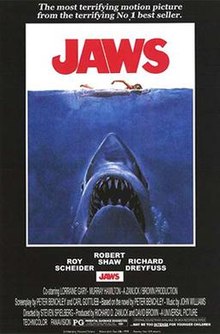
Jaws (1975)

day 23, jaws

JAWS (1975) Three-and-a-half stars
Steven Spielberg’s JAWS wanted to do for sharks what Alfred Hitchcock’s PSYCHO did for showers 15 years earlier.

Like PSYCHO, JAWS became a game-changing motion picture and it’s been analyzed, overanalyzed, parodied, and satirized, and it spawned many clones and rip-offs with just about every animal turned into a relentless killer.

It’s known as the first summer blockbuster film (released on June 20, 1975), I mean it even says so in the Guinness Book of World Records, “Not only did people queue up around the block to see the movie, it became the first film to earn $100 million at the box office.”

Before 1975, summers were traditionally reserved for dumping insignificant fluff.

Based on Peter Benchley’s best-selling novel, JAWS tells a pulp story: a great white shark terrorizes Amity Island, a summer resort community, and transplanted city policeman Sheriff Brody (Roy Scheider) wants to close off the beaches but he runs into much resistance from Mayor Larry Vaughn (Murray Hamilton), who of course fears the loss of tourist revenue more than he does a great white shark. Eventually, though, Brody, along with preppy Ichthyologist Matt Hooper (Richard Dreyfuss) and grizzled old man of the sea Quint (Robert Shaw), attempts to hunt down and kill the great white aboard Quint’s ship, the Orca.

The film and the novel are different in several fundamental ways: Hooper and Brody’s wife do not have an affair in the film; Mayor Vaughn’s squeezed by the mafia in the novel and not simply local business interests; newspaper man Harry Meadows plays a bigger role in the novel; Quint’s made a survivor of the World War II USS Indianapolis; Hooper escapes death in the film; Quint dies by drowning in the novel; in the film, Brody kills the shark by shooting a compressed air tank inside the creature’s jaws, of course.

Spielberg said that he rooted for the shark the first time he read Benchley’s novel because he found the human characters unlikeable.

Normally, books are credited for having stronger characterizations than their screen adaptations.

That’s not the case with JAWS.

In fact, none of the subsequent JAWS films could match the characterizations of Brody, Hooper, and Quint and performances by Scheider, Dreyfuss, and Shaw. We have three indelible characters who stay within our hearts and minds just as much as the image of the great white shark.

Scheider and Dreyfuss appeared to have great chemistry together, just like there seemed to be real tension between Dreyfuss and Shaw.

Universal had Scheider bent over a barrel after he dropped out two weeks before filming started on THE DEER HUNTER, due to “creative differences,” and so they forced Scheider into starring in JAWS 2. Scheider’s performance in JAWS 2 suggests a very, very unhappy person and his conflicts with director Jeannot Szwarc must have only contributed to Scheider’s apparent misery.

Dreyfuss passed on JAWS 2 because Spielberg did not direct it; they made CLOSE ENCOUNTERS OF THE THIRD KIND together instead. Of course, there were obvious difficulties in Quint returning for JAWS 2.

JAWS 2 gives us a bunch of teeny boppers and repeats the basic plot of the first movie, JAWS 3-D sinks even more into a morass of mediocrity (how bad must you be to be disowned by the next JAWS film), and JAWS THE REVENGE, well, it gives us the first shark movie designed for geriatric consumption. To be honest, JAWS THE REVENGE defies the suspension of disbelief beyond belief and becomes one of the worst bad movies ever made.

Necessity became the mother of invention for JAWS, because of the numerous technical difficulties with the mechanical shark that became known as Bruce, named after Spielberg’s lawyer, or alternately “the great white turd.” Spielberg wanted to show the shark a lot sooner, but instead the film took on more Val Lewton proportions than the average horror movie. JAWS relies heavily on John Williams’ famous musical score to substitute for the shark.

The JAWS sequels utilized the mechanical shark far more often and much earlier on, honestly to their detriment. Less is more and more is less.

I always love it when horror movies take on more than just being a horror movie. At times, especially when our three protagonists are stuck on that damn boat together, JAWS becomes grand adventure and an unexpected comedy.

Five Deadly Venoms (1978)

day 47, five deadly venoms

FIVE DEADLY VENOMS (1978) Three-and-a-half stars
Years ago, I finally tracked down (i.e. bought) a subtitled copy of FIVE DEADLY VENOMS and it made all the difference in the world after having extreme technical difficulties watching a dubbed copy the week before the subtitled version, failing twice to make it through because of the haphazard dub job.

The plot in a nutshell: A wise old martial arts master, on his death bed, gives his latest young martial arts pupil a dying wish to go track down some wayward pupils who have done “evil” with the master’s teachings, the “Five Deadly Venoms” that provide our lovely and oh so poetic title, and redeem the master and his martial arts philosophy and teachings forever.

Like DRUNKEN MASTER, FIVE DEADLY VENOMS provides us with multiple idiosyncratic martial artists, fighting styles, and personalities: The Centipede, The Snake, The Scorpion, The Gecko (lizard), and The Toad. The young pupil combines all five styles, although he’s not as potent as the older pupils because he only knows a little about each style.

The old man describes their styles in some detail on his deathbed. Honestly, this scene gets us hyped for the movie ahead, filled with great expectations.

Each fighter and fighting style have their own distinct strengths and weaknesses, some more apparent than others.

The Centipede: Based on speed and quickness. Fastest of the fast.

The Snake: Based on agility and flexibility. This flexibility makes for mad defensive skills and the pinpoint ability to attack the opponents’ weak spots.

The Scorpion: Based on acrobatic kicks or “the sting.” The style resembles the scorpion pincer in the hand techniques of the artist.

The Lizard: Nimble, quick footwork, also described on the FAQs at the IMDb as “Spider-Man with a black belt” because of The Lizard’s mastery of walls.

The Toad: Based on power and resilience. Once mastered, this style lends itself to becoming immune to physical harm. Well, we’ll all see how well that stands up in FIVE DEADLY VENOMS.

These fascinating artists and styles are placed inside an old-fashioned movie plot involving an old man’s treasure, imperial politics, and secret identities. We also have the age-old themes of redemption and revenge that seem to be at the core of the genre.

The different artists each wear masks that prominently feature their animal at the top of the mask.

Of course, you might find FIVE DEADLY VENOMS silly, very silly indeed, almost by default with this genre. I’ve always found that “silliness” in martial arts entertainments to be one of their most endearing features. Your mileage may vary.

Granted, THE FIVE DEADLY VENOMS takes itself seriously. It’s not attempting to be a comedy in any way shape or form.

There’s several twists and turns in the plot and we have to figure out the alignment of the “Five Deadly Venoms.”

We know that certain fighters will be more deadly than the others. To the film’s credit, I couldn’t guess it straight out. We align ourselves with the young pupil early on and follow him on his journey through such deadly waters.

Just a cut below DRUNKEN MASTER and THE 36TH CHAMBER OF SHAOLIN, two fabulous martial arts entertainments from 1978, THE FIVE DEADLY VENOMS nonetheless proves itself a damn good time at the movies and another iconic entry in the Shaw Brothers’ filmography. (Another martial arts film referenced by multiple hip-hop artists over the years, as well as Quentin Tarantino. It was also the inspiration for a series of Sprite commercials in the late 1990s.)

Please seek out the subtitled version. The dubbing proved deadliest venom in the English dubbed version. It took effect almost immediately.

Clan of the White Lotus (1980)

DAY 45, CLAN OF THE WHITE LOTUS.jpg

CLAN OF THE WHITE LOTUS (1980) Three-and-a-half stars
The Shaw Brothers (Runme and Run Run Shaw) rapidly became my favorite old school movie factory producers, following hot on the trails of the spectacles of the incomparable INFRA-MAN and THE 36TH CHAMBER OF SHAOLIN with CLAN OF THE WHITE LOTUS, a 1980 effort directed by Lo Lieh.

Like Sam Elliott’s rustic narrator said to the Dude in THE BIG LEBOWSKI, “I like your style.”

I get all giddy when I see and hear the Shaw Brothers fanfare before their every movie.

CLAN OF THE WHITE LOTUS quickly dispenses with its standard issue martial arts plot and focuses on exciting fight sequences centered on choreographed punches and kicks that play like violent ballet or Fred Astaire and Gene Kelly meets Bruce Lee.

Gordon Liu made his fame in THE 36TH CHAMBER OF SHAOLIN and stars here as our bald protagonist with the wicked cool handle. In THE 36TH CHAMBER, it was San Te (pronounced like the jolly fat guy from the North Pole) and in WHITE LOTUS, it’s Hong Wen-Ting but the subtitles tell us it’s “Hung Man Ting.”

Anyway, Liu plays the hot-tempered fiery young martial artist who faces many unbelievable hardships through the first couple acts before finally triumphing over every obstacle and the resident evil antagonist holding our main man back during the first couple acts through his sheer dedication, hard work, and martial arts talent.

As we discussed at some length in THE 36TH CHAMBER review, Liu is a genuine movie star and holds the camera and our attention and rooting interest.

Director Lo Lieh doubles as the resident evil antagonist Priest White Lotus and he’s virtually untouchable in the first two reels and he undoubtedly could take on an entire cast of doubles and extras just with his glorious white beard alone.

Tarantino fans will immediately recognize White Lotus.

CLAN OF THE WHITE LOTUS depends on a durable storytelling formula (underdog triumphs over evil) and, like DRUNKEN MASTER and THE 36TH CHAMBER OF SHAOLIN, WHITE LOTUS puts enough quirky twists and turns on the formula without diluting its very purity and making it unrecognizable from its basic elements.

For example, CLAN OF THE WHITE LOTUS co-stars needles, a martial artist getting in touch with his feminine side and martial arts style, a child, and pressure points. I believe I’ll skip more generic action movies and stick to films like CLAN OF THE WHITE LOTUS.

I mean, just look at a poster that hypes “Deadly Needle Kung-Fu Against the Invincible Armor of White Lotus.”

I would certainly have bought tickets for that extravaganza.

Alternate titles: HONG WENDING SAN PO BAI LIAN JIAO and FISTS OF THE WHITE LOTUS.