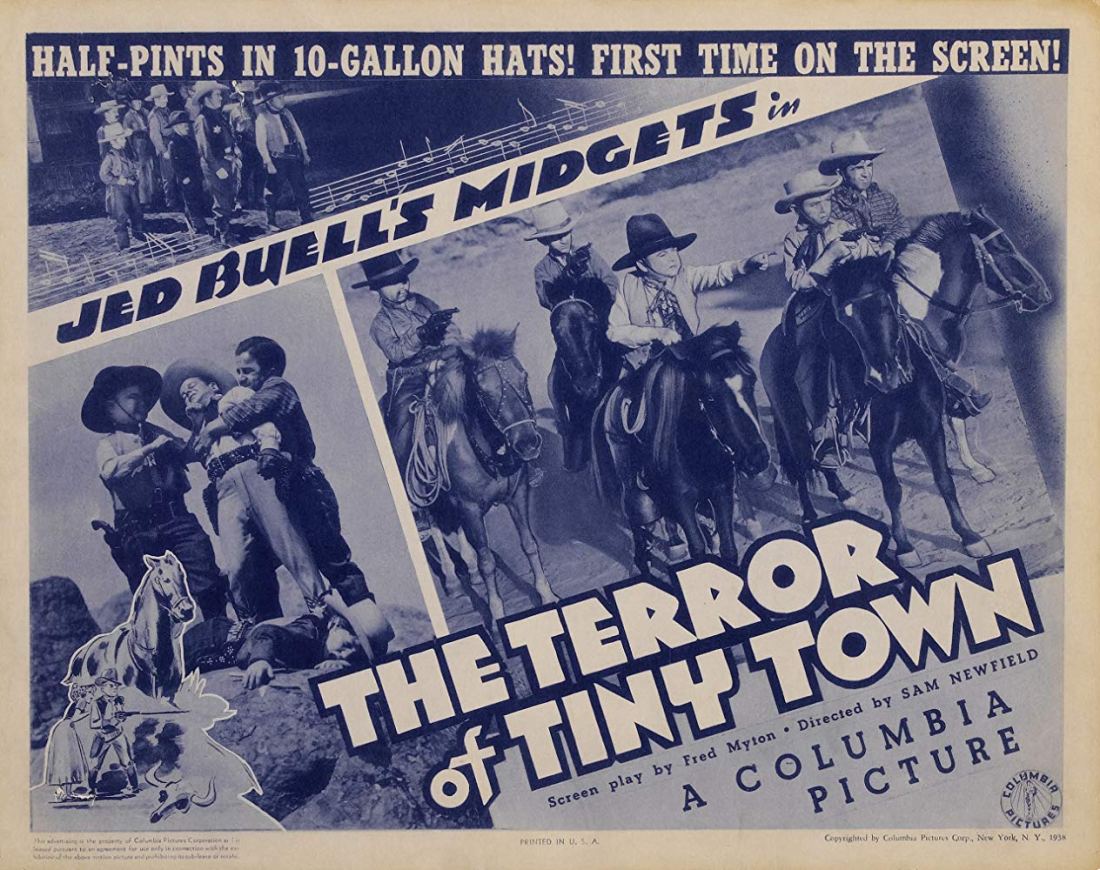
The Terror of Tiny Town (1938)

THE TERROR OF TINY TOWN

THE TERROR OF TINY TOWN (1938) Three-and-a-half stars

This is obviously the shortest Western ever made.

THE TERROR OF TINY TOWN owns the distinction of being the world’s only known Western musical starring midgets, hence the cheap wisecrack about it being the shortest Western ever made. We can be sure there’s many Westerns shorter than 62 minutes.

Exploitation film producer Jed Buell put out a casting call and he more or less put together the cast of the Munchkins before THE WIZARD OF OZ. We see just one non-vertically challenged cast member and that’s in the opening sequence.

Our announcer begins, “Ladies and gentlemen and children of all ages, we’re going to present for your approval a novelty picture with an all-midget cast, the first of its kind to ever be produced. I’m told that it has everything, that is everything that a Western should have.”

During this introduction, our hero Buck Lawson (Billy Curtis) and our villain Bat Haines (‘Little Billy’ Rhodes) just about shoot it out over who’s the star of the picture.

Buck Lawson, “I’m the hero. After this picture’s out, I’ll be the biggest cowboy star in Hollywood.”

Bat Haines, “I’m the villain. I’m the toughest hombre that ever lived, and I ain’t afraid o’ the biggest one o’ you. I’m the Terror of Tiny Town, and that’s the star part.”

Finally, the announcer, who could have been qualified to broker world peace or at least peace in the Middle East, gets Buck Lawson and Bat Haines to agree to let the motion picture play and prove who’s the star.

Judging by their subsequent careers, Curtis (1909-88) easily won.

You may remember him from his role as Mordecai in Clint Eastwood’s HIGH PLAINS DRIFTER.

Frankly, I was floored after looking up Curtis’ screen credits.

He appeared (mostly uncredited) in THE WIZARD OF OZ, MEET JOHN DOE, HELLZAPOPPIN’, SABOTEUR, BUCK PRIVATES COME HOME, LIMELIGHT, THE COURT JESTER, THE INCREDIBLE SHRINKING MAN, and PLANET OF THE APES, plus a multitude of TV shows. Apparently, Curtis hit on Judy Garland during the making of THE WIZARD OF OZ.

Curtis made his debut in THE TERROR OF TINY TOWN.

THE WIZARD OF OZ marked his third role and his first not in a Western. Curtis appeared in THREE TEXAS STEERS — a John Wayne picture — between TINY TOWN and OZ.

You can see why Curtis enjoyed the most successful career in TINY TOWN, because he gives the least stilted line readings.

If you watch THE TERROR OF TINY TOWN, please do not hunt me down if you hated all 62 minutes and then want to give me a piece of your mind because TINY TOWN sucked.

I’ll tell you a little secret right now: THE TERROR OF TINY TOWN, it’s not exactly a good movie and you can just ignore the three-and-a-half stars rating because these are not normal circumstances. I love it and enjoy it a great deal because it’s bad on an epic scale … it belongs in a special place in cinematic history alongside such infamous features as REEFER MADNESS and PLAN 9 FROM OUTER SPACE. I find all of them good for their own distinct reasons.

The announcer proved to be correct, in that THE TERROR OF TINY TOWN does have everything that a Western should have, at least plot wise. They filmed this basic plot a million times before TINY TOWN, I have no doubt. I mean, our villain pits two families against each other and the townspeople must organize to defeat “The Terror of Tiny Town,” and it all leads to an explosive final act. This basic plot was ancient many years before 1938.

Bottom line: THE TERROR OF TINY TOWN is a novelty picture, for sure, and I enjoy the novelty. If we’re being honest, every film exploits some form of novelty.

I find immense enjoyment from the sight gag of characters entering a saloon under the swinging doors, for example, and the ridiculous final showdown between hero and villain.

Unlike ZORRO THE GAY BLADE, TINY TOWN plays its Western musical story straight and does not beat us over the head with either its gags or its premise, at least after the credits and the announcer scene. It’s not a nudge-nudge wink-wink comedy like ZORRO THE GAY BLADE. It’s more funny than it might be otherwise because it’s played straight. The actors made no effort to be campy, but their stilted line readings help THE TERROR OF TINY TOWN achieve bad movie infamy.

Trivia: Jerry Maren (1920-2018) played one of the townspeople in THE TERROR OF TINY TOWN and he was the last surviving WIZARD OF OZ cast member and the last surviving Marx Brothers film cast member.

Back to the Future Trilogy (1985-90)


BACK TO THE FUTURE TRILOGY (1985-1990)
The BACK TO THE FUTURE trilogy stands up better now than when the films were originally released.

That’s partly because we’ve not seen any more sequels or remakes, retcons, reboots, and ripoffs.

The three films have been allowed to stand on their own.

They stand up tall and straight.

Once upon a time, I wrote that DAWN OF THE DEAD, THE TERMINATOR, and THE FLY are great films because they not only succeed at giving audiences satisfaction on genre terms but they also work on additional levels. For example, the satire that equates mall shoppers with zombies (DAWN OF THE DEAD), the romance between Kyle Reese and Sarah Connor (THE TERMINATOR), and the romance between Seth Brundle and Veronica (THE FLY). All three films have a lot going on for and in them.

The same greatness principle holds true for all three BACK TO THE FUTURE films: They’re all successful comedies that work on a deeper level, mostly thanks to time travel.

Speaking of time travel, I’m definitely a fan because I love THE TERMINATOR, TIME AFTER TIME, X-MEN: DAYS OF FUTURE PAST, and MEN IN BLACK 3 and enjoy BILL & TED’S EXCELLENT ADVENTURE, STAR TREK IV: THE VOYAGE HOME, and FREQUENCY, for example.

The BACK TO THE FUTURE films — especially PART II — play around with the paradoxes of time travel, both for comedic and dramatic effect. It allows certain actors to play multiple roles in different times — 1885, 1955, 1985, alternate 1985, and 2015.

BACK TO THE FUTURE starts with the inspiration of containing a time machine in a DeLorean and the movie revs up when that baby moves 88 mph because, as Christopher Lloyd’s Dr. Emmett “Doc” Brown says, “If my calculations are correct, when this baby hits 88 miles per hour, you’re gonna see some serious shit.”

We do.

Anyway, our teenage protagonist Marty McFly (played by a 23-year-old Michael J. Fox), he’s bummed out by his parents George (Crispin Glover) and Lorraine (Lea Thompson), a hopeless nerd picked on by eternal bully Biff Tannen (Thomas F. Wilson) for one parent and a drunk for the other.

Sitting at the dinner table with his family, Marty’s not too interested in how his parents met: Lorraine’s father hit George with his car and Lorraine nursed George back to health. Lorraine experienced a real Florence Nightingale effect.

However, no kid’s ever all that interested in how their parents met. Especially parents like George and Lorraine.

The DeLorean hits 88 mph and Marty ends up back in 1955 — Nov. 5, 1955, stuck there, without any plutonium to return.

BACK TO THE FUTURE then becomes an even greater movie when it takes on the premise of a teenager meeting their parents when they’re teenagers. Marty’s a lot more interested in how his parents met, that’s for sure.

Not long after their first meeting in 1955, Marty saves George from being hit by that fateful car. Marty’s knocked unconscious instead and Nurse Lorraine grows “amorously infatuated” (Doc’s words) with her future son rather than her future husband. She’s in hot pursuit, and we remember her 1985 self warning her teenaged son about girls that chase after boys.

Just be glad that Marty finds a younger Doc to sort it all out and get him “back to the future.”

We especially need Doc around for PART II to explain the movie’s convoluted plot.

PART II gives us a version of 2015 highlighted by technological advancements. It was great fun watching the 2015 scenes in 1989 based on future speculation and it’s still great fun watching them 30 years later as we reflect what they got right and what they got wrong. The Royals, not the Cubs though, won the World Series and Universal mercifully stopped at four JAWS films.

(The Cubs ended the longest world championship drought in North American professional sports history — only 108 years — by winning the 2016 World Series.)

Futurepedia even provided a list of the new technology: Air traffic control; auto-adjusting and auto-drying jacket; automatic dog walker; automated Texaco service station; barcode license plate; binocular card; bionic implants; Compu-Fax; Compu-Serve; computerized breastplate; cosmetic factory; data-court; dehydrated pizza; dust-repellent paper; flying circuits; fruit dispenser; hands free video games; holobillboard; holofilms a la JAWS 19; hoverboards; hovercam; hover conversion; hydrator; Identa-pad; Internet; Kirk Gibson Jr. Slugger 2000 adjustable bat; Litter Bugs; Master-cook; Mr. Fusion; multi-channel video screen; neon curbing; Ortho-lev; Pac Fax; portable thumb unit; power-lacing shoes; rejuvenation clinic; scene screen; skyway; slam ball; sleeping device; soda bottles with built-in straws; flying cars; tablet computer; thumb pad; tranquilization; transponder; U.S. Weather Service; video glasses and video telephone glasses; video simulacrum; video telephone.

PART II ends up back in Nov. 12, 1955 (Marty’s final day in 1955 in BACK TO THE FUTURE), so we have two Martys and two Docs running breathlessly around Hill Valley.

Given all the plot convolutions and time permutations in PART II, it’s fitting that the 1955 Doc faints during a scene late in the movie.

Lightning strikes the DeLorean and sends Doc back to 1885 near the end of PART II … and Marty tracks him down in PART III.

We get a Western comedy in a year that included Best Picture winner DANCES WITH WOLVES and QUIGLEY DOWN UNDER.

PART III finds employment for veteran character actors Pat Buttram (1915-94), Harry Carey Jr. (1921-2012), and Dub Taylor (1907-94) in the 1885 scenes. It’s nice to see and hear them codgers.

Their presence lets us know that PART III is a different kind of Western than DANCES WITH WOLVES and QUIGLEY DOWN UNDER, more like a TV Western.

Marty takes Clint Eastwood for his 1885 name.

PART III casts Mary Steenburgen as Doc’s love interest and we remember Steenburgen as H.G. Wells’ love interest in TIME AFTER TIME (1979). Wells wrote “The Time Machine.” In TIME AFTER TIME, Jack the Ripper uses Wells’ time machine to travel to modern day San Francisco and Wells follows and pursues Jack the Ripper. During his pursuit, Wells meets bank clerk Amy (Steenburgen) and falls in love with her. (In real life, McDowell and Steenburgen became married in 1980, separated in 1989, and divorced in 1990. They met and began dating making TIME AFTER TIME.)

The BACK TO THE FUTURE trilogy ends on a satisfying note.

More notes on BACK TO THE FUTURE:

— Michael J. Fox is one of the most likable actors of all-time. He was the first choice for Marty, but “Family Ties” producer Gary David Goldberg refused to allow Fox away from that show to make a movie. That’s why BACK TO THE FUTURE originally cast Eric Stoltz as Marty. Stoltz worked a few weeks on the film before director Robert Zemeckis and screenwriter Bob Gale realized there’s something wrong with Stoltz as Marty: He’s not the Marty they wanted. Stoltz lacked screwball energy and he played scenes more dramatically. They let Stoltz go and recast with Fox, who became free to make the movie. Fox did not have to reach very far to portray Marty, “All I did in high school was skateboard, chase girls, and play in bands. I even dreamed of becoming a rock star.”

For two months, Fox worked on “Family Ties” during the day and BACK TO THE FUTURE at night, giving him at most a few hours of sleep each day.

Re-shooting added $3 million to the film’s budget, a number more than made up for by grosses for all three films that have amassed nearly $1 billion in returns.

— Christopher Lloyd’s boundless madcap energy earns Doc a place in the annals of great mad scientists and nutty professors. He becomes more than that, though, over the course of three movies. We love Doc, perhaps more than any other character in the series.

— Thomas F. Wilson makes any variation on the bully, whether it’s Buford “Mad Dog,” Biff, or Griff Tannen and whether it’s 1885, 1955, 1985, alternate 1985, or 2015, a lovable asshole. We love to hate “Mad Dog,” Biff, and Griff, especially Biff. We love every time Biff screws up a phrase like “Make like a tree … and get out of here.” We love every time he’s doused in manure. We love every time he’s burned and showed up by our protagonists. How do you feel after learning Donald Trump inspired the Biff character?

— Crispin Glover proved to be the next evolution in screen nerd, taking off from Eddie Deezen and REVENGE OF THE NERDS. Glover stepped in that direction in FRIDAY THE 13TH: THE FINAL CHAPTER, but he gets a fuller character in BACK TO THE FUTURE.

— Lea Thompson is quite fetching in the 1955 scenes and her character unknowingly lusting after her future son fits into a career where she was attacked by The Great White Mother in JAWS 3-D, yelled at and embarrassed by her sexually frustrated and football obsessed boyfriend in ALL THE RIGHT MOVES, involved with a married police officer who should have arrested himself for his own sex crimes in THE WILD LIFE, and kissed by an animatronic duck in HOWARD THE DUCK. John Hughes at least gave her the name Amanda Jones in SOME KIND OF WONDERFUL, from the Rolling Stones song “Miss Amanda Jones.” What a career.

— Huey Lewis and the News’ “Power of Love” achieves being their only song that does not inspire my thoughts of giving the nearest person a pencil and having them stab my eardrums. For example, it seemed that for the longest time at the Pittsburg Subway I’d hear their hit song “The Heart of Rock & Roll.” Every damn single time. I survived by wisecracking, “If Huey Lewis is the heart of rock ’n’ roll, then rock ’n’ roll needs a defibrillator.” I suppose I think more positively of “Power of Love” from being in BACK TO THE FUTURE.

— Zemeckis produced some of the best mass entertainments for nearly a decade-and-a-half, everything from 1941 (directed by Steven Spielberg) and USED CARS to BACK TO THE FUTURE and WHO FRAMED ROGER RABBIT.

I just hope that Hollywood leaves those films alone and does not burden us with remakes, retcons, reboots, or any other ripoff.

Is that too much to ask?

BACK TO THE FUTURE (1985) Four stars; BACK TO THE FUTURE PART II (1989) Three-and-a-half stars; BACK TO THE FUTURE PART III (1990) Four stars

Caddyshack (1980)

CADDYSHACK

CADDYSHACK (1980) Three-and-a-half stars
Harold Ramis’ CADDYSHACK gives the consumer four movies for the price of one.

1) Rodney Dangerfield vs. Ted Knight.

2) Chevy Chase and his meandering philosophical musings and lady man ways.

3) Bill Murray and his bizarre shenanigans.

4) The caddies and their little melodramas.

Most films don’t even give us one.

We have four distinct comedic styles at work in CADDYSHACK: Dangerfield (1921-2004) comes on and thankfully never stops doing variations on his night club act; Knight (1923-86) plays the ultimate snob and perfect counterpoint to Dangerfield; Chase gives us Zen wisdom filtered through deadpan absurdity; and Murray creates a world of his own that combines Dalai Lama and Cinderella stories, gross out snooty old ladies Baby Ruth taste testing, hunting and blowing up animatronic gophers real good, and Bob Marley joints.

Murray’s like a gopher within CADDYSHACK itself, burrowing underneath Dangerfield vs. Knight and the caddies.

CADDYSHACK plays like a 98-minute throwback to the Marx Brothers, the Three Stooges, and W.C. Fields.

First-time director Ramis (1944-2014), in fact, envisioned Murray as Harpo Marx, Dangerfield as Groucho, and Chevy as Chico. Guess that made Ted Knight the villainous Sig Ruman (A NIGHT AT THE OPERA, A DAY AT THE RACES) and Cindy Morgan a more risqué Thelma Todd (MONKEY BUSINESS, HORSE FEATHERS).

Improvisation and cocaine fueled CADDYSHACK.

It seems like Ramis and gang threw away the script written by Brian Doyle-Murray, Ramis, and Douglas Kenney (Ramis and Kenney worked together on NATIONAL LAMPOON’S ANIMAL HOUSE) just to make it all up as they went along, especially Chase, Dangerfield, and Murray.

This is one example of how the makers of a film went in expecting to make a certain film and came out with something completely different. The original plan had been to make the movie focused on the caddies, of course with a title like that, but the comedians took over and stole the show.

To be fair, however, the caddies have their fair share of funny moments and Doyle-Murray steals every scene that he’s in as caddy master Lou.

Chris Nashawaty’s book “Caddyshack: The Making of a Hollywood Cinderella Story” details just how much of a miracle it was even that the movie got finished.

“I had never seen cocaine before I got to the set of CADDYSHACK,” actor Peter Berkrot said. “This was really good cocaine. Pure, like they had just beaten it out of a leaf in Columbia and somebody had carried the leaf to us and turned it into powder in front of us just so we knew how pure it was,” said actor Hamilton Mitchell.

Ramis and Kenney (1946-80) turned in an original cut that ran four hours. A consultant recommended a through line with Danny Noonan (Michael O’Keefe) and his quest for a caddy scholarship and his relationship with a waitress (Sarah Holcomb, who played the mayor’s daughter in ANIMAL HOUSE).

Like classics by the Marx Brothers, the Three Stooges, and Fields, though, we don’t require much of a plot when there’s so much funny going on.

Over the years, I’ve come to appreciate Knight’s asshole Judge Elihu Smails just as much as Dangerfield’s Al Czervik and Murray’s Carl Spackler.

Smails is every bit as quotable as Czervik, Spackler, and Chase’s Ty Webb.

My favorite Smails line comes right after Noonan says that he would like to go to law school after he graduates but his parents do not have enough money to put him through college.

Smails says, “Well, the world needs ditch diggers, too.”

July 1980 undoubtedly ranks among the great months for comedies: AIRPLANE! debuted July 2, USED CARS on July 11, and CADDYSHACK on July 25.

Bette Davis: Tougher than Anybody Else

BETTE DAVIS: TOUGHER THAN ANYBODY ELSE
Like most people in my generation, I first encountered Bette Davis (1908-89) through popular music rather than her 123 movie or TV roles from 1931 through 1989.

Oh, let’s see, Davis made a starring performance in Kim Carnes’ “Bette Davis Eyes,” a hit that spent nine weeks at No. 1 on the Billboard Hot 100 and proved to be 1981’s biggest song. You might vividly remember that one and songwriters Donna Weiss and Jackie De Shannon gave their heroine — er, their femme fatale — not only Bette Davis eyes, but also “Harlow gold hair” and “Greta Garbo’s standoff sighs.”

Davis also made the hall of fame in songs by Madonna and the Kinks.

Madonna Ciccone and Step Pettibone (Ciccone-Pettibone has got a better ring to it than Lennon-McCartney or Strummer-Jones) co-wrote “Vogue” and Madonna’s rap (her best) finishes off with “Bette Davis, we love you” after running through Garbo, Monroe, Dietrich, DiMaggio, Brando, James Dean (called Jimmy Dean, not the sausage manufacturer), Kelly, Astaire, Hayworth, Bacall, Hepburn, and Lana Turner.

Like the other two songs that came later in time, Ray Davies’ lyrics on “Celluloid Heroes” mention Garbo and she gets top billing (first mention) before the song moves on to Rudolph Valentino, Bela Lugosi, Davis, George Sanders, Mickey Rooney, and Marilyn Monroe. Davies groups Davis with Valentino and Lugosi, capping off six lines with “But stand close by Bette Davis / Because hers was such a lonely life.” (Davis named her 1962 autobiography “The Lonely Life.”) For the record, Garbo gets six lines, Monroe four, and Valentino, Lugosi, Sanders, and Rooney two each.

— The first Bette Davis movies I saw were ALL ABOUT EVE (1950) and WHAT EVER HAPPENED TO BABY JANE? (1962), both highly enjoyable for different reasons.

Their common ground, though, centers around Davis.

ALL ABOUT EVE, that’s the one featuring her famous line “Fasten your seat belts. It’s going to be a bumpy night.” Margo Channing — a highly-regarded but aging and difficult stage actress — must not have been a great stretch for a Davis in her early 40s.

Other actresses considered for the role were Ingrid Bergman, Marlene Dietrich, Susan Hayward, Gertrude Lawrence, and Barbara Stanwyck. Think we can all agree that Davis was the perfect choice for Margo Channing.

You can almost feel Davis herself speaking through dialogue like “Lloyd, I am not twenty-ish. I am not thirty-ish. Three months ago I was forty years old. Forty. 4-0. That slipped out. I hadn’t quite made up my mind to admit it. Now I suddenly feel as if I’ve taken all my clothes off” and “Bill’s 32. He looks 32. He looked it five years ago. He’ll look it twenty years from now. I hate men.”

BABY JANE capitalized on the real-life feud between Davis and Joan Crawford, where most of the fun comes from speculating how much reality crossed over into their fictional characters.

Just a casual search on the Internet will bring up all sorts of quotes from Davis on Crawford and I might as well as share a few within this space: “You should never say bad things about the dead, you should only say good … Joan Crawford is dead. Good”; “There may be a heaven, but if Joan Crawford is there, I’m not going”; “Why am I so good at playing bitches? I think it’s because I’m not a bitch. Maybe that’s why Miss Crawford always plays ladies”; and “The best time I ever had with Joan Crawford was when I pushed her down the stairs in WHAT EVER HAPPENED TO BABY JANE?”

Davis never had a problem being the villain and that’s one of the things that made her so great. Let’s face it, sometimes we like the villains infinitely more than bland, square heroes.

She played a strong character in almost every single role.

Davis became the first performer to be nominated for 10 Academy Awards, all for Best Actress, and she won statuettes for DANGEROUS (1935) and JEZEBEL (1938), her first two nominations.

— Recently, I caught up with OF HUMAN BONDAGE (1934), FOG OVER FRISCO (1934), and THE PETRIFIED FOREST (1936).

OF HUMAN BONDAGE — her 22nd film — is renowned for being the film that made Davis a star.

Davis’ character Mildred Rogers has been described as “callous,” “manipulative,”  “cold,” “shrewish,” et cetera, and Davis really sinks her teeth into “You cad, you dirty swine! I never cared for you, not once! I was always makin’ a fool of ya! Ya bored me stiff; I hated ya! It made me SICK when I had to let ya kiss me. I only did it because ya begged me, ya hounded me, and drove me crazy! And after ya kissed me, I always used to wipe my mouth! WIPE MY MOUTH!”

That’s her big scene with Leslie Howard’s Philip Carey, an overly sensitive, club-footed man who’s in love with Mildred despite the fact that she treats him like trash.

— FOG OVER FRISCO came out 26 days before OF HUMAN BONDAGE in 1934 and it’s a fast-moving crime melodrama over in 68 minutes. Action-packed and the big chase scene called to mind BULLITT and THE DEAD POOL, believe it or not.

Davis considered this one of her favorite pictures, though her character Arlene Bradford does not make it to the final reel.

Maybe here’s why FOG OVER FRISCO rated among her favorites: Davis received top billing after Warner Bros. boss Jack Warner caught drift of the Bette buzz from rushes of the film and she found out while filming FOG OVER FRISCO that Warner agreed to loan Davis out to RKO to make OF HUMAN BONDAGE.

Davis also said that FOG OVER FRISCO had a good script and that it was superbly directed by William Dieterle over a shoot that lasted around 20 days (Monday, January 22, 1934 through Saturday, February 10, 1934).

Davis plays characters on opposing ends of the social spectrum in FOG OVER FRISCO and OF HUMAN BONDAGE. In both films, though, she has a weak male admirer. She’s the stronger character, as usual.

— A lot of the fascination watching THE PETRIFIED FOREST came from seeing both Davis and Humphrey Bogart in roles early in their career.

Bogart had done 10 feature films before THE PETRIFIED FOREST and he first played the Duke Mantee role in the 1935 Broadway production alongside Leslie Howard. Warner Bros. wanted Edward G. Robinson (LITTLE CAESAR) for the film adaptation, but Howard refused to appear in the film unless Bogart got the chance to revisit Mantee, a character and performance inspired by John Dillinger. The rest was history. (Bogart and Lauren Bacall named their daughter Leslie Howard Bogart, born 1952, in honor of their friend.)

Bogart is just dynamite in THE PETRIFIED FOREST.

Like OF HUMAN BONDAGE, Davis plays a waitress and Howard’s love interest. Unlike that earlier movie, however, her Gabrielle Maple’s almost instantly smitten with Howard’s Alan Squier and their fates are reversed from OF HUMAN BONDAGE.

The New York Times’ review of the film said of her performance in THE PETRIFIED FOREST, “There should be a large measure of praise for Bette Davis, who demonstrates that she does not have to be hysterical to be credited with a grand portrayal.”

Gabrielle’s a very sympathetic character, a dreamer and an aspiring artist.

— Davis once said, “I survived because I was tougher than anybody else.”

ALL ABOUT EVE (1950) Four stars; WHAT EVER HAPPENED TO BABY JANE? (1962) Four stars; OF HUMAN BONDAGE (1934) Three-and-a-half stars; FOG OVER FRISCO (1934) Three-and-a-half stars; THE PETRIFIED FOREST (1936) Three-and-a-half stars

Electric Boogaloo: The Wild, Untold Story of Cannon Films (2014)

ELECTRIC BOOGALOO, THE WILD UNTOLD STORY OF CANNON FILMS

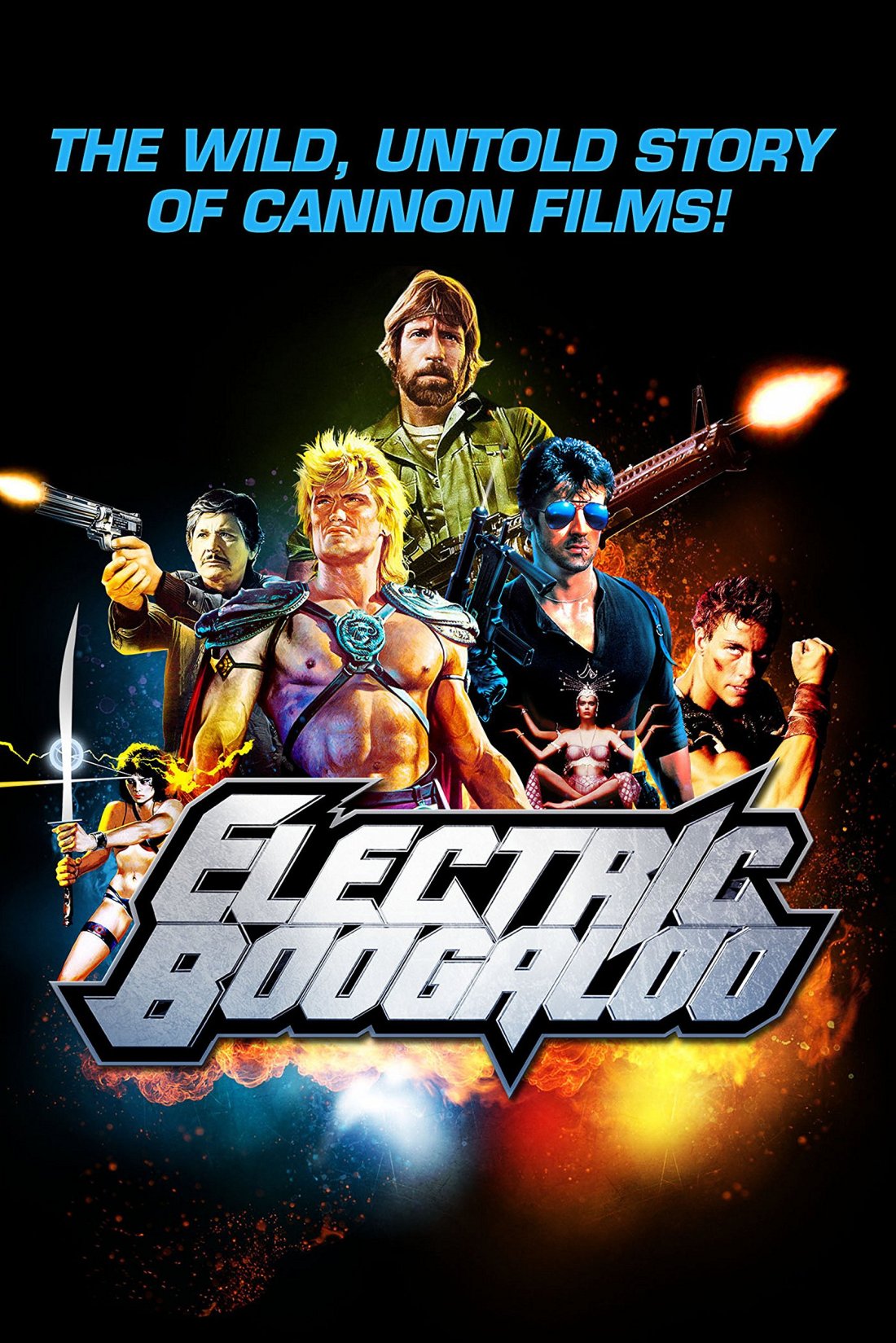
ELECTRIC BOOGALOO: THE WILD, UNTOLD STORY OF CANNON FILMS (2014) Three-and-a-half stars
There’s bad movies and then there’s movies released by Cannon Films.
Cannon became one of the most productive motion picture studios in the 1980s, known for producing schlock on an epic scale.
You might remember Cannon from their productions SUPERMAN IV: THE QUEST FOR PEACE, THE DELTA FORCE, MASTERS OF THE UNIVERSE, BLOODSPORT, OVER THE TOP, KING SOLOMON’S MINES, THE TEXAS CHAINSAW MASSACRE 2, THE LAST AMERICAN VIRGIN, and, of course, BREAKIN’ 2: ELECTRIC BOOGALOO.
Once upon a time, I believe I wrote that cousins and Cannon heads Menahem Golan (1929-2014) and Yoram Globus were never responsible for a “good” film.
It sure does seem that way at times with their Cannon canon, but I might have been guilty of practicing a little bit of hyperbole. Never. And it’s not like Cannon was never guilty of the same.
I watched many of these films growing up and thus, I watched ELECTRIC BOOGALOO: THE WILD, UNTOLD STORY OF CANNON FILMS with a certain nostalgia.
I’ll take a bad film produced by Cannon over many, many good films. They’re never ever boring, unlike so many prestigious prize winners over the years.
For example, I’ve never considered OVER THE TOP a good movie in any traditional sense, but it’s always been great fun watching this incredible cinematic train wreck that combines “arm wrestling, child custody, and truck driving” into a macho soap opera for the ages. See, your regular bad movie would not take on all three of those subjects and play them full tilt. Child actor David Mendenhall mugs so heavily that I check my wallet every single time I watch OVER THE TOP and his emotional moments with Stallone are so cringe worthy.
Anyhoo, ELECTRIC BOOGALOO is filled with many, many nuggets of juicy information.
— Golan honestly believed that Brooke Shields would win an Academy Award for her performance in SAHARA. Come on, are we talking about the same Brooke Shields, one of the worst actresses ever to disgrace the screen? SAHARA marked the last Cannon picture that MGM distributed; MGM called it “Dry as the Sahara desert … it was awful.” During his review of the 1985 Chevy Chase and Dan Akyroyd comedy SPIES LIKE US, Gene Siskel mentioned that he watched the film while he was on vacation in Hawaii and that Hollywood studios should show him a movie every time he’s on vacation in Hawaii because he’d like anything … then he remembered that a year-and-a-half before, he saw SAHARA in Hawaii and it nuked his see-a-movie-in-Hawaii-and-like-it theory.
Rather than winning an Oscar, Shields instead became the first and so far only actress to win both Worst Actress and Worst Supporting Actor (“Brooke Shields (with a mustache)”) at the 1984 Razzies.
— Cannon wanted “that Stone woman” for their RAIDERS OF THE LOST ARK and ROMANCING THE STONE rip-off KING SOLOMON’S MINES.
Golan meant Kathleen Turner, star of both ROMANCING THE STONE and JEWEL OF THE NILE, but instead “that Stone woman” was interpreted to mean Sharon Stone, who had a limited filmography at that point in her career.
Seemingly everybody hated Stone during the production.
Legend has it that crew members pissed on Stone’s bathtub in her trailer.
Stone said that her contribution to both KING SOLOMON’S MINES and the sequel ALLAN QUATERMAIN AND THE LOST CITY OF GOLD was her bad hairdo running through the jungle. She took work on POLICE ACADEMY 4: CITIZENS ON PATROL next to have some fun after the stress of both King Solomon films and her divorce.
Here I thought it was a chance to work with both Brian Backer and Billie Bird (1908-2002).
— SUPERMAN IV: THE QUEST FOR PEACE is one of the worst super hero movies of all-time and rates with JAWS THE REVENGE as the worst third sequel released in 1987.
This is a film where the IMDb trivia is infinitely more interesting than the final product.
For example, the SUPERMAN IV entry begins promisingly, “Christopher Reeve publicly regretted his involvement in the film. He stated, ‘SUPERMAN IV was a catastrophe from start to finish. That failure was a huge blow to my career.’”
The special effects on the picture are shoddier than probably anything you’ve ever seen, as Cannon slashed the budget by $20 million during the film’s production.
Another juicy bit from the IMDb, “Christopher Reeve’s flying harness was concealed under a larger version of the red shorts he wore for the costume, making his waist look bigger. In previous SUPERMAN movies, the bigger waist was hidden by the cape, quick cuts, or creative camera angles. In this movie, the bigger waist is clearly visible, leading some reviewers to speculate that the thicker waist was Reeve’s actual waistline.”
You could say SUPERMAN IV: THE QUEST FOR PEACE rates a 10 on IMDb, if you add 6.3 points from the trivia section to the 3.7 score the film earned after 39,268 votes.
You could also say that Cannon had no business making pictures like SUPERMAN IV, would-be blockbusters that proved to be dead in the water.
— ELECTRIC BOOGALOO reminds (or informs) one that Cannon took chances on John Cassavetes’ LOVE STREAMS, Andrei Konchalovsky’s RUNAWAY TRAIN, and Jean-Luc Godard’s KING LEAR, for example, respectable films coming from a studio not known for respectability.
— Overall, taking in the wide (and wild) variety of films produced by Cannon, everything from break dancing to ninjas and Michael Dudikoff to Chuck Norris and Bronson to Indiana Jones rip-offs, you might be tempted to conclude — like I do — that yesterday’s bad movies are sometimes better than today’s good movies.
— ELECTRIC BOOGALOO itself surpasses all of the Cannon “classics” in entertainment value.

King Kong (1976)

KING KONG 1976

KING KONG (1976) Three-and-a-half stars
Of course this 1976 KING KONG cannot hold a candle to the 1933 version, one of the all-time screen classics.

If and when you and I can get past that fact, admittedly not an easy hurdle, the 1976 version stands out for being a great entertainment.

Jeff Bridges and Jessica Lange are improvements over Bruce Cabot and Fay Wray, respectively, in the male and female leads and Charles Grodin’s not far below what Robert Armstrong did in a similar role.

Of course, you can immediately tell when this movie was made by all the contemporaneous dialogue (especially from Lange) and Grodin plays an executive with Petrox Corporation, a fictional American oil company referencing the “pet rock” phenomenon. This KONG is more bound to 1976 than the original is to 1933.

Beset with production issues of a wide variety, including a complicated legal battle between Paramount, Universal, RKO, and the Cooper estate before filming even started (at one point, both Paramount and Universal had KONG projects lined up), and a first-time leading lady, as well as practical effects that often look more dated than what Willis O’Brien accomplished in 1933, KONG 1976 still works on a basic level.

It is fun.

The stories around the film, though, are more interesting than the finished product and help explain why the hype for the film took on epic proportions before its December 17 premiere.

Italian producer Dino DeLaurentiis (1919-2010) had the Carl Denham quotes in real life: “No one cry when JAWS die,” he said in Time. “But when the monkey die, people gonna cry. Intellectuals gonna love Kong. Even film buffs who love the first Kong gonna love ours.”

Or how about this one about Barbra Streisand told by Roger Ebert: “It’s-a no good, have two monsters in one movie.”

Unfortunately, when Meryl Streep auditioned for the Jessica Lange part, Dino said to his son in Italian that she was “too ugly” for the role; Streep understood Italian and replied in Italian to Dino, “I’m sorry I’m not beautiful enough to be in KING KONG.” We are printing legends, and that only seems appropriate for KING KONG.

Dino talked more smack about JAWS with ORCA THE KILLER WHALE (1977).

Gotta love Dino, whose mouth bit off more than his productions could chew.

Rather than Universal’s competing KONG movie (not released until Peter Jackson’s remake in 2005), the public first received A*P*E, an American / South Korean co-production with its Grade Z special effects, an early appearance for future TV mother Joanna (“Growing Pains”) Kerns, and an infamous shot where the ape uses the middle finger to show his disgust with the helicopters shooting at him.

Either that or he’s just showing his disgust at being trapped in that damn gorilla suit in a shitty movie.

A*P*E would later be topped, in the KING KONG ripoff department, by the Shaw Brothers’ MIGHTY PEKING MAN, the best of the King Kong ripoffs.

There’s also KING KUNG FU from 1976, where a gorilla trained in martial arts wreaks havoc on Wichita, Kansas. Financial constraints forced the makers into not being able to finish their film until 1987.

A*P*E invaded movie screens in October 1976, beating DeLaurentiis’ KONG by a good two months. MIGHTY PEKING MAN came out April 10, 1977, and Quentin Tarantino’s Rolling Thunder Pictures re-released the film on April 23, 1999.

Carlo Rambaldi, Glen Robinson, and Frank Van der Veer won a Special Achievement Award from the Academy of Motion Picture Arts and Sciences for the visual effects in KING KONG, believe it or not.

Legendary make-up artist Rick Baker played Kong, or he’s the man in the ape suit. The original plan had been for KONG ’76 to feature a 40-foot high mechanical ape, but that mechanical monster worked even less than Bruce the Shark in JAWS. JAWS director Steven Spielberg worked around the frequent mechanical failure to make an even better film than if the mechanical shark had been fully operational.

That’s not exactly the case with KONG ’76, partially because musical cues would not be a proper substitute for an ape like John Williams’ musical score proved to be for the shark or even Harry Manfredini’s score for the psycho killer in FRIDAY THE 13TH.

In other words, you have to see the ape.

“KING KONG offered the one chance to do a really perfect gorilla suit,” Baker said. “With the money and the time, it could have been outstanding. Unfortunately, it wasn’t. There were compromises and enforced deadlines.”

Let’s face it, KONG director John Guillermin, he’s no Spielberg.

At the same time, though, I give KONG ’76 and JAWS both three-and-a-half stars. Why?

A) Because life (and my brain) work in mysterious ways.

B) Because star ratings are basically arbitrary.

C) Because both films tap into the same primordial appeal and work as great entertainments for a couple hours each.

Road House (1989)

ROAD HOUSE

ROAD HOUSE (1989) Three-and-a-half stars
This is the Patrick Swayze (1952-2009) movie that ate all his other movies. More like ripped all the other movies’ throats out. We are talking about ROAD HOUSE, after all.

You can weep to GHOST, you can boogie to DIRTY DANCING, and you can kill Commies to RED DAWN, that’s fine and dandy, whatever floats your boat and tickles your fancy, but ROAD HOUSE is the ultimate Swayze viewing experience, at least for this magnificent bastard.

It is Swayze in Testosterone Hyperdrive, or it should have been titled OVER THE TOP rather than Sylvester Stallone’s epic about child custody, arm wrestling, and truck driving.

“Dalton lives like a loner, fights like a professional. And loves like there’s no tomorrow.”

“The dancing’s over. Now it gets dirty.”

“Dalton’s the best bouncer in the business. His nights are filled with fast action, hot music and beautiful women. It’s a dirty job, but somebody’s got to do it.”

Three taglines for ROAD HOUSE that only hit at the surface of the epic sleaze within the film.

Swayze plays Dalton, who’s not only the world’s greatest bouncer, he’s got a degree in philosophy from NYU. At one point, Dalton shares his general bouncer philosophy to his bouncer troops at the Double Deuce, the world’s roughest bar and the pride of the fictional Jasper, Missouri. (Bet the film’s producers did not know there’s a real Jasper, Missouri.)

“All you have to do is follow three simple rules. 1) Never underestimate your opponent. Expect the unexpected. 2) Take it outside. Never start anything inside the bar unless it’s absolutely necessary. And 3) Be nice.”

I enjoy hearing these rules — every single time — just like in GREMLINS when inventor Rand Peltzer tells his son about his new pet Mogwai, “First of all, keep him out of the light, he hates bright light, especially sunlight, it’ll kill him. Second, don’t give him any water, not even to drink. But the most important rule, the rule you can never forget, no matter how much he cries, no matter how much he begs, never feed him after midnight.”

I enjoy hearing both the rules in GREMLINS and ROAD HOUSE because I know that rules are meant to be broken in the movies. The rules — and a whole lot more, namely bones and plate glass windows — are definitely broken in ROAD HOUSE.

ROAD HOUSE is the most quotable Swayze movie by far.

“Pain don’t hurt.”

“Prepare to die.”

“Nobody ever wins a fight.”

“A polar bear fell on me.”

“You’re too stupid to have a good time.”

“Calling me ‘sir’ is like putting an elevator in an outhouse, it don’t belong.”

“Elvis! Play something with balls!”

“I thought you’d be bigger.”

“I’ll get all the sleep I need when I’m dead.”

“I sure ain’t gonna show you my dick.”

Three lines that you might want to pass on: “I used to fuck guys like you in prison.” “I heard you had balls big enough to come in a dump truck.” “Whaddaya say we get nipple to nipple?”

Sam Elliott strolls into Jasper as Wade Garrett, Dalton’s mentor and friend who rates second best bouncer in the world. Garrett’s salty language would not pass muster with Elliott’s ‘The Stranger’ in THE BIG LEBOWSKI — The Stranger asked The Dude at one point, “Do you have to use so many cuss words?” The Dude replied “What the fuck are you talking about?”

ROAD HOUSE is a Western cast in bar room terms all the way down the line, from the hero to the old mentor to the businessman with an offer for the hero to come in and calm down a rowdy scene to the super villain to the henchmen to the leading lady to the watering hole to a guy named Red. Kelly Lynch plays “Doc,” Dalton’s love interest, and ROAD HOUSE might have showed its only restraint in not choosing “Kitty” for the character’s name. Doc’s real name is the film’s big twist.

Guess we should have expected ROAD HOUSE from a director named Rowdy Herrington.

It was destined to be, especially since Herrington adopted the correct approach: “I saw it as a cartoon,” he said. “Broader than life. Brighter than life.”

Epic bar fights. Live music from a real band. A monster truck. Bouncer philosophy. Boobs. Obligatory Swayze butt shot. All that eminently quotable dialogue, although it would be hard saying any of it if we met arch henchman Jimmy’s fate. By the way, Jimmy’s wardrobe approved by Chuck Norris from INVASION U.S.A. and Ramon Revilla from THE KILLING OF SATAN.

In the film’s bravura climax, we encounter super villain Brad Wesley’s trophy room. True story: Recently visiting the Wonders of Wildlife National Museum in Springfield, Missouri, it called to mind Wesley’s trophy room.

Roger Ebert (1942-2013) found this late scene the key to unlocking the film’s guiding spirit: “His hunting trophies include not only the usual deer and elk and antelopes, but also orangutans, llamas and a matched set of tropical monkeys. This guy went hunting in the zoo.

“We are expected to believe that the sadist financed these hunting expeditions by shaking down the businessmen in a town that, on the visible evidence, contains a bar, a general store, a Ford dealership and two residences. ROAD HOUSE is the kind of movie that leaves reality so far behind that you have to accept it on its own terms.”

That’s right. It’s so ridiculous, so cartoonish, so over-the-top that it becomes highly enjoyable, just like COMMANDO and LONE WOLF McQUADE.

There’s a lot (not a whole lot, though) more that I have to say about ROAD HOUSE, but that can wait for another time down at the Double Deuce.

Don’t worry, it’s cooled down considerably since 1989.

Three favorite character actors in ROAD HOUSE: Sunshine Parker, John Doe (rock musician), and Terry Funk (professional wrestler).

Miles Ahead (2016)

MILES AHEAD

MILES AHEAD (2016) Three-and-a-half stars
Jazz trumpeter, composer, and band leader Miles Davis (1926-91) made some of the best albums of all-time: KIND OF BLUE, SKETCHES OF SPAIN, and IN A SILENT WAY among them.

He’s listed for 51 studio albums, 36 live albums, 35 compilation albums, 17 box sets, four soundtrack albums, 57 singles, and three remix albums in a solo career that lasted over 40 years.

MILES AHEAD (also the title of a 1957 album) works as a meditation on Davis’ public image and Samuel L. Jackson’s favorite word.

Actor, director, and writer Don Cheadle, who stars as Davis, has not fashioned a traditional screen biography and I am very thankful for that. I mean, I gave that genre up for good after the double whammy of RAY (2004) and WALK THE LINE (2005) nearly 15 years ago. I don’t think an old-fashioned screen biography could possibly contain Davis, anyway, just like it failed with Johnny Cash; Kris Kristofferson captured Cash better than a two-hour motion picture with these lyrics, “He’s a poet, he’s a picker / He’s a prophet, he’s a pusher / He’s a pilgrim and a preacher, and a problem when he’s stoned / He’s a walkin’ contradiction, partly truth and partly fiction.”

A Rolling Stone article titled “The Two Sides of Miles Davis” begins, “There was never one Miles Davis. Depending on whom you ask, there may have been as many as five. But those would be the jazz fans, those who charted his every artistic move. They’re right. The composer/trumpeter blew through styles with a restless energy unlike any other 20th century musician. But for our purposes, let’s step back from Davis’ stylistic devices and creations and look at the two fundamental Miles Davises: the public and the private.”

The article goes on to discuss Davis’ 1989 autobiography.

It definitely seems that Cheadle and gang read “Miles Davis: An Autobiography,” with detailed notes from Davis’ vocabulary.

Here’s a few samples:

“Anybody can play. The note is only 20 percent. The attitude of the motherfucker who plays it is 80 percent.”

“I remember one time — it might have been a couple times — at the Fillmore East in 1970, I was opening for this sorry-ass cat named Steve Miller. Steve Miller didn’t have his shit going for him, so I’m pissed because I got to open for this non-playing motherfucker just because he had one or two sorry-ass records out. So I would come late and he would have to go on first and then we got there we smoked the motherfucking place, everybody dug it.”

“We were all up in that shit like a muthafucka. It’s cleaner than a broke dick dog.”

“You can tell whether a person plays or not by the way he carries the instrument, whether it means something to him or not. Then the way they talk and act. If they act too hip, you know they can’t play shit.”

Davis would probably tell me to go eat a dead dog’s dick for using the word “jazz” to categorize his music at the start of this review. He rants about that early on during MILES AHEAD.

“I don’t like that word ‘jazz.’ Don’t … don’t call it ‘jazz,’ man. That’s some made-up word. Trying to box somebody in. Don’t call my music ‘jazz.’ It’s social music.”

There’s no effort to soften or sugarcoat or make Davis more palatable for the masses in MILES AHEAD, unlike both RAY and WALK THE LINE.

That’s probably why Cheadle, unlike Jamie Foxx in RAY and Joaquin Phoenix in WALK THE LINE, did not get showered during awards season.

We do hear Davis’ music throughout MILES AHEAD — notably “So What” from KIND OF BLUE, “Solea” from SKETCHES OF SPAIN, “Seven Steps to Heaven” from SEVEN STEPS TO HEAVEN, “Frelon Brun (Brown Hornet)” from FILLES DE KILIMANJARO, and “Black Satin” from ON THE CORNER.

Just incredible music.

You wouldn’t have been able to tell that to Davis. Bless him.

Enjoy this excerpt from Nick Kent’s “Lightening Up with the Prince of Darkness”:

“It’s (music’s) never been better!” Davis said. “Damn right! Are there drawbacks? None whatsoever! Hell, some damn critic’ — the word is spat out — ‘might disagree, but, you see, he don’t know! All this shit about me bein’ better in the old days … music bein’ better. That’s reactionary thinking from motherfuckers who weren’t even there. The old days … shit!”

That’s something that Davis could have easily said during MILES AHEAD.

Cheadle’s film bounces back between Davis’ hiatus period and his relationship and subsequent decade-long marriage (1958-68) with his first wife Frances Taylor (1929-2018).

Several articles have called MILES AHEAD’s factual accuracy into question.

More importantly, though, MILES AHEAD captures the spirit of Miles Davis accurately.

Q: The Winged Serpent (1982)

Q

Q: THE WINGED SERPENT (1982) Three-and-a-half stars
I admit loud and proud a weakness for time travel, robots, monsters, and mad scientists.

Maybe weakness is the wrong choice of word. How about predilection?

Q: THE WINGED SERPENT definitely fits the bill for monsters, a grand homage to the great monster movies of the 1950s.

It’s directed, written, and produced by Larry Cohen (1941-2019) and it’s financed by Samuel Z. Arkoff (1918-2001) as the first release from Arkoff International Pictures.

Of course, Arkoff was involved with Q.

Arkoff’s producer credits include THE PHANTOM FROM 10,000 LEAGUES, IT CONQUERED THE WORLD, THE SHE-CREATURE, INVASION OF THE SAUCER MAN, THE AMAZING COLOSSAL MAN, HOW TO MAKE A MONSTER, and REPTILICUS.

Arkoff even provided a great quote in a conversation between the producer and critic Rex Reed (relayed by Roger Ebert).

Reed: “Sam! I just saw THE WINGED SERPENT! What a surprise! All that dreck — and right in the middle of it, a great Method performance by Michael Moriarty!”

Arkoff: “The dreck was my idea.”

That brings us to Michael Moriarty, whose performance elevates Q to another level.

He plays Jimmy Quinn (though he’s not the “Q” of the film’s title), a cheap dime store hood with aspirations of being a jazz pianist.

Quinn’s like Jeffrey Combs’ Herbert West in RE-ANIMATOR and Thomas Wilson’s Biff Tannen (and various historical offshoots) in the BACK TO THE FUTURE series.

In other words, he’s a lovable asshole or we love hating Jimmy Quinn.

Personally, I love what he does after his discovery of the Quetzalcoatl (the real source for the film’s title) responsible for several deaths.

A pair of hoods lean on Quinn after his part in a botched diamond heist and he leads them to the Chrysler Building, nesting ground of the Quetzalcoatl. The hoods don’t know that.

Quinn’s priceless reaction to the fate of the hoods: “Eat ‘em, eat ‘em! Crunch! Crunch!”

Then Quinn comes up with a plan, a ransom deal for New York City authorities: $1 million in cold, hard cash in exchange for divulging the nest location. “All my life I’ve been a nobody and right now I’ve got the chance of being somebody important,” Quinn said.

Seems like Quinn served as New York City’s preparation for the Ghostbusters, especially dealing with one Peter Venkman.

Guess we’ve covered a little bit of the plot.

If you’re not satisfied, though, I found this plot summary on Amazon: “Its name is Quetzalcoatl, a dragon-like Aztec god that is summoned to modern-day Manhattan by a mysterious cult. But just call it Q … because that is all you’ll be able to say before it tears you apart!”

Okay, that’s enough plot.

Moriarty headlines a very capable cast also including David Carradine, Richard Roundtree, and Candy Clark.

Carradine and Roundtree play NYPD detectives, who almost matter-of-factly react to a winged serpent and ritualistic Aztec murder.

Just another day on the beat.

That’s the beauty of a Larry Cohen film.

In the opening paragraph, I mentioned a taste for time travel, robots, monsters, and mad scientists. I should go back and put “stop-motion” in front of monsters, loving everything from Willis O’Brien’s pioneering work in KING KONG (1933) to Ray Harryhausen’s grand finale CLASH OF THE TITANS (1981).

Randall William Cook and David Allen worked on Q, a deliberate throwback to O’Brien and Harryhausen.

Between Moriarty’s performance and a stop-motion winged serpent, as well as Cohen’s work both writing and directing, Q rates as one of the great not-so-guilty pleasures.

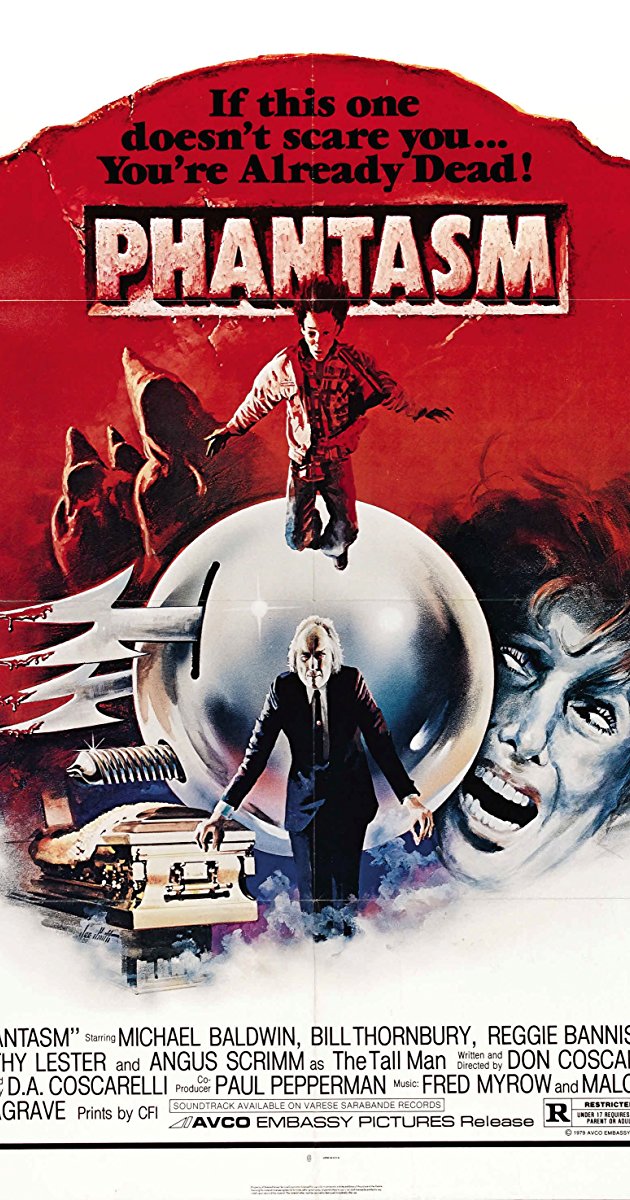
Phantasm (1979)

DAY 27, PHANTASM

PHANTASM (1979) Three-and-a-half stars
Child protagonists have been used to great effect in literature and films.

In the world of film, we’ve had all the Disney films, all the Hayao Miyazaki films, THE WIZARD OF OZ, ALICE IN WONDERLAND, FORBIDDEN GAMES, THE 400 BLOWS, WILLY WONKA AND THE CHOCOLATE FACTORY, THE SPIRIT OF THE BEEHIVE, PAN’S LABYRINTH, and Harry Potter, just to name a few greats.

We can add Don Coscarelli’s low-budget horror film PHANTASM (estimated at $300,000) to that distinguished list and I don’t know if a child protoganist has ever been as resourceful or such a relentless little fighter as the 13-year-old Mike (A. Michael Baldwin).

He’s our entry point into the strange and bizarre world created by Coscarelli, who not only directed but wrote, photographed, and edited this little labor of love.

Mike’s not a passive observer reluctantly drawn into the action, rather his innate curiosity gets the best of him.

Mike fears that his older brother Jody (Bill Thornbury) will leave him at any moment and there’s one rather poignant scene when Mike follows Jody in medium long shot. Mike’s always following Jody and this bothers Jody, who’s considering hitting the road for a while and leaving Mike in the care of their Aunt Belle.

Mike and Jody’s parents died two years before the events in PHANTASM.

Mike and Jody are joined by Reggie (Reggie Bannister), a family friend and an ice cream vendor. Their family and friends seem to be dropping left and right.

They go up against The Tall Man (Angus Schrimm) and I’ll let the “Slender Man Connection Wiki” describe him, “The Tall Man is the primary antagonist of the PHANTASM horror film series and one of the main influences on the Slender Man mythos. Originally a human known as Jebediah Morningside, the Tall Man was a mysterious, malevolent entity disguised as a mortician, who would rob graveyards of their corpses to reanimate them into his vast interdimensional army.”

Both Jody and Reggie are reluctant to believe Michael and his overactive imagination, but boy oh boy are they believers well before the end of PHANTASM.

The Tall Man’s minions include dwarfs who have a nice little back story and he also dispatches flying metallic spheres known as the Sentinel Sphere or the Flying Death Sphere or Brain Suckers. They are one of the most nifty death devices in any horror movie, and every PHANTASM movie includes at least a couple sphere scenes.

The spheres are eight inches tall and 50 pounds, and they fly rapidly through the air relentlessly tracking their potential victims.

Apparently, they contain the shrunken brains of The Tall Man’s victims and The Tall Man controls the spheres with his mind.

The spheres have drills, dual blades, saws, telescopes, explosives, and spikes at their disposal and the golden spheres (that originate from The Tall Man’s body) have tri-blades, lasers, and dual saws. The spheres drain the victims of all their blood.

The spheres do have three weaknesses: extremely cold temperatures, direct hits with a projectile weapon (Jody shotgun blasts one in PHANTASM), and the frequency emitted by a tuning fork. The golden spheres are tougher to kill.

Basically, we have three solid protagonists who take us from the beginning to the end of the picture, one especially malevolent antagonist, and one ripped, twisted instrument of death. What else do we need?

Unfortunately, some viewers have complained about the story.

However, I think the title PHANTASM itself clues the viewer in to the basic nature of the plot. Phantasm means “a figment of the imagination or disordered mind.”

Coscarelli’s imagination created some memorable moments in the history of horror.
For example, Mike’s snooping around one night at The Tall Man’s lair and he survives his first encounter with a sphere, but one of The Tall Man’s henchmen does not.

Then, Mike meets The Tall Man up close and personal for the first time.

The Tall Man chases Mike down the corridors of terror and Mike eventually traps The Tall Man’s hand in a heavy door. This affords Mike the opportunity to cut off The Tall Man’s fingers. The Tall Man emits a ghastly, inhuman sound and yellow blood (embalming fluid) shoots out from the severed fingers on the floor.

Mike takes one of the still-moving fingers and puts the evidence in a box to convince the skeptical thus far Jody.

Jody (Thornbury) plays his reaction to the finger just perfectly, and it’s a great moment of course when the older brother finally believes the younger brother.

As they’re about to take their evidence to the authorities, that yellow finger transforms into a monstrous bug and it attacks the brothers.

I live for moments and scenes like that.

At one point, The Tall Man, in a voiceover, tells Mike, “You play a good game, boy, but the game is finished. Now you die.”

Now, if you’re nice to me and ask me politely, I’ll do my best Tall Man impression and recite that dialogue for you.