Shaft (1971)

SHAFT

SHAFT (1971) Three-and-a-half stars

A whole new generation of fans discovered Isaac Hayes (1942-2008) through his work for Trey Parker and Matt Stone on “South Park.”

I’m talking about Chef, Hayes’ animated alter ego, his songs like “Chocolate Salty Balls” and “Love Gravy,” his lines “Hello there, children” and “Damn, woman, I just gave you sweet loving five minutes ago” (oh, for just one game of South Park pinball right about now), and his overall cool until everything went all screwy there at the end between Mr. Hayes and the boys.

I went back in time and delved through Hayes’ previous work.

At some point in the late 20th or early 21st century, I watched Gordon Parks’ SHAFT for the first time, roughly the same time as I watched the John Singleton remake, er, sequel starring Samuel Jackson and featuring Christian Bale, Toni Collette, and Jeffrey Wright. It would have been nice if the suburban multiplex paired the ‘71 and ‘00 pictures together, but, no, of course not, and my ears still feel like they’re ringing from the 110-minute action spectacular. Nigel Tufner must have been the projectionist that day, because it was cranked up to 11 x 11.

(For crying out loud, why do we need three movies simply titled SHAFT? This is just as bad as HALLOWEEN.)

I vastly prefer the ‘71 SHAFT over any of the later SHAFT films (I, of course, have not seen the 2019 one) and there’s not one scene in either ‘70s sequel, BIG SCORE and GOES TO AFRICA, or the 2000 sequel or the rest of the first picture itself that even approaches the opening five minutes. Talk about iconic.

It all starts with the multifaceted sounds of the modern day big city rumble, then it moves on to the sights. Burt Lancaster and Telly Savalas in THE SCALPHUNTERS and George Peppard and Dean Martin in ROUGH NIGHT IN JERICHO. Robert Redford, Michael Pollard, and Lauren Hutton in LITTLE FAUSS … never mind, the first 42nd Street showing of HE AND SHE and second big hit THE ANIMAL. There’s more hype, then the first notes of Hayes’ “Theme from Shaft” hit us.

Nearly 45 seconds into the movie, we’re given our introduction to the title character with a close-up of the man coming out from the subway and we’re already interested. He walks across six lanes of traffic and flashes an obscene gesture and shouts “Up yours!” at somebody who had the audacity to honk their horn. We’re interested some more, as we observe what must be just another day in the life of this angry black man.

We see more commercialization and Shaft walks through a crowd of picketers. One sign: “I GOT MY JOB THROUGH THE New York Times.” Another: “WANT YOUR SEX LIFE PUBLISHED?” One more: “I LOST MY JOB THRU Fidelifacts.” Just before making his way through picketers, Shaft flashes his badge at a street peddler, who promptly skedaddles to somewhere else. “Theme from Shaft” has been playing this whole time and picking up momentum as the opening credits scroll and our title character strolls.

It’s been about 150 seconds into the number before Hayes matter-of-factly asks “Who’s the black private dick that’s a sex machine to all the chicks?” Backing vocalists Pat Lewis, Rose Williams, Mitchell Butler, and Telma Hopkins answer “Shaft” and Hayes replies “Damn right.” We are hooked, that’s damn right for sure.

“Theme from Shaft” won the 1972 Academy Award for Best Original Song, and it’s a stone cold classic especially in its single form. We can file the opening scene in SHAFT under “Great Opening Scenes.”

Hayes wrote the lyrics, handled lead vocals, made the arrangements, and played the keyboards. Lester Snell (electric piano), David Becker (viola), Charles Pitts (guitar), Michael Toles (guitar), Marc “Dr. Love” Davis (guitar solo), James Alexander (bass guitar), Richard “Johnny” Davis (trumpet), John Fonville (flute), Gary Jones (congas), and Willie Hall (drums) all played their parts masterfully.

Despite the fact that none of the remaining 90 or so minutes can measure up against the opening five, SHAFT affords one additional pleasures. That should be of little surprise, since this material puts a black spin on James Bond and Mike Hammer.

White author Ernest Tidyman (1928-84) adapted his own 1970 novel for the screen and Tidyman became a household name in Hollywood with SHAFT and THE FRENCH CONNECTION both major hits in 1971. Tidyman won the Academy Award for Best Adapted Screenplay for THE FRENCH CONNECTION, a Best Picture winner.

Tidyman, who FRENCH CONNECTION producer Philip D’Antoni thought would be black, did not like the SHAFT rewrite by John D.F. Black, a writer hired by Parks. Despite his displeasure, Tidyman returned to write the sequel also directed by Parks (1912-2006). The former newspaperman wrote more Shaft novels, “Shaft Among the Jews” (1972), “Shaft’s Big Score” (1972), “Shaft Has a Ball” (1973), “Goodbye, Mr. Shaft” (1973), “Shaft’s Carnival of Killers” (1974), and “The Last Shaft” (1975). Tidyman also wrote HIGH PLAINS DRIFTER and the early Chuck Norris pic A FORCE OF ONE.

Former model turned actor Richard Roundtree makes such a strong impression as Shaft that he’s been called the first black action hero. Not a bad screen debut. Hayes’ opening number greatly assists Roundtree, his character, and us audience members because it paints a portrait of Shaft’s basic personality and makes him a bit larger-than-life. We like this character a great deal already within the film’s first five minutes. We applaud him, especially when he sticks it to the man. Every now and then, all of us wish that we could stick it to the man, just like John Shaft.

Class of 1984 (1982)

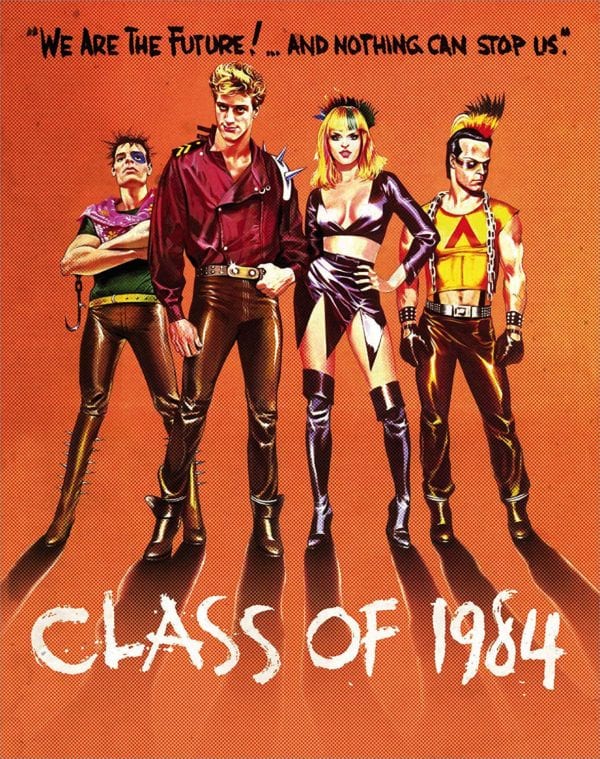
CLASS OF 1984

CLASS OF 1984 (1982) Three-and-a-half stars

Given its exploitation film content including gore, nudity, profanity, sex, and violence, CLASS OF 1984 will not be shown to new teachers or substitute teachers any school year soon.

Not that it should, but a little independent research never hurt anybody.

I don’t remember, though, if I first watched CLASS OF 1984 during or after my three years as substitute teacher in the late 00s. However, I do remember that it made a strong impact with its story of how an idealistic music teacher eventually gives into the dark side and murders his most unruly students at an inner city high school. It’s definitely the movie to see after DANGEROUS MINDS, LEAN ON ME, all that feel good uplifting claptrap.

Watching CLASS OF 1984 again in a decade since I substituted, it still brings on memories of the little punks who threatened violence, who said they would sue, who just ran their mouths incessantly, and who made getting through another day feel like an endurance contest from Hell. For every good student, it often seemed like there were two or three or twenty bad ones in every class. “I would love to punch you in the face,” one junior high student said. “Go ahead, give it your best shot,” the substitute teacher said. Thankfully, not every day substitute teaching was quite like that.

In that spirit, though, we return to our regularly scheduled review of CLASS OF 1984.

Be warned: This is a rough little movie, a nasty piece of work at times, but if you can make it through scenes like the biology teacher’s murdered rabbits and the rape of the music teacher’s wife, this 1982 update on the 1955 classic BLACKBOARD JUNGLE does have its merits.

The performances help lift this film above mere exploitation trash: Perry King as the music teacher, Roddy McDowall as the biology teacher, Timothy Van Patten as every teacher’s worst nightmare, and Michael J. Fox (in an early role) as one of the good students.

King makes for a likable protagonist and takes us from one end of the picture to the next. We are behind him every step of the way, and that’s critical during the film’s violent final act as enough has become more than enough for this music teacher. Those damn punks go too far, far enough for at least a couple exploitation films. Roger Ebert called the climax a cross between THE HUNCHBACK OF NOTRE DAME and BEYOND THE VALLEY OF THE DOLLS.

McDowall (1928-98) had a knack for supporting performances that almost steal a movie away from their nominal stars, and he displays that knack here in CLASS OF 1984, especially when he cracks and teaches his biology class by gunpoint. I bet you’ll remember how many chambers are in the human heart with a gun pointed at you, and I also bet that Richard Kiley (from BLACKBOARD JUNGLE) wishes he could have got a scene like that after the punks in his film had their way with his favorite jazz records. Damn kids, damn punks.

[Review resumed about two weeks later.]

To work properly, this genre requires a repugnant piece of work going up against the hero and Van Patten certainly provides that as teenage antagonist Peter Stegman. Audiences have been known to cheer his demise. Stegman’s personality profile on Villains Wiki, “A totally violent, sadistic, ruthless and mentally unstable teenager. He will hurt anyone who he thinks is threatening his authority over the school, or he will also kill them with no remorse or regrets.” In a different movie, Stegman’s piano-playing ability would have been exploited for a different kind of feel-good ending, not one where you feel good the bastard’s dead.

You can see why Fox became a superstar, even in a supporting performance.

CLASS OF 1984 director Mark L. Lester also directed TRUCK STOP WOMEN, WHITE HOUSE MADNESS, BOBBIE JO AND THE OUTLAW, GOLD OF THE AMAZON WOMEN, ROLLER BOOGIE, FIRESTARTER, and COMMANDO. Now, that’s some filmography and I’ll say that it’s close (real close) between CLASS OF 1984 and COMMANDO for his best work.

A movie like this needs a proper soundtrack.

Nearly two decades before AMERICAN GRAFFITI, BLACKBOARD JUNGLE made waves with its use of Bill Haley and the Comets’ “Rock Around the Clock.” What an opener!

Alice Cooper provides “I Am the Future” for CLASS OF 1984. Mr. Cooper has the ideal credentials for scoring a teenage rebellion pic: specifically “I’m Eighteen,” “School’s Out,” and “Teenage Lament ‘74” from his glory days. As far as mid-period solo Alice standards go, “I Am the Future” does not quite measure up against 1980’s “Clones” and 1983’s “I Love America,” but it still far surpasses Alice’s late 80s and early 90s hair metal period.

CLASS OF 1984 belongs to a branch of entertainment that includes such notables as not only BLACKBOARD JUNGLE but also BEYOND THE VALLEY OF THE DOLLS, OVER THE EDGE, ROCK ‘N’ ROLL HIGH SCHOOL, RIVER’S EDGE, and PUMP UP THE VOLUME, as well as the “Smells Like Teen Spirit” video.

Willy Wonka & the Chocolate Factory (1971)

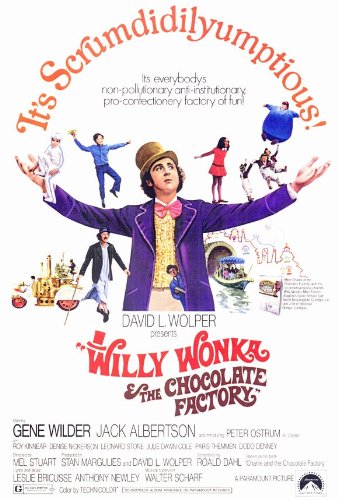
WILLY WONKA

WILLY WONKA & THE CHOCOLATE FACTORY (1971) Three-and-a-half stars

Over the years, many individual performers have walked away with a movie and made it their own. For example, Gene Wilder in WILLY WONKA & THE CHOCOLATE FACTORY.

Wilder provides one of the great movie entrances at about the 45-minute mark of the picture and it’s about darn time because it’s a bit of a slog before we reach the chocolate factory. Our expectations are very high by this point in the picture and Wilder’s Willy Wonka meets and even surpasses them. It was Wilder himself who insisted that he make such an entrance.

“When I make my first entrance, I’d like to come out of the door carrying a cane and then walk toward the crowd with a limp,” Wilder said. “After the crowd sees Willy Wonka is a cripple, they all whisper to themselves and then become deathly quiet. As I walk toward them, my cane sinks into one of the cobblestones I’m walking on and stands straight up, by itself; but I keep on walking, until I realize that I no longer have my cane. I start to fall forward, and just before I hit the ground, I do a beautiful forward somersault and bounce back up, to great applause.”

This entrance establishes Wonka’s unpredictability right from the start.

Wilder magnificently expresses all the sides of Willy Wonka’s personality. It turns on a dime from joy and wonder to malevolent anger at the selfish children who found their golden ticket in a Wonka bar. Their golden tickets earned the children a pass to Wonka’s factory. The five children are Augustus Gloop, Veruca Salt, Violet Beauregarde, Mike Teavee, and Charlie Bucket and they are each joined by one parent or grandparent in the case of final ticket winner Charlie Bucket. The bad children are punished in unspeakable, horrifying ways for their indiscretions. That’ll show ‘em and serves ‘em right, greedy little bastards.

When the beloved Wilder died in 2016 at the age of 83, I thought immediately of his performance as Willy Wonka and his spotlight song “Pure Imagination,” a number written by the British duo of Leslie Bricusse and Anthony Newley. “If you want to view paradise / Simply look around and view it / Anything you want to do it / Wanna change the world / There’s nothing to it / There is no life I know / To compare with pure imagination / Living there you’ll be free / If you truly wish to be.” At its very, very best, WILLY WONKA approaches THE WIZARD OF OZ and Wilder’s on par with Margaret Hamilton and Frank Morgan and gang. They all share a certain joy of performance that’s wonderful to behold.

Like THE WIZARD OF OZ, WILLY WONKA undoubtedly introduced multitudes of children to scary movies. The Haunted Forest, the Wicked Witch of the West, flying monkeys, et cetera, in the 1939 film and the Oompa-Loompas and the boat ride in WILLY WONKA.

“Charlie and the Chocolate Factory” author Roald Dahl (1916-90) absolutely hated the 1971 screen adaptation. Dahl received credit for writing the screenplay, but it was the uncredited David Seltzer who came in and made script changes that raised Dahl’s ire.

What did Mr. Dahl hate about the picture? The shift in focus from Charlie to Willy Wonka. Check. The musical numbers. Check. Casting Gene Wilder rather than Spike Milligan, Dahl’s stated preference. Check. Guess the question should be changed to what didn’t Mr. Dahl hate about WILLY WONKA. This whole situation reminds one that Stephen King hates Stanley Kubrick’s THE SHINING.

I saw WILLY WONKA for the first time in fifth grade (1990) and read Dahl’s novel the next school year. I loved Dahl’s novel, but I have not read it since completing it during sixth grade, roughly the same age as the precocious golden ticket winners. Meanwhile, I have seen the 1971 version several times since that first encounter nearly three decades ago, on cable TV (Teavee), VHS, and DVD. I do think of the film more often than I do the book, and I believe that it has almost everything to do with the Wilder performance.

I have skipped Tim Burton’s 2005 adaptation CHARLIE & THE CHOCOLATE FACTORY & I just remember being appalled from the start by still photographs of Johnny Depp’s take on Willy Wonka. Remember that scene in ANIMAL HOUSE when the older members of Delta Tau Chi pelt that picture of pledge Flounder with beer cans? That’s about how I feel every time I see a picture of Depp as Wonka. (Generally speaking, I have no problem with Burton and Depp movies. I love ED WOOD and like SLEEPY HOLLOW and SWEENEY TODD a lot.)

In a 2013 interview with Turner Classic Movies host Robert Osborne (1932-2017), Wilder shared his true feelings on the 2005 version.

“I think it’s an insult,” he said. “Johnny Depp, I think, is a good actor, but I don’t care for that director [Tim Burton]. He’s a talented man, but I don’t care for him doing stuff like he did.”

Clash of the Titans (1981)


CLASH OF THE TITANS (1981) Three-and-a-half stars

Harryhausen vs. Harry Hamlin.

That’s what CLASH OF THE TITANS amounts to in the long run for this viewer.

Artist, designer, visual effects man, writer, and producer Ray Harryhausen (1920-2013) mastered the dying art of stop-motion animation. His credits include MIGHTY JOE YOUNG, THE 7TH VOYAGE OF SINBAD, JASON AND THE ARGONAUTS, ONE MILLION YEARS B.C., and CLASH OF THE TITANS, Harryhausen’s final production in which he goes out with a big bang.

Harryhausen is the real star of CLASH OF THE TITANS, and not Harry Hamlin or even big-name actors Laurence Olivier, Ursula Andress, Maggie Smith, Burgess Meredith, and Claire Bloom.

I like CLASH OF THE TITANS a lot because of all them stop-motion creations.

Let’s see, we have scorpions, the Stygian witches, Calibos and his vulture, a two-headed hound of Hell, the Kraken, the mechanical owl Bubo, and, of course, Medusa.

The Medusa sequence is the pièce de résistance of CLASH OF THE TITANS and responsible for at least three stars alone.

Harryhausen himself favored Medusa among his many creations.

The snake-haired Medusa, we all know that she’s deadly with arrows and she can turn a person to stone if you make contact with her eyes. Personally, I pretend that every salesperson in a shopping mall is Medusa and eye contact must be strictly avoided. Perseus (Hamlin) tricks Medusa with his reflection and he lops off her head. Then, our hero uses Medusa’s head to turn the formidable Kraken to stone.

A wide range of filmmakers have been inspired by Harryhausen’s work, including Steven Spielberg, Joe Dante, James Cameron, Tim Burton, Peter Jackson, and Sam Raimi.

In 2010, Academy Award winning animator Nick Park talked with the BBC about his three favorite Harryhausen moments. He finished up with Medusa from CLASH OF THE TITANS after picking two from JASON AND THE ARGONAUTS.

“It was so well done and frightening,” Park said. “It’s all the same technique but going to different heights of intricacy.

“I thought it was a combination of really good lighting and shadow. I do admire a lot of CGI, but there’s something not real about it.

“In the Medusa that Ray did it’s there and it’s grounded, there’s real light hitting real surfaces. Somehow your brain knows it’s not real with CGI.”

I’ll be honest, I am far more interested in Harryhausen’s creatures than the rather convoluted plot involving Perseus, Andromeda (Judi Bowker), Calibos, Cassiopeia, and the gods pulling all the strings.

That’s what I meant by starting this review “Harryhausen vs. Harry Hamlin.”

Most of CLASH OF THE TITANS plays like a soap opera, not helped out by pretty boy Hamlin and Bowker, who seem like they should be on “Days of Our Lives.”

Google is a wondrous invention: With just two magic words and one little click, I found the 1987 People article on Hamlin, “The Sexiest Man Alive” double issue no less, and the opening paragraph of “Last of the Great Romantics” just hooks me in against my better instincts.

“The name seems wrong for The Sexiest Man Alive, Harry is a name for an uncle, or a guy who asks you to the prom because his mother made him. Of course, Harold would be worse. So Harry it is. Harry Robinson Hamlin, to be precise … the Harry everyone’s just wild about.” (Personally, I prefer Harry Truman or Harry Potter, quite possibly since neither will ever be proclaimed “The Sexiest Man Alive.”)

The article comes back around for a swipe at CLASH OF THE TITANS.

“And there’s always the possibility of doing a remake of CLASH OF THE TITANS. ‘I brought my toga home,’ says Harry, raising hopes of another glimpse of those knees. He’s kidding, of course. Frivolous flicks are a thing of the past for The Sexiest Man Alive. Besides, says Harry, laughing, ‘I used the toga to wash my car.’”

Frivolous flicks a thing of the past for Hamlin? Hamlin’s career has included 105 episodes of “L.A. Law,” 21 of “Movie Stars,” 12 of “Veronica Mars,” eight apiece of “Army Wives” and “Shameless,” and 15 of “Mad Men,” as well as a plethora of TV movies and other shows.

Hamlin should count himself lucky to be associated with CLASH OF THE TITANS.

Because Harryhausen trumps Harry Hamlin every single time.

Time After Time (1979)

TIME AFTER TIME

TIME AFTER TIME (1979) Three-and-a-half stars

Screenwriter and director Nicholas Meyer created some nifty concepts for his 1979 directorial debut TIME AFTER TIME: what if writer Herbert George Wells (1866-1946) really did invent a time machine, what if surgeon John Stephenson (“Jack the Ripper”) steals Wells’ time machine and travels from 1893 London to 1979 San Francisco, what if Wells tracks down Stephenson in San Francisco and becomes more like Sherlock Holmes (Meyer wrote the novel and screenplay THE SEVEN-PER-CENT SOLUTION), and what if Wells falls in love with a modern woman and they find themselves in danger from Mr. Stephenson.

Malcolm McDowell as Wells, David Warner as Stephenson, and Mary Steenburgen as Amy Robbins flesh out Meyer’s concepts.

McDowell brought a devilish charm to Alex in A CLOCKWORK ORANGE, another high concept picture with literary roots, and he’s a lovable English eccentric in TIME AFTER TIME.

Warner makes for a suitably menacing antagonist, who’s more in his element in late 20th Century America than he was in late 19th Century England. Meyer works the juxtaposition of Wells and Stephenson to maximum impact.

Steenburgen plays a character who almost instantly falls in love with Wells. There’s just something about the way that she tells Wells that she will believe him. She later played basically the same character in Robert Zemeckis’ BACK TO THE FUTURE PART THREE, and it works in both films.

McDowell and Steenburgen fell in love making TIME AFTER TIME together and they were married from 1980 to 1990.

They do have that extra special glow during TIME AFTER TIME, and they do create a screen couple that we fervently desire to stay together.

I have at least liked virtually every movie I have ever seen that incorporates time travel, from BACK TO THE FUTURE and TIME AFTER TIME to THE TERMINATOR, MEN IN BLACK 3, and X-MEN: DAYS OF FUTURE PAST. I find time travel movies endearingly silly and goofy in the best possible way, if nothing else, and the best ones are profound.

TIME AFTER TIME especially has fun with Wells being a stranger in a strange land … and time. Mileage will invariably vary on these gags. Of course, we have to keep in mind this Wells (1893 model) would not know about the 1906 San Francisco earthquake or about the Golden Gate Bridge which opened in 1937.

Meyer’s other credits include writing the delightfully whacked out INVASION OF THE BEE GIRLS and writing the two best STAR TREK films, THE WRATH OF KHAN and THE VOYAGE HOME. Meyer said that he tried out ideas for THE VOYAGE HOME that he did not use in TIME AFTER TIME.

TIME AFTER TIME works as comedy, science fiction, romance, and thriller. I revisited it recently as the second half of a double feature with BREAKING AWAY and both films left me feeling all nice and fuzzy inside.

NOTE: Of course, it must be a September 21 thing, since H.G. Wells, Stephen King, Bill Murray, Chuck Jones, Leonard Cohen, Ethan Coen, and David Coulier were all born Sept. 21 in their respective years.

Predator and The Most Dangerous Game


PREDATOR (1987) & THE MOST DANGEROUS GAME (1932)

It’s been duly noted over the years that PREDATOR combines elements from ALIENS and RAMBO into one blockbuster.

Until only recently, I did not realize PREDATOR also updated a 1932 horror movie named THE MOST DANGEROUS GAME for modern times and weaponry. That relatively unknown classic centers around the concept of a big game hunter (Leslie Banks) who moved on from animals to humans on his own island reserve. The big game hunter finally meets his match in another legendary hunter (Joel McCrea) shipwrecked on the island, due to the big game hunter’s dastardly design of sabotaging ships and hosting then hunting the shipwrecked survivors. The two great hunters contest their most dangerous game on the same jungle sets as KING KONG. Ernest B. Schoedsack co-directed both MOST DANGEROUS GAME and KING KONG, films released several months apart. Fay Wray and Robert Armstrong appeared in both. I say go check out THE MOST DANGEROUS GAME.

In a two-star review for THE PREDATOR, I summed up the difference between the 1987 original and the 2018 retread.

“PREDATOR ‘87 does not have perfunctory dialogue and dead weight, and it does not drag. It plays like ‘a lean, mean fighting machine’ (in the great words from STRIPES) and it’s a streamlined entertainment that moves faster than this, er, last year’s model (an Elvis Costello reference following STRIPES).

“The cast of the original PREDATOR amounted to 16 actors.

“By comparison, THE PREDATOR features approximately 50 credited and 20 uncredited cast members.

“Favorite character: ‘Sobbing veterinarian.’ Second favorite: ‘Cantina bartender.’ Show: ‘Halloween mom.’”

Let’s face it: PREDATOR star Arnold Schwarzenegger could do very little wrong at this stage in his career and he’s a presence missing from the PREDATOR movies that have followed. This is a different Schwarzenegger film in one key aspect: When his Dutch faces off against the title character in the final act, it’s an incredibly tense final showdown because, for a change, we are not sure Schwarzenegger’s character will make it out alive. Kevin Peter Hall’s Predator knocks Schwarzenegger around real good, something that we just don’t see every day. Hall stood at 7-foot-2 and he towers over everybody, including Schwarzenegger.

The film’s marketing campaign proved to be misleading, since Schwarzenegger is not the predator, he’s the prey.

The supporting cast around Schwarzenegger forms one of the most macho in history, with such luminaries as Carl Weathers, Jesse Ventura, and Bill Duke around to chew the scenery. Their machismo ultimately descends into terror as the title character begins systematically eliminating them. They sure do make great trophies for the intergalactic hunter. They’re the best of the best, at least on this planet.

PREDATOR director John McTiernan (DIE HARD) and crew made the film in the real jungles of Mexico rather than some back lot. Like PLATOON, PREDATOR turns the jungle into another character and it exerts a force seemingly every bit as potent as the title character. If that intergalactic hunter don’t kill you, then the damn jungle will for sure.

Like JAWS, behind-the-scenes difficulties benefited the finished product. Originally, Jean-Claude Van Damme signed on to play the Predator, but was fired during production for reasons that nobody has ever been able to agree on. Apparently, some of his footage survived and made the final cut. The 5-foot-10 Van Damme would have made a radically different Predator, one definitely not quite as imposing and intimidating and one more ninja-like than Hall, who played the role in the first two PREDATOR movies before his 1991 death.

The first Predator suit failed, so the filmmakers called on special effects guru Stan Winston (1946-2008) to solve the problem. Winston is another one of those behind-the-scenes figures who developed a legendary reputation and just reading some of his credits justify the legend: PREDATOR, ALIENS, THE TERMINATOR and TERMINATOR 2, STARMAN, A.I., FRIDAY THE 13TH PART III (uncredited), THE THING, and PUMPKINHEAD (Winston also made his directorial debut with this 1988 horror feature).

Like a classic horror movie, we have a gradual build-up to the full reveal of the monster in PREDATOR. Characters also build him up in our imaginations with their dialogue. Of course, we see the effects of an escalating body count and this only fuels our anticipation for seeing this predator in his true form. When we do see this intergalactic villain, it’s worth the wait. The final showdown between Schwarzenegger and Predator definitely lives up to our expectations, and it’s on par with the big fights in KING KONG VS. GODZILLA and FREDDY VS. JASON, though PREDATOR is overall a better film than both KING KONG VS. GODZILLA and FREDDY VS. JASON.

You have not lived a full cinematic life until you have seen Schwarzenegger’s Dutch tell the Predator, “You’re one ugly motherfucker,” as he takes off his mask.

PREDATOR (1987) Three-and-a-half stars; THE MOST DANGEROUS GAME (1932) Three-and-a-half stars

Fright Night (1985)

FRIGHT NIGHT

FRIGHT NIGHT (1985) Three-and-a-half stars

In a not-at-all shocking revelation, Crispin Glover admitted that he did FRIDAY THE 13TH: THE FINAL CHAPTER (1984) because he needed the money and that he does not think much of the slasher film genre overall.

“I’ve only seen two of those films, I saw the original film [FRIDAY THE 13TH] and the one that I’m in,” Glover told Yahoo! Movies. “I remember when I saw the original one, not too long before it I’d seen the original TEXAS CHAINSAW MASSACRE, and when I saw the first FRIDAY THE 13TH, I thought, ‘Well, this is extremely derivative.'”

Not sure what Glover thinks of FRIGHT NIGHT, but surely he can relate to the dialogue from horror movie host Peter Vincent (Roddy McDowall) after he’s fired by that darn TV station wrapped up in demographics and ratings.

“I have just been fired because nobody wants to see vampire killers anymore, or vampires either. Apparently, all they want to see are demented madmen running around in ski-masks, hacking up young virgins.”

FRIGHT NIGHT gives us vampires and vampire killers, and it’s one of the best examples from a decade of horror movies that successfully mixed horror and comedy. That’s part of a grand tradition that started with all them Universal classics in the 1930s.

FRIGHT NIGHT both pays tribute to classic horror movies of the variety that we’d see on late night TV and updates them for contemporary audiences and mores, taking in the rising expectations for special effects and our increased demand for gore and nudity. Richard Edlund, whose previous credits include RAIDERS OF THE LOST ARK and GHOSTBUSTERS, delivers the gore effect goods late on in FRIGHT NIGHT and Chris Sarandon’s head vampire Jerry Dandridge is both a charming ladies killer and a nasty piece of work. He’s not one of them pretty boy puss vampires that we have seen in such bastardizations of the genre as TWILIGHT and DRACULA 2000.

The name Peter Vincent itself descends from actors Peter Cushing and Vincent Price, who are symbolic of the horror movies obviously loved by director and screenwriter Tom Holland. Cushing slayed Dracula several times in Hammer films, as he played Van Helsing in HORROR OF DRACULA, DRACULA A.D. 1972, THE SATANIC RITES OF DRACULA, THE BRIDES OF DRACULA, and THE LEGEND OF THE 7 GOLDEN VAMPIRES. He should not be mistaken for Christopher Lee, who played Dracula so many times that a Hollywood traffic cop once pulled over the actor and asked him if he should be out in the daylight.

I wonder if Cushing (1913-94) and Price (1911-93) saw FRIGHT NIGHT and what they made of both the film and the Peter Vincent character. (McDowall said that he used “The Cowardly Lion” from THE WIZARD OF OZ as his inspiration for Peter Vincent. As a guest at one of McDowall’s parties, Price said FRIGHT NIGHT was wonderful and McDowall gave a wonderful performance.)

McDowall’s Vincent is one of those characters that elevate a film. Fortunately, there’s a few more memorable characters in FRIGHT NIGHT.

William Ragsdale plays our bright-eyed high school protagonist Charley Brewster who just might be Peter Vincent’s biggest fan. He never misses a “Fright Night” episode. Mr. Brewster encounters great difficulty getting anybody to believe him that his next-door neighbor, the charming and good-looking Jerry, is a vampire. Everybody thinks it’s just a byproduct of Charley’s overactive imagination only made worse by horror movies.

Peter ultimately believes Charley and the old washed-up actor becomes a real-life vampire hunter, paired up with the horror movie fanatic. They believe in each other.

Amanda Bearse is Charley’s girlfriend and Jerry’s target for his vampire bride, since she resembles the lady in that painting on his wall or Bearse’s Amy is the reincarnation of Jerry’s long-lost love. Stephen Geoffreys, who looked like he was Jack Nicholson’s son, almost steals every scene that he’s in as Evil Ed, Charley’s friend.

FRIGHT NIGHT has made a lasting impression on me. I first watched it as part of a horror movie marathon during a friend’s slumber party. It was the film that I remembered most fondly and it stuck with me for several years before watching it again.

The Marx Brothers & The Three Stooges

THE MARX BROTHERS & THE THREE STOOGES

Before Elvis and Chuck Berry, the Beatles and the Stones, Zeppelin and the Who, the Clash and the Sex Pistols, Nirvana and Pearl Jam, Woody Allen and Mel Brooks, Richard Pryor and George Carlin, Monty Python and Benny Hill, David Letterman and Jay Leno, and Jay and Conan, there was Buster Keaton and Charlie Chaplin, yes, but also the Marx Brothers and the Three Stooges.

There seems to be a notion that you can’t like both the Marx Brothers and the Three Stooges, and that you have to choose one over the other and the twain shall never meet.

I call bullshit on that notion.

There’s room for both in this mad, mad, mad, mad world.

However, I will admit upfront a preference for the Marx Brothers.

Granted, at the age of 8 through 10 or 11, I absolutely loved the Three Stooges and I learned only of the Marx Brothers from a scene in GOOD MORNING, VIETNAM. For a period of time on the school bus, my two cousins and I pretended that we were the Three Stooges and I played the Moe role. For many years after that obsessive period, though, I barely paid the Three Stooges a bit of attention. I don’t know, like fart jokes, they just seemed precisely like something that you instinctively move beyond as you get older and mature. I’ve revisited the Three Stooges’ work recently, though, and I’ve found enjoyment in them once again.

During college, I discovered the Marx Brothers and DUCK SOUP (1933) became one of my favorite all-time movies and Groucho Marx’s Rufus T. Firefly one of my favorite all-time characters. The Marx Brothers influenced my sense of humor tremendously, Groucho especially, and I don’t know how many co-workers or women I flirted with ever picked up any of the distinctive Marxist vibes.

I once argued with a college professor that DUCK SOUP retained value in the 21st Century because there’s still pompous jerks around who need to be deflated, not that I would have ever thought of naming that particular college professor as one.

In the end, I’ll choose Marxist anarchy over Stoogian anarchy because I prefer absurdist verbal wit over slapstick brutality.

The Marx Brothers paved the road for Mel Brooks, Woody Allen, Monty Python, Rodney Dangerfield, Bill Murray, Dan Aykroyd, Peter Sellers, Carl Reiner, Robin Williams, AIRPLANE!, Borat, Bugs Bunny, and “South Park.” Their influence extended to music — you cannot tell me their satirical and sartorial choices in military dress at the end of DUCK SOUP did not have an impact on the “Combat Rock” era Clash, Queen named two of their albums after Marx Brothers spectaculars (A NIGHT AT THE OPERA, A DAY AT THE RACES), and Alice Cooper and Groucho reportedly became good friends late in Groucho’s life. Groucho died in 1977, a year that also included the deaths of Elvis Presley and Charlie Chaplin (Elvis and Groucho separated by a mere three days in August 1977). The Ramones also had that great song “I’m Against It” on 1978’s ROAD TO RUIN, itself a reference to Hope and Crosby.

The Three Stooges influenced Sam Raimi, John Hughes, John Landis, John Belushi, John Candy, Chris Farley, the Farrelly Brothers, Mel Gibson, SMOKEY AND THE BANDIT, and wherever violent slapstick can be found in animation or live-action.

Now, I present 10 Marx Brothers and Three Stooges classics, five from each comedic team.

It should be duly noted the Marx Brothers starred in feature-length pictures (13 from 1929 to 1949) and the Three Stooges produced shorts (190 from 1934-1959).

HORSE FEATHERS (1932) — You don’t have to attend college for 10 years to appreciate HORSE FEATHERS. Oh, it definitely helps, don’t get me wrong. I must say I adopted Groucho’s opening song “I’m Against It” as my credo during college (I didn’t give a hoot that I had no son during the song adoption process): “I don’t know what they have to say / It makes no difference anyway / Whatever it is, I’m against it / No matter what it is or who commenced it / I’m against it / Your proposition may be good / But let’s have one thing understood: Whatever it is, I’m against it / And even when you’ve changed it or condensed it / I’m against it / I’m opposed to it / On general principles, I’m opposed to it … For months before my son was born / I used to yell from night till morn / ‘Whatever it is, I’m against it’ / And I’ve been yelling since I first commenced it / I’m against it.” I just now realized that “I’m Against It” as credo may have been responsible for 10 years of college. I met a lot of Connie Baileys during college, and they for sure were not “college widows,” but, yeah, everyone still says ‘I love you.’

DUCK SOUP (1933) — I don’t know how many damn times I’ve laughed myself silly at this damn movie. I just love how Groucho comes out firing innuendos and witticisms from the get-go and I’ve used several of them in real life like “I could dance with you till the cows come home. On second thought, I’d rather dance with the cows till you came home” and “[Fill in the blank] here may talk like an idiot and look like an idiot. But don’t let that fool you. He really is an idiot.” I must say that I always wanted to conduct official business at staff meetings just like Groucho’s Rufus T. Firefly does in the darkest chamber of Freedonia, especially the business about new and old business and the workers demanding shorter hours. DUCK SOUP upset Benito Mussolini and flopped at the box office, precipitating the brothers’ move from Paramount to MGM and the loss of one brother (Zeppo) from their movies. That’s what you get for truly being ahead of your time. DUCK SOUP is all killer, no filler Marx Brothers madness, and earns the highest (second highest) recommendation.

PUNCH DRUNKS (1934) — Moe Howard, Larry Fine, and Curly Howard starred together in 97 short films from 1934 to 1947, and there were many, many more featuring different Stooge permutations for Columbia Pictures. In their second production, Moe’s a struggling boxing manager, Curly’s a shy waiter, and Larry’s a fiddler. Curly turns into the world’s greatest heavyweight boxer, though, under the influence of the tune “Pop Goes the Weasel.” Rosin up that bow, Larry, and say ‘Bye, Curly, hello, K.O. Stradivarius.’ We can understand the effects of “Pop Goes the Weasel” in 1934 through later songs. In the late-1960s, for example, it’d have been the MC5’s “Kick Out the Jams.” In the early 1980s, Motorhead’s “Ace of Spades” or AC-DC’s “Hells Bells.” In the early 2000s, Drowning Pool’s “Bodies” would’ve perfectly suited a PUNCH DRUNKS remake. Personally, over the years, I’ve found much therapeutic value in such lovely, lilting songs as the Stooges’ “Search and Destroy,” the Clash’s “Cheat,” and the Misfits’ “Where Eagles Dare.”

MEN IN BLACK (1934) — Before Tommy Lee Jones and Will Smith, there was Doctor Howard, Doctor Fine, and Doctor Howard hot off the heels of PUNCH DRUNKS in this hospital spectacular that puts “Laughter is the Best Medicine” to the ultimate test. I know it was during the Great Depression, but one should consider how much dire straits a hospital must have been in to call on Doctor Howard, Doctor Fine, and Doctor Howard. MEN IN BLACK spoofs on the Clark Gable and Myrna Loy film MEN IN WHITE, which earned the distinction of being one of the first films condemned by the Legion of Decency. MEN IN BLACK competed against winner LA CUCARACHA and WHAT, NO MEN! for Best Short Subject – Comedy at the Academy Awards, the Three Stooges’ lone nomination in this category. The Three Stooges worked the broken glass running gag better than BETTER OFF DEAD (1985).

HOI POLLOI (1935) — Greek rooted phrase “Hoi polloi” means the masses or the common people, and elitist snobs use it derisively for people they believe are beneath them. Some pompous fools might even say the Three Stooges are “hoi polloi” or lowest common denominator entertainment. You might remember the good old “Nature vs. Nurture” discussion from school or at least TRADING PLACES when Ralph Bellamy and Don Ameche placed their bets on Dan Aykroyd and Eddie Murphy. Nature argues that genes and hereditary factors determine human behavior, whereas nurture centers around childhood experiences and how individuals are raised. Many great minds — from John Locke to Steven Pinker — have entered the dialectical fray in the last say 400 years, but the work of Doctor Howard, Doctor Fine, and Doctor Howard should not be neglected in the halls of history. HOI POLLOI is their 18-minute dissertation, replete with those patented Three Stooges slaps, eye pokes, head conks, and nose honks. Believe that’s even the name of a 1-minute, 42-second YouTube clip. There’s also some real good dancing in HOI POLLOI, and it left me with the urge to listen to Pulp’s or William Shatner’s “Common People.”

NIGHT AT THE OPERA, A (1935) — MGM producer Irving Thalberg (1899-1936) made sure the Marx Brothers were more “commercial” and “normal” after their five anarchic pictures at Paramount — especially DUCK SOUP — failed. A NIGHT AT THE OPERA, their MGM debut, gives us less Groucho, Chico, and Harpo and more standard romantic leads Allan Jones (not an improvement from Zeppo, who was a perfect parody of this kind of leading man) and Kitty Carlisle. We don’t want this romantic carp, er, crap, er, carp anywhere near our Marx Brothers madcap antics and wasn’t this a betrayal for our boys? For crying out loud, at the end of DUCK SOUP, all four Marx Brothers pelt Margaret Dumont with fruit when she begins singing a sweet victory song. One picture two years later, our boys embraced opera and let Jones and Carlisle sing their songs. What a letdown! Come on, man, I wish our heroes used fruit on Jones and Carlisle. I wish Zeppo stayed in their act. That said, Groucho, Chico, and Harpo still perform some of their best gags in A NIGHT AT THE OPERA and that’s a must to get somebody who hates opera through 96 minutes of a plot centered around opera.

DAY AT THE RACES, A (1937) — Despite not being the biggest fan of phones in real life, I’ve long been a fan of great telephone scenes in the movies, everything from Ray Milland’s final scene in FROGS (referencing DIAL M FOR MURDER, no doubt) and DR. STRANGELOVE to ONCE UPON A TIME IN AMERICA and IT’S A WONDERFUL LIFE. Groucho’s Dr. Hackenbush gives us a beautiful prank stall call scene and the boys get to ruffle the stuffed shirts of both Leonard Ceeley and Sig Ruman in A DAY AT THE RACES. I’ve always found it easier to get through A DAY AT THE RACES than A NIGHT AT THE OPERA, surely because it’s not opera. Yes, because it’s not opera and I’ll stop calling you Shirley. Allan Jones still needs a pie in the face whenever he opens that pretty boy mouth to sing, but Maureen O’Sullivan — TARZAN movies — proves to be a major upgrade from Kitty Carlisle and this is the MGM picture that most captures the spirit of the Marx Brothers at Paramount.

YOU NAZTY SPY! (1940) — A pioneer in mocking Hitler, well before THE DEVIL WITH HITLER and DER FUEHRER’S FACE and even before Charlie Chaplin’s THE GREAT DICTATOR. YOU NAZTY SPY premiered January 19, 1940, beating Chaplin’s first full-fledged talking picture by 286 days. Moe plays dictator Moe Heilstone, Larry’s propaganda minister Larry Pebble, and Curly’s field marshal Curly Gallstone. At least nobody’s “kidney stone.” After some evil shenanigans by evil cabinet ministers, Moe, Larry, and Curly take over Moronica and prove that old Rufus T. Firefly line true from the start of DUCK SOUP, “If you think this country’s bad off now / Just wait ‘till I get through with it.” The sung laws of Firefly’s administration included the line “Pop goes the weasel,” ironically the ditty featured in PUNCH DRUNKS. Yes, both YOU NAZTY SPY and its follow-up I’LL NEVER HEIL AGAIN could play right alongside DUCK SOUP … in fact, all three could join THE GREAT DICTATOR, TO BE OR NOT TO BE, THE DEVIL WITH HITLER, DER FUEHRER’S FACE, STALAG 17, and THE PRODUCERS in a marathon friendly to fascist dictators. Reportedly, YOU NAZTY SPY was both Moe’s and Larry’s favorite Three Stooges short.

I’LL NEVER HEIL AGAIN (1941) — Moe Heilstone (dictator), Larry Pebble (propaganda minister), and Curly Gallstone (field marshal) return again for this sequel released July 4, 1941, months before the United States’ official entry into World War II. The boys are paired again with director Jules White and screenwriters Clyde Bruckman and Felix Adler, despite the fact their characters were fed to the lions or something disturbing like that in YOU NAZTY SPY. One must wonder if Adolf Hitler and Joseph Goebbels ever came across YOU NAZTY SPY and I’LL NEVER HEIL AGAIN and how exactly they reacted. There’s much debate on whether or not Hitler saw THE GREAT DICTATOR. Chaplin himself wanted to know what Hitler thought of it. There were reports that Moe Howard rushed from the production to his daughter’s birthday party while still being dressed in full-on Hitler. Bet the switchboards in Hollywood went crazy on that one. It predated the mass hysteria in PLAN 9 FROM OUTER SPACE.

NIGHT IN CASABLANCA, A (1946) — German emigre Sig Ruman enjoyed a distinguished career in the films of the Marx Brothers, Ernst Lubitsch, and Billy Wilder and when you Google Sig Ruman you’ll encounter “Sig Ruman Marx Brothers” as keyword very quickly. He appeared in A NIGHT AT THE OPERA, A DAY AT THE RACES, and A NIGHT IN CASABLANCA, finding work in the most temporal Marx Brothers films. He’s like a windup machine that specializes in anger … and the Marx Brothers masterfully wind up that machine. Ruman’s incredible at both the double take and the overreaction. Watching A NIGHT IN CASABLANCA for the first time in several years, Ruman came to mind because he’s so great as the comic villain. Both the Marx Brothers and the Three Stooges needed comic villains, because sure they aggravate virtually everybody in their films but it’s more fun when it’s a comic villain who’s beyond exasperated.

The Marx Brothers: HORSE FEATHERS (1932) Four stars; DUCK SOUP (1933) Four stars; NIGHT AT THE OPERA, A (1935) Three-and-a-half stars; DAY AT THE RACES, A (1937) Four stars; NIGHT IN CASABLANCA, A (1946) Three-and-a-half stars

The Three Stooges: PUNCH DRUNKS (1934) Three-and-a-half stars; MEN IN BLACK (1934) Three-and-a-half stars; HOI POLLOI (1935) Three-and-a-half stars; YOU NAZTY SPY (1940) Four stars; I’LL NEVER HEIL AGAIN (1941) Four stars

The Rocky Horror Picture Show vs. Rock ‘N’ Roll High School

THE ROCKY HORROR PICTURE SHOW VS. ROCK ’N’ ROLL HIGH SCHOOL

I’ve never understood the appeal of THE ROCKY HORROR PICTURE SHOW and how it became the ultimate cult film.

Lord knows I’ve tried, but it’s still neither good nor bad enough to be any good for me.

First time I watched it was late-night TV during my early teenage years. This same late-night program later showed WOLFEN and those are the only two films I can remember watching from that program. (Upon further reflection, I also recall watching HOWARD THE DUCK and THE BREAKFAST CLUB under such circumstances.) Who would have ever guessed that I liked ROCKY HORROR most on this first viewing.

Second time I saw it was part of Starz’ “Midnight Movies” circa 2005. Starz presented a documentary called MIDNIGHT MOVIES based from the book written by film critics J. Hoberman and Jonathan Rosenbaum, then played the movies featured in the doc. I remember watching THE HARDER THEY COME and ROCKY HORROR.

Third time did not prove to be a charm. Two of my ex-girlfriend’s friends could not believe that she had never seen ROCKY HORROR, so they immediately rushed out to the nearest video store and snagged a copy. My ex-girlfriend and I sat there in stunned disbelief at ROCKY HORROR.

The second and third viewings of ROCKY HORROR turned out to be washes and I liked it less each viewing.

I don’t know, I’ve always expected something more outrageous, something more shocking than GREASE in drag.

In fact, I’ve long equated ROCKY HORROR with GREASE: They’re both downright positively absolutely wholesome in dealing with the source material of transgressive art.

Hip to be square, indeed.

Next to FREAKS, BEYOND THE VALLEY OF THE DOLLS, ERASERHEAD, and SHOWGIRLS, for example, ROCKY HORROR especially seems like a lame little song-and-dance picture.

As a social phenomenon, ROCKY HORROR is undeniable.

As a stand-alone film without the cult audience in the living room, it’s not so hot.

Feed me THE LITTLE SHOP OF HORRORS (1986) instead.

Hell, give me ROCK ’N’ ROLL HIGH SCHOOL, a 1979 production from the Roger Corman factory.

It’s a teenage rebellion picture and as the late, great Joey Ramone (1951-2001) once said, we haven’t had one of those since the Revolution. Think he meant the American Revolution, not the Industrial or the Television or the Rocky Horror.

ROCK ’N’ ROLL HIGH SCHOOL benefits greatly from a pair of fun fun fun performances at the heart of the picture: P.J. Soles as Ramones loving Riff Randell, who introduces herself as rock ’n’ roller, and Mary Woronov as the fascist Principal Togar, who’s the type to burn rock ’n’ roll albums and crush any individuality. She’s the Principal of Vince Lombardi High, and Riff Randell is her nemesis. Togar hates the Ramones, and I believe she point blank asks them, “Do your parents know you’re Ramones?”

In her quest to quash rock music, Togar introduces a nifty little device that I don’t remember seeing anywhere else: The Rock-O-Meter, which measures, I do believe, the comparative loudness of rock bands. The meter starts with Muzak at the bottom and proceeds through Pat Boone, Debbie Boone, Donny & Marie, Kansas, Peter Frampton, Foreigner, Jethro Tull, Led Zeppelin, Ted Nugent, the Rolling Stones, the Who, and, finally, the Ramones at the very top. Yeah, it’s a long way to the top, if you wanna rock ’n’ roll. When you reach that level, it’s not a good time to be a lab mouse (it’s just as bad as being a drummer in Spinal Tap).

Oh, it would have been a nifty little joke to have ROCKY HORROR between Donny & Marie and Kansas.

There’s also a role in ROCK ’N’ ROLL for cult film director Paul Bartel (1938-2000), who evolves from a rock ’n’ roll hater to a Ramones lover. It’s a great moment in dance and cinema when Bartel’s Mr. McGree shakes a tail feather to the Ramones’ cover of “Do You Wanna Dance?” after band and students have taken over the halls of Lombardi High.

That guy Dick Miller (1928-2019) shows up late, late in the pic as a scull-cracking would-be fascist police officer. Roger Corman once named Miller “the best actor in Hollywood” and he’s a favorite of fans of flicks like A BUCKET OF BLOOD, GREMLINS and GREMLINS 2, and PIRANHA. Arnold even blew him away in THE TERMINATOR.

Clint Howard plays Eaglebauer, a procurer at Vince Lombardi who sets up shop in a Brownsville Station dream.

Over the years, I began to notice the majority of my favorite movies are blessed with a multitude of great supporting characters and great character actors. BOOGIE NIGHTS and THE BIG LEBOWSKI, for example, leap quickly to mind.

Guess it goes to show the overall quality of ROCK ’N’ ROLL HIGH SCHOOL when I have mentioned five performers — Soles, Woronov, Bartel, Miller, and Howard — and not gone into detail about the Ramones.

Delving into the Ramones’ song catalog became one of the enduring pleasures of my life and their songs from “Beat on the Brat” and “Rockaway Beach” to “Rock ’N’ Roll High School” and “The KKK Took My Baby Away” have earned a place inside my punk rock heart alongside the Clash, the Sex Pistols, the Buzzcocks, et cetera.

It’s the punk rocker (and the antisocial free spirit) inside me that prefers ROCK ’N’ ROLL HIGH SCHOOL over THE ROCKY HORROR PICTURE SHOW.

THE ROCKY HORROR PICTURE SHOW (1975) One-and-a-half stars; ROCK ’N’ ROLL HIGH SCHOOL (1979) Three-and-a-half stars

The Spy Who Loved Me (1977)

THE SPY WHO LOVED ME

THE SPY WHO LOVED ME (1977) Three-and-a-half stars

This is the best of the James Bond films starring Roger Moore (1927-2017) and the one that ranks with the Best of the Bonds like FROM RUSSIA WITH LOVE, GOLDFINGER, ON HER MAJESTY’S SECRET SERVICE, TOMORROW NEVER DIES, and SKYFALL.

I believe it’s no small coincidence that after our small Kansas town of Arcadia finally picked up cable TV, I became hooked on watching James Bond films on TBS. It also helped that I hit puberty during this Bond discovery. Bond just fits perfectly with an adolescent mindset.

Moore had the unenviable task of replacing Sean Connery as Bond. Connery established Bond in the hearts and minds of the public after playing the character in DR. NO, FROM RUSSIA WITH LOVE, GOLDFINGER, THUNDERBALL, YOU ONLY LIVE TWICE, and then DIAMONDS ARE FOREVER after the George Lazenby Bond Experiment proved disastrous. (I’ll argue that ON HER MAJESTY’S SECRET SERVICE is one of the two or three best James Bond pictures.)

Connery’s first three Bond pictures especially worked as legitimate thrillers. He brought a conviction and toughness to the character that Moore generally lacked during his run from 1973 to 1985. Moore made seven Bond films, beginning with LIVE AND LET DIE and ending with A VIEW TO A KILL. In 1983, both Moore and Connery starred in competing Bond pictures, Moore in OCTOPUSSY and Connery in NEVER SAY NEVER AGAIN, the latter title a reference to Connery’s reported quote from 1971 that he would never play James Bond again.

Moore played a radically different Bond than Connery and his worst Bond films descended into campy territory, everything from the cheesiest double entendres and over-the-top product placement to a cartoonish character like Clifton James’ Sheriff J.W. Pepper in two films and a Bond-meets-Blaxploiation plot like 1973’s LIVE AND LET DIE.

Connery got down and dirty, whereas Moore never soiled his suit. That’s at least the perception.

THE SPY WHO LOVED ME is a cinematic exhibit for that old phrase “third time’s a charm,” since this is Moore’s third outing as Bond.

Moore fits the character better and let’s face it, THE SPY WHO LOVED ME benefits significantly from a great Bond girl, Russian agent Major Anya Amasova a.k.a. Agent XXX (played by Barbara Bach), and a great henchman, Jaws (played by the 7-foot-2 Richard Kiel). Both Agent XXX and Jaws stand among the great Bond girls and great Bond henchmen, respectively.

On top of that, we have Carly Simon’s “Nobody Does It Better,” one of the great Bond songs with music by Marvin Hamlisch and lyrics by Carole Bayer Sager.

Jaws puts a genuine fright into Bond and we like the British super agent a lot better under such circumstances. Bond’s one-liners won’t save him against this relentless Jaws, who does take a licking and keeps on ticking. He’s a dedicated henchman.

We cheer on Jaws’ destruction — he does some great work on a truck — and we especially love him when he makes Bond squirm. Of course, we’re rooting for Bond, but it’s still more fun seeing the indestructible Bond against the indestructible Jaws. It’s a fair matchup, for a change. Silly fools that we are, we believe for isolated moments that Bond might finally meet his match. We hadn’t felt that way since ON HER MAJESTY’S SECRET SERVICE and before that GOLDFINGER.

Not only does Bond face Jaws, but Agent XXX wants revenge on Bond once she finds out that he killed her lover Sergi Barsov (in the movie’s opening). Will she or won’t she kill Bond? Of course, we all know the answer.

Production designer Ken Adam (1921-2016) did some of his best work for THE SPY WHO LOVED ME, and he earned an Academy Award nomination. Our megalomaniac Stromberg (Curt Jargons) wants to destroy the world and build a civilization under the sea … designed by Adam.

Veteran cinematographer Claude Renoir (1913-93) worked on his uncle’s films TONI and THE GRAND ILLUSION. His work on THE SPY WHO LOVED ME should have been a fourth Academy Award nomination for the film.

In other words, THE SPY WHO LOVED ME is a first-rate production and entertainment that ranks among the very best James Bond films.

Five best James Bond films:

— ON HER MAJESTY’S SECRET SERVICE (1969)

— GOLDFINGER (1964)

— FROM RUSSIA WITH LOVE (1963)

— SKYFALL (2012)

— THE SPY WHO LOVED ME (1977)