Ninja Rap: Enter the Ninja, Revenge of the Ninja

NINJA RAP: ENTER THE NINJA, REVENGE OF THE NINJA

An instant word search on ninja returns this definition, “A ninja or shinobi was a covert agent or mercenary in feudal Japan. The functions of a ninja included espionage, deception, and surprise attacks. Their covert methods of waging irregular warfare were deemed dishonorable and beneath the honor of the samurai.” Buh.

It goes without saying but we’ll say it anyway that ninja survived a gratuitous Vanilla Ice rap number and mass flatulence, er, mass gas in a kiddie picture.

There’s also “A person who excels in a particular skill or activity. ‘The courses vary — you don’t have to be a computer ninja to apply.’”

I contribute: “An iconic action movie bad ass character archetype epitomized by the legendary ‘Ninja Trilogy’ from Cannon Films, ENTER THE NINJA (1981), REVENGE OF THE NINJA (1983), and NINJA III: THE DOMINATION (1984).”

I’ve already discussed NINJA III at some length — any movie that combines ENTER THE NINJA, THE EXORCIST, and FLASHDANCE must have something brilliant up her sleeve — and only very recently caught up with ENTER THE NINJA and REVENGE OF THE NINJA on the same night.

Of course, any definition of “ninja” would be greatly served by a picture of Japanese martial artist Sho Kosugi. In fact, this review would be vastly improved just by the mere insertion of a picture of The Man, The Myth, The Legend. A picture speaks louder than a thousand words … regardless, it’s not like any action movie hero worth their celluloid ever spoke a thousand words.
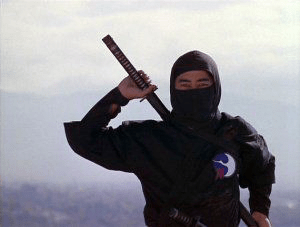
SHO KOSUGI

I’ve made it through most of the collected film works of Eastwood, Bruce Lee, Jackie Chan, Norris, Stallone, Schwarzenegger, et cetera, and now I am grateful for the opportunity to delve into Kosugi’s filmography. It’s a safe bet that I will eventually seek out PRAY FOR DEATH, DEATHS OF THE NINJA, and RAGE OF HONOR because they’re great titles and have great cover art in addition to starring Mr. Kosugi.

I’ll start with REVENGE OF THE NINJA, the second and best overall installment of the so-called ‘Ninja Trilogy.’ Kosugi takes on a starring role after playing second (or third or fourth) fiddle in ENTER THE NINJA, behind at least Franco Nero, Susan George, and Christopher George. The Kosugi parts are arguably the best parts of ENTER, so REVENGE serves up a full course of Kosugi with hors d’oeuvres, wine (or beer or liquor), and dessert included.

The nominal plot: “After his family is killed in Japan by ninjas, Cho and his son Kane come to America to start a new life. He opens a doll shop but is unwittingly importing heroin in the dolls. When he finds out that his friend has betrayed him, Cho must prepare for the ultimate battle he has ever been involved in.”

The actual plot: ACTION! PLENTY OF ACTION! We’re talking serious hardcore ninja action here. I’m no expert on ninja weaponry, but I do believe that REVENGE (as did ENTER before and THE DOMINATION after it) employs the ninjato, the katana, nunchaku, blowgun, shuriken, crossbow, and many, many more weapons of mass dismemberment. Gore hounds have a lot of howling to do over the ‘Ninja Trilogy.’

REVENGE prevails over ENTER because it spends more time focused on the actual plot than the nominal plot.

We have not only two fierce ninja warriors, Kosugi’s hero Cho Osaki opposed by the dastardly bastard Braden (Arthur Roberts), but we also have two, er, 1 1/2 Kosugis in this picture, since Sho’s real-life son Kane Kosugi plays Cho’s son Kane. We say 1/2 because Kane was around 9 years old when he made his memorable motion picture debut in REVENGE. He’s not one of those insufferable movie brats who mugs so heavily that I check my wallet after their every scene. He’s not David Mendenhall in OVER THE TOP, for example. Yes, he’s basically a miniaturized Sho Kosugi.

Both REVENGE and THE DOMINATION ultimately win over ENTER because they’re more entertaining and off-the-wall in that classic crazy Cannon way.

Nero, of course, makes for an effective action hero in a more traditional sense and I find his filmography very fascinating, from playing the title character in the 1966 Spaghetti Western DJANGO and Lancelot in the lavish 3-hour 1967 American musical CAMELOT (singing voice by Gene Merlino) to roles in Quentin Tarantino’s DJANGO UNCHAINED (naturally) and JOHN WICK: CHAPTER 2. Nero plays a character named “Cole” in ENTER and that has seemed to be one of the more common given names for both action movies and soap operas; Roger Ebert’s Little Movie Glossary includes The Cole Rule: “No movie made since 1977 containing a character with the first name ‘Cole’ has been any good.”

I commented during ENTER that it marked the first time I had seen English actress Susan George (STRAW DOGS) in a movie without her getting naked.

Christopher George almost walks away with the picture as the nefarious businessman Charles Venarius. He’s so bad that he’s good because George savors every single line. It is indelible fun hearing George deliver “This is 20th Century Manila, not feudal Japan.”

Kosugi appeared in all three NINJA films, as three different characters, and ultimately it is his screen presence that makes all three such enjoyable and memorable experiences.
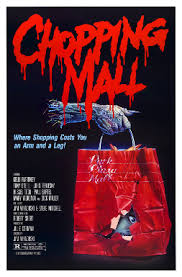
Chopping Mall (1986)

CHOPPING MALL (1986) ***1/2

Jim Wynorski’s CHOPPING MALL has just about everything anybody would ever want from a mid-80s horror film.

— An iconic shopping mall shooting location.

— Three killer robots who shoot real frickin’ laser beams. By the way, these kill-bots could eat Paul Blart for breakfast, lunch, dinner, and three desserts, plus in-between snacks.

— Big hair and big boobs.

— A Barbara Crampton topless scene that rates below RE-ANIMATOR and FROM BEYOND. Still, though, it’s topless Barbara Crampton.

— Other familiar teeny bopper horror movie bods and faces.

— The great character actor Dick Miller playing a character named Walter Paisley (his character’s name from BUCKET OF BLOOD).

— A Corman Factory production with posters from previous cult classics (including one directed by Wynorski, his debut film LOST EMPIRE) and clips from Roger Corman’s 1957 epic ATTACK OF THE CRAB MONSTERS.

— Cameos from Corman favorites Paul Bartel and Mary Woronov playing their characters from EATING RAOUL.

— Outdated special effects that were outdated even before the movie’s release. However, that’s all part of their charm.

— Gore galore highlighted by a gnarly head explosion.

— A plot that plays like a fast and loose combination of FAST TIMES AT RIDGEMONT HIGH, FRIDAY THE 13TH, and THE TERMINATOR.

CHOPPING MALL does not muck around, giving us our first killer robot scene right from the start and hey, let’s face it, it breezes past in 76 minutes. For crying out loud, that’s a running time straight from an earlier time in cinematic history. That not mucking around quality is one of the most admirable traits of CHOPPING MALL, that and its desire to give the people what they want in terms of meeting and exceeding the demands of an exploitation film.

It has a basic plot: Three security robots go haywire after a lightning storm, turn rogue and run amok in Park Plaza Mall, actually the Sherman Oaks Galleria in the Sherman Oaks neighborhood in Los Angeles. The galleria, on the corner of Ventura and Sepulveda Boulevards, has been given credit for inspiring the Frank and Moon Unit Zappa satirical hit single “Valley Girl” and FAST TIMES and COMMANDO famously utilized the location.

Of course, with this genre and location, we have four teenage couples who stay after hours to frolic and fool around inside a furniture store, naturally and predominantly hot and horny couples who make up the majority of our body count. That contributes the FRIDAY THE 13TH element, and the presence of Russell Todd aids and abets that mental connection. Todd played Scott in FRIDAY THE 13TH PART 2, a real smug horny bastard adept with a slingshot. Not that did him any bit of damn good against burlap sack Jason Voorhees.

CHOPPING MALL has a good cast and Kelli Maroney and Alan O’Dell make for appealing, likeable female and male leads, especially Maroney. With her big hair, her struggles working in a restaurant, her spunky attitude, and her way around weaponry, Maroney’s Alison Parks feels very reminiscent of Sarah Conner (Linda Hamilton) from the first TERMINATOR.

What I especially like about the teenagers in CHOPPING MALL is that they load up on guns (echoes of DAWN OF THE DEAD) almost immediately after discovering the killer robots. They are far more proactive than the average horror movie teenager, and that helps separate CHOPPING MALL from the pack of run-of-the-mill exploitation films.

File CHOPPING MALL right alongside cult classics from that moment in time like RE-ANIMATOR, FROM BEYOND, and NIGHT OF THE CREEPS.

It (1927)

IT (1927) ***1/2

“Hey, old timer, have you seen IT?”

“Yeah.”

“I bet, though, knowing you, that you liked the crusty old TV version from, like what, 1890 better than the new one.

[Silence for a couple beats]

“Well, which one did you prefer?”

“Neither.”

“What?”

“That’s right, I prefer the 1927 IT starring legendary ‘It’ girl Clara Bow over any Stephen King adaptations called IT. Boom!”

— Theoretical conversation circa ‘18


That quality possessed by some which draws all others with its magnetic force. With ‘It’ you win all men if you are a woman and all women if you are a man. ‘It’ can be a quality of the mind as well as a physical attraction.

— Definition of ‘It’


Clara Bow obviously had ‘It’ and she displays it throughout IT, the film that officially made her a sensation after it was released on February 19, 1927.

Bow’s 1927 can stand against Babe Ruth’s — .356 average with 158 runs scored, 29 doubles, eight triples, 60 home runs, 165 RBI, 137 walks vs. 89 strikeouts, and 110 victories and a 4-0 World Series sweep against Pittsburgh — and Charles Lindbergh’s, for his legendary nonstop flight from New York City to Paris.

Bow (1905-65) made six films in 1927: IT, CHILDREN OF DIVORCE, ROUGH HOUSE ROSIE, WINGS, HULA, and GET YOUR MAN.

She helped pave the way for every female sex symbol to come. For example, her skirt flew up during IT, a good 28 years before Marilyn Monroe’s most famous movie bit in THE SEVEN YEAR ITCH. WINGS also features a brief — I mean brief — Bow boob flash. Blink and you’ll miss it.

She also inspired a millinery fashion craze, for crying out loud.

From the June 10, 1927 edition of the St. Louis Dispatch — advertising Clara Bow Vacation Hats for $1.25 each — “Smart and clever are these Clara Bow Hats that are fashioned of a good quality felt in twelve attractive modes. In black, white, pink and all the Summer shades — trimmed with applique of felt in contrasting colors as well as soid effects. Are soft and crushable, easily packed in handbag or trunk.” Each hat purchased came with a 8 x 10 photograph of Bow wearing that hat. No additional charge.

In the August 16 edition of the Minneapolis Star Tribune, Clara Bow Hats were being sold for 98 cents and each hat came with a copy of Bow’s signature. Apparently, there were 12 styles and colors of hats.

From the June 19 Nebraska State Journal, “In Gold’s smart millinery collections you’ll find ‘it’ — the cutest cleverest group of Clara Bow hats and every one of ‘em has ‘it.’ These perky little felt novelties are only $1.45 but they look like a million dollars worth of Clara Bow’s vivacity.”

Bow also became tabloid fodder, like this report from the Los Angeles Times during the making of WINGS, “Clara Bow, Paramount star, is becoming destructive. The queen of the flappers wrecked one perfectly good Ford while learning to drive one for certain sequences in “Wings,” the road show which tells the story of the American Ace in France. Miss Bow plays the part of an ambulance driver. “Wings” is being directed by William Wellman, himself a flyer during the war.” The reports and the rumors became wilder.

Bow retired from acting in 1933 to move to a ranch in Nevada, where she focused her energies on being a wife and a mother.

IT provides an early example of a concept film and it uses product placement — plugging Cosmopolitan Magazine and giving source material writer Elinor Glyn a cameo where she expounds on ‘It.’

IT features a plot that’s older than the Hollywood hills: A salesgirl, Betty Lou (Bow), sets her sights on wealthy (and handsome) playboy Cyrus T. Walham (Antonio Moreno), who’s her boss. There’s plot complications left and right — not convolutions, though — like so many romantic comedies but this is a movie that moves easily beyond its plot because of the style of director Clarence Badger, the witty dialogue and inter-titles, and both the incredible style, spunk, and star power of Bow.

“I don’t go to church. Kneeling bags my nylons.” — ACE IN THE HOLE

“Alright, I’ll go manicure my gloves.” — BUGSY MALONE

“She gave me a smile I could feel in my hip pocket.” — FAREWELL, MY LOVELY

Supporting character Monty Montgomery (William Austin) gets one of the all-time great lines, “I feel so low, old chap, that I could get on stilts and walk under a dachshund.” File it alongside the three lines quoted right above.

Monty proved to be a pleasant surprise, a supporting character who at least made me smile from his very first to his very last appearance. Monty creates the film’s biggest laughs and in a different way than Bow, he’s nearly as unforgettable. I would argue his eyes are just as memorable. What could otherwise be melodramatic mugging benefits from the parameters of silent cinema and his reactions — especially his astonished double takes — are worth their weight in comic gold. He’s a genuine hoot. That statement works for IT as a whole. In movie terms, IT definitely has “it.”

Nosferatu (1979)

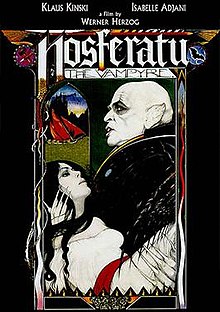
NOSFERATU

NOSFERATU (1979) ***1/2

German director Werner Herzog’s NOSFERATU THE VAMPYRE has often been described as a “slow burn” horror film and every critic seems to want to sound a fire alarm that it’s not the average “creature feature” with cheap thrills every few minutes and that it will disappoint most horror movie fans.

The former is certainly true and I cannot speak for the latter except to say this horror movie fan liked it. I’ll be honest, I did not much enjoy it the first time watching it a good 20 years before my return viewing. I remember having a more neutral reaction that first time. Not sure why.

Looking up “slow burn,” I find that it means “a filmmaking style, usually in narrative productions, wherein plot, action, and scenes develop slowly, methodically toward a (usually) explosive boiling point.”

NOSFERATU definitely fits methodical and perhaps only slow to viewers raised on Attention Deficit Cinema. I’d rather say that Herzog’s remake and F.W. Murnau’s original 1922 masterpiece subtitled A SYMPHONY OF HORROR both move at their own leisurely pace. They play more like fever dreams than the average horror movie.

NOSFERATU does not fit the back end of that slow burn definition, because there’s not an explosive boiling point. Certainly not anything resembling the stereotypical big bang grand finale to a standard Hammer Dracula picture.

Herzog marches to the beat of his own drum. That’s for sure and thank God for that, just as we should be thankful for every great director. I consider his AGUIRRE, THE WRATH OF GOD to be the best film I have seen from 1972 and I would put it on a list of the greatest films ever made. LITTLE DIETER NEEDS TO FLY and GRIZZLY MAN are on my top 10 lists for 1997 and 2005, respectively. Les Blank’s documentary BURDEN OF DREAMS, which chronicles Herzog’s great adventure making FITZCARRALDO, also makes my top 10 list for 1982. Ramin Bahrani’s 18-minute PLASTIC BAG, a top 10 entry for 2010, utilizes Herzog as its narrator.

I know that NOSFERATU was my first time watching a Herzog movie and I believe I had not yet seen the Murnau original. To be sure, I was more equipped watching NOSFERATU for a second time.

More than anything else, images stand out. Brilliant images are the heart of both the 1922 and 1979 films and both Murnau’s and Herzog’s filmography.

Musophobes should not watch NOSFERATU, because rats take over the screen at crucial points late in the picture. The rats are the source of some legendary stories: Herzog said the rats were better behaved during the shoot than star Klaus Kinski and since real grey rats proved to be unavailable, white rats were given a grey makeover, for example.

The rats call to mind the monkeys from AGUIRRE.

Of course, there’s every time Dracula (Kinski) is on the screen. Since copyright was not a concern for Herzog like it had been in 1922 for the first NOSFERATU, Herzog returned names like Dracula, Jonathan Harker, and Lucy to his version. Dracula’s look echoes Max Schreck’s iconic Count Orlok and both vampires are radically different from the classic bloodsuckers played by Bela Lugosi and Christopher Lee, as well as just about every other vampire in cinematic history. Herzog and Murnau both show how it is more of a curse to be a vampire and make it far less of a power trip. Herzog’s Dracula and Count Orlok are not suave and debonair, and their striking physical appearances echo vampire folklore. We also have far more complex reactions to the vampires played by Schreck and Kinski, since we feel more empathy for them.

Around her mid-20s at the time she made NOSFERATU, French actress Isabelle Adjani already had a strong claim on the title of most beautiful woman in the world. NOSFERATU did nothing to refute that.

Thinking about the various Jonathan Harkers over time, Bruno Ganz’s performance ranks better than David Manners in the 1931 DRACULA and Keanu Reeves in the 1992 DRACULA. He certainly goes through a wider emotional range than either Manners or Reeves, who are both “mannered” in their performances.

Ultimately, NOSFERATU leaves one with feelings different from how we normally react to a vampire picture. There’s not the standard euphoria that we experience, for example, when Lee’s Dracula spectacularly bites the dust. Instead, we are more pensive and melancholic than excited and thrilled.

The Warriors (1979)

THE WARRIORS

THE WARRIORS (1979) Three-and-a-half stars

David Patrick Kelly belongs in the Actors Who We Love to Hate Hall of Fame, right alongside such performers as Thomas F. Wilson (for his work as 1955 Biff, 1985 Biff, alternate 1985 Biff, 2015 Biff, Griff, and Buford “Mad Dog” Tannen in the BACK TO THE FUTURE trilogy) and Michael Moriarty (Q: THE WINGED SERPENT).

You might remember Kelly from COMMANDO as Sully, the creep who John Matrix promised to kill last because, you know, Matrix liked Sully … well, Matrix lied and Sully took a great fall. Or maybe DREAMSCAPE starring Dennis Quaid and Kate Capshaw, where the name of Kelly’s would-be presidential assassin, Tommy Ray Glatman, suggests Lee Harvey Oswald, John Wilkes Booth, and James Earl Ray.

Kelly made his motion picture debut as Luther in Walter Hill’s 1979 cult classic THE WARRIORS and Kelly plays a great creep right straight out of the box. Hill later cast Kelly as (a different) Luther in 48 HOURS.

Luther assassinates charismatic, visionary street gang leader Cyrus (Roger Hill) in an early scene and the Warriors from Coney Island are framed as the assassins. The police and every street gang in New York City want them Warriors bad, real bad. The Warriors’ long, harrowing journey back home makes up the vast majority of the movie.

Kelly delivers the goods in every scene that he’s in.

Swan (Michael Beck), the leader of the Warriors, and Luther, the leader of the Rogues, are finally face-to-face late in the picture. Thankfully, because everything’s been leading up toward showdown, Swan asks Luther the burning question we’ve been wanting to ask him ourselves, you know, why’d you do it, why’d you waste Cyrus? In an answer that makes THE WILD ONE proud, Luther says, “No reason. I just … like doing things like that!”

Just a few minutes earlier, Kelly begat the world the famous “Warriors, come out to play,” made famous by the way he said it.

Kelly alone earns THE WARRIORS three stars.

THE WARRIORS is a chase movie, predominantly on foot, and a survival of the fittest movie. It’s one of those great entertainments where you can find deeper messages or merely just sit back and enjoy Hill’s ability to stage larger-than-life action scenes, the colorful characters, and the approximately 90-minute tour of large city street gangs.

In addition to our title characters, we have the Turnbull AC’s, the Orphans, the Baseball Furies (they naturally brandish baseball bats and Kiss-like face paint, combining two of Walter Hill’s two loves), the Lizzies, the Punks, the Rogues, the Riffs (Cyrus’ former gang), the Boppers, the Boyle Avenue Runners, the Electric Eliminators, the Gladiators, the Hi-Hats, the Hurricanes, the Jones Street Boys, the Moonrunners, the Panzers, the Saracens, the Satans Mothers, the Savage Huns, the Van Cortland Rangers, and there’s a whole slew of gangs listed in Hill’s original script.

These gangs have a meeting in the Bronx and that’s when Luther kills Cyrus. All hell breaks loose with our title characters, eight gang members, at the center of the mayhem. The Warriors have more than 20 miles to go from the Bronx to their Coney Island home. It takes about 2 hours via mass transit, so THE WARRIORS feels like it plays out in real time.

Another stylistic flourish in a film overflowing with them involves a female DJ (face of Lynne Thigpen, voice of Pat Floyd) who’s the voice of the street gangs. “All right now, for all you boppers out there in the big city, all you street people with an ear for the action, I’ve been asked to relay a request from the Gramercy Riffs. It’s a special for the Warriors, that real live bunch from Coney, and I do mean the Warriors. Here’s a hit with them in mind.” Her apology to the Warriors at the end comes in the form of Joe Walsh’s “In the City.”

Real-life violence, allegedly inspired by seeing THE WARRIORS itself, unfortunately soured the reaction to the film in early 1979. Tony Bill, who produced his own gang film (BOULEVARD NIGHTS) that was protested in early 1979, said in People Magazine, “It makes sense that a movie that basically glorifies violence would attract violence.” Co-screenwriter David Shaber said THE WARRIORS was Sesame Street compared to a Sam Peckinpah movie (like THE WILD BUNCH). Paramount VP Gordon Weaver said of the violence, “[It’s] the sort of thing that happens at rock concerts, high school basketball games and any place where diverse groups meet. It could have happened anywhere.”

Similar controversies unfortunately later swirled around such films as DO THE RIGHT THING, NEW JACK CITY, and BOYZ N THE HOOD.

Code of Silence (1985)

CODE OF SILENCE

CODE OF SILENCE (1985) Three-and-a-half stars

CODE OF SILENCE and LONE WOLF McQUADE are the best Chuck Norris movies.

They are the ones for people who otherwise grunt and groan at the possibility of watching a Chuck Norris movie. You know, individuals who go, “Ugh, I don’t like Chuck Norris, his movies are so dumb and stupid. They’re ridiculous and redneck.” Then, there’s other people who only want to watch Norris on “Walker, Texas Ranger” re-runs 24 hours a day 365 days a year because they have little tolerance for movie violence and vulgarity.

Let’s get a few things straight: I don’t especially care for Norris’ ultra-conservative politics (he predicted 1,000 years of darkness if Obama won a second term). I hate those darn infomercials that he did with Christie Brinkley plugging exercise machines. I cannot stand “Walker, Texas Ranger,” except for when clips were used for the “Walker, Texas Ranger Lever” on Conan O’Brien. I hate that he sued “Chuck Norris Facts” author Ian Specter because “Mr. Norris is known as an upright citizen to whom God, country, and values are of paramount importance” and “Mr. Norris also is concerned that the book may conflict with his personal values and thereby tarnish his image and cause him significant personal embarrassment.” I often dislike the use of slow motion in many Norris pictures, like, for example, at the end of A FORCE OF ONE and I cannot decide if that ridiculous echoed voice-over in THE OCTAGON is the worst or the funniest thing I have ever heard. Finding all his voice-overs compiled into a 4-minute, 20-second YouTube video, I vote for the latter. I will one day write a review of THE OCTAGON in the style of that voice-over; I remember Richard Meltzer’s review of the Creedence album PENDULUM with a built-in echo. For whatever reason, Norris’ inner monologues in THE OCTAGON call to mind Ted Striker’s cockpit moment when he hears echo and Manny Mota pinch-hitting for Pedro Borbon. THE OCTAGON voice-over is even funnier than the one in AIRPLANE! I understand that I like watching old Norris movies for their camp and nostalgic value. I’d rather watch one than listen to a Ted Nugent album (or song). I apologize for (possibly) coming on so defensive about Carlos.

In the pantheon of action stars, Norris rates below Clint Eastwood, Steve McQueen, Jackie Chan, Bruce Lee, Arnold Schwarzenegger, and Sylvester Stallone. He’s never made a movie quite at the level of THE GOOD, THE BAD AND THE UGLY, THE GREAT ESCAPE, DRUNKEN MASTER, ENTER THE DRAGON, the first two TERMINATOR movies, and ROCKY. Norris belongs in the second tier of action stars.

Back to CODE OF SILENCE (and LONE WOLF McQUADE).

Both movies have good supporting casts — for example, CODE OF SILENCE surrounds Norris with quality character actors like Henry Silva, Bert Remsen, Dennis Farina (before he became a full-time actor), Ralph Foody, Ron Dean, and Joseph F. Kosala.

Andrew Davis directed CODE OF SILENCE, his first action picture, and his later credits include ABOVE THE LAW, THE PACKAGE, UNDER SIEGE, THE FUGITIVE, CHAIN REACTION, and COLLATERAL DAMAGE. THE FUGITIVE, one of the best films of 1993, was nominated for seven Academy Awards, including Best Picture, and good old grizzled Tommy Lee Jones won an Oscar for Best Supporting Actor. He’s a good director, certainly the best of any Norris movie.

At this point in his career, Norris wanted to distance himself somewhat from his karate and become a more polished, all-purpose action star. If all his subsequent movies were more like CODE OF SILENCE, he would have been onto something, but, alas, Norris returned to third- and fourth-rate product like FIREWALKER and MISSING IN ACTION III before finding his greatest commercial success on TV.

In CODE OF SILENCE, Norris plays Chicago policeman Eddie Cusack, who finds himself in the middle of a gang war all while he’s alienated himself from his fellow officers (barring one, his former partner) for breaking the “code of silence” by standing and testifying lone wolf like against a veteran officer (Foody) accused of killing an unarmed teenager.

Norris enlists Prowler on his side for the final confrontation, Prowler a police robot with a tremendous arsenal that kills bad guys good.

We do see one particularly rare scene in any Norris movie: He gets knocked around real good by a group of thugs. That’s not happened often to Norris since he took on Bruce Lee late in WAY OF THE DRAGON.

Between his work in CODE OF SILENCE, ABOVE THE LAW, and THE FUGITIVE, Davis showed himself to be a master of scenes involving the ‘L,’ Chicago’s elevated train rapid transit system that we have seen on many films and shows. There’s a chase and fight scene on top of the ‘L’ in CODE OF SILENCE that belongs with Norris’ flying kick through a windshield in GOOD GUYS WEAR BLACK and driving his super-charged Dodge Ramcharger out of the grave in LONE WOLF McQUADE as the best Norris moments.

Big (1988)

BIG (1988) Three-and-a-half stars

Twelve-year-old Joshua Baskin (David Moscow) cannot gain admittance on a roller coaster ride because he’s not tall enough, so the embarrassed young man finds a Zoltar Speaks machine and it grants his wish that he were big. Overnight, Joshua Baskin becomes 30 years old and he’s played by Tom Hanks for basically the rest of the movie.

BIG is by far the best of the body switch movies that were all the rave during the Reagan administration. Anybody sentient during that era can surely remember a body switch pic or two. Let’s see, we had OH! HEAVENLY DOG from 1980, whose July 11 release date predates Reagan and which gives us Chevy Chase trapped inside Benji … Chase provides voice-over for Benji in a rather dull murder mystery. Then, there’s LIKE FATHER LIKE SON from 1987 pairing Dudley Moore and Kirk Cameron, who just scream father and son, in one of the worst movies of all-time had it not come out during the same year as such cinematic landmarks as THE GARBAGE PAIL KIDS MOVIE, LEONARD PART 6, JAWS THE REVENGE, MANNEQUIN, and TEEN WOLF TOO. Never mind, it’s still one of the worst movies of all-time.

BIG streamlined and more or less perfected the body switch, because we stick with one character (Joshua Baskin) the whole time and there’s less of a suspension of disbelief required for the movie to work. For example, in LIKE FATHER LIKE SON, we have to picture Dudley Moore inside Kirk Cameron and vice-versa (pun and reference to another body switch movie intended), but it’s almost impossible since their speaking voices remain the same. Movies like LIKE FATHER LIKE SON are why the late Roger Ebert coined the phrase “The Idiot Plot.”

Hanks gives a strong performance, especially in conveying the whole child trapped inside a grown man’s body through body language, facial gestures, boyish enthusiasm, wide-eyed reactions. He works his predicament for laughs, for pathos, for drama, and there’s a compelling sequence during his first “big” day when he’s staying at this seedy New York City hotel and he’s scared by the real world. Hanks broke away from his poor man’s Bill Murray for the first time in his career and established his own niche that would culminate in playing Forrest Gump.

Elizabeth Perkins is just terrific in BIG and I don’t think she’s ever been either better or more beautiful than as Susan. Perkins matches Hanks every step of the way during their complicated romance and please go back and watch her during the farewell scene with Baskin. She kisses him on the forehead and strokes behind his ear, in a tender and more motherly fashion. She makes the scene work, as Hanks reverts back to Moscow as Baskin.

Robert Loggia (1930-2015) and John Heard (1946-2017) were two of the best character actors during their respective careers.

Loggia plays against type here as MacMillan, the owner of a toy company who takes a major liking to the way Baskin looks at toys; phooey to marketing reports, Baskin and MacMillan test toys the old-fashioned way by going straight to the biggest toy store. They pair together for a toy piano duet and create one of the most iconic movie scenes of the late 80s. It’s known quite simply as the “Big Piano Scene.”

There was often an edge to Heard during his performances and he taps into that edge a great deal in BIG. Heard creates a real jerk.

Penny Marshall became a name director after BIG and she and Hanks reunited for A LEAGUE OF THEIR OWN. Anne Spielberg and Gary Ross wrote the script and Barry Sonnenfeld worked as cinematographer; Ross later directed PLEASANTVILLE and Sonnenfeld’s directorial credits include GET SHORTY and MEN IN BLACK.

There seems to be a certain nostalgia for BIG, just like at times it seems like that’s all true for anything (the good and the bad, and the ugly) from the 80s.

How far can that nostalgia go? Well, there’s the Nostalgic Zoltar Speaks machine for sale on the Zoltar site. One machine comes equipped with a $10,500 price tag and that’s not counting any customization like a wireless microphone to talk through Zoltar ($425 without remote control, $520 with), breathing movement for Zoltar ($625), motion activated attract ($75), custom fortune cards, custom audio messages, and traveling case ($1,500 plastic, $650 wood).

If you do buy that Nostalgic Zoltar Speaks machine for a major chunk of change, do you dare make a wish, “I wish I were big.” I say you better for that level of investment.


Good Morning, Vietnam (1987)

GOOD MORNING, VIETNAM.jpg

GOOD MORNING, VIETNAM (1987) Three-and-a-half stars

GOOD MORNING, VIETNAM director Barry Levinson knew that Louis Armstrong’s “What A Wonderful World” came out in 1967 and that his movie was set in 1965, but he overlooked that because Satchmo’s song fit the scene best.

Thus, Levinson created an anachronism or a chronological inconsistency.

Adrian Cronauer (1938-2018), played by Robin Williams (1951-2014) in GOOD MORNING, said that he liked the movie based on his time on Armed Forces Radio in Vietnam well enough, as far as it went, but that it was more about Williams and what suited him than it was about Cronauer and what actually happened. File GOOD MORNING in the “loosely based” category.

Cronauer added that Levinson did not allow Cronauer and Williams to meet each other until after filming completed, because the director did not want Williams impersonating the former disc jockey.

GOOD MORNING is the first Robin Williams movie I ever watched and it’s one of the few I watched again in the immediate aftermath of his 2014 suicide. Just this last time I watched it, though, early in 2020, I paid less attention to Williams and more to a dynamite supporting cast surrounding Williams: Bruno Kirby (1949-2006), J.T. Walsh (1943-98), Noble Willingham (1931-2004), Forest Whitaker, Robert Wuhl, and Richard Edson, as well as the various Vietnamese actors and actresses. I know Williams received most of the acclaim for his performance, a Golden Globe victory and an Academy Award nomination for Best Actor, but it’s the work of that deep supporting cast that makes GOOD MORNING a very good movie rather than merely a good one or at least if nothing else a one-man show.

Kirby plays some of the same notes as he did seven years before in WHERE THE BUFFALO ROAM with Bill Murray’s Hunter S. Thompson his adversary in that earlier film. In GOOD MORNING, Kirby plays Lt. Steven Hauk, who fails to see the humor in Cronauer and who finally bombs on the air when he replaces Cronauer for a brief spell. We patiently wait for that failure to happen, and we are rewarded. We laugh at Hauk’s failure, and the vast disconnect between his ego and his actual ability to make people laugh is the joke.

Walsh put together a decade of memorable supporting performances and he earned that memorability because he plays characters that we love to hate. Quite frankly, he played a dick better than most anybody in show business and thus, it’s no surprise that Walsh plays a character named Sgt. Major Dickerson in GOOD MORNING, because, yes, he’s a major dick. Many of us miss Walsh, a love to hate figure even after his death with both THE NEGOTIATOR and PLEASANTVILLE posthumously released.

Williams and Whitaker especially seem like they have genuine chemistry and their byplay from early in the movie all the way until the end rewards us with both laughter and emotions.

Cronauer teaches English to South Vietnamese students during some of his spare time, initially because he sets his sights on a pretty young woman. Cronauer’s friendship with her brother earns him a flight out of Vietnam, one that’s long overdue given all his trouble from the first time Cronauer shouted “Good morning, Vietnam” on the air.

In short, the soldiers love Cronauer and the brass, especially Dickerson, hate him.

Cronauer plays by his own rules, especially on-air, as he favors that Devil’s music rock and soul over that Easy Listening jive preferred by Hauk and Dickerson. That’s his first sin of many, but it all starts with that playing by one’s own rules.

Probably about half of the movie gives itself over to Williams’ manic free-form ad-libs and Cronauer is one of the few characters played by Williams where his patented comic anarchy fits and does not break away from the fabric of the movie to the point that we forget the character and only see Robin Williams being stand-up comedian Robin Williams. Williams’ anything-for-a-laugh shtick also worked for The Genie in ALADDIN.

In all honesty, I find more humor in Williams’ scenes with the supporting actors, both his fellow military men and his Vietnamese students, than I do his solo flights of fancy on his popular radio show.

GOOD MORNING is not all comedy, though, and it does thankfully give the Vietnamese more of a voice than we normally get in Hollywood films about Vietnam and the war. Cronauer’s friend Tuan (Tung Thanh Tran) expresses it during their confrontation scene late in the movie, “ENEMY? What is enemy? You killing my own people so many miles from your home. We not the enemy! You the enemy! … My mother is dead. And my older brother, who be 29 years old, he dead! Shot by Americans! My neighbor, dead! His wife, dead. WHY? Because we’re not human to them! We’re only Vietnamese.”

The film does lay it on a little too thick with sentimentality and showing that Cronauer’s a good guy at heart performing a noble service for the troops and humanity in general through humor. Critics have accused movie comedians of that weakness for sentimentality ever since the glory days of Charlie Chaplin. Williams definitely fell prey to sentimentality often throughout his career, and it works better in some films than others.

Finally, GOOD MORNING goes on a little too long and it could have been tightened, but I doubt that Levinson and gang wanted to lose any of Williams’ improvisation. Remember that moment in ANIMAL HOUSE when Tim Matheson’s Otter looks at Peter Riegert’s Boon and asks “Germans?” after Bluto says the Germans bombed Pearl Harbor. Boon quite simply and beautifully says, “Forget it, he’s rolling.” Bet that’s what they said every day on the set of GOOD MORNING, VIETNAM about Robin Williams.

Monty Python’s The Meaning of Life (1983)

MONTY PYTHON’S THE MEANING OF LIFE (1983) Three stars

There’s a DVD bundle called “A Little Something to Offend Everybody” and it pairs Mel Brooks’ HISTORY OF THE WORLD PART I and MONTY PYTHON’S THE MEANING OF LIFE.

That’s fitting, because both films definitely fit that bill. For example, both have centerpiece musical numbers that flaunt their potential for controversy: “The Inquisition” in HISTORY OF THE WORLD and “Every Sperm is Sacred” in THE MEANING OF LIFE. Both films go highbrow, middlebrow, lowbrow, below the brow, and even more below the brow. Scatological and sexual jokes abound and Brooks and the Python troupe use just about every trick in the book for their assault on delicate sensibilities and community standards, and they especially indulge their willingness to go over the top in almost every single moment.

It seems like the Monty Python gang (Graham Chapman, John Cleese, Terry Gilliam, Eric Idle, Terry Jones, Michael Palin) made THE MEANING OF LIFE as a reaction to the intense controversy around LIFE OF BRIAN. “If you thought that was bad, well, you ain’t seen nothing yet,” that’s what it seems like they’re saying for all 90 minutes of THE MEANING OF LIFE.

I can hear some of you asking, though, do you get the meaning of life from the movie? Just think about the ridiculousness of that question.

Lady Presenter: Uh, try and be nice to people, avoid eating fat, read a good book every now and then, get some walking in, and try and live together in peace and harmony with people of all creeds and nations. …

The lady presenter (actually Palin in one of his almost 20 roles in the movie) then gets at the crux of the movie as she continues her speech: “And, finally, here are some completely gratuitous pictures of penises to annoy the censors and to hopefully spark some sort of controversy, which, it seems, is the only way, these days, to get the jaded, video-sated public off their fucking arses and back in the sodding cinema. Family entertainment? Bollocks. What they want is filth: people doing things to each other with chainsaws during Tupperware parties, babysitters being stabbed with knitting needles by gay presidential candidates, vigilante groups strangling chickens, armed bands of theatre critics exterminating mutant goats.”

If people truly want “filth,” THE MEANING OF LIFE delivers the goods.

The feature’s second sketch “The Third World” highlights a Catholic working class father (Palin) from Yorkshire, his wife (Jones), and their 63 children. He comes home and informs his family that he’s out of work because the local mill shut down, they are destitute, and that he must sell all 63 children for scientific experiments. He says, “Blame the Catholic Church for not letting me wear one of those little rubber things.”

The father eventually breaks into “Every Sperm is Sacred,” with the memorable chorus “Every sperm is sacred / Every sperm is great / If a sperm is wasted / God gets quite irate.” It turns into a production number straight out of an elaborate musical nominated for a multitude of awards, with even the children getting in on the act before they hit the streets.

The children obviously knew not what they were singing about at the time. Palin felt uncomfortable with one particular line and he originally delivered it “sock” in front of the children before “cock” was later dubbed in.

Beyond “Every Sperm is Sacred,” there’s “Penis Song” (I remember somebody once sang this crowd pleaser at karaoke) and “Christmas in Heaven.”

Quentin Tarantino said the Mr. Creosote sequence makes him nauseous and that says all there needs to be said about the explosive sequence.

I am not or have ever been offended by any of the content in THE MEANING OF LIFE. I think it’s an uneven grab bag of comedy, with hilarious bits, merely funny bits, and other bits where I admire the bits on an intellectual level but I do not laugh. That’s a bit too much of the word bit, but obviously THE MEANING OF LIFE deserves excess verbiage. It’s not as good (funny) as AND NOW FOR SOMETHING COMPLETELY DIFFERENT, THE HOLY GRAIL, and LIFE OF BRIAN.

Before THE MEANING OF LIFE officially starts, we get a bonus 17-minute pirate movie from Gilliam. The elderly British accountants of Crimson Permanent Assurance are fed up with corporate efficiency and they are not gonna take it anymore after the big corporation sacks one of the accountants. Their building turns into a pirate ship with filing cabinets for cannons, ceiling fans for broadswords, and paper spindles for short swords, and they attack The Very Big Corporation of America.

There were several pirate movies during the 1980s and I vote THE CRIMSON PERMANENT ASSURANCE one of the best, right alongside CASTLE IN THE SKY and THE PRINCESS BRIDE.


THE CRIMSON PERMANENT ASSURANCE (1983) Three-and-a-half stars

Bill & Ted’s Bogus Journey (1991)

BILL & TED’S BOGUS JOURNEY (1991) ***1/2

A great supporting character can elevate a movie.

Take, for example, the Grim Reaper from BILL & TED’S BOGUS JOURNEY. I mean, it’s not every day that a supposedly lowbrow comedy puts a novel spin on a character and plot thread from Ingmar Bergman’s THE SEVENTH SEAL.

In that one, you might remember a medieval knight (Max von Sydow) plays a game of chess against a personification of Death (Bengt Ekerot) to prolong his life. The mere image of the knight and Death playing chess by the sea had become one of the most revered in movie history by the time BOGUS JOURNEY director Peter Hewitt, writers Chris Matheson and Ed Solomon, and Grim Reaper player William Sadler, as well as co-stars Keanu Reeves and Alex Winter, got their grubby little mitts on it.

In BOGUS JOURNEY, our two most excellent dudes Bill S. Preston Esquire (Winter) and Ted “Theodore” Logan (Reeves) find themselves in a most hellish predicament. They are killed by evil robot Bill & Teds, called the Evil Robot Usses by our poetic lead characters, and wind up in Hell. What else would happen to a pair of heavy metal fans? Bill & Ted, who quickly discover their album covers lied to them, man, are greeted by Granny Preston, an evil Easter Bunny, Colonel Oats, and eternal boot camp, a plight highlighted by infinity push-ups and verbal abuse, in their own personal Hell. Colonel Oats tells Bill & Ted they are silky boys and silk comes from the butts of Chinese worms.

Back to the Grim Reaper. “How’s it hanging, Death?” asks Ted.

Bill & Ted play The Reaper dude in a series of games, including Battleship, Clue, and Twister, because Death is a sore loser and Bill & Ted must win two out of three or was that three out of five. Nah, believe it’s best five out of seven. The Reaper finally relents, “I will take you back.”

Bill & Ted are the first to ever beat The Reaper, and before that the first to melvin him. “Ted, don’t fear the reaper.” Cue them celestial cowbells.

I love just about everything about the Grim Reaper in BOGUS JOURNEY and he contributes to BOGUS JOURNEY being a step up from EXCELLENT ADVENTURE.

Sadler should have been at least nominated for Best Supporting Actor for his performance here. No, instead, the Academy of Motion Picture Arts and Sciences saw fit to nominate Harvey Keitel and Ben Kingsley from BUGSY, Michael Lerner from BARTON FINK, Tommy Lee Jones from JFK, and winner Jack Palance from CITY SLICKERS. Keitel and Kingsley should have faced off against Sadler in a best-of-seven to see if we could get one less nomination for BUGSY. Colonel Oats would certainly have approved of Palance’s victory with his celebratory one-armed push-ups.

EXCELLENT ADVENTURE takes on time travel, historical figures, and historical fiction. Bill & Ted need to earn an A+ on their final report in history … and the future of the human race hangs in the balance. Literally, because in a mere 700 years in the future, humanity exists in an utopia built around the music of the Wyld Stallions, Bill & Ted’s most excellent rock band.

BOGUS JOURNEY adds depictions of the afterlife, Heaven, and Hell to the mix, and it gives us good and evil robot Bill & Teds in addition to living and dead Bill & Teds. Winter and Reeves compete with Michael J. Fox and Thomas F. Wilson for most permutations in a time travel comedy. Peter Sellers and Tony Randall would have been proud of all of them.

Additionally, the universe’s most brilliant scientific genius uses a single word vocabulary and that’s his name, Station. Station builds the “good robot usses” or “Station’s creations.”

I should not forget Joss Ackland as arch villain Chuck DeNomolos, who programs the evil robots to kill the good Bill & Ted because he hates their ideas and their insipid music. Don’t feel too bad for Chuck, because he gets a shot with Missy. Doesn’t just about everybody?

In the end, though, remember “You might be a king or a street sweeper, but sooner or later you dance with the reaper.”

That and, of course, “Be excellent to each other.”