The Universal Frankenstein Movies

THE UNIVERSAL FRANKENSTEIN MOVIES
Of all the horror movie series, there’s not one I like more than Universal Studios’ Frankenstein cycle which started with the immortal 1931 classic Frankenstein and continued through The Bride of Frankenstein, Son of Frankenstein, The Ghost of Frankenstein, Frankenstein Meets the Wolf Man, House of Frankenstein, House of Dracula, and finally concluded with Abbott and Costello Meet Frankenstein in 1948.

Seven of the eight films are stone cold classics and I rate Frankenstein, The Bride of Frankenstein, Son of Frankenstein, and Abbott and Costello Meet Frankenstein at four stars and The Ghost of Frankenstein, Frankenstein Meets the Wolf Man, and House of Frankenstein three-and-a-half, with House of Dracula ranked two-and-a-half and it’s the only one that I would even slightly hesitate to recommend to people.

I watched Frankenstein, The Bride of Frankenstein, and Abbott and Costello Meet Frankenstein around roughly the same time in the late ’90s and early ’00s. I caught up with the others much later on during a marathon of Universal horror films. I liked The Ghost of Frankenstein, Frankenstein Meets the Wolf Man, and House of Frankenstein upon first viewing, as well Abbott and Costello Meet Frankenstein a lot, but they’ve all grown on me to where I bumped up their rating one-half star.

I have a feeling that watching the eight films in close proximity to one another will become a tradition, like it has for who knows how many people over the last 90 years.

Here’s a look at the film series that seemingly started it all in the horror genre.

Frankenstein (1931; James Whale): The one that started it all, Edward Van Sloan, who plays Dr. Van Helsing in Dracula and Doctor Waldman in Frankenstein, begins the picture, How do you do? Mr. Carl Laemmle feels it would be a little unkind to present this picture without just a word of friendly warning. We’re about to unfold the story of Frankenstein, a man of science who sought to create a man after his own image without reckoning upon God. It is one of the strangest tales ever told. It deals with the two great mysteries of creation: life and death. I think it will thrill you. It may shock you. It might even horrify you. So if any of you feel that you do not care to subject your nerves to such a strain, now is your chance to, uh … well, we’ve warned you!

Colin Clive and Dwight Frye are great in their roles as mad scientist Henry Frankenstein and hunchbacked assistant Fritz, Van Sloan is much better in Frankenstein than in Dracula, and Boris Karloff is not even credited as Karloff yet for playing The Monster. The opening credits have it The Monster — ?

The work done by makeup artist Jack Pierce and set designer Herman Rosse is just as definitive and influential as the characters and performances by Clive, Frye, and Karloff.

We’ve all seen Frankenstein time and time again in the thousands if not hundreds of thousands of films that have been influenced by James Whale’s first horror masterpiece.

The Bride of Frankenstein (1935; James Whale): One of the greatest horror films and greatest sequels ever made, I rate The Bride of Frankenstein as the best Frankenstein and it’s not even all that close, despite the fact that it shares the same star rating as Frankenstein, Son of Frankenstein, and Abbott and Costello Meet Frankenstein.

The Bride of Frankenstein has a more wicked sense of humor than any of the other films in the series, and that’s including Abbott and Costello Meet Frankenstein, and it’s undeniably the most fun to watch. It’s just as iconic and influential as the original Frankenstein, from the more sympathetic, speaking Monster to the makeup and the sets.

Mad scientists do not come madder than Ernest Thesiger’s Doctor Pretorius, and he’s a devious hoot throughout The Bride of Frankenstein. He’s so mad that he makes Colin Clive’s Doctor Frankenstein seem almost sane. You think I’m mad. Perhaps I am. But listen, Henry Frankenstein. While you were digging in your graves, piecing together dead tissues, I, my dear pupil, went for my material to the source of life. I grew my creatures, like cultures, grew them as nature does, from seed.

I wish they would have done more with the title character, that’s just about my only gripe against The Bride of Frankenstein.

Son of Frankenstein (1939; Rowland V. Lee): Easily the longest of the series, the third Frankenstein entry benefits tremendously from the presence of four absolute legends of the genre in Lionel Atwill, Boris Karloff, Bela Lugosi, and Basil Rathbone. Atwill and Lugosi are especially fantastic.

I would make the argument that Lugosi never had a better role than Ygor and never gave better performances than he did in Son of Frankenstein and The Ghost of Frankenstein. He’s the driving engine in both films and helps make them so entertaining. They hanged me once Frankenstein. They broke my neck. They said I was dead. Then they cut me down. They threw me in here, long ago. They wouldn’t bury me in holy place like churchyard. Because I stole bodies, eh they said. So, Ygor is dead! So, Dr. Frankenstein. Nobody can mend Ygor’s neck. It’s alright.

Atwill became the most versatile and most important supporting player in the Frankenstein series, playing Inspector Krogh in Son of Frankenstein, Doctor Theodore Bohmer in The Ghost of Frankenstein, the Mayor in Frankenstein Meets the Wolf Man, Inspector Arnz in House of Frankenstein, and Police Inspector Holtz in House of Dracula.

He’s at his best as Inspector Krogh, and this character will ring a bell to Young Frankenstein fans, as will Ygor. Most vivid recollection of my life. I was but a child at the time, about the age of your own son Herr Baron. The Monster had escaped and was … ravaging the countryside, killing, maiming, terrorizing. One night he burst into our house. My father took a gun and fired at him but the savage brute sent him crashing to a corner. Then he grabbed me by the arm!

Karloff gives his final performance as Frankenstein’s Monster and he’s given less to do than Frankenstein and especially The Bride of Frankenstein. He returns to not speaking in Son of Frankenstein after the strides the Monster made in Bride, but Karloff had the innate ability to communicate much without dialogue.

The Ghost of Frankenstein (1942; Erle C. Kenton): This is the first downturn in quality in the series after the triple triumph of Frankenstein, The Bride of Frankenstein, and Son of Frankenstein, but The Ghost of Frankenstein still proves to be loads of fun with the return of Ygor, the brain transplant and mad scientist plot, and plenty of action during one of the shortest running times in the entire series.

Ygor could take a hanging before Son of Frankenstein and take a shooting in Son and keep on ticking in The Ghost of Frankenstein. He’s still got his one true friend in Ghost, Frankenstein’s Monster, though it’s no longer Boris Karloff but Lon Chaney Jr in his first and only appearance. Chaney became a big horror movie star after The Wolf Man and Universal cast him as Frankenstein’s Monster, Dracula, and Kharis. Not sure how they missed him for The Invisible Man and The Phantom of the Opera.

Anyway, Lugosi dominates The Ghost of Frankenstein, despite the fact that Ygor’s not as menacing as he was in Son of Frankenstein. You cannot take my friend away from me. He’s all that I have. Nothing else. You’re going to make him your friend and I’ll be alone. Ygor plots to have his brain transplanted inside Frankenstein’s Monster, so he can rule the world, and finds a willing conspirator in Atwill’s Doctor Theodore Bohmer. As Doctor Ludwig Frankenstein says, You’re a cunning fellow, Ygor. Do you think I would put your sly and sinister brain into the body of a giant? That would be a monster indeed. You will do as I tell you or I will not be responsible for the consequences.

The Ghost of Frankenstein has one of the better casts in the series with Cedric Hardwicke as Ludwig Frankenstein and The Wolf Man cast members Ralph Bellamy and Evelyn Ankers join Chaney and Lugosi. The original Frankenstein (Colin Clive) makes an archive footage cameo appearance; Clive passed away in 1937 at the age of 37.

Frankenstein Meets the Wolf Man (1943; Roy William Neill): The fifth installment of the series begins with arguably the best seven minutes of the entire franchise and the film takes a steady dip in quality for the next hour until we get to the last few minutes.

Lawrence Talbot and The Wolf Man make their first appearance in the series, and his tortured soul number makes sweet music especially as played by Chaney Jr. I only want to die. That’s why I’m here. If I ever find peace I’ll find it here. Lugosi plays Frankenstein’s Monster, but one might remember from the end of The Ghost of Frankenstein that our Monster speaks like Ygor because of the brain transplant operation late in the picture. He’s still blind, as well, respecting continuity for a change in any of these sequels, but it’s all rendered moot because Universal muted Lugosi’s speaking voice as the Monster. He’s not the worst Monster, and they all became interchangeable after Karloff left the role anyway.

Before King Kong vs. Godzilla and long before Freddy vs. Jason, there was Frankenstein Meets the Wolf Man.

Isn’t it an interesting coincidence that Frankenstein Meets the Wolf Man came out in 1943, the American version of King Kong vs. Godzilla in 1963, and Freddy vs. Jason in 2003?

House of Frankenstein (1944; Erle C. Kenton): The sixth installment piles on the monster characters and the acting talent.

Boris Karloff returns to the series for the final time as the mad doctor Gustav Niemann and not Frankenstein’s Monster, Chaney returns as Lawrence Talbot and The Wolf Man, John Carradine and Glenn Strange make their debuts as Dracula and Frankenstein’s Monster, and J. Carrol Naish almost steals the show as the hunchbacked henchman Daniel.

There’s also Lionel Atwill, George Zucco, and Sig Ruman, so there’s no shortage of talent in the cast even in the smallest roles.

Where’s Lugosi? No, seriously, where’s Lugosi?

Carradine and Strange are major downgrades as Dracula and Frankenstein’s Monster, it’s great to have Karloff back in a speaking and a mad doctor role though I’d still prefer him as Frankenstein’s Monster, Chaney plays his tortured soul number again, and Naish joins Dwight Frye and Lugosi in the lexicon of scene-stealing servant characters.

This is as good a place as any to mention Frye, who passed away in 1943 and who appeared in Frankenstein as Fritz, The Bride of Frankenstein as Karl, Son of Frankenstein as a villager, The Ghost of Frankenstein as a village, and Frankenstein Meets the Wolf Man as Rudi, a nice little supporting role for Frye.

House of Frankenstein is a step down from The Ghost of Frankenstein and Frankenstein Meets the Wolf Man and closer to a three-star rating.

House of Dracula (1945; Erle C. Kenton): This is the only film in the series that I’ve not been able to warm into a positive review after repeat viewings. Apparently, I’ve made three attempts over the last couple years.

Unfortunately, by this point in the series, House of Dracula feels like we’ve been here before … and in better films.

The title, the poster, and the cast of characters echo House of Frankenstein.

The Wolf Man, Dracula, and Frankenstein’s Monster all return and we have a new mad doctor and a new hunchback after Karloff and Naish in House of Frankenstein.

I must state again that I don’t particularly care for Carradine and Strange in the roles of Dracula and Frankenstein’s Monster. They are many grades below Lugosi and Karloff. Especially Carradine, who I unfortunately watched playing Dracula first in Billy the Kid vs. Dracula from 1966. I had no idea back then Carradine had played Dracula before he revisited the role for director William Beaudine in a toothless cross between a western and a horror film. Anyway, Carradine does this thing with his eyes that’s supposed to be hypnotic, but it always comes across like somebody’s just squirted him in the eyes. They wisely gave Strange absolutely little to do in House of Frankenstein, House of Dracula, and Abbott and Costello Meet Frankenstein.

Chaney is still pretty good in House of Dracula, and he’s the main positive reason for the film’s mixed review.

Abbott and Costello Meet Frankenstein (1948; Charles Barton): The comedic duo of Bud Abbott and Lou Costello and the monsters like Frankenstein’s Monster, Dracula, and The Wolf Man were the main cash cows for Universal throughout the 1940s.

Universal squeezed from the teets for a big hit in Abbott and Costello Meet Frankenstein — we have Bud and Lou as Chick and Wilbur, Lugosi for the second and final time as Dracula, Chaney once more as tortured soul Lawrence Talbot and The Wolf Man, and Strange as Frankenstein’s Monster. The monsters do make for great straight men and Costello’s fright never proved more convincing or delightful or funny than it is throughout Abbott and Costello Meet Frankenstein.

Lenore Aubert and Jane Randolph are both quite fetching as women with ulterior motives for their interest in Wilbur.

I reviewed Abbott and Costello Meet Frankenstein at length earlier in the month, and I stand 100 percent behind that four-star review.

The Universal Frankenstein Movies, Ranked
1. The Bride of Frankenstein (1935) ****
2. Frankenstein (1931) ****
3. Son of Frankenstein (1939) ****
4. Abbott and Costello Meet Frankenstein (1948) ****
5. Frankenstein Meets the Wolf Man (1943) ***1/2
6. The Ghost of Frankenstein (1942) ***1/2
7. House of Frankenstein (1944) ***1/2
8. House of Dracula (1945) **1/2

Arachnophobia (1990)

ARACNOPHOBIA (1990) ***1/2
Arachnophobia is another one of those movies from the late ’80s or early ’90s that I must have watched a hundred times back when it first played on cable TV.

File it alongside such movies as Back to the Future 2, the first two Bill & Ted movies Excellent Adventure and Bogus Journey, The Great Outdoors, Gremlins 2, Terminator 2, Total Recall, Tremors, and Young Guns. Those are the ones that quickly come to mind.

Recently revisiting Arachnophobia again for the first time in many years, I have to admit that I remembered a good number of the scenes, especially during the second half of the film when the spiders go wild on the fictional small town Canaima, California. I blurted out John Goodman’s line before his exterminator character Delbert McClintock says Rock and roll! I had a lot of fun with it around the age of 13 and I still had a lot of fun with it at 44.

You can have a good old time with Arachnophobia, just like Tremors, because it doesn’t go too far into extreme gross-out territory with the shock moments and death scenes, it has predominantly quirky and likable characters that you can support for the length of a silly, spooky monster movie, it straddles that razor-thin line successfully between comedy and horror, and it enjoys preying upon our fear of the unknown. I don’t have arachnophobia, or an extreme or irrational fear of spiders, but that doesn’t necessarily mean I want a surprise in my size 12 shoe either.

Arachnophobia gives us a lot of familiar character archetypes.

For example, we have the highly educated big city doctor with the loving wife and two small children who relocate to a small town to get away from all the hustle and bustle. They have his new practice, her severance pay, and they also have each other. It goes without saying, of course, that our doctor suffers from arachnophobia.

The crusty old doctor who takes back his retirement after the young doctor and his family already made their move into a new house and who then seemingly opposes the young doctor at every turn during his subsequent effort to set up shop in the small town. He’s also the resident disbeliever when the spiders begin mounting their body count, and the younger doctor wants an outrageous autopsy because he doesn’t believe it was a heart attack.

The local head law enforcement officer who resents somebody like the highly educated big city doctor.

The straight-shooting but friendly old widow who takes an instant shining to the young doctor and who volunteers to be his first patient in a new town.

The football coach and his wholesome All-American family and the funeral home director and his penchant for jokes that never quite land.

Also, the world’s foremost expert on spiders, who Arachnophobia introduces before any of the small-town characters with a prologue set in Venezuela.

See, Dr. James Atherton (Julian Sands) and crew discover a new species of spiders, very large and very deadly, and one of the specimens hitches a ride in the coffin of his first victim Jerry Manley (Mark L. Taylor), a photographer from Canaima, California.

Our lethal spider makes his way out from the coffin and ultimately into the barn of the young doctor named Ross Jennings (Jeff Daniels). He crossbreeds with a local domestic spider that Jennings’ wife saves from their new house and relocates to their barn. The Jennings not only have the barn but also the cellar that’s very convenient for spiders and their nests, and their eventual world domination.

Daniels has been one of the most reliable actors in the movies, and his presence almost guarantees quality. His 88 acting credits include Terms of Endearment, The Purple Rose of Cairo, Something Wild, Gettysburg, Speed, Dumb and Dumber, Pleasantville, The Squid and the Whale, and The Martian. He’s very good as Jennings and this character and performance come across to the audience like Roy Scheider as Martin Brody in Jaws because he’s terrified by spiders just like Brody was not the biggest fan of water. In the end, though, it’s Jennings and Brody who overcome their greatest fears.

Goodman attempts to steal the movie with great moment after great moment. He’s a strong and steady injection of humor especially when the horror kicks into overdrive around the midpoint of the 110-minute film. I wouldn’t be surprised to find out if Goodman’s Delbert McClintock and Michael Gross’ Burt Gummer are related.

I prefer Tremors over Arachnophobia, because Kevin Bacon and Fred Ward are absolutely fantastic and trump any of the characters in Arachnophobia, Finn Carter’s Rhonda LeBeck is not cast aside for large chunks of the movie like Harley Jane Kozak’s Molly Jennings, and I just think it’s a better overall movie.

Both films, though, do a fine cinematic tradition justice.

The Mad Doctor (1940)

THE MAD DOCTOR (1940) ***1/2
Basil Rathbone, like his fellow English actor Peter Cushing afterwards in the Hammer films, could effectively play both villains and heroes. He’s perfect as both Guy of Gisbourne in The Adventures of Robin Hood and Sherlock Holmes in the 14 movies produced by 20th Century Fox and Universal from 1939 through 1946.

Rathbone (1892-1967) could be suave and sinister, charming and cunning, and it worked for him during a career that lasted from the 1920s through the 1960s.

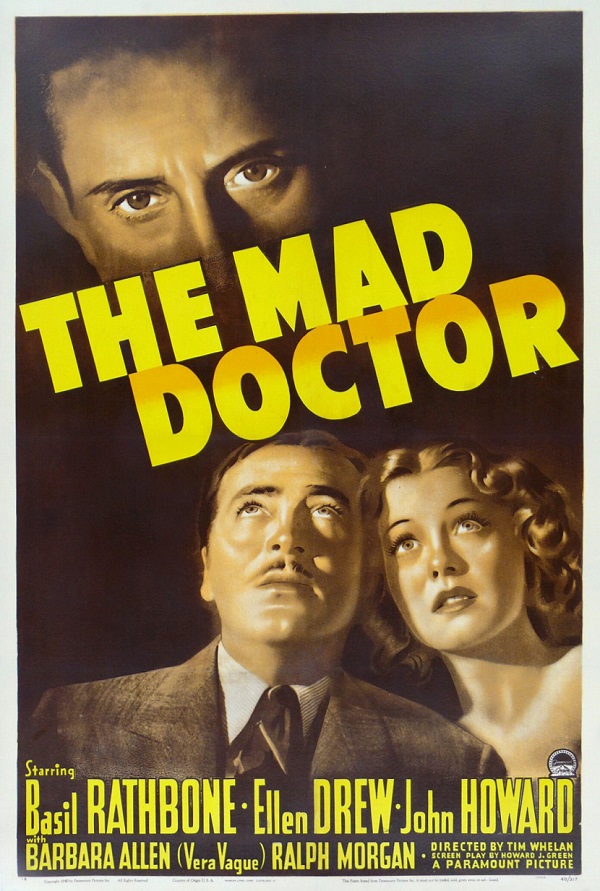
That great ability to play both suave and sinister, charming and cunning, serves both Rathbone and The Mad Doctor well, a 1940 release directed by Tim Whelan and from Paramount Pictures (now owned by Universal, though) not to be confused with the 1933 Disney animated short The Mad Doctor or the 1942 Universal film The Mad Doctor of Market Street starring Lionel Atwill and directed by Joseph H. Lewis.

You just might recognize the plot of The Mad Doctor from a hundred or a thousand or maybe even a million novels, TV shows, and movies. It seems to have been one of the first plots ever devised.

Our title character targets wealthy women, marries them, and then murders them for their money. We pick it up with his latest target, who also happens to be suicidal in addition to being wealthy. Her ex-fiancé, a newspaper reporter, and an older doctor find out the dark truth about the mad doctor but is it too late for the latest target to be saved from becoming the latest victim. The mad doctor and his male assistant are obviously lovers, something made a lot more obvious than the average movie from 1940.

Yeah, definitely seems familiar, but The Mad Doctor works so effectively and becomes a minor classic because of the performances of not only Rathbone but also Ralph Morgan as bloodhound Dr. Charles Downer and resident villain actor Martin Kosleck as the real nasty piece of work Maurice Gretz.

I heard that Rathbone and Kosleck played up the gay subtext more and more because they found it amusing, and it’s so blatant when Kosleck sinks his teeth into You’re like all the other clever ones, clever until they meet a woman, and then they suddenly become fools.

One can be relatively sure this passed the Hays Code because, let’s face it, Rathbone’s title character and Kosleck’s Maurice Gretz do not meet happy endings.

The Mad Doctor has a classic promotional trailer.

[Text] Women Know The ECSTASY and TERROR Of Loving This Man!

But For Him A KISS … A CARESS Is Not Enough!

He Builds a Bonfire OF WOMEN’S SOULS …

To Satisfy His MONSTROUS CONCEIT!

[Narration] Blood-chilling drama of a man who kills as easily as he loves starring Basil Rathbone, Ellen Drew, and John Howard with Barbara Allen and Ralph Morgan in the amazing drama of a fiend who fascinates women, lures them with love, and then as he tears their souls apart, destroys them.

[Text] SUAVE!

TENDER!

SINISTER!

TERRIBLE!

‘THE MAD Doctor’


Prey (2022)

PREY (2022) ***1/2
Even if you do not care for Prey, the latest entry and one of the best entries in the often-lackluster Predator series, you have to admit they cooked up one hell of a great idea for a new Predator movie: Have the action take place in the Northern Great Plains in North America in 1719 with Comanche warriors and French trappers up against the first Predator alien to arrive on Earth.

I’ll come straight to the main point: Prey left me gobsmacked because it far exceeded my feeble expectations for the fifth (or seventh) installment of not exactly my favorite series.

Prey approaches the 1987 original in overall quality, and I never thought I would ever say that because of the track record of the series other than Predator.

There were other significant areas that created trepidation before I sat down and watched Prey on August 15.

I watched The Predator, the previous installment, and wrote a two-star review of it back in 2018 which I closed out with At the end of the day, The Predator is not a bad movie, nor a good one, and I doubt that I’ll be able to remember it for too much longer. I’ll say that I’ve killed two hours of my life in worse fashion many times before and hopefully not as many times after. I was right, because I had to go back and read the review to even remember it.

Prey bypassed theaters and began streaming on Hulu in August 2022.

Prey received several enthusiastic reviews, and I seem to remember one or two or maybe a few voices saying that it’s even better than Predator.

Also, unfortunately I could not avoid garbage discourse like Prey is the most woke blockbuster in Hollywood and woke trash and Prey woke garbage. I don’t know, at this point in time, I bypass any writing or any opinion or any discourse that revolves around calling something and somebody woke. You lost me at woke, a word that has been overused to death in recent times and which I see as intellectual laziness.

A simple Google search returns 5,420,000 results for ‘prey woke.’

Oh, for crying out loud, I liked Prey because it hearkened back to Predator in some ways, staked out plenty territory for itself different than any other Predator film before it, and I don’t think it had one damn thing to do with racial and social justice.

Personally, I would love to see future Predator installments that give us samurai, ninjas, cowboys, bounty hunters, assassins, secret agents, saboteurs, and historic rather than contemporary soldiers.

The Comanche warriors and French trappers were so much more interesting than what passed for characters in The Predator, for example.

Prey worked because it had a strong central premise successfully executed more than not with a main character that we can give a damn about from beginning to end.

Twenty-five-year-old Amber Midthunder is the single best reason to recommend Prey.

I had never seen this actress before or at least I had thought so, but then again, I am not exactly a person who keeps up with the latest, greatest movies and shows.

Looking over her acting credits, Midthunder played Vernon Teller in Hell or High Water, a crime movie from 2016 directed by David Mackenzie and starring Chris Pine, Ben Foster, and Jeff Bridges that I love. I thought about it a little more, and I think I can remember Midthunder from that movie. Hell or High Water could be even more interesting on a revisit, given that I would be specifically looking out for one Midthunder.

Midthunder recently hit a little back at Prey haters.

I think a lot of people thought our movie would be some super woke, F-the-patriarchy kind of a story, and that’s not what it’s about at all. It’s not a girl defying what men say she can and can’t do. It’s literally an individual who feels called to something and the people who know her don’t think that is her calling. That is so much more personal and, I think, as the character, harder to deal with anything.

People don’t know a lot about native history. Period. So they don’t know what kind of warriors we were. There are people who don’t even know that there are different tribes or languages. So already that’s coming from a place of ignorance. Then you look at it and go, ‘Oh no, man. Comanche were really, really great warriors. They were known for being some of the fiercest warriors of all. And they did have female-warrior society, so there were women that fought and hunted. So yeah, I think you look at that and you just [tell yourself], ‘Alright, whatever, people are always going to say stuff.’ I’m proud of what we did.

Midthunder’s Naru works in the fine tradition of an underdog protagonist whose progress makes for compelling, emotionally involving entertainment for 100 minutes.

Right around the same time Prey came out the formal apology from the Academy of Motion Picture Arts and Sciences to Native American activist and actor Sacheen Littlefeather for her mistreatment at the 1973 Academy Awards ceremony became public.

Hello. My name is Sacheen Littlefeather. I’m Apache and I am president of the National Native American Affirmative Image Committee. I’m representing Marlon Brando this evening and he has asked me to tell you in a very long speech, which I cannot share with you presently because of time but I will be glad to share with the press afterwards, that he very regretfully cannot accept this very generous award. And the reasons for this being are the treatment of American Indians today by the film industry and on television in movie reruns, and also with recent happenings at Wounded Knee. I beg at this time that I have not intruded upon this evening and that we will in the future, our hearts and our understandings will meet with love and generosity. Thank you on behalf of Marlon Brando.

Littlefeather passed away Oct. 2, 2022, at the age of 75.

Frankenstein Meets the Wolf Man (1943)

FRANKENSTEIN MEETS THE WOLF MAN (1943) ***1/2
Frankenstein Meets the Wolf Man starts with an absolute big bang and we have possibly the greatest five minutes in any classic Universal monster movie.

That includes such immortal movies as Frankenstein, The Bride of Frankenstein, Son of Frankenstein, Dracula, The Mummy, The Invisible Man, and The Creature from the Black Lagoon, all stone cold classics essential to every horror movie lover.

The opening gets everything absolutely right: two grave robbers, a cemetery in the middle of the night, Larry The Wolf Man Talbot’s crypt, a full moon, a whole bunch of wolfbane, the revived Wolf Man’s hand, and enough overall spooky atmosphere for approximately 50 scary movie scenes. Yeah, it’s such a phenomenal sequence that director Tom McLoughlin revived it for his opening in Jason Lives, the one film during that long-running series most influenced by classic monster movies.

The rest of Frankenstein Meets the Wolf Man does not quite measure up, especially once Frankenstein’s Monster enters the picture, but it’s still a great deal of fun.

Of course, it doesn’t hurt any that Lon Chaney Jr. (1906-73) returns as Larry Talbot, one of the greatest horror movie characters. Chaney Jr. played Talbot five times from 1941 through 1948 — the original Wolf Man, Frankenstein Meets the Wolf Man, House of Frankenstein, House of Dracula, and Abbott and Costello Meet Frankenstein.

Talbot’s a tortured soul — in fact, mondoshop.com hypes its Wolf Man poster, The most tortured soul in the Universal Monsters universe is unquestionably that suffering bastard Larry Talbot, a.k.a. The Wolf Man — and we feel great empathy for this character because he essentially doesn’t want any damn part of being the Wolf Man. Your own son Bela was a werewolf. He attacked me. He changed me into a werewolf. He’s the one that put this curse on me. You watched over him until he was permitted to die. Well, now I want to die to. Won’t you show me the way?

In that way, he’s different from Dracula, Frankenstein’s Monster, the Mummy, and the Invisible Man. Lon Chaney’s Phantom in the 1925 classic The Phantom of the Opera inspires similar feelings as Talbot and the Wolf Man. To his enduring credit, Boris Karloff (1887-1969) worked some pathos into Frankenstein’s Monster, especially in Frankenstein and The Bride of Frankenstein. Still, Talbot stands apart from most cinematic monsters and maybe it’s because he’s the most explicitly human.

Bela Lugosi (1882-1956) passed on Frankenstein’s Monster in Frankenstein, much to his eternal regret, and so he signed on for the Monster in Frankenstein Meets the Wolf Man after playing Ygor in Son of Frankenstein and The Ghost of Frankenstein. During the latter film, one might remember that Dr. Ludwig Frankenstein accidentally put Ygor’s brain into the Monster’s head — he speaks poetically at one point in the film, I am Ygor. In a series that paid minuscule attention to continuity from one film to the next, the Monster originally spoke and explained his plight in Frankenstein Meets the Wolf Man, but Universal studio heads apparently laughed their heads off at Lugosi’s dialogue and demanded it be excised from the final cut, rendering the monster absolutely ridiculous and his scenes basically a washout. I am not sure why Lugosi’s voice suddenly became laughable. Lugosi’s stunt double stands in for the 61-year-old man in many scenes. Ironically, though, whenever people imitate Frankenstein’s Monster, it’s the Lugosi version from Frankenstein Meets the Wolf Man. (Lugosi played Bela in The Wolf Man and Chaney Jr. was Frankenstein’s Monster in The Ghost of Frankenstein after Karloff bowed out.)

We’re not sure exactly why the Monster’s encased in ice or why there’s a production number that must have moseyed on over from MGM. The second half of Frankenstein Meets the Wolf Man often leaves us feeling awful perplexed.

Frankenstein Meets the Wolf Man finishes strong, thankfully, and we do see our titular monsters slug it out, though it presents an internal struggle because while we’d love more battle royale between the monsters we do love the 90 seconds they give us. This movie paved the highway for King Kong vs. Godzilla and Freddy vs. Jason.

In most every way possible, Frankenstein Meets the Wolf Man proves to be a red hot mess, but a lovable and thoroughly entertaining one nonetheless.

Odds and Odds: The Vikings, Dolls, The Monster Squad, Scream Blacula Scream

ODDS AND ODDS: THE VIKINGS, DOLLS, THE MONSTER SQUAD, SCREAM BLACULA SCREAM
Richard Fleischer’s The Vikings calls to mind epic grand adventure pictures Captain Blood, The Adventures of Robin Hood, The Sea Hawk, and The Sea Wolf, not to mention The Seventh Voyage of Sinbad from the same year (1958) and John Boorman’s Excalibur from 1981.

Kirk Douglas’ lust for life recalls Errol Flynn’s in Captain Blood, Robin Hood, and Sea Hawk and Janet Leigh’s incredible beauty compares with Olivia de Havilland’s in Captain Blood and Robin Hood, as well as Helen Mirren’s in Excalibur. Never mind that Leigh and Mirren play characters named Morgana; however, their beauty and first name are where their characters’ similarities begin and end.

In other words, The Vikings belongs to the fine cinematic tradition of swashbucklers, hair-raisers, cliff-hangers, nail-biters, period costume pieces, and historical fiction.

Of course, it doesn’t hurt that it has an uncredited Orson Welles narrate. The Vikings, in Europe of the eighth and ninth century, were dedicated to a pagan god of war, Odin. Trapped by the confines of their barren ice-bound northlands, they exploited their skill as shipbuilders to spread a reign of terror, then unequaled in violence and brutality in all the records of history. Good stuff.

Highlights include Douglas’ Einar and Curtis’ Eric having key body parts removed, the former his eye by a falcon and the latter his hand in a bout of capital punishment. These moments undoubtedly make The Vikings one of the most gruesome films in 1958 this side of the British classic Fiend Without a Face. Oh, that’s a golden oldie.

Naturally, one can’t go too wrong with any picture where Ernest Borgnine plays a character named Ragnar and spouts screenwriter Calder Willingham’s dialogue like a bountiful fountain, for example What man ever had a finer son? Odin could have sired him, but I did … and Look how he glares at me. If he wasn’t fathered by the black ram in the full of the moon my name is not Ragnar.

Back in the day, my friend would call on quotes from Airplane and Austin Powers for our amusement, and it’s a crying shame that we had no idea about The Vikings, because I think lines such as You sound like a moose giving birth to a hedgehog and The sun will cross the sky a thousand times before he dies, and you’ll wish a thousand times that you were dead would have perfectly fit a night of carousing, especially for two byproducts of a school with Vikings for its mascot.

Rating: Four stars.

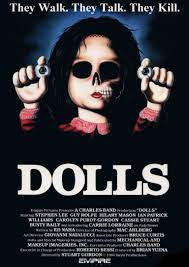
— I finally got around to watching Stuart Gordon’s Dolls for the first time.

Finally, because I love Gordon’s first two features Re-Animator and From Beyond.

I must say that I wasn’t disappointed by Dolls, though it’s a step down from From Beyond and a good two or three from Re-Animator.

Alas, Dolls belongs to a slightly different but no less venerable tradition than Re-Animator and From Beyond, both of which cross mad scientists and low-budget exploitation (nudity, gore, etc.). Think Frankenstein meets Dawn of the Dead.

Dolls, meanwhile, recalls such touchstones as The Old Dark House and The Devil-Doll, not to mention the 1979 Tourist Trap. See if this plot sounds familiar: On a dark and stormy night, six people — a dysfunctional family (husband and father, wife and stepmother, and daughter / stepdaughter) and a young man with two hitchhikers — find the nearest house (The Old Dark House) and they have to fight to make it out of the other end of the motion picture alive because their kindly old hosts are magical toy makers with killer dolls (The Devil-Doll, Tourist Trap).

Like both Re-Animator and From Beyond, Gordon and Dolls screenwriter Ed Naha jump off from their basic old-fashioned plot structure with inspired moments of madness.

Dolls also predates Child’s Play by more than a year and rather than just one killer doll, it has a horde … but Child’s Play, created by Don Mancini, spawned Child’s Play 2, Child’s Play 3, Bride of Chucky, Seed of Chucky, Curse of Chucky, Cult of Chucky, and Child’s Play (2019), plus short films Chucky’s Vacation Slides and Chucky Invades and the TV series Chucky.

So, apparently, not all killer doll films are created equal.

Rating: Three stars.

The Monster Squad starts with an absolute genius idea: Take a group of kids, horror movie fans one and all, and have them do battle against Dracula, Frankenstein’s Monster, Wolf Man, Mummy, and Gill Man.

Yes, what an absolutely positively brilliant idea by screenwriters Shane Black and Fred Dekker, whose names ring a bell loud and clear for genre fans. Others will be familiar with their work regardless whether they know their names or not.

Black made his fame and fortune first for the script of the buddy cop picture Lethal Weapon and some of his other credits include Predator (he plays Hawkins), The Last Boy Scout, and The Long Kiss Goodnight.

Dekker’s other feature directorial credits are the fantastic Night of the Creeps and the not-so-fantastic RoboCop 3.

The Monster Squad gives us both protagonists and monsters that we like, and that goes a long way toward producing a memorable motion picture experience.

The Wolf Man gets his due for a change. The fat kid Horace kicks the Wolf Man in the groin and unleashes the film’s trademark line Wolfman’s got nards! In 2018, Andre Gower, one of the stars of The Monster Squad, directed a documentary named Wolfman’s Got Nards, which looks at the impact one little cult horror film made on fans, cast and crew, and the movie industry.

Anyway, in a movie filled with nifty little moments, I love it when the Wolf Man regenerates after he’s blown up real good.

On the site Drinking Cinema, I found a game for The Monster Squad so drink whenever: 1. Dynamite EXPLODES! 2. A monster dies! 3. You hear a sweet insult. 4. You learn a new monster fact. 5. The cops are having a really hard time figuring out that, um, hello, the perps are various Jack Pierce creations. 6. You see amazing dog acting. 7. You witness a patented Monster Slow-Walk. 8. There’s a monster scare!

I give The Monster Squad a slight deduction for the obligatory music video montage right around the midway point of the picture.

Rating: Three-and-a-half stars.

— Vampirism and voodoo go together rather well and their combination helps Scream Blacula Scream become one of those rare sequels I prefer over the original.

I thought William Marshall’s performance as the title character was the redeeming factor in Blacula and he’s every bit as good in Scream Blacula Scream. Marshall just has a commanding screen presence and he brings both a gravitas to a character and legitimacy to a movie that otherwise might be laughable with the wrong person in the main role. He’s equally effective in every guise of this character — the debonair Mamuwalde who has a definite charm with the ladies befitting an African prince (which he indeed was before the racist Dracula cursed him and imprisoned in a coffin until Blacula awakened in 1972 Los Angeles), the menacing Blacula with his fangs bared, and the more reflective Mamuwalde who hates the dreaded vampire curse.

A highly respectable box office return — not voodoo, no matter what the plot synopsis might read — brought Mamuwalde / Blacula / Marshall back.

In the first movie, Mamuwalde / Blacula comes to believe the lovely Tina’s the reincarnation of his long dead wife Luva. Well, it definitely helps that Vonetta McGee plays both Tina and Luva. By golly, doesn’t this plot thread just get you every single time?

In the sequel, Mamuwalde / Blacula believes in the voodoo powers of Lisa Fortier. She can provide a cure and exorcise the curse once and forever.

Scream Blacula Scream came out two weeks after Coffy and had it been made later in 1973 after Pam Grier busted out as a star playing Coffy, her Lisa Fortier character in Scream Blacula Scream would have undoubtedly been different. Grier plays a more traditional leading lady and screaming and shrinking damsel in distress in Scream Blacula Scream, and she’s definitely no shrinking violet in either Coffy or Foxy Brown. So if Scream Blacula Scream had been produced more in the aftermath of both Coffy and Cleopatra Jones, which came out a month after both Coffy and Scream Blacula Scream, surely American-International — one of the best exploitation film outlets — would have wanted Grier to play one badass mama jama vampire killer rather than her more stereotypical role.

Fair warning: Scream Blacula Scream ends on an extremely jarring note. I remember thinking, in the immortal song title of Peggy Lee, is that all there is? Despite the fact of that ending, you might be surprised to find that I am granting Scream Blacula Scream three-and-a-half stars. Yes, it is just that good.

Cobain: Montage of Heck, I Am Chris Farley

COBAIN: MONTAGE OF HECK, I AM CHRIS FARLEY

Like Jimi Hendrix, Janis Joplin, and Jim Morrison before and Tupac and Biggie after him, Kurt Cobain became a cottage industry after his death at the age of 27 in 1994. Nothing floods the market like a dead superstar.

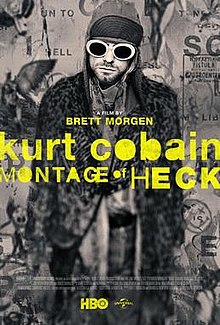
Just on the documentary front alone, we’ve had Nick Bloomfield’s 1998 investigative and speculative KURT & COURTNEY, A.J. Schnack’s 2006 KURT COBAIN: ABOUT A SON built around Cobain interviews for Michael Azerrad’s 1993 book “Come As You Are: The Story of Nirvana,” and then the 2015 double dose of SOAKED IN BLEACH and COBAIN: MONTAGE OF HECK, the former centered around private investigator Tom Grant and his digging into Cobain’s suicide and the latter officially approved by Cobain’s widow Courtney Love and their daughter Frances Bean Cobain. They made a real big deal about MONTAGE OF HECK being the first officially approved Cobain / Nirvana documentary, which automatically raises some red flags.

Throw in Gus Van Sant’s fictionalized LAST DAYS from 2005 and between all those cinematic incarnations and the Greatest Hits package (2002), the Journals (first released 2002), the three CD and one DVD box set (2004), the single-disc “Best of the Box” (2005), and various live albums released after his death beginning with MTV UNPLUGGED IN NEW YORK (Nov. 1, 1994) nearly six months after Cobain’s suicide, as well as all the celebrities from every walk of life fawning over seemingly every little thing Cobain, it’s easy to see why some of us experience Cobain fatigue or even why old fans sour on Cobain and Nirvana and ponder what they ever saw in their former heroes in the first place. Additionally, there are others who will tell you they hated Cobain and Nirvana during their brief heyday and that Cobain’s best move was blowing his brains out (a former co-worker actually said that during one musical discussion). We have more than enough room for each perspective and then some.

Through it all, though, I remain a Nirvana fan, mainly because I do my best to keep the legend at bay and just listen to the music. I turned 13 years old just three days before the release of Nirvana’s second album, NEVERMIND, so I definitely smelled teen spirit. That album, especially its first half, became so ingrained in my life during my teenage years that eventually I rarely ever played it, especially its first half, for quite some time. Only in the last year or so have I listened again to studio “Smells Like Teen Spirit,” “In Bloom,” “Come As You Are,” and “Lithium” on my own accord.

Anyway, that’s a long way of saying I watched MONTAGE OF HECK more than five years after its original release and subsequent hype and backlash. Movies about real people, especially artists, face at least one huge challenge: Do you focus on that person’s darker side or do you focus on the good times or do you try and find a middle ground between dark and light? Matters are compounded when the subject in question committed suicide at the age of 27 and titled songs “I Hate Myself and Want to Die.” Cobain’s often dark sense of humor should never be shortchanged and it’s not during MONTAGE OF HECK. We do see the darker side of Cobain throughout, especially in the second half of MONTAGE OF HECK, but the film also helps recall why Nirvana unexpectedly exploded into the stratosphere in late 1991 and early 1992. That said, I still do not and will probably never understand why Cobain became a generational spokesman, because like others before and after him, he did not want that responsibility and because this whole generational spokesman concept strikes me as being profoundly silly. Always remember, though, “It’s not what your celebrity (corporation) can do for you, it’s what you can do for your celebrity (corporation).”

MONTAGE OF HECK calls to mind Jeff Feuerzeig’s 2005 documentary THE DEVIL AND DANIEL JOHNSTON in a multitude of ways, through their deeply troubled protagonists who have a talent for writing songs, playing music, and drawing, their every moment seemingly captured on camera, and their animated interludes. Cobain himself appeared in THE DEVIL AND DANIEL JOHNSTON, wearing a “Hi, How Are You?” T-shirt alongside Red Hot Chili Peppers bassist and Nirvana trumpeter Flea at the 1992 MTV Music Awards.

MONTAGE OF HECK attempts to avoid the canned talking head format as much as possible — director Brett Morgen said the interviews from Bob Fosse’s Lenny Bruce screen biography LENNY influenced his style for MONTAGE OF HECK.

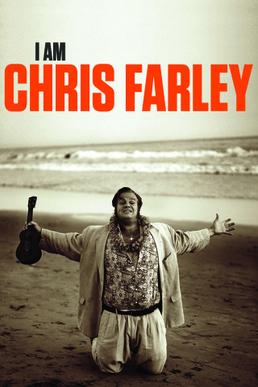
I AM CHRIS FARLEY, meanwhile, reinforces the idea that excess informed Chris Farley’s life and death at the age of 33 from an overdose in December 1997.

Farley enjoyed an excess of friends and loved ones, because fellow celebrities Christina Applegate, Tom Arnold, Dan Aykroyd, Bo Derek, Jon Lovitz, Lorne Michaels, Jay Mohr, Mike Myers, Bob Odenkirk, Bob Saget, Adam Sandler, and David Spade all share their Farley memories and anecdotes, in addition to excess in both overall lifestyle and comedic style.

I quickly realized once again that it was that very excess at the heart of Farley’s lead roles in TOMMY BOY, BLACK SHEEP, BEVERLY HILLS NINJA, and the posthumously released ALMOST HEROES. I watched BLACK SHEEP and BEVERLY HILLS NINJA and passed on the other two, because I thought BLACK SHEEP and BEVERLY HILLS NINJA relentlessly played one note for a good 90 minutes at a time — we shall call this note “Fat Man Takes a Really, Really Big Fall.” Seeing clips in I AM CHRIS FARLEY just brought it all back home again how much I disliked Farley’s films.

Also, during I AM CHRIS FARLEY, Aykroyd compared the comedic duo of Farley and Spade to Aykroyd and Belushi, Abbott and Costello, and Martin and Lewis. Wow. I mean, I did a double take when I first heard it and I just did another now writing it out. Farley and Spade paired for TOMMY BOY and BLACK SHEEP, while Abbott and Costello began working together in radio in 1935 and continued through radio, film, and TV into the mid-50s, highlighted by their legendary “Who’s on First?” routine. Abbott and Costello’s filmography doubled Farley and Spade in 1941 alone. Martin and Lewis made 16 films together — like Abbott and Costello, they worked in three entertainment mediums — from 1949 to 1956. Farley and Spade compared to Aykroyd and Belushi checks out, because of “Saturday Night Live” and two feature films.

On the other hand, I loved almost every Farley clip from “Saturday Night Live,” especially motivational speaker Matt Foley’s debut on May 8, 1993, because I can handle Farley’s excess better at five-minute sketch intervals than feature-length excess. I laughed at the Matt Foley sketch like I remember laughing at it 27 years earlier when it first aired. Spade and Applegate’s reactions and straining to remain in character when Foley unleashes “From what I understand, you’re not using your paper for writing, but for rolling doobies … you’ll be doing a lot of doobie rolling when you’re living in a van down by the river” make this sketch even funnier. Farley’s defining moment and one of the best on SNL.

By the way, you’ll discover the identity of the real-life Matt Foley during I AM CHRIS FARLEY. That’s one of the low-key highlights.

I AM CHRIS FARLEY balances toward light more than dark, but comments like Odenkirk’s “It’s just rare that a person has that much joy and brings that much happiness to everyone around him, but with Chris, there’s a limit to how wonderful it is to me and that limit is when you kill yourself with drugs and alcohol, you know, because that’s where it stops being so fucking magical” certainly get their point across.

Here’s another way to look at Cobain and Farley, “The light that burns twice as bright burns half as long.” In the case of a musician and a comedian who are preserved on record and celluloid, though, we have a chance to step into the light once more any time we so desire our personal favorite Nirvana album or “The Best of Chris Farley.” I believe that’s the best way to remember Cobain and Farley, as well as ourselves in the process.

COBAIN: MONTAGE OF HECK (2015) ****; I AM CHRIS FARLEY (2015) ***1/2

Boris, Boris, Boris: The Man They Could Not Hang, The Man with Nine Lives, The Boogie Man Will Get You

BORIS, BORIS, BORIS: THE MAN THEY COULD NOT HANG, THE MAN WITH NINE LIVES, THE BOOGIE MAN WILL GET YOU

I am a big fan of the horror movies of the 1930s and 1940s and I am a big Boris Karloff (1887-1969) fan.

Older horror movies often stand out for two main reasons: atmosphere and wit. Just think DR. JEKYLL AND MR. HYDE and THE BRIDE OF FRANKENSTEIN.

Karloff’s film career began in the silent era and he was already 80 movies deep into his career when he portrayed Frankenstein’s Monster in James Whale’s 1931 FRANKENSTEIN. Karloff’s career exploded and he (along with such figures as Bela Lugosi, Peter Lorre, Basil Rathbone, Lionel Atwill, and Lon Chaney Jr.) became synonymous with a certain vintage of horror thrillers.

Watching his early Universal films like FRANKENSTEIN and THE OLD DARK HOUSE and then his work for Columbia like THE MAN THEY COULD NOT HANG, THE MAN WITH NINE LIVES, and THE BOOGIE MAN WILL GET YOU, it is fascinating to observe Karloff’s evolution from menacing mutes to mad scientists with mad elocution. In fact, during THE BOOGIE MAN WILL GET YOU, I wanted Karloff’s Professor Nathaniel Billings to just the heck shut up for a darn minute. He’s a blabbermouth, and it’s amazing to even think of Karloff playing that way after FRANKENSTEIN and THE OLD DARK HOUSE made the actor famous for playing silent but deadly.

THE MAN THEY COULD NOT HANG contains one of Karloff’s best performances. He plays Dr. Henryk Savaard, a genius who can bring the dead back to life, a feat that might come in handy for a film titled THE MAN THEY COULD NOT HANG. You guessed it, that man would be Dr. Savaard. Anyway, a medical student volunteers for Dr. Savaard and before he can be returned to life, them darn proper authorities interrupt Dr. Savaard. Call it “cadaver reanimatus interruptus.” They bring Dr. Savaard up for murder, convict him, and sentence him to death by hanging. They do in fact hang the good doctor, but his incredibly trustworthy assistant claims the body and brings the doctor back to life to enact his revenge against the judge and the jury responsible for convicting him and sentencing him to his death.

THE MAN THEY COULD NOT HANG basically splits into three movies: mad scientist, courtroom drama, and revenge thriller. It all works extremely well predominantly because of Karloff, whose performance dominates the movie. His courtroom defense scene is a thing of absolute beauty and it just might be his best single scene.

By the way, I absolutely love it when horror movies are not afraid to venture into other genres and become more than a horror movie while simultaneously maintaining the bulk of their body within the genre.

THE MAN WITH NINE LIVES tells a similar tale and Karloff plays a similar character to his role in THE MAN THEY COULD NOT HANG. Both pictures also have the same director (Nick Grinde) and the same writer (Karl Brown), as well as the same cinematographer (Benjamin Kline).

NINE LIVES picks up once we find Karloff’s Dr. Leon Kravaal frozen in an ice chamber deep in a secret passage within his home. Also found are Dr. Kravaal’s accusers … and might I add the plot of THE MAN WITH NINE LIVES gets very loopy even for its genre, despite its ties to real life.

Both THE MAN THEY COULD NOT HANG and THE MAN WITH NINE LIVES are rooted in Dr. Robert E. Cornish and his famous resuscitation experiments. Cornish successfully revived two dogs (Lazarus IV and V) and he wanted to expand his testing on humans. San Quentin inmate Thomas McMonigle, on Death Row, contacted Cornish and offered his body for experimentation, but California denied Cornish and McMonigle their petition because law enforcement officials feared a reanimated McMonigle would have to be freed due to “double jeopardy.” McMonigle was executed in early 1948. Cornish (1903-63) himself appeared in the 1935 film LIFE RETURNS, playing himself.

THE BOOGIE MAN WILL GET YOU plays around with similar material as the other Karloff films he made for Columbia, only more for laughs this fifth time. Yes, Karloff plays yet another mad scientist.

The presence of Karloff and Peter Lorre (1904-64) guarantees at minimum a certain quality and THE BOOGIE MAN WILL GET YOU definitely finds that minimum and nothing less or nothing more. The less said about it the better, and I wish the movie would have followed that policy.


THE MAN THEY COULD NOT HANG ***1/2; THE MAN WITH NINE LIVES ***; THE BOOGIE MAN WILL GET YOU **

The In-Flight Double Feature: Airplane!, Airplane II: The Sequel

AIRPLANE!, AIRPLANE II: THE SEQUEL

AIRPLANE! contributed to the demise of the dominance of the disaster film just as much as beyond lackluster disaster films AVALANCHE, THE SWARM, WHEN TIME RAN OUT, BEYOND THE POSEIDON ADVENTURE, and AIRPORT ‘77 and THE CONCORDE … AIRPORT ‘79. It was like the decisive blow and disaster movies disappeared for many years.

AIRPLANE satirized disaster films in general and the AIRPORT series in particular. The team of Jim Abrahams, David Zucker, and Jerry Zucker ripped their ridiculous plot straight from the 1957 Paramount Pictures film ZERO HOUR starring an exclamatory title and Dana Andrews, Linda Darnell, Sterling Hayden, and Elroy “Crazy Legs” Hirsch. I watched ZERO HOUR (sans exclamation) after learning of the fact that it directly inspired AIRPLANE, and it’s scary how much AIRPLANE lifted from the earlier film. It is also fitting, because Arthur Hailey co-wrote the screenplay for ZERO HOUR and wrote the 1968 novel AIRPORT that became the beginning of the disaster film craze when AIRPORT hit box office gold upon its March 1970 release.

A decade later, millions were obviously clamoring for a sledgehammer attack on disaster films, because AIRPLANE finished behind only THE EMPIRE STRIKES BACK, 9 TO 5, and STIR CRAZY at the American box office in 1980.

Abrahams, Zucker, and Zucker not only had their way with disaster films, but they ripped to shreds both famous individual scenes (SATURDAY NIGHT FEVER, FROM HERE TO ETERNITY, KNUTE ROCKNE ALL-AMERICAN) and standard narrative devices. They especially had some devious fun with flashbacks and voice-over narration courtesy our rather square, good-looking protagonist with a troubled past (Robert Hays’ Ted Striker a perfect match for Dana Andrews’ Ted Stryker in ZERO HOUR. Andrews’ Stryker also brings to mind his troubled character 11 years earlier in THE BEST YEARS OF OUR LIVES).

In the process of satirizing movie genres, AIRPLANE created its own genre that has endured far longer than disaster films and gave birth to new old movie stars like Leslie Nielsen, Lloyd Bridges, Robert Stack, and Peter Graves, whose ability to play it straight at every moment made at least half the joke work.

(Disaster films have periodically made huge comebacks like when INDEPENDENCE DAY, TWISTER, and ARMAGEDDON became super blockbusters late in the apocalypse-minded 20th Century. Definitely not my favorite trend. For the record, I hate both TWISTER and ARMAGEDDON, and I have never managed to make it through INDEPENDENCE DAY in spite or more precisely because of all the hype and euphoric glee that came with it and still comes with it years later.)

Yes, we have seen virtually every movie genre under the sun parodied, quoted, and (less frequently) satirized. We have lived through all the immediate AIRPLANE imitations, the Z-A-Z Boys’ own movies, and everything from the works of the Wayans Brothers to Jason Friedberg and Aaron Seltzer. At some point, let’s say early in the 21st Century, I dreaded the parody movie even more than its various targets.

Most of these later parodies miss the satirical bent that gave AIRPLANE, TOP SECRET, and THE NAKED GUN, as well as Mel Brooks’ YOUNG FRANKENSTEIN, BLAZING SADDLES, HISTORY OF THE WORLD PART 1, and SPACEBALLS, their special verve. The later parodies seem far more willing to merely quote from a blockbuster movie and to just leave it at that. “You’ve seen it before and now, let’s see it again, only done less effectively.” Honestly, what’s the point and more precisely, what’s so funny about that?

For many years, I passed on AIRPLANE II: THE SEQUEL, especially after learning that Zucker, Abrahams, and Zucker were not involved. The boys apparently sent out a press release before the release of the sequel that stated just that.

The crack research team just unearthed this David Zucker gem from 2015: “Jim just said, ‘If your daughter became a prostitute, would you go and watch her work?’” That’s one way to look at THE SEQUEL, one of the cheaper, less essential AIRPLANE imitations out there. The addition of more stars (Raymond Burr, Chuck Connors, William Shatner) makes it even cheaper.

I laughed a couple and smiled a few times during THE SEQUEL, but mostly I watched this comedy that attempts maybe 500 jokes in an indifferent state. The laughs were front-loaded and I found it challenging to even remember them at the back end of the picture. Have you ever had that feeling, where you’re stuck in the middle of a movie thinking about how much you were enjoying it earlier and now you’re dreading it and the remaining seconds and minutes?

There’s almost nothing worse in the movie world than a comedy that fails, since most human life forms love to laugh, even or especially at the dumbest and corniest jokes. We are prepared to laugh during a comedy. We want to laugh. So, when you find very little or absolutely nothing to laugh at over 84 minutes, all this hostility builds up inside you and you get very upset about how you have wasted 84 minutes of precious time which you could have wasted on something else.

Never mind, I should have passed on THE SEQUEL and just watched AIRPLANE one more time.


AIRPLANE! ***1/2; AIRPLANE II: THE SEQUEL **

Sequels Second to None: The Empire Strikes Back, Indiana Jones and the Temple of Doom

SEQUELS SECOND TO NONE: THE EMPIRE STRIKES BACK, INDIANA JONES AND THE TEMPLE OF DOOM

Having recently watched THE EMPIRE STRIKES BACK and INDIANA JONES AND THE TEMPLE OF DOOM for the first time in a movie theater, I have asked myself one tough question: Why are they my favorite Star Wars and Indiana Jones movies?

THE EMPIRE STRIKES BACK, the second installment in George Lucas’ space opera series eventually taken over by the fine folks at Disney, has the best direction (Irvin Kershner), best writing (courtesy Leigh Brackett and Lawrence Kasdan), best acting, best environs (the icy planet Hoth, the swampy Dagobah, and Cloud City), and the characters display their greatest emotional range and depth. Yoda, Boba Fett, and Lando are iconic additions, especially Yoda. Only the very first STAR WARS (A NEW HOPE) even approaches EMPIRE and please just forget about the prequels (REVENGE OF THE SITH by far the best of them) and the entries post-Disney takeover. It seems like the majority of STAR WARS fans agree.

Meanwhile, I seem to be in the minority who prefer TEMPLE OF DOOM over RAIDERS OF THE LOST ARK. I understand that it’s dark and disgusting, and that Kate Capshaw’s nightclub singer Willie Scott annoys the hell out of you with all that darn histrionic screaming that she does from the first reel to the very last. I grant all those points. Regardless, I prefer TEMPLE OF DOOM because it’s very dark and very disgusting, and yes, I do believe that it is one of the all-time best gross out movies. We’re talking such pleasantries as monkey brains, eels, snakes, bats, bugs, child slavery, heart removal, and bad, bad, bad men eaten by alligators. To be fair and honest, the Shanghai and Indian characters are grotesque caricatures even more disgusting than any of the creature and culinary discomforts, but then again so are the Nazis and Commies in the other Indiana Jones pictures. Understandably, though, India once banned TEMPLE OF DOOM.

TEMPLE OF DOOM does call to mind such classics as BLACK NARCISSUS, GUNGA DIN, THE STEEL HELMET (Short Round borrowed from Samuel Fuller’s 1951 Korean War picture), and THE GENERAL. Scott’s opening production number (Spielberg has long said that he’d love to do a musical and this scene and the jitterbug sequence in 1941 shows that he could make a very good even great one) clues us in on what’s exactly up the sleeves of director Steven Spielberg, screenwriters Willard Huyck and Gloria Katz, story writer Lucas, and gang. What’s that number called? “Anything Goes,” the Cole Porter standard. TEMPLE OF DOOM works because it is oversized and over-the-top like Spielberg’s earlier comedy 1941. Perhaps it is only fitting that Spielberg apparently likes 1941 and TEMPLE OF DOOM the least among his filmography. Does he recoil from their being so politically incorrect?

As far as Willie Scott goes, she epitomizes the sister or girlfriend or wife perpetually grossed out and disgusted by the shenanigans of all the boys surrounding her. I find that element fun. Yes, I do agree that Karen Allen’s Marion Ravenwood is a better match for Indiana Jones and it’s great they brought her character back for KINGDOM OF THE CRYSTAL SKULL. Scott remains more consistent throughout TEMPLE OF DOOM, though, whereas Marion switches between several modes and moods — just one of the boys, spitfire, damsel-in-distress, and wounded woman chief among them. I enjoy both characters, for different reasons. Capshaw’s performance and her character do not mar TEMPLE OF DOOM for me.

It’s been said numerous times before that Lucas endured a divorce around the time of the making of TEMPLE OF DOOM and that seeped into the movie — in the overall tone but specifically the Willie Scott character and the heart removal. Spielberg, two years after his divorce from actress Amy Irving, married Capshaw and they have been together nearly three decades.

It also must be said TEMPLE OF DOOM was my first Indiana Jones movie, because it was the only VHS tape she kept from a mid-1980s Christmas present from her children. Between that and her later acquisition, THE ADVENTURES OF ROBIN HOOD, I must have thrilled on them 100 times. Maybe nostalgia and sentimentality for old movies, even older movies, grand adventure, brassy dames from the Midwest, and politically incorrect characters and gross out gags animates my overall affection for TEMPLE OF DOOM. (I watched RAIDERS OF THE LOST ARK at the drive-in a couple weeks before TEMPLE OF DOOM. I passed on THE LAST CRUSADE for THE EMPIRE STRIKES BACK.)

As I watched THE EMPIRE STRIKES BACK in the Fort Cinema in the town where I attended high school and the first couple years of college, I periodically momentarily flashed back on how I must have first felt watching the movie some more than 35 years ago in the even smaller Southeast Kansas town Arcadia. I felt that way again, despite having seen EMPIRE 30-40-50 times.

Just one nagging thought occasionally spoiled the mood: We were not seeing the original theatrical version of EMPIRE, rather we had one of them dang blasted Special Editions that genius George Lucas masterminded in the mid-’90s for theatrical and home video release circa 1997 where he touched up some of the old school special effects and made some cringe-worthy insertions that will be mocked until the end of time. Lucas has sadly tinkered with A NEW HOPE, EMPIRE, and RETURN OF THE JEDI even more since then, until I think we fans have to ask him, “Why, George, why?” Some outraged STAR WARS fans have gone as far to proclaim “George Lucas Raped My Childhood.” (I do have both VHS and DVD copies of the original theatrical version of EMPIRE.)

Fortunately, I feel that Lucas has mangled EMPIRE considerably less than both A NEW HOPE and RETURN, which alone points to it being the best entry in the entire series. The uncanny valley effect: “An eerie feeling of unfamiliarity people get while observing or interacting with robots that resemble humans almost but not quite perfectly.” I believe we can add the “Star Wars Special Edition” corollary, as well as separate corollaries for both the prequels and the Disney Star Wars, to the uncanny valley effect. George, you should have just kept your ILM CGI magic in the prequels.

As EMPIRE played out more and more and we got deeper into the plot, though, any thoughts about Lucas, Special Edition, cringe-worthy insertions, etc., faded away and I became swept up in the spectacle more than ever before, because it was up there on the big screen for the first time. I felt wonderment and exhilaration, as well as the broader spectrum of emotions that other STAR WARS movies usually do not reach.

THE EMPIRE STRIKES BACK ****; INDIANA JONES AND THE TEMPLE OF DOOM ***1/2