Son of Kong (1933)

SON OF KONG

Son of Kong (1933) Two stars

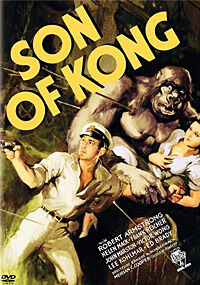
Released on Mar. 7, 1933, in New York City and a month later nationally, King Kong quickly took the nation by storm and became a cinematic landmark.

Nine months later, incredibly, RKO released the sequel Son of Kong and Hollywood did not make another Kong picture for more than 40 years.

Son of Kong just might be Hollywood’s first rush job and one of its first sequels*. It is a pleasant enough movie to watch, but obviously it’s not a patch on an all-time classic. I’ve watched the original numerous times, but I doubt I’ll want to return to Son of Kong a second time.

That’s because it’s virtually dull as dishwater. It takes approximately 45 minutes to get to our title character. That’s way too long for a movie that lasts only 69 minutes. Despite the return of Carl Denham, the most interesting human character in King Kong, played by the reliably entertaining Robert Armstrong, Son of Kong does not maintain the interest level high enough for a Kong movie. Of course, the original set the bar incredibly high.

They give Denham a potential romantic interest, because lovebirds Ann Darrow (Fay Wray) and John Driscoll (Bruce Cabot) quite naturally did not return for the sequel after their harrowing experiences, and Helen Mack’s Helene Peterson epitomizes the movie as a whole, since she’s pleasant but dull. She’s a singer, not an actress like the lovely Miss Darrow, and gets a production number. Again, pleasant but dull.

Kong co-directors Ernest B. Schoedsack and Merian C.Cooper returned as director and producer. Special effects guru Willis O’Brien and composer Max Steiner also returned, as did some of the supporting cast.

They were on a tight budget, an even tighter schedule, and they obviously knew there was no way they could topple King Kong. Armstrong himself preferred Son of Kong, but that’s because Denham received greater character arc. He’s probably the only person to ever prefer Son over its father. Both the son and the sequel are kinder, gentler — not good for a creature feature.

Sequels very rarely even approach their predecessors, and that was true in 1933 every bit as it is this very day.

For every Bride of Frankenstein and The Empire Strikes Back, we have a million failures and footnotes, like Son of Kong.

*United Artists released Don Q, Son of Zorro in 1925, a sequel to the 1920 classic Mark of Zorro. Swashbuckler supreme Douglas Fairbanks starred in both films. Son of Zorro also predates Son of Kong, Son of Frankenstein, Son of Godzilla, and Son of the Mask. To be fair, though, the sound of a toilet flushing predates Son of the Mask.

The Wasp Woman (1959)

THE WASP WOMAN (1959) **

Seems like only yesterday — time’s such an elusive concept during quarantine — that I highlighted the deceptive print ads and posters for THE GIANT CLAW.

Today, we return to that beat with Roger Corman’s 1959 wasploitation “non-classic” THE WASP WOMAN — do not fear, it’s not another movie about yet another “White Anglo-Saxon Protestant” woman. Instead, in this one, our protagonist takes, no, abuses an experimental potion made from the royal jelly of wasps that can apparently reverse the aging progress. Unfortunate side effect that even more unfortunately only kicks in during the film’s last 20 minutes: It turns her into the title character or “A BEAUTIFUL WOMAN BY DAY — A LUSTING QUEEN WASP BY NIGHT.”

Anyway, the poster for THE WASP WOMAN, it lies. Oh, how it lies. The poster “Wasp Woman” has a woman’s head and a wasp’s body. In the film, it’s flipped and she resembles a distant cousin of the title character in the much, much better THE FLY from 1958.

THE WASP WOMAN itself could make one feel appreciably older, rather than younger, because it’s extremely dull for the first hour.

We have a crusty old scientist named Zinthrop (Michael Mark). He’s not fun in any traditional mad scientist way … and, then, he’s ran over by a car and subsequently bed ridden for most of the rest of the picture … of course, his accident happened before he could warn our protagonist Janice Starlin (Susan Cabot) of some of the unfortunate side effects found in the other non-human test subjects. He redeems himself in the final act. Actually, no, he does not.

Believe it or not, most of this movie takes place in an office building, the location for the monster movie of your dreams. On top of a dull scientist, we have multiple cosmetic company staff meetings, just exactly what the viewers want during a movie called THE WASP WOMAN. Less wasp woman, more staff meetings, bingo! This movie should have been titled CLUELESS in roughly all 6,500 languages of the world.

By the way, I do believe the film shows bees rather than wasps, most notably in both the opening and closing title screens. I might be wrong, but I don’t want to be stung for being wrong. Please, have mercy on me, I’ve been stung bad enough watching THE WASP WOMAN, which definitely pales against ATTACK OF THE CRAB MONSTERS in the Roger Corman monster movie filmography.

In 1993, TNT’s MonsterVision featured THE WASP WOMAN alongside THE GIANT CLAW, THE CYCLOPS, CREATURE WITH THE ATOM BRAIN, FROM HELL IT CAME, VALLEY OF THE DRAGONS, and THE WEREWOLF during a bad movie marathon called “A Christmas Nightmare.” THE WASP WOMAN played between THE CYCLOPS and CREATURE WITH THE ATOM BRAIN.

At that point in my life, I did not watch “MonsterVision”; I started watching it only during the Joe Bob years. I would love to go back in time to the early ‘90s and talk my teenage self into watching (and taping) “MonsterVision,” so I could have all them old tapes to watch at this critical junction in time. Also, I am sure that I would have already converted them from VHS to DVD. Preservation of the species of bad movies is an imperative.

Sleepaway Camp (1983)

SLEEPAWAY CAMP

SLEEPAWAY CAMP (1983) Two stars

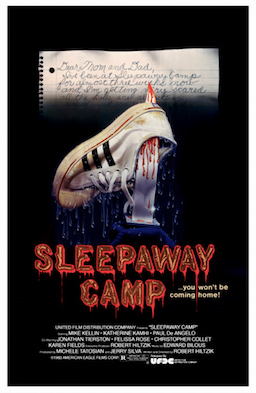
This is one of those instances where I can remember seeing the poster long before the attached movie.

Undoubtedly like most of the jaded youth of my generation, I first saw the poster for SLEEPAWAY CAMP back in the late 1980s. It’s the one that stayed with me the most over the decades.

It has the dominant image of a dripping wet shoe being stabbed all the way through by a bloodied knife. Above, there’s a letter from a camper, “Dear Mom and Dad, I’ve been at Sleepaway Camp for almost three weeks now and I’m getting very scared. …” Right below the hand holding the knife are the title dripping blood from its bold type and the tag “You won’t be coming home!”

Now, hours after watching SLEEPAWAY CAMP for the first time, it’s just as unforgettable as the poster.

To a great degree, SLEEPAWAY CAMP chucks our traditional notions of what constitutes a “good” or a “bad” movie right out the fucking window. It’s more of an experience, an event, a rite of passage, something where you can ask friends and family if they have ever seen it. If they have or haven’t, dynamite conversation will follow either way. For sure, though, it would make a great watch party — of course, following proper social distancing protocol at this point in history.

Here’s a few notes on the experience:

— Melodrama is defined as such, “A sensational dramatic piece with exaggerated characters and exciting events intended to appeal to the emotions.” Addendum: See SLEEPAWAY CAMP. Early on, after the obligatory flashback to traumatic events of the past, Desiree Gould’s Aunt Martha establishes the basic tone for the rest of the movie: Campy with overacting possible. Yes, SLEEPAWAY CAMP goes over-the-top, gleefully, merrily, in every scene, including the end credits.

— Being bat shit crazy for 84 minutes has been SLEEPAWAY CAMP’s meal ticket to cult movie immortality. Because, let’s face it, it’s not as well-made technically as similar low-budget precursors BLACK CHRISTMAS, ALICE SWEET ALICE, and HALLOWEEN. Not even remotely close.

— SLEEPAWAY CAMP uses a musical score that also functions as bludgeoning device and melodrama amplifier. I just checked for any injuries after being whacked upside the head at regular intervals by Edward Bilous’ sledgehammer score. I survived without a single bump — amazing, I know. Anyway, I looked up this Bilous fellow. IMDb linked me to edwardbilous.com and a Bilous quote from the Wall Street Journal, “Artists today need a new set of skills to be able to tell the unique story of their generation.” He’s the founding director for the Center for Innovation in the Arts and the artistic director for Beyond the Machine, A Festival of Electro-Acoustic and Interdisciplinary Art at Juilliard. He joined the Juilliard faculty in 1984.

— “Weird Al” Yankovic’s “Nature Trail to Hell” sounds like a spin on FRIDAY THE 13TH PART III and SLEEPAWAY CAMP. “Coming this Christmas to a theater near you / The most horrifying film to hit the screen / There’s a homicidal maniac who finds a cub scout troop / And he hacks up two or three in every scene / Please don’t reveal the secret ending to your friends / Don’t spoil the big surprise / You won’t believe your eyes when you see. …” and “See severed heads that almost fall right in your lap / See that bloody hatchet coming right at you / No, you’ll never see hideous effects like these again / ‘Till we bring you ‘Nature Trail to Hell Part 2.’” File “Nature Trail to Hell” alongside such “Weird Al” epics as “The Biggest Ball of Twine in Minnesota,” “Albuquerque,” “Trapped in the Drive-Thru,” and “Jackson Park Express.”

— In his final performance, veteran actor Mike Kellin (1922-83) surpasses Gould in scenery chewing. He chews scenery to such a degree that he could chew through every picture’s scenery within an entire multiplex. Kellin plays Camp Arawak owner Mel Kostic, who keeps downplaying everything until about the 50th dead body. At least it feels that way anyway. He’s one of those characters who becomes creepier and more detestable over the course of the movie, especially when he lines up dinner with a camp counselor in her late teens and assaults one of the main characters who he mistakenly believes to be the killer. Mel loses his shit late in the picture, and it’s not pretty.

— By this point in the review, I should have already discussed the plot. Eight years after a tragic boating accident near Camp Arawak, Aunt Martha sends her niece Angela (Felissa Rose) to camp with Ricky (Jonathan Tiersten), Angela’s cousin and Martha’s son who’s a veteran camper. Mean girls Judy (Karen Fields) and Meg (Katherine Kamhi), as well as a group of their male counterparts both teenage and prepubescent, are relentlessly cruel and nasty toward Angela and Ricky, especially the initially painfully shy and quiet Angela. Ricky’s friend Paul (Christopher Collet) takes a shining to Angela and he’s able to break her silence. Over time, however, the picture develops a dread pattern: Every character who’s cruel and nasty to Angela or Ricky bites the dust in spectacular fashion. Yes, just like everything else in the picture, including the crop-tops and short-shorts, the murder set pieces are over-the-top.

— At this relative late point in the slasher film craze, a mere five years since HALLOWEEN, films in the genre needed a major selling point and SLEEPAWAY CAMP includes one of those (awesome but infuriating) endings that redefines the reality of every scene that came before, just like FRIDAY THE 13TH and HAPPY BIRTHDAY TO ME. This beyond bizarre ending is the first and foremost reason we still talk about SLEEPAWAY CAMP all these years later.

Ice Castles (1979)

ICE CASTLES

ICE CASTLES (1978) **

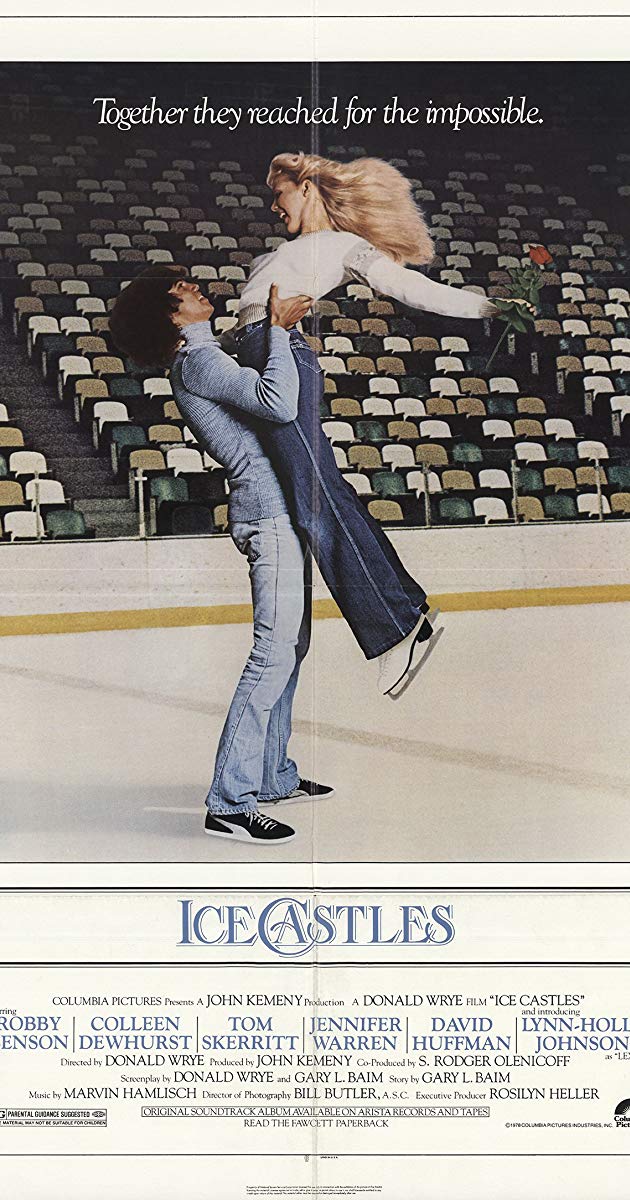
Not that I have a problem with either figure skating or movie romance — I like THE CUTTING EDGE, for example — but ICE CASTLES is not a very good movie and that’s because it makes one (like yours truly) mad due to its relentlessly manipulative nature.

We know entering ICE CASTLES that it centers on a blind figure skater and her personal and amateur figure skating travails. Naturally, she does not start out the movie blind, so that means we are waiting for her freak accident. That makes it the pièce de résistance of the picture and that makes the picture quite sick and perverse because her disability itself becomes more important than her state before or after her disability.

When skater-on-the-rise Alexis “Lexie” Winston tries a difficult triple jump and takes a mighty fall, we see it drawn out in explicit slow motion. None of her other jumps play out in this fashion. She ends up with a blood clot in her brain and loses 90 percent of her sight. There goes her shot at the 1980 Winter Olympics, right?

Director and screenwriter Donald Wyre and fellow screenwriter Gary L. Baim undercut their own movie with such a focus on the accident.

They gave first-time actress and former amateur figure skater Lynn-Holly Johnson one helluva challenge for her debut. Let’s see here, her 16-year-old character goes through not only a debilitating accident, but she breaks up with her jealous boyfriend (Robby Benson), hooks up with a television reporter (David Huffman) who helped out her career and made all her figure skating cohorts upset by all her publicity, argues with her father (Tom Skerritt) at different points throughout the picture, eventually hashes it out with her former boyfriend, and makes her triumphant comeback — despite her blindness — for a grand finale. Johnson gives a good performance and it’s certainly better than her work in subsequent films THE WATCHER IN THE WOODS, FOR YOUR EYES ONLY, and WHERE THE BOYS ARE ‘84.

Benson can be one of the most irritating movie actors and he’s especially awful with emotional scenes; he so often turns them into bad soap opera with fake anger his dread specialty. Benson does that a handful of times during the last half of ICE CASTLES, especially in the scene at the dinner table when the four main characters (I have not mentioned Colleen Dewhurst as rink operator and trainer Beulah Smith, but she’s the fourth main character) are debating whether or not Lexie should return to competition. The melodrama hits its high point when Benson’s Nick Peterson feasts on the line “Don’t give me that. Not trying is pointless and cruel. Not trying is wondering your whole life if you gave up too soon. Who the hell needs that?” It’s all so phony baloney, but it’s nowhere as bad as Benson in HARRY & SON. In that horrible movie, I wanted Paul Newman’s character Harry to punch out his son Howard as played by Benson. Time Out London called it “a curiously indigestible phenomenon, like being forced to eat five courses of avocado by an overbearing dinner-party host.” One of Benson’s immortal lines in HARRY & SON, “Want a Cherry Coke, pa?”

American adult contemporary singer Melissa Manchester performed her two nominated songs at the 1980 Academy Awards ceremony: “Through the Eyes of Love (Theme from Ice Castles)” and “I’ll Never Say Goodbye” from THE PROMISE, another soap opera. “It Goes Like It Goes” (wow, oh wow, what a title) beat out both Manchester numbers for “Best Original Song.” “Rainbow Connection” from THE MUPPET MOVIE was obviously robbed. For many years, the Academy seemed to nominate the most forgettable songs 90 percent of the time.

I promise that I’m not a hater of figure skating or movie romance, but I will often bristle at manipulation and melodrama — ICE CASTLES, despite some good elements at work, offers large portions of both manipulation and melodrama.

Then again, RogerEbert.com writers Christy Lemire, Sheila O’Malley, and Susan Wloszczyna contributed to a 2017 piece titled “Through the Eyes of Love: On the Timelessness of ‘Ice Castles.’” But, then again, so what?

Phantom of the Paradise (1974)

PHANTOM OF THE PARADISE

PHANTOM OF THE PARADISE (1974) **

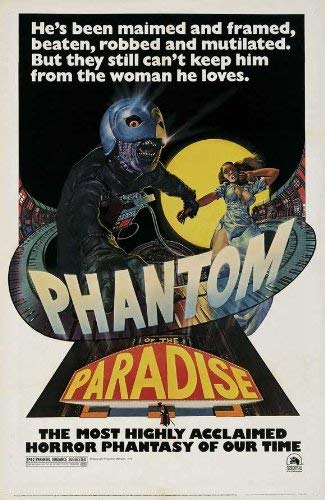
Brian De Palma’s PHANTOM OF THE PARADISE, a great big flop during its original release, is another cult film where I have to say, “I am glad you love this movie, but I don’t.” Big deal, it happens both ways on a regular basis.

It’s also one of those movies where I liked it less and less the more it was on, until I simply just wanted it to be over.

PHANTOM OF THE PARADISE gets called a “rock opera” and compared with THE ROCKY HORROR PICTURE SHOW, which came out about one year later.

Now, we’re getting to the heart of the problem. Both PHANTOM OF THE PARADISE and ROCKY HORROR are limp-wristed rock if they are in fact rock at all. Paul Williams, the songwriter and star of PHANTOM, he’s best known for writing Three Dog Night’s “An Old Fashioned Love Song,” the Carpenters’ “Rainy Days and Mondays,” Barbra Streisand’s “Evergreen” from A STAR IS BORN, and Kermit the Frog’s “Rainbow Connection” from THE MUPPET MOVIE. Not exactly the most rocking credentials.

Singer-songwriter and show tunes, with a little Sha Na Na and Meatloaf thrown in for extra measure, are not my idea of rock and that’s what PHANTOM and ROCKY HORROR offer listeners and viewers.

I already wrote a review comparing ROCKY HORROR against ROCK ‘N’ ROLL HIGH SCHOOL, a 1979 film that centers around the music of the Ramones.

This whole rock opera angle initiated my brilliantly engineered mind to recall Ken Russell’s TOMMY from 1975, another musical contemporaneous with both PHANTOM and ROCKY HORROR that’s far more deserving of being called a “rock opera.” That’s definitely true, because at one time The Who — the band responsible for the music for both the 1969 album and 1975 movie — owned the rights on “loudest rock band in the world.” They lived rock, long before they wrote a song like “Long Live Rock,” “Be it dead or alive.”

Russell, who’s every bit as good as De Palma at capturing wretched excess on celluloid, gives us non-singers Oliver Reed and Jack Nicholson, natural born entertainers Ann-Margret and Tina Turner, a Marilyn Monroe-themed cult led by “The Preacher” (Eric Clapton), and Elton John’s centerpiece “Pinball Wizard” number, taking advantage of a $5 million budget. Hell to the yes, I love me some pinball and Sir Elton’s melodramatic demise. Never mind what Ann-Margret does with champagne, beans, chocolates, and bubbles. What’s that Beach Boys line about excitation?

PHANTOM OF THE PARADISE (reportedly made for $1.3 million) takes on classic novels “Phantom of the Opera,” “The Picture of Dorian Gray,” and “Faust.” It also predates the Black Sabbath compilation album “We Sold Our Soul for Rock ‘N’ Roll.”

I prefer the 1925 silent PHANTOM OF THE OPERA because of Lon Chaney’s brilliant performance (his 1974 counterpart William Finley gives the best performance in the movie), the fact that melodrama works better in silent rather than sound films, and the fact that we do not hear the opera music. Yeah, that’s right, I do not particularly care for opera, rock or not. PHANTOM OF THE PARADISE does not rock enough.

I would have greatly preferred Robert Johnson’s music over Paul Williams’ tunes. Here I am and I can’t remember any of Williams’ songs from the film. Not a good sign.

I would not be surprised, though, to find out that Dario Argento cast Jessica Harper in SUSPIRIA (1977) because of her performance in PHANTOM OF THE PARADISE.

I’ll take SUSPIRIA.

TOMMY (1975) ***

TOMMY

The Cannonball Run (1981)

CANNONBALL RUN

THE CANNONBALL RUN (1981) Two stars

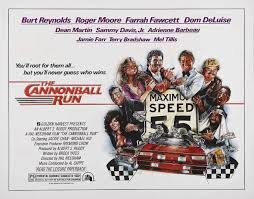
THE CANNONBALL RUN is not a very good movie, but nonetheless it contains a certain undeniable value in the time capsule department.

That’s right, THE CANNONBALL RUN shows us a society that once highly valued Burt Reynolds, James Bond, crude foreign stereotypes, cameos, cleavage, NFL, TV, and stuntman turned director Hal Needham, not in that exact order. THE CANNONBALL RUN finished sixth in the 1981 box office sweepstakes.

However, it came a few years late in the cinematic car chase-and-crash department, not so hot on the wheels of such illustrious precursors as GONE IN 60 SECONDS, DEATH RACE 2000, CANNONBALL,THE GUMBALL RALLY, EAT MY DUST, GRAND THEFT AUTO, and SMOKEY THE BANDIT, by far the best of the six Needham and Reynolds productions that saw the light of multiplex from 1977 through 1984. Never mind John Landis’ THE BLUES BROTHERS, which should have been the final word on car chases and crashes.

Needham (1931-2013) made his directorial debut with SMOKEY AND THE BANDIT and that film contains just about everything you need to know about the director and his films: chases, races, curves, stunts, pile-ups, punch-ups, slapstick, Southern humor, and Reynolds. The great success of SMOKEY AND THE BANDIT, only behind STAR WARS at the box office in 1977, paved the road for the TV show “The Dukes of Hazzard” (1979-85).

On the Needham scale, THE CANNONBALL RUN finds itself halfway between the high point of SMOKEY AND THE BANDIT and the dual low points of STROKER ACE and CANNONBALL RUN II.

SMOKEY AND THE BANDIT had the benefit of the great performance of Jackie Gleason, a performance not matched in any of the other Needham and Reynolds productions, including Gleason again in SMOKEY AND THE BANDIT II. Gleason walked (or drove) away with the first movie.

Reynolds (1936-2018) more or less squandered his career on Needham films.

For example, he chose STROKER ACE over TERMS OF ENDEARMENT. Jack Nicholson won the Best Supporting Actor Oscar for playing former astronaut Garrett Breedlove, the role turned down by Reynolds. The $16.5 million STROKER ACE bombed at the box office as it earned $5 million less than its budget. TERMS OF ENDEARMENT won Best Picture and took in over $100 million, succeeding both commercially and critically.

Reynolds’ career was never quite the same after STROKER ACE.

It would not be until BOOGIE NIGHTS (1997) the name “Burt Reynolds” was spoken with respect again. Reynolds earned a Best Supporting Actor nomination (part of a tally of 12 awards and three more nominations) for his performance as porn director Jack Horner in Paul Thomas Anderson’s sprawling epic. BOOGIE NIGHTS showed us a glimpse of what could have been for Reynolds had the actor not chosen his friend Needham in cynical productions.

They are cynical because they believed that Reynolds’ trademark grin and laugh could get us through a series of tossed off stunts, gags, and in-jokes.

This cynicism hit its absolute worst in CANNONBALL RUN II, which ironically found Reynolds playing alongside TERMS OF ENDEARMENT star Shirley MacLaine.

Frank Sinatra phoned in his cameo appearance and animator-for-hire Ralph Bakshi worked harder on the race than any of the big-name performers.

Roger Ebert called THE CANNONBALL RUN “Hollywood Squares on Wheels.”

“I’ll take James Bond for the block, please.”

“I’ll take Adrienne Barbeau’s cleavage for the win, please.”

When Roger Moore passed on the sequel, they brought in Bond villain Richard Kiel. The 7-foot-2 actor played Jaws in THE SPY WHO LOVED ME and MOONRAKER.

Barbeau and her busty blonde counterpart Tara Buckman were replaced by Catherine Bach and Susan Anton for the sequel.

The best thing to come from the CANNONBALL RUN films was that Jackie Chan borrowed the closing credit gag reel for his productions. Chan showcased not only bloopers and cast members cracking up like the CANNONBALL RUN films, but also stunts like the one in ARMOUR OF GOD that nearly killed him.

“I try to grab every tree,” Chan said in a 2017 interview. “They just keep breaking. Breaking, breaking, breaking, breaking. Then, boom, I just hit on the rock. I get up, I thought, ‘It’s nothing.’ I just feel my back’s hurt. Then I get up, but everybody pushes me down because my whole body was numb. By the time the numb passed, then I feel my air and I see the blood. We go to the hospital … I almost died.”

Even in his worst films, Chan gives it everything he got, certainly more than what the vast majority of the cast members did in CANNONBALL RUN, CANNONBALL RUN II, and SPEED ZONE. Chan’s presence helped CANNONBALL RUN II make a killing in Japan.

All we need to know about the CANNONBALL RUN series is that Jamie Farr’s Sheik Abdul ben Falafel is the only character to appear in all three films.

Terror Train (1980)

TERROR TRAIN.jpg

TERROR TRAIN (1980) Two stars
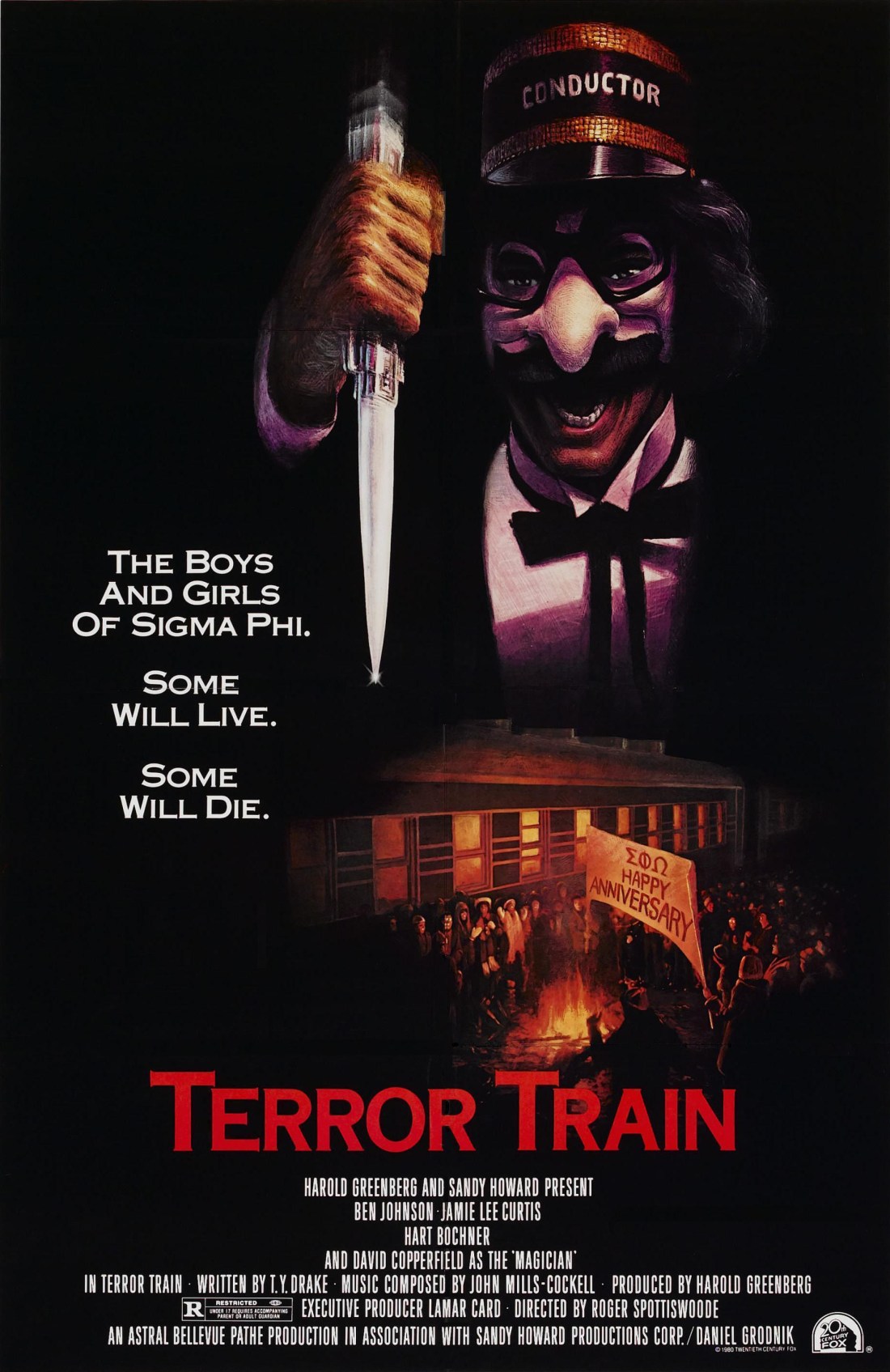
An above-average cast and cinematographer John Alcott’s work aboard a novel setting for a horror film distinguish TERROR TRAIN but otherwise, it’s a bumpy ride for 90-plus minutes.

TERROR TRAIN succeeds in making the sales pitch “HALLOWEEN on a train” come true.

Scream queen Jamie Lee Curtis headlined the cast and this was her fourth horror movie of a career that began with a big bang in HALLOWEEN. She appeared in three horror movies alone in the calendar year 1980: THE FOG in February followed by Canadian productions PROM NIGHT (July) and TERROR TRAIN (October). HALLOWEEN II rounded out the Curtis horror movie quintology in October 1981 and she had successfully become typecast. Curtis broke free by the end of the decade, proving herself especially adept at comedy.

HALLOWEEN was a great scary movie and Curtis’ next four ranged from the average (THE FOG, HALLOWEEN II, TERROR TRAIN) to the abysmal (PROM NIGHT). They made her Laurie Strode character in HALLOWEEN II a shell of herself from the first movie: Curtis never quite perfected her limp and it was depressing to see her in that hobbled state after being such a refreshing, resourceful character in the original. She never lost her scream, though.

Like seemingly every other slasher of the era, TERROR TRAIN starts in the past. In the original HALLOWEEN, 6-year-old Michael Myers murdered his teenage sister Judith. In FRIDAY THE 13TH, two camp counselors are murdered. In PROM NIGHT, there’s a prank gone horribly wrong. TERROR TRAIN belongs in the prank gone horribly wrong category.

Curtis plays Alana Maxwell, who reluctantly takes a central role in the sexual initiation prank against fraternity pledge Kenny (Derek MacKinnon). Kenny, of course, goes schizo almost immediately after this prank and he’s sent to a psychiatric hospital. Three years later, these same fraternity and sorority creeps host a New Year’s Eve costume party on a moving train … and they have an uninvited guest. This costume party angle affords the filmmakers another novelty: Kenny can assume the identity of every person he kills, so he can be the guy in the Groucho Marx mask or the great lizard costume and catch his next victim by complete surprise.

These fraternity and sorority characters are by and large noxious pieces of work, especially Doc (Hart Bochner) and Mo (Timothy Webber). Their inevitable deaths feel like they take forever, mainly because we have to endure more and more of their odious behavior. Then, when we get there, their deaths are letdowns compared to similar moments in other slasher films. I mean, for crying out loud, even PROM NIGHT, an otherwise awful movie, gives us a great decapitation replete with a head roll.

And now for something completely different: Slashers often found room for at least one veteran cast member. They picked Ben Johnson (1918-96) as the veteran cast member in TERROR TRAIN and he thankfully gets a more substantial role than, let’s say, Glenn Ford in HAPPY BIRTHDAY TO ME. As the conductor Carne, Johnson shows the cool of a world champion rodeo cowboy and Academy Award winning supporting actor (LAST PICTURE SHOW). In fact, he’s almost too cool in the midst of all the murder and mayhem. Overall, he’s a welcome presence.

David Copperfield (the magician, not the Charles Dickens character) makes his motion picture debut, apparently because producer Sandy Howard liked magicians. Copperfield stretches his chops by playing “The Magician,” does a routine that slows down the movie even more in the middle, and bows out none too gracefully after being an obligatory red herring.

Harry Houdini (1874-1926) made only silent movies: feature-length THE GRIM GAME, THE MAN FROM BEYOND, and HAIDANE OF THE SECRET SERVICE. Silence could have served TERROR TRAIN well.

John Alcott (1931-86) received a mention in the opening paragraph for his cinematography. His credits include the Stanley Kubrick films 2001, A CLOCKWORK ORANGE, BARRY LYNDON, and THE SHINING (released about five months before TERROR TRAIN), and I mentioned him in the review of the 1975 World War II film OVERLORD. OVERLORD seamlessly combined archival footage director Stuart Cooper found from the Imperial War Museum with contemporary footage shot by Alcott. Alcott’s challenge in TERROR TRAIN naturally centered on space and lighting, and he proved up to the challenge. You can file TERROR TRAIN in the great-looking slasher films after HALLOWEEN and MY BLOODY VALENTINE.

Ultimately, though, TERROR TRAIN succeeds at train and fails at terror.

The Burning (1981)

THE BURNING (1981) Two stars
The late, great director Howard Hawks (1896-1977) once said that a good movie is “three great scenes and no bad ones.”

No way that Hawks could have possibly had a movie like THE BURNING in mind, since he died a few years before the release of the 1981 slasher and even before the boom of that genre. John Carpenter paid Hawks tribute in HALLOWEEN with characters watching THE THING FROM ANOTHER WORLD on TV.

THE BURNING does have three great scenes but also several bad ones.

Let’s get the three great scenes out of the way first.

There’s an effective jump scare in an early hospital scene, before the opening credits. It makes up for a couple clunker false alarms later on in the picture.

Several early period slasher films include a scene where one character would regale both the rest of the characters and the audience with an origin story of the killer. THE BURNING, FRIDAY THE 13TH PART 2, and MADMAN all have a similar campfire story. These scenes are fun, because most of us can remember at least once being enthralled and freaked out by somebody’s ghastly yarn around the fire. Cropsy is based on a real-life New York urban legend, the Cropsey Maniac, a genuine campfire tale which obviously had a major impact on the creative forces, including Bob and Harvey Weinstein and Brad Grey (later three of the most powerful men in Hollywood), behind THE BURNING.

The “infamous raft massacre” scene, when Cropsy takes out five teenagers with his garden shears. This is the pièce de résistance of THE BURNING and the one scene when the film deserves its reappraised “classic” status. Splatter effect maestro Tom Savini earned his paycheck for this sequence alone and it can stand side-by-side with his best work.

In some quarters, THE BURNING has been called one of the best slasher films and a classic that flew under the radar.

Truth be told, I’ve always been underwhelmed and sometimes even disgusted by it, except for the three great scenes. I first watched it on late night Cinemax in the early 2000s and a few years later, I taped it off IFC.

The three great scenes probably make up less than 10 percent of the running time. Some of the camp scenes also work on a basic level.

Most often, though, THE BURNING alternates a jeering, leering tone with moments of brutal violence, a juxtaposition that makes for strange bedfellows.

We especially find that leering tone in the nude scenes of Carrick Glenn and Carolyn Houlihan. Houlihan, who won Miss Ohio in 1979, reportedly felt very uncomfortable with her nude scene and it only gets much worse for her Karen character as she receives first a temper tantrum from her would-be boyfriend after she changes her mind about sex and then Cropsy’s garden shears as she looks for her clothes scattered in the woods. Houlihan only appeared in two features, her second and final role “Bathing suit model” in A LITTLE SEX.

Ned Eisenberg and Larry Joshua play jerks in Eddy and Glazer, respectively. Joshua makes undoubtedly one of the oldest summer campers in screen history, as he turned 29 years old three months before the May 1981 release of the film. We just have absolutely no idea what Glenn’s Sally even sees in the first place in a creep like Glazer. Eddy, he’s not quite as bad as Glazer, but his scene with Karen leaves us liking the guy appreciably less.

Guess it goes to show what kind of movie we’re dealing with when Brian Matthews’ Todd and Brian Backer’s Alfred (possible nod to Hitchcock) take on Cropsy at the end. We find out Todd was one of the campers who participated in the fiery prank on Cropsy that horribly backfired during the prologue and we first see Alfred peeping on Sally in the shower. Alfred does grow on us, especially as he becomes friends with four of his fellow male campers.

Cropsy’s first murder, naturally of a prostitute, represents one of the worst aspects of the slasher film: a self-contained murder sequence that wastes precious time (sometimes minutes on end) and contributes nothing of virtue to the film.

THE BURNING holds interest today predominantly as a time capsule film.

It was part of a wave of low-budget horror films that attempted to cash in on the runaway success of HALLOWEEN. There proved to be a glut of these films in 1981.

Several famous performers and behind-the-scenes figures got their start with THE BURNING. Holly Hunter, Jason Alexander (with a head of hair), and Fisher Stevens made their screen debuts. THE BURNING marked one of the first productions of Miramax, known for their film production and distribution; Miramax (named after the Weinsteins’ parents Miriam and Max) started in 1979 in Buffalo, New York, close to where they filmed THE BURNING.

Maybe that leering, jeering tone should come of no surprise considering Harvey Weinstein’s role in THE BURNING as writer and producer.

Former production assistant Paula Wachowiak recounted her worst experience on THE BURNING with the Buffalo News in October 2017. She went to Harvey Weinstein’s hotel room, because she needed him to sign checks, and he greeted her at the door wearing nothing but a towel, which he naturally dropped when she entered his room. He wanted a massage. Wachiowiak spurned him. The Buffalo News article features the headline, “’You disgust me’: Buffalo woman tells of 1980 encounter with Weinstein.”

Breaker! Breaker! (1977)

BREAKER! BREAKER!

BREAKER! BREAKER! (1977) Two stars

We all have to start somewhere, as they say, and Chuck Norris fittingly started his true movie career with BREAKER! BREAKER! (We’ll ignore WAY OF THE DRAGON, because Norris plays a villain defeated by Bruce Lee.)

Well, BREAKER! BREAKER! is not a very good movie: Norris himself admitted that he had no idea what he was doing, it was made on an extremely low budget ($250,000) and looks it, its plot defines simplistic and leaves no room for shades of grey, and it’s a time capsule of the 1970s.

Whether or not that’s good or bad, I will leave for you to decide.

Hairdos, that music, arm wrestling, greasy diners, truck driving vernacular and CB radio lingo, and high flying karate with or without slow motion.

Yes, it all screams 1977.

BREAKER! BREAKER! only needed child custody and it could have predated OVER THE TOP by a decade.

Film’s alternate title: ROUNDHOUSE! ROUNDHOUSE! Believe you me, Mr. Norris unleashes one roundhouse per every minute of the film’s running time. Keep in mind that his feet have to catch up between the dialogue scenes.

Thinking about it a little bit longer, I believe I know where I’ve seen BREAKER! BREAKER! before: John Sturges’ 1955 classic BAD DAY AT BLACK ROCK, when Spencer Tracy’s one-armed war veteran runs into Lee Marvin, Robert Ryan, Ernest Borgnine, and just about every Black Rock resident.

BREAKER! BREAKER! is a dumbed-down BAD DAY AT BLOCK ROCK (which also predated FIRST BLOOD) and director Don Hulette is definitely no Sturges, whose other credits include GUNFIGHT AT THE O.K. CORRAL, THE MAGNIFICENT SEVEN, and THE GREAT ESCAPE.

The plot: Truck driver J.D. Dawes (Norris) warns his younger brother to stay away from Texas City, a California municipality rather hostile toward truckers. Judge Joshua Trimmings, Sergeant Strode, Deputy Boles, and seemingly every Texas City resident in cahoots run a brutal racket and they rough up one of Dawes’ friends, hence the warning to the younger brother. Well, of course, the younger brother does not stay away from Texas City and older brother springs into action to rescue younger brother and bring down corrupt Texas City. You can fill in the rest.

BREAKER! BREAKER! could play as part of a marathon with DUEL, SMOKEY AND THE BANDIT, and CONVOY or merely a double feature with the far superior BAD DAY AT BLACK ROCK.

NOTE: The poster for BREAKER! BREAKER! gets four stars.

Silver Bullet (1985)

SILVER BULLET

SILVER BULLET (1985) Two stars

“It’s such a fine line between stupid, and clever.”

— Spinal Tap lead singer David St. Hubbins

That’s one way to describe the Stephen King adaptation SILVER BULLET, which has left viewers from day one debating whether or not the film makers were intentionally parodying Stephen King and werewolf movies by making so many individual details ridiculous.

Many reviewers just considered SILVER BULLET to be laughably bad and not in the good way, hot on the entrails of previous laughably bad King adaptations CUJO and CHILDREN OF THE CORN.

Watching SILVER BULLET for the first time in many, many years, I must admit the internal split and acknowledge the fine line between stupid and clever.

Let us consider:

— We have a narrator (Broadway standout Tovah Feldshuh) who sounds like an old woman, although it’s only nine years after the main events depicted in the film when she was 15 years old. Feldshuh’s even listed as playing “Older Jane.”

— Gary Busey plays Uncle Red, a womanizing drunkard who dotes on paralyzed prepubescent protagonist Marty Coslaw (Corey Haim), Jane’s younger brother, and makes the boy customized wheelchairs called “The Silver Bullet.” I remembered the second wheelchair most from previous viewings of the film when I was roughly the same age as Marty.

— That second wheelchair, oh wow, just let me tell you that you’ve not enjoyed a complete moviegoing life until you’ve seen the scene where our priest / werewolf (Everett McGill) stalks Marty and his souped-up “Silver Bullet” in broad daylight. Marty’s second great escape is even greater than his first.

— Uncle Red should have pursued a career in wheelchair manufacturing.

— This review gives away the identity of the werewolf. Big deal. The movie tips off the identity almost immediately, but, of course, in a movie like SILVER BULLET, the townspeople are nincompoops and it takes young ones like Marty and Jane to figure out the truth. Those nincompoops are on an epic scale of nincompoop. I mean, it’s tipped off so obviously that “WEREWOLF” should have flashed on the screen below the character. They all should have died.

— The nincompoops form a “Citizens Action Brigade” in the first 30 minutes … after four killings. They load up on guns, load up into trucks, head out into the woods, step into traps, et cetera. Two nincompoops produce one of the great dialogue exchanges from the Planet X. …

Maggie Andrews: What’s the matter, Bobby? You gonna make lemonade in your pants?

Bobby Robertson: I ain’t scared!

— The werewolf resembles a black bear. After the technological advances made in the werewolf movie just four years earlier by THE HOWLING and AN AMERICAN WEREWOLF IN LONDON, SILVER BULLET set the species back years.

If they remade SILVER BULLET today, would the original be called a “classic”? Undoubtedly yes, of course, because every old movie remade automatically becomes “classic.” We’ve heard that incessantly about the 1989 PET SEMATARY, for example.

SILVER BULLET, like PET SEMATARY, is not a classic by any definition — “Judged over a period of time to be of the highest quality and outstanding of its kind” or “A work of art of recognized and established value.”

For crying out loud, TEEN WOLF — released a couple months before SILVER BULLET — stands up better.