The Intruder vs. To Kill a Mockingbird

THE INTRUDER VS. TO KILL A MOCKINGBIRD

A tale of two movies, both from 1962 and both dealing with racism.

Other than their year of release, some of their subject matter, and their being filmed in black-and-white, the films are worlds apart in virtually every other way, including how they have been received by the establishment and the general public.

Roger Corman directed and co-produced (alongside his younger brother Gene) THE INTRUDER for $80,000 and it was filmed on location for three-and-a-half weeks in Southeast Missouri towns East Prairie, Charleston, and Sikeston. William Shatner stars as race hate inciter and outside agitator Adam Cramer and the young Canadian actor was still years away from becoming a household name for “Star Trek.” THE INTRUDER takes place contemporaneously with the civil rights movement and school integration; Charles Beaumont adapted his screenplay from his own 1959 novel of the same name and he even plays school principal Mr. Paton in the film.

Robert Mulligan directed TO KILL A MOCKINGBIRD behind a $2 million budget and major studio backing with a screenplay by future Pulitzer Prize winner Horton Foote adapted from Harper Lee’s 1960 Pulitzer Prize-winning novel of the same name that had already become an institution even before a prestigious film adaptation. Gregory Peck, nominated for an Academy Award for Best Actor four times before his most famous role (THE KEYS OF THE KINGDOM, THE YEARLING, GENTLEMAN’S AGREEMENT, TWELVE O’CLOCK HIGH), stars as noble lawyer Atticus Finch. TO KILL A MOCKINGBIRD filmed on Hollywood back lots and sets designed to recreate the Monroeville, Alabama of Lee’s Great Depression youth.

THE INTRUDER premiered May 14, 1962 in New York City and it would be reissued as I HATE YOUR GUTS and SHAME. In other words, it flopped and Corman has never quite made another picture like THE INTRUDER again. His later exploitation productions hid and obscured their social commentary behind and beneath protective layers of nudity, sex, and violence.

TO KILL A MOCKINGBIRD debuted Dec. 25, 1962 and just like the Lee source material, it became an almost instantaneous social institution and beloved classic. It received eight Academy Award nominations, including Best Picture, and won three, including Best Actor for Peck. It has been a longtime staple of the American Film Institute: No. 34 on the 1997 “100 Years … 100 Movies” list and No. 25 on the 10th Anniversary list and the AFI voted it the No. 1 courtroom drama and Atticus Finch the No. 1 hero on its list of the 100 greatest heroes and villains.

I watched both films in close proximity of each other (both for the first time) and THE INTRUDER absolutely shames TO KILL A MOCKINGBIRD.

Sorry, folks, Adam Cramer presents a far more interesting character than Atticus Finch and Shatner’s incendiary performance blows away Peck and its relentless note of nobility.

Cramer, a non-Southerner decked in a bright white suit, rides into the fictional small Southern town of Caxton and quickly comes on strong as a gentleman. This clever conman and charlatan then goes to work and preys on the racist, anti-integration sympathies of many of the residents to meet his goal of inciting a race war town-by-town. Cramer’s a master manipulator and rabble-rouser who also sets his sights on a high school girl and a frustrated housewife. His manipulative powers lead to one of the black students, Joey Greene (Charles Barnes), being falsely accused of rape by a white girl. That, of course, ties in with the absolute worst nightmare of a racist, one infinitely worse than integration. In a chilling final scene, the inflamed mob interrogates Mr. Greene about this rape. The mob believes it has become judge, jury, and executioner.

Fact and fiction must have blurred for novice actor Charles Barnes, a 19-year-old young man from Charleston (one of the three towns used in filming) whom Corman instructed to draw from real-life experiences attending an integrated high school in his hometown his senior year. The Pittsburgh Courier ran a story on Barnes in May 1962, headlined “Negro Actor’s Reel Role Too Real for Whites … And He Has to Leave Hometown.”

THE INTRUDER plays real, and that sealed its commercial doom and consignment to the dustbin (at least the margins) of cinematic history.

On the other hand, TO KILL A MOCKINGBIRD plays like a series of pat moral lessons for two hours, interrupted by youthful shenanigans and occasional voice-over narration to put us in a proper nostalgic mood.

Enter “To Kill a Mockingbird moral lessons” into a search engine and it returns 1,340,000 hits.

Is that why so many people love TO KILL A MOCKINGBIRD?

Are fans of the film made to feel virtuous watching it?

Just asking for a friend.

Atticus Finch comes across so darn noble maybe because an older Scout Finch, his daughter, narrates the story.

She begins, “Maycomb was a tired old town, even in 1932 when I first knew it. Somehow, it was hotter then. Men’s stiff collars wilted by nine in the morning; ladies bathed before noon, after their 3 o’clock naps, and by nightfall were like soft teacakes with frosting from sweating and sweet talcum. The day was twenty-four hours long, but it seemed longer. There was no hurry, for there was nowhere to go and nothing to buy … and no money to buy it with. Although Maycomb County had recently been told that it had nothing to fear but fear itself … That summer, I was six years old.”

The narration put me off right from the start and it all translated as “Grandma, tell me about the good ole days.”

Between the narration and the sets and the characters, TO KILL A MOCKINGBIRD feels like experiencing a show called “The South 1932” at Universal Studios Hollywood. LOOK! It’s a one-dimensional racist white trash caricature! LOOK! It’s busybody neighbors! LOOK! It’s a crotchety old bag! LOOK! It’s a sheriff named “Heck Tate”! FEEL GOOD ENTERTAINMENT! I don’t know why I need to pay money to see that when I could experience all that for real somewhere in Small Town U.S.A. Never mind, I’ll pass on both.

TO KILL A MOCKINGBIRD stitches together multiple narrative threads, some more successfully than others.

— Scout (Mary Badham), her older brother Jem (Phillip Alford), and her best friend Dill (John Megna), and their larger-than-life misadventures.

— Scout and Jem and their relationship with Atticus, as well as their black maid Calpurnia (Estelle Evans).

— Atticus defends Tom Robinson (Brock Peters), a black man falsely accused of rape by Mayella Ewell (Collin Wilcox) and her father Robert E. Lee “Bob” Ewell (James Anderson), during a trial when the odds are stacked dramatically against both men. Before the trial, townspeople — including Scout’s school mates — call Atticus a “nigger lover” and some of the most concerned citizens form a lynch mob.

— The children’s obsession with Boo Radley (Robert Duvall).

Badham and Alford both give very good performances and their rapport with each other and Peck forms the strongest part of the movie. Badham’s debut performance received a well-deserved nomination for Academy Award for Best Supporting Actress. I understand why multiple generations of young women have responded so favorably toward TO KILL A MOCKINGBIRD. (Mulligan later directed Reese Witherspoon in a similarly affecting performance in the 1991 film THE MAN IN THE MOON.)

On the race level, though, that’s where TO KILL A MOCKINGBIRD fails and it fails miserably.

The black characters remain predominantly in the background, Tom Robinson dies offscreen, and Bob Ewell belongs to a movie racist tradition called “Ku Klux Klown.”

We also have quite possibly the only mob in history ever talked down by a 6- or 7-year-old girl.

By comparison, in THE INTRUDER, a mob burns a cross in a black neighborhood, blows up the local black church and kills the preacher in the blast, and severely beats up the white character who takes a stand alongside the blacks and encourages them to return to school after the bombing. This conscientious white character gets so beaten that he receives broken ribs and loses one eye.

Nobody lays a hand on Atticus.

Meanwhile, only Peters and Evans received screen credit among the black actors in TO KILL A MOCKINGBIRD.

All the others were not credited.

That includes William “Bill” Walker in the small but pivotal role of Reverend Sykes, who delivers the famous line “Miss Jean Louise? Miss Jean Louise, stand up. Your father’s passin’.” Peck himself said this scene — where all the black people in the balcony stand up for Atticus Finch after he defended Tom Robinson — wrapped up his Academy Award for Best Actor.

To be fair, some of the white actors, including Kim Stanley as the narrator, also were not credited.

By the point late in the movie when Bob Ewell attacks Jem and Scout and Boo Radley comes to their rescue, it was basically too little too late for this viewer. I was just ready for TO KILL A MOCKINGBIRD to be over.
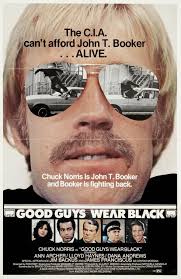
Good Guys Wear Black (1978)

GOOD GUYS WEAR BLACK

GOOD GUYS WEAR BLACK (1978) Two-and-a-half stars
The late Steve McQueen gave his friend Chuck Norris some advice for his motion picture career. McQueen said that Norris talked too much in GOOD GUYS WEAR BLACK and that, in the future, he should let his supporting actors do more talking, since it would have the effect of making what Norris says more important.

I quoted McQueen in a review of A FORCE OF ONE, Norris’ third feature. McQueen’s right about GOOD GUYS WEAR BLACK: Norris does talk too much and he should have allowed his talented supporting cast more of an opportunity to carry the speaking.

Norris stars in GOOD GUYS as John T. Booker and there’s Anne Archer as Booker’s romantic interest and smaller roles for James Franciscus, Dana Andrews, and Jim Backus. It is especially nice to see Andrews on the screen, because we remember him from classics like LAURA and especially THE BEST YEARS OF OUR LIVES. Backus deserved better, especially since, all things considered, he probably enjoyed C.H.O.M.P.S. more than what he did GOOD GUYS.

Because I saw the later film before the earlier one, GOOD GUYS’ plot reminded me of the 1985 Arnold Schwarzenegger vehicle COMMANDO. Booker’s surviving Vietnam War comrades are being systemically eliminated five years after the first scene in the movie when they survive a death trap set for them. We have a shady diplomat on the verge of becoming Secretary of State, who is blackmailed into pursuing the elimination of the Black Tigers, the elite group of CIA assassins headed by Norris’ Booker. This plot was written on the back of a much larger napkin than COMMANDO.

GOOD GUYS, like A FORCE OF ONE, exists as middle-of-the-road Norris, not quite as inspired as his best films CODE OF SILENCE and LONE WOLF McQUADE, but still better than his starring debut BREAKER! BREAKER! and THE OCTAGON, his fourth picture.

CODE OF SILENCE and LONE WOLF are his best pictures mainly because they have the best supporting casts. They also have their fair share of exciting moments.

I mean, who could ever forget that classic scene in LONE WOLF when David Carradine’s treacherous villain buries Norris alive in his super-charged Dodge Ramcharger. After coming to and pouring beer on himself, Norris and his Dodge rise up out of the ground and he gets out and guns down several of Carradine’s anonymous henchmen. Capping it all off, Norris tells his young partner to get him a beer. Epic.

There’s just one scene in GOOD GUYS that even approaches that great LONE WOLF scene.

Booker faces down an assassin, who just blew up the plane carrying Archer’s reporter character and Booker’s romantic interest Margaret, and eventually Booker takes out this formidable foe with a flying kick through the bad guy’s windshield as he attempts to run over Booker. This moment alone is worth the price of a rental or a more long-term purchase, and it could play as the front end of a highlight reel with LONE WOLF.

Unfortunately, the rest of GOOD GUYS does not live up to that incredible flying kick, reportedly performed by Norris’ brother Aaron, but it still has a certain value, especially in seeing Norris portray a college professor and a race car driver in addition to being a cold-blooded assassin. Boy, that Norris sure could do anything.

NOTES: In 2017, a 22-year-old John T. Booker, from Topeka (Kansas), was sentenced to 30 years in prison for his vehicle bomb detonation attempt at Fort Riley. Booker wanted to kill American soldiers and assist the Islamic State of Iraq and al-Sham (ISIS) in their fight against the United States.

There’s also a Dr. John T. Booker who’s an Associate Professor of French at the University of Kansas. His teaching and research focus on the French novel of the 19th and 20th centuries.

Kansas seems to have the market cornered on the John T. Booker name.

Laserblast (1978)

LASERBLAST

LASERBLAST (1978) Two-and-a-half stars

LASERBLAST is a clunky piece of low-budget junk, but it is not without its charms.

For example, LASERBLAST takes a pot shot at STAR WARS, literally when our teenage protagonist Billy Duncan (Kim Milford) blows up a STAR WARS billboard on the side of the road with his laser cannon. It blows up real good. For that matter, just about everything blows up real good in LASERBLAST.

We’ll get back to that later.

For now, however, I’d like to touch on a couple of the contemporaneous pot shots taken at JAWS.

THE GIANT SPIDER INVASION, which came out a few months after JAWS in 1975, has Sheriff Jeff Jones (Alan Hale Jr.) say over the CB radio of the spider, “You ever see the movie JAWS? It makes that shark look like a goldfish!”

THE HILLS HAVE EYES includes a ripped poster of JAWS.

ORCA: THE KILLER WHALE has a killer whale kill a great white shark early on in the proceedings.

Coincidentally, both THE HILLS HAVE EYES and ORCA were released on the same day (July 22) in 1977.

Anyway, back to LASERBLAST, a quickie exploitation picture made to cash in on the teenybopper science fiction craze between STAR WARS movies. It later became known for being one of the worst movies ever made, especially after Mystery Science Theater 3000 lampooned LASERBLAST in a 1996 episode.

I feel almost bad for giving a mixed review to LASERBLAST, especially after writing positive reviews for THE KILLING OF SATAN, TROLL 2, THE TERROR OF TINY TOWN, and PLAN 9 FROM OUTER SPACE. Almost. Believe it or not, all four of those other films have a higher IMDb rating than LASERBLAST.

LASERBLAST surrenders itself to filler scenes that just scream out TACKY SEVENTIES. It feels like a bloated production even at 80-85 minutes.

David W. Allen (1944-99) worked on 48 films in visual effects or puppetry or stop motion animation over nearly a 30-year career. His notable credits include FLESH GORDON, THE HOWLING, CAVEMAN, Q: THE WINGED SERPENT, THE STUFF, WILLOW, and GHOSTBUSTERS II.

Allen’s alien stop motion work in LASERBLAST received better reviews than any other aspect of the film.

Unfortunately, the stop motion aliens do not have more screen time in LASERBLAST.

Milford is not exactly playing the greatest hero in the history of cinema. For example, he’s the first and only hero ever to be picked on by screen nerd extraordinaire Eddie Deezen; both Milford and Deezen made their screen debuts in LASERBLAST. Milford (1951-88) became known for his work in the musicals “Jesus Christ Superstar” and “The Rocky Horror Picture Show.” He plays most of the movie without a shirt.

Let’s face it, Billy Duncan has a bad, bad, bad life: His mother always seems to be going to Acapulco, his girlfriend’s grandpa freaks out on him and runs poor, poor Billy off, two dope-smoking cops love writing up Billy for speeding tickets, and Chuck (Mike Bobenko) and Froggy (Deezen) bully him. Froggy, by the way, has seen STAR WARS five times, according to one of the dope-smoking deputies (played by veteran character actor Dennis Burkley in the early stages of his career).

Billy’s life changes for the better when he finds that darn laser cannon in the desert. As it says on the poster, Billy was a kid who got pushed around then he found the power.

Billy, of course, uses the laser cannon to blow up a bunch of stuff real good before the stop-motion aliens come for him.

One car blows up about five times in LASERBLAST. They give us just about every conceivable angle.

Yes, it’s that kind of a movie.

Keenan Wynn and Roddy McDowall (his last name spelled “McDowell” in the credits) make glorified cameo appearances.

LASERBLAST is bad enough that McDowall’s Peter Vincent could have played it on the TV series “Fright Night” featured in FRIGHT NIGHT.

On the bright side, LASERBLAST is considerably better than “The Star Wars Holiday Special,” which has gone down in history as the biggest STAR WARS rip-off of them all.

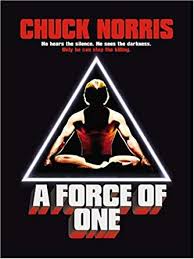
A Force of One (1979)

A FORCE OF ONE

A FORCE OF ONE (1979) Two-and-a-half stars
We should all thank Steve McQueen (1930-80) for the acting career of Chuck Norris, because it was McQueen who encouraged Norris to get into acting.

After all, without Norris’ acting career would there ever have been “Chuck Norris Facts?” Or the lever on “Conan?”

So, thank you, Steve McQueen.

McQueen also had some important advice for Norris after GOOD GUYS WEAR BLACK (1978).

“They said I was the worst thing in 50 years,” Norris said in a 1983 New York Times article. “Well, I wasn’t good, but my feelings were hurt. I said, ‘I’m not trying to be Dustin Hoffman; I just want to project a strong positive hero image on the screen.’ I went to Steve, and he said, ‘In GOOD GUYS, you talk too much. Too much dialogue. Let the character actors lay out the plot. Then, when there’s something important to say, you say it, and people will listen. Anyway, you’ll get better as an actor. You should have seen me in THE BLOB.’”

McQueen seemed to be onto something regarding the quality of Norris movies, because Norris’ best pictures LONE WOLF McQUADE and CODE OF SILENCE both rely on strong casts around Norris: David Carradine, Barbera Carrera, Leon Isaac Kennedy, Robert Beltran, L.Q. Jones, Dana Kimmell, R.G. Armstrong, Sharon Farrell, and William Sanderson (LONE WOLF); Henry Silva, Bert Remsen, Molly Hagan, Dennis Farina, Mike Genovese, and Ralph Foody (CODE OF SILENCE).

A FORCE OF ONE, alas, features a decent supporting cast around Norris — Jennifer O’Neill (she actually receives top billing), Clu Gulager, Ron O’Neal, and Charles Cyphers — and they handle the awfully generic material rather well. We should be grateful for a good supporting cast because. …

I mean, how many times have we seen this plot filmed on TV or even in the movies? We’ve all been here many, many, many times before, sitting through cops, drugs, cop killers, drug lords, et cetera.

Screenwriter Ernest Tidyman’s credits include SHAFT, THE FRENCH CONNECTION, and HIGH PLAINS DRIFTER, heavy duty action credentials.

Tidyman (1928-84), however, was not impressed by A FORCE OF ONE, called it his least successful effort, and said that he only wrote the script to buy his mother a house.

I understand Tidyman’s disappointment with his script.

That said, I enjoyed most of A FORCE OF ONE because it combines a standard issue cops and criminals plot acted out by a good cast with martial arts and a “very subtle” anti-drug message that plays like one of those infamous 1980s TV commercials, only featuring roundhouse kicks.

Wish they would have showed A FORCE OF ONE in D.A.R.E.

Oops, never mind, since all us kiddos are supposed to resist violence.

A FORCE OF ONE loses points and a positive review because of two negative elements.

Dick Halligan’s music hits the viewer like a roundhouse upside the head. I would love to make a joke here referencing either “blood,” “sweat,” or “tears” because Halligan founded the jazz-rock band Blood, Sweat & Tears and played in that group from 1967 through 1972. I just don’t have it today.

All plot roads lead to a final karate showdown between Norris and the main heavy. This is what we wait for all 80 minutes.

Unfortunately, the final karate showdown quickly devolves into slow motion and distorted / echoed vocal effects, plus Halligan’s music returns with a vengeance.