Arachnophobia (1990)

ARACNOPHOBIA (1990) ***1/2
Arachnophobia is another one of those movies from the late ’80s or early ’90s that I must have watched a hundred times back when it first played on cable TV.

File it alongside such movies as Back to the Future 2, the first two Bill & Ted movies Excellent Adventure and Bogus Journey, The Great Outdoors, Gremlins 2, Terminator 2, Total Recall, Tremors, and Young Guns. Those are the ones that quickly come to mind.

Recently revisiting Arachnophobia again for the first time in many years, I have to admit that I remembered a good number of the scenes, especially during the second half of the film when the spiders go wild on the fictional small town Canaima, California. I blurted out John Goodman’s line before his exterminator character Delbert McClintock says Rock and roll! I had a lot of fun with it around the age of 13 and I still had a lot of fun with it at 44.

You can have a good old time with Arachnophobia, just like Tremors, because it doesn’t go too far into extreme gross-out territory with the shock moments and death scenes, it has predominantly quirky and likable characters that you can support for the length of a silly, spooky monster movie, it straddles that razor-thin line successfully between comedy and horror, and it enjoys preying upon our fear of the unknown. I don’t have arachnophobia, or an extreme or irrational fear of spiders, but that doesn’t necessarily mean I want a surprise in my size 12 shoe either.

Arachnophobia gives us a lot of familiar character archetypes.

For example, we have the highly educated big city doctor with the loving wife and two small children who relocate to a small town to get away from all the hustle and bustle. They have his new practice, her severance pay, and they also have each other. It goes without saying, of course, that our doctor suffers from arachnophobia.

The crusty old doctor who takes back his retirement after the young doctor and his family already made their move into a new house and who then seemingly opposes the young doctor at every turn during his subsequent effort to set up shop in the small town. He’s also the resident disbeliever when the spiders begin mounting their body count, and the younger doctor wants an outrageous autopsy because he doesn’t believe it was a heart attack.

The local head law enforcement officer who resents somebody like the highly educated big city doctor.

The straight-shooting but friendly old widow who takes an instant shining to the young doctor and who volunteers to be his first patient in a new town.

The football coach and his wholesome All-American family and the funeral home director and his penchant for jokes that never quite land.

Also, the world’s foremost expert on spiders, who Arachnophobia introduces before any of the small-town characters with a prologue set in Venezuela.

See, Dr. James Atherton (Julian Sands) and crew discover a new species of spiders, very large and very deadly, and one of the specimens hitches a ride in the coffin of his first victim Jerry Manley (Mark L. Taylor), a photographer from Canaima, California.

Our lethal spider makes his way out from the coffin and ultimately into the barn of the young doctor named Ross Jennings (Jeff Daniels). He crossbreeds with a local domestic spider that Jennings’ wife saves from their new house and relocates to their barn. The Jennings not only have the barn but also the cellar that’s very convenient for spiders and their nests, and their eventual world domination.

Daniels has been one of the most reliable actors in the movies, and his presence almost guarantees quality. His 88 acting credits include Terms of Endearment, The Purple Rose of Cairo, Something Wild, Gettysburg, Speed, Dumb and Dumber, Pleasantville, The Squid and the Whale, and The Martian. He’s very good as Jennings and this character and performance come across to the audience like Roy Scheider as Martin Brody in Jaws because he’s terrified by spiders just like Brody was not the biggest fan of water. In the end, though, it’s Jennings and Brody who overcome their greatest fears.

Goodman attempts to steal the movie with great moment after great moment. He’s a strong and steady injection of humor especially when the horror kicks into overdrive around the midpoint of the 110-minute film. I wouldn’t be surprised to find out if Goodman’s Delbert McClintock and Michael Gross’ Burt Gummer are related.

I prefer Tremors over Arachnophobia, because Kevin Bacon and Fred Ward are absolutely fantastic and trump any of the characters in Arachnophobia, Finn Carter’s Rhonda LeBeck is not cast aside for large chunks of the movie like Harley Jane Kozak’s Molly Jennings, and I just think it’s a better overall movie.

Both films, though, do a fine cinematic tradition justice.

Tremors (1990)

TREMORS (1990) ****
The title Tremors immediately conjures up such science fiction and monster movie touchstones from a long-gone era as Tarantula and Them!

Matter of fact, though it does not approach the suspense in Them, Tremors belongs filed right alongside the classic horror films of the ’30s and the science fiction films of the ’50s from predominantly Universal Studios.

Tremors also calls to mind The Birds, Jaws, and Night of the Living Dead at various times, obviously, but director Ron Underwood and screenwriters Brent Maddock and S. S. Wilson provide us with a talented ensemble cast playing quirky and likable characters, as well as interesting and intelligent monsters, nifty special effects that bring the monsters to life, and the ability to balance horror and humor, that Tremors becomes a minor classic with a fresh and funky vibe all its own.

Kevin Bacon and Fred Ward star as Val (short for Valentine) and Earl, two repairmen in the small town of Perfection, Nevada. Can you really call Perfection a small town when it’s Population 14 and Elevation 2135? Anyway, Bacon and Ward have incredible chemistry in Tremors and they’re every bit as good as Danny Glover and Mel Gibson in Lethal Weapon, for example. Their characters and their performances are stronger than what can be found within the average monster movie, and they form a strong human core at the epicenter of Tremors. We like these two characters a great deal and make an investment in their fate.

Finn Wilson is also quite good as seismology student (and potential Kevin Bacon romantic interest) Rhonda LeBeck. She’s not some dumdum, thankfully, and she fits right in alongside Val and Earl because she’s feisty and intelligent and resourceful and likable.

Supporting cast members Michael Gross, best known beforehand for playing Michael J. Fox’s dad on Family Ties, and Reba McEntire nearly steal the show as survivalist and prepper husband and wife Burt and Heather Gummer. Their scene in the basement when they do battle against one of the monsters earned a spot in the annals of unforgettable movie scenes next to the final scene in Road House.

Burt Gummer’s Gun Wall has, as matter of fact, its own fan page with the weapons listed: William and Moore 8 gauge, Heckler & Koch HK91, Colt AR-15 Sporter II, Remington 870, Winchester 1200 Defender, Winchester Model 1894, Winchester Model 70, Steyr-Mannlicher SSG-PII Rifle, Micro Uzi, Colt Single Action Army, Smith & Wesson Model 19, Beretta 92FS Inox, SIG-Sauer P226, Ruger Redhawk, Magnum Research Inc. Mark I Desert Eagle, M8 Flare Pistol, M1911A1, Walther P38, Luger P08, TT-33, Browning Hi-Power, Walther PPK, .600 Nitro Express, Browning Auto-5, Norinco Type 54, Ruger Mini-14, Uzi, Nambu Type-14, Ruger Mk1, Browning Hi Power, SIG-Sauer P228, .38 Derringer, Webley Mk1, S&W Model 66 3-inch barrel, S&W Model 66 4-inch barrel, S&W Model 686 5-inch barrel, Chinese SKS, Factory stock blued Ruger Mini-14, Auto Ordnance M1 Carbine with metal heat shroud, Mil-Spec M1 Carbine, M1 Carbine in aftermarket unfolding stock, and Ruger Mini-14 with Choate folding stock.

Okay, yeah, anyway, I’m glad that somebody went to such great lengths to keep organized stock of an inventory that could be considered a Dirty Harry dream come true.

There’s one super irritating, annoying character in Tremors — prankster Melvin Plug (Bobby Jacoby), a smug little teenage punk who never becomes a kill count statistic much to everybody’s chagrin who’s ever watched Tremors. He’s only a small blemish on the film, because we do get a certain satisfaction when Burt tells Melvin I wouldn’t give you a gun if it were World War 3 and eventually gives him a gun without bullets.

Tremors still comes equipped with such an inherent appeal in part because it’s one of those movies I would always sit and watch if I came across it on cable TV. I don’t know how many times I’ve watched it over the years, but I know it’s a lot and Tremors fits this definition of romp — a light fast-paced narrative, dramatic, or musical work usually in a comic mood.

Any way you define it, though, it’s a fun 96 minutes and I do know that, after writing this review, I do want to watch it once again.

Bride of Re-Animator (1990)

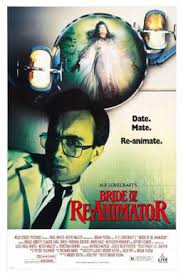
BRIDE OF RE-ANIMATOR

BRIDE OF RE-ANIMATOR (1990) ***

Jeffrey Combs’ Herbert West is one of the all-time great movie characters and his presence alone makes BRIDE OF RE-ANIMATOR, a sequel to the 1985 cult favorite RE-ANIMATOR, worth a recommendation.

H.P. Lovecraft first created Herbert West for the 1922 short story “Herbert West-Reanimator.” RE-ANIMATOR took inspiration from “From the Dark” and “The Plague-Demon” (the first two sections), while BRIDE OF RE-ANIMATOR turned to “The Horror from the Shadows” and “The Tomb Legions” (the final two). West is the central human character in both films.

How to describe West for the uninitiated, that’s a challenge I face during this review. I first think of comparing West to a horror movie character archetype like Colin Clive’s Victor Frankenstein or, to be more precise, Peter Cushing’s Victor Frankenstein from the Hammer FRANKENSTEIN series. He’s brilliant, narcissistic, intense, intensely driven, and essentially amoral. He’s even far less interested in the ladies than Cushing’s Frankenstein. He’s only focused on his work.

West is one of those characters that we love to hate, like Cushing’s Victor Frankenstein and Michael Moriarty’s Jimmy Quinn in Q: THE WINGED SERPENT. There’s that great pencil breaking scene in RE-ANIMATOR, for example, that epitomizes West. He’s one of the great movie assholes.

Alas, most of the rest of BRIDE OF RE-ANIMATOR does not measure up against both West and the first picture. First and foremost, RE-ANIMATOR director and co-writer Stuart Gordon did not return for the sequel and instead Brian Yuzna directed from his own script. Yuzna earned production credits on his friend Gordon’s films RE-ANIMATOR, FROM BEYOND, and DOLLS.

Basically, I find that BRIDE OF RE-ANIMATOR drags more than RE-ANIMATOR or it’s a bit of a slog to get to the sequel’s rather nifty grand finale. I was really struggling around the hour mark and I even contemplated exiting BRIDE OF RE-ANIMATOR.

West’s arch nemesis from the first movie, Dr. Carl Hill (David Gale), returns for the sequel or at least his infamous disembodied head shows up for work. We do not get enough scenes with Hill in the sequel and that helps explain why BRIDE OF RE-ANIMATOR sputters a bit during its middle portion.

The incredible tension between West and Hill contributed a great deal to the success of RE-ANIMATOR. That’s predominantly missing from BRIDE OF RE-ANIMATOR and West battling a persistent burly policeman simply does not possess the same magic. However, we do ultimately have a great payoff when Hill and West are finally reunited.

Bruce Abbott’s Dan Cain returns for the sequel in his role of the straight man and main audience identification figure. He’s not as effective as he was in the first movie.

Kathleen Kinmont and Fabiana Udenio do not make up for the first movie’s Barbara Crampton.

The one area where the sequel trumps the original is special effects, especially during the final 20 minutes. Credited artists include John Carl Buechler, Screaming Mad George, Greg Nicotero, and David Allen, who rank among the best in their field.

Combs’ West and the special effects make BRIDE OF RE-ANIMATOR one of those relatively difficult to come-by sequels that works.

Gremlins 2: The New Batch (1990)

GREMLINS 2

GREMLINS 2: THE NEW BATCH (1990) Four stars

I watched GREMLINS 2: THE NEW BATCH for the first time sometime that summer after it first attacked multiplexes on June 15, 1990.

I wanted to see it badly, since I absolutely loved the original GREMLINS and felt hyped up additionally by the TV ads. I saw it at the Pittsburg 8 during a calendar year (1989-90) that brought multiplex trips to BATMAN, BACK TO THE FUTURE PART II, PARENTHOOD, and TEENAGE MUTANT NINJA TURTLES.

GREMLINS 2 did not let me down, I loved it then and I love it now after having seen it several times, and it has remained one of the most pleasurable multiplex experiences of my life. It’s lingered in my head all these years.

For example, every time since watching GREMLINS 2, when I hear Frank Sinatra’s “New York, New York,” I cannot help but replace it with the Gremlins’ grand production number inside my head. Watching the horribly overrated SHAME (2011) quite a few years back, I wished that GREMLINS 2 and SHAME were spliced together and the little beasties would ruin Carey Mulligan’s showcase rendition.

I’ve heard that GREMLINS 2 is an acquired taste and that you have to be in a certain mood to watch it. Well, I can say that I have acquired that taste and I don’t know, I’m always in the mood to watch a good movie.

“Silly rather than scary like the first GREMLINS” is the verdict on GREMLINS 2 and what people really mean when they spew the party line about being in that certain mood.

— GREMLINS 2 is a running commentary on sequels — everything from merchandising to an endless supply of new characters to sharp but affectionate jabs at the rules of the GREMLINS world and movie sequels in general.

It attempts to be an anti-sequel.

“When I was asked to do the sequel, which I originally turned down because it was so hard to make the first one,” director Joe Dante said in a 2015 interview. “The only reason I decided to make the sequel was because years later they had tried to make a sequel and couldn’t figure out how to do it, and they really wanted another one. So they said to me, ‘If you give us a couple of cans of film with gremlins in them next summer, you can do whatever you want.’ And they gave me three times the money we had to make the first one. So I made GREMLINS 2, which was essentially about how there didn’t need to be a sequel to GREMLINS.”

— We all know the three rules from GREMLINS: Don’t get them wet; Don’t expose them to bright light (especially sunlight, it will kill them); Don’t feed them after midnight.

Naturally, in GREMLINS 2, supporting characters in a control room challenge the hero Billy after he shares the rules.

“What if one of them eats something at 11:00, but then he gets something stuck in his teeth?”

“Like a caraway seed or a sesame seed?”

“And after 12:00, it comes out. Now, he didn’t eat that after midnight.”

It goes on.

“Wait, what if they’re eating in an airplane and they cross a time zone? I mean, it’s always midnight somewhere.”

I am sure many of us asked the burning question, “Isn’t it always after midnight?”

— Mr. and Mrs. Murray Futterman, whom we all thought met their demise in GREMLINS, return for the sequel. That guy Dick Miller (1928-2019) and Jackie Joseph (born 1933) reprise their roles, partly because it’s a Joe Dante movie and what’s a Joe Dante movie without Dick Miller.

— GREMLINS sparked much controversy over its ‘PG’ rating and parents complained about the film, a fact incorporated into GREMLINS 2.

From a 1984 article in The Christian Science Monitor, “Recent releases such as INDIANA JONES AND THE TEMPLE OF DOOM and GREMLINS have spurred controversy about their PG ratings. Many parents felt the violent content and some of the special effects warranted a stiffer rating. A significant number of directors, producers, and theater owners agreed and pushed for a change.”

Hence, the PG-13 rating was born and it debuted with the release of RED DAWN on Aug. 10, 1984.

— Film critic Leonard Maltin, a fan of Dante and his work, gave a negative review to GREMLINS.

“A teenager’s unusual new pet spawns a legion of vicious, violent monsters who turn picture-postcard town into living hell. Comic nightmare is a cross between Capra’s IT’S A WONDERFUL LIFE and THE BLOB; full of film-buff in-jokes but negated by too-vivid violence and mayhem.”

Maltin then makes a gratuitous cameo appearance in GREMLINS 2, where he’s mauled by the new batch for his negative review of the original film. Maltin’s famous last words, “Ow. I was just kidding. Ah. It’s a 10. It’s a 10.”

— At one point in GREMLINS 2, the title monsters disrupt their own film and it takes a threat from Hulk Hogan to get the picture back on track. …

“Okay you guys, listen up! People pay good money to see this movie! When they go out to a theater they want cold sodas, hot popcorn, and no monsters in the projection booth! Do I have to come up there myself? Do you think the Gremsters can stand up to the Hulkster? Well, if I were you, I’d run the rest of GREMLINS 2! Right now! Sorry folks, it won’t happen again.”

— Phoebe Cates became famous predominantly for two scenes: doffing her bikini top to the tune of the Cars’ “Moving in Stereo” in FAST TIMES AT RIDGEMONT HIGH and her ‘Why I hate Christmas’ speech in GREMLINS. In GREMLINS 2, Cates’ Kate starts on a speech why she also hates Lincoln’s birthday.

— GREMLINS and GREMLINS 2 main protagonist Billy Peltzer’s inept inventor father Rand (Hoyt Axton) played a pivotal role in the first movie. Rand Peltzer gets an upgrade in GREMLINS 2. We get eccentric billionaire Daniel Clamp (John Glover), a combination of Donald Trump and Ted Turner, whose technological innovations inside his wonderful Clamp Tower never seem to work properly. I get a kick from the building announcements, for example “Tonight, on the Clamp Cable Classic Movie Channel, don’t miss CASABLANCA, now in full color with a happier ending.”

The title characters take over Clamp Tower, creating all sorts of memorable scenes.

— I should perhaps mention the diabolical Dr. Catheter (Christopher Lee), identical twins Martin and Lewis played by identical twin actors Don and Dan Stanton, Grandpa Fred (Robert Prosky) clearly inspired by Grandpa (Al Lewis) from “The Munsters,” the appearance of the Batman logo, and a talking Gremlin named Brain (voiced by Tony Randall) who gets an opportunity to sum up the ethos of the beasts.

“The fine points: diplomacy, compassion, standards, manners, tradition … that’s what we’re reaching toward. Oh, we may stumble along the way, but civilization, yes. The Geneva Convention, chamber music, Susan Sontag. Everything your society has worked so hard to accomplish over the centuries, that’s what we aspire to; we want to be civilized.”

Of course, in the very next moment, Brain takes out his gun and shoots dead a goofy acting Gremlin.

Civilization is very hard to come by.

Back to the Future Trilogy (1985-90)


BACK TO THE FUTURE TRILOGY (1985-1990)
The BACK TO THE FUTURE trilogy stands up better now than when the films were originally released.

That’s partly because we’ve not seen any more sequels or remakes, retcons, reboots, and ripoffs.

The three films have been allowed to stand on their own.

They stand up tall and straight.

Once upon a time, I wrote that DAWN OF THE DEAD, THE TERMINATOR, and THE FLY are great films because they not only succeed at giving audiences satisfaction on genre terms but they also work on additional levels. For example, the satire that equates mall shoppers with zombies (DAWN OF THE DEAD), the romance between Kyle Reese and Sarah Connor (THE TERMINATOR), and the romance between Seth Brundle and Veronica (THE FLY). All three films have a lot going on for and in them.

The same greatness principle holds true for all three BACK TO THE FUTURE films: They’re all successful comedies that work on a deeper level, mostly thanks to time travel.

Speaking of time travel, I’m definitely a fan because I love THE TERMINATOR, TIME AFTER TIME, X-MEN: DAYS OF FUTURE PAST, and MEN IN BLACK 3 and enjoy BILL & TED’S EXCELLENT ADVENTURE, STAR TREK IV: THE VOYAGE HOME, and FREQUENCY, for example.

The BACK TO THE FUTURE films — especially PART II — play around with the paradoxes of time travel, both for comedic and dramatic effect. It allows certain actors to play multiple roles in different times — 1885, 1955, 1985, alternate 1985, and 2015.

BACK TO THE FUTURE starts with the inspiration of containing a time machine in a DeLorean and the movie revs up when that baby moves 88 mph because, as Christopher Lloyd’s Dr. Emmett “Doc” Brown says, “If my calculations are correct, when this baby hits 88 miles per hour, you’re gonna see some serious shit.”

We do.

Anyway, our teenage protagonist Marty McFly (played by a 23-year-old Michael J. Fox), he’s bummed out by his parents George (Crispin Glover) and Lorraine (Lea Thompson), a hopeless nerd picked on by eternal bully Biff Tannen (Thomas F. Wilson) for one parent and a drunk for the other.

Sitting at the dinner table with his family, Marty’s not too interested in how his parents met: Lorraine’s father hit George with his car and Lorraine nursed George back to health. Lorraine experienced a real Florence Nightingale effect.

However, no kid’s ever all that interested in how their parents met. Especially parents like George and Lorraine.

The DeLorean hits 88 mph and Marty ends up back in 1955 — Nov. 5, 1955, stuck there, without any plutonium to return.

BACK TO THE FUTURE then becomes an even greater movie when it takes on the premise of a teenager meeting their parents when they’re teenagers. Marty’s a lot more interested in how his parents met, that’s for sure.

Not long after their first meeting in 1955, Marty saves George from being hit by that fateful car. Marty’s knocked unconscious instead and Nurse Lorraine grows “amorously infatuated” (Doc’s words) with her future son rather than her future husband. She’s in hot pursuit, and we remember her 1985 self warning her teenaged son about girls that chase after boys.

Just be glad that Marty finds a younger Doc to sort it all out and get him “back to the future.”

We especially need Doc around for PART II to explain the movie’s convoluted plot.

PART II gives us a version of 2015 highlighted by technological advancements. It was great fun watching the 2015 scenes in 1989 based on future speculation and it’s still great fun watching them 30 years later as we reflect what they got right and what they got wrong. The Royals, not the Cubs though, won the World Series and Universal mercifully stopped at four JAWS films.

(The Cubs ended the longest world championship drought in North American professional sports history — only 108 years — by winning the 2016 World Series.)

Futurepedia even provided a list of the new technology: Air traffic control; auto-adjusting and auto-drying jacket; automatic dog walker; automated Texaco service station; barcode license plate; binocular card; bionic implants; Compu-Fax; Compu-Serve; computerized breastplate; cosmetic factory; data-court; dehydrated pizza; dust-repellent paper; flying circuits; fruit dispenser; hands free video games; holobillboard; holofilms a la JAWS 19; hoverboards; hovercam; hover conversion; hydrator; Identa-pad; Internet; Kirk Gibson Jr. Slugger 2000 adjustable bat; Litter Bugs; Master-cook; Mr. Fusion; multi-channel video screen; neon curbing; Ortho-lev; Pac Fax; portable thumb unit; power-lacing shoes; rejuvenation clinic; scene screen; skyway; slam ball; sleeping device; soda bottles with built-in straws; flying cars; tablet computer; thumb pad; tranquilization; transponder; U.S. Weather Service; video glasses and video telephone glasses; video simulacrum; video telephone.

PART II ends up back in Nov. 12, 1955 (Marty’s final day in 1955 in BACK TO THE FUTURE), so we have two Martys and two Docs running breathlessly around Hill Valley.

Given all the plot convolutions and time permutations in PART II, it’s fitting that the 1955 Doc faints during a scene late in the movie.

Lightning strikes the DeLorean and sends Doc back to 1885 near the end of PART II … and Marty tracks him down in PART III.

We get a Western comedy in a year that included Best Picture winner DANCES WITH WOLVES and QUIGLEY DOWN UNDER.

PART III finds employment for veteran character actors Pat Buttram (1915-94), Harry Carey Jr. (1921-2012), and Dub Taylor (1907-94) in the 1885 scenes. It’s nice to see and hear them codgers.

Their presence lets us know that PART III is a different kind of Western than DANCES WITH WOLVES and QUIGLEY DOWN UNDER, more like a TV Western.

Marty takes Clint Eastwood for his 1885 name.

PART III casts Mary Steenburgen as Doc’s love interest and we remember Steenburgen as H.G. Wells’ love interest in TIME AFTER TIME (1979). Wells wrote “The Time Machine.” In TIME AFTER TIME, Jack the Ripper uses Wells’ time machine to travel to modern day San Francisco and Wells follows and pursues Jack the Ripper. During his pursuit, Wells meets bank clerk Amy (Steenburgen) and falls in love with her. (In real life, McDowell and Steenburgen became married in 1980, separated in 1989, and divorced in 1990. They met and began dating making TIME AFTER TIME.)

The BACK TO THE FUTURE trilogy ends on a satisfying note.

More notes on BACK TO THE FUTURE:

— Michael J. Fox is one of the most likable actors of all-time. He was the first choice for Marty, but “Family Ties” producer Gary David Goldberg refused to allow Fox away from that show to make a movie. That’s why BACK TO THE FUTURE originally cast Eric Stoltz as Marty. Stoltz worked a few weeks on the film before director Robert Zemeckis and screenwriter Bob Gale realized there’s something wrong with Stoltz as Marty: He’s not the Marty they wanted. Stoltz lacked screwball energy and he played scenes more dramatically. They let Stoltz go and recast with Fox, who became free to make the movie. Fox did not have to reach very far to portray Marty, “All I did in high school was skateboard, chase girls, and play in bands. I even dreamed of becoming a rock star.”

For two months, Fox worked on “Family Ties” during the day and BACK TO THE FUTURE at night, giving him at most a few hours of sleep each day.

Re-shooting added $3 million to the film’s budget, a number more than made up for by grosses for all three films that have amassed nearly $1 billion in returns.

— Christopher Lloyd’s boundless madcap energy earns Doc a place in the annals of great mad scientists and nutty professors. He becomes more than that, though, over the course of three movies. We love Doc, perhaps more than any other character in the series.

— Thomas F. Wilson makes any variation on the bully, whether it’s Buford “Mad Dog,” Biff, or Griff Tannen and whether it’s 1885, 1955, 1985, alternate 1985, or 2015, a lovable asshole. We love to hate “Mad Dog,” Biff, and Griff, especially Biff. We love every time Biff screws up a phrase like “Make like a tree … and get out of here.” We love every time he’s doused in manure. We love every time he’s burned and showed up by our protagonists. How do you feel after learning Donald Trump inspired the Biff character?

— Crispin Glover proved to be the next evolution in screen nerd, taking off from Eddie Deezen and REVENGE OF THE NERDS. Glover stepped in that direction in FRIDAY THE 13TH: THE FINAL CHAPTER, but he gets a fuller character in BACK TO THE FUTURE.

— Lea Thompson is quite fetching in the 1955 scenes and her character unknowingly lusting after her future son fits into a career where she was attacked by The Great White Mother in JAWS 3-D, yelled at and embarrassed by her sexually frustrated and football obsessed boyfriend in ALL THE RIGHT MOVES, involved with a married police officer who should have arrested himself for his own sex crimes in THE WILD LIFE, and kissed by an animatronic duck in HOWARD THE DUCK. John Hughes at least gave her the name Amanda Jones in SOME KIND OF WONDERFUL, from the Rolling Stones song “Miss Amanda Jones.” What a career.

— Huey Lewis and the News’ “Power of Love” achieves being their only song that does not inspire my thoughts of giving the nearest person a pencil and having them stab my eardrums. For example, it seemed that for the longest time at the Pittsburg Subway I’d hear their hit song “The Heart of Rock & Roll.” Every damn single time. I survived by wisecracking, “If Huey Lewis is the heart of rock ’n’ roll, then rock ’n’ roll needs a defibrillator.” I suppose I think more positively of “Power of Love” from being in BACK TO THE FUTURE.

— Zemeckis produced some of the best mass entertainments for nearly a decade-and-a-half, everything from 1941 (directed by Steven Spielberg) and USED CARS to BACK TO THE FUTURE and WHO FRAMED ROGER RABBIT.

I just hope that Hollywood leaves those films alone and does not burden us with remakes, retcons, reboots, or any other ripoff.

Is that too much to ask?

BACK TO THE FUTURE (1985) Four stars; BACK TO THE FUTURE PART II (1989) Three-and-a-half stars; BACK TO THE FUTURE PART III (1990) Four stars

Troll 2 (1990)

day 98, troll 2

TROLL 2 (1990) Three stars
It’s about time we get around to discussing the “good” bad movie, because none of the movies I have reviewed before fit the bill for this niche more than TROLL 2.

It took me years to finally watch the full movie, and I watched it twice on Christmas. Two on New Year’s Day for MAD MONKEY KUNG FU, and there you go, I wrote my “How I spent my winter vacation” essay. I’ll leave out the part about the 15 games at the Holiday Classic basketball tournament.

Of course, I had seen the infamous “Oh my God!” scene numerous times and I even watched THE BEST WORST MOVIE, a documentary from several years back on the TROLL 2 phenomenon directed by its child star, Michael Stephenson, all grown up. The documentary allows you to catch up with Darren Ewing, the first-time actor who played Arnold and uttered the line that should have made AFI’s 100 Years, 100 Quotes list. I mean, for crying out loud, couldn’t they have taken away one damn quote from CASABLANCA? Not only Ewing, but we catch up with several of the guilty parties from TROLL 2 in THE BEST WORST MOVIE.

TROLL 2 is not a good movie in any traditional sense of the concept, but it’s such a glorious train wreck that I was always entertained from stem to stern, all 94 glorious minutes. LEONARD PART 6 wishes it was this bad and this good.

We have an Italian director and crew who did not speak fluent English directing and writing an English language film, a ridiculous concept based on the screenwriter’s apparent contempt for vegetarianism (similarities with LEONARD PART 6 afoot), inexperienced and just plain bad actors behind every scene, and even an incompetent title, since TROLL 2 does not bear any direct relation to the 1986 film TROLL other than a marketing attempt by a studio that had no faith in a movie titled GOBLINS. See, there’s no actual trolls in TROLL 2 and its fictional town of “Nilbog,” which is oh wow Holy Toledo “goblin” spelled backwards. Haven’t seen that device for a while. Sheer genius.

Unfortunately, despite the Italian production with director and screenwriter Claudio Fragasso (under the pseudonym Drake Floyd) and vegetarian-hating screenwriter Rossella Drudi, there’s no soundtrack by Goblin, who did the work on several Dario Argento classics.

However, there’s a Boston based folk and punk quartet called Troll 2. On their website, they have releases “Death Magnanimous,” “Inheritance,” and “Nobody Cares.” They play the “Theme from Troll 2” twice on “Death Magnanimous,” their EP released in June 2018.

Lunaris Records released the soundtrack for the film and their hype includes “Composed by Italian maestro Carlo Maria Cordio, the soundtrack offers an eclectic mix of synth, bluegrass, and guitar rock jams.” Only $14! And they even provided samples on their site.

Why, you can’t piss on hospitality!

TROLL 2 was made on an estimated $200,000 budget and I’m not exactly sure where the money went. Oh, sure, probably on the special effects.

It was released October 12, 1990, not sure if that was theatrical or just straight to video infamy. Some of the other movies released that day include THE HOT SPOT, MEMPHIS BELLE, MR. DESTINY, and WELCOME HOME, ROXY CARMICHAEL. A week later, it was NIGHT OF THE LIVING DEAD, QUIGLEY DOWN UNDER, and WHITE PALACE.

I am not even sure that TROLL 2 made back its budget on first release. Not sure that I can even find a non-retrospective review. This is definitely one of those cases where I’d love to go back in time and see people’s original reactions to the movie.

Finding a poster for TROLL 2, I discovered that it says “Celebrate one of the most disrespected horror films in recent history and fall in love with this genuine failure. Troll 2 is coming to EAT a theater near you” at the bottom.

Guess the movie failed instantly and then became a success because it failed on such an epic scale.

On Rotten Tomatoes, there’s one positive review of the movie and 17 negatives, although the blurb for the positive review by Kevin Carr of 7M Pictures goes like “godawfulness in the best way imaginable.” No other movie deserves such a blurb, and the positive review is not very different from the negative ones.

In a 2010 review in the Chicago Reader, J.R. Jones gave TROLL 2 one star and BEST WORST MOVIE two. He attacks the “so bad it’s good” train of thought and starts off with a bang.

“Nobody knows the troubled movies I’ve seen. In the past eight years I’ve reviewed over 2,000 releases for the Reader, and at least half of them were bad. If we assume an average running time of 90 minutes, then since 2002 I’ve spent some 1,500 hours watching bad movies. For that reason I’m relatively immune to the blandishments of midnight-movie fans claiming that some egregious turkey, be it THE APPLE or THE ROOM or XANADU or THE TERROR OF TINY TOWN or PLAN 9 FROM OUTER SPACE, is ‘so bad it’s good.’ Life is short, given the choice, I’d rather watch something so good it’s good. I’ve yet to come across a movie so good it’s bad.”

At the start of 2019, TROLL 2 is ranked No. 26 on the IMDb’s Bottom 100. DISASTER MOVIE (2008) currently sits in the top spot and such icons of cinematic badness as No. 2 MANOS: THE HANDS OF FATE, No. 3 SUPERBABIES: BABY GENIUSES 2, No. 4 THE HOTTIE & THE NOTTIE, No. 10 SON OF THE MASK, No. 11 FROM JUSTIN TO KELLY, No. 16 BATTLEFIELD EARTH, No. 18 GLITTER, No. 19 GIGLI, and No. 25 JAWS THE REVENGE are “below” TROLL 2.

I am far more forgiving of TROLL 2 than I am, for example, BATTLEFIELD EARTH, a movie that wasted $73 million and still looks like shit. On Rotten Tomatoes, it has four positive reviews and 144 negative; four positives are from Scott Chitwood (IGN Movies), Bob Graham (San Francisco Chronicle), JoBlo (JoBlo’s Movie Emporium), and Luke Y. Thompson (New Times). That’s just more proof that every now and then we all find things in certain movies that many, many, many others do not.

On a certain fundamental level, though, I am sure that I can quote from BATTLEFIELD EARTH just as much as TROLL 2, especially with all them damn references to the home office.

I remember BATTLEFIELD EARTH’s head villain loved to throw around the insult “rat brain.” Oh, how that Terl makes me wanna hurl.

I don’t know, BATTLEFIELD EARTH just made me feel glad that I won’t be alive in the year 3000.

Guess there’s a fundamental difference between an unpleasant bad movie and a pleasant one. You just feel it when you see it. I wanted to flee the multiplex during such cinematic mishaps as WHITE NOISE and THE HAPPENING, but I was gripped and did not want to miss the next potential bad scene or line of dialogue. I mean, I would be punching myself silly had I missed that “What? No!” scene in THE HAPPENING, but, other than that unintentional bit of hilarity, THE HAPPENING was THE CRAPPENING. M. Night Shyamalan’s PRETENTIOUS LOAD OF CRAP.

I knew coming into TROLL 2 that it would be awful, godawful in fact, and it did not disappoint on that level. For that, I give it a positive review. I am glad being in the movie’s not on my résumé, although I’m not sure that I’ll put liking TROLL 2 on mine.