
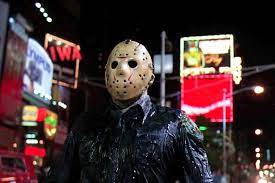
Friday the 13th Part VIII: Jason Takes Manhattan

FRIDAY THE 13TH PART VIII: JASON TAKES MANHATTAN (1989) *
The tragically titled Friday the 13th Part VIII: Jason Takes Manhattan just might be the first movie that I ever considered a bust, a disappointment, and a great big ripoff.

I remember looking forward to Jason Takes Manhattan because I had already seen Part III and Jason Lives on video and liked them a good deal and, let’s face it, I got all hyped up on promotional material that included the trailer and TV spots, the poster and print ads, and Jason Voorhees himself making a guest appearance on The Arsenio Hall Show on Friday, July 28, 1989, the date of the film’s release.

At that very point in time, I thought Jason Takes Manhattan would be the greatest thing ever in the whole wide world.

Boy, would I ever be wrong on that one!

Let’s see here, where to start, other than none of the human characters are exactly likable in the slightest degree, just like most of the later Friday the 13th sequels starting with A New Blood and running through both New Line Cinema films and the 2009 remake.

Uncle Charles, played by veteran character actor Peter Mark Richman (1927-2021), just might possibly be the most reprehensible character in the Friday series. Other worthy contenders right off the old head are Axel from The Final Chapter and Roy Burns from A New Beginning, but there’s so many loathsome characters in the later Friday films.

Jason Takes Manhattan almost feels like an episode of The Love Boat … seriously, the movie spends far more time on a boat than it does Manhattan. It’s unfortunate that Jason Takes Manhattan came out 30 years before Lonely Island’s I’m on a Boat.

Takes Manhattan? Seriously, are you kidding? More like Barely Walks Through Manhattan! It takes more than an hour of the longest entry in the Friday series to even get to Manhattan, and it’s disappointing even after we get there.

Director and screenwriter Rob Hedden possessed a vision to incorporate landmarks like the Statue of Liberty, the Brooklyn Bridge, and Madison Square Garden, naturally, but parent studio Paramount decided to be the Grinch and slash the budget for what turned out to be the final Paramount entry after a series of declining returns starting with A New Beginning and continuing through Jason Lives, A New Blood, and finally Jason Takes Manhattan.

They spent very little time in the actual Manhattan, and of course Vancouver stands in for the Big Apple most of the time.

Guess you could say Jason Takes Manhattan paved the way for Rumble in the Bronx, which makes up for featuring even less of the Bronx than Manhattan’s featured in Jason Takes Manhattan by having some absolutely fantastic Jackie Chan action scenes.

The kill scenes in Jason Takes Manhattan are disappointing, just like about every other single thing during the 100-minute motion picture.

In the film’s most famous scene, Lakeview High School boxing champion Julius Gaw engages our anti-hero Jason Voorhees in a boxing match and punches Jason many, many, many times before Jason knocks Julius’ block off with just a single punch.

I’ve always been underwhelmed by that scene, and I far prefer a similar scene the year before in Killer Klowns from Outer Space.

I don’t even want to think about another one of those patented beyond weird Friday endings that leave viewers dumbfounded and stupefied.

Here instead is a transcript of the Arsenio interview.

A: How are you?

That’s good.

You know what I’ve noticed. I see all your movies, man, and you know what I’ve really noticed. You’re angry.

I don’t mean to laugh. Excuse me, it’s just the way I am, but you’re you’re you’re angry.

What happened, man, where did it all begin?

[Long pause]

You know what I mean? Was it a woman? Did you get cut from the hockey team in high school?

What happened? What’s up?

Let me ask you this.

I saw the new movie, Jason Takes Manhattan.

You killed 16 people … I don’t know why I’m laughing.

You killed 16 people and you were responsible for the death of eight others. Total, that’s less than what you usually kill in a movie.

Are you getting soft? Are you losing a step?

You’re trembling, man.

Oh, you brought a clip.

Would you set it up for us?

Set up the clip, like tell them you know how this fits into the movie and what they’re about to see and all that kind of stuff.

Jason Takes Manhattan, here’s his clip.

[Times Square clip plays.]

Working on the streets of New York, did you get a lot of people come up to you to ask for your autograph and stuff like that?

Ever think about doing a musical?

[Another pause.]

I’m running out of questions, man.

Oh, I know what I wanted to ask you.

You didn’t kill anybody with that big knife you used to kill people with, did you change because you were afraid of being typecast as just being a big knife killer?

So what’s next, man?

Some more of Jason Part Nine, I got some great titles I put together.

Jason and the Three Babies. What do you think of that?

Jason’s Big Top would be funny.

Oh … Jason Rabbit.

That would be great.

Oh … When Jason Met Sally … would that be funny?

You don’t do many comedies, do you?

Um … I’d like to thank you for coming by. It’s a pleasure.

(Jason shakes Arsenio’s hand very, very, very strongly.)

Jason, ladies and gentlemen.

Definitely another case where the promotion is a whole lot better than the picture.

Back to the Future Trilogy (1985-90)


BACK TO THE FUTURE TRILOGY (1985-1990)
The BACK TO THE FUTURE trilogy stands up better now than when the films were originally released.

That’s partly because we’ve not seen any more sequels or remakes, retcons, reboots, and ripoffs.

The three films have been allowed to stand on their own.

They stand up tall and straight.

Once upon a time, I wrote that DAWN OF THE DEAD, THE TERMINATOR, and THE FLY are great films because they not only succeed at giving audiences satisfaction on genre terms but they also work on additional levels. For example, the satire that equates mall shoppers with zombies (DAWN OF THE DEAD), the romance between Kyle Reese and Sarah Connor (THE TERMINATOR), and the romance between Seth Brundle and Veronica (THE FLY). All three films have a lot going on for and in them.

The same greatness principle holds true for all three BACK TO THE FUTURE films: They’re all successful comedies that work on a deeper level, mostly thanks to time travel.

Speaking of time travel, I’m definitely a fan because I love THE TERMINATOR, TIME AFTER TIME, X-MEN: DAYS OF FUTURE PAST, and MEN IN BLACK 3 and enjoy BILL & TED’S EXCELLENT ADVENTURE, STAR TREK IV: THE VOYAGE HOME, and FREQUENCY, for example.

The BACK TO THE FUTURE films — especially PART II — play around with the paradoxes of time travel, both for comedic and dramatic effect. It allows certain actors to play multiple roles in different times — 1885, 1955, 1985, alternate 1985, and 2015.

BACK TO THE FUTURE starts with the inspiration of containing a time machine in a DeLorean and the movie revs up when that baby moves 88 mph because, as Christopher Lloyd’s Dr. Emmett “Doc” Brown says, “If my calculations are correct, when this baby hits 88 miles per hour, you’re gonna see some serious shit.”

We do.

Anyway, our teenage protagonist Marty McFly (played by a 23-year-old Michael J. Fox), he’s bummed out by his parents George (Crispin Glover) and Lorraine (Lea Thompson), a hopeless nerd picked on by eternal bully Biff Tannen (Thomas F. Wilson) for one parent and a drunk for the other.

Sitting at the dinner table with his family, Marty’s not too interested in how his parents met: Lorraine’s father hit George with his car and Lorraine nursed George back to health. Lorraine experienced a real Florence Nightingale effect.

However, no kid’s ever all that interested in how their parents met. Especially parents like George and Lorraine.

The DeLorean hits 88 mph and Marty ends up back in 1955 — Nov. 5, 1955, stuck there, without any plutonium to return.

BACK TO THE FUTURE then becomes an even greater movie when it takes on the premise of a teenager meeting their parents when they’re teenagers. Marty’s a lot more interested in how his parents met, that’s for sure.

Not long after their first meeting in 1955, Marty saves George from being hit by that fateful car. Marty’s knocked unconscious instead and Nurse Lorraine grows “amorously infatuated” (Doc’s words) with her future son rather than her future husband. She’s in hot pursuit, and we remember her 1985 self warning her teenaged son about girls that chase after boys.

Just be glad that Marty finds a younger Doc to sort it all out and get him “back to the future.”

We especially need Doc around for PART II to explain the movie’s convoluted plot.

PART II gives us a version of 2015 highlighted by technological advancements. It was great fun watching the 2015 scenes in 1989 based on future speculation and it’s still great fun watching them 30 years later as we reflect what they got right and what they got wrong. The Royals, not the Cubs though, won the World Series and Universal mercifully stopped at four JAWS films.

(The Cubs ended the longest world championship drought in North American professional sports history — only 108 years — by winning the 2016 World Series.)

Futurepedia even provided a list of the new technology: Air traffic control; auto-adjusting and auto-drying jacket; automatic dog walker; automated Texaco service station; barcode license plate; binocular card; bionic implants; Compu-Fax; Compu-Serve; computerized breastplate; cosmetic factory; data-court; dehydrated pizza; dust-repellent paper; flying circuits; fruit dispenser; hands free video games; holobillboard; holofilms a la JAWS 19; hoverboards; hovercam; hover conversion; hydrator; Identa-pad; Internet; Kirk Gibson Jr. Slugger 2000 adjustable bat; Litter Bugs; Master-cook; Mr. Fusion; multi-channel video screen; neon curbing; Ortho-lev; Pac Fax; portable thumb unit; power-lacing shoes; rejuvenation clinic; scene screen; skyway; slam ball; sleeping device; soda bottles with built-in straws; flying cars; tablet computer; thumb pad; tranquilization; transponder; U.S. Weather Service; video glasses and video telephone glasses; video simulacrum; video telephone.

PART II ends up back in Nov. 12, 1955 (Marty’s final day in 1955 in BACK TO THE FUTURE), so we have two Martys and two Docs running breathlessly around Hill Valley.

Given all the plot convolutions and time permutations in PART II, it’s fitting that the 1955 Doc faints during a scene late in the movie.

Lightning strikes the DeLorean and sends Doc back to 1885 near the end of PART II … and Marty tracks him down in PART III.

We get a Western comedy in a year that included Best Picture winner DANCES WITH WOLVES and QUIGLEY DOWN UNDER.

PART III finds employment for veteran character actors Pat Buttram (1915-94), Harry Carey Jr. (1921-2012), and Dub Taylor (1907-94) in the 1885 scenes. It’s nice to see and hear them codgers.

Their presence lets us know that PART III is a different kind of Western than DANCES WITH WOLVES and QUIGLEY DOWN UNDER, more like a TV Western.

Marty takes Clint Eastwood for his 1885 name.

PART III casts Mary Steenburgen as Doc’s love interest and we remember Steenburgen as H.G. Wells’ love interest in TIME AFTER TIME (1979). Wells wrote “The Time Machine.” In TIME AFTER TIME, Jack the Ripper uses Wells’ time machine to travel to modern day San Francisco and Wells follows and pursues Jack the Ripper. During his pursuit, Wells meets bank clerk Amy (Steenburgen) and falls in love with her. (In real life, McDowell and Steenburgen became married in 1980, separated in 1989, and divorced in 1990. They met and began dating making TIME AFTER TIME.)

The BACK TO THE FUTURE trilogy ends on a satisfying note.

More notes on BACK TO THE FUTURE:

— Michael J. Fox is one of the most likable actors of all-time. He was the first choice for Marty, but “Family Ties” producer Gary David Goldberg refused to allow Fox away from that show to make a movie. That’s why BACK TO THE FUTURE originally cast Eric Stoltz as Marty. Stoltz worked a few weeks on the film before director Robert Zemeckis and screenwriter Bob Gale realized there’s something wrong with Stoltz as Marty: He’s not the Marty they wanted. Stoltz lacked screwball energy and he played scenes more dramatically. They let Stoltz go and recast with Fox, who became free to make the movie. Fox did not have to reach very far to portray Marty, “All I did in high school was skateboard, chase girls, and play in bands. I even dreamed of becoming a rock star.”

For two months, Fox worked on “Family Ties” during the day and BACK TO THE FUTURE at night, giving him at most a few hours of sleep each day.

Re-shooting added $3 million to the film’s budget, a number more than made up for by grosses for all three films that have amassed nearly $1 billion in returns.

— Christopher Lloyd’s boundless madcap energy earns Doc a place in the annals of great mad scientists and nutty professors. He becomes more than that, though, over the course of three movies. We love Doc, perhaps more than any other character in the series.

— Thomas F. Wilson makes any variation on the bully, whether it’s Buford “Mad Dog,” Biff, or Griff Tannen and whether it’s 1885, 1955, 1985, alternate 1985, or 2015, a lovable asshole. We love to hate “Mad Dog,” Biff, and Griff, especially Biff. We love every time Biff screws up a phrase like “Make like a tree … and get out of here.” We love every time he’s doused in manure. We love every time he’s burned and showed up by our protagonists. How do you feel after learning Donald Trump inspired the Biff character?

— Crispin Glover proved to be the next evolution in screen nerd, taking off from Eddie Deezen and REVENGE OF THE NERDS. Glover stepped in that direction in FRIDAY THE 13TH: THE FINAL CHAPTER, but he gets a fuller character in BACK TO THE FUTURE.

— Lea Thompson is quite fetching in the 1955 scenes and her character unknowingly lusting after her future son fits into a career where she was attacked by The Great White Mother in JAWS 3-D, yelled at and embarrassed by her sexually frustrated and football obsessed boyfriend in ALL THE RIGHT MOVES, involved with a married police officer who should have arrested himself for his own sex crimes in THE WILD LIFE, and kissed by an animatronic duck in HOWARD THE DUCK. John Hughes at least gave her the name Amanda Jones in SOME KIND OF WONDERFUL, from the Rolling Stones song “Miss Amanda Jones.” What a career.

— Huey Lewis and the News’ “Power of Love” achieves being their only song that does not inspire my thoughts of giving the nearest person a pencil and having them stab my eardrums. For example, it seemed that for the longest time at the Pittsburg Subway I’d hear their hit song “The Heart of Rock & Roll.” Every damn single time. I survived by wisecracking, “If Huey Lewis is the heart of rock ’n’ roll, then rock ’n’ roll needs a defibrillator.” I suppose I think more positively of “Power of Love” from being in BACK TO THE FUTURE.

— Zemeckis produced some of the best mass entertainments for nearly a decade-and-a-half, everything from 1941 (directed by Steven Spielberg) and USED CARS to BACK TO THE FUTURE and WHO FRAMED ROGER RABBIT.

I just hope that Hollywood leaves those films alone and does not burden us with remakes, retcons, reboots, or any other ripoff.

Is that too much to ask?

BACK TO THE FUTURE (1985) Four stars; BACK TO THE FUTURE PART II (1989) Three-and-a-half stars; BACK TO THE FUTURE PART III (1990) Four stars

Road House (1989)

ROAD HOUSE

ROAD HOUSE (1989) Three-and-a-half stars
This is the Patrick Swayze (1952-2009) movie that ate all his other movies. More like ripped all the other movies’ throats out. We are talking about ROAD HOUSE, after all.

You can weep to GHOST, you can boogie to DIRTY DANCING, and you can kill Commies to RED DAWN, that’s fine and dandy, whatever floats your boat and tickles your fancy, but ROAD HOUSE is the ultimate Swayze viewing experience, at least for this magnificent bastard.

It is Swayze in Testosterone Hyperdrive, or it should have been titled OVER THE TOP rather than Sylvester Stallone’s epic about child custody, arm wrestling, and truck driving.

“Dalton lives like a loner, fights like a professional. And loves like there’s no tomorrow.”

“The dancing’s over. Now it gets dirty.”

“Dalton’s the best bouncer in the business. His nights are filled with fast action, hot music and beautiful women. It’s a dirty job, but somebody’s got to do it.”

Three taglines for ROAD HOUSE that only hit at the surface of the epic sleaze within the film.

Swayze plays Dalton, who’s not only the world’s greatest bouncer, he’s got a degree in philosophy from NYU. At one point, Dalton shares his general bouncer philosophy to his bouncer troops at the Double Deuce, the world’s roughest bar and the pride of the fictional Jasper, Missouri. (Bet the film’s producers did not know there’s a real Jasper, Missouri.)

“All you have to do is follow three simple rules. 1) Never underestimate your opponent. Expect the unexpected. 2) Take it outside. Never start anything inside the bar unless it’s absolutely necessary. And 3) Be nice.”

I enjoy hearing these rules — every single time — just like in GREMLINS when inventor Rand Peltzer tells his son about his new pet Mogwai, “First of all, keep him out of the light, he hates bright light, especially sunlight, it’ll kill him. Second, don’t give him any water, not even to drink. But the most important rule, the rule you can never forget, no matter how much he cries, no matter how much he begs, never feed him after midnight.”

I enjoy hearing both the rules in GREMLINS and ROAD HOUSE because I know that rules are meant to be broken in the movies. The rules — and a whole lot more, namely bones and plate glass windows — are definitely broken in ROAD HOUSE.

ROAD HOUSE is the most quotable Swayze movie by far.

“Pain don’t hurt.”

“Prepare to die.”

“Nobody ever wins a fight.”

“A polar bear fell on me.”

“You’re too stupid to have a good time.”

“Calling me ‘sir’ is like putting an elevator in an outhouse, it don’t belong.”

“Elvis! Play something with balls!”

“I thought you’d be bigger.”

“I’ll get all the sleep I need when I’m dead.”

“I sure ain’t gonna show you my dick.”

Three lines that you might want to pass on: “I used to fuck guys like you in prison.” “I heard you had balls big enough to come in a dump truck.” “Whaddaya say we get nipple to nipple?”

Sam Elliott strolls into Jasper as Wade Garrett, Dalton’s mentor and friend who rates second best bouncer in the world. Garrett’s salty language would not pass muster with Elliott’s ‘The Stranger’ in THE BIG LEBOWSKI — The Stranger asked The Dude at one point, “Do you have to use so many cuss words?” The Dude replied “What the fuck are you talking about?”

ROAD HOUSE is a Western cast in bar room terms all the way down the line, from the hero to the old mentor to the businessman with an offer for the hero to come in and calm down a rowdy scene to the super villain to the henchmen to the leading lady to the watering hole to a guy named Red. Kelly Lynch plays “Doc,” Dalton’s love interest, and ROAD HOUSE might have showed its only restraint in not choosing “Kitty” for the character’s name. Doc’s real name is the film’s big twist.

Guess we should have expected ROAD HOUSE from a director named Rowdy Herrington.

It was destined to be, especially since Herrington adopted the correct approach: “I saw it as a cartoon,” he said. “Broader than life. Brighter than life.”

Epic bar fights. Live music from a real band. A monster truck. Bouncer philosophy. Boobs. Obligatory Swayze butt shot. All that eminently quotable dialogue, although it would be hard saying any of it if we met arch henchman Jimmy’s fate. By the way, Jimmy’s wardrobe approved by Chuck Norris from INVASION U.S.A. and Ramon Revilla from THE KILLING OF SATAN.

In the film’s bravura climax, we encounter super villain Brad Wesley’s trophy room. True story: Recently visiting the Wonders of Wildlife National Museum in Springfield, Missouri, it called to mind Wesley’s trophy room.

Roger Ebert (1942-2013) found this late scene the key to unlocking the film’s guiding spirit: “His hunting trophies include not only the usual deer and elk and antelopes, but also orangutans, llamas and a matched set of tropical monkeys. This guy went hunting in the zoo.

“We are expected to believe that the sadist financed these hunting expeditions by shaking down the businessmen in a town that, on the visible evidence, contains a bar, a general store, a Ford dealership and two residences. ROAD HOUSE is the kind of movie that leaves reality so far behind that you have to accept it on its own terms.”

That’s right. It’s so ridiculous, so cartoonish, so over-the-top that it becomes highly enjoyable, just like COMMANDO and LONE WOLF McQUADE.

There’s a lot (not a whole lot, though) more that I have to say about ROAD HOUSE, but that can wait for another time down at the Double Deuce.

Don’t worry, it’s cooled down considerably since 1989.

Three favorite character actors in ROAD HOUSE: Sunshine Parker, John Doe (rock musician), and Terry Funk (professional wrestler).