Silent Night, Deadly Night Part 2 (1987)

SILENT NIGHT, DEADLY NIGHT PART 2 (1987) *
One might think that the sequel to one of the most controversial movies ever made would not have to rely upon nearly 40 minutes of flashing back to the original like it was a forgotten movie from long ago.

It’s then quite possible the folks responsible for Silent Night, Deadly Night Part 2 thought they didn’t have much of a movie in the first place and they wanted to see if they could ride in on the coattails of the original controversy.

There’s so much of Silent Night, Deadly Night in Part 2 that we could skip the original and just watch Part 2 instead. In fact, that would be my advice to anybody out there curious about watching a Silent Night, Deadly Night movie for the first time, because it’s better to get two bad movies for the price of one.

Take it from someone who obviously went about it all the wrong way and picked the original movie first. Naughty, very naughty, and I was indeed punished!

I postponed watching Silent Night, Deadly Night Part 2 for so long because I heard it through the grapevine that it flashed back heavily on the original, a movie that I detest like almost no other and rate at zero stars. I consider Silent Night, Deadly Night to be one of the worst movies ever made, let alone one of the worst horror movies. It has a steady succession of scuzzy, sleazy, sordid scenes acted out in the most overacted way imaginable. The actors who play Grandpa, Mother Superior, the toy store owner, in particular, they’re all guilty of crimes against cinema for their overacting. Even the kid mullets are overacting. I did appreciate shots of the mountains in the background, however, and it was interesting to see what toys were on the shelves around 1984. Other than that, though, Silent Night, Deadly Night was one great big lump of coal.

Any movie flashing back so heavily on one of the worst movies ever made would seem to have an uphill struggle. Yes, that’s certainly true for Silent Night, Deadly Night Part 2, because how much I despise the original came back almost instantly.

Part 2 centers around Ricky Caldwell (Eric Freeman), who inherits the mantle of serial killer from his older brother Billy Chapman. Ricky’s responsible for the flashbacks to the first movie, as he tells his life story in a nuthouse to court-appointed therapist Henry Bloom. We flash back on events when Ricky was just a baby and several events where he was not even present, but sure why not and 1987 seems to be the year of the flashback with Part 2 outdoing even Jaws: The Revenge.

Part 2 has developed a cult following over the years, of course, centered around Freeman’s performance as Ricky. Yes, he’s responsible for the meme GARBAGE DAY! At one point, I thought I would give Part 2 two stars just because I was enjoying Freeman’s overacting so much; he’s an overacting force of nature, topping Will Hare as Grandpa, Lilyan Chauvin as Mother Superior, Britt Leach as Mr. Sims and everyone else from the first movie combined. Freeman’s exaggerated line readings and expressive eyebrows start out hysterical before they finally wear out their welcome down the backstretch of a bloodbath.

Elizabeth Kaitan briefly provides a bright and sunny presence as Ricky’s potential romantic interest Jennifer before she becomes cannon fodder.

Subtlety is definitely not the strong point of the first two Silent Night, Deadly Night movies. Take for instance the Mother Superior character in Part 2. We know she’s evil incarnate, right, because we can remember her despicable character from the first movie even without all the flashbacks. Mother Superior had a stroke in the interim and she’s retired and living alone when Billy, er, Ricky catches up with her for one final showdown between more evil and less evil. Naturally, she has a scarred face and lives at an address 666. Ho, ho, ho!

I realize that Part 2 was made in a hurry with a shoestring budget well under $1 million, but nonetheless both Silent Night, Deadly Night and Silent Night, Deadly Night Part 2 are garbage movies.

Odds and Odds: The Vikings, Dolls, The Monster Squad, Scream Blacula Scream

ODDS AND ODDS: THE VIKINGS, DOLLS, THE MONSTER SQUAD, SCREAM BLACULA SCREAM
Richard Fleischer’s The Vikings calls to mind epic grand adventure pictures Captain Blood, The Adventures of Robin Hood, The Sea Hawk, and The Sea Wolf, not to mention The Seventh Voyage of Sinbad from the same year (1958) and John Boorman’s Excalibur from 1981.

Kirk Douglas’ lust for life recalls Errol Flynn’s in Captain Blood, Robin Hood, and Sea Hawk and Janet Leigh’s incredible beauty compares with Olivia de Havilland’s in Captain Blood and Robin Hood, as well as Helen Mirren’s in Excalibur. Never mind that Leigh and Mirren play characters named Morgana; however, their beauty and first name are where their characters’ similarities begin and end.

In other words, The Vikings belongs to the fine cinematic tradition of swashbucklers, hair-raisers, cliff-hangers, nail-biters, period costume pieces, and historical fiction.

Of course, it doesn’t hurt that it has an uncredited Orson Welles narrate. The Vikings, in Europe of the eighth and ninth century, were dedicated to a pagan god of war, Odin. Trapped by the confines of their barren ice-bound northlands, they exploited their skill as shipbuilders to spread a reign of terror, then unequaled in violence and brutality in all the records of history. Good stuff.

Highlights include Douglas’ Einar and Curtis’ Eric having key body parts removed, the former his eye by a falcon and the latter his hand in a bout of capital punishment. These moments undoubtedly make The Vikings one of the most gruesome films in 1958 this side of the British classic Fiend Without a Face. Oh, that’s a golden oldie.

Naturally, one can’t go too wrong with any picture where Ernest Borgnine plays a character named Ragnar and spouts screenwriter Calder Willingham’s dialogue like a bountiful fountain, for example What man ever had a finer son? Odin could have sired him, but I did … and Look how he glares at me. If he wasn’t fathered by the black ram in the full of the moon my name is not Ragnar.

Back in the day, my friend would call on quotes from Airplane and Austin Powers for our amusement, and it’s a crying shame that we had no idea about The Vikings, because I think lines such as You sound like a moose giving birth to a hedgehog and The sun will cross the sky a thousand times before he dies, and you’ll wish a thousand times that you were dead would have perfectly fit a night of carousing, especially for two byproducts of a school with Vikings for its mascot.

Rating: Four stars.

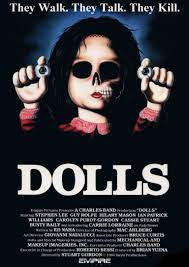
— I finally got around to watching Stuart Gordon’s Dolls for the first time.

Finally, because I love Gordon’s first two features Re-Animator and From Beyond.

I must say that I wasn’t disappointed by Dolls, though it’s a step down from From Beyond and a good two or three from Re-Animator.

Alas, Dolls belongs to a slightly different but no less venerable tradition than Re-Animator and From Beyond, both of which cross mad scientists and low-budget exploitation (nudity, gore, etc.). Think Frankenstein meets Dawn of the Dead.

Dolls, meanwhile, recalls such touchstones as The Old Dark House and The Devil-Doll, not to mention the 1979 Tourist Trap. See if this plot sounds familiar: On a dark and stormy night, six people — a dysfunctional family (husband and father, wife and stepmother, and daughter / stepdaughter) and a young man with two hitchhikers — find the nearest house (The Old Dark House) and they have to fight to make it out of the other end of the motion picture alive because their kindly old hosts are magical toy makers with killer dolls (The Devil-Doll, Tourist Trap).

Like both Re-Animator and From Beyond, Gordon and Dolls screenwriter Ed Naha jump off from their basic old-fashioned plot structure with inspired moments of madness.

Dolls also predates Child’s Play by more than a year and rather than just one killer doll, it has a horde … but Child’s Play, created by Don Mancini, spawned Child’s Play 2, Child’s Play 3, Bride of Chucky, Seed of Chucky, Curse of Chucky, Cult of Chucky, and Child’s Play (2019), plus short films Chucky’s Vacation Slides and Chucky Invades and the TV series Chucky.

So, apparently, not all killer doll films are created equal.

Rating: Three stars.

The Monster Squad starts with an absolute genius idea: Take a group of kids, horror movie fans one and all, and have them do battle against Dracula, Frankenstein’s Monster, Wolf Man, Mummy, and Gill Man.

Yes, what an absolutely positively brilliant idea by screenwriters Shane Black and Fred Dekker, whose names ring a bell loud and clear for genre fans. Others will be familiar with their work regardless whether they know their names or not.

Black made his fame and fortune first for the script of the buddy cop picture Lethal Weapon and some of his other credits include Predator (he plays Hawkins), The Last Boy Scout, and The Long Kiss Goodnight.

Dekker’s other feature directorial credits are the fantastic Night of the Creeps and the not-so-fantastic RoboCop 3.

The Monster Squad gives us both protagonists and monsters that we like, and that goes a long way toward producing a memorable motion picture experience.

The Wolf Man gets his due for a change. The fat kid Horace kicks the Wolf Man in the groin and unleashes the film’s trademark line Wolfman’s got nards! In 2018, Andre Gower, one of the stars of The Monster Squad, directed a documentary named Wolfman’s Got Nards, which looks at the impact one little cult horror film made on fans, cast and crew, and the movie industry.

Anyway, in a movie filled with nifty little moments, I love it when the Wolf Man regenerates after he’s blown up real good.

On the site Drinking Cinema, I found a game for The Monster Squad so drink whenever: 1. Dynamite EXPLODES! 2. A monster dies! 3. You hear a sweet insult. 4. You learn a new monster fact. 5. The cops are having a really hard time figuring out that, um, hello, the perps are various Jack Pierce creations. 6. You see amazing dog acting. 7. You witness a patented Monster Slow-Walk. 8. There’s a monster scare!

I give The Monster Squad a slight deduction for the obligatory music video montage right around the midway point of the picture.

Rating: Three-and-a-half stars.

— Vampirism and voodoo go together rather well and their combination helps Scream Blacula Scream become one of those rare sequels I prefer over the original.

I thought William Marshall’s performance as the title character was the redeeming factor in Blacula and he’s every bit as good in Scream Blacula Scream. Marshall just has a commanding screen presence and he brings both a gravitas to a character and legitimacy to a movie that otherwise might be laughable with the wrong person in the main role. He’s equally effective in every guise of this character — the debonair Mamuwalde who has a definite charm with the ladies befitting an African prince (which he indeed was before the racist Dracula cursed him and imprisoned in a coffin until Blacula awakened in 1972 Los Angeles), the menacing Blacula with his fangs bared, and the more reflective Mamuwalde who hates the dreaded vampire curse.

A highly respectable box office return — not voodoo, no matter what the plot synopsis might read — brought Mamuwalde / Blacula / Marshall back.

In the first movie, Mamuwalde / Blacula comes to believe the lovely Tina’s the reincarnation of his long dead wife Luva. Well, it definitely helps that Vonetta McGee plays both Tina and Luva. By golly, doesn’t this plot thread just get you every single time?

In the sequel, Mamuwalde / Blacula believes in the voodoo powers of Lisa Fortier. She can provide a cure and exorcise the curse once and forever.

Scream Blacula Scream came out two weeks after Coffy and had it been made later in 1973 after Pam Grier busted out as a star playing Coffy, her Lisa Fortier character in Scream Blacula Scream would have undoubtedly been different. Grier plays a more traditional leading lady and screaming and shrinking damsel in distress in Scream Blacula Scream, and she’s definitely no shrinking violet in either Coffy or Foxy Brown. So if Scream Blacula Scream had been produced more in the aftermath of both Coffy and Cleopatra Jones, which came out a month after both Coffy and Scream Blacula Scream, surely American-International — one of the best exploitation film outlets — would have wanted Grier to play one badass mama jama vampire killer rather than her more stereotypical role.

Fair warning: Scream Blacula Scream ends on an extremely jarring note. I remember thinking, in the immortal song title of Peggy Lee, is that all there is? Despite the fact of that ending, you might be surprised to find that I am granting Scream Blacula Scream three-and-a-half stars. Yes, it is just that good.

The Stepfather (1987)

THE STEPFATHER (1987) ****

Every now and then, a horror film will feature a performance that earns widespread critical acclaim and official recognition typically not bestowed on actors or actresses within horror films.
For example, we’ve had Fredric March in Dr. Jekyll and Mr. Hyde, Anthony Perkins in Psycho, Sissy Spacek in Carrie, Anthony Hopkins in Magic, and Jeff Goldblum in The Fly. We should include The Stepfather star Terry O’Quinn with those distinguished performances. He’s so magnificently malevolent that he elevates The Stepfather a notch or two above the average horror thriller and makes it a transcendent exploitation film.

O’Quinn is one of those veteran character actor types who creates the stereotypical reaction, “Hey, I know that guy! He looks so familiar and he was in. …” But most people can’t quite name him! That joke told about John Malkovich in Being John Malkovich applies even more to O’Quinn. Let’s see, aside from a pair of Stepfather movies, O’Quinn appeared in Young Guns, The Rocketeer, and Tombstone, as well as numerous TV shows and movies.

O’Quinn plays a real piece of work in The Stepfather and the movie begins with him assuming his next guise Jerry Blake, after he murdered his family. We see the bloody aftermath, so there’s no doubt about the identity of the killer and we’re left waiting for the moment Blake again explodes into violence. We’re also waiting for when his new family discovers his old identity and his bloody murders, all roads leading to a final showdown that seems obligatory for any thriller since Halloween. That macabre interest level starts with the standard One Year Later title card.

O’Quinn effectively shows that he wants to be a straight, clean-cut, self-effacing man with the All-American nuclear family traditionally identified with Father Knows Best, Leave It to Beaver, and The Adventures of Ozzie and Harriet, also familiar through many, many other sitcoms. At the same time, we know that it’s 99.9 percent likely he’ll gradually snap, crack, and pop when familial disappointment hits dear old Dad again, so a lot of the fun involves Blake’s tension between establishing or slaughtering his new family.

Jill Schoelen’s spitfire teenage stepdaughter Stephanie naturally sees right through Jerry Blake and her character earns our sympathy and empathy almost immediately after we learn her biological father died only a year before this Blake fellow entered the picture and romanced her mother. Of course, nobody quite believes Stephanie, who gets expelled from school for her latest punch out, when she expresses that something’s not quite right about her stepfather. Schoelen plays a 16-year-old girl, so it’s a little creepy when director Joseph Ruben and screenwriter Donald E. Westlake give her a nude scene late in the picture; granted, Schoelen carried on the grand old movie tradition of a teenager portrayed by somebody at least several years older.

Shelley Hack complements O’Quinn and Schoelen and completes the trio of solid performances, in the role of the new Mrs. Blake. She plays a tricky role, perhaps just as tricky as the title role, because her discovery of the truth must be timed absolutely perfect. Otherwise, we see that she’s a dolt and feel she deserves her fate. The Stepfather times it just perfect, and it gets so many things right that we bask in the presence of a superior horror film.

Leonard Part 6 (1987)

LEONARD PART 6

LEONARD PART 6 (1987) No stars

Before all Bill Cosby’s legal troubles, LEONARD PART 6 was merely one of the worst movies ever made.

After more than 60 women accused Cosby of crimes such as sexual assault, rape, drug-facilitated sexual assault, and sexual battery dating back to 1965, we can now safely call LEONARD PART 6 the worst movie ever made.

First and foremost, there’s not a single laugh to be found during the 85 minutes of LEONARD PART 6.

Seriously.

Not one.

Epic fail, especially for a man considered at that point in time by millions of viewers to be one of the funniest people in the world.

At the time of the release of LEONARD PART 6, Cosby was star of the No. 1 show on TV, “The Cosby Show.” “The Cosby Show” spent five consecutive seasons on top of the ratings, from Fall 1985 through Spring 1990. It honestly seemed like Cosby was inescapable during the late ‘80s and early ‘90s, between his TV show and product endorsements. Coca-Cola, Jell-O, home computers, E.F. Hutton, Kodak, you name it.

Speaking of Coca-Cola, the beverage company based in Atlanta, it owned Columbia Pictures at the time of LEONARD PART 6 and there’s an obscene amount of product placement for Coca-Cola and Coke in LEONARD PART 6. Who released LEONARD PART 6? Columbia. In one infamous scene in particular, Cosby holds a bottle in his hand and it says Coca-Cola on one side and Coke on the other. They make sure we see both sides very subtle like.

Jane Fonda and her workout make a cameo and I believe that Cosby’s super spy Leonard Parker even showers in Perrier.

This movie is drenched in product placement, including Cosby himself.

How do I proceed from here with this spoof of secret agent and spy movies?

Guess we should briefly hone in on the joke of the title. Yeah, that’s right, this is the sixth Leonard Parker super spy adventure. Get it? Sure, we all do. I say that we all should consider ourselves blessed in that we did not actually have to see the previous five adventures. I just reviewed JASON LIVES and it does a greater job of spy spoofing (than LEONARD PART 6) with its brief parody of the famous James Bond gun barrel sequence.

Leonard is a retired CIA spy and millionaire restaurant owner. Of course, he’s brought out of retirement to save the world (or at least Northern California, anyway) from Mephistophelian vegetarian Medusa Johnson. Medusa’s played by Gloria Foster (1933-2001), who should be remembered as the Oracle in THE MATRIX and forgotten as Medusa. I believe that she would have wanted it that way.

What happened to the CIA agent to create the need for Leonard Parker’s return? He’s eaten alive by diabolical rainbow trout. Yes, that’s all part of the plan for Medusa and her thugs. She’s enlisted the animal kingdom on her side.

I don’t know if my brain can handle any more thoughts or if my fingers can bang out any more words about LEONARD PART 6, but I must persevere and if just one person out there reading this review decides to never watch LEONARD PART 6, I know that I have done my job and performed humanity a great and honorable service.

Nothing about this stupid film makes any sense.

TROLL 2 did a touch better job with the evil vegetarian plot on a $200,000 budget, whereas LEONARD PART 6 blew $25 million. Now, if somebody could just piece together Darren Ewing’s infamous “Oh my God!” reaction from TROLL 2 with a scene from LEONARD PART 6, that would be utterly fantastic and would make my year.

Why does it say “Ipso Facto” on Leonard’s helmet? Why oh why is there a flying ostrich? Who thought it would be a brilliant idea to have vegetarians killed by raw hamburger meat and glittery hot dogs? Why does Leonard’s wife enjoy pouring food on him? Why? Why? Why?

Cosby himself went on Larry King and denounced LEONARD PART 6 before its release. How often does that happen with any movie? Of course, LEONARD PART 6 is not just any movie, it’s the worst one ever made.

We should be thankful LEONARD PART 7 never happened, although, to be honest, it’s bad enough that Cosby gave us GHOST DAD, perhaps the second worst movie ever made, three years after LEONARD PART 6.

Good Morning, Vietnam (1987)

GOOD MORNING, VIETNAM.jpg

GOOD MORNING, VIETNAM (1987) Three-and-a-half stars

GOOD MORNING, VIETNAM director Barry Levinson knew that Louis Armstrong’s “What A Wonderful World” came out in 1967 and that his movie was set in 1965, but he overlooked that because Satchmo’s song fit the scene best.

Thus, Levinson created an anachronism or a chronological inconsistency.

Adrian Cronauer (1938-2018), played by Robin Williams (1951-2014) in GOOD MORNING, said that he liked the movie based on his time on Armed Forces Radio in Vietnam well enough, as far as it went, but that it was more about Williams and what suited him than it was about Cronauer and what actually happened. File GOOD MORNING in the “loosely based” category.

Cronauer added that Levinson did not allow Cronauer and Williams to meet each other until after filming completed, because the director did not want Williams impersonating the former disc jockey.

GOOD MORNING is the first Robin Williams movie I ever watched and it’s one of the few I watched again in the immediate aftermath of his 2014 suicide. Just this last time I watched it, though, early in 2020, I paid less attention to Williams and more to a dynamite supporting cast surrounding Williams: Bruno Kirby (1949-2006), J.T. Walsh (1943-98), Noble Willingham (1931-2004), Forest Whitaker, Robert Wuhl, and Richard Edson, as well as the various Vietnamese actors and actresses. I know Williams received most of the acclaim for his performance, a Golden Globe victory and an Academy Award nomination for Best Actor, but it’s the work of that deep supporting cast that makes GOOD MORNING a very good movie rather than merely a good one or at least if nothing else a one-man show.

Kirby plays some of the same notes as he did seven years before in WHERE THE BUFFALO ROAM with Bill Murray’s Hunter S. Thompson his adversary in that earlier film. In GOOD MORNING, Kirby plays Lt. Steven Hauk, who fails to see the humor in Cronauer and who finally bombs on the air when he replaces Cronauer for a brief spell. We patiently wait for that failure to happen, and we are rewarded. We laugh at Hauk’s failure, and the vast disconnect between his ego and his actual ability to make people laugh is the joke.

Walsh put together a decade of memorable supporting performances and he earned that memorability because he plays characters that we love to hate. Quite frankly, he played a dick better than most anybody in show business and thus, it’s no surprise that Walsh plays a character named Sgt. Major Dickerson in GOOD MORNING, because, yes, he’s a major dick. Many of us miss Walsh, a love to hate figure even after his death with both THE NEGOTIATOR and PLEASANTVILLE posthumously released.

Williams and Whitaker especially seem like they have genuine chemistry and their byplay from early in the movie all the way until the end rewards us with both laughter and emotions.

Cronauer teaches English to South Vietnamese students during some of his spare time, initially because he sets his sights on a pretty young woman. Cronauer’s friendship with her brother earns him a flight out of Vietnam, one that’s long overdue given all his trouble from the first time Cronauer shouted “Good morning, Vietnam” on the air.

In short, the soldiers love Cronauer and the brass, especially Dickerson, hate him.

Cronauer plays by his own rules, especially on-air, as he favors that Devil’s music rock and soul over that Easy Listening jive preferred by Hauk and Dickerson. That’s his first sin of many, but it all starts with that playing by one’s own rules.

Probably about half of the movie gives itself over to Williams’ manic free-form ad-libs and Cronauer is one of the few characters played by Williams where his patented comic anarchy fits and does not break away from the fabric of the movie to the point that we forget the character and only see Robin Williams being stand-up comedian Robin Williams. Williams’ anything-for-a-laugh shtick also worked for The Genie in ALADDIN.

In all honesty, I find more humor in Williams’ scenes with the supporting actors, both his fellow military men and his Vietnamese students, than I do his solo flights of fancy on his popular radio show.

GOOD MORNING is not all comedy, though, and it does thankfully give the Vietnamese more of a voice than we normally get in Hollywood films about Vietnam and the war. Cronauer’s friend Tuan (Tung Thanh Tran) expresses it during their confrontation scene late in the movie, “ENEMY? What is enemy? You killing my own people so many miles from your home. We not the enemy! You the enemy! … My mother is dead. And my older brother, who be 29 years old, he dead! Shot by Americans! My neighbor, dead! His wife, dead. WHY? Because we’re not human to them! We’re only Vietnamese.”

The film does lay it on a little too thick with sentimentality and showing that Cronauer’s a good guy at heart performing a noble service for the troops and humanity in general through humor. Critics have accused movie comedians of that weakness for sentimentality ever since the glory days of Charlie Chaplin. Williams definitely fell prey to sentimentality often throughout his career, and it works better in some films than others.

Finally, GOOD MORNING goes on a little too long and it could have been tightened, but I doubt that Levinson and gang wanted to lose any of Williams’ improvisation. Remember that moment in ANIMAL HOUSE when Tim Matheson’s Otter looks at Peter Riegert’s Boon and asks “Germans?” after Bluto says the Germans bombed Pearl Harbor. Boon quite simply and beautifully says, “Forget it, he’s rolling.” Bet that’s what they said every day on the set of GOOD MORNING, VIETNAM about Robin Williams.

Predator and The Most Dangerous Game


PREDATOR (1987) & THE MOST DANGEROUS GAME (1932)

It’s been duly noted over the years that PREDATOR combines elements from ALIENS and RAMBO into one blockbuster.

Until only recently, I did not realize PREDATOR also updated a 1932 horror movie named THE MOST DANGEROUS GAME for modern times and weaponry. That relatively unknown classic centers around the concept of a big game hunter (Leslie Banks) who moved on from animals to humans on his own island reserve. The big game hunter finally meets his match in another legendary hunter (Joel McCrea) shipwrecked on the island, due to the big game hunter’s dastardly design of sabotaging ships and hosting then hunting the shipwrecked survivors. The two great hunters contest their most dangerous game on the same jungle sets as KING KONG. Ernest B. Schoedsack co-directed both MOST DANGEROUS GAME and KING KONG, films released several months apart. Fay Wray and Robert Armstrong appeared in both. I say go check out THE MOST DANGEROUS GAME.

In a two-star review for THE PREDATOR, I summed up the difference between the 1987 original and the 2018 retread.

“PREDATOR ‘87 does not have perfunctory dialogue and dead weight, and it does not drag. It plays like ‘a lean, mean fighting machine’ (in the great words from STRIPES) and it’s a streamlined entertainment that moves faster than this, er, last year’s model (an Elvis Costello reference following STRIPES).

“The cast of the original PREDATOR amounted to 16 actors.

“By comparison, THE PREDATOR features approximately 50 credited and 20 uncredited cast members.

“Favorite character: ‘Sobbing veterinarian.’ Second favorite: ‘Cantina bartender.’ Show: ‘Halloween mom.’”

Let’s face it: PREDATOR star Arnold Schwarzenegger could do very little wrong at this stage in his career and he’s a presence missing from the PREDATOR movies that have followed. This is a different Schwarzenegger film in one key aspect: When his Dutch faces off against the title character in the final act, it’s an incredibly tense final showdown because, for a change, we are not sure Schwarzenegger’s character will make it out alive. Kevin Peter Hall’s Predator knocks Schwarzenegger around real good, something that we just don’t see every day. Hall stood at 7-foot-2 and he towers over everybody, including Schwarzenegger.

The film’s marketing campaign proved to be misleading, since Schwarzenegger is not the predator, he’s the prey.

The supporting cast around Schwarzenegger forms one of the most macho in history, with such luminaries as Carl Weathers, Jesse Ventura, and Bill Duke around to chew the scenery. Their machismo ultimately descends into terror as the title character begins systematically eliminating them. They sure do make great trophies for the intergalactic hunter. They’re the best of the best, at least on this planet.

PREDATOR director John McTiernan (DIE HARD) and crew made the film in the real jungles of Mexico rather than some back lot. Like PLATOON, PREDATOR turns the jungle into another character and it exerts a force seemingly every bit as potent as the title character. If that intergalactic hunter don’t kill you, then the damn jungle will for sure.

Like JAWS, behind-the-scenes difficulties benefited the finished product. Originally, Jean-Claude Van Damme signed on to play the Predator, but was fired during production for reasons that nobody has ever been able to agree on. Apparently, some of his footage survived and made the final cut. The 5-foot-10 Van Damme would have made a radically different Predator, one definitely not quite as imposing and intimidating and one more ninja-like than Hall, who played the role in the first two PREDATOR movies before his 1991 death.

The first Predator suit failed, so the filmmakers called on special effects guru Stan Winston (1946-2008) to solve the problem. Winston is another one of those behind-the-scenes figures who developed a legendary reputation and just reading some of his credits justify the legend: PREDATOR, ALIENS, THE TERMINATOR and TERMINATOR 2, STARMAN, A.I., FRIDAY THE 13TH PART III (uncredited), THE THING, and PUMPKINHEAD (Winston also made his directorial debut with this 1988 horror feature).

Like a classic horror movie, we have a gradual build-up to the full reveal of the monster in PREDATOR. Characters also build him up in our imaginations with their dialogue. Of course, we see the effects of an escalating body count and this only fuels our anticipation for seeing this predator in his true form. When we do see this intergalactic villain, it’s worth the wait. The final showdown between Schwarzenegger and Predator definitely lives up to our expectations, and it’s on par with the big fights in KING KONG VS. GODZILLA and FREDDY VS. JASON, though PREDATOR is overall a better film than both KING KONG VS. GODZILLA and FREDDY VS. JASON.

You have not lived a full cinematic life until you have seen Schwarzenegger’s Dutch tell the Predator, “You’re one ugly motherfucker,” as he takes off his mask.

PREDATOR (1987) Three-and-a-half stars; THE MOST DANGEROUS GAME (1932) Three-and-a-half stars

Jaws: The Revenge (1987)

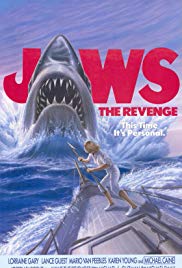
JAWS THE REVENGE

JAWS: THE REVENGE (1987) No stars

Just when you thought it was safe to see a JAWS movie again.

In the JAWS III review, we discussed the Idiot Plot.

That’s when all the characters have to be idiots to propel the plot forward.

Now, with JAWS: THE REVENGE, we have under consideration another idiotic plot.

I mean, if you’ve never seen this one, you better get that suspension of belief ready for the workout of its life.

You will need every single bit of it for a plot where not only does a shark pursue revenge against a single family — them poor Brodys from Amity Island — but this shark follows said familial unit all the way from New England to the ol’ Bahamas after the shark dispatches widow Ellen Brody’s youngest son in the opening sequence.

Maybe it’s another shark who owes the New England shark something fierce and so he carries out the New England shark’s vendetta against one family. The New England shark just dials up the Bahamas shark and gives him the assignment over the phone.

Maybe the New England shark found the Bahamas shark’s number on a bathroom wall in a watering hole, a genuine dive.

Going back a couple paragraphs, yes, it’s true that our New England shark sets a trap for Sean Brody (Mitchell Anderson), who’s a policeman just like dear old Martin Brody. Sean survived a shark in three previous JAWS installments, but not in this one where he’s outsmarted by a (mechanical) shark. This is just plain ridiculous, but it does prepare us for the ridiculousness ahead.

On his JAWS Wiki entry, “Devoured by Vengeance” is listed as Sean’s cause of death.

Oh, by the way, we might as well get this bit of trivia out of the way before we move on to bigger fish, but four different actors play Sean and Michael Brody in the JAWS series.

Jay Mello played Sean in JAWS, followed by Marc Gilpin in JAWS 2, John Putch in JAWS III, and Anderson in THE REVENGE.

The higher-profile character Michael gets higher-profile actors for at least a couple movies in Dennis Quaid in JAWS III and Lance Guest in THE REVENGE. Chris Rebello and Mark Gruner had the honor in JAWS and JAWS 2, respectively.

Just some random thoughts:

— You might wonder how in the world Lorraine Gary could possibly get top billing. She’s terrible in this movie, for crying out loud.

Well, let’s see, she was married at the time to Universal Studios boss Sidney Sheinberg. (Gary, now 81 years old, and Sheinberg were married for more than 62 years, until he passed away March 7, 2019, at the age of 84.)

Gary came out of retirement for THE REVENGE. Her first feature was the first JAWS and her last was THE REVENGE.

Looking at her movie credits, an earlier role describes Gary’s acting in her last feature.

In CAR WASH, Gary played the “Hysterical Lady,” obvious training for THE REVENGE.

Of course, if you’re terrified by sharks like a curse down the generations, one might argue that it’s justification for being hysterical.

Nah, if the Brodys moved to Kansas, for example, their problem would be solved and their life expectancy would probably be elongated by many years.

Instead, they go back in the ocean. Every single time.

— We get a very awkward romance between Ellen and Hoagie, played by Michael Caine, so we have the first shark movie suitable for geriatric consumption.

Filming THE REVENGE caused Caine to miss the 1987 Oscar ceremony,  where he earned Best Supporting Actor for HANNAH AND HER SISTERS.

Caine did give us a great quote about THE REVENGE, “I have never seen it, but by all accounts it is terrible. However, I have seen the house that it built, and it is terrific.”

Hoagie, a charter pilot who carries Michael Brody and his dear friend Jake (Mario Van Peebles) to their shark rendezvous, crash-lands his plane late in the movie in the ocean and he’s submerged. Of course, for a split-second, we think he’s shark chow, especially when our great revenge seeker devours his plane.

Not only does Hoagie survive this close encounter of the shark kind, but when he climbs aboard the ship, he’s completely dry and looks freshly laundered.

Apparently, Caine’s explanation for this epic continuity error was that the filmmakers waited so long for the camera to turn over that Caine’s shirt and pants dried in the sun.

— Honestly, THE REVENGE plays like one continuous error.

I mean, what can you say about a movie where the best thing you can say about it is that the children’s choir gives a good performance. Oh, I forgot to mention, shame on me, THE REVENGE takes place around Christmas. Yeah, sure, it’s the gift that keeps on giving.

Mario Van Peebles chose a laughable accent.

THE REVENGE abuses “It’s Only A Dream” scenes.

Multiple endings exist for this movie, one where Van Peebles survives and the other where his character dies. I’ve seen both, and either way, it doesn’t really matter.

Characters have flashbacks to events where they were not present.

Back to the shark. This one is a doozy, and for even more reasons than what’s already been covered within this space. “Bruce the Shark” roars. Maybe he’s in pain. Maybe he couldn’t believe what he did for the money. Maybe he’s mad that he looks faker than ever before. He even swims backwards, probably in an effort to escape THE REVENGE. Isn’t that how one of the explorers went around the world?

Believe it or not, THE REVENGE finds an even more ridiculous way to kill the shark than the previous entries.

You know what, I do believe that we can believe it with this particular movie.

Full Metal Jacket (1987)

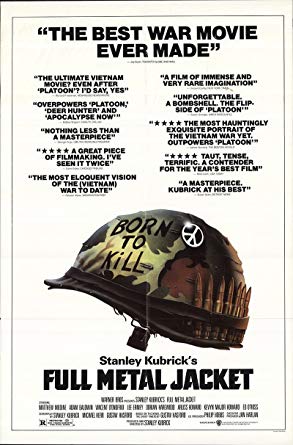
day 65, full metal jacket

FULL METAL JACKET (1987) Four stars
I’m a firm believer in the “Full Metal Jacket Fallacy.”

Why, that’s when fools argue the first half of Stanley Kubrick’s FULL METAL JACKET is just brilliant and the second half flat-out sucks donkey testicles.

I’ve heard that argument many, many times in high school, college, and probably will continue to hear it for all my living days. You’re all wrong and I have no problem saying that.

Yes, I would agree the first half’s superior to the second, especially thanks to the powerhouse performances by R. Lee Ermey (1944-2018) and Vincent D’Onofrio, but the second half does not suck.

Granted, I do believe Kubrick’s Vietnam begins with our main protagonist Private Joker (Matthew Modine) and his sidekick Rafterman (Kevyn Major Howard) picking up a Da Nang hooker. In dialogue sampled by infamous rap group 2 Live Crew, she says, “Me so HORNY. Me love you long time.” Anyway, she goes on to guarantee “Me sucky-sucky. Me love you too much” and later on, we hear “Sucky! Sucky! Five dolla!,” rather infamous words. She’s relentless, I’ll give her that.

So, yeah, I can see why people think FULL METAL JACKET sucks during its second half, since hearing “suck” so many times conditioned them into believing the Vietnam portion sucked. I get it now, after many years of being mystified.

FULL METAL JACKET, as many already know, made several great contributions to the English language and it furthered cursing more than just about any other film in cinematic history. Ermey, in particular, used profanity like other artists use clay.

For example, I learned such timid little phrases as “I didn’t know they stacked shit that high,” “Only steers and queers come from Texas” (an Oklahoma variation on this line used in AN OFFICER AND A GENTLEMAN), and “I bet you’re the kind of guy that would fuck a person in the ass and not even have the goddamn common courtesy to give him a reach-around.”

Not that I ever use such phrases, I promise.

That’s good, since I first watched FULL METAL JACKET around the age of 10 on home video. Right around that same moment in time, I first watched films like COMMANDO, THE TERMINATOR, PREDATOR, PLATOON, and STAND BY ME, all films that definitely had an impact on me, though I found their vulgarity funny at the time in a different way than years later. I did not know what most of the words meant upon first viewing, but found them funny in just how they sounded and how they were delivered. I picked up the meanings in later viewings, and I still find them all funny.

STAND BY ME, as well as THE BAD NEWS BEARS, especially proved revelatory, in that kids from different eras cussed.

I mean, STAND BY ME gave us the line “A pile of shit has a thousand eyes” and Tanner Boyle in THE BAD NEWS BEARS, why he’s one of the greatest foul-mouthed hooligans in history.

Ermey and D’Onofrio give two brilliant performances, but since they’re in a film directed by Kubrick (1927-99), they were not nominated for the Academy Awards.

That’s because Kubrick’s often considered the real star in his movies and he’s one of the greatest directors ever whose credits include THE KILLING (watch this one followed by RESERVOIR DOGS), PATHS OF GLORY, SPARTACUS, DR. STRANGELOVE, 2001, A CLOCKWORK ORANGE, BARRY LYNDON, THE SHINING, and EYES WIDE SHUT.

Kubrick made 13 feature films during his career from 1953 through 1999. He was a photographer for Look magazine in the late 1940s and early 1950s, and that background informs all his films. They all have indelible scenes.

Kubrick’s films grow better over time and they’re generally perceived more favorably after cold or hostile receptions during their first theatrical release. They have a timeless quality about them.

How often were the actors’ performances saluted by the industry?

Seemingly not very often.

Peter Ustinov won the 1961 Academy Award for Best Supporting Actor for SPARTACUS, probably the project least satisfactory personally to Kubrick.

Sue Lyon won the Golden Globe for Most Promising Newcomer for her work in LOLITA and James Mason, Shelley Winters, and James Mason were nominated along with Lyon.

Peter Sellers received a 1965 Academy Award Best Actor nomination for DR. STRANGELOVE. Sellers played three roles … and he lost the award to Rex Harrison, Professor Henry Higgins in MY FAIR LADY. (Lee Marvin won the next year for two roles in CAT BALLOU, so it must have been easier to win for two roles rather than three.)

All of the awards and nominations for 2001 were either technical (visual effects, cinematography, production design) or for Kubrick and writer Arthur C. Clarke, though Douglas Rain, as the voice of HAL 9000, gives one of the best performances in any film. How would you like to have been beaten out by a sentient computer? No, instead, the 1969 Academy Award nominees for Best Actor were Cliff Robertson in CHARLY, Alan Arkin in THE HEART IS A LONELY HUNTER, Alan Bates in THE FIXER, Ron Moody in OLIVER!, and Peter O’Toole in THE LION IN WINTER … with the prize to Robertson. Who remembers their performances? Honestly … we all remember HAL 9000, “Look Dave, I can see you’re really upset about this. I honestly think you ought to sit down calmly, take a stress pill, and think things over.”

Nearly all the kudos for A CLOCKWORK ORANGE were technical or for the director, like before, but Malcolm McDowell earned a Golden Globe nomination for his performance as larger-than-life Alex DeLarge.

BARRY LYNDON won 1976 Academy Awards for best production design, best costume design, best cinematography, and best original score.

Jack Nicholson won Academy Awards for Best Actor in 1976 (ONE FLEW OVER THE CUCKOO’S NEST) and 1998 (AS GOOD AS IT GETS) and for Best Supporting Actor in 1984 (TERMS OF ENDEARMENT), but he got no love for THE SHINING though his flamboyant performances before and after Kubrick received nominations. I mean, for example, is Nicholson’s performance in THE SHINING all that different from his one in ONE FLEW OVER THE CUCKOO’S NEST?

EYES WIDE SHUT received no Academy Award nominations, just like THE SHINING before it, although Tom Cruise and Nicole Kidman do some of their best work.

Back to FULL METAL JACKET.

Kubrick, Michael Herr, and Gustav Hasford received the film’s lone Academy Award nomination for Best Adapted Screenplay, while both Ermey and D’Onofrio were both separately nominated for Best Supporting Actor, Ermey by the Golden Globes and D’Onofrio by the Boston Society of Film Critics.

I doubt there were better performances from any films released in 1987.

Erney and D’Onofrio bring their characters Gunnery Sergeant Hartman and Private Leonard “Gomer Pyle” Lawrence to such life that they stay with us for the rest of the movie after their unfortunate, tragic demise at the end of the Parris Island sequence. Their characters stay with us forever, in fact, and I venture to say that’s a definition of a great performance.

If somebody mentions Gomer Pyle, for example, I think first of FULL METAL JACKET and not Jim Nabors of “The Andy Griffith Show” and “Gomer Pyle, U.S.M.C.” Please consider that, for a second.

D’Onofrio gained 70 pounds for the role of the overweight Gomer Pyle, who finds that he’s only got one true skill in basic training. Those 70 pounds surpassed what Robert DeNiro did for RAGING BULL, and that performance earned an Academy Award.

Ermey served as a U.S. Marine drill instructor during the Vietnam War and this real experience informed his performance as Hartman.

Kubrick allowed Ermey to ad lib his dialogue, something that does not jibe with Kubrick’s reputed uncompromising perfectionism. In fact, Google “Kubrick perfectionist” and see results like a Telegraph article titled “The relentless, ridiculous perfectionism of Stanley Kubrick.”

I don’t know, Kubrick earned his reputation for relentless perfectionism, of course, but what about Sellers in DR. STRANGELOVE or, for that matter, George C. Scott’s War Room stumble in that same film? Or McDowell’s “Singin’ in the Rain” number in A CLOCKWORK ORANGE? Or Nicholson’s “Here’s Johnny” in THE SHINING? Ad libs, ad libs, ad libs.

Kubrick and his films are complex, contradictory, and controversial, and that’s part of why they stand the test of time.