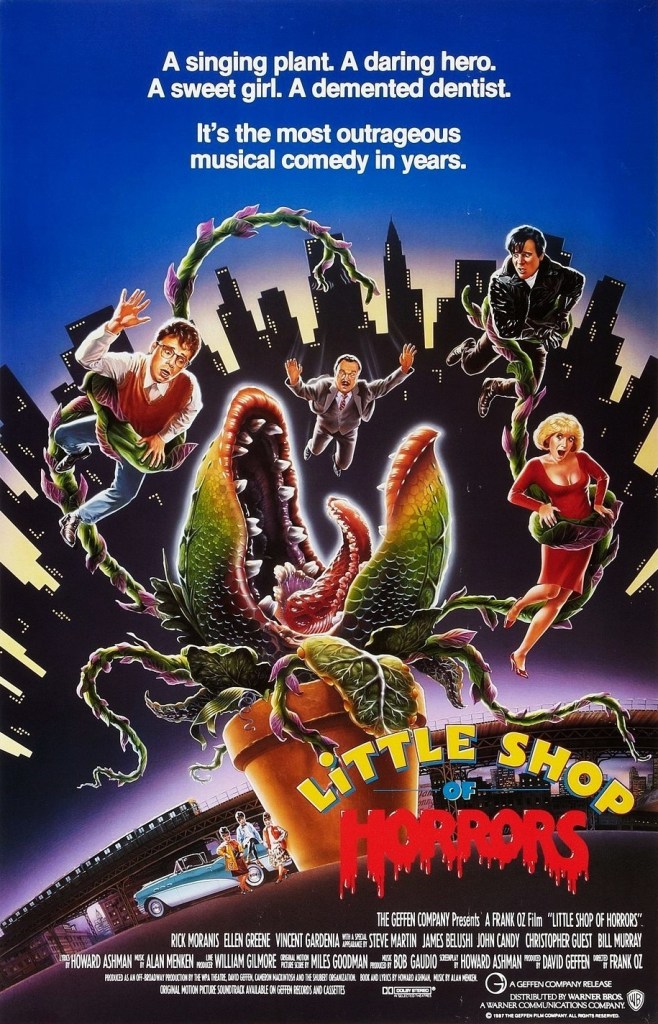
Little Shop of Horrors (1986)

LITTLE SHOP OF HORRORS (1986) ****
Little Shop of Horrors, based on the off-Broadway stage musical itself based on the 1960 Roger Corman cult film, is one of those movies that I like a little bit more every time I watch it.

I’ll just come right out and say it early on in this review: I’ll take Little Shop of Horrors over The Rocky Horror Picture Show every day of the week because the performances and characters, the science fiction and horror plot, the script, the direction, the musical production numbers, and the special effects are all far superior. Granted, to be fair, Little Shop of Horrors had more than 25 times the production budget of Rocky Horror.

I watched both films around the same time, in the late ’80s or early ’90s both on late-night local TV Saturday night movie programming. I also remember first coming across Wolfen and The Breakfast Club in this format. Anyway, I’ve always liked Little Shop of Horrors and never particularly cared for Rocky Horror, which I’ve come to like even less with every viewing so it’s Little Shop of Horrors inverted.

Rick Moranis stars as the meek, nerdy florist Seymour Krelborn. He means well but he’s extremely clumsy and pines after his beautiful coworker Audrey (Ellen Greene) who dates the abusive, sadistic, nitrous oxide fiend ’50s style greaser biker dentist Orin Scrivello (Steve Martin). Seymour’s perpetually chewed out by his boss Mr. Mushnik (Vincent Gardenia), the owner of Mushnik’s Flower Shop. Everything changes for Seymour, Audrey, and Mr. Mushnik when Seymour discovers Audrey II (voiced by Levi Stubbs, lead singer of the Four Tops), one mean green mother from outer space with an insatiable appetite and designs on taking over Planet Earth. Feeding Audrey II proves to be a nightmare for Seymour.

Moranis gives his definitive film performance, Greene returns to play Audrey from the stage production, Moranis and Greene make for a great movie couple and they’re very deserving of a happy ending, and Martin and Stubbs are both absolutely incredible in their villainous roles.

In fact, Martin and Stubbs both should have been nominated for Best Supporting Actor, but it’s understandable why they were not in a year with supporting actor winner Michael Caine for Hannah and Her Sisters and nominees Tom Berenger and Willem Dafoe for Platoon, Denholm Elliott for A Room with a View, and Dennis Hopper for Hoosiers.

Comedies, science fiction, and horror films very rarely earn nods from the Academy, a problem for Little Shop of Horrors when it encompasses all three genres.

It also became complicated when considering Stubbs (1936-2008) for a nomination, since he’s the voice of an animatronic puppet with 21 different principal puppeteers including Brian Henson. Stubbs’ authoritative, booming voice benefits the movie infinitely in both the dialogue scenes between Audrey II and poor Seymour and four musical numbers.

Audrey II’s Mean Green Mother from Outer Space, with lyrics by Howard Ashman and music by Alan Menken, received an Academy Award nomination for Best Original Song and lost to Berlin’s Take My Breath Away from Top Gun.

I’ve been known to say to pets both canine and feline Feed me, Seymour.

Crystal (Tichina Arnold), Ronette (Michelle Weeks), and Chiffon (Tisha Campbell), names borrowed from three girl groups contemporaneous with the original Little Shop of Horrors, provide a Greek chorus with sass and style.

Jim Belushi, John Candy, Christopher Guest, and Bill Murray show up in small roles.

Little Shop of Horrors originally retained the ending of the stage musical with Audrey and Seymour killed and giant Audrey II plants on a Godzilla-like rampage, but test audiences positively absolutely hated that Audrey and Seymour were killed and the original 23-minute ending became a rewritten and reshot happy ending that pushed the release date back to December 19, 1986.

I’ve only watched Little Shop of Horrors with the happy ending, and I must say that I’m more than happy with that.

The Texas Chainsaw Massacre 2

THE TEXAS CHAINSAW MASSACRE 2 (1986) ***
I wanted to like The Texas Chainsaw Massacre 2 considerably more than I did, because of the way director Tobe Hooper (1943-2017) and screenwriter Kit Carson (1941-2014) mixed in satire and dark comedy with all the material that seems like a prerequisite for a sequel to only one of the most infamous movies ever made, 1974’s The Texas Chain Saw Massacre.

Unfortunately, though, leading lady Caroline Williams’ harried disc jockey Stretch — yes, even women from Texas have names that play right alongside Slim and Tex — spends a good 75 percent of her screen time screaming. Williams screams more than Fay Wray in The Most Dangerous Game and King Kong and Mystery of the Wax Museum combined, more than Jamie Lee Curtis in Halloween and The Fog and Prom Night and Terror Train and Halloween II combined, and more than all the heroines combined who have faced Jason and Freddy and Michael over the last couple decades. Williams probably wishes they paid her by the scream.

All that infernal screaming begins to bog Massacre 2 down in the middle stretches of a film that both starts and finishes rather strongly.

Massacre 2 also features a Dennis Hopper performance that rates a distant fourth behind River’s Edge, Blue Velvet, and Hoosiers in the unofficial Hopper-portrays-an-epic-burnout-not-totally-unlike-himself (though, to be fair to Hopper, his Blue Velvet character goes beyond, way beyond, the pale of the normal cinematic psychopath) in 1986 competition.

Since Hopper (1936-2010) portrays former Texas Ranger and Sally and Franklin Hardesty-Enright’s uncle Lt. Boude ‘Lefty’ Enright and Cannon Films released Massacre 2, wouldn’t it have been absolutely fantastic if Cannon action hero Chuck Norris played the ranger pursuing vigilante justice against the ripped, twisted, absolutely positively deranged (not to mention cannibalistic) Sawyer family.

Both Chainsaw movies start with narration and an opening crawl.

The original: The film which you are about to see is an account of the tragedy which befell a group of five youths, in particular Sally Hardesty and her invalid brother, Franklin. It is all the more tragic in that they were young. But, had they lived very, very long lives, they could not have expected nor would they have wished to see as much of the mad and macabre as they were to see that day. For them an idyllic summer afternoon drive became a nightmare. The events of that day were to lead to the discovery of one of the most bizarre crimes in the annals of American history, The Texas Chain Saw Massacre.

The sequel: On the afternoon of August 18, 1973, five young people in a Volkswagen van ran out of gas on a farm road in South Texas. Four of them were never seen again. The next morning the one survivor, Sally Hardesty-Enright, was picked up on a roadside, blood-caked and screaming murder. Sally said she had broken out of a window in Hell. The girl babbled a mad tale: a cannibal family in an isolated farmhouse … chainsawed fingers and bones … her brother, her friends hacked up for barbecue … chairs made of human skeletons … Then she sank into catatonia. Texas lawmen mounted a month-long manhunt, but could not locate the macabre farmhouse. They could find no killers and no victims. No facts; no crime. Officially, on the records, The Texas Chainsaw Massacre never happened. But during the last 13 years, over and over again reports of bizarre, grisly chainsaw mass-murders have persisted all across the state of Texas. The Texas Chainsaw Massacre has not stopped. It haunts Texas. It seems to have no end.

Made on an estimated $80-140,000 production budget, the original deserves such descriptive phrases as grainy and gritty. Gory, no. Disturbing, yes definitely, terrifying, for sure, with a more than macabre sense of humor, especially during the best dinner table scene this side of Tod Browning’s Freaks. I about lose it every time the family wants the 124-year-old Grandpa Sawyer to end Sally’s life with one crushing blow of a hammer and this cannibalistic codger just can’t find the strength to do it, ultimately giving Sally the opportunity for escape.

More than a decade later, Hooper wanted Massacre 2 to be a dark comedy, accentuating those elements from the original. Meanwhile, naturally, Cannon desired a finished product more along the lines of The Texas Chainsaw Massacre or at least its shocking reputation.

The finished product plays more like a compromise.

Both films are reflective of the times they were made. The original, released on the first day of October 1974, came out in the midst of Richard Nixon’s resignation speech, the Watergate scandal that brought Nixon down, the final year of the Vietnam War, the Oil Embargo 1973-74, and general discord in the land. The sequel, released on Aug. 22, 1986, gives us cannibals with ‘family values’ a few months before former Hollywood actor turned politician Ronald Reagan’s speech centered around the family unit and giddy excess in every single frame to produce a bigger but not better Texas Chainsaw Massacre.

The original has this insidious way of getting underneath our skin and dominating our thought patterns, and none of the slicker sequels, remakes or imitations even come remotely close to its power to provoke.

NOTE: The parody of The Breakfast Club earns the film’s poster four stars.

Chopping Mall (1986)

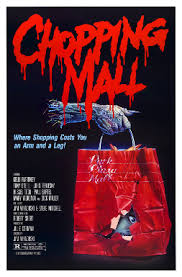
CHOPPING MALL (1986) ***1/2

Jim Wynorski’s CHOPPING MALL has just about everything anybody would ever want from a mid-80s horror film.

— An iconic shopping mall shooting location.

— Three killer robots who shoot real frickin’ laser beams. By the way, these kill-bots could eat Paul Blart for breakfast, lunch, dinner, and three desserts, plus in-between snacks.

— Big hair and big boobs.

— A Barbara Crampton topless scene that rates below RE-ANIMATOR and FROM BEYOND. Still, though, it’s topless Barbara Crampton.

— Other familiar teeny bopper horror movie bods and faces.

— The great character actor Dick Miller playing a character named Walter Paisley (his character’s name from BUCKET OF BLOOD).

— A Corman Factory production with posters from previous cult classics (including one directed by Wynorski, his debut film LOST EMPIRE) and clips from Roger Corman’s 1957 epic ATTACK OF THE CRAB MONSTERS.

— Cameos from Corman favorites Paul Bartel and Mary Woronov playing their characters from EATING RAOUL.

— Outdated special effects that were outdated even before the movie’s release. However, that’s all part of their charm.

— Gore galore highlighted by a gnarly head explosion.

— A plot that plays like a fast and loose combination of FAST TIMES AT RIDGEMONT HIGH, FRIDAY THE 13TH, and THE TERMINATOR.

CHOPPING MALL does not muck around, giving us our first killer robot scene right from the start and hey, let’s face it, it breezes past in 76 minutes. For crying out loud, that’s a running time straight from an earlier time in cinematic history. That not mucking around quality is one of the most admirable traits of CHOPPING MALL, that and its desire to give the people what they want in terms of meeting and exceeding the demands of an exploitation film.

It has a basic plot: Three security robots go haywire after a lightning storm, turn rogue and run amok in Park Plaza Mall, actually the Sherman Oaks Galleria in the Sherman Oaks neighborhood in Los Angeles. The galleria, on the corner of Ventura and Sepulveda Boulevards, has been given credit for inspiring the Frank and Moon Unit Zappa satirical hit single “Valley Girl” and FAST TIMES and COMMANDO famously utilized the location.

Of course, with this genre and location, we have four teenage couples who stay after hours to frolic and fool around inside a furniture store, naturally and predominantly hot and horny couples who make up the majority of our body count. That contributes the FRIDAY THE 13TH element, and the presence of Russell Todd aids and abets that mental connection. Todd played Scott in FRIDAY THE 13TH PART 2, a real smug horny bastard adept with a slingshot. Not that did him any bit of damn good against burlap sack Jason Voorhees.

CHOPPING MALL has a good cast and Kelli Maroney and Alan O’Dell make for appealing, likeable female and male leads, especially Maroney. With her big hair, her struggles working in a restaurant, her spunky attitude, and her way around weaponry, Maroney’s Alison Parks feels very reminiscent of Sarah Conner (Linda Hamilton) from the first TERMINATOR.

What I especially like about the teenagers in CHOPPING MALL is that they load up on guns (echoes of DAWN OF THE DEAD) almost immediately after discovering the killer robots. They are far more proactive than the average horror movie teenager, and that helps separate CHOPPING MALL from the pack of run-of-the-mill exploitation films.

File CHOPPING MALL right alongside cult classics from that moment in time like RE-ANIMATOR, FROM BEYOND, and NIGHT OF THE CREEPS.

Friday the 13th Part VI: Jason Lives (1986)

JASON LIVES

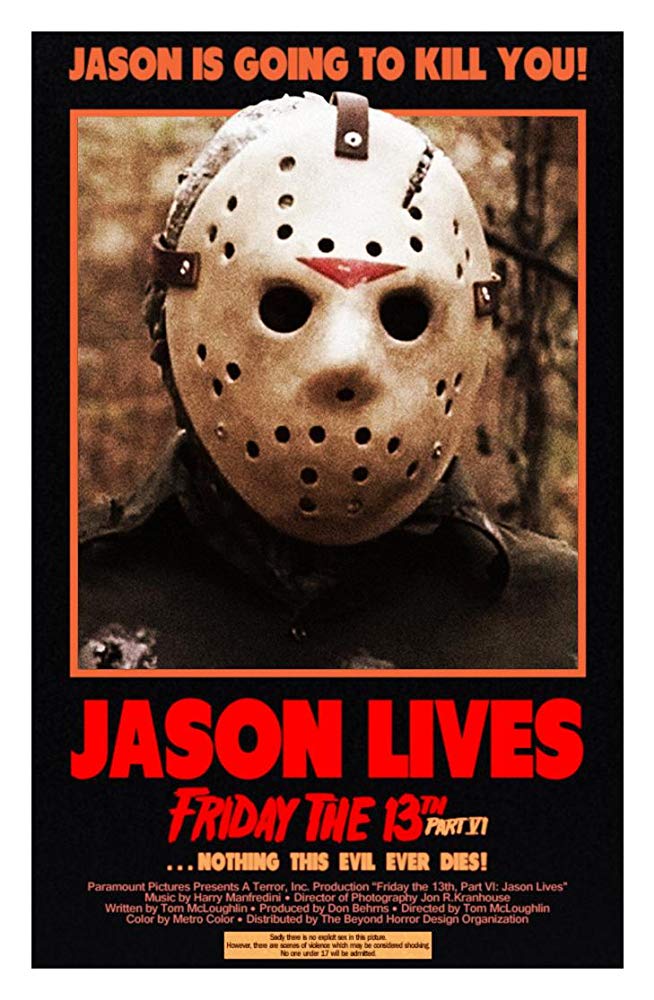
FRIDAY THE 13TH PART VI: JASON LIVES (1986) Three stars

I find the FRIDAY THE 13TH movies that I like the most are the ones with the best sense of humor.

That’s why I’ll call PART VI: JASON LIVES the best film in the entire series, beating out PART III and THE FINAL CHAPTER. JASON LIVES includes several intentionally funny scenes and that helps its 86 minutes go down smoothly.

Director and writer Tom McLoughlin wanted to satirize a slasher movie all while making one, turn Jason into a supernatural zombie, and not simply churn out a carbon copy of the five previous movies in the series. There are moments intended to recall classic horror movies, like the beginning scene in the cemetery echoes the grave robbers at the beginning of FRANKENSTEIN MEETS THE WOLF MAN. Jason’s revival from the dead courtesy lightning also recalls Frankenstein’s Monster.

“I set up a lot of visual gags,” McLoughlin said in the book “A Strange Idea of Entertainment — Conversations with Tom McLoughlin.” “Like when my wife Nancy is killed by Jason. She tries to bribe him, offering him her wallet to keep him from killing her. She’s got money and a credit card in her wallet, and when Jason kills her in this giant mud puddle, the money sinks and the American Express card floats. I held on that shot for a few extra beats because I knew there would always be some joker in the theater that would yell, ‘Don’t leave home without it!’ And someone always did.”

McLoughlin’s background proved to have a strange influence on Jason Voorhees.

“I was recently interviewed about it, and someone said, ‘Your Jason seemed to be much more communicative,’” McLoughlin said. “I said, ‘That’s because I was dealing with a mime character.’ When he sees the motor home bouncing up and down because a couple are having sex in there, Jason just stands there and stares, with his head tilting back and forth — like a dog trying to figure out what’s going on. It got a big laugh. I wasn’t making fun of Jason … I just figured he would be processing what was going on in that motor home. Whenever I find a way to put my mime training to use in storytelling, I do it.”

Marcel Marceau influenced Jason Voorhees. Makes perfect sense to me.

McLoughlin sang in a rock band before he went to Paris to study mime under Marceau. Back in the States, several years later, McLoughlin had a part as the mutant bear monster in the 1979 horror film PROPHECY directed by John (MANCHURIAN CANDIDATE) Frankenheimer. All these experiences seemingly fed McLoughlin more insight into Jason than any other director.

Alice Cooper provided three songs for JASON LIVES:  “Teenage Frankenstein,” “Hard Rock Summer,” and “He’s Back (The Man Behind the Mask).” Unfortunately, they are not classic Alice Cooper songs, a la the four-album period from “I Love It to Death” through “Billion Dollar Babies” when the band cranked out some of the greatest hard rock ever made, but I still enjoy “He’s Back.” SCREAM later made great use of the Alice classic “School’s Out.”

Speaking of SCREAM, apparently screenwriter Kevin Williamson wanted McLoughlin to direct his hot commodity screenplay, before the project ended up with Wes Craven. Williamson told McLoughlin that JASON LIVES and its humor made a huge impact on Williamson during his youth, so much so that it served as one of the inspirational springboards for SCREAM.

There’s a James Bond gun barrel sequence parody, dialogue that breaks the proverbial fourth wall, a camper reading Jean-Paul Sartre’s existentialist play “No Exit,” a camper praying to God for the first (and only) time in the series, and even Jason surprised at his own astonishing strength. Also, for the first and only time in the series, young campers are in attendance at Camp Forest Green, er, Camp Crystal Lake.

“I’ve seen enough horror movies to know any weirdo wearing a mask is never friendly” and “Some folks sure got a strange idea of entertainment” are lines that display how JASON LIVES influenced SCREAM.

The young children, who Jason does not harm, have their moments, as well, especially when one boy asks his little friend, “So, what were you gonna be when you grew up?”

All these words so far and I have not even mentioned protagonist Tommy Jarvis, who figured in THE FINAL CHAPTER, A NEW BEGINNING, and JASON LIVES. He’s responsible for reviving Jason in the opening sequence and Tommy even makes sure to bring that infamous hockey mask with him. Originally, it had been planned for Tommy to become the antagonist, but it was the extremely negative reaction to A NEW BEGINNING and its non-Jason killer which truly brought Jason back from the dead. Tommy never panned out like he should have and part of the problem is that he’s played by three different actors, Corey Feldman (THE FINAL CHAPTER), John Shepherd (A NEW BEGINNING), and Thom Mathews (JASON LIVES).

Anyway, definitely by this point in the series, Jason became the focus of attention and the antihero extraordinaire of the late ‘80s. Dan Bradley played Jason in the paintball massacre sequence, but former soldier C.J. Graham handled the rest of the duties. He’s a lot more interesting than Tommy Jarvis. That’s why the series moved forward with Jason (Kane Hodder the man behind the mask for four more sequels) and without Tommy Jarvis.

The Delta Force (1986)

THE DELTA FORCE

THE DELTA FORCE (1986) Three stars

Watching THE DELTA FORCE for the first time in 30 years, it surprised me in three ways.

First, it accumulates a running time of 2 hours, 5 minutes.

Second, the heavy action does not kick in until about 1 hour, 15 minutes in.

Third, it’s more thoughtful than expected, given that it is a Golan-Globus production starring Chuck Norris and featuring a cast of many highlighted by hostages Martin Balsam, Joey Bishop, Lainie Kazan, George Kennedy, and Shelley Winters, actors who initially suggest the movie would quickly become AIRPORT ‘86.

About that running time, let’s see here, RAMBO: FIRST BLOOD PART II and COMMANDO, both from 1985, clock in at approximately 96 and 92 minutes, respectively. Then again, Norris’ previous cinematic crusade against terrorism, INVASION U.S.A., lasts 110 minutes.

Once the action does kick in, it kicks in real good in THE DELTA FORCE and it especially delivers the goods with shit blown up real good just like an old school action movie should. Of course, I hope the demolition experts were paid real good.

The action truly begins with a chase: Major Scott McCoy (Norris) and his Delta Force colleague are pursued by Lebanese terrorists through Beirut and one terrorist vehicle crashes into a poor defenseless fruit cart and melons fly everywhere. Ah, yes, this is one of the better fruit cart scenes in history because they used both slow motion and big melons. I say the bigger the melons, the better the fruit cart scene.

I have argued the best Chuck Norris movies are the ones with the best supporting casts and THE DELTA FORCE definitely upholds that argument. Other cast members include Robert Forster, Hanna Schygulla (it’s a long way from Rainer Werner Fassbinder melodramas to Chuck Norris action spectaculars), Susan Strasberg, Bo Svenson, and Robert Vaughn. The great Lee Marvin (1924-87) also plays a key role in his final movie performance. Of course, Marvin brings his association with THE DIRTY DOZEN.

This is Norris’ best supporting cast, though I still rate THE DELTA FORCE slightly below LONE WOLF MCQUADE and CODE OF SILENCE overall.

Palestine born Menahem Golan (1929-2014) wrote, produced, and directed the film, which takes an undeniable pro-Israeli, pro-Jewish position. Golan served in the Israeli Air Force as a young man, long before he and his younger cousin and business partner Yoram Globus attempted to conquer the international film market.

Call me a fool and slap me silly, but it seems that Golan paid a lot more attention and dedicated more craft to THE DELTA FORCE than the average run-of-the-mill Cannon production, like, for example, Norris’ other 1986 film, FIREWALKER. Granted, J. Lee Thompson directed that one, but it’s doubtful that Golan would have evinced any passion in a watered down third-rate Indiana Jones retread like he did for THE DELTA FORCE.

THE DELTA FORCE ripped its plot from the real-life hijacking of Trans World Airlines Flight 847 on June 14, 1985. There’s a real-life Delta Force who have engaged in Operation Eagle Claw, Operation Enduring Freedom, the Iraq War, Operation Inherent Resolve, and Operation Kayla Mueller, among many other specialized missions incorporating counter-terrorism, hostage rescue, and direct action.

THE DELTA FORCE began production in July 1985 and filming in September 1985. The shoot lasted until early November. The filming took place in predominantly Israel. THE DELTA FORCE opened February 14, 1986, 245 days after the hijacking.

We have about the same number of passengers and crew members in the movie as in real life, the same number of terrorists behind the hijacking, a purser based on flight service manager Uli Derickson, the singling out of the Jewish passengers and the Navy divers and the eventual murder of one of them, and a similar flight pattern.

In real life, though, diplomats brought about the release of the hostages, not the Delta Force. Of course, that’s not what anybody wants to see in an action movie. I mean, you don’t cast Chuck Norris and Lee Marvin for that.

THE DELTA FORCE can be a wish fulfillment fantasy particularly for those who feel the United States perpetually takes a soft position on international terrorism and that we should go right into the heart of the Middle East and “Kill all the A-rabs” once and forever. Never mind that all our prior and ongoing efforts in the Middle East have seemingly only compounded matters and created more terrorists. One just might be left to conclude the War on Terrorism will never end, just like the War on Drugs.

The Arab characters in THE DELTA FORCE, terrorists one and all, earned their place in Jack G. Shaheen’s book “Reel Bad Arabs: How Hollywood Vilifies a People.” Vincent Canby of the New York Times wrote, “[DELTA FORCE] will be the 1986 film all others will have to beat for sheer, unashamed, hilariously vulgar vaingloriousness.”

Subaru customized a motorcycle just for Norris’ late picture heroics. Gene Siskel wrote in his one-star review for the Chicago Tribune, “The action in Beirut is more appropriate for a bad James Bond film than for a subject that has been all too real lately. Norris gets off shooting rocket launchers from his specially built motorcycle, and we sit there stunned at the movie industry’s ability to make money off of any tragedy.”

Israeli filmmaker Rafi Bukai said that he hated films like THE DELTA FORCE because they do not show Arabs as human beings.

Veteran character actor Robert Forster (1941-2019) plays the main terrorist Abdul Rafai. Forster was born in Rochester, New York, to parents of Italian, English, and Irish descent. His father trained elephants for the Ringling Bros. and Barnum & Bailey Circus. File this casting alongside John Wayne as Genghis Khan in the 1956 THE CONQUEROR. Along this same line, how many ethnicities and nationalities have character actors like Alfred Molina and Armand Assante played over the years?

I give THE DELTA FORCE a positive review because I enjoy it as a big, dumb, and even stupid action movie and it is an effective time capsule piece with Golan-Globus, Cannon Films, Chuck Norris, Lee Marvin, and all those older character actors. Not because it is a sobering, thoughtful, and balanced consideration of Middle East politics and international terrorism. Thankfully, I have read several books just like that on those subjects.

Howard the Duck (1986)

HOWARD THE DUCK

HOWARD THE DUCK (1986) One star

KODE-TV in Joplin once aired movies on Saturday nights and I recall watching THE ROCKY HORROR PICTURE SHOW, THE BREAKFAST CLUB, WOLFEN, and HOWARD THE DUCK in my impetuous youth.

Sometimes movies that we liked during our childhood and teenage years do not hold up during later viewings. Unfortunately, I do not remember how I reacted to HOWARD THE DUCK upon first viewing it some 30 years ago.

I do know that I caught up with HOWARD THE DUCK in 2009, though, wrote a negative review centered around the question “What were they thinking?” when Universal Pictures made HOWARD THE DUCK, and listed it as one of the worst movies of the 1980s, right down there with such “classics” as LEONARD PART 6 and THE GARBAGE PAIL KIDS.

That’s when I first encountered online defenders of bad movies. They’re vehement, and will leave you digital pleasantries like, for example, “Opinions are like assholes. …” Genius, pure genius, never heard that one before, Internet tough guy. I mean, how dare somebody think both HOWARD THE DUCK and LEONARD PART 6 stink it up. HOWARD THE DUCK and LEONARD PART 6 are both not so bad they’re good, they’re both so bad that they’re really really really bad. Every once in a great while, I dust them off just to remember what a bad movie plays like.

HOWARD THE DUCK is one of the great cinematic follies of all-time.

It wanted dearly to be like GHOSTBUSTERS, a combination of dazzling special effects and wisecracking comedy.

It fails in both departments and it starts with that live action duck, the biggest special effect mistake and comedic failure.

Howard’s a creepy little duck, a rather fowl protagonist despite the fact that director Willard Huyck (Huyck rhyme with duck?) and producer Gloria Katz toned him down and tried making him a nicer duck from his comic book origins.

It does not help the character that the film trots out every duck pun for 111 minutes, a running time a few minutes longer than GHOSTBUSTERS. Every single character must get at least one and I got tired of all the puns by the 5-minute mark.

Eight actors are credited as having some role in playing Howard the Duck: Ed Gale, Chip Zien, Tim Rose, Steve Sleap, Peter Baird, Mary Wells, Lisa Sturz, and Jordan Prentice. Six of the actors and actresses inside the duck suit (at different times) won the Razzie for Worst Performance in a Motion Picture. This is almost as impressive as the fact Harvey Stephens began his career as the Antichrist in THE OMEN. Where does one go from the Antichrist and where does one go from Howard the Duck? These are tough questions, and I have some more.

Do those actors and actresses put Howard the Duck on their resume? Or brag down at the pub “Oh yeah, man, you better not fuck with Howard the Duck” and “I played a talking duck from another planet in the movies. How about you, asshole, what the fuck have you done that’s so great?” Have any of these actors exploited their playing Howard the Duck to pick up women? Stranger lines have been spouted.

Howard’s not a funny duck and he must try a thousand jokes. He’s a lame duck, instead, that wishes he could have been the Groucho Marx or Bill Murray of ducks.

The last 40-45 minutes surrender to chase scenes and special effect showcases with lame duck pun interludes, then we’re treated to a thrilling grand finale of the “Howard the Duck” song, written by Thomas “She Blinded Me with Science” Dolby and George “Atomic Dog” Clinton.

The last 40-45 minutes feel like they run on as long as BEN-HUR and GONE WITH THE WIND combined.

Every time I see Lea Thompson, it brings me back to the strange trajectory of her early screen career: attacked by shark in JAWS 3-D, a creepy love affair with a married police officer who should have arrested himself for sex crimes in THE WILD LIFE, and unknowingly lusting after her own future son in BACK TO THE FUTURE. In HOWARD THE DUCK, the fetching Thompson smooches Howard all while she’s in her skimpies. It’s bad enough that her hairdo attacked the ozone layer, but she has to go the extra mile in HOWARD THE DUCK.

(We believe that Thompson’s hairdo in HOWARD THE DUCK contributed to the Montreal Protocol on Substances that Deplete the Ozone Layer that became effective in August 1989.)

Every time I watch HOWARD THE DUCK, I marvel at the fact that Tim Robbins somehow survived his performance and managed to sustain a career in such high-quality films as BULL DURHAM, JACOB’S LADDER, and THE SHAWSHANK REDEMPTION. His performance in HOWARD THE DUCK ranks among the most annoying supporting performances in history. Believe it or not, this was his fifth credited screen performance … and we have one more believe it or not.

HOWARD THE DUCK is the first feature-length Marvel Comics adaptation. When will Disney take a crack at remaking this remedial GHOSTBUSTERS?

The Fly (1986)

DAY 5, THE FLY

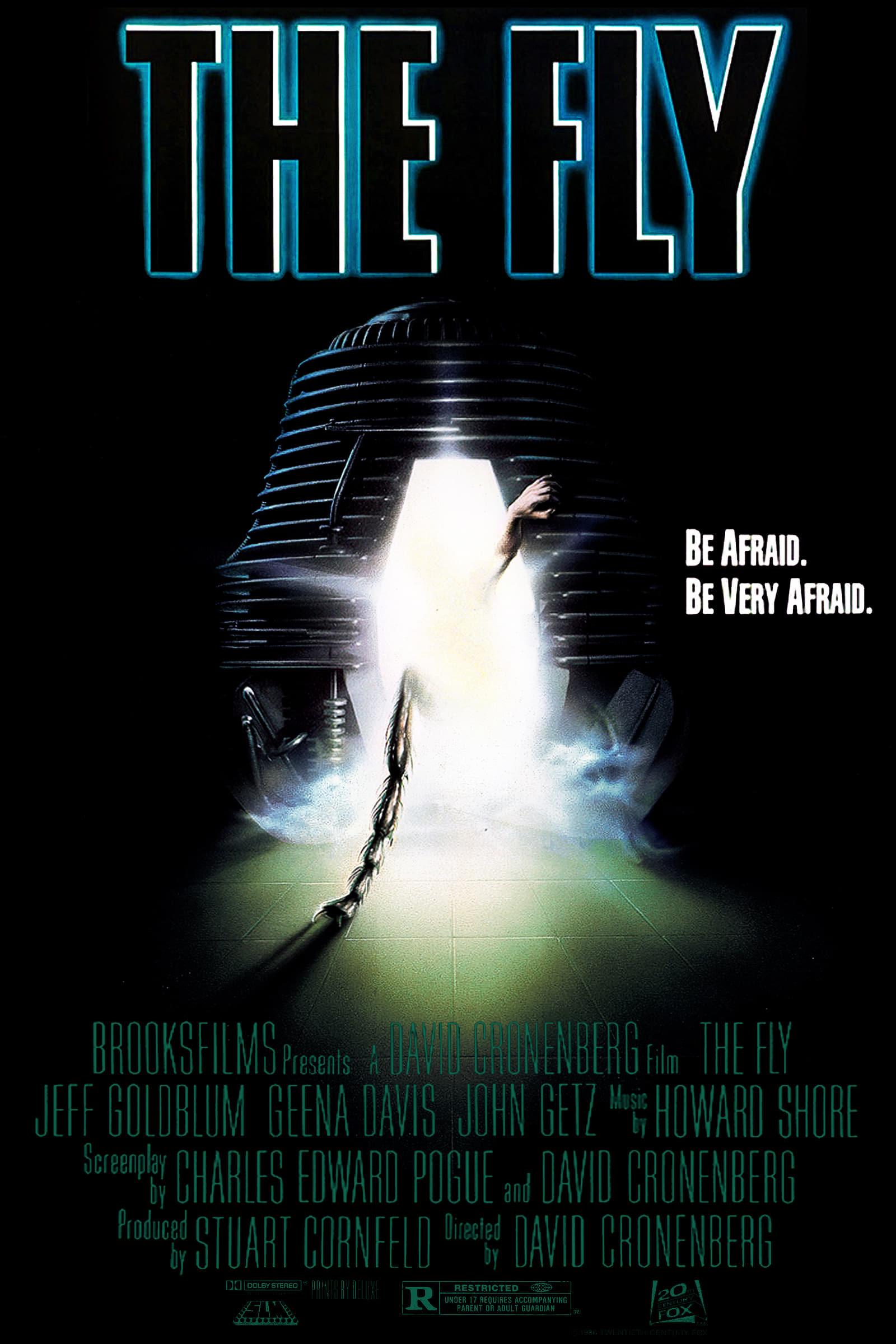
THE FLY (1986) Four stars
I absolutely love it when a horror movie takes on more than just merely being a horror movie. These movies rank among the most pleasurable viewing experiences.

For example, George Romero’s DAWN OF THE DEAD (1978), a horror movie or a zombie picture that also passes through action and adventure, black comedy, silent and slapstick comedy, drama, gore galore, cinematic and social satire, surrealism, survivalism, and melodrama in addition to being great at the basic level of being a horror movie. All those extra traits put DAWN OF THE DEAD in the upper echelon.

Another example is David Cronenberg’s THE FLY (1986). It works on the most basic horror movie level but reaches greatness because it’s also a few other things it didn’t have to be. It grosses us out at times (rather, make that many times) but it also zaps us straight in the heart with its central storyline.

We’ve seen lots and lots of scientists over the years in loads and loads of pictures, but Jeff Goldblum’s Seth Brundle is one of those that sticks with you and stays in your mind. He’s not Colin Clive’s Dr. Frankenstein and he’s not Jeffrey Combs’ Herbert West, two other great cinematic scientists who embody more of the mad scientist archetype than Brundle. Brundle is more of the lovable eccentric that puts you in mind of what Albert Einstein must have been like in real life. We come to know this cinematic scientist more than just about any that spring to mind.

Brundle invents a teleportation device and he’s inspired to teleport himself one night after having successfully tried everything from Geena Davis’ stocking to a baboon. Of course, unbeknowst to him, a darn pesky housefly joins Brundle in the pod and throws a monkey wrench variable into this grand scientific experiment. Over the rest of the movie, Brundle transforms into Brundlefly.

Some viewers took what happened to Brundle as a metaphor for AIDS, but director Cronenberg said that his original intent was for an analogy for disease itself, terminal conditions such as cancer, and aging. This is one of the main sources for the emotional heft of THE FLY, because most of us grow old and die from a disease. Most of us are afraid, very afraid, indeed, it seems, and THE FLY plays on our fears.

On top of that, there’s a great tragic love story between Goldblum’s Brundle and Davis’ Veronica Quaife.

I highly doubt anybody expected such a moving love story coming in, especially considering Cronenberg’s previous films like SCANNERS and VIDEODROME.

And, let’s face a fact: Horror movies have not always been a great source for love stories.

Chris Walas deserved his Academy Award for Best Special Effects Make-up, but it’s the pleasant surprise love story and Brundle himself that elevate THE FLY.

Goldblum and Davis were a real-life couple, boyfriend and girlfriend during the making of THE FLY, and they were married from 1987 to 1990. They met during TRANSYLVANIA 6-5000 and later made a third movie together, EARTH GIRLS ARE EASY. For both actors, THE FLY would be their break into the mainstream and honestly, neither performer has ever done anything better.

Goldblum would play variations on scientists in seemingly every appearance for the next 30 years, in everything from JURASSIC PARK and INDEPENDENCE DAY to POWDER and THE LIFE AQUATIC WITH STEVE ZISSOU. It’s a role that fits him well and we can say that it’s become the Jeff Goldblum role just as we can say that Dabney Coleman (think NINE TO FIVE) and Hal Holbrook (think ALL THE PRESIDENT’S MEN) have come to develop their own respective roles.

Davis moved on to director Renny Harlin in both her personal and professional life, and her career never quite recovered after such flops as SPEECHLESS, CUTTHROAT ISLAND, and THE LONG KISS GOODNIGHT, the latter pair directed by Harlin. Davis’ career took off for a few years after THE FLY with hits like BEETLEJUICE, THELMA & LOUISE, and A LEAGUE OF THEIR OWN and an Academy Award for Best Supporting Actress for THE ACCIDENTAL TOURIST.

This is the rare remake that has obscured the original, which was made in 1958, directed by Kurt Neumann, and starred Vincent Price.

Goldblum wrote Price a letter telling one of the great hams in history, “I hope you like it as much as I liked yours.” Price, touched by the letter, went to see the remake and unfortunately, he did not quite return Goldblum’s affection for the original and called the remake “wonderful right up to a certain point … it went a little too far.”

In addition to both FLY movies, there’s been a lot of great fly moments throughout history, both screen and sound.

I’ll briefly guide you through three of them.

Norman Bates (Anthony Perkins), his stare, his voiceover, and a fly in the final moments of PSYCHO (1960): “They’re probably watching me. Well, let them. Let them see what kind of a person I am. I’m not even going to swat that fly. I hope they are watching. They’ll see. They’ll see and they’ll know, and they’ll say, ‘Why she wouldn’t even harm a fly.'”

Hungarian animator Ferenc Rofusz’s THE FLY (1980) won the 1981 Academy Award for Best Animated Short and it follows a fly on its journey from the woods to a house and finally on death’s end of a fly swatter. Oh, sorry, did I spoil that for you or the fly? Since it’s only three minutes long, this animated short might be a replacement if you have no desire to sit through 96 minutes of THE FLY (1986). In fact, you can watch the animated one 32 times in a row to substitute for the experience of the live-action flick.

English rock band Wire released the song “I Am the Fly” on its 1978 album CHAIRS MISSING and it features the great lines “I am the fly in the ointment / I can spread more disease than the fleas which nibble away at your window display / Yes, I am the fly in the ointment / I shake you down to say please as you accept the next dose of disease.”