
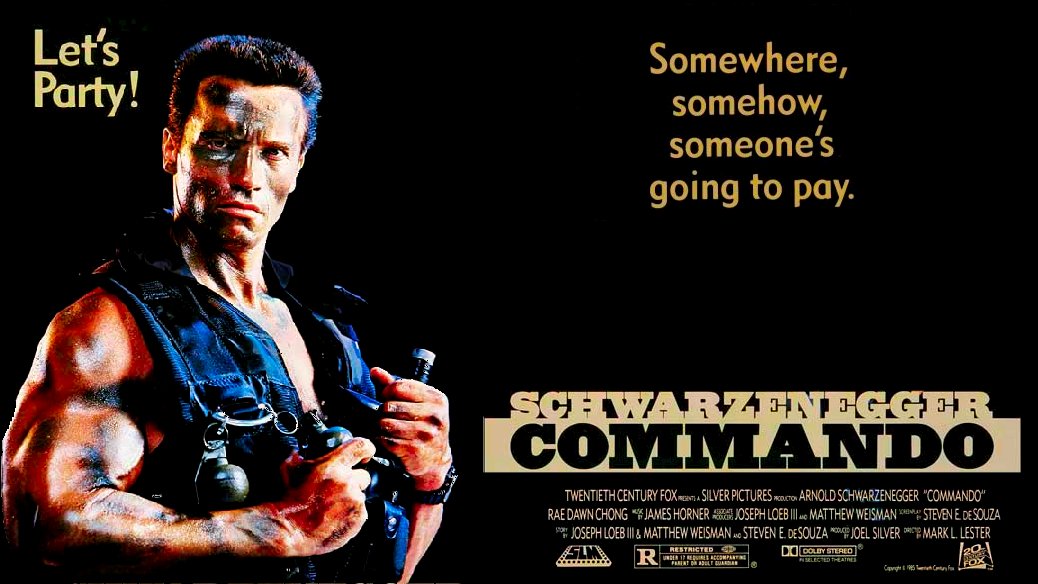
Commando (1985)

day 63, commando

COMMANDO (1985) Three-and-a-half stars
In some ways, COMMANDO is the ultimate comic book movie, although it’s merely based on a screenplay by Steven de Souza and a story by de Souza, Joseph Loeb III, and Matthew Weisman rather than something adapted from DC or Marvel.

It moves fast, thankfully so very, very fast because it keeps us from looking at logical mistakes, continuity errors, and the like. There’s a lot of them and we cruise right past them, because it’s onward and forward to the next bit of action. From the first scene, it’s nonstop action for 90 minutes, larger-than-life action with a larger-than-life hero who’s funnier than, for example, Howard the Duck.

Arnold Schwarzenegger made for a great villain in THE TERMINATOR and he made for a great comic book action hero in COMMANDO, a style that he would again utilize to great effect in PREDATOR and TOTAL RECALL. He’s the right size of personality and fighting style for John Matrix, and he’s believable in an unbelievable world that’s like a heightened macho take on terrorism in news reports.

Both the director Mark L. Lester and screenwriter de Souza are right at home with an exaggerated macho world. Lester directed THE CLASS OF 1984, the Punks vs. Teachers public school nightmare world epic from 1982 that should be required viewing for substitute teachers or anybody entering a public junior high or high school today for the first time. De Souza wrote screenplays for the first 48 HOURS and the first two DIE HARD pictures, so he proved himself at writing the mixture of action with comedy that worked for Schwarzenegger, Bruce Willis, and Eddie Murphy, especially Schwarzenegger, who seemed to have studied Clint Eastwood.

Just as Eastwood perfected reading lines like “Go ahead, make my day,” “Smith and Wesson … and me,” and “Why don’t you boys suck some fish heads, huh?” by the time of SUDDEN IMPACT, Schwarzenegger did the same in several of his films from THE TERMINATOR and PREDATOR to KINDERGARTEN COP and TERMINATOR 2. There’s a reason Schwarzenegger’s dialogue became the basis for soundboards. He just might be at his funniest on film throughout COMMANDO. (For the ultimate Schwarzenegger experience, try his 1983 “Arnold Schwarzenegger’s Total Body Workout.” Nirvana edited together clips from “Total Body Workout” to most humorous effect when the band played the U4 on November 22, 1989 in Vienna, Austria, Schwarzenegger’s native land.)

Take his exchanges with Sully, one of the prerequisite henchmen who’s a genuine sleaze (played by none other than David Patrick Kelly, who did this kind of creep in THE WARRIORS, 48 HOURS, and DREAMSCAPE, for example).

At one point early in the movie, Matrix tells Sully, “You’re a funny guy Sully, I like you. That’s why I’m going to kill you last.”

Later on, though, we get a great big payoff based on his promise that he would kill Sully last.

Did anybody remember this exchange when Schwarzenegger ran for Governor of California in the 2003 recall election?

You should remember Matrix’s line “I eat Green Berets for breakfast and right now, I’m very hungry” right alongside Nada’s “I have come here to chew bubblegum and kick ass … and I’m all out of bubblegum” from THEY LIVE.

In one of his funniest reviews, Roger Ebert on the “Siskel & Ebert” program boiled COMMANDO down to its essence: “Schwarzenegger tough guy, bad guys kidnap daughter, he blow ’em up real good.” Ebert said the script was written on the back of a small envelope.

They made some great choices for the actors who played the bad guys. In addition to Kelly, they picked Dan Hedaya, Vernon Wells, and Bill Duke. They’re actors who you love to hate, especially Hedaya, who’s been effective in that role in everything from BLOOD SIMPLE to THE HURRICANE. He made a great Richard Nixon in DICK.

Back when reviewing THE FLY (1986) a couple months ago, I touched on how it and DAWN OF THE DEAD (1978) work on several more levels than just merely being horror movies.

To a slightly lesser extent, the same holds true for COMMANDO within the action movie genre. Other Schwarzenegger films work on additional levels.

In THE TERMINATOR, for example, we get an unexpected tender love story between Kyle Reese (Michael Biehn) and Sarah Connor (Linda Hamilton).

In COMMANDO, we get the airline stewardess character named Cindy and played by Rae Dawn Chong, a part that Sharon Stone and Brigitte Nielsen wanted.

“The part was written for a Caucasian actress,” Chong said, “so I knew I had only one shot. My first reading with Arnold was this weird scene where he pulls a dildo out of my handbag. I knew other actresses were stumbling, because the character was supposed to shrug and say, ‘It gets lonely on the road.’ I thought that was so lame, so when my turn came I screamed and said, ‘That’s not mine!’ It got me the part. Was Arnold embarrassed about the dildo? Not even slightly. He didn’t break a sweat running a state, and he didn’t break a sweat handling a dildo then.”

Of course, there was a plan for a sex scene between Matrix and Cindy when they’re en route to the dictator’s island, but the studio did not like a Schwarzenegger and Chong pairing just as surely as Universal Pictures did not want a Schwarzenegger and Grace Jones pairing in CONAN THE DESTROYER. It worked out for the best in the long run, because that final scene of Matrix and his daughter boarding the plane with Cindy says all there needs to be said.

Cindy gives COMMANDO an extra dimension, a nice change of pace within a hypermacho world, and characters like her lift a genre picture even higher above others.
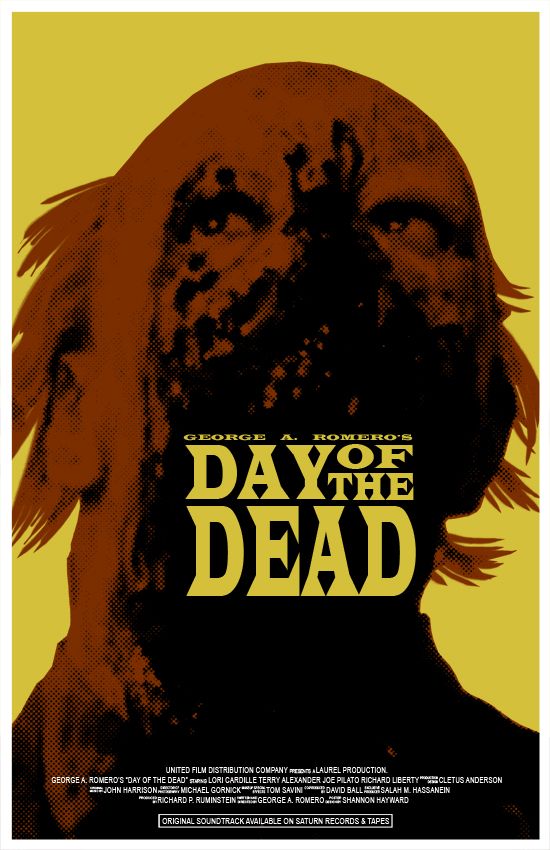
Day of the Dead (1985)

DAY 12, DAY OF THE DEAD

DAY OF THE DEAD (1985) Four stars
DAWN OF THE DEAD (1978) showed more hope for humanity than NIGHT OF THE LIVING DEAD (1968).

DAY OF THE DEAD (1985), the third entry in George Romero’s zombie series, heads in the opposite direction and it’s the bleakest installment of the entire run of films (six in total) as we see only just a sliver of hope for the human race. Honestly, we see more potential in the evolution of zombies throughout DAY OF THE DEAD than we do in mankind. Fans were blindsided after the more humorous DAWN OF THE DEAD.

The human characters in DAY OF THE DEAD mostly scream and shout at each other, they don’t listen to one another, and they’re just plain nasty and mean on a regular basis. You would think in a zombie apocalypse that they could put aside their differences and unite and fight toward a common goal, their survival. You would think they could get past their petty differences, their hostility for others who don’t fit their preconceived notions, their political and religious beliefs and prejudices, et cetera, but they are only human after all.

The action centers on an underground bunker where scientists are working on a solution to the zombie pandemic, while being protected from the hordes of zombies (who outnumber humans by 400,000 to 1) above by soldiers. Keep in mind that zombies, of course, are the test subjects and the soldiers are responsible for procuring more specimens. Whatever natural tensions exist between scientists and military professionals are only exacerbated by dwindling supplies, communication breakdowns, and not enough results from the scientists in the eyes of the soldiers.

Of course, we like some characters more than others and it’s quite obvious from the getgo that we are to be more sympathetic toward female scientist Dr. Sarah Bowman (Lori Cardille), black helicopter pilot John (Terry Alexander), and booze hound radio operator McDermott (Jarlath Conroy) than screw loose martinet Captain Henry Rhodes (Joseph Pilato) and mad scientist Dr. Matthew “Frankenstein” Logan (Richard Liberty).

That Romero always loved to mess with audience expectations.

Bowman’s an even stronger female character than Francine Parker in DAWN OF THE DEAD and it’s a joy watching her go toe-to-toe with Captain Rhodes and the boys.

Pilato makes for a great human antagonist and his demise provides us one of the great death scenes in any zombie movie.

Roger Ebert criticized the actors in DAY OF THE DEAD for overacting. Yes, these performances fit the definition of overacting with their exaggerated manner, but this overacting is for a very good reason. It demonstrates how much the human characters have lost the plot and degenerated into worse monsters than the zombies.

That’s apparent throughout by not only the behavior of the human characters but the behavior of the domesticated zombie Bub (Richard Sherman). Bub learns more than any of the characters in DAY OF THE DEAD and that’s a painful lesson for humanity.

DAY OF THE DEAD works today even more than when it was originally released on July 3, 1985.

Just go online and look at the comments section on especially a political story. Bask in relentless name-calling, abusive language, and hostility that only continue to get worse over time. You will probably come across words like “snowflake” and “libtard” (both especially popular since the 2016 Election) and other phrases from the main two sides of the political divide that show our increasing inability to have civil discussions about politics and religion. It should be alright to agree to disagree.

Reading an Oxford Dictionaries article from 2014 on the most common American political insults, it started with a quote from a Pew Research Center report conclusion, “Republicans and Democrats are more divided along ideological lines—and partisan antipathy is deeper and more extensive—than at any point in the last two decades.”

The article continued, “The lack of civility in our political discourse shines through in the frequency of taunts suggesting stupidity and irrationality. Such terms were brandished on both sides, but liberals were more likely to be called morons, fools, and loons, whereas conservatives were most often derided as nutjobs, nuts, and lunatics. Idiot was a favorite on both sides of the aisle.

“The type of adjective favored in insulting phrases varied by partisan affiliation as well. People insulting conservatives favored the adjective right-wing, which was more than twice as common as Republican and nearly four times more common than conservative. In contrast, the dominant adjective in negative epiphets for liberals was—liberal. Liberal was used more than four times as often as left-wing, and Democrat and Democratic accounted for only a fraction of the insults for liberals, with the former used twice as often as the latter.”

It concluded, “But there may be a ray of hope: partisans on both sides of the aisle accuse each other of being racists and bigots, demonstrating a consensus that intolerance and discrimination are universally reprehensible. And while there may not be much common ground between Democrats and Republicans, at least we can all agree on calling each other ‘idiots.'”

During a summer vacation in 2013, several months after the presidential election, a downtown Omaha, Nebraska artist displayed two posters combining both major parties’ candidates with silent movie classics, creating “Obamaratu” and “Mittropolis.” Of course, I bought both posters, because I love both NOSFERATU and METROPOLIS and I hated the 2012 Election. And the 2016 Election was amazingly even worse, a nonstop spitting contest between two jerks that brought thought and discourse to a new low. We’re being taken on a toboggan slide down the slopes of stupidity.

Every time I watch DAY OF THE DEAD, the shouting matches painfully recall so much of what life in 21st Century America has become. Increasingly strident, unpleasant, hateful negativity that’s become far less escapable with the social media boom providing us more convenient and diverse ways to hate. It’s so easy to be an asshole with the safe distance that social media entails. There’s very likely to be absolutely no repercussions for running one’s mouth online, especially when there’s an opportunity to hide behind the cloak of anonymity. Now, if we can develop the means to reach through our side of the screen and punch or kick the other person, we might actually get somewhere on the civility front. It would take just one legitimate punch in the mouth or kick in the crotch to curtail the snarkiness, and that goes for each party.

Being a sports writer by trade, I’ve found it bitterly ironic that over the nearly eight years in the sports writing business politics have become more “sports” than sports. Winning or losing and nothing else in between with much bellyaching, boohooing and bragging depending on which side of the outcome you’re on and increasingly partisan with passionate fans who can be fired up apparently so easily at rallies with platitudes and slogans mostly based on hating the other team. GO! FIGHT! HATE! TEAM!

Unfortunately, though, unlike sports, American politics gives us two basic teams, Democrats and Republicans. Why only two sides of the same coin? Should we not have far more diversity in thought or, if nothing else, evils? Pretend for a moment if the only NFL teams were the New England Patriots and the Dallas Cowboys or the only MLB teams were the New York Yankees and the Boston Red Sox.

One of my favorite concepts in George Orwell’s 1984 is the Two Minutes Hate. Absolutely brilliant. Every day in Oceania, Party members must watch a film depicting the Party’s enemies (namely the traitor Goldstein) and express nothing but their hatred for two minutes. It’s also a memorable scene in Michael Radford’s film adaptation.

In our rather informal way, how many minutes of hate do some of us get in? Bet we don’t limit it to two minutes every day. I’ll be honest, I am guilty of it too, I react violently to certain stimuli like a true automaton. There seems to be only two ways to react to Donald Trump, Hillary Clinton, Barack Obama, Kanye West, Colin Kaepernick, and LeBron James, using the most prominent examples.

“The horrible thing about the Two Minutes Hate was not that one was obliged to act a part, but that it was impossible to avoid joining in,” Orwell wrote. “Within thirty seconds any pretense was absolutely unnecessary. A hideous ecstasy of fear and vindictiveness, a desire to kill, to torture, to smash faces in with a sledge hammer, seemed to flow through the whole group of people like an electric current, turning one even against one’s will into a grimacing, screaming lunatic. And yet the rage that one felt was an abstract, undirected emotion which could be switched from one subject to another like the flame of a blowlamp.”

I generally avoid making explicitly political posts on Facebook, mainly because I do not want to contribute any more to the quagmire. This especially holds true after every mass shooting or the latest national anthem controversy, for example. Sure, I have my own beliefs and my own opinions, but a few years back I learned not to blurt them out because it doesn’t do any damn bit of good beyond possibly making me feel good.

Now we can generate memes that encapsulate our beliefs, our prejudices, and our thoughts in a most catchy (and generally rude) fashion, of course packaged together by somebody else. Orwell was clearly ahead of his time and one of the true meme pioneers before anybody even knew what the hell memes were. You might remember his greatest hits “Big Brother is Watching You” and “War is Peace / Freedom is Slavery / Ignorance is Strength.” Package them together with great images normally painting the target in a most unsavory light and why the Internet Wars are won.

Sometimes I’ll laugh at memes, sometimes I’ll look at them rather unamused, and sometimes I lose a smidgen of faith in intelligent thought, one bad meme at a time.

That said, I haven’t blocked or unfriended anybody on Facebook just because their political or religious beliefs are different than mine.