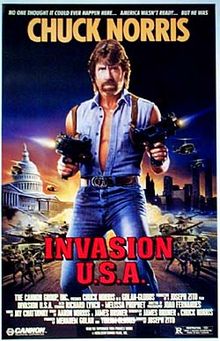
Invasion U.S.A. (1985)

INVASION U.S.A. (1985) *
Joseph Zito made a logical progression from directing mad slasher films The Prowler and The Final Chapter (Jason Voorhees’ third screen entry) to Chuck Norris action spectaculars Missing in Action and Invasion U.S.A for the Cannon Films Group, one of the ultimate purveyors of schlock all through the ’80s.

Their schlock includes Ninja III: The Domination and Breakin’ 2: Electric Boogaloo, both from 1984 and directed by Sam Firstenberg.

Anyway, I digress, which is something that I will invariably do whenever discussing Invasion U.S.A. Yes, I admit upfront this review will be filled with digressions.

The plot: Multinationals with guns (sometimes with subtitles, sometimes without) invade the United States, actually Florida but Invasion Florida doesn’t quite ring the same liberty bell, and one-man army Chuck Norris stops them with bloody ballyhoo. Named Matt Hunter in a fit of poetic fancy, perhaps by one of the writers of this garbage, Norris could have killed ’em all with denim.

Basically, Invasion U.S.A is Red Dawn dumbed down even more and it substitutes teeny bopper Commie scum killers Patrick Swayze, Charlie Sheen, C. Thomas Howell, Jennifer Grey, and Lea Thompson for Norris, who laughably tells us that he works alone. No joke, we know this after ’bout 50 Norris films where his character informs us that he kills scumbags all on his lonesome. I mean, wasn’t one of Norris’ better movies even called Lone Wolf McQuade for crying out loud?

The best Norris pictures have strong supporting characters and casts, who make up for the sometimes personality deficient Norris. Alas, Invasion U.S.A gives us one of the worst characters in not only a Norris movie but all movies in general — an apparent photojournalist named McGuire (Melissa Prophet) who probably should have been named Molly Magsnarl instead. She’s not the least bit grateful for Hunter saving her, and I would have let her meet her ultimate demise after the first time she snarls at me Cowboy. She blows out the tires on Invasion U.S.A every time she’s on screen.

Seeing her camera made me laugh, though, because I thought about how it was John Rambo’s assignment to only take photos of the POWs — not to rescue them — in Rambo: First Blood Part 2.

Speaking of First Blood Part 2, released a few months before Invasion U.S.A, it and Arnold Schwarzenegger’s Commando (released just after Invasion U.S.A) both blow away Invasion U.S.A in the great 1985 One-Man Army Movie Sweepstakes.

I also found a worse movie than Star Trek V: The Final Frontier that includes characters singing Row, Row, Row Your Boat.

The Last Dragon (1985)

THE LAST DRAGON

THE LAST DRAGON (1985) Three stars

Gene Siskel included THE LAST DRAGON among his “Guilty Pleasures” in a 1987 “Siskel & Ebert” show and he gave it one of his funniest reviews, highlighted by “I’m a sucker for glowing fingers. Roger, I see glowing fingers in a movie, I tend to like the movie. … Just one finger (in E.T.), that’s how much I like it. In this one, you get 20. Two men, Roger, 20. Can you imagine the ads? ‘20 times the entertainment value of E.T.’” Siskel gave it three-and-a-half stars in his 1985 print review.

Roger Ebert gave it a mixed negative review and two-and-a-half stars, “THE LAST DRAGON turns into a funny, high-energy combination of karate, romance, rock music and sensational special effects. It’s so entertaining that I could almost recommend it … if it weren’t for an idiotic subplot about a gangster and his girlfriend, a diversion that brings the movie to a dead halt every eight or nine minutes. … They’ve been borrowed from a hundred other movies, they say things that have been said a hundred other times, and they walk around draining the movie of its vitality. They’re tired old cliches getting in the way of the natural energy of Taimak, Vanity and the Shogun character.”

I find myself occupying the middle ground between Siskel and Ebert. They both agreed on the strengths and the weaknesses of THE LAST DRAGON, but Siskel found the strengths to be stronger and Ebert the weaknesses to be weaker. LAST DRAGON co-stars Taimak, Vanity, and Julius J. Carry III are the strengths and Chris Murney as comic gangster Eddie Arkadian and Faith Prince as his aspiring singer girlfriend Angela Viracco are the weaknesses.

Taimak (full name Taimak Guarriello) stars as Leroy Green, who’s inspired by the works of Bruce Lee to such a degree that he’s called “Bruce Leroy.” He’s in pursuit of “The Glow,” referenced memorably by Siskel — see, only a true martial arts master can exhibit “The Glow” over his entire body and that’s Leroy’s No. 1 goal. Scenes like “Don’t think, feel! It’s like a finger pointing away to the moon. Do not concentrate on the finger or you will miss all of the heavenly glory” from ENTER THE DRAGON undoubtedly warmed the heart of Mr. Leroy … and possibly Motown mogul Berry Gordy, whose Motown Productions sponsored THE LAST DRAGON.

He’s opposed by Sho’nuff (Carry III), a.k.a. “The Shogun of Harlem,” who sees Leroy in his way for ultimate martial arts mastery. Sho’nuff interrupts a showing of the sacred text ENTER THE DRAGON in an urban theater and he throws down the gauntlet, “Well well, well. If it ain’t the serious, elusive Leroy Green. I’ve been waiting a long time for this, Leroy. I am sick of hearing these bullshit Superman stories about the — Wassah! — legendary Bruce Leroy catching bullets with his teeth. Catches bullets with his teeth? Nigga please.” Leroy counters with two platitudes that he might have gleaned from the “Kung Fu” TV show, then Sho’nuff throws it down again, “See, now it is mumbo jumbo like that, and skinny little lizards like you thinkin’ they the last dragon that gives kung fu a bad name. Get up, Leroy, I got somethin’ real fo’ yo’ ass in these hands.” Carry III (1952-2008) undoubtedly prepared for his role as Sho’nuff by playing in both DISCO GODFATHER, his debut feature, and THE FISH THAT SAVED PITTSBURGH.

All roads lead to a final showdown between Leroy and Sho’nuff when, sure enough, they both have “The Glow.” Leroy, though, finally exhibits true martial arts mastery.

Bruce Leroy also becomes the protector of television personality Laura Charles (Vanity) against them comic gangsters. She tells Leroy, “I thought that maybe it would be a great idea if I got myself a bodyguard. You know, like someone to guard my body? What girl could do worse than to have her own real life kung fu master?”

THE LAST DRAGON is a lot of fun, especially for viewers who are fans of martial arts spectaculars, particularly Bruce Lee. During the 1985 episode they reviewed THE LAST DRAGON, Siskel and Ebert lamented the lack of quality martial arts entertainment in a special “X-ray segment.” They singled out three “better” martial arts films that predated THE LAST DRAGON: ENTER THE DRAGON, THE OCTAGON starring Chuck Norris, and THE KARATE KID, the surprise blockbuster from 1984. I felt bad for Siskel and Ebert, because it seemed like they missed a great many great martial arts films like DRUNKEN MASTER and THE 36TH CHAMBER OF SHAOLIN, for example, and instead they made several “Dogs of the Week” (their picks for worst movie each episode until September ‘82) from seeing obviously inferior martial arts imports with lousy prints and horrific dubbing. It would be difficult for anybody not to form a negative opinion about martial arts films from seeing only the mass-produced bargain-basement rip-offs that almost immediately came in the wake of Bruce Lee’s death in 1973.

Thankfully, through ventures like the Dragon Dynasty, we can see classics like THE 36TH CHAMBER, KING BOXER (a.k.a. FIVE FINGERS OF DEATH), THE ONE-ARMED SWORDSMAN, FIST OF LEGEND, MAD MONKEY KUNG FU, FIVE DEADLY VENOMS, and EIGHT DIAGRAM POLE FIGHTER in quality prints and not dubbed in dodgy English. Films like these have provided me a ridiculous amount of enjoyment over the years.

Code of Silence (1985)

CODE OF SILENCE

CODE OF SILENCE (1985) Three-and-a-half stars

CODE OF SILENCE and LONE WOLF McQUADE are the best Chuck Norris movies.

They are the ones for people who otherwise grunt and groan at the possibility of watching a Chuck Norris movie. You know, individuals who go, “Ugh, I don’t like Chuck Norris, his movies are so dumb and stupid. They’re ridiculous and redneck.” Then, there’s other people who only want to watch Norris on “Walker, Texas Ranger” re-runs 24 hours a day 365 days a year because they have little tolerance for movie violence and vulgarity.

Let’s get a few things straight: I don’t especially care for Norris’ ultra-conservative politics (he predicted 1,000 years of darkness if Obama won a second term). I hate those darn infomercials that he did with Christie Brinkley plugging exercise machines. I cannot stand “Walker, Texas Ranger,” except for when clips were used for the “Walker, Texas Ranger Lever” on Conan O’Brien. I hate that he sued “Chuck Norris Facts” author Ian Specter because “Mr. Norris is known as an upright citizen to whom God, country, and values are of paramount importance” and “Mr. Norris also is concerned that the book may conflict with his personal values and thereby tarnish his image and cause him significant personal embarrassment.” I often dislike the use of slow motion in many Norris pictures, like, for example, at the end of A FORCE OF ONE and I cannot decide if that ridiculous echoed voice-over in THE OCTAGON is the worst or the funniest thing I have ever heard. Finding all his voice-overs compiled into a 4-minute, 20-second YouTube video, I vote for the latter. I will one day write a review of THE OCTAGON in the style of that voice-over; I remember Richard Meltzer’s review of the Creedence album PENDULUM with a built-in echo. For whatever reason, Norris’ inner monologues in THE OCTAGON call to mind Ted Striker’s cockpit moment when he hears echo and Manny Mota pinch-hitting for Pedro Borbon. THE OCTAGON voice-over is even funnier than the one in AIRPLANE! I understand that I like watching old Norris movies for their camp and nostalgic value. I’d rather watch one than listen to a Ted Nugent album (or song). I apologize for (possibly) coming on so defensive about Carlos.

In the pantheon of action stars, Norris rates below Clint Eastwood, Steve McQueen, Jackie Chan, Bruce Lee, Arnold Schwarzenegger, and Sylvester Stallone. He’s never made a movie quite at the level of THE GOOD, THE BAD AND THE UGLY, THE GREAT ESCAPE, DRUNKEN MASTER, ENTER THE DRAGON, the first two TERMINATOR movies, and ROCKY. Norris belongs in the second tier of action stars.

Back to CODE OF SILENCE (and LONE WOLF McQUADE).

Both movies have good supporting casts — for example, CODE OF SILENCE surrounds Norris with quality character actors like Henry Silva, Bert Remsen, Dennis Farina (before he became a full-time actor), Ralph Foody, Ron Dean, and Joseph F. Kosala.

Andrew Davis directed CODE OF SILENCE, his first action picture, and his later credits include ABOVE THE LAW, THE PACKAGE, UNDER SIEGE, THE FUGITIVE, CHAIN REACTION, and COLLATERAL DAMAGE. THE FUGITIVE, one of the best films of 1993, was nominated for seven Academy Awards, including Best Picture, and good old grizzled Tommy Lee Jones won an Oscar for Best Supporting Actor. He’s a good director, certainly the best of any Norris movie.

At this point in his career, Norris wanted to distance himself somewhat from his karate and become a more polished, all-purpose action star. If all his subsequent movies were more like CODE OF SILENCE, he would have been onto something, but, alas, Norris returned to third- and fourth-rate product like FIREWALKER and MISSING IN ACTION III before finding his greatest commercial success on TV.

In CODE OF SILENCE, Norris plays Chicago policeman Eddie Cusack, who finds himself in the middle of a gang war all while he’s alienated himself from his fellow officers (barring one, his former partner) for breaking the “code of silence” by standing and testifying lone wolf like against a veteran officer (Foody) accused of killing an unarmed teenager.

Norris enlists Prowler on his side for the final confrontation, Prowler a police robot with a tremendous arsenal that kills bad guys good.

We do see one particularly rare scene in any Norris movie: He gets knocked around real good by a group of thugs. That’s not happened often to Norris since he took on Bruce Lee late in WAY OF THE DRAGON.

Between his work in CODE OF SILENCE, ABOVE THE LAW, and THE FUGITIVE, Davis showed himself to be a master of scenes involving the ‘L,’ Chicago’s elevated train rapid transit system that we have seen on many films and shows. There’s a chase and fight scene on top of the ‘L’ in CODE OF SILENCE that belongs with Norris’ flying kick through a windshield in GOOD GUYS WEAR BLACK and driving his super-charged Dodge Ramcharger out of the grave in LONE WOLF McQUADE as the best Norris moments.

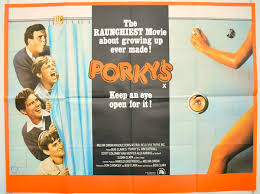
Porky’s (1981)

PORKY'S

PORKY’S (1981) Three stars

“Nobody ever went broke underestimating the intelligence of the American public,” H.L. Mencken famously said.

Mencken said that long before the success of PORKY’S, PORKY’S II: THE NEXT DAY, and PORKY’S REVENGE!, comedies which combined for over $200 million in box office and rental returns. Mencken died in 1956.

PORKY’S earned the vast majority of that $200 million and it came from out of seemingly nowhere to place fifth at the American box office in 1982, behind only breakaway winner E.T., ROCKY III, ON GOLDEN POND, and AN OFFICER AND A GENTLEMAN. PORKY’S sat on top of the American box office from late March through early May and it was dethroned by Arnold Schwarzenegger and CONAN THE BARBARIAN.

Unlike those other films, however, critics absolutely detested PORKY’S and aligned it with FRIDAY THE 13TH and THE CANNONBALL RUN in an unholy trinity of films that would no doubt lead to the downfall of Western Civilization. PORKY’S exhibits more than most how a film can be hated by critics and loved by the masses.

The success of the first PORKY’S spawned a whole slew of teenage sex comedies, often nostalgic and especially set in either the 1950s or 1960s.

I claimed a copy of PORKY’S as one of my first VHS purchases in my late teenage years and it quickly became a favorite movie of my rowdy group of friends. We loved it, as well as NATIONAL LAMPOON’S ANIMAL HOUSE, CADDYSHACK, KINGPIN, and THE BIG LEBOWSKI.

Every time I watch PORKY’S, I find a few big laughs and that’s why I am giving the film a passing grade. As far as the sequels are concerned, they are dreadful and deserve their horrible reputation. I remember seeing all of them in heavily edited form on “USA Up All Night,” before catching up with them all on video or pay TV.

Of course, our seven high school horn balls in PORKY’S are all played by older actors: Dan Monahan turned 26 in 1981, Mark Herrier 27, Wyatt Knight 26, Roger Wilson 25, Cyril O’Reilly 23, Tony Ganios 22, and Scott Colomby 29. That’s not anything new for a Hollywood film. For example, in GREASE, another highly successful nostalgia piece, John Travolta was 23 when he made it and Olivia Newton-John was 28 almost 29, Stockard Channing 33, Jeff Conaway 27, Barry Pearl 27, and Michael Tucci 31 when they were playing high school students.

Speaking of GREASE, one could describe PORKY’S as GREASE with T&A and rednecks instead of PG and greasers and without musical numbers.

PORKY’S includes sex jokes, condom jokes, sex jokes, size jokes, sex jokes, nude jokes, sex jokes, penis jokes, sex jokes, virgin jokes, sex jokes, and fat jokes, especially at the expense of villains Porky (Chuck Mitchell, a 6-foot-3, nearly 400-pound man) and Ms. Beulah Balbricker (Nancy Parsons).

Porky is a real vile piece of work, a saloon and brothel owner who is the most powerful man in his county. Every public official seems to be related to Mr. Wallace, namely his brother Sheriff Wallace (former NFL great Alex Karras). Mitchell wraps his best redneck goon around such dialogue as “I was givin’ the old place an enema and this pile of shit come floatin’ up to the surface” and “Where are these five little virgins who think they reached manhood? You wanna tangle ass with me? Come up here, you sawed-off punk! I’ll educate ya! I’ll wrap this right around your damn neck!” It is to Mitchell’s credit that he creates such a nasty character that we do root for his comeuppance in the final reel.

Balbricker embodies the worst killjoy or she’s basically portrayed as the Carrie Nation of the teenage sex comedy. Less successful, though, much less successful. After all, Carrie Nation (1846-1911) said things like “I felt invincible. My strength was that of a giant. God was certainly standing by me. I smashed five saloons with rocks before I ever took a hatchet” and “I want all hellions to quit puffing that hell fume in God’s clean air.” Balbricker (also called “Ball-breaker” and “King Kong” by other characters) develops an obsession with one character’s penis. Please can we call it a tallywhacker? Penis is so personal. Parsons, like Mitchell, gives a very good performance, one that rates with John Vernon in ANIMAL HOUSE.

Kim Cattrall must have used her work here as Miss Honeywell (“Lassie”) during her audition for “Sex and the City.” It definitely beats MANNEQUIN.

Writer and director Bob Clark (1939-2007) has a very interesting story and filmography, since his credits include the 1974 proto-slasher BLACK CHRISTMAS, the beloved A CHRISTMAS STORY, and the first two PORKY’S films, as well as even more diverse entries like MURDER BY DECREE, TRIBUTE, RHINESTONE, TURK 182!, LOOSE CANNONS, and BABY GENIUSES.

His entry in “Take One’s Essential Guide to Canadian Film” from 2001 : “Clark turned down bids to play pro football to complete a drama major at the University of Miami. With the success of his low-budget horror classic CHILDREN SHOULDN’T PLAY WITH DEAD THINGS, Clark moved to Montreal in 1973 and came to dominate Canadian commercial filmmaking for a decade. He followed CHILDREN with BLACK CHRISTMAS, a box-office hit starring Margot Kidder, and then, from 1978 to 1981, he directed MURDER BY DECREE, TRIBUTE, and PORKY’S – three of the most successful films produced in the tax-shelter era. Sad to say, the sophomoric PORKY’S remains the Canadian box-office champ. Clark returned to the United States in 1984; his career, like his locale, has gone south since.”

I read that Clark gathered the material for PORKY’S over a 15-year period, combining stories from other males of his generation with his own experiences. Every Hollywood studio passed on PORKY’S and it was produced by the Canadian company Astral Bellevue Pathe and Melvin Simon Productions (Mr. Simon, who died in 2009 at the age of 82, developed Mall of America, co-owned the Indiana Pacers along with his brother Herbert, and produced films including PORKY’S, THE STUNT MAN, and ZORRO, THE GAY BLADE), but 20th Century Fox picked up the U.S. distribution and a slick marketing campaign, combined with strong word-of-mouth, produced a monster hit on a $4 million budget.

Clark passionately defended the film amid the constant cries of misogyny and racism.

Those critics are missing that Wendy, played by Kaki Hunter, is often the sunniest presence and that Clark set his film in the Deep South in 1954. One character does overcome his initial anti-Semitism and becomes friends with a Jewish classmate.

THE NEXT DAY seems to address both criticisms, though, with one thoughtful dialogue scene between Wendy and main horn ball Pee-Wee (Monahan) and then adds a fanatical reverend, hypocritical politicians, a Native American, and the Ku Klux Klan to the mix. All the latter material simply does not mesh with the juvenile sex comedy.

Clark did not return to direct REVENGE and director James Komack and screenwriter Ziggy Steinberg wanted the third installment to return to the pure sex farce of the first movie. All the actors simply look too long in the tooth to be partaking in such adolescent shenanigans. I mean, for crying out loud, Colomby was nearly in his mid-30s by the point they made this third PORKY’S film; he graduated from Beverly Hills High School in 1970. Bottom line: I laughed not a single time at PORKY’S REVENGE, maybe once at NEXT DAY.


PORKY’S II: THE NEXT DAY (1983) One star; PORKY’S REVENGE! (1985) No stars

Fright Night (1985)

FRIGHT NIGHT

FRIGHT NIGHT (1985) Three-and-a-half stars

In a not-at-all shocking revelation, Crispin Glover admitted that he did FRIDAY THE 13TH: THE FINAL CHAPTER (1984) because he needed the money and that he does not think much of the slasher film genre overall.

“I’ve only seen two of those films, I saw the original film [FRIDAY THE 13TH] and the one that I’m in,” Glover told Yahoo! Movies. “I remember when I saw the original one, not too long before it I’d seen the original TEXAS CHAINSAW MASSACRE, and when I saw the first FRIDAY THE 13TH, I thought, ‘Well, this is extremely derivative.'”

Not sure what Glover thinks of FRIGHT NIGHT, but surely he can relate to the dialogue from horror movie host Peter Vincent (Roddy McDowall) after he’s fired by that darn TV station wrapped up in demographics and ratings.

“I have just been fired because nobody wants to see vampire killers anymore, or vampires either. Apparently, all they want to see are demented madmen running around in ski-masks, hacking up young virgins.”

FRIGHT NIGHT gives us vampires and vampire killers, and it’s one of the best examples from a decade of horror movies that successfully mixed horror and comedy. That’s part of a grand tradition that started with all them Universal classics in the 1930s.

FRIGHT NIGHT both pays tribute to classic horror movies of the variety that we’d see on late night TV and updates them for contemporary audiences and mores, taking in the rising expectations for special effects and our increased demand for gore and nudity. Richard Edlund, whose previous credits include RAIDERS OF THE LOST ARK and GHOSTBUSTERS, delivers the gore effect goods late on in FRIGHT NIGHT and Chris Sarandon’s head vampire Jerry Dandridge is both a charming ladies killer and a nasty piece of work. He’s not one of them pretty boy puss vampires that we have seen in such bastardizations of the genre as TWILIGHT and DRACULA 2000.

The name Peter Vincent itself descends from actors Peter Cushing and Vincent Price, who are symbolic of the horror movies obviously loved by director and screenwriter Tom Holland. Cushing slayed Dracula several times in Hammer films, as he played Van Helsing in HORROR OF DRACULA, DRACULA A.D. 1972, THE SATANIC RITES OF DRACULA, THE BRIDES OF DRACULA, and THE LEGEND OF THE 7 GOLDEN VAMPIRES. He should not be mistaken for Christopher Lee, who played Dracula so many times that a Hollywood traffic cop once pulled over the actor and asked him if he should be out in the daylight.

I wonder if Cushing (1913-94) and Price (1911-93) saw FRIGHT NIGHT and what they made of both the film and the Peter Vincent character. (McDowall said that he used “The Cowardly Lion” from THE WIZARD OF OZ as his inspiration for Peter Vincent. As a guest at one of McDowall’s parties, Price said FRIGHT NIGHT was wonderful and McDowall gave a wonderful performance.)

McDowall’s Vincent is one of those characters that elevate a film. Fortunately, there’s a few more memorable characters in FRIGHT NIGHT.

William Ragsdale plays our bright-eyed high school protagonist Charley Brewster who just might be Peter Vincent’s biggest fan. He never misses a “Fright Night” episode. Mr. Brewster encounters great difficulty getting anybody to believe him that his next-door neighbor, the charming and good-looking Jerry, is a vampire. Everybody thinks it’s just a byproduct of Charley’s overactive imagination only made worse by horror movies.

Peter ultimately believes Charley and the old washed-up actor becomes a real-life vampire hunter, paired up with the horror movie fanatic. They believe in each other.

Amanda Bearse is Charley’s girlfriend and Jerry’s target for his vampire bride, since she resembles the lady in that painting on his wall or Bearse’s Amy is the reincarnation of Jerry’s long-lost love. Stephen Geoffreys, who looked like he was Jack Nicholson’s son, almost steals every scene that he’s in as Evil Ed, Charley’s friend.

FRIGHT NIGHT has made a lasting impression on me. I first watched it as part of a horror movie marathon during a friend’s slumber party. It was the film that I remembered most fondly and it stuck with me for several years before watching it again.

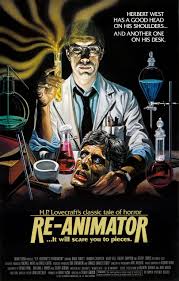
Re-Animator (1985)

RE-ANIMATOR

RE-ANIMATOR (1985) Four stars

Watching director Stuart Gordon’s feature debut for the first time in a theater and the first time in a couple years, I became impressed all over again by a horror movie that’s so gory and gross that it crosses over from gory and gross into surreal and comical.

DAWN OF THE DEAD (1978) and EVIL DEAD II (1987) are two more examples.

I also became impressed once again by the performances of Jeffrey Combs as Herbert West and the late David Gale as Dr. Carl Hill. Their work helps elevate RE-ANIMATOR.

I absolutely love Combs’ performance in RE-ANIMATOR. West’s a mad scientist pushed to the absolute limit of madness, but he’s not the least bit campy. He’s intense and 1,000 percent committed to his life’s work. West never waivers from this intensity, not even in the face of death or being kicked out of medical school. Mr. West has developed a reagent that can re-animate dead bodies, and his experiments graduate from a house cat to humans. West will see it through.

The poster’s tagline: “Herbert West has a good head on his shoulders … and another one on his desk.”

That another one belongs to Dr. Hill, whose ego and libido are epic and legendary.

Gale (1936-91) plays Dr. Hill in sleaze mode. This is a character that you absolutely love to hate. You want to see him bashed over the head with that shovel, but you also enjoy when his disembodied head takes command over the rest of his body and then takes control of the situation against West and his reluctant partner Dan Cain (Bruce Abbott). West hates Dr. Hill from the get-go and it’s fun to watch their mutual hatred for each other develop over RE-ANIMATOR.

Dr. Hill lusts after both Cain’s fiancee Megan (Barbara Crampton) and West’s reagent, and his intense lusting only makes this character even more hatable.

Crampton plays a tougher role than any of the boys: She gasps and screams a lot, understandably so, and she’s naked a couple times, including for one of the most interesting sex scenes around since it alternates between disturbing and comical. Let’s just say the disembodied head of Dr. Hill attempts to carry out his depraved sexual fantasies.

RE-ANIMATOR follows Mr. West and Dr. Hill into some ripped, twisted territory, but it’s also delightfully funny.

In a review of AN AMERICAN WEREWOLF IN LONDON, I rattled off a bunch of titles from the 80s that effectively balanced horror and comedy: EVIL DEAD II, FRIGHT NIGHT, GREMLINS, GHOSTBUSTERS, KILLER KLOWNS FROM OUTER SPACE, and, yes, of course, RE-ANIMATOR.

Those films carry on the proud tradition of the great 1930s horror films that successfully integrated comedy into horror, without one sacrificing the other. You can laugh one moment and be frightened the next, or delighted that next moment, all legitimate reactions.

Guess it’s the highest praise for RE-ANIMATOR when you say that it could have been directed by James Whale (1889-1957), who brought us FRANKENSTEIN, THE OLD DARK HOUSE, THE INVISIBLE MAN, and BRIDE OF FRANKENSTEIN.

Teen Wolf (1985)

TEEN WOLF

TEEN WOLF (1985) Three stars

During the review of SILVER BULLET, TEEN WOLF came to mind and then I looked up a rather negative review I wrote 10 years ago.

A decade later, I recommend TEEN WOLF for the very things I once mocked. Here’s the original two-star review (with only small edits):

“TEEN WOLF almost succeeds in spite of itself and I do mean in spite of itself.

“The film stockpiles a nuclear arsenal of cliches. Next time I see Kim Jong-Il I will ask him what he thinks of the film, in between our usual rap session ‘bout FRIDAY THE 13TH films. Let’s see, I’ll have to make a list otherwise my brain will explode and that cannot happen before Finals Week, let alone Dead Week.

“I’ll briefly mention 1) the Nebraska small town setting; 2) the loving, single widower and his teenage son protagonist on their own; 3) the teenage son protagonist feels he’s doomed to an eternity of being “average” until he finds out that he can be a teenage werewolf just like Michael Landon and the Cramps song before him; 4) the protagonist’s hipster and profiteer best friend; 5) the “fat guy” fifth wheel nicknamed, oh you’ll love this one, “Chubby”; 6) The Blonde = Bad Girl and The Brunette = Good Girl formula; 7)the protagonist lusts after the Blonde, actually succeeds in sleeping with the Blonde as the Wolf, and ends up realizing his undying love for the Brunette in the final act though she prefers “average” Scott Howard over the Wolf; 8) the Blonde’s Evil Overlord of Brooding Hot Shot boyfriend and the protagonist’s eternal foil; 9) the Evil Principal; 10) the wise guy head basketball coach who spits out incantations of advice rejected by Fortune 500 fortune cookie companies; 11) the scene where the protagonist faces down a wily old liquor store veteran who’s heard every scam ever to purchase some alcoholic contraband for a monster party; 12) The Monster Party; 13) The Big High School Dance; and I believe I’m done after this one, 14) The Big Game. Sorry, I apologize in advance for missing a few there.

“Once we grant the film’s central premise, that werewolf genes run down a family’s genetic line, which sounds too much like TWILIGHT for its own good before Taylor Lautner was even born, what’s wrong with a few generic movie standards? Nothing, absolutely nothing, except for when taken in tandem our friendly standards make for a generic motion picture spread. TEEN WOLF almost set the cliche land speed record.

“Michael J. Fox makes for a likable, charismatic protagonist and his energetic movie star performance lets us live through standard, predictable material. He enlists us on his side, whether he’s average small town boy lined up to inherit his father’s small town hardware store, Scott Howard, or his alter ego, ultra-cool and ultra-hip and dazzling slam dunker “The Wolf.” Fox essentially plays the Lon Chaney existential dread film werewolf crossed with John Travolta in SATURDAY NIGHT FEVER (at least for the big dance sequence and the big preparation for the dance sequence) and Julius Erving, as well as having issues with anger management and teenage angst.

“Do teen wolves get pimples? TEEN WOLF fails to address several burning questions. Especially not a PG-rated TEEN WOLF. Fox plays these scenes ‘bout as good as any actor possibly can and we stomach him through every predictable change like, for example, how Scott Howard transforms himself into above average when he’s the Wolf: He can dance, he can act, he can surf on slow-moving customized Wolf vans, and he can play mean basketball. Scott Howard eventually turns his back on ‘Wolf Mania’ and decides to be himself for The Big Game.

“James Hampton must have enjoyed playing a humble, sagely teenage protagonist’s old man in TEEN WOLF, considering his past as evil public relations man in THE CHINA SYNDROME and his future as evil federal regulatory agency man in PUMP UP THE VOLUME. Susan Ursitti breathes some fire into her standard issue role as the Brunette / Good Girl and this is both good and bad, good because it makes our lives relatively less boring and bad ‘cause we get even more frustrated by the wait for the inevitable dramatic (overdue) realization made by the protagonist that she’s meant for him, forever. The Bad Girl and her maligned Evil Overlord of Brooding Hot Shit boyfriend are the only characters who fail to entertain us, interest us, et cetera. They’re not very good performers and it’s painful waiting for their inevitable downfalls.

“Surely Teen Wolf’s impressive slam dunk artistry did not inspire Spud Webb, the 5’7” Atlanta Hawks point guard who prevailed in the NBA Slam Dunk Contest at the 1986 NBA All-Star Weekend in Dallas, besting his own Atlanta Hawks teammate, Dominique Wilkins. Michael J. Fox, why he’s short and he’s Canadian, two proverbial strikes against him, so naturally it takes a stunt double werewolf for him to slam dunk. I would have thought a werewolf’s claws would have made playing basketball like a proverbial artiste virtually impossible. Anything goes, in the movies.

“Hey wait, lovely lads and lovely ladies, I recollect another standard trotted out by TEEN WOLF. The montage. The “Winning Streak” Montage. The Car Surfing Montage. The Big High School Dance Montage. The Big Game Montage. Hyperkinetic action scored by a hyperkinetic rock song. For the big dance montage, we get a bad theme song namedropping “The Big Bad Wolf.” It’s an unwritten rule that any 1980s movie referencing itself in song, like PROM NIGHT and BETTER OFF DEAD, will turn out crap. When in doubt, filmmakers, yes, bring on a montage of hyperkinetic action (basketball, dancing, violence) scored by hyperkinetic rock music. TEEN WOLF competes with THE HEAVENLY KID and OVER THE TOP for montage land speed record. I bet the composers do not put TEEN WOLF down on their permanent record.

“Oh, now I remember a couple more standard tricks exploited by TEEN WOLF. Slow motion. BONNIE AND CLYDE and THE WILD BUNCH used slow motion to brilliant effect, as did early Bruce Lee karate films, but lesser films like BLACK BELT JONES made slow motion passé, not to mention its overuse on sports television. Want to see Teen Wolf slam dunk for what feels like the hundredth billionth time? Watch TEEN WOLF! Want to see “average” Scott Howard’s lay-up that barely makes it around the cup and in? Watch TEEN WOLF!

“Now, here we have a standard within a standard: late in the game, Scott Howard gets clotheslined on a final shot layup attempt by his eternal foil (at least for 90 minutes eternity) and his team, the Beavers, are down by one point and two made free throws will naturally win The Big Game for the Beavers.

“Howard steps to the free throw line … his eternal foil stares him down … he makes the first one, smoothly … the second free throw … it’s released … it’s looking good … it’s SLOW MOTION … slower and slower … oh no! … it hits the back of the rim … slower and slower and even slower motion … it touches almost every corner of the rim … and it finally rolls in … reaction shots galore … NO MORE SLOW MOTION … and the crowd storms the court in celebration of either the end of the Big Game, the end of the movie, the end of shooting the movie, or all three simultaneously. I’ll bet on all three ‘cause I know they were solid pros.

“Rod Daniel, oh what a director, this here Rod Daniel. TEEN WOLF perhaps represents the peak of Rod Daniel’s cinematic directorial career, TEEN WOLF up against the Dudley Moore-Kirk Cameron body switch masterpiece of dreck cinema LIKE FATHER LIKE SON and the BEETHOVEN sequel. I favor a slam-dunking, breakdancing Teen Wolf over a born again Kirk Cameron (Jesus couldn’t save Kirk Cameron’s acting) and Charles Grodin overshadowed by a dog. At least, Daniel had the decency not to direct TEEN WOLF TOO. On this or any other job, you win some, you lose some.”

Not sure what came over me when I wrote that review 10 years ago, especially since I have enjoyed TEEN WOLF many times over the years. A lot of the success of TEEN WOLF has to do with Michael J. Fox at the center. After all, with Jason Bateman in the title role instead, TEEN WOLF TOO proved to be a disaster, although that’s partly because TEEN WOLF did not require a sequel.

Silver Bullet (1985)

SILVER BULLET

SILVER BULLET (1985) Two stars

“It’s such a fine line between stupid, and clever.”

— Spinal Tap lead singer David St. Hubbins

That’s one way to describe the Stephen King adaptation SILVER BULLET, which has left viewers from day one debating whether or not the film makers were intentionally parodying Stephen King and werewolf movies by making so many individual details ridiculous.

Many reviewers just considered SILVER BULLET to be laughably bad and not in the good way, hot on the entrails of previous laughably bad King adaptations CUJO and CHILDREN OF THE CORN.

Watching SILVER BULLET for the first time in many, many years, I must admit the internal split and acknowledge the fine line between stupid and clever.

Let us consider:

— We have a narrator (Broadway standout Tovah Feldshuh) who sounds like an old woman, although it’s only nine years after the main events depicted in the film when she was 15 years old. Feldshuh’s even listed as playing “Older Jane.”

— Gary Busey plays Uncle Red, a womanizing drunkard who dotes on paralyzed prepubescent protagonist Marty Coslaw (Corey Haim), Jane’s younger brother, and makes the boy customized wheelchairs called “The Silver Bullet.” I remembered the second wheelchair most from previous viewings of the film when I was roughly the same age as Marty.

— That second wheelchair, oh wow, just let me tell you that you’ve not enjoyed a complete moviegoing life until you’ve seen the scene where our priest / werewolf (Everett McGill) stalks Marty and his souped-up “Silver Bullet” in broad daylight. Marty’s second great escape is even greater than his first.

— Uncle Red should have pursued a career in wheelchair manufacturing.

— This review gives away the identity of the werewolf. Big deal. The movie tips off the identity almost immediately, but, of course, in a movie like SILVER BULLET, the townspeople are nincompoops and it takes young ones like Marty and Jane to figure out the truth. Those nincompoops are on an epic scale of nincompoop. I mean, it’s tipped off so obviously that “WEREWOLF” should have flashed on the screen below the character. They all should have died.

— The nincompoops form a “Citizens Action Brigade” in the first 30 minutes … after four killings. They load up on guns, load up into trucks, head out into the woods, step into traps, et cetera. Two nincompoops produce one of the great dialogue exchanges from the Planet X. …

Maggie Andrews: What’s the matter, Bobby? You gonna make lemonade in your pants?

Bobby Robertson: I ain’t scared!

— The werewolf resembles a black bear. After the technological advances made in the werewolf movie just four years earlier by THE HOWLING and AN AMERICAN WEREWOLF IN LONDON, SILVER BULLET set the species back years.

If they remade SILVER BULLET today, would the original be called a “classic”? Undoubtedly yes, of course, because every old movie remade automatically becomes “classic.” We’ve heard that incessantly about the 1989 PET SEMATARY, for example.

SILVER BULLET, like PET SEMATARY, is not a classic by any definition — “Judged over a period of time to be of the highest quality and outstanding of its kind” or “A work of art of recognized and established value.”

For crying out loud, TEEN WOLF — released a couple months before SILVER BULLET — stands up better.

Back to the Future Trilogy (1985-90)


BACK TO THE FUTURE TRILOGY (1985-1990)
The BACK TO THE FUTURE trilogy stands up better now than when the films were originally released.

That’s partly because we’ve not seen any more sequels or remakes, retcons, reboots, and ripoffs.

The three films have been allowed to stand on their own.

They stand up tall and straight.

Once upon a time, I wrote that DAWN OF THE DEAD, THE TERMINATOR, and THE FLY are great films because they not only succeed at giving audiences satisfaction on genre terms but they also work on additional levels. For example, the satire that equates mall shoppers with zombies (DAWN OF THE DEAD), the romance between Kyle Reese and Sarah Connor (THE TERMINATOR), and the romance between Seth Brundle and Veronica (THE FLY). All three films have a lot going on for and in them.

The same greatness principle holds true for all three BACK TO THE FUTURE films: They’re all successful comedies that work on a deeper level, mostly thanks to time travel.

Speaking of time travel, I’m definitely a fan because I love THE TERMINATOR, TIME AFTER TIME, X-MEN: DAYS OF FUTURE PAST, and MEN IN BLACK 3 and enjoy BILL & TED’S EXCELLENT ADVENTURE, STAR TREK IV: THE VOYAGE HOME, and FREQUENCY, for example.

The BACK TO THE FUTURE films — especially PART II — play around with the paradoxes of time travel, both for comedic and dramatic effect. It allows certain actors to play multiple roles in different times — 1885, 1955, 1985, alternate 1985, and 2015.

BACK TO THE FUTURE starts with the inspiration of containing a time machine in a DeLorean and the movie revs up when that baby moves 88 mph because, as Christopher Lloyd’s Dr. Emmett “Doc” Brown says, “If my calculations are correct, when this baby hits 88 miles per hour, you’re gonna see some serious shit.”

We do.

Anyway, our teenage protagonist Marty McFly (played by a 23-year-old Michael J. Fox), he’s bummed out by his parents George (Crispin Glover) and Lorraine (Lea Thompson), a hopeless nerd picked on by eternal bully Biff Tannen (Thomas F. Wilson) for one parent and a drunk for the other.

Sitting at the dinner table with his family, Marty’s not too interested in how his parents met: Lorraine’s father hit George with his car and Lorraine nursed George back to health. Lorraine experienced a real Florence Nightingale effect.

However, no kid’s ever all that interested in how their parents met. Especially parents like George and Lorraine.

The DeLorean hits 88 mph and Marty ends up back in 1955 — Nov. 5, 1955, stuck there, without any plutonium to return.

BACK TO THE FUTURE then becomes an even greater movie when it takes on the premise of a teenager meeting their parents when they’re teenagers. Marty’s a lot more interested in how his parents met, that’s for sure.

Not long after their first meeting in 1955, Marty saves George from being hit by that fateful car. Marty’s knocked unconscious instead and Nurse Lorraine grows “amorously infatuated” (Doc’s words) with her future son rather than her future husband. She’s in hot pursuit, and we remember her 1985 self warning her teenaged son about girls that chase after boys.

Just be glad that Marty finds a younger Doc to sort it all out and get him “back to the future.”

We especially need Doc around for PART II to explain the movie’s convoluted plot.

PART II gives us a version of 2015 highlighted by technological advancements. It was great fun watching the 2015 scenes in 1989 based on future speculation and it’s still great fun watching them 30 years later as we reflect what they got right and what they got wrong. The Royals, not the Cubs though, won the World Series and Universal mercifully stopped at four JAWS films.

(The Cubs ended the longest world championship drought in North American professional sports history — only 108 years — by winning the 2016 World Series.)

Futurepedia even provided a list of the new technology: Air traffic control; auto-adjusting and auto-drying jacket; automatic dog walker; automated Texaco service station; barcode license plate; binocular card; bionic implants; Compu-Fax; Compu-Serve; computerized breastplate; cosmetic factory; data-court; dehydrated pizza; dust-repellent paper; flying circuits; fruit dispenser; hands free video games; holobillboard; holofilms a la JAWS 19; hoverboards; hovercam; hover conversion; hydrator; Identa-pad; Internet; Kirk Gibson Jr. Slugger 2000 adjustable bat; Litter Bugs; Master-cook; Mr. Fusion; multi-channel video screen; neon curbing; Ortho-lev; Pac Fax; portable thumb unit; power-lacing shoes; rejuvenation clinic; scene screen; skyway; slam ball; sleeping device; soda bottles with built-in straws; flying cars; tablet computer; thumb pad; tranquilization; transponder; U.S. Weather Service; video glasses and video telephone glasses; video simulacrum; video telephone.

PART II ends up back in Nov. 12, 1955 (Marty’s final day in 1955 in BACK TO THE FUTURE), so we have two Martys and two Docs running breathlessly around Hill Valley.

Given all the plot convolutions and time permutations in PART II, it’s fitting that the 1955 Doc faints during a scene late in the movie.

Lightning strikes the DeLorean and sends Doc back to 1885 near the end of PART II … and Marty tracks him down in PART III.

We get a Western comedy in a year that included Best Picture winner DANCES WITH WOLVES and QUIGLEY DOWN UNDER.

PART III finds employment for veteran character actors Pat Buttram (1915-94), Harry Carey Jr. (1921-2012), and Dub Taylor (1907-94) in the 1885 scenes. It’s nice to see and hear them codgers.

Their presence lets us know that PART III is a different kind of Western than DANCES WITH WOLVES and QUIGLEY DOWN UNDER, more like a TV Western.

Marty takes Clint Eastwood for his 1885 name.

PART III casts Mary Steenburgen as Doc’s love interest and we remember Steenburgen as H.G. Wells’ love interest in TIME AFTER TIME (1979). Wells wrote “The Time Machine.” In TIME AFTER TIME, Jack the Ripper uses Wells’ time machine to travel to modern day San Francisco and Wells follows and pursues Jack the Ripper. During his pursuit, Wells meets bank clerk Amy (Steenburgen) and falls in love with her. (In real life, McDowell and Steenburgen became married in 1980, separated in 1989, and divorced in 1990. They met and began dating making TIME AFTER TIME.)

The BACK TO THE FUTURE trilogy ends on a satisfying note.

More notes on BACK TO THE FUTURE:

— Michael J. Fox is one of the most likable actors of all-time. He was the first choice for Marty, but “Family Ties” producer Gary David Goldberg refused to allow Fox away from that show to make a movie. That’s why BACK TO THE FUTURE originally cast Eric Stoltz as Marty. Stoltz worked a few weeks on the film before director Robert Zemeckis and screenwriter Bob Gale realized there’s something wrong with Stoltz as Marty: He’s not the Marty they wanted. Stoltz lacked screwball energy and he played scenes more dramatically. They let Stoltz go and recast with Fox, who became free to make the movie. Fox did not have to reach very far to portray Marty, “All I did in high school was skateboard, chase girls, and play in bands. I even dreamed of becoming a rock star.”

For two months, Fox worked on “Family Ties” during the day and BACK TO THE FUTURE at night, giving him at most a few hours of sleep each day.

Re-shooting added $3 million to the film’s budget, a number more than made up for by grosses for all three films that have amassed nearly $1 billion in returns.

— Christopher Lloyd’s boundless madcap energy earns Doc a place in the annals of great mad scientists and nutty professors. He becomes more than that, though, over the course of three movies. We love Doc, perhaps more than any other character in the series.

— Thomas F. Wilson makes any variation on the bully, whether it’s Buford “Mad Dog,” Biff, or Griff Tannen and whether it’s 1885, 1955, 1985, alternate 1985, or 2015, a lovable asshole. We love to hate “Mad Dog,” Biff, and Griff, especially Biff. We love every time Biff screws up a phrase like “Make like a tree … and get out of here.” We love every time he’s doused in manure. We love every time he’s burned and showed up by our protagonists. How do you feel after learning Donald Trump inspired the Biff character?

— Crispin Glover proved to be the next evolution in screen nerd, taking off from Eddie Deezen and REVENGE OF THE NERDS. Glover stepped in that direction in FRIDAY THE 13TH: THE FINAL CHAPTER, but he gets a fuller character in BACK TO THE FUTURE.

— Lea Thompson is quite fetching in the 1955 scenes and her character unknowingly lusting after her future son fits into a career where she was attacked by The Great White Mother in JAWS 3-D, yelled at and embarrassed by her sexually frustrated and football obsessed boyfriend in ALL THE RIGHT MOVES, involved with a married police officer who should have arrested himself for his own sex crimes in THE WILD LIFE, and kissed by an animatronic duck in HOWARD THE DUCK. John Hughes at least gave her the name Amanda Jones in SOME KIND OF WONDERFUL, from the Rolling Stones song “Miss Amanda Jones.” What a career.

— Huey Lewis and the News’ “Power of Love” achieves being their only song that does not inspire my thoughts of giving the nearest person a pencil and having them stab my eardrums. For example, it seemed that for the longest time at the Pittsburg Subway I’d hear their hit song “The Heart of Rock & Roll.” Every damn single time. I survived by wisecracking, “If Huey Lewis is the heart of rock ’n’ roll, then rock ’n’ roll needs a defibrillator.” I suppose I think more positively of “Power of Love” from being in BACK TO THE FUTURE.

— Zemeckis produced some of the best mass entertainments for nearly a decade-and-a-half, everything from 1941 (directed by Steven Spielberg) and USED CARS to BACK TO THE FUTURE and WHO FRAMED ROGER RABBIT.

I just hope that Hollywood leaves those films alone and does not burden us with remakes, retcons, reboots, or any other ripoff.

Is that too much to ask?

BACK TO THE FUTURE (1985) Four stars; BACK TO THE FUTURE PART II (1989) Three-and-a-half stars; BACK TO THE FUTURE PART III (1990) Four stars

Rambo: First Blood Part II (1985)

day 67, first blood part ii

RAMBO: FIRST BLOOD PART II (1985) Three stars
Sylvester Stallone has proven responsible for two movie franchises, ROCKY and RAMBO, that have produced a combined 12 films over the last four decades.

Outside those franchises, though, it’s been a struggle for the actor, writer, and director, barring a $255 million worldwide hit like CLIFFHANGER. (We’ll see how many EXPENDABLES installments they make.)

Honestly, it’s been a struggle for this viewer to stay interested through sheer crap like STOP! OR MY MOM WILL SHOOT!, for example, or to enjoy something like OVER THE TOP as more than an exercise in overblown ridiculousness (arm wrestling, child custody, and truck driving).

Given a choice between Stallone franchises, I’ll take ROCKY.

RAMBO: FIRST BLOOD PART II works best on a comic book level, just like a couple of the ROCKY pictures from that era.

Just the other day, we took a look back at COMMANDO, a similar cinematic action comic strip with a muscular actor whose surname begins with the same letter.

FIRST BLOOD PART II came out May 22, 1985, while COMMANDO blew up screens beginning October 4, 1985. Only during the Cold War, baby!

Just like I prefer ROCKY over RAMBO, I prefer COMMANDO over FIRST BLOOD PART II for a similar reason.

FIRST BLOOD PART II makes a dread mistake with the female character Co-Bao, played by Julia Nickson. Why did they create her character in the first place?

Let’s be honest, Rambo and FIRST BLOOD PART II don’t know what to do with her. We don’t have time for love in this universe. It just bogs everything down.

Outside the first couple ROCKY movies, it’s often been a struggle for women characters in Stallone movies.

Rambo and Co-Bao are no Rocky and Adrian, for sure.

Rae Dawn Chong’s Cindy provided an unexpected bright spot in COMMANDO and helped elevate it above FIRST BLOOD PART II.

I don’t know, I just cringe when I hear Co-Bao ask Rambo to take her with him.

Then, she’s killed because, let’s face it, FIRST BLOOD PART II handles violence better than any other human attribute.

Her death means that a distraction’s out of the way and we can get back to the true love at the heart of FIRST BLOOD PART II.

I found the number of kills in the RAMBO movies: one in FIRST BLOOD, 74 in the first sequel, 115 in the third edition, and 254 in the fourth installment.

According to moviebodycounts.com, COMMANDO featured 88 kills, including 74 in the grand finale.

HOT SHOTS! PART DEUX satirized this rather well.

Frank Stallone’s big musical number over the FIRST BLOOD PART II end credits, why, you guessed it, it’s called “Peace In Our Life.” Yeah right, there’s barely even a moment of peace in the entire movie.

On a big, dumb action movie level, though, I enjoy both FIRST BLOOD PART II and RAMBO III. That’s about the only level I can enjoy them. I love that we have a protagonist who speaks less and less over time. When he does speak, though, we go back to enjoying the silence. “To survive war, you gotta become war,” I believe Gizmo adapted that mighty well in GREMLINS 2: THE NEW BATCH.

If you think about FIRST BLOOD PART II, it falls apart or it disgusts you.

For example, let’s start with the premise that Rambo’s assigned to go to Vietnam to only take reconnaissance photographs of possible POWs. No engagement of the enemy whatsoever.

Yeah, sure, he’s a regular Henri Cartier-Bresson (1908-2004).

Murdock (Charles Napier) should have known better.

I mean, he only reads the following aloud, “Rambo, John J. Born 7-6-47 in Bowie, Arizona. Of Indian-German descent, that’s a hell of a combination. Joined the army 8-6-64. Accepted special forces, specialization: light weapon, medic, helicopter, and language qualified. 59 confirmed kills. Two Silver Stars, four Bronze, four Purple Hearts. Distinguished Service Cross and Medal of Honor. You got around, didn’t you? Incredible.”

Yeah, sure, no engagement of the enemy. Only photos. I mean, where does it say that in Rambo’s dossier?

We know, of course, that Murdock set Rambo up to fail and that Rambo will not fail … again, Murdock should have known better. You should have picked somebody else. Kurtwood Smith, coming off his performance as one of the sleaziest villains ever in ROBOCOP, inherited the sleaze mantle from Napier in RAMBO III.

In the RAMBO series, the early scenes in FIRST BLOOD (1982) are the ones that stick with me the most over time.

These scenes tell us everything that we need to know about John Rambo and his sad plight in his own country after coming home from Vietnam, and say more than Rambo’s actual concluding monologue.

FIRST BLOOD PART II works better on that level of articulation with Rambo’s “I want what they want and every other guy who came over here and spilled his guts and gave everything he had wants! For our country to love us as much as we love it! That’s what I want!” That’s about as good as any of the speechmaking in RAMBO gets.

Hey, do you remember when I said I liked FIRST BLOOD PART II more than COMMANDO? I lied.