
Silent Night, Deadly Night (1984)

SILENT NIGHT, DEADLY NIGHT (1984) No stars
It should be stated right away that I found Silent Night, Deadly Night, the legendary killer Santa Claus picture, to be a shocking experience, though not anywhere near the same reason it created a firestorm of controversy in 1984 and 1985.

Silent Night, Deadly Night is a shockingly bad motion picture, so poorly acted, written, directed, and executed that it becomes laughable without being funny.

If you Google why is Silent Night, Deadly Night controversial, you’ll receive Most protests were generated by the feeling that the depiction of a killer in a Santa Claus suit would traumatize children and undermine their traditional trust in Santa Claus.

Poppycock!

Silent Night, Deadly Night is one of the worst horror movies ever made, but it didn’t traumatize this 44-year-old man or undermine his traditional trust in motion pictures, even low-budget exploitation films.

It must be said that Little Billy, definitely not the same one in the Who song, faces enough childhood trauma in the opening minutes of Silent Night, Deadly Night for a lifetime of bad movies. It should be played at dentist offices everywhere, and not only around Christmas.

He’s told by his otherwise catatonic Grandpa that Santa punishes all those who are naughty, he watches his parents get slaughtered by a killer dressed as Santa, he’s orphaned and introduced to the hateful Mother Superior, and he’s given a lethal mullet.

Little Billy was the fattest kid in his class / Always the last in line / All the other little kids would laugh at him / Said he’d die before his time / Ha ha ha ha / Ha ha ha ha / Little Billy didn’t mind / Most of the kids smoked cigarettes / Just to prove that they were cool / The teacher didn’t know about the children’s games / And Billy always followed the rules / Ha ha ha ha / Ha ha ha ha / Little Billy didn’t mind / Billy was big on the outside / But there’s an even bigger inside / Ten million cigarettes burning every day / And Billy’s doing fine.

The Billy in Silent Night, Deadly Night finally snaps from all that overacting. I mean, seriously, they start in with that shit from the first scene and never let up. Grandpa, Mother Superior, Billy’s boss at the toy store, on down the line, they all played it for the back row.

Now Billy and his classmates are middle-aged / With children of their own / Their smoking games are reality now / And cancer’s seed is sown / Ha ha ha ha / Ha ha ha ha / Little Billy didn’t mind / Most of them smoke maybe 40 a day / A habit Billy doesn’t share / One by one they’re passing away / Leaving orphans to Billy’s care / Ha ha ha ha / Ha ha ha ha / Ha ha ha ha / Little Billy doesn’t mind / Ha ha ha ha / Ha ha ha ha / Little Billy’s doing fine.

Little Billy could have punched out Mike Tyson. When he punches out Santa at the orphanage, you’d think maybe somebody could have introduced Little Billy to Cus D’Amato. Granted, it’s a long, long, long way from Utah to New York and a more uplifting boxing picture would not generate all that controversy and curiosity like a killer dressed up like Santa Claus.

Did you ever see the faces of children? They get so excited / Waking up on Christmas morning hours before the winter sun has ignited / They believe in dreams and all they mean, including heaven’s generosity / Peeping round the door to see what parcels are for free in curiosity.

We patiently wait for Billy to snap throughout Silent Night, Deadly Night, because isn’t that why we’re watching this tripe in the first place?

When he finally does snap and starts the slaughter, it’s every bit as bad and maybe even worse than what came before, believe it or not. This movie does not stop in the pursuit of just plain awful scenes.

Surrounding by his friends he sits / So silently and unaware of everything / Playing Poxy Pinball / Picks his nose and smiles and pokes his tongue at everything / I believe in love but how can men / Who’ve never seen light be enlightened? / Only if he’s cured will his spirits future level ever heighten.

Silent Night, Deadly Night lays it on thick with gratuitous nudity and sexual assault. It’s a very, very, very naughty movie!

Tara Buckman plays Billy’s mother and you might remember her or at least her cleavage from The Cannonball Run, where her and her race partner Adrienne Barbeau brandish their copious amounts of cleavage whenever they’re stopped by law enforcement. She’s not particularly convincing in her role as mother and her bad acting, as well as her sexual assault / death scene, set an early tone for Silent Night, Deadly Night.

Robert Brian Wilson made his motion picture debut as 18-year-old Billy and it easily could have been his only performance because he’s not very good in Silent Night, Deadly Night. Needless to say, for an IMDb biography that starts handsome and muscular actor, Wilson moved on to appearing in a number of soap operas and TV shows.

All of the actors are on the level of a bad soap opera, and the project feels like Amateur Night all the way.

The director Charles E. Sellier Jr. (1943-2011) produced The Life and Times of Grizzly Adams, In Search of Noah’s Ark, The Lincoln Conspiracy, Beyond and Back, The Bermuda Triangle, In Search of Historic Jesus, Hangar 18, Earthbound, The Boogens, and The President Must Die before Silent Night, Deadly Night.

Sellier Jr.’s mini-bio on IMDb starts something like this: Sellier skillfully pioneered market testing and ‘four-walling’ – renting a theater to show his films, thereby enabling him to keep all the profits for himself – garnered him the distinction of having more pictures in the top 50 independent grossers than any other independent producer in the 1970s.

In other words, he was a skilled con artist.

Silent Night, Deadly Night is a big con, and the people responsible for it all knew exactly what they were doing when they marketed the picture with TV spots like the one that intones The most talked-about film of the decade … the movie that shocked America, outraged Hollywood, and frightened the government … the movie that they tried to ban … you’ve read about it, heard about it, and now you can see it in all its terrifying aura.

Their first TV spot played on the killer Santa angle — Santa with an ax, Santa with a gun — and capped it with the tagline You’ve made it through Halloween, now try and survive Christmas! Also, he knows when you’ve been naughty!

Were Silent Night, Deadly Night not so bloody inept it could be a terrifying experience.

Rather, it’s just terrible, and I am thankful for a running time under 90 minutes because any longer I might not have survived Christmas.
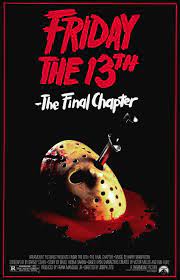
Friday the 13th: The Final Chapter (1984)

FRIDAY THE 13TH: THE FINAL CHAPTER (1984) ***
Once upon a time, I called Friday the 13th: The Final Chapter the most schizophrenic movie ever made and what I mean by this bit of hyperbole is that The Final Chapter largely alternates being a rather brutal, occasionally mean-spirited horror movie sequel and a jovial teenage sex comedy especially made explicit in casting Lawrence The Last American Virgin Monoson in one of the key supporting roles.

The Final Chapter has some of the best and also some of the worst moments in the entire 12-movie Friday series, easily the best cast and most likable characters from (almost) top to bottom, Tom Savini’s return as makeup artist, Harry Manfredini’s first-rate musical score, Ted White’s brutal conviction selling his kill scenes as Jason Voorhees, and it’s arguably the quintessential Friday the 13th movie.

Let’s hit a couple of the high points first.

The Final Chapter introduces us to Tommy Jarvis (Corey Feldman), a 12-year-old boy with a hyperactive imagination and penchant for monster make-up and masks not unlike Savini; Trish Jarvis (Kimberly Beck), Tommy’s older sister and our Final Girl; Mrs. Jarvis (Joan Freeman), Tommy’s and Trish’s single mother; Gordon the Family Dog, the golden retriever whose fate remains uncertain. Anyway, this family dynamic is something fresh and new for the Friday series.

Crispin Glover, one of the great movie eccentrics, makes his mark on The Final Chapter and his Jimmy becomes one of the most unforgettable horny (dead) teenagers in a series that served them up by the hundreds as fodder for the slaughter. Jimmy and his buddy Ted (Monoson) especially feel like refugees from a teenage sex comedy, like they continued playing their characters from My Tutor (Glover) and The Last American Virgin (Monoson). Jimmy’s dance and exit line in this movie have become the stuff of slasher movie legend.

Feldman and Glover provide us two of the most likable characters in any of the dozen Friday movies, something that’s ironic given the fact The New Beginning (which arrived in theaters around 11 months after The Final Chapter) has almost no likable characters among the largest cast of corpses in series history. Never mind that Tommy did not exactly pan out in The New Beginning and Jason Lives like the endings of The Final Chapter and The New Beginning seemed to promise.

I almost forgot Rob (E. Erich Anderson), the older brother of a character killed by potato sack Jason in Part 2. Rob seeks revenge against Jason and fortunately he meets Trish and Tommy first, though ultimately it does not matter because Rob represents one of the great missed opportunities. Here’s a character who could have served as a basis for an entire movie and The Final Chapter makes him completely underwhelming. His death scene, designed to be poignant, instead becomes laughable (‘He’s killing me. He’s killing me’) and it wishes it could be as enjoyably bad as the bookseller’s death in Dario Argento’s Inferno. You might recall that the creepy old book retailer’s done in by rats and a homicidal Central Park hot dog vendor.

Now, we’ve moved on to the more negative.

Our first two new corpses in The Final Chapter represent one of my least favorite scenarios that’s commonly found in Friday movies. We spend several minutes, it feels even longer, much much much longer, with super horny morgue attendant Axel (Bruce Mahler) and super uninterested Nurse Morgan (Lisa Freeman) before they are massacred by Jason. Maybe it’s only a few minutes, but I never want to watch their scenes ever again to find out. I’ll use their introduction as my cue to go make some scrumptious butter popcorn.

Like the beginning of Part III and the obligatory murder of the lakefront store owners, these are minutes of my life that could have been attended to better things, even during a Friday movie.

The Final Chapter loves breaking glass and characters falling through windows.

The Final Chapter gets straight at the heart of the ambivalent relationship between parent company Paramount Pictures and the Friday movies.

One immediately gets the feeling that Paramount wanted The Final Chapter, you know, to be the end of Jason once and forever because the studio hotshots were ashamed to be associated with such a disreputable and sleazy franchise, but, alas, at the same time, The Final Chapter leaves the door open for more sequels with one of the series’ trademark endings. Paramount walked through that very door — actually, more like sprinted — when The Final Chapter returned a hefty profit.

The Final Chapter finished in the top 25 box office for 1984 and put together a $11.1M opening during the weekend of April 13.

Friday, April 13, 1984. The Challenger returned to Earth from their 11th space shuttle mission. India beat Pakistan by 54 runs to win the first Asia Cricket Cup in Sharjah, United Arab Emirates.

Paramount released A New Beginning on March 22, 1985, and 1983 and 1987 are the only years of the ’80s without a Friday the 13th movie. Do 1983 and 1987 belong to another decade?

I more or less grew up with the Friday movies, so I might be more forgiving of them for all their numerous faults than people who grew up in different times.

Then again, I might not be, because I only consider Jason Lives (the best made and the only entry that deserves a place near second- or third-tier classic horror movies like Frankenstein Meets the Wolf Man), Part III (the most suspenseful and the one where Jason acquires his legendary hockey mask), and The Final Chapter even worth recommending. Most of the rest of them have their isolated moments, all of them are excuses for reels of sex and violence and vulgarity, and the movies definitely created their own distinctive space in the cinematic marketplace.

How did the world end up with 12 Friday the 13th movies and legendary status for both the series overall and serial killer Jason Voorhees specifically, when similar movies like My Bloody Valentine, The Burning, Happy Birthday to Me, and Madman failed to produce one sequel among them. Granted, the original Friday finished 15th in the 1980 American box office sweepstakes and the first three sequels also proved to be solid hits among strong competition, while The Burning grossed $700 thousand, Madman $1.3M, My Bloody Valentine $5.7M, and Happy Birthday to Me $10.6M.

Money obviously talked for Jason.

Sequels Second to None: The Empire Strikes Back, Indiana Jones and the Temple of Doom

SEQUELS SECOND TO NONE: THE EMPIRE STRIKES BACK, INDIANA JONES AND THE TEMPLE OF DOOM

Having recently watched THE EMPIRE STRIKES BACK and INDIANA JONES AND THE TEMPLE OF DOOM for the first time in a movie theater, I have asked myself one tough question: Why are they my favorite Star Wars and Indiana Jones movies?

THE EMPIRE STRIKES BACK, the second installment in George Lucas’ space opera series eventually taken over by the fine folks at Disney, has the best direction (Irvin Kershner), best writing (courtesy Leigh Brackett and Lawrence Kasdan), best acting, best environs (the icy planet Hoth, the swampy Dagobah, and Cloud City), and the characters display their greatest emotional range and depth. Yoda, Boba Fett, and Lando are iconic additions, especially Yoda. Only the very first STAR WARS (A NEW HOPE) even approaches EMPIRE and please just forget about the prequels (REVENGE OF THE SITH by far the best of them) and the entries post-Disney takeover. It seems like the majority of STAR WARS fans agree.

Meanwhile, I seem to be in the minority who prefer TEMPLE OF DOOM over RAIDERS OF THE LOST ARK. I understand that it’s dark and disgusting, and that Kate Capshaw’s nightclub singer Willie Scott annoys the hell out of you with all that darn histrionic screaming that she does from the first reel to the very last. I grant all those points. Regardless, I prefer TEMPLE OF DOOM because it’s very dark and very disgusting, and yes, I do believe that it is one of the all-time best gross out movies. We’re talking such pleasantries as monkey brains, eels, snakes, bats, bugs, child slavery, heart removal, and bad, bad, bad men eaten by alligators. To be fair and honest, the Shanghai and Indian characters are grotesque caricatures even more disgusting than any of the creature and culinary discomforts, but then again so are the Nazis and Commies in the other Indiana Jones pictures. Understandably, though, India once banned TEMPLE OF DOOM.

TEMPLE OF DOOM does call to mind such classics as BLACK NARCISSUS, GUNGA DIN, THE STEEL HELMET (Short Round borrowed from Samuel Fuller’s 1951 Korean War picture), and THE GENERAL. Scott’s opening production number (Spielberg has long said that he’d love to do a musical and this scene and the jitterbug sequence in 1941 shows that he could make a very good even great one) clues us in on what’s exactly up the sleeves of director Steven Spielberg, screenwriters Willard Huyck and Gloria Katz, story writer Lucas, and gang. What’s that number called? “Anything Goes,” the Cole Porter standard. TEMPLE OF DOOM works because it is oversized and over-the-top like Spielberg’s earlier comedy 1941. Perhaps it is only fitting that Spielberg apparently likes 1941 and TEMPLE OF DOOM the least among his filmography. Does he recoil from their being so politically incorrect?

As far as Willie Scott goes, she epitomizes the sister or girlfriend or wife perpetually grossed out and disgusted by the shenanigans of all the boys surrounding her. I find that element fun. Yes, I do agree that Karen Allen’s Marion Ravenwood is a better match for Indiana Jones and it’s great they brought her character back for KINGDOM OF THE CRYSTAL SKULL. Scott remains more consistent throughout TEMPLE OF DOOM, though, whereas Marion switches between several modes and moods — just one of the boys, spitfire, damsel-in-distress, and wounded woman chief among them. I enjoy both characters, for different reasons. Capshaw’s performance and her character do not mar TEMPLE OF DOOM for me.

It’s been said numerous times before that Lucas endured a divorce around the time of the making of TEMPLE OF DOOM and that seeped into the movie — in the overall tone but specifically the Willie Scott character and the heart removal. Spielberg, two years after his divorce from actress Amy Irving, married Capshaw and they have been together nearly three decades.

It also must be said TEMPLE OF DOOM was my first Indiana Jones movie, because it was the only VHS tape she kept from a mid-1980s Christmas present from her children. Between that and her later acquisition, THE ADVENTURES OF ROBIN HOOD, I must have thrilled on them 100 times. Maybe nostalgia and sentimentality for old movies, even older movies, grand adventure, brassy dames from the Midwest, and politically incorrect characters and gross out gags animates my overall affection for TEMPLE OF DOOM. (I watched RAIDERS OF THE LOST ARK at the drive-in a couple weeks before TEMPLE OF DOOM. I passed on THE LAST CRUSADE for THE EMPIRE STRIKES BACK.)

As I watched THE EMPIRE STRIKES BACK in the Fort Cinema in the town where I attended high school and the first couple years of college, I periodically momentarily flashed back on how I must have first felt watching the movie some more than 35 years ago in the even smaller Southeast Kansas town Arcadia. I felt that way again, despite having seen EMPIRE 30-40-50 times.

Just one nagging thought occasionally spoiled the mood: We were not seeing the original theatrical version of EMPIRE, rather we had one of them dang blasted Special Editions that genius George Lucas masterminded in the mid-’90s for theatrical and home video release circa 1997 where he touched up some of the old school special effects and made some cringe-worthy insertions that will be mocked until the end of time. Lucas has sadly tinkered with A NEW HOPE, EMPIRE, and RETURN OF THE JEDI even more since then, until I think we fans have to ask him, “Why, George, why?” Some outraged STAR WARS fans have gone as far to proclaim “George Lucas Raped My Childhood.” (I do have both VHS and DVD copies of the original theatrical version of EMPIRE.)

Fortunately, I feel that Lucas has mangled EMPIRE considerably less than both A NEW HOPE and RETURN, which alone points to it being the best entry in the entire series. The uncanny valley effect: “An eerie feeling of unfamiliarity people get while observing or interacting with robots that resemble humans almost but not quite perfectly.” I believe we can add the “Star Wars Special Edition” corollary, as well as separate corollaries for both the prequels and the Disney Star Wars, to the uncanny valley effect. George, you should have just kept your ILM CGI magic in the prequels.

As EMPIRE played out more and more and we got deeper into the plot, though, any thoughts about Lucas, Special Edition, cringe-worthy insertions, etc., faded away and I became swept up in the spectacle more than ever before, because it was up there on the big screen for the first time. I felt wonderment and exhilaration, as well as the broader spectrum of emotions that other STAR WARS movies usually do not reach.

THE EMPIRE STRIKES BACK ****; INDIANA JONES AND THE TEMPLE OF DOOM ***1/2

Attack of the Fantastical Movies

ATTACK OF THE FANTASTICAL MOVIES: ATTACK OF THE 50 FOOT WOMAN, EARTH VS. THE FLYING SAUCERS, PLANET OF THE VAMPIRES, MOTORPSYCHO!, GALAXINA, REPTILICUS, BIG BAD MAMA, REAL LIFE, NINJA III: THE DOMINATION, NIGHT OF THE DEMONS

How do I grade something like ATTACK OF THE 50 FOOT WOMAN from 1958? It has a setup that could be called “laborious” or “lackluster” or “lugubrious.” I’m not going to call it any of those words, but I can see exactly why somebody else would. In other words, it’s not until about the 45-minute mark that we get to the 50 foot woman. Yes, I wish they had reversed the numbers, 15 minutes of setup and 45 minutes of 50 foot woman. Simple mathematics. At least, 45 minutes of setup and 45 minutes of 50 foot woman. Yes, that sounds even better than “15 then 45.” The final 15 or 20 minutes of ATTACK OF THE 50 FOOT WOMAN, though, are solid gold. Rating: ***

— It’s virtually impossible to watch EARTH VS. THE FLYING SAUCERS and not think about MARS ATTACKS! (flying saucers) and INDEPENDENCE DAY (Washington D.C. invaded), two blockbusters from 1996 with a combined production budget of $145 million and big, big, big stars, including Jack Nicholson in dual roles in MARS ATTACKS! In EARTH VS. THE FLYING SAUCERS from 1956, Ray Harryhausen’s stop-motion flying saucers are the real star of the show (step aside, Hugh Marlowe) and the film thankfully wastes very little time in showcasing them. It’s the inverse of ATTACK OF THE 50 FOOT WOMAN. ***1/2

— Italian director Mario Bava (1914-80) became especially known for his stylish horror films. From his British Film Institute profile, “Mario Bava took a vital role in the creation of the modern horror film. If there was to be a a Mount Rushmore-style monument dedicated to four directors whose work pioneered a new form of big screen chills and thrills, those giant faces etched in granite on the mountainside would be: Bava, Alfred Hitchcock, Georges Franju and Michael Powell.” In the words of a Pavement song, a Bava film has style, miles and miles. Case in point: PLANET OF THE VAMPIRES, a low-budget science fiction and horror production from 1965 that masked its cheap sets through smoky skullduggery. Bava said in Fangoria, “Do you know what that unknown planet was made of? A couple of plastic rocks — yes, two: one and one! — left over from a mythological movie made at Cinecitta! To assist the illusion, I filled the set with smoke!” Watching PLANET OF THE VAMPIRES for the first time, you might think you’ve seen this basic plot somewhere before … ahem … Ridley Scott’s ALIEN. ***1/2

— 1965 proved to be a great year for titles with exclamation points and for director, producer, writer, cinematographer, and editor Russ Meyer (1922-2004), whose films often proved to be ahead of their time. Meyer contributed two exclamation point titles — FASTER, PUSSYCAT! KILL! KILL! and MOTORPSYCHO! — during a 1965 in which he directed three films overall; Meyer’s greatest cinematic year began with MUDHONEY. Proof of being ahead of its time: MOTORPSYCHO! (what a title) gives us a psychotic motorcycle trio led by a deeply disturbed Vietnam vet — before TAXI DRIVER, before ROLLING THUNDER, before THE DEER HUNTER, before FIRST BLOOD — in addition to all the elements (large-breasted women and endless cleavage, campy humor, satire, and quotable dialogue) we expect from a Meyer film. ***

— GALAXINA lands a few successful jabs at STAR WARS, STAR TREK, and ALIEN, but otherwise it’s a real long slog through 90-plus minutes of a lowbrow and low-budget science fiction and western parody set in the 31st century. Here’s just one example of the film’s humor: Avery Schreiber (1935-2002) plays a character named “Capt. Cornelius Butt.” Then again, I probably should have just said that it’s a Crown International Pictures release. Surely you remember Crown International Pictures? They brought us such immoral, er, immortal classics as THE BEAST OF YUCCA FLATS, THEY SAVED HITLER’S BRAIN, SEXTETTE, and THE BEACH GIRLS. The late former Playboy Playmate of the Year Dorothy Stratten fills the title role and she’s been described as “a voluptuous blonde android servant.” Galaxina works better when she’s silent (the first half of the picture), because Stratten proves that she was a true novice thespian every time she speaks during GALAXINA. Stratten reportedly complained to film director and her paramour Peter Bogdanovich that the ads for GALAXINA promoted her being the Playmate of the Year, because she wanted to be taken seriously as an actress. GALAXINA would not do good for anybody wanting to be taken seriously for anything. Unfortunately, Stratten’s estranged husband Paul Snider murdered her two months after the release of GALAXINA. Stratten would be immortalized on film by the 1981 TV movie DEATH OF A CENTERFOLD: THE DOROTHY STRATTEN STORY and the 1983 theatrical release STAR 80, played by Jamie Lee Curtis and Mariel Hemingway, respectively. In case you were wondering, you see a lot more of Stratten in Playboy than GALAXINA. *1/2

— Recent weeks, mostly under self-quarantine, have included a few first-time watch monster movies: GODZILLA VS. MECHAGODZILLA and TERROR OF MECHAGODZILLA, SLITHIS (possibly the worst monster movie ever made), THE GIANT CLAW, and, most recently, REPTILICUS, Denmark’s infamous first entry in the monster movie sweepstakes. Judging by REPTILICUS, the Danish should stick to pastries. They make a mean strudel, not so much a Godzilla rip-off. Apparently, there’s never been a second Danish monster movie, so I guess they have stuck to pastries for nearly 50 years since this 1961 turkey. Anyway, I wanted to find the Danish version of REPTILICUS, but, of course, I had to settle for the English dub from good old American International. The plot: Copper miners find the tail of a prehistoric reptile and it eventually regenerates into Reptilicus, a hand puppet (close-up) and a marionette (wide shot) that give the $50 Giant Claw its money for being the “best” worst movie monster of all-time. I enjoyed REPTILICUS even less than THE GIANT CLAW, though. For example, when Reptilicus eats an extra or two, the victims look like they have been cut out of a magazine and they are being thrown into the puppet’s mouth. In THE GIANT CLAW, at least its victims being eaten scene brought me back to the “Eat ‘em! Eat ‘em! Crunch! Crunch!” scene from Q: THE WINGED SERPENT. I even called out “Crunch! Crunch!” during THE GIANT CLAW. No such luck during REPTILICUS. **

— Arthur Penn’s 1967 film BONNIE AND CLYDE proved to be one of the watershed films of the second half of the 20th century and one indication was that for several years, BONNIE AND CLYDE inspired many sensationalistic crime films set during the Great Depression. Roger Corman produced a whole slew of them, with the most famous being 1974’s BIG BAD MAMA starring Angie Dickinson, Tom Skerritt, and William Shatner and directed by Steve Carver (who later directed the Chuck Norris spectacular LONE WOLF McQUADE). BIG BAD MAMA mixes in a hippie-like free love sensibility and showcases bed hopping and generous amounts of nudity between all the murder and mayhem. The title character (Dickinson) and her two not long past jailbait daughters (Susan Sennett, Robbie Lee) all have multiple nude scenes, highlighted by Dickinson’s full-frontal shot late in the picture. One of the picture’s tag lines: “Wilma gave her daughters everything — her looks, her lovers and the crime of their lives!” Dick Miller (1928-2019), yes, that guy, plays a crime fighter and you know you can’t go too wrong with a picture that features an old-fashioned bloody crime spree, much nudity and shenanigans (Dickinson looked absolutely sensational in 1974), Shatner, and Dick Miller. ***

— Many years before the proliferation of reality TV, Albert Brooks skewered it with his 1979 directorial debut REAL LIFE, a satire of the 1973 PBS documentary “An American Family.” Brooks plays an exaggerated version of himself and watching this movie for the first time in 2020, it’s difficult not to conjure up memories of all the obnoxious or obsequious hosts and participants on reality TV shows from years ago — “The Real World,” “The Bachelor,” et cetera, they’re all terrible and I’m fortunate to have survived all my encounters with them. All those creeps still give me the willies just thinking about it now, but unfortunately reality TV seems like it’s here and it’s here to stay. Take that from somebody who’s not watched a whole lot of TV in the last decade, with reality TV being one of the big reasons. I laughed a lot during REAL LIFE, from the epic sight gag on the head of every cameraman (I laughed every single time) to the fiery grand finale Brooks borrows from GONE WITH THE WIND. ****

— The Cannon Group’s best of the worst films could generously be called “sublime stupidity” and I believe that description fits NINJA III: THE DOMINATION perfectly. Part ENTER THE NINJA, part FLASHDANCE, and part EXORCIST, THE DOMINATION must be seen to not be believed. Imagine Jennifer Beals possessed by the evil spirit of a ninja with an Oriental Max von Sydow attempting to bring it out. THE DOMINATION starts out with its very best scene, a golf course massacre that leads to the bad ninja transferring his spirit into the body of telephone lineman and aerobics instructor Christie (Lucinda Dickey). Also happening in the first 30 minutes of the picture: Christie’s aerobics class, her fight against a handful of creeps who were harassing one of her students, and possibly the most awkward bedroom seduction scene in the history of cinema. Christie won’t give this creepy cop the time of day and then, practically the next moment, they end up in embrace and she pours V-8 on herself … this is the beginning of a beautiful friendship. There’s also a bizarre sequence involving Christie’s Bouncer arcade game. On the International Arcade Museum page for Bouncer, it says “Bouncer was seen in the low budget martial arts film NINJA 3: THE DOMINATION. The game is in the main character’s apartment and she is seen playing it. The character becomes possessed by the spirit of the ninja, and as he overtakes her body, the arcade cabinet begins to bellow out smoke and hypnotizes her with a little laser show from the screen.” I thought she was already possessed. Yeah, I know, bizarre. Then again, bizarre basically describes both THE DOMINATION and Cannon films in general. We wouldn’t have them any other way. ***

— We’ve seen NIGHT OF THE DEMONS done better before, especially the first two EVIL DEAD movies and RETURN OF THE LIVING DEAD, which it seems to reference through both Linnea Quigley and punk rock. We’ve seen this plot before: 10 (mostly) horny high school kids have a Halloween party inside an abandoned funeral parlor. You can fill in the rest, down to every detail both personality and plot. It’s not a bad movie, exactly, it’s just after having seen EVIL DEAD and RETURN OF THE LIVING DEAD and EVIL DEAD 2, why settle for less? Seemingly just about every movie from the ‘80s — the good, the bad, and the ugly — has developed a cult following over time and NIGHT OF THE DEMONS is one of them, spoken about in an enthusiastic tone by admirers. I can sympathize, because I feel similarly about numerous movies. I have mixed feelings on NIGHT OF THE DEMONS. On one hand, I can’t think very highly of a movie that goes for three jump scares very early on. That loses points for it real quickly. It’s also one of those movies that I started liking less down the home stretch and I wished it would get to its inevitable conclusion sooner rather than later. On the other hand, it does have a few good moments, just not enough for a recommendation. **

Children of the Corn (1984)

CHILDREN OF THE CORN

CHILDREN OF THE CORN (1984) One star

CHILDREN OF THE CORN is yet another textbook example of a film that cannot be taken seriously although it would love to be considered a serious film. We know that ‘cause we read an opening title like STEPHEN KING’S CHILDREN OF THE CORN, bashing us over the head this film wants to be a major event in our lives rather than a borderline incoherent, rambling supernatural thriller with pseudo-religious hogwash and brutal thriller machinations as its main selling points.

I will be the first to admit my ambivalence toward Stephen King, as well as Tom Clancy, John Grisham, Laurel Hamilton, Dean Koontz, and every other author who seems to have built-in access to a guaranteed mass audience every single time they publish even their napkins. Kmart, Walmart, and your friendly local supermarket determine the ultimate literary value of a select few writers and the rest of us hacks wallow in anonymity and simmering jealousy.

Fortunately, and unfortunately, I am well-versed in Stephen King film adaptations, probably just as much as you are at home. For every successful adaptation, like STAND BY ME and THE SHAWSHANK REDEMPTION, there’s absolute doggerel like CUJO, MAXIMUM OVERDRIVE, and DREAMCATCHER that rate among the most torturous movie experiences. In fact, I’d rate DREAMCATCHER high up among my top five worst movie theater experiences. One day, I’ll have to sit down and concentrate on that list.

CHILDREN OF THE CORN rates as bad King film adaptation. The rabid cult following may disagree but they’re not writing this review.

First and foremost, this is another King adaptation with religious poppycock galore. I traditionally despise religious fanaticism in the movies ‘cause it’s used by filmmakers as a cheap exploitation tactic. I hated, hated, hated this approach in films like AMITYVILLE II: THE POSSESSION, CARRIE, and THE OMEN. Are we supposed to cheaply laugh at somebody’s faith ‘cause they’re overzealous suckers and we’re in on the know and the joke they’re suckers?

How are we supposed to react to the evil corn, the pontification, and the music recycled from THE OMEN every time our filmmakers — led by director Fritz Kiersch — want us to pay attention. I have what’s called “bad laughs” and lots of them over the running time of CHILDREN OF THE CORN.

There’s a gruesome opening scene: The kids of Gatlin, Nebraska (introductory title: “GATLIN, NEBRASKA — THREE YEARS AGO”), kill their fathers and mothers and grandfathers and grandmothers and “The Blue Man.” See, a couple shady little individuals calling themselves Isaac and Malachi are instructed by “He Who Walks Behind the Rows.”

At this point, we should make a crucial distinction that just might save your life or at least guide you toward a better movie rental: In Nebraska, corn fields command kids to kill all the adults and make them sacrificial fodder. Meanwhile, in Iowa, corn fields instruct farmers to build a baseball diamond and they will come, well, except for Ty Cobb.

Anyhoo, Isaac (John Franklin) establishes a tyrannical regime of kids opposed to “sex, drugs, and rock ’n’ roll.” He’s a babbling pseudo-religious visionary with bad make-up. I laughed at Isaac’s pontification more than I have at some comedians over an entire career, because Isaac is a power-hungry miniature twit.

Malachi is the brute enforcer, a red-headed Jason Voorhees minus the hockey mask. He’s played by Courtney Gains, one of the best faces of 1980s movies. Sure we all remember Courtney Gains. George Constanza remembers him as the evil video store clerk in a “Seinfeld” episode. Gains appeared in BACK TO THE FUTURE, THE ‘BURBS, CAN’T BUY ME LOVE, and SECRET ADMIRER. For example, he tried cutting in on George McFly with Lorraine Baines at the Enchantment Under the Sea dance in good ole 1955. I’d rather talk more about Courtney Gains and his career than go back to reviewing CHILDREN OF THE CORN.

Where was I again? Who am I?

Anyway, Peter Horton and Linda Hamilton play our resident clean-cut wholesome All-American couple taking a trip inside a clean-cut wholesome All-American nightmare only found within a bad horror movie. These young lovers violate the Number One rule of interstate travel: ALWAYS STAY ON THE HIGHWAY. It’s almost like they never watched THE HILLS HAVE EYES.

This is yet another one of those “Of course” movies, because we say of course, they find a run down gas station with no telephone. Of course, the gas station owner’s a diabolical, shady old man in cahoots with the evil kiddos. Of course, the husband Burt (Horton) sees and hears something OVER THERE, always OVER THERE, and checks it out while the wife Vicky (Hamilton) wants to leave. Of course, they never do leave (until the end of the movie) and must fight through a living Hell to survive.

Next time, however, I suggest they drive through Iowa and find the Buddy Holly Crash Site near Clear Lake. It’s a long walk to the shrine of Holly, Ritchie Valens, and the Big Bopper, but a must if you love rock ‘n’ roll.

Back to the old man who’s the gas station attendant. He’s played by R.G. Armstrong in not one of his finest screen moments. Armstrong plays the role of a character whose function is that of the corpse in a self-contained murder sequence in a horror film, where it takes untold minutes to reach a destination we already predetermined in our heads after having watched countless self-contained murder sequences in horror films. Armstrong (1917-2012) must have rapidly slipped in his old age, considering that he survived THE BEAST WITHIN just a couple years before.

There’s also a little girl named Sarah, another pint-sized visionary. Her endearing and redeeming character trait is that she draws pictures of everything. Of course, Malachi wants to curb her artistic inclinations and of course, Isaac defends her visionary gifts, conflict among the ranks of the evil kiddos that only escalates during CHILDREN OF THE CORN.

I’d rather have looked at an exhibit of Sarah’s illustrations than watch CHILDREN OF THE CORN.

That’s because CHILDREN OF THE CORN bludgeons us with every cheap shock tactic of the bad horror movie.

There’s a lot of thunder and lightning, fire and brimstone, and loud music. And there are way too many scenes built on tight framing so we’re supposed to be scared on cue by an unexpected object jumping into the frame. The scariest accomplishment, however, of CHILDREN OF THE CORN is that it developed a cult following.

The Terminator (1984)

DAY 29, THE TERMINATOR

THE TERMINATOR (1984) Four stars
James Cameron said that John Carpenter’s HALLOWEEN inspired him to make THE TERMINATOR, and it’s easy to see that with Arnold Schwarzenegger’s T-800 and Michael Myers, both (virtually) unstoppable killing machines.

Apparently, while in Rome around the time of PIRANHA II: THE SPAWNING, Cameron had a dream about a metallic torso equipped with kitchen knives in hand and dragging itself from an explosion, which almost sounds exactly like a scene late in THE TERMINATOR. This dream became the basis for the film.

Then again, late author Harlan Ellison (1934-2018) claimed that Cameron was inspired by Ellison’s 1964 Outer Limits episode “Soldier” (adapted from Ellison’s own short story) where a future soldier goes back in time to save a present-day woman from another future soldier. I believe Ellison (although he liked the movie) used that nasty ‘P’ word, plagiarism. Ellison received a financial settlement from Hemdale and Orion Pictures, and home video releases of THE TERMINATOR subsequently read “The Producers Acknowledge the Works of Harlan Ellison.”

THE TERMINATOR benefits greatly from the casting of the central roles: Schwarzenegger as the literal force of death and destruction, Michael Biehn as the feisty freedom fighter of the future brought back to the present Kyle Reese, and Linda Hamilton as the present-day young woman Sarah Connor who initially can’t quite believe that she’s in the middle of such a ridiculous plot until Reese (and the corpses) convince her. They fit the roles to a T.

Schwarzenegger has largely played heroic characters and in fact, he’s on the good side for the rest of THE TERMINATOR series. Playing the villain, though, he benefits greatly from speaking few lines (keep in mind his first movie, HERCULES IN NEW YORK, dubbed Schwarzenegger); granted, we have less of the great humor that permeates COMMANDO, PREDATOR, and TOTAL RECALL, but it’s still there with Schwarzenegger as villain with his infamous line “I’ll be back,” for example.

That good spirit and joy of performance still comes through for Schwarzenegger in THE TERMINATOR.

Schwarzenegger plays a more interesting variation on Michael Myers and Jason Voorhees, because those roles in theory can be played by anybody. (Please don’t tell that to Ted White or Kane Hodder.)

Reese explains the situation to Sarah Connor, “That Terminator is out there! It can’t be bargained with. It can’t be reasoned with. It doesn’t feel pity, or remorse, or fear. And it absolutely will not stop … ever, until you are dead!”

Schwarzenegger originally read for the Kyle Reese role and Cameron wanted Lance Henriksen to be the Terminator. Wow, Henriksen as the Terminator just boggles the mind, although Cameron used Robert Patrick to great success as T-1000 in TERMINATOR 2: JUDGMENT DAY. Kristianna Loken as T-X in TERMINATOR 3, well, let’s just say epic fail.
Biehn works better in the Reese role because of all the dialogue and in some ways, he’s like Donald Pleasence’s Dr. Sam Loomis in HALLOWEEN. He understands T-800, even though, of course, nobody believes him until it’s too late.

The Dr. Silberman character (Earl Boen) gets one great scene interrogating Reese and then playing the video back for the Paul Winfield and Henriksen police characters. Dr. Silberman just got out of the police station in the nick of time, and he returns for the sequel.

THE TERMINATOR works as horror movie, as science fiction, and as action, in a streamlined combination of some of the best aspects of HALLOWEEN, BLADE RUNNER, and THE ROAD WARRIOR.

On top of all that, we have a great love story and this element gives THE TERMINATOR the slight edge over JUDGMENT DAY.

Just that scene alone when Reese explains why he accepted the assignment to come back through time and save Sarah Connor, mother of a future resistance leader.

“John Connor gave me a picture of you once,” Reese said. “I didn’t know why at the time. It was very old … torn, faded. You were young like you are now. You seemed just a little sad. I used to always wonder what you were thinking at that moment. I memorized every line, every curve. … I came across time for you, Sarah. I love you; I always have.”

When you go see a movie called THE TERMINATOR, bet you weren’t expecting a genuinely touching love story.

It’s the element of the unexpected that makes for the most rewarding experiences, movies or in general.