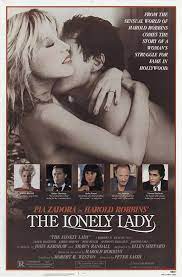
The Lonely Lady

THE LONELY LADY (1983) 1/2*
The Lonely Lady is one of the all-time great stinker movies, 91 minutes of unpleasant characters in unsavory relationships with unbelievably bad actors speaking dialogue that should have never been uttered or ever written in the first place.

Like the (believe it or not) even more awful, killer Santa picture Silent Night, Deadly Night, The Lonely Lady potentially takes the heat off viewers by undercutting a procession of controversial scenes with unintentional humor. I could see hooting and howling in derisive laughter at the performances and the dialogue throughout Silent Night, Deadly Night and The Lonely Lady.

I found myself appalled more than anything else throughout The Lonely Lady, so I was basically too appalled to laugh.

The Lonely Lady especially lays it on thick whenever the title character — aspiring young screenwriter Jerilee Randall, played by the immortal Pia Zadora, though she’s never lonely — expresses her outrage at her perpetual exploitation by Hollywood writers, directors, actors, and producers, every one of them sexist pigs who just nonstop use and abuse her.

At the same time, however, the camera lingers on this exploitation from the rape by garden hose early on in the picture to some of the least sexy movie sex ever captured on celluloid.

On top of all that, Zadora’s real-life husband, Israeli multimillionaire industrialist Meshulam Riklis, funded Butterfly and The Lonely Lady with both pictures starring none other than Zadora. Legend has it that Riklis bought a Golden Globe award for his wife and her performance in Butterfly.

Zadora beat out Elizabeth McGovern and Howard E. Rollins Jr. in Ragtime, Kathleen Turner in Body Heat, Rachel Ward in Sharky’s Machine, and Craig Wasson in Four Friends, all five better-received performances in better-received films.

It remains inconceivable that Zadora — who made her motion picture debut in the 1964 cult film Santa Claus Conquers the Martians — won that award on her own merits.

Riklis was more than 30 years older than Zadora, and that’s not any different than the age gap between Jerilee and her much older husband, veteran Hollywood hack screenwriter Walter Thornton (Lloyd Bochner), in The Lonely Lady.

All those factors combine to make Jerilee’s speech at the Academy Awards — highlighted by that risible line I don’t suppose I’m the only one who’s had to fuck her way to the top! — the absolute worst scene in a movie populated by predominantly bad scenes.

Most of them involve Jerilee sleeping her way through some of the ugliest men imaginable.

Let’s take a look at one more scene that epitomizes The Lonely Lady.

Jerilee and Walter argue outside their Beverly Hills home, near the swimming pool seen first in one of the film’s most appalling scenes.

Jerilee: Walter? Walter, come to bed.
Walter: Haven’t you had enough wine? Go sleep it off.
J: If you’ll come with me.
[W turns away.]
J: I’m trying to say sorry.
W: With a head full of drink!
J: We don’t have to make love.
W: Thank you.
J: We could talk. We need to talk.
W: Why didn’t you go off with Dacosta? He would’ve enjoyed it.
[W picks up the garden hose that raped J earlier in the film.]
W: Or is this more your kick?

That’s even worse than the argument between Kathryn Harrold and Luciano Pavarotti in Yes, Giorgio that culminated in the infamous line I don’t want to be watered on by Fini.

That garden hose, in fact, might have once belonged to Fini.

The Lonely Lady flopped so badly that, thankfully, Hollywood never adapted one of Harold Robbins’ trashy novels again.

Now, I call that a happy ending.

Ninja Rap: Enter the Ninja, Revenge of the Ninja

NINJA RAP: ENTER THE NINJA, REVENGE OF THE NINJA

An instant word search on ninja returns this definition, “A ninja or shinobi was a covert agent or mercenary in feudal Japan. The functions of a ninja included espionage, deception, and surprise attacks. Their covert methods of waging irregular warfare were deemed dishonorable and beneath the honor of the samurai.” Buh.

It goes without saying but we’ll say it anyway that ninja survived a gratuitous Vanilla Ice rap number and mass flatulence, er, mass gas in a kiddie picture.

There’s also “A person who excels in a particular skill or activity. ‘The courses vary — you don’t have to be a computer ninja to apply.’”

I contribute: “An iconic action movie bad ass character archetype epitomized by the legendary ‘Ninja Trilogy’ from Cannon Films, ENTER THE NINJA (1981), REVENGE OF THE NINJA (1983), and NINJA III: THE DOMINATION (1984).”

I’ve already discussed NINJA III at some length — any movie that combines ENTER THE NINJA, THE EXORCIST, and FLASHDANCE must have something brilliant up her sleeve — and only very recently caught up with ENTER THE NINJA and REVENGE OF THE NINJA on the same night.

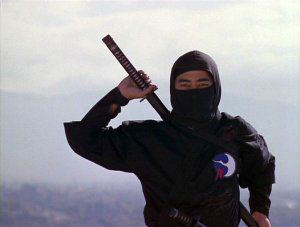
Of course, any definition of “ninja” would be greatly served by a picture of Japanese martial artist Sho Kosugi. In fact, this review would be vastly improved just by the mere insertion of a picture of The Man, The Myth, The Legend. A picture speaks louder than a thousand words … regardless, it’s not like any action movie hero worth their celluloid ever spoke a thousand words.

SHO KOSUGI

I’ve made it through most of the collected film works of Eastwood, Bruce Lee, Jackie Chan, Norris, Stallone, Schwarzenegger, et cetera, and now I am grateful for the opportunity to delve into Kosugi’s filmography. It’s a safe bet that I will eventually seek out PRAY FOR DEATH, DEATHS OF THE NINJA, and RAGE OF HONOR because they’re great titles and have great cover art in addition to starring Mr. Kosugi.

I’ll start with REVENGE OF THE NINJA, the second and best overall installment of the so-called ‘Ninja Trilogy.’ Kosugi takes on a starring role after playing second (or third or fourth) fiddle in ENTER THE NINJA, behind at least Franco Nero, Susan George, and Christopher George. The Kosugi parts are arguably the best parts of ENTER, so REVENGE serves up a full course of Kosugi with hors d’oeuvres, wine (or beer or liquor), and dessert included.

The nominal plot: “After his family is killed in Japan by ninjas, Cho and his son Kane come to America to start a new life. He opens a doll shop but is unwittingly importing heroin in the dolls. When he finds out that his friend has betrayed him, Cho must prepare for the ultimate battle he has ever been involved in.”

The actual plot: ACTION! PLENTY OF ACTION! We’re talking serious hardcore ninja action here. I’m no expert on ninja weaponry, but I do believe that REVENGE (as did ENTER before and THE DOMINATION after it) employs the ninjato, the katana, nunchaku, blowgun, shuriken, crossbow, and many, many more weapons of mass dismemberment. Gore hounds have a lot of howling to do over the ‘Ninja Trilogy.’

REVENGE prevails over ENTER because it spends more time focused on the actual plot than the nominal plot.

We have not only two fierce ninja warriors, Kosugi’s hero Cho Osaki opposed by the dastardly bastard Braden (Arthur Roberts), but we also have two, er, 1 1/2 Kosugis in this picture, since Sho’s real-life son Kane Kosugi plays Cho’s son Kane. We say 1/2 because Kane was around 9 years old when he made his memorable motion picture debut in REVENGE. He’s not one of those insufferable movie brats who mugs so heavily that I check my wallet after their every scene. He’s not David Mendenhall in OVER THE TOP, for example. Yes, he’s basically a miniaturized Sho Kosugi.

Both REVENGE and THE DOMINATION ultimately win over ENTER because they’re more entertaining and off-the-wall in that classic crazy Cannon way.

Nero, of course, makes for an effective action hero in a more traditional sense and I find his filmography very fascinating, from playing the title character in the 1966 Spaghetti Western DJANGO and Lancelot in the lavish 3-hour 1967 American musical CAMELOT (singing voice by Gene Merlino) to roles in Quentin Tarantino’s DJANGO UNCHAINED (naturally) and JOHN WICK: CHAPTER 2. Nero plays a character named “Cole” in ENTER and that has seemed to be one of the more common given names for both action movies and soap operas; Roger Ebert’s Little Movie Glossary includes The Cole Rule: “No movie made since 1977 containing a character with the first name ‘Cole’ has been any good.”

I commented during ENTER that it marked the first time I had seen English actress Susan George (STRAW DOGS) in a movie without her getting naked.

Christopher George almost walks away with the picture as the nefarious businessman Charles Venarius. He’s so bad that he’s good because George savors every single line. It is indelible fun hearing George deliver “This is 20th Century Manila, not feudal Japan.”

Kosugi appeared in all three NINJA films, as three different characters, and ultimately it is his screen presence that makes all three such enjoyable and memorable experiences.

Sleepaway Camp (1983)

SLEEPAWAY CAMP

SLEEPAWAY CAMP (1983) Two stars

This is one of those instances where I can remember seeing the poster long before the attached movie.

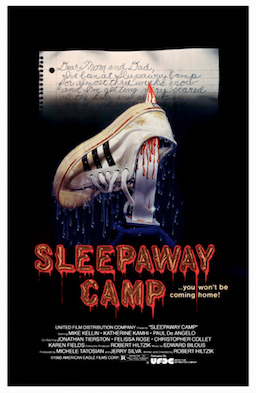
Undoubtedly like most of the jaded youth of my generation, I first saw the poster for SLEEPAWAY CAMP back in the late 1980s. It’s the one that stayed with me the most over the decades.

It has the dominant image of a dripping wet shoe being stabbed all the way through by a bloodied knife. Above, there’s a letter from a camper, “Dear Mom and Dad, I’ve been at Sleepaway Camp for almost three weeks now and I’m getting very scared. …” Right below the hand holding the knife are the title dripping blood from its bold type and the tag “You won’t be coming home!”

Now, hours after watching SLEEPAWAY CAMP for the first time, it’s just as unforgettable as the poster.

To a great degree, SLEEPAWAY CAMP chucks our traditional notions of what constitutes a “good” or a “bad” movie right out the fucking window. It’s more of an experience, an event, a rite of passage, something where you can ask friends and family if they have ever seen it. If they have or haven’t, dynamite conversation will follow either way. For sure, though, it would make a great watch party — of course, following proper social distancing protocol at this point in history.

Here’s a few notes on the experience:

— Melodrama is defined as such, “A sensational dramatic piece with exaggerated characters and exciting events intended to appeal to the emotions.” Addendum: See SLEEPAWAY CAMP. Early on, after the obligatory flashback to traumatic events of the past, Desiree Gould’s Aunt Martha establishes the basic tone for the rest of the movie: Campy with overacting possible. Yes, SLEEPAWAY CAMP goes over-the-top, gleefully, merrily, in every scene, including the end credits.

— Being bat shit crazy for 84 minutes has been SLEEPAWAY CAMP’s meal ticket to cult movie immortality. Because, let’s face it, it’s not as well-made technically as similar low-budget precursors BLACK CHRISTMAS, ALICE SWEET ALICE, and HALLOWEEN. Not even remotely close.

— SLEEPAWAY CAMP uses a musical score that also functions as bludgeoning device and melodrama amplifier. I just checked for any injuries after being whacked upside the head at regular intervals by Edward Bilous’ sledgehammer score. I survived without a single bump — amazing, I know. Anyway, I looked up this Bilous fellow. IMDb linked me to edwardbilous.com and a Bilous quote from the Wall Street Journal, “Artists today need a new set of skills to be able to tell the unique story of their generation.” He’s the founding director for the Center for Innovation in the Arts and the artistic director for Beyond the Machine, A Festival of Electro-Acoustic and Interdisciplinary Art at Juilliard. He joined the Juilliard faculty in 1984.

— “Weird Al” Yankovic’s “Nature Trail to Hell” sounds like a spin on FRIDAY THE 13TH PART III and SLEEPAWAY CAMP. “Coming this Christmas to a theater near you / The most horrifying film to hit the screen / There’s a homicidal maniac who finds a cub scout troop / And he hacks up two or three in every scene / Please don’t reveal the secret ending to your friends / Don’t spoil the big surprise / You won’t believe your eyes when you see. …” and “See severed heads that almost fall right in your lap / See that bloody hatchet coming right at you / No, you’ll never see hideous effects like these again / ‘Till we bring you ‘Nature Trail to Hell Part 2.’” File “Nature Trail to Hell” alongside such “Weird Al” epics as “The Biggest Ball of Twine in Minnesota,” “Albuquerque,” “Trapped in the Drive-Thru,” and “Jackson Park Express.”

— In his final performance, veteran actor Mike Kellin (1922-83) surpasses Gould in scenery chewing. He chews scenery to such a degree that he could chew through every picture’s scenery within an entire multiplex. Kellin plays Camp Arawak owner Mel Kostic, who keeps downplaying everything until about the 50th dead body. At least it feels that way anyway. He’s one of those characters who becomes creepier and more detestable over the course of the movie, especially when he lines up dinner with a camp counselor in her late teens and assaults one of the main characters who he mistakenly believes to be the killer. Mel loses his shit late in the picture, and it’s not pretty.

— By this point in the review, I should have already discussed the plot. Eight years after a tragic boating accident near Camp Arawak, Aunt Martha sends her niece Angela (Felissa Rose) to camp with Ricky (Jonathan Tiersten), Angela’s cousin and Martha’s son who’s a veteran camper. Mean girls Judy (Karen Fields) and Meg (Katherine Kamhi), as well as a group of their male counterparts both teenage and prepubescent, are relentlessly cruel and nasty toward Angela and Ricky, especially the initially painfully shy and quiet Angela. Ricky’s friend Paul (Christopher Collet) takes a shining to Angela and he’s able to break her silence. Over time, however, the picture develops a dread pattern: Every character who’s cruel and nasty to Angela or Ricky bites the dust in spectacular fashion. Yes, just like everything else in the picture, including the crop-tops and short-shorts, the murder set pieces are over-the-top.

— At this relative late point in the slasher film craze, a mere five years since HALLOWEEN, films in the genre needed a major selling point and SLEEPAWAY CAMP includes one of those (awesome but infuriating) endings that redefines the reality of every scene that came before, just like FRIDAY THE 13TH and HAPPY BIRTHDAY TO ME. This beyond bizarre ending is the first and foremost reason we still talk about SLEEPAWAY CAMP all these years later.

Porky’s (1981)

PORKY'S

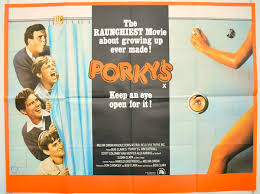
PORKY’S (1981) Three stars

“Nobody ever went broke underestimating the intelligence of the American public,” H.L. Mencken famously said.

Mencken said that long before the success of PORKY’S, PORKY’S II: THE NEXT DAY, and PORKY’S REVENGE!, comedies which combined for over $200 million in box office and rental returns. Mencken died in 1956.

PORKY’S earned the vast majority of that $200 million and it came from out of seemingly nowhere to place fifth at the American box office in 1982, behind only breakaway winner E.T., ROCKY III, ON GOLDEN POND, and AN OFFICER AND A GENTLEMAN. PORKY’S sat on top of the American box office from late March through early May and it was dethroned by Arnold Schwarzenegger and CONAN THE BARBARIAN.

Unlike those other films, however, critics absolutely detested PORKY’S and aligned it with FRIDAY THE 13TH and THE CANNONBALL RUN in an unholy trinity of films that would no doubt lead to the downfall of Western Civilization. PORKY’S exhibits more than most how a film can be hated by critics and loved by the masses.

The success of the first PORKY’S spawned a whole slew of teenage sex comedies, often nostalgic and especially set in either the 1950s or 1960s.

I claimed a copy of PORKY’S as one of my first VHS purchases in my late teenage years and it quickly became a favorite movie of my rowdy group of friends. We loved it, as well as NATIONAL LAMPOON’S ANIMAL HOUSE, CADDYSHACK, KINGPIN, and THE BIG LEBOWSKI.

Every time I watch PORKY’S, I find a few big laughs and that’s why I am giving the film a passing grade. As far as the sequels are concerned, they are dreadful and deserve their horrible reputation. I remember seeing all of them in heavily edited form on “USA Up All Night,” before catching up with them all on video or pay TV.

Of course, our seven high school horn balls in PORKY’S are all played by older actors: Dan Monahan turned 26 in 1981, Mark Herrier 27, Wyatt Knight 26, Roger Wilson 25, Cyril O’Reilly 23, Tony Ganios 22, and Scott Colomby 29. That’s not anything new for a Hollywood film. For example, in GREASE, another highly successful nostalgia piece, John Travolta was 23 when he made it and Olivia Newton-John was 28 almost 29, Stockard Channing 33, Jeff Conaway 27, Barry Pearl 27, and Michael Tucci 31 when they were playing high school students.

Speaking of GREASE, one could describe PORKY’S as GREASE with T&A and rednecks instead of PG and greasers and without musical numbers.

PORKY’S includes sex jokes, condom jokes, sex jokes, size jokes, sex jokes, nude jokes, sex jokes, penis jokes, sex jokes, virgin jokes, sex jokes, and fat jokes, especially at the expense of villains Porky (Chuck Mitchell, a 6-foot-3, nearly 400-pound man) and Ms. Beulah Balbricker (Nancy Parsons).

Porky is a real vile piece of work, a saloon and brothel owner who is the most powerful man in his county. Every public official seems to be related to Mr. Wallace, namely his brother Sheriff Wallace (former NFL great Alex Karras). Mitchell wraps his best redneck goon around such dialogue as “I was givin’ the old place an enema and this pile of shit come floatin’ up to the surface” and “Where are these five little virgins who think they reached manhood? You wanna tangle ass with me? Come up here, you sawed-off punk! I’ll educate ya! I’ll wrap this right around your damn neck!” It is to Mitchell’s credit that he creates such a nasty character that we do root for his comeuppance in the final reel.

Balbricker embodies the worst killjoy or she’s basically portrayed as the Carrie Nation of the teenage sex comedy. Less successful, though, much less successful. After all, Carrie Nation (1846-1911) said things like “I felt invincible. My strength was that of a giant. God was certainly standing by me. I smashed five saloons with rocks before I ever took a hatchet” and “I want all hellions to quit puffing that hell fume in God’s clean air.” Balbricker (also called “Ball-breaker” and “King Kong” by other characters) develops an obsession with one character’s penis. Please can we call it a tallywhacker? Penis is so personal. Parsons, like Mitchell, gives a very good performance, one that rates with John Vernon in ANIMAL HOUSE.

Kim Cattrall must have used her work here as Miss Honeywell (“Lassie”) during her audition for “Sex and the City.” It definitely beats MANNEQUIN.

Writer and director Bob Clark (1939-2007) has a very interesting story and filmography, since his credits include the 1974 proto-slasher BLACK CHRISTMAS, the beloved A CHRISTMAS STORY, and the first two PORKY’S films, as well as even more diverse entries like MURDER BY DECREE, TRIBUTE, RHINESTONE, TURK 182!, LOOSE CANNONS, and BABY GENIUSES.

His entry in “Take One’s Essential Guide to Canadian Film” from 2001 : “Clark turned down bids to play pro football to complete a drama major at the University of Miami. With the success of his low-budget horror classic CHILDREN SHOULDN’T PLAY WITH DEAD THINGS, Clark moved to Montreal in 1973 and came to dominate Canadian commercial filmmaking for a decade. He followed CHILDREN with BLACK CHRISTMAS, a box-office hit starring Margot Kidder, and then, from 1978 to 1981, he directed MURDER BY DECREE, TRIBUTE, and PORKY’S – three of the most successful films produced in the tax-shelter era. Sad to say, the sophomoric PORKY’S remains the Canadian box-office champ. Clark returned to the United States in 1984; his career, like his locale, has gone south since.”

I read that Clark gathered the material for PORKY’S over a 15-year period, combining stories from other males of his generation with his own experiences. Every Hollywood studio passed on PORKY’S and it was produced by the Canadian company Astral Bellevue Pathe and Melvin Simon Productions (Mr. Simon, who died in 2009 at the age of 82, developed Mall of America, co-owned the Indiana Pacers along with his brother Herbert, and produced films including PORKY’S, THE STUNT MAN, and ZORRO, THE GAY BLADE), but 20th Century Fox picked up the U.S. distribution and a slick marketing campaign, combined with strong word-of-mouth, produced a monster hit on a $4 million budget.

Clark passionately defended the film amid the constant cries of misogyny and racism.

Those critics are missing that Wendy, played by Kaki Hunter, is often the sunniest presence and that Clark set his film in the Deep South in 1954. One character does overcome his initial anti-Semitism and becomes friends with a Jewish classmate.

THE NEXT DAY seems to address both criticisms, though, with one thoughtful dialogue scene between Wendy and main horn ball Pee-Wee (Monahan) and then adds a fanatical reverend, hypocritical politicians, a Native American, and the Ku Klux Klan to the mix. All the latter material simply does not mesh with the juvenile sex comedy.

Clark did not return to direct REVENGE and director James Komack and screenwriter Ziggy Steinberg wanted the third installment to return to the pure sex farce of the first movie. All the actors simply look too long in the tooth to be partaking in such adolescent shenanigans. I mean, for crying out loud, Colomby was nearly in his mid-30s by the point they made this third PORKY’S film; he graduated from Beverly Hills High School in 1970. Bottom line: I laughed not a single time at PORKY’S REVENGE, maybe once at NEXT DAY.


PORKY’S II: THE NEXT DAY (1983) One star; PORKY’S REVENGE! (1985) No stars

Monty Python’s The Meaning of Life (1983)

MONTY PYTHON’S THE MEANING OF LIFE (1983) Three stars

There’s a DVD bundle called “A Little Something to Offend Everybody” and it pairs Mel Brooks’ HISTORY OF THE WORLD PART I and MONTY PYTHON’S THE MEANING OF LIFE.

That’s fitting, because both films definitely fit that bill. For example, both have centerpiece musical numbers that flaunt their potential for controversy: “The Inquisition” in HISTORY OF THE WORLD and “Every Sperm is Sacred” in THE MEANING OF LIFE. Both films go highbrow, middlebrow, lowbrow, below the brow, and even more below the brow. Scatological and sexual jokes abound and Brooks and the Python troupe use just about every trick in the book for their assault on delicate sensibilities and community standards, and they especially indulge their willingness to go over the top in almost every single moment.

It seems like the Monty Python gang (Graham Chapman, John Cleese, Terry Gilliam, Eric Idle, Terry Jones, Michael Palin) made THE MEANING OF LIFE as a reaction to the intense controversy around LIFE OF BRIAN. “If you thought that was bad, well, you ain’t seen nothing yet,” that’s what it seems like they’re saying for all 90 minutes of THE MEANING OF LIFE.

I can hear some of you asking, though, do you get the meaning of life from the movie? Just think about the ridiculousness of that question.

Lady Presenter: Uh, try and be nice to people, avoid eating fat, read a good book every now and then, get some walking in, and try and live together in peace and harmony with people of all creeds and nations. …

The lady presenter (actually Palin in one of his almost 20 roles in the movie) then gets at the crux of the movie as she continues her speech: “And, finally, here are some completely gratuitous pictures of penises to annoy the censors and to hopefully spark some sort of controversy, which, it seems, is the only way, these days, to get the jaded, video-sated public off their fucking arses and back in the sodding cinema. Family entertainment? Bollocks. What they want is filth: people doing things to each other with chainsaws during Tupperware parties, babysitters being stabbed with knitting needles by gay presidential candidates, vigilante groups strangling chickens, armed bands of theatre critics exterminating mutant goats.”

If people truly want “filth,” THE MEANING OF LIFE delivers the goods.

The feature’s second sketch “The Third World” highlights a Catholic working class father (Palin) from Yorkshire, his wife (Jones), and their 63 children. He comes home and informs his family that he’s out of work because the local mill shut down, they are destitute, and that he must sell all 63 children for scientific experiments. He says, “Blame the Catholic Church for not letting me wear one of those little rubber things.”

The father eventually breaks into “Every Sperm is Sacred,” with the memorable chorus “Every sperm is sacred / Every sperm is great / If a sperm is wasted / God gets quite irate.” It turns into a production number straight out of an elaborate musical nominated for a multitude of awards, with even the children getting in on the act before they hit the streets.

The children obviously knew not what they were singing about at the time. Palin felt uncomfortable with one particular line and he originally delivered it “sock” in front of the children before “cock” was later dubbed in.

Beyond “Every Sperm is Sacred,” there’s “Penis Song” (I remember somebody once sang this crowd pleaser at karaoke) and “Christmas in Heaven.”

Quentin Tarantino said the Mr. Creosote sequence makes him nauseous and that says all there needs to be said about the explosive sequence.

I am not or have ever been offended by any of the content in THE MEANING OF LIFE. I think it’s an uneven grab bag of comedy, with hilarious bits, merely funny bits, and other bits where I admire the bits on an intellectual level but I do not laugh. That’s a bit too much of the word bit, but obviously THE MEANING OF LIFE deserves excess verbiage. It’s not as good (funny) as AND NOW FOR SOMETHING COMPLETELY DIFFERENT, THE HOLY GRAIL, and LIFE OF BRIAN.

Before THE MEANING OF LIFE officially starts, we get a bonus 17-minute pirate movie from Gilliam. The elderly British accountants of Crimson Permanent Assurance are fed up with corporate efficiency and they are not gonna take it anymore after the big corporation sacks one of the accountants. Their building turns into a pirate ship with filing cabinets for cannons, ceiling fans for broadswords, and paper spindles for short swords, and they attack The Very Big Corporation of America.

There were several pirate movies during the 1980s and I vote THE CRIMSON PERMANENT ASSURANCE one of the best, right alongside CASTLE IN THE SKY and THE PRINCESS BRIDE.


THE CRIMSON PERMANENT ASSURANCE (1983) Three-and-a-half stars

Jaws III (1983)

JAWS III (1983) One star
In the movies, three is most often not a magic number.

In the movies, three is most often not a magic number.

In the movies, three is most often not a magic number.

Were the second and third entries less interesting than the first?

Of course, they were and that principle applies to sequels like, for example, JAWS III, a long, long way down from the original JAWS directed by Steven Spielberg.

JAWS: THE REVENGE pretended JAWS III — originally titled JAWS 3-D — never happened and that’s something I would like to do with both movies.

Nah, I take it back, because I enjoy both movies for their epic badness. I’ve watched both whenever I’ve had the chance and I hope that I will always be able to marvel once again at their incredible ineptitude.

In the business, they have what’s known as the Idiot Plot or that’s when everything would be figured out much sooner if the characters were not complete idiots.

In JAWS III, it takes our protagonists incredibly long to figure out that our Great White Mother’s inside the park.

I chortle when female protagonist Kathryn Morgan (Bess Armstrong) says the following dialogue, “Overman was killed inside the park. The baby was caught inside the park. Its mother is inside the park.”

This dramatic moment instead plays comedic.

Honestly, though, I live for that moment partially because earlier Morgan explains the bite radius, a plot detail essential to any JAWS film. Right, JAWS: THE REVENGE?

There’s a couple more favorite moments in JAWS III that I will try and get through sooner or later within this review.

Now, however, I’ll go through some of the problems with JAWS III one-by-one. We already hit the Idiot Plot, the film’s biggest problem.

— Weak characters: The original JAWS featured three great characters in Sheriff Brody (Roy Scheider), Hooper (Richard Dreyfuss), and Quint (Robert Shaw). Brody returned in JAWS 2 — Universal had Scheider by the balls and made him do JAWS 2 — and there’s not a single great character in JAWS III or JAWS: THE REVENGE. Not a one.

— Weak shark: In JAWS 2, the shark stood out more than any human character, including Sheriff Brody and Mayor Larry Vaughn. Especially them darn insipid teenagers. Not in JAWS III. The Great White Mother in JAWS III does not approach the ridiculousness of the fourth JAWS entree, but a plot that has a mother shark taking revenge for her son, why that’s just preposterous and plain out-of-character for a shark. I might owe ORCA THE KILLER WHALE (1977) an apology.

— Weak big moment: Let’s briefly set this one up. It’s late in the movie and Morgan and her love interest Mike Brody (Dennis Quaid), park manager Calvin Bouchard (Louis Gossett, Jr.), and two park technicians are inside the control room. Of course, here comes the Great White Mother and it’s obviously going to crash through the glass in full-on 3D glory. Here it comes … here it comes … here it comes … 2D anticlimax! I don’t know what else to say but this scene’s even more laughable than our great-shark-inside-the-park-revelation scene, especially with Morgan and Brody’s priceless slow-motion reactions leading up to the shark’s crash.

— Them damn dolphins: Yes, Cindy and Sandy, who are worse than our teeny boppers from JAWS 2, believe it or not. Granted, to their credit, Cindy and Sandy figure out the plot faster than anybody else in the movie. Cindy and Sandy (a.k.a. “The Shrieking Dolphins”) went up against some tough competition at the 1984 Razzies for Worst New Star — Finola Hughes in STAYING ALIVE, Reb Brown in YOR, THE HUNTER FROM THE FUTURE, Loni Anderson in STROKER ACE, and the grand prize winner Lou Ferrigno in HERCULES.

Okay, okay, that’s enough for now.

I’ll close on what I consider to be the great mystery from JAWS III.

Does anybody out there know what the following dialogue even means: “You tell Shelby Overman for me he can take a flyin’ leap in a rollin’ doughnut on a gravel driveway, you hear?”

The Killing of Satan (1983)

day 106, the killing of satan

THE KILLING OF SATAN (1983) Three stars
Not exactly sure what to make of this 1983 Filipino production named LUMABAN KA, SATANAS or THE KILLING OF SATAN elsewhere in this great big world.

I mean, you can’t go too far wrong with a movie that features the line, “Satan! Where are you? Come out and fight!”

THE KILLING OF SATAN has a preposterous but literal plot (our hero does kill Satan), ridiculous dubbing (mouths are moving without dialogue coming out, I do believe, on multiple occasions), eye-popping special effects, nudity galore (not too much galore, though), and a hero who’s equipped with the powers of a jean jacket, jeans, a rockin’ ‘stache, and Chuck Taylors. Yeah, he’s an ex-con too and you’re right, he sounds like the most believable action hero to ever grace a movie screen.

Not sure how many action heroes graced a jean jacket. I do remember Martin Sheen wore one in BADLANDS, a Levi’s 507XX jacket, but does that count? Oh, I better not forget Chuck Norris and his demolition in denim from INVASION U.S.A.

Jean jackets apparently date back to the late 19th Century.

Levi Strauss designed the first-ever jeans in 1870, designed to be “a durable, breathable utility garment for cowboys, railroad engineers, and miners to wear during the gold rush out West.”

In all my research, I do not see Ramon Revilla, the actor who plays our hero Lando, listed among the great celebrities who rocked jean jackets. I mean, for crying out loud, I think he’s every bit as important as Kanye West, especially after research.

Revilla was around his mid-50s in age when he made THE KILLING OF SATAN. Are you kidding? That makes his feats in THE KILLING OF SATAN even more impressive. You must have God on your side, though, to overcome middle age, a jean jacket, being an ex-con, and that mustache.

Over a lengthy career that started in the 1950s, Revilla has been nominated for five and won two awards from the Filipino Academy of Movie Arts and Sciences (FAMAS), although he was not nominated for THE KILLING OF SATAN.

Revilla won Best Actor for his work in the 1973 film HULIHIN SI TIAGONG AKYAT and won the Presidential Award in 2005. His other nominations include Best Actor for NARDONG PUTIK (1972), SANUGIN ANG SAMAR (1974), and CORDILLERA (1986).

Revilla, now 91 years old, served 12 years (1992-2004) as Senator in the Philippines and he also developed a legendary reputation for being a ladies man, before he ever went near politics.

Did he use killing Satan for his campaign?

Revilla’s son Ramon “Bong” Revilla Jr., who succeeded his old man in politics, took umbrage at Hollywood actor Alec Baldwin for his 2009 “mail-order bride” joke on David Letterman.

“Let him try to come here in the Philippines and he’ll see mayhem,” Revilla said.

“Bong” said this while being an active Filipino senator. Baldwin, of course, later apologized and said he understood why folks like the Senator were so upset.

“Bong” is Revilla’s 60th child of 72 children with 16 different women.

We’ll have more on the rest of THE KILLING OF SATAN in another episode.

Lone Wolf McQuade (1983)

day 39, lone wolf mcquade

LONE WOLF MCQUADE (1983) Three-and-a-half stars
Let’s get the facts straight on Chuck Norris.

That might be impossible at this point, even though I have the book “Chuck Norris vs. Mr. T” by Ian Specter on the shelf below Ray Bradbury and on top Benjamin Franklin. How’s that for strange literary bedfellows?

You might not know Specter by name, but you know his creation “Chuck Norris Facts” that blew up the Internet in the mid-2000s. He’s your typical, pencil-necked geek from an Ivy League school who thought it would be a laugh riot (and smart investment strategy) to parody Norris’ machismo. I thought his facts were a laugh riot and quoted them endlessly in between reciting Charles Bukowski’s “Notes of a Dirty Old Man.”

The humor was on the level of “Chuck Norris does not wear a condom. Because there is no such thing as protection from Chuck Norris.”

Since I technically majored in history in college, I got more of a kick out of the historically-based facts. Donald Trump would probably call them “alternative facts.”

Like, for example, I loved the one “JFK wasn’t killed by a bullet, Chuck Norris ran in and deflected the bullet with his beard … JFK’s head exploded out of sheer amazement.”

That’s the most cogent explanation for JFK’s assassination I’ve ever heard and damn, if they had existed back then, Chuck Norris Facts would have saved me from watching Oliver Stone’s JFK.

Apparently, Norris was in on the joke himself until he sued Mr. Specter late 2007 and early 2008.

Mr. Specter quotes from the suit letter in his “Chuck Norris vs. Mr. T” intro, “Mr. Norris is known as an upright citizen to whom God, country, and values are of paramount importance” and “Mr. Norris also is concerned that the book may conflict with his personal values and thereby tarnish his image and cause him significant personal embarrassment.”

The parties eventually reached a settlement in the spring of 2008.

In a roundabout way, we’re here to discuss LONE WOLF McQUADE, Norris’ best film (along with CODE OF SILENCE) and one of his first successful attempts to break free of the martial arts stranglehold.

The director Steve Carver and Norris worked together previously on EYE FOR AN EYE and here Carver wanted to mess with Norris’ squeaky clean image (critic Dave Kehr called Norris “a Boy Scout Clint Eastwood”), insisting that Norris grow a beard and drink beer. Norris, of course, was hesitant. You’ve not lived until you have seen Norris roll around in the mud with Barbara Carrera.

When I found this movie was rated PG by the Motion Picture Association of America, I thought it must have been a mistake. Did we see the same movie?

No, apparently not, and the MPAA pencil necks saw the light due to Norris persuasion. Just think they were all scared of that Norris roundhouse.

Norris said, “This is the second time I’ve appealed. They gave GOOD GUYS WEAR BLACK an R, but I persuaded them to make it a PG. My argument was the strong, positive image I project on the screen. The word karate, unfortunately, connotes violence to many people. Actually, it’s a means of avoiding violent situations, and a form of defense if you have no choice and you’re backed into a corner. … My films are very similar to the John Wayne movies of the ’40s. He’d go in a bar and Jack Palance would pick a fight with him, and then Wayne would take out half the saloon. It’s the same theme: A man is pushed into a situation where he has to resort to violence.”

What a bunch of hooey.

Norris avoided violence like I avoid metaphors.

I mean, seriously, why else would we watch a Norris action spectacular?

LONE WOLF McQUADE gives us a few more reasons to watch than the average Norris action spectacular.

Carver wanted to recreate the atmosphere of a Sergio Leone film, to put the viewer in that mythic, larger-than-life mindset.

L.Q. Jones and R.G. Armstrong are in the cast and just a year before LONE WOLF, they were seen together in THE BEAST WITHIN. The brief plot summary of that one: “A young woman gets raped by a mysterious man-creature, and years later her son begins a horrific transformation into a similar beast.” That beast would be a cicada.

Jones, who turned 91 in August, appeared in 163 movies and TV shows ranging from HANG ‘EM HIGH and Sam Peckinpah epics (Jones and Armstrong were both in PAT GARRETT AND BILLY THE KID) to CASINO and THE MASK OF ZORRO.

Armstrong (1917-2012), whose ‘G’ in his name stands for “Golden,” had memorable roles in PREDATOR, DICK TRACY (Pruneface), and CHILDREN OF THE CORN among his nearly 200 credits. In fact, I still cannot believe that he did not survive those Gatlin, Nebraska upstarts in the latter film. No respect for their elders. Damn kids.

I nearly always enjoy seeing Jones and Armstrong.

I love it, for example, when Armstrong’s superior officer leans on Norris’ J.J. McQuade to change his slovenly, “lone wolf” ways. McQuade’s a blemish on the wholesome, upstanding Texas Ranger image.

This is a scene that we’ve seen in many, many films involving cops, I mean you can guess what happens when a superior officer calls the protagonist or protagonists into his office. Sometimes, it’s fun to watch. More often, it’s a pain in the neck.

This one works, because of Armstrong. He’s one of the greats in crotchety, and it’s also enjoyable watching somebody dish it out to Norris for a change.

Dana Kimmell plays Norris’ daughter in the movie and she went from surviving Jason Voorhees to surviving being Norris’ daughter.

Of course, it’s rough on her in that macho, macho, macho world.

David Carradine (1936-2009) gives the flick a legitimate villain, not some candy ass pushover. Unlike Norris, Carradine played both good guy and bad guy roles throughout his career, and he’s credible at both. (Norris made a great villain in Bruce Lee’s WAY OF THE DRAGON, but he turned hero after that. Yawn.) Of course, we’re all waiting for Norris and Carradine to have their final showdown.

There’s one legendary scene in LONE WOLF McQUADE.

It’s relatively late in the proceedings.

McQuade is captured and beaten by Carradine’s Wilkes, and Wilkes orders his men to put McQuade in his customized Dodge truck and bury him alive.

You don’t bury McQuade alive, especially not in his Dodge.

McQuade finally comes to, opens up a beer and pours it over his head, and starts up his souped-up truck, which plows through the dirt en route to reality.

You can’t bury McQuade alive, you fools.

Outside his truck, McQuade then dispenses some anonymous henchmen and, in a heap on the ground, our exhausted Ranger tells his young Latino partner, “Get me a beer, kid.”

McQuade’s truck deserved a movie of its own.

Christine (1983)

DAY 2, CHRISTINE

CHRISTINE (1983) Three-and-a-half stars
Back in college, during my first assignment for the school paper, I wrote a section about how Americans love their cars, from Route 66 and Jack Kerouac to James Dean and back. The summer editor took out the Americans love their cars section and now, it’s a suitable introduction for John Carpenter’s CHRISTINE, an adaptation of a Stephen King novel that does put a novel spin on some American fiction tropes.

We’ve seen many, many (arguably too many) films where boy meets girl and it’s love at first sight, but this is a film where it’s boy meets car and they meet cute with the car in shambles and up for sale by a codger who’s suspiciously quick to accept any price for the car. The boy’s arguably not in any better shape than the car.

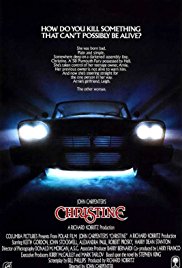
The boy in love is Arnie Cunningham, a nerd supreme, and the car is a 1958 Plymouth Fury named Christine that’s definitely “bad to the bone” or at least bad to the bumper. Arnie, who dwells in 1978 California, might have liked to seen the 1957 Detroit prologue where an assembly line worker’s killed by the devil car, but Arnie and Christine are definitely meant for each other.

True love at first sight for both parties, and it will not be denied.

Yeah, you might say the film’s ridiculous, but most horror films are ridiculous, of course, and CHRISTINE works partly because it’s a love story with a twist in the main premise that we can appreciate. We love our cars, of course, but our love thankfully never reaches Arnie and Christine levels. It’s undeniable, though, to watch it happen to somebody else in a movie.

CHRISTINE also works because of the lead performance by Keith Gordon as the super nerd Arnie, who might be the cousin of Terry the Toad. He’s transformed by his love for his car into somebody foreign to his parents and his best friend Dennis, a football jock who sticks up for Arnie in the face of relentless school bullies and who questions Arnie’s purchase of the car right from the start. With this special car in his life, Arnie becomes a new young man by discarding his old taped-up horn-rimmed glasses, dressing like a latter day James Dean (ideal since Christine only plays ’50s rock ‘n’ roll), and becoming first arrogant and later belligerent, especially whenever any one comes between him and Christine. Fools they are, several individuals mess with the boy and car or just the car alone and they usually face gruesome consequences for their reprehensible actions.

We like this Arnie character and Gordon performance even more when Arnie starts taking a walk (or drive) on the mean side.

Anyway, the new brimming-with-confidence Arnie begins seeing the hot new girl in school, Leigh Cabot, and their relationship needless to say is complicated by Christine. Romantic triangles are frequent in the movies, but CHRISTINE might be the first and only one with a boy, a girl, and a killer car.

The girl and the car are both jealous of each other and that leads to the classic moment at the drive-in when the car attempts to kill the girl. Serves her right.

Needless to say, the girl wants very little to do with the boy after surviving this moment and the boy and the car become even closer, all leading us to a thrilling duel-to-the-death climax between machines in a garage.

John Rockwell and Alexandra Paul are just fine in their roles as best friend Dennis and would-be girlfriend Leigh, respectively, and if Columbia Pictures had its way, casting would have been disastrous with Scott Baio in the Arnie role and Brooke Shields as Leigh. Egads! Thankfully, the filmmakers insisted on lesser known actors. Kevin Bacon auditioned for Arnie, but he went off to do FOOTLOOSE instead and that obviously worked out best for all parties involved.

Gordon, who had previously appeared in JAWS 2 and DRESSED TO KILL, gives the defining performance of his career and his Arnie Cunningham rates with the greats in screen nerddom.

Veteran character actors Robert Prosky, Harry Dean Stanton, and Roberts Blossom (three of the best) are on hand and their old-fashioned grit and grime mesh well with the teeny boppers and the possessed car.

We talked about the subtle twists CHRISTINE puts on formula material. Well, the final line reading gives us Leigh declaring “God, I hate rock ‘n’ roll.” Probably the first teenager to ever say that in a film.