
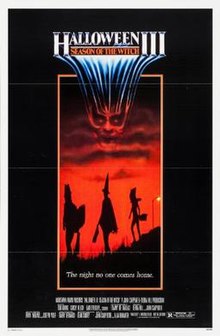
Halloween III: Season of the Witch (1982)

HALLOWEEN III

HALLOWEEN III: SEASON OF THE WITCH (1982) One star

The late critic Roger Ebert (1942-2013) took a lot of heat from readers for his review of HALLOWEEN III, mainly because his review contained glaring factual errors, including the biggie that Michael Myers was in HALLOWEEN III. Even those who agree with his basic finding that HALLOWEEN III sucks wish that Ebert had written a better review.

Recently, a Facebook post on a cult and exploitation film group referenced Ebert’s HALLOWEEN III review from one of his video companion books as just one more reason why the critic sucked. Going back nearly five years ago, the “Halloween III: Season of the Witch Appreciation” group posted his entire review. Would it be too much to say get over it? I mean, I hope Ebert never looked back and moved on past HALLOWEEN III.

Here’s the part, though, referencing Myers: “It begins at the end of HALLOWEEN II, when the monster was burned up in the hospital parking lot, but it’s not still another retread of the invincible monster. In fact, the monster is forgotten, except for a lab technician who spends the whole movie sifting through his ashes.”

Here’s what I find most fascinating: There’s a “Halloween III: Season of the Witch Appreciation” group. Certain fans of the film stick up for it very, very, very intensely and go after those who do not believe in their cult favorite, a phenomenon that also exists with other flicks like, for example, HOWARD THE DUCK. Be careful, very very very careful indeed, when expressing a “negative” opinion these days about somebody’s misunderstood, neglected cult favorite.

As one might gather from the star rating, I think HALLOWEEN III sucks. Yeah, I said it, just like how Rodney Dangerfield said it during CADDYSHACK. (HALLOWEEN III fans believe their movie’s been treated like Dangerfield’s most famous line.)

At just about this moment in time, somebody might be saying that I just don’t understand the conceptual brilliance throughout HALLOWEEN III.

No, believe me, I get HALLOWEEN III, I understand it, hell I even admire it for trying something completely different than being just one more damn assembly line horror movie sequel, I think it fails miserably.

I find HALLOWEEN III to be a drag, a real downer of a movie, redeemed only somewhat by two performances, including one by veteran Irish character actor Dan O’Herlihy as diabolical villain Conal Cochran, the world’s greatest practical joker. Though I enjoyed O’Herlihy more in both THE LAST STARFIGHTER and ROBOCOP, he brings that same ebullient spirit to HALLOWEEN III. He’s just like a James Bond super villain.

Unfortunately, though, I would be hard-pressed to name a main protagonist in any horror movie I like less than Dan Challis in HALLOWEEN III. Maybe somebody from THE AMITYVILLE HORROR series, perhaps. It’s no coincidence that HALLOWEEN III co-writer and director Tommy Lee Wallace also wrote AMITYVILLE II: THE POSSESSION (1982), giving him the distinction of being involved with two of the most unpleasant mainstream horror films I’ve ever seen. Both films come from the Dino DeLaurentiis Corporation. Not sure if there’s an “Amityville II: The Possession Appreciation” group in this great big world.

Challis, getting back on track, he’s played by Tom Atkins. I do like Atkins, especially in the cult favorite NIGHT OF THE CREEPS. He’s traditionally a supporting actor, but I don’t think Atkins proved himself up to the task of being the lead actor. He’s too much of a creep in HALLOWEEN III.

Because of that, HALLOWEEN III features one of the most awkward, most unbelievable, and creepiest love scenes in history between Atkins and Stacey Nelkin.

I do believe Ebert nailed it on Nelkin: “The one saving grace in HALLOWEEN III is Stacey Nelkin, who plays the heroine. She has one of those rich voices that makes you wish she had more to say and in a better role. But watch her, too, in the reaction shots: When she’s not talking, she’s listening. She has a kind of rapt, yet humorous, attention that I thought was really fetching. Too bad she plays her last scene without a head.”

Though enjoying both Nelkin and O’Herlihy (file them under good performances in bad movies), the majority of the movie bludgeons me over the head every few minutes with a gory murder scene involving characters I don’t give a damn about. This is one of those movies where you apply ice to the back of your head after it’s over because it’s been hitting you for 100 minutes.

In a nutshell, we have mostly unpleasant characters in unpleasant situations, topped off by ultra-annoying commercial jingles for Silver Shamrock (I get that it’s the point of these jingles) and plots and scenes recycled wholesale from better movies like INVASION OF THE BODY SNATCHERS (1956 version) and James Bond.

Other than that, how was the play, Mrs. Lincoln?

Q: The Winged Serpent (1982)

Q

Q: THE WINGED SERPENT (1982) Three-and-a-half stars
I admit loud and proud a weakness for time travel, robots, monsters, and mad scientists.

Maybe weakness is the wrong choice of word. How about predilection?

Q: THE WINGED SERPENT definitely fits the bill for monsters, a grand homage to the great monster movies of the 1950s.

It’s directed, written, and produced by Larry Cohen (1941-2019) and it’s financed by Samuel Z. Arkoff (1918-2001) as the first release from Arkoff International Pictures.

Of course, Arkoff was involved with Q.

Arkoff’s producer credits include THE PHANTOM FROM 10,000 LEAGUES, IT CONQUERED THE WORLD, THE SHE-CREATURE, INVASION OF THE SAUCER MAN, THE AMAZING COLOSSAL MAN, HOW TO MAKE A MONSTER, and REPTILICUS.

Arkoff even provided a great quote in a conversation between the producer and critic Rex Reed (relayed by Roger Ebert).

Reed: “Sam! I just saw THE WINGED SERPENT! What a surprise! All that dreck — and right in the middle of it, a great Method performance by Michael Moriarty!”

Arkoff: “The dreck was my idea.”

That brings us to Michael Moriarty, whose performance elevates Q to another level.

He plays Jimmy Quinn (though he’s not the “Q” of the film’s title), a cheap dime store hood with aspirations of being a jazz pianist.

Quinn’s like Jeffrey Combs’ Herbert West in RE-ANIMATOR and Thomas Wilson’s Biff Tannen (and various historical offshoots) in the BACK TO THE FUTURE series.

In other words, he’s a lovable asshole or we love hating Jimmy Quinn.

Personally, I love what he does after his discovery of the Quetzalcoatl (the real source for the film’s title) responsible for several deaths.

A pair of hoods lean on Quinn after his part in a botched diamond heist and he leads them to the Chrysler Building, nesting ground of the Quetzalcoatl. The hoods don’t know that.

Quinn’s priceless reaction to the fate of the hoods: “Eat ‘em, eat ‘em! Crunch! Crunch!”

Then Quinn comes up with a plan, a ransom deal for New York City authorities: $1 million in cold, hard cash in exchange for divulging the nest location. “All my life I’ve been a nobody and right now I’ve got the chance of being somebody important,” Quinn said.

Seems like Quinn served as New York City’s preparation for the Ghostbusters, especially dealing with one Peter Venkman.

Guess we’ve covered a little bit of the plot.

If you’re not satisfied, though, I found this plot summary on Amazon: “Its name is Quetzalcoatl, a dragon-like Aztec god that is summoned to modern-day Manhattan by a mysterious cult. But just call it Q … because that is all you’ll be able to say before it tears you apart!”

Okay, that’s enough plot.

Moriarty headlines a very capable cast also including David Carradine, Richard Roundtree, and Candy Clark.

Carradine and Roundtree play NYPD detectives, who almost matter-of-factly react to a winged serpent and ritualistic Aztec murder.

Just another day on the beat.

That’s the beauty of a Larry Cohen film.

In the opening paragraph, I mentioned a taste for time travel, robots, monsters, and mad scientists. I should go back and put “stop-motion” in front of monsters, loving everything from Willis O’Brien’s pioneering work in KING KONG (1933) to Ray Harryhausen’s grand finale CLASH OF THE TITANS (1981).

Randall William Cook and David Allen worked on Q, a deliberate throwback to O’Brien and Harryhausen.

Between Moriarty’s performance and a stop-motion winged serpent, as well as Cohen’s work both writing and directing, Q rates as one of the great not-so-guilty pleasures.

Swamp Thing (1982)

SWAMP THING

SWAMP THING (1982) Three stars
This is the “green” movie I should have watched on St. Patrick’s Day.

Either that or perhaps any of the Incredible Hulk movies or the first SHREK.

Anything, just about anything, would have been preferred over LEPRECHAUN.

SWAMP THING rates as one of those indelible films that leave me with a goofy smile on my face and a warm glow in my heart, probably green colored in this particular case.

It’s been duly noted that filmmaker Wes Craven (1939-2015) earned an undergraduate degree in English and psychology from Wheaton College and a master’s in philosophy and writing from Johns Hopkins. He worked as English teacher before a four-decade film career predominantly associated with exploitation and horror.

Believe it or not, many of his films are informed by his educational, literary background.

Craven’s feature debut THE LAST HOUSE ON THE LEFT (1972) updated Ingmar Bergman’s THE VIRGIN SPRING (1960) for modern times in America; THE VIRGIN SPRING itself told a tale based on a 13th Century Swedish folk ballad incorporating rape, murder, and revenge.

Craven’s third film THE HILLS HAVE EYES (1977) took inspiration from 16th Century Scotland with Sawney Bean and His Cannibal Clan (45 members), responsible for the mass murder and cannibalization of over 1,000 people.

Even Craven’s arguably most famous film, A NIGHTMARE ON ELM STREET (1984), started after Craven read stories in the Los Angeles Times about how Southeast Asian refugees — who fled to the United States after the atrocities in Laos, Cambodia, and Vietnam — began experiencing terrifying nightmares and refused to sleep. Some of these men, ranging from age 19 to 57, even died in their sleep.

Based on a comic book, SWAMP THING, Craven’s fifth feature, was his first attempt to break away from the horror genre that would both be his blessing and his curse.

I suspect that one’s enjoyment of SWAMP THING depends on an individual’s level of sympathy for mad scientists, a megalomaniac and his nasty henchmen, a damsel-in-distress, secret formulas, mutations, comic book action, and Harry (FRIDAY THE 13TH) Manfredini’s relentless music that sounds echoes of his most famous work.

Busty actress Adrienne Barbeau proved to be at the peak of her film career at the time of SWAMP THING — it was the fifth picture in a six-picture run beginning with THE FOG (1980) and continuing with ESCAPE FROM NEW YORK, THE CANNONBALL RUN, THE THING (“Computer Voice”), and SWAMP THING before concluding later in 1982 with CREEPSHOW. She’s at her very best in SWAMP THING, and her very worst in CREEPSHOW.

Barbeau was married to filmmaker John Carpenter from 1979 to 1984, and half of those films listed in the above paragraph came from Carpenter in a flurry of films after HALLOWEEN.

Barbeau’s most famous talents are on display in the “international version” and the original DVD copies in America before viewers complained and had that “smut” recalled. Seriously, who would complain about Barbeau’s boobies, them magnificent mammaries? American DVD and Blu-ray issues since 2005 feature the American theatrical ‘PG’ version, and it would make America great again if we could have the “international version” of SWAMP THING.

Barbeau herself understands what makes SWAMP THING better than one more run-of-the-mill “creature feature.”

“When I read it, I fell in love with the screenplay,” Barbeau said of SWAMP THING. “It was whimsical, and charming, and lovely. I didn’t see it as a horror film. I guess I don’t see it as a horror film to this day, actually. It’s Beauty and the Beast — it’s more of a fantasy or a fairy tale, maybe, in my mind.”

I’ve long had admiration for Boris Karloff as Frankenstein’s Monster and Peter Weller as RoboCop. We can add stunt man and actor Dick Durock (1937-2009) as Swamp Thing to that list.

Like both Karloff and Weller, Durock creates great sympathy for Swamp Thing.

That human element — pieced together with Swamp Thing’s relationship with Alice Cable (Barbeau) — lifts SWAMP THING out of the swamp, if you will.

Just as when the Monster speaks in BRIDE OF FRANKENSTEIN, there’s poignancy when Swamp Thing says a line like “Much beauty in the swamp, if you only look.”

Swamp Thing and Cable have a better relationship than what the Monster and His Bride had in BRIDE OF FRANKENSTEIN. Cable gets far more screen time than the poor Bride, as well.

SWAMP THING has some of the same wit and same spirit as BRIDE OF FRANKENSTEIN.

I always say, “There’s much beauty in B-movies, if you only look.”