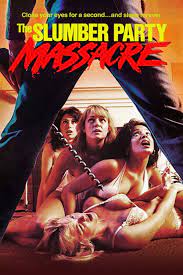
The Slumber Party Massacre (1982)

THE SLUMBER PARTY MASSACRE (1982) ***
Coming across the beloved cult film that was once not so beloved just might be the biggest hazard of movie spectatorship these days.

You better not ride on the general train of thought from the film’s original release or you just might get bludgeoned in the comments section by devotees of the cinematic item under discussion.

You have no taste! You’re an idiot! You just don’t get it! You’re too stupid to understand the undeniable genius! Blah blah blah!

I am thinking first and foremost about films like Halloween III, Howard the Duck, Sleepaway Camp, and Silent Night, Deadly Night.

Maybe you are reading my confession why I had not watched The Slumber Party Massacre until very recently.

I finally caught up with it on Halloween night 2022, I liked it well enough, and I can definitely understand why it’s held in such high esteem in some quarters though I certainly don’t like it as much as others so enthusiastically do.

The Slumber Party Massacre took a while to get started, packed with so many false alarms and jump scares that I began losing patience early on and it was not until the 45- or 50-minute mark that I became enveloped in suspense. The final 25-30 minutes are especially well-made and filled with plenty of impacting moments, so much so that I almost bumped The Slumber Party Massacre up to three-and-a-half stars even after the mixed reaction to the first two-thirds of the film.

All slasher films, whether it be the good, the bad or the ugly, have their gimmicks, be it their setting or their killer in everything from the favorite weapon of choice down to style.

The Slumber Party Massacre sold a good amount on the fact that it has a female director (Amy Holden Jones) and a feminist screenwriter (Rita Mae Brown), something not common for the horror genre overall and specifically the subgenre of the slasher.

Jones shows definite talent in her directorial debut, and it’s no surprise she later directed Love Letters, Maid to Order, and The Rich Man’s Wife and received screenwriting credits on Love Letters, Maid to Order, Mystic Pizza, Beethoven, Indecent Proposal, The Getaway (1994), and The Relic. She also married acclaimed cinematographer Michael Chapman (Taxi Driver, Raging Bull, The Fugitive) in 1980 and stayed his wife until his death in September 2020.

Brown intended The Slumber Party Massacre to be a satire of the slasher genre, but Jones filmed it as straight horror.

However, satirical traces remain throughout The Slumber Party Massacre.Virtually all the male characters are super horny creeps and more than one female character survives all the murder and mayhem, for example.

Never mind that escaped serial killer Russ Thorn (Michael Villella) walks around in plain sight without a mask from the first scene on. He’s also one of a select few slasher film killers with quotes on the Internet Movie Database. Eat your heart out, Jason and Michael!

Also, never mind Thorn’s weapon of choice that could possibly be some kind of metaphor. Yes, it’s a power drill and I’m not sure of the symbology there! I also don’t believe there’s any greater meaning in the ways he meets his inevitable demise at the end of the movie.

The local radio station announces Thorn’s escape more than once, yet nobody seems to notice let alone care until it’s (almost) too late. I seem to remember one of the characters shutting off her car radio in the middle of one of the announcements.

Nearly all the characters are too preoccupied with their pursuits of pleasure at this very moment in time, just like the characters in any Friday the 13th film, to be concerned about some homicidal maniac on a rampage.

These satirical traces make The Slumber Party Massacre a good deal more interesting than, let’s say, Madman and The Prowler.

It works as both a satire and a straight horror film nearly 15 years before Scream came out.

In fact, not that I want to shout about it or anything, The Slumber Party Massacre works better than Scream.
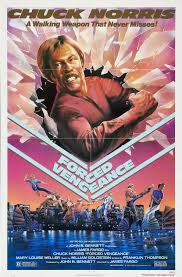
Forced Vengeance (1982)

FORCED VENGEANCE (1982) **1/2
Slow motion’s absolutely vital to understanding the cinematic and TV work of the one and only Carlos Ray Norris.

Slow motion’s everywhere, in action movies, sporting events, movie musicals, etc. To the point that we don’t even realize how everywhere it’s become.

Over the decades, for example, slow motion became a customary tool in violent scenes, from Arthur Penn’s Bonnie and Clyde and Sam Peckinpah’s The Wild Bunch to The Matrix and beyond. Sometimes, I think Gee whiz, that’s awesome and very artfully done, but mostly I just think That’s super lame. I take off points for the obligatory and cheap use of slow motion.

Let’s see, off the top of my head, I deducted from The Lion King and Teen Wolf and Young Guns for their abuse of slow motion late in their motion picture spreads, while Kickboxer 2 flogs viewers with slow motion until it’s like receiving a slow motion roundhouse upside the head. For crying out loud, though, it’s slow motion, super slow even, and that gives us a greater chance to duck out of the way and to see all the cheap audience manipulation at play. I mean, I ducked the Kickboxer 2 roundhouse and found the Siskel & Ebert review playing alongside the movie inside my head esp. Ebert imitating the sounds of slow motion. It was more entertaining that way.

That brings us full roundhouse back to Norris, one of the foremost slow motion abusers.

A former co-worker said that his ears were ringing for a long time after he watched the Who play one of the Day on the Green concerts at Oakland-Alameda County Coliseum. He talked about being whacked upside the head by their incredible Wall of Noise. I soaked up this conversation.

“In 1976, the Who entered the Guinness Book of World Records for performing the loudest concert in history at the time during their concert at England’s Charlton Athletic Grounds with 76,000 watts at 120 decibels. This record would stand for nearly a decade.”

You can bet they used the Rock-o-meter from Rock ‘N’ Roll High School.

Anyway, now I will make the case for something that’s louder than any rock concert or sporting event, any plane taking flight, any hyena’s laugh, and any howler monkey.

For a couple months, I visited my Grandma for her bingo dominance Tuesday and Thursday. After the bingo hour, we’d return to her room and she’d turn her TV back on. Naturally, it would be Walker, Texas Ranger on Hallmark. Of course. At 3 every day, every single TV in the nursing home would simultaneously be turned on full volume and tuned in to Walker, Texas Ranger. That’d be probably close to 100 TVs. Yeah, we’ll go with 100 for the sake of hyperbole.

I’ve never in my life heard anything louder than 100 full blast TVs simultaneously reverberating Walker slow motion roundhouse kicks.

Guinness, book it.

I deducted a half-star from Forced Vengeance because it broke through my pain threshold for slow motion consumption early on during the final act leading toward a grand finale.

You have been forewarned.

Once again, though, a poster for a Norris spectacular earns four stars.

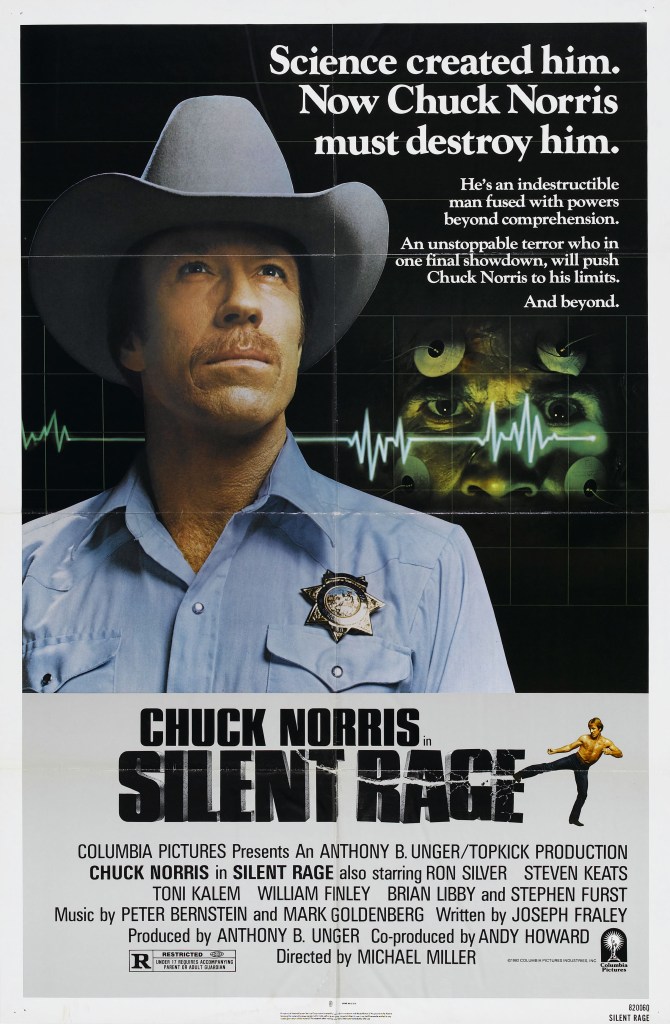
Silent Rage (1982)

SILENT RAGE (1982) ***
Michael Miller’s 1982 feature Silent Rage combines several American movie hallmarks into one barely coherent package: Chuck Norris, a small Texas town (never sleepy when Norris plays Sheriff), a madman killer, mad scientists, shots borrowed straight from John Carpenter’s Halloween, two love scenes, Stephen Furst basically playing his character from Animal House again, bar fights, roundhouse kicks, biker gangs, breasts (inc. Norris but not Furst), and a schizophrenic musical score, not in any particular order.

We also have at least five wildly different acting styles for the price of one. We’ve already covered Norris and Furst, then there’s Ron Silver and he’s playing it straight in easily the best dramatic acting that one can find in anything starring Chuck Norris. Silver plays the voice of reason and let’s do the right thing scientist, whereas his colleagues played by Steven Keats and William Finley are variants on Universal horror archetypes updated for a new generation. Keats, of course, wants to push science further than any one ever before even when it’s not prudent and Finley, best known for his roles in Brian De Palma and Tobe Hooper films Phantom of the Paradise and Eaten Alive, occupies the middle ground between Silver and Keats. Brian Libby’s madman killer continues in the proud screen tradition of Frankenstein’s Monster and Michael Myers, especially after our mad scientists flat out turn him posthumously into an indestructible killing machine whose stalking does all the talking. I wanted Dr. Loomis to show up and say THIS ISN’T A MAN. Bummer that it didn’t happen.

Norris battles the mad killer and later the virtually indestructible mad killer in the opening and concluding scenes. Otherwise, he alternates between mentoring and supporting unsure and unsteady rookie cop Furst, rekindling his romance with a former lover played by Toni Kalem, and questioning Silver and Keats. For Norris fans, apparently the scariest parts of Silent Rage involved Kalem’s bare breasts and Norris favoring jazz music because our favorite roundhouse specialist returned to only love scenes between men for the rest of his career, barring his rolling around in the mud with the sultry Barbara Carrera in the 1983 Walker, Texas Ranger precursor Lone Wolf McQuade. I for one like Silent Rage because it’s nice to see more chests on display than just Chuck’s for a change.

Silent Rage unfortunately drags at two main points. The death of Silver’s wife literally feels like it takes forever, like one of the filler killings in a Friday the 13th sequel. Ditto for the bar fight, which are drags both in real life and in the movies. A couple moments in this otherwise humdrum bar fight sequence redeem it, just barely though. If you’ve seen Silent Rage, you know exactly what I mean.

The poster for Silent Rage rates with Breaker! Breaker as the best Norris film poster. There’s really no arguing with a mini-Norris roundhouse cracking the movie’s title and the promotional hype Science created him. Now Chuck Norris must destroy him. He’s an indestructible man fused with powers beyond comprehension. An unstoppable terror who in one final showdown, will push Chuck Norris to his limits. And beyond.

Once upon a review, I believe I wrote that I wanted to see Chuck Norris vs. Jason Voorhees and Silent Rage is the closest that I will ever get to seeing that dream come true.

Six Weeks (1982)

SIX WEEKS (1982) *
My wife awoke in the middle of the night, it took her quite some time falling back asleep, and so naturally she joined me for about the last 30 minutes or so of Six Weeks. She asked me some basic journalistic questions like ‘What’s the little girl dying from?’ ‘I believe it’s leukemia.’ ‘No, it can’t be. It’s got to be something else. I don’t think she’d just suddenly die like that.’

At some point during our discussion, I said that actually this poor little girl has got the dread movie disease where the invariably dead-by-the-end-of-the-movie character becomes ever more beautiful and noble until her big death scene. Yes, the late film critic Roger Ebert named this affliction ‘Ali MacGraw Disease’ after the star of Love Story, the film based on the best-selling novel that one might say started it all way back in 1970.

Movies derived in way or another from Love Story invariably pour it on awful darn thick with the sentiment, until the movie in question becomes a real maudlin exercise. Six Weeks pulls out the stops more than most in this dubious category and that’s why I was utterly amazed that it did not feature a hot-air balloon scene like fellow maudlin tearjerkers Bobby Deerfield, Yes Giorgio, and Just the Way You Are. That’s about the only restraint practiced by Six Weeks.

Casting 101 pairs Dudley Moore (1935-2002) and Mary Tyler Moore (1936-2017), fresh off critical and commercial hot commodities Arthur and Ordinary People, respectively. Yes, wow, how far out, both actors have the same last name and they’re apparently not related. They don’t even have the same national origin. Anyway, like Walter Matthau and Jill Clayburgh in the turkey bomb First Monday in October, Moore and Moore do not share the slightest bit chemistry either, that’s for darn sure. Dudley plays a California politician who’s running for Congress, Mary’s a wealthy cosmetics heiress with the precocious 12-year-old daughter already discussed in the opening paragraph. Dudley’s hopelessly lost in an early scene, very late to a political fundraiser where he’s the featured speaker, and the 12-year-old gives him directions and a whole lot more. She wants Dudley to win his election and Moore² to hook up and become the ultimate happy family for her life’s remaining duration.

Katherine Healy plays the dying little girl and she’s a bit, what’s the word, insufferable. She’s one of those movie children with an unlimited supply of wannabe sharp dialogue and snappy comebacks. She’s dying, remember, and that makes her dialogue even worse and her fantasies ever more powerful. Yes, that’s right, she’s got six weeks left and she’s going to live out as many of her fantasies as possible within the production budget of a 107-minute feel good extravaganza.

Moore² and the little girl hit the bright lights of New York City because what better place to live out fantasies on the big screen and little Niki skates at The Rink at Rockefeller Center, takes on the lead in The Nutcracker, and rounds up Moore² for a smug little cutesy pie wedding ceremony that almost extracted wholesale vomit from the pit of my stomach. Not exactly in that order, though, because the wedding ceremony happens before the grandstanding grand finale ballet number. Niki performed her ballet number on center stage, I looked at my wrist like there’s a watch attached to it and said to my wife, ‘It’s about time for the little girl to die.’ Sure enough, that’s what happened in the very next scene.

I left out the part (until now, anyway) about Dudley’s family, his dutiful wife and teenage son. That’s OK, because they’re not that important and don’t stand in the way of the main body of the plot. Speaking of the plot, Six Weeks pushes and pulls so many emotional levers that it becomes one of the most shameful tearjerkers ever made. They finally resorted to yanking them emotions with pliers. Thankfully, I still resisted and this review signals my protest on aesthetic and emotional grounds.

Bomb, Bomb, Bomb: Partners, Charlie Chan and the Curse of the Dragon Queen, When Time Ran Out

BOMB, BOMB, BOMB: PARTNERS, CHARLIE CHAN AND THE CURSE OF THE DRAGON QUEEN, WHEN TIME RAN OUT

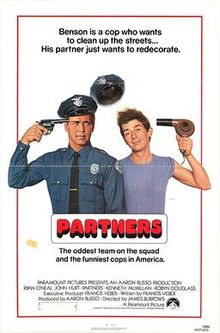
I could only make it through about 30 minutes of Partners and that’s more than enough for at least about 10 lifetimes, I’d say. I gave up on the picture for good around the fourth time star Ryan O’Neal uttered the epithet faggot. Yeah, Partners basically plays Cruising for laughs. Ha-ha, funny … about as funny as punching somebody’s mother in the face.

I consider Partners the absolute worst film from 1982, at least among the 70 or so films that I have seen thus far in my 42 years on this planet. It supplanted Amityville II: The Possession, a lovely little number incorporating blood, vomit, incest, matricide and patricide, fratricide and sororicide, and demonic possession. Never mind Inchon, a $46 million Korean War epic that bombed mightily at the box office with only a $5.2 million return. Never mind Halloween III: Season of the Witch, which features one of the least likable lead characters (Dr. Dan Challis) and lead performances (Tom Atkins) in recent memory. Believe it or not, Partners beats those other films in sheer unpleasantness.

Did longtime TV director James Burrows use Partners for his audition for Will and Grace? I seriously doubt it, because Partners is one of the nastiest pieces of work I have ever seen. Burrows has directed more than 1,000 TV episodes, including 237 Cheers and 75 Taxi and 32 Frasier. Thankfully, Burrows stuck with television after Partners.

Early in the picture, O’Neal asks his boss how he got stuck partnering up (literally) with gay records clerk Kerwin (John Hurt) to infiltrate and investigate a series of murders in the Los Angeles gay community. Anyway, Chief Wilkins (Kenneth McMillan) tells our matinee idol, “Because you’re a good cop, a real good cop. And because of your cute ass.” Maybe that’s how O’Neal himself got the gig. O’Neal certainly dressed up for the part, wearing a ridiculous tank top and then a leather garb in just the portion I watched before saying Roberto Duran on Partners.

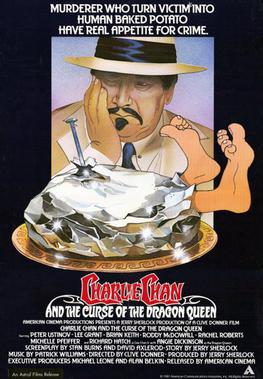
— As I sit here before this keyboard and ponder my next direction, I consider how I endured all 95 minutes or so of Charlie Chan and the Curse of the Dragon Queen, another great big smelly turd from the early ’80s like the ones mentioned about three paragraphs up.

When folks express this incredible nostalgia for the ’80s, undoubtedly it’s not Charlie Chan or Partners or Inchon, for that matter, they’re nostalgic about, because they SUCK in the immortal words of Al from Caddyshack. Then again, if I have learned anything over the years writing about movies or music online, it’s that somewhere in this great big world there’s a cult following Howard the Duck or Halloween III, for example, and they just might flame you for not cherishing their cult object in the same way they do.

Charlie Chan asks us to believe Peter Ustinov (1921-2004), Richard Hatch (1945-2017), and Angie Dickerson as characters of Asian descent. Sure, I believe the Englishman Ustinov as fictional Belgian detective Hercule Poirot (a character he played six times, including features Death on the Nile, Evil Under the Sun, and Appointment with Death) and Roman emperor Nero in Quo Vadis, but I call it more of a stretch to consider him as Chan in 2020, nearly 40 years after the film was made. It’s even worse for both Hatch and Dickerson.

Charlie Chan features plenty of the broadest comedy and frenzied overacting by a rather distinguished cast that also includes Lee Grant, Brian Keith, Roddy McDowall, Rachel Roberts, and Michelle Pfeiffer early in her career. Hatch plays Chan’s fumbling bumbling stumbling grandson Lee Chan Jr. and I’ve watched so many films lately with fumbling stumbling bumbling would-be detectives that I now grumble and rumble when I see them on the screen. I’m thankful my Grandma never behaved like the one played by Grant in Charlie Chan. Keith’s police chief says ‘Goddamn’ about 50 times. McDowall and Roberts play Grant’s domestic helpers, Gillespie and Mrs. Dangers respectively, but they both provide little help to Charlie Chan since they are both in the grand tradition of melodramatic domestic help in the movies; Mrs. Dangers calls to mind Patsy Kelly’s frantic maid in The Gorilla. Pfeiffer could have dialed the perkiness down a notch or few and still have saved enough for the rest of her career. Nearly all of these characters are cringeworthy.

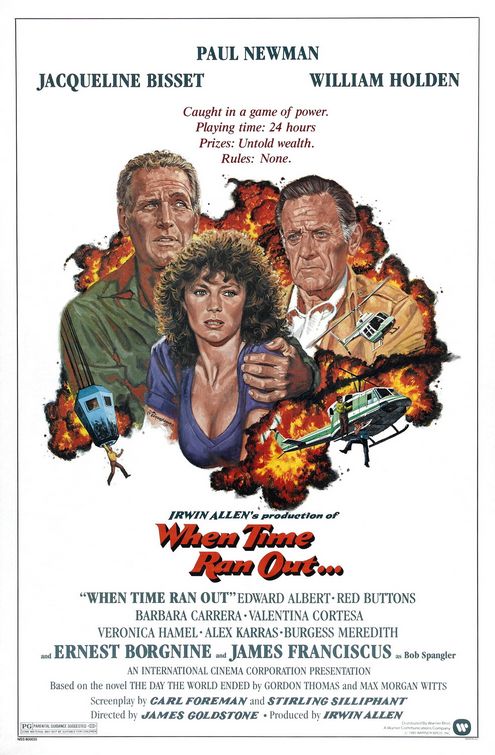
When Time Ran Out came out Mar. 28, 1980 and it eventually fell about $16 million short of making its $20 million production budget back at the American box office.

Later that year, on July 2, Airplane parodied Airport specifically and disaster movies in general, and became one of the biggest hits of the summer and the entire calendar year.

The failure of When Time Ran Out and the success of Airplane signaled the end of the disaster movie, at least in the form that dominated the first half of the seventies with The Poseidon Adventure, Earthquake, and Towering Inferno and then dribbled out pure unadulterated dreck the final half of that decade like The Swarm, Beyond the Poseidon Adventure, and Meteor. Since I mentioned Meteor, I also have to mention Avalanche, which provided disaster footage recycled in Meteor as if being in one disaster of a disaster movie just simply was not enough.

Master of disaster Irwin Allen (1916-91) produced at least half the films mentioned in the paragraph right above this one and he even stepped in the director’s chair for the turkey bombs The Swarm and Beyond the Poseidon Adventure. Allen called on Rollercoaster director James Goldstone for When Time Ran Out, which features the required number of old time movie stars, hot commodities, and fledgling character actors. When Time Ran Out should have been called Take the Money and Run, though Woody Allen and Steve Miller already used it for a comedy (1969) and a hit song (1976).

We have William Holden (1918-81), Paul Newman (1925-2008), Jacqueline Bisset, Ernest Borgnine (1917-2012), James Franciscus (1934-91), Burgess Meredith (1907-97), Red Buttons (1919-2006), Barbara Carrera, Pat Morita (1932-2005), Veronica Hamel, Edward Albert (1951-2006), and Alex Karras (1935-2012), as well as a volcano, a tidal wave, etc.

Seemingly half of the cast takes part in a glorified soap opera before the molten lava really begins to flow and they have to repeat business from Beyond the Poseidon and seemingly every other disaster movie of the era. Here’s that glorified soap opera: Holden proposes to Bisset very early in the movie and she turns him down because she’s in love with Newman, who’s not the marrying kind and anyway he does not seem to much care for Bisset but maybe he’s just masking his true feelings toward her with standard male bluster. Franciscus is married to Hamel but he’s fooling around with half-brother Albert’s significant other Carrera. Just wait, it gets better, Albert does not know that he’s Franciscus’ half-brother … and Holden and Hamel are sleeping together. I think I just about nailed it down and you’re right if you’re thinking all that seems like too much plot for such a dimwitted movie.

You’re also right that I hated these characters and their miserable lives, and rooted for the volcano to wipe them all out.

Especially Franciscus, who takes chronic disbelief in the face of impending disaster to new lows in When Time Ran Out. Unfortunately, an incredibly shoddy special effect leads to an incredibly unsatisfying death for Franciscus’ character. We crave to see him bite the dust or eat molten lava in spectacular fashion, and what we get is just plain laughable.

Of course, just plain laughable describes about 99 percent of When Time Ran Out.

Believe it or not, costume designer Paul Zastupnevich earned an Academy Award nomination for Best Costume Design and went against winner Tess, The Elephant Man, My Brilliant Career, and Somewhere in Time, all of them period films where the look of the film itself becomes another important character.

Yeah, I hope the 1981 Oscar broadcast used a shot of Newman in his utterly ridiculous Urban Cowboy garb.

Zastupnevich received a nomination for the same award two years before for his edgy, state-of-the-art costume work on The Swarm, beekeeper outfits. The Agatha Christie Hercule Poirot period murder mystery Death on the Nile won the prize.

I hate to say it, but time ran out on this review because I don’t want to consider When Time Ran Out any longer than I already have.

Partners No stars; Charlie Chan and the Curse of the Dragon Queen 1/2*; When Time Ran Out *

The In-Flight Double Feature: Airplane!, Airplane II: The Sequel

AIRPLANE!, AIRPLANE II: THE SEQUEL

AIRPLANE! contributed to the demise of the dominance of the disaster film just as much as beyond lackluster disaster films AVALANCHE, THE SWARM, WHEN TIME RAN OUT, BEYOND THE POSEIDON ADVENTURE, and AIRPORT ‘77 and THE CONCORDE … AIRPORT ‘79. It was like the decisive blow and disaster movies disappeared for many years.

AIRPLANE satirized disaster films in general and the AIRPORT series in particular. The team of Jim Abrahams, David Zucker, and Jerry Zucker ripped their ridiculous plot straight from the 1957 Paramount Pictures film ZERO HOUR starring an exclamatory title and Dana Andrews, Linda Darnell, Sterling Hayden, and Elroy “Crazy Legs” Hirsch. I watched ZERO HOUR (sans exclamation) after learning of the fact that it directly inspired AIRPLANE, and it’s scary how much AIRPLANE lifted from the earlier film. It is also fitting, because Arthur Hailey co-wrote the screenplay for ZERO HOUR and wrote the 1968 novel AIRPORT that became the beginning of the disaster film craze when AIRPORT hit box office gold upon its March 1970 release.

A decade later, millions were obviously clamoring for a sledgehammer attack on disaster films, because AIRPLANE finished behind only THE EMPIRE STRIKES BACK, 9 TO 5, and STIR CRAZY at the American box office in 1980.

Abrahams, Zucker, and Zucker not only had their way with disaster films, but they ripped to shreds both famous individual scenes (SATURDAY NIGHT FEVER, FROM HERE TO ETERNITY, KNUTE ROCKNE ALL-AMERICAN) and standard narrative devices. They especially had some devious fun with flashbacks and voice-over narration courtesy our rather square, good-looking protagonist with a troubled past (Robert Hays’ Ted Striker a perfect match for Dana Andrews’ Ted Stryker in ZERO HOUR. Andrews’ Stryker also brings to mind his troubled character 11 years earlier in THE BEST YEARS OF OUR LIVES).

In the process of satirizing movie genres, AIRPLANE created its own genre that has endured far longer than disaster films and gave birth to new old movie stars like Leslie Nielsen, Lloyd Bridges, Robert Stack, and Peter Graves, whose ability to play it straight at every moment made at least half the joke work.

(Disaster films have periodically made huge comebacks like when INDEPENDENCE DAY, TWISTER, and ARMAGEDDON became super blockbusters late in the apocalypse-minded 20th Century. Definitely not my favorite trend. For the record, I hate both TWISTER and ARMAGEDDON, and I have never managed to make it through INDEPENDENCE DAY in spite or more precisely because of all the hype and euphoric glee that came with it and still comes with it years later.)

Yes, we have seen virtually every movie genre under the sun parodied, quoted, and (less frequently) satirized. We have lived through all the immediate AIRPLANE imitations, the Z-A-Z Boys’ own movies, and everything from the works of the Wayans Brothers to Jason Friedberg and Aaron Seltzer. At some point, let’s say early in the 21st Century, I dreaded the parody movie even more than its various targets.

Most of these later parodies miss the satirical bent that gave AIRPLANE, TOP SECRET, and THE NAKED GUN, as well as Mel Brooks’ YOUNG FRANKENSTEIN, BLAZING SADDLES, HISTORY OF THE WORLD PART 1, and SPACEBALLS, their special verve. The later parodies seem far more willing to merely quote from a blockbuster movie and to just leave it at that. “You’ve seen it before and now, let’s see it again, only done less effectively.” Honestly, what’s the point and more precisely, what’s so funny about that?

For many years, I passed on AIRPLANE II: THE SEQUEL, especially after learning that Zucker, Abrahams, and Zucker were not involved. The boys apparently sent out a press release before the release of the sequel that stated just that.

The crack research team just unearthed this David Zucker gem from 2015: “Jim just said, ‘If your daughter became a prostitute, would you go and watch her work?’” That’s one way to look at THE SEQUEL, one of the cheaper, less essential AIRPLANE imitations out there. The addition of more stars (Raymond Burr, Chuck Connors, William Shatner) makes it even cheaper.

I laughed a couple and smiled a few times during THE SEQUEL, but mostly I watched this comedy that attempts maybe 500 jokes in an indifferent state. The laughs were front-loaded and I found it challenging to even remember them at the back end of the picture. Have you ever had that feeling, where you’re stuck in the middle of a movie thinking about how much you were enjoying it earlier and now you’re dreading it and the remaining seconds and minutes?

There’s almost nothing worse in the movie world than a comedy that fails, since most human life forms love to laugh, even or especially at the dumbest and corniest jokes. We are prepared to laugh during a comedy. We want to laugh. So, when you find very little or absolutely nothing to laugh at over 84 minutes, all this hostility builds up inside you and you get very upset about how you have wasted 84 minutes of precious time which you could have wasted on something else.

Never mind, I should have passed on THE SEQUEL and just watched AIRPLANE one more time.


AIRPLANE! ***1/2; AIRPLANE II: THE SEQUEL **

Class of 1984 (1982)

CLASS OF 1984

CLASS OF 1984 (1982) Three-and-a-half stars

Given its exploitation film content including gore, nudity, profanity, sex, and violence, CLASS OF 1984 will not be shown to new teachers or substitute teachers any school year soon.

Not that it should, but a little independent research never hurt anybody.

I don’t remember, though, if I first watched CLASS OF 1984 during or after my three years as substitute teacher in the late 00s. However, I do remember that it made a strong impact with its story of how an idealistic music teacher eventually gives into the dark side and murders his most unruly students at an inner city high school. It’s definitely the movie to see after DANGEROUS MINDS, LEAN ON ME, all that feel good uplifting claptrap.

Watching CLASS OF 1984 again in a decade since I substituted, it still brings on memories of the little punks who threatened violence, who said they would sue, who just ran their mouths incessantly, and who made getting through another day feel like an endurance contest from Hell. For every good student, it often seemed like there were two or three or twenty bad ones in every class. “I would love to punch you in the face,” one junior high student said. “Go ahead, give it your best shot,” the substitute teacher said. Thankfully, not every day substitute teaching was quite like that.

In that spirit, though, we return to our regularly scheduled review of CLASS OF 1984.

Be warned: This is a rough little movie, a nasty piece of work at times, but if you can make it through scenes like the biology teacher’s murdered rabbits and the rape of the music teacher’s wife, this 1982 update on the 1955 classic BLACKBOARD JUNGLE does have its merits.

The performances help lift this film above mere exploitation trash: Perry King as the music teacher, Roddy McDowall as the biology teacher, Timothy Van Patten as every teacher’s worst nightmare, and Michael J. Fox (in an early role) as one of the good students.

King makes for a likable protagonist and takes us from one end of the picture to the next. We are behind him every step of the way, and that’s critical during the film’s violent final act as enough has become more than enough for this music teacher. Those damn punks go too far, far enough for at least a couple exploitation films. Roger Ebert called the climax a cross between THE HUNCHBACK OF NOTRE DAME and BEYOND THE VALLEY OF THE DOLLS.

McDowall (1928-98) had a knack for supporting performances that almost steal a movie away from their nominal stars, and he displays that knack here in CLASS OF 1984, especially when he cracks and teaches his biology class by gunpoint. I bet you’ll remember how many chambers are in the human heart with a gun pointed at you, and I also bet that Richard Kiley (from BLACKBOARD JUNGLE) wishes he could have got a scene like that after the punks in his film had their way with his favorite jazz records. Damn kids, damn punks.

[Review resumed about two weeks later.]

To work properly, this genre requires a repugnant piece of work going up against the hero and Van Patten certainly provides that as teenage antagonist Peter Stegman. Audiences have been known to cheer his demise. Stegman’s personality profile on Villains Wiki, “A totally violent, sadistic, ruthless and mentally unstable teenager. He will hurt anyone who he thinks is threatening his authority over the school, or he will also kill them with no remorse or regrets.” In a different movie, Stegman’s piano-playing ability would have been exploited for a different kind of feel-good ending, not one where you feel good the bastard’s dead.

You can see why Fox became a superstar, even in a supporting performance.

CLASS OF 1984 director Mark L. Lester also directed TRUCK STOP WOMEN, WHITE HOUSE MADNESS, BOBBIE JO AND THE OUTLAW, GOLD OF THE AMAZON WOMEN, ROLLER BOOGIE, FIRESTARTER, and COMMANDO. Now, that’s some filmography and I’ll say that it’s close (real close) between CLASS OF 1984 and COMMANDO for his best work.

A movie like this needs a proper soundtrack.

Nearly two decades before AMERICAN GRAFFITI, BLACKBOARD JUNGLE made waves with its use of Bill Haley and the Comets’ “Rock Around the Clock.” What an opener!

Alice Cooper provides “I Am the Future” for CLASS OF 1984. Mr. Cooper has the ideal credentials for scoring a teenage rebellion pic: specifically “I’m Eighteen,” “School’s Out,” and “Teenage Lament ‘74” from his glory days. As far as mid-period solo Alice standards go, “I Am the Future” does not quite measure up against 1980’s “Clones” and 1983’s “I Love America,” but it still far surpasses Alice’s late 80s and early 90s hair metal period.

CLASS OF 1984 belongs to a branch of entertainment that includes such notables as not only BLACKBOARD JUNGLE but also BEYOND THE VALLEY OF THE DOLLS, OVER THE EDGE, ROCK ‘N’ ROLL HIGH SCHOOL, RIVER’S EDGE, and PUMP UP THE VOLUME, as well as the “Smells Like Teen Spirit” video.

Conan the Barbarian (1982)

CONAN THE BARBARIAN

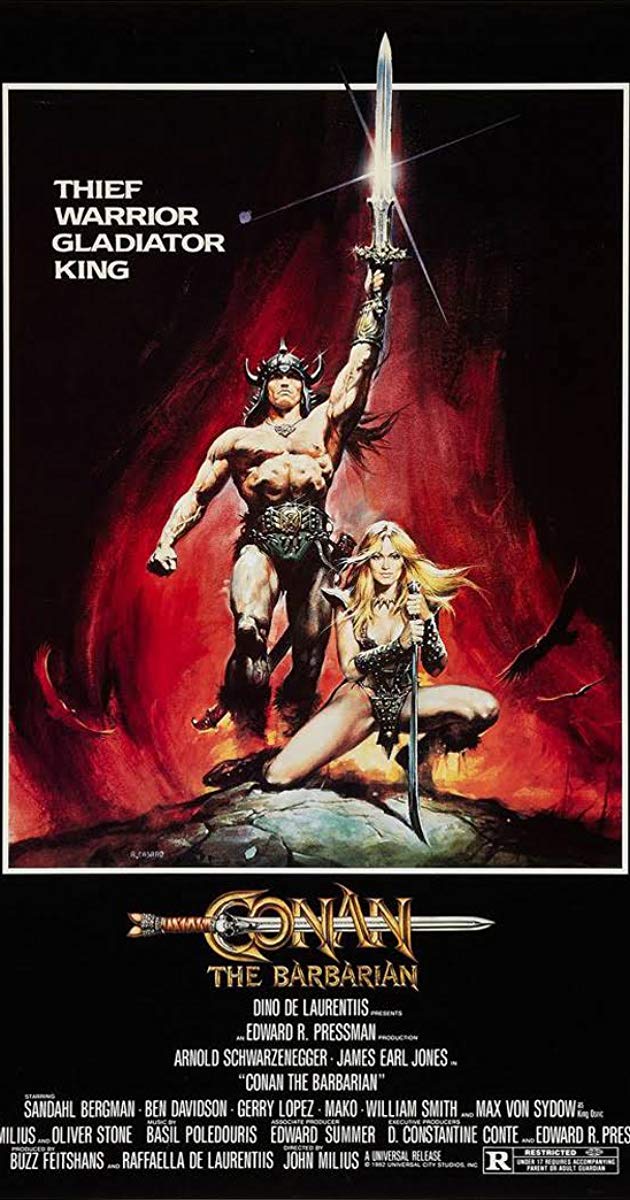
CONAN THE BARBARIAN (1982) Three stars

For the longest time, at least since Al Gore invented the Internets, I have thought the ultimate version of CONAN THE BARBARIAN is the 3-minute, 52-second version on YouTube that scores select scenes from the movie with Iron Maiden’s “Run to the Hills.”

As I watched CONAN THE BARBARIAN again, I kept hoping that Basil Poledouris’ score would be replaced by Bruce Dickinson’s wail and the soaring guitars of Dave Murray and Adrian Smith. Alas, it was not to be.

Lyrically, though, it’s not a perfect fit, since Conan seeks revenge against Thulsa Doom, who’s played by none other than James Earl Jones.

Iron Maiden released “Run to the Hills” on February 12, 1982 and THE NUMBER OF THE BEAST album on March 22.

CONAN THE BARBARIAN came out on May 14, 1982.

Both works proved to be controversial.

Critics thought CONAN THE BARBARIAN was either too violent or that it fell too short of the violence in the source material. That was the biggest controversy for John Milius’ film.

Of course, with an album title like THE NUMBER OF THE BEAST, Iron Maiden were called Satanists and boycotts, record burning, and demonstrations were organized by religious groups in the United States. Just picture old women smashing hundreds of copies of THE NUMBER OF THE BEAST to bits with their hammers.

“The Number of the Beast,” though, is not 867-5309.

Sword and sorcery films were big in the 1980s, a fantasy sub-genre defined as “sword-wielding heroes engaged in exciting and violent adventures. An element of romance is often present, as is an element of magic and the supernatural.”

CONAN THE BARBARIAN inspired a steady stream of imitations and knockoffs, like the DEATHSTALKER series: A big man with a big sword, busty women, and plenty of sex, violence, and head-splitting gore. Not that there’s anything wrong with that.

I had forgotten (shame on me) the amount of nudity during the first hour of CONAN and here I thought that I never forget a nude scene. (For what it’s worth, I remembered Sandahl Bergman’s shining moments in CONAN.)

Then, down the home stretch, CONAN turns up the violence to an operatic level. There’s also an orgy late in the picture.

Arnold Schwarzenegger was born to play Conan and he played him twice, less effectively though a second time. Arnold also played supporting role Lord Kalidor in RED SONJA, so three of his four films made for sultan of schlock producer Dino DeLaurentiis were sword and sorcery. Ed Pressman and fellow producer Edward Summer had considered Charles Bronson, Sylvester Stallone, and William Smith for the Conan role, but they found Arnold to be the embodiment of Conan the Barbarian after they watched a rough cut of PUMPING IRON. The success of both CONAN and THE TERMINATOR made Arnold a star.

Before CONAN, Arnold found mixed success in the motion picture business. In his 1969 debut HERCULES IN NEW YORK, Arnold’s thick Austrian accent required a dub job and the film credits him as “Arnold Strong ‘Mr. Universe’” partly to play against the name of co-star Arnold Stang. If you watch HERCULES IN NEW YORK, you will be amazed that Arnold ever had a motion picture career. I’ve seen it several times and it gets me every single time.

Other than PUMPING IRON, Arnold’s best early career role is Joe Santo in STAY HUNGRY, where he played alongside Jeff Bridges and Sally Field in a supporting role. This is a role that stands alone in a Schwarzenegger filmography populated with action and comedy.

CONAN started Arnold’s decade long run of solid action movies. Why did this seemingly muscle-bound guy with a ridiculous accent become at one point the biggest movie star in the world? Siskel & Ebert pondered that very question in an entire show dedicated to Arnold called “Arnold Schwarzenegger: The Unlikeliest Star.”

A joy of performance is the one element that Arnold exudes in all his best films and it’s what separates him from his competition.

Arnold meets his match in Broadway dancer Sandahl Bergman and when she and Arnold pair up, CONAN truly kicks into gear. The 6-foot tall Bergman (this Shawnee Mission East High graduate liked to say that she’s 5-12 rather than 6-0 because no girl should have to be 6-0) possesses an impressive physicality that’s not dwarfed by Arnold or any of her male co-stars and she exudes the same joy of performance as Arnold.

There’s certainly not been another woman, not Grace Jones in CONAN THE DESTROYER or Brigitte Nielsen in RED SONJA, paired more effectively on screen with Arnold than Bergman.

James Earl Jones became a popular villain after STAR WARS came out in 1977; Jones lent his voice to Darth Vader because director George Lucas did not want David Prowse’s English accent for Vader. Never mind Jones’ role as the older Kokumo in EXORCIST II: THE HERETIC, which was released not long after STAR WARS during the summer of ‘77. Just imagine the collection Jones possibly built from his villainous roles in the STAR WARS films, THE HERETIC, and CONAN. Not only Darth Vader’s helmet, but also his locust costume from THE HERETIC and possibly the snake from CONAN after his transformation. Later in the 1980s, Jones began playing kindly older men and that’s where he’s been ever since.

In addition to Jones, Max von Sydow (most famous for his work with Ingmar Bergman and THE EXORCIST) and Mako (Academy Award nomination for Best Supporting Actor for THE SAND PEBBLES) also lend their gravitas to the proceedings.

When he was the Governor of California, did Arnold read the following dialogue, “To crush your enemies, to see them driven before you, and to hear the lamentations of their women,” or say the following prayer, “Crom, I have never prayed to you before. I have no tongue for it. No one, not even you, will remember if we were good men or bad. Why we fought, or why we died. All that matters is that two stood against many. That’s what’s important! Valor pleases you, Crom … so grant me one request. Grant me revenge! And if you do not listen, then to HELL with you!”

Let’s hope there’s a soundboard with Arnold’s CONAN dialogue out there somewhere. This would restore a smidgen of my faith in humanity.

Blade Runner (1982)

BLADE RUNNER

BLADE RUNNER (1982) Four stars

Rutger Hauer’s death at the age of 75 brought me back a day later to BLADE RUNNER, one of the key movies in understanding the cinema of the last four decades.

It seems ironic that Hauer died in 2019, the same year as his character in BLADE RUNNER.

I can’t believe I’ve never written in detail about BLADE RUNNER, which has long been my No. 5 favorite movie of all-time behind CITY LIGHTS, DUCK SOUP, FREAKS, and TAXI DRIVER. Well, now is just as good a time as any to change that.

Watching the theatrical version from 1982, seeing BLADE RUNNER in any cut for what must have been the 100th time, faces especially stood out.

Title character Rick Deckard (Harrison Ford) as he takes in the death of main replicant Roy Batty (Hauer). We can read many different thoughts going through Deckard’s mind. The theatrical cut articulates it through Decker’s voice-over narration. I’ll get back to the narration later.

Batty throughout, from his entrance to his exit. Hauer’s so damn good that he almost steals the movie from both Ford and the incredible production design.

Batty’s punk pleasure model replicant lover Pris (Daryl Hannah) when she ambushes and assaults Deckard late in the picture.

J.F. Sebastian (William Sanderson) as he bears unfortunate witness to Batty settling his account with his creator Tyrell (Joe Turkel, best known as Lloyd from THE SHINING).

Leon Kowalski (Brion James) as he’s shot dead by replicant and Deckard romantic interest Rachel (Sean Young), just when it seemed Kowalski had Deckard near his demise.

Capt. Harry Bryant (M. Emmet Walsh) and his oily charm, and the enigma of Gaff (Edward James Olmos).

I’ve never exactly understood the criticism leveled at BLADE RUNNER that it’s great to look at but difficult to care about any of the characters.

I wonder if those critics saw the same movie.

I’ve always been moved by the plight of the replicants, the bio-engineered people who are “more human than human.”

The Nexus-6 model of replicants — represented by Batty, Pris, Leon, and Zhora (Joanna Cassidy) — look exactly like your average adult human being, but they have superior strength, speed, agility, resilience, and intelligence, especially combat model Batty. For the protection of the human race, replicants have a four-year life span and were given false memories.

Imagine finding out your childhood never happened.

The cold, hard facts of life.

Indeed.

The replicants bring a wide range of responses.

They’re slave labor off Earth … and illegal on Earth. “Quite an experience to live in fear, isn’t it? That’s what it is to be a slave.”

They’re at least complex villains, if they’re even the “bad guys.” We can make a strong case for Tyrell being more of a villain.

Then, we have the ambiguous title character who’ll probably always inspire debate: Is or isn’t Deckard a replicant? Ford argues human, director Ridley Scott replicant, but it’s been left for each viewer to determine.

Deckard plays like the detective hero lifted straight from THE BIG SLEEP or CHINATOWN and that comes across even more in the theatrical version with Ford’s gruff narration explicitly putting over Deckard’s world-weary cynicism.

Deckard gets no pleasure from his job “retiring” replicants. And the narration makes Deckard sound like he’s just woke up from a long hangover. (Ford’s hatred of the narration could not be more obvious.)

Later releases excised the voice-over narration, a device the executives wanted to make the film seem less confusing.

I watched the 1992 Director’s Cut first and so it took some adjustment to the narration. I find it works, except for one scene very late in the film where it’s sheer overkill. I mean, try it out:

“I don’t know why he saved my life. Maybe in those last moments he loved life more than he ever had before. Not just his life — anybody’s life; my life. All he’d wanted were the same answers the rest of us want. Where did I come from? Where am I going? How long have I got? All I could do was sit there and watch him die.” Do we need that? No.

That brings us to Batty’s final speech, “I’ve seen things you people wouldn’t believe. Attack ships on fire off the shoulder of Orion. I watched C-beams glitter in the dark near the Tannhauser gate. All those moments will be lost in time … like tears in rain … Time to die.”

In a sports column way back in 2012, I called Batty’s final speech my favorite movie dialogue.

In office conversation about this column, the late, great Morning Sun writer Nikki Patrick said that Hauer improvised Batty’s speech.

That made the speech even greater and Nikki even cooler.

Friday the 13th Part III (1982)

DAY 30, FRIDAY THE 13TH PART III

FRIDAY THE 13TH PART III (1982) Three stars
On their movie review program “Sneak Previews,” Gene Siskel and Roger Ebert hated just about every slasher film (Ebert called them “Dead Teenager” movies) that came down the pike after HALLOWEEN. They lambasted MANIAC, THE BURNING, MADMAN, MY BLOODY VALENTINE, HE KNOWS YOU’RE ALONE, MOTHER’S DAY, and HAPPY BIRTHDAY TO ME (nearly all those picked “Dogs of the Week”), but seemed to save their greatest reserves of spleen for the FRIDAY THE 13TH series. That’s okay, they weren’t alone in condemning the series.

Coming of age in the late-1980s and early-1990s, slasher films played a formative role in my filmgoing experience. One way or another, I caught up with all the Jason, Freddy, Michael Myers, Chucky, et cetera, movies. Why were these films so popular amongst young people? Must have felt that we were rebelling against the decorum set for us young people by our elders. Also sure that we were reveling in the forbidden.

PART III was my very first FRIDAY THE 13TH movie (saw it about 30 years ago) and that must contribute to why it’s among my favorites in the series all these years later.

It’s not a good movie in any traditional way shape or form and it has a lot of the same underlying problems as the other movies in the long-running series, but it’s very entertaining and silly at least until the body count starts piling up. Hey, let’s face it, though, we don’t watch movies like FRIDAY THE 13TH for the same reasons that we watch other movies. We go for the body count, No. 1, then the other exploitation movie elements like gore, nudity, and general vulgarity. The characters are often superficial archetypes, the dialogue is nothing to write home about, and it’s all very predictable. To some degree, we like it that way.

With it being originally filmed in 3-D, that only adds to the silliness of PART III because there must be at least 50 gimmick shots for the sake of the 3-D, including ones where Jason squeezes our male protagonist’s head until his eyeball heads straight for us and Jason’s first kill wearing his iconographic hockey mask. Additionally, we have a disco variation on Harry Manfredini’s score over the gonzo opening credits and some new character archetypes for the slaughter, like a married couple with the male partner suggesting Tommy Chong and a would-be motorcycle gang who gives Jason his first opportunity to kill outside his race.

Just keep in mind the FRIDAY THE 13TH movies have a transcendent appeal; for example, Kim Jong-il (1941-2011) loved him some Jason along with Rambo and Godzilla and rapper Big Daddy Kane used Jason for a rhyme in “Ain’t No Half Steppin.'”

For whatever reason, PART III generates more suspense than any other entry in the series. Steve Miner, assistant director on the first movie, remains the only person to direct more than one installment and that just might be the difference maker. Miner directed PART 2 and PART III.

I mentioned problems and there’s about 10 minutes of my life (multiplied by every time I see this sequence unless I fast-forward) that I will never get back when Jason dispatches Harold and Edna early in the movie, two unfortunate proprietors of a lakefront store. I call this hallmark of the genre “filler killings,” ones that pad running time or serve a body count (PART V fills that bill) and no greater purpose to the movie as a whole. Of course, haters of the genre would say that “filler killings” describe the entire movie.

Also, we have another shock ending that’s only shocking in just how non-shocking it turns out to be. Just about every slasher film in the era had a shock ending. This one almost defies belief.

Larry Zerner, who plays the asshole prankster Shelly, became an entertainment lawyer and Tracie Savage covered the Heidi Fleiss and O.J. Simpson trials as TV reporter, so undoubtedly PART III both served them well in their later careers.

Jason acquires his trademark hockey mask from Shelly. Jason’s played in PART III by British trapeze artist Richard Brooker, who apparently believed that playing a psychopathic killer was his entry way into a successful movie career. “It felt great with the mask on,” Brooker said. “It just felt like I really was Jason because I didn’t have anything to wear before that.”

After his screen debut as Jason, Brooker (1954-2013) appeared in DEATHSTALKER, “Trapper John, M.D.,” and DEEP SEA CONSPIRACY. Brooker later went into TV directing, for example “Bill Nye the Science Guy.” A fan-made documentary FRIDAY THE 13TH: THE MEMORIAM DOCUMENTARY appeared on YouTube in early 2018, which memorialized Brooker by interviews with FRIDAY THE 13TH luminaries and an on-screen dedication to his memory.

Final girl Dana Kimmell appeared in the Chuck Norris action spectacular LONE WOLF McQUADE after FRIDAY THE 13TH PART III. There’s a meme out there, “Chris Higgins survived her encounter with Jason because Chuck Norris wanted Chris Higgins to survive her encounter with Jason.” That’s great and everything, but there’s an alternate ending to PART III where Jason decapitated Chris (Kimmell).

Still, that gets me thinking about what would happen if Chuck Norris met Jason Voorhees in a movie.