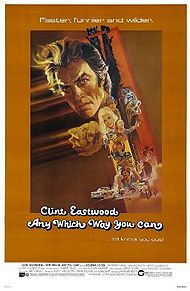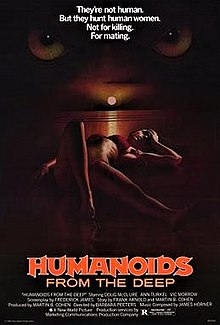
Humanoids from the Deep (1980)

HUMANOIDS FROM THE DEEP

HUMANOIDS FROM THE DEEP (1980) One star
Exploitation film legend Roger Corman loved ripping off / paying homage to JAWS, first with PIRANHA then a couple years later with HUMANOIDS FROM THE DEEP. The great white shark in JAWS and the piranhas did not prey almost exclusively on busty supporting players and extras so this was cinematic evolution at work here.

Yes, these humanoids are horny bastards: They should meet up with the horny aliens from the SPECIES films and we’d have ourselves a party. The humanoids resemble Swamp Thing, only uglier and with no poignant qualities. Do you want a Humanoid from the Deep this Valentine’s Day? They do not take a subtle approach to scoring with the ladies. These humanoids score with busty young women by raping them and leaving almost nothing but a mess behind. Legend has it that Uncle Roger went back in after the director turned in a final cut and shot additional scenes focused on sex and gore. This sounds like CALIGULA or any of the more repugnant Corman productions.

Uncle Roger shows his JAWS hand early on during HUMANOIDS FROM THE DEEP: There’s a child eaten and an explosion in the first 10 minutes of the film, elements of scenes from JAWS and JAWS 2, respectively. Yes, it’s that kind of movie.

In certain sequences, there are jump scares every few moments, soundtracked by gasps, phone calls, and jarring musical score and then we’re brutalized with a “real” scare every so often. These scare tactics backfire miserably.

We have good old Doug McClure as our reluctant proletariat hero, strong working class family man. Just a couple weeks before watching HUMANOIDS I saw McClure survive AT THE EARTH’S CORE. In that classic, he played a fellow named David and Peter Cushing played Doc as we’ll never forget in scene after scene where characters say David and Doc and Doc and David and Doc and David. Here McClure’s Jim and the HUMANOIDS FROM THE DEEP characters do not share the same romance with “Jim.”

A Native American named Johnny Eagle (who would have been played by Will Sampson if the film had a larger budget) opposes the evil shenanigans of a venal capitalist played by Vic Morrow, who’s seeking a cannery deal for the people of Noyo, yes, Noyo. Eagle sounds forewarnings of portentous doom so naturally he’s set up to be a villain and later turns out to be a hero. Oh, sweet irony!

I mean, just once I’d love to see a film with the Native American as the venal capitalist and the white man as the conscientious environmentalist hero. Anyway, Eagle finds a fight without looking too hard and his presence at the Noyo Salmon Festival spawns a horrible fight scene, indicative of white pattern Native American bashing. Luckily, for all of us, a tear did not stain Johnny Eagle’s face.

Of course, Noyo holds a big carnival for its annual Salmon Festival. Nothing and I mean nothing will stop these Noyo yo-yo’s from holding their carnival, not even mutant killer fish slash humans. So, naturally, our Humanoids from the Deep play the role of the spoiler.

For some bizarre reason, this overdrawn attack-massacre sequence brought out fond memories flashing back on a similar overdrawn sequence in GIANT SPIDER INVASION. A lot of humanoids are killed good, a lot of bit players are taken a bite out of by humanoids, and it’s all broadcast over live radio by a disc jockey calling himself “Madman” although he’s not played by real-life DJ Don Steele, who showed up in both DEATH RACE 2000 and ROCK ’N’ ROLL HIGH SCHOOL, as well as GRAND THEFT AUTO.

None of these scenes are remotely entertaining or interesting and that basically describes HUMANOIDS FROM THE DEEP.

Been there, seen that, and please roll the final credits.

Caddyshack (1980)

CADDYSHACK

CADDYSHACK (1980) Three-and-a-half stars
Harold Ramis’ CADDYSHACK gives the consumer four movies for the price of one.

1) Rodney Dangerfield vs. Ted Knight.

2) Chevy Chase and his meandering philosophical musings and lady man ways.

3) Bill Murray and his bizarre shenanigans.

4) The caddies and their little melodramas.

Most films don’t even give us one.

We have four distinct comedic styles at work in CADDYSHACK: Dangerfield (1921-2004) comes on and thankfully never stops doing variations on his night club act; Knight (1923-86) plays the ultimate snob and perfect counterpoint to Dangerfield; Chase gives us Zen wisdom filtered through deadpan absurdity; and Murray creates a world of his own that combines Dalai Lama and Cinderella stories, gross out snooty old ladies Baby Ruth taste testing, hunting and blowing up animatronic gophers real good, and Bob Marley joints.

Murray’s like a gopher within CADDYSHACK itself, burrowing underneath Dangerfield vs. Knight and the caddies.

CADDYSHACK plays like a 98-minute throwback to the Marx Brothers, the Three Stooges, and W.C. Fields.

First-time director Ramis (1944-2014), in fact, envisioned Murray as Harpo Marx, Dangerfield as Groucho, and Chevy as Chico. Guess that made Ted Knight the villainous Sig Ruman (A NIGHT AT THE OPERA, A DAY AT THE RACES) and Cindy Morgan a more risqué Thelma Todd (MONKEY BUSINESS, HORSE FEATHERS).

Improvisation and cocaine fueled CADDYSHACK.

It seems like Ramis and gang threw away the script written by Brian Doyle-Murray, Ramis, and Douglas Kenney (Ramis and Kenney worked together on NATIONAL LAMPOON’S ANIMAL HOUSE) just to make it all up as they went along, especially Chase, Dangerfield, and Murray.

This is one example of how the makers of a film went in expecting to make a certain film and came out with something completely different. The original plan had been to make the movie focused on the caddies, of course with a title like that, but the comedians took over and stole the show.

To be fair, however, the caddies have their fair share of funny moments and Doyle-Murray steals every scene that he’s in as caddy master Lou.

Chris Nashawaty’s book “Caddyshack: The Making of a Hollywood Cinderella Story” details just how much of a miracle it was even that the movie got finished.

“I had never seen cocaine before I got to the set of CADDYSHACK,” actor Peter Berkrot said. “This was really good cocaine. Pure, like they had just beaten it out of a leaf in Columbia and somebody had carried the leaf to us and turned it into powder in front of us just so we knew how pure it was,” said actor Hamilton Mitchell.

Ramis and Kenney (1946-80) turned in an original cut that ran four hours. A consultant recommended a through line with Danny Noonan (Michael O’Keefe) and his quest for a caddy scholarship and his relationship with a waitress (Sarah Holcomb, who played the mayor’s daughter in ANIMAL HOUSE).

Like classics by the Marx Brothers, the Three Stooges, and Fields, though, we don’t require much of a plot when there’s so much funny going on.

Over the years, I’ve come to appreciate Knight’s asshole Judge Elihu Smails just as much as Dangerfield’s Al Czervik and Murray’s Carl Spackler.

Smails is every bit as quotable as Czervik, Spackler, and Chase’s Ty Webb.

My favorite Smails line comes right after Noonan says that he would like to go to law school after he graduates but his parents do not have enough money to put him through college.

Smails says, “Well, the world needs ditch diggers, too.”

July 1980 undoubtedly ranks among the great months for comedies: AIRPLANE! debuted July 2, USED CARS on July 11, and CADDYSHACK on July 25.

Any Which Way You Can (1980)

ANY WHICH WAY YOU CAN

ANY WHICH WAY YOU CAN (1980) Three stars
If I believed in feeling any guilt whatsoever about feeling pleasure, I might call ANY WHICH WAY YOU CAN a guilty pleasure.

It’s another one of those sublimely ridiculous movie packages that I can’t help but not to like. I mean, it could play on a double bill with ROAD HOUSE.

We all have “guilty pleasures,” and they form one of the most rewarding experiences that we can have at the movies.

If you describe ANY WHICH WAY YOU CAN as a movie with a little bit of everything, that’s still selling it short. I mean, it’s not every day that you have Clint Eastwood in a comedic role, an orangutan named Clyde (played by Buddha and C.J., although there’s no screen credit) who steals every scene that he’s in, a concluding fight scene that can go head-to-head with the later ROCKY sequels and THEY LIVE, a buffoonish motorcycle gang, Ruth Gordon (1896-1985) in what can only be called the “Ruth Gordon” role, and a country song played seemingly every few seconds.

This is the only motion picture that starts with an Eastwood and Ray Charles duet on a little ditty over the opening credits named “Beers for You.”

Personally, I feel the movie could have used more Clyde scenes — more “Right Turn Clyde,” more flipping the bird, more smashing cars, et cetera — and fewer scenes between Eastwood and his real-life partner at the time Sondra Locke. Locke generally became the weak link in Eastwood’s films of the period, and both EVERY WHICH WAY BUT LOOSE and ANY WHICH WAY YOU CAN dramatically prove that as Eastwood demonstrates better chemistry with the orangutan than Locke.

Back to Clyde and Buddha and C.J. Buddha and C.J. assumed the Clyde role for the sequel since Manis — who alone played the role in EVERY WHICH WAY BUT LOOSE — apparently had grown too much between films. Manis returned to his act in Las Vegas.

Reports have it Buddha alone played the role in ANY WHICH WAY YOU CAN and C.J. came on in publicity because Buddha was caught stealing doughnuts on the set near the end of filming and he was brought back to his training facility and beaten for 20 minutes, according to the book “Visions of Caliban: On Chimpanzees and People” by Jane Goodall and Dale Peterson.

Buddha then died soon after of a cerebral hemorrhage.

C.J. went on to star in Bo Derek’s TARZAN THE APE MAN and a NBC sitcom named MR. SMITH.

Executive producer Ed Weinberger said of C.J. in the Washington Post, “It’s a Buddha-like presence. He has wisdom about him. You have to know the animal; I’m in love with him. I’d have him in my house any time.”

MR. SMITH lasted all of 13 episodes from Sept. 22 through Dec. 16 in 1983 and finished a dismal 95th in the Nielsens.

So much for a talking orangutan and who knows if Weinberger had C.J. over at his house after the show flopped big time.

I remember loving ANY WHICH WAY YOU CAN as a young child. It was an affinity for Clyde. He’s what I remembered about the movie for many years before I revisited it decades later.

Not every movie I loved in childhood holds up revisited in adulthood. For example, CANNONBALL RUN, an entertainment I found to be an endurance contest several years back. (For the record, I recently watched SMOKEY AND THE BANDIT, another childhood favorite, again and it held up. I enjoyed Burt Reynolds, Sally Field, Jerry Reed, and Jackie Gleason.)

ANY WHICH WAY YOU CAN is not quite at the same high level as COMMANDO, LONE WOLF McQUADE, and ROAD HOUSE.

That’s because it’s a little flabby with a running time of 1 hour, 56 minutes. Granted, that concluding fight scene between Eastwood and William Smith eats up a good 10 percent of a nearly two-hour experience.

LONE WOLF McQUADE and ROAD HOUSE do have similar run times, but fewer bad scenes than ANY WHICH WAY YOU CAN.

The great director Howard Hawks (1896-1977), born the same year as Ruth Gordon, said that a good movie is “three great scenes and no bad ones.” Not sure that he had movies like ANY WHICH WAY YOU CAN in mind, which does have three great scenes but also some bad ones.

ANY WHICH WAY YOU CAN, though, is one of those sequels better than the original.

Alligator (1980)

ALLIGATOR

ALLIGATOR (1980) Three stars
At the three-quarters mark of the 20th Century, beginning June 20, 1975, the JAWS phenomenon changed the game forever.

Since then, we’ve seen a deluge of killer shark pictures and Nature Attacks flicks, not to mention summer blockbuster after summer blockbuster.

Two of the best films in the JAWS mold are Joe Dante’s PIRANHA (Steven Spielberg himself endorsed PIRANHA) and Lewis Teague’s ALLIGATOR, both written by John Sayles.

Sayles’ surprisingly witty script for ALLIGATOR starts with the urban legend about what happens if you flush a pet alligator down the toilet. Of course, Ramon — our alligator — grows to gigantic proportions by feeing off discarded animal corpses spiked with growth hormones. Awesome sewer chow, no doubt, for a growing boy alligator.

We’ll go through a couple more examples of the film’s wit.

Ramon’s first victim, why he’s named Edward Norton. We all remember Ed Norton from “The Honeymooners” and his occupation. “Ol Ed Norton, reliable ol’ Ed Norton, working 17 years in the sewer. And now everything’s down the drain.” I believe Mr. Norton talked about them damn alligators in the sewer.

Late in the movie, graffiti on the sewer wall states “Harry Lime Lives.” Fans of the late show might remember Harry Lime’s fate in THE THIRD MAN. I wonder if Orson Welles ever caught this cinematic tribute before his 1985 death.

ALLIGATOR has a great cast, very distinguished for a B-movie indeed, and Ramon munches on some big names. This is all part of the fun, watching these actors chew the scenery before they’re chewed up by a giant alligator.

Dean Jagger (1903-91) won an Academy Award for Best Supporting Actor for his performance in TWELVE O’CLOCK HIGH (1949). ALLIGATOR marked Jagger’s last feature film; Jagger died in both his last two features, this one and GAME OF DEATH. What a way to go out!

Jack Carter (1922-2015) plays the weasel mayor who finds his reelection campaign deadly. Carter made his name being a comedian’s comedian, but he’s no laughing matter in ALLIGATOR. The Mayor certainly received no support from Ramon, though.

Sydney Lassick (1922-2003) proved to be one of those memorable character actors. You might remember him best from ONE FLEW OVER THE CUCKOO’S NEST; he played Cheswick, who tells Nurse Ratched, “Rules?! Piss on your fucking rules, Miss Ratched! I want you to know something right here and now, Miss Ratched! I’m no little kid! I ain’t no little kid!” We all can relate.

Henry Silva (who turned 90 in 2018) plays arrogant big game hunter Brock and we all know what happens to arrogant big game hunters in pictures like ALLIGATOR. Silva accumulated 138 acting credits from 1950 through 2001, and he could tell us about Frank Sinatra, Burt Reynolds, Chuck Norris, Steven Seagal, and Forrest Whitaker, not to mention Alfred Hitchcock, John Frankenheimer, and Jim Jarmusch.

Baby face Perry Lang — in his early 20s at the time — made 1941, ALLIGATOR, and THE BIG RED ONE within a year’s period.

Robert Forster and Robin Riker play our main protagonists, he a frazzled police detective with a troubled past and she a perky herpetologist who once was the proud owner of poor Ramon. Forster’s a legitimate good actor and that serves ALLIGATOR well.

Michael V. Gazzo (1923-95), another veteran character actor, plays the crusty but lovable police chief and you might remember Gazzo from THE GODFATHER PART II as Frankie Pentangeli. Gazzo received a nomination for Best Supporting Actor for his work in THE GODFATHER PART II.

I just wish they could have found a role for Keenan Wynn (1916-86), whose characters met their demise in both ORCA THE KILLER WHALE and PIRANHA.

ALLIGATOR proves to be a lot of fun.

The Big Red One (1980)

day 72, the big red one

THE BIG RED ONE (1980) Four stars
When I think of the dumb things college students love to say, I drift back to the History in Film & Fiction class that I took back in 2005 at Pittsburg State.

Boy oh boy, all those undergrads sure did say the dumbest things. (A graduate student like myself would never.)

Like, for example, after we consumed SAVING PRIVATE RYAN around Veterans’ Day.

Were these normally cynical and reserved undergrads all of a sudden turned into Steven Spielberg’s press agents?

Sounded like it.

I mean, for crying out loud, I don’t remember any of those bastards liking the other films we considered that semester or liking at least enough to break on through that cool, detached undergrad reserve.

Several classmates said “SAVING PRIVATE RYAN is the greatest war movie ever made.” One even said, “It’s the only war movie to ever truly care about its characters.” All said with that gleeful, pretentious undergrad enthusiasm.

The first opinion makes you wonder how many war movies they have seen. Probably not that many, either then or now for that matter. Anyway, just say that it’s your favorite and not make that great leap to being an asshole by saying “the greatest.”

The second one makes you wonder how that undergrad history major knew how Spielberg felt about his characters and how that was somehow purer of heart than all the other makers of countless war movies.

For example, makes you wonder how director William Wyler, a World War II veteran, felt about the three veteran characters returning home in THE BEST YEARS OF OUR LIVES (1946). Man, oh man, betcha he must have disliked them characters and didn’t care a single lick about them and their plight. Sure, sure, sure, Wyler just did it for the money and the heaps of critical praise, unlike Mr. Spielberg.

We needed a Walter Sobchak in our class that day and he could have pretended the undergrads were all named Donny, especially when they were getting just a wee bit too grandiose in their statements.

“SAVING PRIVATE RYAN is the greatest war movie ever made. …”

“Shut the fuck up, Donny.”

“It’s the only war movie to ever truly care about its characters. …”

“Forget it, Donny, you’re out of your element.”

“SAVING PRIVATE RYAN is the greatest war movie ever made. …”

Jeffrey Lebowski speaks up, “Yeah, well, you know, that’s just, like, your opinion, man.”

I am sure that Spielberg would not be guilty of such ridiculous statements as his many unabashed admirers in that Film & Fiction class.

For example, Spielberg and George Lucas grabbed the character name “Short Round” for INDIANA JONES AND THE TEMPLE OF DOOM from director Samuel Fuller’s Korean War film THE STEEL HELMET.

You can be sure Spielberg watched Fuller’s World War II epic THE BIG RED ONE before taking on SAVING PRIVATE RYAN.

Fuller (1912-97) was truly an one-of-a-kind dynamo who lived one helluva life. A screenwriter, a novelist, a reporter, a combat veteran, a World War II survivor, a director, an actor, an inspiration to many. He directed some of the best movies you could ever have the chance to see (I would start with WHITE DOG) and THE BIG RED ONE lives and breathes Fuller.

From his 1980 Cannes Film Festival interview with Roger Ebert, where there’s an audience of a German TV crew and they ask him if THE BIG RED ONE was pro-war or anti-war, Fuller said, “Pro or anti, what the hell difference does it make to the guy who gets his ass shot off? The movie is very simple. It’s a series of combat experiences, and the times of waiting in between. Lee Marvin plays a carpenter of death. The sergeants of this world have been dealing death to young men for 10,000 years. He’s a symbol of all those years and all those sergeants, no matter what their names were or what they called their rank in other languages. That’s why he has no name in the movie.

“The movie deals with death in a way that might be unfamiliar to people who know nothing of war except what they learned in war movies. I believe that fear doesn’t delay death, and so it is fruitless. A guy is hit. So, he’s hit. That’s that. I don’t cry because that guy over there got hit. I cry because I’m gonna get hit next. All that phony heroism is a bunch of baloney when they’re shooting at you. But you have to be honest with a corpse, and that is the emotion that the movie shows rubbing off on four young men.

“I wanted to do the story of a survivor, because all war stories are told by survivors. Pro- or anti-war, that’s immaterial, because in any war picture, you’re going to allegedly feel anti-war because they make a character sympathetic and then the character gets shot, and so you say, ‘How tragic.’ What baloney. Why should I be against war because some kid gets hit while he’s reading a letter from Mom? I don’t think I’ve seen any war movie where you get to know the characters and one of them isn’t killed. It’s a cliche.

“But to the guy who’s killed, try telling him about heroism and courage. Get him to listen after he’s dead. Even World War II, with all its idealism, basically there was a lot of hypocrisy. …”

I could read a Fuller interview all day.

Fuller served in the 1st Infantry Division or “The Big Red One” and he received the Silver Star, Bronze Star, and Purple Heart during his service. THE BIG RED ONE’s based on his experiences with Robert Carradine’s Pvt. Zab as Fuller’s alter ego. Fuller sold a gangster novel that he wrote during his military service and in the movie, just like in real life, he finds out that his novel’s been published when he spots a soldier reading it.

Fuller, in his interview with Ebert, said that Carradine’s character is not nearly as vicious as Fuller was in real life.

Zab’s the narrator in THE BIG RED ONE and I just love his narration, both the words themselves (apparently written by Jim McBride) and Carradine’s delivery.

A couple examples: “The Bangalore Torpedo was 50′ long and packed with 85 pounds of TNT and you assembled it along the way. By hand. I’d love to meet the asshole who invented it.”

Example No. 2: “These Sicilian women cooked us a terrific meal. It’s too bad they were all over 50. We were more horny than we were hungry.”

Those are words you could find yourself saying.

Our four privates are Zab, Griff (Mark Hamill), Vinci (Bobby DiCicco), and Johnson (Kelly Ward), and they all do bang-up jobs. It’s especially nice seeing Hamill in a live-action role outside Luke Skywalker.

In the long run, though, THE BIG RED ONE belongs to Lee Marvin as The Sergeant.

You could just say that Marvin was born to play this role.

He’s one gruff son-of-a-bitch and he’s lovable because of it.

Marvin’s delivery and Fuller’s dialogue are a match made in heaven.

Check out this conversation and try and imagine Marvin saying it as The Sergeant.

Griff: I can’t murder anybody.

The Sergeant: We don’t murder; we kill.

Griff: It’s the same thing.

The Sergeant: The hell it is, Griff. You don’t murder animals; you kill ’em.

THE BIG RED ONE marked Fuller’s return to directing after 11 years, with THE SHARK from 1969 his previous credited film, and it was to be his grand epic.

Fuller originally submitted a 4-hour cut and then a 2-hour cut, and both were rejected, of course, by the studio.

The studio reedited the film and tacked on the narration, but still in any form, THE BIG RED ONE packs a wallop and it’s one of the best war movies out there.

Clan of the White Lotus (1980)

DAY 45, CLAN OF THE WHITE LOTUS.jpg

CLAN OF THE WHITE LOTUS (1980) Three-and-a-half stars
The Shaw Brothers (Runme and Run Run Shaw) rapidly became my favorite old school movie factory producers, following hot on the trails of the spectacles of the incomparable INFRA-MAN and THE 36TH CHAMBER OF SHAOLIN with CLAN OF THE WHITE LOTUS, a 1980 effort directed by Lo Lieh.

Like Sam Elliott’s rustic narrator said to the Dude in THE BIG LEBOWSKI, “I like your style.”

I get all giddy when I see and hear the Shaw Brothers fanfare before their every movie.

CLAN OF THE WHITE LOTUS quickly dispenses with its standard issue martial arts plot and focuses on exciting fight sequences centered on choreographed punches and kicks that play like violent ballet or Fred Astaire and Gene Kelly meets Bruce Lee.

Gordon Liu made his fame in THE 36TH CHAMBER OF SHAOLIN and stars here as our bald protagonist with the wicked cool handle. In THE 36TH CHAMBER, it was San Te (pronounced like the jolly fat guy from the North Pole) and in WHITE LOTUS, it’s Hong Wen-Ting but the subtitles tell us it’s “Hung Man Ting.”

Anyway, Liu plays the hot-tempered fiery young martial artist who faces many unbelievable hardships through the first couple acts before finally triumphing over every obstacle and the resident evil antagonist holding our main man back during the first couple acts through his sheer dedication, hard work, and martial arts talent.

As we discussed at some length in THE 36TH CHAMBER review, Liu is a genuine movie star and holds the camera and our attention and rooting interest.

Director Lo Lieh doubles as the resident evil antagonist Priest White Lotus and he’s virtually untouchable in the first two reels and he undoubtedly could take on an entire cast of doubles and extras just with his glorious white beard alone.

Tarantino fans will immediately recognize White Lotus.

CLAN OF THE WHITE LOTUS depends on a durable storytelling formula (underdog triumphs over evil) and, like DRUNKEN MASTER and THE 36TH CHAMBER OF SHAOLIN, WHITE LOTUS puts enough quirky twists and turns on the formula without diluting its very purity and making it unrecognizable from its basic elements.

For example, CLAN OF THE WHITE LOTUS co-stars needles, a martial artist getting in touch with his feminine side and martial arts style, a child, and pressure points. I believe I’ll skip more generic action movies and stick to films like CLAN OF THE WHITE LOTUS.

I mean, just look at a poster that hypes “Deadly Needle Kung-Fu Against the Invincible Armor of White Lotus.”

I would certainly have bought tickets for that extravaganza.

Alternate titles: HONG WENDING SAN PO BAI LIAN JIAO and FISTS OF THE WHITE LOTUS.