The Fog (1980)

THE FOG (1980) **1/2
Fog has been a critical element in many horror movies and the 1939 Hound of the Baskervilles, The Wolf Man, Frankenstein Meets the Wolf Man, and The Return of the Vampire immediately leap to mind as films made definitely better from their use of fog effects to create a foreboding atmosphere.

Edgar Allan Poe died at the age of 40 in 1849 but his writing and his influence live on forever. Is all that we see or seem / But a dream within a dream?

Ghost stories around the campfire have been around longer than The Legend of Sleepy Hollow, and I believe that’s how Washington Irving first heard about Ichabod Crane, Brom Bones, and the Headless Horseman.

John Carpenter directed, co-wrote, and scored the original Halloween in 1978, one of the great transcendent low-budget shockers with a boogeyman killer.

Carpenter’s The Fog, his first horror film after Halloween, combines the title character, a Poe quote before the opening credits, a ghost story around the campfire told by distinguished actor John Houseman, and some grisly murder set pieces that far surpass the relatively tame and nearly entirely bloodless Halloween, but I remain steadily down the middle of the road in my reaction to it.

I want to like it a lot more than I do, believe me, and maybe I will get there next time.

I liked it more during the most recent viewing of the film and I definitely understand why it’s developed a cult following and a much better reputation in recent years.

It does create quite the foreboding atmosphere at times, it bears all the trademarks of a Carpenter film with his penchant for great composition both in the sense of framing and the music present throughout, and I do like the story of this small California town celebrating their centenary with a dark secret about the founding discovered, discussed, and confronted during the film as the dead men return 100 years to the day for their revenge.

Still, all the same, it’s underwhelming.

I believe it’s mainly because I don’t particularly connect to any of the characters and thus, I don’t really care about their fates particularly all that much.

I come the closest to connecting with radio station owner and host Stevie (played by Carpenter’s former wife Adrienne Barbeau) and Father Patrick Malone (Hal Holbrook), but they’re not on the same level as Dr. Loomis and Laurie Strode in Halloween, Kurt Russell’s characters in Escape from New York and The Thing, Keith Gordon’s Arnie Cunningham in Christine, Karen Allen’s and Jeff Bridges’ characters in Starman, and Roddy Piper’s George Nada in They Live, some of Carpenter’s best characters and best films.

While it is comforting to see Carpenter regulars like Barbeau, Jamie Lee Curtis, Tom Atkins, Charles Cyphers, Nancy Kyes, and good old ‘Buck’ Flower, they’ll still all be remembered first for other characters in other Carpenter films.

We simply don’t get enough of any of the main characters.

The Fog lacks a certain something, energy perhaps first and foremost, to really take it over the top and into the stratosphere like Halloween.

All that said, The Fog still has some very good even almost great moments.

I especially like the scene when Father Malone reads four entries from his grandfather’s journal and then delivers the best line of the film, The celebration tonight is a travesty. We’re honoring murderers.

Speaking of a travesty, I watched the 2005 remake in a theater and I have to believe that it’s one of the 10 worst movies I’ve ever watched in a multiplex near you.

Midnight Madness (1980)

MIDNIGHT MADNESS (1980) 1/2*
Midnight Madness is a teenybopper It’s a Mad, Mad, Mad, Mad World and I wrote of the latter picture ‘I laughed more during Inherit the Wind,’ ‘Because of its length, It’s a Mad, Mad, Mad, Mad World (dumb, dumb, dumb, dumb title) earns my vote for worst comedy ever made,’ and ‘I did not laugh once for more than three hours. That’s a record.’

Had I seen it at the time of the original review, I would have stated ‘I laughed more during Judgement at Nuremberg.’

I, however, did not laugh more during Midnight Madness, which I thought I would rate higher than It’s a Mad, Mad, Mad, Mad World (much prefer James Brown’s It’s a Man’s Man’s Man’s World) because it’s shorter by a hour but Midnight Madness got so incredibly dumb in the final act that I could not in clear conscience give it any more than half a star.

Letterboxd plot summary for It’s a Mad, Mad, Mad, Mad World: ‘A group of strangers come across a man dying after a car crash who proceeds to tell them about the $350,000 he buried in California. What follows is the madcap adventures of those strangers as each attempts to claim the prize for himself.’

Letterboxd plot summary for Midnight Madness: ‘A genius grad student organizes an all-night treasure hunt in which five rival teams composed of colorful oddballs furiously match wits with one another while trying to locate and decipher various cryptic clues planted ingeniously around Los Angeles.’

Laugh summary for a disgruntled viewer in the middle of nowhere, er, middle America: None.

Basically, I just do not like this comedic style, where a bunch of rumbling bumbling stumbling fumbling idiots fall all over themselves for two (or three) hours in the broadest possible acting imaginable (mugging) and this is supposed to be funny, entertaining, satirical.

Midnight Madness also belongs in this bizarre cinematic nether region between a G-rated Disney live-action movie and an R-rated National Lampoon’s Animal House.

Walt Disney Productions released Midnight Madness and it’s quite obvious, despite the studio not appearing in the credits and despite no Dean Jones, no Tim Conway, no Don Knotts, no Sandy Duncan, no Bette Davis, no Ray Milland, and no Keenan Wynn in the cast.

It has enough, more than enough, zany slapstick action for 10 Disney live-action pictures.

We get five different teams of colorful oddballs or rather, 21 young professional actors mugging through stereotypes like the fat twins, the beer-loving jocks, the debate nerds, the feminists, the Latino who never speaks, the older and younger brother, etc. There’s even a character named ‘Barf,’ preceding Spaceballs and Pizza the Hutt’s infamous line Barf … Puke … Whatever! Stephen Furst plays Harold – Blue Team Leader in a way that amplifies his Flounder from Animal House and crosses him with Mark Metcalf’s detestable Douglas C. Neidermeyer.

Midnight Madness certainly delivers the fat jokes at rapid intervals.

Anyway, well before the end of this dreary mess of a motion picture, all the characters are reduced to becoming overacting jerks like they’re all descended from Dick Shawn’s Sylvester.

The plot summary mentioned something or other about matching wits.

That’s more like half-wits, if you ask the spirit of Moe, Larry, and Curly.

Speaking of them, I’ll stick with Men in Black, Punch Drunks, and Hoi Polloi.

Bomb, Bomb, Bomb: Partners, Charlie Chan and the Curse of the Dragon Queen, When Time Ran Out

BOMB, BOMB, BOMB: PARTNERS, CHARLIE CHAN AND THE CURSE OF THE DRAGON QUEEN, WHEN TIME RAN OUT

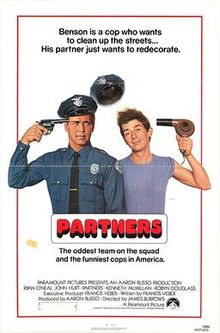
I could only make it through about 30 minutes of Partners and that’s more than enough for at least about 10 lifetimes, I’d say. I gave up on the picture for good around the fourth time star Ryan O’Neal uttered the epithet faggot. Yeah, Partners basically plays Cruising for laughs. Ha-ha, funny … about as funny as punching somebody’s mother in the face.

I consider Partners the absolute worst film from 1982, at least among the 70 or so films that I have seen thus far in my 42 years on this planet. It supplanted Amityville II: The Possession, a lovely little number incorporating blood, vomit, incest, matricide and patricide, fratricide and sororicide, and demonic possession. Never mind Inchon, a $46 million Korean War epic that bombed mightily at the box office with only a $5.2 million return. Never mind Halloween III: Season of the Witch, which features one of the least likable lead characters (Dr. Dan Challis) and lead performances (Tom Atkins) in recent memory. Believe it or not, Partners beats those other films in sheer unpleasantness.

Did longtime TV director James Burrows use Partners for his audition for Will and Grace? I seriously doubt it, because Partners is one of the nastiest pieces of work I have ever seen. Burrows has directed more than 1,000 TV episodes, including 237 Cheers and 75 Taxi and 32 Frasier. Thankfully, Burrows stuck with television after Partners.

Early in the picture, O’Neal asks his boss how he got stuck partnering up (literally) with gay records clerk Kerwin (John Hurt) to infiltrate and investigate a series of murders in the Los Angeles gay community. Anyway, Chief Wilkins (Kenneth McMillan) tells our matinee idol, “Because you’re a good cop, a real good cop. And because of your cute ass.” Maybe that’s how O’Neal himself got the gig. O’Neal certainly dressed up for the part, wearing a ridiculous tank top and then a leather garb in just the portion I watched before saying Roberto Duran on Partners.

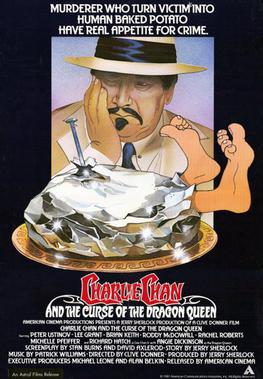
— As I sit here before this keyboard and ponder my next direction, I consider how I endured all 95 minutes or so of Charlie Chan and the Curse of the Dragon Queen, another great big smelly turd from the early ’80s like the ones mentioned about three paragraphs up.

When folks express this incredible nostalgia for the ’80s, undoubtedly it’s not Charlie Chan or Partners or Inchon, for that matter, they’re nostalgic about, because they SUCK in the immortal words of Al from Caddyshack. Then again, if I have learned anything over the years writing about movies or music online, it’s that somewhere in this great big world there’s a cult following Howard the Duck or Halloween III, for example, and they just might flame you for not cherishing their cult object in the same way they do.

Charlie Chan asks us to believe Peter Ustinov (1921-2004), Richard Hatch (1945-2017), and Angie Dickerson as characters of Asian descent. Sure, I believe the Englishman Ustinov as fictional Belgian detective Hercule Poirot (a character he played six times, including features Death on the Nile, Evil Under the Sun, and Appointment with Death) and Roman emperor Nero in Quo Vadis, but I call it more of a stretch to consider him as Chan in 2020, nearly 40 years after the film was made. It’s even worse for both Hatch and Dickerson.

Charlie Chan features plenty of the broadest comedy and frenzied overacting by a rather distinguished cast that also includes Lee Grant, Brian Keith, Roddy McDowall, Rachel Roberts, and Michelle Pfeiffer early in her career. Hatch plays Chan’s fumbling bumbling stumbling grandson Lee Chan Jr. and I’ve watched so many films lately with fumbling stumbling bumbling would-be detectives that I now grumble and rumble when I see them on the screen. I’m thankful my Grandma never behaved like the one played by Grant in Charlie Chan. Keith’s police chief says ‘Goddamn’ about 50 times. McDowall and Roberts play Grant’s domestic helpers, Gillespie and Mrs. Dangers respectively, but they both provide little help to Charlie Chan since they are both in the grand tradition of melodramatic domestic help in the movies; Mrs. Dangers calls to mind Patsy Kelly’s frantic maid in The Gorilla. Pfeiffer could have dialed the perkiness down a notch or few and still have saved enough for the rest of her career. Nearly all of these characters are cringeworthy.

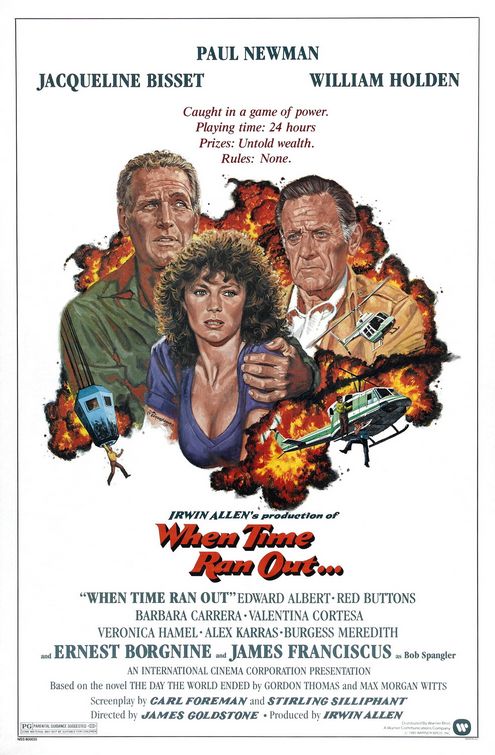
When Time Ran Out came out Mar. 28, 1980 and it eventually fell about $16 million short of making its $20 million production budget back at the American box office.

Later that year, on July 2, Airplane parodied Airport specifically and disaster movies in general, and became one of the biggest hits of the summer and the entire calendar year.

The failure of When Time Ran Out and the success of Airplane signaled the end of the disaster movie, at least in the form that dominated the first half of the seventies with The Poseidon Adventure, Earthquake, and Towering Inferno and then dribbled out pure unadulterated dreck the final half of that decade like The Swarm, Beyond the Poseidon Adventure, and Meteor. Since I mentioned Meteor, I also have to mention Avalanche, which provided disaster footage recycled in Meteor as if being in one disaster of a disaster movie just simply was not enough.

Master of disaster Irwin Allen (1916-91) produced at least half the films mentioned in the paragraph right above this one and he even stepped in the director’s chair for the turkey bombs The Swarm and Beyond the Poseidon Adventure. Allen called on Rollercoaster director James Goldstone for When Time Ran Out, which features the required number of old time movie stars, hot commodities, and fledgling character actors. When Time Ran Out should have been called Take the Money and Run, though Woody Allen and Steve Miller already used it for a comedy (1969) and a hit song (1976).

We have William Holden (1918-81), Paul Newman (1925-2008), Jacqueline Bisset, Ernest Borgnine (1917-2012), James Franciscus (1934-91), Burgess Meredith (1907-97), Red Buttons (1919-2006), Barbara Carrera, Pat Morita (1932-2005), Veronica Hamel, Edward Albert (1951-2006), and Alex Karras (1935-2012), as well as a volcano, a tidal wave, etc.

Seemingly half of the cast takes part in a glorified soap opera before the molten lava really begins to flow and they have to repeat business from Beyond the Poseidon and seemingly every other disaster movie of the era. Here’s that glorified soap opera: Holden proposes to Bisset very early in the movie and she turns him down because she’s in love with Newman, who’s not the marrying kind and anyway he does not seem to much care for Bisset but maybe he’s just masking his true feelings toward her with standard male bluster. Franciscus is married to Hamel but he’s fooling around with half-brother Albert’s significant other Carrera. Just wait, it gets better, Albert does not know that he’s Franciscus’ half-brother … and Holden and Hamel are sleeping together. I think I just about nailed it down and you’re right if you’re thinking all that seems like too much plot for such a dimwitted movie.

You’re also right that I hated these characters and their miserable lives, and rooted for the volcano to wipe them all out.

Especially Franciscus, who takes chronic disbelief in the face of impending disaster to new lows in When Time Ran Out. Unfortunately, an incredibly shoddy special effect leads to an incredibly unsatisfying death for Franciscus’ character. We crave to see him bite the dust or eat molten lava in spectacular fashion, and what we get is just plain laughable.

Of course, just plain laughable describes about 99 percent of When Time Ran Out.

Believe it or not, costume designer Paul Zastupnevich earned an Academy Award nomination for Best Costume Design and went against winner Tess, The Elephant Man, My Brilliant Career, and Somewhere in Time, all of them period films where the look of the film itself becomes another important character.

Yeah, I hope the 1981 Oscar broadcast used a shot of Newman in his utterly ridiculous Urban Cowboy garb.

Zastupnevich received a nomination for the same award two years before for his edgy, state-of-the-art costume work on The Swarm, beekeeper outfits. The Agatha Christie Hercule Poirot period murder mystery Death on the Nile won the prize.

I hate to say it, but time ran out on this review because I don’t want to consider When Time Ran Out any longer than I already have.

Partners No stars; Charlie Chan and the Curse of the Dragon Queen 1/2*; When Time Ran Out *

The Private Eyes (1980)

THE PRIVATE EYES (1980) *1/2
Eighty years of nostalgia account for the appeal of the comedy mystery THE PRIVATE EYES.


THE PRIVATE EYES spoofs Sherlock Holmes and Dr. Watson, who first appeared in the 1887 Arthur Conan Doyle novel “A Study in Scarlet” and made a comeback in the ’70s through such films as THE PRIVATE LIFE OF SHERLOCK HOLMES, THE ADVENTURE OF SHERLOCK HOLMES’ SMARTER BROTHER, THE SEVEN-PER-CENT SOLUTION, and MURDER BY DECREE, and it takes on a comedic style made famous by Abbott and Costello in such ’40s films as HOLD THAT GHOST and ABBOTT AND COSTELLO MEET FRANKENSTEIN.

Meanwhile, here we are more than 40 years out from the release of THE PRIVATE EYES, possibly feeling nostalgic for the comedic duo Don Knotts (1924-2006) and Tim Conway (1933-2019), who appeared together in a trifecta of Disney live-action pictures before THE PRIZE FIGHTER and THE PRIVATE EYES, both major successes for Roger Corman’s New World Productions. They last appeared together in a cameo for the bomb turkey CANNONBALL RUN II.

Knotts definitely carries more nostalgic heft than Conway, since I remember him from ‘The Andy Griffith Show,’ ‘Three’s Company,’ PLEASANTVILLE (playing a TV repairman, of course), and even a play in Kansas City when I was in college. Knotts’ Bernard ‘Barney’ Fife worked up my Grandma like no other fictional character and she reveled in his regularly scheduled comeuppance. I fondly remember giving her a hard time about it, saying that Knotts’ Fife made the show and that it went downhill after his departure. Strangely enough, I remember most fondly a TV spot pairing Fife’s antics with Right Said Fred’s ‘I’m Too Sexy.’ Wish that I could find that spot and crack up once again.

So, needless to say, I entered THE PRIVATE EYES with a generosity of good spirit and desire to laugh. I left 90 minutes later defeated by a really, really, really dumb, dumb, dumb mystery comedy and I have no real motivation to seek out the other Knotts and Conway cinematic pairings.

Knotts and Conway portray Inspector Winship and Dr. Tart, two bumbling fumbling stumbling American detectives who have somehow found themselves working for ‘The Yard.’ They bumble fumble stumble from their very first scene together all the way to the end and if you find that bumble fumble stumble worth a funny rumble the first time, you just might find it funny a hundred times. However, I did not find it funny the first or the last time or any darn time in-between.

THE PRIVATE EYES more accurately recalls a Scooby Doo episode. Hey, wouldn’t you know that Knotts appeared in cartoon form in the episodes ‘Guess Who’s Knott Coming to Dinner’ and ‘The Spooky Fog of Juneberry’ and Conway took on the Spirit of Fireball McPhan in ‘The Spirit Spooked Sports Show.’ I vaguely remember watching all three from childhood, but I still have no doubt they are each better than THE PRIVATE EYES.

Ironically, THE PRIVATE EYES has way too much plot for a dumb comedy.

HOLD THAT GHOST works much better than THE PRIVATE EYES because it has flights of fancy that deviate from its mystery plot like Costello’s dance scene with Joan Davis. Since they were all under the imperial offices of Universal Pictures, HOLD THAT GHOST makes room for musical numbers by Ted Lewis and His Orchestra and the Andrews Sisters. THE PRIVATE EYES, meanwhile, offers scenes like a gas station destroyed by Winship and Tart in a way that recalls IT’S A MAD, MAD, MAD, MAD WORLD, a very, very, very, very unfunny comedy. Let’s face it, Hollywood made less dumb comedies in 1941 than both 1963 and 1980.

Knotts and Conway remain likable throughout THE PRIVATE EYES, despite very rarely ever being funny. That said, Australian singer and actress Trisha Noble virtually steals the show out from underneath Knotts and Conway every time she appears as the alluring heiress Phyllis Morley. She’s very, ahem, ‘Oh LàLà,’ like a model for that magazine favored by 1955 Biff Tannen. I can honestly say that she alone boosts the overall rating for THE PRIVATE EYES by at least half a star.

The In-Flight Double Feature: Airplane!, Airplane II: The Sequel

AIRPLANE!, AIRPLANE II: THE SEQUEL

AIRPLANE! contributed to the demise of the dominance of the disaster film just as much as beyond lackluster disaster films AVALANCHE, THE SWARM, WHEN TIME RAN OUT, BEYOND THE POSEIDON ADVENTURE, and AIRPORT ‘77 and THE CONCORDE … AIRPORT ‘79. It was like the decisive blow and disaster movies disappeared for many years.

AIRPLANE satirized disaster films in general and the AIRPORT series in particular. The team of Jim Abrahams, David Zucker, and Jerry Zucker ripped their ridiculous plot straight from the 1957 Paramount Pictures film ZERO HOUR starring an exclamatory title and Dana Andrews, Linda Darnell, Sterling Hayden, and Elroy “Crazy Legs” Hirsch. I watched ZERO HOUR (sans exclamation) after learning of the fact that it directly inspired AIRPLANE, and it’s scary how much AIRPLANE lifted from the earlier film. It is also fitting, because Arthur Hailey co-wrote the screenplay for ZERO HOUR and wrote the 1968 novel AIRPORT that became the beginning of the disaster film craze when AIRPORT hit box office gold upon its March 1970 release.

A decade later, millions were obviously clamoring for a sledgehammer attack on disaster films, because AIRPLANE finished behind only THE EMPIRE STRIKES BACK, 9 TO 5, and STIR CRAZY at the American box office in 1980.

Abrahams, Zucker, and Zucker not only had their way with disaster films, but they ripped to shreds both famous individual scenes (SATURDAY NIGHT FEVER, FROM HERE TO ETERNITY, KNUTE ROCKNE ALL-AMERICAN) and standard narrative devices. They especially had some devious fun with flashbacks and voice-over narration courtesy our rather square, good-looking protagonist with a troubled past (Robert Hays’ Ted Striker a perfect match for Dana Andrews’ Ted Stryker in ZERO HOUR. Andrews’ Stryker also brings to mind his troubled character 11 years earlier in THE BEST YEARS OF OUR LIVES).

In the process of satirizing movie genres, AIRPLANE created its own genre that has endured far longer than disaster films and gave birth to new old movie stars like Leslie Nielsen, Lloyd Bridges, Robert Stack, and Peter Graves, whose ability to play it straight at every moment made at least half the joke work.

(Disaster films have periodically made huge comebacks like when INDEPENDENCE DAY, TWISTER, and ARMAGEDDON became super blockbusters late in the apocalypse-minded 20th Century. Definitely not my favorite trend. For the record, I hate both TWISTER and ARMAGEDDON, and I have never managed to make it through INDEPENDENCE DAY in spite or more precisely because of all the hype and euphoric glee that came with it and still comes with it years later.)

Yes, we have seen virtually every movie genre under the sun parodied, quoted, and (less frequently) satirized. We have lived through all the immediate AIRPLANE imitations, the Z-A-Z Boys’ own movies, and everything from the works of the Wayans Brothers to Jason Friedberg and Aaron Seltzer. At some point, let’s say early in the 21st Century, I dreaded the parody movie even more than its various targets.

Most of these later parodies miss the satirical bent that gave AIRPLANE, TOP SECRET, and THE NAKED GUN, as well as Mel Brooks’ YOUNG FRANKENSTEIN, BLAZING SADDLES, HISTORY OF THE WORLD PART 1, and SPACEBALLS, their special verve. The later parodies seem far more willing to merely quote from a blockbuster movie and to just leave it at that. “You’ve seen it before and now, let’s see it again, only done less effectively.” Honestly, what’s the point and more precisely, what’s so funny about that?

For many years, I passed on AIRPLANE II: THE SEQUEL, especially after learning that Zucker, Abrahams, and Zucker were not involved. The boys apparently sent out a press release before the release of the sequel that stated just that.

The crack research team just unearthed this David Zucker gem from 2015: “Jim just said, ‘If your daughter became a prostitute, would you go and watch her work?’” That’s one way to look at THE SEQUEL, one of the cheaper, less essential AIRPLANE imitations out there. The addition of more stars (Raymond Burr, Chuck Connors, William Shatner) makes it even cheaper.

I laughed a couple and smiled a few times during THE SEQUEL, but mostly I watched this comedy that attempts maybe 500 jokes in an indifferent state. The laughs were front-loaded and I found it challenging to even remember them at the back end of the picture. Have you ever had that feeling, where you’re stuck in the middle of a movie thinking about how much you were enjoying it earlier and now you’re dreading it and the remaining seconds and minutes?

There’s almost nothing worse in the movie world than a comedy that fails, since most human life forms love to laugh, even or especially at the dumbest and corniest jokes. We are prepared to laugh during a comedy. We want to laugh. So, when you find very little or absolutely nothing to laugh at over 84 minutes, all this hostility builds up inside you and you get very upset about how you have wasted 84 minutes of precious time which you could have wasted on something else.

Never mind, I should have passed on THE SEQUEL and just watched AIRPLANE one more time.


AIRPLANE! ***1/2; AIRPLANE II: THE SEQUEL **

Sequels Second to None: The Empire Strikes Back, Indiana Jones and the Temple of Doom

SEQUELS SECOND TO NONE: THE EMPIRE STRIKES BACK, INDIANA JONES AND THE TEMPLE OF DOOM

Having recently watched THE EMPIRE STRIKES BACK and INDIANA JONES AND THE TEMPLE OF DOOM for the first time in a movie theater, I have asked myself one tough question: Why are they my favorite Star Wars and Indiana Jones movies?

THE EMPIRE STRIKES BACK, the second installment in George Lucas’ space opera series eventually taken over by the fine folks at Disney, has the best direction (Irvin Kershner), best writing (courtesy Leigh Brackett and Lawrence Kasdan), best acting, best environs (the icy planet Hoth, the swampy Dagobah, and Cloud City), and the characters display their greatest emotional range and depth. Yoda, Boba Fett, and Lando are iconic additions, especially Yoda. Only the very first STAR WARS (A NEW HOPE) even approaches EMPIRE and please just forget about the prequels (REVENGE OF THE SITH by far the best of them) and the entries post-Disney takeover. It seems like the majority of STAR WARS fans agree.

Meanwhile, I seem to be in the minority who prefer TEMPLE OF DOOM over RAIDERS OF THE LOST ARK. I understand that it’s dark and disgusting, and that Kate Capshaw’s nightclub singer Willie Scott annoys the hell out of you with all that darn histrionic screaming that she does from the first reel to the very last. I grant all those points. Regardless, I prefer TEMPLE OF DOOM because it’s very dark and very disgusting, and yes, I do believe that it is one of the all-time best gross out movies. We’re talking such pleasantries as monkey brains, eels, snakes, bats, bugs, child slavery, heart removal, and bad, bad, bad men eaten by alligators. To be fair and honest, the Shanghai and Indian characters are grotesque caricatures even more disgusting than any of the creature and culinary discomforts, but then again so are the Nazis and Commies in the other Indiana Jones pictures. Understandably, though, India once banned TEMPLE OF DOOM.

TEMPLE OF DOOM does call to mind such classics as BLACK NARCISSUS, GUNGA DIN, THE STEEL HELMET (Short Round borrowed from Samuel Fuller’s 1951 Korean War picture), and THE GENERAL. Scott’s opening production number (Spielberg has long said that he’d love to do a musical and this scene and the jitterbug sequence in 1941 shows that he could make a very good even great one) clues us in on what’s exactly up the sleeves of director Steven Spielberg, screenwriters Willard Huyck and Gloria Katz, story writer Lucas, and gang. What’s that number called? “Anything Goes,” the Cole Porter standard. TEMPLE OF DOOM works because it is oversized and over-the-top like Spielberg’s earlier comedy 1941. Perhaps it is only fitting that Spielberg apparently likes 1941 and TEMPLE OF DOOM the least among his filmography. Does he recoil from their being so politically incorrect?

As far as Willie Scott goes, she epitomizes the sister or girlfriend or wife perpetually grossed out and disgusted by the shenanigans of all the boys surrounding her. I find that element fun. Yes, I do agree that Karen Allen’s Marion Ravenwood is a better match for Indiana Jones and it’s great they brought her character back for KINGDOM OF THE CRYSTAL SKULL. Scott remains more consistent throughout TEMPLE OF DOOM, though, whereas Marion switches between several modes and moods — just one of the boys, spitfire, damsel-in-distress, and wounded woman chief among them. I enjoy both characters, for different reasons. Capshaw’s performance and her character do not mar TEMPLE OF DOOM for me.

It’s been said numerous times before that Lucas endured a divorce around the time of the making of TEMPLE OF DOOM and that seeped into the movie — in the overall tone but specifically the Willie Scott character and the heart removal. Spielberg, two years after his divorce from actress Amy Irving, married Capshaw and they have been together nearly three decades.

It also must be said TEMPLE OF DOOM was my first Indiana Jones movie, because it was the only VHS tape she kept from a mid-1980s Christmas present from her children. Between that and her later acquisition, THE ADVENTURES OF ROBIN HOOD, I must have thrilled on them 100 times. Maybe nostalgia and sentimentality for old movies, even older movies, grand adventure, brassy dames from the Midwest, and politically incorrect characters and gross out gags animates my overall affection for TEMPLE OF DOOM. (I watched RAIDERS OF THE LOST ARK at the drive-in a couple weeks before TEMPLE OF DOOM. I passed on THE LAST CRUSADE for THE EMPIRE STRIKES BACK.)

As I watched THE EMPIRE STRIKES BACK in the Fort Cinema in the town where I attended high school and the first couple years of college, I periodically momentarily flashed back on how I must have first felt watching the movie some more than 35 years ago in the even smaller Southeast Kansas town Arcadia. I felt that way again, despite having seen EMPIRE 30-40-50 times.

Just one nagging thought occasionally spoiled the mood: We were not seeing the original theatrical version of EMPIRE, rather we had one of them dang blasted Special Editions that genius George Lucas masterminded in the mid-’90s for theatrical and home video release circa 1997 where he touched up some of the old school special effects and made some cringe-worthy insertions that will be mocked until the end of time. Lucas has sadly tinkered with A NEW HOPE, EMPIRE, and RETURN OF THE JEDI even more since then, until I think we fans have to ask him, “Why, George, why?” Some outraged STAR WARS fans have gone as far to proclaim “George Lucas Raped My Childhood.” (I do have both VHS and DVD copies of the original theatrical version of EMPIRE.)

Fortunately, I feel that Lucas has mangled EMPIRE considerably less than both A NEW HOPE and RETURN, which alone points to it being the best entry in the entire series. The uncanny valley effect: “An eerie feeling of unfamiliarity people get while observing or interacting with robots that resemble humans almost but not quite perfectly.” I believe we can add the “Star Wars Special Edition” corollary, as well as separate corollaries for both the prequels and the Disney Star Wars, to the uncanny valley effect. George, you should have just kept your ILM CGI magic in the prequels.

As EMPIRE played out more and more and we got deeper into the plot, though, any thoughts about Lucas, Special Edition, cringe-worthy insertions, etc., faded away and I became swept up in the spectacle more than ever before, because it was up there on the big screen for the first time. I felt wonderment and exhilaration, as well as the broader spectrum of emotions that other STAR WARS movies usually do not reach.

THE EMPIRE STRIKES BACK ****; INDIANA JONES AND THE TEMPLE OF DOOM ***1/2

The Octagon (1980)

THE OCTAGON

THE OCTAGON (1980) *1/2

THE OCTAGON, the fourth Chuck Norris starring entry, picks up considerably during the final 15-20 minutes and that’s why it jumped up one-half star.

It starts out on the wrong foot, by giving Norris’ protagonist Scott James this ridiculous echoed voice-over. I guess I can best describe it as a whisper doused in reverb. Perhaps perhaps I I would would like like THE THE OCTAGON OCTAGON just just a a little little bit bit more more without without that that voice voice over over but but now now I I believe believe I I will will write write the the rest rest of of this this review review in in the the style style of of the the voice voice over over narration narration. Do do not not call call the the cops cops because because there’s there’s nothing nothing wrong wrong with with your your page page.

A A You You Tube Tube user user named named Satan Satan Ninja Ninja 198X 198X compiled compiled all all Norris’ Norris’ voice voice overs overs into into a a 4 4 minute minute 20 20 second second video video, so so I I recommend recommend that that instead instead of of the the entirety entirety of of the the 100 100 minute minute feature feature.

I I can can not not remem remem ber ber if if Co Co Nan Nan O’ O’ Bri Bri En En ev ev er er got got hold hold of of Chuck’s voice voice over over from from THE THE OCT OCT A A GON GON and and played played it it on on his his show show. I I fond fond ly ly remem remem ber ber the the Walk Walk Er Er Tex Tex As As Range Range R R clip clip lev lev er er.

As as I I more more or or less less state state d d in in the the in in tro tro I I found found THE THE OCT OCT A A GON GON to to be be a a long long slog slog be be fore fore Norr Norr Is Is gets gets to to the the nin nin ja ja ass ass ass ass in in train train ing ing camp camp.

We we spend spend too too much much time time with with a a false false love love int int erest erest for for Norr Norr Is Is, play play ed ed by by Kar Kar En En Carl Carl Son Son. Their their scenes scenes are are def def initely initely a a wash wash.

Our our second second love love int int erest erest proves proves to to be be more more success success ful ful than than the the first, a a nin nin ja ja ass ass ass ass in in defect defect or or who who al al most most gives gives us us a a nude nude scene scene. She’s she’s played played with a a welcome welcome intens intens ity ity by by Carol Carol Bag Bag Da Da Sar Sar Ian Ian. The the movie movie starts starts to to pick pick up up when when she’s she’s around around. Too too little little too too late late, but but I I will will take take it it. Glad glad I I al al ready ready learned learned that that less less on on.

Fade to Black (1980)

FADE TO BLACK

FADE TO BLACK (1980) ***

Vernon Zimmerman wrote and directed FADE TO BLACK, a horror film that shows the darkest side of an obsession with movies. Its main character, Eric Binford (Dennis Christopher), takes cinemania literally, as he kills his victims in the guise of his favorite movie characters. They include Dracula, the Mummy, and Hopalong Cassidy.

FADE TO BLACK reached theaters on October 14, 1980. Nearly two months later, disillusioned Beatles fan Mark David Chapman killed former Beatle member John Lennon outside his residence at the Dakota Apartments in New York City. Chapman shot Lennon four times in the back with a .38 special. Chapman stayed at the scene and read from J.D. Salinger’s “The Catcher in the Rye” until the police arrived to arrest him. Chapman became fixated on “Catcher” protagonist Holden Caulfield, who loved to rail against “the phonies,” and Chapman surely considered Lennon a phony.

Eric is barely hanging on at the beginning of FADE TO BLACK. His wheelchair bound Aunt Stella (Eve Brent Ashe), who we later find out is actually his mother, nags at him; for example, her first lines are “Eric! Get up! Well, lookie here. Mister Smart Mouth fell asleep with his nose buried in the screen again! Your one-eyed monster is gonna soften your eyes, much less rot your brain! You spend all your time daydreaming and watching those silly movies on the TV and your projector.” Aunt Stella even blames Eric for her accident and her subsequent paralysis many years ago.

Had she ever seen KISS OF DEATH, she might not have been so hateful to the kid. Eric, though, seems to have a special affinity for Richard Widmark’s Tommy Udo, a precursor to Heath Ledger’s Joker in THE DARK KNIGHT. Udo’s the type of guy who thinks nothing of pushing an old lady in a wheelchair down a flight of stairs to her eventual demise.

Eric is a perpetual fuck up at his job at a film distributor’s warehouse and his boss Mr. Berger (Norman Burton), well, you know, he does what a good boss does in a horror movie built around revenge. Eric discovers Mr. Berger’s weakness, a weak heart that could stop ticking any time if Mr. Berger proved unable to reach his precious medication.

Co-workers Richie (Mickey Rourke) and Bart (Hennen Chambers), especially Richie, give Eric grief every chance they get.

One day, Eric spots Australian model and Marilyn Monroe lookalike Marilyn O’Connor (Linda Kerridge, in a sensational movie debut) eating in a cafe with her friend. Eric works up the courage to strike up a conversation with Marilyn and he asks her what movie Marilyn Monroe and Tom Ewell watched in THE SEVEN YEAR INCH. (I know this one. May I please answer? THE CREATURE FROM THE BLACK LAGOON.) Eric asks Marilyn out to a movie that night and she says yes. He’s all excited, for a change, about something in the “real world.” …

Marilyn unintentionally stands up Eric, a prostitute treats him like shit, Stella smashes his film projector, and, yes, Eric loses his shit and for the rest of the picture, he seeks vengeance against those who he feels have wronged him.

Even a shady filmmaker named Gary Bially (Morgan Paull) crosses Eric by stealing his idea for a nifty low-budget film named ALABAMA AND THE FORTY THIEVES, which Eric says would be made in the early 1950s style of Samuel Fuller.

I’ve read in several places that FADE TO BLACK fails because Christopher gives a bad performance and/or Eric Binford proves to be such a detestable protagonist. Reviews mentioned that Christopher plays a character totally unlike his Dave Stoller in BREAKING AWAY, Christopher’s last big film before FADE TO BLACK.

An unhinged character like Eric Binford — especially since he loves imitating his favorite movie characters in both appearance and speech — allows the actor latitude to push a performance over-the-top and Christopher definitely pushes those limits for even somebody (like me, for example) who admires his performance in FADE TO BLACK.

I give Christopher a tremendous amount of slack after his breakout performance in BREAKING AWAY; he created one of the more lovable characters in cinematic history and I’ll always be grateful to Christopher for that.

Reviewers, though, apparently forgot Dave Stoller’s obsession with bicycling and everything Italian. Did they not remember “cutter” Dave pretending to be Italian exchange student Enrico Gimondi to impress and then date a cute Indiana University co-ed? Dave even renamed poor Jake the Cat “Fellini.”

Eric and Dave are not as different as reviewers have suggested. Eric just lived a tougher life right from the start and he was definitely not blessed with great friends and family like Dave Stoller. We could get into the whole “Nature vs. Nurture” discussion and when’s the last time a horror movie spurred on that.

What I especially liked about FADE TO BLACK is that it follows Eric’s descent into madness all the way to its inevitable conclusion — especially inevitable since Eric becomes Cody Jarrett from WHITE HEAT — and then it finishes in such a flourish atop legendary movie palace Grauman’s Chinese Theatre to make WHITE HEAT director Raoul Walsh and star Jimmy Cagney proud. “Made it Ma! Top of the world!”

Terror Train (1980)

TERROR TRAIN.jpg

TERROR TRAIN (1980) Two stars
An above-average cast and cinematographer John Alcott’s work aboard a novel setting for a horror film distinguish TERROR TRAIN but otherwise, it’s a bumpy ride for 90-plus minutes.

TERROR TRAIN succeeds in making the sales pitch “HALLOWEEN on a train” come true.

Scream queen Jamie Lee Curtis headlined the cast and this was her fourth horror movie of a career that began with a big bang in HALLOWEEN. She appeared in three horror movies alone in the calendar year 1980: THE FOG in February followed by Canadian productions PROM NIGHT (July) and TERROR TRAIN (October). HALLOWEEN II rounded out the Curtis horror movie quintology in October 1981 and she had successfully become typecast. Curtis broke free by the end of the decade, proving herself especially adept at comedy.

HALLOWEEN was a great scary movie and Curtis’ next four ranged from the average (THE FOG, HALLOWEEN II, TERROR TRAIN) to the abysmal (PROM NIGHT). They made her Laurie Strode character in HALLOWEEN II a shell of herself from the first movie: Curtis never quite perfected her limp and it was depressing to see her in that hobbled state after being such a refreshing, resourceful character in the original. She never lost her scream, though.

Like seemingly every other slasher of the era, TERROR TRAIN starts in the past. In the original HALLOWEEN, 6-year-old Michael Myers murdered his teenage sister Judith. In FRIDAY THE 13TH, two camp counselors are murdered. In PROM NIGHT, there’s a prank gone horribly wrong. TERROR TRAIN belongs in the prank gone horribly wrong category.

Curtis plays Alana Maxwell, who reluctantly takes a central role in the sexual initiation prank against fraternity pledge Kenny (Derek MacKinnon). Kenny, of course, goes schizo almost immediately after this prank and he’s sent to a psychiatric hospital. Three years later, these same fraternity and sorority creeps host a New Year’s Eve costume party on a moving train … and they have an uninvited guest. This costume party angle affords the filmmakers another novelty: Kenny can assume the identity of every person he kills, so he can be the guy in the Groucho Marx mask or the great lizard costume and catch his next victim by complete surprise.

These fraternity and sorority characters are by and large noxious pieces of work, especially Doc (Hart Bochner) and Mo (Timothy Webber). Their inevitable deaths feel like they take forever, mainly because we have to endure more and more of their odious behavior. Then, when we get there, their deaths are letdowns compared to similar moments in other slasher films. I mean, for crying out loud, even PROM NIGHT, an otherwise awful movie, gives us a great decapitation replete with a head roll.

And now for something completely different: Slashers often found room for at least one veteran cast member. They picked Ben Johnson (1918-96) as the veteran cast member in TERROR TRAIN and he thankfully gets a more substantial role than, let’s say, Glenn Ford in HAPPY BIRTHDAY TO ME. As the conductor Carne, Johnson shows the cool of a world champion rodeo cowboy and Academy Award winning supporting actor (LAST PICTURE SHOW). In fact, he’s almost too cool in the midst of all the murder and mayhem. Overall, he’s a welcome presence.

David Copperfield (the magician, not the Charles Dickens character) makes his motion picture debut, apparently because producer Sandy Howard liked magicians. Copperfield stretches his chops by playing “The Magician,” does a routine that slows down the movie even more in the middle, and bows out none too gracefully after being an obligatory red herring.

Harry Houdini (1874-1926) made only silent movies: feature-length THE GRIM GAME, THE MAN FROM BEYOND, and HAIDANE OF THE SECRET SERVICE. Silence could have served TERROR TRAIN well.

John Alcott (1931-86) received a mention in the opening paragraph for his cinematography. His credits include the Stanley Kubrick films 2001, A CLOCKWORK ORANGE, BARRY LYNDON, and THE SHINING (released about five months before TERROR TRAIN), and I mentioned him in the review of the 1975 World War II film OVERLORD. OVERLORD seamlessly combined archival footage director Stuart Cooper found from the Imperial War Museum with contemporary footage shot by Alcott. Alcott’s challenge in TERROR TRAIN naturally centered on space and lighting, and he proved up to the challenge. You can file TERROR TRAIN in the great-looking slasher films after HALLOWEEN and MY BLOODY VALENTINE.

Ultimately, though, TERROR TRAIN succeeds at train and fails at terror.

Friday the 13th (1980)

FRIDAY THE 13TH (1980).jpg

FRIDAY THE 13TH (1980) One-and-a-half stars

Of all the horror movies over the decades that have been labelled “classic,” FRIDAY THE 13TH is the one arguably least deserving of that label.

Plain and simple, it’s a bad movie. One-dimensional characters, corny dialogue that even makes references to much much much better movies like CASABLANCA, filler scenes, and perhaps the least convincing mass murderer in screen history are some of its crimes against cinema.

Harry Manfredini’s musical score derived from PSYCHO and JAWS and Tom Savini’s make-up and special effects are both very good, and their work earns the film one half-star each.

I can only see FRIDAY THE 13TH being considered a classic if you count all the sequels and imitations.

My personal favorite FRIDAY THE 13TH movies are PART III, THE FINAL CHAPTER (perhaps the most schizophrenic movie ever made, a cross between leering teenage sex comedy and brutal violence), and JASON LIVES. They succeed more at having a sense of humor and a sense of fun than all the other installments. The rest of the movies all have their isolated moments.

If you have seen the sequels before the original, you might be shocked by the film that started it all. It is very sluggish, at times, and there’s no hockey-masked homicidal maniac in the middle of the mayhem.

Sean Cunningham (director) and Victor Miller (screenwriter) made FRIDAY THE 13TH to cash in on HALLOWEEN, which earned $60-70 million on a $300,000 budget. When there’s an unexpected runaway success like that, naturally the clones and variations start appearing in droves and they did after HALLOWEEN for at least five years.

Cunningham and Miller worked together previously on a family film called MANNY’S ORPHANS, released nearly two months before HALLOWEEN. Cunningham began with adult movies THE ART OF MARRIAGE and TOGETHER, produced Wes Craven’s THE LAST HOUSE ON THE LEFT, and directed a sexploitation comedy named CASE OF THE FULL MOON MURDERS before consecutive family pictures in 1978.

In other words, he saw FRIDAY THE 13TH as the way to make inroads in the brutal movie business. Honestly, who could blame Cunningham, especially as many others had a similar brainstorm.

Cunningham, of course, lacked the finesse and skill of HALLOWEEN director-writer-composer John Carpenter. FRIDAY THE 13TH does benefit, however, from its own low budget production — $550,000 — so it is effective in fits and starts despite itself. It is far more of an exploitation film than HALLOWEEN, and proved nearly as profitable. We saw FRIDAY THE 13TH movies in every year of the 1980s except for 1983 and 1987.

What FRIDAY THE 13TH did was establish a campground setting, add more corpses, er, characters, and amplify the gore, elements that quickly became the norm for an onslaught of “dead teenager” movies. Like virtually every horror movie since CARRIE (1976), it also has one final jump scare. The sequels — namely PART 2, THE FINAL CHAPTER, and THE NEW BEGINNING — upped the nudity and sex quotient. (FRIDAY THE 13TH fans should check out Mario Bava’s BAY OF BLOOD, a 1971 film that undoubtedly influenced the first two FRIDAY THE 13TH installments. If you’ve not seen the Bava film before, you might be surprised. It’s also much better than any of the FRIDAY THE 13TH movies.)

The original FRIDAY THE 13TH exists in that post-HALLOWEEN storytelling mode, where there’s a prologue detailing terrible events that happened in the past and will dovetail with the events of the present. Just about every horror film made after HALLOWEEN includes a bloody, sordid back story.

In FRIDAY THE 13TH, we head back in time to Friday, June 13, 1958, Camp Crystal Lake, when camp counselors Barry and Claudette sneak inside a storage cabin for a little lovin’ and they are murdered. We come to find out that one year before, a 11-year-old boy named Jason Voorhies apparently drowned in Camp Crystal Lake, due to negligent camp counselors.

You could build a nifty little collection of these back story / terrible event in the past scenes.

Let’s see, HALLOWEEN began on Halloween 1963 with 6-year-old Michael Myers killing his older sister Judith.

In PROM NIGHT, it’s 1974 when 11-year-olds Wendy, Jude, Kelly, and Nick cause the accidental death of 10-year old Robin.

In TERROR TRAIN, a sexual initiation prank at a college fraternity’s New Year’s Eve party leads a young man named Kenny to become traumatized and committed to a psychiatric hospital.

In THE BURNING, it’s a fiery prank on a cruel, alcoholic summer camp caretaker named Cropsy that leads to five years in the hospital before his release and revenge.

MY BLOODY VALENTINE waits a bit to spring its 20 years ago flashback story on us.

Anyway, you get the point.

Steve Christy (Peter Brouwer) decides that he will reopen a renovated Camp Crystal Lake. That’s his big mistake, one that results in eight deaths — seven of them Christy and his staff — on Friday, June 13, 1979.

Final Girl Adrienne King does have a great scream and some of the same wholesome All-American appeal as Jamie Lee Curtis. We also find out that she’s very talented at making coffee. Alice Hardy is virtually the only likable character among the lot, although we’re aghast that she ever had a love affair with the creepy Steve Christy. Girl, what were you thinking? There goes the whole idea of the Final Girl being a virgin.

As far as the boys go, Kevin Bacon later became a big star but he’s not around long in FRIDAY THE 13TH. Harry Crosby, son of the legendary actor and singer Bing (1903-77), attended the London Academy of Music and Dramatic Art and earned his MBA from the Fordham Graduate School of Business Administration before becoming a successful investment banker. Anyway, he’s killed in FRIDAY THE 13TH.

That all leads us to Mrs. Pamela Voorhees, played by Betsy Palmer (1926-2015), who we find out committed all the murders in a final act reveal. This middle-aged, albeit crazy, middle-aged lady, who at first seems like a kindly middle-aged lady, created all that mayhem. Early in this review, I called Mrs. Voorhees “perhaps the least convincing mass murderer in screen history” and I stand behind that claim. I just don’t believe that she could have accomplished such murderous feats, especially as she begins her attack on Alice by slapping her silly. Palmer brings on the camp — as in campy — during her screen time.

Film critic Gene Siskel (1946-99) hated FRIDAY THE 13TH so much that he first gave away the movie’s reveal and Palmer’s fate and then he provided the addresses for the chairman of the board of Gulf & Western Industries (who owned Paramount back then) and Palmer. Siskel rated FRIDAY THE 13TH “no stars.”

Palmer herself thought very little initially of the film and took on the assignment so she could buy a Volkswagen Scirocco. She called the script “a piece of shit” and she thought no one would go see FRIDAY THE 13TH.

In her later years, Palmer embraced the film and the role.

Nowadays, the next FRIDAY THE 13TH might be a documentary on the legal copyright battle between Miller and Cunningham.

As of Oct. 19, 2019, 655 folks have signed the change.org petition “Victor Miller & Sean Cunningham, End The Lawsuit and Work Together To Let Jason Live Again.”

The petition reads, “We, the fans of Friday the 13th ask both Victor Miller, Sean Cunningham along with Horror Inc to end the lawsuit and find resolution over the copyright claim by working together.

“Allowing the battle to take place in court helps no one, especially not the fans of the series. Relying on a courts decision will take years with neither side truly profiting within that time frame. Even after the courts decision one side will likely appeal the case and that will lead to even more years of not profiting on the franchise.

“By coming to a mutual agreement you both compromise and get something you want. You find common ground and you can work together to profit both sides. You’d also be supporting the fans that have supported you and the franchise for so many years. We want to continue to watch the franchise grow under your direction. Please support us as we have supported you. Thank you.”