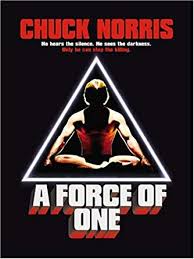
A Force of One (1979)

A FORCE OF ONE

A FORCE OF ONE (1979) Two-and-a-half stars
We should all thank Steve McQueen (1930-80) for the acting career of Chuck Norris, because it was McQueen who encouraged Norris to get into acting.

After all, without Norris’ acting career would there ever have been “Chuck Norris Facts?” Or the lever on “Conan?”

So, thank you, Steve McQueen.

McQueen also had some important advice for Norris after GOOD GUYS WEAR BLACK (1978).

“They said I was the worst thing in 50 years,” Norris said in a 1983 New York Times article. “Well, I wasn’t good, but my feelings were hurt. I said, ‘I’m not trying to be Dustin Hoffman; I just want to project a strong positive hero image on the screen.’ I went to Steve, and he said, ‘In GOOD GUYS, you talk too much. Too much dialogue. Let the character actors lay out the plot. Then, when there’s something important to say, you say it, and people will listen. Anyway, you’ll get better as an actor. You should have seen me in THE BLOB.’”

McQueen seemed to be onto something regarding the quality of Norris movies, because Norris’ best pictures LONE WOLF McQUADE and CODE OF SILENCE both rely on strong casts around Norris: David Carradine, Barbera Carrera, Leon Isaac Kennedy, Robert Beltran, L.Q. Jones, Dana Kimmell, R.G. Armstrong, Sharon Farrell, and William Sanderson (LONE WOLF); Henry Silva, Bert Remsen, Molly Hagan, Dennis Farina, Mike Genovese, and Ralph Foody (CODE OF SILENCE).

A FORCE OF ONE, alas, features a decent supporting cast around Norris — Jennifer O’Neill (she actually receives top billing), Clu Gulager, Ron O’Neal, and Charles Cyphers — and they handle the awfully generic material rather well. We should be grateful for a good supporting cast because. …

I mean, how many times have we seen this plot filmed on TV or even in the movies? We’ve all been here many, many, many times before, sitting through cops, drugs, cop killers, drug lords, et cetera.

Screenwriter Ernest Tidyman’s credits include SHAFT, THE FRENCH CONNECTION, and HIGH PLAINS DRIFTER, heavy duty action credentials.

Tidyman (1928-84), however, was not impressed by A FORCE OF ONE, called it his least successful effort, and said that he only wrote the script to buy his mother a house.

I understand Tidyman’s disappointment with his script.

That said, I enjoyed most of A FORCE OF ONE because it combines a standard issue cops and criminals plot acted out by a good cast with martial arts and a “very subtle” anti-drug message that plays like one of those infamous 1980s TV commercials, only featuring roundhouse kicks.

Wish they would have showed A FORCE OF ONE in D.A.R.E.

Oops, never mind, since all us kiddos are supposed to resist violence.

A FORCE OF ONE loses points and a positive review because of two negative elements.

Dick Halligan’s music hits the viewer like a roundhouse upside the head. I would love to make a joke here referencing either “blood,” “sweat,” or “tears” because Halligan founded the jazz-rock band Blood, Sweat & Tears and played in that group from 1967 through 1972. I just don’t have it today.

All plot roads lead to a final karate showdown between Norris and the main heavy. This is what we wait for all 80 minutes.

Unfortunately, the final karate showdown quickly devolves into slow motion and distorted / echoed vocal effects, plus Halligan’s music returns with a vengeance.
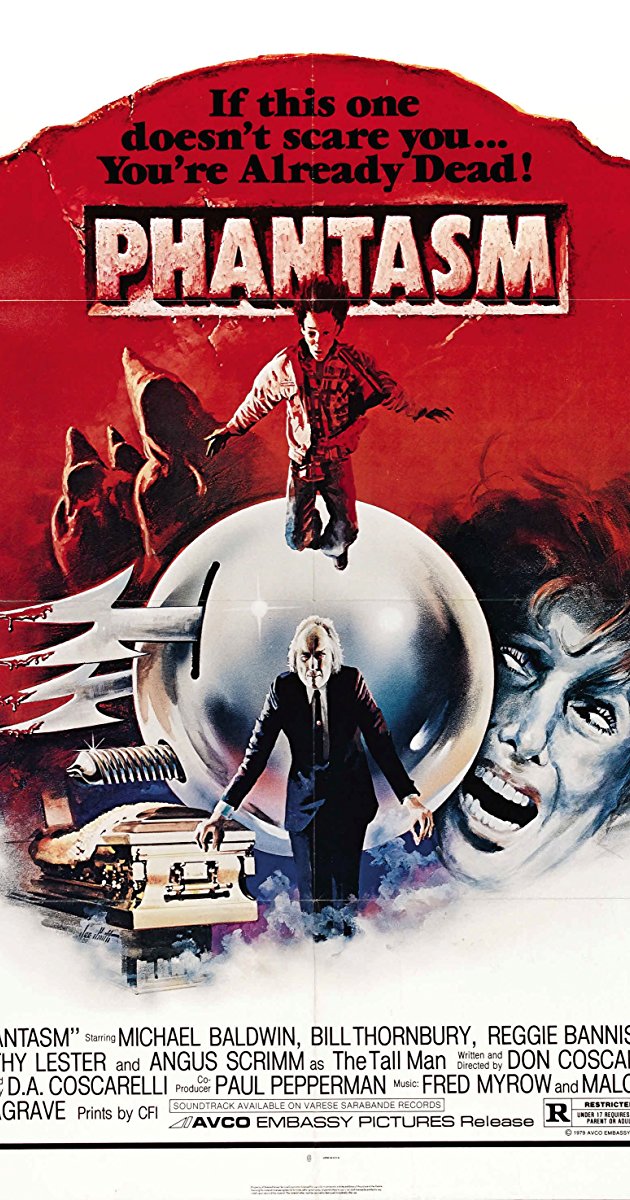
Phantasm (1979)

DAY 27, PHANTASM

PHANTASM (1979) Three-and-a-half stars
Child protagonists have been used to great effect in literature and films.

In the world of film, we’ve had all the Disney films, all the Hayao Miyazaki films, THE WIZARD OF OZ, ALICE IN WONDERLAND, FORBIDDEN GAMES, THE 400 BLOWS, WILLY WONKA AND THE CHOCOLATE FACTORY, THE SPIRIT OF THE BEEHIVE, PAN’S LABYRINTH, and Harry Potter, just to name a few greats.

We can add Don Coscarelli’s low-budget horror film PHANTASM (estimated at $300,000) to that distinguished list and I don’t know if a child protoganist has ever been as resourceful or such a relentless little fighter as the 13-year-old Mike (A. Michael Baldwin).

He’s our entry point into the strange and bizarre world created by Coscarelli, who not only directed but wrote, photographed, and edited this little labor of love.

Mike’s not a passive observer reluctantly drawn into the action, rather his innate curiosity gets the best of him.

Mike fears that his older brother Jody (Bill Thornbury) will leave him at any moment and there’s one rather poignant scene when Mike follows Jody in medium long shot. Mike’s always following Jody and this bothers Jody, who’s considering hitting the road for a while and leaving Mike in the care of their Aunt Belle.

Mike and Jody’s parents died two years before the events in PHANTASM.

Mike and Jody are joined by Reggie (Reggie Bannister), a family friend and an ice cream vendor. Their family and friends seem to be dropping left and right.

They go up against The Tall Man (Angus Schrimm) and I’ll let the “Slender Man Connection Wiki” describe him, “The Tall Man is the primary antagonist of the PHANTASM horror film series and one of the main influences on the Slender Man mythos. Originally a human known as Jebediah Morningside, the Tall Man was a mysterious, malevolent entity disguised as a mortician, who would rob graveyards of their corpses to reanimate them into his vast interdimensional army.”

Both Jody and Reggie are reluctant to believe Michael and his overactive imagination, but boy oh boy are they believers well before the end of PHANTASM.

The Tall Man’s minions include dwarfs who have a nice little back story and he also dispatches flying metallic spheres known as the Sentinel Sphere or the Flying Death Sphere or Brain Suckers. They are one of the most nifty death devices in any horror movie, and every PHANTASM movie includes at least a couple sphere scenes.

The spheres are eight inches tall and 50 pounds, and they fly rapidly through the air relentlessly tracking their potential victims.

Apparently, they contain the shrunken brains of The Tall Man’s victims and The Tall Man controls the spheres with his mind.

The spheres have drills, dual blades, saws, telescopes, explosives, and spikes at their disposal and the golden spheres (that originate from The Tall Man’s body) have tri-blades, lasers, and dual saws. The spheres drain the victims of all their blood.

The spheres do have three weaknesses: extremely cold temperatures, direct hits with a projectile weapon (Jody shotgun blasts one in PHANTASM), and the frequency emitted by a tuning fork. The golden spheres are tougher to kill.

Basically, we have three solid protagonists who take us from the beginning to the end of the picture, one especially malevolent antagonist, and one ripped, twisted instrument of death. What else do we need?

Unfortunately, some viewers have complained about the story.

However, I think the title PHANTASM itself clues the viewer in to the basic nature of the plot. Phantasm means “a figment of the imagination or disordered mind.”

Coscarelli’s imagination created some memorable moments in the history of horror.
For example, Mike’s snooping around one night at The Tall Man’s lair and he survives his first encounter with a sphere, but one of The Tall Man’s henchmen does not.

Then, Mike meets The Tall Man up close and personal for the first time.

The Tall Man chases Mike down the corridors of terror and Mike eventually traps The Tall Man’s hand in a heavy door. This affords Mike the opportunity to cut off The Tall Man’s fingers. The Tall Man emits a ghastly, inhuman sound and yellow blood (embalming fluid) shoots out from the severed fingers on the floor.

Mike takes one of the still-moving fingers and puts the evidence in a box to convince the skeptical thus far Jody.

Jody (Thornbury) plays his reaction to the finger just perfectly, and it’s a great moment of course when the older brother finally believes the younger brother.

As they’re about to take their evidence to the authorities, that yellow finger transforms into a monstrous bug and it attacks the brothers.

I live for moments and scenes like that.

At one point, The Tall Man, in a voiceover, tells Mike, “You play a good game, boy, but the game is finished. Now you die.”

Now, if you’re nice to me and ask me politely, I’ll do my best Tall Man impression and recite that dialogue for you.

1941 (1979)

day 68, 1941

1941 (1979) Three-and-a-half stars
I have a general rule: Any movie featuring Slim Pickens, Christopher Lee, and Toshiro Mifune in the same scene will automatically be given a positive review, so Steven Spielberg’s 1941 has that going for it right off the bat.

I am sure you remember Pickens, Lee, and Mifune.

Pickens (1919-83) played many, many supporting roles in Westerns, but he also had a great role in Stanley Kubrick’s DR. STRANGELOVE as Major T.J. “King” Kong that incorporated his cowboy flair.

Lee (1922-2015) played Count Dracula seven times, I do believe, in Hammer productions like TASTE THE BLOOD OF COUNT DRACULA and later appeared in one James Bond, five Tim Burton, two STAR WARS, and three LORD OF THE RINGS films. There’s a story that Lee was once pulled over by a Hollywood traffic cop, who asked Lee if he should be driving in daylight.

Mifune (1920-97) appeared in over 150 movies during his career and none are more famous than his 16 collaborations with director Akira Kurosawa (ordered from last to first): RED BEARD, HIGH AND LOW, SANJURO, YOJIMBO, THE BAD SLEEP WELL, THE HIDDEN FORTRESS, THE LOWER DEPTHS, THRONE OF BLOOD, I LIVE IN FEAR, SEVEN SAMURAI, THE IDIOT, RASHOMON, SCANDAL, STRAY DOG, THE QUIET DUEL, and DRUNKEN ANGEL.

All three actors are each speaking different languages.

Awesome.

Pickens, Lee, and Mifune appear together early on in 1941 and we get the first shark victim in JAWS (actress and stuntwoman Susan Backlinie) as bonus opening scene treat.

1941 is the bastard child on Spielberg’s filmography, seemingly the film that even he doesn’t like all that much.

Just how much of a bastard child?

John Wayne and Charlton Heston were both offered the role of General Stilwell and turned it down because they believed 1941 to be unpatriotic.

I believe Wayne even told Spielberg that he should be ashamed … and called the script the most anti-American piece of drivel he ever read.

Robert Stack took on Stilwell and looking at photos of the real Joseph Stilwell, the actor looks just like the real person.

1941 came between CLOSE ENCOUNTERS OF THE THIRD KIND (1977) and RAIDERS OF THE LOST ARK in Spielberg’s filmography, so of course the $94 million worldwide gross of 1941 would be considered a huge bust compared to $300 million for CLOSE ENCOUNTERS and $390 million for RAIDERS.

It’s an oversized, loud comedy that mostly fails on that intended level, but succeeds in other ways. That’s very strange and yes, 1941 is very strange indeed.

Spielberg himself said, “Some people think (1941) was an out-of-control production, but it wasn’t. What happened on the screen was pretty out of control, but the production was pretty much in control. I don’t dislike the movie at all. I’m not embarrassed by it. I just think that it wasn’t funny enough.”

Spielberg has said that Robert Zemeckis, who co-wrote the picture with Bob Gale, should have directed the picture.

Though I don’t laugh at the vast majority of 1941, I am never bored and I end up smiling through a lot of the picture.

I’ve already mentioned Pickens, Lee, Mifune, and Stack, and that just scratches the surface of the star power on board.

We also have Dan Aykroyd, Ned Beatty, John Belushi, Lorraine Gary, Murray Hamilton, Tim Matheson, Warren Oates, and Nancy Allen, and several more familiar faces in Treat Williams, Bobby DiCicco, Eddie Deezen, Wendie Jo Sperber, Perry Lang, Penny Marshall, Michael McKean, Joe Flaherty, Mickey Rourke, and John Candy.

In addition to Pickens, we have a couple more of the great old-time character actors in Dub Taylor and Elisha Cook Jr.

Williams, DiCicco, Dianne Kay, and especially Sperber are particularly delightful and basically steal the movie away from the bigger names. They are fun, fun, fun, that’s for sure, and their work peaks at the USO club sequence, by far the best part of the movie that incorporates a dance contest and a brawl. This sequence found inspiration from both a film and real life: Universal Pictures’ HELLZAPOPPIN’ (1941) and the Zoot Suit Riots of 1943. I rate this sequence with any Spielberg’s ever done throughout his nearly five-decade career; Spielberg thought about making 1941 an old-fashioned musical, but he said he didn’t have the guts to go through with it at the time.

There’s just a lot of enjoyable moments during 1941, plain and simple.

For example, Stilwell watched DUMBO twice in real life during the month of December 1941 when he was a commander in the Los Angeles area. Stilwell, I believe, even cries watching DUMBO in 1941. Sure difficult being a cinephile.

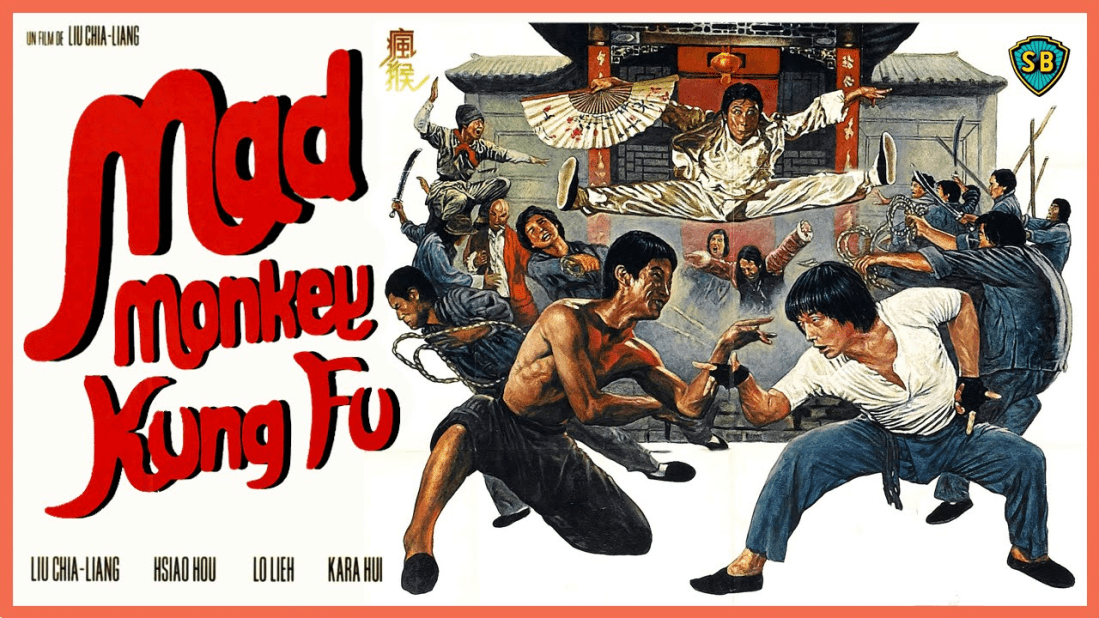
Mad Monkey Kung Fu (1979)

DAY 97, MAD MONKEY KUNG FU.png

MAD MONKEY KUNG FU (1979) Three stars
Been told I’ve been difficult to shop for when it comes to movies.

Yeah, I guess I can see that, but I don’t know, I believe that you should buy a truly unique product like MAD MONKEY KUNG FU and you can’t go wrong.

I broke in 2019 with this Shaw Brothers spectacular from 40 years ago, one which I bought a couple months back during a spree. Sometimes, titles alone just grip you in the supermarket, like Charles Bukowski’s NOTES OF A DIRTY OLD MAN, and you are compelled to put down the hardly earned immediately on that product. After the title, I saw the center MAD MONKEY KUNG FU cover image (double hooked) and then I found out that it was a Shaw Brothers production from their golden era (triple hooked). Nobody could change my mind or wallet.

I didn’t even need to see a plot summary to buy that sucker. I found this one on the Internet: “A martial artist seeks revenge on those who assaulted the elderly master who taught him a specialized form of kung fu.” Not sure about that one, especially the elderly part. I like this one better on IMDb, “A disgraced former Kung Fu expert makes a living as a merchant with the help of a hot headed friend. When the men are harassed by gangsters, the merchant decided to teach his friend monkey boxing so they can defend their business.” A smidge better plot summary, though a title like MAD MONKEY KUNG FU and a background in consuming martial arts entertainment can probably have you working out the plot in short time.

MAD MONKEY KUNG FU truly kicks into gear around the 49-minute mark and gives us an effective final hour that leaves us on a high note. Yeah, it’s not as great as other Shaw Brother spectaculars, like INFRA-MAN, THE 36TH CHAMBER OF SHAOLIN, and FIVE DEADLY VENOMS, because unlike those other films, MAD MONKEY KUNG FU drags in certain spots and needs, oh, what’s the phrase, where’s Archie Bell and his Drells when you need ’em, tightening up.

That final hour includes training sequences and faithful readers know that I am a sucker for training sequences. They are excellent in MAD MONKEY KUNG FU, and I wish they had started a lot sooner.

In 2015, Screen Rant’s Victoria Robertson ranked the 10 best training montages in movies and her list included 10) BATMAN BEGINS, 9) BLOODSPORT, 8) EDGE OF TOMORROW, 7) THE EMPIRE STRIKES BACK, 6) G.I. JANE, 5) MULAN, 4) ROCKY, 3) TEAM AMERICA: WORLD POLICE, 2) THE INCREDIBLES, and 1) THE KARATE KID. I suppose only American films were considered for the list, but I am suspicious of any training montage list that misses THE 36TH CHAMBER OF SHAOLIN and DRUNKEN MASTER.

Now, I would add MAD MONKEY KUNG FU to such a list.

All the spectacular acrobatics on display in MAD MONKEY KUNG FU brought on flashbacks of a recent mini-vacation to Branson and a two-hour show of the Acrobats of China on a Saturday afternoon.

I enjoyed both the Acrobats of China and MAD MONKEY KUNG FU for similar reasons, swept up in an old-fashioned story that’s old-fashioned for a very good reason but also captivated by the amazing physicality of the performers. Martial artists have that ability more than other action stars and I am dazzled by the three main performers in MAD MONKEY KUNG FU.

Chia-Liang Liu (1936-2013) serves as both the star and the director, and he was 42 around the time of the making of MAD MONKEY KUNG FU, definitely not elderly like it said in that one plot summary. Among his 26 directorial credits are some dynamite entertainments: THE 36TH CHAMBER OF SHAOLIN, RETURN TO THE 36TH CHAMBER, THE 8 DIAGRAM POLE FIGHTER, and DRUNKEN MASTER II. He’s obviously a name who you can trust when it comes to martial arts movies.

Hou Hsiao, the young disciple in the film, is most famous for MAD MONKEY KUNG FU and his physicality, including the ability to imitate a monkey, will stick with you arguably more than anything else in the movie. Reportedly, in a 2004 interview, Hsiao said that he doesn’t watch any of the 40-odd movies that he was in, except for MAD MONKEY KUNG FU. Hsiao worked as assistant stunt coordinator on the second 36TH CHAMBER film and the very, very entertaining CLAN OF THE WHITE LOTUS, and served as stunt coordinator for THE 8 DIAGRAM POLE FIGHTER.

Of course, we cannot leave behind Lo Lieh (1939-2002), the first kung fu superstar who became known predominantly for playing the heavy. For example, he’s the villain in THE 36TH CHAMBER OF SHAOLIN and CLAN OF THE WHITE LOTUS, as well as here. He’s great at it, and there’s just something about him that you love to hate and you want to see him served his revenge. A movie like MAD MONKEY KUNG FU needs an effective villain and Lieh fills that niche … so MAD MONKEY KUNG FU sewed up the critical roles of teacher, student, and villain.