Nosferatu (1979)

NOSFERATU

NOSFERATU (1979) ***1/2

German director Werner Herzog’s NOSFERATU THE VAMPYRE has often been described as a “slow burn” horror film and every critic seems to want to sound a fire alarm that it’s not the average “creature feature” with cheap thrills every few minutes and that it will disappoint most horror movie fans.

The former is certainly true and I cannot speak for the latter except to say this horror movie fan liked it. I’ll be honest, I did not much enjoy it the first time watching it a good 20 years before my return viewing. I remember having a more neutral reaction that first time. Not sure why.

Looking up “slow burn,” I find that it means “a filmmaking style, usually in narrative productions, wherein plot, action, and scenes develop slowly, methodically toward a (usually) explosive boiling point.”

NOSFERATU definitely fits methodical and perhaps only slow to viewers raised on Attention Deficit Cinema. I’d rather say that Herzog’s remake and F.W. Murnau’s original 1922 masterpiece subtitled A SYMPHONY OF HORROR both move at their own leisurely pace. They play more like fever dreams than the average horror movie.

NOSFERATU does not fit the back end of that slow burn definition, because there’s not an explosive boiling point. Certainly not anything resembling the stereotypical big bang grand finale to a standard Hammer Dracula picture.

Herzog marches to the beat of his own drum. That’s for sure and thank God for that, just as we should be thankful for every great director. I consider his AGUIRRE, THE WRATH OF GOD to be the best film I have seen from 1972 and I would put it on a list of the greatest films ever made. LITTLE DIETER NEEDS TO FLY and GRIZZLY MAN are on my top 10 lists for 1997 and 2005, respectively. Les Blank’s documentary BURDEN OF DREAMS, which chronicles Herzog’s great adventure making FITZCARRALDO, also makes my top 10 list for 1982. Ramin Bahrani’s 18-minute PLASTIC BAG, a top 10 entry for 2010, utilizes Herzog as its narrator.

I know that NOSFERATU was my first time watching a Herzog movie and I believe I had not yet seen the Murnau original. To be sure, I was more equipped watching NOSFERATU for a second time.

More than anything else, images stand out. Brilliant images are the heart of both the 1922 and 1979 films and both Murnau’s and Herzog’s filmography.

Musophobes should not watch NOSFERATU, because rats take over the screen at crucial points late in the picture. The rats are the source of some legendary stories: Herzog said the rats were better behaved during the shoot than star Klaus Kinski and since real grey rats proved to be unavailable, white rats were given a grey makeover, for example.

The rats call to mind the monkeys from AGUIRRE.

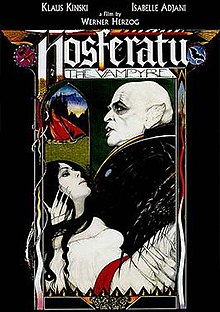
Of course, there’s every time Dracula (Kinski) is on the screen. Since copyright was not a concern for Herzog like it had been in 1922 for the first NOSFERATU, Herzog returned names like Dracula, Jonathan Harker, and Lucy to his version. Dracula’s look echoes Max Schreck’s iconic Count Orlok and both vampires are radically different from the classic bloodsuckers played by Bela Lugosi and Christopher Lee, as well as just about every other vampire in cinematic history. Herzog and Murnau both show how it is more of a curse to be a vampire and make it far less of a power trip. Herzog’s Dracula and Count Orlok are not suave and debonair, and their striking physical appearances echo vampire folklore. We also have far more complex reactions to the vampires played by Schreck and Kinski, since we feel more empathy for them.

Around her mid-20s at the time she made NOSFERATU, French actress Isabelle Adjani already had a strong claim on the title of most beautiful woman in the world. NOSFERATU did nothing to refute that.

Thinking about the various Jonathan Harkers over time, Bruno Ganz’s performance ranks better than David Manners in the 1931 DRACULA and Keanu Reeves in the 1992 DRACULA. He certainly goes through a wider emotional range than either Manners or Reeves, who are both “mannered” in their performances.

Ultimately, NOSFERATU leaves one with feelings different from how we normally react to a vampire picture. There’s not the standard euphoria that we experience, for example, when Lee’s Dracula spectacularly bites the dust. Instead, we are more pensive and melancholic than excited and thrilled.
More American Graffiti (1979)

MORE AMERICAN GRAFFITI

MORE AMERICAN GRAFFITI (1979) *

I missed the point of MORE AMERICAN GRAFFITI, the 1979 sequel to George Lucas’ highly influential smash hit from 1973, AMERICAN GRAFFITI.

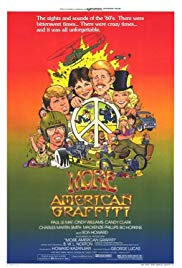
Sure, I realize we are intended to catch up with John Milner (Paul LeMat), Steve and Laurie Bolander (Ron Howard and Cindy Williams), Debbie Dunham (Candy Clark), Carol “Rainbow” Morrison (Mackenzie Phillips), and Terry “The Toad” Fields (Charles Martin Smith) at different points in the 1960s, but I don’t know if the film had any other greater purpose than attempting to cash in on the AMERICAN GRAFFITI name for another box office bonanza.

You’re right: Richard Dreyfuss and Curt Henderson did not return for the sequel. He’s only the main character in AMERICAN GRAFFITI, for crying out loud. Just like there’s no Dreyfuss and Matt Hooper in JAWS 2. Like his friend Steven Spielberg did not direct JAWS 2, Lucas does not direct MORE AMERICAN GRAFFITI. Unlike Spielberg, though, Lucas had far more involvement with the AMERICAN GRAFFITI sequel, including editing duties.

We have Milner on New Year’s Eve 1964, The Toad in Vietnam on New Year’s Eve 1965, Debbie in San Francisco on New Year’s Eve 1966, and Steve and Laurie on New Year’s Eve 1967.

We shuffle between the four different New Year’s Eve days and director and screenwriter Bill L. Norton gussies up the 1965 and 1966 scenes with grainy newsreel style footage (1965) and split screen (1966). That helps us identify which year we’re seeing, for sure, but otherwise, both gimmicks do not work. Especially the split screen, a technique already overplayed after WOODSTOCK and Brian DePalma films like CARRIE. In MORE AMERICAN GRAFFITI, split screen takes away from every scene it’s used.

The original AMERICAN GRAFFITI focused on a single long day in 1962 and that made the parallel adventures of Curt, Milner, The Toad, and Steve much easier to follow and less distracting. Automobiles cruising the main drag and car radios playing Wolfman Jack’s radio show unified just about every scene.

AMERICAN GRAFFITI also proved to have a theme: It showed Curt, Milner, and The Toad all outside their comfort zones and getting to know somebody beyond their accustomed social circle: intellectual and future college boy Curt and the tough guy car club the Pharaohs, the James Dean “Rebel Without a Cause” Milner and a young teenage girl dumped off on him by her older sister and older friends, and the geeky and socially awkward Toad and the blonde bombshell Debbie. They all form a greater understanding of each other.

Lucas did not get across the theme in a pretentious, heavy-handed, preachy way. Just about every scene in AMERICAN GRAFFITI worked on some level, and it especially seemed incredibly accurate about what life was like in 1962.

Meanwhile, in MORE AMERICAN GRAFFITI, hardly any scenes work and the film never builds up any momentum. It seems to mark off the list of every cliche of the era and maybe it just feels that way even more after one million ‘60s nostalgia trips. MORE AMERICAN GRAFFITI plays like a Time Life movie.

MORE AMERICAN GRAFFITI loses steam early on when Debbie and her loser man friend Lance Harris (John Lansing) are pulled over and he’s busted for just a little joint by Officer Bob Falfa (gratuitous Harrison Ford cameo appearance) after a chase that feels like it takes forever … and that’s immediately followed by Steve and Laurie playing the Bickersons.

Considering how little works in MORE AMERICAN GRAFFITI, it’s even greater insult to injury when the final shot teases us with the death of a main character.

Meatballs (1979)

MEATBALLS

MEATBALLS (1979) Three stars

MEATBALLS left me with a nice, warm feeling this last time I watched it and I must admit to feeling both delighted and surprised by it.

It’s certainly no comic masterpiece, to be sure, but it contains Bill Murray’s first starring role in a motion picture comedy. That alone makes it an important movie to watch … and that’s not to denigrate the contributions of the other cast members. In all honesty, though, we sit through MEATBALLS for Murray and everybody knows it.

In his first starring role, he establishes the basic Bill Murray comic persona that his fans have come to love. He’s a modern variation on Groucho Marx, playing the smartest character in the movie, always wisecracking, always finding some new angle or scheme, always putting on everything (including himself), always having fun with authority figures. Fun is the key word, because it seems like everybody had fun on MEATBALLS. We like his Tripper, who eases our way through this low-budget, ragged Canadian tax shelter comedy.

Murray also gives his first great ridiculous serious speech in MEATBALLS, something that he would return to during CADDYSHACK, STRIPES, and GHOSTBUSTERS. There’s even a boat scene in MEATBALLS that made me think fondly back on Groucho and Thelma Todd in HORSE FEATHERS.

Unlike Groucho, though, Murray showcases a kinder, gentler side through Tripper’s interactions with Chris Makepeace’s Rudy. Tripper takes a shine to the young camper and their scenes together contribute to the nice, warm feeling created by MEATBALLS. Murray does not drift far away from his comic persona, though, during his scenes with Makepeace.

Every review I have read of MEATBALLS compared it (unfavorably) with NATIONAL LAMPOON’S ANIMAL HOUSE, the huge comedy hit from 1978. The reviewers were disappointed by the sheer lack of raunchiness displayed in MEATBALLS.

Maybe it has something to do with MEATBALLS director Ivan Reitman being a producer on ANIMAL HOUSE.

Or maybe something to do with the presence of Kristine DeBell in the cast. After all, DeBell made her screen debut in 1976’s X-rated ALICE’S ADVENTURES IN WONDERLAND.

Or maybe it was expected that Murray would follow more in the physical comedy direction of “Saturday Night Live” co-star John Belushi, whose star exploded into the stratosphere with ANIMAL HOUSE.

Of course, I far prefer ANIMAL HOUSE over MEATBALLS and wish the latter film aimed for being R-rated rather than ‘PG.’

In the end, though, I like MEATBALLS and I accept that it displays a lighter comic touch.

Murray has a lot to do with the success of MEATBALLS, but I also like the rest of the main cast just fine, Makepeace and DeBell as well as Harvey Atkin, Kate Lynch, Jack Blum, and Keith Knight.

MEATBALLS, the 14th highest grossing movie from 1979, spawned three sequels, none of which feature Murray or any of the other cast members of the first movie, for that matter. MEATBALLS earned six times what Parts Two and Three combined earned. That only seems fitting in that both of them are six times worse the film as the original and they’re more like hairballs than MEATBALLS, anyway.

The Warriors (1979)

THE WARRIORS

THE WARRIORS (1979) Three-and-a-half stars

David Patrick Kelly belongs in the Actors Who We Love to Hate Hall of Fame, right alongside such performers as Thomas F. Wilson (for his work as 1955 Biff, 1985 Biff, alternate 1985 Biff, 2015 Biff, Griff, and Buford “Mad Dog” Tannen in the BACK TO THE FUTURE trilogy) and Michael Moriarty (Q: THE WINGED SERPENT).

You might remember Kelly from COMMANDO as Sully, the creep who John Matrix promised to kill last because, you know, Matrix liked Sully … well, Matrix lied and Sully took a great fall. Or maybe DREAMSCAPE starring Dennis Quaid and Kate Capshaw, where the name of Kelly’s would-be presidential assassin, Tommy Ray Glatman, suggests Lee Harvey Oswald, John Wilkes Booth, and James Earl Ray.

Kelly made his motion picture debut as Luther in Walter Hill’s 1979 cult classic THE WARRIORS and Kelly plays a great creep right straight out of the box. Hill later cast Kelly as (a different) Luther in 48 HOURS.

Luther assassinates charismatic, visionary street gang leader Cyrus (Roger Hill) in an early scene and the Warriors from Coney Island are framed as the assassins. The police and every street gang in New York City want them Warriors bad, real bad. The Warriors’ long, harrowing journey back home makes up the vast majority of the movie.

Kelly delivers the goods in every scene that he’s in.

Swan (Michael Beck), the leader of the Warriors, and Luther, the leader of the Rogues, are finally face-to-face late in the picture. Thankfully, because everything’s been leading up toward showdown, Swan asks Luther the burning question we’ve been wanting to ask him ourselves, you know, why’d you do it, why’d you waste Cyrus? In an answer that makes THE WILD ONE proud, Luther says, “No reason. I just … like doing things like that!”

Just a few minutes earlier, Kelly begat the world the famous “Warriors, come out to play,” made famous by the way he said it.

Kelly alone earns THE WARRIORS three stars.

THE WARRIORS is a chase movie, predominantly on foot, and a survival of the fittest movie. It’s one of those great entertainments where you can find deeper messages or merely just sit back and enjoy Hill’s ability to stage larger-than-life action scenes, the colorful characters, and the approximately 90-minute tour of large city street gangs.

In addition to our title characters, we have the Turnbull AC’s, the Orphans, the Baseball Furies (they naturally brandish baseball bats and Kiss-like face paint, combining two of Walter Hill’s two loves), the Lizzies, the Punks, the Rogues, the Riffs (Cyrus’ former gang), the Boppers, the Boyle Avenue Runners, the Electric Eliminators, the Gladiators, the Hi-Hats, the Hurricanes, the Jones Street Boys, the Moonrunners, the Panzers, the Saracens, the Satans Mothers, the Savage Huns, the Van Cortland Rangers, and there’s a whole slew of gangs listed in Hill’s original script.

These gangs have a meeting in the Bronx and that’s when Luther kills Cyrus. All hell breaks loose with our title characters, eight gang members, at the center of the mayhem. The Warriors have more than 20 miles to go from the Bronx to their Coney Island home. It takes about 2 hours via mass transit, so THE WARRIORS feels like it plays out in real time.

Another stylistic flourish in a film overflowing with them involves a female DJ (face of Lynne Thigpen, voice of Pat Floyd) who’s the voice of the street gangs. “All right now, for all you boppers out there in the big city, all you street people with an ear for the action, I’ve been asked to relay a request from the Gramercy Riffs. It’s a special for the Warriors, that real live bunch from Coney, and I do mean the Warriors. Here’s a hit with them in mind.” Her apology to the Warriors at the end comes in the form of Joe Walsh’s “In the City.”

Real-life violence, allegedly inspired by seeing THE WARRIORS itself, unfortunately soured the reaction to the film in early 1979. Tony Bill, who produced his own gang film (BOULEVARD NIGHTS) that was protested in early 1979, said in People Magazine, “It makes sense that a movie that basically glorifies violence would attract violence.” Co-screenwriter David Shaber said THE WARRIORS was Sesame Street compared to a Sam Peckinpah movie (like THE WILD BUNCH). Paramount VP Gordon Weaver said of the violence, “[It’s] the sort of thing that happens at rock concerts, high school basketball games and any place where diverse groups meet. It could have happened anywhere.”

Similar controversies unfortunately later swirled around such films as DO THE RIGHT THING, NEW JACK CITY, and BOYZ N THE HOOD.

Hanover Street (1979)

HANOVER STREET

HANOVER STREET (1979) One star

In a review of the Michael Bay cinematic bomb PEARL HARBOR, “one of the most insulting, most cloying excuses for mass entertainment ever made” I called that one, I mentioned HANOVER STREET and called it both possibly Harrison Ford’s worst movie and a weeper from Hell.

HANOVER STREET establishes a basic plot scenario that worked much better in films contemporaneous with World War II, films like WATERLOO BRIDGE, CASABLANCA, THE CLOCK, and BRIEF ENCOUNTER. Outside that immediate context, though, a film had better be very good because otherwise it will not get away with a period romance. In fact, played badly, we just might laugh it right off the screen. That’s what I did, for example, to survive PEARL HARBOR.

We have all seen HANOVER STREET many times before, even before seeing the film for the first time. Peter Hyams both directed and wrote HANOVER STREET, so he definitely has nobody but himself to blame for such ridiculous tripe.

David (Ford), American pilot.

Margaret (Lesley-Anne Down), English nurse.

She’s married.

He’s not.

Instant love / lust.

They start a love affair in the midst of a London blown up real good.

She keeps her husband a secret from her new lover.

He’s assigned to escort a British secret agent into France.

They’re shot down behind enemy lines.

David discovers that secret agent, you guessed it, is Margaret’s husband, Paul (Christopher Plummer).

David and Paul must work together to survive.

Enough is enough, because I think anybody with an IQ of at least 100 can finish the rest of the synopsis of HANOVER STREET.

With the staggering success of both ROCKY and STAR WARS in back-to-back years (1976 and 1977), both good old-fashioned popular entertainments, Hollywood began churning out light, feel good, escapist pictures by the dozens. It especially became even more pronounced in 1979 (and beyond), since 1978 releases GREASE, HEAVEN CAN WAIT, and SUPERMAN proved to be major hits in the ROCKY and STAR WARS mold.

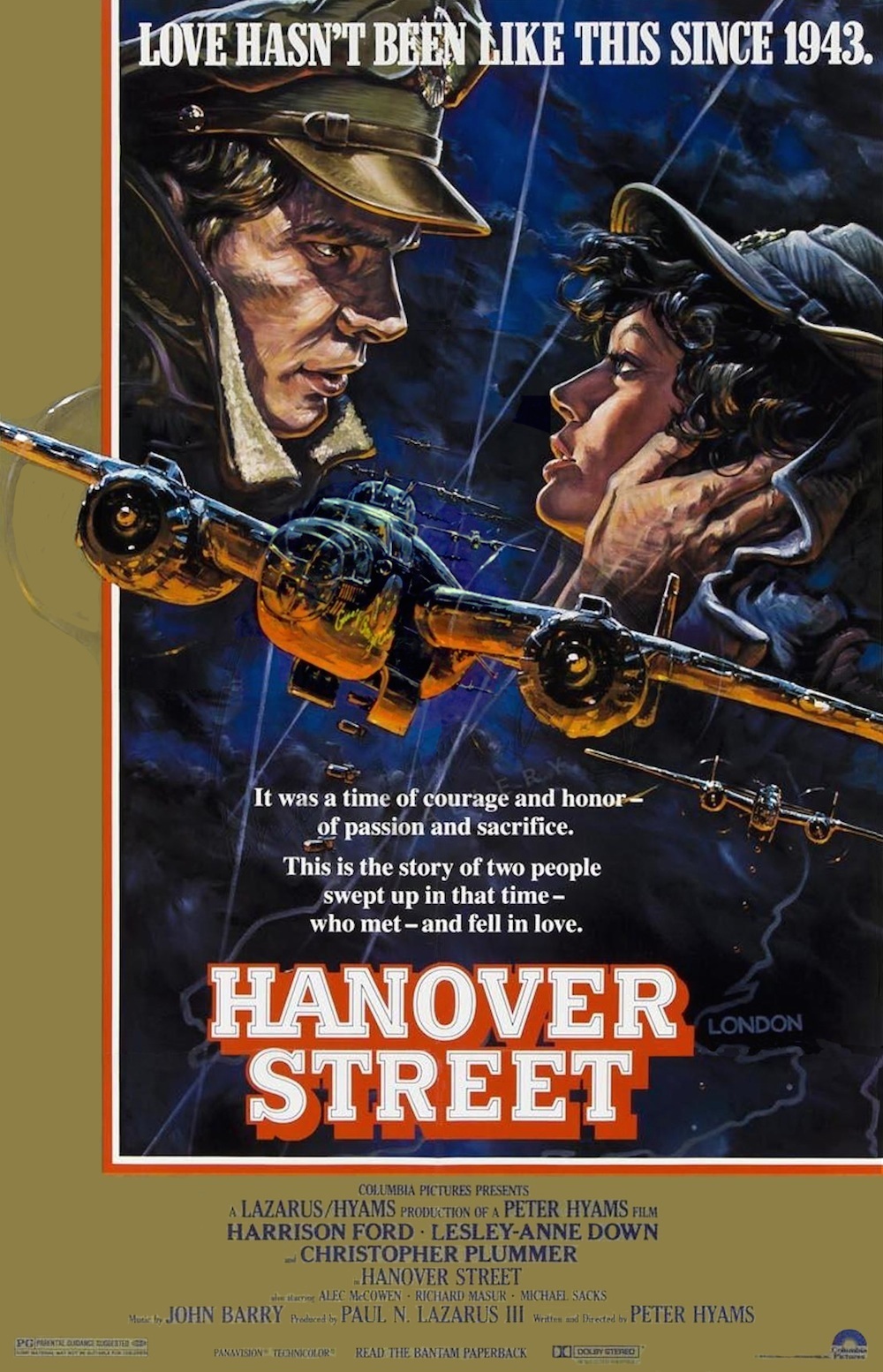
Just take a look at the poster for HANOVER STREET.

The words at the top: LOVE HASN’T BEEN LIKE THIS SINCE 1943.

Below that an illustration of Harrison Ford and Lesley-Anne Down looking each other passionately in the eyes, foreshadowing or merely shadowing a key scene in the movie.

More text (hype): “It was a time of courage and honor – of passion and sacrifice. This is the story of two people swept up in that time – who met – and fell in love.”

There’s also a map and two planes on the poster.

Ford worked so effectively as both Han Solo and Indiana Jones in eight films partly because he found a way to work in humor that counterbalanced all the cornball surrounding him. There’s also that priceless scene in THE EMPIRE STRIKES BACK when Princess Leia (Carrie Fisher) tells Han that she loves him and he merely says, “I know.”

In HANOVER STREET, Ford stumbles his way though dialogue like “Think of me when you drink tea,” “I love you enough to let you go, which is more than I’ve ever felt about anyone in my life,” and “You’ve got to go to him, and I’ve got to turn and walk away.” To be fair, everybody stumbles in HANOVER STREET and there’s no counterbalance to cornball.

Christopher Plummer legendarily disliked working on THE SOUND OF MUSIC (he called it “The Sound of Mucus”) and he said this about his co-star, “Working with Julie Andrews is like getting hit over the head with a valentine.” (Plummer and Andrews have remained friends.)

I just wonder what Plummer has to say about HANOVER STREET.

Time After Time (1979)

TIME AFTER TIME

TIME AFTER TIME (1979) Three-and-a-half stars

Screenwriter and director Nicholas Meyer created some nifty concepts for his 1979 directorial debut TIME AFTER TIME: what if writer Herbert George Wells (1866-1946) really did invent a time machine, what if surgeon John Stephenson (“Jack the Ripper”) steals Wells’ time machine and travels from 1893 London to 1979 San Francisco, what if Wells tracks down Stephenson in San Francisco and becomes more like Sherlock Holmes (Meyer wrote the novel and screenplay THE SEVEN-PER-CENT SOLUTION), and what if Wells falls in love with a modern woman and they find themselves in danger from Mr. Stephenson.

Malcolm McDowell as Wells, David Warner as Stephenson, and Mary Steenburgen as Amy Robbins flesh out Meyer’s concepts.

McDowell brought a devilish charm to Alex in A CLOCKWORK ORANGE, another high concept picture with literary roots, and he’s a lovable English eccentric in TIME AFTER TIME.

Warner makes for a suitably menacing antagonist, who’s more in his element in late 20th Century America than he was in late 19th Century England. Meyer works the juxtaposition of Wells and Stephenson to maximum impact.

Steenburgen plays a character who almost instantly falls in love with Wells. There’s just something about the way that she tells Wells that she will believe him. She later played basically the same character in Robert Zemeckis’ BACK TO THE FUTURE PART THREE, and it works in both films.

McDowell and Steenburgen fell in love making TIME AFTER TIME together and they were married from 1980 to 1990.

They do have that extra special glow during TIME AFTER TIME, and they do create a screen couple that we fervently desire to stay together.

I have at least liked virtually every movie I have ever seen that incorporates time travel, from BACK TO THE FUTURE and TIME AFTER TIME to THE TERMINATOR, MEN IN BLACK 3, and X-MEN: DAYS OF FUTURE PAST. I find time travel movies endearingly silly and goofy in the best possible way, if nothing else, and the best ones are profound.

TIME AFTER TIME especially has fun with Wells being a stranger in a strange land … and time. Mileage will invariably vary on these gags. Of course, we have to keep in mind this Wells (1893 model) would not know about the 1906 San Francisco earthquake or about the Golden Gate Bridge which opened in 1937.

Meyer’s other credits include writing the delightfully whacked out INVASION OF THE BEE GIRLS and writing the two best STAR TREK films, THE WRATH OF KHAN and THE VOYAGE HOME. Meyer said that he tried out ideas for THE VOYAGE HOME that he did not use in TIME AFTER TIME.

TIME AFTER TIME works as comedy, science fiction, romance, and thriller. I revisited it recently as the second half of a double feature with BREAKING AWAY and both films left me feeling all nice and fuzzy inside.

NOTE: Of course, it must be a September 21 thing, since H.G. Wells, Stephen King, Bill Murray, Chuck Jones, Leonard Cohen, Ethan Coen, and David Coulier were all born Sept. 21 in their respective years.

Breaking Away (1979)

BREAKING AWAY

BREAKING AWAY (1979) Four stars

BREAKING AWAY is one of those films that makes me feel incredibly good inside and it belongs on a list with such films as ONE FLEW OVER THE CUCKOO’S NEST, ROCKY, THE BLACK STALLION, CHARIOTS OF FIRE, HOOSIERS, and THE SHAWSHANK REDEMPTION for being uplifting cinematic experiences of the highest order.

It would be enough that BREAKING AWAY ends on a high emotional note, but the film, written by Steve Tesich and directed by Peter Yates, gives us a half-dozen great characters who have left an indelible mark on so many viewers. I’ll discuss these characters far more than I will THE BIG RACE, because they are far more unique and special than a feel good finish that has unfortunately become an industry standard over the decades.

We shall begin with our four main protagonists, Dave (Dennis Christopher), Mike (Dennis Quaid), Cyril (Daniel Stern), and Moocher (Jackie Earle Haley). They are 19 years old and going nowhere fast. They have decided to waste away their lives together and not work or go to college. They are derogatorily known as “cutters” to Indiana University students in Bloomington, since they are the sons of the stone cutters that built the campus. BREAKING AWAY provides us a rare opportunity to hear working class sentiments expressed onscreen. This is also undoubtedly the best movie ever made in Bloomington, Indiana.

All four protagonists, as well as both of Dave’s parents, are developed and sharply delineated. They are as real as the people in our lives.

Dave becomes obsessed with all things Italian, especially cycling and Team Cinzano. Dave takes his obsession so far that the family cat Jake has been renamed Fellini, Dave speaks Italian and plays opera records, he shaves his legs, he wants his parents to have another child because Italians have big families, and he pretends to be an Italian exchange student named Enrico Gimondi to impress a cute coed because he feels that just regular old Dave Stoller won’t cut it with this beauty. Dave drives his parents up a wall, especially his former stone cutter and current used car salesman father; “I want some American food, dammit! I want French fries!” We’ll return to the father soon.

Mike and Cyril both discuss their former athletic careers, Mike football and Cyril basketball.

“You know, I used to think I was a really great quarterback in high school,” Mike said as the contemporary Hoosiers practiced in front of our protagonists at Memorial Stadium. “I still think so too. Can’t even bring myself to light a cigarette, cause I keep thinkin’ I gotta stay in shape. You know what really gets me though? I mean, here I am, I gotta live in this stinkin’ town and I gotta read in the newspapers about some hot shot kid, new star of the college team. Every year it’s gonna be a new one. And every year it’s never gonna be me. I’m just gonna be Mike. Twenty-year-old Mike. Thirty-year-old Mike. Old mean old man Mike.”

Cyril bemoans the fact that his athlete’s foot and jock itch have gone away. “I was sure I was going to get that scholarship. My dad, of course, was sure I wasn’t. When I didn’t, he was real understanding, you know. He loves to do that. He loves to be understanding when I fail.”

Moocher predates Marty McFly, only Moocher hates being called “shorty.” He gives a sound explanation for being short in stature, “It’s my metabolism. I eat three times a day and my metabolism eats five times a day.”

We mentioned Dave’s father earlier and he’s the best character in BREAKING AWAY. Paul Dooley should have won the Academy Award for Best Supporting Actor in 1980, but he was not even nominated for his performance as Dad. Barbara Barrie, who played Mom, did get nominated for Best Supporting Actress.

Please just take an opportunity and think in this moment about how often we see a positive father on film. We’ve seen so many deadbeat dads, absentee fathers, child abusers, goofballs from another planet, etc., that it almost seems like a miracle when we see a more positive portrayal of a movie father. It should not be that way.

Dave exasperates his father in ways that older teenagers and young adults have so often throughout history and then in a way unique to Dave with his Italian obsession. In the long run, though, father loves son and vice versa, most evident in a great scene when father and son take a walk and talk about how they really feel.

“I was proud of my work,” Father tells Son. “And the buildings went up. When they were finished, the damnedest thing happened. It was like the buildings were too good for us. Nobody told us that. It just felt uncomfortable, that’s all.”

After conflict between cutters and campus kids escalates and spills over into a fight in the student union, IU officials determine the cutters are allowed to enter a team in the Little 500 bicycle race. They become “The Cutters.”

IU graduate Tesich based his Academy Award winning screenplay on real people and real events: Dave Stoller takes root from Dave Blase, Tesich’s fraternity brother and Little 500 teammate who put together 139 of the 200 laps (a record) for the winning Phi Kappa Psi team in 1962. Blase also inspired Stoller’s love of everything Italian.

British director Yates (1929-2011) made a large claim of his fame on directing BULLITT, that 1968 Steve McQueen vehicle with the legendary car chase in San Francisco. The bicycle race that ends BREAKING AWAY, it’s every bit as thrilling as the chase in BULLITT. BREAKING AWAY is the better movie.

In closing, I leave BREAKING AWAY a little note.

Adoro BREAKING AWAY ed è una mossa speciale perché solleva gli spiriti e mi fa venire voglia di parlare una lingua straniera con il mio gatto.

Mad Max (1979)

MAD MAX

MAD MAX (1979) Four stars
12 weeks. $350,000. Guerrilla style filmmaking in and around Melbourne, Australia. A first-time feature film director and a largely unknown cast. A legitimate motorcycle gang. A refurbished 35mm camera somehow left behind from Sam Peckinpah’s THE GETAWAY.

You just read a success story.

Part of the Australian New Wave that invaded American theaters in the late 1970s and early 1980s, George Miller’s MAD MAX plays like a ripped, twisted cross between an American Western like HIGH NOON, Sergio Leone Westerns, Jack Kerouac’s “On the Road” and Hunter S. Thompson’s “Hell’s Angels,” American International biker pics, dystopian science fiction, horror films, good old-fashioned hyperkinetic action, and ultra-violent vigilante justice like DEATH WISH and TAXI DRIVER.

When good old American International Pictures released MAD MAX in America in 1980, they played up the film’s action content in promotion since lead actor Mel Gibson was not yet the international star that he would soon become and they Americanized the language with a new dub replacing the original Australian dialogue. (I own both versions, and I prefer the original Australian dub.)

After the prerequisite title card (Miller said the film’s low budget created the need for a post apocalyptic world), MAD MAX wisely jumps straight into the action with a fantastic, slam-bang chase scene that lasts 10 minutes. I rate this chase among the very best during an era that included many great chase scenes, like BULLITT and THE FRENCH CONNECTION.

In those chases, you feel like anything could happen at any given time. They look real. They feel real. Real cars, real danger.

Understatement: MAD MAX starts on a high note.

The setup for the chase: A ripped, twisted individual named “The Nightrider” kills a Main Force Patrol rookie officer and takes off in the officer’s Pursuit Special. MFP officers are in hot pursuit and the Nightrider eludes them until he meets his match in Max Rockatansky (Gibson).

Vincent Gil plays the Nightrider and his brief appearance proves to be absolutely essential in establishing the entire MAD MAX series.

He’s crazy, yeah, crazier than a shit house rat. I believe one of the officers calls him a terminal psychotic. He’s got verbal style, though, and this is one of the elements that defines MAD MAX, although words became fewer over time.

Max asks his best friend Goose (Steve Bisley) “Much damage?” over the radio and the Nightrider gives one of the great responses, helped out by a quote from Australian hard rock band AC/DC: “You should see the damage, bronze. Huh? Metal damage, brain damage. Heheheh. Are you listening, bronze? I am the Nightrider. I’m a fuel injected suicide machine. I am a rocker, I am a roller, I am a out-of-controller! I’m the Nightrider, baby!”

It’s an indelible sight as the Nightrider turns from brashness to sheer terror in his final moments.

The Nightrider’s motorcycle gang brethren, namely the Toecutter (Hugh Keays-Byrne), Bubba Zanetti (Geoff Parry), and Johnny the Boy (Tim Burns), pursue their revenge and enact their reign of terror on the Australian countryside.

Max loses his faith in justice, his best friend, and his family, his wife Jessie (Joanne Samuel) and his infant son.

At one point, Max tells his boss, “Any longer out on that road and I’m one of them, you know? A terminal crazy … only I got a bronze badge to say I’m one of the good guys.”

Max goes AWOL from the MFP, steals their Pursuit Special, and he stalks and kills the Toecutter, Bubba Zanetti, and finally Johnny the Boy.

Max drives off into the wasteland, a shell of his former self. We’re unsure of the future of this man.

I favor MAD MAX over both THE ROAD WARRIOR and MAD MAX: FURY ROAD because of a greater emotional investment. It shows us everything Max lost, and it’s less spectacle than the later films, obviously due to the difference in budget constraints. (FURY ROAD, for example, cost a cool $150 million. That’s 428.571428571 times the budget of the original.)

Miller, whose credits include BABE: PIG IN THE CITY and THE WITCHES OF EASTWICK in addition to the Mad Max films, is a former medical doctor and that profession informs MAD MAX.

Miller worked as an emergency room doctor to earn funds to make MAD MAX.

The surname “Rockatansky” derives from 19th century Bohemian pathologist Carl von Rokitansky, who originated a procedure that became the most common method for the removal of internal organs during an autopsy.

Miller’s experiences in the emergency room with motorcycle and automobile accidents are played out in MAD MAX.

Five great Australian New Wave films:
— PICNIC AT HANGING ROCK (1975)
— THE LAST WAVE (1977)
— THE CHANT OF JIMMIE BLACKSMITH (1978)
— MAD MAX (1979)
— BREAKER MORANT (1980)

The Rocky Horror Picture Show vs. Rock ‘N’ Roll High School

THE ROCKY HORROR PICTURE SHOW VS. ROCK ’N’ ROLL HIGH SCHOOL

I’ve never understood the appeal of THE ROCKY HORROR PICTURE SHOW and how it became the ultimate cult film.

Lord knows I’ve tried, but it’s still neither good nor bad enough to be any good for me.

First time I watched it was late-night TV during my early teenage years. This same late-night program later showed WOLFEN and those are the only two films I can remember watching from that program. (Upon further reflection, I also recall watching HOWARD THE DUCK and THE BREAKFAST CLUB under such circumstances.) Who would have ever guessed that I liked ROCKY HORROR most on this first viewing.

Second time I saw it was part of Starz’ “Midnight Movies” circa 2005. Starz presented a documentary called MIDNIGHT MOVIES based from the book written by film critics J. Hoberman and Jonathan Rosenbaum, then played the movies featured in the doc. I remember watching THE HARDER THEY COME and ROCKY HORROR.

Third time did not prove to be a charm. Two of my ex-girlfriend’s friends could not believe that she had never seen ROCKY HORROR, so they immediately rushed out to the nearest video store and snagged a copy. My ex-girlfriend and I sat there in stunned disbelief at ROCKY HORROR.

The second and third viewings of ROCKY HORROR turned out to be washes and I liked it less each viewing.

I don’t know, I’ve always expected something more outrageous, something more shocking than GREASE in drag.

In fact, I’ve long equated ROCKY HORROR with GREASE: They’re both downright positively absolutely wholesome in dealing with the source material of transgressive art.

Hip to be square, indeed.

Next to FREAKS, BEYOND THE VALLEY OF THE DOLLS, ERASERHEAD, and SHOWGIRLS, for example, ROCKY HORROR especially seems like a lame little song-and-dance picture.

As a social phenomenon, ROCKY HORROR is undeniable.

As a stand-alone film without the cult audience in the living room, it’s not so hot.

Feed me THE LITTLE SHOP OF HORRORS (1986) instead.

Hell, give me ROCK ’N’ ROLL HIGH SCHOOL, a 1979 production from the Roger Corman factory.

It’s a teenage rebellion picture and as the late, great Joey Ramone (1951-2001) once said, we haven’t had one of those since the Revolution. Think he meant the American Revolution, not the Industrial or the Television or the Rocky Horror.

ROCK ’N’ ROLL HIGH SCHOOL benefits greatly from a pair of fun fun fun performances at the heart of the picture: P.J. Soles as Ramones loving Riff Randell, who introduces herself as rock ’n’ roller, and Mary Woronov as the fascist Principal Togar, who’s the type to burn rock ’n’ roll albums and crush any individuality. She’s the Principal of Vince Lombardi High, and Riff Randell is her nemesis. Togar hates the Ramones, and I believe she point blank asks them, “Do your parents know you’re Ramones?”

In her quest to quash rock music, Togar introduces a nifty little device that I don’t remember seeing anywhere else: The Rock-O-Meter, which measures, I do believe, the comparative loudness of rock bands. The meter starts with Muzak at the bottom and proceeds through Pat Boone, Debbie Boone, Donny & Marie, Kansas, Peter Frampton, Foreigner, Jethro Tull, Led Zeppelin, Ted Nugent, the Rolling Stones, the Who, and, finally, the Ramones at the very top. Yeah, it’s a long way to the top, if you wanna rock ’n’ roll. When you reach that level, it’s not a good time to be a lab mouse (it’s just as bad as being a drummer in Spinal Tap).

Oh, it would have been a nifty little joke to have ROCKY HORROR between Donny & Marie and Kansas.

There’s also a role in ROCK ’N’ ROLL for cult film director Paul Bartel (1938-2000), who evolves from a rock ’n’ roll hater to a Ramones lover. It’s a great moment in dance and cinema when Bartel’s Mr. McGree shakes a tail feather to the Ramones’ cover of “Do You Wanna Dance?” after band and students have taken over the halls of Lombardi High.

That guy Dick Miller (1928-2019) shows up late, late in the pic as a scull-cracking would-be fascist police officer. Roger Corman once named Miller “the best actor in Hollywood” and he’s a favorite of fans of flicks like A BUCKET OF BLOOD, GREMLINS and GREMLINS 2, and PIRANHA. Arnold even blew him away in THE TERMINATOR.

Clint Howard plays Eaglebauer, a procurer at Vince Lombardi who sets up shop in a Brownsville Station dream.

Over the years, I began to notice the majority of my favorite movies are blessed with a multitude of great supporting characters and great character actors. BOOGIE NIGHTS and THE BIG LEBOWSKI, for example, leap quickly to mind.

Guess it goes to show the overall quality of ROCK ’N’ ROLL HIGH SCHOOL when I have mentioned five performers — Soles, Woronov, Bartel, Miller, and Howard — and not gone into detail about the Ramones.

Delving into the Ramones’ song catalog became one of the enduring pleasures of my life and their songs from “Beat on the Brat” and “Rockaway Beach” to “Rock ’N’ Roll High School” and “The KKK Took My Baby Away” have earned a place inside my punk rock heart alongside the Clash, the Sex Pistols, the Buzzcocks, et cetera.

It’s the punk rocker (and the antisocial free spirit) inside me that prefers ROCK ’N’ ROLL HIGH SCHOOL over THE ROCKY HORROR PICTURE SHOW.

THE ROCKY HORROR PICTURE SHOW (1975) One-and-a-half stars; ROCK ’N’ ROLL HIGH SCHOOL (1979) Three-and-a-half stars

Tourist Trap (1979)

TOURIST TRAP


TOURIST TRAP (1979) Three stars

TOURIST TRAP belongs to a rather fine and distinguished horror movie tradition I’ll call “American Gothic” (forget the famous 1930 painting by Grant Wood).

Other films that fit the bill are several Universal productions, Val Lewton productions beginning with CAT PEOPLE, HOUSE OF WAX, PSYCHO, NIGHT OF THE LIVING DEAD, THE LAST HOUSE ON THE LEFT, TEXAS CHAINSAW MASSACRE, EATEN ALIVE, THE HILLS HAVE EYES, and FUNHOUSE. As you can see, directors Wes Craven (1939-2015) and Tobe Hooper (1943-2017) both liked this mode.

“American Gothic” horror films are heavy on atmosphere, whether they’re filmed in black & white or color. They often delight in exposing the darker underbelly of American society after such happenings as the closing of the local slaughterhouse or the roadside wax museum that once existed on the right side of the road before it was bypassed. They sometimes take on the disintegration of the family unit or any number of issues plaguing our society. “American Gothic” films are rich in metaphorical readings.

Since it belongs to such a fine tradition, you’ll be able to recognize TOURIST TRAP right off the bat and see that it’s a dab of HOUSE OF WAX layered on top THE HILLS HAVE EYES or any of the seemingly hundreds of horror movie plots that begin with car trouble and the wrong gas station and end after several deaths.

Later on, you’ll note that it’s also a pinch of PSYCHO and a dash of TEXAS CHAINSAW MASSACRE — Chuck Connors plays wax museum proprietor Mr. Slausen in the grand old Anthony Perkins as Norman Bates style (a hallmark “American Gothic” element)  and production designer Robert Burns worked on both TEXAS CHAINSAW and THE HILLS HAVE EYES.

Just like the Bates Motel had seen better days before PSYCHO, so had Mr. Slausen’s “Slausen’s Lost Oasis.” Nowadays, Mr. Slausen’s wax museum would have been profiled by Roadside America, the guide to “uniquely odd tourist attractions,” and it could have survived and even thrived off this exposure.

If you find wax figures, mannequins, human replicas, et cetera, repellent or they weird you the fuck out, then you will enjoy TOURIST TRAP.

I especially recommend seeing the film before stopping in at Jesse James Wax Museum right off the highway in Stanton, Missouri.

It’s your patriotic duty.

TOURIST TRAP creates a creepy, claustrophobic atmosphere transcendent of the standard issue plot.

From the brilliant opening scene all the way to the bitter end about 90 minutes later, there’s somebody eyeball stalking the protagonists in every scene in TOURIST TRAP.

That somebody’s usually a wax figure, mannequin, human replica, etc., and that’s just creepy, for lack of a better word.

For many years, TOURIST TRAP itself met the fate of “Slausen’s Lost Oasis,” seemingly forgotten and consigned to being a relic of a bygone era of horror movies. Never mind Stephen King’s recommendation in his 1981 book “Danse Macabre.”

The film has made a comeback in recent years.

Cinemassacre’s “Monster Madness” featured TOURIST TRAP in 2014.

In July 2018, Joe Bob Briggs opened “The Last Drive-In with Joe Bob Briggs” by showcasing TOURIST TRAP.

It just goes to show you that nobody can ever keep an “American Gothic” horror film down for too long.