When a Stranger Calls (1979)

WHEN A STRANGER CALLS (1979) **
The 1979 psychological horror film When a Stranger Calls has developed a certain reputation in horror movie circles.

Or we should say the first 20 or so minutes of the movie have become legendary.

When a Stranger Calls starts with the babysitter and the man upstairs urban legend, or a teenage girl babysitter keeps receiving phone calls from a stalking stranger who repeatedly asks her to check the children.

The film revisits the babysitter and the man upstairs seven years later for the final 20 or so minutes.

In between, we have many, many, many scenes that left me wondering how exactly I am supposed to be reacting to this bilge. What a waste!

I found When a Stranger Calls predominantly a dull experience, and it kept me thinking about superior and much superior films like Black Christmas, Halloween, and Dog Day Afternoon during even the film’s best moments.

First of all, Carol Kane plays the babysitter and seven years later the married young adult Jill Johnson. When a Stranger Calls tries to make her out to be high school in the first 20 minutes. Of course, that’s a fine showbiz tradition, like the thirtysomething Norma Shearer and fortysomething Leslie Howard playing tempestuous teenage lovers Romeo and Juliet in the 1936 MGM version, but it’s simply not convincing in the slightest bit and jars considerably.

I mean, for crying out loud, Kane received a nomination for Best Actress at the 1976 Academy Awards for her performance in Hester Street. We have the feeling that she shouldn’t be playing meek, timid, and cowering, even if she lost to Louise Fletcher for her performance as Nurse Ratched in One Flew Over the Cuckoo’s Nest.

Black Christmas did this phone caller and psycho killer number and big THE CALLS ARE COMING FROM INSIDE THE HOUSE reveal not only before but also better than When a Stranger Calls. Fred Walton (director and co-writer) and Steve Feke (co-writer) basically remade their 1977 short film The Sitter for the first 20 minutes of When a Stranger Calls, only with a much-larger budget and big-name cast members, and it’s possible they weren’t inspired by Black Christmas.

Seven years after murdering both children Jill was babysitting for Dr. and Mrs Mandrakis, Curt Duncan (Tony Beckley) escapes from the psychiatric facility and Dr. Mendrakis (Carmen Argenziano) hires former police officer and current private detective John Clifford (Charles Durning) to find Duncan. We first see Clifford in an early shock moment.

Are we supposed to feel sympathy for Duncan in the film’s long middle passages?

I only ask because I’m not buying it one bit, especially after Clifford goes into explicit detail about Duncan’s child killings, After the coroner’s investigation the bodies were taken to the mortuary where the undertaker took one look at them and said their bodies couldn’t be reconstructed for the burial without six days of steady work. Then he asked what had been the murder weapon, because looking at the mess in front of him he couldn’t imagine what had been used. The coroner told him there had been no murder weapon. The killer had used only his hands.

Before that monologue, we get to watch two awkward scenes between Duncan and the 54-year-old Colleen Dewhurst’s Tracy. Their first scene together culminates in one of their fellow bar patrons beating Duncan to a pulp. Tracy feels sympathy for Duncan after that.

Clifford’s dogged pursuit and obsession with Duncan calls to mind Dr. Loomis in Halloween and the opening 20 and closing 20 minutes place When a Stranger Calls near both Halloween and Black Christmas.

It’s the roughly 50-55 minutes in between that mostly lose and frustrate me. Imagine Halloween if it ditched Laurie Strode after 20 minutes in only to rejoin her later in the movie and instead, we spent 50 minutes following mostly babysitter killer Michael Myers in mostly awkward and (seemingly) pointless scenes.

That’s right, it would be painful to watch and that describes When a Stranger Calls, an otherwise well-made movie, for most of its duration.

Bats, Bats, Bats & Jaws with Claws: Nightwing, Prophecy, Grizzly

BATS, BATS, BATS & JAWS WITH CLAWS: NIGHTWING, PROPHECY, GRIZZLY
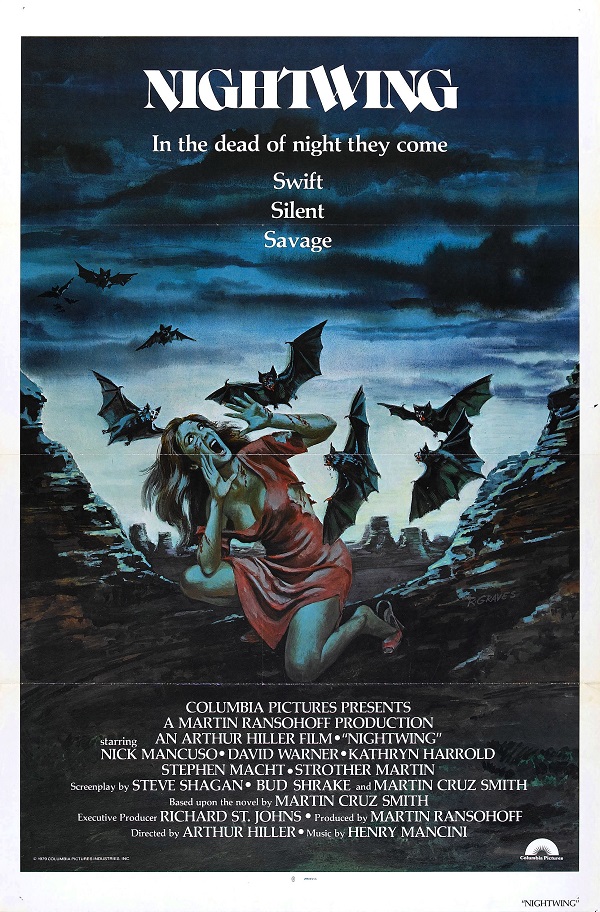
Distinguished character actor David Warner (1941-2022) almost redeems large portions of the 1979 killer vampire bat picture Nightwing, and he’s the reason that it rates out around two stars rather than one or possibly even worse.

Pardon the pun, but Warner truly bites into his dialogue and his monologues are the best moments in Nightwing. Phillip Payne comes across a little batty himself, more often delightfully so than not, and that batty quality would seem to come naturally with the territory of studying and killing plague-infested vampire bats.

The film’s best moments are definitely not the special effects and the vampire bat attack scenes, which almost had me laughing as much as The Bat People or Prophecy or perhaps the ultimate cinematic disaster disaster movie The Swarm.

Generally, I love the prerequisite genre scenes where the scientist explains the phenomenon on the rampage within the movie to a slack-jawed authority figure who usually downplays whatever threat it might be and decides to keep the park / town open.

It rarely ever lets me down, and I enjoyed Nightwing every time Phillip Payne goes all Dr. Sam Loomis on us about vampire bats.

Youngman Duran: It just doesn’t seem natural for a man to spend his life, his entire life, killing bats.

Phillip Payne: Not just bats. Vampire bats. I kill them because they’re evil. There’s a mutual grace and violence in all forms of nature; and each specie of live gives something in return for its own existence. All but one. The freak. The vampire bat alone is that specie. Have you ever seen one of their caves?

YD: No.

PP: I killed over 60,000 of them last year in Mexico. You really understand the presence of evil when you go into their caves. The smell of ammonia alone is enough to kill you. The floor of the cave is a foul syrup of digested blood. And the bats: up high, hanging upside down, rustling, fighting, mating, sending constant messages, waiting for the light to fade, hungry for blood, coaxing the big females to wake up and flex their nightwings to lead the colony out across the land, homing in on any living thing; cattle, sheep, dogs, children, anything with warm blood. And they feast, drinking the blood and pissing ammonia. I kill them because they’re the quintessence of evil. To me, nothing else exists. The destruction of vampire bats is what I live for.

Alrighty then.

Almost none of the small pleasures from Nightwing are to be found in Prophecy, films released only a week apart during June 1979.

Prophecy alternates between a serious, more ambitious movie about ecological concerns and land rights in a dispute between Native Americans and the polluting paper mill, domestic scenes involving a husband (Robert Foxworth) and his wife (Talia Shire), and silly monster attack scenes that belong in something like Food of the Gods or Bigfoot, two bad monster movies from earlier in the ’70s.

Rather, I meant laughably bad monster attack scenes.

None of the elements gel well together in Prophecy.

Prophecy gets awful preachy at times, maybe not too much of a surprise given the film’s title, and Foxworth’s Dr. Robert Verne makes for a rather lackluster and thus unlikable protagonist. Foxworth does not give Prophecy a jolt like Warner does in Nightwing, and his scientific explanatory scenes are pedestrian.

Dr. Verne and his wife Maggie do not have the relationship that, let’s see here, pugilist protagonist Rocky Balboa (Sylvester Stallone) and Adrian (Shire) do in Rocky and Rocky II, ironic considering that Rocky II and Prophecy were both released June 15, 1979.

Their domestic scenes are a drag, and I think less of Foxworth’s Dr. Verne from early on because of the way he treats his wife.

Veteran character actor Richard Dysart (1929-2015) gives the best performance in Prophecy, and it’s not even close. Dysart plays the role of the detestable paper mill company man Isely so effectively that it’s one of the film’s greatest disappointments when it cuts away from his graphic dismemberment by mercury mutant bear Katahdin late in the picture. We’ll have to settle instead for Dysart’s grisly death scene in John Carpenter’s The Thing.

The Katahdin we actually get in the finished product and the one in the promotional material (and dialogue) are not exactly one and the same, which hearkens Prophecy back to low-budget precursors like The Giant Claw and The Wasp Woman more than contemporaries like Alien and Dawn of the Dead, but without the fun of any of those movies.

Leonard Maltin described the monster as a giant salami, Isely said that it’s larger than a dragon with the eyes of a cat, Time reportedly said that it’s Smokey the Bear with an advanced acne condition, and Gene Siskel and Roger Ebert called it a cross between an earthworm and a bear (Siskel) and a grizzly bear and Godzilla (Ebert).

Given that it’s Kevin Peter Hall as the man in the monster suit, one might be tempted to call it a cross between Predator and Harry and the Hendersons.

Manbearpig!

Grizzly, a killer bear picture released three years before Prophecy, works a lot better than Prophecy because it succeeds at a much more modest level of ambition.

It’s required by law that every review mention Grizzly is a Jaws rip-off or we can go right on ahead and call it Jaws with Claws.

We have a law enforcement officer (park ranger), a military veteran (helicopter pilot), and a scientist (naturalist) on the hunt for a giant killer animal (grizzly bear). We also have a park supervisor who refuses to close down the national park despite a series of brutal deaths. The park supervisor allows hunters into the forest to hunt and kill the bear, while media converge on the scene for sensational coverage, but eventually our three main characters must try and do the deed themselves.

I honestly don’t mind too much that Grizzly follows the Jaws formula because Christopher George, Richard Jaeckel, and Andrew Prine are good in their roles and I care about them in their battle against a primal beast.

Honestly, it’s as simple as that, whereas I didn’t particularly care about the overwhelming majority of the human characters in Prophecy and did not care one way or another whether they lived or died just as long as the end credits rolled.

Grizzly, thankfully, is also not preachy, it’s endearing and entertaining on a basic level, and it’s a pleasant way to spend 90 minutes.

Granted, the three main actors and characters are not anywhere near the same level as Roy Scheider’s Sheriff Brody, Richard Dreyfuss’ Matt Hooper, and Robert Shaw’s Captain Quint, just like William Girdler’s no Steven Spielberg, but I still think Grizzly has earned a place right alongside such ’70s killer animal staples as Night of the Lepus, Frogs, Squirm, Kingdom of the Spiders, and Piranha.

Nightwing (1979) **; Prophecy (1979) *; Grizzly (1976) ***

Auto Pilot Cinema: The Airport Movies

AUTO PILOT CINEMA: THE AIRPORT MOVIES
When thinking of the worst series in movie history, I am tempted to start with Saw and Fast and the Furious then move back through time with The Omen and Amityville Horror and finally go way way way back to the Dead End Kids, er, Bowery Boys.

In piecing through all this cinematic carnage, I should not leave behind the four Airport movies that were churned out by Universal Pictures from 1970 to 1979. Maybe I should leave them behind.

Airport, based on Arthur Hailey’s 1968 novel of the same name, made a killing at the box office upon its late May release in 1970 and it even received 10, yes, believe it or not, 10 Academy Award nominations, including Best Picture, and 70-year-old Helen Hayes won Best Supporting Actress.

The three subsequent films — helpfully labeled 1975, ’77, and ’79 — got worse and worse, naturally, and the last film in the series, The Concorde … Airport ’79, is so bad (and so aggressively stupid) in fact that it could kill off any series. That’s despite the fact that it reportedly made $65 million, a much better take than, for example, Irwin Allen productions The Swarm ($7.7 million), Beyond the Poseidon Adventure ($2.1 million), and When Time Ran Out ($3.8 million). Regardless, Universal stopped making Airport movies after The Concorde and I’m almost dumbfounded why there’s not been a remake or a reboot loaded with today’s stars.

Hey, wait, did somebody mention stars? Yes, stars, that’s what these Airport movies were about — speculating which ones would emerge at the end of the picture relatively intact and which ones would die spectacularly. Grand Hotel in the sky, not exactly, since none of the careers in the Airport movies were at their peak like the ones in Grand Hotel, but the idea of stuffing the screen with stars in every scene applies just the same.

Airport: Burt Lancaster, Dean Martin, Jean Seberg, Jacqueline Bisset, George Kennedy, Hayes, Van Heflin, Maureen Stapleton, Barry Nelson, Dana Wynter, Lloyd Nolan.

Airport 1975: Charlton Heston, Karen Black, Kennedy, Efrem Zimbalist Jr., Susan Clark, Helen Reddy, Linda Blair, Dana Andrews, Roy Thinnes, Sid Caesar, Myrna Loy, Gloria Swanson.

Airport ’77: Jack Lemmon, Lee Grant, Branda Vaccaro, Joseph Cotten, Olivia de Havilland, Darren McGavin, Christopher Lee, Robert Foxworth, Kathleen Quinlan, James Stewart.

Airport ’79: Alain Delon, Susan Blakely, Robert Wagner, Sylvia Kristel, Kennedy, Eddie Albert, Bibi Andersson, Charo, John Davidson, Andrea Marcovicci, Martha Raye, Cicely Tyson, Jimmie Walker, David Warner, Mercedes McCambridge.

More like Hollywood Squares in the Sky? Yeah, believe so, especially since Davidson hosted a Hollywood Squares revival in the late ’80s.

Beside Airport in the titles, Kennedy (1925-2016) proved to be the connective tissue between all four pictures, meaning he’s the inverse of the Brody boys (Jaws) and the Griswold children (Vacation). Kennedy played Joe Patroni — first as mechanic, then as vice president of operations (1975), a consultant (’77), and finally an experienced pilot (’79). Regardless of position or rank, the character got worse and worse over the course of the films, not that he or the films started out all that hot. I found even his cigar was guilty of overacting in the original film and Patroni was so odiously obnoxious in the fourth film, especially after he utters the line that articulates the sexism of the entire series, They don’t call it the cockpit for nothing, honey. George Kennedy as sex symbol? Sure, I’ll believe anything, nearly anything except for, oh, the entire plot of The Concorde.

I’ll talk more about The Concorde and the original because they’re fresher in my memory. To be honest, though, I probably won’t even feel like discussing the original because …

Movies rarely come any dumber than The Concorde: Let’s see, this is going to be fun, not really, anyway TV reporter Susan Blakely comes across some highly incriminating evidence against defense contractor (and covert arms dealer) Robert Wagner. Wagner decides that he’s going to attempt to blow up real good the plane she’s on en route from Washington to Paris. Okay, okay, his plot to blow up the Concorde real good fails and they have dinner together in Paris during the middle section of the movie, because, you know, they have a history together and they still love each other. She still has this incriminating evidence, naturally, she’s going to eventually go public with it, of course, and what does he do? Kill her? He lets her walk away safe and unharmed, so he’ll have to go after the plane again. That’s right, she gets back on the Concorde for the final leg of the flight from Paris to Moscow. Guilt stricken, Wagner commits suicide very late in the picture and I believe it’s not because his secret’s been discovered and will be exposed regardless of whether he’s alive or not, but more that he’s one of the worst villains in cinematic history.

The Concorde is so laughable in so many ways, as if that whole plot discussed in the last paragraph wasn’t enough. The Concorde stops over in Paris for a night, and every single passenger gets back on the plane the next morning. They all seem way too calm and collected after the events of the first half of the movie. I would love to have just heard one character say ‘Hell no, I’m not getting back on that damn plane!’ They all deserved to die, but we know that’s not happening.

At one critical point during the first attack on the Concorde, the Übermensch George Kennedy proves that he’s truly The Übermensch by sticking his hand out the window of the Concorde and throwing a flare. Unbelievable, utterly unbelievable even in this preposterous movie. If only the first Airport had been the in-flight movie on The Concorde, especially that scene where Patroni discusses the effects of a bomb on a 707 and concludes, When I was a mechanic in the Air Force, I was being transferred on a MATS plane. At 20,000 feet, one of the windows shattered. The guy sitting next to it was about 170 pounds. He went through that little space like a hunk of hamburger going down a disposal, and right after him coats, pillows, blankets, cups, saucers. That was just a MATS plane, not the fastest plane in the universe.

I’m done, I can’t take it anymore, and I’m bailing out on the Airport movies.

Airport (1970) **; Airport 1975 (1974) **1/2; Airport ’77 (1977) *; The Concorde: Airport ’79 (1979) 1/2*

Calling All Cars, We Have a 412! Calling All Cars!

CALLING ALL CARS, WE HAVE A 412! CALLING ALL CARS!
I watched Chu Chu and the Philly Flash on March 7 and 18 days later, I can still hear it, that’s for sure, especially co-stars Alan Arkin and Carol Burnett and supporting player Danny Aiello.

Burnett plays Chu Chu, or Emily as only her dearest friends know her, who performs this Carmen Miranda routine out in the streets. Her performance gives one all the maracas needed for at least one year, perhaps even one lifetime. Emily used to be a successful entertainer, before the booze got to her. We all know the story by now.

Arkin, meanwhile, plays the Philly Flash, given that name not because of his ability to shed his raincoat but his former ability turning double plays at second base for the Philadelphia Phillies. Was he named the Philly Flash just because the real-life Phillies won the World Series in 1980? Anyway, just like Emily, booze got to Flash, not Grandmaster Flash (think I’d rather watch The Adventures of Grandmaster Flash on the Wheels of Steel than Chu Chu and the Philly Flash) or Flash Gordon (who just had a movie, a much better one believe it or not, come out in 1980) or The Flash. No, the Philly Flash’s power, like Chu Chu’s, seems to be that he can scream and carry on a whole lot. In fact, that’s about both all they ever do in Chu Chu and the Philly Flash.

Not sure that it even matters or not if Burnett played the Philly Flash and Arkin drew Chu Chu. They could have made him a former professional golfer and her a former burlesque entertainer or something. Yeah, like Bill Murray said in Meatballs, it doesn’t even matter.

Government secrets fall, yes, literally fall into the hands of Philly Flash and Chu Chu. Well, technically, not right into their hands, I mean they did have to walk over and pick up the briefcase. By the way, the briefcase gives the best performance in Chu Chu and the Philly Flash, since even the maracas overact.

Rating: One-half star.

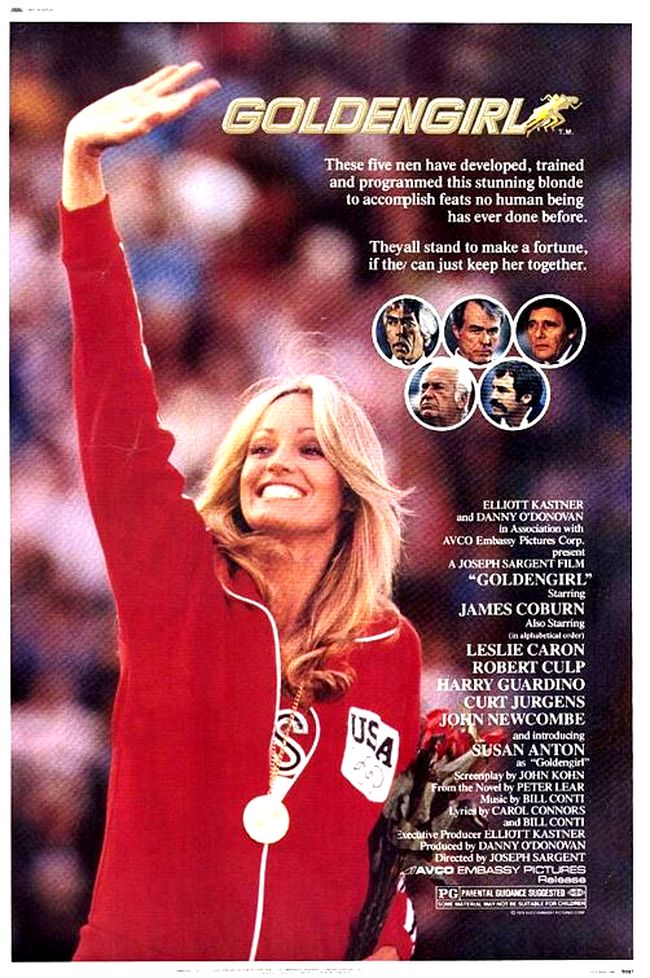
— Earlier in the same day I watched Chu Chu and the Philly Flash, I endured Goldengirl about basically a genetically engineered super female runner and it co-stars James Coburn, Robert Culp, Curt Jurgens, Leslie Caron, Jessica Walter, Michael Lerner, and Harry Guardino.

They’re all fine and dandy, more or less, but it’s star Susan Anton who ruins Goldengirl every single time she expresses any emotion. Guess they can’t genetically engineer the ability to act and the ability to not wreck an entire movie, because Anton can’t act and she absolutely obliterates Goldengirl every single time I wanted to give it another chance.

Give her one thing, though, because just like Donny and Marie Osmond in their motion picture debut and finale Goin’ Coconuts, Anton does have a great set of teeth. Outside her canines, incisors, premolars, and molars, though, Anton sucks in Goldengirl and despite the speeded up and slowed down footage, she’s not the least bit convincing as this incredible champion runner.

Anton and Coburn do have one of the great dialogue exchanges in motion picture history, one that could be played right alongside Fini can water you from Yes, Giorgio. She just set a new Olympic record and doesn’t she even deserve a kiss? Coburn works his way toward her magical lips and Anton moves the goalposts. She insists that he kisses her feet, then laughs maniacally, while Coburn, well, maybe he’s wishing that he could get hit upside the head by his old friend Bruce Lee’s one-hit punch again. Lee died in 1973 and Coburn was one of the pallbearers at Lee’s funeral.

The IMDb trivia entry starts out promisingly for Goldengirl, “Produced and theatrically released in 1979 prior to the 1980 Olympics boycott, this film depicts American athletes competing at the Moscow games. In reality, the boycott meant that the USA did not perform there, making the picture post-release anachronistic and historically inaccurate.”

Blame the boycott on Goldengirl.

Rating: One star.

— I watched Under the Rainbow between opener Goldengirl and closer Chu Chu and the Philly Flash.

That’s right, one of the worst movie-watching nights of a lifetime.

Under the Rainbow, like Goldengirl, has at least a far more interesting plot summary than anything else associated with the finished product.

Okay, to be honest, only the part about the 150 little people descending upon Hollywood for a part in The Wizard of Oz (and a wild and crazy party) sounds interesting, then it gets all mucked up when federal agents, fat cats, and Nazi and Japanese spies enter the picture. Anyway, doesn’t 1938 seem too early for Nazi and Japanese spies? I mean, the Nazis didn’t invade Poland until Sept. 1939 and the United States officially remained neutral until late 1941.

Regardless of social class and nationality and historical accuracy, though, all the characters get run through the cinematic claptrap blender at maximum speed with broad, inane slapstick and would-be wacky hijinks the settings. Despite the maximum speed, Under the Rainbow still feels like it takes forever to be done and over. That’s because it’s all played as loudly as possible, of course, with so much mugging on display that it’s another one of those movies where you feel the back of your head for lumps and bruises and then check for your wallet after watching it.

Chevy Chase and Carrie Fisher are the nominal stars, but they’re lost in the crowd because they play it too cool for school. Meanwhile, Billy Barty acts like he’s in three movies simultaneously and Japanese-American actor Mako settles for only two, and their terminal mugging calls to mind the 1942 propaganda comedy short The Devil with Hitler. The Devil with Hitler is better than Under the Rainbow, and I should just leave it at that statement, though I want to end this review with one last cheap shot at three lousy pictures that I wish I would have left buried inside their time capsules.

Stan Freberg would have charged the casts of Chu Chu and the Philly Flash, Goldengirl, and Under the Rainbow with one heinous crime against humanity: a 412. What’s a 412? Over-acting.

Rating: One star.

Bloodline (1979)

BLOODLINE (1979) *
Bloodline, a.k.a. Sidney Sheldon’s Bloodline, tries its hand at several fiction genres and fails mightily at every single one of them.

Let’s see here, we have the always popular Woman in Danger, murder mystery, police procedural, and the film adaptation of a literary potboiler that revolves around the rich and the shameful, predominantly shameful anyway, in lush international jet set surroundings. It also throws in a snuff film style murder every 30 minutes.

The great British actress Audrey Hepburn (1929-93) proves to be the only redeeming factor at play during Bloodline and she’s responsible for the one star rating. She brings a touch of class to the proceedings. At that point in her career, Hepburn rarely did movies and focused more of her time on her family. Considering the dubious nature of Bloodline, her first and only R-rated movie, she should have devoted even more time to her family. After all, Hepburn made her fame in such films as Roman Holiday, Sabrina, Funny Face, Breakfast at Tiffany’s, and My Fair Lady, productions far removed from the cheap thrills and tawdry exploitation that Bloodline tenders at its best and worst. Hepburn and Bloodline director Terence Young made the 1967 psychological thriller Wait Until Dark and that’s much, much, much better and way, way, way more suspenseful than Bloodline.

Maybe, just maybe I have an instant great distaste for adaptations made from the fiction of such writers as Sheldon (1917-2007), Harold Robbins (1916-97), and Jacqueline Susann (1918-74), who are said to have authored popular novels or works better understood by the unwashed masses than the snooty literary critics. I have not read their work, but having watched Valley of the Dolls and Bloodline, both trashy productions, I’ll stick being to a snob, thank you very much. Anyway, I can’t read a single word of anything else until I finish Crime and Punishment.

Since it wants to be classy, Bloodline comes hyped as a thriller rather than a horror film, but there’s not a single thrill to be had regardless of genre classification. Hepburn plays Elizabeth Roffe, a pharmaceutical heiress who becomes the next in line for murder after her father’s murdered in the film’s opening scene. Like her father before her, Ms. Roffe doesn’t want her company’s stock to go public and this creates incredible friction with her three cousins who mostly provide the rich and shameful portion of the program. All roads lead to the obligatory denouement, and I should have taken a detour.

In fact, I did just that because at regular intervals during Bloodline, I kept distracting myself with other movies. For example, almost every time I saw Gert Frobe’s Inspector Hornung, I desperately wanted him to say (just once), “No, Mr. Bond, I expect you to die.” Instead, Hornung spends most his screen time discussing the case with a talking computer. Ben Gazzara seems like he’s under sedation throughout Bloodline and I could not believe this was the same actor who gave us such lusty characters in Anatomy of a Murder and Road House. Meanwhile, I still occasionally debate within myself which one’s worse between Bloodline and Oh Heavenly Dog, both turkey bombs featuring Omar Sharif. Yes, I don’t hate myself.

The Dark (1979)

THE DARK (1979) *

Be afraid, very afraid, not of the dark but of The Dark, a laughable thriller that only increases in being laughable until one of the most ridiculous conclusions in cinematic history.

See, I’m not afraid of sleeping in the dark, not afraid of being in a cemetery late at night, not afraid of being home alone in an old house, not afraid of admitting or being wrong, et cetera. In all honesty, though, I hated working alone late nights at the Neosho Daily News office and avoided it as much as possible, except Friday nights during football season. Once corporate killed the Sunday edition and made Tuesday our next paper, though, I started going home after the game, uploaded photos online, and wrote the gamer the next day.

Anyway, The Dark tells the story of a killer who strikes every night in the Los Angeles area and earns the cheap nickname ‘The Mangler.’ What’s a killer without a cheap nickname? This one is a nightmare for the police, because of his unusual strength, his seeming lack of any discernible pattern in his killing, his ability to leave no forensic evidence behind, and, predating Austin Powers, he shoots frickin’ laser beams from his frickin’ eyes. We eventually find out that he even grows stronger with every killing.

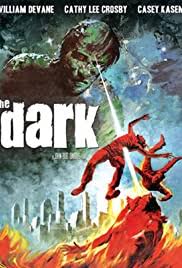
The killer and his laser beams look awesome on the poster for The Dark and I grade that promo artwork three-and-a-half stars. In the actual movie, though, the killer and his laser beams absolutely positively suck. These special effects alone impeded the advancement of all technology. When our killer unleashes his laser beams on several anonymous policemen in the grand finale, he clearly misses the mark but the policemen nonetheless take a mighty fall. In all seriousness, just thinking about these scenes now, I haven’t laughed this loudly since Richard Burton’s telekinesis in The Medusa Touch.

Just think all one had to do was light the killer on fire and BOOM! KABOOM! KABLOOEY! Just thinking about the killer’s demise now, I haven’t laughed so heavily since the paragraph before.

The Dark wastes a relatively distinguished cast — William Devane, Cathy Lee Crosby, Richard Jaeckel, and Keenan Wynn — and I find it ironic that fired director Tobe Hooper (replaced by John Cardos) later directed a flop horror film titled The Mangler.

Please remember, though, to be afraid, very afraid, of The Dark, especially since it’s possible that one’s head may explode from convulsive laughter.

Attack of the Fantastical Movies

ATTACK OF THE FANTASTICAL MOVIES: ATTACK OF THE 50 FOOT WOMAN, EARTH VS. THE FLYING SAUCERS, PLANET OF THE VAMPIRES, MOTORPSYCHO!, GALAXINA, REPTILICUS, BIG BAD MAMA, REAL LIFE, NINJA III: THE DOMINATION, NIGHT OF THE DEMONS

How do I grade something like ATTACK OF THE 50 FOOT WOMAN from 1958? It has a setup that could be called “laborious” or “lackluster” or “lugubrious.” I’m not going to call it any of those words, but I can see exactly why somebody else would. In other words, it’s not until about the 45-minute mark that we get to the 50 foot woman. Yes, I wish they had reversed the numbers, 15 minutes of setup and 45 minutes of 50 foot woman. Simple mathematics. At least, 45 minutes of setup and 45 minutes of 50 foot woman. Yes, that sounds even better than “15 then 45.” The final 15 or 20 minutes of ATTACK OF THE 50 FOOT WOMAN, though, are solid gold. Rating: ***

— It’s virtually impossible to watch EARTH VS. THE FLYING SAUCERS and not think about MARS ATTACKS! (flying saucers) and INDEPENDENCE DAY (Washington D.C. invaded), two blockbusters from 1996 with a combined production budget of $145 million and big, big, big stars, including Jack Nicholson in dual roles in MARS ATTACKS! In EARTH VS. THE FLYING SAUCERS from 1956, Ray Harryhausen’s stop-motion flying saucers are the real star of the show (step aside, Hugh Marlowe) and the film thankfully wastes very little time in showcasing them. It’s the inverse of ATTACK OF THE 50 FOOT WOMAN. ***1/2

— Italian director Mario Bava (1914-80) became especially known for his stylish horror films. From his British Film Institute profile, “Mario Bava took a vital role in the creation of the modern horror film. If there was to be a a Mount Rushmore-style monument dedicated to four directors whose work pioneered a new form of big screen chills and thrills, those giant faces etched in granite on the mountainside would be: Bava, Alfred Hitchcock, Georges Franju and Michael Powell.” In the words of a Pavement song, a Bava film has style, miles and miles. Case in point: PLANET OF THE VAMPIRES, a low-budget science fiction and horror production from 1965 that masked its cheap sets through smoky skullduggery. Bava said in Fangoria, “Do you know what that unknown planet was made of? A couple of plastic rocks — yes, two: one and one! — left over from a mythological movie made at Cinecitta! To assist the illusion, I filled the set with smoke!” Watching PLANET OF THE VAMPIRES for the first time, you might think you’ve seen this basic plot somewhere before … ahem … Ridley Scott’s ALIEN. ***1/2

— 1965 proved to be a great year for titles with exclamation points and for director, producer, writer, cinematographer, and editor Russ Meyer (1922-2004), whose films often proved to be ahead of their time. Meyer contributed two exclamation point titles — FASTER, PUSSYCAT! KILL! KILL! and MOTORPSYCHO! — during a 1965 in which he directed three films overall; Meyer’s greatest cinematic year began with MUDHONEY. Proof of being ahead of its time: MOTORPSYCHO! (what a title) gives us a psychotic motorcycle trio led by a deeply disturbed Vietnam vet — before TAXI DRIVER, before ROLLING THUNDER, before THE DEER HUNTER, before FIRST BLOOD — in addition to all the elements (large-breasted women and endless cleavage, campy humor, satire, and quotable dialogue) we expect from a Meyer film. ***

— GALAXINA lands a few successful jabs at STAR WARS, STAR TREK, and ALIEN, but otherwise it’s a real long slog through 90-plus minutes of a lowbrow and low-budget science fiction and western parody set in the 31st century. Here’s just one example of the film’s humor: Avery Schreiber (1935-2002) plays a character named “Capt. Cornelius Butt.” Then again, I probably should have just said that it’s a Crown International Pictures release. Surely you remember Crown International Pictures? They brought us such immoral, er, immortal classics as THE BEAST OF YUCCA FLATS, THEY SAVED HITLER’S BRAIN, SEXTETTE, and THE BEACH GIRLS. The late former Playboy Playmate of the Year Dorothy Stratten fills the title role and she’s been described as “a voluptuous blonde android servant.” Galaxina works better when she’s silent (the first half of the picture), because Stratten proves that she was a true novice thespian every time she speaks during GALAXINA. Stratten reportedly complained to film director and her paramour Peter Bogdanovich that the ads for GALAXINA promoted her being the Playmate of the Year, because she wanted to be taken seriously as an actress. GALAXINA would not do good for anybody wanting to be taken seriously for anything. Unfortunately, Stratten’s estranged husband Paul Snider murdered her two months after the release of GALAXINA. Stratten would be immortalized on film by the 1981 TV movie DEATH OF A CENTERFOLD: THE DOROTHY STRATTEN STORY and the 1983 theatrical release STAR 80, played by Jamie Lee Curtis and Mariel Hemingway, respectively. In case you were wondering, you see a lot more of Stratten in Playboy than GALAXINA. *1/2

— Recent weeks, mostly under self-quarantine, have included a few first-time watch monster movies: GODZILLA VS. MECHAGODZILLA and TERROR OF MECHAGODZILLA, SLITHIS (possibly the worst monster movie ever made), THE GIANT CLAW, and, most recently, REPTILICUS, Denmark’s infamous first entry in the monster movie sweepstakes. Judging by REPTILICUS, the Danish should stick to pastries. They make a mean strudel, not so much a Godzilla rip-off. Apparently, there’s never been a second Danish monster movie, so I guess they have stuck to pastries for nearly 50 years since this 1961 turkey. Anyway, I wanted to find the Danish version of REPTILICUS, but, of course, I had to settle for the English dub from good old American International. The plot: Copper miners find the tail of a prehistoric reptile and it eventually regenerates into Reptilicus, a hand puppet (close-up) and a marionette (wide shot) that give the $50 Giant Claw its money for being the “best” worst movie monster of all-time. I enjoyed REPTILICUS even less than THE GIANT CLAW, though. For example, when Reptilicus eats an extra or two, the victims look like they have been cut out of a magazine and they are being thrown into the puppet’s mouth. In THE GIANT CLAW, at least its victims being eaten scene brought me back to the “Eat ‘em! Eat ‘em! Crunch! Crunch!” scene from Q: THE WINGED SERPENT. I even called out “Crunch! Crunch!” during THE GIANT CLAW. No such luck during REPTILICUS. **

— Arthur Penn’s 1967 film BONNIE AND CLYDE proved to be one of the watershed films of the second half of the 20th century and one indication was that for several years, BONNIE AND CLYDE inspired many sensationalistic crime films set during the Great Depression. Roger Corman produced a whole slew of them, with the most famous being 1974’s BIG BAD MAMA starring Angie Dickinson, Tom Skerritt, and William Shatner and directed by Steve Carver (who later directed the Chuck Norris spectacular LONE WOLF McQUADE). BIG BAD MAMA mixes in a hippie-like free love sensibility and showcases bed hopping and generous amounts of nudity between all the murder and mayhem. The title character (Dickinson) and her two not long past jailbait daughters (Susan Sennett, Robbie Lee) all have multiple nude scenes, highlighted by Dickinson’s full-frontal shot late in the picture. One of the picture’s tag lines: “Wilma gave her daughters everything — her looks, her lovers and the crime of their lives!” Dick Miller (1928-2019), yes, that guy, plays a crime fighter and you know you can’t go too wrong with a picture that features an old-fashioned bloody crime spree, much nudity and shenanigans (Dickinson looked absolutely sensational in 1974), Shatner, and Dick Miller. ***

— Many years before the proliferation of reality TV, Albert Brooks skewered it with his 1979 directorial debut REAL LIFE, a satire of the 1973 PBS documentary “An American Family.” Brooks plays an exaggerated version of himself and watching this movie for the first time in 2020, it’s difficult not to conjure up memories of all the obnoxious or obsequious hosts and participants on reality TV shows from years ago — “The Real World,” “The Bachelor,” et cetera, they’re all terrible and I’m fortunate to have survived all my encounters with them. All those creeps still give me the willies just thinking about it now, but unfortunately reality TV seems like it’s here and it’s here to stay. Take that from somebody who’s not watched a whole lot of TV in the last decade, with reality TV being one of the big reasons. I laughed a lot during REAL LIFE, from the epic sight gag on the head of every cameraman (I laughed every single time) to the fiery grand finale Brooks borrows from GONE WITH THE WIND. ****

— The Cannon Group’s best of the worst films could generously be called “sublime stupidity” and I believe that description fits NINJA III: THE DOMINATION perfectly. Part ENTER THE NINJA, part FLASHDANCE, and part EXORCIST, THE DOMINATION must be seen to not be believed. Imagine Jennifer Beals possessed by the evil spirit of a ninja with an Oriental Max von Sydow attempting to bring it out. THE DOMINATION starts out with its very best scene, a golf course massacre that leads to the bad ninja transferring his spirit into the body of telephone lineman and aerobics instructor Christie (Lucinda Dickey). Also happening in the first 30 minutes of the picture: Christie’s aerobics class, her fight against a handful of creeps who were harassing one of her students, and possibly the most awkward bedroom seduction scene in the history of cinema. Christie won’t give this creepy cop the time of day and then, practically the next moment, they end up in embrace and she pours V-8 on herself … this is the beginning of a beautiful friendship. There’s also a bizarre sequence involving Christie’s Bouncer arcade game. On the International Arcade Museum page for Bouncer, it says “Bouncer was seen in the low budget martial arts film NINJA 3: THE DOMINATION. The game is in the main character’s apartment and she is seen playing it. The character becomes possessed by the spirit of the ninja, and as he overtakes her body, the arcade cabinet begins to bellow out smoke and hypnotizes her with a little laser show from the screen.” I thought she was already possessed. Yeah, I know, bizarre. Then again, bizarre basically describes both THE DOMINATION and Cannon films in general. We wouldn’t have them any other way. ***

— We’ve seen NIGHT OF THE DEMONS done better before, especially the first two EVIL DEAD movies and RETURN OF THE LIVING DEAD, which it seems to reference through both Linnea Quigley and punk rock. We’ve seen this plot before: 10 (mostly) horny high school kids have a Halloween party inside an abandoned funeral parlor. You can fill in the rest, down to every detail both personality and plot. It’s not a bad movie, exactly, it’s just after having seen EVIL DEAD and RETURN OF THE LIVING DEAD and EVIL DEAD 2, why settle for less? Seemingly just about every movie from the ‘80s — the good, the bad, and the ugly — has developed a cult following over time and NIGHT OF THE DEMONS is one of them, spoken about in an enthusiastic tone by admirers. I can sympathize, because I feel similarly about numerous movies. I have mixed feelings on NIGHT OF THE DEMONS. On one hand, I can’t think very highly of a movie that goes for three jump scares very early on. That loses points for it real quickly. It’s also one of those movies that I started liking less down the home stretch and I wished it would get to its inevitable conclusion sooner rather than later. On the other hand, it does have a few good moments, just not enough for a recommendation. **

Ice Castles (1979)

ICE CASTLES

ICE CASTLES (1978) **

Not that I have a problem with either figure skating or movie romance — I like THE CUTTING EDGE, for example — but ICE CASTLES is not a very good movie and that’s because it makes one (like yours truly) mad due to its relentlessly manipulative nature.

We know entering ICE CASTLES that it centers on a blind figure skater and her personal and amateur figure skating travails. Naturally, she does not start out the movie blind, so that means we are waiting for her freak accident. That makes it the pièce de résistance of the picture and that makes the picture quite sick and perverse because her disability itself becomes more important than her state before or after her disability.

When skater-on-the-rise Alexis “Lexie” Winston tries a difficult triple jump and takes a mighty fall, we see it drawn out in explicit slow motion. None of her other jumps play out in this fashion. She ends up with a blood clot in her brain and loses 90 percent of her sight. There goes her shot at the 1980 Winter Olympics, right?

Director and screenwriter Donald Wyre and fellow screenwriter Gary L. Baim undercut their own movie with such a focus on the accident.

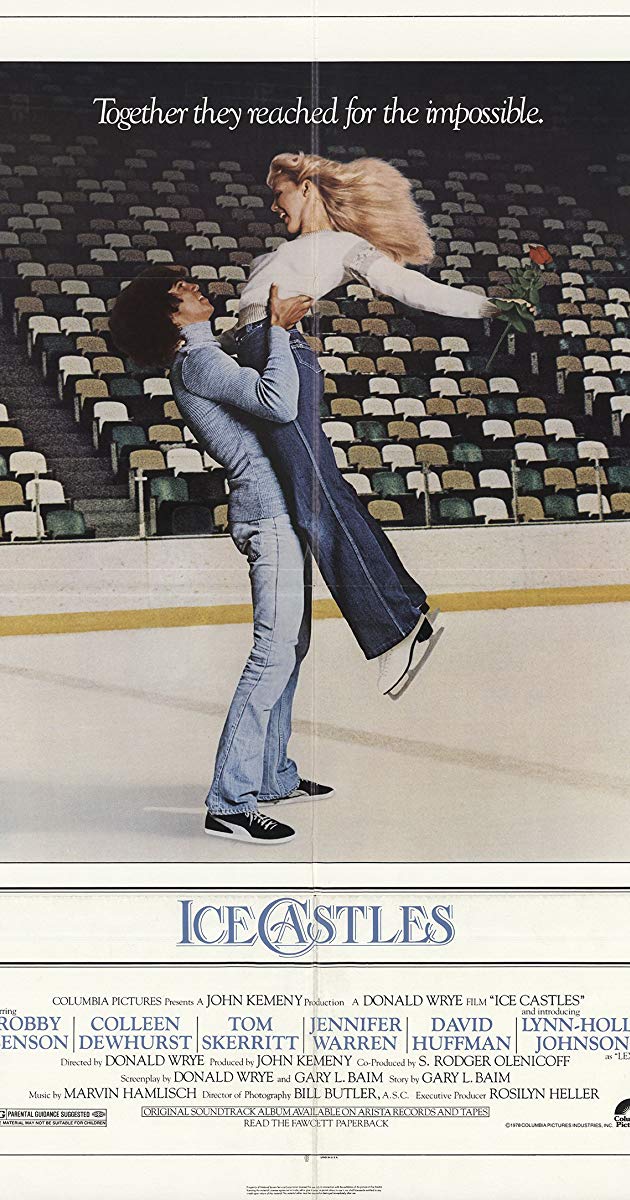
They gave first-time actress and former amateur figure skater Lynn-Holly Johnson one helluva challenge for her debut. Let’s see here, her 16-year-old character goes through not only a debilitating accident, but she breaks up with her jealous boyfriend (Robby Benson), hooks up with a television reporter (David Huffman) who helped out her career and made all her figure skating cohorts upset by all her publicity, argues with her father (Tom Skerritt) at different points throughout the picture, eventually hashes it out with her former boyfriend, and makes her triumphant comeback — despite her blindness — for a grand finale. Johnson gives a good performance and it’s certainly better than her work in subsequent films THE WATCHER IN THE WOODS, FOR YOUR EYES ONLY, and WHERE THE BOYS ARE ‘84.

Benson can be one of the most irritating movie actors and he’s especially awful with emotional scenes; he so often turns them into bad soap opera with fake anger his dread specialty. Benson does that a handful of times during the last half of ICE CASTLES, especially in the scene at the dinner table when the four main characters (I have not mentioned Colleen Dewhurst as rink operator and trainer Beulah Smith, but she’s the fourth main character) are debating whether or not Lexie should return to competition. The melodrama hits its high point when Benson’s Nick Peterson feasts on the line “Don’t give me that. Not trying is pointless and cruel. Not trying is wondering your whole life if you gave up too soon. Who the hell needs that?” It’s all so phony baloney, but it’s nowhere as bad as Benson in HARRY & SON. In that horrible movie, I wanted Paul Newman’s character Harry to punch out his son Howard as played by Benson. Time Out London called it “a curiously indigestible phenomenon, like being forced to eat five courses of avocado by an overbearing dinner-party host.” One of Benson’s immortal lines in HARRY & SON, “Want a Cherry Coke, pa?”

American adult contemporary singer Melissa Manchester performed her two nominated songs at the 1980 Academy Awards ceremony: “Through the Eyes of Love (Theme from Ice Castles)” and “I’ll Never Say Goodbye” from THE PROMISE, another soap opera. “It Goes Like It Goes” (wow, oh wow, what a title) beat out both Manchester numbers for “Best Original Song.” “Rainbow Connection” from THE MUPPET MOVIE was obviously robbed. For many years, the Academy seemed to nominate the most forgettable songs 90 percent of the time.

I promise that I’m not a hater of figure skating or movie romance, but I will often bristle at manipulation and melodrama — ICE CASTLES, despite some good elements at work, offers large portions of both manipulation and melodrama.

Then again, RogerEbert.com writers Christy Lemire, Sheila O’Malley, and Susan Wloszczyna contributed to a 2017 piece titled “Through the Eyes of Love: On the Timelessness of ‘Ice Castles.’” But, then again, so what?

Disco Godfather (1979)

DISCO GODFATHER

DISCO GODFATHER (1979) *1/2

I kept having flashbacks throughout DISCO GODFATHER.

I asked myself several times, “Am I tripping balls or have I not seen this film a few hundred times?” Then, I said, “I know, I know, this is my first time watching it, but it still feels like I have seen DISCO GODFATHER before.” Later, “It’s only a movie. It’s only a movie. It’s only a movie.” Finally, “I’ll have my revenge. I’ll write a review.”

The plot: Rudy Ray Moore plays retired cop Tucker Williams turned nightclub owner and famed DJ “Disco Godfather.” His nephew Bucky (Julius J. Carry III) gets hooked on angel dust and it warps him something fierce. Tucker decides to return to his roots and wipe out this angel dust plague. See what I mean about having seen DISCO GODFATHER before?

After the dust has settled so to speak on this movie, I mostly remember the Disco Godfather saying “Put your weight on it!” It feels like Mr. Disco Godfather says “Put your weight on it” a million times. Apparently, it’s actually only 24 times that he uttered that infamous line. I am shocked and thoroughly disappointed.

“Put your weight on it” still, though, ranks among the greats in the cinematic annals of lines / incantations / mantras.

Cheech & Chong said “Man” 285 times in UP IN SMOKE, far out, man. Characters say the name “Carol Anne” 121 times in POLTERGEIST III. With their lesser weight, both UP IN SMOKE and POLTERGEIST III had to make up for it through sheer volume of repetition.

We also cannot forget “With great power comes great responsibility” from the Sam Raimi SPIDER-MAN films (originally from the comic books written by Stan Lee). From what I understand, this phrase has become known as the Peter Parker Principle. To be honest, I have not ever written much on the SPIDER-MAN films because “Weird Al” Yankovic already criticized the first Raimi SPIDER-MAN magnificently with “Ode to a Superhero,” which is set to the tune of Billy Joel’s “Piano Man.” Here’s the part about “With great power comes great responsibility”:

“With great power comes great responsibility / That’s the catch phrase of old Uncle Ben / If you missed it, don’t worry, they’ll say the line / Again and again and again.” Yeah, that’s exactly what I thought, “Weird Al,” and you wrote “Ode to a Superhero” after just the first SPIDER-MAN film.

Anyway, through the virtual magic of searching the Internet, I found a link to Rudy Ray Moore’s “Put Your Weight on It” in song form. Rudy Ray Moore and the Fillmore Street Soul Rebellion released a single in 1971 with “Put Your Weight on It” the B-side to a monologue and “Easy Easy Baby.” Hold on for about 2 minutes, 43 seconds, I must cast aside this “Weird Al” playlist that started by listening to “Ode to a Superhero” and instead listen to “Put Your Weight on It.” I’ll report back very soon with my findings.

Holy bat shit, Robin, I found a version that’s 4 minutes, 55 seconds. It’s from the Rudy Ray Moore Singing Album “The Turning Point,” from 1972. I’ve got Mr. Rudy Ray down for saying “Put your weight on it” 21 times. I did not count the “Keep your weight on it,” which he seems to say about as many times as the name of the song. I’m not going back for another listen any time soon.

Moore (1927-2008) was a multimedia “ghetto expressionist” (his preferred nomenclature for his act) who recorded his first comedy album “Below the Belt” in 1959. Moore debuted the Dolemite character in the early 1970s and he released albums with titles like “Eat Out More Often” and “This Pussy Belongs to Me.” He then successfully financed the motion picture DOLEMITE in 1975, followed by THE HUMAN TORNADO and THE MONKEY HUSTLE in 1976, PETEY WHEATSTRAW in 1977, and DISCO GODFATHER in 1979. He’s been called “The Godfather of Rap.” Dolemite unleashed lines like “You no-business, born-insecure, jock-jawed motherfucker” and “I’m gonna let ‘em know that Dolemite is my name, and fuckin’ up motherfuckers is my game.” This influence on subsequent generations of black entertainment is undoubtedly why DISCO GODFATHER seemed so old hat and overly familiar watching it for the first time in 2020.

Roller Boogie (1979)

ROLLER BOOGIE

ROLLER BOOGIE (1979) *1/2

Hot on the heels of reviewing THANK GOD IT’S FRIDAY, here’s another one where it’s a soundtrack in search of a movie.

Or, in other words, a gimmick in search of a movie. ROLLER BOOGIE belongs to a specific time and place of quickie exploitation flick: post-SATURDAY NIGHT FEVER boogie down and roller skating, hence that genius title.

ROLLER BOOGIE should have been a better film. I mean, director Mark L. Lester went on to make CLASS OF 1984 and COMMANDO, two films that go above-and-beyond in going over-the-top and that’s both films’ best virtue by far.

Not in ROLLER BOOGIE, though, which earns a ‘PG’ from the MPAA. It should have been ‘R.’

I’ll give one example.

Early on in the picture, we’re talking first few minutes here, our female lead Terry Barkley (Linda Blair) gets dressed and we sense there’s a missing nude scene, like they filmed one but left it on the cutting room floor. This early scene establishes the awkwardness that we sense around Blair’s character all movie.

We find Blair, who was in her late teens when she made ROLLER BOOGIE, in her transition period, between her breakout in THE EXORCIST (1973) and later exploitation films like CHAINED HEAT and SAVAGE STREETS. Maybe it’s because I watched ROLLER BOOGIE after her later films that I felt like the 1979 film teases us with possibilities that it ultimately did not want to pursue, undoubtedly for commercial reasons. The one song that should have been written for Blair: “I’m Not a Girl, Not Yet a Woman,” which was instead written for Britney Spears at the turn of the 21st Century. Rick James wrote “Cold Blooded” (title song for his 1983 album) about his relationship with Blair. “Cold Blooded” hit No. 40 on the Billboard Hot 100.

Upon further reflection, ROLLER BOOGIE does go above-and-beyond in recycling grand old cliches and stereotypes, pilfering from both the Mickey Rooney-Judy Garland “Let’s put on a show” movies of the late 1930s and early ‘40s and the Frankie Avalon-Annette Funicello BEACH PARTY movies of the early ‘60s in addition to SATURDAY NIGHT FEVER and the disco and roller skating fads more contemporaneous with ROLLER BOOGIE.

Like THANK GOD IT’S FRIDAY, ROLLER BOOGIE rattles off characters and scenes we have seen many times before.

Terry develops a romance with roller boogie master Bobby James (Jim Bray), who, get this, comes from another socioeconomic class than rich girl and musical genius Terry. Bray makes both his film debut and finale, basically playing a fictional version of himself … not all that well. He does skate convincingly, of course, and he does possess a great smile, but in any scene that requires any emotion whatsoever Bray absolutely falls flat on his face. Bray apparently had already earned 275 trophies for his skating before he made ROLLER BOOGIE. For his acting, though, Bray received “Dishonourable Mention” from the Stinkers Bad Movie Awards; Robby Benson won “Worst Actor” for WALK PROUD. Blair lost “Worst Actress” to Barbra Streisand in THE MAIN EVENT.

Then we have Franklin (Christopher S. Nelson), who’s this hopeless rich snob always lusting after Terry’s bod. We’ve seen this character archetype before, like Collins Hedgeworth (Paul Linke) in GRAND THEFT AUTO and Spaulding Smails (John F. Barmon Jr.) in CADDYSHACK. You remember Spaulding? He’s the snotty but spectacularly slobby grandson of Judge Smails (Ted Knight). In a classic scene, Spaulding wants a hamburger, no, a cheeseburger, a hot dog, and a milkshake … before Judge Smails sets the impetuous lad straight, “You’ll get nothing, and like it.” Well, there’s nothing that funny or worthwhile in ROLLER BOOGIE. Franklin’s scenes drag ROLLER BOOGIE down.

Cartoon gangsters lean on Jammer Delaney (Sean McClory), the owner of roller boogie rink Jammers. Nobody would ever believe this plot thread, but this here old Jammer, why he’s the last property owner holding out. Jammer’s sitting on a relative gold mine and he’s standing in the way of progress. We have seen this old cinematic war horse trotted out for everything ranging from BLACK BELT JONES (where property owner Scatman Crothers died from the weakest punch in cinematic history) to WHO’S THE MAN? Cartoon gangsters rarely ever bode well for a motion picture spread and they do not for ROLLER BOOGIE. I do not want to write another word on the plot.

Kimberly Beck’s next screen credit would be as final girl Trish Jarvis in 1984’s FRIDAY THE 13TH: THE FINAL CHAPTER. She famously said of the FRIDAY THE 13TH series: “I had never seen any of the FRIDAY films. And I didn’t want to see any of them. I still have never seen any of them. I just don’t like that kind of genre at all. And this was not even a B-movie, it was really just a C-movie.” Unfortunately, we do not have a quote from Beck detailing her experience playing Terry’s best friend Lana, who does really fill out her outfits rather nicely in ROLLER BOOGIE. She provides one of the fleeting pleasures of the movie. Sometimes, you take it wherever you can find it and ask questions never.