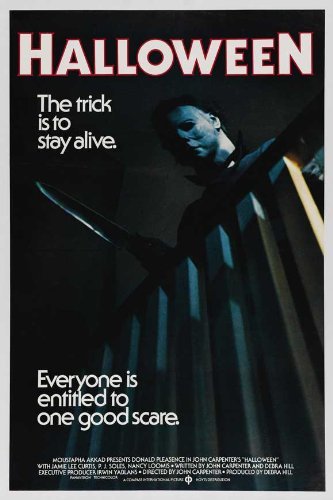
Halloween (1978)

day332challoween

HALLOWEEN (1978) Four stars

There’s one particularly cherished moment from all the years watching HALLOWEEN.

Every time I have showed the film to friends and family, there’s one scene I patiently wait for with devilish anticipation.

I make internal bets with myself that it will work on everybody who’s seeing the movie for the first time, and it will even still work on those return viewers.

It’s a jump scare, one of the best ever filmed.

Every time, I would be taciturn leading up to this scene, not wanting to give a single thing away to my friends and family.

I wanted to see them jump, and I wanted to hear them scream.

It worked every single time.

It’s the scene where Dr. Loomis (Donald Pleasence) and Sheriff Brackett (Charles Cyphers) are discussing matters inside the old Myers house.

I won’t go any further than that.

Like the slasher films that followed, including its own many sequels, HALLOWEEN is a fun one to watch especially with several peers, but for slightly different reasons than the many, many, many followers and imitators.

First and foremost, director John Carpenter (in the words of Alfred Hitchcock) played the audience like a piano in HALLOWEEN. He’s the maestro and we love the music he’s playing, literally. The main theme in HALLOWEEN just stays with the viewer and in fact right now writing this review, I have that song playing over scenes from the first movie playing inside my head. Like other classics PSYCHO and JAWS, the music in HALLOWEEN added immeasurably to the film’s success.

Reportedly, Carpenter composed the theme in one hour, according to an interview he did for Consequence of Sound.

Carpenter discusses the movie and its music at some length on his official site: “HALLOWEEN was written in approximately 10 days by Debra Hill and myself. It was based on an idea by Irwin Yablans about a killer who stalks baby-sitters, tentatively titled ‘The Baby-sitter Murders’ until Yablans suggested that the story could take place on October 31st and HALLOWEEN might not be such a bad title for an exploitation-horror movie.

“I shot HALLOWEEN in the spring of 1978. It was my third feature and my first out-and-out horror film. I had three weeks of pre-production planning, twenty days of principle photography, and then Tommy Lee Wallace spent the rest of the spring and summer cutting the picture, assisted by Charles Bornstein and myself. I screened the final cut minus sound effects and music, for a young executive from 20th Century-Fox (I was interviewing for another possible directing job). She wasn’t scared at all. I then became determined to ‘save it with the music.’

“I had composed and performed the musical scores for my first two features, DARK STAR and ASSAULT ON PRECINCT 13, as well as many student films. I was the fastest and cheapest I could get. My major influences as a composer were Bernard Herrmann and Ennio Morricone (who I had the opportunity to work with on THE THING). Hermann’s ability to create an imposing, powerful score with limited orchestra means, using the basic sound of a particular instrument, high strings or low bass, was impressive. His score for PSYCHO, the film that inspired HALLOWEEN, was primarily all string instruments.

“With Herrmann and Morricone in mind, the scoring for HALLOWEEN began in late June at Sound Arts Studios, then a small brick building in an alley in central Los Angeles. Dan Wyman was my creative consultant. I had worked with him in 1976 on the music for ASSAULT. He programmed the synthesizers, oversaw the recording of my frequently imperfect performances, and often joined me to perform a difficult line or speed-up the seemingly never ending process of overdubbing one instrument at a time. I have to credit Dan as HALLOWEEN’s musical co-producer. His fine taste and musicianship polished up the edges of an already minimalistic, rhythm-inspired score.

“We were working in what I call the ‘double-blind’ mode in 1978, which simply means that the music was composed and performed in the studio, on the spot, without reference or synchronization to the actual picture. recently, my association with Alan Howarth has led me to a synchronized video-tape system, a sort of ‘play it to the TV’ approach. Halloween’s main title theme was the first to go down on tape. The rhythm was inspired by an exercise my father taught me on the bongos in 1961, the beating out of 5-4 time. The themes associated with Laurie (Jamie Lee Curtis) and Dr. Loomis (Donald Pleasence) now seem to be the most Herrmannesque. Finally came the stingers. Emphasizing the visual surprise, they are otherwise known as ‘the cattle prod’: short, percussive sounds placed at opportune moments to startle the audience. I’m now ashamed to admit that I recorded quite so many stingers for this one picture.

“The scoring sessions took two weeks because that’s all the budget would allow. HALLOWEEN was dubbed in late July and I finally saw the picture with an audience in the fall. My plan to ‘save it with the music’ seemed to work. About six months later I ran into the same young executive who had been with 20th Century-Fox (she was now with MGM). Now she too loved the movie and all I had done was add music. But she really was quite justified in her initial reaction.

“There is a point in making a movie when you experience the final result. For me, it’s always when I see an interlock screening of the picture with the music. All of a sudden a new voice is added to the raw, naked-without-effects-or-music footage. The movie takes on it’s final style, and it is on this that the emotional total should be judged. Someone once told me that music, or the lack of it, can make you see better. I believe it.”

HALLOWEEN, unlike its sequels and imitators, works from a minimalist base, with much fewer characters than the run-of-the-mill body count thriller for one prominent example of minimalism. HALLOWEEN gives us time with the characters, especially the three girls Laurie (Curtis), Annie (Nancy Loomis), and Lynda (P.J. Soles) and Dr. Loomis (Pleasence), and this is definitely to the film’s benefit. These characters take on a greater resonance than, for example, the gallery of grotesqueries in FRIDAY THE 13TH: A NEW BEGINNING, who only have a couple minutes of (largely) unpleasant behavior before their gruesome death scenes.

Carpenter and Hill found gold in Curtis: not only the daughter of Janet Leigh (PSYCHO) and Tony Curtis, but a great rooting interest who can be intelligent and resourceful and strong enough that we forgive her for the other moments that are standard in horror films, like (for just one example) her difficulty finding the keys with a madman bearing down on her. She’s pretty, as well, without it being overwhelming.

Annie and especially Lynda are pioneers of the Valley Girl speak, totally, and that might be one of the great sources of annoyance for anybody watching HALLOWEEN. Soles, though, is one of the more likable young actresses from that era, seen to even more effect in ROCK ‘N’ ROLL HIGH SCHOOL and STRIPES.

Likability is a key in the success of both HALLOWEEN and the first NIGHTMARE ON ELM STREET.

Dr. Loomis is the character lacking in any of the FRIDAY THE 13TH movies, for example. He’s just brilliant, brought to the life by the indelible screen presence of the late Pleasence (1919-95). His character commands our attention every time he steps onscreen and definitely every time he delivers that dialogue he keeps that attention, especially about Michael Myers and “pure evil.”

“I met him 15 years ago,” Dr. Loomis said. “I was told there was nothing left: no reason, no conscience, no understanding in even the most rudimentary sense of life or death, of good or evil, right or wrong. I met this … 6-year-old child with this blank, pale, emotionless face, and … the blackest eyes – the Devil’s eyes. I spent eight years trying to reach him, and then another seven trying to keep him locked up, because I realized that what was living behind that boy’s eyes was purely and simply … evil.”

` That’s one of the best monologues in any horror film (or any film period).

Monologues like that can sometimes bring the attached film to a halt, because we don’t want to hear this psychological jive talk recited by some hack actor at just that very moment. Please, shut the fuck up (Donnie).

For example, Simon Oakland’s jive talk late in PSYCHO drags us down a bit.

Honestly, though, I could have listened to Dr. Loomis talk all day.

Pleasence sells this dialogue with the conviction of his craft and I don’t know, I’ve always got the feeling that maybe Dr. Loomis is maybe just maybe a bit mad himself all these years working around Michael Myers.

You see this Dr. Loomis coming, and you just might head to the next city or county or perhaps country, because you know he’s trouble.

In horror films, often times authority figures do not believe the stories of teenage protagonists until it’s too late, but HALLOWEEN applies the slight twist to the formula by having authority figures question the story of another authority figure.

I love the way Carpenter and his team utilize Michael Myers in HALLOWEEN: he’s driving or standing around in the background of many early shots and combined with Dr. Loomis’ dramatic playing up of Myers in dialogue, he takes on mythic proportions. Paraphrasing from Dr. Loomis, this isn’t a man. He’s a shape, and a killing force. But we also get the sense that he’s childlike and in one of the great moments for any screen killer, Myers stands and admires his own craftmanship after one kill.

He’s far more interesting with far less back story, as the sequels beginning with HALLOWEEN II irrefutably proved.

Let’s see here, we have two great protagonists, one great killer (and one great weapon), and great music.

Seems like this is the beginning of a great horror movie.

Five Deadly Venoms (1978)

day 47, five deadly venoms

FIVE DEADLY VENOMS (1978) Three-and-a-half stars
Years ago, I finally tracked down (i.e. bought) a subtitled copy of FIVE DEADLY VENOMS and it made all the difference in the world after having extreme technical difficulties watching a dubbed copy the week before the subtitled version, failing twice to make it through because of the haphazard dub job.

The plot in a nutshell: A wise old martial arts master, on his death bed, gives his latest young martial arts pupil a dying wish to go track down some wayward pupils who have done “evil” with the master’s teachings, the “Five Deadly Venoms” that provide our lovely and oh so poetic title, and redeem the master and his martial arts philosophy and teachings forever.

Like DRUNKEN MASTER, FIVE DEADLY VENOMS provides us with multiple idiosyncratic martial artists, fighting styles, and personalities: The Centipede, The Snake, The Scorpion, The Gecko (lizard), and The Toad. The young pupil combines all five styles, although he’s not as potent as the older pupils because he only knows a little about each style.

The old man describes their styles in some detail on his deathbed. Honestly, this scene gets us hyped for the movie ahead, filled with great expectations.

Each fighter and fighting style have their own distinct strengths and weaknesses, some more apparent than others.

The Centipede: Based on speed and quickness. Fastest of the fast.

The Snake: Based on agility and flexibility. This flexibility makes for mad defensive skills and the pinpoint ability to attack the opponents’ weak spots.

The Scorpion: Based on acrobatic kicks or “the sting.” The style resembles the scorpion pincer in the hand techniques of the artist.

The Lizard: Nimble, quick footwork, also described on the FAQs at the IMDb as “Spider-Man with a black belt” because of The Lizard’s mastery of walls.

The Toad: Based on power and resilience. Once mastered, this style lends itself to becoming immune to physical harm. Well, we’ll all see how well that stands up in FIVE DEADLY VENOMS.

These fascinating artists and styles are placed inside an old-fashioned movie plot involving an old man’s treasure, imperial politics, and secret identities. We also have the age-old themes of redemption and revenge that seem to be at the core of the genre.

The different artists each wear masks that prominently feature their animal at the top of the mask.

Of course, you might find FIVE DEADLY VENOMS silly, very silly indeed, almost by default with this genre. I’ve always found that “silliness” in martial arts entertainments to be one of their most endearing features. Your mileage may vary.

Granted, THE FIVE DEADLY VENOMS takes itself seriously. It’s not attempting to be a comedy in any way shape or form.

There’s several twists and turns in the plot and we have to figure out the alignment of the “Five Deadly Venoms.”

We know that certain fighters will be more deadly than the others. To the film’s credit, I couldn’t guess it straight out. We align ourselves with the young pupil early on and follow him on his journey through such deadly waters.

Just a cut below DRUNKEN MASTER and THE 36TH CHAMBER OF SHAOLIN, two fabulous martial arts entertainments from 1978, THE FIVE DEADLY VENOMS nonetheless proves itself a damn good time at the movies and another iconic entry in the Shaw Brothers’ filmography. (Another martial arts film referenced by multiple hip-hop artists over the years, as well as Quentin Tarantino. It was also the inspiration for a series of Sprite commercials in the late 1990s.)

Please seek out the subtitled version. The dubbing proved deadliest venom in the English dubbed version. It took effect almost immediately.

The Star Wars Holiday Special (1978)

day 71, star wars holiday special

THE STAR WARS HOLIDAY SPECIAL (1978) No stars
Movies, oops, TV specials based on movies, like “The Star Wars Holiday Special” are when yours truly wishes that he owned a stunt reviewer or had an evil twin movie reviewer, yes, an evil movie reviewer.

I first watched “The Star Wars Holiday Special” during the same week as LEONARD PART 6 and it’s amazing, it’s stupendous that anything competes with LEONARD PART 6 for sheer gut-wrenching awfulness. Sure enough, I saw two of the most awful pieces of celluloid within a short time of each other. I survived and now I am here to put together my story. Let me just say that you are not a true STAR WARS fan until you see “The Holiday Special,” which I rate at the bottom of the barrel. That’s an insult to the bottom and to the barrel.

Where does this review start? Where does it end? Why didn’t they dub in the laugh track?

First and foremost, please look at the cast for “The Star Wars Holiday Special.”

I seriously doubt kiddos in 1978 wanted codgers like Beatrice (her friends just called her “Bea”) Arthur and Art Carney anywhere near Han Solo, Luke Skywalker, Princess Leia, Chewbacca, and Darth Vader.

One bad idea right after the next flies right past our systems. No, wait, I am practicing the fine art of understatement when I say bad idea.

The first bad idea would be centering the action so to speak on Chewbacca’s family unit. Yeah, I know what you’re thinking. That’s absolutely unbelievable.

Granted, I am somebody who desired Chewbacca being a Hollywood leading man and paired with all them blazing beauty starlets like Kate Hudson, Katherine Heigl, and Jennifer Lopez in all them lovey dovey romances. Sorry, I am behind the times in romantic comedies and their beautiful people.

Anyway, we get Chewbacca’s wife Malla, his son Lumpy, and old man Itchy, who should have been named “Icky.”

Back to the bad ideas.

Malla watches an intergalactic cooking program with a cook based on Julia Child played by Harvey Korman, not Harvey Keitel, in drag.

Diahann Carroll shows up as an intergalactic and holographic sex fantasy of a dirty old wookie and sings a song for all our troubles. She doesn’t solve them, she makes them even worse.

Yes, Bea Arthur owned the intergalactic famous Cantina we saw in STAR WARS and of course, she sings a song.

Dagnammit, everybody, well, almost everybody gets a song.

We see intergalactic famous bounty hunter extraordinaire Boba Fett in cartoon form and we laugh every time he tells our protagonists that he’s a friend of Luke and Han and the droids. Boba Fett sounds like Mr. Rogers. Let’s see, Boba Fett died a crap death in RETURN OF THE JEDI and he made a crap entrance in “The Holiday Special,” but hey, at least, he made for a great action figure.

Jefferson Starship, a holographic facsimile of a rock band in the infant stages of dinosaurism, plays us an old-fashioned love song or perhaps not and they are not yet Starship, who knocked down a city with adult contemporary schlock rock and sang the love theme from MANNEQUIN that stopped Andrew McCarthy’s career.

“The Star Wars Holiday Special … brought to you by the Force or 20th Century Fox.” It premiered November 17, 1978 on CBS to much bewilderment.

George Lucas was not a big fan. Here’s Mr. Lucas from a 2005 interview:

“The special from 1978 really didn’t have much to do with us, you know. I can’t remember what network it was on, but it was a thing that they did. We kind of let them do it. It was done by … I can’t even remember who the group was, but they were variety TV guys. We let them use the characters and stuff and that probably wasn’t the smartest thing to do, but you learn from those experiences.”

If you’re seeking out “The Star Wars Holiday Special,” you will have to do it on YouTube. That’s how I came across my dubbed copy several years back. Folks, a.k.a. preservationists, found their original videotape recordings from November 17, 1978 and made copies, so what you see today started as second- to sixth-generation VHS dubs. Some copies have the original commercials and news breaks.

Apparently, at one point in time, Lucas said that he wished he could take a sledgehammer and smash every single copy of “The Holiday Special” in existence.

Out there in this cold, mean world, you will see “George Lucas Ruined My Childhood,” “Georce Lucas Wrecked My Childhood,” and even “George Lucas Raped My Childhood.”

Would those people look more favorably upon Lucas if he indeed smashed every copy of “The Holiday Special”?

Dammit, George, you’re not smashing mine, though.

Game of Death (1978)

day 44, game of death

GAME OF DEATH (1978) One-and-a-half stars
After Bruce Lee’s death in 1973, a new genre of exploitation films came into existence, “Bruceploitation.”

Actors in this genre included Bruce Li, Bronson Lee (combining two action stars), Bruce Lai, Bruce Le, Bruce Lei, Bruce Lie, Bruce Liang, Saro Lee, Bruce Ly, Bruce Thai, Bruce K.L. Lea, Brute Lee, Myron Bruce Lee, Lee Bruce, and Dragon Lee, while Jackie Chan was touted as the next Bruce Lee until he found his own groove with SNAKE IN THE EAGLE’S SHADOW and DRUNKEN MASTER (both 1978).

“Bruceploitation” films often included some variant of “Enter,” “Fist,” “Fury,” “Dragon,” and “New” in their titles. BRUCE LEE FIGHTS BACK FROM THE GRAVE, that’s my favorite title and VHS cover art.

The films were nearly all garbage.

That leads us to GAME OF DEATH.

Lee started filming GAME OF DEATH after WAY OF THE DRAGON and he finished a few dazzling fight sequences, including the most famous one against NBA superstar Kareem Abdul-Jabbar, a matchup pitting the 5-foot-7 Lee and 7-2 Abdul-Jabbar. GAME OF DEATH had all the makings of Lee’s masterwork.

Alas, it never came to be.

Lee stopped filming GAME OF DEATH to go make ENTER THE DRAGON, the film that helped break martial arts films in the international market.

Unfortunately, Lee died on July 20, shortly before the release of ENTER THE DRAGON, and he never completed GAME OF DEATH.

A few years later, director Robert Clouse built a theatrical version of GAME OF DEATH around Lee’s three fight scenes (totaling 11 minutes), with all sorts of subterfuge used to “cover” for the fact Lee died and left a major hole in the production. Clouse, under the pseudonym Jan Spears with Raymond Chow, concocted an entirely different plot leading up to the fights and changed Lee’s character from “Hai Tien” to “Billy Lo.” Amazingly enough, two former Academy Award winners found their way into the cast, Dean Jagger (in his penultimate theatrical film) and Gig Young (in his final film).

This insulting subterfuge includes multiple Lee stand-ins who hide behind shades for the majority of the movie, stock footage beginning with Lee’s fight scene from WAY OF THE DRAGON against Chuck Norris, a superimposed towel over stock footage, a cardboard cutout, cuts to “fake” Bruce from “real” Bruce, and finally footage from Lee’s actual funeral.

You can differentiate stock footage from the body of the movie, because of its grainy quality.

Abdul-Jabbar even refused to participate in the reshoot and so they filled the “Hakim” part with somebody who does not even closely resemble the basketball star.

In other words, none of it’s well done.

Not that it should have been done at all.

Heart of the Matter: The 11 minutes of the real Lee are the only reason GAME OF DEATH gets more than one star for a rating and these scenes are the only reasons for watching. Lee deserved better, a lot better, than a cynical slapdash exploitation film like the first 80 minutes directed by Clouse.

In those 11 minutes, however, we remember what a dynamo Lee truly was, a marvel of modern man. Just dazzling.

Thankfully, after technological advances, viewers can skip all the bullshit and cue up the good parts, as Phil Hartman’s Telly Savalas said (about different movies, lol, but yeah, we don’t have time to fast-forward).

Still, it’s tempting to speculate what could have been.

They could have taken all of Lee’s completed footage and built around it with interviews from Lee himself, Norris, Abdul-Jabbar, Robert Wall, Steve McQueen, James Coburn, et cetera. Or just used only the completed footage.

Nearly anything would have been superior to what they did for the first 80 minutes in GAME OF DEATH.

The 36th Chamber of Shaolin (1978)

day 38, the 36th chamber of shaolin

THE 36TH CHAMBER OF SHAOLIN (1978) Four stars
Wu Tang Clan founder RZA said that he’s probably watched THE 36TH CHAMBER OF SHAOLIN more than 300 times, beginning with a dub on TV (called THE MASTER KILLER) and then continuing through many, many viewings in seedy urban theaters.

RZA has shown the movie the same devotion that its central character Liu Yude / Monk San Te (Gordon Liu) shows in THE 36TH CHAMBER OF SHAOLIN.

THE 36TH CHAMBER OF SHAOLIN truly takes off into the stratosphere of the highest level of martial arts entertainment when our protagonist arrives at the Shoalin Temple around the 31st minute.

Training sequences have long been a staple of action movies, in everything from THE DIRTY DOZEN and FULL METAL JACKET to ROCKY, DRUNKEN MASTER, and THE KARATE KID, just a few prominent examples.

However, I’ve never seen anything quite like the training sequences in THE 36TH CHAMBER. They’re on another level, taken far more seriously than usual.

Training sequences in a lot of movies seem to end up being consolidated into a couple montages and topped off with an uplifting song along the lines of Bill Conti’s “Gonna Fly Now” (ROCKY). We’ve seen it time and time again, a standard of the action movie relentlessly satirized in TEAM AMERICA: WORLD POLICE.

THE 36TH CHAMBER gives us a good 45 minutes of training, helped out by the fact there’s 35 chambers in the Shaolin Temple. San Te advances more rapidly than any student ever before, six years that, through the magic of movies, goes by quickly. I could have gone for the entire movie being nothing but training sequences, though.

It all leaves you with an unbelievably giddy feeling as he cracks every level, bests every challenge. The challenges are not merely physical, and there’s a rigorous attention to detail rare for any genre.

San Te wants to create a 36th chamber to teach the common man the basics of Kung Fu. He’s rebuffed and sent back out into the larger world.

San Te sought sanctuary at the temple because, as a young student named Liu Yude, he took part in an uprising against the Manchu government.

Now, back in the world, equipped with his three section staff invention, San Te’s ready for combat against those heartless Manchu oppressors.

After vanquishing his foes, San Te eventually returns to the temple and establishes that 36th chamber.

Of course, he becomes a folk legend.

Beyond the usual suspects Bruce Lee and Jackie Chan, Gordon Liu is one of my absolute favorite martial arts stars. In addition to THE 36TH CHAMBER, notable titles in his filmography include CLAN OF THE WHITE LOTUS, RETURN TO THE 36TH CHAMBER, and EIGHT DIAGRAM POLE FIGHTER.

Western audiences likely know Liu best from his role in Quentin Tarantino’s KILL BILL movies, where he played Johnny Mo and Pai Mei in the two parts, respectively. Pai Mei in EXECUTIONERS FROM SHAOLIN and Priest White Lotus in CLAN OF THE WHITE LOTUS, both villains, inspired Tarantino’s Pai Mei.

(Please watch CLAN OF THE WHITE LOTUS if you want another screw loose entertainment. Liu defeats Priest White Lotus in one memorable final fight that incorporates the fine art of needlepoint.)

Liu had the necessary movie star charisma and joy of performing to carry viewers from one end of the picture to the next or stay interested through 35 chambers, to be more precise. Riveting is the word for it.

Liu’s at his best in THE 36TH CHAMBER and the movie does not waste any time in showcasing him, with an opening credits sequence that previews the final hour of the film when it kicks into a high level.

Lo Lieh played the villain General Tien Ta in THE 36TH CHAMBER and he also played both Pai Mei and Priest White Lotus. He played the heavy in a lot of Shaw Brothers films, but one should remember that he played the protagonist in FIVE FINGERS OF DEATH, a film (along with ENTER THE DRAGON) that broke martial arts films in the Western world. Lieh also directed himself as Priest White Lotus.

This is not his best villain, but that’s alright because the training sequences and Liu’s starmaking performance alone make THE 36TH CHAMBER one for the ages.

We know what RZA has to say on that.

“Me and Dirty (Ol’ Dirty Bastard) were probably the most fanatical about it,” RZA said in Rolling Stone. “36TH CHAMBER to me has had a strong spiritual connection that set me and Dirty on the path.

“It’s one film I’ve never gotten sick of. I’ve probably seen this movie more than any other, especially now that it’s something I perform with, but I don’t get tired of it. More than anything, I love watching people discover it. When I was in California doing it at the Egyptian Theater, that was the first time my son, 10 years old, watched the movie. And he loved it. Turning somebody onto a film that’s so dear to you is, to me, for me, the coolest thing.”

RZA provided a live score to THE 36TH CHAMBER at various Alamo Drafthouse Cinema screenings.

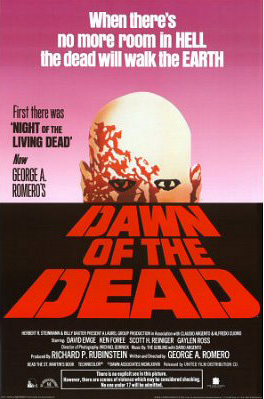
Dawn of the Dead (1978)

DAY 10, DAWN OF THE DEAD

DAWN OF THE DEAD (1978): Four stars
In a 2014 NPR interview, the late director George Romero (1940-2017) answered the question about how zombies were a vessel for commentary.

“I’ve sort of been able to bring them out of the closet whenever I need them,” he said. “They are multi-purpose, you can’t really get angry at them, they have no hidden agenda, they are what they are. I sympathize with them. My stories have always been more about the humans and the mistakes that they’ve made and the zombies are just sort of out there. … They’re the disaster that everyone is facing, but my stories are more about the humans.”

None of Romero’s zombie movies have been more about the humans than DAWN OF THE DEAD.

It gives us four characters that we grow to care about, Stephen (David Emge) and his girlfriend Francine (Gaylen Ross) and Peter (Ken Foree) and Roger (Scott H. Reiniger). Stephen’s a traffic reporter (light on traffic, heavy on zombies in this flick) and our four protagonists load up into his traffic helicopter and eventually take refuge and lock themselves within a secluded shopping mall (Monroeville Mall located in Monroeville, Pennsylvania, east of Pittsburgh). They kill all the zombies inside and literally clean up, with an endless array of consumer goods at their disposal. They’re like four big kids in a candy store. They become complacent fat cats in a sense, fattened up by self-indulgence, until a motorcycle gang descends upon the mall and these rough biker dudes have the unmitigated gall to go for the kingdom. Of course, our two remaining male protagonists take on the motorcycle gang to the bloody end.

These characters are much better than what Romero and fellow script writer John Russo gave us in the 1968 classic NIGHT OF THE LIVING DEAD.

First and foremost, Francine seems at one crucial point early on like she might be headed for the Judith O’Dea Barbra character in the first movie, a real drag of a helpless female who’s either in panic mode or a catatonic state throughout. Granted, Francine gave us other early signs that she would break the helpless female mode. Sure enough, Francine does break that stereotype and DAWN OF THE DEAD is all the better for it.

Not counting Russell Streiner’s indelible Johnny, who’s only in the movie for a few minutes, Duane Jones’ Ben was the best character in NIGHT OF THE LIVING DEAD. Likewise, Foree gives us another strong black male protagonist and Peter’s the best character here. In fact, Peter’s even stronger than Ben. He’s a Superfly T.N.T. bad ass mofo zombie killin’ action hero, he says all the great lines including “When there’s no more room in Hell, the dead will walk the Earth,” and he’s also far more upbeat than Ben. We end the flick happy little consumers when Peter decides that he will continue to fight rather than pull his trigger and end it all. Two downbeat endings in a row would have been truly horrible.

Romero told Rolling Stone in 1978, “Monsters do exist: in us, and among us.”

Through Stephen, Francine, Peter, and Roger, I think we can see the monster that’s inside us, especially after they become fat cats inside the mall. It’s because these characters all develop within our hearts and minds until they’re not just standard issue, interchangeable horror movie victims like characters in lesser movies. We understand them when they indulge themselves at the mall; they’re living out many people’s consumerist fantasies. We truly feel it when zombies happen to them. We’re there with them every step of the way during their incredible journey.

Not only are the human characters an improvement from Romero’s first zombie try, but the zombies truly come alive in DAWN OF THE DEAD.

At times, they are sinister and relentlessly terrifying. Other times, they are sad or they are funny at other junctures. Romero uses them like characters from different silent movie genres, for slapstick, for sentiment, and to scare us, and they also remind us of the Monster in BRIDE OF FRANKENSTEIN. The director said that he sympathized with his zombies and that’s apparent throughout DAWN OF THE DEAD. Like the four main protagonists, the main antagonists are not standard issue, interchangeable zombies. Anyway, they still just want to go shopping too, just like us.

Now, let’s talk about the gore.

Like the later EVIL DEAD movies and RE-ANIMATOR, the gore in DAWN OF THE DEAD passes through queasy to surreal and quite enjoyable.

On the other hand, in April 1979, former New York Times film critic Janet Maslin walked away from DAWN OF THE DEAD. Here’s the opening paragraph of her review:

“Some people hate musicals, and some dislike westerns, and I have a pet peeve about flesh-eating zombies who never stop snacking. Accordingly, I was able to sit through only the first 15 minutes of ‘Dawn of the Dead,’ George Romero’s follow-up to ‘Night of the Living Dead,’ which Mr. Romero directed in black and white in 1968. Since then, he has discovered color. Perhaps horror-movie buffs will consider this an improvement.”

No, I don’t view the color in DAWN OF THE DEAD an improvement over the B & W in NIGHT OF THE LIVING DEAD, but I do believe the 1978 movie improves on the earlier film in just about every single possible way. Better human characters and better zombies (who are still not all that different from us, despite their preference in food and their makeovers) especially make this a rare sequel that outdoes the original. Not to mention Romero’s biting satire on consumerism.

I mentioned DAWN OF THE DEAD in the review of THE FLY and it’s a fitting way to end this review.

“For example, George Romero’s DAWN OF THE DEAD (1978), a horror movie or a zombie picture that also passes through action and adventure, black comedy, silent and slapstick comedy, drama, gore galore, cinematic and social satire, surrealism, survivalism, and melodrama in addition to being great at the basic level of being a horror movie. All those extra traits put DAWN OF THE DEAD in the upper echelon.”

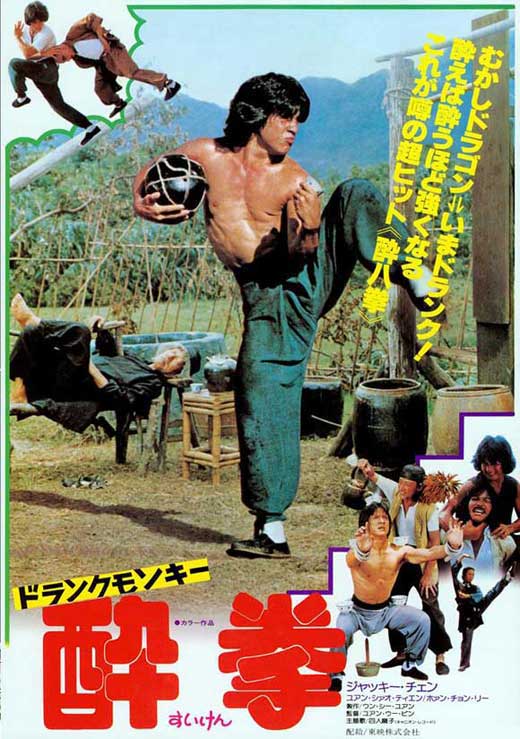
Drunken Master (1978)

DAY 35, DRUNKEN MASTER

DRUNKEN MASTER (1978) Four stars
There’s at least one more DRUNKEN MASTER fan out there in this great big world: 11-year-old Isaac Gonzalez from Carthage, Missouri.

Looking for a movie to watch one night, bored out of his skull after being grounded from his PlayStation 4 and his tablet, Mr. Gonzalez started thumbing around through hundreds of “old” and “older” movies, finally discovering a run of martial arts films, namely Jackie Chan films.

A wise old man finally asked Mr. Gonzalez, “Don’t you like THE KARATE KID?”

Mr. Gonzalez said, “Yeah.”

The wise old man then declared, “Well, I’ve got a movie that’s much better than THE KARATE KID. It’s awesome.”

Mr. Gonzalez said, “OK, put it on.”

Mr. Gonzalez, after subtitles were retired and the English dub reinstated early on, sat back and watched DRUNKEN MASTER in an apparent state of joy.

He laughed at the slapstick comedy, the vulgar humor, the silly banter, and the drunken boxing shenanigans. After all, doesn’t the Three Stooges’ humor transcend?

He enjoyed all the fight scenes and the great wide world variety of fighters thrown at Chan’s Wong Fei-hung.

The wise old man, after the 110 minutes were over and right before the 11-year-old boy had to go to bed on a school night, asked Mr. Gonzalez how the movie was and he said, “You were right, it’s better than THE KARATE KID. It’s awesome.”

Watching the film again with Mr. Gonzalez, paying attention to his reaction to it as well as my own, I was reminded that DRUNKEN MASTER rates as one of the most entertaining movies ever made.

It’s a blast.

This was still relatively early in Chan’s long career and two films released in 1978 helped make Chan a star, at least in Hong Kong, SNAKE IN THE EAGLE’S SHADOW and DRUNKEN MASTER. Both films have the same director and the same three actors in hero and villain roles.

I prefer DRUNKEN MASTER because, let’s see, it’s ROCKY meets ANIMAL HOUSE meets Bruce Lee.

It’s sublime ridiculousness.

Just imagine if Rocky Balboa drank alcohol before he came out against Apollo Creed and if Rocky’s trainer Mickey threw him a bottle in the middle of the fight and Rocky downed every single drop of it before knocking out Apollo.

Or if Bluto Blutarsky threw down and kicked the holy living hell out of Marmalard and Neidermeyer in a karate fight rather than start a food fight or throw a toga party. (Not that ANIMAL HOUSE had any influence on DRUNKEN MASTER. Both were released in 1978: ANIMAL HOUSE on July 28 in the United States and DRUNKEN MASTER on October 5 in Hong Kong. However, I would pair them in a double feature or perhaps group them with ROCKY for a triple feature.)

Lee tried some relatively bawdy humor early on during THE WAY OF THE DRAGON, but alas, that style worked better for Chan.

Just as it worked better for Chan developing his own brand of martial arts theater and not becoming “the next Bruce Lee.” Not possible, anyway.

DRUNKEN MASTER mixes raunch, slapstick, and (of course) great fight scenes in a way that I had never seen before.

It must have been almost 20 years ago when I first saw it; I rented a dubbed copy on VHS and was blown away.

Like I said not that long ago (certainly not been 20 years), I had never seen anything like DRUNKEN MASTER before and it especially enthralled me with its bountiful supply of colorful fighters with distinct fighting styles. Seems like there’s a great fight scene every few minutes, and they just keep getting better every single fight.

Yes, virtually every single character in this action spectacular can fight and these characters each get their moment in the sun over 110 minutes.

It also has a fantastic “Eight Drunken Gods” training montage.

Speaking of training, before we leave one should mention THE KARATE KID (1984) features a watered-down, more feel-good version of the mentor by comparison with the one in DRUNKEN MASTER. Beggar So (Yuen Siu-Tien) can be cruel and sadistic, at times, but he and Chan’s Wong Fei-Hung do form enough of a bond that helps carry us through.
Ironic that Chan played the mentor role in THE KARATE KID remake (2010).

With DRUNKEN MASTER, Chan started to find his niche as one of the most enduring of action movie stars.

He’s so damn likable partly because he gives you value for money. You know you’re likely to get your money’s worth when you put it down on Chan, through action or humor or both and you know that it’s Chan performing all those stunts himself. That man certainly risked life and limb to entertain us.

Chan also brought his influences from silent movie comedians like Buster Keaton, Charlie Chaplin, and Harold Lloyd, unique sources for inspiration. Chan even replicated a pair of the most famous stunts from Keaton and Lloyd, respectively.

Having a small role in CANNONBALL RUN, Chan was influenced by that Burt Reynolds-starring, Hal Needham-directed, cast-of-thousands car race comedy to feature a gag reel in his own movies, but rather than blown lines, Chan’s end credits often highlight stunts gone awry.

Chan belongs in the upper echelon of action stars, alongside such luminaries as Clint Eastwood, Arnold Schwarzenegger, Bruce Lee, Paul Newman, and Sylvester Stallone, who at their very best deliver the goods at a high level.