Message from Space (1978)

MESSAGE FROM SPACE

MESSAGE FROM SPACE (1978) *

It took two tries to make it all the way through Kinji Fukasaku’s MESSAGE FROM SPACE, one of the first of many STAR WARS rip-offs that only make you appreciate more what George Lucas and gang did in their movies.

How does MESSAGE FROM SPACE rip off STAR WARS? Let us count the ways. A soap, er, space opera, characters named Meia and Hans, a robot, interplanetary strife and destruction, aerial dogfights in space, laser beams, and a musical score by Kenichiro Morioka that should have been enough for grounds for a lawsuit from 20th Century Fox, John Williams, and the London Symphony Orchestra.

I struggled through MESSAGE FROM SPACE and it was a real cinematic endurance contest to get through its 105 minutes. I only made it through about 30 minutes the first try.

At one point in time, I thought about cutting MESSAGE FROM SPACE a little slack for its often lousy special effects, until I read that MESSAGE FROM SPACE cost $5-6 million. Okay, that’s about half of what 20th Century Fox spent on STAR WARS the previous year, but the budget for MESSAGE FROM SPACE apparently established a record (long since broken, of course) for largest budget for a Japanese movie. There went the slack, she be gone.

Vic Morrow (1929-82) sadly found himself at that stage in his career when he appeared in awful movies like HUMANOIDS FROM THE DEEP, GREAT WHITE, and MESSAGE FROM SPACE. Work is work is work, right? In MESSAGE FROM SPACE, Morrow plays a character named General Garuda and receives top billing in the cast above Sonny Chiba. Garuda Indonesia is the airline of Indonesia. Morrow seems to be drinking in every scene and if you had to act with an imitation R2-D2 named Beba, you’d be a full-blown alcoholic too.

This is one of those films not exactly helped out by a bad dubbing job.

I am normally one equipped with more empathy and enthusiasm than the average cinematic pleasure seeker for movies like MESSAGE FROM SPACE. I mean, for crying out loud, I have given four stars to INFRA-MAN, DRUNKEN MASTER, and PLAN 9 FROM OUTER SPACE, three incredibly ridiculous movies that immediately came to mind.

I just found scant pleasure to be experienced from MESSAGE FROM SPACE.

Hard to believe, right, when MESSAGE FROM SPACE features eight Liabe seeds. They resemble walnuts, glowing, magical walnuts that are the unifying plot device; bet Nuts.com would do killer business with a MESSAGE FROM SPACE remake. Rather than The Force, MESSAGE FROM SPACE only manages doze nuts. Bad joke, I know right, but the bad movie made me do it. I promise, I promise, I would never write anything like that otherwise.

A New World Pictures Double Feature: Avalanche & Piranha (1978)

A NEW WORLD PICTURES DOUBLE FEATURE: AVALANCHE & PIRANHA (1978)

Two New World Pictures exploitation films entered the Great American box office sweepstakes in August 1978.

One became a surprise hit and the other dramatically flopped.

Roger Corman, a man of a million film productions, tossed his hat into the disaster movie ring with AVALANCHE, while PIRANHA riffed on the killer fish blockbuster JAWS.

PIRANHA, directed by Joe Dante and populated by experienced character actors like Bradford Dillman and Keenan Wynn and Dick Miller, recouped its budget and then some and spawned one sequel and at least two remakes.

Star actors Rock Hudson (1925-85) and Mia Farrow headline the human cast of AVALANCHE and New World invested a reported $6.5 million on the picture, a great deal more $ than PIRANHA. You know that it did not go very well for AVALANCHE when its greatest claim to fame is that it made “The Official Razzie Movie Guide” honoring the 100 most enjoyably bad movies ever made.

This bad movie enthusiast, however, did not enjoy AVALANCHE. I found it to be a long slog. I mean, I felt like the one climbing the mountain to get through its 90-odd minutes.

First and foremost, it’s a soap opera in the shape of a ski resort hosting a ski tournament and a figure skating competition. Egads! Magazine reporter Caroline (Farrow) divorced control freak and wealthy ski resort owner David (Hudson). You guessed it, David wants her back, wants her to use his last name rather than her maiden name, she keeps him at arm’s length, and she attaches herself to another man, which only infuriates Mr. Control Freak. Man oh man, that scene on the dance floor when David flips on Caroline, I wanted to bury my head in the snow.

That’s not all: We have David’s spirited mother, an elite skier who seems to be even better as lothario, competing figure skaters, competing lovers, a television reporter, and a nosy photographer. Remember, we need a body count.

That nosy photographer (Robert Forster) and David act out a scene near and dear to disaster movie connoisseurs everywhere. Nick Thorne, the nosy photographer’s name, warns David there’s an avalanche coming and that everybody’s in danger. Any of us could write the rest of the scene and, for that matter, the rest of the movie.

Disaster movies often create a dilemma in our hearts and minds: We desperately want the disaster to come and take us away from the phony baloney dialogue and situations. Yes, I’ll say it, the characters deserve to die a dramatic cinematic death sooner rather than later. … Then, when disaster strikes, disaster movies invariably give us scenes just as phony baloney as before. That’s what happens in AVALANCHE.

Director and screenwriter Corey Allen (1934-2010) blamed AVALANCHE’s disaster as a movie on budget cuts and a tight production schedule, whereas Corman said PIRANHA succeeded because it’s funny and very well directed.

I agree.

PIRANHA tips its humorous hand very early on when one of the main characters plays the classic Atari “Shark Jaws” arcade game. Then, we have classic lines like “They’re eating the guests, sir” and “People eat fish. Fish don’t eat people” and “Terror, horror, death. Film at eleven.” Those with a darker sense of humor may find a friend in PIRANHA. We can thank John Sayles for the script.

I’ve said it before and I’ll gladly say it again: Joe Dante is one of the best American directors. His credits include GREMLINS, GREMLINS 2: THE NEW BATCH, THE HOWLING, THE ‘BURBS, MATINEE, and SMALL SOLDIERS. I don’t think he’s ever let me down, and he does not let me down in PIRANHA.

PIRANHA goes cheerfully over-the-top.

For example, JAWS eliminates one kid. PIRANHA takes out virtually an entire summer camp in grisly detail. I’ve known people who hate PIRANHA because of this one sequence.

Roger Ebert began his one-star review, “I walked into PIRANHA wondering why the U.S. government would consider the piranha to be a potential secret weapon. After all, I reasoned, you can lead the enemy to water but you can’t make him wade. I was, it turns out, naive. PIRANHA is filled with people who suffer from the odd compulsion to jump into the water the very moment they discover it is infested by piranhas.”

Of course, the characters in PIRANHA have a compulsion to jump into piranha-infested waters. Honestly, that’s all part of the joke and part of the fun, especially when Kevin McCarthy works up a variant on his INVASION OF THE BODY SNATCHERS performance.

Just like it’s fun seeing Dick Miller doing his take on Murray Hamilton’s mayor in JAWS. Miller, of course, does not want to hear about top secret scientifically-engineered killer piranhas (created through Operation: Razorteeth) and he does not cancel his party for prospective home buyers. You can guess what happens to most of them home buyers. Yes, PIRANHA takes many of the elements from JAWS and pushes them to extremes.

I enjoyed PIRANHA quite a bit, for its tongue-in-cheek humor and film buff references. There’s brilliant little touches strewn throughout the film, like Phil Tippett’s stop-motion animation creation in McCarthy’s lab. He’s the scientific genius behind them super killer fish, who are released into the system by our heroes played by Dillman and Heather Menzies. Anyway, this stop-motion creation, part-fish and part-lizard, epitomizes the generosity of PIRANHA in general. The film gives us a lot to enjoy.

The credits for PIRANHA are first-rate: Dante, Sayles, Tippett, composer Pino Donaggio, editors Dante and Mark Goldblatt, and makeup effects creator Rob Bottin. They all have done some fine work during their careers, inc. PIRANHA.

Steven Spielberg, the director of JAWS, reportedly considered PIRANHA the best of the many JAWS rip-offs and his approval expressed to Universal stopped the studio from pursuing an injunction against New World for PIRANHA. Universal’s first JAWS sequel, JAWS 2, came out two months before PIRANHA.

AVALANCHE (1978) *; PIRANHA (1978) ***

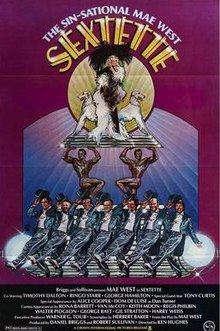
Sextette (1978)

SEXTETTE

SEXTETTE (1978) ***

Mae West made her final theatrical film, SEXTETTE, in her mid-80s.

Please, just take a second and consider that statement.

How many people of any age, let alone somebody outside their golden years, have the chance to be the center of a Hollywood movie?

West, who made her first film NIGHT AFTER NIGHT in 1932 and then became a cinematic legend after SHE DONE HIM WRONG, I’M NO ANGEL, and BELLE OF THE NINETIES, had that chance more times than most people.

Your response to SEXTETTE will probably center upon how you feel about seeing West (1893-1980) performing the same act that made her fame and fortune … only 45 years older. Can you buy a woman her age being a sex symbol pursued by virtually every man in the movie? That’s the proverbial $64,000 question.

Granted, we’re not talking about just any woman, even an octogenarian. We’re talking about Mae West, a force of nature blessed with a splendid bosom and a splendid wit. But not in her advanced age, at least the splendid bosom part? Anyway, I think it’s more important whether or not you can believe the characters in the movie finding her sexy.

I believe West here as Marlo Manners, a world famous sex symbol and movie star who also does some important work for her country, repeats a line from Lady Lou in SHE DONE HIM WRONG, “Why don’t you come up some time and see me?”

Must be a slow news day in the world of SEXTETTE, because Marlo’s marriage to Sir Michael Barrington (Timothy Dalton), her sixth husband, seems to be all that’s covered. Regis Philbin’s coverage starts off the movie and then we have Gil Stratton and Dana, er, Rona Barrett. They all play themselves.

SEXTETTE is a tribute, albeit one that’s ridiculous, to Mae West.

There’s quite simply not any other film like it, then again there’s never been anybody quite like Mae West.

For example, West and Dalton sink their vocal chords into the Neil Sedaka and Howard Greenfield song made world famous by Captain & Tennille in 1975, “Love Will Keep Us Together.”

That comes after the infamous “Hooray for Hollywood” number and before the Jimmy Carter impersonator. You’ll never believe it until you see it yourself, but this Jimmy Carter rip-off eats peanuts. Crazy.

Ringo Starr and Keith Moon each make appearances, Starr a director and Moon a designer, and I wonder why they did not cast John Bonham and Charlie Watts. SEXTETTE came out a few months before Moon’s death in early September ‘78.

Alice Cooper sings a piano ballad in SEXTETTE in the same year that he played Uncle Sam, er, Father Sun in SGT. PEPPER’S LONELY HEARTS CLUB, a musical that gets my vote for one of the worst films of 1978 and one of the worst movies ever made. Cooper’s Father Son sings “Because” in SGT. PEPPER. Both Cooper songs from 1978 movies are worse than his “He’s Back (The Man Behind the Mask)” for 1986’s FRIDAY THE 13TH PART VI: JASON LIVES, believe it or not.

SGT. PEPPER brings us back to Mae West, who initially refused the four mop tops permission for her image to appear on the famous album cover, because, get this, she would never be part of any lonely hearts club.

Back to SEXTETTE.

Dom DeLuise (1933-2009) earns the most laughs in the picture, I mean he works hard for the money in SEXTETTE as he delays Marlo and Sir Michael consummating their marriage. Tony Curtis (1925-2010) tries on a Russian accent as one of Marlo’s five ex-husbands and I just want to point out that other Curtis films released in 1978 are THE MANITOU and THE BAD NEWS BEARS GO TO JAPAN. Could it be possible that SEXTETTE is the least ridiculous among those three movies?

George Raft (1901-80) recommended West for NIGHT AFTER NIGHT and plays himself in SEXTETTE, his penultimate film. Furthermore, West and Raft a couple two days apart in 1980 — West November 22 and Raft November 24.

I would be reticent, socially irresponsible even, not to mention that George Hamilton plays another ex-husband. Here’s a man who’s played Hank Williams, Evel Knievel, Dracula, and (later) Zorro, so I don’t think playing alongside Mae West intimidated him in the slightest. I bet he’s got some terrific stories.

NOTE: Crown International Pictures released SEXTETTE and Crown’s renowned for such films as THE BEAST OF YUCCA FLATS, THEY SAVED HITLER’S BRAIN, and ORGY OF THE DEAD, not to mention teenage sex comedies THE BEACH GIRLS, MY TUTOR, WEEKEND PASS, and TOMBOY.

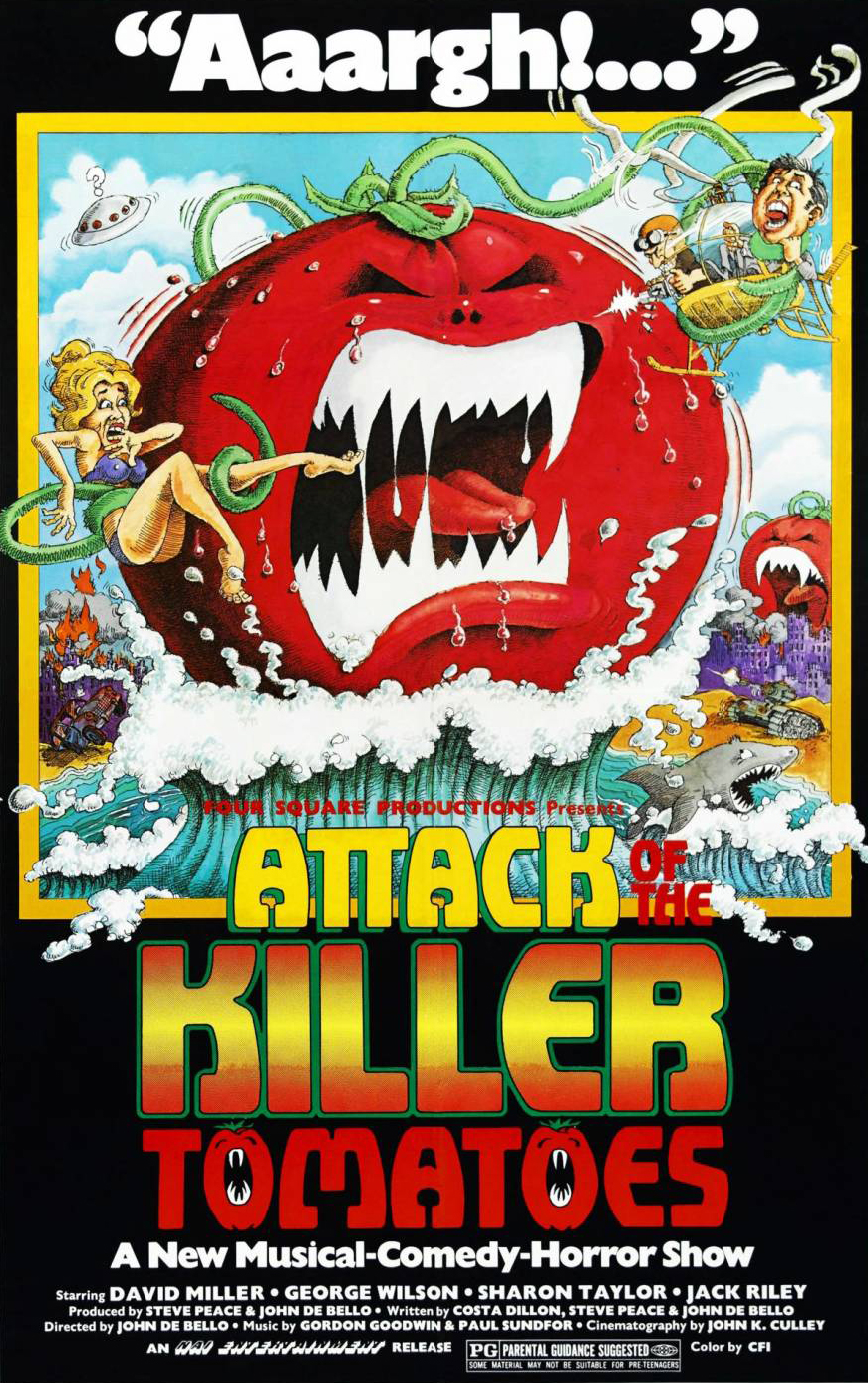
Attack of the Killer Tomatoes (1978)

ATTACK OF THE KILLER TOMATOES

ATTACK OF THE KILLER TOMATOES (1978) Three stars

“In 1963, Alfred Hitchcock made a motion picture entitled THE BIRDS, a film which depicted a savage attack upon human beings by flocks of the winged creatures.

“People laughed.

“In the fall of 1975, 7 million black birds invaded the town of Hopkinsville, Kentucky, resisting the best efforts of mankind to dislodge them.

“No one is laughing now.”

— Introduction to ATTACK OF THE KILLER TOMATOES


Watching ATTACK OF THE KILLER TOMATOES in full for the first time in possibly 30 years, it brought to mind KING KUNG FU.

Both are extremely low-budget labor-of-love parodies and tributes to both older and contemporaneous movies. Both have their dead spots and their high points. Both try many, many, many jokes. Both are filed under cult movies and “so bad they’re good.” Both love their filming locations, Wichita in KING KUNG FU and San Diego in KILLER TOMATOES. Both show people having a darn good time making a silly little movie. Both are so endearingly goofy that I end up forgiving all their various sins and transgressions and enjoying them.

Unlike KING KUNG FU, though, KILLER TOMATOES inspired three sequels — RETURN OF THE KILLER TOMATOES! (1988), KILLER TOMATOES STRIKE BACK! (1990), and KILLER TOMATOES EAT FRANCE! (1991) — plus an animated series and two video games.

Let me highlight what I liked (or loved) about KILLER TOMATOES.

— The songs are great. We have “Theme from Attack of the Killer Tomatoes,” “Puberty Love,” “The Mindmaker Song,” “Tomato Stomp,” and “Love Theme from Attack of the Killer Tomatoes.” I am sure that millions and millions proclaim GREASE the best musical from the film year 1978. No way! I say it’s KILLER TOMATOES all the way. I mean, both the opening and closing musical numbers are fantastic. “Theme” should have been a hit a la “The Blob” by The Five Blobs in 1958. “Love Theme” gives us better opera than YES, GIORGIO, Pavarotti’s feature film debut and farewell. I should have selected it to play at my wedding. “Puberty Love” kills the tomatoes. It’s that bad. Even badder. Just the sheet music for “Puberty Love” alone kills tomatoes smack dead in their tracks. Future Soundgarden and Pearl Jam drummer Matt Cameron sang “Puberty Love” around the tender age of 15. Maybe one day Pearl Jam will cover “Puberty Love.” It couldn’t be any worse than “Last Kiss.” By the way, you can’t throw tomatoes at the performers during “Puberty Love,” because all the tomatoes will be dead.

— KING KUNG FU combined King Kong and kung fu, according to a report from man on the spot Captain Obvious. KILLER TOMATOES affectionately kids monster movies, for example. Notice how the Japanese military always struggles against Godzilla. Well, in KILLER TOMATOES, the American military cannot lick our title characters. Rather, it takes playing a horrible little song named “Puberty Love” throughout San Diego Stadium. Tim Burton must have been taking notes before he made MARS ATTACKS!

— Fans of imported monster movies should have a great time with the character Dr. Nokitofa (credited to Paul Oya). KILLER TOMATOES purposely gave Dr. Nokitofa a bad dub, you know, one of those wildly inappropriate voices that just does not fit the character. I love it and I wish they gave his character more scenes with more lines. I busted a gut at his scene. When Dr. Nokitofa corrects somebody for calling tomatoes “vegetables,” he says “Technically sir, tomatoes are fags” … then his colleague Dr. Morrison says, “He means fruits.” Yes, there’s some bad taste humor in KILLER TOMATOES. Some of it works and some of it does not. Nature of the humor, so they say.

— There’s something absolutely brilliant about a character being chased by a “killer” tomato, relentlessly down the street, up the stairs, and through the hallway.

— I must admit to feeling grateful none of my newspaper bosses ever said that I have a great ass, like the editor (Ron Shapiro) tells Lois Fairchild (Sharon Taylor) in their first scene together.

— With a reporter named Lois, of course that affords KILLER TOMATOES an opportunity to kid SUPERMAN. KILLER TOMATOES came out a good two months before SUPERMAN, one of the most wildly anticipated releases in 1978.

— KILLER TOMATOES kids JAWS much more affectionately and successfully than GIANT SPIDER INVASION, A*P*E, THE HILLS HAVE EYES, and ORCA: THE KILLER WHALE, all of which took pot shots at Steven Spielberg’s game-changing summer blockbuster.

— I cannot have much of any ill will toward a film that works in a cameo for the San Diego Chicken (Ted Giannoulas) and thanks “Every Screwball in San Diego County,” that’s including Mr. Chicken, for the great crowd scene near the end of the picture.

— In conclusion, I thank director and co-writer John DeBello and fellow writers Costa Dillon and J. Stephen Peace (all three each took on even more roles) for their efforts in making a fun little movie.

The Swarm (1978)

THE SWARM

THE SWARM (1978) One-half star

Many comedies wish they could make me laugh as hard as I do at the ridiculous disclaimer at the end of the 1978 Irwin Allen film THE SWARM: “The African killer bee portrayed in this film bears absolutely no relationship to the industrious hard-working American honey bee to which we are indebted for pollinating vital crops that feed our nation.”

Were the folks at Warner Bros. seriously afraid of alienating the American honey bee?

I’ve read that the American Bee Association considered suing Allen for defaming the honey bee … and that must be why we ended up with that jive disclaimer right before the end credits. But, honestly, why stop there? The director, writer, and actor guilds should have sued Allen for defaming their respective trades, because this has to be the worst use ever of a $21 million production budget (reports vary on the $), seven Academy Award winning actors (Michael Caine, Olivia de Havilland, Ben Johnson, Jose Ferrer, Patty Duke, Lee Grant, and Henry Fonda, but none of them earned for this movie), and 800,000 bees with their stingers removed.

I’ll never forget THE SWARM because it’s not easy forgetting one of the worst movies ever made. I caught it (not all of it, though) for the first time in either late 1997 or early 1998, home alone late afternoon during my freshman year of college. I returned from class and found this disaster pic flipping channels. It was somewhere in the middle and I watched the rest. The lousy special effects, the cornball everything (premise, plot, dialogue, acting, title), and that darn disclaimer stuck with me. …

I’ve caught up with THE SWARM a couple more times or I’ve watched it at an interval of once every 10 years. It still rates about the exact same as the first time watching it, though, but I guess I have watched it a couple more times after the first as a honest reminder of what a bad movie’s truly like.

Guess we should give a lot of blame for THE SWARM to Allen (1916-91). The Master of Disaster produced THE POSEIDON ADVENTURE, THE TOWERING INFERNO, THE SWARM, BEYOND THE POSEIDON ADVENTURE, and WHEN TIME RAN OUT, the last three of which helped kill off the disaster films that were so popular in the 1970s. THE SWARM earned $7.7 million, BEYOND THE POSEIDON $2.1 million, and WHEN TIME RAN OUT $3.8 million.

Allen also directed THE SWARM and BEYOND THE POSEIDON. In THE SWARM, he kills two genres in one movie, combining disaster with the killer animal genre that became a dominant exploitation staple after the incredible success of Steven Spielberg’s JAWS in 1975.

It was David Hannum, not P.T. Barnum, who came up with the legendary quote, “There’s a sucker born every minute.” Should have been Irwin Allen, though, because his films really take us for suckers one and all. Fortunately, we are better (smarter) than that.

Stirling Silliphant (1918-96) wrote the screenplay for THE SWARM and he wrote both of Allen’s biggest hits, THE POSEIDON and TOWERING INFERNO. He also won an Academy Award for his screenplay for Best Picture winner IN THE HEAT OF THE NIGHT. (Silliphant’s erratic credits include VILLAGE OF THE DAMNED, SHAFT IN AFRICA, and OVER THE TOP.)

Unfortunately, his work on THE SWARM will go down in infamy.

Helicopter pilot: “Oh my God! Bees! Bees! Millions of bees … (later on) Bees! Millions of bees!” Of course, it does not help matters that the bees sometimes look more like painted-on black dots.

There’s some dynamite exchanges in THE SWARM. I’ll highlight just one.

Dr. Crane (Caine): Are you endowing these bees with human motives? Like saving their fellow bees from captivity, or seeking revenge on Mankind?

General Slater (Richard Widmark): I always credit my enemy, no matter what he may be, with equal intelligence.

“No matter what he may bee,” maybe they should have stripped Silliphant of his Academy Award for writing that one.

There’s more howlers in THE SWARM: “Houston on fire. Will history blame me, or the bees?”; “I know people look at me and think that I’m just the man behind the aspirin counter, but inside I love you”; “They’re more virulent than the Australian Brown-Box Jellyfish”; “By tomorrow there will be no more Africans … at least not in the Houston sector.” This dialogue indicts inself.

THE SWARM is one time where calling a film a train wreck is literal.

A train wreck, by the way, that kills Olivia de Havilland, Ben Johnson, and Fred MacMurray, two of the film’s seven Academy Award winning actors. Johnson (1918-96) fared better later as the conductor in the horror film TERROR TRAIN. I really did not want to mention that de Havilland, Johnson, and MacMurray form a romantic triangle in THE SWARM. Let’s just get past that and move on immediately, unlike the movie.

Having such an all-star cast, by the way, backfires miserably for THE SWARM, because I start thinking about movies like ZULU (Caine), THE ADVENTURES OF ROBIN HOOD (de Havilland), THE LAST PICTURE SHOW (Johnson), DOUBLE INDEMNITY (MacMurray), THE MIRACLE WORKER (Duke), and ONCE UPON A TIME IN THE WEST (Fonda), for example, rather than what I am supposed to be watching.

Some of the stars have smaller roles than others. Yeah, and I almost forgot about Richard Widmark, Richard Chamberlain, and Slim Pickens, though I mentioned the always skeptical, always boneheaded General Slater played by Widmark. How could I forget though about Mr. Pickens? According to Cinemorgue Wiki, Pickens died cinematic deaths in THE LAST COMMAND, A THUNDER OF DRUMS, DR. STRANGELOVE, MAJOR DUNDEE, ROUGH NIGHT IN JERICHO, PAT GARRETT & BILLY THE KID, BEYOND THE POSEIDON, THE BLACK HOLE, and THE HOWLING. They missed an opportunity in not killing Pickens in THE SWARM. I mean, his death scenes in DR. STRANGELOVE and PAT GARRETT & BILLY THE KID are legendary.

I am rambling, just like THE SWARM itself.

When you watch THE SWARM, please try and keep in mind that Paul Zastupnevich received a nomination for the Academy Award for Best Costume Design. Unbelievable, just unbelievable, like THE SWARM.

National Lampoon’s Animal House (1978)

NATIONAL LAMPOON’S ANIMAL HOUSE (1978) Four stars

There are few comedies I have enjoyed as much as NATIONAL LAMPOON’S ANIMAL HOUSE.

I have watched it many times over the years and that’s not even counting all those times on TBS, because, let’s face it, one misses so many “good parts” of a movie like ANIMAL HOUSE when it’s been edited for TV. It warped my fragile little mind seeing it on video the first time and I lost count of how many times I watched that VHS tape I bought circa 1997.

I loaned it to Brad Rich so he could watch Bluto’s infamous “Germans bombed Pearl Harbor” speech and remember it verbatim for his high school speech class. Mr. Rich earned an ‘A’ for his performance. Unfortunately, I did not have the opportunity to watch him act it out, though, fortunately, Mr. Rich returned the VHS tape. Bonus points for him.

College friend Don Stephens came over to my house about once a week to watch ANIMAL HOUSE it seemed like after Mr. Stephens joined a fraternity at Pittsburg State. Mr. Stephens and I started living ANIMAL HOUSE just a little bit so the viewings of the movie decreased significantly, especially after I continued my educational career in 2000 at Pitt State. Mr. Stephens eventually returned to the ranks of the independents and I remained one throughout both tours of college.

There was that one night when Mr. Stephens played Otter and I was Boon: “Hi, Don Stephens, damn glad to meet you,” then I hit ‘em with “Hi, that was Don Stephens, he was damn glad to meet you.” We only used it that one night, especially since it seemed like nobody got the reference. That’s when I started losing faith in the youth of America and have ever since.

Another time, Mr. Stephens and I went on a Thanksgiving break pilgrimage to Wichita to meet two young women (sisters) and, ahem, spend the night at their house. At some point, I believe it was early on at the bar, my date said that I was just like that Bluto guy from ANIMAL HOUSE, since I told her I’d been in college seven years. You win some, you lose some, and another time I’ll tell you about the six years off-and-on I knew my date from Wichita, although, to be honest, I really don’t want to do that.

Enough about that: ANIMAL HOUSE made a tremendous impact on the movie industry.

Every year, we get at least one raunchy, R-rated, gross out comedy.

ANIMAL HOUSE paved the parade route for PORKY’S, FAST TIMES AT RIDGEMONT HIGH, DAZED AND CONFUSED, AMERICAN PIE, OLD SCHOOL, WEDDING CRASHERS, and HANGOVER.

Every time I watch ANIMAL HOUSE, it holds up and it remains better than its followers.

First and foremost, it is superbly acted up and down the cast.

Tom Hulce and Stephen Furst (1954-2017) make a successful entry point into this world, as one snooty sorority sister calls them “the wimp and the blimp.” Tim Matheson and Peter Riegert play off each other so well as ladies man Otter and wing man Boon that we believe their characters have been friends for several years. James Daughton and Mark Metcalf, especially Metcalf as Niedermeyer, create thoroughly detestable characters that we love to hate.

Speaking of characters that we love to hate, Canadian actor John Vernon (1932-2005) had a knack for playing them better than just about anybody else. We enjoy every single appearance made by his Dean Wormer in ANIMAL HOUSE, every single time he gets his comeuppance, and especially every single time Vernon sinks his teeth into lines like “Fat, drunk, and stupid is no way to go through life, son” and “Put a sock in it, boy, or else you’ll be outta here like shit through a goose.” Vernon later played a similar character in KILLER KLOWNS FROM OUTER SPACE, retaining that bias against college kids.

John Belushi (1949-82) exploded into stardom with the success of ANIMAL HOUSE, one of the biggest hits of 1978. Outside action heroes Clint Eastwood, Charles Bronson, and Steve McQueen, we don’t find star-making performances built around fewer words. Belushi’s Bluto makes us laugh mostly through classic physical comedy and he irritates the comic villains every bit as effectively as the Marx Brothers and the Three Stooges did in their heyday.

Bluto definitely puts the animal in ANIMAL HOUSE, smashing acoustic guitars, downing full whiskey bottles in one fell swig (actually iced tea), pouring mustard on himself, starting food fights (by popping “zits”) and nationwide dance crazes, and peeping at cute coeds. Bluto’s predominantly silent act pays off with his big speech late in the pic for the Delta troops. It’s not quite George C. Scott as George S. Patton at the start of PATTON, but it’s close, real close in memorability.

Bluto has been described as a cross between Harpo Marx and the Cookie Monster.

Just about everybody has a memorable character in ANIMAL HOUSE, from Kevin Bacon in his motion picture debut (“Thank you sir, may I have another?”; how dare I forget a softball practice where I made every teammate who wanted another grounder hit their way ask that very question) to the lovely Karen Allen also in her debut, as well as Verna Bloom (1938-2019) as the ready and willing dean’s wife, Donald Sutherland as a hip professor, and DeWayne Jessie lip syncing his way through Otis Day on “Shout” and “Shama Lama Ding Dong.”

John Landis began a string of winners here, followed by THE BLUES BROTHERS, AN AMERICAN WEREWOLF IN LONDON, and TRADING PLACES over a few years. Universal wanted Chevy Chase to play the Otter role that went to Matheson, but Landis felt Chase was not right for the part and the director played a little Jedi mind trick by telling Chase that ANIMAL HOUSE would be an ensemble pic. That disinterested Chase, who instead made FOUL PLAY. Landis contributed to the anarchic atmosphere of ANIMAL HOUSE by throwing things at the actors, like an early scene when Bluto leads Flounder and Pinto into the Delta house and they’re greeted by a couple flying bottles.

Harold Ramis (1944-2014), Chris Miller, and Douglas Kenney (1946-80) combined on the screenplay and contributed their own collegiate and fraternal experiences.

George Lucas’ AMERICAN GRAFFITI famously asks “Where were you in ‘62?” ANIMAL HOUSE, released almost five years later to the day by the same studio, also takes place in ‘62 and Lucas, Ramis, Miller, and Kenney obviously had different answers to where they were in ‘62 and these different answers inform their respective movies and characters.

Both smash hit movies inform us what happened to their main characters. For example, in AMERICAN GRAFFITI, we’re told Terry the Toad is reported missing in action in Vietnam in December 1965. Meanwhile, in ANIMAL HOUSE, we read that Neidermeyer’s own troops kill him in Vietnam. Yes, indeed, they fragged Neidermeyer. Maybe even Terry the Toad took part in it.

Good Guys Wear Black (1978)

GOOD GUYS WEAR BLACK

GOOD GUYS WEAR BLACK (1978) Two-and-a-half stars
The late Steve McQueen gave his friend Chuck Norris some advice for his motion picture career. McQueen said that Norris talked too much in GOOD GUYS WEAR BLACK and that, in the future, he should let his supporting actors do more talking, since it would have the effect of making what Norris says more important.

I quoted McQueen in a review of A FORCE OF ONE, Norris’ third feature. McQueen’s right about GOOD GUYS WEAR BLACK: Norris does talk too much and he should have allowed his talented supporting cast more of an opportunity to carry the speaking.

Norris stars in GOOD GUYS as John T. Booker and there’s Anne Archer as Booker’s romantic interest and smaller roles for James Franciscus, Dana Andrews, and Jim Backus. It is especially nice to see Andrews on the screen, because we remember him from classics like LAURA and especially THE BEST YEARS OF OUR LIVES. Backus deserved better, especially since, all things considered, he probably enjoyed C.H.O.M.P.S. more than what he did GOOD GUYS.

Because I saw the later film before the earlier one, GOOD GUYS’ plot reminded me of the 1985 Arnold Schwarzenegger vehicle COMMANDO. Booker’s surviving Vietnam War comrades are being systemically eliminated five years after the first scene in the movie when they survive a death trap set for them. We have a shady diplomat on the verge of becoming Secretary of State, who is blackmailed into pursuing the elimination of the Black Tigers, the elite group of CIA assassins headed by Norris’ Booker. This plot was written on the back of a much larger napkin than COMMANDO.

GOOD GUYS, like A FORCE OF ONE, exists as middle-of-the-road Norris, not quite as inspired as his best films CODE OF SILENCE and LONE WOLF McQUADE, but still better than his starring debut BREAKER! BREAKER! and THE OCTAGON, his fourth picture.

CODE OF SILENCE and LONE WOLF are his best pictures mainly because they have the best supporting casts. They also have their fair share of exciting moments.

I mean, who could ever forget that classic scene in LONE WOLF when David Carradine’s treacherous villain buries Norris alive in his super-charged Dodge Ramcharger. After coming to and pouring beer on himself, Norris and his Dodge rise up out of the ground and he gets out and guns down several of Carradine’s anonymous henchmen. Capping it all off, Norris tells his young partner to get him a beer. Epic.

There’s just one scene in GOOD GUYS that even approaches that great LONE WOLF scene.

Booker faces down an assassin, who just blew up the plane carrying Archer’s reporter character and Booker’s romantic interest Margaret, and eventually Booker takes out this formidable foe with a flying kick through the bad guy’s windshield as he attempts to run over Booker. This moment alone is worth the price of a rental or a more long-term purchase, and it could play as the front end of a highlight reel with LONE WOLF.

Unfortunately, the rest of GOOD GUYS does not live up to that incredible flying kick, reportedly performed by Norris’ brother Aaron, but it still has a certain value, especially in seeing Norris portray a college professor and a race car driver in addition to being a cold-blooded assassin. Boy, that Norris sure could do anything.

NOTES: In 2017, a 22-year-old John T. Booker, from Topeka (Kansas), was sentenced to 30 years in prison for his vehicle bomb detonation attempt at Fort Riley. Booker wanted to kill American soldiers and assist the Islamic State of Iraq and al-Sham (ISIS) in their fight against the United States.

There’s also a Dr. John T. Booker who’s an Associate Professor of French at the University of Kansas. His teaching and research focus on the French novel of the 19th and 20th centuries.

Kansas seems to have the market cornered on the John T. Booker name.

Foul Play (1978)

FOUL PLAY

FOUL PLAY (1978) Three stars

Universal Studios demanded that Chevy Chase, the first breakout star from “Saturday Night Live,” be cast in NATIONAL LAMPOON’S ANIMAL HOUSE. However, in a lunch between ANIMAL HOUSE director John Landis, producers Matty Simmons and Ivan Reitman, and Chase, Landis played a Jedi mind trick on Chase, telling him that ANIMAL HOUSE would be an ensemble piece whereas FOUL PLAY would let Chase be a star. Chase stayed with FOUL PLAY and ANIMAL HOUSE cast Tim Matheson in the Otter role.

FOUL PLAY debuted July 14, 1978, and ANIMAL HOUSE came out two weeks later.

ANIMAL HOUSE made $141.6 million on a $3 million budget and changed the face of comedy forever. Yes, every year we get at least one comedy that would not have been possible without the example set by ANIMAL HOUSE. Meanwhile, FOUL PLAY generated $45 million and has been consigned to the margins of history.

It’s certainly not a bad movie by any stretch of the imagination, but it does pale in comparison when stacked up against ANIMAL HOUSE. Granted, FOUL PLAY chased different goals than the undeniably anarchic, anti-establishment ANIMAL HOUSE.

FOUL PLAY is the byproduct of writer and director Colin Higgins (1941-88). He’s one of those cases where you just might not know the name but you definitely know his movies. He made his name in Hollywood by penning the screenplay for the legendary cult favorite HAROLD AND MAUDE (1971). Five years later, he wrote the screenplay to SILVER STREAK, a comedic thriller hit pairing Gene Wilder and Richard Pryor. Higgins made his directorial debut with FOUL PLAY and would end with three directorial credits, 9 TO 5 and THE BEST LITTLE WHOREHOUSE IN TEXAS his second and third efforts. Additionally, Higgins wrote the screenplay for all three comedies he directed. All five comedies enjoyed some level of success.

Nominally Chase and Goldie Hawn are the stars of FOUL PLAY, but the writing and directing style of Higgins should not go unappreciated.

Both SILVER STREAK and FOUL PLAY stand out from HAROLD AND MAUDE, 9 TO 5, and THE BEST LITTLE WHOREHOUSE, in the fact they are heavily influenced by Alfred Hitchcock. SILVER STREAK screams Hitchcock’s 1938 thriller THE LADY VANISHES and FOUL PLAY references THE 39 STEPS, SABOTEUR, NORTH BY NORTHWEST, THE MAN WHO KNEW TOO MUCH, NOTORIOUS, VERTIGO, and PSYCHO. Fans of the Master of Suspense will also be delighted by Higgins’ inclusion of what the maestro called “The MacGuffin,” which is a roll of film hidden in a pack of cigarettes in FOUL PLAY.

I know that Hitchcock himself loved Mel Brooks’ HIGH ANXIETY, a 1977 affectionate spoof of suspense films mostly focused on Hitchcock’s SPELLBOUND, VERTIGO, PSYCHO, and THE BIRDS, so it is quite possible that he enjoyed FOUL PLAY.

In FOUL PLAY, librarian Gloria Mundy (Hawn) finds herself in the midst of a bizarre plot that ultimately involves an assassination attempt on the pope. We have a dwarf, an albino, a wild and crazy guy who attempts to seduce Miss Mundy, a karate fight between two highly unlikely combatants, an endless chase scene, and a pair of Japanese tourists who are big fans of Kojak and bang, bang! This is a pleasantly silly concoction and Hawn takes us through what turns out to be an overlong motion picture at 115 minutes. Or maybe it just felt that way every single damn time I heard the song “Ready to Take a Chance Again,” which predated the similar use of the song “That’s What Friends Are For” a few years later in NIGHT SHIFT. In both cases, I was ready to hear another song again instantly.

What about Chase? He’s part of an ensemble and he almost gets lost in the shuffle at times in his first movie leading role, but this is one of his better performances and his best films. Chase plays a capable leading man paired with Hawn.

Dudley Moore (1935-2002) basically steals every scene that he’s in and his work here led to his being cast in Blake Edwards’ 10, Burgess Meredith (1907-97) made four movies in 1978 and this is the one where his character knows martial arts, and Rachel Roberts’ last screen credit before FOUL PLAY was the eccentric Australian thriller PICNIC AT HANGING ROCK. Moore and Brian Dennehy, Chase’s partner, appeared together in 10.

FOUL PLAY is a minor film with minor charms, but sometimes that’s more than enough or just enough to hit the spot.

Laserblast (1978)

LASERBLAST

LASERBLAST (1978) Two-and-a-half stars

LASERBLAST is a clunky piece of low-budget junk, but it is not without its charms.

For example, LASERBLAST takes a pot shot at STAR WARS, literally when our teenage protagonist Billy Duncan (Kim Milford) blows up a STAR WARS billboard on the side of the road with his laser cannon. It blows up real good. For that matter, just about everything blows up real good in LASERBLAST.

We’ll get back to that later.

For now, however, I’d like to touch on a couple of the contemporaneous pot shots taken at JAWS.

THE GIANT SPIDER INVASION, which came out a few months after JAWS in 1975, has Sheriff Jeff Jones (Alan Hale Jr.) say over the CB radio of the spider, “You ever see the movie JAWS? It makes that shark look like a goldfish!”

THE HILLS HAVE EYES includes a ripped poster of JAWS.

ORCA: THE KILLER WHALE has a killer whale kill a great white shark early on in the proceedings.

Coincidentally, both THE HILLS HAVE EYES and ORCA were released on the same day (July 22) in 1977.

Anyway, back to LASERBLAST, a quickie exploitation picture made to cash in on the teenybopper science fiction craze between STAR WARS movies. It later became known for being one of the worst movies ever made, especially after Mystery Science Theater 3000 lampooned LASERBLAST in a 1996 episode.

I feel almost bad for giving a mixed review to LASERBLAST, especially after writing positive reviews for THE KILLING OF SATAN, TROLL 2, THE TERROR OF TINY TOWN, and PLAN 9 FROM OUTER SPACE. Almost. Believe it or not, all four of those other films have a higher IMDb rating than LASERBLAST.

LASERBLAST surrenders itself to filler scenes that just scream out TACKY SEVENTIES. It feels like a bloated production even at 80-85 minutes.

David W. Allen (1944-99) worked on 48 films in visual effects or puppetry or stop motion animation over nearly a 30-year career. His notable credits include FLESH GORDON, THE HOWLING, CAVEMAN, Q: THE WINGED SERPENT, THE STUFF, WILLOW, and GHOSTBUSTERS II.

Allen’s alien stop motion work in LASERBLAST received better reviews than any other aspect of the film.

Unfortunately, the stop motion aliens do not have more screen time in LASERBLAST.

Milford is not exactly playing the greatest hero in the history of cinema. For example, he’s the first and only hero ever to be picked on by screen nerd extraordinaire Eddie Deezen; both Milford and Deezen made their screen debuts in LASERBLAST. Milford (1951-88) became known for his work in the musicals “Jesus Christ Superstar” and “The Rocky Horror Picture Show.” He plays most of the movie without a shirt.

Let’s face it, Billy Duncan has a bad, bad, bad life: His mother always seems to be going to Acapulco, his girlfriend’s grandpa freaks out on him and runs poor, poor Billy off, two dope-smoking cops love writing up Billy for speeding tickets, and Chuck (Mike Bobenko) and Froggy (Deezen) bully him. Froggy, by the way, has seen STAR WARS five times, according to one of the dope-smoking deputies (played by veteran character actor Dennis Burkley in the early stages of his career).

Billy’s life changes for the better when he finds that darn laser cannon in the desert. As it says on the poster, Billy was a kid who got pushed around then he found the power.

Billy, of course, uses the laser cannon to blow up a bunch of stuff real good before the stop-motion aliens come for him.

One car blows up about five times in LASERBLAST. They give us just about every conceivable angle.

Yes, it’s that kind of a movie.

Keenan Wynn and Roddy McDowall (his last name spelled “McDowell” in the credits) make glorified cameo appearances.

LASERBLAST is bad enough that McDowall’s Peter Vincent could have played it on the TV series “Fright Night” featured in FRIGHT NIGHT.

On the bright side, LASERBLAST is considerably better than “The Star Wars Holiday Special,” which has gone down in history as the biggest STAR WARS rip-off of them all.

Jaws 2 (1978)

JAWS 2

JAWS 2 (1978) Two stars
When you watch JAWS 2, you just get the feeling that human star Roy Scheider wasn’t a happy camper during the film’s production.

Then you read more about the film and you find out that it’s true.

Scheider had a multi-picture agreement with Universal, makers of the JAWS films, and when he left THE DEER HUNTER, Universal made a deal with Scheider that if he did JAWS 2, it would be counted as the two films remaining on his contract. Fundamental problem: Scheider did not want to appear in JAWS 2.

We can feel Scheider’s resentment on the screen.

Scheider clashed with director Jeannot Szwarc to the point that it produced a physical confrontation between the men. They even carried it over into letters.

Scheider: “Working with Jeannot Szwarc is knowing he will never say he is sorry or ever admitting he overlooked something. Well, enough of that shit for me!”

Szwarc: “Time and pressure are part of my reality and priorities something I must deal with.

“You have been consulted and your suggestions made part of my scenes many times, whenever they did not contradict the overall concept of the picture.

“If you have to be offended, I deplore it, for no offense was meant. At this point in the game, your feelings or my feelings are immaterial and irrelevant, the picture is all that matters.”

When you’re watching JAWS, you don’t get the sense of a troubled production.

We do throughout JAWS 2.

Despite all that behind-the-scenes hullabaloo, also including a change of director and more technical difficulties with that damn mechanical shark, JAWS 2 became a huge financial success as it racked up nearly $78 million at the box office. Why? A hard sell advertising campaign centered around the immortal tagline “Just when you thought it was safe to go back in the water”; “Merchandising, merchandising, where the real money from the movie is made,” in the words of SPACEBALLS; and, let’s face it, at that point in time, folks wanted more of the shark and JAWS 2 delivers “more shark.”

In fact, I give the shark in JAWS 2, oh, let’s see here, three stars, maybe three-and-a-half stars on a charitable day.

The people in JAWS 2, though, sink to one star.

Averaging out both numbers gives JAWS 2 two stars.

Yes, the characters in JAWS 2 (and the following sequels) suck.

The fundamental difference between JAWS and its sequels: JAWS gives audiences three great characters in Chief Brody (Scheider), Matt Hooper (Richard Dreyfuss), and Quint (Robert Shaw). Amity mayor Larry Vaughn (Murray Hamilton), why he’s not too far behind. You care about the characters in JAWS.

Brody and Vaughn return in JAWS 2, but they’re competing against the shark and other less interesting human characters.

Instead of the core of adults in JAWS, we have an endless array of teeny boppers in JAWS 2 who just can’t hold a candle to Hooper and Quint. Dreyfuss did not return for the sequel, as he and JAWS director Steven Spielberg made CLOSE ENCOUNTERS OF THE THIRD KIND. And it’s quite obvious why Quint’s not back for JAWS 2.

All we need to know about the plot of JAWS 2 is that it’s the namesake of “The Jaws 2 Syndrome,” or when a sequel repeats the worst element of the original movie. We all know that Chief Brody will have to take out the shark, but the ringer it runs him through en route does more than try our patience, it’s blowed up real good.